I Came With Two Children to Keep His Books—Then One Wrong Name Exposed the Life We Were Afraid to Choose
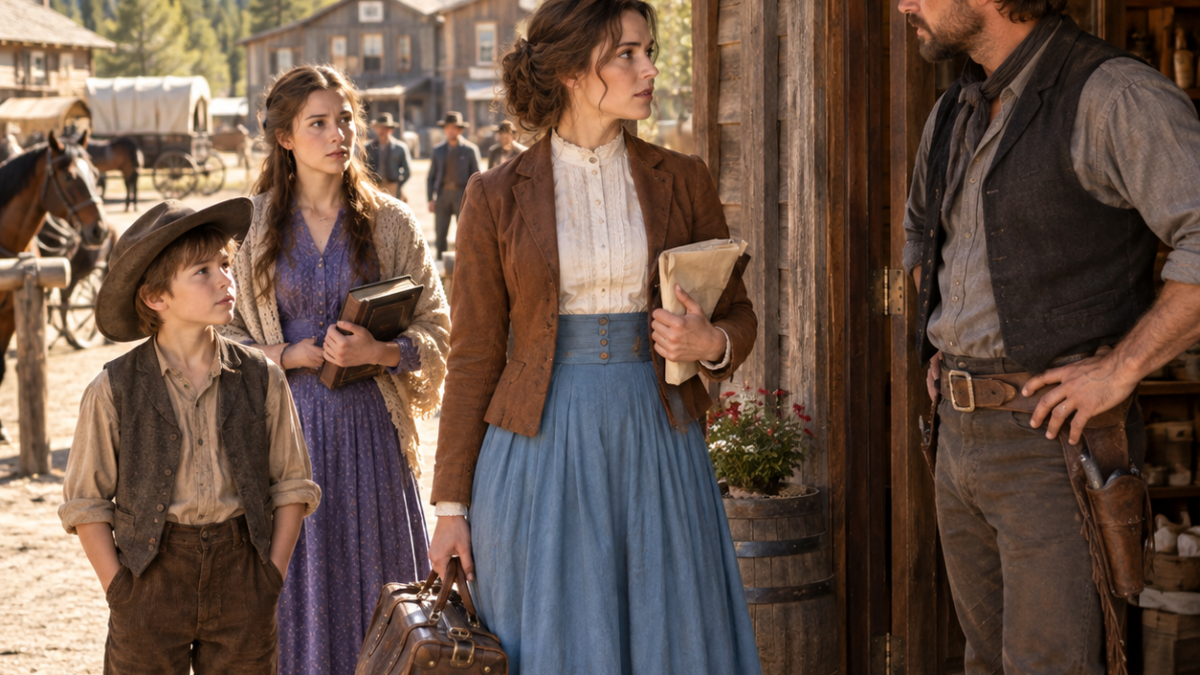
I Came With Two Children to Keep His Books—Then One Wrong Name Exposed the Life We Were Afraid to Choose
I arrived in Montana with two orphaned children, two carpetbags, and a job that was supposed to last only one hard winter.
One wrong name in a freight ledger should have been nothing more than ink on a page, but I knew what men like Miles Corbett did not yet understand—break the name, and the whole trail disappears.
By the time I fixed his books, the real question was not whether I would stay for the work, but whether I could trust a quiet man who wanted me badly enough to let me leave freely.
My name is Rachel Bell, and when I came to Dylan, Montana Territory, in late September of 1888, I had two children beside me, two carpetbags between us, and a letter folded inside my coat that promised employment if the man who wrote it still meant what he had put on paper.
That last part mattered.
I had learned, by then, that paper could be both shield and trap. A promise on paper could keep a roof over a child’s head, or it could be waved later as proof that you owed more than wages. A name written correctly could send a crate to the right merchant. A name written carelessly could split one man into two debts, two ledgers, two trails, until money vanished and everyone blamed the road.
Names mattered.
That was the first thing I taught myself after my sister died.
Before that, I had been ordinary enough to believe sorrow arrived alone. I thought death would be the hard part. I thought standing beside my sister Mary’s narrow bed while fever took her breath would be the thing that broke me. I thought telling her children goodbye to their mother would be the deepest pain any woman could survive.
I was wrong.
Death was clean compared to what came after.
Death took Mary.
The living took inventory.
Three days after my sister was buried, her husband’s cousin sat at my kitchen table and said, “A widow with no husband and two children not her own ought to think sensibly.”
I remember his hands more than his face. Thick fingers. Dirty nails. A gold ring that had belonged to his dead brother before passing somehow into his possession because grief often moves slower than greed.
“Evelyn is nearly grown,” he said. “She can go into service.”
Evelyn was sixteen and sitting in the next room, silent as a held breath.
“Noah can go west with my brother’s people,” he continued. “Boys do well where they learn work early.”
Noah was nine.
Nine years old, with a habit of counting fence rails, windowpanes, wagon spokes, and anything else that could prove the world had order if a person only looked closely enough.
I set my teacup down.
“They stay with me.”
The cousin smiled the way men do when they think kindness is a garment women wear until pressure makes it fall off.
“You have no position.”
“I will find one.”
“No proper room.”
“I will find that too.”
“No husband.”
“I noticed.”
His smile thinned.
“The children need stability.”
“So do I,” I said. “We’ll learn it together.”
That was the beginning of everyone calling me stubborn, foolish, too proud, unrealistic, sentimental, and finally hard.
Hard became my favorite.
Hard things do not fold easily.
By the time I reached Dylan, I had spent three months answering letters for bookkeeping work from offices that did not want children near them. Forwarding houses, supply companies, merchants, and ranch concerns needed clean books but preferred the person cleaning them to have no inconvenient lives attached. One proprietor in Helena wrote that he might consider me if the children could be “placed elsewhere.” Another offered me half wages because “a woman with dependents ought to be grateful for security.”
Then Miles Corbett’s letter came.
Plain paper.
Plain hand.
No flourish.
Miss Bell,
I require a bookkeeper at Beaverhead Forwarding House before winter traffic increases. Wages enclosed below. Two rooms behind the office go with the post, if suitable. I understand from your letter that two children are in your care. Their presence is not an objection provided the work is kept. They will owe the yard no labor for the rooms.
M. Corbett
I read that sentence twelve times.
They will owe the yard no labor for the rooms.
A man who thought to write that before being asked either understood the world too well or had reason to know what it took from children when adults were careless.
So I came.
Dylan was smaller than I expected and colder than the season had any right to be. The street was hard-packed dirt, cut by wagon ruts and edged with false-front buildings that leaned into the wind like men listening for trouble. The schoolhouse stood two streets back from the main road. Evelyn noticed it before I did. She did not say anything, but I saw her count the distance in her mind. Evelyn never entered a new place without first finding the exits, the school, the stove, and the person most likely to decide whether she was welcome.
Noah counted wagons.
Seven in the yard when we arrived.
PART2:
Then eight when a team came in from the south road.
Then six after two rolled out.
He announced none of this aloud, which meant he was nervous.
Beaverhead Forwarding House stood near the freight road, broad-doored and practical, with a loading yard to one side, an office in front, and a warehouse behind it smelling of rope, cold iron, flour dust, leather, damp wool, and the thousand private histories of goods passing through before belonging somewhere else.
Miles Corbett came out to meet us himself.
He was taller than I expected. Not handsome in the polished way men in advertisements are handsome, but steady-looking, plainly dressed, with shirtsleeves rolled to the forearms and dark hair in need of trimming. He had the appearance of a man who spent more hours checking freight than discussing it, and the eyes of someone who listened before deciding whether words were necessary.
“Miss Bell,” he said.
“Mr. Corbett.”
His gaze moved once to Evelyn, once to Noah, not measuring them like burdens but placing them carefully inside the situation.
“Rooms are this way.”
No speech.
No questions.
No pity.
He lifted one carpetbag before I could protest and led us around the side of the office to a rear entrance. The rooms behind Beaverhead were plain but warm enough, with a door of their own, a small stove already laid with kindling, two narrow beds, a washstand, hooks on the wall, and one window that faced the alley rather than the yard.
“The rooms come with your position,” Miles said before I could ask. “The children owe the yard no work for them. They’re welcome to the step and the stove, not the wagons.”
Evelyn looked at him then.
Really looked.
Noah looked at the stove.
“How long are these hours?” he asked.
“As long as my work lasts,” I told him.
That seemed to satisfy him for the moment, though with Noah satisfaction usually meant he had filed the answer under Temporary and would reopen the question later.
Miles showed me the receiving desk, the shipping book, the old index, the freight room, the ledgers waiting like neglected consciences, and the peg by his own desk where the freight room key hung. He did not hover. He did not apologize for disorder. He did not make a joke about women and numbers. He placed the books before me and said, “You’ll see more than I can explain.”
That was true.
PART3:
At a forwarding house, an account was the trail a shipment left behind.
Merchant’s name.
Goods received.
Wagon that carried them out.
Charges still owed.
Credits applied.
Delays.
Damages.
Signatures.
A crate might begin in Butte, pass through Beaverhead, ride south by wagon, and arrive at a mercantile in Bannack weeks later. If every hand named it properly, the shipment lived cleanly in the books. If one man wrote the wrong name, shortened a store, used a given name instead of a business name, or guessed at spelling because the driver was cold and the ink was freezing, the trail broke.
Break the name and the trail broke with it.
I found the first break before my first morning was an hour old.
A crate bound for Bannack carried a railroad bill reading Hollis Mercantile. The old shipping book, in a hand too neat to excuse its carelessness, called the same customer J. Hollis. The index had both. A third entry from two months earlier listed Hollis Mkt. with an unpaid balance.
One man had become three accounts.
Who knew how long?
The driver was already climbing onto the wagon seat when I stepped into the yard with the papers in my hand.
“Hold your team.”
He stared at me.
“What?”
“Hold your team.”
He looked toward Miles, who had come out at the delay.
Miles did not take my word for it.
I respected that.
He read both papers himself the way a man checks a debt before he pays it.
Then he turned to the driver.
“The account is Miss Bell’s to hold. Wagon waits until the name is set right.”
The driver muttered something about women and ink, but he waited.
The crate left that evening.
The mistake did not.
By the second week, I understood the trouble ran deeper than one line. The old clerk’s handwriting had been neat. His logic had not. He had entered merchants by first name one week and storefront the next. He trusted memory where memory had no business carrying freight. He abbreviated stores differently depending on weather, impatience, or indigestion. Silver Bow deliveries, especially, were a tangle of split accounts, reversed credits, and missing balances.
I began a private list.
Merchant’s given name beside storefront name.
Common abbreviations.
Prior balances.
Freight marks.
Wagon numbers.
Driver habits.
I worked at it in whatever hour the children did not need me.
Evelyn noticed before I told her.
She sat at the office table practicing her letters in a careful hand she pretended not to care about improving. She had been too long out of steady schooling while Mary was ill, and the shame of that made her quieter than ignorance ever could. One afternoon, she paused over her slate and looked toward the index.
“Jay Hollis and Hollis Mercantile are the same man?”
“Yes.”
“And Hollis Mkt. too?”
“Most likely.”
“Does it matter?”
“It might.”
She looked at the books, then at me.
“You write them together so they stop being lost.”
I smiled.
“That is exactly it.”
She returned to her slate, but after that I saw her glancing toward the index with less caution.
Noah’s contribution came differently.
One afternoon, just before a team pulled out with flour sacks and stove parts, he stood on the office step and said, “It knocks twice.”
Miles was crossing the yard with a bill in hand.
“What does?”
“The wagon. It should only knock once when it starts.”
The driver laughed.
Miles did not.
He waited until the team leaned into the traces.
A clink sounded.
Then another a heartbeat late.
Miles stepped closer, crouched, and found a trace chain hooked one link too long, slack until the pull caught it hard against the singletree.
“You heard right,” he said.
He had the driver rehook it before sending the team out.
Noah sat a little straighter on the step for the rest of the afternoon and said nothing more about it because nothing more needed saying.
That was something I noticed about Miles early.
He did not praise children loudly.
He confirmed them.
There is a difference.
Praise can make a child feel watched.
Confirmation gives them a place to stand.
A few evenings later, I found Noah still on the step at dusk, watching the last team unhitch. Before I could call him in, Miles came out, lowered himself beside him, and sat without speaking for a while.
The yard settled into evening around them. Harness creaked. A driver cursed softly at a knot. Somewhere in the freight room, a crate shifted with a wooden sigh.
“You’ll make a fair driver someday,” Miles said at last, “if your aunt ever allows it.”
Noah considered this with great seriousness.
“She won’t.”
“No?”
“Not for years.”
“No,” Miles agreed. “Probably not.”
Neither of them seemed troubled by the fact.
They sat together until the yard went dark and I called Noah in for supper.
Miles rose, brushed dust from his trousers, and went back to close the office.
I stood at our stove later that night, stirring beans and thinking about how dangerous small kindnesses can be when a woman is trying to remain practical.
Small kindnesses build rooms in the heart before you know you have given permission.
I did not come to Dylan for kindness.
I came for wages.
For rooms.
For the chance to keep Evelyn and Noah together through one winter without owing any man more than work.
I reminded myself of that often.
Especially when Miles said things like “She has the account” to men who tried to ask him questions while I stood holding the book.
It happened first with a driver named Phelps, a round-shouldered man who smelled of tobacco and old wool.
“There’s a charge wrong on the Bannack load,” he said to Miles, though I stood three feet away with the relevant ledger open.
Miles looked at him.
“Miss Bell has the account.”
Phelps blinked, turned toward me, and repeated the question.
No ceremony.
No lecture.
Miles simply moved the authority where it belonged.
I noticed.
I did not want to.
I also noticed that Miles checked the loading doors and the yard every evening after the last wagon long past any reasonable need. He checked latch, lock, axle, harness, stove, back gate, freight room, office window. Not because he distrusted anyone in particular, but because the forwarding house seemed to sit on his shoulders after sunset.
He noticed that I checked the children’s stove and their boots before I let myself sit down to anything of my own.
Neither of us said so aloud.
On evenings when her lessons were finished, Evelyn took Noah back to the rooms before the cold settled in. The office always seemed quieter after they left. Not empty exactly. Miles and I still worked in it. But the absence of Noah’s counting and Evelyn’s turned pages made the room aware of itself.
The first thin snow crossed the yard in the middle of October and did not stay past noon.
After closing that evening, Miles and I stood for a while in the freight room doorway without talking about the books at all.
“I keep listening for wagons after the doors are shut,” he said.
His voice sounded different in the dimness.
Less proprietor.
More man.
“Some evenings I don’t believe I’ve stopped. Not since I took this place on alone.”
I thought about that before answering.
“I had forgotten an office could grow quiet without feeling empty.”
Neither of us added to it.
We went back to our separate work, and the sentence stayed where we had left it.
Hard sleet kept Miles late at the office one evening in early November. I had already put beans and salt pork on for myself and the children. Without much thought, I set a fourth bowl.
That was not true.
It was not thoughtless.
I simply made the decision before fear could make a committee of it.
Miles hesitated at the doorway when I called him in, the way a man does when he is not sure an invitation was meant for him.
“There’s plenty,” I said.
“That wasn’t my concern.”
“What was?”
He looked at the children already seated at the small table. Noah had pulled out a chair for him with the solemn air of a church usher. Evelyn watched quietly.
Miles removed his hat.
“Whether I was intruding.”
“This is your building,” I said.
“Not these rooms.”
I did not know what to do with that answer.
So I handed him a bowl.
He took the chair Noah offered.
Noah wanted to know how far a wagon could go before a wheel gave out entirely and whether anyone had ever tried to find out on purpose. Evelyn described her schoolmistress’s opinion of the Dylan post office with more feeling than the subject strictly required. Miles said little, mostly listened, and ate like a man who had not sat at a full table in some time.
When Noah asked if he had ever driven a wagon clear to Butte, Miles said, “Once. Badly.”
Noah nodded, entirely satisfied.
That was enough answer for him.
It was the first evening the four of us shared a table without a ledger anywhere near it.
I thought of it again before I fell asleep.
And again the next morning.
And again three days later when Miles fixed the hinge on our back door without mentioning it.
By then, I had stopped pretending I did not look for him when the office door opened.
In late November, Evelyn woke with a head cold, cheeks flushed and eyes bright with fever. I kept her home, which meant I missed the office entirely. I hated it more than I should have. Not because the work would disappear without me, though I worried over the books like a mother hen. Because I imagined Miles turning toward my empty chair.
The next morning, Evelyn was well enough to sit up with her lessons by the stove, and I returned to find the morning’s papers sorted into the order I preferred.
Receiving bills.
Outgoing loads.
Outstanding corrections.
Silver Bow entries.
Miles did not mention having done it.
I did not mention noticing.
We had both become cowards in small, polite ways.
But the books were improving.
By December, I had found split names throughout the Silver Bow entries that passed through Beaverhead. Silver Bow’s deliveries had been slow to trace for longer than anyone had troubled to ask why. Miles knew the account mattered. So did I. The Silver Bow contract was the kind that could carry a forwarding house through winter or disappear to a competitor if trust thinned too far.
The man from Butte who would decide whether Beaverhead’s books could be trusted was Edwin Marsh.
He arrived on schedule, courteous and exact, carrying a leather case and wearing the expression of a man who had reviewed many books and trusted none until paper gave him permission.
“Why does the same consignee appear under two names?” he asked before removing his gloves.
Miles started to answer.
Then stopped himself.
“That is Miss Bell’s work,” he said. “She should tell you.”
It was a small correction.
It changed the room.
Edwin turned toward me.
I walked him through one crate start to finish.
The railroad bill.
The old heading.
The split entry.
The false unpaid balance.
The index that closed it.
He turned each paper once before setting it down and asked only two questions the entire time.
At the end, Miles did not soften what came next.
“The books were wrong before she got here,” he said. “They were mine to examine, and I didn’t look closely enough.”
Across the room, Noah watched him say it and gave one small nod.
Miles returned the nod.
I nearly lost my place in the ledger.
There is a particular kind of steadiness in a man willing to admit fault where a child can hear him. I had known many men who apologized only when cornered, and then only to regain comfort. Miles said the truth like it was part of the account. Not pleasant. Not dramatic. Necessary.
Edwin held his final word until late afternoon.
Silver Bow would ship through winter while I finished the reconstruction.
The coming season would be decided once the last entries were clean.
Before leaving, he asked almost in passing where I had learned bookkeeping and whether I had ever thought about a larger office.
I heard a question.
Miles heard the beginning of a choice.
For one heartbeat at his own desk, he forgot what he had meant to write next.
I saw his pen stop.
I pretended not to.
That night, Evelyn moved the office lamp a few inches nearer Miles’s work without being asked. He looked up. She held his eyes for a moment, then returned to her reading. Afterward, she watched him with less caution than before.
A week later, she began leaving a spare pencil at his end of the desk each morning as if it had simply always been there.
Miles never thanked her aloud.
He used it.
That was better.
Winter came down hard.
Not like Eastern winters, which have the decency to arrive with some softness at first. Montana winter announced itself with iron. Wind drove snow against the freight doors. Wagon wheels froze into ruts overnight. Ink thickened. Hands cracked. Breath smoked in the office before the stove caught properly.
Our separate routines began to overlap in small, ordinary ways.
I rebuilt the index page by page.
Evelyn filled whole slates with practice names before she was satisfied. Her schoolmistress praised her penmanship, and Evelyn pretended not to care, then copied the praise into her notebook.
Noah counted teams the way another child might count birds. He could identify three drivers by the sound of their wagons before seeing them. Once, he spent the better part of an hour trying to teach Miles a game involving thrown buttons. Miles never mastered it but played anyway.
One afternoon, Noah left a small bruised apple by Miles’s ledger.
“Unfit to sell,” he said.
“Is that so?”
“Too bruised for a customer. Still good enough for a proprietor.”
Miles looked at the apple.
Then at Noah.
Then ate it at his desk and said nothing.
Which was by then exactly the right thing to say.
One evening in December, the wind found the ill-fitted window latch near Evelyn’s study corner, and her papers kept sliding onto the floor no matter how she weighted them. Miles came by with a scrap of leather and a nail, fixed the latch without a word about it, and went back to his own side of the room.
Evelyn watched him do it.
“Thank you,” she said.
“That latch was making a nuisance of itself.”
“It bothered my papers.”
“Then your papers have my sympathy.”
She almost smiled.
That was the whole exchange.
But she did not look at him with quite the same carefulness afterward.
Carefulness had been Evelyn’s armor since Mary died. She wore it in her posture, her lowered voice, the way she folded her own desires into practical statements before anyone could dismiss them. She never asked directly whether she could stay in school. She asked how many blocks the schoolhouse stood from the office. She never asked whether Miles liked children. She watched how he answered Noah. She never asked if he could be trusted. She left him a pencil and waited to see whether he treated the gift as foolish.
He did not.
Near Christmas, I found her standing in the office doorway after school, snow melting on her bonnet, watching Miles help Noah lift an empty harness collar. Noah wanted to know how many pounds it weighed. Miles told him to guess first.
Evelyn looked at me.
“He lets Noah be odd without laughing.”
I followed her gaze.
“Noah is not odd.”
“Aunt Rachel.”
“He is particular.”
“That means odd with manners.”
I smiled despite myself.
“Miles is particular too.”
“Yes,” she said.
And then no more.
But I heard what lay beneath it.
He might understand us.
I did not know whether that comforted or frightened me.
Christmas passed quietly.
I made molasses cakes. Evelyn sewed a handkerchief for Noah and one for me. Noah gave Evelyn a smooth stone shaped almost like a heart and gave Miles a list titled Five Wagon Sounds and Their Probable Causes. Miles read it with grave seriousness, folded it once, and put it in his desk drawer.
For the children, he gave books.
Not toys chosen at random by a man eager to appear generous.
Books.
For Noah, a small manual with diagrams of wagon parts and harness fittings. For Evelyn, a used grammar and composition book with margins still clean enough for notes.
Evelyn touched the cover as if it might vanish.
“Thank you, Mr. Corbett.”
“You needed better exercises than the school copies.”
“I did not say that.”
“No.”
“But you noticed.”
His eyes lowered to the ledger.
“Yes.”
Later, in our rooms, Evelyn sat on her bed with the book in her lap and cried silently for ten minutes. When I sat beside her, she leaned into me like a child younger than sixteen.
“I thought nobody would ever notice things for us again,” she whispered.
I held her.
Outside, in the office, Miles closed the freight room door and locked it for the night.
I listened to the key turn.
A strange thought came to me then.
Maybe safety was not a grand promise.
Maybe it was the sound of someone locking a door properly every evening and never asking to be thanked for it.
In January, the Silver Bow work became urgent.
A warning came by post: the account would move unless the last entries were proven sound before the spring hauling decisions.
I closed the gap within the week.
That sounds easy when said quickly.
It was not.
I worked past supper more than once. Evelyn brought tea without being asked. Noah sharpened pencils too short to sharpen because he wanted to help with something that did not risk ink. Miles stayed late, checking current freight so I could remain inside the old pages. We moved around one another in the office with the precision of people who had become accustomed without admitting attachment.
At midnight on the last night, I found the final split account.
Silver Bow Hardware.
S.B. Hard.
Samuel Boyd.
The same consignee.
Three places.
One trail.
I connected them cleanly and sat back with my eyes burning.
Miles stood from his desk.
“That it?”
“That is it.”
He came around the desk but stopped short of standing too close.
The lamp threw shadows along his face.
“You did it.”
“We did it.”
“No,” he said. “You did.”
I was too tired to resist the gift.
“Then yes,” I said. “I did.”
Something in his expression changed.
Pride, maybe.
Not possession.
Not surprise.
Pride.
As if my competence gave him pleasure without needing to become his credit.
I had not known how hungry I was for that kind of regard until it stood across from me in lamplight.
In February, Silver Bow accepted the reconstruction in full.
The account would run another season so long as it stayed sound. Nothing beyond that was promised, but in freight work a season could mean survival. Miles read Edwin Marsh’s letter twice, then handed it to me without comment.
I read it once and allowed myself three breaths of satisfaction before the next letter changed everything.
Edwin had written separately to me.
Miss Bell,
Your reconstruction of the Beaverhead accounts suggests skill beyond temporary ledger correction. I am authorized to offer you a year-round post in Butte at a steadier wage, with advancement possible after six months. There are schools nearby. No rooms are provided, but the wage should allow suitable lodging for yourself and the children. The post carries no condition but the work itself.
If you are willing to consider the matter, please reply within ten days.
E. Marsh
A good offer.
That was the trouble.
If it had been insulting, I could have dismissed it cleanly. If it had required me to send Evelyn into service or Noah to some relative, I could have burned it. If Edwin had attached some patronizing condition, I could have turned my back with pride intact.
But Butte offered steadier work.
Better wage.
Real advancement.
Schools I would not have to worry over.
No room tied to a proprietor’s goodwill.
No winter contract ending in uncertainty.
No quiet man whose presence had begun to matter too much.
When Edwin asked whether I might consider it, Miles’s pen stopped over the page he was writing.
He finished the line a moment later.
Slower than before.
That evening, after the children and I returned to our rooms, Miles stayed at his desk longer than the work required.
I knew because I could see the line of light beneath the connecting door.
On his desk lay Evelyn’s spare pencil, two of Noah’s game buttons that had rolled beneath the stove and never been retrieved, and my handwriting running cleanly through pages that had once defeated every question put to them.
The office had learned our habits.
So had he.
I knew what time Miles checked the loading doors by the sound of his steps. I knew when he had slept badly because he reread the same bill twice. I knew when he wanted coffee but would not leave a warm office because the yard still troubled him. I knew he preferred figures in columns but thoughts in silence.
Until Edwin’s offer, I had not understood how much of my day I measured by his presence.
Wanting to stay was easy.
That frightened me.
Because needing ground for the children was not the same as wanting a man.
A woman can survive wanting.
Children should not be asked to live inside it.
So I made myself weigh Butte honestly.
Evelyn and Noah knew enough to know a decision had entered the room.
They always did.
At breakfast three days after the letter, Evelyn buttered bread with great care and said, “I can study in Butte too.”
Not pleading.
Only stating a fact she had clearly already settled for herself.
Noah’s question was smaller.
“Do wagons sound different there?”
“I imagine some do.”
“More wheels?”
“Likely.”
He considered that.
“Too many sounds can make counting worse.”
Evelyn looked at him.
“That is not a reason to stay.”
“I didn’t say it was.”
“Your face did.”
“My face is not a legal document.”
Despite myself, I laughed.
They both looked relieved.
That was when I realized I had been too solemn with them.
“I will not let either answer decide for me,” I said. “But I will hear both.”
Evelyn looked down.
“Dylan feels less borrowed now.”
My throat tightened.
Noah nodded.
“The stove knows us.”
Evelyn rolled her eyes.
“Stoves do not know people.”
“This one does.”
I looked toward the little black stove that had warmed us through winter and thought perhaps Noah was not entirely wrong.
Still, Butte remained on its own terms a good offer.
I spent three evenings after the children slept turning the matter over.
What I came to was simpler than love or fear of either place.
Evelyn and Noah needed ground that would hold longer than a season. I needed authority that was real and not merely permitted. I would not choose Dylan unless Dylan remained the fairer choice even if Miles never asked me anything beyond the work.
That last condition mattered most.
Because I had seen too many women accept shelter and learn too late that affection had been written into the price.
The next evening, after Evelyn and Noah had gone back to the rooms, I raised the question with Miles.
The account books lay open between us, though for once neither of us was looking at the figures.
“Before I answer Mr. Marsh,” I said, “I need to know what Dylan can truly offer.”
Miles rested his hand beside the ledger.
“You should know all of it. Even the parts that favor Butte.”
“I believe I do.”
He nodded once.
“Then ask me what you need to ask.”
“Could Beaverhead promise a full year?”
“I went through the winter figures twice,” he said. “Your wage could stand for a year even if Silver Bow moved its account. After the coming season, there would be less left to spare, but your wage would still be paid.”
“And the rooms?”
“They would remain with the position for the same year.”
“My authority over the work?”
“The receiving book, shipping book, index, and freight room would be yours to manage. I would put that in writing.”
I glanced toward the closed door leading to our rooms.
“Six months might leave Evelyn and Noah facing another move before next winter is secure. I will not ask them to settle somewhere that may disappear beneath them.”
Miles followed my glance.
“I know what another move would ask of them.”
His voice had softened.
His answer did not.
“I would rather see you choose Butte than ask you to stay on a promise Beaverhead could not keep.”
I looked back at him.
“That makes Dylan harder to dismiss.”
“I did not mean it to.”
“I know.”
For a moment, neither of us looked away.
Then Miles closed the account book.
“Give me until tomorrow. I will write only what I can honestly stand behind.”
He brought me the memorandum the next evening.
One full year of employment at a stated wage.
Use of the two rooms for the same term.
Authority over the books and freight room.
Written notice before either side chose not to continue beyond the year.
No condition beyond the work.
He gave it to me without a word beyond the paper and told me I was welcome to have someone else read it first.
I did.
Not because I distrusted him.
Because trust that cannot tolerate verification is not trust.
It is obedience.
I brought the memorandum to Walter Haynes, the only attorney in Dylan who did not seem offended by women reading before signing. Miles came with me because the paper concerned his business, but he stood aside while Walter read.
Walter read it through once, unhurried, and set it on the desk between us.
“These terms stand for the full year?” he asked.
“They do,” Miles said.
“Is there any personal understanding attached to them?”
“No.”
No hesitation.
No glance toward me to see how the word landed.
Walter made a small note in the margin.
“If Miss Bell refuses any request you might make of her outside this office, does her position change? Her rooms? Her wage?”
“No,” Miles said again. “They don’t.”
Walter wrote a line to that effect at the foot of the page and witnessed it himself.
For a moment, the three of us sat in silence.
The matter was stated plainly enough to need no further word.
“I’ll take it back tonight,” I said.
“Of course,” Miles answered.
I carried the memorandum home to the two rooms.
Evelyn set her schoolbook aside to look it over. Noah had noticed that the freight room key was still hanging on its office peg when we came in.
“If you choose this one, are the rooms ours for a year?” he asked.
“For a year if we choose to keep them.”
“And Mr. Corbett promised that?”
“Yes.”
“Because you asked?” Evelyn said. “Or because he wants you to stay?”
I looked down at the page before answering.
“He promised only what he was willing to put in writing.”
Evelyn absorbed that.
Then nodded.
Noah asked, “Would I still sit on the step?”
“When your lessons are done and the yard is safe.”
“Would Mr. Corbett still ask me about wagon sounds?”
“I cannot promise what Mr. Corbett will ask.”
Noah thought carefully.
“But he would be nearby to ask.”
“Yes.”
That answer seemed to matter more than he wanted to admit.
I slept on the decision.
Morning brought no grand certainty.
Only quiet.
Sometimes that is the best a decision gives you.
I signed the memorandum after breakfast.
When I carried it to Miles, he stood behind his desk with the freight room key still hanging on the peg beside him.
“I’ve chosen the Beaverhead position,” I said.
Only then did he take the brass key from its peg and set it in my hand.
Our fingers touched briefly as it passed between us.
Neither of us moved for one dangerous second.
Then I closed my hand around the key.
It was heavier than I expected.
Authority often is.
Several quiet days went by after that, ordinary business in an office that no longer needed watching so closely. The books balanced. Drivers learned to ask me first. Silver Bow freight moved under one true name straight through the ledgers. Evelyn’s schoolwork improved. Noah kept finding new reasons wagons had opinions.
But something else remained unsaid.
Not hidden.
Waiting.
One evening, after the books were closed and no wage or wagon stood between us, Miles waited until Evelyn and Noah had gone back to the rooms. He stood by his desk, hat in hand, looking more uncertain than I had ever seen him.
“Rachel.”
It was the first time he used my given name without practical necessity.
“Yes?”
“Nothing in the memorandum changes whatever you answer next.”
I went still.
He looked down at the hat, then back at me.
“I’d like to call on you as myself. Not as the man who signs your wages.”
My heart moved in a way I did not permit my face to show.
“I won’t answer tonight,” I said.
“Fair.”
“You understand why?”
“Yes.”
“Do you?”
“I think so. But you can tell me if I don’t.”
That nearly undid me.
A man willing to be corrected before being refused was rarer than gold.
“My whole life right now,” I said slowly, “is tied to keeping Evelyn and Noah safe. I cannot risk them for affection. Not mine. Not yours. Not any man’s loneliness.”
Miles nodded once.
“I know.”
“I cannot let them live under a roof where my no might cost them warmth.”
“It won’t.”
“I believe you. And I still needed it written.”
“Yes.”
His answer held no injury.
That helped more than any promise.
The next evening after supper, I told him I would take one Sunday walk and see where it led.
“Noah will ask to come,” I warned.
“I assumed he would.”
“He may ask how far a courtship can go before a wheel gives out.”
“I’ll prepare an answer.”
On Sunday, Noah walked with us as far as the crossing before turning back with Evelyn, who had promised him a lesson in fractions if he stopped pretending he did not understand them. Rachel and Miles—no, I should say we—went on alone down a road still soft with the last of winter mud.
For a while, neither of us spoke.
The silence felt different outside the office.
Larger.
Less protected by ledgers.
“I meant every answer I gave Haynes,” Miles said after we had walked some distance.
“I know.”
He looked ahead along the road.
“Then why did you agree to this?”
I allowed myself a small smile.
“Because I could answer you without first wondering what the answer would cost me.”
Miles was quiet for several steps.
“And what does your answer mean?”
“One walk today. Nothing beyond it.”
“May I ask again?”
“Next Sunday.”
The next Sunday, Miles asked again.
I said yes.
By the third, I was already waiting near the crossing.
By the fourth, Noah stopped asking whether he could come all the way and began asking how muddy the road would be when he saw us off. Evelyn pretended not to care and then watched from the office window until we were out of sight.
On that fourth Sunday, we walked farther than before, following the road until the noise of Dylan faded behind us.
“I used to think quiet meant there was nothing left to say,” Miles said.
I looked at him.
“And now?”
“Now I think it can mean someone is willing to stay beside you until the words come.”
A small smile touched my face.
“That is a dangerous thing to say to a bookkeeper.”
“Why?”
“Because I may hold you to it.”
He looked ahead, though I could see the smile he was trying not to show.
“I was hoping you would.”
Our courtship did not alter the shape of our days so much as deepen it.
Miles still checked the loading doors after the last wagon.
I still corrected his figures when they were wrong.
Evelyn still left a pencil at his end of the desk each morning.
Noah still believed every wagon had a voice worth learning if a person only troubled to listen.
But now, when Miles came to supper, he did not hesitate at the doorway quite as long. When I poured coffee, his hand sometimes brushed mine. When he read a bill aloud, his eyes sometimes found mine over the paper. We were careful, not because we doubted what was growing, but because the children deserved love that did not rush in and rearrange furniture before asking where grief still sat.
Evelyn accepted the change first in the way Evelyn accepted anything: privately, after sufficient observation.
One evening, she stayed behind after Noah went to bed.
“Aunt Rachel.”
“Yes?”
“If you married Mr. Corbett someday, would we still be Bell?”
I set down the mending.
“Do you want to be?”
She frowned.
“I asked first.”
“And I am answering carefully.”
She looked at me then, sixteen and not sixteen, a girl who had lost too much and learned that names could be taken by death, marriage, law, and careless adults.
“You and Noah will not lose your name unless you choose differently when you are grown,” I said. “No man I marry changes that.”
Her shoulders eased.
“And if Noah wanted to call him something?”
“That would be between Noah and Mr. Corbett.”
She nodded.
After a moment, she said, “I think Mama would have liked him.”
My throat tightened.
“Why?”
“He doesn’t ask us to be grateful before being kind.”
I had to look away.
Mary would have liked that too.
Noah’s acceptance came through machinery.
He asked Miles one afternoon whether a family could be built like a wagon.
Miles, repairing a loose hinge on the yard gate, looked suitably alarmed.
“How do you mean?”
“Well, if one wheel is wrong, the whole thing pulls badly. But if you fix the wheel, it doesn’t mean the road is easy. It just means the wagon can travel.”
Miles took a long moment with that.
“Sounds true.”
“Are you the wheel?”
“I hope not.”
“Are you the driver?”
“No.”
“Then what are you?”
Miles looked toward the office window where I stood pretending not to listen.
“Still figuring that.”
Noah nodded.
“Good. A man who thinks he’s the whole wagon is usually wrong.”
Miles laughed.
A full laugh, brief but real.
Noah beamed for the rest of the day.
By late April, the yard began to dry. Snow still held high on the far ranges, but spring light entered the office differently. The first wagon of the renewed Silver Bow account stood loaded under one true name straight through the books.
A merchant’s man asked who held the account these days.
Miles told him, “Rachel Bell, Beaverhead’s bookkeeper.”
And left it at that.
No possessive note.
No “my.”
No explanation.
Just my name where it belonged.
Evelyn came home from school with her books under her arm and stopped in the doorway to watch the wagon roll out before changing from her school clothes. Noah, waiting on the step, wanted to know if Sunday would still be muddy for the walk and whether he could come as far as the crossing to see us off.
“You can if your boots are clean,” I told him.
He looked wounded.
“My boots are always clean in spirit.”
“Then your spirit may come. Your boots may stay home.”
Miles turned away to hide a smile.
By closing time, I finished the final entry in my own hand. I closed the shipping book, crossed to the freight room, and turned the brass key in the lock.
The sound settled something inside me.
Behind me, Miles waited by the outer door.
“Ready?” he asked.
I slipped the key into my pocket.
“Now I am.”
We walked out together into clear spring light. Behind us, the forwarding house settled for the evening, its last wagon gone and its freight room locked. Nothing certain waited ahead except the truth as it stood between us, plainly stated and freely chosen.
That sounds small, perhaps.
It was not.
A fair choice does not remove uncertainty.
It leaves the answer in your own hands.
I had spent so long surviving on arrangements that came with hidden costs that freedom felt almost frightening when placed before me without a trap. Miles loved like a man checking a load before sending it over bad road: carefully, honestly, unwilling to promise what could not hold. I loved like a woman who had counted every exit and still found herself wanting to stay.
By summer, people in Dylan had begun to speak of us before speaking to us.
That is the way of small towns.
“Corbett’s bookkeeper.”
“Bell woman with the children.”
“Those two behind Beaverhead.”
“Widow?”
“No, sister.”
“Will he marry her?”
“Will she take him?”
“Will the children stay?”
Rumor is a lazy clerk.
It writes quickly and files badly.
I ignored most of it.
Miles ignored all of it except once, when a merchant’s wife said within my hearing, “A woman with children should be thankful when a decent man looks her way.”
Miles set down the crate he was carrying.
“Mrs. Harlan,” he said, “Miss Bell is not a charity shipment waiting to be claimed.”
The woman flushed.
“I didn’t mean—”
“I know what you meant.”
Then he picked up the crate and continued across the yard.
I should not have loved him more for that.
I did.
But I also told him later not to fight every fool with a mouth.
He said, “I wasn’t fighting.”
“What were you doing?”
“Correcting an entry.”
I laughed so hard Evelyn came in from the next room to ask what happened.
In August, Edwin Marsh returned.
He looked over the books and found them sound. The Silver Bow account continued. He congratulated Miles, who said, “Miss Bell’s work,” and then congratulated me properly.
After the review, Edwin asked if I had reconsidered Butte.
Miles stood by the freight room door with a bill in hand, very still.
Edwin was not cruel. He asked because my work merited the question.
“I have considered it,” I said.
“And?”
“I am staying in Dylan.”
“For the work?”
“For the work,” I said. “And because the terms are fair.”
Edwin looked toward Miles, then back at me.
“Fair terms are rarer than people admit.”
“Yes,” I said. “I’ve learned that.”
When Edwin left, Miles did not speak for several minutes.
Then he said, “I’m glad.”
I looked at him.
“That is a personal statement, Mr. Corbett.”
“It is.”
“How reckless.”
“Very.”
His smile came easier now.
Not careless.
Never careless.
But less afraid of being seen.
That autumn, a year after I arrived with two children and two carpetbags, Miles asked me to marry him.
He did not do it in the office.
That mattered.
He took me walking beyond the crossing, farther than our first Sunday, to a rise overlooking the freight road. The grass had gone gold. The sky was wide enough to humble any pride. In the distance, Dylan looked temporary and stubborn, which perhaps all settlements are.
Miles carried his hat in both hands like a nervous boy.
I let him suffer for only a little while.
“You may ask,” I said.
He looked at me sharply.
“You don’t know what I was going to say.”
“Miles.”
His mouth twitched.
Then the humor left his face.
“I love you,” he said.
My heart moved.
Not because the words surprised me.
Because he gave them plainly.
No bargain.
No flourish.
No pressure hidden inside tenderness.
“I love Evelyn and Noah too,” he continued. “Not the same as you do. Not in a way that asks them to give me a name they don’t want to give. But enough to want the stove to know them as long as they want it.”
I cried then.
I did not mean to.
Miles looked alarmed.
“I said it badly.”
“No.”
“I can try again.”
“No.”
He stopped.
I wiped my face with the heel of my hand and laughed once.
“That was exactly right.”
He breathed out slowly.
“I have the memorandum still,” he said.
“Of course you do.”
“If you marry me, I want another. For the children. Their rooms, their schooling, their property from your sister if any comes, their names. Written clear.”
I looked at him through tears.
“You are proposing with legal protections?”
His ears reddened.
“I thought it practical.”
“It is the most romantic thing anyone has ever said to me.”
“That’s unfortunate.”
“It is very fortunate.”
He reached into his coat and pulled out a small ring.
Not new.
Not flashy.
A narrow gold band with a small blue stone.
“It was my mother’s,” he said. “If you want it.”
I held out my hand.
“Yes.”
His hand shook slightly as he slid it onto my finger.
We stood there in the gold grass, no witness but wind, no certainty but choice.
When we told the children, Evelyn cried silently and hugged me first, then Miles with great solemnity.
Noah asked whether marriage meant Miles would have authority to forbid him from driving wagons until thirty.
Miles said, “Your aunt already holds that authority.”
Noah sighed.
“Then nothing useful changes.”
But that night, when Miles came to supper, Noah set his bowl beside Miles’s place without being asked.
The wedding took place in October, one year after the first snow I saw in Dylan. We married in the same church where Evelyn had won a prize for penmanship and Noah had once counted twenty-three knots in a pew during a sermon. The ceremony was small. My dress was dark green because white would have been impractical and because Evelyn said the green made me look “less worried,” which I accepted as praise.
Walter Haynes witnessed the papers.
So did Edwin Marsh, who came from Butte and told me privately that if Miles ever became unreasonable, the offer of work would not disappear.
“I hope not to need it,” I said.
“Hope is no reason to lack options.”
“I agree.”
Miles overheard that and said, “So do I.”
That was why I married him.
Not because he made safety unnecessary.
Because he never asked me to give it up as proof of love.
Marriage changed some things.
Not as many as gossip hoped.
I still kept the books.
The freight room key remained mine.
Evelyn continued school.
Noah continued counting wagons, though now he had a notebook labeled Observations, which made Miles very careful about wheel maintenance.
We moved from the rooms behind the office into the small house attached to the rear yard, but I insisted the children help choose where their beds went. Evelyn chose the room with the better light. Noah chose the room where he could hear the yard gate. Miles pretended not to be moved when Noah said, “I like knowing when the last wagon’s in.”
At supper one evening in our new kitchen, Evelyn looked around and said, “It feels like ours.”
Noah nodded.
“The stove is still learning us.”
Miles looked at me.
I looked back.
There was no need to say anything.
Years later, people would say the story began when I took a job at Beaverhead.
They were wrong.
It began with one wrong name.
A crate bound for Bannack.
Hollis Mercantile.
J. Hollis.
Hollis Mkt.
One man split into three places because someone had written carelessly and nobody had cared enough to ask whether the trail still held.
I understood that mistake because grief had almost done the same to us.
Mary’s children could have become burdens in someone else’s book.
Evelyn, old enough to work.
Noah, young enough to send away.
Rachel Bell, woman without husband.
Three separate entries.
No family left between them.
But I kept the names together.
Then Beaverhead did.
Then Miles did.
That is the truth at the heart of it.
Love, at its best, is not someone taking over your ledger.
It is someone caring whether the names are written correctly.
It is someone seeing the child on the step and not turning him into labor.
It is someone watching a girl leave pencils near his desk and understanding the gift without embarrassing her.
It is someone wanting you to stay and still writing terms that make leaving possible.
It is someone asking as himself, only after making sure his power cannot answer for you.
The freight house still stands.
The sign has been repainted twice. The office window latch has been fixed properly, though Evelyn kept the old leather scrap Miles used that first winter tucked inside her grammar book for reasons she never explained. Noah eventually did drive wagons, though not until he was sixteen and only after I made him demonstrate more caution than any boy believes necessary. He became very good. Annoyingly good. The kind of driver who could hear trouble before wood admitted it.
Evelyn went on to teach.
Then to write letters for half the town because she had a hand so clean people trusted bad news more when she shaped it properly. She never lost her carefulness entirely, but it became discernment rather than fear.
And Miles?
Miles still checks the doors after closing.
Not because the building will fall apart without him.
Because care becomes habit when practiced long enough.
Some evenings, after the last wagon is gone and the freight room locked, he stands in the doorway and listens as if the yard might tell him one more thing. I let him. Then I call him in for supper before the beans burn.
He always comes.
That, too, is a kind of answer.
People speak often of grand choices, as if life turns only at weddings, funerals, courtrooms, departures, and declarations. Mine turned over a wrong name in a ledger. A quiet man telling a driver to hold his team. A key placed in my hand only after I had chosen freely. A memorandum that said affection would not be allowed to disguise itself as debt.
I arrived in Dylan with two children to keep his books.
I stayed because the books were not the only thing Miles Corbett wanted kept honestly.
He wanted the work true.
The wages true.
The rooms true.
The children safe.
The asking separate from the power to punish.
And when a man can want you enough to make sure your no remains yours, his yes becomes something a woman may trust.
So if anyone asks when I first knew I loved him, I could give them any number of prettier answers.
The first supper.
The bruised apple.
The spare pencil.
The Sunday road.
The proposal with legal protections and trembling hands.
But the truest answer is this:
I began to love Miles Corbett the morning he read the broken account for himself, looked at the waiting driver, and said the wagon would not move until the name was set right.
Because that was what he did for all of us.
He set the names right.
And at last, after a long season of grief, work, caution, and freely chosen truth, the trail led home.








