I Came to the Shelter for a Beagle—But They Begged Me to Meet the War Dog No One Could Touch
PART3:
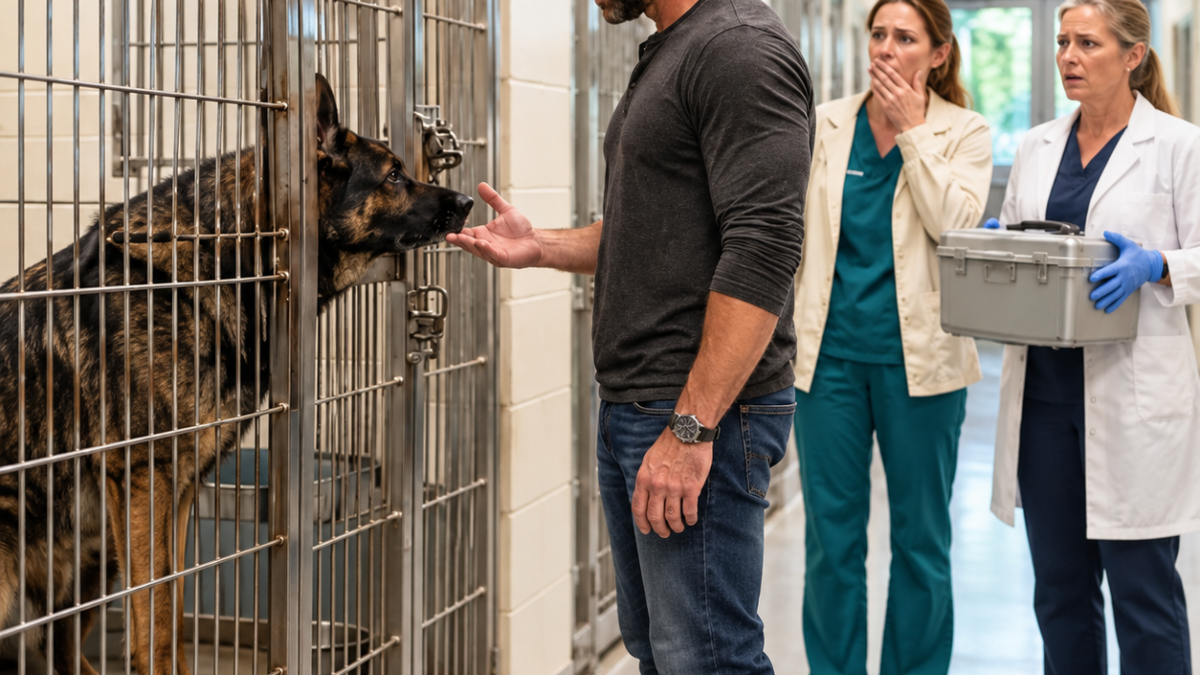
Beside her stood a man in his fifties with a shaved head and thick forearms. He was wrapping gauze around his left arm. The bandage beneath was stained dark red.
His name tag said DAVE — BEHAVIOR.
He looked up when I entered.
His eyes assessed me the way animal people assess strangers in shelters: hands, posture, voice, threat level.
Emily forced a smile.
“Can I help you?”
“I’m looking for a beagle,” I said.
My voice came out rougher than I meant it to.
“For my daughter. Seven years old. Needs to be gentle. Good temperament. Puppy or older dog doesn’t matter as long as it’s safe.”
Something softened in Emily’s face.
“A beagle for a little girl,” she said. “That sounds nice.”
Nice.
That was all I wanted.
A nice dog.
A normal dog.
A floppy-eared creature that would chase balls badly, sleep on Lily’s blanket, and maybe teach the house to sound less empty when she was not there.
Emily typed into an old computer that seemed held together by tape and patience.
“We have two beagles in the general ward. Row B. Let me grab the keys and—”
A sound exploded from behind the heavy steel doors at the back of the shelter.
Not a bark.
Not exactly.
A deep, guttural roar that vibrated through the floor and punched every instinct in my body awake.
My right hand twitched toward my hip.
There was no sidearm there.
There hadn’t been for years.
My heart rate spiked anyway.
Dave flinched and gripped his bandaged arm.
Emily froze.
Another crash followed.
Metal against metal.
Heavy.
Violent.
I turned toward the sound.
“What the hell is that?”
Dave muttered, “That is a nightmare.”
Emily closed her eyes.
Dave looked at me. “Don’t worry about him. He’s scheduled for euthanasia at four p.m. State mandate. Unadoptable.”
The word euthanasia moved through the room like cold air.
I should have said nothing.
I should have followed Emily to Row B, met the beagles, chosen the gentler one, and gone home with something safe for Lily.
That was the mission.
Beagle.
Daughter.
Weekend peace.
But the roar came again.
This time there was something inside it I recognized.
Not anger.
Not only anger.
A perimeter warning.
Stay back.
Threat.
Hold.
Emily’s eyes had moved to my cap.
Then to my stance.
Then to my hands.
“Mr. Riley,” she said quietly.
I looked at her.
“You’re military.”
My jaw tightened.
“Was.”
“Special operations?”
I hated that question.
“Navy,” I said.
Dave shook his head immediately.
“Emily, don’t.”
She ignored him.
Her voice dropped to a whisper.
“Please. Before you look at the beagles, could you meet him?”
“No,” Dave snapped. “Absolutely not.”
Emily turned on him with a sudden flash of exhaustion and anger.
“He is going to die in less than two hours.”
“He almost took my arm off this morning.”
“He is not a monster.”
“He tore through a reinforced catch pole.”
“He is terrified.”
“He is lethal.”
Their argument felt old.
Rehearsed.
The kind people have when hope has become dangerous.
I said, “What is he?”
Emily looked at me.
“When he came in three weeks ago, county animal control labeled him as a feral Malinois mix because of his drive and aggression. But his microchip data came back last week.”
Another crash sounded behind the doors.
Emily swallowed.
“He is not a Malinois mix. He is a purebred German Shepherd. Retired tactical K-9. Federal task force dog.”
Everything inside me went still.
I knew tactical dogs.
I had worked with them overseas.
A good working dog was not a pet in the way civilians meant the word. Not at first. They were trained purpose wrapped in fur. They cleared rooms, found explosives, chased armed men into dark places, ignored gunfire, read body language faster than humans, and trusted their handlers with a kind of loyalty most people spent their lives pretending to understand.
“What’s his name?” I asked.
“Havoc.”
Of course it was.
“What happened to his handler?”
Emily’s face changed.
“Agent Brian Kesler. DEA task force. Killed during a cartel operation in Juárez six months ago.”
I felt Dave shift beside me.
Emily continued, voice cracking.
“The unit was ambushed. Kesler took two rounds to the chest. Havoc dragged him behind a concrete barrier and held the perimeter for fourteen hours. He wouldn’t let the cartel near him.”
She paused.
“He wouldn’t let the medevac team near him either.”
The barking from the adoption wing seemed to fade behind the blood rushing in my ears.
“They had to dart him from a helicopter,” she said. “To recover Kesler’s body.”
I closed my eyes.
A handler down.
A dog holding the line.
No one able to tell him the mission had ended.
Dave’s voice was softer when he spoke.
“He’s been through two rehab facilities. Bit a kennel master in Texas. Bit a behaviorist in California. Attacked transport staff. He got dumped in our jurisdiction after a botched transfer, and the order came down. State and federal liability. He’s classified Level Five. He dies at four.”
Emily looked at me.
Tears had gathered in her eyes, but she did not blink them away.
“I know you came for a beagle. I know you have a little girl. I’m not asking you to take him. I’m not even asking you to help. But I can’t let a veteran die on a cold steel table in the back room without someone who understands at least looking him in the eye.”
The word veteran hit differently when applied to a dog.
Maybe it shouldn’t have.
Maybe that was the point.
I thought of Lily’s beagle.
Soft ears.
Gentle eyes.
Safe.
I thought of Sarah saying, Don’t break her heart.
Then I thought of a German Shepherd standing over his dead handler for fourteen hours because nobody had given him permission to stop.
I already knew what I would find in the back.
Not a monster.
A mirror.
“Show me,” I said.
Dave cursed under his breath.
Emily grabbed the keys with trembling hands.
The quarantine corridor sat behind two heavy doors and a keypad lock. The air changed the moment we entered. Less barking. More echo. Damp concrete. Ammonia. Metal. Fear thick enough to taste.
The fluorescent lights flickered overhead.
I hated that.
Flickering light does things to a mind built around muzzle flashes and memory.
Dave walked slightly behind Emily, his bandaged arm held close to his body. I noticed that despite his fear, he still positioned himself between Emily and the end of the corridor. Good man, then. Scared, but not useless.
At the far end was Kennel 4.
The door was reinforced chain-link mounted in steel. Extra locks. Heavy latch. Two catch poles leaned against the wall outside. A bite sleeve lay on the floor, torn open, stuffing exposed.
Before I saw Havoc, he hit the gate.
Bang.
The steel bowed outward.
Emily gasped despite expecting it.
Dave stepped back.
I did not move.
The dog behind the gate was eighty-five pounds of black and tan fury.
His coat was dull and matted. Scars cut through fur along his shoulders. A jagged pink line ran down the left side of his muzzle, puckered and ugly, shrapnel or a graze. His lips curled away from white teeth. Saliva flew from his jaws as he snarled.
But his eyes were what stopped me.
Amber.
Sharp.
Focused.
Not rabid.
Not mindless.
He looked at my hands first.
Then my shoulders.
Then my feet.
Then my eyes.
Assessing.
Calculating.
Threat matrix.
Havoc was not thrashing blindly.
He was holding a perimeter.
Dave said, too loudly, “You see? He’s hyperfixated. If that gate opens, he goes for the throat. He’s not in there anymore, Riley. The dog’s mind is gone.”
I barely heard him.
Havoc lowered into a crouch, muscles coiling under dirty fur. His growl deepened, a continuous rumble that vibrated in my sternum.
Three feet separated us.
Steel.
Air.
Ghosts.
I knew that posture.
I had worn it myself in grocery stores.
At school assemblies.
In restaurants where my back could not find a wall.
Scanning exits.
Reading hands.
Expecting violence from people reaching for napkins.
He was not trying to kill me.
He was certain I was going to kill him.
The realization hurt.
Not emotionally first.
Physically.
A hollow pressure behind my ribs.
“He’s scared,” I said.
Dave barked a humorless laugh.
“That is not fear.”
“It is.”
“You’re projecting.”
“Yes,” I said. “Probably.”
I took off my jacket.
Emily whispered, “Mr. Riley?”
I dropped the jacket behind me.
Then I lowered myself to the concrete floor.
Not a crouch.
A crouch is readiness.
A crouch says spring.
I sat fully, crossing my legs slowly despite the sharp complaint from my bad knee.
I turned my shoulders slightly away from Havoc, no direct challenge, no forward lean. I rested my hands loosely on my knees, palms up.
“Don’t,” Dave said. “Do not put yourself at face level with him.”
“Quiet,” I said.
Not loud.
Command tone.
He shut up.
Havoc stopped barking.
The sudden silence was worse than the noise.
He remained low, breathing hard, eyes locked on me in confusion.
People did not sit down in front of him.
People yelled.
People sprayed water.
People jabbed catch poles.
People ran.
I looked at the floor near his paws.
Not directly into his eyes now.
“Hey, buddy,” I whispered.
Havoc’s lips twitched.
“It’s loud in here, isn’t it?”
His ears shifted.
“Lots of ghosts.”
He barked once, sharp and violent, lunging a few inches toward the gate.
I did not blink.
“I know,” I said. “I know about the ghosts.”
My voice settled into the low rhythm I used with Lily after nightmares.
“They follow you home. They get in the corners. They wait in the dark. They make safe places feel like kill zones.”
Havoc’s breathing changed.
“Brian is safe now.”
At the name, the dog flinched.
Emily covered her mouth.
Dave went still.
“Brian is safe,” I repeated. “You held the line. You did good, Havoc. You did so damn good.”
The growl dropped.
Not gone.
Lower.
Uncertain.
“I lost my spotter,” I said.
The words came out before I decided to give them.
“Fallujah. His name was Danny. He bled out in my lap while I kept my rifle up because rounds were still coming through the windows. I held the perimeter until extraction.”
My mouth went dry.
“I know what it is to keep working after the person beside you is gone.”
Havoc took one step backward.
Not retreat.
Processing.
“No one told us how to stand down when the shooting stopped,” I whispered.
Slowly, I lifted my right hand.
Dave made a small sound.
I ignored him.
I did not reach through the wire.
I simply pressed my palm flat against the mesh and held it there.
“Stand down, soldier,” I said softly.
Not a plea.
An order.
Gentle.
Certain.
“Your watch is over.”
Ten seconds passed.
Maybe more.
In those seconds, the shelter disappeared.
No barking.
No rain.
No Emily.
No Dave.
Just me on one side of steel and Havoc on the other, both of us trapped in wars people kept telling us were finished.
Then Havoc exhaled.
A long, shuddering breath.
The tension drained from his body inch by inch.
His lips lowered over his teeth.
His ears lifted halfway.
He stepped forward.
Dave whispered, “No way.”
Havoc pressed the scarred side of his muzzle against the wire, exactly where my hand rested.
Then he closed his eyes.
Emily sobbed.
I looked up at Dave.
“Give me the keys.”
His face went white.
“No.”
“Give me the keys.”
“Riley, through a barrier is one thing. Without it, his defense drive could trigger. Protocol—”
“To hell with protocol.”
My voice cracked down the hallway like a rifle shot.
Havoc’s eyes opened, but he did not move away from my hand.
“He is scheduled to die in less than two hours because nobody has the guts to tell him he’s safe. Give me the damn keys.”
Dave looked at Emily.
Emily’s face was wet with tears.
She gave one terrified nod.
“Emily,” Dave said.
“Give him the keys.”
He unclipped the heavy brass ring and slid it across the concrete.
It stopped by my boot.
I did not stand.
Standing would change my shape.
Change the energy.
I picked up the keys, reached up slowly, and unlocked the padlock.
The metallic click echoed too loudly.
I slid the deadbolt.
The door opened.
There was no barrier now.
Havoc stepped out of the shadows.
His paws clicked against concrete.
He came toward me slowly, head level with mine, jaws inches from my face.
I could smell him.
Fear.
Fur.
Blood.
Stress.
The metallic edge of adrenaline.
My own heart beat hard enough that I felt it in my throat.
Havoc stood over me.
If he decided to bite, I would not stop him.
Not from this position.
Maybe that was the point.
Trust is useless if you keep one hand on the escape route.
“Easy,” I whispered.
He lowered his head.
For one terrifying second, his muzzle hovered near my throat.
Then his front legs buckled slightly, and he dropped his massive, scarred head against the center of my chest.
The breath left me.
Not because of his weight.
Because of the surrender inside it.
A soldier exhausted beyond measure had finally found somewhere to put down his weapon.
My arms moved around his neck before I could stop them.
His fur was coarse, matted, damp.
I buried my face in it.
“I’ve got you,” I whispered.
My voice shook for the first time in years.
“I’ve got you, brother.”
Havoc’s body trembled.
“The war is over.”
Emily had collapsed against the wall.
Dave stood frozen, eyes wide, bandaged arm hanging at his side.
I kept one hand on Havoc’s ribs, feeling each breath.
Too thin.
Underfed.
Exhausted.
Anger moved through me again, but this time it had a target larger than one shelter.
“I’m taking him,” I said.
Dave recovered first.
“You can’t.”
I looked at him.
“I am.”
“No, I mean legally. Even if I wanted to let you, I can’t. He’s classified Level Five. He’s technically Department of Justice property. The euthanasia order isn’t shelter policy. It’s a state mandate backed by the regional DEA office.”
Havoc pressed his shoulder against my left leg.
Dave took half a step back when Havoc looked at him.
“Easy,” I said.
Havoc stopped rumbling immediately.
Emily whispered, “The county vet arrives at four.”
I checked my watch.
2:15 p.m.
Ninety minutes.
I pulled out my phone and scrolled to numbers I had not called since before my medical retirement.
“Who signed the order?”
“Judge Arthur Penhalagan,” Emily said. “But it came through the regional DEA office in Portland. They declared him a destroyed asset.”
Destroyed asset.
The words tasted like ash.
I knew that language.
Not officially.
Not on paper.
But I knew the feeling of it.
Once the weapon malfunctions, remove it from service.
Once the operator breaks, process him out.
Thank you for your service.
Now disappear quietly where normal people do not have to see what service costs.
I dialed.
For the next ninety minutes, I fought a different kind of war.
No rifle.
No team.
No overwatch.
Just a dying cell phone, old favors, and a dog sitting beside my boots like he had decided I was command now.
I started with Captain Richard Tremble, my former commanding officer, who now had a Pentagon office and a voice that sounded permanently disappointed.
“Tremble.”
“Sir, it’s Riley.”
A pause.
“Tom?”
“I need a favor.”
“Are you safe?”
The fact that this was his first question said too much about what people thought of me after discharge.
“Yes.”
“What kind of favor?”
“One that’s going to annoy lawyers.”
He sighed.
“Of course.”
Tremble called a DOJ liaison.
The liaison called regional command.
I called Deputy Director James Whitmore at the DEA, a man whose agents my team had pulled from a burning compound in Jalalabad years earlier.
Whitmore answered on the third try.
“Chief Riley,” he said, surprised. “It’s been a long time. I heard about your retirement. I’m sorry.”
“Save the pity.”
Silence.
“All right.”
“Three years ago, after Jalalabad, you told me if I ever needed a marker called in, I should name it.”
His voice changed.
“I remember.”
“I’m naming it.”
“What do you need?”
“I’m sitting in Westridge County Animal Shelter in Oregon with a retired tactical K-9 named Havoc. Badge K-944. Handler Brian Kesler killed in Juárez. Your office ordered the dog destroyed at sixteen hundred hours.”
A pause.
A long one.
“Tom.”
“No.”
“That dog is a serious liability. He injured personnel at two facilities. We cannot release him into public custody.”
“He is not going into public custody. He is coming with me.”
“You have a child.”
“I know what I have.”
“You are medically retired with documented PTSD.”
“Yes.”
Another silence.
“Then you understand why this concerns me.”
The words hit harder than he meant them to.
Havoc nudged my hand.
I looked down at him.
“He’s me,” I said.
Whitmore said nothing.
“He’s me if no one had grabbed the leash before I went under. He’s every man you sent into dark places and then didn’t know where to put when the dark came back with him.”
“Tom—”
“If you let them put a needle in him, you are telling every veteran out there that we are only worth keeping alive while we can still be useful without making anyone uncomfortable.”
My voice broke on the last word.
I hated that.
But I did not stop.
“I want him reclassified. Psychiatric service candidate. Transfer to my custody pending evaluation. I’ll sign every liability document you want. I’ll do home checks, training, quarantine, court hearings, whatever it takes. But you owe me this call, James.”
Havoc leaned against my knee.
At 3:45 p.m., the front door opened.
Dr. Harrison, the county veterinarian, walked in carrying a stainless steel lockbox.
I knew what was in it.
Blue juice.
Sodium pentobarbital.
The drug that makes bodies stop.
Emily stood between him and the back hallway.
He looked exhausted before he even spoke.
“Emily, don’t.”
“You can’t go back there.”
“I have a court order.”
“We’re waiting on a federal call.”
“If I don’t carry out the order, the state can pull funding.”
“Then they can pull it from my cold dead hands.”
Dave muttered, “Emily.”
She didn’t move.
At 3:52 p.m., the shelter landline rang.
Everyone froze.
Emily snatched it up.
“Westridge County Animal Shelter.”
She listened.
Her eyes widened.
She grabbed a pen and began writing so fast the tip tore through the paper.
“Yes, sir. Yes. Confirmation number? Repeat that, please. Yes, Deputy Director. Transfer to custody of Chief Petty Officer Thomas Riley pending service evaluation. Euthanasia order rescinded. Yes, sir.”
She hung up.
For a second, nobody spoke.
Then she turned to Dr. Harrison.
“The order is rescinded.”
He looked relieved.
Not angry.
Relieved.
“Thank God,” he whispered.
I walked out of the quarantine hall holding a makeshift slip lead made from heavy nylon rope.
Havoc walked beside me in a perfect military heel, shoulder glued to my left leg.
Not lunging.
Not barking.
Not snarling.
He paused in the lobby and lifted his face toward the rain outside.
The doors opened.
Oregon air rushed in.
Wet.
Cold.
Clean.
Havoc stepped into it like a prisoner stepping into sunlight.
Then he shook himself hard enough to spray water on my boots.
Emily laughed and cried at the same time.
Dave stood in the doorway, staring.
I looked at him.
“He didn’t nearly take your arm off because he hated you.”
Dave swallowed.
“I know.”
“He thought you were coming through the wire.”
Dave nodded slowly.
“I know that now.”
“You still need that looked at.”
He looked down at his bandage.
“Yeah.”
Havoc glanced at him.
Dave stepped back out of reflex.
Then stopped himself.
“Good luck, Riley.”
I looked at the dog beside me.
“We’re going to need more than luck.”
The transition was not clean.
Stories like this get told later with all the hard parts polished smooth. They make it sound like one moment of connection fixed everything.
It did not.
For the first two days at my cabin, Havoc did not sleep.
He patrolled.
Living room to kitchen.
Kitchen to hallway.
Hallway to front door.
Windows.
Back door.
My bedroom.
Lily’s room, though she was not there yet.
Again.
Again.
Again.
He checked corners, sniffed window frames, froze at distant sounds, and placed himself between me and every door.
I did not force him into a crate.
I left one open with bedding inside.
He ignored it.
I tossed high-value meat treats on the floor and let him decide when to take them.
He waited until I looked away.
Fine.
Trust on his timeline.
Not mine.
At night, I slept badly.
So did he.
Two ghosts haunting the same cabin.
Sometimes, at two in the morning, I would wake from a nightmare already reaching for a rifle that was not beside the bed. Havoc would be standing at the door, silent, watching me.
Not comforting me.
Not yet.
Assessing.
I would lower my hand.
“Clear,” I’d whisper.
He would hold my gaze for a long moment.
Then resume patrol.
On Friday afternoon, the real test arrived.
At 5:00 p.m., a silver sedan pulled up the gravel driveway.
My heart started pounding before the engine stopped.
Sarah got out first, holding an umbrella against the rain. She looked toward the cabin, then toward me, suspicion already in her face because Sarah could read me even after divorce.
Then Lily burst from the back seat in a bright yellow raincoat.
“Daddy!”
She ran across the driveway and launched herself into my arms.
I caught her, bad knee protesting, heart cracking open.
“Hey, Bug.”
She smelled like rain, bubblegum shampoo, and crayons.
Sarah approached more slowly.
“She has been talking about this beagle all week.”
I closed my eyes briefly.
“Sarah—”
Her face tightened.
“Tom.”
“I got a dog.”
“What kind of dog?”
“He’s a little different.”
“How different?”
From inside the cabin, Havoc barked once.
Deep.
The sound rolled through the walls.
Sarah’s eyes widened.
“That is not a beagle.”
“No.”
“Thomas.”
“I need you to trust me.”
Her laugh was sharp.
“That has not historically worked out well for me.”
I deserved that.
Lily looked between us.
“Daddy?”
I crouched in front of her despite the pain.
“Bug, I need to explain something.”
“Is the dog sick?”
“No. Not exactly.”
“Is he mean?”
I thought about how to answer.
Adults lie to children by making complicated things too simple. I had done enough lying to myself.
“He’s scared,” I said. “And sad. He was in the military, like Daddy. His name is Havoc. He’s a big boy, not a beagle. Loud noises and fast movements scare him sometimes, so we have to be very gentle.”
Lily’s eyes softened immediately.
“He has boo-boos?”
“Not the kind you can see.”
She nodded solemnly.
“On his heart.”
My throat tightened.
“Yeah.”
Sarah pulled me aside before leaving.
“No,” she said.
“You haven’t met him.”
“I heard him.”
“He’s trained.”
“He’s traumatized.”
“So am I.”
“That is not the argument you think it is.”
I looked toward the cabin.
“I know.”
“Lily is seven.”
“I know.”
“If that dog so much as growls at her—”
“He won’t be alone with her. Not for a second. I swear.”
Sarah studied me.
She had seen me swear things before.
Some I kept.
Some I couldn’t.
“This better not be about you trying to prove something,” she said.
I looked back at Lily, who was standing in the rain whispering to a worm on the driveway.
“It’s about not letting something broken be killed because it made people uncomfortable.”
Sarah’s face changed.
Just slightly.
“Are we talking about the dog?”
“Yes,” I said.
Mostly.
After Sarah drove away, I brought Lily inside but kept Havoc behind my closed bedroom door.
He stood on the other side, silent.
That worried me more than barking.
I knelt in the hallway.
“Remember what I said?”
Lily nodded.
“No running. No screaming. No touching unless he asks.”
“Good.”
“Can I sing?”
The question startled me.
“Why?”
“When I get scared, singing helps.”
I looked at the bedroom door.
“Softly.”
I opened it.
Havoc stood in the center of the room.
Rigid.
Ears forward.
Eyes locked on Lily.
Every muscle in my body prepared to move.
Lily did not run toward him.
She did not squeal.
She did not reach out.
She sat cross-legged on the hallway carpet, looked down at her own hands, and began humming.
Soft.
Gentle.
A little off-key.
Havoc tilted his head.
He took one step forward.
Then another.
His nose worked.
Rainwater.
Bubblegum.
Child.
And underneath, me.
My blood.
My family.
His handler’s pup.
The VIP.
He moved closer.
I stopped breathing.
Havoc lowered his massive head and touched his nose to Lily’s knee.
She giggled.
Not loud.
Just a small burst of delight she tried to swallow because she remembered the rules.
“Hi, Havoc,” she whispered.
His ears softened.
Then, slowly, he sat in front of her.
Lily looked at me, eyes shining.
“He’s not a beagle.”
“No.”
“He’s better.”
I exhaled for what felt like the first time all day.
The weekend went well.
Better than I had any right to expect.
Havoc followed Lily at a careful distance, as if guarding her from threats only he could imagine. He watched cartoons from the hallway. He inspected her backpack. He allowed her to place one stuffed rabbit near his paws, though he looked deeply uncertain about its tactical purpose.
By Saturday afternoon, Lily was reading him a book.
He did not understand the book.
He understood her voice.
That night, the storm came.
The weather had been building all evening. Pressure dropping. Wind moving through the trees. Rain tapping harder at the windows. I felt it in my knee and in the back of my skull.
At 11:07 p.m., lightning split the sky white.
Thunder cracked so violently the windows rattled.
I woke on the floor.
Not climbed down.
Not sat up.
One second asleep.
The next on hardwood, gasping, hands over my head, heart trying to break through my ribs.
I was not in Oregon.
I was in Helmand.
The thunder was incoming.
The rain was radio static.
The shadows were walls closing around a room I could not clear.
I could smell cordite.
Blood.
Dust.
My mouth filled with sand that was not there.
Then, from down the hall, Lily screamed.
“Daddy!”
I tried to stand.
My right knee buckled.
My brain would not release me.
Move.
Move.
Move.
I could not.
Another crash of thunder.
Lily screamed again.
A blur of black and tan shot past me.
Havoc.
Terror punched through the flashback.
Not for myself.
For Lily.
If the storm triggered his combat drive, if he ran toward the noise, if Lily moved too fast—
I dragged myself down the hallway.
Elbows.
Bad knee.
Hands slipping on wood.
“Havoc,” I choked.
I reached Lily’s doorway and hauled myself up by the frame.
Then froze.
Havoc was on the bed.
Not attacking.
Not pacing.
He had climbed beside my terrified daughter and laid his body across her legs, heavy enough to ground, careful enough not to crush. His massive frame curved around her like a shield.
Lily sobbed into his fur.
Another thunderclap hit.
She flinched.
Havoc lowered his head and licked tears from her cheek.
A low rumble came from his chest.
Not a growl.
A soothing sound.
Steady.
Deep.
Alive.
Lily’s hands clutched his neck.
“I’m scared,” she whispered.
Havoc pressed closer.
Her breathing began to slow.
Mine did not.
I slid down the doorframe, shaking, sweat cold on my back.
I should have gone to her.
I should have been the father in the bed, the arms around her, the voice saying she was safe.
Instead, the dog everyone wanted dead was doing the job I could not.
When Lily finally fell asleep, Havoc carefully eased himself away from her.
He stepped down from the bed.
Walked to the doorway.
Sat in front of me.
I could not look at him.
Shame is strange after trauma.
It does not always attach itself to what you did wrong.
Sometimes it attaches itself to what you could not do at all.
Havoc stepped forward.
With incredible precision, he placed both front paws on my shoulders and pressed his chest against mine.
Deep pressure.
Grounding.
A biological anchor.
My arms went around him.
And then, for the first time in twelve years, I cried.
Not one tear.
Not a controlled leak.
I broke.
On the hallway floor outside my daughter’s bedroom, with thunder shaking the cabin and a traumatized war dog holding me down so I would not float back into the past, I cried for Danny.
For Kesler.
For every man who didn’t come home.
For Sarah.
For Lily.
For myself, though that was the hardest one.
Havoc did not move.
He absorbed the shaking.
The panic.
The ugly sounds.
He held the line again.
Only this time, he was not guarding the dead.
He was guarding the living.
When morning came, Lily found us asleep in the hallway.
My back against the wall.
Havoc half across my lap.
She stepped over us carefully and whispered, “Good boy.”
Havoc opened one eye.
His tail thumped once.
Sarah arrived Sunday evening expecting a disaster.
Instead, she found Lily sitting on the porch beside Havoc, explaining to him that beagles were nice but “not as brave as you, probably.”
Sarah stopped at the bottom of the steps.
Havoc lifted his head.
I stood slowly.
“He helped her through the storm,” I said.
Sarah looked at Lily.
Lily nodded seriously.
“And Daddy too.”
Sarah’s eyes moved to me.
I looked away.
The old habit.
Hide damage before it becomes someone else’s burden.
But Sarah was done accepting that.
“Tom.”
I met her gaze.
“Havoc handled it better than I did.”
She stepped onto the porch.
The dog watched her carefully.
Not threatening.
Reading.
Sarah did what Lily had done. She did not reach for him. She sat in the porch chair and let him decide.
After a long moment, Havoc stood, walked to her, and sniffed her hands.
Sarah’s face softened.
“Hello, Havoc.”
He huffed.
She looked at me.
“You did not get a beagle.”
“No.”
“No, you absolutely did not.”
Lily wrapped both arms around Havoc’s neck.
“He’s our storm dog.”
Sarah closed her eyes.
When she opened them, they were wet.
“I need to know she’s safe here.”
“She is.”
“I need to know you’re safe here.”
That answer took longer.
Havoc leaned against my leg.
“I’m safer than I was.”
It was not perfect after that.
Nothing good ever is.
There were setbacks.
Havoc broke a window the first time fireworks went off in the valley.
I had to replace two doors after he tried to intercept a delivery man who ignored the sign that said DO NOT APPROACH THE HOUSE.
He could not handle crowded places.
Neither could I.
He hated men in baseball caps for reasons we never fully understood.
He slept only after checking Lily’s room, my room, the back door, the front door, the windows, and the hallway.
Every night.
Same route.
Same mission.
But slowly, the patrol changed.
It became less frantic.
More ritual.
Less survival.
More care.
I changed too.
I started attending therapy again because Havoc had mandatory behavioral rehabilitation, and it felt hypocritical to ask the dog to heal while I kept pretending I could manage myself with coffee and locked doors.
I joined a veterans group I had avoided for two years.
The first night, Havoc lay under my chair and growled softly when a man across the room started crying.
Not at him.
With him, maybe.
The man laughed through tears and said, “Same, buddy.”
Havoc became officially certified as my psychiatric service dog after months of evaluation and training that was less about teaching him tasks and more about giving structure to instincts he already had.
Deep pressure therapy during panic attacks.
Room clearing on command.
Waking me from nightmares.
Creating space in crowds.
Interrupting dissociation.
Finding Lily during storms.
That last one was not an official task.
It was his own.
On the first anniversary of Kesler’s death, I drove Havoc to a small memorial service held by the DEA regional office.
I expected bureaucracy.
Bad coffee.
Speeches.
Instead, Kesler’s widow was there.
Her name was Marisol.
She stood beside a framed photograph of her husband, one hand resting on the shoulder of their teenage son.
When Havoc saw the photo, he stopped.
Completely.
His ears lifted.
A sound came from his chest.
A whine so small only I heard it.
Marisol turned.
Her face collapsed.
“Havoc?”
The dog pulled once on the leash.
I looked at her.
“Is it okay?”
She covered her mouth and nodded.
I released him.
Havoc crossed the room slowly, not rushing, not lunging.
He stopped in front of Marisol.
Sniffed her hands.
Then pressed his head against her stomach.
She folded over him.
“Oh, baby,” she cried. “Oh, you poor baby.”
Her son knelt too, one hand shaking as he touched Havoc’s scarred head.
“Dad loved you,” he whispered.
Havoc closed his eyes.
People around us cried openly.
DEA agents.
Handlers.
Men with hard faces and folded arms.
I stood back because that reunion did not belong to me.
Later, Marisol thanked me.
I told her I had done nothing.
She looked at Havoc sleeping against my boot.
“You told him he could stand down.”
I thought about that.
Maybe I had.
Maybe he had told me the same.
Years passed.
Lily grew taller.
Havoc’s muzzle grew gray.
My nightmares did not disappear, but they changed. They became storms we knew how to weather instead of enemies that owned the night.
Sarah and I did not remarry.
Life is not always that kind of story.
But we became better at standing near each other without bleeding old hurt into every conversation.
She trusted my house again.
She trusted me again, cautiously at first, then with something that looked like peace.
She trusted Havoc completely.
By ten, Lily was telling people her dad had a service dog but “really they service each other.”
By twelve, she wanted to train working dogs.
By fourteen, she said she might become a veterinarian, but only for “dogs with complicated feelings.”
Havoc adored her.
There is no other word.
He followed her from room to room during her weekends. He tolerated her painting his old harness with a tiny removable patch that said STORM DOG. He sat beside her during homework. He once stood between her and a boy from school who came to pick her up for a group project, not aggressively, but with enough silent judgment that the boy addressed me as “sir” six times in three minutes.
Good dog.
When Havoc’s hips began to weaken, Lily noticed first.
“He’s slower,” she said one Sunday after he took longer to climb the porch steps.
“He’s getting older.”
She sat beside him and stroked the gray fur around his muzzle.
“Does that mean he’ll die soon?”
Children do not soften the knife.
I sat down on the step below her.
“Not today.”
“But someday.”
“Yes.”
She nodded, tears already forming.
“All dogs?”
“All of us.”
She leaned against Havoc.
“That’s rude.”
I smiled sadly.
“Yeah.”
Havoc rested his chin on her knee.
By then, he had been with us six years.
Six years stolen from a death order.
Six years of storms, school pickups, therapy appointments, hikes, bad knees, good mornings, and nights when he pressed his weight against my chest until the past let go.
His final winter came quietly.
No grand event.
No dramatic collapse.
Just a gradual setting down.
He slept more.
Ate slower.
His patrol shortened from every window to just Lily’s room and the front door.
Then only the front door.
Then one night, he rose from his bed, tried to reach the hallway, and his back legs failed.
I was beside him before he hit the floor.
“I’ve got you.”
His eyes met mine.
Still sharp.
Still Havoc.
But tired.
Dr. Marisol Patel—not Kesler’s widow, different Marisol, a veterinarian Lily adored—came to the cabin the next morning.
She examined him gently while Lily sat on the floor with his head in her lap.
Sarah came too.
So did Emily Stanton.
She had left the shelter years earlier and started a nonprofit focused on working dogs with trauma. When I called, she drove three hours without asking why.
Dave came with her.
The same behaviorist Havoc had bitten.
He stood in my doorway holding a bag of treats and looking older.
When Havoc saw him, his tail moved.
Dave crouched carefully.
“Well,” he said, voice thick, “look at you.”
Havoc sniffed his bandaged arm.
The scar was still visible.
Dave laughed softly.
“Yeah. You and me both.”
Dr. Patel told us what I already knew.
Pain management could buy time.
Not good time.
Not much.
Havoc had fought enough wars.
I was not going to make his body into one more battlefield.
We chose sunset.
Because he loved the porch at sunset.
Because from there he could see the driveway, the tree line, the bend in the road, Lily’s old swing, and the windows he had guarded for years.
We carried his bed outside.
He objected weakly to being carried.
Pride intact.
Good.
Lily lay beside him on the porch boards, one hand buried in his fur.
Sarah sat on his other side.
Emily cried silently.
Dave looked out at the trees and pretended he wasn’t.
I sat at Havoc’s head.
The sky turned gold behind the mountains.
No rain.
No thunder.
Just evening.
I took off the old olive drab cap with the faded Trident and set it beside him.
“You remember the shelter?” I asked.
His ear moved.
“Yeah. Me neither.”
Lily laughed through tears.
I placed my hand against the scarred side of his muzzle, the same place he had pressed to the kennel wire the day we met.
“You held the line for Brian,” I whispered.
His eyes stayed on mine.
“You held it for Lily.”
His breathing was slow.
“You held it for me.”
My voice broke.
“But you can stand down now.”
Havoc exhaled.
Dr. Patel gave the first injection.
His body softened.
Not collapsed.
Softened.
Like a dog finally stretching after sleeping too long in armor.
Lily whispered, “You’re the best beagle we never got.”
Sarah made a sound between a laugh and sob.
Havoc’s tail moved once.
I bent close.
“The war is over, brother.”
His eyes closed.
He died with my hand on his head, Lily’s hand on his chest, Sarah’s hand on his side, and the people who had once feared him standing close enough to prove they no longer did.
No steel table.
No cold needle in a back room.
No label reading destroyed asset.
Home.
Afterward, Lily would not let go for a long time.
Nobody made her.
When she finally sat up, her face was swollen and wet.
“Daddy?”
“Yeah, Bug?”
“He wasn’t broken.”
I looked at Havoc.
Scarred.
Old.
Still.
“No,” I said.
“He was hurt.”
I nodded.
“So were you.”
The old reflex rose.
Deny.
Deflect.
Protect her.
Instead, I told the truth.
“Yes.”
She wiped her face.
“But not broken.”
I pulled her into my arms.
“No,” I whispered. “Not broken.”
We buried Havoc under the cedar tree beyond the porch, where he used to sit and watch the driveway.
Emily brought a small plaque weeks later.
It read:
HAVOC
K-944
He held the line until love brought him home.
Years have passed since then.
Lily is older now, too old to be called Bug in public but not too old to answer when I forget.
She volunteers with Emily’s nonprofit on weekends.
Sarah remarried a kind man who asks before approaching dogs and has never once tried to replace me, which somehow made it easier to respect him.
I still live in the cabin.
There is a beagle here now.
That surprises people.
His name is Murphy.
He is round, dramatic, useless in emergencies, terrified of thunder, and beloved by everyone.
Lily chose him from Westridge County Animal Shelter two years after Havoc died.
When we brought him home, he walked into the living room, sniffed Havoc’s old bed, and immediately fell asleep on it like he had inherited a throne.
I almost objected.
Then I heard Lily whisper, “Havoc would share.”
She was right.
He would.
The shelter changed after Havoc.
Not overnight.
Nothing real does.
But Emily fought harder. Dave learned trauma-informed handling for working dogs and eventually became one of the best rehabilitation specialists in the state. The county revised euthanasia review procedures for retired service animals. Federal agencies began sending retired K-9s to proper assessment instead of letting them fall through bureaucratic cracks into county kennels with no context and no time.
One dog does not fix a system.
But one dog can expose the lie that the system is working.
Havoc did that.
Sometimes people ask me if I saved him.
I tell them no.
I interrupted an execution.
He did the saving afterward.
He saved Lily from storms.
He saved me from nights when I could not find my way back.
He saved Emily from believing compassion was useless.
He saved Dave from thinking fear was always truth.
He saved himself too, though people forget animals do that. They choose. They risk trust. They step through open doors even after the world has taught them doors lead to pain.
The last photograph I have of Havoc sits on my mantel.
Not the heroic one from the nonprofit brochure.
Not the service dog certification photo.
Not the memorial.
My favorite was taken by Lily when she was eleven.
Havoc is asleep on the porch in a patch of sun. His scarred muzzle is gray. His paws twitch like he is dreaming. My old Trident cap rests between his front legs because he stole it from the table and decided it belonged to him.
On the back of the frame, Lily wrote:
He came home because Dad sat down.
That sentence gets me every time.
Because she understood the thing adults missed.
I did not reach Havoc by being stronger than him.
I reached him by lowering myself to the floor.
By becoming less threatening.
By refusing to make him prove his fear was convenient before I believed it.
Maybe that is what love is, when the world has turned someone into a weapon.
You sit down outside the cage.
You open your hands.
You say the war is over.
And then you wait.
Sometimes the door opens.
Sometimes the scarred, furious creature on the other side steps forward.
Sometimes he drops his head against your chest, and you realize you were inside a cage too.
I went to the shelter for a beagle.
A safe dog.
A simple dog.
A promise I thought I could control.
Instead, I found an eighty-five-pound German Shepherd with scars on his muzzle, ghosts in his eyes, and less than two hours to live.
The shelter called him unadoptable.
The order called him a destroyed asset.
The world called him dangerous.
My daughter called him our storm dog.
I called him brother.
And Havoc, who had every reason to give up on people, spent the rest of his life proving that even warriors can come home when someone finally tells them they are safe.








