I Came Home With My K9 and Found My Mother Abandoned—Then the Truth About My Brother Destroyed Me
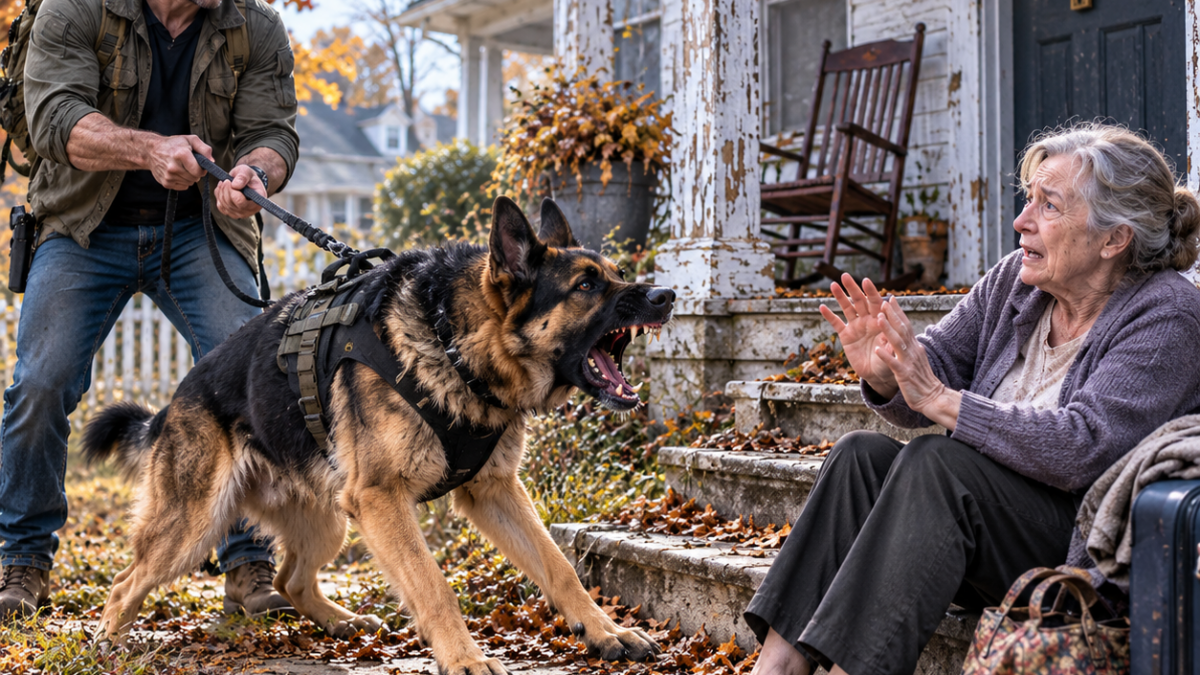
PART3:
Free and clear.
For thirty-five years.
I moved toward the porch with Havoc tight at my side.
The rusty gate screamed when I opened it.
The sound cut through the dead suburban quiet like a warning.
“Havoc,” I murmured.
He stayed close, but a low rumble built deep in his chest.
He knew.
Not the details.
Dogs don’t need details.
He knew the shape of wrong.
I took out my phone and called my mother.
The number was disconnected.
Not unanswered.
Disconnected.
A cold pressure formed under my ribs.
I called Derek.
Five rings.
Voicemail.
Generic.
No name.
No message.
No warmth.
I called Brenda.
Straight to voicemail.
I looked through the cracked front window.
The living room was empty.
Not messy.
Empty.
No floral curtains. No bookshelf. No quilt over the back of the sofa. No framed photograph of my father in his Army dress uniform. No picture of Derek and me in Little League uniforms. No ceramic bowl by the entry where my mother always dropped keys, coupons, and peppermint candies.
The house had been stripped to the bone.
Dust floated in pale shafts of light over bare hardwood floors.
“Where is she?” I said.
My voice sounded unfamiliar.
“Nathan?”
I turned fast.
My hand went instinctively toward my hip before I remembered there was no sidearm there.
Frank Miller stood by the chain-link fence between our properties, holding pruning shears in one hand. He had lived next door since I was in elementary school. Back then, he had been broad-shouldered and red-faced from yard work. Now he looked thinner, older, and pale enough to frighten me.
He stared at me like he was seeing a dead man.
“Mr. Miller,” I said, crossing the yard. “Where is my mother?”
Frank’s eyes moved to Havoc.
Havoc sat without being told, still as a statue, amber eyes fixed on him.
“Where is she?” I repeated. “What happened to the house?”
Frank swallowed.
“Nathan, son, we thought you knew.”
Every combat veteran knows there are moments when time slows not because of adrenaline, but because your brain has already found the edge of a cliff.
“Knew what?”
Frank gripped the fence.
“Derek told everyone you signed off on it.”
“Signed off on what?”
My voice dropped.
I heard it happen.
So did Frank.
He flinched.
“The sale.”
I did not move.
“What sale?”
“The house. Your mother’s care. He said her dementia got too bad for her to live alone. He told us he was liquidating the estate to pay for a luxury assisted living facility in the city.”
Dementia.
The word landed wrong.
My mother had been doing Sunday crosswords in pen a year earlier. She kept the accounts for the church bake sale because no one else could balance them without losing thirty dollars in pie money. She remembered every birthday in three counties and could recite recipes from memory while correcting the local news anchor’s grammar.
“My mother does not have dementia,” I said.
Frank’s eyes filled.
“I didn’t think so either. Helen didn’t. But Derek had paperwork. He had doctors’ notes, or he said he did. Moving trucks came six months ago. He told us not to upset her by visiting.”
“Where is she?”
Frank looked down.
“Derek said Sunrise Estates.”
I knew that place. Private. Expensive. Clean. The kind of facility with piano music in the lobby and fresh flowers no resident had arranged.
“But?” I said.
Frank wiped at his face.
“My wife volunteers at county records. She checked because your mother never answered the phone there.”
He looked up.
“Nathan, he didn’t put her in Sunrise Estates.”
My fingers curled around the fence wire.
“Where?”
“Oak Creek Manor.”
For a moment, the neighborhood vanished.
Oak Creek.
Everyone in the county knew Oak Creek.
A state-run facility at the edge of nowhere. Underfunded. Understaffed. Investigated more than once. People whispered about it in grocery store lines, the way people whisper about places where the forgotten go to disappear.
I turned without another word.
“Nathan,” Frank called.
I stopped.
Frank’s voice broke.
“I’m sorry.”
I looked back at the house.
At the porch where my mother used to wave.
At the foreclosure notice.
At the empty windows.
Then I looked at Havoc.
“Come.”
We moved.
SEALs don’t run in panic.
We move with purpose.
The drive to Oak Creek took forty minutes.
I remember none of it clearly and all of it exactly.
The blur of trees.
The pale sky.
Havoc in the passenger seat, rigid and watchful.
My hands on the wheel.
My mother’s voice in my head.
You eat when you’re tired, Nathan. Heroes are just hungry boys who forgot lunch.
Be good to your brother. He acts proud because he’s scared people will notice he’s lonely.
I made cookies. Don’t tell me you don’t need them. Everyone needs cookies.
Every memory sharpened the rage until it became cold.
I had been angry before.
Real anger.
Battlefield anger.
The kind that comes when someone you love is bleeding and the world narrows into threat assessment and response.
But this was different.
This was personal in a way combat never was.
An enemy overseas hated what I represented.
Derek knew my mother’s hands.
He knew how she rubbed her thumb over her wedding ring when she missed Dad.
He knew the sound she made when she tried not to cry.
He knew what losing a son would do to her.
And some part of me already knew he had used that.
Oak Creek Manor looked worse than memory.
Concrete walls.
Flat roof.
Dirty windows.
A parking lot broken by potholes filled with gray water.
A narrow strip of lawn littered with cigarette butts and fast-food wrappers.
No flowers.
No benches.
No one sitting outside in the autumn air.
The building looked less like a care facility than a place hope had been administratively denied.
I parked crooked across two spaces.
Havoc waited while I clipped on his service vest.
“Close,” I said.
He pressed his flank against my leg.
Grounding.
He knew that job too.
The automatic doors opened with a shriek.
The smell hit me first.
Bleach.
Unwashed bodies.
Boiled cabbage.
Stale urine.
Neglect.
A young woman in faded scrubs sat behind the front desk chewing gum and scrolling on her phone. She did not look up.
“Visiting hours are over at four,” she said.
“I’m here for Margaret Reed.”
She looked up then, eyes moving immediately to Havoc.
“No dogs.”
“He’s my service dog. Margaret Reed. Room number.”
She sighed like I had inconvenienced her.
“Name?”
I leaned forward.
“Margaret. Reed.”
Something in my face made her type faster.
“Room 114. C wing. But I said visiting hours are—”
I was already moving.
“Nathan!” she called.
I did not ask how she knew my name.
C wing was worse than the lobby.
Dim fluorescent lights flickered overhead. A television blared an infomercial at full volume to no one in particular. Elderly residents sat slumped in wheelchairs along the hall, some asleep, some staring, some calling softly to people who did not come. A man in a robe reached one trembling hand toward me as I passed, then let it fall when he saw I was not there for him.
That will haunt me.
I was there for my mother.
But he deserved someone too.
Havoc stayed pressed against my left leg, ears back now, tail low. He had searched bombed-out buildings with less distress in his body.
Dogs smell truth.
Room 114 was half open.
I pushed the door.
The room was the size of a walk-in closet.
Two narrow beds.
One stripped to a plastic mattress.
The other occupied by a small figure facing the cinder block wall, wrapped in a thin hospital blanket.
My breath caught.
“Mom.”
She did not move.
I took one step.
Then another.
I walked around the bed and dropped to one knee.
The woman on the bed looked like my mother after the world had erased her.
She had lost at least thirty pounds. Her silver hair, once cut neatly in a bob she maintained with religious precision every six weeks, hung matted and greasy around a sunken face. Her cheekbones protruded sharply. Her skin had a sick yellow cast. Her lips were cracked. Her hands lay in her lap like pale paper.
Her eyes were open.
Cloudy.
Vacant.
Staring at the wall.
“Mom,” I said again.
Nothing.
I took her hand.
Her skin was freezing.
Her fingernails were overgrown and caked with dirt.
Something inside my chest tore.
“Mom, it’s me.”
Her head turned slowly.
She looked through me.
No recognition.
No spark.
No Margaret Reed who had made pancakes shaped like dinosaurs because I refused normal circles at age six.
“They took the garden away,” she whispered.
Her voice was dry and thin.
“Derek said… Derek said I couldn’t have the garden anymore. I have to pay my debt.”
My throat closed.
“Mom, it’s Nathan. I’m home.”
Her cloudy eyes shifted, struggling to focus.
“Nathan?”
“Yes. I’m here.”
Her face twisted with confusion.
“No.”
“Yes.”
“No. Derek said Nathan died in the desert.”
The room tilted.
Margaret continued in the same weak voice.
“Derek said the government wouldn’t pay to bring you home. He said I had to give him the house. For the funeral. I had to pay my debt.”
If rage could stop a heart, mine would have stopped.
Derek had not only stolen from her.
He had buried me alive in her mind.
He had made my mother grieve a son who was still breathing, then used that grief to strip away everything she owned.
A low, broken whine came from beside me.
Havoc stepped forward.
This dog had gone through gunfire without sound. He had held position under explosions. He had watched men die and stayed mission-focused because that was what we trained him to do.
But in that room, looking at my mother, Havoc whined.
He approached her gently, lowering his massive head onto her lap.
Margaret looked down.
Her hand trembled.
Then her fingers sank into his fur.
Havoc leaned into her legs with careful pressure, the same deep-pressure grounding he used on me when nightmares dragged me back overseas. He did not lick. Did not startle. Did not move too quickly. He simply gave her weight.
Warmth.
Presence.
A tear slid down my mother’s cheek.
Her eyes cleared by one impossible fraction.
“Havoc?” she breathed.
I almost broke.
Because she remembered him.
I had sent photos. Videos. Stories. She had called him “your shadow with teeth.”
“Yes,” I whispered. “That’s Havoc.”
Her hand tightened in his fur.
Then her eyes lifted to me.
“Nathan?”
“I’m here, Mom.”
“You’re not dead?”
“No.”
Doubt, hope, terror, and recognition fought across her face.
I took both of her hands in mine.
“I’m not dead. I came home. I came back for you.”
A sound came out of her that I will never forget.
Not quite a sob.
Not quite a word.
A mother’s heart trying to reverse a funeral.
She leaned forward, collapsing into my chest.
I wrapped my arms around her.
She was so thin I could feel every rib.
I buried my face in her matted hair and cried for the first time in years without trying to stop it.
Havoc stayed pressed against us both.
In that filthy little room, surrounded by cinder block and neglect, my mother came back to me one breath at a time.
Then the grief hardened.
I lifted my head and looked at the wall.
Derek had picked a fight with a woman who could not defend herself.
But I was home now.
The first mission was extraction.
I did not ask permission from the front desk.
I did not wait for a supervisor.
I wrapped my mother in the thin blanket, lifted her into my arms as if she weighed no more than a child, and walked out.
Havoc moved ahead of us, not aggressive, but unmistakably clearing space.
In the lobby, a balding man in a cheap tie hurried from an office, sweating before he reached us.
“Sir, you can’t remove a resident without discharge authorization. There are protocols. Legal guardianship issues. Liability—”
I stopped.
My mother shook in my arms.
I looked at his name badge.
Gregory Fitch.
“Mr. Fitch,” I said, quietly enough that the receptionist stopped chewing gum. “If you place a hand on me, I will consider it a hostile act.”
His mouth opened.
I continued.
“If you attempt to delay me from taking my mother to a legitimate emergency room, I will spend the next twelve hours making sure the state health department, every local news station, the county prosecutor, adult protective services, and the federal elder abuse task force know exactly what I saw in C wing.”
Fitch went gray.
“You don’t understand the—”
“I understand this facility left Margaret Reed malnourished, filthy, confused, and freezing in a room that smells like neglect. Step aside.”
He stepped aside.
Forty minutes later, my mother was in the emergency department at Pine Ridge General.
The attending physician, Dr. Benjamin Hayes, was a man with calm eyes and the controlled anger of someone who had seen neglect before and still refused to get used to it.
He examined her.
Bloodwork.
Fluids.
Scans.
Medication review.
Neurological assessment.
Nutrition markers.
He did not rush.
He did not dismiss her.
He did not look through her.
When he finally came to me, I was standing outside the room with Havoc at my feet, my hands still smelling like that facility no matter how many times I washed them.
Dr. Hayes held a chart.
“Chief Reed.”
“How bad?”
He exhaled.
“She does not have irreversible dementia.”
The words nearly dropped me.
“What?”
“She is experiencing delirium. Severe prolonged malnutrition, profound dehydration, and what appears to be heavy sedative exposure. I want toxicology confirmed, but based on her presentation and medication records from Oak Creek, she was likely being given sedatives she did not medically require.”
I gripped the wall rail.
“Will she come back?”
“I believe much of her cognition may improve with fluids, nutrition, medication washout, sleep, physical therapy, and engagement. I won’t promise full recovery today. But this is not what you were told.”
My eyes burned.
Dr. Hayes put one hand on my shoulder.
“She is very lucky you found her when you did. Another month in that place, and we might be having a different conversation.”
For three days, I barely left her bedside.
I slept in a plastic chair designed by someone with no mercy. Havoc curled at my feet, waking whenever my mother stirred. Nurses came and went. Fluids dripped. Food trays changed from clear liquids to soft meals. My mother slept like someone climbing out of a grave.
On the second day, she recognized me consistently.
On the third, she asked for a comb.
That was when I knew Margaret Reed was still in there.
“I look like a scarecrow,” she said weakly.
I laughed and cried at the same time.
“You look beautiful.”
“I raised you better than to lie that badly.”
Her voice was still thin.
But the shape of her was returning.
Later that afternoon, when Havoc placed his chin on her blanket, she rubbed the spot behind his ear and whispered, “You found my boy.”
Havoc closed his eyes.
My mother told me everything in pieces.
Derek and Brenda had come a year earlier with documents.
A protective trust, they said.
Taxes, they said.
Estate planning, they said.
They brought a notary.
They used words designed to make her feel foolish for asking questions.
My mother trusted her eldest son.
So she signed.
Months later, Derek came back crying.
He told her my helicopter had gone down overseas.
He told her my remains were being held because the government would not cover certain transport costs.
He told her there were debts.
Fees.
Penalties.
Emergency legal problems.
He told her she could still do one last thing for me.
Give him control.
Give him the house.
Give him the accounts.
Give him everything.
And my mother, shattered by a grief he had invented, did it.
“He cried,” she whispered.
She would not look at me when she said that.
“My own son cried while he lied to me.”
That was the part that broke her anew.
Not just the theft.
The performance.
The way Derek had used love as a weapon.
When she was stable enough, I transferred her to a private rehabilitation center two towns over. Clean rooms. Real staff. Physical therapy. Nutrition support. Cognitive work. A garden courtyard visible from her window.
I made sure she could see flowers.
Then I went to work.
Not as a grieving son.
Not yet.
Grief could wait.
This was reconnaissance.
My first call was to Cameron Walsh.
Former Navy intelligence officer. Current owner of a private security and forensic accounting firm in Washington, D.C. Cameron owed me nothing officially and his life unofficially, after a bad firefight in Afghanistan that neither of us discussed unless drunk, and I had been sober for years.
He answered on the second ring.
“Reed. I heard you were stateside.”
“I need a favor.”
His tone changed immediately.
“Send me everything.”
Within an hour, he had copies of the foreclosure notice, county filings, names, dates, Derek’s known addresses, Brenda’s business connections, the trust documents my mother remembered signing, and Oak Creek admission records Dr. Hayes helped request through proper channels.
“Give me forty-eight hours,” Cameron said.
It took him twenty-four.
The footprint Derek and Brenda left was arrogant.
That was the word Cameron used.
Arrogant.
They had taken a massive reverse mortgage against the Pine Ridge house, draining nearly four hundred thousand dollars in equity from a property my father had died proud of paying off. They emptied my mother’s pension deposits. Liquidated savings. Sold furniture. Transferred funds through shell companies with names bland enough to sound invisible.
But greed makes people sloppy.
Cameron found the wire transfers.
The forged notary signatures.
The false medical statements.
The shell accounts.
Then he found the motive.
“Derek didn’t do this just for lifestyle,” Cameron said over an encrypted call.
I stood outside my mother’s rehab room, watching through the glass as she slept.
“Then why?”
“Brenda.”
I closed my eyes.
“What did she do?”
“Leveraged their home to fund a fraudulent tech startup. Total collapse. Private lenders involved. Dangerous ones. They were drowning and hiding it behind the country club act.”
“And my mother was the life raft.”
“More like the sacrifice.”
My jaw tightened.
“Where are they?”
“Naples, Florida. Gated community. Beachfront condo under Brenda’s maiden name. They’re trying to move what’s left of the money.”
“Send it to law enforcement.”
“Already did. Detective Mitchell Ross, Florida Department of Law Enforcement. Financial crimes. He has the package and is expecting your call.”
I looked back at my mother.
Havoc lay beside her bed.
She had one hand resting in his fur even while asleep.
“I’m going down there.”
“I’ll fly with you.”
“No.”
“Nathan—”
“Havoc and I can handle a conversation.”
“Do not do anything stupid.”
“I said conversation.”
“That is not reassuring from you.”
For once, I smiled.
Barely.
Detective Ross was exactly the kind of investigator I wanted.
No nonsense.
No theatrics.
No moral fatigue.
When I briefed him, he had already reviewed Cameron’s evidence.
“Your brother and sister-in-law are looking at elder abuse, wire fraud, identity theft, grand larceny, forgery, conspiracy, and whatever else Pennsylvania wants to stack on top,” he said.
“Good.”
“I understand you want to confront them.”
“I want them arrested.”
“That can be arranged.”
“I want them to know she survived.”
A pause.
Then Ross said, “That can also be arranged.”
The plan was precise.
Not revenge in the cinematic sense.
No breaking doors.
No threats.
No illegal entry.
That would insult my mother’s suffering by giving Derek something to use in court.
We did it clean.
Warrants.
Coordination.
State troopers.
Financial crimes.
Asset freezes.
Extradition paperwork started before Derek knew I was alive.
Three days later, at seven on a warm Tuesday evening, I stood outside a glass-and-stucco condominium in Naples, Florida, with Havoc at my left and Detective Ross beside me.
The Gulf air smelled like salt, expensive landscaping, and money pretending it had never been stolen.
Inside, classical music played.
Ross knocked.
A woman’s voice called, “Coming.”
Brenda opened the door in a silk blouse and diamond earrings.
For half a second, her face showed irritation.
Then she saw me.
All color vanished.
I had imagined that moment too many times on the drive down.
I thought I would feel satisfaction.
I didn’t.
Only disgust.
“Hello, Brenda.”
She stepped backward.
“Nathan.”
Derek appeared behind her, holding a wineglass.
When he saw me, it slipped from his fingers and shattered on the marble floor, red wine spreading like blood.
He looked like he had seen a corpse stand up.
“You’re supposed to be dead,” he whispered.
I walked in only after Ross did.
Havoc stayed in heel.
“That was a very creative lie,” I said. “It broke Mom’s heart. It broke her mind for a while. But unfortunately for you, my helicopter never went down.”
Derek’s mouth opened and closed.
Brenda found her voice first.
“You can’t be here. This is harassment. We’ll call the police.”
Detective Ross lifted his badge.
“They’re already here.”
Brenda stared at him.
Two state troopers entered behind us.
Derek began to cry.
Not quietly.
Not with shame.
With panic.
“Nathan, please,” he said. “You don’t understand. We were drowning. We owed people. Brenda said we just needed time. I was going to fix it. I was going to get Mom into a better place once the investment paid out.”
I looked at him.
This was the boy who once taught me to ride a bike.
The teenager who shoved a bully into a locker for calling me fatherless.
The man who held my mother’s hand at my father’s funeral.
For one breath, I tried to find my brother in his face.
I couldn’t.
“You told her I was dead.”
He sobbed harder.
“I didn’t know what else to do.”
“You told our mother I died in the desert so she would hand you the house Dad worked his whole life to pay off.”
“Nathan—”
“You left her in a warehouse to rot.”
Brenda snapped, “Don’t put this all on him. He was weak. He couldn’t make hard choices. I did what had to be done to keep us alive.”
Havoc growled once.
Low.
Short.
I placed two fingers against his collar.
“Easy.”
Brenda looked at the dog, then at me.
“You think you’re better than us?”
“No,” I said. “I think she is.”
For the first time, Brenda had no answer.
Detective Ross unfolded the warrants.
“Derek and Brenda Reed, you are under arrest for multiple counts of felony elder abuse, wire fraud, identity theft, grand larceny, forgery, and conspiracy. Turn around and place your hands behind your backs.”
Brenda collapsed into screaming.
Derek simply held out his wrists.
As the cuffs closed, he looked at me one last time.
“Tell Mom I’m sorry.”
I stepped close enough that he could hear me without raising my voice.
“You don’t get to use her name tonight.”
The troopers took them out.
The condo, the wine, the marble, the ocean view—none of it looked powerful anymore.
It looked rented.
Temporary.
Hollow.
Exactly what it was.
Over the next weeks, accounts froze. Transfers reversed. Properties were seized. Pennsylvania filed charges. Florida cooperated. The federal case expanded. Oak Creek Manor came under investigation after Dr. Hayes and I filed formal complaints supported by medical documentation. Gregory Fitch resigned before the state finished its review. He did not escape consequences.
My mother did not ask about Derek for eleven days.
When she finally did, we were sitting in the rehab garden courtyard. She wore a pale blue sweater, her hair washed and trimmed. She had gained six pounds. Not enough. But enough that her face had begun to look like hers again.
Havoc lay across her feet, watching sparrows hop along the path.
“Where is your brother?” she asked.
“In custody.”
She nodded slowly.
“And Brenda?”
“Yes.”
My mother looked at the flowers.
“I keep trying to hate him.”
I said nothing.
She continued.
“I should hate him.”
“You don’t have to decide that today.”
Her eyes filled.
“Did I fail him somehow?”
That question hurt worse than any wound I ever carried.
“No.”
“But a son doesn’t do that to his mother unless something—”
“No,” I said, more firmly.
Havoc lifted his head.
I softened my voice.
“No, Mom. His choices are not proof of your failure. They are proof of his.”
She looked at me then.
Really looked.
For the first time since I found her, I saw the full weight of Margaret Reed return behind her eyes.
“I believed him,” she whispered.
“Of course you did. He was your son.”
“So were you.”
I reached for her hand.
“I came back.”
Her fingers closed around mine.
“Yes,” she said. “You did.”
Three months later, we went home.
The foreclosure sign was gone.
Cameron and Ross had helped unwind enough of the fraud that the legal fight turned in our favor. The house was damaged, stripped, and wounded—but not lost.
I used savings, military benefits, frozen asset recovery, and stubbornness to restore what mattered first.
Windows.
Locks.
Heat.
Plumbing.
Paint.
The porch.
The garden.
Neighbors came without being asked.
Frank Miller repaired fence slats with me in silence. His wife Helen brought soup. Men I had not seen since high school hauled brush. Women from my mother’s church arrived with cleaning supplies, casseroles, curtains, and righteous fury.
One afternoon, I found a framed photograph of my parents on the porch table.
I asked who brought it.
No one admitted it.
That was Pine Ridge.
Not perfect.
Not innocent.
But capable of showing up when it finally understood the truth.
The first morning my mother walked back onto the porch, she stopped at the threshold.
Her hand trembled.
I stood beside her.
Havoc waited one step ahead, then looked back, as if asking permission from both of us.
The house smelled of fresh paint and sawdust.
Not the old smell yet.
Not coffee, lavender soap, tomato vines, and my mother’s baking.
But it would.
“It looks different,” she said.
“Yes.”
“But it’s ours?”
“Yes.”
Her lips trembled.
“They told me I didn’t deserve to come back.”
I swallowed.
“They lied.”
She stepped inside.
That was the real victory.
Not Derek in handcuffs.
Not Brenda screaming.
Not asset recovery.
My mother stepping back into her own home.
In autumn, she returned to the garden.
At first, only ten minutes at a time. She used a foam kneeling pad because her joints hurt and her strength was still rebuilding. Havoc appointed himself supervisor. He lay in the yard watching her with total seriousness, as if marigolds were a tactical operation.
She planted yellow marigolds first.
“They’re stubborn,” she said.
“Flowers can be stubborn?”
“These can.”
I stood on the porch with black coffee, watching her press soil around the roots with careful hands.
Her silver hair was clean and styled again. Her cheeks had color. Her eyes were still sad sometimes—how could they not be?—but they were clear.
Havoc trotted around the side of the house with a slobber-covered tennis ball and dropped it beside her trowel.
She laughed.
The sound struck something in my chest and healed a piece I had not known was still bleeding.
“You’re a good boy, Havoc,” she said.
She scratched behind his ears and tossed the ball across the lawn.
He chased it like he was young again.
I took a breath.
Crisp air.
Fresh paint.
Dirt.
Coffee.
Home.
For the first time in years, my body understood there was no immediate threat.
No breach.
No incoming fire.
No radio call.
No sand under my teeth.
Just my mother in her garden and my dog in the grass.
People like to say the war ends when you come home.
They are wrong.
Sometimes the war follows you.
Sometimes it waits in your childhood house.
Sometimes it wears your brother’s face.
Sometimes the battlefield is a nursing home room where your mother does not recognize you because someone convinced her grief was debt.
But sometimes, if you are lucky, the war ends slowly.
A repaired fence.
A restored porch.
A dog asleep at your mother’s feet.
A yellow flower blooming where weeds used to be.
Derek wrote letters from jail.
I did not read the first three.
My mother asked for the fourth.
I gave it to her and stayed in the room while she opened it.
Her hands shook.
She read two lines, then folded it closed.
“What do you want done with it?” I asked.
She looked toward the kitchen window, where Havoc was sleeping in a square of sunlight.
“Put it in the stove.”
I did.
She never asked for another.
Forgiveness may come someday.
Or not.
That belongs to her.
Justice had its own path.
The courts took time, as courts do. Derek and Brenda pleaded eventually, though Brenda tried to turn on him first. That surprised no one. The money did not all come back. Money rarely returns whole after greed touches it. But enough did. Enough to secure my mother’s care, restore the house, and make sure Oak Creek could never hide behind paperwork without someone looking closer.
My mother’s mind continued to clear.
There were gaps.
There were days when fatigue brought confusion back in small waves.
There were nights she woke crying because she dreamed I was dead again.
On those nights, Havoc went to her before I did.
He would push open her bedroom door with his nose, rest his heavy head on the edge of her mattress, and wait until she put a hand in his fur.
Then I would sit beside her.
“I’m here,” I would say.
She would touch my face like she was checking reality.
“I know,” she would whisper.
And eventually, she did.
One year after I came home, I found my mother on the porch at sunrise with two cups of coffee.
One black.
One with too much cream.
Mine and hers.
Havoc lay across the top step, watching the street.
I sat beside her.
For a while, we said nothing.
Pine Ridge woke slowly around us. Garage doors opening. A school bus sighing at the corner. Leaves scratching along the sidewalk. Frank Miller’s lawnmower starting exactly when it had always started.
My mother handed me my cup.
“You were angry when you found me,” she said.
I looked at her.
“I still am.”
“At me?”
“No.”
“At him?”
“Yes.”
“At yourself?”
I did not answer.
She nodded as if I had.
“You came as soon as you knew.”
“I should have known sooner.”
“How?”
I stared into the coffee.
“I should have called more. Asked more. Checked.”
“You were at war.”
“That’s not an answer.”
“It is part of one.”
I looked at her then.
She was smaller than she used to be.
That still hurt.
But she was not weak.
Her eyes were clear. Her back was straight. Her hands wrapped around the coffee mug with the same steady grace I remembered from childhood.
“Nathan,” she said, “your brother used my love for you to blind me. That is not your fault.”
I looked away.
She reached over and placed one hand on mine.
“And he used your trust in him to blind you. That is not your fault either.”
Havoc lifted his head, watching us.
My throat tightened.
“I should have protected you.”
“You did.”
“Too late.”
“No,” she said. “Late is when no one comes.”
I closed my eyes.
Her hand squeezed mine.
“You came.”
The street blurred.
I had survived explosions without crying.
That morning, on the porch, coffee cooling in my hand, I cried quietly while my mother held on.
Havoc rested his chin on my boot.
That was home.
Not fixed.
Not untouched.
Not the old life perfectly restored.
Something harder.
Something earned.
Something with scars in the walls and new paint over them.
These days, people in town still lower their voices when Derek’s name comes up.
I don’t need them to.
His name has less power now.
My mother gardens again. She still does crosswords in pen. She has regained most of the weight she lost. She volunteers twice a week at the church pantry, where she has become very unpopular with anyone who tries to rush elderly clients through paperwork.
“Read it before you sign,” she tells them.
Every time.
Havoc follows her from room to room when I let him, which is most days. He is supposed to be my dog, but the truth is he became hers too. He sleeps outside her bedroom door. He escorts her to the garden. He accepts toast crusts from her even though I have told them both not to do that.
Neither listens.
Sometimes I stand in the hallway and watch them together.
My mother in her chair, one hand in his fur.
Havoc’s eyes half closed.
Two survivors sharing quiet.
I think about the day I found her.
Room 114.
The wall.
The blanket.
The lie that I was dead.
Then I look at her now, correcting a crossword clue out loud while Havoc snores at her feet, and I understand something I did not understand in combat.
Some rescues happen fast.
A door breached.
A body lifted.
A helicopter landing in dust.
Others take months.
Paperwork.
Physical therapy.
Protein shakes.
Nightmares.
Court hearings.
Repainting a porch.
Planting flowers.
Teaching a heart that it is safe to believe good news again.
I did not save my mother in one day.
I found her in one day.
Saving her took time.
And she saved herself too.
Every meal she forced down when food tasted like metal.
Every therapy session.
Every signature she learned not to fear.
Every morning she stepped into the garden instead of staying in bed.
That was her fight.
Mine was only making sure she had ground to stand on.
Last week, she planted more marigolds.
Same bright yellow ones.
I asked her why she liked them so much.
She pressed soil around the roots, thinking.
“Because they look cheerful,” she said first.
Then she smiled.
“And because they survive bad soil.”
Havoc dropped his ball beside her.
She laughed and threw it.
I stood on the porch of the house I thought was lost, watching my mother’s hands return to the earth she loved.
The war was not erased.
The betrayal was not undone.
The scars remained.
But the house was alive again.
My mother was alive.
Havoc was chasing sunlight across the lawn.
And I was home.
That is the truth my brother could not destroy.
He could steal money.
He could forge papers.
He could lock my mother away.
He could even tell her I was dead.
But he could not make that lie permanent.
Because one day, a Navy SEAL came limping down Elm Street with his K9 beside him.
One neighbor told the truth.
One dog put his head in a broken woman’s lap.
One mother looked through the fog and remembered her son.
And one house that had been stripped empty filled again with coffee, flowers, barking, laughter, and the stubborn sound of a family refusing to stay buried.
My mother says Havoc brought me home.
I tell her she did.
The truth is both.
For six years, I carried the thought of her porch like a light through war.
When I finally reached it, the light had almost gone out.
Almost.
But not completely.
That is the thing about home.
Sometimes you return to find it damaged, stolen, abandoned, and nearly unrecognizable.
Sometimes you have to fight your way back into it.
Sometimes you have to rebuild it board by board, truth by truth, flower by flower.
But if the people you love are still breathing, if one loyal dog is still standing beside you, if one voice can still say your name and believe it—
then it is not gone.
Not yet.
And not while you are willing to come home and fight for it.








