I Called 911 on the Tattooed Biker Climbing My Neighbor’s Balcony—Then I Saw the Starving Dog He Was Trying to Save
PART3:
“That would be your decision.”
So I called the police.
The dispatcher took my statement. An officer called me back forty minutes later and said animal control had jurisdiction unless there was a direct public safety threat.
“A dog dying isn’t a safety threat?”
“It’s a welfare issue, ma’am.”
“That sounds like safety to the dog.”
“I understand your concern.”
“No, you don’t.”
He was not cruel.
That was part of the problem.
No one was cruel in a way I could point to and fight.
Everyone was calm. Apologetic. Limited. Bound by policy. Waiting on authorization. Logging the complaint. Escalating through channels.
Meanwhile, the German Shepherd was trapped on concrete in the sun.
On day two, the barking became hoarse.
By then, the whole building knew.
People gathered in hallways whispering. Someone posted on our building message board: Does anyone know what’s happening with the dog in 3D? Another replied: Animal control has been called. Another: Leasing office says they’re handling it. Someone else: This is disgusting.
But outrage inside a building app does not fill a water bowl.
I called again.
And again.
Animal control said an officer had “visually assessed” the animal and requested legal access. The leasing office said they were attempting to reach Mark Rudd. The police said they could not force entry without a warrant or exigent circumstances confirmed by the appropriate agency.
I learned phrases I never wanted to know.
Private property.
Chain of custody.
Liability.
Documented neglect.
Owner of record.
Civil matter.
Emergency threshold.
Each phrase landed like a locked door.
On day three, we learned Mark was gone.
Not officially.
Through gossip.
Mrs. Patel from 2A heard it from a maintenance worker who heard it from Victor’s assistant. Mark had been behind on rent. There had been noise complaints, property damage, threats to another resident, and a final lease violation. He had been told to vacate. He apparently packed what he wanted, left the keys in the mailbox after hours, and vanished.
Leaving the dog behind.
Someone said maybe he thought animal control would pick it up.
Someone else said maybe he simply did not care.
I do not know which possibility is worse.
By day four, the dog was no longer barking much.
That was when I really became afraid.
Barking meant strength.
Silence meant the body was conserving what little it had left.
I opened my window and tried to talk to it from across the gap.
“Hey, sweetheart,” I called softly. “Hey, baby. I’m sorry.”
Its ears moved.
It lifted its head, then lowered it again.
I cried at my sink that afternoon while washing a coffee mug I did not remember using.
I cried because I could see it and could not reach it.
I cried because every system in place seemed designed to protect doors, leases, and liability before life.
I cried because I kept making calls so I could tell myself I was doing something, while the dog got weaker thirty feet from my kitchen window.
On day five, a teenager from the fourth floor tried throwing pieces of hot dog onto the balcony from above.
Most missed.
One landed.
The dog staggered toward it and ate it so fast I was terrified it would choke.
The leasing office sent an email asking residents not to throw food or objects from windows because it created “safety concerns.”
Mrs. Patel replied all:
What about the safety concern dying on the balcony?
The leasing office disabled replies.
That night, I barely slept.
The dog whined until almost dawn, a thin broken sound I still hear sometimes when the apartment is too quiet.
On day six, James Morrison arrived.
It was 9:18 on a bright Saturday morning.
I remember the exact time because I was standing at my kitchen window holding my phone, preparing to call animal control for the fifth time, when the motorcycle rolled up to the curb below.
It was black, big, and loud enough to rattle the silverware in my drawer.
The rider cut the engine.
The sudden silence rang.
He swung one boot over and stood.
Huge.
That was my first thought.
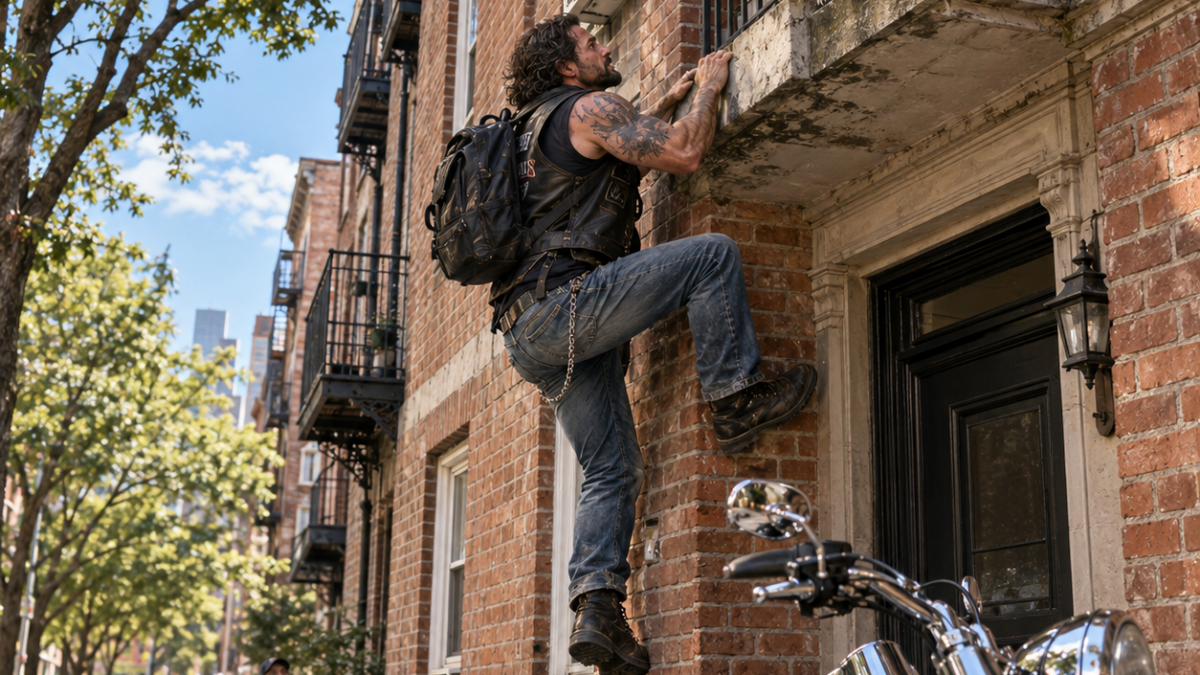
He was tall, broad through the shoulders, built thick in the way men get from years of labor instead of gyms. His beard was full and dark with gray at the chin. His arms were tattooed from wrist to sleeve. He wore a leather vest over a black shirt, with patches I could not read from above. His jeans were worn. His boots heavy. His hands looked like they had broken things and fixed more.
People on the sidewalk glanced at him and looked away quickly.
I felt my body tense.
There it was.
The judgment I would later be ashamed of.
Not safe.
That was the story my mind wrote from the window.
He took off his sunglasses and stared up at the balcony.
The German Shepherd had dragged itself near the railing. Its bark was barely a sound now, more breath than warning.
The biker stood there for a full two minutes.
Still.
Focused.
Then he walked into the lobby.
Twenty minutes later, voices carried down the hallway.
I opened my apartment door a crack.
The biker stood outside the leasing office with Victor in front of him. Several residents had opened doors along the hall. Mrs. Patel stood openly in her doorway, arms crossed, not pretending anything.
“That dog is dying up there,” the biker said.
His voice was low, rough, controlled.
“I understand your concern,” Victor said.
I almost laughed because those words had become the official hymn of uselessness.
“No,” the biker said. “You don’t. Because if you understood, that animal would not still be on that balcony.”
“Sir, we are following legal procedure.”
“Legal procedure doesn’t need six days to notice ribs.”
“We cannot permit residents or visitors to enter another tenant’s unit by force.”
“I’m not asking permission.”
Victor blinked.
The biker stepped closer.
“I’m telling you I’m getting that dog.”
“Sir, if you attempt to break into a unit, I will have to call the police.”
The biker stared at him.
“Then call them.”
Victor swallowed.
“But I’m getting that dog.”
My pulse quickened.
This was dangerous.
This was insane.
This was everything I had been secretly wishing someone would say.
Victor hurried away with his phone already in hand.
The biker walked back outside.
I ran to the kitchen window.
He went to his motorcycle, pulled off a black backpack, opened one side pocket, checked something, then slung it over both shoulders. He looked up at the building again.
Then he started climbing.
Not the stairwell.
Not a ladder.
The actual building.
The front of Larkspur Heights had decorative brickwork and shallow stone ledges under each row of windows. I had always thought they were ugly. I had never considered they might become handholds.
James Morrison did.
He gripped a vertical seam in the brick, planted one boot on the lip of a ground-floor window, and pulled himself upward.
My phone was already in my hand.
My thumb hovered over 911.
He reached the second row of brick.
His arms flexed.
Boots searched for narrow edges.
No rope.
No harness.
No one below spotting him.
Just a middle-aged biker scaling three floors of brick in daylight while residents pressed faces to windows and gasped.
I hit the emergency call button.
Then hesitated before pressing call.
Because at that exact second, he looked up toward the dog, and I saw his face.
Not reckless.
Not performative.
Not wild.
Focused.
The way a firefighter looks moving toward smoke.
The way a surgeon looks before cutting.
The way a person looks when fear is present but not in charge.
I lowered my phone.
Maybe that makes no sense.
Maybe it was irresponsible.
Maybe if he had fallen, I would never have forgiven myself.
But six days of phone calls had done nothing. This stranger was doing the only thing anyone had done that looked like rescue.
So I watched.
He climbed past the first row of windows.
Someone below shouted, “Are you crazy?”
He did not look down.
Second floor.
A child in 2C started crying.
Mrs. Patel appeared on the sidewalk below, one hand pressed to her chest, the other holding her phone.
The dog saw him coming and found a last burst of strength.
It staggered upright, barking and whining, claws scraping against the balcony floor. Its tail moved once, weakly, uncertain whether this approaching human meant salvation or more fear.
James reached the underside of the third-floor balcony.
For a moment, he hung there with both hands on the ledge, boots braced against brick, body stretched over open air.
I stopped breathing.
Then he pulled himself up.
Slowly.
Powerfully.
One arm over.
Shoulder.
Chest.
Knee.
Then he rolled onto the balcony floor.
The dog exploded into desperate barking.
Not aggressive.
Overwhelmed.
James stayed low.
He did not reach fast. Did not grab. Did not crowd the animal. He held one hand out, palm down, fingers relaxed.
“Easy, buddy,” he said.
I could hear him because my window was open and the courtyard carried sound upward strangely.
“Easy. I’m not here to hurt you.”
The dog’s bark broke into a whine.
It stretched its neck toward his fingers.
Sniffed.
Licked.
Then shoved its bony frame forward, pressing against the railing as if trying to crawl into the first kindness that had arrived.
I started crying at my window.
Not quietly.
I pressed my fist to my mouth, but it did not matter.
I had watched that dog die slowly for six days while everyone said wait, and this tattooed stranger was kneeling three floors up, speaking to it like it mattered.
James tried the sliding door.
Locked.
Of course.
He looked inside, then cursed softly.
He unzipped the backpack.
I expected tools.
Crowbar.
Bolt cutters.
Something.
Instead, he pulled out a collapsible bowl, a bottle of water, and a bag of kibble.
That broke me open all over again.
He had not climbed intending to break in first.
He had climbed intending to feed the dog even if that was all he could do.
He poured kibble into the bowl and held it through the metal railing where the dog could reach. With his other hand, he braced himself against the balcony wall.
The dog lunged at the food.
“Slow,” James murmured. “Slow down, buddy. You’ll make yourself sick.”
The dog could not slow down.
Starvation is not polite.
It ate as if every mouthful might disappear.
James did not pull the bowl away. He tilted it carefully, controlling what he could, speaking in that same calm voice.
“That’s it. Easy. I know. I know.”
Below, sirens sounded.
Victor had made his call.
Two police cruisers pulled up, lights flashing but sirens cutting off as officers stepped out and looked up.
The younger officer’s face went slack.
The older one, heavier, with gray hair and a tired posture, put one hand on his radio.
“Sir!” the younger cop shouted. “Stay exactly where you are!”
James glanced down.
“I’m feeding a dog that’s been starving all week while every one of you did nothing.”
The sidewalk crowd murmured.
“I’ll come down when he’s fed.”
“Sir, you need to descend immediately.”
James poured water into the bowl.
The dog drank so desperately that water splashed over its muzzle.
The younger cop muttered something and reached toward the cuffs on his belt, as if he expected to handcuff a man dangling from a third-floor balcony.
The older cop lifted a hand to stop him.
“Wait.”
He stepped closer to the base of the building and looked up.
“James?”
That surprised me.
James looked down again.
“Officer Dugan.”
“You know this guy?” the younger cop asked.
Dugan ignored him.
“Animal control is ten minutes out. They’re bringing bolt cutters and authorization. Can you hold on ten more minutes?”
James looked at the dog.
Refilled the bowl.
“I can hold on all day.”
The older officer sighed, and even from my window, I could see something like respect move across his face.
“Try not to.”
By then, people were filming.
Of course they were.
Phones rose everywhere.
From windows, sidewalks, passing cars.
Someone across the street was already narrating live.
“This biker dude just climbed the building to save a dog, bro, this is crazy…”
I hated the phones and understood them at the same time. Evidence mattered. Attention mattered. Shame sometimes moved institutions faster than compassion.
Animal control arrived nine minutes later.
A woman in uniform jumped out before the truck fully stopped.
Sarah.
I knew her from one of the earlier visits, though we had only spoken briefly. Her hair was pulled into a tight braid, and her face had the controlled urgency of someone furious but working.
She ran inside with two officers and a maintenance worker carrying tools.
From my apartment, I heard pounding.
Then drilling.
Then the whine of a power tool.
The dog startled at the sound and backed against the railing.
James shifted closer.
“Easy, buddy. That’s help. That’s help coming.”
His arms had to be screaming by then. Sweat darkened his black shirt. His hands were scraped bloody across the knuckles. He kept one knee wedged against the balcony corner and one boot hooked beneath the railing for balance.
The sliding door finally opened.
Sarah stepped onto the balcony slowly, holding a leash and speaking softly.
The dog turned in panic, uncertain between James and the open door.
James made the choice for him.
“Go on,” he said. “She’s got you now. You’re safe.”
The dog hesitated.
Then, with heartbreaking obedience, it moved toward Sarah.
She slipped the leash over its head, crouched, and let it lean against her legs. Her face crumpled for half a second when she felt how thin it was.
Then she became professional again.
“We’ve got him,” she called down.
The crowd cheered.
James stayed where he was for another moment, watching until the dog disappeared inside.
Then he started climbing down.
That was worse than watching him go up.
Going up had purpose pulling him. Going down was only gravity waiting for a mistake.
The crowd went silent.
Step by step, handhold by handhold, James lowered himself from the third floor to the second. His boot slipped once, scraping against brick, and everyone gasped. He caught himself with one arm and held there long enough that my own muscles hurt from watching.
Then he continued.
When his boots finally hit the sidewalk, the crowd erupted.
Cheers.
Clapping.
A few whistles.
Someone shouted, “Hell yeah, biker!”
Officer Dugan stepped forward and handed him a bottle of water.
“That was stupid,” Dugan said.
James opened the bottle with shaking hands.
Dugan’s mouth twitched.
“Also brave. Also stupid.”
James drank half the bottle in one pull.
“Couldn’t let it die.”
“We have procedures for these situations.”
James wiped his mouth with the back of his hand and looked at him.
“Your procedures took six days. That dog wouldn’t have made another two.”
Dugan had nowhere to go with that.
Neither did any of us.
Sarah came out twenty minutes later with the German Shepherd wrapped in a blanket and carried in both arms with help from another animal control officer. Up close, the dog looked even worse. Ribs like fingers beneath fur. Eyes sunken. Tongue pale. Its paws trembled.
But alive.
Sarah walked straight to James.
“You probably just saved this dog’s life,” she said. “You also broke somewhere around seven laws doing it.”
James looked at the police.
The younger officer still looked eager to prove something.
Dugan did not.
Sarah smiled faintly.
“But I don’t see any reason to put most of that in my report.”
Dugan scratched his chin.
“Report says concerned citizen provided food prior to animal removal.”
The younger officer opened his mouth.
Dugan looked at him.
The mouth closed.
James nodded once.
“Thanks.”
Sarah’s eyes softened.
“Thank you.”
The dog lifted its head weakly at the sound of James’s voice.
For a second, they looked at each other.
Then Sarah carried it to the truck.
The crowd began breaking apart.
Victor stood near the entrance, pale and sweating, repeating to anyone who would listen that the leasing office had followed appropriate legal channels. Nobody seemed interested in believing him anymore.
I went downstairs before I could talk myself out of it.
James stood by his bike, inspecting scrapes on his hands. Blood marked his knuckles. Brick dust streaked his jeans. He looked less like a criminal than a man who had done exactly what he came to do and now wanted to disappear before gratitude made things awkward.
“I’m in 3B,” I said.
He looked up.
His eyes were blue-gray, tired, and sharper than I expected.
“I’ve been watching that dog all week,” I continued. “I called everyone I could think of.”
He nodded.
“System’s too slow sometimes.”
“You could have been killed.”
He shrugged.
“Could’ve.”
“That’s your answer?”
“Wasn’t.”
I stared at him.
He glanced toward the balcony, now empty.
“Had a German Shepherd when I was a kid,” he said. “Best friend I ever had. Saw that dog up there and knew somebody had to move.”
“So you scaled a building.”
“Seemed quickest.”
Despite everything, I laughed.
It came out shaky.
“I almost called 911 on you.”
“You wouldn’t have been the only one.”
“I thought…”
I stopped.
He looked at me, waiting.
I could have softened it.
I did not.
“I thought you were breaking in.”
“Fair.”
“Is it?”
He looked down at his vest, his tattoos, his bloody hands.
“People see what they’ve learned to see.”
That should have absolved me.
It did not.
“What’s your name?” I asked.
“James Morrison.”
“Nora Whitaker.”
He nodded.
“Good to meet you, Nora.”
Then he started his bike.
The loud pipes that had irritated me an hour earlier sounded different now.
Not gentler.
They were still obnoxious.
But now they sounded like arrival.
Three days later, the internet had turned James into something he clearly did not want to be.
The first video hit fifty thousand views by dinner.
By the next morning, local news had picked it up.
BIKER RISKS LIFE TO SAVE STARVING DOG.
LEATHER-CLAD HERO CLIMBS BUILDING AFTER AUTHORITIES DELAY.
MAN FEEDS ABANDONED SHEPHERD THREE FLOORS UP.
The comments did what comments do.
Half called him a hero.
Some said he was reckless.
Others asked why nobody helped sooner.
A few blamed the dog for barking.
The internet contains every kind of person, including the kind who can see a starving animal and still find a way to be smug.
The German Shepherd was taken to Harbor Light Animal Clinic.
Sarah came to my door on the third day because I had left my number with animal control.
She looked exhausted.
“How is he?” I asked before she even said hello.
“Alive.”
That one word nearly dropped me.
“He needed fluids, bloodwork, treatment for dehydration, and surgery for an intestinal blockage.”
“Surgery?”
She nodded.
“Starving dogs eat things they shouldn’t. There were pieces of plastic, cloth, and balcony debris in his stomach. He was trying to survive.”
I leaned against the doorframe.
“Oh God.”
“He pulled through the surgery.”
I covered my mouth.
“But he’s not out of the woods yet,” Sarah continued. “He’ll need weeks of monitored feeding, medication, and foster care.”
“What’s his name?”
“We don’t know. Mark Rudd never registered him properly. Vet records are spotty.”
“Mark should be in jail.”
Sarah’s mouth tightened.
“He’s being investigated for animal cruelty and abandonment.”
“Investigated.”
“I know.”
She sounded as tired of procedures as I was.
Then she took a breath.
“There’s something else.”
My stomach tightened.
“What?”
“Someone online started a fundraiser for the dog’s medical care. It detonated.”
“Detonated?”
“Over one hundred twenty-seven thousand dollars in three days.”
I stared.
“For one dog?”
“For one dog, one viral rescue, and six days of public outrage.”
“That’s…”
“A lot. Vet bills and rehab will be covered. Even after setting aside for his ongoing care, there’s about a hundred nineteen thousand left.”
I blinked.
“What happens to it?”
“The organizer wants the balance to go to James Morrison.”
That made sense.
Then Sarah’s face told me there was a problem.
“You can’t find him.”
“We can’t find him. He never gave contact information. Police had a name, but the address on his license is outdated. No active social media. No club affiliation that we can confirm. He melted away.”
A man climbs a building, saves a dog, refuses attention, and disappears before anyone can thank him.
It was almost irritatingly noble.
“Most biker thing I’ve ever heard,” I said.
Sarah smiled faintly.
“Can you help find him?”
“I met him for three minutes.”
“You got more than most.”
I thought about his bike.
Black.
Scratched tank.
A silver wolf emblem near the rear fender.
The patch on his vest I had noticed only afterward in the videos: MORRISON GARAGE.
“Maybe.”
I became mildly obsessed.
That is the polite phrase.
The honest phrase is I spent the next week searching for a stranger because I could not stand the idea that the only person who had truly acted would vanish while the rest of us shared videos and felt inspired.
I watched clips frame by frame, trying to read patches, license plates, anything. I called two motorcycle shops. I asked a delivery driver who rode a Harley if he knew a James Morrison. I posted in a local community group and immediately received seventeen wrong answers and one marriage proposal from a man named Tank.
Then, eight days after the rescue, I saw him at a red light.
Same black motorcycle.
Same vest.
Same posture.
He was idling at the corner of Fulton and Madison, one boot on the pavement, looking like a man waiting for the universe to stop bothering him.
I panicked.
There is no dignified way to chase a motorcycle in a compact hatchback while waving both arms.
I did it anyway.
He turned into a hardware store parking lot.
I followed, parked badly, and jumped out.
“James!”
He turned fast, body tensing.
Then he recognized me.
“Nora from 3B.”
“I’ve been trying to find you.”
His face tightened.
“Something happen to the dog?”
“No. He’s okay. Surgery went well. He’s recovering.”
His shoulders loosened.
“Good.”
“A family is interested in adopting him eventually. Big yard. Two kids. Experience with shepherds.”
“Good,” he said again.
He started to put his helmet back on.
“Wait.”
He paused.
“There’s money.”
That got a frown.
“What money?”
I explained the fundraiser, the vet bills, the balance, Sarah, the organizer, the plan to give it to him.
He stared at me like I had suggested paying him in snakes.
“No.”
“You haven’t heard the amount.”
“Don’t need to.”
“It’s one hundred nineteen thousand dollars.”
His expression did not change.
“No.”
“You climbed three floors and risked your life.”
“I fed a dog.”
“You saved him.”
“Dog saved himself by holding on six days.”
“That is not how most people see it.”
“Most people weren’t up there.”
He looked away toward the street.
“Give it to rescues.”
“James—”
“I don’t need money for doing the thing everyone should have done.”
That sentence hit harder than he intended.
Because I had not done it.
Not really.
I made calls.
He moved.
“You should at least take some.”
“No.”
“You’re impossible.”
“So I’ve been told.”
Eventually, he agreed to meet Sarah.
Not for an interview.
Not on camera.
Not at an event.
In the back room of an animal clinic after hours, with no reporters, no speeches, and no one calling him a hero.
I was invited only because I had found him.
Sarah brought paperwork. The fundraiser organizer joined by phone. James sat with his arms crossed, visibly uncomfortable with gratitude as a concept.
They divided the money among five animal rescue groups: Harbor Light’s emergency fund, a German Shepherd rescue, a senior dog sanctuary, a low-income veterinary care program, and a legal advocacy group that helped pursue animal cruelty cases.
“Keep some for yourself,” Sarah tried once.
James shook his head.
“Buy bolt cutters.”
She laughed.
Then realized he was not joking.
“We have bolt cutters.”
“Buy faster ones.”
The room went quiet.
Sarah wrote that down.
The dog recovered slowly.
His foster family called him Morrison at first as a joke.
Then the name stuck.
Morrison gained weight ounce by ounce. His coat improved. His eyes grew brighter. At first, he panicked if left near glass doors or balconies. He ate too fast. He hoarded food under blankets. He woke from sleep barking.
Trauma does not vanish because rescue arrives.
But he learned.
The foster family became the adoptive family.
Of course they did.
They had two children, nine and twelve, who sat on the floor and read aloud to him until he trusted their voices. They had a fenced yard, patient hands, and another older dog who taught Morrison where sun patches were best.
They invited James to meet him.
He refused.
“Why?” I asked when Sarah told me.
Sarah shrugged.
“He said the dog was happy, and that was all that mattered.”
I understood and did not.
A few weeks later, I saw James ride past our building.
He did not stop.
He eased off the throttle near the balcony.
Looked up.
The balcony was empty.
Cleaned.
Repainted.
Silent.
Then he rode on.
That should have been the end.
But public attention does strange things to private failure.
The viral video forced an investigation into Larkspur Heights. Residents flooded city offices with complaints. Reporters asked why animal control had been unable to act for six days. Animal control pointed to legal restrictions. The leasing company pointed to procedure. The police pointed to jurisdiction. Everyone pointed somewhere.
For once, the pointing was filmed.
Mrs. Patel organized residents better than any attorney could have.
She collected call logs, emails, screenshots, timestamps, videos of the dog crying, and the leasing office’s disabled reply thread. She created a folder labeled DOG FAILURE, which was the most Mrs. Patel thing imaginable.
I helped.
Guilt is an excellent administrative motivator.
We documented everything.
Every call.
Every “we’re handling it.”
Every “cannot enter.”
Every hour that dog remained without food or water.
Mark Rudd was eventually found in Virginia Beach.
He claimed he had arranged for “someone” to pick up the dog.
He could not name the someone.
He claimed he thought the balcony door was open.
It was locked.
He claimed the dog was aggressive and he had been afraid.
Videos showed the dog starving and seeking help from every human who approached.
He was charged with animal cruelty and abandonment.
Was the sentence enough?
No.
Sentences rarely are.
But he stood in court while the prosecutor showed photos of Morrison’s condition. He had to look at what he had done. He had to hear the vet describe dehydration, starvation, intestinal blockage, muscle wasting, and fear. He had to hear that the dog survived not because of him, not because of the building, not because of any agency, but because a stranger climbed a wall.
Mark’s face showed shame only when cameras turned toward him.
That told me enough.
The leasing company was fined for mishandling the abandoned unit and failing to expedite emergency access after clear evidence of animal distress. Victor was “reassigned,” which in corporate language meant sacrificed just enough to preserve the larger machine.
Animal control changed its emergency protocol for animals trapped on balconies or visible exterior spaces without access to food or water. Police and animal control created a joint exigent response policy.
Sarah sent James a copy of the policy update.
He read it in my kitchen.
Yes, my kitchen.
By then, James Morrison had somehow become part of my life in the inconvenient way stray cats become part of a porch. You feed them once emotionally, and suddenly they appear at odd hours with engine trouble, coffee, or a piece of news they pretend is not important.
He had dropped by to return a book I had lent him about trauma in rescue dogs.
He claimed he hated it.
He had dog-eared seventeen pages.
When Sarah’s email came, I printed it because James did not “do attachments.” He read the policy slowly.
Then he folded the paper.
“Good,” he said.
“That’s it?”
“That’s a lot.”
“It doesn’t sound like a lot.”
“It is.”
He tapped the paper.
“Next dog gets help faster.”
That was how James measured victory.
Not applause.
Not interviews.
Next time.
The more I learned about him, the more ashamed I became of my first assumption.
James owned a small independent motorcycle repair garage on the west side. He lived above it. He had been sober sixteen years. He had served two tours as an Army mechanic and came home with a bad knee, worse dreams, and a talent for fixing engines that did not extend to fixing himself for a long time.
The German Shepherd from his childhood had been named King.
“He wasn’t really mine,” James told me one evening.
We were sitting on the front steps of my building, which I had once considered too dirty to sit on. Life changes standards.
“My old man brought him home from somebody who owed him money. King was supposed to guard the yard. Mostly he guarded me.”
“From what?”
James looked at the street.
“The house.”
I did not ask more.
He gave it anyway, not because he liked talking, but because silence sometimes stops working.
“My father drank. Mean drunk. My mother worked nights. King slept outside my window. If my old man started in, that dog would bark until the neighbors looked out. Bought me time.”
“What happened to him?”
James rubbed one thumb over the scarred knuckles of his other hand.
“Dad left him chained when we got evicted. I was fourteen. Came back next day with food I stole from a corner store. Dog was gone. Animal control, neighbor, dead—I never knew.”
I understood then.
Of course he climbed.
For Morrison, yes.
But also for King.
For the fourteen-year-old who came back too late.
“You couldn’t save him,” I said.
James’s jaw tightened.
“No.”
“So you saved this one.”
He looked at me.
“Maybe.”
That was James.
He could scale a building but struggled to stand near his own grief without pretending it was someone else’s.
Months passed.
Morrison the dog became healthy enough to visit Harbor Light’s donor event. James refused to attend. I went with Sarah.
The dog was beautiful by then.
Still lean, but strong. Coat shining. Ears high. Eyes alert. He wore a blue bandana and leaned against his new family’s youngest child like he had assigned himself a job.
When he saw the rescue video playing silently on a screen, Morrison tilted his head at the image of James on the balcony.
Then he whined.
His adoptive mother turned to me.
“Do you think he remembers him?”
“Yes,” I said.
I had no proof.
I did not need it.
At the end of the event, they announced the Morrison Fund, created from the leftover donations James had refused. It would pay emergency medical costs for abandoned animals and help shelters buy equipment for urgent rescues. Sarah cried while trying not to. Mrs. Patel recorded the entire thing even though she claimed she did not know how phones worked.
I sent James a photo of Morrison in his bandana.
He replied four hours later.
Good dog.
That was it.
But the next morning, when I went downstairs for coffee, James was parked across the street, looking up at the old balcony again.
I walked over.
“You know stalking a balcony is weird.”
He did not look embarrassed.
“Was passing by.”
“You live twenty minutes west.”
“Long way.”
“Very long.”
He looked at the building.
“I kept thinking about him up there.”
“Me too.”
“You did what you could.”
“No,” I said.
That made him look at me.
“I did what was comfortable. Calls. Emails. Complaints. Things that kept me safe and legal and let me feel less responsible. You did what had to be done.”
James frowned.
“Don’t turn me into a saint. I’m not one.”
“I know.”
His eyebrow lifted.
“You say that quick.”
“You’re stubborn, rude to reporters, allergic to compliments, and your motorcycle is too loud.”
“Fair.”
“But you moved.”
He looked away.
“I’m not saying laws don’t matter,” I continued. “I’m not saying everyone should climb buildings.”
“Good.”
“I’m saying I learned something ugly about myself that week.”
“You cared.”
“I hesitated.”
“Everybody hesitates.”
“You didn’t.”
He looked back at me then.
“You think I didn’t stand on that sidewalk for two minutes scared stupid?”
I blinked.
“I watched that balcony thinking, If I fall, I’m dead or worse. Thinking, Cops will arrest me. Thinking, dog might bite me. Thinking, I’m too old for this. Thinking, somebody younger should be here.”
He nodded toward the building.
“But the dog didn’t have time for me to finish being scared.”
That stayed with me.
Courage was not being fearless.
It was fear interrupted by urgency.
A year later, Larkspur Heights held a residents’ meeting about installing new emergency access protocols, external cameras, and balcony welfare checks for abandoned units. The leasing company sent a regional manager in a navy suit who used phrases like “learning opportunity” and “resident concern.”
Mrs. Patel nearly swallowed her tongue.
I stood and spoke.
My voice shook at first.
Then steadied.
I talked about hearing Morrison cry at night. About calling every number. About watching residents look at each other in hallways, angry and helpless. About the danger of hiding behind procedure until compassion becomes someone else’s job.
Then I said, “The only person who acted fast enough was a man most of us would have judged from the sidewalk. He should never have needed to climb that wall. But we should all ask ourselves why he did.”
The room went quiet.
Afterward, Victor’s replacement, a woman named Denise, approached me.
“I read the file,” she said. “It should not have happened.”
“No.”
“It won’t happen again.”
I wanted to believe her.
I almost did.
Outside, James waited by his bike.
“You didn’t come in,” I said.
“Nope.”
“You were invited.”
“Still nope.”
“They talked about you.”
He looked horrified.
“Why?”
“Because you’re central to the story.”
“I hate stories where I’m central.”
“That must be difficult, being a local legend.”
He put on his helmet.
“I’m leaving now.”
I laughed.
He paused before starting the engine.
“You did good in there?”
It was a question.
Not a statement.
I thought about it.
“Yes.”
He nodded.
“Good.”
That was all.
From James, it felt like a medal.
Morrison’s adoptive family sent updates every few months.
Photos in the yard.
Photos asleep on the couch.
Photos wearing ridiculous holiday antlers.
In every picture, he looked more present.
That is the only word I have.
Not just alive.
Present.
As if his body had finally learned no one was coming to lock him out again.
One spring afternoon, nearly two years after the rescue, Sarah called me.
“I need a favor.”
“That sounds ominous.”
“Morrison’s family is moving out of state.”
My heart dropped.
“They’re giving him up?”
“No. Taking him, obviously. They’re wonderful, not monsters. But before they go, their youngest wants to meet James. Apparently Morrison still perks up every time a motorcycle passes, and the kid has decided he needs closure.”
“James will say no.”
“I know.”
“He already said no.”
“I know.”
“You want me to ask him anyway.”
“Yes.”
“Why me?”
“Because he likes you.”
I scoffed.
Sarah said nothing.
“Oh, shut up,” I told the silence.
I asked James that evening at his garage.
He was rebuilding a carburetor and pretending not to listen as I explained.
“No,” he said before I finished.
“You didn’t let me get to the sentimental child part.”
“I assumed.”
“The kid made a card.”
“No.”
“Morrison might remember you.”
His hands paused.
Then resumed.
“Dog’s happy.”
“Yes.”
“That’s enough.”
“Maybe it’s not only for the dog.”
He looked up then.
I regretted nothing.
“The little boy needs to thank the person who saved his dog.”
“No, he doesn’t.”
“Yes, he does. Because kids need to know there are people who show up. They need to see it has a face.”
James looked back at the carburetor.
“I’m not good with kids.”
“You climbed three floors with kibble in a backpack. Nobody is asking you to perform balloon animals.”
He sighed.
“Hard pass.”
I waited.
Silence stretched.
He muttered something under his breath.
“What was that?”
“I said fine.”
“Really?”
“I can still change my mind.”
“I’ll stop talking.”
“First time for everything.”
Morrison saw James from across the clinic parking lot.
The dog froze.
Ears forward.
Tail still.
James stood beside me looking like he wanted to fight a war instead.
Then Morrison began whining.
Not fear.
Recognition.
He pulled toward James so hard his adoptive father nearly lost the leash.
James crouched just as Morrison reached him.
The German Shepherd pressed his whole body into James’s chest.
Not jumped.
Not frantic.
Pressed.
Like he had been waiting to put the memory somewhere safe.
James closed one hand over the dog’s back.
His eyes shut.
“Hey, buddy,” he whispered.
Morrison licked his beard.
The little boy who owned him now stood nearby holding a handmade card. He was maybe seven, with glasses and solemn eyes.
“You saved my dog,” he said.
James opened his eyes.
“Dog did most of the work.”
The boy frowned.
“My mom says grown-ups say stuff like that when they don’t want to say thank you.”
James looked at me.
I smiled.
Children are useful.
The boy held out the card.
James took it carefully.
On the front was a drawing of a very large stick figure biker on a very small motorcycle beside a very large dog. Above them, in uneven letters, it said:
THANK YOU FOR CLIMING.
The B was missing.
James stared at it for a long moment.
Then said, “Best card I ever got.”
The boy beamed.
Morrison leaned harder against James.
Sarah cried openly.
I pretended not to.
After they left, James sat on the curb for a while.
I sat beside him.
“You okay?”
“No.”
“Good answer.”
He huffed a laugh.
“That dog looks good.”
“He does.”
“Kid loves him.”
“He does.”
James held the card in both hands.
After a long silence, he said, “King would’ve liked him.”
I did not touch him.
I did not need to.
“Yeah,” I said. “I think so too.”
James framed the card.
He will deny this if asked.
But I have seen it hanging in his garage office, right beside his business license.
THANK YOU FOR CLIMING.
Eventually, the balcony became just a balcony again.
New tenants moved into 3D. A young couple with too many plants and a cat that judged everyone through the glass. They did not know, at first, what had happened there.
I told them.
Not to frighten them.
Because places remember whether we admit it or not.
They listened quietly.
A week later, they hung a small wind chime near the railing.
“For good energy,” the woman said.
Mrs. Patel called it nonsense.
But she smiled when it rang.
As for me, I changed in ways that were not dramatic enough for videos but mattered more.
I stopped assuming action belonged to someone else.
I started volunteering with Sarah’s rescue twice a month, mostly paperwork at first, then transport, then foster coordination. I learned how many animals fall through gaps: legal gaps, funding gaps, attention gaps, compassion gaps. I learned that outrage is easy and logistics are holy.
I also learned that the people who show up rarely look the way you expect.
A retired accountant who bottle-fed kittens every three hours.
A teenage boy with face piercings who could calm feral cats like magic.
A grandmother who drove emergency transports in a church van.
A tattooed biker who pretended he only cared about engines but kept a bag of dog food in his saddlebag “just in case.”
James and I became friends.
Then, slowly, something more complicated than friendship and less easily named.
But that is not the point of this story, and James would climb another building just to avoid being described romantically online.
What I will say is this:
Some people enter your life by knocking.
Some by crashing.
Some by climbing past your window with a backpack full of kibble.
I am less concerned now with how people arrive than with what they do once they get there.
James Morrison still rides a motorcycle too loud for civilized society. He still scares strangers on sidewalks. He still refuses interviews, hates being called a hero, and believes most emotional conversations can be avoided by checking tire pressure.
But I know what he is.
He is the man who looked up and saw a life fading behind a railing.
He is the man who understood that waiting for permission can become its own kind of cruelty.
He is the man who climbed because a dog could not.
And I am the woman who almost called the police on him before realizing he was doing what I had been begging someone to do all week.
That shame has become useful.
It keeps me humble.
It reminds me that decency is not what I believe about myself when nothing is demanded of me.
Decency is what I do when the phone calls fail.
When procedure stalls.
When fear speaks first.
When the person moving toward danger looks nothing like I expected help to look.
The last time I saw Morrison the dog, he was riding away in the back seat of his family’s SUV, head out the window, ears lifted in the wind. James stood beside me as the car turned the corner.
Morrison looked back once.
I swear he did.
James lifted two fingers in a small goodbye.
Then the dog was gone.
For a while, neither of us spoke.
Finally, I said, “You know he remembers.”
James looked down the empty street.
“Maybe.”
“He does.”
“You always this sure?”
“No.”
He glanced at me.
“But I’m sure about this.”
The wind moved through the trees. Somewhere above us, the chime on 3D’s balcony rang softly.
James looked up.
Empty balcony.
Open sky.
No crying.
No scratching.
No desperate barking in the night.
Then he nodded once.
“Good.”
That was all he needed.
Maybe that is what real rescue looks like in the end.
Not applause.
Not headlines.
Not a check with too many zeroes.
Just an empty balcony where suffering used to be.
A dog asleep in a home where he is loved.
A policy changed before the next emergency.
A woman at a window who learned to look twice.
And a man in a leather vest riding away before anyone can make him into something simpler than he is.
Some people wear capes.
Some people wear uniforms.
Some people wear suits and carry clipboards and explain why nothing can be done yet.
And some people wear leather, park at the curb, look up at a starving dog, and decide that “yet” has run out of time.
I had my thumb on the emergency call button that morning.
I thought I was about to report a criminal.
Instead, I witnessed courage.
And I have never judged a book by its cover again.








