I Brought My Premature Baby’s Blanket to the NICU—Then Our Cat Refused to Leave the Incubator for 41 Days
PART3:
For twelve hours, Caleb held my hand until his knuckles turned white.
For twelve hours, I prayed in fragments because full prayers required a calm I did not have.
Please.
Not yet.
Please.
She’s too small.
Please.
Please.
At 3:17 a.m., her heart rate dropped and did not recover fast enough.
A doctor named Dr. Elena Ruiz looked at me, then at Caleb.
Her eyes were kind.
That was how I knew.
“We need to deliver now.”
My daughter entered the world in an operating room full of white light.
I did not hear her cry.
That is the first thing people ask without meaning to hurt you.
Did she cry?
No.
There was only a quick glimpse of something impossibly small, red and fragile, lifted from my body by gloved hands. A neonatal team surrounded her before I could understand she was no longer inside me.
Caleb stood near my head, pale and shaking.
“What’s happening?” I asked.
No one answered quickly enough.
“What’s happening?”
A nurse leaned close.
“They’re helping her breathe.”
“What’s her Apgar?”
I only knew the word from pregnancy books.
The nurse did not answer.
That was when I started sobbing.
Not loudly.
I was too numb for loud.
Tears slid into my hairline while someone stitched my body closed and my daughter fought for air across the room.
We had chosen the name Clara.
Clara June Cole.
Clara after Caleb’s grandmother, June because she was supposed to be born in June.
She arrived in March.
Fourteen weeks early.
One pound, ten ounces.
Seven hundred and fifty grams.
When they finally wheeled me into the neonatal intensive care unit, I thought I was prepared.
I had seen premature babies in awareness videos. I had seen tiny diapers and little hats. I had heard words like miracle and fighter, words people use when they want terror to sound inspirational.
Nothing prepared me for seeing Clara in the incubator.
She did not look like a baby at first.
That is the truth I hated myself for thinking.
She looked like something unfinished.
Skin almost translucent.
Eyes sealed.
Arms thinner than my fingers.
A chest that rose because a machine insisted it must.
Tubes.
Wires.
Tape.
A breathing tube smaller than anything I had known existed.
Her diaper was the size of a folded tissue.
Her hand was so small that her fingers curled around nothing.
I reached toward the incubator and stopped because I did not know where I was allowed to touch.
Dr. Ruiz stood beside us with a neonatologist named Dr. Samuel Hart.
He had tired eyes and a voice that did not waste words.
“Your daughter is extremely premature,” he said gently. “Her lungs are not fully developed. She required significant resuscitation. We are supporting her breathing and blood pressure. The next several hours are critical.”
“How critical?” Caleb asked.
Dr. Hart hesitated.
I hated him for hesitating.
Then I loved him for telling the truth.
“We need you to prepare for the possibility that she may not survive the next six hours.”
Six hours.
A life measured in less than a work shift.
Less than the drive to my mother’s house and back.
Less than a night of sleep.
Less than the time Morse spent on my belly most evenings, purring over the child we had not yet held.
Caleb made a sound behind me.
I placed my palm on the side of the incubator.
The plastic was warm.
“Hi, Clara,” I whispered.
Her chest fluttered.
“I’m here.”
Six hours passed.
She lived.
No one celebrated.
Not exactly.
In the NICU, survival is counted quietly because everyone knows the next hour may take back what the last hour gave.
Twelve hours passed.
She lived.
Forty-eight.
She lived.
By the third day, I understood that the world had split into two places.
There was the NICU, where every number on a monitor had the power to empty my lungs.
And there was everywhere else, where people bought coffee, complained about parking, pushed grocery carts, and answered emails as if life had not become a screen showing oxygen saturation and heart rate.
I was discharged before Clara was.
That felt obscene.
A nurse came into my postpartum room with discharge papers and instructions about incision care, bleeding, pain medication, and warning signs.
I stared at her.
“My baby is upstairs.”
“I know.”
“You’re sending me home without her.”
Her face softened.
“I know.”
I wanted to refuse.
I wanted to chain myself to the NICU floor.
But hospitals do not keep mothers in beds because their babies are not ready to leave plastic boxes.
Caleb drove me home four days after Clara’s birth.
I sat in the passenger seat with a folded hospital blanket in my lap and an emptiness where my daughter had been.
My body still believed it was pregnant.
Then it remembered it was not.
Milk came in for a baby I could not nurse.
My incision pulled.
My arms ached with an instinct that had nowhere to go.
When we opened the farmhouse door, Morse appeared in the hallway.
She stopped.
Looked at me.
Looked behind me.
Then looked at my stomach.
I had not thought about what my return would mean to her.
She had last seen me round with life, a body carrying the heartbeat she guarded every night.
Now I was hollowed out, holding nothing.
Morse walked to me slowly.
She sniffed the hospital blanket.
Then circled my feet.
Then walked into the living room.
Then the nursery.
Caleb and I followed.
She jumped into the crib.
Sniffed the sheet.
Jumped down.
Checked beneath it.
Walked to the closet.
Pushed it open with her head.
Looked inside.
Returned to the crib.
“Mosie,” I whispered.
She ignored me.
For three days, Morse searched the house.
Room by room.
Closet by closet.
Under the bed.
Behind the bathroom door.
Inside the laundry basket.
She checked the crib seventeen times the first day.
I counted because I could not stop watching her.
Each time, she jumped in, sniffed, turned in a circle, and looked at me as if asking where I had put the baby.
By the third night, I sat on the nursery floor and cried so hard Caleb found me bent over with my forehead against the rug.
Morse sat in the crib above me, staring down.
“She doesn’t understand,” I sobbed.
Caleb sat beside me, moving carefully because my incision still hurt when I folded too far.
“I don’t think we understand either.”
Every morning, we drove ninety minutes to St. Adelaide.
Every night, we drove home without Clara.
The road between our farmhouse and the hospital became a punishment I memorized.
Soybean fields.
Gas station with a broken sign.
White church.
Bridge over a narrow river.
Industrial park.
City traffic.
Parking garage.
Elevator.
Handwashing station.
NICU doors.
Buzz.
Wait.
Enter.
Scrub.
Gown.
Look at the monitor before looking at my child because I had become superstitious about numbers.
Clara’s heart rate was unstable from the beginning.
It climbed too high.
Dropped too low.
Her oxygen hovered around numbers that made nurses watch without explaining too much.
Every beep lodged beneath my skin.
I could not hold her at first.
She was too fragile.
Too many lines.
Too much support.
So I placed my hand through the little round porthole in the incubator and rested one finger near her leg, not on her unless the nurse said it was okay.
“Containment touch,” they called it.
A still hand.
No stroking.
No rubbing.
Just steady pressure, because premature babies can be overwhelmed by sensation.
Imagine that.
A mother waiting months to touch her child, then learning even love had to be kept still.
On the fourth day, Dr. Hart approved kangaroo care.
Skin-to-skin.
Supervised.
Short.
Careful.
I was terrified.
Two nurses and a respiratory therapist helped move Clara from the incubator to my chest. Tubes and wires followed her like a fragile web. She weighed almost nothing, and yet the moment her body touched mine, I felt the weight of the entire world.
Her skin was warm.
Too warm and not warm enough.
Her tiny head rested between my breasts.
I could feel the faint flutter of her breathing.
I did not move.
I barely breathed.
Caleb sat beside me with tears running silently down his face.
“Hi, baby girl,” I whispered.
For forty-seven minutes, Clara lay against me.
Her oxygen improved slightly.
Her heart rate settled, then wavered, then settled again.
When they placed her back in the incubator, I felt like someone had removed an organ.
That afternoon, a nurse named Joy told me we could bring a small cloth or blanket from home.
“Something that smells familiar,” she said. “A lot of families bring a bonding cloth. Sometimes scent helps. It’s not magic, but it can be comforting.”
Nothing in the NICU was magic.
Everything was measured, charted, adjusted, documented.
Still, I clung to the word help like a rope.
At home, I stood in the nursery holding the small cream blanket from Clara’s crib.
Morse had slept on it every day since I came home.
It was covered in tortoiseshell hair.
I almost washed it.
Then I didn’t.
I folded it carefully and placed it in a sealed bag.
Morse watched from the crib.
“This is for her,” I told the cat.
She jumped down and sniffed the bag.
Then she pressed her face against it.
The next morning, Joy placed the blanket over the top of Clara’s incubator, not inside. Infection control mattered. Everything had rules. But the warmth of the incubator released the scent slowly.
Home.
Cotton.
My skin.
Morse.
Forty minutes later, Clara’s heart rate stabilized in a way it had not before.
I did not notice first.
Joy did.
She stood at the monitor, head tilted.
“Huh.”
That sound became enormous to me.
“What?”
“Nothing bad.”
“Joy.”
She smiled.
“Her heart rate has been steadier.”
“For how long?”
“About thirty minutes.”
We watched.
Her oxygen saturation, which had been hovering stubbornly around eighty-eight to ninety, climbed to ninety-four.
Then stayed there.
A number can become a prayer.
Ninety-four.
Ninety-four.
Ninety-four.
I looked at the blanket on top of the incubator.
Then at my daughter.
Then at the tortoiseshell hairs clinging to the fabric.
When Caleb came after work, I told him.
He placed both hands on the incubator.
“Morse knew her,” he said.
It sounded ridiculous.
It also sounded true.
That night, at home, I sat at the kitchen table and cried for an hour.
Not because Clara was worse.
Because she was better.
Hope hurt more than despair sometimes.
Despair was heavy but still.
Hope moved.
Hope lifted its head.
Hope asked you to imagine a future and risk losing it all over again.
Morse sat on the chair beside me, tail wrapped around her paws.
I looked at her.
“What if you came?”
Caleb, standing at the sink, turned.
“Hannah.”
“I know.”
“No hospital is letting a cat into the NICU.”
“I know.”
Morse blinked slowly.
“But what if?”
The next morning, I asked Joy.
She stared at me.
“No.”
“I figured.”
“No, like absolutely no.”
“Okay.”
“It’s a neonatal intensive care unit, Hannah.”
“I know.”
“With immunocompromised premature infants.”
“I know.”
“And you want to bring a cat.”
“When you say it like that, it sounds unreasonable.”
“It is unreasonable.”
I nodded.
Then I asked Dr. Hart.
He also said no.
At first.
Then he looked at Clara’s chart.
Then at the notes about the blanket.
Then back at me.
“We cannot allow an animal in the NICU,” he said.
“I understand.”
“However.”
That word reopened the universe.
He removed his glasses and rubbed the bridge of his nose.
“If there were to be any consideration, it would require administrative approval, infection control review, veterinary clearance, behavioral assessment, strict containment, and a liability waiver.”
My mouth went dry.
“So it’s possible?”
“I did not say that.”
“But not impossible.”
“I also did not say that.”
“Dr. Hart.”
He sighed.
“I am saying that I saw what happened after the blanket was introduced. I am also saying hospitals have rules for good reasons.”
“I’m not asking to break rules.”
“You are asking for something the rules were not designed to permit.”
“Then maybe the rules need help.”
He studied me for a long moment.
I expected annoyance.
Instead, I saw tired compassion.
“I will ask.”
The process took a week.
Seven days in the NICU feel like seven years and seven seconds at once.
Morse went to our veterinarian twice.
Full exam.
Vaccinations verified.
Parasite check.
Fecal test.
Behavior evaluation.
Claw trim.
Bath, which Morse considered an act of war and for which she punished us with silence until dinner.
The hospital’s infection control nurse, a woman named Diane Pickett, interviewed us with the expression of someone who had personally prevented plagues through paperwork.
“Has the cat ever bitten anyone?”
“No.”
“Scratched?”
“Not aggressively.”
“Define not aggressively.”
“She once scratched Caleb because he tried to move her off the clean laundry.”
Diane looked at Caleb.
He nodded solemnly.
“I deserved it.”
Diane did not smile.
Morse had to arrive in a sanitized carrier.
She could not enter common areas outside the agreed route.
She could not touch other infants, staff clothing, linens, or medical equipment aside from the exterior of Clara’s incubator after it was cleaned before and after.
She had to remain on a designated barrier pad.
She could not stay overnight.
She had to be removed immediately if distressed, disruptive, or if Clara’s condition worsened.
We signed forms until my hand cramped.
Hospital administration agreed to a trial.
One hour.
Supervised.
No exceptions.
The morning Morse came to St. Adelaide, I was more nervous than I had been for my first job interview.
Caleb drove.
I sat in the back beside the carrier.
Morse was quiet.
Too quiet.
She did not meow.
She did not scratch.
She sat upright inside the carrier, eyes forward, as if she had understood this was not a normal trip.
When we entered through the side doors, Diane met us with Joy, Dr. Hart, and a security guard who looked deeply confused by his assignment.
“This is temporary,” Diane said.
“Yes.”
“If the cat becomes agitated—”
“We leave.”
“If any infant in the unit shows signs of reaction—”
“We leave.”
“If staff report concern—”
“We leave.”
Morse looked at Diane through the carrier door.
Diane looked back.
“I am not intimidated by cats,” Diane said.
Caleb whispered, “She can hear pride.”
I elbowed him.
They led us through a service corridor, into a small consultation room, then through the scrub procedure. I washed my hands. Caleb washed his. Joy wiped down the outside of Morse’s carrier. Diane inspected everything as if Morse might be smuggling contraband under her tail.
Then we entered Clara’s pod.
The NICU was quieter than usual.
Or maybe everyone had gone quiet because they had heard.
People pretend not to stare in hospitals.
They stare.
Morse’s carrier was placed on a chair beside the incubator.
I crouched.
“Mosie,” I whispered. “She’s here.”
For ten minutes, Morse did nothing.
She sniffed.
Looked around.
Watched the monitors.
Listened to the soft mechanical breath of Clara’s ventilator support.
Then she looked up.
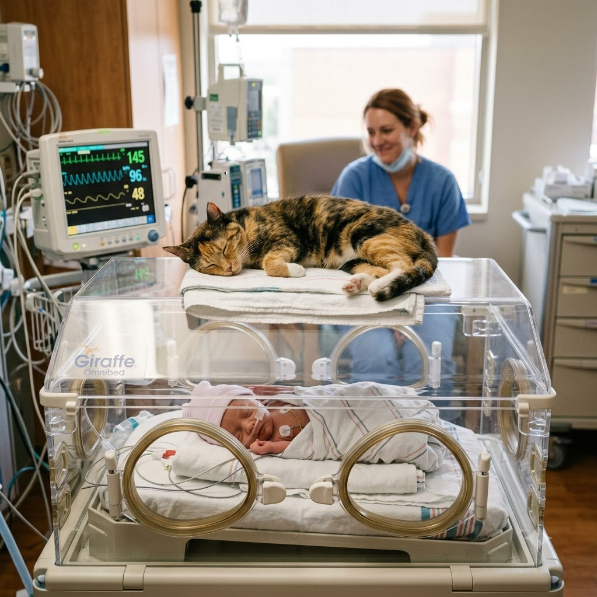
The top of the incubator was flat, warm, and covered with the approved sterile barrier pad Diane had insisted on placing exactly three inches from each edge.
Morse stepped out of the carrier.
Joy inhaled sharply.
Diane said, “Do not let her—”
Morse jumped.
One smooth movement.
Chair to incubator top.
She turned once, lowered herself carefully, and lay directly above the place where Clara rested inside.
Not near.
Not approximate.
Directly above her.
Her tortoiseshell body flattened against the warm plastic.
Her paws tucked under.
Her chin lowered.
Then she began to purr.
The sound was faint at first.
Then steady.
Deep.
Vibrating through the incubator’s surface.
No one moved.
Diane opened her mouth.
Closed it.
Dr. Hart looked at the monitor.
Joy whispered, “Heart rate is steady.”
I gripped Caleb’s hand.
Clara’s oxygen saturation rose from ninety-one to ninety-four.
Then ninety-five.
Morse purred.
Clara breathed.
Machines hummed.
A cat lay above a one-pound baby as if she had finally found the heartbeat she had searched the farmhouse to locate.
The one-hour trial became three hours because Dr. Hart did not ask Morse to leave.
Then five.
Then nine.
That first day, Morse stayed on the incubator for nine hours.
She did not wander.
Did not hiss.
Did not groom excessively.
Did not try to climb inside.
She simply lay there and purred.
When Caleb lifted her down so we could go home, she resisted for the first time, pressing her body flat against the pad.
“I know,” he whispered.
Her claws hooked slightly into the barrier.
“Morse,” I said.
She looked at me.
“We’ll come back tomorrow.”
She did not believe me.
I saw it in her face.
So the next day, we returned.
And the next.
And the next.
For forty-one days, Morse came to the NICU.
Every morning, Caleb or I drove her ninety minutes to St. Adelaide. Every evening, we drove her home. On days when Caleb had to work, my neighbor Mrs. Bell drove me because she said if a cat had hospital visiting hours, the least the town could do was organize transportation.
Mill Creek became involved in the way small communities do when they do not know how to fix tragedy but cannot stand doing nothing.
People left gas cards in our mailbox.
Mrs. Bell made casseroles.
The feed store owner covered my bookkeeping shifts.
The church ladies sewed tiny NICU hats.
The librarian put a jar on the desk labeled CLARA’S ROAD FUND, which embarrassed me until I realized pride was useless and fuel was not.
Morse became part of the NICU routine.
Diane, the infection control nurse, pretended to remain skeptical for two weeks.
By day fifteen, I caught her adjusting the barrier pad and saying, “Your left side is wrinkled, Miss Morse.”
Morse blinked at her.
Diane looked up and saw me.
“I’m ensuring compliance.”
“Of course.”
Joy began charting everything.
Not officially at first.
Then officially because Dr. Hart told her, “If we are going to be strange, we are going to be accurately strange.”
Heart rate.
Oxygen saturation.
Episodes of bradycardia.
Cortisol markers when labs were already drawn for medical reasons.
Sleep patterns.
Response during kangaroo care.
Morse’s arrival time.
Morse’s departure time.
Morse’s purring.
On day twelve, a nurse named Kelly downloaded a frequency-measuring app on her phone during break.
“I know this is not medical-grade equipment,” she said quickly when Dr. Hart saw her.
He raised an eyebrow.
“I know,” she repeated. “But look.”
The purr registered mostly between twenty-five and fifty hertz.
Kelly began talking about research she had read during veterinary school before switching to nursing—something about feline purr frequencies, tissue healing, bone growth, pain reduction, mechanisms still debated.
Dr. Hart stood there silently.
Then he said, “Print what you have.”
“Really?”
“If we are documenting this, we document it carefully. No claims we cannot support.”
He looked at Morse.
“And no one is putting ‘magic cat’ in my chart.”
Joy whispered, “Not even in parentheses?”
“No.”
But he added the observations to Clara’s file.
That was Dr. Hart.
Careful.
Skeptical.
Kind enough to allow wonder only if it sat beside evidence and behaved itself.
Morse did not behave herself perfectly.
She refused to eat properly at the hospital.
She would take a few bites when removed from the incubator, then stare at Clara until placed back. At home, she ate more, but not enough. Over the weeks, she lost weight.
Eight pounds became seven.
Then six and a half.
Then six.
Our vet warned us.
“She can’t keep this up indefinitely.”
“I know.”
“She’s not a machine, Hannah.”
“I know.”
“She is grieving and bonding and stressed in ways we cannot fully measure.”
The vet’s voice softened.
“You have to care for the cat too.”
So we tried.
High-calorie food.
Small meals.
Treats.
Breaks.
A little litter setup in a storage room Diane approved after inspecting it like a military site.
But Morse always wanted back on the incubator.
If we removed her too long, Clara’s numbers did not always drop, but sometimes they wavered.
Or maybe I imagined the connection because I needed it.
That is the difficulty with hope.
It makes patterns everywhere.
Still, the nurses saw it too.
When Morse lay above Clara, the room changed.
Clara settled.
I settled.
Even the staff seemed to lower their voices.
Parents from nearby pods began asking about the cat. At first, I worried they would resent us. A living animal in the NICU when their babies were fighting too. But most did not.
One father whose twins were born at twenty-eight weeks stopped beside me one afternoon.
“My boy’s oxygen behaves better when she purrs,” he said, nodding toward Morse.
I laughed softly.
“She’s not approved for general practice.”
“Shame. She takes insurance?”
After that, he brought Morse a tiny badge printed on cardstock.
VISITING CONSULTANT.
Diane confiscated it because it was not sanitized.
Then she laminated it and returned it.
The world inside the NICU became small and enormous.
Outside, spring moved on without us.
Fields thawed.
Farmers planted.
Rain came.
Our mailbox filled.
At home, the nursery waited.
The crib stood ready.
The mobile hung motionless.
Tiny clothes remained folded in drawers.
Morse no longer searched the rooms because she knew where Clara was now. Each morning, she walked to the carrier before we lifted it. Each night, she came home exhausted and slept on the cream blanket until dawn.
I lived between hospital alarms and farmhouse silence.
Caleb carried more than I knew.
He went to work because bills did not pause for medical crises. Then he drove to the hospital. Then he drove home. Then he cleaned pump parts while I cried over milk supply charts. Then he called insurance. Then he fixed the washing machine because of course it broke. Then he sat beside me at midnight and let me accuse him of being calm when he was only trying not to collapse.
One night, around day twenty-three, we fought in the kitchen.
Not about anything real.
That is how pressure escapes.
He had forgotten to move milk from the freezer bag to the cooler.
I said he didn’t understand how much work pumping was.
He said he was doing his best.
I said his best felt like leaving me alone.
He said, “I am so scared I can barely breathe, Hannah.”
That stopped me.
He stood by the sink, both hands braced on the counter, shoulders shaking.
“I go to work and everyone asks how she is. I go to the hospital and I’m afraid to touch her. I come home and the house feels like a room waiting for a funeral or a miracle, and I don’t know which one to prepare for.”
I covered my mouth.
He looked at me.
“I’m not calm. I’m trying to keep the car on the road.”
I went to him.
We stood in the kitchen holding each other while Morse watched from the carrier by the door, apparently unimpressed by human communication.
The next morning, Clara had her first serious setback in two weeks.
Her oxygen dropped.
Her heart rate dipped.
Alarms rang.
Nurses moved fast.
Dr. Hart appeared.
I was guided back by Joy’s hand, firm but gentle.
Morse remained on the incubator, ears flattened, body low, purring so hard I could see her sides vibrate.
For twenty minutes, the room became controlled urgency.
Adjustments.
Suction.
Respiratory settings.
Medication.
Words I understood only enough to fear.
Then Clara stabilized.
I stood against the wall shaking.
Dr. Hart turned to me.
“She’s okay.”
I heard the words.
They took time to enter.
“Morse didn’t move,” Joy whispered.
I looked at the incubator.
Morse’s eyes were half closed, but her purr had not stopped.
That was the day I stopped thinking of her as visiting.
Morse was working.
Not in any official medical capacity. Not in a way science would neatly approve. Not instead of doctors, nurses, ventilators, surfactant, nutrition, sterile procedure, medication, and the astonishing skill of people who had dedicated their lives to keeping impossibly small babies alive.
But she was working.
She was doing what she had done for months on my belly.
Listening.
Warming.
Purring.
Staying.
On day thirty-one, Clara came off the ventilator and moved to less invasive breathing support.
On day thirty-four, I held her skin-to-skin for two full hours.
On day thirty-six, Caleb held her for the first time.
I will remember that until I die.
He sat in the recliner like a man being trusted with a bomb and a blessing. The nurse placed Clara against his chest. Caleb’s large hands hovered, afraid to settle.
“You can touch her,” I whispered.
“I know.”
His finger stroked the air near her back, not quite making contact.
Then Clara’s tiny hand opened against his skin.
Caleb broke.
He bent over her and cried silently, shoulders shaking, one hand finally resting gently across her back.
Morse watched from the incubator top, tail flicking once, as if approving delayed paternal competence.
On day forty, Clara weighed three pounds, twelve ounces.
Still tiny.
Still fragile.
But growing.
Her skin looked less translucent.
Her breathing had steadied.
She tolerated feeds better.
The doctors still warned us not to assume.
NICU parents learn to fear confidence.
But something had shifted.
Even Dr. Hart, careful Dr. Hart, smiled more often.
Then came day forty-one.
It was raining that morning.
A soft, steady rain that blurred the hospital windows and made the NICU lights feel warmer than usual. Morse had been restless during the drive, turning in her carrier, pressing her nose to the door.
“You okay, girl?” Caleb asked.
She did not answer.
At the hospital, she followed the usual routine.
Carrier to chair.
Chair to incubator.
Curl directly above Clara.
Purr.
But around 6:20 p.m., after almost ten hours, Morse stood up.
That alone made me lift my head.
She stretched.
Slowly.
Front paws forward, back arched, tail lifted.
Then she stepped to the edge of the incubator and jumped down onto the chair.
“Morse?” I said.
She sat.
Not anxiously.
Not tired.
She sat with her tail wrapped around her paws and looked at me.
“What is it?”
She blinked.
Then looked toward Clara.
Joy, who was charting nearby, noticed too.
“She’s getting down early.”
“She never gets down early.”
Morse licked one paw.
Diane happened to walk by and stopped.
“Is she ill?”
“I don’t know.”
Caleb lifted Morse gently, checking her body.
She did not resist.
That worried me more than if she had.
“She feels okay,” he said.
“She’s tired,” Diane said.
“She’s been tired for weeks.”
Morse leaned into Caleb’s hand, then looked at Clara again.
Joy checked the monitor.
“Numbers are good.”
Dr. Hart came by ten minutes later and found all of us staring at the cat.
“What happened?”
“She got down,” I said.
He looked at Morse.
“Cats do occasionally move.”
“Not her.”
He checked Clara’s chart, then her monitor, then the baby herself.
“Everything looks stable.”
But he stayed a little longer than necessary.
Morse did not return to the incubator.
She stayed on the chair.
Watching.
At 6:43 p.m., Clara opened her eyes.
Not fully at first.
A flutter.
I thought I imagined it.
“Joy.”
The nurse turned.
Clara’s eyelids moved again.
Then, slowly, impossibly, my daughter opened her eyes for the first time.
They were dark.
Unfocused.
New.
She stared at nothing and everything.
I made a sound I did not recognize.
Caleb grabbed my shoulder.
Joy whispered, “Oh, sweetheart.”
Dr. Hart stepped closer.
No one spoke loudly.
No one wanted to startle her back into wherever she had been.
Clara’s eyes shifted slightly.
Not toward me.
Not toward Caleb.
Toward the top of the incubator.
Where Morse had been.
Morse sat on the chair, still as stone.
Then she blinked slowly.
A cat’s blessing.
A cat’s goodbye to one kind of vigil.
People will call that coincidence.
I understand.
Science must be careful.
Medicine must be careful.
A baby born at twenty-six weeks may open her eyes around that developmental stage. A cat may climb down because she is tired. A mother may connect two unrelated events because she needs meaning.
I know all of that.
But I also know the nurse who had tracked Morse from day one stood beside me with tears on her face and whispered, “I know it could be coincidence.”
Then she looked at the cat.
“But I don’t think it is.”
Neither did I.
After that night, Morse still came to the hospital, but not for ten-hour vigils.
She visited.
There is a difference.
She lay on the incubator sometimes, but shorter. She ate better. She slept more at home. She had done whatever she believed needed doing and had moved herself into a new role.
Guardian instead of furnace.
Witness instead of bridge.
Clara kept improving.
Not in a straight line.
Never that.
There were feeding struggles, temperature issues, alarms that sent my heart into my throat, and one terrifying infection scare that turned out to be nothing but stole three years from my life in an afternoon.
But she grew.
Gram by gram.
Breath by breath.
On the day the doctors first mentioned discharge planning, I laughed.
Not because it was funny.
Because the phrase sounded fictional.
Bringing Clara home had become something I imagined the way children imagine moon colonies. Beautiful. Technically possible. Not relevant to Tuesday.
But she reached four pounds.
Then four pounds, three ounces.
She maintained her temperature.
She took feeds.
She breathed without assistance.
At nine weeks old, still weeks before her original due date, Clara came home.
The discharge process took hours.
Papers.
Instructions.
Medication.
Follow-up appointments.
Emergency signs.
Safe sleep.
Feeding schedule.
Temperature monitoring.
Hand hygiene.
No visitors with sniffles.
No crowds.
No kissing the baby.
No scented candles.
No smoking.
No pretending she was a full-term baby just because she was leaving the hospital.
I nodded until my neck hurt.
Then Joy placed Clara in the car seat.
She looked impossibly small inside it.
But she was not one pound ten ounces anymore.
She was four pounds three.
A giant, compared to the child I first saw under plastic.
Dr. Hart came to say goodbye.
He stood beside the doorway with his hands in his coat pockets.
“I expect updates,” he said.
“You’ll get too many.”
“Good.”
I hesitated.
“Thank you.”
He nodded once.
I knew doctors heard those words often.
I also knew they were never enough.
He looked toward Morse’s carrier.
“And thank you, Miss Morse.”
Morse, from inside, gave a short irritated meow.
Dr. Hart smiled.
“Still refusing formal co-authorship, I see.”
Diane appeared behind him holding a small laminated card.
Morse’s Visiting Consultant badge.
“I suppose she earned it,” she said.
I hugged her.
Diane stiffened.
Then hugged me back.
“Wash your hands when you get home,” she whispered.
“I will.”
The drive home felt longer than all the others.
Caleb drove like he was transporting ancient glass.
I sat in the back between Clara’s car seat and Morse’s carrier.
Halfway home, Clara made a tiny squeak.
Morse answered with one chirp.
I cried quietly for twenty miles.
When we pulled into the farmhouse driveway, Mrs. Bell was standing on her porch across the road, hands clasped under her chin. A banner hung over our own porch, crooked and hand-painted by half the town.
WELCOME HOME CLARA
The C leaned left.
The A was backwards.
It was perfect.
Inside, the house smelled like lemon cleaner, old wood, and the soup someone had left in our refrigerator.
We set Morse’s carrier down first.
When Caleb opened it, she stepped out, walked straight to the nursery, and jumped into the crib.
“Absolutely not,” I said automatically.
She ignored me.
Caleb placed the car seat near the crib.
Morse sniffed Clara’s face once.
Only once.
Then she lay down in the crib and waited.
I looked at Caleb.
“We can’t put the baby in a crib with a cat.”
“I know.”
Morse stared.
“We really can’t,” I told her.
Morse stared harder.
So we compromised.
That became the pattern of our life with Morse.
We did not leave her unsupervised in the crib with Clara. We followed safe sleep guidance. We used the bassinet. We did things properly because miracles do not excuse carelessness.
But each day, during supervised rest, Morse lay beside Clara on a blanket on the floor or next to her while I sat within arm’s reach.
Same position.
Body curved close.
Purr steady.
Clara slept best that way.
At night, Morse slept outside the bedroom door at first.
Then inside.
Then on the chair near the bassinet.
Every time Clara stirred, Morse lifted her head before I did.
If Clara cried too long, Morse meowed at me as if I had failed a performance review.
“She’s very judgmental for someone without thumbs,” Caleb muttered one night while warming a bottle.
“She kept our baby stable for forty-one days.”
“That doesn’t make her a lactation consultant.”
Morse meowed sharply.
Caleb looked at her.
“Fine. Assistant lactation consultant.”
Those early months at home were hard in ways people do not include in miracle stories.
Clara had appointments constantly.
Weight checks.
Developmental assessments.
Eye exams.
Hearing tests.
Pulmonology follow-ups.
Early intervention.
I lived by ounces and milliliters.
I sanitized until my knuckles cracked.
I feared coughs like wolves at the door.
Sometimes I stood over Clara while she slept, counting breaths until Caleb gently guided me back to bed.
And I was angry.
That surprised me.
I was grateful, yes.
So grateful it hurt.
But also angry.
Angry that other mothers complained about normal newborn exhaustion while my body still shook when a monitor beeped on TV.
Angry that pregnancy announcements made me jealous instead of joyful.
Angry that Clara’s first months had been stolen and replaced with fear, tubes, and permission slips to touch my own child.
Angry that Morse seemed to understand what I could not explain.
One night, around three in the morning, I sat in the nursery rocker holding Clara after a feeding. She weighed barely five pounds. Morse slept curled on the rug beneath us.
“I’m sorry,” I whispered to my daughter.
Her tiny mouth moved in sleep.
“I’m sorry my body couldn’t keep you safe.”
Morse opened her eyes.
She stood, stretched, and jumped onto the arm of the rocker with effort. Then she pressed her forehead against my sleeve.
I broke.
Not loudly.
The baby was sleeping.
Mothers of fragile infants learn to break quietly.
Morse stayed there until dawn.
That was what she did for us.
For Clara, yes.
But for me too.
She became proof that I had not imagined the baby inside me.
That someone else had known her before the hospital.
That she had been loved before she was seen.
When Clara turned one, adjusted age still not quite one, we held a small birthday party with immediate family and half the NICU staff because Joy threatened to arrive whether invited or not.
Dr. Hart came late, carrying a book instead of a toy.
“Doctors are terrible at age-appropriate gifts,” he said.
It was a copy of Goodnight Moon.
Diane came with hand sanitizer and a stuffed cat.
Morse avoided most guests but allowed Joy to photograph her wearing the laminated Visiting Consultant badge for approximately six seconds before removing it with violence.
Clara sat in a high chair, rounder now, still small but sturdy, frosting on one hand, staring at the candle as if she had personally defeated fire.
Caleb leaned close to me.
“Six hours,” he whispered.
I knew what he meant.
Six hours had become one year.
I reached for his hand.
Morse jumped onto the windowsill behind Clara and began to purr.
At two, Clara started walking.
Late, but she walked.
At three, she talked constantly.
Late, then all at once, as if she had been gathering words in secret.
At four, she could not pronounce Morse.
She called her More.
“More come,” she would say every night at bedtime.
And Morse came.
Older now.
Slower.
Still tortoiseshell, still split-faced, still convinced closed doors were insults. She climbed onto Clara’s bed and lay beside her, not on top, never smothering, always along her side like punctuation at the end of a day.
Clara would place one hand in Morse’s fur.
“More purr.”
Morse purred.
Every night.
The sound that had vibrated through my pregnant belly, through plastic, through hospital fear, through our old farmhouse, became the soundtrack of my daughter’s childhood.
As Clara grew, we told her the story carefully.
Not all at once.
Not with the terror first.
With love.
“You were born very early.”
“How early?”
“Too early.”
“Was I tiny?”
“So tiny.”
“Like my doll?”
“Smaller.”
“Did More see me?”
“Morse heard you before she saw you.”
That fascinated her.
“She heard me in your tummy?”
“Yes.”
“Was I loud?”
I laughed.
“Sometimes.”
“Did she love me then?”
“Yes.”
Clara accepted that easily.
Children understand things adults complicate.
One evening when she was four, I found her sitting on the nursery rug with Morse, now eleven, telling her a story.
“You was on my box,” Clara said. “And you go purr purr purr. And I open my eyes.”
Morse blinked slowly.
Clara leaned close.
“I saw you.”
I stood in the doorway holding laundry against my chest, unable to move.
She could not remember.
Of course she could not.
But some stories enter children so deeply through repetition and love that they become a kind of inherited memory.
Clara believed she had opened her eyes and seen Morse.
Maybe, in some way no chart could record, she had.
I have been asked many times what I think saved my daughter.
The answer is complicated only because people want it to be simple.
The doctors saved her.
The nurses saved her.
The respiratory therapists, neonatal pharmacists, lactation consultants, lab technicians, researchers, transport teams, and everyone who built the machines that breathed for her saved her.
Science saved her.
Medicine saved her.
Do not ever think I believe otherwise.
But Morse stayed.
That is also true.
She lay on a plastic incubator for forty-one days.
She purred at a frequency a nurse bothered to measure because sometimes love makes people curious.
She lost weight because she would not leave long enough to eat properly.
She searched our house for the baby before we knew how to explain absence to an animal.
She recognized Clara by scent, sound, heartbeat, or some mystery I do not have to name to respect.
She climbed down the night my daughter opened her eyes.
Coincidence?
Maybe.
I have made peace with that word.
Coincidence is what we call mystery when we are trying to be polite.
Morse does not care what we call it.
Neither does Clara.
Neither do I.
The old farmhouse is still drafty.
The kitchen floor still slopes.
The nursery became Clara’s room, then a little girl’s room with stickers on the wall and books under the bed. The crib is gone now, passed to another family in town who needed one.
The cream blanket remains.
Folded on a shelf.
Covered, somehow still, in a few strands of tortoiseshell fur that refuse every attempt at removal.
Morse is eleven now.
She sleeps more.
Eats less dramatically.
Complains when lifted.
Has arthritis in one back leg.
Every year, at Clara’s birthday, we take the same photo.
Clara holding Morse.
At first, Morse dwarfed her.
Then Clara caught up.
Then Clara grew taller, and Morse became the small one.
In every picture, Clara is smiling.
In every picture, Morse looks mildly inconvenienced.
In every picture, I see time doing what we once feared it would not get the chance to do.
Continue.
On hard days, I still think about the first six hours.
The window Dr. Hart gave us.
Prepare for the possibility.
I think about who I was then, standing outside an incubator, believing motherhood had been reduced to watching numbers.
I wish I could go back to that woman.
I wish I could stand beside her and say, Six hours will become twelve. Twelve will become forty-eight. Forty-eight will become forty-one days. Forty-one days will become home. Home will become bedtime. Bedtime will become a little girl saying, “More comes.”
I cannot go back.
So I tell the story forward.
For the parents in NICU chairs.
For the mothers leaving hospitals without babies.
For the fathers trying to stay calm because somebody has to drive.
For the nurses who notice small things.
For the doctors brave enough to let compassion stand beside protocol without abandoning either.
For the animals who know our children before the world does.
For Morse.
The cat who searched seventeen times.
The cat who climbed onto a plastic box and stayed.
The cat who purred over my daughter until my daughter was ready to open her eyes.
People ask whether I believe Morse knew Clara would live.
No.
I do not think she knew the future.
I think she knew the present better than we did.
The baby was missing.
Then the baby was found.
The baby was fragile.
So Morse stayed near.
The baby needed warmth, rhythm, steadiness, and a familiar sound from before birth.
So Morse gave what she had.
Her body.
Her purr.
Her refusal to leave.
Sometimes love is not dramatic because it knows the ending.
Sometimes love is dramatic because it does not know the ending and stays anyway.
When Clara falls asleep now, Morse curls against her side, purring softer than she used to but still with that strange pattern.
Short.
Long.
Short.
Code from one body to another.
I stand in the doorway and listen.
I think of the NICU.
The incubator.
The monitors.
The first time Clara’s oxygen rose.
The night Morse climbed down.
The first opening of my daughter’s eyes.
And I think maybe my baby did know that sound before she knew our voices.
Maybe inside me, in the dark water of the life before birth, Clara heard Morse’s purr through skin and muscle and blood and understood one thing before she understood anything else.
Someone is here.
Someone is staying.
Someone is waiting for you to come home.
And she did.








