I Brought Home the Shelter Cat Nobody Could Touch—Then His First Safe Sleep Exposed the Woman Who Abandoned Him
PART3:
I did not reach under the chair. Did not shake treats. Did not make kissing noises. Something in me knew whatever had made him that afraid had probably involved too much forcing and not enough kindness.
So I stayed.
The apartment got darker.
The heater clicked on.
Traffic outside thinned.
I ate half a sandwich standing at the counter because sitting at the table felt too loud somehow. Every few minutes, I looked toward the chair.
Two wide eyes looked back.
That was it.
No movement.
No trust.
Just watchfulness.
Around nine, disappointment surprised me.
It rose up small and ugly.
I had brought him home. I had signed papers. Bought food. Cleared space. Spoken gently. Some selfish part of me wanted proof that it mattered. A brush against my leg. A tiny purr. Something.
Then shame followed.
He had been in my apartment less than three hours, and already I wanted healing to reassure me.
That is how people ruin wounded things.
We call it love, but sometimes what we really mean is, Please get better fast enough that I can feel good about helping you.
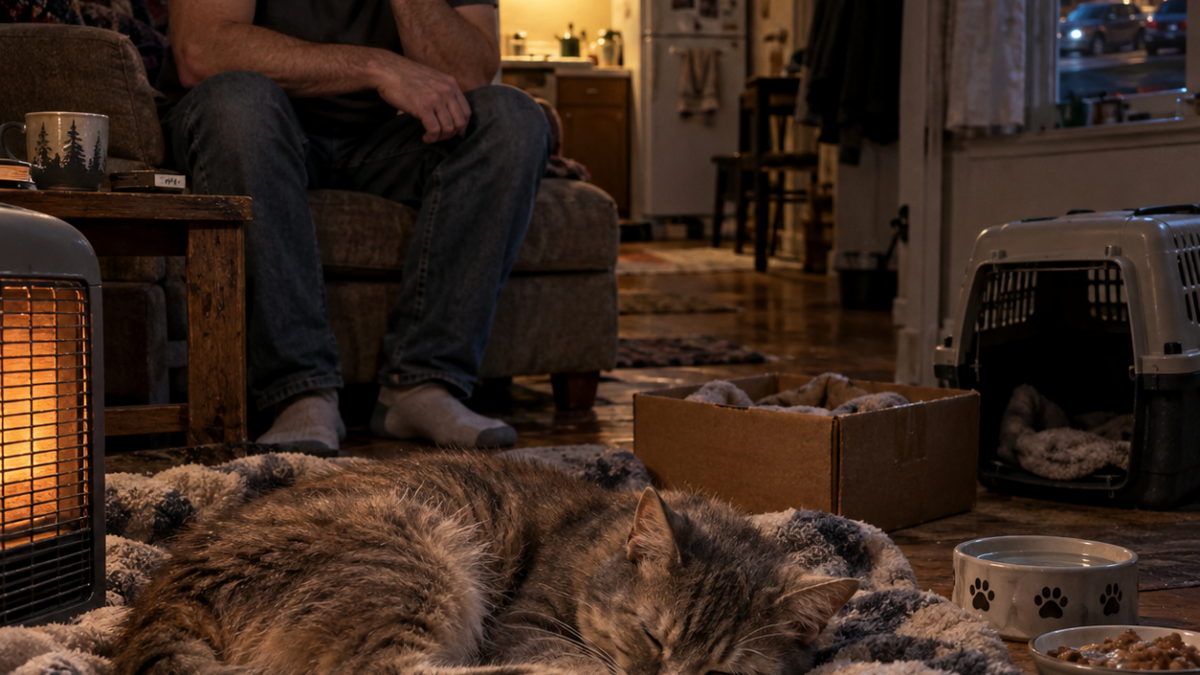
I turned off the main lights around ten and left only the weak kitchen light glowing. I spread an old blanket on the couch and decided I would sleep there, just in case he came out and got scared in the night.
A little later, I heard a soft thump.
I sat up too fast.
Moka had come out from under the chair, but only far enough to bump into the leg of the coffee table. The sound startled him so badly he dropped flat to the floor, eyes huge, body stiff, like he was bracing for something bad to happen next.
That nearly broke me.
Because he was not acting like a cat in a new apartment.
He was acting like someone who had learned that every small mistake came with a cost.
I stayed still.
“You don’t have to be brave tonight,” I whispered. “You just have to be here.”
He stared at me.
Then at the room.
Then at the folded fleece blanket by the heater.
The heater clicked again, sending out a breath of warm air.
Moka took one step.
Stopped.
Took another.
I do not know why I held my breath, as if breathing wrong could scare him back into whatever life had taught him to hide. But I did.
He reached the blanket and sniffed it for a long time.
Then he looked over at me.
It was the kind of look that felt too large for a cat and a man in a dim apartment.
Is this really mine?
Are you really not going to take it away?
I did not move.
After a few seconds, Moka turned in a tiny circle and lowered himself onto the blanket.
Not all at once.
Slowly.
Carefully.
Like comfort was something he had to test for traps.
For the next minute, his head stayed up. His eyes stayed open. His body was ready to run.
Then, little by little, I saw it happen.
His shoulders loosened.
His paws untucked.
His chin lowered.
His eyes closed.
And for the first time since I had seen him, Moka fell fully asleep.
Deep asleep.
The kind of sleep you only get when your body finally believes it can stop guarding itself.
I sat on that couch in the half-dark and cried so hard I had to cover my mouth.
Not because something terrible had happened.
Because nothing terrible had.
Because somewhere along the way, that little cat had learned to expect fear. And that night, in my small apartment with the old heater and the weak kitchen light, he got one quiet hour that told him maybe life could be different now.
People think rescue always looks big.
A dramatic phone call.
A last-minute save.
A before-and-after photo with thousands of strangers typing heart emojis.
Sometimes it does not.
Sometimes rescue looks like a cheap blanket.
A warm corner.
A full bowl.
A soft voice that does not ask for anything back.
Moka did not climb into my lap that night.
He did not purr.
He did not suddenly become fearless.
But he slept.
And after the kind of life that teaches you not to trust kindness, that first safe sleep is its own kind of miracle.
By morning, he was still there.
Still curled on that blanket.
Still home.
And somehow, so was I.
The next weeks changed me in ways so small I almost missed them.
Moka claimed three safe places first: under the chair, inside the cardboard box, and on the blanket near the heater. I called it his triangle of trust. He moved between them like a soldier between bunkers. He learned the sound of my shoes. Learned that the microwave beep did not mean danger. Learned that my keys hitting the table made a sharp sound but nothing bad came after.
I learned too.
I learned not to drop things.
Not to reach too quickly.
Not to stand over him.
Not to mistake stillness for rejection.
Most of all, I learned how impatient I had become with tenderness.
That surprised me.
I had always thought of myself as gentle enough. I was the man people called when an old neighbor needed help moving a recliner. I was the coworker who remembered birthdays. I was the son who handled doctor visits and insurance forms and medication schedules until my mother’s last breath rattled out in a room that smelled like antiseptic and lavender lotion.
But caretaking is not the same as tenderness.
I had been useful.
Useful is not always soft.
Moka required softness.
Not the sentimental kind. Not the baby-talk kind. Real softness. The kind that does not rush another living thing toward comfort just because discomfort embarrasses you.
By day five, he ate while I was in the kitchen, though he watched me the whole time.
By day eight, he brushed against the back of my hand.
Barely.
So quick I almost thought I imagined it.
I was sitting cross-legged near the heater, sorting mail into piles of bills, junk, and things I would avoid until guilt matured. Moka came out from behind me. I heard the faint tap of his paws on the floorboards. I did not turn.
Then I felt the lightest warmth against my knuckles.
I looked down slowly.
He had backed up two inches, eyes huge, like he could not believe he had done it.
I did not reach for him.
I just let my hand stay where it was.
After a few seconds, he leaned in again.
Nose first.
Warm and cautious.
That was all.
Not a cuddle.
Not trust in full.
Just contact.
But it went through me like the first honest good thing in months.
I had spent years telling people I liked being alone. Some of it was true. I did like my own pace. My own coffee. My own thermostat. My own quiet. But there is a difference between choosing solitude and lowering your expectations until disappointment cannot reach them.
Moka had been described as sweet but not expecting much.
That line stayed with me because I had been living that way too.
Not tragically.
Not in a way people noticed.
I still worked. Still paid my bills. Still made polite conversation. Still laughed when something was funny. Still told my son, “No, no, I’m good,” when he forgot to call on Sunday and texted Monday afternoon with a sorry, Dad, crazy weekend.
But emotionally, I had built my life smaller than I wanted and then called it peace.
Moka did not fix that.
Animals do not exist to fix us. That is too much weight to put on something with paws and a nervous system of its own.
But loving him required me to become present again.
I came home earlier.
I stopped letting the television talk for me.
I opened the blinds because he liked the light.
I swept more often because he rolled in dust like it was a luxury item.
I started cooking real dinners twice a week because the smell of the stove made the apartment feel less like a waiting room.
I talked out loud.
Not to fill silence anymore.
To share it.
By the third week, he sat in the middle of the living room rug when I came home from work.
Not close to the door.
Not close to me.
But out in the open.
I stepped inside with a grocery bag cutting into my fingers and stopped so abruptly the door bumped my back.
Moka stiffened.
I stiffened too.
We looked at each other like two diplomats trying not to ruin a fragile peace treaty.
Then I set the groceries down slowly.
“Hey,” I said.
His tail twitched once.
I took off my shoes.
He stayed.
I hung my jacket on the hook.
He stayed.
I walked to the kitchen.
He stayed.
I wish I could explain to people how enormous that felt.
He was ten feet away.
Still ready to run.
But he stayed.
That night, I ate reheated soup sitting on the floor because the couch felt too far from him. He watched from the edge of the rug. I told him about work, about a customer who had yelled at me over a policy I did not write, about my neighbor upstairs vacuuming at six-thirty in the morning like she had declared war on dust.
He did not understand a word.
Or maybe he understood enough.
Presence is underrated.
The first time he climbed onto the couch while I was sitting there, I cried again.
I hate admitting that.
A grown man sitting in a dim apartment crying because a scared cat decided the far cushion was safe.
But grief does not care what looks ridiculous.
Neither does relief.
It was a hard day. Nothing dramatic. Just one of those days that gathers weight as it goes. A rude comment from a supervisor young enough to think exhaustion was a personality flaw. A text from my sister asking if I had “done anything social lately,” which somehow felt both loving and accusatory. A call from my son that lasted four minutes because he was in line somewhere and clearly distracted.
By the time I got home, I felt hollow.
I sat on the couch without turning on the lamp.
The heater clicked.
Outside, rain streaked the window.
Moka watched me from the floor.
Then he jumped up.
He landed at the far end, stiff-legged and uncertain, like he was not sure who had authorized this bravery. For a moment, he looked ready to jump down. Instead, he sat.
Not touching me.
Not close.
Just there.
I turned my head slowly.
He faced forward like he had not just done something enormous.
I covered my eyes and laughed once through tears.
“You have terrible timing,” I whispered.
His ear flicked.
After a full minute, he walked across one cushion.
Then another.
Then curled against my thigh.
I stopped breathing.
There is no graceful way to describe what it feels like when something wounded decides, even briefly, that you are softer than the floor.
He stayed maybe twenty minutes.
Long enough for warmth to spread through my work pants.
Long enough for my hand to rest lightly against his back.
Long enough for my breathing to slow until it matched his.
Then came the first purr.
Low.
Uneven.
Rusty.
Like an engine that had not been started in a very long time.
I closed my eyes.
And I understood something I should have learned years earlier.
A home is not where everything is perfect.
A home is where your body stops preparing for harm.
Moka got that in my apartment.
And whether anyone thinks it sounds ridiculous or not, so did I.
The trouble started with a video.
Not mine.
I have never been a person who films everything. I do not trust anyone who can cry, eat soup, rescue a dog, or watch a sunset while also making sure the lighting is good. But Hannah from the shelter asked if she could post a small update on Green Hollow’s page about Moka’s progress.
“At a distance,” she promised. “No pressure. No address. No full name. People like seeing shy cats settle. It helps them understand that not every rescue looks instant.”
I thought about it.
Moka was sleeping near the heater, not fully stretched out but close, his chin resting on the same fleece blanket from the first night. He looked peaceful.
I took one photo.
No face of mine. No apartment details beyond the blanket and a strip of old floor.
I sent it to Hannah with a short message:
Three weeks home. He slept through the rain last night. I think he’s starting to believe me.
Green Hollow posted it two days later.
The caption was simple.
Moka, one of our shy boys, is learning that safe can be real. Thank you to adopters who give scared animals time.
For a few days, the comments were kind.
Beautiful boy.
Thank you for choosing him.
My shy cat took six months and now sleeps on my head.
This gives me hope.
Then the video came.
I did not see it at first.
My coworker, Denise, showed me during lunch.
Denise worked at the front desk of the warranty office where I processed claims. She had sharp glasses, sharp nails, and a way of delivering information like she was handing you a bill.
“Isn’t this your cat?” she asked.
I looked up from my sandwich.
She turned her phone toward me.
A woman filled the screen.
Late twenties, maybe early thirties. Smooth blond hair. Big worried eyes. Pale sweater. The kind of face that knew exactly where the camera was. Behind her, soft music played.
Text floated over the video:
MY CAT WAS ADOPTED WITHOUT MY CONSENT.
My stomach tightened.
The woman pressed a hand to her chest.
“Hi, everyone. I don’t normally do this, but I’m devastated. My sweet cat, Moka, disappeared months ago after a misunderstanding with a former roommate. I recently found out he was adopted out by a local shelter, and the man who has him refuses to return him.”
I could not move.
Denise’s eyebrows rose.
The woman continued.
“Moka is anxious and special-needs. He needs his real mom. Please help me bring my baby home.”
The video cut to old clips.
Moka as a younger cat, sitting on a white bedspread.
Moka wearing a little bow tie, frozen with fear.
Moka being held stiffly against the woman’s chest while she kissed his head and stared into the camera.
Then a screenshot of Green Hollow’s post appeared.
My photo.
My floor.
My blanket.
My words.
I think he’s starting to believe me.
The woman’s voice trembled.
“This man says Moka is safe, but animals don’t belong to strangers just because they’re adopted on paper. If you know Green Hollow Animal Shelter, please tell them to do the right thing.”
The video ended with her crying.
Not ugly crying.
Pretty crying.
Camera-ready crying.
Denise lowered the phone.
“Well,” she said. “That’s awkward.”
I stood so fast my chair scraped the floor.
The video had already been shared thousands of times.
The woman’s name was Tessa Lane.
By the time I got home that evening, Green Hollow had called three times. Hannah left one voicemail telling me not to panic, which is the sort of message that guarantees panic. Lena, the shelter director, left another saying the adoption was legal, they were handling it, and I should not engage online.
Do not engage online.
That is sound advice in the same way “do not bleed” is sound advice after being stabbed.
My name was not in Tessa’s video, but the internet has never needed complete information to ruin a person’s day. People in the comments were already calling me a thief, a creep, a lonely old man who stole someone’s emotional support animal, a predator, a pet hoarder, a monster.
One comment said:
Men like this adopt shy animals because they like control.
I stared at that one until my eyes hurt.
Moka was under the bed.
The second I entered the apartment, I knew something was wrong. Normally by then, he waited near the kitchen doorway, not greeting me exactly but making his presence known with the cautious confidence of a creature who had begun to believe dinner happened daily.
That night, he was gone.
Not gone gone.
But hidden.
I found him flat beneath my bed, eyes huge, body tight, ears low.
Someone had knocked on my apartment door while I was at work. My neighbor Mrs. Finch told me later. A woman with blond hair and a man holding a phone. They knocked, called through the door, and filmed the hallway when nobody answered.
“She said she was trying to recover her stolen cat,” Mrs. Finch said, lips pressed thin. “I told her nobody steals cats in this building except maybe loneliness.”
Mrs. Finch was seventy-eight and had no patience for modern nonsense.
Moka must have heard the knocking.
The voices.
The stranger saying his name.
Maybe that was all it took.
Trust is built slowly and shaken fast.
I sat on the bedroom floor.
“I’m here,” I said softly. “I’m not reaching for you.”
He stared.
His breathing was too fast.
The apartment felt different that night. Not safe. Not quiet. Invaded. The photo I had sent to help shy cats be understood had become a weapon in someone else’s performance.
My phone buzzed on the floor beside me.
Another message from Hannah.
Daniel, please call when you can. Tessa is claiming she never surrendered him. We have records, but there may be more to the story. We’re sorry.
More to the story.
There always is.
I did not call right away.
I stayed on the floor beside the bed until Moka’s breathing slowed.
It took almost two hours.
He did not come out.
But sometime around midnight, one paw stretched from the darkness and rested on the carpet near my knee.
Not touching.
Close enough.
I slept on the floor that night.
Because sometimes love is not efficient.
Sometimes love has a stiff back in the morning.
The next day, I went to Green Hollow.
I took a personal day from work and told my supervisor there was a family emergency. He said, “For your cat?” in a tone that made me suddenly understand how people lose all respect for someone in three seconds.
“For my family,” I said.
Then I hung up.
Green Hollow’s lobby was chaos.
Phones ringing.
Volunteers whispering.
A couple near the dog hallway watching me like they recognized me from a crime documentary. Someone had printed a sign and taped it near the desk.
We do not discuss adopter information.
Lena met me in the office.
She was in her forties, with short dark hair, tired eyes, and the calm of a woman who had cleaned blood, fear, and bureaucracy off the same floor too many times to scare easily.
Hannah sat beside her, pale and angry.
“I’m sorry,” Hannah said immediately.
“You didn’t do this.”
“I posted the update.”
“To help.”
“It still—”
“To help,” I said again.
She looked down.
Lena motioned for me to sit.
“Tessa Lane was Moka’s previous owner,” she said.
The sentence landed heavy, even though I had known it was coming.
“Owner,” I repeated.
“Legally, at one point, yes. According to the records we found after her video started spreading, Moka was adopted from a rescue partner as a kitten under the name Mocha, with a c-h. He was registered to Tessa for about a year.”
“She said a roommate surrendered him.”
“She’s lying.”
Hannah’s voice was sharp.
Lena gave her a look, then turned back to me.
“We don’t have direct surrender paperwork from Tessa because Moka did not come in as an owner surrender. He was brought to animal control by a storage facility manager. He had been living behind the units for at least two weeks. Thin, dehydrated, no collar. No chip.”
“So she abandoned him.”
“That is what we believe.”
“What can she do?”
“Legally? Probably not much. The stray hold expired. No one claimed him. He was transferred here. You adopted him properly.”
“Probably?”
Lena folded her hands.
“Tessa has followers. She’s making noise. People like that can create pressure even when they don’t have a case.”
Hannah leaned forward.
“She called us seven times yesterday. She said if we didn’t return him, she’d organize a protest.”
“A protest?”
“For a cat she left behind,” Hannah said.
Lena’s jaw tightened. “We need to be careful. We can’t release your information, and we won’t. But she already found your building somehow.”
“I think from the photo.”
Hannah closed her eyes. “I cropped it. I thought—”
“Stop,” I said gently. “She did this. Not you.”
Lena opened a folder.
“There’s more.”
I did not like the way she said it.
She turned a printed page toward me.
It was an email.
From a woman named Brittany Cole, listed as Tessa’s former roommate.
I read it twice.
Then a third time.
Brittany wrote that Tessa had owned Moka for content. That she filmed him constantly as a kitten because “shy cat learns love” videos performed well. That when he grew older and stayed anxious, he became less useful. Tessa got frustrated. She wanted a more outgoing pet for her channel. When she moved apartments, she told Brittany she had “rehomed” Moka, but Brittany later learned from another friend that Tessa had left him near the storage units after he scratched her during a filming attempt.
My hands went cold.
“She dumped him because he wouldn’t perform,” I said.
Hannah looked like she might cry.
Lena nodded.
“Brittany saw Tessa’s video and contacted us. She’s willing to make a statement.”
“Then why not post that?”
“Because internet mobs do not care about facts until facts are packaged well enough to entertain them,” Lena said.
It was the saddest accurate sentence I had heard in months.
“We’re preparing a response,” she continued. “We’ll keep your name out of it. But I wanted you to know what we know.”
I sat back.
For a moment, I saw Moka in those old video clips.
The bow tie.
The frozen body.
The pretty crying woman calling him her baby.
The way he flattened when the coffee table bumped that first night.
The way he braced for punishment over a harmless sound.
Who taught you this?
Now I knew at least part of the answer.
I walked out of Green Hollow shaking with anger.
Not loud anger.
Not the kind that sends you yelling across parking lots.
A colder anger.
The kind that wants records, dates, screenshots, evidence.
The kind that says, You will not make his fear into your brand twice.
The investigation unfolded over the next week.
I use that word because that is what it felt like, though none of us were detectives. We were a shelter director, a tired volunteer, a former roommate with receipts, a seventy-eight-year-old neighbor with a sharp memory, and me.
Lena gathered animal control intake records showing where and when Moka had been found.
Brittany sent screenshots of texts.
In one, Tessa wrote:
I can’t keep wasting time on a cat that acts abused when I literally rescued him.
In another:
He scratched me again. I’m done. Maybe someone else can deal with his trauma act.
Another:
Don’t judge me. He’ll be fine. Cats survive outside.
I had to stop reading after that one.
Cats survive outside.
People say things like that when they need cruelty to sound natural.
Mrs. Finch gave me a written statement about Tessa coming to my apartment and filming the hallway.
“She had no concern for the animal,” Mrs. Finch wrote in her careful old-lady handwriting. “She seemed concerned mainly with lighting.”
That line almost made Hannah laugh for the first time all week.
My coworker Denise, surprisingly, became useful too.
Denise had a cousin who worked in digital marketing and knew how to archive social media posts before people deleted them. When I mentioned Tessa’s video at lunch, Denise leaned across the table and said, “Do not comment. Do not message. Screenshot everything. People like that run on reaction.”
“I thought you believed her.”
“I said it was awkward. I didn’t say I was stupid.”
Fair.
She helped me save every video Tessa posted.
There were five in total.
Each one more dramatic than the last.
In the second, Tessa stood outside Green Hollow wearing sunglasses and crying into a tissue while asking why shelters “punish loving pet parents for misunderstandings.”
In the third, she showed an old kitten photo of Moka and said, “He always slept on my chest,” which made me sick because every video she showed had his body stiff and his eyes wide.
In the fourth, she implied the shelter had sold him to “an older man who lives alone” and that she feared for his safety.
That one changed things.
People began calling my apartment building.
Not many.
Enough.
A woman left a voicemail for the building manager calling me “dangerous.” Someone taped a printed screenshot of Tessa’s video near the mailboxes with the words GIVE HIM BACK written in red marker. My supervisor called me into his office and said he had received an anonymous message about me “stealing an emotional support animal.”
I sat across from his desk and watched him avoid my eyes.
“Do you believe I stole a cat?”
He shifted.
“I’m saying it’s creating concern.”
“That’s not what I asked.”
He sighed. “Daniel, perception matters.”
There it was.
The coward’s prayer.
Perception matters.
Not truth.
Not evidence.
Not the frightened animal under my bed.
Perception.
I had spent years being the quiet employee who showed up on time, handled difficult customers, covered shifts, and never made trouble. Now a woman with a ring light and a lie had made me questionable in two days.
“Do you need me to take leave?” I asked.
Relief moved across his face before he could hide it.
“If that would help until this clears up.”
I almost laughed.
Help who?
But I nodded.
Because sometimes dignity means leaving a room before you teach it what your anger sounds like.
At home, Moka had regressed.
There is no softer word for it.
He hid under the bed most of the day. He ate only after midnight. He flinched when anyone walked in the hall. The first safe sleep he had earned so slowly seemed to have been stolen by voices at the door and a woman online saying his name like she owned his fear.
I wanted to kill the internet.
Instead, I sat on the floor.
Every night.
No pushing.
No reaching.
No asking him to reassure me.
That was the hardest part.
Because I was scared too.
Scared the shelter would somehow be pressured into taking him back. Scared Tessa would show up again. Scared my job would decide I was too inconvenient. Scared the old loneliness would return now that the apartment had become tense and quiet in the wrong way.
One night, around three in the morning, Moka came out from under the bed.
I was half asleep on the floor, one arm under my head, back aching.
He walked to the blanket by the heater.
The old one.
The first one.
He sniffed it.
Turned once.
Lowered himself.
His head stayed up for a long time.
Then, finally, his chin dropped.
He slept.
Not fully like before.
Not deep enough to make me cry hard.
But enough.
I watched him through the dark and whispered, “She doesn’t get to take this from you.”
He slept on.
The public meeting was Hannah’s idea.
Lena hated it at first.
“I don’t want to feed the circus,” she said.
Hannah stood in the shelter office with both hands on her hips. “The circus is already eating us alive.”
Tessa had announced a livestream outside Green Hollow for Saturday. She called it Bring Moka Home. She told her followers she would “peacefully demand accountability.”
By then, local media had noticed. Not big media. Not the kind that changes laws or ruins careers. Just the county online paper and one morning radio host who liked stories with outrage and animals.
Lena decided if people were going to gather, Green Hollow would not hide.
They scheduled a community statement for Saturday at noon. They invited adopters, volunteers, donors, and anyone with questions. They also contacted animal control, the storage facility manager, and Brittany.
I did not want to go.
Every cell in my body wanted to stay home with Moka and lock the world outside.
But Tessa had used my silence as a blank page.
So I went.
I left Moka asleep on his heater blanket. Mrs. Finch promised to sit in my apartment while I was gone, bringing knitting and a level of moral outrage that could have powered the building.
“If blondie comes back,” she said, “I’ll handle her.”
I believed her.
Green Hollow’s parking lot was full when I arrived.
People stood in little groups under a gray sky. Some held phones. A few held signs with phrases like PET PARENTS HAVE RIGHTS and GIVE MOKA BACK. Others stood near the shelter doors wearing volunteer shirts, arms crossed, faces tight.
Tessa was easy to spot.
She stood near the front, blond hair curled, makeup perfect, pale pink coat buttoned neatly. A man beside her held a phone on a stabilizer. She looked smaller in person but somehow sharper, like all that softness on camera had been wrapped around wire.
When she saw me, she knew.
I watched recognition move across her face. Not because she had ever seen me clearly, but because I was exactly the kind of man her followers had already imagined: middle-aged, tired, plain coat, work shoes, not polished enough for the story she wanted to tell.
She lifted one hand to her mouth.
The man with the camera swung toward me.
“There he is,” someone whispered.
My stomach tightened.
For one second, I almost turned around.
Then Hannah appeared beside me.
“You don’t have to speak,” she said.
“I know.”
“You can stand with us.”
That helped.
More than she knew.
Lena stepped onto a low concrete planter near the entrance and raised one hand.
“Thank you for coming,” she said.
The crowd quieted halfway.
Phones stayed up.
Lena’s voice carried well. Calm. Firm. Shelter-director voice. The kind that had told a thousand panicked people the truth about sick animals, scared animals, lost animals, and the limits of love.
“We are here because false information has been spread about a cat adopted from this shelter. For legal and safety reasons, we will not share the adopter’s personal information. But we will share the documented history of the animal now known as Moka.”
Tessa stepped forward.
“I just want my cat back,” she said, voice trembling beautifully.
The camera moved closer.
Lena looked at her.
“You will have a chance to speak after the records are read.”
“I have been silenced for days.”
“No,” Lena said. “You have been posting constantly.”
A few people laughed.
Tessa’s eyes flashed.
Lena opened a folder.
“Moka entered county animal control on May 3 after being found behind Route 9 Storage. He was underweight, dehydrated, and unchipped. No collar. No identifying information. The mandatory stray hold was completed. No owner claimed him. He was transferred to Green Hollow on May 12.”
“That’s because I didn’t know!” Tessa cried.
The crowd murmured.
Lena turned a page.
“Animal control posted his intake photo publicly. Green Hollow also posted him three times over four months.”
Tessa said, “Algorithms don’t show everything.”
Brittany stepped forward from near the shelter door.
She looked nervous, pale, and determined.
“No,” she said. “But my texts did.”
Tessa froze.
The crowd turned.
Brittany held up her phone with a shaking hand.
“I lived with Tessa when she had him. His name was Mocha then. She didn’t lose him. She didn’t leave him with me. She abandoned him.”
Tessa’s mouth opened.
“That is not true.”
Brittany’s voice grew stronger. “You said he was bad content. You said he acted abused and made you look cruel on camera. You said you were done dealing with his trauma act.”
People began whispering.
The man filming Tessa lowered the phone slightly.
Tessa’s face changed.
Not fully.
Just enough for the mask to slip.
“You have no idea what I was dealing with,” she snapped.
There it was.
The real voice beneath the soft one.
“He scratched me. He hid constantly. He ruined videos. He made everything difficult.”
Someone in the crowd said, “So you dumped him?”
“I rehomed him.”
Brittany shook her head. “No. You left him near storage units and told me cats survive outside.”
The crowd shifted.
The people with GIVE MOKA BACK signs looked suddenly unsure of their hands.
Lena nodded to Hannah, who connected a small speaker to her phone.
“I am going to play a voicemail left at this shelter by Ms. Lane yesterday,” Lena said.
Tessa lunged forward. “You cannot do that.”
“It was left on our public shelter line regarding this public claim.”
The voicemail played.
Tessa’s voice came through tinny but clear.
“You people have no idea how bad this is going to look for you. I built an audience on rescue content. Do you understand that? If I tell them you stole my cat, they’ll believe me. Give him back before I make Green Hollow famous for the wrong reason.”
Silence dropped over the parking lot.
No one moved.
Even the phones seemed to hold still.
Tessa’s face went white.
Then red.
“That was taken out of context.”
Lena looked tired.
“You threatened a shelter because a cat you abandoned became loved by someone else.”
Tessa’s eyes filled again, but this time the tears came differently.
Messier.
Angrier.
“I made him popular,” she said. “Nobody cared about him until me.”
I heard myself speak before I planned to.
“That’s not love.”
Every head turned.
Tessa looked at me.
The camera followed.
My mouth went dry.
I hated being watched. Hated it more than I can explain. I had lived quietly for years because quiet felt safer, cleaner, less likely to demand a version of me I did not know how to be.
But Moka had no voice there.
So I used mine.
“You filmed his fear,” I said. “You dressed it up, posted it, called it rescue, and when he stopped being useful, you left him. Then when he started healing somewhere else, you came back because his pain got attention again.”
Tessa stared at me with hatred so sudden and pure it almost felt clarifying.
“You don’t know anything about him.”
“I know he flinches when keys hit a table. I know he hides when strangers knock. I know he eats like food might disappear. I know the first time he slept safely, it took him hours to let his head touch the blanket.”
My voice shook.
I let it.
“And I know whatever you call yourself, you were not his home.”
The parking lot was silent.
Then Mrs. Finch, who apparently had not stayed at my apartment after all, shouted from the back, “And she films hallways like a criminal!”
I turned.
She stood near a parked minivan with her knitting bag over one arm.
“Mrs. Finch,” I said helplessly.
“What?” she called. “It’s true.”
A ripple of laughter moved through the crowd.
The tension cracked.
Not completely.
Enough.
The storage facility manager spoke next. He confirmed Moka had been seen around the units for weeks. Then Brittany read the texts. Then Lena announced that Green Hollow had filed a harassment report and issued a trespass notice after Tessa came to my building.
Tessa tried to speak again, but the crowd was different now.
That is the thing about public humiliation built on lies.
It is powerful until the truth enters with receipts.
One by one, people lowered their phones.
A woman holding a PET PARENTS HAVE RIGHTS sign folded it in half.
Someone muttered, “That’s messed up.”
Tessa looked around and realized the story had turned.
So she did what people like that often do.
She made herself the victim of being found out.
“You’re all attacking me,” she cried. “I made mistakes, okay? I was overwhelmed. No one cares about how hard it is to have an anxious animal. Everyone wants to judge.”
Lena’s face softened, but her voice did not.
“Being overwhelmed is real,” she said. “Asking for help is real. Rehoming through proper channels is real. Dumping a frightened cat outdoors and later harassing his adopter is not the same thing.”
That was the cleanest justice I had ever heard.
No screaming.
No revenge.
Just the line.
Tessa left before the meeting ended.
Her cameraman followed.
No one stopped her.
By evening, Green Hollow posted the records with private information removed. Brittany posted her statement. The county paper updated its article. Tessa deleted two videos, then posted a crying apology that never used the word abandoned.
The internet moved on faster than it had arrived.
It always does.
But real life stayed.
My supervisor called Monday and said I could return to work.
Could.
As if he were handing me grace.
I asked if the company had addressed the fact that he had suggested leave based on an anonymous online accusation.
He got quiet.
“We were trying to avoid disruption.”
“And I was the easiest disruption to remove.”
He sighed. “Daniel—”
“No,” I said. “I’ll come in tomorrow. But I need this documented. And if anyone brings up the situation, you will correct the record.”
He did not like that.
I no longer needed him to like it.
Denise heard about the conversation and said, “Look at you, developing boundaries because of a cat.”
“Don’t make it weird.”
“It’s already weird. You’re just late noticing.”
At home, Moka did not recover all at once.
That would make a cleaner story.
I wish it had happened that way.
But fear does not vanish because the villain gets embarrassed in a parking lot.
For days, he still startled at hallway sounds. He still hid under the bed if someone knocked. He still watched the door like the past might know the building code and find a way in.
So I went back to the beginning.
Floor sitting.
Soft voice.
No pressure.
The heater blanket.
One evening, almost two weeks after the public meeting, he came out while I was reading on the couch.
He paused beside the rug.
I did not look directly at him.
He walked to the blanket.
Sniffed it.
Then changed his mind.
He came to the couch instead.
Jumped up.
Walked across my lap once, clumsy and light.
Turned around.
Settled against my stomach.
His purr started almost immediately.
Still rusty.
Still uneven.
But there.
I cried again.
By then, I had stopped being ashamed of that.
Some people will say it was just a cat.
They are allowed to be wrong.
The shelter changed after Moka’s story.
Not magically. Not in some grand movie ending where every scared animal got adopted and every cruel person learned a lesson. Real life is less tidy.
But people paid attention.
Green Hollow started a Shy Doesn’t Mean Broken program. They made cards for the cages explaining how fear can look like disinterest, how trust takes time, how adopters should not expect instant affection. Hannah asked me to write a short paragraph about Moka’s first safe sleep, and I did.
I kept it simple.
He did not need to love me right away. He needed me not to make his fear about my ego.
Lena printed that sentence and put it on the wall.
I pretended not to be embarrassed.
Denise’s cousin helped the shelter redesign some of their social media policies so updates could not identify adopters by accident. Mrs. Finch began volunteering once a month at the front desk, where she terrified rude callers into better manners. Brittany adopted a senior cat named Pickles and sent me photos sometimes.
Even my son, Aaron, called after seeing the story.
“I didn’t know you were that lonely, Dad,” he said.
I sat at my kitchen table with Moka asleep in the chair beside me.
For a moment, the old reflex rose.
Tell him I was fine.
Protect him from guilt.
Keep the conversation easy.
Then I looked at Moka, scarred by too many easy exits, and told the truth.
“I didn’t either,” I said. “Not fully.”
Aaron was quiet.
Then he said, “I should call more.”
I almost said, You’re busy.
Instead I said, “I’d like that.”
He called the next Sunday.
And the Sunday after that.
Not every call was deep. Most were ordinary. Work, weather, his daughter’s soccer games, the price of groceries, the strange noise his car made when turning left. But ordinary contact, repeated honestly, can become a bridge.
Moka met Aaron on video three months later.
By met, I mean Moka looked at the phone, heard a stranger’s voice, and left the room.
Aaron laughed.
“He hates me.”
“He doesn’t hate you,” I said. “You’re new.”
“That’s kinder.”
“It’s true.”
By winter, my apartment felt entirely different.
Not fancy.
The floors were still old. The kitchen light still looked like it was losing a private battle. The heater still clicked three times before starting. The neighbor upstairs still vacuumed at morally questionable hours.
But the place had become inhabited.
There were toys under the couch.
A scratching post by the window.
A lint roller permanently on the side table.
The fleece blanket by the heater, washed soft and thin, still in the same spot.
Moka no longer slept there every night.
He had options now.
The couch.
The bed.
The windowsill.
My lap, if he felt generous.
But sometimes he returned to that blanket. He would circle once, lower himself, and sleep with his belly partly exposed, one paw stretched out like surrender had become ordinary.
Every time I saw it, I remembered the first night.
The question in his eyes.
Is this really mine?
Are you really not going to take it away?
The answer had become routine.
Yes.
Still yes.
Again yes.
That is how healing works, I think.
Not one big proof.
A thousand little ones.
Safe.
Fed.
Warm.
Not trapped.
Not hurt.
Still here.
Still here.
Still here.
Tessa tried once more.
Six months after the parking lot meeting, I received a letter from an attorney. Not a lawsuit. A threat wearing a tie. It claimed reputational harm, emotional distress, defamation, and demanded that Green Hollow and “the current possessor of the animal” stop repeating “unproven allegations.”
The current possessor of the animal.
I read that phrase while Moka sat on my lap, purring into my stomach.
Possessor.
Some people reveal everything in the words they choose.
I took the letter to Lena.
She read it, rolled her eyes, and said, “Her lawyer cousin has a printer.”
Green Hollow’s actual attorney responded with records, statements, and a reminder that Tessa’s own public posts and voicemails had created the situation. We never heard from the lawyer again.
A week later, Tessa’s account pivoted to lifestyle content.
New apartment tour.
New skincare routine.
New puppy.
That last one made me sit very still.
The puppy was small and fluffy and terrified of the camera.
I sent the video to Lena.
She sent it to animal control, who already knew.
Brittany posted one comment before blocking Tessa.
Animals are not props.
It stayed up for eleven minutes.
Long enough.
I wish I could tell you Tessa became a better person.
I do not know that.
What I know is this: Moka did not go back to her. Green Hollow did not bend. My apartment stayed his home. And when people in town talked about the story later, they did not say, “That poor woman lost her cat.”
They said, “That poor cat finally got away.”
Sometimes justice is not a courtroom.
Sometimes it is the story changing hands.
Spring came.
Moka grew braver with the windows open.
He learned the sound of birds.
At first, bird noise startled him. Then fascinated him. Then personally offended him. He sat on the sill making tiny clicking sounds in his throat, tail twitching, eyes sharp with a hunter’s soul trapped in an indoor-cat body.
“You would last eleven minutes outside,” I told him.
He ignored me.
He became bossy about breakfast. Opinionated about wet food. Deeply suspicious of bananas. He developed a habit of walking across my chest at 5:40 in the morning as if testing whether I remained alive enough to serve him.
He also began sleeping on my bed every night.
Not at my feet.
Against my side.
The first time I woke with his head tucked under my chin, I did not move for twenty minutes. My shoulder went numb. My neck hurt. I was late for work.
I did not care.
That morning, I looked in the mirror and saw a man who still looked tired, still looked fifty-one, still had lines around his mouth and gray in his beard. But something had changed behind the eyes.
I no longer looked like I was waiting for life to become smaller.
I looked like I had let something in.
At work, things changed too.
Not dramatically.
My supervisor became careful around me. Denise became openly protective, which meant she insulted me with more affection than before. When a customer yelled, I did not absorb it into my bones. When someone asked me to stay late without notice, I said no unless I truly could. When my sister texted, Have you been social lately?, I sent a photo of Moka sitting on my tax papers.
She replied:
That cat looks like he knows your secrets.
I wrote back:
He does. He’s under NDA.
She came to visit in May.
My sister, Caroline, is two years older than me and has the emotional subtlety of a dropped pan. She walked into my apartment, saw Moka vanish under the couch, and said, “That’s the famous traumatized cat?”
“Hello to you too.”
She set a casserole on the counter. “I’m just saying. After all that drama, I expected him to make an appearance.”
“He doesn’t owe you a performance.”
Caroline looked at me.
Then, to my surprise, she softened.
“No,” she said. “I guess he doesn’t.”
She sat at my table while I made coffee. For a while, we talked about normal things. Her knee. Her husband’s blood pressure. Aaron’s daughter. The cost of eggs. Then she looked toward the living room, where Moka’s eyes glowed faintly from under the couch.
“You sound different,” she said.
“How?”
“Less braced.”
That was Caroline. No gentle entry. Straight to the bone.
I poured coffee.
“I think I was lonelier than I knew.”
She nodded.
“I knew.”
I turned.
“You knew?”
“Daniel, you were eating soup out of the pot and pretending television counted as company.”
“That was efficient.”
“That was sad.”
I wanted to argue.
Could not.
She wrapped both hands around her mug.
“I didn’t know how to say it without making you feel pathetic.”
“Did calling my cat famous and traumatized avoid that?”
“Not my finest opening.”
We both laughed.
Moka came out halfway then.
Not for her.
Probably because the casserole smelled like chicken.
Caroline went very still.
“Well,” she whispered. “Hello.”
Moka looked at her.
Then at me.
Then walked to the heater blanket and sat down, visible but not available.
Caroline’s eyes filled.
“Oh,” she said.
“What?”
“I get it now.”
I did not ask her to explain.
I think some understandings should be allowed to arrive quietly.
That summer, Green Hollow held a small event for shy and senior cats. They asked me to speak again. This time I said yes before fear could put on a suit and argue.
I stood in front of a room of maybe sixty people. Folding chairs. Bottled water. Shelter flyers. A few kids sitting cross-legged in front. Posters on the wall that said things like Give Them Time and Fear Is Not Failure.
I told Moka’s story.
Not Tessa’s version.
Not the internet’s version.
His.
The cage.
The first touch.
The first safe sleep.
The regression.
The slow return.
The purr.
I did not make it neat.
I told them that rescue had made me impatient with myself first. That I had wanted proof too soon. That I had learned how much ego hides inside the phrase “I just want him to love me.”
People listened.
Some cried.
Some looked uncomfortable.
Good.
Comfort is overrated when truth is trying to enter the room.
Then I said the line I had been carrying for months.
“A scared animal is not a broken animal. And a quiet soul is not an empty one.”
A woman in the second row covered her face.
I kept going.
“We live in a world that rewards whatever performs quickly. Pets, people, children, employees, relationships, even grief. We want everything to reassure us fast. We want rescue to look grateful. We want love to come with proof. But some of the most important things you will ever be trusted with will not know how to thank you at first.”
I looked toward the senior cat room visible through the glass.
“They may hide. They may flinch. They may doubt every kindness because life taught them kindness has a deadline.”
My voice shook.
“So give them time. And while you’re at it, give that same grace to people too. There are a lot of Mokas in this world, and not all of them have fur.”
Afterward, a man about my age came up to me.
Big hands. Red eyes. Work boots.
“My wife died last year,” he said.
There it was.
The whole story before the story.
“I’m sorry,” I said.
He nodded like he hated needing the sentence and appreciated it anyway.
“I came for my granddaughter. She wants a kitten.”
He looked toward the shy cat room.
“But there’s a cat in there that hasn’t come out of his box.”
I smiled.
“You don’t have to choose the hardest one to prove anything.”
“I know.”
He looked down.
“I just think maybe I know something about boxes.”
He adopted that cat two weeks later.
Sent Green Hollow a photo three months after that.
The cat was asleep on his recliner.
The man was asleep beside him.
Two lives still happening.
That is how Moka’s story spread in ways no algorithm could measure.
Not through outrage.
Through permission.
Permission to choose the shy one.
Permission to take time.
Permission to admit loneliness without dressing it up.
Permission to believe a small life can still be sacred.
One year after Moka came home, I bought a new blanket.
Not because the old fleece was ruined. It was still there by the heater, thin and faded, but holding on. I bought a second one, softer, thicker, dark green. I placed it on the couch beside me.
Moka inspected it for twelve minutes.
Sniffed it.
Stepped on one corner.
Left.
Returned.
Turned around twice.
Sat.
Then, finally, lay down.
I looked at him and thought about all the things that had happened since that first night.
The shelter.
The video.
The public lie.
The parking lot truth.
The way my apartment had become a home.
The way Aaron called more.
The way Caroline visited without needing an excuse.
The way I no longer apologized at work for having a life outside the office.
The way Moka slept now, deep and shameless, stretched across blankets like he had never once doubted the floor beneath him.
That is not entirely true, of course.
He still startled sometimes.
Certain sounds still sent him under the bed. A stranger’s knock. Keys dropped too sharply. A woman laughing loudly in the hallway once made him vanish for an hour. He carried his history in his body.
So do I.
So do most of us.
Healing is not becoming untouched.
Healing is building a life where the wound no longer gets to run everything.
Moka taught me that in the least dramatic way possible.
By staying.
By sleeping.
By trying again.
There are still people who say it was just a cat.
Sometimes they say it kindly, like they are trying to help me keep perspective. Sometimes they say it with that smug little edge people use when they think feeling less makes them wiser.
I do not argue anymore.
Some people will not understand until life makes them.
But I know what I saw.
I saw a cat so afraid that a coffee table bump made him brace for punishment.
I saw his body loosen by a heater because, for once, nothing bad came next.
I saw a woman try to turn his fear into content, then into sympathy, then into ownership.
I saw a shelter full of tired people stand between him and the life that had hurt him.
I saw strangers lower their signs when the truth arrived.
I saw my own loneliness reflected in a small animal who had stopped expecting much.
And I saw both of us become less afraid.
That is not just a cat.
That is a miracle small enough for people to dismiss and large enough to change a life.
Tonight, Moka is asleep on the couch beside me.
The heater still clicks before it starts.
The kitchen light is still weak.
The old floor still creaks near the bathroom.
Rain taps the window, soft and steady, the same way it did the night he came home.
His paw is stretched toward me, not quite touching my leg.
He does that now.
Leaves one paw near me like a quiet signature.
I used to think rescue meant taking a frightened animal out of a cage.
Now I know that was only the first door.
Real rescue was every night after.
Every time I came home when I said I would.
Every time I sat on the floor instead of reaching.
Every time I let him hide without making it rejection.
Every time I chose patience when impatience would have been easier.
Every time he slept and woke to find nothing had been taken from him.
That is how trust is built.
Not by promises.
By proof.
Small proof.
Repeated proof.
The kind that nobody claps for.
The kind that changes the nervous system one ordinary evening at a time.
Moka does not sleep by the heater every night anymore.
He does not need to.
But sometimes, when the rain is hard or the hallway gets too loud, he goes back to that old fleece blanket. He circles once. He lowers himself carefully. He keeps his head up for a while.
Then he remembers.
This is mine.
No one is taking it.
I am still here.
And then he sleeps.
When he does, I still sometimes cry.
Not like that first night.
Not with my hand over my mouth, trying not to scare him.
Now the tears come quietly, if they come at all.
Gratitude has a different weight than grief.
I look at that little cat, the one nobody could touch, the one somebody threw away because his fear was inconvenient, the one who survived being used, abandoned, reclaimed, lied about, and nearly turned into content all over again.
And I think about how many living things are out there right now being misunderstood because they do not heal attractively.
How many children get labeled difficult when they are scared.
How many adults get called cold when they are protecting the last soft part of themselves.
How many old people sit in quiet apartments with the television on low.
How many animals wait in cages because they do not know how to sell themselves.
How many people only love what makes them feel good quickly.
How many of us have mistaken performance for worth.
Moka never performed for me.
That was his gift.
He made me love without applause.
Without proof at first.
Without any guarantee that the tenderness I gave would come back in a form I recognized.
And when it finally did come back, it came as something better than performance.
It came as trust.
A sleeping body.
A rusty purr.
A paw near my leg.
A frightened creature choosing, again and again, not to run.
So no, he did not become fearless.
Neither did I.
But fear is no longer the largest thing in this apartment.
Love is.
Quiet love.
Slow love.
The kind that does not film well.
The kind that sits on the floor and waits.
The kind that says, You don’t have to be brave tonight. You just have to be here.
And maybe, after everything, that is enough.
More than enough.
Because the first night Moka slept safely, I thought I was watching a cat learn to trust my home.
I did not understand yet that I was learning too.
I had spent years living like someone who did not expect much.
Then a small scared shelter cat curled up beside my heater and showed me that expecting nothing is not the same as being at peace.
Peace is warmer than that.
Peace breathes.
Peace stays.
Peace sleeps without guarding itself.
And now, in this old apartment with the weak light and the rain against the glass, Moka sleeps like he believes tomorrow will not betray him.
Most nights, so do I.








