I Brought a Blind K9 to a Memorial With 100 Officers—Then He Kept Turning Toward a Nurse He Wasn’t Supposed to Know
PART2:
“No,” Mark said softly. “It means he decided you’re not an idiot.”
That was the beginning.
During Mark’s visits home, Ranger remembered me.
Not the way family pets remember people, with wild joy and careless paws, but with professional acknowledgment that slowly became something warmer.
He would find me in the yard and lean against my leg.
He would lie beside the couch while Mark and I watched movies too loud.
He would rest his chin on my shoe when Mark fell asleep in the recliner, still holding a paper plate with pizza crust on it.
Once, during a thunderstorm, I found Ranger standing in the hallway outside the guest room, not entering, not whining, simply waiting.
Inside, Mark was having a nightmare.
I woke him.
Ranger did not move until Mark touched his head.
After that, I stopped thinking of him as just Mark’s dog.
He was Mark’s witness.
His partner.
His second nervous system.
His shadow with teeth.
Then Mark died.
There are official words for that too.
Line of duty.
Service-related incident.
Hostile engagement.
Fallen officer.
Names designed to make death stand upright in uniform.
But my family did not receive a phrase.
We received folded flags, clipped sentences, casseroles, and a silence in the house that seemed to enter through the walls.
Ranger survived.
That hurt in a way I felt ashamed to admit.
For months, I could not ask about him.
Then I heard he had been reassigned briefly, retired early after injury complications, and later developed progressive blindness from trauma-related damage and age. He went to a retirement kennel connected to the department’s K9 program.
I told myself not to look him up.
I told myself reopening that door would not help anyone.
I became a veterinary nurse.
I specialized in working dogs.
PART3;
I pretended that was not connected.
Years passed.
Then came the memorial.
It was an annual ceremony honoring fallen handlers and service officers across several departments. Harbor Ridge had been asked to provide an animal care station because retired K9 teams would attend. The clinic director assigned me without much ceremony.
“Emily, can you cover hydration checks, paw care, stress response, and medication support?”
“Yes.”
“Are you all right with memorial events?”
“Yes.”
She studied me.
“You can say no.”
“I know.”
I did not say no.
Useful people do not say no when they are needed.
The memorial plaza sat outside the county law enforcement training center. A wide stone path led to a black granite wall engraved with names. Flags lined both sides. Rows of folding chairs faced the main podium. Beyond them, officers gathered in formal uniforms, badges polished, gloves white, boots aligned with a precision that always made grief look more disciplined than it felt.
The morning air was cold and bright.
Too bright.
A late autumn sun struck the stone and made the engraved names shine silver.
I set up the animal care station beneath a white canopy near the side aisle.
Water bowls.
Cooling mats, though the day was not warm.
Towels.
First-aid kit.
Paw balm.
Disposable gloves.
Extra leads.
Medication log.
Waste bags.
Portable scanner.
Everything in its place.
That helped.
Order helps when memory is waiting nearby with its hands folded.
I had not yet walked to the wall.
I knew Mark’s name was there.
I had seen photographs.
I had not touched it.
A young nurse named Ally worked the station with me. She was newer, kind, and nervous around ceremonial events. I gave her tasks to keep her grounded.
“Check water levels every twenty minutes. If any dog starts panting or scanning too hard, call me. If a handler says, ‘He’s fine,’ but the dog’s body says otherwise, trust the dog first and get me.”
Ally nodded.
“Trust the dog first.”
“Always.”
At 9:40, the K9 detail began forming.
Retired dogs and active teams lined along the side path. Some stood at perfect heel. Some sat stiffly with old pain. Some leaned against handlers who pretended not to need the contact as much as the dogs did.
Then I saw Captain Daniel Hayes.
I knew his name from the event packet.
Responsible officer for Ranger.
Escort for retired K9 ceremonial honors.
Daniel was tall, square-shouldered, with close-cropped dark hair and the controlled expression of a man who trusted procedures because procedures had probably saved him more than once. He wore his dress uniform like armor.
Beside him stood Ranger.
For a moment, the plaza disappeared.
I was sixteen again in my mother’s kitchen, sitting on the floor while Mark laughed and Ranger decided whether I was an idiot.
But this Ranger was older.
Much older.
His muzzle had gone white.
His body still carried the proud architecture of a working dog, but age had softened the edges. His eyes were cloudy, pale, unfocused. He wore a ceremonial harness over his service vest, and his head moved in small, searching motions.
He could not see the formation.
He could not see the wall.
He could not see me.
But when the wind shifted, his nose lifted.
My chest tightened.
Ranger turned his head slightly toward the animal care station.
Daniel shortened the lead by instinct.
“Easy,” he murmured.
Ranger obeyed in body, not attention.
His face remained angled toward me.
I stepped back behind the table.
Not because I wanted to hide.
Because I did not know what right I had to be seen by him.
The ceremony director called for officers to prepare.
One hundred officers moved into formation.
Boots adjusted.
Shoulders squared.
The air sharpened with silence.
Ranger was positioned beside Daniel near the front line, just off the main aisle.
Then he broke stance.
Not dramatically.
Not lunging.
He simply shifted toward me.
Daniel checked the lead.
Ranger stopped, but his head stayed turned.
I watched his chest.
Too fast.
His nostrils worked rapidly.
He was not being defiant.
He was searching.
Daniel guided him back to his mark.
Ranger returned because he was trained.
Then turned toward me again.
My feet moved before I gave them permission.
“Don’t tighten that lead.”
Daniel’s hand stopped mid-motion.
He looked across the aisle at me.
I had spoken too loudly.
Several officers turned their heads.
I should have apologized.
Returned to the station.
Remembered my place.
Instead, I watched Ranger.
His cloudy eyes saw nothing.
His nose worked faster.
His paws shifted once, uncertain on stone.
Daniel kept his voice low.
“He has to hold position.”
“He’s not refusing you,” I said. “He’s trying to locate something.”
Daniel’s eyes narrowed.
“He’s trained for ceremonies.”
“Yes,” I said. “And today he can’t see one.”
The words landed harder than I intended.
Daniel looked at Ranger, then back at me.
“You’re assigned to animal care?”
“Yes.”
“Then return to your station, please.”
He was not rude.
That almost made it worse.
A rude man is easier to dismiss.
Daniel was doing his job.
His dog, his responsibility, his formation, his risk.
I could have gone back.
Should have, maybe.
But Ranger moved one paw toward me.
The lead tightened again.
His breathing quickened.
“Don’t correct him for that,” I said.
Daniel’s jaw flexed.
“I need control of my dog.”
“Then give him enough room to orient himself.”
A command came from the front for the formation to prepare.
Daniel had seconds.
I saw the calculation in his face.
Procedure said one thing.
The dog said another.
Slowly, Daniel loosened the lead by a few inches.
Ranger stopped fighting it.
His shoulders dropped.
His breathing eased.
Not fully.
But enough.
Daniel noticed.
He gave another inch.
Ranger remained angled toward me, but his body settled beside Daniel.
Daniel looked at me differently then.
“Do you know him?”
The question opened something sharp.
I could have said yes.
I could have said, He was my brother’s partner.
I could have said, I have known that dog’s scent since I was sixteen years old and grief had not yet taught me what memory can do to the body.
Instead, I said, “I know what he needs right now.”
“That’s not what I asked.”
No.
It wasn’t.
The memorial reader stepped to the microphone.
I glanced back at Ally at the station.
She was watching me, wide-eyed.
The other nurse could cover the table.
Or I could go back and let Ranger lose the only reference point he seemed to trust.
Ranger moved again.
Daniel did not shorten the lead this time.
He watched me.
I said, “Stay where he can track me?”
It came out as half suggestion, half question.
Daniel’s eyes moved from Ranger to the aisle to the officers behind him.
Then he said, “Stay where he can track you.”
So I did.
I moved three steps closer to the aisle and stopped.
The reading began.
Names.
Rank.
Department.
End of watch.
One after another.
The formal cadence of loss.
Ranger settled beside Daniel, but his body remained angled toward me. Every time I shifted, his ears moved. When I stepped half a foot backward, he rose.
Daniel saw it immediately.
He did not yank him down.
That mattered.
He looked across at me.
“If you leave now, he’ll follow,” I said quietly.
“If you stay there, he may cross the aisle.”
“Then that’s information.”
His expression said he did not appreciate information arriving during a memorial.
I understood.
The ceremony director signaled to clear the aisle for the next tribute movement.
Daniel looked toward the side exit.
I knew what that meant.
Remove the dog.
Solve the immediate problem.
Protect the ceremony.
Protect the department.
Protect himself.
But Ranger resisted when Daniel turned him toward the gate.
His breathing quickened again.
“Wait,” I said.
“I can’t keep stopping the ceremony for this.”
“I’m not asking you to.”
“Then what are you asking?”
I looked back at the animal care station.
My radio clipped to my belt.
My assigned role.
My safe boundary.
Useful people stay where they are assigned.
But Ranger was searching for me.
Or for something my presence represented.
I unclipped the radio and held it toward Ally.
“Cover my station for a few minutes.”
“Emily, are you sure?”
“No,” I said honestly. “Take it anyway.”
She did.
I walked to the edge of the aisle and stopped.
“Don’t take him out yet.”
Daniel’s eyes narrowed.
“You’re asking me to leave a blind dog loose beside an active formation.”
“No. Keep the lead. Stop choosing his destination.”
Ranger pulled toward me again.
Not hard.
Insistent.
Daniel stared at the line of officers, the open aisle, the side gate.
Force him back.
Remove him.
Those were the clean options.
I was asking for a third.
“How much room?” he asked.
“Enough for him to answer the question.”
Daniel opened his hand.
The lead went slack.
Ranger moved immediately.
One step.
Then another.
No one called him.
I stayed still.
He crossed the open path, found my scent, and pressed his shoulder against my leg.
Then he sat.
His breathing eased almost at once.
Behind him, one hundred officers remained in formation.
The aisle was blocked.
The ceremony had paused around a blind dog and a nurse who was suddenly part of something she had not been assigned to carry.
Daniel stepped out of formation.
“Hold the reading.”
The reader stopped.
No one spoke.
Daniel crossed to us.
He did not pull Ranger away.
That was when I began to trust him.
Not completely.
Enough.
He looked at me.
“If he stays in this ceremony, you stay where he can find you.”
The choice had become responsibility.
“All right.”
Daniel loosened the lead again.
For the first time that morning, Ranger’s place in the memorial depended not on where the formation expected him to stand, but on where he could function.
Daniel asked me, “Where do you need to be?”
Minutes earlier, he had been telling me where not to stand.
I pointed to the edge of the aisle.
“There. Give him room to choose the distance.”
I moved.
Ranger lifted his nose.
He followed until his nose touched the toe of my shoe.
Then he lay down.
Daniel left the lead loose.
“Continue,” he told the reader.
The names resumed.
Officers adjusted around Ranger instead of moving him.
When one officer approached me and motioned toward the civilian section, Daniel stopped him with a small shake of his head.
“She stays.”
I heard it.
I did not react.
My attention stayed on Ranger.
A few minutes later, Ranger shifted beneath his harness. One shoulder rolled against the strap. Daniel crouched automatically, hand reaching.
Then he stopped and looked at me.
That was the second time I trusted him.
“Wait,” I said.
Ranger shifted again, found a better position, then leaned toward Daniel’s hand.
“Now.”
Daniel adjusted the strap.
No argument.
No second-guessing.
Just observation, response, trust.
The ceremony continued.
Then came the handler tribute.
Retired K9 teams began forming beside the stone path that led to the memorial wall. Each dog would walk the engraved names of handlers lost in service. It was the part of the ceremony I had avoided thinking about because Mark’s name waited there.
Daniel looked toward the line.
“He’s next.”
I watched Ranger’s ears turn toward the movement ahead.
Harnesses.
Boots.
Soft commands.
Old dogs shifting on stone.
“Has he walked that wall since he lost his sight?” I asked.
“No.”
Daniel looked down at Ranger, then back at me.
“Do we take him this time?”
The question carried more weight than he probably meant to reveal.
Saying no would remove Ranger from the tribute he had been brought there to make.
Saying yes meant asking a blind dog to enter a path of stone, echoes, people, scent, grief, and expectation.
I stepped away from Ranger.
He stood instantly and turned toward my scent, but he did not pull.
That told me enough.
“Take him.”
Daniel reached for the lead.
“But don’t lead him to the wall.”
His hand stopped.
“Then how does he get there?”
“Clear the route. Let him work out the rest.”
Daniel studied me.
Maybe he thought I was asking too much.
Maybe I was.
But blindness had not erased Ranger’s training. It had changed how he accessed it. If Daniel guided every step, Ranger would obey Daniel’s uncertainty instead of using his own information.
Finally, Daniel loosened the lead until it barely curved between his hand and Ranger’s harness.
“Stay close,” he said.
“I will.”
I moved several feet to Ranger’s left.
Daniel took the other side.
Neither of us walked in front.
Ranger lifted his nose.
His first step was cautious.
The second was not.
Daniel matched his pace instead of setting it.
So did I.
Ahead, the memorial wall stretched along the path.
Black stone.
Silver names.
Years of grief polished into public permanence.
Ranger moved toward it, choosing each step himself.
He reached the wall without Daniel guiding him once.
I felt Daniel glance at me.
I did not look back.
Ranger slowed at the first engraved section.
Lifted his nose.
Moved on.
Paused at the next.
Continued.
Then, several names down, he stopped completely.
He turned toward the stone and pressed his nose against one name.
Daniel looked at me.
I stepped closer to read it.
Staff Sergeant Mark Carter.
For a moment, sound left the world.
No ceremony.
No officers.
No flags.
No crowd.
Only my brother’s name under the nose of the dog who had once slept outside his door during nightmares.
Daniel read it too.
Then looked at me.
“Carter.”
“My brother.”
The words came out smaller than I intended.
Ranger touched his nose to Mark’s name again.
I wanted to kneel.
I wanted to put both arms around him.
I wanted to say, I know, I know, I miss him too.
But Ranger was not searching for me now.
He had found Mark.
I moved one step closer.
Ranger’s ears turned toward me immediately.
That almost broke me.
One more step, and he would have come.
Instead, I moved back.
Daniel noticed.
“Don’t bring him to me,” I said.
“He knows you’re here.”
“I know.”
Ranger’s head turned slightly toward my voice.
For a moment, his body shifted away from the wall.
I stayed still.
Then he faced the stone again.
Daniel lowered his hand until part of the lead rested on the pavement.
He did not pull Ranger onward.
Other K9 teams approached and moved around him quietly.
No one told them to.
Respect traveled through the formation without command.
After several seconds, Ranger lowered himself beneath Mark’s name and rested his head on his front paws.
Daniel glanced toward the formation.
Then at me.
His hand lifted slightly toward the harness.
Stopped.
“We can move him,” he said.
I shook my head.
Ranger’s breathing was slow.
His body loose against the stone.
He was not searching for me.
He was not resisting.
He was not confused.
“No.”
“How long?”
I almost answered.
Then stopped.
It was not my grief to schedule.
“Until he gets up.”
Daniel nodded.
We stood there without touching him.
The memorial continued around us.
Names were read.
Boots moved.
Dogs passed.
People adjusted their paths.
Ranger stayed beneath my brother’s name.
For the first time, Daniel was not waiting for me to tell him when to move the dog.
He was waiting for Ranger.
That was when I understood the morning had changed him too.
The final salute detail began to assemble.
One hundred officers preparing to come to attention.
Ranger was scheduled to stand with Daniel.
Daniel looked at the lead.
Then at Ranger.
Then at the formation.
“I’m taking him out,” he said.
“Is he asking to leave?”
“He’s been here long enough.”
“That’s not what I asked.”
Ranger lay with his head between his paws.
Calm.
Still.
Daniel’s jaw tightened.
“I’m responsible for him. I’m not going to leave him here just because nobody wants to interrupt the moment.”
I understood then.
He was not trying to restore the ceremony anymore.
He was trying to protect Ranger from being turned into a symbol at the dog’s expense.
“Then watch him,” I said.
“I am.”
“Watch what he’s doing, not what you’re afraid this is doing to him.”
Daniel looked back at Ranger.
His hand dropped from the harness.
Then he looked at me.
“You’re Mark’s sister.”
I said nothing.
“Maybe I’m not the only one who’s had enough.”
That hit deeper than I wanted it to.
Because yes.
I had spent years avoiding the wall.
Avoiding Ranger.
Avoiding the possibility that grief might still recognize me even if I refused to recognize it first.
I could end it.
If I called Ranger, he would probably rise, find me, leave Mark’s name behind.
Daniel could clip the lead.
The path would clear.
The ceremony would proceed neatly.
Instead, I stepped away.
Ranger’s ears turned toward the sound of my shoes.
He did not rise.
Daniel saw it too.
I moved to an empty bench several yards from the wall and sat down with my hands folded in my lap.
“If he starts pacing or searching, we move him,” I said. “If he comes to one of us, we respond.”
Daniel looked at Ranger.
“And if he stays?”
“Then we stay too.”
The memorial director signaled that the final salute needed space.
Daniel stood.
For a second, I thought he would overrule everything.
Instead, he walked to the director.
The two men spoke quietly.
The formation shifted several feet away from the wall.
No one touched Ranger.
When Daniel returned, he sat at the opposite end of my bench.
For a while, neither of us spoke.
Ranger remained beneath Mark’s name.
Then boots began moving into formation across the plaza.
Ranger lifted his head.
Daniel looked at the ceremonial lead lying beside him.
“He’s scheduled to stand with me.”
I watched Ranger listen to the movement.
Daniel reached toward the lead, then stopped before touching it.
“If I leave that there,” he said, “I’m giving up the choice.”
“No,” I said. “You’re giving up your choice.”
He turned to me.
“Then who chooses where he stands?”
This time, I knew the answer.
But saying it was not enough.
I stood, crossed to Ranger, picked up the ceremonial lead from the pavement, and placed the loop in Daniel’s hand.
“You’re still responsible for him.”
Daniel closed his fingers around it.
“Then I put him in position.”
I crouched beside Ranger and unclipped the lead from his harness.
Ranger lifted his head.
“You keep him safe,” I said. “But you don’t choose where he stands.”
Daniel stared at the disconnected lead.
“He could walk into the formation.”
“Stop him if he’s in danger.”
“He could leave the memorial.”
“Let him.”
“He could come to you.”
I looked across the plaza toward the animal care station.
“That has to be his choice too.”
Then I walked away.
I did not call Ranger’s name.
Did not tap my leg.
Did not look back.
Every step away from him felt like tearing something loose.
I crossed the aisle, passed the first row of chairs, and stopped beside the station where the morning had begun.
Nearly thirty yards separated us.
Daniel remained beside Ranger with the lead in his hand.
He raised it slightly.
I shook my head.
After a second, he folded it once and hooked it through his belt.
The command rang out.
“Final salute in one minute.”
Daniel moved toward his assigned position.
Ranger stayed beneath Mark’s name.
After two steps, Daniel looked back.
His hand almost lifted.
Then he let it fall and joined the line.
Officers closed the gaps around him.
I stood by the animal care table with my hands loose at my sides.
I had given Ranger distance without disappearing.
Mark’s wall was behind him.
Daniel was ahead.
I was across the plaza.
Nobody called him.
“Detail, prepare.”
Boots shifted together.
Ranger raised his head.
His nose moved toward the stone.
Then toward the open ground.
He stood.
Daniel heard the harness behind him.
He did not turn.
I saw his shoulders tighten.
He did not turn.
Ranger took one careful step away from Mark’s name.
My mouth opened.
I stopped myself.
Another step.
He paused, listening to the formation settle.
Daniel kept facing forward.
The lead stayed folded at his belt.
“Detail, attention.”
One hundred officers came to attention.
Ranger stood alone behind them.
For several seconds, he did not move.
Then his head turned toward me.
He took one step onto the stone path.
Another.
His paw touched the grass edge.
He stopped.
Lifted his nose.
He knew my scent.
He had known it years before when Mark brought him home and I sat on the kitchen floor pretending I did not desperately want the working dog to like me.
Now he was blind.
Untethered.
Old.
Surrounded by ceremony.
And somewhere across the plaza was the scent of the sister of the man whose name he had just found.
Ranger moved again.
Three steps.
Five.
Then faster.
He passed behind the first row of officers.
A captain at the end of the formation started to step out.
Daniel spoke without turning his head.
“Let him go.”
The captain stopped.
Ranger reached the center aisle.
That was when I saw the change.
He was no longer testing the ground.
His head rose.
His body straightened.
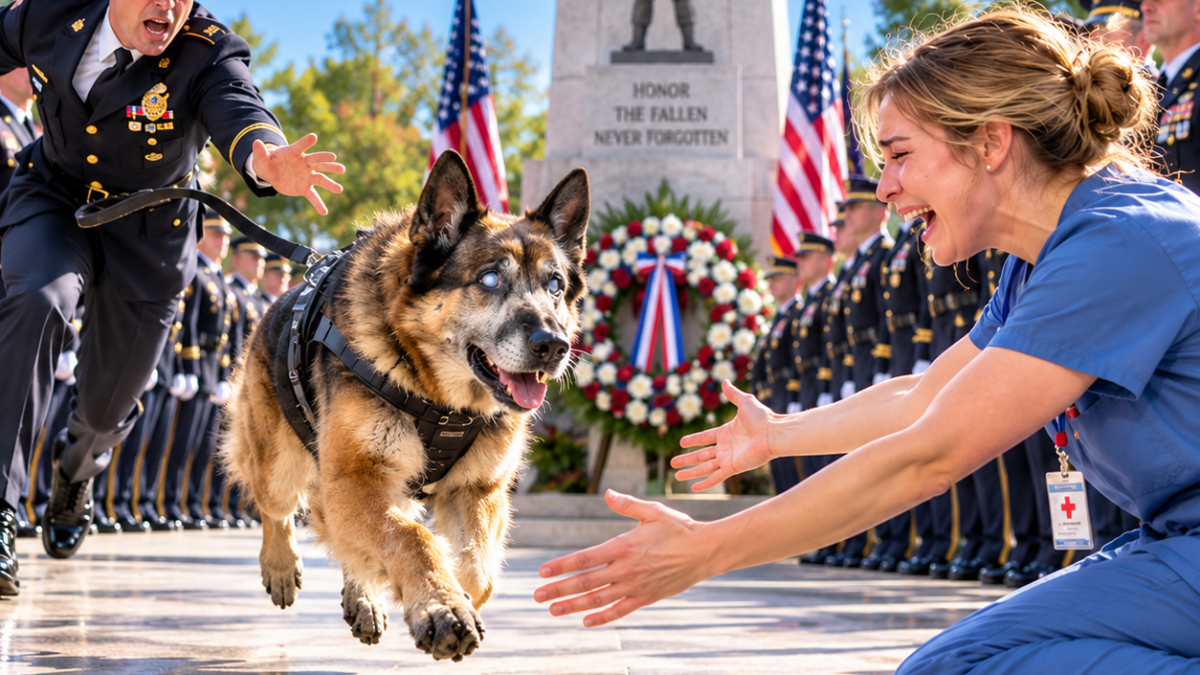
Then the blind K9 broke rank and ran.
Straight toward me.
Across the open memorial ground.
Past the last row of officers.
Across the pavement.
I dropped to one knee but did not call him.
He reached me hard enough to push me back against the medical chair.
I caught his harness with both hands.
His head drove beneath my chin.
His full weight leaned into me.
His breathing came fast against my jacket.
For one second, I closed my eyes.
The plaza vanished.
I was sixteen.
Mark was alive.
Ranger was young.
Our mother was laughing in the kitchen.
And grief, which I had spent years keeping useful and contained, finally broke rank too.
“Easy,” I whispered.
Nothing more.
Ranger leaned harder.
Across the plaza, Daniel finally turned.
The formation was no longer perfect.
Ranger was thirty yards from his assigned place, pressed against a nurse during the final salute.
Daniel’s hand moved toward the disconnected lead at his belt.
Then stopped.
Earlier that morning, he would have crossed the plaza, taken Ranger by the harness, and restored the line.
Instead, he looked at the memorial director and made the call.
“Continue.”
The salute continued with Ranger beside me.
An officer near the aisle stepped back to keep the path open.
Another adjusted his position instead of closing the gap.
No one came for the dog.
I did not hold Ranger in place.
When his breathing slowed, I opened both hands against his shoulders.
He could leave.
He stayed.
Only after the formation was released did Daniel walk toward us.
He stopped several feet away.
He did not reach for Ranger.
“What does he need?” he asked.
“A minute.”
Daniel nodded.
Several officers began to approach.
He raised one hand, and they stopped.
No argument.
No crowd.
No touching.
Ranger rested against me until he lifted his head on his own.
Daniel crouched with empty hands.
“Ranger.”
Nothing else.
The dog’s ears turned toward him.
Ranger stood, touched his nose to my hand, then crossed to Daniel.
Only after Ranger reached him did Daniel place one hand on the harness.
“All right,” he said softly.
I stood.
My knees shook.
The ceremony ended in fragments after that.
People spoke to me, but I remember little.
A captain thanked me.
Ally hugged me too tightly.
Someone asked whether I was Mark Carter’s sister, and I nodded because words had become hard.
Daniel did not leave immediately.
He followed me back to the animal care station and removed a folded document from Ranger’s gear pouch.
“He’s scheduled to return to the retirement kennel this afternoon,” he said.
I looked at the paperwork but did not take it.
“That plan was written before today.”
I looked down at Ranger.
His cloudy eyes faced neither of us, but his body stood between my shoes and Daniel’s boots.
“Today doesn’t automatically make me the answer,” I said.
“I know.”
The answer came without argument.
That mattered too.
Daniel laid the transition sheet on the table.
“That’s why I’m asking.”
We went through the plan together.
Not as a dramatic custody decision.
Not as a memorial miracle wrapped in a bow.
A process.
A real one.
Daniel would keep responsibility for Ranger’s mobility schedule and handling transitions.
The kennel staff would track sleep, appetite, navigation, stress, and response after the event.
I agreed to attend two transition visits at the clinic to see whether Ranger’s response to me held outside the ceremony.
When Daniel reached the line marked permanent placement, his pen stopped above it.
I looked at him.
“Not today.”
He left it blank.
No pressure.
No argument.
Just an unfinished decision with a process behind it.
Ranger settled beneath the table, positioned between us.
Neither of us moved him.
When the transport team arrived, one handler reached for a spare lead.
Daniel raised a hand.
“Give him a second.”
He crouched beside Ranger but did not attach the leash.
“Ready?”
Ranger stood at his voice.
I stayed by the table.
I did not call him back.
Daniel walked toward the transport vehicle at Ranger’s pace, leaving space for the blind dog to navigate beside him.
At the door, Ranger paused and turned his head toward me.
I gave him one small nod.
“Go ahead.”
He stepped into the vehicle.
Daniel closed the door gently.
No one had won Ranger that day.
No one needed to.
We had stopped treating responsibility like something only one person could hold.
Three weeks later, Ranger walked into Harbor Ridge beside Daniel with nothing pulling him through the door.
The old ceremonial lead was folded inside Daniel’s jacket pocket.
I was finishing a chart at the treatment counter when Ranger stopped in the doorway and lifted his nose.
Daniel kept walking.
He did not shorten a lead.
Did not point Ranger toward me.
Did not tell him where to stand.
Ranger crossed the room on his own, brushed one shoulder against a cabinet, corrected his path, and found my chair.
His nose touched my knee.
I gave him one slow stroke between the ears, then returned to the chart.
“Wait,” I said.
He waited.
Daniel set Ranger’s care folder on the counter.
“Eating steady. Sleeping through the night. No problems with the new route.”
I opened the folder.
Ranger heard Daniel pull out the second chair and moved toward the sound. A moment later, he lowered himself between us, his back against Daniel’s boot and one paw touching my shoe.
Neither of us repositioned him.
I turned to the final page.
The permanent placement line was no longer blank.
Ranger would live with me.
Daniel would continue scheduled mobility sessions and remain part of his working transition.
The kennel team had signed off after the trial visits.
No one had needed to disappear from Ranger’s life to make the arrangement simple.
I signed the nursing care section and handed the folder back.
Daniel closed it.
“Thursday at ten.”
“I’m working until eleven.”
“Eleven-thirty.”
“Works for me.”
That was it.
No speech.
No argument about who had the final say.
No reminder about giving Ranger room.
We adjusted the schedule and moved on.
Daniel stood first.
Ranger lifted his head but stayed on the floor.
Daniel walked to the doorway and waited without calling him.
I finished the last line on my chart, capped my pen, and reached for my bag.
Ranger stood immediately.
He faced Daniel for a second.
Then turned toward me and touched my hand with his nose.
I rested my fingers briefly against his harness.
“Come on.”
Daniel opened the door and stepped aside.
Ranger walked through first.
Outside, the sidewalk split toward two parking areas.
Daniel’s truck was to the left.
My car was to the right.
Ranger stopped at the split.
Daniel kept walking toward his truck.
He did not call the dog back.
Did not look over his shoulder.
I started toward my car.
After a moment, Ranger followed me.
His harness brushed lightly against my leg.
Daniel reached his truck and pulled out his keys.
The folded ceremonial lead stayed in his pocket.
I opened my car door and waited while Ranger found the step.
He climbed in beside me.
The door closed.
Daniel drove one way.
We drove another.
And for the first time since Mark died, I did not feel as if love had been taken from me in one final, unchangeable direction.
Something had come back.
Not the same.
Never the same.
But real.
Ranger lives with me now.
He knows the layout of my house better than most sighted visitors.
Three steps from the rug to the water bowl.
Seven from the couch to the back door.
One careful turn around the coffee table I refuse to move because stability matters.
He sleeps in my room, usually halfway between my bed and the door, because retirement has not erased all duty from his bones.
On difficult nights, he finds my side of the bed and rests his head on the mattress.
I place one hand between his ears.
Neither of us says what we are remembering.
Daniel comes every Thursday at eleven-thirty unless duty interferes.
He and Ranger practice mobility routes, scent orientation, curb work, steps, vehicle loading, and calm response to crowds. Sometimes they walk in silence. Sometimes Daniel talks to him in the low voice handlers use when they pretend they are giving commands but are really saying everything else.
Before he leaves, Daniel always asks, “Anything change?”
I tell him.
Appetite.
Sleep.
Stress.
New routes.
Bad mornings.
Good ones.
We share responsibility without fighting over possession.
It is one of the most adult arrangements I have ever been part of.
Ranger still visits the memorial.
Not often.
Enough.
The first time I took him back, Daniel came too.
We did not make it a ceremony.
No uniforms.
No formation.
No speeches.
Just the three of us walking the stone path in late afternoon light.
Ranger found the wall.
Found Mark’s name.
Lowered himself beneath it.
I sat beside him.
Daniel stood a few feet away, hands in his pockets.
For a long time, nobody spoke.
Then I placed my palm flat against the engraved letters.
Staff Sergeant Mark Carter.
Brother.
Handler.
Son.
Friend.
The boy who taught me to ride a bike by letting go.
The man who brought home a working dog and told me not to touch him until the dog chose.
Ranger leaned against my side.
I finally said what I had not said at the memorial.
“I missed you.”
Not to Ranger.
Not only to Mark.
To the whole life before the door closed.
The kitchen.
The thunderstorm.
The guest room.
The dog who was young.
The brother who was alive.
Daniel turned away politely while I cried.
Ranger stayed.
Of course he did.
People still tell the story of the memorial.
Usually they tell it wrong.
They make it sound like a blind K9 sensed a grieving nurse and ran to comfort her during a salute.
That is not false, exactly.
But it is too simple.
Ranger did not break rank because I needed him.
He broke rank because for once, everyone stopped deciding for him.
Daniel stopped pulling.
I stopped calling.
The officers moved around him.
The ceremony adjusted.
The lead came off.
The choice became his.
And when given the choice, Ranger honored Mark, then found me, then returned to Daniel, then built a life that had room for all of us.
That is what people miss.
Love is not always holding tighter.
Sometimes love is loosening the lead.
Sometimes loyalty means standing still while the one you love decides where they need to be.
Sometimes responsibility is not control.
Sometimes the most respectful command is silence.
At the memorial, one hundred officers stood in perfect formation.
But the moment everyone remembers is the moment the formation changed for a blind old dog who could no longer see where he was supposed to stand.
Ranger taught us that grief has its own orientation.
It follows scent.
Memory.
Stone.
Voices.
The familiar shape of someone who once belonged to someone you lost.
He could have stayed beneath Mark’s name.
He could have gone to Daniel.
He could have found me.
That day, he did all three.
And somehow, because no one forced him to choose only one, all of us got to keep loving him.
Every morning now, Ranger waits by my front door while I clip on his working harness.
He cannot see the world waiting outside.
But he lifts his nose.
Listens.
Breathes.
Finds what is familiar.
Then takes one step forward.
I follow beside him, not in front.
Daniel taught me that without meaning to.
Or maybe Ranger did.
Either way, I understand now.
You do not always have to lead the ones you love.
Sometimes you clear the path.
Give them room.
Trust what they still know.
And let them find their way home.








