I Bought Pies from an Old Woman in the Rain—Then My Marine K9 Recognized My Missing Father’s Keepsake
PART3:
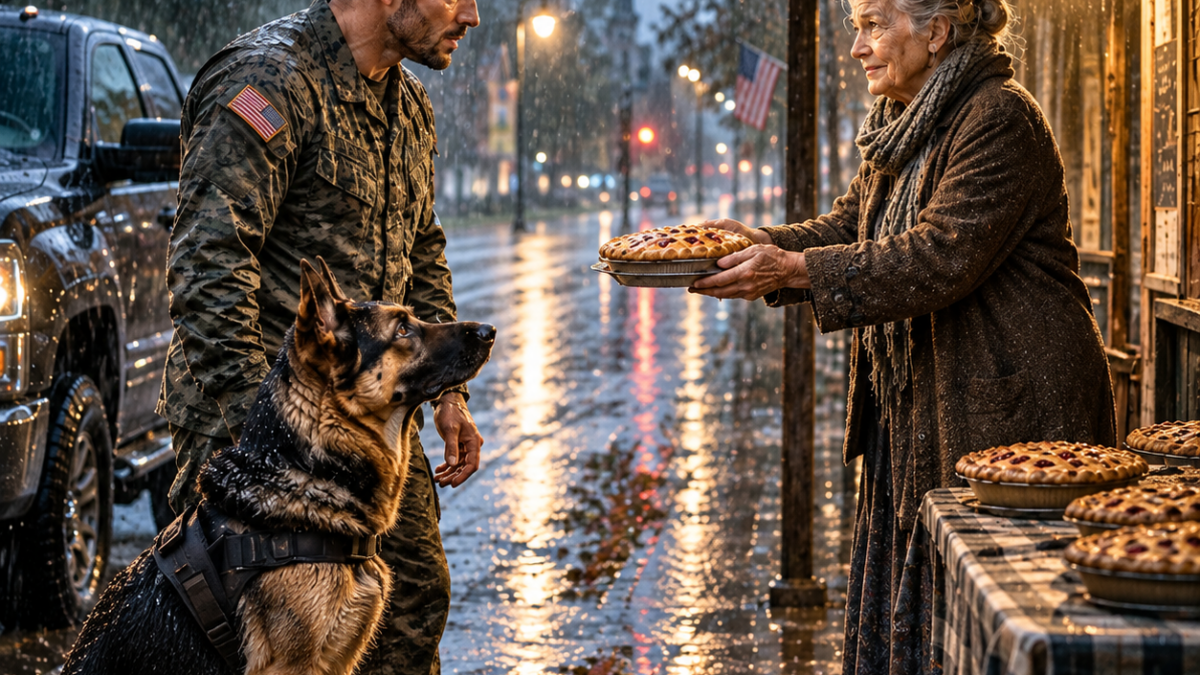
Atlas looked at me.
Only after I gave the smallest nod did he step forward. He accepted the crust with careful gentleness, his teeth never touching her skin.
The woman’s face softened.
“Such polite manners,” she whispered. “Someone loved you enough to teach them.”
“He had good instructors,” I said.
“So did you, I think.”
Something about the way she said it made me study her more carefully.
Her eyes were hazel, light but tired, with a kind of warmth that had survived more than comfort could explain. Deep lines softened rather than hardened her face. Her coat was old, but clean. Her table was poor, but orderly. The pies were arranged as if presentation mattered even when nobody stopped.
“My name is Agnes Hale,” she said, extending one weathered hand. “I know selling pies at an abandoned bus stop isn’t exactly impressive, but old habits become faithful companions.”
“Gideon Roark.”
She repeated my last name politely.
“Roark.”
No recognition crossed her face.
Not yet.
“I’ll take all four pies,” I said.
Her smile brightened, then turned cautious.
“Only if you promise they’re going home to be eaten.”
“I can pay for them either way.”
“No.”
The word was soft but firm.
I had heard orders delivered with less authority.
“My father used to say food given without purpose fills the stomach for a day,” Agnes said. “Food shared around a table keeps people alive much longer.”
I stood there in the rain with my wallet halfway out of my pocket and understood that I had nearly insulted her without meaning to.
She was not begging.
She was selling what her hands still knew how to make.
I nodded once.
“I’ll eat every slice.”
Her eyes narrowed slightly, but this time with humor.
“All four?”
“I know Marines who have survived worse.”
“Then we have ourselves a fair bargain.”
As she leaned down to lift the final pie from the basket, something slipped through her trembling fingers.
A wooden spoon struck the wet pavement with a dull sound.
The rain washed over the walnut handle.
I bent to pick it up.
Then my breath stopped.
The spoon was old. Worn smooth in the grip. Darkened by time, oil, and use. But along the handle, carved in careful letters, were words I knew.
For Ev, until every road leads home.
For several seconds, the rain seemed to fall without sound.
I had seen those words once before.
Only once.
In a faded photograph my father kept tucked inside a book of field notes. He guarded that photograph more carefully than any medal. I was young when I found it, maybe eleven. My mother Cordelia had told me not to pry, but children are built from questions and disobedience. In the photo, my father, Everett Roark, stood in a modest relief kitchen overseas, smiling with flour on his shirt and a wooden spoon in his hand.
That spoon.
This spoon.
I heard myself whisper one name.
“Everett.”
Agnes froze.
The rain caught along the brim of her hat and fell in silver threads between us.
Her color drained so quickly I stepped closer without thinking.
Her eyes locked onto my face.
Not my uniform jacket.
Not Atlas.
My face.
“You…” Her voice cracked. “You knew Everett?”
Before I could answer, her knees buckled.
I caught her before she struck the pavement.
Atlas barked once, sharp and commanding, then planted himself between us and the street as if holding the world back by force.
I lowered Agnes carefully, one arm around her shoulders, the wooden spoon still gripped in my hand.
“Agnes? Can you hear me?”
Her eyelids fluttered.
I pulled out my phone and called for an ambulance.
By the time help arrived, a few pedestrians had gathered beneath the shelter, murmuring useless questions. I gave instructions without thinking. Space. Back up. Don’t move the table. Leave the bag there. Atlas, guard.
Atlas stood beside Agnes, his body rigid, eyes moving from her face to the road and back again.
Only when the paramedics lifted her onto a stretcher did I notice the small leather pouch that had fallen from her coat pocket.
I picked it up.
It was old, soft from use, and tied closed with a narrow strip of blue ribbon.
I should have handed it directly to the paramedics.
Instead, for reasons I could not have explained, I slipped it into my pocket with the spoon.
Hours later, inside a quiet hospital room, a nurse handed me Agnes’s belongings.
“Are you family?” she asked.
I almost said no.
The word would not come.
“I’m the one who found her.”
The nurse looked from me to Atlas lying across the doorway like a sentry and seemed to decide that was enough.
Agnes had suffered exhaustion, dehydration, and a respiratory flare made worse by cold exposure. The doctor said she needed rest, medication, proper food, and a much better sense of self-preservation. He said it kindly, but I heard the concern beneath it.
Atlas became the unofficial guardian of the hallway before midnight.
Nurses smiled when they passed him. One asked if he was working.
“Yes,” I said.
“What’s his job?”
I looked through the room window at Agnes sleeping beneath a thin hospital blanket.
“He knows before I do.”
I sat beside the bed with the leather pouch in my hands.
It felt wrong to open it.
It felt worse not to.
The spoon had already changed everything.
Inside the pouch was a worn photograph.
My hands began to shake before I fully understood why.
A much younger Agnes stood beside my father in the same relief kitchen from his old photo. Both of them dusted with flour. Both laughing. Everett had one sleeve rolled higher than the other and a streak of something across his jaw. Agnes held the wooden spoon like a trophy.
On the back, in my father’s unmistakable handwriting, were five words.
If I am late, wait for me.
I sat there reading those words until they blurred.
My father had been a quiet man.
Not cold.
Quiet.
He had loved with acts more than language. Boots cleaned outside the door. A repaired fence before my mother could mention it. A hand on my shoulder before my first deployment. A letter in my gear bag written in case I became too proud to ask for advice.
He died when I was twenty-three.
Heart failure, sudden and merciless.
I thought I knew the shape of his life.
I thought grief had already finished revealing him.
Then an old woman selling pies in the rain collapsed at the sound of his name, and I found his handwriting on the back of a photograph he had never shown me.
Morning light entered the hospital room pale and hesitant.
Agnes was awake when I returned with coffee and a paper bag from the bakery across the street. Atlas lifted his head from the doorway, approved my presence, then lowered it again.
Agnes sat upright, the photograph resting on her lap.
“I haven’t looked at this picture in years,” she said before I spoke. “Last night was the first time I believed someone else might understand why I kept it.”
I placed the coffee beside her.
Neither of us spoke for a while.
Then she smiled faintly.
“Everett always laughed whenever he tried to bake.”
That startled me.
“He baked?”
“Oh, terribly. The first pie he ever made collapsed before it reached the oven. He insisted flour had declared war on him.”
The memory lit her face from somewhere inside.
Without realizing it, I smiled too.
For the first time, Everett Roark stopped being only my father.
He became a young man.
Someone who failed at pie crust.
Someone who laughed.
Someone who had stood beside this woman under a foreign sky and apparently promised her a future no one in my family had ever mentioned.
“We met at a humanitarian relief center overseas,” Agnes began. “I was twenty-six. I helped prepare meals for families displaced by fighting. Everett had been assigned to protect aid convoys bringing food and medicine into villages that had almost nothing left.”
Her thumb moved over the photograph’s edge.
“Most soldiers came through quickly. Everett always stayed long enough to carry water buckets after unloading supplies. He never wanted thanks. He said kindness counted less if someone noticed it.”
I stared at the photo.
That sounded like him.
Painfully like him.
“One evening, the generator failed while dozens of children were waiting for dinner. Everyone panicked because darkness came quickly there. Your father disappeared without saying a word.”
She reached toward the bedside drawer where the nurse had placed her belongings.
I handed her the spoon.
She held it with both hands.
“He returned carrying a broken wooden spoon. He carved a new handle by lantern light because he said no kitchen should stop feeding hungry people over something that simple.”
Her smile trembled.
“He gave it to me unfinished. I waited until he fell asleep before carving the words into it.”
“Until every road leads home,” I said.
She nodded.
“When he saw it the next morning, he laughed and said I had turned a simple kitchen tool into something too precious to use.”
“But you used it anyway.”
“Every day,” she said. “A promise should be useful, don’t you think?”
I did not answer.
She took a slow breath.
“Everett left for America three weeks later. The night before he left, we stood outside the relief kitchen until sunrise. We did not promise impossible things. We only promised that no matter how far life carried us, we would build a home together when the roads finally stopped separating us.”
My chest felt tight.
“What happened?”
Agnes looked at the rain drying on the window.
“A month after he returned home, I discovered I was carrying his child.”
The room changed shape around me.
Atlas lifted his head.
Agnes did not look at me.
“I wrote letter after letter. I told him about ordinary things I believed he would one day cherish. The first tiny clothes I sewed by hand. The little room I began preparing. The apple tree I dreamed of planting beside the home we would someday share.”
Her fingers trembled around the spoon.
“I never stopped writing. I simply stopped receiving answers.”
I sat completely still.
“At last, one envelope arrived. I cried before opening it because I thought it meant Everett was finally coming for us.”
Her face tightened.
“The letter said he wanted no child, no family, no future with me.”
“No.”
The word left me before discipline could stop it.
Agnes looked at me then.
“I recognized his name. But I never believed those words sounded like him.”
“They don’t.”
“By then, I was frightened, alone, and ready to believe the worst.”
“What happened to the baby?”
Her eyes closed.
“My labor began during the first heavy snow of winter. I remember bright lights, hurried voices, unbearable pain. Then darkness. When I woke, a doctor told me my son had died shortly after birth.”
She swallowed.
“They would not let me hold him. They said it would deepen my grief.”
I felt cold in a way the hospital warmth could not reach.
“For years, I tried to accept that answer,” she whispered. “But a mother’s heart kept saying something different.”
Decades later, she said, a retired hospital records clerk secretly mailed her copies of forgotten documents. Delivery records. Transfer logs. Inconsistencies. Altered dates. Signatures that did not match. No official certificate confirming her son’s death.
“I sold nearly everything I owned,” Agnes said. “I crossed cities. Searched archives. Visited churches, adoption agencies, veterans groups. I wasn’t chasing certainty anymore.”
She looked at me.
“I was chasing hope.”
I stood and walked to the window because staying seated felt impossible.
Outside, wet branches trembled in the hospital courtyard. A man in scrubs smoked beneath a covered walkway. Somewhere down the hall, someone laughed too loudly because hospitals make people desperate for normal sounds.
“My mother raised me,” I said.
“Of course she did.”
“Cordelia Roark. She loved me.”
“I believe that.”
“She waited through deployments. She packed school lunches. She sat through football games in the rain. She knew how I took coffee before I did.”
Agnes’s eyes filled, but she did not interrupt.
“If everything you’re telling me is true,” I said, voice rough, “then neither of you deserved what happened.”
At that moment, Atlas stood.
His ears turned toward the bedside cabinet.
My phone vibrated.
The screen lit up.
Cordelia Roark.
I stared at the name.
I had not told my mother I was in Millstone.
I answered slowly.
“Mom?”
A brief silence.
Then Cordelia’s calm voice came through.
“Gideon. Are you in Millstone?”
I did not ask how she knew.
Years in the Marine Corps had taught me that answers offered too quickly are often designed to guide you away from the right question.
“Yes,” I said.
Another silence.
Then she said, “Come home when you’re ready.”
That was all.
She ended the call first.
The boarding house where Agnes lived stood a few streets from the hospital, tucked between an aging laundromat and a closed hardware store. The brick walls were faded, ivy climbing across the porch like it was trying to hold the building together. Agnes unlocked the narrow door with a brass key tied to a worn blue ribbon.
“I’ve rented the same room for twelve years,” she said, apologetic though she had no reason to be. “The owner stopped raising the rent after his wife passed. He says lonely people should never have to bargain for a place to sleep.”
Her room sat beneath the roof.
Small.
Tidy.
A quilt on the narrow bed. Books on uneven shelves. A cracked teacup holding pencils. A small table near the window where, I imagined, she wrapped pies before walking to the bus shelter. The room smelled faintly of cinnamon, despite her spending the night in the hospital.
Every object had its place.
That was why I noticed what did not.
The rocking chair beside the window faced the door, not the light.
One dresser drawer sat slightly open.
A lace curtain hung crookedly.
Atlas began moving before I said anything.
He sniffed along the wardrobe, the bed, the doorway. Then he stopped beneath the window, nose working along the floorboards.
Agnes had gone still.
“No.”
Her voice barely escaped.
She dropped to her knees before the lowest wardrobe shelf.
A dust-free rectangle showed where something had rested for years.
“My letters,” she whispered.
She reached into the empty space.
“The photographs. The papers.”
I crouched beside her without touching anything.
No broken lock.
No shattered glass.
Whoever entered had used a key or had been welcomed in.
“What was in the box?”
“Every letter I ever wrote Everett. Every picture we had. Hospital papers. Newspaper clippings. Everything I couldn’t bear to throw away.”
Atlas looked back at me.
“There are scents here that don’t belong,” I murmured. “But chasing them won’t give us the whole truth.”
Agnes looked at me through tears.
“What do we do now?”
I unfolded the photograph from the hospital.
“My father trusted one place before every dangerous mission.”
Her eyes followed mine.
“The Veterans Association?”
“If someone stole your memories,” I said, “we start looking where he left his.”
The Millstone Veterans Association smelled of polished oak, old paper, and coffee brewed so often it had become part of the walls. Framed photographs lined the hallways. Young men and women looked out from them with the terrible innocence of people who did not yet know what history would ask.
An elderly volunteer sat at the archive desk.
Walter Briggs.
Eighty-one, tall despite age bending him slightly, white beard neatly trimmed, blue eyes still sharp with old military alertness. He had been a logistics officer once and had spent twenty years preserving the belongings of veterans whose families no longer knew where to begin searching.
When I introduced myself, his face changed.
“Roark,” he repeated quietly. “Everett Roark?”
I nodded.
Walter stood without another word and disappeared into the archive room.
When he returned, he carried a faded canvas envelope.
“He left this with us before his final overseas assignment,” Walter said. “Joked that if he didn’t come back quickly, someone would eventually need to remember him better than he remembered himself.”
Agnes accepted the envelope with trembling hands.
Then hesitated.
“I have waited forty years,” she whispered. “Another minute won’t matter.”
Atlas had wandered toward the staircase at the back of the hall.
He sniffed along the baseboards, paused at the lowest step, then scratched twice at a loose panel before sitting down.
I recognized the behavior.
Atlas was not seeking attention.
He had found something.
Walter frowned.
“I’ve worked here since I retired. I’ve never seen that.”
I removed two rusted screws from the narrow board.
Behind it was a shallow compartment built into the wall.
Inside sat a small metal box covered with dust.
Walter removed his cap.
I lifted the box carefully.
Inside were unopened letters tied with faded blue ribbon, another photograph of Everett and Agnes outside the relief kitchen, and an old cassette recorder wrapped inside Everett’s field jacket.
Agnes lifted the jacket first.
She pressed the worn collar to her face.
The scent was long gone.
The memory was not.
I carried an emergency kit in my truck, because old habits are stubborn. Fresh batteries brought the recorder to life with a crackle of static.
Then my father’s younger voice filled the room.
“If one day my son hears this…”
Agnes gasped.
Walter bowed his head.
“I want him to know his father never stopped looking for the road home.”
Tears rolled down my face before I realized they had begun.
“And Agnes,” Everett’s voice continued, “if life tells you I abandoned you, don’t believe it. Every road I’ve walked has always been leading back to you.”
No one spoke after the recording ended.
The room seemed to hold its breath.
Finally, I turned to Agnes.
“I want to take the DNA test.”
She looked at me without breathing.
“Not because I need another mother,” I said. “Cordelia raised me with love. That will always be true.”
Her face folded slightly, pain and hope struggling in equal measure.
“But you spent forty years searching for your child,” I continued. “You deserve to know whether he had the life you prayed he would.”
For the first time since I met her, Agnes reached for my hand without looking afraid that hope might disappear if touched.
Waiting is the hardest mission because there is nothing to attack.
No target.
No plan that speeds time.
No discipline strong enough to force an answer from a laboratory.
So I kept moving.
Every morning, I stopped by Agnes’s boarding house before sunrise. Sometimes with groceries. Sometimes with medicine from the county pharmacy. Sometimes with a toolbox balanced against my shoulder.
The room beneath the roof needed more repairs than she admitted.
A cabinet hinge rusted nearly through.
Rainwater stains in the ceiling corner.
Cold air slipping around old window frames.
A loose stair tread that shifted underfoot.
“I’ve been meaning to fix that for years,” Agnes said when I knelt by the cabinet.
“My father used to tell me every job gets harder the longer we postpone it.”
She looked at me sharply.
“He said that?”
I paused with the screwdriver in hand.
“I don’t know,” I admitted. “Maybe I imagined it after hearing stories about him.”
She smiled sadly.
“Sometimes memory and wishing hold hands until you can’t tell which one led.”
Atlas supervised every repair with solemn attention. At one point, he nudged a loose paintbrush away from the ladder before curling in a patch of sunlight near the window.
Agnes laughed.
A real laugh.
“I think he’s supervising.”
“He believes nobody can do anything properly unless he watches first.”
Atlas lifted one ear at his name but otherwise remained perfectly still, which made her laugh again.
The sound lingered.
It was the first genuine laugh I had heard from her since the bus shelter.
Later that week, I drove her to the grocery store after a clinic appointment. I filled the cart with flour, butter, cinnamon, apples, vegetables, tea, soup, and enough practical food to keep her from pretending pie crust counted as dinner.
“That’s far too much,” she said.
“It isn’t.”
“I can’t let you keep spending money on me.”
“I’m not buying groceries because I feel sorry for you.”
“Then why?”
I rested both hands on the cart.
“Because for forty years, you kept setting one more place at the table for people who never came home.”
She lowered her eyes.
“I stopped setting the table years ago.”
“No,” I said gently. “You never stopped baking.”
The words surprised her.
Then they broke something open.
Every pie she had baked was not business.
Not habit.
Not stubbornness.
Hope.
As we reached the truck, Agnes held the sack of flour against her chest.
“Would you,” she asked almost shyly, “like me to teach you the pie your father never quite learned to make?”
For the first time in my life, I wished a simple yes could return forty years.
Before I could answer, my phone vibrated.
Cordelia Roark.
This time, I drove home.
The white farmhouse where I grew up stood at the edge of Millstone exactly as I remembered it. Porch swing creaking in the breeze. Flower pots lined along the steps. Porch light glowing though sunset was still an hour away. Nothing had changed.
Everything had changed.
Atlas climbed from the truck and settled beside the porch steps instead of following me in.
Smart dog.
Some conversations do not need witnesses, not even loyal ones.
Cordelia waited in the living room with a cedar box on her lap.
She was sixty-eight, elegant despite the weight of age and whatever this truth had done inside her. Silver hair pinned neatly. Gentle eyes that had comforted me through childhood fevers, nightmares, first heartbreak, deployments, and my father’s funeral.
I had loved her my entire life.
That did not make what was coming easier.
“I’ve prayed for this conversation,” she whispered. “I’ve also prayed it would never come.”
She opened the box.
Dozens of letters lay inside, tied with faded blue ribbon.
My father’s handwriting on some.
Agnes’s on others.
None delivered.
My chest tightened so hard I had to stand still.
Cordelia touched the top bundle.
“When Everett disappeared, everyone preparing casualty reports believed he wouldn’t survive. Around the same time, I learned about Agnes. About the baby. About how completely alone she was.”
Tears rolled down her face.
“I convinced myself I could save one innocent child.”
I could barely hear over the pulse in my ears.
“I never realized I was destroying a family.”
She told me the story in pieces.
She had been working with military family support offices at the time, helping organize paperwork, casualty updates, and correspondence. When Everett went missing for months and reports suggested he might not survive, Cordelia found Agnes’s letters. She learned about the pregnancy. She believed Agnes was unstable, alone, impoverished, and in danger.
Then I was born.
Agnes nearly died in childbirth.
Confusion in the hospital.
No advocate beside her.
Cordelia made a decision no one had given her the right to make.
She arranged for the infant boy to enter adoption under a different identity.
She intercepted every letter afterward.
When Everett returned alive, broken and desperate to find Agnes, Cordelia had already built her lie into my life so thoroughly that undoing it would destroy everyone she claimed to love.
“I told myself love made my decision righteous,” she said, shaking. “But love without humility becomes control.”
Silence filled the room.
I stared at the letters.
At the proof of every year stolen.
“You loved me,” I said finally.
“I still do.”
“And Agnes loved me every day without knowing where I was.”
Cordelia nodded through tears.
“So did Everett.”
Another long silence.
I thought rage would come.
Maybe it did.
But it came heavy instead of hot.
Too large to spend in shouting.
“You didn’t fail because you loved too much,” I said.
Cordelia looked up.
“You failed because you believed love gave you permission to choose someone else’s life.”
She closed her eyes as if the words had struck exactly where she already lived.
“I know.”
That was all she said.
No defense.
No plea.
No excuse.
Just those two words.
The laboratory envelope arrived the following afternoon.
I did not open it.
I drove directly to Agnes’s boarding house.
She sat at the little table by the window, hands folded, wooden spoon resting beside her teacup.
I placed the sealed envelope in front of her.
“For more than forty years,” I said, “other people decided what truth you were allowed to know.”
Her eyes filled.
“This decision belongs only to you.”
Her hands trembled so badly I almost offered to open it.
I did not.
Some doors must be opened by the person kept outside them.
She unfolded the report.
The words blurred behind her tears.
Then one sentence came into focus.
Probability of maternity: 99.998%.
Agnes covered her mouth.
Her shoulders shook.
“I don’t need you to call me mother,” she whispered. “I only hope I may remain part of your life.”
I crossed the room and embraced her without hesitation.
She was smaller than I expected in my arms.
Fragile, yes.
But not weak.
No woman who had survived forty years of stolen truth and still baked pies in the rain could be called weak.
My voice broke for the first time.
“We don’t have to go back to forty years ago.”
I pulled away enough to see her face.
“We begin with today.”
Atlas rose from the doorway and pressed his head against both of us, completing the circle he had started beneath the bus shelter.
Nearly three weeks passed before we went to the memorial.
Nothing dramatic happened in those weeks.
That surprised me.
I expected revelation to rearrange everything loudly.
Instead, healing arrived through ordinary mornings.
I drove Agnes to medical appointments.
She packed lunches and insisted sandwiches tasted better if wrapped properly.
Cordelia wrote Agnes a letter, then rewrote it three times, then finally delivered it in person because cowardice and remorse cannot share the same chair forever.
That meeting was not easy.
It was not meant to be.
Agnes listened.
Cordelia confessed again.
No excuses this time either.
At the end, Agnes said, “I cannot give you forgiveness today.”
Cordelia nodded.
“I know.”
“But Gideon loves you.”
Cordelia broke then.
Agnes looked toward me.
“And I will not ask my son to cut away the woman who raised him.”
That was the first time she called me that.
My son.
I had stood under fire without flinching.
Those two words nearly took my knees.
One crisp Saturday morning, I drove Agnes to the Veterans Memorial overlooking the river outside town. She held the wooden spoon with both hands the entire way. Atlas rode in the backseat, his head resting between us, watching trees pass with calm amber eyes.
The memorial stood beneath tall oaks shedding gold and brown leaves. Hundreds of names were engraved into polished granite.
We stopped before one.
Everett Roark.
For a while, nobody spoke.
The silence did not feel empty.
It felt respectful.
Agnes knelt slowly despite the stiffness in her knees and placed the wooden spoon beneath his name. The walnut had darkened with age, but the carved words remained clear.
Until every road leads home.
“I carried this every day,” she whispered. “At first because I believed you would come back for it. Then because it became the only proof that what we shared had truly happened.”
I removed the restored cassette recorder from my jacket.
“I thought maybe he should be here when we hear him again.”
Agnes nodded.
I pressed play.
Static.
Then my father’s voice.
“Agnes, if you’re hearing this, life has probably been much harder than either of us imagined. Please don’t spend your years waiting beside a window for footsteps that may never come. Laugh whenever you can. Bake your pies. Keep loving people who need kindness.”
Agnes closed her eyes.
“And if our child is alive somewhere beneath this same sky,” Everett continued, “tell him I never stopped trying to find the road home.”
When the recording ended, none of us moved.
Finally, Agnes wiped her tears.
“I waited for you for more than forty years,” she whispered to the stone. “Today, I think it is time I let you rest.”
As we walked back toward the truck, I noticed something I had not seen before.
Agnes was no longer walking like someone chasing yesterday.
For the first time, she was walking toward tomorrow.
Several months later, the abandoned meeting hall beside the Millstone Veterans Association became the warmest place in town.
I had organized volunteers to restore it because lonely people rarely need charity first.
They need somewhere someone expects them to arrive.
We tore out rotten boards, replaced windows, repaired plumbing, painted walls, refinished tables, and turned the old hall into a community kitchen. Veterans who once came only for memorial services now gathered around long wooden tables covered with flour, rolling pins, soup bowls, and fresh coffee.
Agnes accepted only one title.
“I’m the baker,” she insisted. “Nothing more.”
Every Tuesday and Friday, she taught anyone willing to learn.
Widowers who had never boiled water before losing their wives.
Veterans whose injuries stole confidence more than strength.
Lonely old men who claimed they came for coffee but stayed three hours.
Young mothers stretching grocery money.
Teenagers who needed somewhere safe after school.
Agnes never criticized clumsy hands or imperfect pies.
She smiled, corrected gently, and reminded everyone that the first pie Everett Roark ever attempted had collapsed before reaching the oven.
Laughter returned to that building slowly.
Then all at once.
On the morning of the grand opening, I drove to the abandoned bus shelter before sunrise.
Agnes stood there waiting.
No basket.
No pies.
Only her hands tucked comfortably into her coat pockets.
“You forgot your basket,” I said.
She looked down the empty road.
“No.”
A peaceful silence settled between us.
“For forty years, I came here believing someone might still find their way back to me.”
She turned toward me.
“Now I know where home is.”
For the first time in my life, the word came without hesitation.
“Mom.”
Agnes covered her mouth.
Tears filled her eyes.
Not grief.
Not regret.
Gratitude.
Together we walked into the community kitchen, where neighbors, veterans, and volunteers applauded like they had been waiting years to welcome her properly.
Near the front stood Thomas Mercer, eighty-nine, retired Marine, posture still straight enough to make younger men fix their shoulders. Snow-white hair. Trimmed mustache. Old service jacket buttoned carefully.
He had served beside Everett.
From inside his jacket, Thomas removed a folded note.
“Everett asked me to tell Agnes something if he never made it home,” he said.
The room went silent.
“He told me, ‘Tell her never to stop baking. One day the smell of her apple pies will guide our family back to one another.’”
Agnes closed her eyes as fresh tears slipped down her cheeks.
Only then did I understand.
She had not baked because she could not move on.
She had baked because hope needed somewhere to live.
That evening, an apple pie rested at the center of our family table.
Atlas lay between my chair and Agnes’s, tail brushing softly against the wooden floor while warm laughter filled the room.
Cordelia sat beside me.
Agnes sat across from her.
Not everything between them was healed.
Maybe it never would be completely.
But both women were there.
Both had loved me.
One had given me life and lost me.
One had raised me and lied because she confused love with ownership.
The truth did not make that simple.
It made it honest.
Before anyone reached for the first slice, I removed the weathered wooden spoon from its protective case and hung it on the kitchen wall beneath a hand-carved sign.
Until every road leads home.
I looked toward Agnes.
Then toward Cordelia.
Then down at Atlas, whose instincts had done what all our records, letters, secrets, and silences could not.
He had stopped in the rain.
He had seen distress beneath a practiced smile.
He had refused to leave.
And because of that, every road that had been broken for forty years finally found its way back.
I smiled with the peace of a son who had found every part of his story.
“Now I understand why Dad never forgot the taste of your pies.”
Outside, autumn leaves drifted gently through the evening light.
Inside, after more than forty years of waiting, my family sat around one table.
The pie was warm.
The spoon was home.
And Atlas slept between us, exactly where he belonged.








