I Bought a Lake Lot for $800—A Year Later a Developer Offered $6.5 Million, Then the HOA Sent a Bulldozer for My Shoreline
I Bought a Lake Lot for $800—A Year Later a Developer Offered $6.5 Million, Then the HOA Sent a Bulldozer for My Shoreline
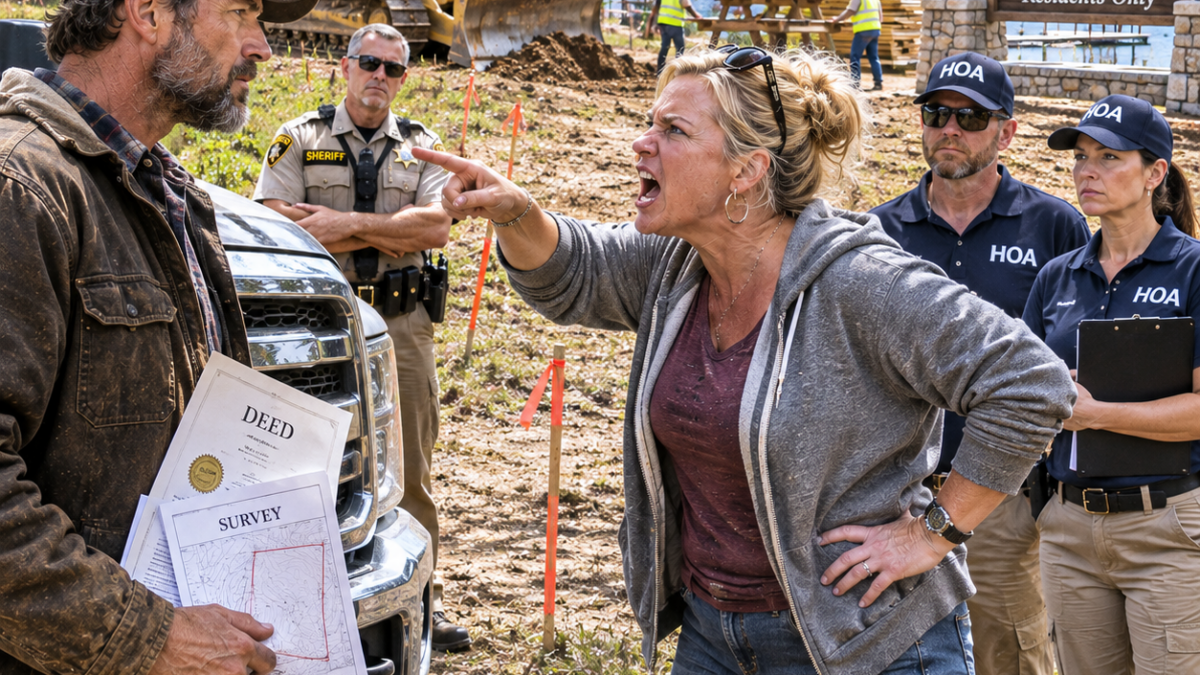
“MOVE YOUR TRUCK, JACOB! PINE CREST OWNS THIS SHORELINE, AND IF YOU BLOCK OUR CREW AGAIN, I’LL HAVE YOU REMOVED FROM ASSOCIATION PROPERTY!” HOA president Patricia Dawson screamed while a bulldozer sat halfway across the lake lot I had bought at a county tax auction for $800.
I looked past her at my trees, nearly 1,100 feet of lakefront, fresh orange survey stakes, picnic tables, fencing, and a huge sign reading PINE CREST PRIVATE WATERFRONT—RESIDENTS ONLY, then reminded her that three weeks earlier a developer had offered me $6.5 million for the same land she was now claiming belonged to her HOA.
Patricia smiled, handed me a county-recorded document supposedly proving Pine Crest had owned my shoreline since 1997, and watched my attorney read it twice before quietly asking, “Patricia, why was this deed notarized twenty-two years before the notary received her commission?”
My name is Jacob Turner.
Twelve months before an HOA president sent a bulldozer onto my property, I was not searching for lakefront land.
I was searching for somewhere cheap to park a fishing trailer.
That was it.
I lived in eastern Tennessee about forty minutes from Lake Bryer.
I had fished there since I was a teenager.
I knew the public ramps.
The shallow coves.
The points where bass stayed close to fallen timber.
I knew which bait shop opened before sunrise and which launch became impossible after Memorial Day.
What I did not have was lake-house money.
I worked as an equipment mechanic.
Good job.
Decent income.
Normal mortgage.
Normal truck.
I fixed things for people who could afford boats worth more than my house.
That was fine with me.
Then my friend Frank Wilson sent me a county tax-auction listing.
LOOK AT LOT 47B.
I opened it.
The listing was terrible.
No photograph.
No street address.
No useful map.
Description:
VACANT REMNANT PARCEL.
Approximate size:
Unknown.
Delinquent taxes:
$612.
Minimum bid:
$800.
I called Frank.
“Why would I want this?”
“It’s near the lake.”
“Near the lake can mean two miles.”
“Map looks closer.”
The county map looked like it had been drawn by somebody actively trying to hide the property.
Lot 47B appeared as a long crooked strip somewhere behind Pine Crest Estates, a subdivision on the northwestern side of Lake Bryer.
Pine Crest had around two hundred houses.
Clubhouse.
Pool.
Private roads.
Tennis courts.
One community dock.
Lot 47B seemed to sit behind it.
Or beside it.
Or partly between Pine Crest and the reservoir.
I honestly could not tell.
So I drove there.
No sign.
No driveway.
PART2:
Just woods beside an old gravel service path.
I walked as far as I could without crossing anyone’s fence.
Eventually I reached the lake.
Beautiful water.
Quiet.
Wide.
Still no idea whether the mystery lot actually touched it.
I called the county tax office.
The clerk told me the parcel had been created during the original Pine Crest development.
The listed owner was Bryer Development Holdings LLC.
Dissolved.
Taxes had gone unpaid for seven years.
No obvious bidders.
“Why is the minimum eight hundred dollars?”
The clerk laughed.
“Because nobody knows what it is.”
That should have ended my interest.
Instead, I became curious.
The auction was online.
I registered.
Bid $800.
Nobody bid against me.
Three days later:
CONGRATULATIONS.
Winning bidder.
Me.
My sister Laura stared at me when I told her.
“You bought mystery land?”
PART3:
“Yes.”
“For eight hundred dollars?”
“Yes.”
“You don’t know where the boundary is?”
“Not exactly.”
She shook her head.
“You are why warning labels exist.”
Probably.
For several months, almost nothing happened.
The county finished the tax-deed process.
I paid the fees.
Then I hired Thomas Reed, a licensed surveyor.
I wanted to know what my $800 had actually purchased.
Thomas called after looking through the original plat.
“Jacob, this parcel is a mess.”
“That sounds expensive.”
“It might be interesting.”
“Interesting is another expensive word.”
He laughed.
Then explained.
When Pine Crest was developed in the late 1990s, Bryer Development Holdings divided a large tract into residential lots, roads, drainage parcels, common areas, utility strips, and future development land.
Lot 47B was a leftover parcel.
But it was not small.
“Roughly fourteen acres.”
I sat up.
“Fourteen?”
“Maybe thirteen and a half after reservoir adjustments.”
“I expected half an acre.”
“The shape is strange.”
The parcel ran behind several western Pine Crest homes, narrowed near the clubhouse, then widened along Lake Bryer.
“How much shoreline?”
“I need fieldwork.”
“Guess.”
“Eight hundred feet.”
I laughed.
Thomas did not.
“Do not celebrate yet.”
Why?
Reservoir boundaries.
Power-authority flowage rights.
Possible easements.
Old development documents.
Anything could change the practical value.
Fine.
I had paid $800.
I could afford patience.
Thomas spent two days in the field.
Then called.
“Come out here.”
I met him beside the old service path.
Orange flags disappeared through trees.
We walked downhill.
Brush.
Old wire.
Fallen limbs.
Then suddenly the trees opened.
Lake Bryer stretched in front of us.
Thomas pointed left.
“Your line runs about five hundred feet that direction.”
Then right.
“And approximately six hundred that direction.”
I stared at him.
“You’re telling me I own this shoreline?”
“Above the reservoir control boundary, yes.”
“How much?”
“Just over eleven hundred feet.”
My first reaction was laughter.
His was not.
“Jacob.”
“What?”
“Do not build anything.”
“I wasn’t planning to.”
“There are easements.”
Of course.
One drainage easement from Pine Crest.
One utility corridor along the eastern edge.
Power authority retained flowage rights near the reservoir.
Normal complications.
Then we found something called a recreational access reservation.
That sounded less normal.
Thomas referred me to Rebecca Hayes.
Property attorney.
Sharp.
Patient.
The kind of lawyer who could read a fifty-page title package and immediately find the paragraph everybody else hoped she would overlook.
She reviewed the tax deed.
Old subdivision documents.
Reservation.
Her conclusion:
The original developer had retained temporary walking access across part of Lot 47B during Pine Crest construction.
Temporary.
It expired when the final subdivision phase ended.
No permanent Pine Crest ownership.
No permanent public access.
No community shoreline deed.
At least none Rebecca could find.
She ordered a title search anyway.
Once the tax-sale redemption period ended, I qualified for title insurance.
Then Rebecca said something I remember clearly.
“You may have bought something worth considerably more than eight hundred dollars.”
“How much?”
“Do not ask until we know what you can legally do with it.”
Good advice.
For several months, I did almost nothing.
Cleared trash.
Cut a narrow trail.
Removed fallen trees.
Fixed some old fencing.
No house.
No dock.
No gate across the walking path residents had apparently used for years.
One older Pine Crest resident, Susan Parker, stopped while I was cutting brush.
“You working for Pine Crest?”
“No.”
“The county?”
“No.”
She looked confused.
“I own this parcel.”
“This?”
“Apparently.”
She laughed.
“Well, congratulations. We always thought it belonged to nobody.”
That sentence explained the next year of my life.
Nobody.
Land that people believe belongs to nobody has a strange way of becoming everybody’s property in their minds.
Susan explained residents walked dogs there.
Teenagers fished.
Families watched fireworks along the bank.
I had no problem with that.
“Walk respectfully. No vehicles. No fires.”
“Fair enough.”
That was how I wanted things.
Neighborly.
Then Patricia Dawson arrived.
White SUV.
Magnetic sign on the door:
PINE CREST HOA PRESIDENT.
That seemed unnecessary.
She walked down my new trail wearing shoes designed for clean sidewalks.
“You’re Jacob?”
“Yes.”
“I’m Patricia Dawson.”
“I figured.”
She smiled.
“Susan told us you purchased the old reserve parcel.”
“Lot 47B.”
“Right. The reserve parcel.”
Rebecca had already warned me about that language.
Names create assumptions.
“What can I do for you?”
“Pine Crest has maintained this shoreline for decades.”
“What does maintained mean?”
“Trash removal. Trail maintenance. Mowing in places.”
Possible.
Then:
“We expect those activities to continue.”
“I’m open to a written access agreement.”
Her face changed.
“Agreement?”
“Walking access. Liability. Basic rules.”
“We don’t need an agreement.”
“Why?”
“Pine Crest already has shoreline rights.”
There it was.
“Send the deed to Rebecca.”
“Our attorney will provide the documents.”
“Good.”
Nothing arrived.
Two weeks later, I got my first HOA violation.
UNAUTHORIZED CLEARING OF COMMUNITY SHORELINE VEGETATION.
Fine:
$500.
I laughed.
Rebecca did not.
She sent one letter.
Jacob Turner is not a Pine Crest member.
Lot 47B is not subject to Pine Crest covenants.
Withdraw the fine.
They did.
Then another notice.
Prohibited private signage.
My sign said:
PRIVATE PROPERTY. PLEASE RESPECT THE LAND.
Another Rebecca letter.
Another cancellation.
Then Patricia offered to buy Lot 47B.
$25,000.
Remember:
I paid $800.
For ten minutes, $25,000 sounded like the best real-estate investment in human history.
Rebecca stopped me.
“Do not answer.”
“Why?”
“The county is considering a zoning change.”
Lake Bryer’s western shoreline was being studied for a mixed-use recreation district.
Low-density waterfront lodging.
Small marinas.
Restaurants.
Cabins.
Tourism.
Nothing guaranteed.
But Lot 47B suddenly had something developers cared about.
Large undeveloped shoreline.
Potential access.
First offer:
$400,000.
I nearly took it.
Rebecca told me to wait.
Next:
$1.1 million.
Then:
$2.8 million.
I stopped sleeping normally.
Thomas updated the survey.
Rebecca cleaned up old title questions.
Then Harbor Point Communities called.
Regional resort developer.
They proposed twelve luxury cabins.
Small marina.
Restaurant.
Conservation trail.
Public kayak launch.
Ninety-day option.
Offer:
$6.5 million.
Six million five hundred thousand dollars.
For land I bought for $800.
I thought the email was fake.
Rebecca confirmed it was real.
The offer depended on zoning.
Environmental review.
Title.
Lake approvals.
Still real.
I drove to Lot 47B and sat beside the water.
I did not feel like a genius.
I felt lucky.
The dirt had not changed.
The lake had not changed.
Information had.
The county auction priced uncertainty.
Harbor Point priced possibility.
Same property.
Different understanding.
Then Patricia learned about the offer.
I did not tell her.
Somebody at county planning probably did.
Two days later:
“Six and a half million?”
“Where did you hear that?”
“So it’s true.”
“Potential offer.”
“You cannot sell Pine Crest shoreline.”
“If you have recorded ownership, send it to Rebecca.”
“We have historical rights.”
“Send them.”
“You’re profiting from land residents maintained for twenty-five years.”
“I bought the land legally.”
“For eight hundred dollars.”
That number offended her.
As if paying $800 made my deed only $800 strong.
“Price doesn’t determine ownership.”
She hung up.
Pine Crest residents soon received an emergency email.
Susan forwarded it.
URGENT THREAT TO COMMUNITY WATERFRONT.
It claimed an outside developer planned to privatize Pine Crest’s historic shoreline.
Not exactly true.
Harbor Point’s concept actually included public access.
But people saw:
DEVELOPER.
MILLIONS.
LOSE OUR LAKE.
Panic did the rest.
SAVE OUR SHORELINE signs appeared.
Residents who had previously waved started asking whether I planned to fence them away from the water.
I told the truth.
“No deal is final.”
Some listened.
Some did not.
Frank Wilson, a Pine Crest board member, contacted me privately.
“I think Patricia is hiding something.”
“What?”
“She keeps saying we own the shoreline.”
“Rebecca has been asking for proof.”
“I know.”
“Has she shown the board?”
“No.”
Interesting.
Patricia kept referring to a 1997 shoreline dedication.
Frank searched HOA records.
Could not find it.
Then Pine Crest held a special meeting.
Board authorized legal action four to three.
Frank voted no.
HOA counsel demanded I stop marketing the shoreline.
Stop clearing vegetation.
Stop excluding residents.
Recognize Pine Crest ownership.
Rebecca replied with:
My deed.
Survey.
Title report.
Tax-sale documents.
Then again:
Show us yours.
Three days later Patricia finally produced it.
SUPPLEMENTAL SHORELINE DEDICATION.
Dated 1997.
Grantor:
Bryer Development Holdings LLC.
Recipient:
Pine Crest Homeowners Association.
It supposedly transferred shoreline surrounding much of the subdivision.
Including mine.
Rebecca read it.
“Where did this come from?”
“Pine Crest archive.”
“Recorded?”
“Yes.”
We checked.
It had been recorded.
Three weeks earlier.
Not 1997.
Three weeks earlier.
Patricia said the document had been discovered in old developer records and recorded late to correct an oversight.
Possible in theory.
Then Rebecca examined the legal description.
First seven boundary calls:
Matched the original plat.
Eighth:
Different.
That altered line swept across Lot 47B.
Thomas compared it to the original developer survey notes.
Not the same.
“Somebody changed the eighth call.”
“Could it be a legitimate correction?”
“Maybe.”
Rebecca refused to guess.
Originals.
Signatures.
Survey records.
Corporate history.
Evidence.
Harbor Point paused.
Not canceled.
Paused.
My $800 miracle had become a title dispute.
Patricia moved faster.
Orange flags appeared by the lake.
Contractors appeared.
Picnic tables.
A Pine Crest sign:
PRIVATE COMMUNITY WATERFRONT.
I removed that one.
It stood inside my surveyed property.
Rebecca sent a cease-and-desist.
Patricia announced shoreline restoration would begin Monday.
Our emergency court hearing was Tuesday.
She knew that.
At 6:12 Monday morning, Susan called.
“Jacob, there’s a bulldozer on your property.”
I drove there.
Bulldozer.
Fencing.
Picnic tables.
Workers.
Huge wooden sign:
PINE CREST PRIVATE WATERFRONT — RESIDENTS ONLY.
Patricia stood beside it like I was the trespasser.
“Move your truck.”
“No.”
“The association authorized shoreline restoration.”
“This is my property.”
“No. You own the upper parcel. Pine Crest owns the shoreline.”
I blocked the entrance.
The contractor stopped voluntarily when I showed him my deed.
Good contractor.
Then Patricia handed me the 1997 dedication.
Rebecca arrived twenty minutes later.
Read it twice.
“Where did you get this legal description?”
“Original developer records.”
“This eighth call doesn’t match the original subdivision plat.”
“It corrects the plat.”
“Who corrected it?”
“The developer.”
“The developer dissolved sixteen years ago.”
“Before that.”
“Then show us the original.”
Patricia stopped answering.
Frank arrived.
Looked at the document.
“I’ve never seen this.”
“You weren’t on the first board.”
“I’ve been treasurer nine years.”
“It was archived.”
“Where?”
“Records room.”
Frank shook his head.
“No.”
Patricia snapped:
“What?”
“I checked last night. There is no original.”
Then Rebecca noticed the notary.
Karen Douglas.
Still alive.
She called her.
“Did you notarize a Pine Crest shoreline dedication in 1997?”
Long pause.
Then Karen said:
“I wasn’t a notary in 1997.”
Patricia’s face changed.
State records showed Karen’s commission number had been issued in 2019.
Twenty-two years after the supposed deed.
The bulldozer supervisor quietly stepped away from his machine.
Patricia tried:
“Maybe it was re-notarized when recorded.”
Rebecca shook her head.
“That is not what the document says.”
County clerk had preserved the electronic filing package.
Uploader:
P. Dawson.
Patricia.
That proved she filed it.
Not necessarily that she created it.
Then PDF metadata.
Created six weeks earlier.
Computer:
DAWSON LAKE DEV.
Frank stared at her.
“What is Dawson Lake Dev?”
Silence.
Then her husband Robert arrived.
Rebecca pulled up planning records.
Dawson Lake Development LLC.
Owner:
Robert Dawson.
A competing development proposal east of Pine Crest.
One major problem:
No marina access.
Unless they controlled my shoreline.
Rebecca looked at Patricia.
“This isn’t only about protecting Pine Crest, is it?”
“You don’t know what you’re talking about.”
“Maybe not yet.”
Then Thomas arrived carrying an old survey tube.
“I found the original developer field sheets.”
Real pencil.
Real dates.
He unrolled the original shoreline plan across my truck.
Lot 47B:
FUTURE PRIVATE WATERFRONT TRACT.
Not HOA common land.
Not community shoreline.
Private.
Then another note.
RESERVED FOR MARINA ACCESS SERVING FUTURE WESTERN DEVELOPMENT.
Robert stared.
Beside it:
BRYER LAKE MARINA PARTNERS.
Then Frank’s phone rang.
Fraud alert.
Pine Crest bank.
Pending wire:
$480,000.
Recipient:
Bryer Lake Marina Partners LLC.
“Who authorized it?”
Frank looked at Patricia.
“You did.”
Robert started toward his truck.
Sheriff’s deputy told him to stay.
Then Thomas pointed at a note almost hidden beneath an old stamp.
Rebecca read it.
“Jacob, Lot 47B wasn’t forgotten.”
“What?”
“This shoreline was separated intentionally.”
Why?
The old marina company.
The $480,000.
The original developer option.
Something had been waiting around that property for nearly thirty years.
The bank froze the wire before it left.
Patricia claimed it was a legitimate historic shoreline obligation.
Frank disagreed.
“We authorized legal expenses. Not a $480,000 wire.”
Robert stayed quiet.
That silence made everyone more interested in him.
We researched Bryer Lake Marina Partners.
Formed:
Owners:
Bryer Development Holdings and Lakeview Recreation Group.
Purpose:
Marina.
Boat storage.
Commercial shoreline access.
It never built anything.
Inactive around 2001.
Administratively dissolved.
Then six months before Patricia recorded the new shoreline dedication:
Reinstated.
Registered agent:
Robert Dawson.
Managing member:
Dawson Lake Development.
Another claimed member:
Pine Crest HOA.
Twenty percent.
Frank almost dropped his coffee.
“We own twenty percent of a marina company?”
“According to the filing.”
“We never voted.”
He searched minutes.
Nothing.
One vague item from eleven years earlier:
LEGACY WATERFRONT ENTITY REVIEW.
No company.
No investment.
No membership agreement.
Emergency Pine Crest meeting.
Residents packed the clubhouse.
Rumors were everywhere.
I stole community land.
Patricia forged everything.
Harbor Point planned a hundred-boat resort.
Most stories were wrong.
Frank opened the meeting with the best sentence anyone had said throughout the dispute.
“We’re going to separate what we know from what we think.”
He laid out facts.
Pending wire.
Old marina company.
Recent reinstatement.
Questionable dedication.
Impossible notary date.
Original map identifying Lot 47B as private.
Susan raised her hand.
“Does Pine Crest own Jacob’s shoreline?”
Frank answered honestly.
“We do not currently have a confirmed deed proving that.”
People shouted.
Patricia stood.
“Our rights are historical.”
Rebecca whispered:
“Historical is not a magic word.”
I almost laughed.
Patricia said the original developer intended residents to use the shore.
Possible.
But intention is not deeded ownership.
Then she claimed the marina partnership inherited waterfront rights.
“Show us the agreement,” Frank said.
“Documents are being located.”
Again.
Rights today.
Proof later.
Then Frank asked why she tried moving $480,000 before those rights were confirmed.
“To secure Pine Crest’s existing interest.”
“From whom?”
No answer.
Board suspended Patricia’s authority over banking, property claims, and settlements.
Five to two.
She remained president in title.
But no money.
No property agreements.
No shoreline work.
Independent forensic accountant hired.
Independent property attorney hired.
The next morning, I walked Lot 47B alone.
No bulldozer.
No angry HOA president.
Just lake.
Susan came down the old trail.
“Am I trespassing?”
“No.”
“Sure?”
“Yes.”
She sat near the shore.
“I’m sorry.”
“For what?”
“For believing Patricia.”
“We still don’t know everything.”
She looked surprised.
“Seriously?”
“The document looks terrible. But people have used this shoreline for years. There may be legitimate old rights somewhere.”
“That’s kinder than I expected.”
“I’m still not giving you the property.”
She laughed.
“Fair.”
That conversation mattered.
Being willing to listen does not require surrender.
Then the accountant found the first financial trail.
Pine Crest had paid Bryer Lake Marina Partners before.
$32,000.
$18,500.
$41,000.
Descriptions:
Waterfront preservation.
Legacy access administration.
Marina rights maintenance.
Patricia approved them.
Money moved from the partnership into Robert’s Dawson Lake Development.
What did Pine Crest receive?
No land.
No dock rights.
No recorded easement.
Nothing obvious.
Then Thomas found the original 1997 option.
Bryer Development Holdings granted Bryer Lake Marina Partners the right to buy Lot 47B for future marina development.
Purchase price:
$480,000.
Exactly the amount Patricia had tried wiring.
“When did it expire?”
Initial three years.
Possible extensions through 2002.
Then a 2001 amendment stretched it to 2005.
A 2004 letter offered another extension for $15,000.
No proof payment occurred.
The option appeared dead.
Then we found the cancellation.
SUBJECT: TERMINATION OF WATERFRONT OPTION.
Clear.
Direct.
All future purchase rights terminated for nonpayment.
Certified mail receipt.
Delivered to:
Bryer Lake Marina Partners.
Signed by:
Robert Dawson.
He had personally received notice that the option died.
Yet twenty years later he was claiming surviving rights.
That seriously damaged any argument that he was acting in innocent belief.
Harbor Point extended its deadline.
But title uncertainty was costing time.
Patricia admitted the shoreline dedication had been “recreated.”
Not forged.
Recreated.
According to her, an original once existed but was lost.
Robert’s company rebuilt it from historical notes.
Karen Douglas had supposedly notarized Patricia’s sworn statement about it.
Except the document itself looked like an original 1997 transfer.
Not a modern memorialization.
The board withdrew reliance on it.
Six to one.
Patricia stood alone.
Then Robert called me.
Rebecca listened on speaker.
“I can solve this.”
“How?”
“Sell us the shoreline.”
“I already own it.”
“Sell the lower six acres to the marina partnership.”
“No.”
“You’ll still make millions.”
“How much?”
“Eight hundred thousand.”
I laughed.
“You paid eight hundred.”
There was that number again.
As if his offer should be generous because I got lucky.
Rebecca texted:
LISTEN.
So I did.
Robert explained:
Sell him the shoreline.
He releases option claims.
Pine Crest gets community access.
Harbor Point can buy the upper land later.
“Why do you need the shoreline?”
“Marina access.”
“For Pine Crest?”
“For future development.”
There.
Dawson Lake Development owned land east of Pine Crest.
No shoreline.
No serious lake amenity.
With my parcel:
Different story.
He offered $1.2 million.
Then $1.5 million.
I kept saying no.
“This land was worthless a year ago.”
“Then why are you trying so hard to buy it?”
Silence.
Then:
“You’re going to lose the Harbor Point deal anyway.”
“How do you know?”
“Clean shoreline title takes more than thirty days.”
He hung up.
The next morning:
New county filing.
NOTICE OF EQUITABLE INTEREST.
Claimant:
Dawson Lake Development.
Basis:
Old marina option.
Robert was multiplying title claims.
Not because he necessarily expected to win each one.
Because every claim made Harbor Point attorneys stop.
Review.
Delay.
Delay could kill my $6.5 million deal.
Then perhaps I would accept his lower price.
Rebecca called it exactly what it was.
“Pressure.”
The accountant then discovered Patricia’s $480,000 had been requested from Pine Crest’s reserve account.
Homeowner money for roads.
Storm damage.
Clubhouse repairs.
Pool maintenance.
Emergencies.
Not a speculative land acquisition.
Transfer memo:
EXERCISE OF LEGACY MARINA OPTION.
So Patricia knew exactly what the payment was.
Then the partnership documents revealed the structure.
Pine Crest supposedly owned:
20%.
Robert controlled:
80%.
Pine Crest homeowners would fund almost the entire $480,000 option price.
Robert would control the asset.
Frank nearly shouted.
Then we found the side agreement.
If the option purchase succeeded:
Pine Crest got a walking easement.
Use of fifteen future boat slips.
Pine Crest would also contribute toward marina construction.
Commercial marina ownership:
Robert’s company.
Residents pay.
Robert controls.
Signed five months earlier.
Before the Harbor Point offer.
Just as county planners started discussing the recreation district.
They had noticed potential value early.
They revived an old company.
Revived an expired option.
Recreated a shoreline dedication.
Then tried using HOA reserves to take control.
Thomas found another document.
Fake-looking 2006 reinstatement of the marina option.
Signed by William Mercer, former president of Bryer Development Holdings.
Problem:
William Mercer died in 2004.
Two years before he supposedly signed it.
The PDF metadata made things worse.
Created two weeks earlier.
Computer:
DAWSON LAKE DEV.
Same machine tied to the recreated shoreline document.
Then another issue appeared.
Access.
Harbor Point’s title team discovered the service road I had been using crossed Pine Crest property.
Old agreement from 1999 said Lot 47B had temporary construction access.
If that had expired, I might own fourteen acres of valuable waterfront with no legal vehicle access.
Patricia’s attorney offered settlement.
Pine Crest grants permanent road access.
I grant permanent recreational rights across my entire shoreline.
Their road.
My waterfront.
I laughed.
Rebecca did not.
“For the first time, they may have real leverage.”
Thomas kept digging through old maps.
Then called.
“I found another road.”
“Where?”
“Southern edge of your lot.”
I met him.
Behind vines and trees was an old gravel track.
Nearly invisible.
It ran south toward County Road 18.
Old 1984 survey:
RESERVOIR ACCESS ROAD.
Another note:
ACCESS RESERVED TO REMAINING LANDS.
Lot 47B might be one of those remaining lands.
Then we reached the county-road end.
New chain.
New sign.
DAWSON LAKE DEVELOPMENT — PRIVATE PROPERTY.
Robert had bought a narrow strip across the road connection.
Forty feet wide.
Three months earlier.
Price:
$22,000.
The strip had almost no value unless your goal was controlling access to Lot 47B.
Then we looked at the seller.
Bryer Development Holdings LLC.
The dissolved original developer.
How did a dead company sell Robert land?
State records answered.
Bryer Development Holdings had been reinstated two years earlier.
New manager:
Robert Dawson.
He was not just reviving an old marina partnership.
He had revived the original developer itself.
Then started claiming leftover subdivision parcels.
Seven of them.
Drainage strips.
Utility areas.
Road pieces.
Lake access.
Common-space remnants.
Frank found a draft agreement.
Pine Crest would pay Robert’s revived developer:
$1.8 million.
In exchange:
Release of “legacy interests” over roads, drainage land, utility corridors, trails, and shoreline.
At the bottom:
Patricia’s handwritten note.
CLOSE AFTER LOT 47B SECURED.
Frank stared.
“The shoreline isn’t the prize.”
“What is?”
He pointed toward Pine Crest.
“The whole HOA.”
Independent Pine Crest counsel reviewed all seven claims.
Slowly, they collapsed.
Three parcels already belonged to Pine Crest.
The deeds existed under an older legal name.
One utility corridor belonged to the county water authority.
Another property had a permanent drainage easement benefiting Pine Crest regardless of technical ownership.
Seven scary claims became four.
Then three.
Then two.
Finally:
One small shoreline strip near the community dock remained genuinely uncertain.
Estimated value:
$60,000 to $90,000.
Not $1.8 million.
Frank wanted to tear Patricia’s draft agreement in half.
Rebecca stopped him.
“Evidence.”
He put it down.
Then came the email that ended whatever goodwill remained.
Robert to Patricia:
ONCE JACOB’S TRACT IS TIED UP, HARBOR POINT WILL WALK.
Patricia:
HOW LONG?
Robert:
60 TO 90 DAYS SHOULD BE ENOUGH.
Patricia:
THEN WE NEED THE HOA SHORELINE CLAIM ACTIVE IMMEDIATELY.
I read it three times.
The point was not only to win.
Delay itself had value.
Destroy my $6.5 million deal.
Reduce my options.
Then negotiate.
Another email:
Patricia:
WHAT IF HE HOLDS?
Robert:
THEN ACCESS STRIP DOES THE REST.
Shoreline claim first.
Road blockade second.
Layered pressure.
Pine Crest called an emergency meeting.
Patricia was removed as president.
Six to one.
She voted for herself.
Jennifer Collins became acting president.
First action:
Withdraw Pine Crest’s shoreline ownership claim against me.
Officially.
In writing.
The HOA reserved the right to investigate any legitimate public-access issues.
But it no longer claimed to own my lakefront.
Susan hugged me afterward.
I had no idea what to do.
I awkwardly patted her shoulder.
She laughed.
“You look terrified.”
“Legal disputes are easier.”
Harbor Point extended its offer.
One condition remained.
Permanent vehicle access within twenty-one days.
The road became everything.
Rebecca submitted old photographs.
1999:
Dump trucks using Southern Reservoir Road.
Sign:
FUTURE WATERFRONT ACCESS — BRYER DEVELOPMENT.
Another:
ACCESS TO REMAINING DEVELOPER LAND.
Old Pine Crest newsletter:
Developer reminds residents Southern Service Road is reserved for access to property outside Pine Crest.
Then the county found the strongest record.
1998 road-maintenance agreement.
The county maintained the first segment in exchange for emergency access.
Language:
PRIVATE ACCESS RIGHTS TO REMAINING LAKE PARCELS ARE EXPRESSLY PRESERVED.
Lot 47B was a remaining lake parcel.
Then a surveyor discovered Robert did not even own the entire forty-foot road-blocking strip.
His deed covered thirty-two feet.
Eight feet remained county drainage shoulder.
Not enough by itself.
But another old map showed a thirty-foot access easement diagonally across his parcel benefiting Lot 47 and successor remnants.
Lot 47B was a successor remnant.
The judge issued temporary access protection.
Robert could not block me.
No marina construction.
No heavy resort traffic yet.
But ordinary property access remained legal.
Harbor Point accepted that for due diligence.
For the first time in months, I could see the end.
Then Pine Crest almost flooded.
A tropical system brought heavy Tennessee rain.
County crews checked drainage.
Thomas and I walked Lot 47B.
Near one of Robert’s claimed remnant strips, we found fresh gravel.
A raised berm.
No visible permit.
It partially covered a large stormwater outlet.
Rebecca contacted Robert’s attorney.
“Erosion control.”
Thomas shook his head.
“Erosion control should not block a culvert.”
County inspection scheduled for morning.
Rain came early.
Hard.
By midnight, Pine Crest’s western storm pond was rising.
Frank called.
“Water is almost over the walking path.”
Storm drains on two streets stopped emptying.
Cars moved uphill.
Firefighters arrived.
The blocked outlet sat behind a locked Dawson Lake Development fence.
County cut the lock under emergency authority.
Excavator began removing gravel.
Thomas shouted:
“STOP!”
Utility markers.
Gas.
Electrical.
They could not dig blindly.
Crews marked everything.
Meanwhile:
First garage flooded.
Then clubhouse lower level.
Finally excavation resumed.
Water exploded through the opening.
For five seconds, it looked like relief.
Then:
CRACK.
The old concrete culvert split under pressure.
Water tore through surrounding soil.
The berm collapsed.
A wave rushed downhill.
Toward my shoreline.
Thomas grabbed my arm.
“MOVE!”
We ran uphill.
Water carved a channel through Lot 47B.
Mud.
Branches.
Rock.
Then another crack.
Western Road dropped almost a foot.
Soil washed out beneath it.
Then Thomas saw something exposed by the erosion.
A massive rusted steel pipe.
Four feet wide.
Not on modern drainage maps.
Water began moving through it.
Wrong direction.
From Lake Bryer.
Toward Pine Crest.
An underground chamber had failed.
The old line had connected the reservoir directly into Pine Crest’s drainage system.
The neighborhood pond began rising even faster.
Evacuation sirens started.
Then workers uncovered a concrete box beneath the place where Patricia’s “private Pine Crest waterfront” sign had stood.
Rusty hatch.
Letters beneath mud:
BRYER LAKE MARINA INTAKE CONTROL.
Everything connected again.
The old marina.
The old option.
Lot 47B.
Inside:
Two enormous valve wheels.
PINE CREST.
WESTERN MARINA.
Both open.
They should have been closed decades earlier.
Rust froze them.
Water kept moving.
Houses were taking water.
Firefighters evacuated the lowest streets.
County brought hydraulic equipment.
Reservoir-authority divers.
Excavator crews stabilized the concrete chamber with steel plates and heavy straps.
Thomas went inside.
Steel bar.
Nothing.
Second worker.
Nothing.
Hydraulic wrench.
The first wheel moved half an inch.
Concrete creaked.
Everyone stopped.
Then another turn.
Quarter.
Half.
Flow monitor dropped.
Frank radioed from Pine Crest.
“The pond stopped rising.”
Not falling.
But no longer rising.
They kept turning.
First valve closed.
Then the second.
It moved halfway.
Stopped.
Bent stem.
Divers went into Lake Bryer.
Found the old intake head.
Inserted an inflatable emergency plug.
Water slowed.
Then stopped.
For the first time all night, the reservoir was no longer pouring into Pine Crest.
Frank called again.
“Water’s dropping.”
I sat down in the mud.
I did not care.
Nobody had been hurt.
That mattered more than my title.
More than $6.5 million.
More than Patricia.
More than Robert.
Seven garages flooded.
Three homes had water in lower rooms.
Clubhouse basement damaged.
Western Road partly collapsed.
My shoreline looked like somebody attacked it with an excavator.
But every family was safe.
Then investigators asked why the old marina intake had ever been left there.
Original 1997 engineering packet explained it.
Bryer Development once planned a commercial marina, restaurant, and waterfront lodge on Lot 47B.
The intake would supply:
Irrigation.
Fire protection.
Wash stations.
Decorative pond.
The marina died.
Option expired.
Infrastructure partly installed.
Valves never permanently closed.
Decades later Pine Crest drainage intersected nearby systems.
Then Robert’s new berm blocked the outlet.
Heavy rain broke underground structures.
Old and new failures met.
Investigators found something worse.
Robert’s engineers had located the old marina intake months earlier.
One engineer warned:
Avoid until ownership and structural condition are confirmed.
Robert replied:
PROCEED. LEGACY MARINA INFRASTRUCTURE WILL BE USEFUL AFTER ACQUISITION.
My acquisition.
Patricia received a copy.
Her response:
DO NOT INVOLVE PINE CREST UTILITY COMMITTEE UNTIL SHORELINE STATUS IS SETTLED.
That became difficult to explain as innocent HOA protection.
The berm came out.
Storm outlet rebuilt.
Old marina intake permanently isolated.
Valve chamber removed.
My shoreline restored enough for Harbor Point engineers to inspect.
I expected Harbor Point to walk.
Their project manager said:
“The property is still valuable.”
“How valuable?”
“Depends on access and title.”
Always access and title.
Then Robert’s road deed collapsed.
Original investment trust challenged his authority to revive Bryer Development Holdings.
Corporate investigators found he had not been the legitimate successor manager.
Assets had passed to an investment trust and liquidation estate when the old developer dissolved.
He could not simply resurrect the company and convey leftover parcels to himself.
Court voided the transfer of the forty-foot access strip pending final title resolution.
Then the trust found the record we had needed all along.
Permanent thirty-foot access easement from Lot 47B to County Road 18.
Recorded.
Never canceled.
Rebecca placed the certified copy on my kitchen table.
“You have legal road access.”
“Permanent?”
“Yes.”
“Not through Pine Crest?”
“No.”
“Not through Robert?”
“No.”
“Can somebody invent another dead company tomorrow?”
“Please don’t give anyone ideas.”
I laughed harder than that deserved.
The final title hearing was almost anticlimactic.
Pine Crest had withdrawn its ownership claim.
The recreated shoreline dedication was invalid for title purposes.
The marina option expired in 2005.
The supposed 2006 reinstatement signed by a dead man carried no weight.
The road easement remained valid.
Judge confirmed Lot 47B included the private shoreline above the reservoir control boundary, subject only to legitimate reservoir and utility rights.
Fourteen acres.
About 1,100 feet of lakefront.
Mine.
Harbor Point called the next morning.
“We’re ready to close.”
I asked for one week.
Six and a half million dollars.
One year earlier, I had wanted somewhere to park a fishing trailer.
I spent the week walking the property.
The shoreline was damaged but still beautiful.
Pine Crest families used their repaired trails nearby.
I thought about Susan.
About people who had used that water for years without knowing where ownership stopped.
Then Harbor Point’s plan.
Twelve cabins.
Small restaurant.
Marina.
Kayak launch.
Walking trail.
Done carefully, it could be good.
So I added one condition.
Public walking access along a clearly surveyed section of shoreline.
Not the entire property.
Not an HOA claim.
Not unlimited use.
Daylight.
Walking only.
No vehicles.
No private events.
No future ownership claim.
Harbor Point maintains it.
Pine Crest residents can use it.
So can anyone else permitted under the easement.
Rebecca wrote it carefully.
Frank read it.
“This is basically what Patricia claimed she wanted.”
“No.”
“What’s different?”
“I’m choosing it.”
That was everything.
Patricia wanted to convert years of informal use into ownership.
I chose to grant a limited documented trail.
Permission and entitlement are not the same thing.
Harbor Point accepted.
I signed.
Final price:
$6.5 million.
Minus taxes.
Legal fees.
Survey costs.
Restoration contributions.
Still more money than I ever imagined possessing.
I sat in my truck after closing and stared at the bank notification.
I did not feel brilliant.
I felt lucky.
I bought a parcel nobody understood.
Zoning changed.
Developers noticed.
Surveying clarified what it contained.
Timing mattered.
Information mattered.
Luck mattered.
I did not discover gold.
Pine Crest’s problems continued after my sale.
Forensic accounting separated legitimate expenses from unauthorized transactions.
The attempted $480,000 reserve transfer became one of the biggest issues.
Homeowners had never approved exercising the marina option.
Patricia moved HOA funds toward a company controlled mostly by her husband.
The conflict had not been properly disclosed.
The side agreement benefiting Robert’s future commercial marina made it worse.
Then:
Recreated dedication.
Impossible option reinstatement.
$1.8 million developer-rights proposal.
Hidden berm.
Flood.
Corporate reinstatement problems.
Investigators separated Patricia’s decisions from Robert’s.
Important.
Robert controlled Dawson Lake Development.
Robert revived the marina partnership.
Robert attempted to revive the original developer.
His computers created multiple disputed documents.
Patricia used some of those documents through the HOA.
She authorized money.
Supported shoreline claims.
Worked to delay Harbor Point in a way that benefited her husband.
Related conduct.
Different roles.
The civil and criminal cases took more than a year.
Some matters became fraud claims.
Some corporate filing violations.
Some improper financial-authority cases.
The county pursued flood damages.
Pine Crest sued over unauthorized contracts and costs.
The original trust challenged Robert’s transfers.
Robert’s development plan collapsed.
Without Lot 47B:
No marina access.
Without the old developer remnants:
Less leverage over Pine Crest.
Legal costs mounted.
Dawson Lake Development eventually sold most of its eastern property.
Another builder proposed a smaller neighborhood.
Its own legal road.
Its own land.
No claim to Harbor Point’s shoreline.
Revolutionary idea.
Patricia resigned before Pine Crest could formally remove her again.
Frank became temporary president.
He protested.
Residents ignored him.
They elected him the next year.
His campaign speech:
“We will not buy land without seeing the deed. We will not sell rights we do not own. And we will not wire half a million dollars because one person says it’s urgent.”
He won easily.
Pine Crest rewrote its rules.
Large transfers:
Two independent approvals.
Related-party contracts:
Full disclosure.
Reserve funds:
No land acquisition without homeowner vote.
Property claims:
Outside title review.
No officer could file deeds or easements without legal verification.
Then the HOA surveyed every common parcel properly.
They found minor errors.
Old easements.
Boundary gaps.
One drainage strip still titled to a dissolved maintenance company.
This time:
Real deeds.
Real signatures.
Real votes.
No fake history.
No bulldozers before hearings.
The seven parcels Robert had tried to package also fell apart.
Three:
Already Pine Crest property.
Two:
Utility authority.
One:
Investment trust.
One small lake strip near the community dock genuinely remained in the original developer estate.
Pine Crest bought it legally.
Appraised.
Voted.
Recorded.
Price:
$72,000.
Not $1.8 million.
Frank sent me a picture of the deed.
LOOK. REAL PAPERWORK.
I replied with a thumbs-up.
Susan remained my favorite Pine Crest resident.
After closing, she called.
“So you’re rich now?”
“I’m comfortable.”
“Six and a half million sounds more than comfortable.”
“Taxes exist.”
She laughed.
Then:
“Can we still use the trail?”
“Yes.”
“You sure?”
“It’s recorded.”
Long pause.
“Thank you.”
That mattered more than I expected.
I could have sold with no public access.
Legally.
Nobody could force me.
But kindness still mattered.
The difference was clarity.
Old informal use gave Patricia room to argue.
The new easement defined everything.
Location.
Hours.
Maintenance.
No vehicles.
No ownership.
No ambiguity.
Harbor Point began construction almost a year later.
Environmental permits first.
Road.
Utilities.
Shore restoration.
The marina ended up smaller because the reservoir authority limited slips.
Public kayak launch stayed.
Walking trail stayed.
Mature trees stayed.
I visited during construction.
Project manager showed me where the old marina intake had been removed.
He suggested a plaque.
I told him:
“Do not put my name on it.”
“Why?”
“I paid eight hundred dollars. I don’t deserve a monument.”
He laughed.
I meant it.
I paid off my house.
Helped Laura with her mortgage.
Invested most of the money in things I understood.
Bought a better fishing boat.
Not a yacht.
Frank was disappointed.
“You can afford something ridiculous.”
“I repair engines. I know how expensive ridiculous becomes.”
I also bought forty acres farther from town.
No lake.
No HOA.
Just woods and a creek.
Laura heard.
“You bought mystery land again?”
“This one has a survey.”
“Growth.”
I still worked.
Less.
Money changed what I had to do.
It did not magically tell me what I wanted.
I liked fixing equipment.
Liked being useful.
I simply stopped panicking when a customer paid late.
That is a good kind of freedom.
People still call Lot 47B the $800 lot.
I understand why.
Even though Harbor Point paid $6.5 million.
Even though a resort eventually occupied it.
Even though lawyers fought for months.
That original number matters most to me.
$800 represented what everybody thought the land was worth before they understood it.
Forgotten remnant.
Bad map.
Back taxes.
No driveway.
Nobody cared.
Then knowledge changed.
The property did not move.
The lake did not change.
People’s understanding changed.
And the moment the value became visible, old assumptions became “rights.”
A walking path became ownership.
An expired option became current.
A recreated document became a deed.
A narrow road became leverage.
That taught me something I will never forget.
When something suddenly becomes valuable, do not only watch the people offering to buy it.
Watch the people who suddenly remember they were supposedly entitled to it all along.
Pine Crest residents were not the villains.
Most were embarrassed when the facts came out.
They had walked the shoreline because nobody stopped them.
They trusted Patricia because she was their elected president.
They believed the HOA owned land because she told them it did.
Then the evidence changed.
Most of them changed too.
That distinction kept me from becoming bitter.
I could fight the HOA without hating two hundred families.
I could defend my deed without fencing everyone away forever.
I could expose Patricia and Robert’s conduct without assuming every board member shared it.
I could leave a public trail while refusing to surrender ownership.
Those things were not contradictions.
Years later, Frank told me Patricia once visited Pine Crest.
No meeting.
No speech.
She walked near the clubhouse.
Then left.
“Want to know more?”
“No.”
He seemed surprised.
“Really?”
“Really.”
I did not hate her anymore.
I simply did not need the story to continue.
That may be one of the best forms of winning.
Your life moves forward enough that you stop needing to know what happens to the person who once consumed so much of your attention.
My $6.5 million sale closed.
Pine Crest’s shoreline claim failed.
Robert lost his leverage.
Flood damage was repaired.
Harbor Point built legally.
The HOA became more careful.
My life moved on.
Enough.
I still have the original county auction confirmation.
MINIMUM BID: $800.
WINNING BID: $800.
NUMBER OF BIDDERS: 1.
ME.
Rebecca once suggested framing it beside the final title judgment.
I said no.
Then I framed both.
They hang in my workshop.
One shows how little I paid.
The other shows what I actually owned.
Customers occasionally ask whether the story is real.
I tell them:
“I bought a lake parcel for eight hundred dollars.”
A year later:
A developer offered me $6.5 million.
Then the HOA claimed my shoreline.
Not because the shoreline moved.
Because the value did.
Patricia tried to convert old use into ownership.
Robert tried turning an expired option into control.
Together they used documents, delay, road access, HOA money, and neighborhood fear.
For a while, it almost worked.
Then people checked.
Dates.
Deeds.
Signatures.
Corporate records.
Survey calls.
Bank transfers.
Road easements.
Who owned what.
Who had authority.
Who did not.
That ended it.
Not screaming.
Not revenge.
Not bulldozing anybody else’s property.
Paperwork.
Patience.
Evidence.
And refusing to let someone else’s confidence substitute for proof.
The giant PINE CREST PRIVATE WATERFRONT sign disappeared after the board withdrew its claim.
Frank once asked if I wanted it.
“Absolutely not.”
He kept it anyway.
It sits in the HOA storage room.
Apparently they use it during new-director orientation.
Whenever somebody starts talking too confidently about “historical community rights,” Frank points at the sign.
That may be the most useful thing it ever did.
Today:
Harbor Point owns the former Lot 47B.
The public trail exists under a clear easement.
Pine Crest owns Pine Crest.
The county controls its roads.
The reservoir authority controls the water.
Nobody needs to guess.
Nobody needs to invent a twenty-year-old deed.
Nobody needs to revive a dead company.
Nobody needs to secretly move $480,000.
And nobody gets to claim that because I paid only $800, my ownership was somehow worth less.
Eight hundred dollars was the price.
It was never the value of my rights.








