I Bought a Lake Lot for $100—A Year Later It Was Worth $6.5M, Then HOA Karen Learned Her 38 Boat Slips Were on My Land
PART2:
Then Marjgerie Vickery emerged from the center vehicle.
White blazer.
Dark slacks.
Leather folder held against her chest.
She was fifty-three and had served as president of the Brierstone Shores Homeowners Association for nearly a decade.
Brierstone was one of those developments people noticed immediately.
Expensive homes.
Landscaped entrances.
Clubhouse.
Private docks.
Polished signs.
Strict rules.
Marjgerie carried herself like someone who considered all of it an extension of herself.
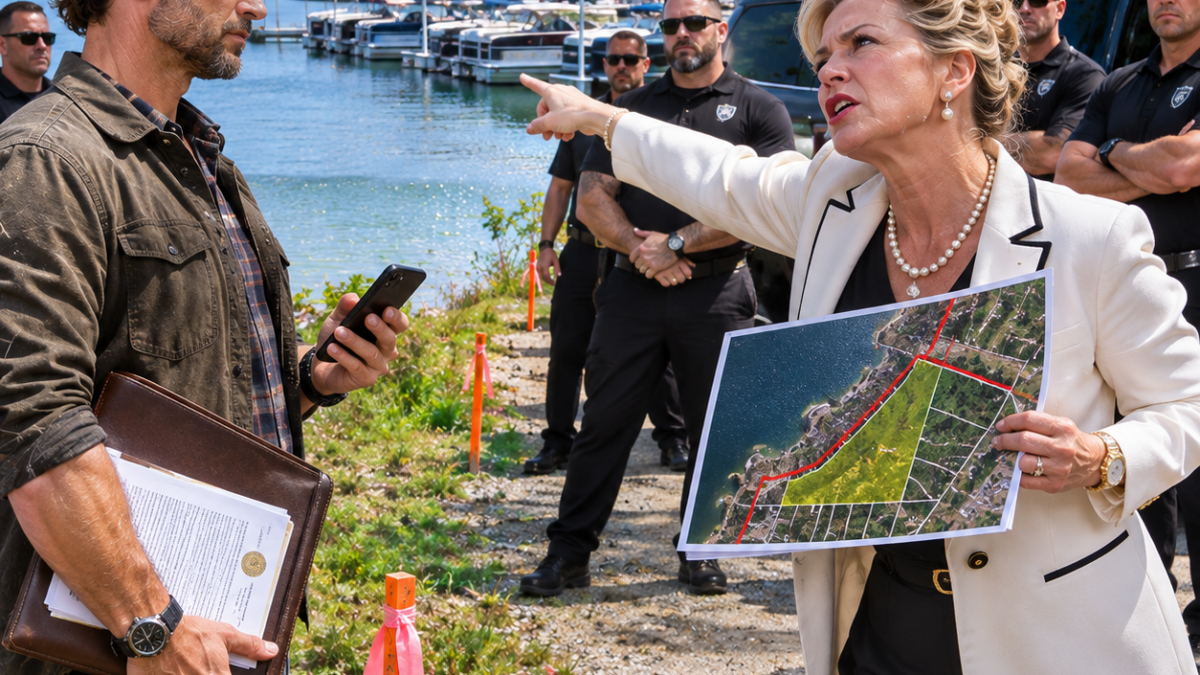
She walked toward Gideon.
Stopped ten feet away.
Then pointed toward the lake.
“You can own the dirt back there.”
Gideon looked at her.
“But the shoreline belongs to the HOA.”
He said nothing at first.
Marjgerie continued.
PART3:
“You cannot sell something you do not own.”
Gideon slipped the phone into his pocket.
“Show me.”
She opened the leather folder.
Inside was a glossy color map.
Brierstone lots were shaded neatly.
Roads in gray.
Common areas in green.
And along the waterfront ran a thick green strip labeled:
BRIERSTONE SHORES COMMUNITY WATERFRONT.
According to that map, Parcel 47B ended before reaching the lake.
If the map were legally accurate, Gideon owned nothing more than a landlocked hillside.
And if that were true, North Point Marine’s $6.5 million offer would almost certainly disappear.
Marjgerie tapped the shoreline.
“Eight hundred ten feet.”
“All yours?”
“All community waterfront.”
“Recorded where?”
“This map reflects the established association boundaries.”
“That wasn’t my question.”
One of the guards stepped toward a survey stake near Gideon.
Without asking, he pulled it out.
Then drove a white sign into the hole.
PRIVATE HOA PROPERTY.
Gideon watched every movement.
No shouting.
No grabbing the guard.
No trying to take the sign back.
He simply took out his phone.
Photographed it.
Marjgerie noticed.
“You have until sunset to remove all unauthorized private property markers.”
“They’re survey stakes.”
“On HOA shoreline.”
“According to your map.”
“According to the association.”
She slid another document toward him.
Offer to purchase.
$17,000.
For what she described as the “non-waterfront portion” of Parcel 47B.
Marjgerie smiled.
“You paid one hundred dollars.”
Gideon looked at the offer.
“You’re offering seventeen thousand.”
“That is a remarkable return.”
He did not pick it up.
Instead, he looked down the shoreline.
Thirty-eight boat slips floated in a long row.
Pontoons.
Fishing boats.
Ski boats.
Gangways.
Most belonged to Brierstone residents.
Gideon knew something about those docks because North Point’s due diligence team had already started asking questions.
He turned back.
“If this shoreline belongs to Brierstone…”
Marjgerie’s expression remained confident.
“…why does the parcel number on your boat-slip leases match the parcel number on my deed?”
The confidence disappeared.
Only for a moment.
But Gideon saw it.
One of the guards stepped toward his truck.
“Let us see the deed.”
Marjgerie grabbed the man’s arm.
“No.”
The guard stopped.
Marjgerie folded the map.
“Everyone back in the vehicles.”
Her voice had changed.
Cold.
Clipped.
No more performance.
The SUVs left in a cloud of dust.
Gideon remained beside the new HOA sign.
He looked again at the text.
PRIVATE HOA PROPERTY.
Then toward the docks.
Thirty-eight slips.
Monthly rent.
Years of operation.
Something felt wrong.
Not merely mistaken.
Wrong in the way a construction plan feels wrong when dimensions technically fit but the geometry underneath does not.
He called Natalie Ashcom.
Forty-one.
Real-estate attorney.
She answered on the fourth ring.
“You’re calling before nine.”
“Yes.”
“That means somebody has done something expensive or stupid.”
“Possibly both.”
“What happened?”
“Brierstone says it owns my shoreline.”
“How much?”
“All eight hundred ten feet.”
Pause.
“The same parcel North Point is buying?”
“Yes.”
“The six-and-a-half-million parcel?”
“Yes.”
“They have a deed?”
“They have a green map.”
Natalie was quiet.
Then:
“Do not touch their signs.”
“I wasn’t going to.”
“Do not threaten anybody.”
“I didn’t.”
“Do not sign anything.”
“I’m insulted you even said that.”
“Send me everything.”
Twelve months earlier, Gideon had found Parcel 47B accidentally.
He had been sitting in a hotel room after a fourteen-hour construction meeting, scrolling through a court-appointed receiver’s liquidation website.
He was not shopping for land.
He wanted equipment.
Used laser.
Survey gear.
Maybe a compact loader.
Then a strange listing appeared.
PARCEL 47B — BRIERSTONE LAKE.
Starting bid:
$100.
The photographs were terrible.
Brush.
Pine needles.
Broken concrete.
Possible erosion.
No visible driveway.
No utility service.
No obvious building pad.
Gideon almost kept scrolling.
Then he noticed the legal description.
2.6 acres.
The online map did not look like 2.6 acres.
That bothered him.
He opened the documents.
Bankrupt development company.
Receiver sale.
No reserve beyond opening bid.
He placed $100.
Mostly because he was curious.
Nobody else bid.
Two days later he got the email.
Winner.
The court-approved sale eventually transferred a properly recorded deed.
Not an internet receipt.
Not a tax-lien certificate.
A deed.
When Gideon first visited, he had to hike through brush.
He found a cracked concrete pad and several rotten posts.
Near the edge sat an old rusted metal survey box.
The lake appeared through the trees below.
He thought maybe he would build a small cabin.
Nothing more.
A few Brierstone residents saw him clearing brush.
“What did you pay?”
“A hundred.”
They laughed.
So did Gideon.
It was funny.
Marjgerie appeared later that afternoon.
She stood behind a split-rail fence and looked over the land.
“Every piece of waterfront worth anything around here belongs to Brierstone.”
Gideon shrugged.
“Okay.”
“Whatever you bought is what nobody wanted.”
He nodded.
Then returned to work.
Gideon had learned years ago that correcting arrogant strangers rarely created profit.
Paperwork did.
And the paperwork on Parcel 47B was strange.
The county’s online GIS map showed a narrow sliver against the hillside.
The legal description suggested something much larger.
He had seen errors like that before.
Old paper plats converted poorly into digital map layers.
Coordinates simplified.
Lines shifted.
Sometimes the online map looked authoritative while being legally meaningless.
So he held off building.
Around the same period, the county announced a road project.
Then a navigation dredging program.
The engineering report noted a deep natural channel near Parcel 47B.
That was when North Point Marine appeared.
Helena Fitzpatrick called him.
“We’re interested in your lake property.”
Gideon laughed.
“Have you seen it?”
“Yes.”
“And you’re still interested?”
“Very.”
North Point did not come once.
They came repeatedly.
Engineers.
Survey consultants.
Environmental specialists.
Appraisers.
Executives.
They tested soil.
Measured bank grades.
Studied water depth.
Examined road access.
The deal became serious.
Finally, they put $6.5 million in writing.
Contingent on clear title and required permits.
Then, on the morning the deposit reached escrow, Marjgerie arrived.
Within forty-eight hours, a courier delivered a nineteen-page HOA packet.
Title:
UNAUTHORIZED SALE OF COMMUNITY SHORELINE.
Three demands:
Cancel the North Point contract.
Remove private ownership markers.
Pay an $18,500 HOA “violation processing fee.”
Gideon sat at his kitchen table and read everything.
At page six he stopped.
The map.
Same green waterfront.
No county recording stamp.
No plat reference.
No deed book.
No instrument number.
Internal HOA diagram.
Natalie reviewed it the next morning.
She turned page after page without speaking.
Finally:
“This does not convey land.”
“I know.”
“Board resolution doesn’t either.”
“I know.”
She looked at Gideon.
“The problem isn’t whether they’re right.”
“It’s North Point.”
“Yes.”
“A dispute is enough.”
“Exactly.”
A commercial buyer spending millions does not want to purchase litigation.
Marjgerie did not need to win.
She needed delay.
If North Point became nervous and walked away, Gideon would lose his leverage.
Then $17,000 might start looking different.
Within days, Brierstone sent a letter directly to North Point.
It accused Gideon of attempting to sell shoreline belonging to 112 families.
New signs appeared:
PRIVATE SHORELINE
HOA MEMBERS ONLY.
Then Gideon returned with surveyors.
Two security guards blocked the access road with a pickup.
“If you go down there, you’ll be trespassing.”
Gideon stood beside his truck.
“On whose land?”
“HOA.”
“Show me the deed.”
“Sir, we’ve been instructed—”
“Fine.”
He did not force the issue.
His dashboard camera recorded the encounter.
He called the sheriff’s office.
Filed an incident report.
Then left.
Natalie told him:
“That was exactly right.”
“It didn’t feel right.”
“Good legal strategy often doesn’t.”
“I wanted to walk past them.”
“I know.”
“They’re keeping me off my property.”
“I know.”
“But now we have them doing it on video.”
That was the difference.
Every time Marjgerie acted, she created a record.
Natalie formally demanded the association produce title.
Brierstone responded.
Same colored map.
Board resolution signed by Marjgerie.
No deed.
Natalie laid the documents on her desk.
“If the association owned the shoreline, the easiest answer in the world would be a recorded instrument.”
“They don’t have one.”
“Looks that way.”
Gideon returned to the boxes from the receiver sale.
He found an old plat dated 1984.
It showed a maintenance route leading toward the lake.
More importantly, the shape of Parcel 47B looked nothing like the current online county map.
He called Tucker Blevens.
Forty-eight.
Licensed surveyor.
Three counties of boundary fights behind him.
“Can you reconstruct a parcel from old records?”
Tucker laughed.
“That is basically how I pay my mortgage.”
“Need it fast.”
“How ugly?”
“HOA.”
Tucker groaned.
“Very ugly.”
Three nights later, Tucker called before midnight.
“I found it.”
“What?”
“The problem.”
“Whose?”
“Theirs.”
Tucker had compared:
Recorded descriptions.
Historic plat.
Neighboring parcel deeds.
Monuments.
Modern GIS.
The HOA’s map had not merely shifted the boundary.
It effectively erased Parcel 47B from the shoreline.
The next morning, Gideon and Tucker visited the county archive.
Curtis Renshaw worked the records counter.
Fifty-nine.
More than thirty years handling plats people rarely asked to see.
Tucker explained what they needed.
Curtis disappeared.
Returned carrying a long cardboard tube.
They unrolled the sheet across an oak table.
The original lake survey predated Brierstone Shores.
Parcel 47B ran directly to the water.
Eight hundred ten feet of frontage.
Permanent monument references.
And the boundary crossed directly beneath part of Brierstone’s dock system.
Gideon stared.
Tucker did not celebrate.
“Field verification.”
They drove back.
Metal detector.
Shovel.
Coordinates.
A brass survey cap emerged beneath several inches of soil.
Then another.
Coordinates matched.
Gideon looked toward the thirty-eight boat slips.
Gangways connected to land within Parcel 47B.
Anchors and structures attached near the shoreline.
Tucker warned him:
“Do not assume you own water rights because you own the bank.”
“I won’t.”
“Lakebed rights can be separate.”
“I understand.”
“But the physical structures using this ground are a problem.”
They searched Brierstone’s founding records.
When the association had been created, common property transfers listed:
Lot 1.
Lot 2.
Lot 3.
All the way through Lot 46.
No 47B.
Never conveyed.
It had remained with a separate development entity.
That company eventually failed.
Receiver sold the parcel.
To Gideon.
Title looked stronger every day.
Natalie, however, had another question.
“Why are they fighting this hard?”
The answer arrived through Walter Dunore.
Older resident.
Pontoon owner.
He brought Gideon a boat-slip lease.
Location:
DOCK FACILITY — PARCEL 47B.
Gideon read it twice.
“What do you pay?”
Walter told him.
Several hundred dollars a month.
“How long have they charged you?”
“Years.”
“All slips?”
“Far as I know.”
Gideon and Natalie began checking HOA annual reports.
Thirty-eight slips operating since approximately 2017.
Estimated revenue over time:
More than $2 million.
Now the dispute was different.
The HOA had not simply landscaped across a bad boundary.
It had built an income stream around a parcel it could not prove it owned.
Marjgerie called Gideon to a meeting.
Six guards outside.
Two directors beside her.
Camera recording.
She reminded everyone that Gideon had paid $100.
Then presented her “final offer.”
$17,000.
Gideon would:
Cancel North Point sale.
Release all shoreline claims.
Waive claims connected to dock use.
Acknowledge HOA ownership.
Never pursue past revenue.
He read it slowly.
Then smiled slightly.
“Why?”
Marjgerie frowned.
“Why what?”
“If this land is worthless, why do you need all these releases?”
“It’s community property.”
“Then you wouldn’t need my release.”
“You’re exploiting an error.”
“What error?”
“You paid one hundred dollars for land nobody considered waterfront.”
“That isn’t how deeds work.”
“You’re trying to profit at our residents’ expense.”
“I have a signed $6.5 million contract.”
“You will lose that buyer.”
The room went quiet.
Marjgerie leaned toward him.
“We can litigate this for years.”
There it was.
Not ownership.
Pressure.
“North Point will walk long before we do.”
The security camera captured every word.
Gideon stood.
“I’m not selling you a $6.5 million property for $17,000.”
Marjgerie slammed her hand on the table.
“Escort him out.”
He walked.
Natalie immediately demanded preservation of the video.
Dock leases.
Financial statements.
Emails.
Contracts.
Across town, HOA treasurer Gloria Nickerson started looking at numbers.
Fifty-seven.
Four years overseeing accounts.
She had always assumed dock income flowed toward association maintenance.
Then she noticed payments.
Vickery Waterfront Services.
A company controlled by Marjgerie.
Large invoices.
Piling work.
Dock repairs.
Depth surveys.
Management services.
Gloria asked for supporting records.
Photos.
Completion reports.
Contractor verification.
Marjgerie refused.
Then told her:
“Do not share those invoices.”
That was the moment Gloria stopped assuming.
She dug deeper.
Dock revenue had been included in financial statements used to support a waterfront expansion financing package.
Loan and credit facility:
$3.1 million.
The application represented that Brierstone lawfully controlled the dock operation.
If it did not, the lender had a serious problem.
Marjgerie became more aggressive.
A work crew arrived on Parcel 47B.
They uprooted new survey monuments.
An excavator began grading Gideon’s cleared track.
Gideon arrived mid-job.
“County permit?”
The foreman held up an HOA work order.
“Mrs. Vickery approved it.”
“That isn’t a county permit.”
The excavator kept moving.
Gideon did not step in front.
He put his phone on the truck hood.
Recorded.
Called law enforcement.
A deputy arrived.
The foreman eventually admitted there was no county permit.
The deputy photographed:
Uprooted monuments.
Fresh excavator tracks.
Work order.
Marjgerie’s authorization.
Crew left.
That evening Gloria called Natalie.
“I think you need to see what I found.”
Two days later, they met in a conference room at an independent accounting firm.
Gloria brought binders.
Laptop.
Records she was authorized to access.
Forensic accountant Raymond Hollis reviewed the numbers.
Recorded slip revenue since 2017 exceeded $2 million.
Some legitimate maintenance.
But hundreds of thousands moved to Vickery Waterfront Services under descriptions with weak or missing support.
Some leases absent from member summaries.
One invoice appeared to have been paid three times under slightly different wording.
Then Gloria produced the document that made Natalie sit back.
Confidential marina redevelopment proposal.
Luxury waterfront project.
Outside investors.
Millions in projected future income.
All based on one premise:
Brierstone controlled the disputed waterfront.
The presentation used Marjgerie’s colored map.
Parcel 47B had disappeared.
Gideon finally understood.
Marjgerie did not care only about losing dock income.
His sale threatened her future project.
The HOA’s marina financing.
Her company’s revenue.
Everything relied on control of land that could not withstand title scrutiny.
The $17,000 offer had never been generous.
It was cheap insurance.
Natalie closed the folder.
“We’re done reacting.”
She filed to quiet title.
Asked for an order stopping further alteration.
Preservation demands covered every lease, invoice, and financial record.
The lender received authenticated title evidence.
Gideon made a deliberate choice.
No giant damage demand yet.
Natalie agreed.
“Your priority?”
“North Point.”
“More specifically?”
“Clean title.”
“Yes.”
“Access.”
“Yes.”
“Closing.”
“Exactly.”
Everything else could wait.
Marjgerie responded by announcing the Brierstone Premium Waterfront Expansion launch.
On the dock.
Investors invited.
Bank representatives.
Realtors.
Residents.
Large banners proclaimed Brierstone the waterfront owner and developer.
An architectural model displayed a future luxury marina.
Every inch of Parcel 47B painted in HOA colors.
Marjgerie expected ceremony to create legitimacy.
Gideon and Natalie had already requested emergency relief.
The judge issued a temporary order on launch morning.
No further alteration of the disputed zone pending a fuller hearing.
Marjgerie was giving a speech about “Brierstone’s proud waterfront heritage” when association counsel Douglas Puit walked onto the stage.
He handed her the order.
At first she tried to ignore him.
Then she saw the court seal.
Her face changed.
Douglas took the microphone.
“We need to pause any representations regarding ownership of the disputed parcel and suspend new construction activity.”
An investor in the second row raised his hand.
“Does the HOA own the property on that model?”
Marjgerie grabbed the microphone.
“Gideon Rowley is attempting to steal shoreline from this community.”
Tucker stepped forward.
Presented the independent survey.
Historic plat.
Field monuments.
The survey did not itself finish the case.
But it destroyed certainty.
Bank representative Diane Kesler asked:
“Can Brierstone produce a recorded deed?”
Marjgerie said:
“Our attorneys have established our rights.”
Diane repeated:
“Can you produce the recorded deed?”
No answer.
Then Gloria stood.
She had been sitting in the third row.
Her hands shook.
Her voice carried.
“There are also financial records the board needs to review regarding money paid to Vickery Waterfront Services.”
The entire event changed.
Board member Philip Grady called for suspension.
Investors began collecting papers.
Diane’s office requested title documents.
Sponsors stepped back.
Marjgerie turned on Gloria.
“You’re betraying this association.”
Gloria replied:
“I’m asking where the money went.”
Staff began removing banners.
BRIERSTONE SHORES — OWNER OF THE WATERFRONT.
Taken down.
Folded.
Boxed.
The lender demanded a formal explanation before lunch.
Marjgerie still believed she had one final weapon.
Access.
The only practical vehicle road to Gideon’s lake parcel crossed through Brierstone.
And through a large security gate operated by the HOA.
She wrote directly to North Point:
Even if Gideon proved title, the parcel had no usable commercial access.
The HOA would not permit trucks.
North Point’s contract required legal access.
For the first time since the dispute began, Gideon became truly worried.
Helena called.
“Our board can tolerate a boundary dispute once resolved.”
“I understand.”
“We cannot buy an industrial waterfront site with no road.”
“I understand.”
“Is there another access route?”
“Working on it.”
Gideon and Tucker returned to the 1984 plat.
That faded maintenance path.
Why was it there?
Back to Curtis Renshaw.
He searched the archive most of the afternoon.
Then emerged holding a recorded easement.
Sixteen-foot right-of-way.
From the public road to Parcel 47B.
Permanent.
Runs with the land.
Binds successor owners.
Recorded before Brierstone Shores existed.
Developers later built the HOA security gate directly across the corridor.
Nobody challenged it because Parcel 47B sat forgotten for years.
But lack of use did not automatically erase the right.
Tucker surveyed the easement.
It crossed the HOA’s service road.
Passed straight through the gate.
Natalie filed it.
At the next hearing, Brierstone’s attorney argued abandonment.
The judge asked:
“Recorded release?”
None.
“Termination?”
None.
“Court order extinguishing the easement?”
None.
Two weeks later, the court confirmed the right-of-way remained valid.
Brierstone was ordered not to interfere with lawful access.
Marjgerie’s final leverage disappeared.
Residents packed the next HOA meeting.
“Why did we build a gate across somebody else’s easement?”
Marjgerie blamed older boards.
Gloria produced minutes.
Marjgerie herself had approved later gate upgrades.
She had ordered the gate controlled against outside landowners.
Then came the bank.
Formal notice.
$3.1 million financing suspended.
Reason:
Review of material representations concerning waterfront rights and revenue.
The luxury marina expansion stopped.
The title case continued.
Gideon’s chain of evidence remained consistent.
Recorded deed.
Receiver sale.
Historic plat.
Physical monuments.
Brierstone founding documents.
No transfer of Parcel 47B.
Recorded easement.
Dock leases naming Parcel 47B.
Brierstone still had no deed.
The final civil judgment confirmed Gideon’s ownership within the surveyed boundaries.
The HOA had to stop occupying his land without authority.
The 38 slips could not simply be dragged away.
Environmental rules applied.
Engineering.
Permits.
Safety.
But the legal foundation for Brierstone’s dock business had collapsed.
The marina expansion was cancelled.
The lender kept remaining financing frozen.
Residents demanded a no-confidence vote.
For almost ten years, Marjgerie had controlled HOA meetings.
She had fined residents over landscaping.
Mailboxes.
Parking.
Exterior colors.
Now those same residents filled the clubhouse.
One hand rose.
Then another.
Then another.
Marjgerie was voted out.
Gloria moved for an independent forensic audit.
Unanimous.
Marjgerie gathered her leather folder.
Walked out.
No security guard followed.
The audit examined Vickery Waterfront Services.
Unsupported payments.
Duplicate invoices.
Undisclosed revenue.
Loan representations.
The records were eventually referred to investigators.
Interviews followed.
Subpoenas.
Separate criminal and civil proceedings.
Ultimately, prosecutors brought charges supported by the financial evidence, and Marjgerie faced consequences for the misconduct proven through those proceedings.
The association faced its own problems.
Dock users had paid money in good faith.
Residents wanted answers.
Remediation costs grew.
Nearly $1 million had to be reserved for dock-related obligations and other claims.
Months earlier, Brierstone had tried to make everything disappear for $17,000.
Now seventeen thousand looked almost absurd.
Gideon did not celebrate.
His main concern remained North Point.
Commercial deals can die from delay alone.
Months passed.
Winter arrived.
North Point had paused closing.
Helena still called occasionally.
But no final commitment.
Then, on a gray afternoon, Gideon’s phone rang.
“Still want to sell?”
Helena asked.
He almost laughed.
“Depends.”
“On?”
“The number.”
“Still $6.5 million.”
Gideon sat down.
“You’re serious.”
“We’ve completed updated due diligence.”
“Title?”
“Clear.”
“Access?”
“Clear.”
“Board approval?”
“This morning.”
He closed his eyes.
Helena continued.
“The value was never based solely on acreage.”
Gideon knew.
Deep channel.
Location.
Shore frontage.
Road access.
Regional logistics needs.
North Point still wanted it.
Closing happened quietly.
Thursday morning.
Title office.
No cameras.
No HOA representatives.
No black SUVs.
Stacks of paper.
Gideon signed the final transfer.
$6.5 million.
Including the original deposit, before expenses and taxes.
He held the pen above the last line for a second.
Remembered the auction.
PARCEL 47B.
$100.
He had almost ignored it.
North Point later announced plans for a logistics facility, with a public-access component along part of the waterfront subject to permitting.
Brierstone’s exclusive grip on the shoreline ended.
County mapping was corrected.
A new HOA board took over.
Gloria joined the financial review process.
Policies changed.
Large contracts received stronger oversight.
Revenue had to be documented.
Property ownership had to be verified before the HOA claimed control.
Marjgerie’s name disappeared from the president’s office.
Months later, Gideon returned for one final walk.
The old HOA security gate remained.
But the sign had changed.
The old PRIVATE HOA ACCESS sign was gone.
In its place:
LAWFUL RIGHT OF WAY
PARCEL 47B.
Gideon followed the sixteen-foot corridor.
Down toward the lake.
Tucker stood near his truck.
“You regret selling?”
Gideon looked across the water.
“No.”
“Not even a little?”
“I bought it because I thought I might build a cabin.”
“You could build a very expensive cabin now.”
Gideon laughed.
“North Point probably wouldn’t appreciate that.”
They stood quietly.
A black SUV appeared.
Rolled slowly along the lakeside road.
Marjgerie sat in the back.
No guards.
No white blazer.
No leather folder visible.
She looked toward the shoreline.
The vehicle slowed.
For a moment Gideon thought it might stop.
It didn’t.
It continued past.
Tucker watched it disappear.
“She really thought she owned this place.”
Gideon shook his head.
“No.”
“What?”
“She thought everybody else believed she owned it.”
Tucker considered that.
“That’s worse.”
“Yes.”
That was what Gideon had learned.
Marjgerie’s power had never come from a deed.
It came from repetition.
For years, Brierstone residents paid the HOA for dock slips.
So they assumed the HOA owned the dock property.
Maps colored the waterfront green.
So people assumed green meant common land.
Security guards patrolled it.
So people assumed the HOA controlled it.
Loan documents described dock revenue.
So banks assumed somebody had verified title.
Investors saw marina plans.
So they assumed legal ownership had already been settled.
Each assumption reinforced the next.
Eventually the story became stronger than anyone’s curiosity.
Until Gideon asked one question.
Show me the deed.
That question broke everything open.
People often imagine land disputes are about fences.
Sometimes they are.
This one was about paper.
A hundred-dollar deed.
An eighty-year-old plat.
Brass survey monuments.
Thirty-eight dock leases.
A sixteen-foot easement.
Loan records.
Board minutes.
Invoices.
No single document told the entire story.
Together, they did.
Marjgerie had six guards.
Gideon had records.
She had an HOA map.
He had the recorded chain of title.
She had years of authority.
He had a parcel number.
And parcel numbers do not care how expensive your blazer is.
The strangest part was the obsession with the original purchase price.
Marjgerie kept returning to it.
“You paid $100.”
Residents repeated it.
Online comments repeated it.
Some people seemed to believe that because Gideon had bought cheaply, his rights were weaker.
They were not.
If he had paid $5 million, the boundary would have been the same.
If he inherited it, the boundary would have been the same.
If somebody gifted it to him, same.
Price measures a transaction.
It does not decide title.
When the HOA offered $17,000, Marjgerie framed it as generosity.
Seventeen thousand compared with one hundred looked enormous.
But seventeen thousand compared with a signed $6.5 million purchase agreement looked completely different.
That was her skill.
Choose the comparison.
Control the story.
Her version:
Greedy man buys worthless land for $100 and demands millions from community.
Gideon’s version:
Recorded owner receives market offer, then association with no deed attempts to claim his shoreline.
Same numbers.
Different frame.
Evidence decided which one survived.
Walter Dunore once asked Gideon:
“Do you feel lucky?”
“Yes.”
“That easy?”
“Absolutely.”
Walter laughed.
“Most people who make money like to pretend it was genius.”
“I got lucky.”
“Then why did nobody else bid?”
“They thought it was worthless.”
“And you?”
“I thought the map looked wrong.”
“That sounds like expertise.”
“Luck made the listing appear while I was bored enough to open it.”
Walter smiled.
“Fair.”
Gideon never pretended everything came from brilliance.
Timing mattered.
County road project mattered.
Dredging mattered.
North Point’s needs mattered.
Market conditions mattered.
But preparation mattered too.
He noticed the discrepancy because he knew land records.
He delayed building because the boundary did not make sense.
He preserved documents because he understood claims.
He did not react violently when guards blocked him.
He let Marjgerie create evidence.
That last part was Natalie’s favorite lesson.
One afternoon, after the case ended, Gideon asked her:
“When did you know we were going to win?”
She shook her head.
“I never know that.”
“You had to have a moment.”
“There was a moment I knew their case was very bad.”
“When?”
“The seventeen-thousand-dollar offer.”
“Not the missing deed?”
“That too.”
“Why the offer?”
“Because of the release.”
Gideon remembered.
Waive everything.
Dock use.
Revenue.
Past claims.
Future claims.
Natalie continued.
“If they truly believed you owned nothing valuable, they wouldn’t need you to release claims worth potentially millions.”
“So the paperwork gave them away.”
“The paperwork usually does.”
That became a recurring theme.
Marjgerie relied on people not reading.
Gideon read.
Gloria read.
Natalie read.
Tucker read.
Curtis preserved.
Diane at the bank asked for the deed.
Once enough people started reading, Marjgerie’s certainty became fragile.
That is how authority sometimes collapses.
Not with one dramatic revelation.
With questions.
Where is the deed?
Where is the release?
Where is the invoice support?
Where did the money go?
Who authorized the grading?
Why does the lease say Parcel 47B?
Why does the gate cross an easement?
Why was the lender told the HOA controlled the docks?
One question becomes ten.
Then a hundred.
Then a room full of homeowners who no longer accept “because I said so.”
Brierstone changed afterward.
Not perfectly.
No community becomes perfect because one president leaves.
But governance became less theatrical.
More boring.
Gideon considered that progress.
More signatures.
More reviews.
More source documents.
Less assumption.
Residents complained.
Of course they did.
People love accountability until accountability requires paperwork.
Gloria did not care.
She told them:
“We already tried the convenient version.”
Nobody had a good answer.
The dock situation took time.
Some residents worried they would lose access entirely.
Gideon never demanded chaos.
Neither did North Point.
The court ordered an orderly remediation process.
Engineering.
Environmental review.
Legal access.
Existing boat owners received notices.
No one woke up one morning to find thirty-eight boats floating loose in the lake.
Reality was slower than Facebook arguments.
Usually is.
Marjgerie’s later legal troubles also unfolded slowly.
Investigators did not rely on anger from homeowners.
They examined records.
The audit separated legitimate work from unsupported charges.
Not every payment to Vickery Waterfront Services automatically became fraud.
Some services had genuinely been performed.
Others lacked documentation.
Some transactions raised serious enough concerns to support further action.
Eventually, the evidence supported charges.
That distinction mattered to Gideon.
He had spent the entire dispute insisting records outranked assumptions.
He was not going to abandon that principle just because the person under investigation was somebody he disliked.
Years later, people still told the story incorrectly.
Some said Gideon bought the entire Brierstone marina for $100.
Wrong.
Some said the HOA had secretly sold his property.
Wrong.
Some said Gideon seized all thirty-eight boats.
Definitely wrong.
The real story was already dramatic enough.
A forgotten parcel.
A court receiver.
A $100 bid.
A mapping discrepancy.
Deep water.
A $6.5 million buyer.
An HOA that had used part of the property for years.
A president trying to preserve millions in financing and future development.
An old easement nobody remembered.
No embellishment required.
The part Gideon liked least was the idea that it was a revenge story.
It wasn’t.
Revenge would have meant hurting Brierstone residents because Marjgerie hurt him.
Most of those residents had no idea.
They paid dock fees because they believed the association had the right to charge them.
They were not thieves.
They were customers relying on institutional claims.
That distinction mattered.
When the new board asked whether Gideon would participate in a meeting about transition plans before closing with North Point, he agreed.
One resident stood.
“You’re not going to sue every boat owner, are you?”
“No.”
The woman blinked.
“That’s it?”
“That’s it.”
“But we used your land.”
“You paid the HOA.”
“Yes.”
“You believed they controlled it.”
“Yes.”
“Then my dispute isn’t with you.”
The relief in the room was visible.
Marjgerie had spent months trying to make Gideon look like an enemy of the community.
Gideon refused the role.
That made her story harder to sustain.
Another resident asked:
“Why didn’t you just take the seventeen thousand?”
A few people laughed awkwardly.
Gideon answered:
“Would you sell your house for seventeen thousand because the buyer reminded you what you paid for it twenty years ago?”
“No.”
“Then there’s your answer.”
Simple.
After North Point closed, Gideon received the final wire confirmation.
He stared at the account longer than he cared to admit.
Money that large does strange things to the mind.
It does not immediately feel real.
He did not rush out and buy anything dramatic.
First:
Taxes.
Legal bills.
Financial planning.
Then he paid off his sister’s mortgage.
She cried.
Gideon pretended something was wrong with his phone so he would not have to respond emotionally.
Tucker later gave him a ridiculous gift.
A frame containing a crisp $100 bill.
Brass plaque:
PARCEL 47B — ORIGINAL BID.
Gideon hung it in his office.
Natalie saw it.
“That is obnoxious.”
“Tucker made it.”
“That makes it jointly obnoxious.”
Beside it, Gideon framed a copy of the 1984 easement.
Natalie approved of that one.
“That piece of paper saved the deal.”
Gideon nodded.
The easement fascinated him.
Forty years.
Almost forgotten.
Then suddenly worth millions because access became essential.
It proved another lesson.
Unused rights do not necessarily stop existing.
Silence is not always surrender.
Brierstone had built a gate across the corridor.
Years passed.
No active owner challenged it.
Marjgerie assumed history had become permission.
The court disagreed.
A recorded right can sleep.
It does not necessarily die.
One spring, Gideon returned to Brierstone to meet Helena.
North Point had begun early design work.
Survey crews marked new areas.
Environmental teams worked near the shore.
Everything looked different.
But one brass monument remained.
Tucker had flagged it.
Gideon crouched beside it.
“That little thing caused a lot of trouble.”
Helena laughed.
“No.”
“What?”
“People ignoring it caused trouble.”
Fair.
She showed him a preliminary rendering.
Commercial dock.
Service area.
Environmental buffer.
Public-access section.
Gideon pointed.
“You’re actually doing the public piece.”
“Yes.”
“Brierstone will hate that.”
“Some will.”
“Why?”
“Good permitting strategy.”
“At least you’re honest.”
“And because the lake shouldn’t feel privately owned by one subdivision.”
Gideon smiled.
Marjgerie had tried to turn the shoreline into an exclusive asset.
Her fight helped create the opposite outcome.
Irony without effort.
The final time Gideon saw Marjgerie came unexpectedly.
He was standing near the old right-of-way sign.
The black SUV slowed.
She was sitting in back.
For years she had arrived surrounded by guards.
Now there was only a driver.
She looked toward him.
Then the water.
No gesture.
No confrontation.
The SUV continued.
Tucker asked:
“Think she still believes the HOA owned it?”
Gideon shook his head.
“No.”
“You sure?”
“She never needed to believe it.”
“What do you mean?”
“She needed everybody else to.”
That was Marjgerie’s real talent.
Not law.
Confidence.
She knew how to make a claim feel settled before anyone checked.
A sign.
A map.
A guard.
A board resolution.
A repeated phrase.
COMMUNITY WATERFRONT.
Say it enough.
Print it enough.
Charge money for it long enough.
People stop asking where the original right came from.
Until somebody does.
Gideon spent $100 because a bad map made him curious.
He made $6.5 million because the real property had something the market wanted.
And he nearly lost all of it because one association had repeated its version of ownership so many times that an entire neighborhood assumed it must be true.
The final irony was that the land itself never changed.
Not once.
The same 810 feet of shoreline existed before Gideon bought it.
During Marjgerie’s claims.
During the court fight.
After North Point closed.
The water did not move.
The brass monuments did not care about HOA meetings.
The 1984 easement did not care that nobody remembered it.
Only the story around the land changed.
First:
Worthless mud.
Then:
Community shoreline.
Then:
Disputed parcel.
Then:
$6.5 million commercial site.
People changed the labels.
The dirt stayed where it was.
That was why Gideon trusted land more than people.
And in the end, Marjgerie Vickery spent years claiming Brierstone owned a shoreline it could never prove had been transferred.
Gideon spent one hundred dollars buying the forgotten parcel beneath that claim.
When the real records were finally opened, the HOA lost its marina expansion, its financing came under review, its president lost her position, and the thirty-eight boat slips that had generated more than $2 million became evidence of how long everybody had trusted the wrong map.
Then North Point Marine closed the purchase for $6.5 million.
On Gideon’s final visit, he walked down the sixteen-foot easement to the lake while Tucker waited beside the truck.
No guards stopped him.
No HOA signs ordered him away.
No one demanded an $18,500 violation fee.
The new sign simply recognized the recorded right-of-way.
Tucker asked whether Gideon regretted selling.
Gideon looked across the water.
Then smiled.
“Not every great investment starts with a lot of money.”
“No?”
“Sometimes it starts with noticing something everyone else already decided was worthless.”
A black SUV moved slowly along the distant road.
Marjgerie sat inside.
It never stopped.
There were no guards behind it.
No violation notices.
No colored maps.
Nothing left for her to claim.
The shoreline had never belonged to her.
It had only taken a $100 purchase, an old brass monument, and one stubborn owner willing to read the paperwork to make everyone finally admit it.








