I Bought a 9,200-Acre Lake Forest—Then 37 Trucks Arrived With Hunting Passes I Never Signed.
PART3:
BLACK ALDER LAKE FOREST
PRIVATE PROPERTY
ACCESS BY WRITTEN PERMISSION ONLY.
In its place stood a large professionally printed banner mounted on steel posts.
CEDAR RISE EXCLUSIVE HUNTING GROUNDS
AUTHORIZED MEMBERS ONLY.
I stopped.
Read it again.
Then I saw the registration table.
Pop-up canopy.
Clipboards.
Coffee urn.
Stacks of gold plastic cards.
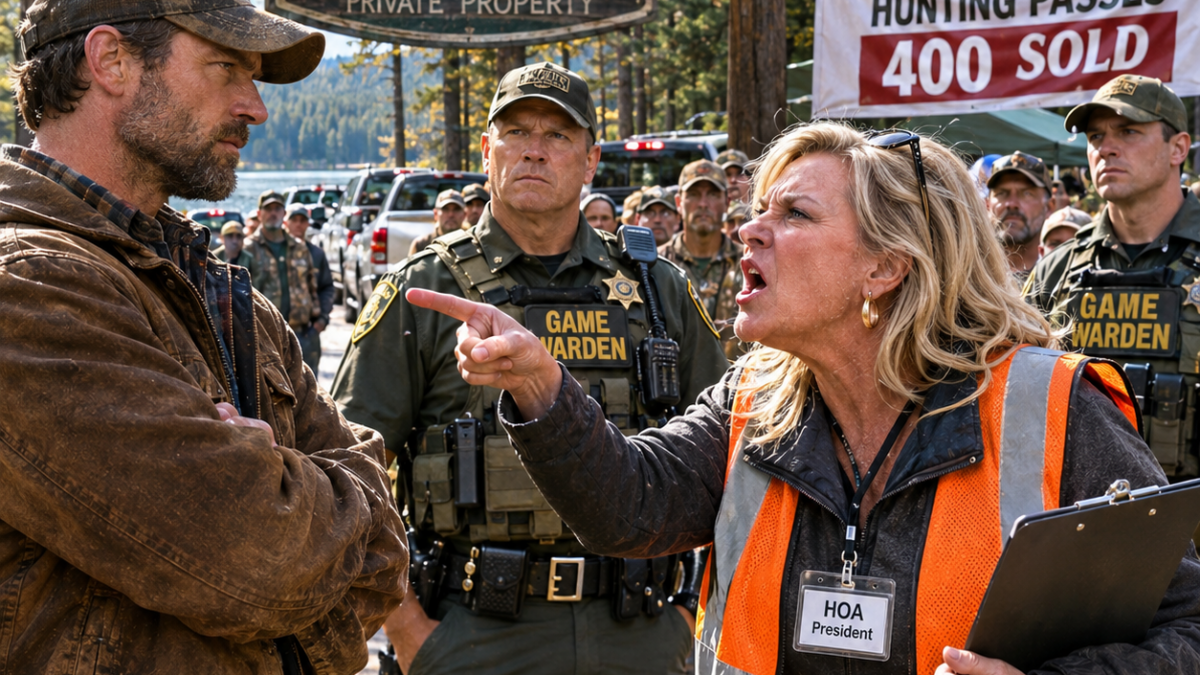
Behind the table stood Darlene Whitcomb.
I knew who she was.
Everyone near Black Alder did.
Fifty-two years old.
President of the Cedar Rise Homeowners Association.
Sixty-eight houses along the southern edge of my forest.
Cedar Rise had originally been built around a timber-frame community lodge near the lake.
Nice neighborhood.
Large lots.
Retired professionals.
Second homes.
People who liked the idea of wilderness while also liking paved driveways.
I had no problem with them.
The HOA boundary stopped at my survey line.
Their business was theirs.
Mine was mine.
At least, that was what I thought.
Darlene wore an orange reflective vest over an expensive winter jacket.
Radio clipped to her shoulder.
Clipboard under one arm.
She looked like the organizer of an event that had been running for years.
Not somebody trespassing on land she had never owned.
I got out.
A few hunters looked over.
Darlene saw me immediately.
She had been waiting.
That is what I realized later.
She walked toward me before I said anything.
“Mr. Hargrove.”
“Darlene.”
“Busy morning.”
“What is this?”
Her smile stayed perfectly calm.
“Our season opening.”
“Your what?”
“Cedar Rise Conservation Partnership hunt.”
I looked at the banner.
Then at the trucks.
“On whose land?”
She gave me the patient expression people use when they think the other person is behind on information.
“Black Alder.”
“My forest.”
“The hunting rights are under separate authorization.”
“No, they aren’t.”
She opened the binder.
Pulled out one of the gold cards.
QR code.
Serial number.
Cedar Rise logo.
Across the top:
BLACK ALDER LAKE FOREST
SEASON ACCESS PASS.
Then she said the sentence I remembered for years.
“You may own the trees, Mr. Hargrove, but you don’t own the hunting rights anymore.”
I actually smiled.
Not because it was funny.
Because sometimes a statement is so absurd your mind checks whether you heard it correctly.
“I own the land.”
“Yes.”
“I never sold the hunting rights.”
“The association has a recreational access program.”
“That is not the same thing.”
“We sold four hundred passes.”
“How many?”
“Four hundred.”
“What did you charge?”
“Thirteen hundred fifty dollars.”
I did the math.
$540,000.
I stared at her.
“You sold half a million dollars of hunting access on my property.”
“You’re oversimplifying.”
“Then simplify it correctly.”
A few hunters had moved closer.
Darlene noticed.
She raised her voice slightly.
“The buyers paid in good faith through a lawful conservation partnership.”
I looked around.
“How many are entering today?”
“Scheduled groups rotate through different zones.”
“Who created the zones?”
“Our management partner.”
“What management partner?”
“You’ll need to speak with counsel.”
Then a man approached.
Forty-something.
Blaze-orange cap.
Brown beard.
He looked annoyed but not aggressive.
“Are you the landowner?”
“Yes.”
He took out his phone.
“My name’s Dustin Ralston.”
He opened an email.
Receipt.
$1,350.
Reservation date.
Map.
I looked at the map.
My stomach tightened.
The document promised access to all 9,200 acres.
Specific hunting zones.
Specific stand coordinates.
Parking locations.
Then Dustin scrolled.
At the bottom:
LANDOWNER AUTHORIZATION.
Below that sat a signature.
Blaine Hargrove.
Mine.
Almost.
Someone had copied it from somewhere.
Same long B.
Same downward angle on the H.
Same short final stroke.
I knew immediately.
Because it was the kind of forgery that works on people who do not know the real signature.
I did.
“I didn’t sign this.”
Dustin’s expression changed.
Darlene said, “Blaine.”
I raised my voice.
Not at her.
At the group.
“Everybody stop entering the forest until we verify these documents.”
Darlene slammed the binder closed.
“You do not have authority to shut down a licensed event.”
“I own the property.”
“These people paid.”
“Not me.”
“You’re trying to cheat four hundred customers.”
“No.”
I held up Dustin’s phone.
“Somebody cheated them.”
That was when the rifle fired.
One shot.
Far inside.
From the direction of the lake.
Every conversation stopped.
Dustin looked toward the trees.
So did I.
That shot scared me more than the forged signature.
Because my forestry crew sometimes ran early survey lines.
We had seasonal contractors.
Habitat workers.
People checking wetland structures.
There were sections where I allowed no hunting precisely because people might be walking through brush before sunrise.
Somebody was already inside.
Somebody carrying a rifle.
Possibly following a fake map.
I turned toward the hunters.
“Unload and case your rifles.”
Darlene stepped closer.
“You cannot order my customers—”
“I’m not asking anyone to surrender anything.”
I pointed toward the county highway.
“Move your trucks to the public gravel pullout. Nobody enters until wardens sort this out.”
One man shouted, “I drove four hours.”
“I understand.”
“I paid thirteen-fifty.”
“I understand.”
“Then refund me.”
“I didn’t take your money.”
That silenced him.
Dustin looked at Darlene.
“So who did?”
She said, “Cedar Rise Outdoors.”
First time I heard that name.
Not the HOA.
Cedar Rise Outdoors.
I took out my phone.
Called the state wildlife enforcement line.
Then another call came in before I finished.
Unknown number.
I answered.
“Blaine Hargrove?”
“Yes.”
“Gideon Mallory. Wisconsin conservation warden.”
I knew the name.
Veteran officer.
Regional enforcement supervisor.
“What can I do for you?”
“I have one of your hunting passes sitting on my desk.”
I looked at Darlene.
“You do?”
“Sporting goods clerk called us yesterday. Thought the state-style emblem looked questionable.”
“It is.”
“Did you authorize four hundred hunters?”
“No.”
“Any of them?”
“No.”
“Did you sign a blanket access agreement?”
“No.”
Pause.
Then Gideon said quietly:
“Then this may be bigger than trespassing.”
He arrived forty minutes later.
By then most hunters had moved vehicles.
Not all happily.
But nobody wanted to be standing inside a disputed access point with rifles while game wardens arrived.
Gideon was fifty-six.
Tall.
Weathered face.
Dark green uniform.
He walked directly to Darlene’s table.
Asked for the program documents.
She produced the binder.
Confidently.
That bothered me.
People holding obvious fraud usually hide paperwork.
Darlene displayed hers.
Either she believed it would survive inspection, or she believed she could control the inspection.
Gideon took copies.
Then walked over.
“Mr. Hargrove, until this is sorted out, do not destroy anything.”
“I wasn’t planning to.”
“Signs, passes, maps, gate records.”
“I understand.”
“And don’t start locking every route yet.”
I frowned.
“This is my land.”
“I know.”
“There’s no hunting right.”
“Maybe not.”
“Maybe?”
He looked toward the forest.
“There may be old access rights unrelated to hunting. We need clean lines.”
I hated that answer.
Which meant it was probably the right one.
The next morning I sat across from Greer Talbott.
My land attorney.
Forty-one.
Precise.
No wasted words.
She reviewed the title documents.
“No recorded hunting lease.”
“I know.”
“No conservation easement granting hunting rights.”
“I know.”
“No reservation by the former timber company.”
“I know.”
“No transfer to Cedar Rise.”
“I know.”
Greer closed the folder.
“Then hunting rights follow your ownership unless some separate agreement exists.”
“Good.”
“But.”
There is always a but when a lawyer says good too early.
She opened another file.
“The former owner had an access program.”
“Wildlife surveys.”
“Researchers and volunteers.”
“It ended before I bought.”
“Yes.”
“But records remain.”
“Old permission isn’t current permission.”
“No.”
She looked at me.
“But old permissions can create confusion.”
“Darlene isn’t confused.”
“I didn’t say she was.”
That afternoon, Darlene held a press conference.
Stone entrance of Cedar Rise.
Reporter from the regional newspaper.
Local radio.
About twenty homeowners standing behind her.
She displayed a glossy map.
The whole 9,200 acres colored green.
Same shade as Cedar Rise recreational land.
No visible boundary.
She said:
“An out-of-state-minded investor has purchased land historically enjoyed by local families and is now attempting to block lawful access.”
I had lived in Wisconsin eleven years.
Apparently still an outsider.
She described the hunt as a conservation partnership.
Said the program supported habitat management.
Claimed I was trying to invalidate contracts after seeing how profitable the program was.
By evening, the story had changed.
I was no longer the landowner whose signature had been forged.
I was the wealthy forest buyer trying to steal a tradition from local families.
My insurance company called.
They had heard armed access was disputed.
They wanted an emergency safety plan.
Now the problem had two fronts.
Physical safety.
Public perception.
I refused to fight the second one emotionally.
Greer sent Darlene a formal request.
Produce any document authorizing Cedar Rise or Cedar Rise Outdoors to sell hunting on Black Alder.
I hired a surveyor.
Full boundary walk.
Every access route.
Every road.
Every trail.
Historic and current.
Then I published a notice to pass holders.
Not an angry one.
Anyone who purchased a Black Alder hunting pass could send receipts, maps, contracts, and confirmation emails to Greer’s office.
Free review.
I made one distinction very clear.
People who had been deceived into buying access were not my enemy.
Anyone who knowingly entered after learning they had no permission would be treated differently.
That helped.
Within a week, more than sixty buyers sent paperwork.
Receipts.
Maps.
Reservation schedules.
Digital contracts.
That was when something started bothering me.
The maps were too accurate.
A random person can pull satellite imagery.
They can see logging roads.
Water.
Openings.
What these maps contained was different.
Abandoned spur roads under canopy.
Old numbered stand sites.
Seasonal drainage crossings.
A hidden service lane that had not appeared on any public map in years.
One map marked a narrow knoll above Alder Creek.
I had needed a handheld GPS to relocate that knoll when I first bought the forest.
Someone who knew Black Alder from inside had built these maps.
Greer said it first.
“This did not come from Darlene looking at Google Maps.”
“No.”
“Who had internal access?”
I thought of Wayland Dorsey.
Fifty-four.
Former Black Alder land manager.
Worked for Northwoods Crown Timber for years.
Knew every road.
Every stand.
Every gate.
Every system password.
When I bought the forest, Wayland handled transition.
Keys.
Maps.
Access records.
He was friendly.
Too friendly in retrospect.
I called him.
“Wayland.”
“Blaine. Heard you’ve got trouble.”
“Apparently.”
He laughed.
“What can I do?”
“Did the old company ever share internal road maps with Cedar Rise?”
“Not that I know.”
“Gate codes?”
“No.”
“Stand data?”
“No.”
“Any old access agreements?”
“Maybe public stuff.”
“Management files?”
“All handed over to you.”
“Administrator accounts?”
“Deactivated.”
His answer came fast.
Too fast?
Maybe I was imagining it.
“Thanks.”
“Hope you sort it out.”
Two days later, Greer received an anonymous envelope.
Inside:
BLACK ALDER HISTORICAL RECREATIONAL ACCESS AGREEMENT.
Old typed document.
County registry stamp.
Greer called me.
“Do not lock another gate.”
“Why?”
“This may be real.”
It was.
That was the first moment I realized Darlene had not invented everything.
She had done something smarter.
She had found one true thing.
Then stretched it until nobody could see where truth ended.
The 1931 document came from the Depression.
Original timber owner had granted townspeople a limited public right to walk a 1.8-mile path along the lakeshore.
Foot access.
To a fishing point.
And a freshwater spring.
The easement ran with the land.
Still valid.
I owned the forest.
But I did not own the right to exclude the public from that narrow corridor.
That was fine.
Lawful rights matter even when they inconvenience me.
But the grant said nothing about hunting.
Nothing about vehicles.
Nothing about ATVs.
Nothing about blinds.
Nothing about commercial access.
Nothing about the other 9,198-plus acres.
Darlene had taken 1.8 miles of footpath and marketed it as historic public access to an entire forest.
At the county administrative hearing, she held the 1931 document like a winning lottery ticket.
She demanded that officials order me to reopen every gate.
Called me dishonest.
Said I had concealed public rights.
Greer leaned toward me.
“Do not deny what is true.”
I nodded.
When my turn came, I stood.
“The public walking easement is valid.”
Darlene’s face changed.
She had expected resistance.
“I intend to honor it fully.”
Then our survey went on the projector.
Exact route.
1.8 miles.
Narrow corridor.
Everything else clearly private.
I proposed reopening the historic path immediately.
Signs.
Emergency access.
Boundary markers.
No hunting.
No vehicle access beyond lawful points.
The hearing officer reviewed the document.
Then said:
“A public pedestrian easement does not authorize an HOA to sell commercial hunting access over private land.”
Darlene’s whole argument collapsed in one sentence.
But she did not care as much as I thought she would.
That bothered me.
We had just taken away her legal theory.
She walked out angry.
Not panicked.
That meant something larger was holding her up.
That afternoon, one of my trail cameras sent photos.
Western wetland.
Three men carrying lumber.
Camouflage netting.
ATV.
They were building hunting blinds.
Nearly a mile from the public footpath.
I checked the Cedar Rise hunting app using access a pass holder had provided.
The map had been updated that morning.
New stand coordinates.
Exactly where the men were.
Darlene was still issuing instructions after losing the access argument.
The next morning, Hank Pruitt and I hiked in.
Hank ran my forestry crew.
Quiet.
Fifty.
Had planted half the sedges in that restoration marsh himself.
We found ruts through wet ground.
Protective fencing pulled down.
Orange survey stakes printed with Cedar Rise logos.
Three blinds.
Two hunters.
They showed me the app.
Updated 2:15 a.m.
Approved stand.
I explained.
“You’ve been sold access nobody authorized.”
One man became angry.
“I paid.”
“I know.”
“You keep saying that.”
“Because I’m not blaming you for the sale.”
“You expect me to leave?”
“Yes.”
“Then get my money back.”
“I can help you document the claim.”
He swore.
I understood.
The conversation was getting worse when Gideon arrived with two wardens.
He checked state licenses.
Passes.
Coordinates.
The hunters cooperated.
Nobody arrested.
Nobody needed to be.
While wardens documented the site, I inspected one blind.
Small contractor label stapled inside.
The company performed maintenance for Cedar Rise.
Then I looked at the ATV tracks.
They had come through the old western service lane.
Not public.
Not mapped.
Electronic gate.
Only former management knew it.
I drove back to the cabin.
Pulled gate logs.
Old administrator credential used the previous night.
A credential I had been told was disabled during the ownership transition.
Wayland.
Still not proof.
But now the shape was there.
I ordered every legacy credential revoked.
Full log preserved.
Passwords reset.
Access history archived.
No accusations yet.
Greer and Gideon agreed.
Evidence first.
Then Dustin called.
The hunter who had shown me his receipt on the first morning.
“I found something.”
He forwarded an email.
Cedar Rise Outdoors had told buyers:
Do not contact the landowner regarding access. All landowner permissions have been handled directly at the management level.
That was deliberate.
Not confusion.
They did not want buyers verifying the supposed agreement.
Greer sent a formal cease-and-desist demand.
Three hours later, Darlene’s attorney sent us a demand for $540,000.
Exactly the total face value of four hundred passes.
They claimed I had interfered with a lawful commercial operation.
That afternoon, Cedar Rise posted another notice.
ALL ACCESS PERSONALLY GUARANTEED BY LANDOWNER.
Below it:
My forged signature.
Fresh copy.
At that moment, proving I owned Black Alder was no longer enough.
Someone was using my identity as a business asset.
Then Faye Norwood called.
No relation to me despite the surname.
Fifty-seven.
Cedar Rise treasurer.
Nine years.
She asked Greer for a confidential meeting.
Faye had originally supported the hunting plan.
She believed it was an HOA recreation project.
Something to improve values.
Maybe fund lodge repairs.
Then she opened the books.
The pass money was not entering the HOA.
Receipts listed seller:
CEDAR RISE OUTDOORS LLC.
Private company.
Linked to Darlene Whitcomb.
Faye found at least $63,000 of HOA money spent on marketing, software, signs, event logistics, and staffing for the hunting program.
No valid board authorization.
No membership vote.
Revenue?
Not in HOA accounts.
Faye confronted Darlene at a board meeting.
Darlene said Cedar Rise Outdoors had been hired as an operating partner.
“Where are the minutes approving that?” Faye asked.
No answer.
“Where is the contract?”
Darlene produced service agreements.
“Where was the board vote?”
Darlene accused Faye of working with me.
That was when homeowners started turning.
I issued a written statement.
Simple.
I had never signed a hunting agreement with Cedar Rise HOA or Cedar Rise Outdoors.
Anyone who paid should preserve receipts and payment records.
I did not call Darlene a thief.
Did not need to.
The paperwork was getting there on its own.
Then Dustin sent the full electronic contract buyers received.
Most people had never opened the appendix.
Greer did.
One sentence changed the case.
BLACK ALDER LAKE FOREST shall serve as a long-term recreational asset supporting development operations associated with Cedar Rise Lodge.
“Asset?” I said.
Greer looked at me.
“That’s financing language.”
Then Faye remembered something.
Months earlier, Darlene had proposed a huge renovation of Cedar Rise Lodge.
Luxury expansion.
Guest suites.
Restaurant.
Event spaces.
A hunting-resort concept.
Price:
$8.4 million.
Faye had opposed it.
The HOA could not support that debt.
Then Darlene announced financing was approved in principle.
How?
Now we knew what the bank thought it was financing.
Faye brought a transaction calendar.
One entry:
THURSDAY — FINAL LOAN VERIFICATION — $8,400,000.
Four hundred fake hunting passes were not the business.
They were evidence.
Evidence of demand.
Four hundred paying customers.
$540,000 in presold revenue.
Enough to make a lender believe a luxury hunting resort had a market.
Greer contacted the bank.
Risk control assigned Bryn Sloane.
Thirty-nine.
Sharp.
Professional.
The bank believed I had signed one of the key documents.
That gave us a path to review it.
They showed me the agreement.
Across the top:
EXCLUSIVE 10-YEAR HUNTING ACCESS AGREEMENT
BLACK ALDER LAKE FOREST.
Ten years.
All 9,200 acres.
Exclusive recreational operating rights.
My forged signature.
Not only the little pass form.
A full contract.
I read it twice.
“How much is this agreement worth in the loan model?”
Bryn did not answer directly.
“It is material.”
“Without it?”
“The underwriting assumptions would change substantially.”
There it was.
The lodge was being presented as a private hunting resort with guaranteed long-term access to nine thousand acres it did not own.
The four hundred passes proved “customer demand.”
The forged ten-year agreement proved “inventory.”
That was why Darlene could not simply refund the hunters.
If she admitted the passes were fake, the loan collapsed.
Bryn closed the file.
“Verification is paused effective immediately.”
Darlene called me within hours.
First direct call since opening morning.
“Blaine.”
“What do you want?”
“A resolution.”
“Good.”
“We can legalize the current program.”
“No.”
“You haven’t heard the terms.”
“I don’t need to.”
“Two-year access agreement.”
“No.”
“Very substantial compensation.”
“No.”
“One year.”
“No.”
“Six months.”
I almost laughed.
“You’re trying to turn a forged agreement into a real one before the bank cancels the loan.”
Silence.
Then:
“You’re destroying millions in value.”
“No.”
“You could make money from this.”
“I already own the land.”
“You can’t use all nine thousand acres yourself.”
“That doesn’t make them yours.”
She lowered her voice.
“Twenty-four hours. Name a number.”
“No.”
I hung up.
We moved quickly.
Sworn declaration to bank.
No authorization.
No agreement.
No consent.
Investigators received all forged documents.
Game wardens coordinated with financial-fraud investigators.
Then Darlene announced something insane.
Grand Opening Hunt.
Next morning.
Every pass holder invited.
She wanted photographs.
Hundreds of hunters entering.
A public display that the program was real.
Something she could show investors.
Maybe the bank.
Gideon called me.
“We have enough to act on parts of this.”
“What does that mean?”
“It means tomorrow is not the day for you and Darlene to stand face to face between two hundred armed people.”
“I agree.”
“We control safety.”
“I’ll control access.”
“Good.”
That night, we met at the East Gate cabin.
Greer.
Hank.
Forestry crew.
Gideon.
Two wardens.
Dustin representing pass holders unofficially.
We designed a verification station in the public gravel staging area outside the boundary.
Not at the private gate.
No rifles carried into the disputed zone.
Wardens handled law.
I answered one question only.
Did I authorize this person’s hunting access?
Answer:
No.
Greer sent a message to every pass holder we could reach.
Bring your receipt.
Bring your pass.
Bring your contract.
Nobody should lose money because somebody lied about owning my land.
That message changed the mood.
Before sunrise, trucks arrived.
Not in a threatening line this time.
Organized.
People carried coffee.
Documents.
Phones.
Many were angry.
But now most anger pointed away from me.
Darlene arrived after six.
Orange vests.
Volunteers.
Registration gear.
She climbed onto a pickup tailgate.
“This is a stunt.”
Nobody cheered.
“Mr. Hargrove is attempting to sabotage a legitimate conservation enterprise.”
A hunter shouted:
“Did he sign my pass?”
“Yes.”
I said:
“No.”
Another:
“Why won’t the state recognize these?”
Darlene raised her voice.
“Historic public access.”
I answered:
“The historic right is a 1.8-mile walking trail.”
Everyone knew that now.
“It does not include hunting.”
Faye stepped forward.
Folder in her hand.
“As HOA treasurer, I found no valid board resolution authorizing sale of hunting rights on Black Alder.”
Darlene glared.
“You are violating board confidentiality.”
“No.”
Faye looked at the crowd.
“I’m telling homeowners where association money went.”
Then Greer announced:
“The bank is reviewing the purported ten-year hunting agreement for suspected forgery.”
That got everyone.
“Bank?”
Someone shouted.
“What bank?”
Darlene had never told pass holders the hunting program supported a loan.
She grabbed her radio.
“Open the north gate.”
No one moved.
Again:
“Open it.”
Her volunteers looked at each other.
The private gates were already managed under the safety plan.
The lawful public walking trail remained open.
Nobody prevented anyone from using the 1931 easement.
Everything beyond it required actual permission.
Darlene pointed at me.
“This is a bank-approved project.”
There.
She said it.
People started murmuring.
“What project?”
“What bank?”
“What does hunting have to do with a loan?”
Then a white service truck pulled in.
Wayland Dorsey stepped out.
For a second, I thought he had come to confess.
He looked far too confident.
“I can settle this.”
Darlene almost smiled.
Wayland walked forward.
He announced that as former Black Alder manager, he had authority over historic access records.
He held up a photograph of an old agreement.
Claims that former ownership had authorized recreational routes used in the Cedar Rise program.
Darlene said loudly:
“Tell them.”
Wayland did.
“Those roads were used under previous management.”
Greer looked at me.
Do not react.
I didn’t.
The document came around.
When it reached me, I saw the problem immediately.
Dates wrong.
Scope wrong.
Road references that had never appeared together in any real agreement.
Gideon stepped forward.
He carried a manila folder.
“Mr. Dorsey.”
Wayland turned.
“We need to discuss your access credentials.”
Confidence changed.
Just slightly.
Gideon opened the file.
Investigators had traced the old administrator account.
Wayland’s.
Used after the sale.
Internal stand locations downloaded.
Road maps.
Gate codes.
Private management data.
All supplied to Cedar Rise Outdoors.
More records tied him to preparation of the forged ten-year agreement.
Then money.
$110,000 promised consulting fee.
Future profit share.
Darlene’s face went white.
Not because she did not know.
Because the crowd now did.
I looked at Wayland.
“That’s why the maps were so good.”
He said nothing.
“You never needed to own Black Alder.”
Nothing.
“You just needed to know what nobody outside could know.”
Darlene suddenly screamed:
“Arrest him!”
She pointed at me.
“He’s sabotaging four hundred lawful customers!”
Gideon did not even look my way.
“Mrs. Whitcomb.”
She turned.
“You are ordered to stop directing any person into restricted hunting areas.”
“This is ridiculous.”
“We also have a warrant related to the forged access documents and financial investigation.”
She stepped backward.
“No.”
Gideon continued.
“Use of forged landowner authorization, fraudulent sale of hunting rights, false representations involving access documents, and related matters remain under investigation.”
Darlene backed toward her vehicle.
One hand went to the tablet she used to manage pass records.
An officer asked for the device under the warrant.
She turned away.
Started tapping.
Fast.
Too fast.
Deleting.
Trying to wipe something.
A warden reached her before she finished.
Took the tablet.
Darlene shouted.
Pulled back.
Then stopped when she realized every phone in the gravel lot was pointed at her.
Gideon and the accompanying officers placed her under arrest.
No one cheered.
I’m glad.
Four hundred people had just learned they had been used.
There was nothing funny about it.
Darlene was led toward the patrol vehicle.
Wayland was detained separately.
Dustin stood near me.
Gold pass in his hand.
He looked at it.
Then me.
“So all four hundred of us bought something she never owned.”
“Yes.”
He shook his head.
“Thirteen hundred fifty dollars.”
“I know.”
“She sold my own signature back to me as proof.”
I looked at the card.
“Yes.”
Dustin stared toward Darlene.
Then said something I did not expect.
“She almost got the lodge, didn’t she?”
“That’s what it looks like.”
The hunting passes had nearly been used to take something much larger.
The $8.4 million lodge financing.
Cedar Rise Lodge belonged to the homeowners.
The proposed transaction would have moved control of it into a private company connected to Darlene.
Black Alder supplied the fake business model.
The lodge supplied the asset.
The hunters supplied the revenue story.
My forged signature tied the whole thing together.
As the patrol car drove away, Faye’s phone rang.
HOA attorney.
Homeowners were panicking.
Would I sue Cedar Rise?
Would I try to take the lodge?
Would I close the public trail?
Faye asked me directly.
I looked across the road.
The lodge stood near the lake.
Timber frame.
Stone chimney.
Built decades before Darlene.
Belonged to sixty-eight households.
Most of them had never known what she was doing.
“That depends.”
Faye waited.
“On whether the homeowners were part of this.”
“And if they weren’t?”
“Then they’re victims too.”
That became important.
The bank terminated financing.
Without verified hunting rights, the entire underwriting package collapsed.
The proposed lodge transfer failed.
HOA records were audited.
Fake minutes surfaced.
Commitments residents never authorized.
Signatures on documents from people who had not attended supposed meetings.
Cedar Rise removed the entire board.
Faye became the temporary voice of the neighborhood.
Not president at first.
She did not want the title.
She wanted the accounts clean.
That made me trust her more.
Refund procedures started.
Payment processors froze recoverable funds.
Money that could be traced was set aside for pass holders.
Criminal cases moved forward.
Civil claims too.
Darlene eventually faced judgment related to the fraud.
Wayland faced his own consequences for helping build the access system and forged agreement.
The gold cards became worthless plastic.
But one issue remained.
The public trail.
Some Cedar Rise residents wanted it closed.
They had decided the old 1931 walking right caused the entire disaster.
It didn’t.
Darlene did.
Greer asked me whether I wanted to challenge the easement.
“No.”
“It may be possible to negotiate relocation.”
“No.”
“Why?”
“Because it’s valid.”
She smiled.
“I knew you’d say that.”
I kept the 1.8-mile trail open.
Clearly marked.
Public walking only.
No hunting.
No vehicles.
No commercial programs.
No confusion.
Everything else:
Private forest.
Written permission required.
Then I did something several people thought was strange.
I invited Dustin back.
Not to hunt.
To help.
The western wetland Darlene’s program damaged needed restoration.
Ruts.
Fence repair.
Trampled plantings.
Dustin had spent weeks helping other pass buyers organize refund documentation.
He came out with six volunteers.
All adults.
Separate written access agreement.
Specific dates.
Specific purpose.
No firearms.
We rebuilt fencing.
Replanted damaged sedges.
Pulled lumber from the illegal blinds.
One afternoon Dustin found his gold pass in his wallet.
He held it up.
“Want this?”
“No.”
“I should probably burn it.”
“Keep it.”
“Why?”
“Reminder.”
“Of what?”
“That a receipt doesn’t make the seller the owner.”
He laughed.
Put it back.
The new Cedar Rise leadership agreed to help maintain the public footpath.
Signs.
Trash pickup.
Small footbridge repair.
The lodge stayed with the homeowners.
No hunting resort.
Eventually they used it for conservation workshops.
Bird walks.
Forestry talks.
Wildlife education.
I spoke there once.
Only once.
Faye invited me.
Topic:
Private Land and Public Rights.
I started by showing the 1931 easement.
Not the fake passes.
Because that was the part I wanted people to understand.
I had spent months fighting people who stretched rights beyond what they actually were.
The answer was not to pretend the real public right did not exist.
My ownership was real.
So was the walking easement.
One did not cancel the other.
That became the principle Black Alder ran on afterward.
Every right exactly as written.
No more.
No less.
Six months after Darlene’s arrest, I stood at East Gate just after sunrise.
Spring.
Mist lifting from Black Alder Lake.
No trucks.
No registration canopy.
No orange-vest volunteers.
No banner.
My brown sign had been replaced with a better one.
BLACK ALDER LAKE FOREST
PRIVATE PROPERTY
ACCESS BY OWNER’S WRITTEN PERMISSION ONLY.
Beneath it:
PUBLIC LAKESHORE FOOTPATH
FOLLOW MARKED ROUTE.
Clear.
Boring.
Perfect.
Dustin pulled in.
He had come for a habitat-monitoring volunteer day.
He got out.
Coffee in one hand.
Gold pass in the other.
“Still got it.”
“I see.”
“Worth thirteen hundred fifty dollars.”
“Not anymore.”
“Worst souvenir I own.”
“Probably most educational.”
He laughed.
Then looked toward the lake.
“You ever think about opening controlled hunting someday?”
“Yes.”
“Really?”
“Maybe.”
His eyebrows lifted.
“Can I buy a pass?”
“No.”
He laughed harder.
“I walked into that.”
“If I ever do it, it’ll be limited.”
“I figured.”
“Real maps.”
“Nice.”
“Real contracts.”
“Luxurious.”
“My signature.”
He held up the fake card.
“How will we tell?”
“You’ll watch me sign it.”
He put the pass away.
We walked toward the marsh.
The whole forest smelled like wet leaves and pine.
A pileated woodpecker hammered somewhere across the ridge.
Water moved through the restored wetland.
Ordinary sounds.
That was what I had bought nine thousand acres for.
Not silence exactly.
The right sounds.
Wind.
Birds.
Work crews.
Water.
Not hundreds of strangers being directed through private roads by somebody selling authority she never had.
People later called the case the Four Hundred Pass Fraud.
The newspapers loved the number.
Four hundred fake passes.
$540,000.
$8.4 million loan.
9,200 acres.
$110,000 consulting promise.
Numbers make stories easier.
But the part I remembered most was smaller.
A signature.
Mine.
At the bottom of a contract I had never seen.
That was the whole scheme in miniature.
Somebody believed that if they copied the appearance of permission carefully enough, people would stop asking whether permission existed.
For a while, it worked.
Hunters believed the gold cards.
The bank believed the ten-year agreement.
Residents believed the lodge plan.
Volunteers believed Darlene.
Even county officials had to dig through a ninety-year-old access record before the exact boundaries became clear.
The fraud survived because it was built around pieces of reality.
A real forest.
A real public walking easement.
Real hunters.
Real money.
Real lodge.
Real old management data.
Real state hunting licenses.
Then one fake layer over another.
A fake signature.
A fake hunting right.
A fake board approval.
A fake ten-year agreement.
The truth was never dramatic.
I owned Black Alder.
The public could walk one old trail.
That was all.
Everything became complicated only when somebody tried to make those facts say more than they did.
I learned something from that.
When a person wants power badly enough, they rarely invent a lie from nothing.
They borrow pieces of truth.
Because truth gives the lie weight.
Darlene had a 1931 public access agreement.
True.
She told people that meant public hunting across 9,200 acres.
False.
Wayland had once managed the forest.
True.
He acted like that old knowledge gave him current authority.
False.
Four hundred people really paid.
True.
Their payment did not create ownership rights.
False.
A bank really considered financing the lodge.
True.
The agreement supporting that financing was forged.
False.
That difference between true and almost true nearly cost hundreds of people money and nearly placed armed strangers in the same forest where my crews worked.
The shot at 5:47 never left me.
Wardens eventually identified the hunter.
He had entered early through a side access point.
He fired legally at a deer under his state license.
The problem was not the shot itself.
The problem was where he believed he had permission to stand.
He was less than half a mile from a restoration route Hank’s crew used.
No one was injured.
That was luck.
People sometimes asked why I did not sue every hunter for trespassing.
Because most had been lied to.
Ownership gives you the right to draw a line.
It does not require you to become stupid about who knowingly crossed it.
Once buyers were informed, anyone who entered anyway would have been treated differently.
Most did not.
Dustin became a friend.
Clyde Barrett, the older hunter who gave me the advertisement, came back one spring to help rebuild a footbridge.
Even the man who threatened to sue me in the diner eventually apologized.
Badly.
He walked up at a volunteer event.
“You know, I was kind of an ass.”
“Kind of?”
He laughed.
“All right.”
“Accepted.”
That was enough.
Wayland hurt more.
Not financially.
Personally.
I had trusted his transition.
He had stood beside me the first month I owned Black Alder and showed me where the spring floods crossed the northern road.
Told me which culverts failed.
Which stands held mature maple.
Where the old wolf den was.
He had made himself useful.
Then sold that knowledge.
People think betrayal is revealing secrets.
Sometimes it is converting someone else’s trust into a price.
One hundred ten thousand dollars.
That was his number.
When investigators later asked whether I wanted to submit a victim-impact statement, I did.
Three paragraphs.
I did not call him evil.
I wrote:
Mr. Dorsey’s actions caused financial harm, increased safety risk, and compromised private operational data.
Then one final sentence:
The greatest damage was not that he knew my forest—it was that I trusted the reason he knew it.
That was enough.
Darlene was different.
I never trusted her.
Not really.
Even before the passes.
She had the kind of confidence that depends on nobody checking the paperwork.
In another life, with another temperament, maybe she would have been excellent at organizing things.
She was organized.
The pass system was professional.
The maps were impressive.
The marketing was polished.
Four hundred customers do not pay $1,350 for something that looks obviously fake.
The dangerous thing about Darlene was competence aimed in the wrong direction.
She did not build a sloppy scheme.
She built one good enough to function until verification reached the core.
That core was my signature.
No amount of design could survive one question.
Did Blaine Hargrove sign this?
No.
Once that answer reached the bank, the wardens, the buyers, and eventually the homeowners, everything else started falling.
Years later, I still own Black Alder.
I kept my original plan.
Lake restoration.
Selective forestry.
Old-growth protection.
Wetland work.
Controlled public access where the law requires it.
We eventually created a very limited hunting program.
Thirty permits.
Not four hundred.
Whitetail only.
Specific zones.
Safety buffers.
No wetland restoration areas.
No active work areas.
Each hunter attends an orientation.
Each signs directly with my management office.
No gold cards.
Plain paper.
Dustin got permit number seven the first year.
He held it up.
“This one real?”
“You watched me sign it.”
“Just checking.”
Hank said, “Shoot the deer, Dustin. Stop interviewing the owner.”
He did.
Clean eight-point buck.
Legal zone.
Safe direction.
He helped process it and donated part of the meat to a local food pantry.
That felt like hunting belonged in Black Alder again.
Not because money made it legitimate.
Because consent did.
Cedar Rise changed too.
The lodge still stands.
Not luxury.
Not resort.
Still community property.
Faye eventually became president after swearing she never would.
That is usually how the best ones start.
She insisted on annual independent financial reviews.
Board minutes published.
No closed-door deals involving community assets.
The HOA paid for new markers along the public trail.
One sign stands at the southern boundary.
PUBLIC WALKING EASEMENT
1.8 MILES
PLEASE REMAIN ON MARKED ROUTE
PRIVATE FOREST BEYOND.
Every time I see it, I smile.
Because that sign says more about the whole conflict than the gold passes ever did.
Yes.
You have a right.
Here is exactly where it begins.
Here is exactly where it ends.
That is not hostility.
That is clarity.
And clarity is what stopped the next Darlene before she ever appeared.
On the fifth anniversary of the morning with thirty-seven trucks, I drove to East Gate before sunrise.
No special reason.
Just remembered the date.
5:47 came.
I looked at the dashboard clock.
No rifle shot.
No angry crowd.
Mist hung over the lake.
One pickup approached.
County plate.
A father and adult daughter.
Hiking clothes.
They parked outside.
Read the public trail sign.
Walked through the pedestrian access.
Exactly where they were allowed.
They waved.
I waved back.
That was it.
I sat there for another minute.
Thinking about how close everything had come to being permanently changed.
If I had arrived a day later, more hunters would have entered.
If Dustin had not shown me the signature, maybe the fraud would have looked like a simple boundary dispute longer.
If Gideon had not questioned the pass seal, maybe the wardens would have treated the whole thing as a civil matter.
If Faye had not opened the books, we might not have found Cedar Rise Outdoors.
If the bank had not allowed identity verification, the ten-year agreement might have stayed hidden until closing.
If Wayland’s old administrator account had been properly disabled, Darlene’s maps would have been less convincing.
Schemes survive through small advantages.
They collapse through small questions.
Who signed this?
Where did the money go?
What exactly does the easement say?
Who opened this gate?
Who owns this company?
Was there actually a vote?
Darlene had answers for speeches.
She did not have answers for records.
That was why the game wardens mattered.
Not because they rode in dramatically and saved my forest.
They didn’t.
They did something better.
They verified.
Pass by pass.
Map by map.
Account by account.
Signature by signature.
That process is slower than outrage.
Less entertaining.
Much more dangerous to a liar.
At the end, I had my forest.
The homeowners had their lodge.
The public had its historic trail.
The hunters had a path to refunds.
The bank kept its $8.4 million out of a fraudulent deal.
And the people who forged the access had to answer for what they actually did.
No broader revenge.
No taking the lodge.
No closing a lawful public right because one person abused it.
That mattered to me.
Because ownership does not mean getting every outcome you want.
It means your right deserves the same respect as everyone else’s.
Mine did not become more important because I owned 9,200 acres.
The walker on the 1931 lakeshore path had a valid right too.
The difference was scope.
Their right was 1.8 miles wide in one specific legal sense.
Mine covered everything beyond it.
Darlene’s mistake was not believing in community rights.
Her mistake was believing she could stretch one until it swallowed somebody else’s.
That is how theft sometimes looks when it wears a blazer.
Not a person sneaking over a fence at midnight.
A committee.
A banner.
A QR code.
A polished map.
A speech about community benefit.
A signature nobody thinks to verify.
The morning sun finally broke through the trees.
Black Alder Lake turned silver.
A loon called from somewhere across the water.
I got out of the truck.
Locked it.
Started walking.
The public trail split from my management road about a quarter mile in.
One arrow pointed toward the lake.
PUBLIC FOOTPATH.
The other toward the interior.
PRIVATE FOREST.
I stood between them.
Two rights.
Two directions.
No confusion.
Then I walked into the trees.
Nine thousand two hundred acres ahead of me.
No registration table.
No fake passes.
No one selling my name.
Just the forest I had bought to protect.
And after everything that happened, that was the only ending I ever wanted.








