I Bought 8,400 Acres Outside the HOA—Then Deputies Shut Down the $5M Marina Road They Built Across My Deed
PART2:
This may be the smartest stupid thing I’ve ever done.
One month later, I found the road.
It happened on a Tuesday in late May.
I was mapping the southern portion of Oak Haven.
The tract was so large that understanding the boundaries required actual work.
Old survey monuments.
Forest roads.
Topographic maps.
County plats.
GPS.
I spent mornings driving my battered secondhand F-250 along old logging tracks, stopping whenever trees or washed-out culverts made the road impassable.
The southern boundary bordered a gated development called The Summit at Josephine Lake.
That name should have warned me.
The Summit sat on a rocky plateau above the lake.
Massive vacation homes.
Glass walls.
Stone facades.
Infinity pools.
Private tennis courts.
The kind of place where architects use the phrase “mountain contemporary” while charging extra to make new houses look old.
I knew the development existed.
It was listed on every map.
What I did not know was that its residents had built a road through my forest.
I was following a boundary coordinate when the old logging track suddenly widened.
Then the gravel disappeared.
My tires rolled onto pavement.
Fresh, smooth, black pavement.
I stopped.
For a few seconds, my brain refused to process what I was seeing.
This wasn’t an old county road.
It wasn’t a utility easement.
It wasn’t even some cheap gravel shortcut.
It was beautiful.
Two lanes.
Engineered drainage shoulders.
Imported river rock.
Hydroseeded slopes.
Culverts.
Solar-powered LED streetlights spaced neatly along the grade.
Reflective markers.
Painted center line.
The road curved down through my Douglas firs toward Lake Josephine.
I got out.
Checked my handheld GPS.
Then the paper map.
Then the survey coordinates I’d received at closing.
I walked fifty yards east.
Checked again.
Same result.
The road wasn’t near my property.
It was on it.
Deep on it.
I drove another half mile downhill.
Then another.
The road remained inside Oak Haven.
At the bottom, the trees opened.
And there was the marina.
Forty or fifty slips.
Large floating docks.
Boats worth more than houses.
Pontoon boats.
Wake boats.
Two fiberglass yachts.
A clubhouse with a mahogany deck.
Fuel pumps.
Storage buildings.
Landscaping.
All fed by a private road running straight across land I had just purchased.
I stood beside my truck with the deed map spread across the hood.
“Well,” I said aloud.
Nobody answered.
Then I heard an engine.
Fast.
A matte-black Mercedes G-Class came around the curve.
It slowed sharply when the driver saw my truck.
Then stopped.
Door opened.
The man who stepped out looked like someone had ordered an HOA president from central casting.
Pastel polo.
White shorts.
Aviator sunglasses.
Loafers that had never touched mud willingly.
He marched toward me.
“What the hell are you doing?”
Good afternoon to you too.
I rested one hand on the truck.
“Mapping my boundary.”
“This is private property.”
“Correct.”
He looked at the truck.
Then at me.
“You can’t park here.”
“I think you’re confused.”
“No, I think you’re confused.”
He pointed uphill.
“This is Summit Marina Road. Residents only.”
“What’s your name?”
His face tightened.
“Richard Garrison.”
He said it as if I should recognize it.
I didn’t.
“Atticus Graham.”
That changed something.
“You’re the bankruptcy-land guy.”
“Oak Haven.”
“Whatever.”
He took off his sunglasses.
“You bought the timber tract.”
“All 8,400 acres.”
“Congratulations.”
He didn’t sound congratulatory.
Then I said, “Your road’s on it.”
He laughed.
Actually laughed.
Sharp.
Quick.
Dismissive.
“You’re using a handheld GPS.”
“Among other things.”
“This road has been here three years.”
“That doesn’t move my deed.”
“We have an easement.”
“Recorded where?”
“County.”
“I reviewed title.”
“Then review it again.”
“What kind of easement?”
“Historical access.”
“For?”
“An old logging route.”
I looked at the pavement.
“Historical logging roads usually don’t come with LED streetlights.”
He stepped closer.
“Listen, Mr. Graham. This was litigated years ago. The HOA established access rights. We paid for this road. We maintain it. It is part of the Summit master plan.”
“Show me the easement.”
“I don’t carry land records in my car.”
“Interesting.”
His jaw tightened.
“Our legal counsel is Caldwell, Stanton and Pierce.”
“Also interesting.”
“If you have a problem, call them.”
“I probably will.”
“And until then, stay off our road.”
I smiled.
He didn’t.
“Rick.”
“What?”
“If the road is on my deed, you’re standing on my property.”
“You don’t understand how prescriptive rights work.”
“I understand enough.”
He laughed again.
“You’re what? A logger?”
“Retired structural engineer.”
That took some air out of him.
Only a little.
He put his sunglasses back on.
“Then you should understand infrastructure. This road cost five million dollars. Nobody spends five million dollars without lawyers checking title.”
I looked down the hill toward the marina.
“People spend five million dollars doing stupid things every day.”
His face hardened.
“Move the truck.”
“No.”
“What?”
“I’m still surveying.”
“I’ll call security.”
“Do that.”
“I’ll have you cited for trespassing.”
“Please do.”
That confused him.
“Why?”
“Because then somebody will have to decide who owns the ground.”
We stared at each other.
Finally he turned.
Got back into his Mercedes.
Then leaned out the window.
“Stay off our road, Graham.”
I nodded.
“Drive safely on mine.”
He accelerated uphill.
I wrote down his plate.
Then I photographed everything.
Road.
Lights.
Drainage.
Marina.
Signs.
Utility vaults.
Gate controls.
Every engineer develops habits.
Mine was documentation.
Infrastructure always leaves evidence.
Materials.
Permits.
Invoices.
Plans.
Rights-of-way.
Easements.
Somebody approves everything.
The question is whether they had the authority.
Next morning, I was outside the county clerk’s office before it opened.
A woman named Brenda let me into the records room at eight.
She looked at the list I handed her.
“That’s a lot.”
“I bought a lot of land.”
She adjusted her glasses.
“You looking for something specific?”
“An easement serving Summit at Josephine Lake.”
“Marina?”
“Yes.”
She stopped.
“You own Oak Haven?”
“I do.”
Her expression changed.
Not shock.
Recognition.
Interesting.
“You might want the old bankruptcy file too.”
“Why?”
Brenda gave me the look county clerks give people when they know more but have learned not to editorialize.
“Because paper tells stories.”
I liked her immediately.
Six hours later, the story was ugly.
The Summit subdivision had a problem from the beginning.
The homes sat on a plateau.
The marina sat far below at lake level.
The shortest route entirely within Summit property would have required cutting a steep road through granite.
Not a hill.
Granite.
As an engineer, I could estimate the difficulty from the contour lines alone.
Mass blasting.
Retaining walls.
Rock anchors.
Drainage galleries.
Slope stabilization.
Years of environmental review.
Expensive.
Very expensive.
Depending on geology, maybe twenty million dollars or more.
But immediately beside the Summit was Oak Haven.
Oak Haven had a natural valley.
Gentle enough grade.
Existing logging trail.
Straight to the water.
At the time, Oak Haven’s former owner was bankrupt.
No active operations.
Lawyers managing claims.
Nobody on the ground.
Three years earlier, the Summit HOA had filed a claim asserting rights over the historical logging trail.
Their lawyers called it a prescriptive access right.
The record was complicated.
There had apparently been some historical use by loggers and fishermen decades ago.
But I found no broad recorded easement granting a private HOA the right to convert that trail into a modern road.
More importantly, the paperwork describing the claimed right referred repeatedly to “access.”
Travel.
Passage.
Nothing granting permanent construction.
Nothing authorizing:
Pavement.
Streetlights.
Storm drainage.
Private water utilities.
Electronic gates.
Widening.
Cut-and-fill slopes.
Landscaping.
And certainly nothing authorizing the HOA to exclude the actual landowner from the road.
I sat there staring at the file.
Brenda walked by.
“Find it?”
“Maybe.”
“Good maybe or bad maybe?”
“For them?”
“Ah.”
“Bad.”
I asked for permit records.
That made things worse.
The HOA had obtained approvals tied to improvements on Summit property.
But the two-mile section through Oak Haven had been described in several documents as rehabilitation of an existing access route.
That was creative.
The road I had seen was not rehabilitation.
It was construction.
Major construction.
I knew what a road like that required.
Subgrade excavation.
Aggregate base.
Drainage.
Asphalt.
Utility trenching.
Slope work.
Clearing.
Somebody had used the old trail as a legal costume for a new private road.
By late afternoon, I called the surveyor who had helped with my purchase.
David Higgins.
Not related to anyone in the development.
Fifty-two.
Former Army engineer.
Licensed land surveyor.
Extremely allergic to nonsense.
“I need you out here.”
“Problem?”
“Maybe two miles long.”
He arrived next day.
We walked.
Shot control points.
Located monuments.
Checked title.
Three days.
At the end, David stood in the middle of the marina road holding his data collector.
“No ambiguity.”
“None?”
“None.”
“How much is on me?”
He looked uphill.
“Pretty much every scenic inch you’re looking at.”
I laughed once.
“So Rick’s five-million-dollar road—”
“Your dirt.”
“Marina?”
“Marina parcel appears separate near shoreline, mostly on HOA-controlled tract.”
“Road to it?”
“Oak Haven.”
“Streetlights?”
“Oak Haven.”
“Utilities?”
“Same.”
“Gate?”
“Top gate touches their land, but road immediately below is yours.”
I looked at David.
“Let’s stake it.”
He raised an eyebrow.
“Visible?”
“Painfully.”
We drove bright orange rebar at the verified lines and tied neon pink survey ribbon to them.
By the time we finished, nobody could pretend.
Survey markers formed a bright boundary across the pristine road.
I photographed everything.
Went home.
Came back next morning.
Every marker was gone.
Not bent.
Not driven over.
Pulled.
Tossed into the woods.
One was twenty yards downhill.
Another had been thrown behind a cedar.
Taped to a pine tree was an envelope.
Cream paper.
Embossed crest.
SUMMIT AT JOSEPHINE LAKE HOMEOWNERS ASSOCIATION.
Inside:
CEASE AND DESIST.
They accused me of vandalism.
Interfering with HOA infrastructure.
Endangering residents.
Harassment.
Threatening property values.
Then a handwritten line beneath the attorney signature:
I told you to stay off our road. Next time it won’t be a letter.
—Rick Garrison
I read it twice.
Then smiled.
Not because it was funny.
Because Rick had done something very useful.
He had put his attitude in writing.
I called Evelyn Russo.
Evelyn had handled the Oak Haven closing.
Seattle property attorney.
Early fifties.
Fast mind.
Zero patience.
She answered:
“Tell me you didn’t discover buried drums.”
“Worse.”
“What’s worse than environmental contamination on bankruptcy timberland?”
“HOA.”
Silence.
“Go on.”
I emailed photos.
Deed.
Survey.
Old easement records.
Threat.
Five minutes later she called back.
“Atticus.”
“Yes.”
“This is beautiful.”
“That’s not the word I’d use.”
“It is from where I’m sitting.”
“They built a road.”
“On your deed.”
“Yes.”
“They admit construction.”
“Yes.”
“They removed fresh survey stakes.”
“Yes.”
“And their president threatened you in writing.”
“Yes.”
She exhaled slowly.
“Do not touch their gate yet.”
“Wasn’t planning to.”
“Do not dig road.”
“I like roads.”
“Do not block anything.”
“Was considering that.”
“Atticus.”
“Fine.”
“I’m serious.”
“So am I.”
She paused.
“How big is the marina?”
“Large.”
“Used much?”
“Looks like.”
“Biggest event?”
“What?”
“HOA calendar. Check.”
I found their website.
Bluewater Regatta.
Saturday.
Annual summer event.
Live jazz.
Catered lunch.
Boat parade.
Wine tasting.
Residents only.
“Saturday.”
“How many?”
“Two hundred, maybe more.”
Evelyn became quiet.
I knew that tone.
“What are you thinking?”
“We need a judge first.”
“For?”
“Declaratory relief and emergency confirmation of possession.”
“Before Saturday?”
“I didn’t say sleep was part of the plan.”
By Friday evening, Evelyn had filed an emergency motion supported by:
My deed.
David’s stamped survey.
Title documents.
Photographs.
The HOA’s own construction records.
The cease-and-desist letter.
The removed survey stakes.
She wasn’t trying to adjudicate the entire case overnight.
She wanted narrow relief.
Recognition that the road lay on Oak Haven land.
No valid recorded roadway easement authorizing the HOA’s existing use had been produced.
And permission for me to secure my property pending further litigation.
Saturday morning, the judge signed a temporary order.
Narrow.
Clear.
The HOA did not have unrestricted vehicular access pending hearing.
The county sheriff could enforce the property boundary.
Evelyn called.
“We have it.”
I read the order.
“You’re sure?”
“Yes.”
“Absolutely sure?”
“Atticus, this is the part where clients insult lawyers.”
“Sorry.”
“No you’re not.”
“What now?”
“Call the sheriff.”
Sheriff Tom Dempsey met me near the county road.
Large man.
Sixties.
Gray mustache.
Twenty-eight years in law enforcement.
He read everything twice.
“You’re telling me this whole road is yours?”
“Land underneath it.”
“HOA built it?”
“Yes.”
“Five million?”
“That’s their number.”
He looked downhill.
Cars were already flowing toward the marina.
BMW.
Porsche.
Range Rover.
Mercedes.
Golf carts.
A catering truck.
“Big party?”
“Apparently.”
Dempsey looked at Evelyn, who had arrived in a dark Audi.
“Counsel?”
“Judge’s order is explicit.”
He read again.
Then looked at me.
“What exactly are you asking my office to do?”
“Secure my private property.”
“Meaning?”
“Close vehicular access.”
He gave me a long look.
“You trying to trap people down there?”
“No.”
“Good.”
Evelyn said, “Pedestrian egress remains available. Water access available. We’re closing unauthorized motor-vehicle use across Oak Haven.”
Dempsey nodded.
“No games.”
“No games.”
He called two deputies.
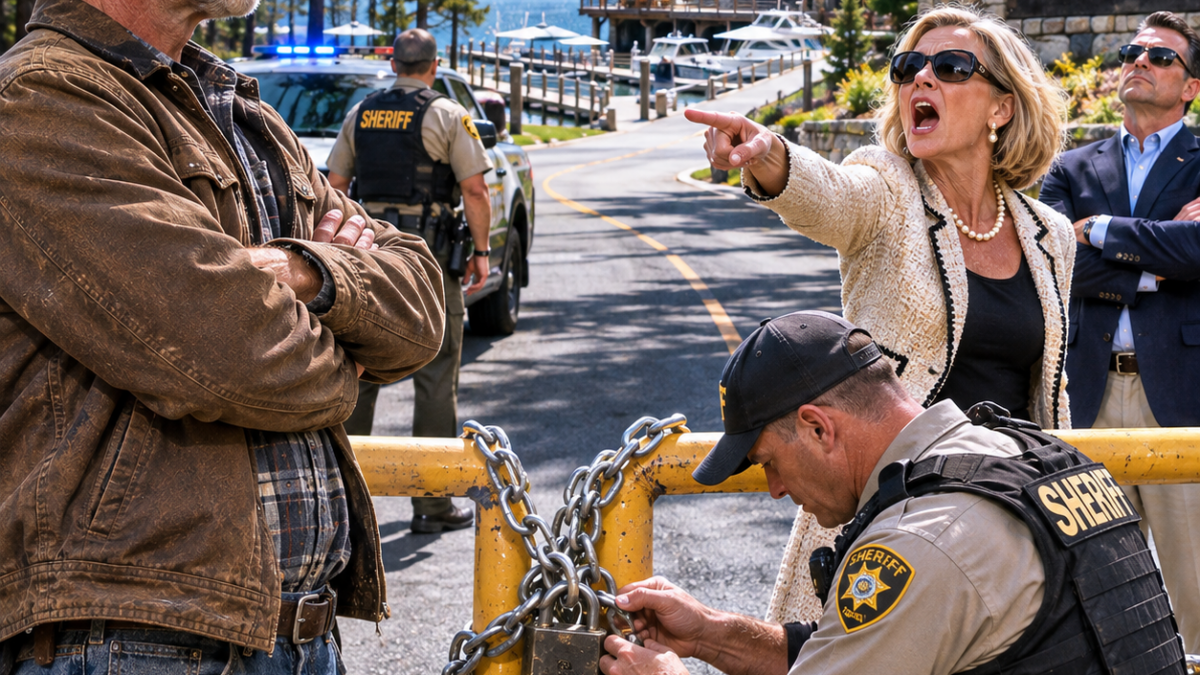
At 1:06 p.m., patrol vehicles arrived.
Lights on.
They positioned across the road at the property boundary.
Then county road barricades.
Flares.
Temporary closure signs.
I stood beside my F-250.
Evelyn stood beside me.
Dempsey looked downhill.
“Ready?”
I thought about Rick.
His threat.
His road.
My deed.
“Yes.”
The first car came uphill forty minutes later.
Silver Porsche Cayenne.
The woman driving slowed.
Stopped.
Window down.
“Officer?”
Deputy Ben Higgins walked over.
“Afternoon.”
“What’s going on?”
“Road closure.”
“Why?”
“Private property.”
She looked confused.
“This is Summit Marina Road.”
“Yes, ma’am.”
“We live here.”
“I understand.”
“We need to get through.”
“Not by vehicle.”
Her face changed.
“What do you mean?”
Higgins pointed to me.
“Mr. Graham owns the underlying parcel. Court order suspended unauthorized access.”
She stared at me.
I gave a small wave.
She did not wave back.
“You have got to be kidding.”
“No, ma’am.”
“I have groceries in the car.”
“You may return to the marina area or park and continue on foot if you remain within authorized routes.”
“This is insane.”
Within twenty minutes, cars stacked downhill.
Drivers got out.
Phones appeared.
Voices rose.
A man in deck shoes shouted that he was an attorney.
Another shouted that his father was a judge.
Somebody threatened to call the sheriff while standing ten feet from Sheriff Dempsey.
Dempsey enjoyed that one.
Then Rick arrived.
I heard him before I saw him.
“What the hell is going on?”
People separated.
Rick came up the hill fast.
Red face.
Aviators gone.
Blue polo soaked at the collar.
He saw me.
Then Evelyn.
Then Dempsey.
His expression moved through several stages.
Anger.
Confusion.
Fear.
Back to anger.
“Dempsey!”
Sheriff didn’t move.
“Open this road.”
“No.”
“Excuse me?”
“We have a court order.”
Rick pointed downhill.
“Two hundred residents are trapped.”
“They aren’t trapped.”
“They can’t leave!”
“They can walk.”
“You cannot force elderly residents to hike two miles.”
“They can remain at the marina while transportation arrangements are made.”
Rick stared.
“This is kidnapping.”
Evelyn stepped forward.
“No.”
He looked at her.
“Who the hell are you?”
“Evelyn Russo. Counsel for Mr. Graham.”
Recognition.
His eyes narrowed.
“You.”
“Me.”
“You people cannot block HOA infrastructure.”
Evelyn handed him a copy.
“Apparently we can.”
Rick read the first page.
His color changed.
“This is temporary.”
“Correct.”
“This proves nothing.”
“It proves enough for today.”
“This road belongs to the Summit.”
I said, “Show me the deed.”
He snapped toward me.
“We have easement rights.”
“Show me.”
“You know we do.”
“Show me.”
“The old logging road—”
“Was a trail.”
“Our attorneys—”
“Your attorneys can explain it Monday.”
Rick stepped closer.
Dempsey moved between us.
“Back up.”
Rick glared.
“Do you have any idea who lives in this community?”
Sheriff smiled faintly.
“People currently standing on private land?”
“CEOs. Judges. State officials. Major donors.”
Dempsey’s expression flattened.
“That supposed to change the order?”
“I can have your badge.”
“Get in line.”
A few people laughed.
Rick heard.
That hurt him more than the barricade.
He turned toward the crowd.
“This is a temporary stunt.”
Evelyn said, “Then tell everyone when the road easement was recorded.”
Rick stopped.
Silence.
A woman asked, “Rick?”
Another:
“Is there an easement?”
He raised his hands.
“Our legal team handled all approvals.”
I said, “That’s not an answer.”
Residents started talking over one another.
Someone asked if the marina itself was legal.
Another asked whether insurance covered access.
Another asked whether the road loan was secured against HOA assets.
Rick shouted:
“Everybody calm down!”
Nobody did.
He turned toward me.
“What do you want?”
That was the first intelligent question he’d asked.
“My property.”
“You have 8,400 acres.”
“Correct.”
“This road occupies what? Twenty acres?”
“Doesn’t matter.”
“It matters.”
“To you.”
“You would destroy a community over a strip of forest you weren’t using?”
There it was.
The logic behind everything.
You weren’t using it.
Therefore we could.
I looked at him.
“If I leave my truck in your driveway for three years, does it become mine?”
“That’s absurd.”
“So is your argument.”
He took another step.
“How much?”
“For?”
“Easement.”
“Not for sale.”
His face tightened.
“Everything is for sale.”
“Then offer me your house.”
“What?”
“You heard me.”
He shook his head.
“You’re insane.”
“No.”
I looked at the road beneath us.
“I’m the owner.”
That afternoon became legendary locally.
Not because anyone was truly imprisoned.
They weren’t.
But wealthy people accustomed to driving wherever they pleased discovered what two miles feels like when you have to walk it uphill in summer clothing.
Some residents took boats across the lake to a public launch.
Some waited.
Some walked.
Caterers carried equipment.
A band packed instruments by hand.
One man in loafers took his shoes off halfway.
I sat on the tailgate drinking coffee.
Not gloating.
Mostly.
At 4:30, an older woman stopped near me.
Sweating.
Angry.
“Are you proud of this?”
I looked at her.
“No.”
She seemed surprised.
“Then why?”
“Because I asked them to prove the road right before they threatened me.”
“We didn’t know.”
“I believe you.”
“You’re punishing us.”
“No.”
I pointed toward Rick.
“I’m stopping him.”
She looked.
Rick was on the phone fifty yards away, shouting at someone.
Then she said something important.
“If you’re right, we’re going to be the ones paying.”
I knew.
That bothered me.
By Monday, they sued.
Aggressively.
Emergency injunction.
Tortious interference.
Business disruption.
Loss of use.
Alleged unlawful detention of vehicles.
Intentional infliction of emotional distress.
Interference with HOA contracts.
The complaint was thick.
Rick also went on television.
I watched from my cabin.
He stood beside the locked road gate looking grave.
“This individual has taken a hostile and extremist approach to what should be a simple land-use discussion.”
Extremist.
Interesting.
“He has effectively seized critical community infrastructure and held residents hostage.”
I turned the television off.
Evelyn called.
“Don’t respond.”
“Wasn’t going to.”
“Do not post anything.”
“I don’t have social media.”
“That’s the healthiest thing you’ve told me.”
The HOA’s strategy was obvious.
Money.
They knew I’d spent heavily purchasing Oak Haven.
They had deep reserves.
Residents with influence.
Powerful law firm.
Drag me through litigation.
Make the legal cost unbearable.
Then offer to buy the land.
Classic attrition.
But Rick had built a road.
Roads have engineering.
And engineering has regulations.
That was his next problem.
I walked the two-mile corridor with an environmental consultant named Leah Moreno.
She specialized in watershed and construction runoff.
Within forty minutes she stopped at a drainage outlet.
“Who designed this?”
“HOA contractor, presumably.”
She crouched.
Water stains cut down the bank.
Sediment deposition.
Exposed soil.
The road was shedding runoff toward Lake Josephine.
“Where are the treatment facilities?”
“What treatment facilities?”
“Exactly.”
We followed culverts.
Some discharged directly into steep slopes.
Several lacked proper energy dissipation.
Sediment had carved channels.
At the bottom, fine material entered a tributary feeding the lake.
Leah looked unhappy.
“How old?”
“Three years.”
“Permits?”
“That’s what we’re checking.”
We checked.
The HOA had treated much of the corridor as an improvement to an existing route.
That had allowed them to avoid parts of the environmental review expected for a new two-mile private roadway through undeveloped timberland.
But the physical work was substantial.
Widening.
Grading.
Paving.
Drainage.
Lighting.
Utilities.
Leah’s report went to state regulators.
An inspection followed.
Then another.
The environmental side exploded.
Sediment discharge.
Improper stormwater control.
Unpermitted work.
Potential impacts to protected fish habitat.
The marina road went from HOA amenity to regulatory problem.
Evelyn filed our counterclaims.
Trespass.
Unauthorized permanent improvements.
Restoration.
Damages.
Declaratory relief.
Removal.
The key point wasn’t that I wanted to become owner of a fancy road.
I didn’t.
The road was an unwanted structure on conservation land.
So Evelyn asked the court for the remedy Rick feared most:
Remove it.
Every bit.
Asphalt.
Aggregate.
Lighting.
Utility infrastructure.
Drainage structures.
Restore the valley.
The cost estimate came back north of twelve million dollars.
That number changed the HOA’s tone.
The courtroom hearing three weeks later was packed.
Residents.
Reporters.
HOA board.
Rick.
Evelyn.
Me.
Their lead attorney argued first.
The road was essential.
The HOA had invested in good faith.
Access had existed historically.
Removal would be economically catastrophic.
Residents relied on it.
Property values depended on marina access.
Then Evelyn stood.
She didn’t shout.
Never did.
“Your Honor, every hardship plaintiff describes is self-created.”
She put the survey on the screen.
“Road lies on Oak Haven.”
Title.
“No recorded grant authorizes this infrastructure.”
Construction plan.
“Plaintiff built anyway.”
Environmental reports.
“Without proper controls.”
Then Rick’s handwritten note.
“The actual owner attempted to assert his boundary.”
She paused.
“And was threatened for doing so.”
Their attorney stood.
“Counsel is mischaracterizing a complicated easement history.”
Evelyn turned.
“Then produce the easement.”
Silence.
That phrase became the entire case.
Produce the easement.
They couldn’t produce what they claimed existed in the form they needed.
They had historical access arguments.
They did not have a clean recorded right authorizing a modern private road of that scope.
Judge Helen Mercer read for a long time.
Then she looked at the HOA lawyers.
“Let me understand your position.”
“Yes, Your Honor.”
“You contend your association possesses a right sufficient to construct, illuminate, gate, service, and exclusively control a paved roadway over another parcel.”
“Based on historical use and prior court proceedings.”
“Yet you cannot point me to a recorded instrument granting those improvements.”
“Our easement rights arose by operation of law.”
Judge Mercer looked at Evelyn.
“And the respondent?”
Evelyn said, “Even if some limited historical passage right existed, it does not transform into ownership of a modern infrastructure corridor.”
The judge nodded.
Then asked:
“If Mr. Graham does not want the roadway?”
Evelyn answered:
“He seeks restoration.”
Rick actually dropped his pen.
Tiny sound.
But in that courtroom, everybody heard it.
Judge Mercer looked toward him.
Then back at the documents.
“Removal estimate?”
“Twelve point four million.”
The HOA attorney stood.
“Which demonstrates why removal would be grossly inequitable.”
Judge Mercer responded:
“Or demonstrates why parties should confirm their property rights before spending five million dollars.”
That line made the papers.
The court allowed our removal claim to proceed.
The road remained closed except for limited negotiated access while litigation continued.
Then the environmental penalties started accumulating.
Reserve funds fell.
Insurance coverage became disputed.
Home sales stalled.
Two title companies flagged properties connected to the marina rights dispute.
That terrified residents more than any courtroom speech.
People who could tolerate legal drama could not tolerate their $3 million home becoming difficult to sell.
The HOA board turned on Rick.
Slowly first.
Then all at once.
Emails emerged.
Rick had been warned during planning that the Oak Haven title situation was uncertain.
A consultant had recommended delaying full construction until permanent access was recorded.
Rick pushed forward.
Why?
Because marina access was central to Summit marketing.
Lake access increased property values.
Homes had been advertised with private marina privileges.
Delays would have hurt sales.
So Rick treated uncertainty as inconvenience.
Then treated the empty bankruptcy land as if no owner meant no rights.
He was wrong.
A closed board meeting in August lasted five hours.
I wasn’t there.
But later documents told the story.
Residents demanded resignation.
Treasurer accused him of reckless exposure.
Another board member called his conduct grossly negligent.
Rick argued I would run out of money.
That told me everything.
He never thought he was right.
He thought he could outspend me.
Three days later, Caldwell, Stanton and Pierce called Evelyn.
“Settlement.”
We met in Seattle.
Fortieth floor.
Glass walls.
Mahogany table.
Five board representatives.
No Rick.
He had resigned the previous evening.
Their new acting president was Bradley Chen.
Tech executive.
Balding.
Exhausted.
Reasonable.
That made him more dangerous than Rick, but also easier to respect.
“Mr. Graham.”
“Bradley.”
“We want to end this.”
“So do I.”
“The residents are carrying an enormous burden.”
“I know.”
“We’d like a permanent easement.”
“No.”
He exhaled.
“We haven’t discussed numbers.”
“Still no.”
“Five hundred thousand.”
“No.”
“One million.”
“No.”
He looked at Evelyn.
“Is he negotiating?”
She smiled.
“Yes.”
“Doesn’t sound like it.”
“You’re asking the wrong question.”
Bradley looked at me.
“What question should I ask?”
“Whether I’ll permit use without giving away ownership.”
He paused.
“Lease.”
“Correct.”
That changed the room.
I slid a single page across.
Fifty-year surface-use lease.
Not deed.
Not easement.
Not ownership.
Conditions.
$4.5 million lump sum.
HOA pays my legal fees.
All environmental penalties paid by HOA.
Drainage rebuilt to modern standards.
Independent monitoring.
No widening.
No additional utilities without written consent.
No parking outside roadway envelope.
Ten-foot security fencing along both sides of corridor.
No pedestrian access into Oak Haven.
Gates locked from 10 p.m. to 6 a.m.
Emergency access excepted.
Lease violation triggers substantial penalties.
Land remains mine.
Road remains subject to the lease.
Bradley read.
His face changed at the $4.5 million.
“That’s nearly our capital reserve.”
“Then you understand why roads belong on land you own.”
One board member said, “This is punitive.”
“No.”
I looked at him.
“Punitive would be removal.”
Silence.
I continued.
“You built five million dollars of road across my forest without permission. Your alternative is paying more than twelve million to remove it, plus restoration, plus fines, plus loss of marina access.”
Bradley rubbed his forehead.
“Four and a half million.”
“Correct.”
“Fifty years.”
“Correct.”
“Then what?”
“Renegotiate with whoever owns Oak Haven.”
“You.”
“Maybe.”
“Or your heirs.”
“Exactly.”
He looked at the lawyers.
They looked miserable.
Evelyn sat perfectly still.
Bradley asked, “Why not sell?”
“Because I didn’t buy 8,400 acres to slowly lose them twenty acres at a time.”
He nodded.
I think that was the moment he understood.
This wasn’t about extracting maximum money.
Money was the price of permission after the fact.
The land itself wasn’t part of the bargain.
They broke for private discussion.
One hour.
Then two.
At 4:17, Bradley returned.
“We accept subject to final drafting.”
I said nothing.
Evelyn said, “Good.”
Bradley looked at me.
“Rick nearly destroyed this community.”
I answered:
“No. Rick nearly taught this community that somebody else’s land was free if nobody was looking.”
He flinched.
“I suppose we learned.”
“Expensive lesson.”
“Very.”
The settlement closed twenty-nine days later.
Four and a half million dollars transferred.
Legal fees reimbursed.
Environmental work began.
New drainage.
Sediment basins.
Armored outlets.
Filtration.
Slope repair.
Water testing.
The road stayed.
But changed.
The biggest change was the fence.
Two miles of black iron.
Ten feet tall.
Both sides.
From Summit boundary to marina parcel.
Residents could drive through Oak Haven.
Only through.
No stopping.
No hiking.
No wandering.
No shortcut.
No trail access.
No treating the forest like shared common area.
At night, the gates locked.
10:00 p.m.
Exactly.
First month, people complained.
A resident arrived at 10:07 and had to use alternate boat access.
He emailed me personally.
Subject line:
THIS IS ABSURD.
I replied:
The gate closes at 10.
He sent six paragraphs.
I replied:
Correct.
Never heard from him again.
Rick sold his house.
Moved away.
Florida, according to rumors.
I never checked.
I didn’t care.
The Summit elected a new board.
They rewrote contracting rules.
Required title opinions.
Conflict disclosures.
Independent engineering review.
Funny how quickly governance improves after a multimillion-dollar catastrophe.
Sheriff Dempsey visited about a year later.
Pulled into my cabin.
I made coffee.
He looked toward the distant road.
Luxury cars moved behind the fence.
“You got your peace?”
“Mostly.”
He laughed.
“You bought wilderness and ended up landlord to a marina road.”
“Life has a sense of humor.”
“Still charging them?”
“Lease was prepaid.”
“Four and a half?”
“Yes.”
He whistled.
“What’d you do with it?”
“Taxes.”
“That’s depressing.”
“Cabin.”
“Better.”
“Conservation trust.”
He looked at me.
“How much?”
“Enough to protect part of Oak Haven after I’m gone.”
Dempsey nodded.
“That’s good.”
I used some money to restore old logging areas.
Remove invasive species.
Repair stream habitat.
Improve firebreaks.
And build the house I’d originally imagined.
Nothing huge.
Two bedrooms.
Workshop.
Metal roof.
Solar panels.
Deep well.
Wraparound porch.
View across the trees.
No neighbors visible.
Exactly right.
Every now and then, a Summit vehicle moves through the valley.
Slow now.
Very slow.
Speed limit is written into the lease.
Twenty-five.
I have cameras.
They know.
Nobody honks.
Nobody throws trash.
Nobody stops to take photographs.
They drive down.
Use the marina.
Drive back.
Some residents wave if they see me.
I wave back.
I don’t hate them.
That’s important.
Most never knew what Rick had done.
They bought homes based on promises.
Paid dues.
Trusted professionals.
Their mistake was believing infrastructure must be legal because it looked expensive.
I made the same assumption about plenty of things during my engineering career.
Money creates the appearance of legitimacy.
Stone walls.
Architectural drawings.
Law-firm letterhead.
Security gates.
Streetlights.
A five-million-dollar road.
All of it looked permanent.
None of it changed the deed.
Years later, the old county records still sit in a fireproof cabinet in my office.
Survey.
Court order.
Lease.
Environmental reports.
And Rick’s handwritten threat.
I told you to stay off our road.
Next time it won’t be a letter.
That one is framed.
Evelyn gave it to me after settlement.
She had written beneath it in pencil:
Apparently it was his road only until someone read the deed.
I laughed for five minutes.
People who hear the story always focus on the deputies.
The flashing lights.
The regatta.
Millionaires walking uphill.
That’s the cinematic part.
But that’s not where the fight was won.
It was won in the county basement.
Plat maps.
Title records.
Survey coordinates.
Permit history.
Old easement language.
Paper.
Rick thought power meant having better lawyers.
Bigger houses.
More money.
A prestigious HOA.
Private security.
A marina.
Real power, in that situation, was knowing exactly what you owned.
That sounds boring.
Property rights usually are boring.
Until someone crosses the line.
Then boring paper becomes everything.
I also learned something I hadn’t expected.
Boundaries do not have to mean hostility.
The Summit road remains behind a fence because I want my forest protected.
But I’ve met several residents since.
Bradley came by once.
No lawyers.
He stood on the porch drinking coffee.
“I’m sorry.”
“For Rick?”
“For the board.”
“You weren’t president.”
“I was on it.”
“Did you know?”
“No.”
“Then learn from it.”
“We did.”
He looked toward the trees.
“I never realized how beautiful this tract was.”
“That’s why I bought it.”
“You could develop it.”
“I could.”
“Make a fortune.”
“I already had a career.”
“What will you do with eight thousand acres?”
I looked around.
“Mostly nothing.”
He laughed.
“That’s expensive nothing.”
“Best kind.”
He understood.
A few years earlier, I probably would have thought eight thousand acres were wasted if they weren’t producing revenue.
That was corporate engineering thinking.
Utilization.
Yield.
Return.
Optimization.
Now I watched elk move through meadow fog.
Bald eagles hunt along the lake.
Salmon return after drainage repairs.
Old firs stand where somebody could have built forty-dollar-a-square-foot vacation homes.
Not everything valuable needs to be maximized.
That was another lesson Rick never learned.
He looked at Oak Haven and saw an unused valley.
A cheaper road.
A solution to his problem.
I looked at it and saw land.
Those are different ways of seeing the world.
His version turned every unoccupied thing into an opportunity.
Mine eventually learned that untouched can be the purpose.
Sometimes I walk the marina corridor early in the morning before the gate opens.
My road now.
Legally leased.
The black pavement looks almost absurd between old trees.
Streetlights.
Curbs.
Drainage.
Evidence of another man’s certainty.
I remember that first day.
Rick standing beside his Mercedes.
This road has been here three years.
As if age created ownership.
As if investment created permission.
As if enough concrete could transform trespass into entitlement.
He was wrong about all three.
One winter morning, I saw a maintenance worker fixing one of the solar lights.
Young guy.
He waved.
“Mr. Graham?”
“Yeah.”
“Can I ask you something?”
“Sure.”
“Is it true deputies shut this whole road down during the regatta?”
“Yes.”
He laughed.
“My boss says half the neighborhood had to walk uphill.”
“Some took boats.”
“Rick Garrison too?”
“Rick stayed.”
“Figures.”
He tightened a bolt.
Then looked around.
“Crazy road.”
“Why?”
“Five million dollars and it wasn’t theirs.”
I smiled.
“Still isn’t.”
He looked at me.
Then laughed.
“Right.”
That is the part people miss.
The settlement didn’t make the road theirs.
It made their use lawful.
There is a difference.
Permission and ownership are not the same.
Access and possession are not the same.
Money and entitlement are not the same.
Those distinctions matter far beyond property.
I spent three decades designing structures.
You learn quickly that systems fail when people ignore boundaries.
Load limits.
Clearances.
Expansion joints.
Property lines.
Waterways.
There is always a point where “just a little more” becomes failure.
Rick lived by just a little more.
Just a little more road.
Just a little more authority.
Just a little more pressure.
Just assume.
Just build.
Just threaten.
Eventually he exceeded the system’s capacity.
Then everything cracked.
Not because I was tougher.
Not because I was richer.
Certainly not because I enjoyed conflict.
I didn’t.
What I did was refuse to accept his definition of reality.
That’s harder than it sounds when someone comes with:
Lawyers.
Letters.
Security.
Money.
Confidence.
Most people start doubting themselves.
Maybe the HOA has rights.
Maybe the lawyers know.
Maybe I misunderstood.
Maybe fighting isn’t worth it.
That doubt is exactly what people like Rick depend on.
The most important thing I did was check.
Not argue.
Check.
Deed.
Survey.
Records.
Permits.
Then check again.
Only after that did I draw the line.
Literally.
Years later, the road is still there.
The marina still operates.
Summit property values recovered.
The HOA survived.
The residents adapted.
Nobody was bankrupted.
Nobody’s life ended.
The only thing that disappeared was the assumption that Oak Haven belonged to whoever had the money to use it.
That was worth the fight.
Sometimes at night, I sit on the porch with coffee.
No city glow.
Just stars.
Wind in Douglas firs.
In the distance, behind two miles of black iron fence, I occasionally see headlights moving down the marina road.
Quiet.
Slow.
Temporary.
At 10 p.m., the gates close.
The forest goes dark again.
And I remember why I bought the land.
Not to fight an HOA.
Not to make money.
Not to humiliate rich people.
I bought it because after decades of designing things for other people, I wanted one place in the world where nothing needed to be optimized.
Where trees could simply stand.
Where a lake could be a lake.
Where a road existed only if the person who owned the dirt agreed.
Rick Garrison taught me how fragile that peace can be when somebody mistakes silence for surrender.
Sheriff Dempsey taught me something else.
The afternoon the deputies closed the marina road, he stood beside the barricade while Rick shouted about governors, lawyers, influence, and millions of dollars.
Dempsey barely reacted.
When Rick finally stopped, the sheriff held up the court order and said:
“Mr. Garrison, this piece of paper doesn’t care how much the road cost.”
I think about that often.
Concrete doesn’t create rights.
Money doesn’t create rights.
Confidence doesn’t create rights.
Repeated trespass doesn’t become moral because it is convenient.
A five-million-dollar road can still be on the wrong deed.
And sometimes the most powerful thing a person can do when everybody around them insists a line no longer matters is calmly pull out the survey, point to the ground beneath their feet, and say:
Yes, it does.
I bought 8,400 acres because I wanted peace.
Ironically, securing that peace required survey stakes, lawyers, environmental inspectors, court orders, flashing patrol lights, two miles of fencing, and one of the ugliest HOA fights this county had ever seen.
But the land is still mine.
The forest is still standing.
The lake is cleaner.
The road is controlled.
And every night, when the last luxury SUV disappears behind the locked gate and silence comes back through the trees, I know exactly what that battle purchased.
Not revenge.
Not victory.
Permission to finally be left alone.








