I Bought 80 Acres of Land—HOA Karen Demanded Access, So I Called the Cops
I Bought 80 Acres of Land—HOA Karen Demanded Access, So I Called the Cops
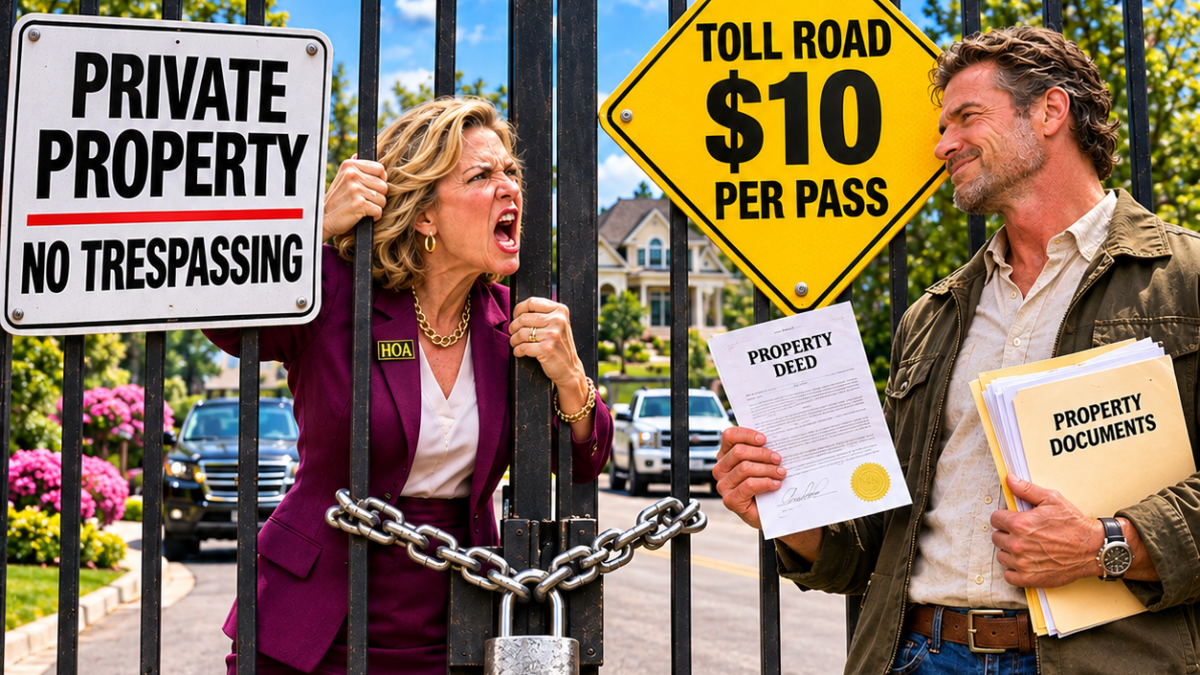
“YOU CANNOT LOCK THIS GATE, DANIEL—CEDAR RIDGE HAS USED THIS TRAIL FOR YEARS, AND IF YOU KEEP BLOCKING HOA ACCESS, WE’LL OPEN IT OURSELVES!” Linda Dawson shouted while six strangers stood inside my new property and a man waited beside my chain with bolt cutters.
I had owned all eighty acres for less than three weeks, my deed showed no HOA rights anywhere on the land, and a deputy had already warned Cedar Ridge once about entering without permission.
Then one of Linda’s own people found an old sign buried behind vines in my woods—and the document hidden behind it made her stop shouting.
My name is Daniel Foster, and buying those eighty acres was supposed to be the happiest decision I had made in years.
I was thirty-nine.
Electrical contractor.
No wife.
No children.
No mansion.
No luxury neighborhood.
All I wanted was land.
Quiet land.
Enough space for a workshop.
A vegetable garden.
Maybe a few cattle.
A cabin beside the creek someday.
Something that belonged to me without somebody measuring my mailbox or telling me what color my barn had to be.
When the Miller family listed their old property outside Knoxville, Tennessee, I thought I had finally found it.
Eighty acres at the end of a narrow county road.
Rolling pasture.
Thick woods.
Two small creeks.
Old farmhouse.
Metal barn.
Gravel driveway.
And several miles of rough logging trails left from years of timber work and cattle use.
The western boundary touched a newer subdivision called Cedar Ridge Estates.
That made me nervous.
Not because I hated neighborhoods.
Because Cedar Ridge had an HOA.
PART2:
Before I signed anything, I asked directly:
“Is this land part of Cedar Ridge?”
The seller, Thomas Miller, shook his head.
“No.”
My real estate attorney, Sarah Collins, checked too.
Deed.
Title history.
County records.
Surveys.
Recorded declarations.
No HOA covenant.
No membership agreement.
No recreational easement.
There were a few old utility rights and one narrow drainage easement.
Nothing giving Cedar Ridge residents the right to cross my property.
Sarah said:
“You are buying eighty acres outside the HOA.”
That sentence mattered.
I closed.
Moved into the farmhouse.
And for the first few days, life felt exactly the way I imagined.
My younger sister Megan came over on weekends to paint.
My friend Brian helped repair the barn roof.
I replaced broken fence posts.
Cleared fallen trees.
Marked the boundary with new private-property signs.
Every evening I sat on the porch with coffee and looked across the pasture.
Peace.
Thomas had warned me about one thing during the final walk-through.
Cedar Ridge residents sometimes used an old logging trail along the western side.
He had lived out of state for several years and visited only occasionally.
People walked.
Jogged.
Sometimes rode golf carts.
Thomas posted signs.
Some disappeared.
He locked a gate once.
Someone cut the chain.
I asked why he never pushed harder.
He shrugged.
“I got tired of arguing.”
Then he gave me one piece of advice.
“Be kind first. But don’t let people turn your kindness into ownership.”
I remembered that.
The first walkers appeared on my fourth day.
A man and woman wearing Cedar Ridge shirts came down one of the old trails while I repaired a fence.
I smiled.
“Hey, just so you know, this part is private now.”
The man looked confused.
“This is the HOA nature trail.”
“No. The HOA trail ends at the western fence.”
The woman pointed behind her.
“We’ve walked this for years.”
“I believe you.”
That seemed to surprise them.
Then I added:
“But that doesn’t mean Cedar Ridge owns it.”
I explained that I had just bought the property.
I planned to close some old trails.
Cattle would eventually use part of the western pasture.
I also needed equipment access.
The couple apologized.
Turned around.
Left.
Perfect.
That was exactly how I wanted every conversation to work.
No yelling.
No threats.
No police.
Two days later, Linda Dawson arrived.
White SUV.
Dark sunglasses.
Large handbag.
She drove straight down my gravel driveway without calling.
Parked beside the barn.
Got out smiling.
“I’m Linda Dawson. President of Cedar Ridge HOA.”
I shook her hand.
“How can I help you?”
“I wanted to welcome you to the neighborhood.”
“I appreciate that, but I’m not actually in Cedar Ridge.”
Her smile changed.
“Not technically.”
That word caught my attention.
“Not technically?”
Linda explained that Cedar Ridge residents had been using trails across the western side of my land for almost ten years.
The HOA considered those routes part of its recreational system.
They expected continued access.
“Expected?”
“Yes.”
“There’s no recreational easement on my deed.”
Linda waved that away.
“Long-standing use can create rights.”
“Sometimes.”
I knew enough to know property law can get complicated.
But I also knew trespassing for years does not automatically turn private land into HOA property.
“I’ll have my attorney review anything you have.”
Linda handed me a folder.
Inside was a glossy Cedar Ridge trail map.
Three walking routes crossed my property.
Not one.
Three.
One through the woods.
One beside the creek.
One across pasture toward my barn.
Altogether, the map treated about fifteen acres of my land like an HOA recreation area.
“Who made this?”
“Our property committee.”
“Did Thomas Miller approve it?”
Linda avoided the question.
Instead, she said Cedar Ridge had spent money maintaining the trails.
I looked at the mud, fallen branches, and rough ground.
“Maintaining them how?”
“Volunteers. Brush clearing. Trail markers.”
“If your volunteers entered private property without permission, that doesn’t strengthen your claim.”
Her smile disappeared.
“Daniel, we’re trying to be good neighbors.”
“So am I.”
“Then don’t close trails families have used for years.”
“I’m not taking anything away from Cedar Ridge.”
She folded her arms.
“You are.”
“No. I’m taking control of land I bought.”
Linda looked toward the woods.
Then back at me.
“The HOA will discuss it.”
That sounded like a warning.
Three days later, I found new orange markers nailed to trees.
CEDAR RIDGE WALKING LOOP.
Fresh nails.
Fresh wood.
Installed after my conversation with Linda.
I removed every marker.
Put them in a box.
Then emailed Linda.
Nobody from Cedar Ridge had permission to enter my property or install anything.
Her response came thirty minutes later.
She accused me of removing HOA property.
Then demanded I return the signs or pay replacement costs.
That was the moment the whole situation stopped being funny.
Sarah called after I forwarded the email.
“Do not pay anything.”
“I wasn’t planning to.”
“She has no authority to fine you.”
Linda fined me anyway.
$750.
Trail-marker replacement.
Administrative cost.
Unauthorized obstruction.
Loss of recreational access.
I stared at the bill.
Then put it into a folder.
Every letter.
Every email.
Every photograph.
Every envelope.
Saved.
Sarah sent a formal notice to Cedar Ridge.
Daniel Foster is not an HOA member.
His property is not subject to Cedar Ridge covenants.
Please provide any deed, easement, signed agreement, or court order supporting your trail claim.
Silence.
For almost two weeks.
Life became peaceful again.
I repaired barn doors.
Megan planted herbs near the farmhouse.
Brian helped build shelves in the workshop.
Then Walter Hayes came to my gate.
Walter was an elderly Cedar Ridge resident.
Quiet man.
He stopped outside the gate.
Did not walk through.
“Would you mind if I went near the creek?”
“Why?”
He looked embarrassed.
“My wife used to love that view. She died last year.”
I opened the gate.
“Come on.”
We walked together.
Walter told me walking near the creek helped him remember her.
That afternoon taught me something important.
Boundaries did not mean shutting everybody out.
Walter asked.
Linda demanded.
That was the difference.
A few days later, George Parker called.
He lived in Cedar Ridge.
Linda had held a community meeting.
She told residents I was trying to seize established HOA trails.
Seize.
My own land.
George sounded uncomfortable.
He said many residents genuinely believed Cedar Ridge owned the trails.
“Why?”
“They’re on the community maps.”
“Has anyone ever shown you an easement?”
“No.”
“A deed?”
“No.”
“Anything signed by Thomas Miller?”
Silence.
Then:
“I guess we all assumed.”
That word became important.
Assumed.
A lot of property fights begin with something people assumed for so long that nobody remembers to check.
The following weekend, I installed a steel gate across the western service road.
The road sat entirely inside my boundary.
I put up a sign.
PRIVATE PROPERTY.
PLEASE ASK BEFORE ENTERING.
Not:
KEEP OUT.
Not:
TRESPASSERS WILL BE SHOT.
Just:
Ask.
Three days passed.
Then I found the gate open.
The lock was gone.
My trail camera showed exactly what happened.
6:12 a.m.
A man wearing a Cedar Ridge volunteer vest drove up in a golf cart.
Two women stood nearby.
He pulled out bolt cutters.
Cut my chain.
Opened the gate.
Residents began walking through.
Sarah watched the footage.
“File a police report.”
I did not want anybody arrested.
I wanted a record.
Deputy Paul Reynolds came out.
He watched the video.
Took my statement.
Said he would contact Cedar Ridge.
The next morning, Linda called furious.
“You involved law enforcement in a neighborhood access issue?”
“Somebody cut my lock.”
“You blocked established access.”
“Show me the easement.”
“We’re working on it.”
Then she made an offer.
Permanent trail access.
$5,000 per year.
“No.”
“Ten thousand.”
“No.”
“You’re being unreasonable.”
“I plan to put cattle in that pasture. I’ll use equipment on those trails. Public walking access is unsafe.”
“The HOA can manage safety.”
“No.”
Her voice changed.
“You bought property next to a community, Daniel. That comes with responsibility.”
“So does owning a home next to private land.”
She hung up.
Then Cedar Ridge started placing things on my property.
Private signs disappeared.
New trail marker.
Picnic table beneath an oak.
Dog-waste station beside a logging road.
Every new object made my land look a little more like HOA land.
Sarah noticed immediately.
“Document everything.”
I did.
Then Cedar Ridge sent a legal-looking notice claiming prescriptive recreational access.
Sarah read it carefully.
She did not dismiss the concept.
Property rights can sometimes arise through long use.
But facts matter.
Permission matters.
Open use.
Hostile use.
Continuous use.
Objections.
Dates.
And Thomas Miller had repeatedly objected.
I called him.
When I explained Linda’s claim, he went quiet.
“Linda is still trying that?”
“Still?”
Thomas said Cedar Ridge asked for permanent trail rights five years earlier.
He refused.
They asked again three years later.
He refused again.
They offered money.
Still no.
Then he told me something else.
“I always thought the trails were about something bigger.”
“What?”
“Cedar Ridge talked about buying land west of mine. Second entrance. Recreation center. Maybe more development.”
“The same trails?”
“Easiest route.”
I looked toward the woods.
“So this may not be about walking.”
Thomas answered:
“I don’t think it ever was.”
Then came the morning I called the police on Linda.
I heard engines near the western boundary.
When I reached the trail, Linda was already inside my property.
Six people.
Two golf carts.
One man holding bolt cutters beside the gate.
Linda pointed at me.
“You cannot block HOA access to this trail.”
I held up my deed folder.
“There is no HOA here.”
She folded her arms.
“Cedar Ridge has access rights.”
“I bought all eighty acres. None of it belongs to your association.”
Then Linda told the man with bolt cutters:
“Open the gate.”
I pulled out my phone.
“If he cuts that chain, I’m calling 911.”
Linda stared at me.
“Call them.”
So I did.
While we waited, one of the men wandered toward an old tree about thirty yards inside the woods.
Vines covered part of the trunk.
Behind them was a weathered wooden board.
He pulled the vines away.
Wiped dirt from the lettering.
Then read it.
His face changed.
Cedar Ridge Trail Access Denied.
Private Miller Property.
No Permanent Easement Granted.
A date.
Two signatures.
Thomas Miller.
And a representative of Cedar Ridge’s original development company.
Linda rushed toward him.
“Give me that.”
He looked confused.
“You said there was always an easement.”
Linda grabbed at the sign.
I stepped between them.
“Don’t touch it.”
For the first time that morning, she looked nervous.
Then someone noticed a plastic sleeve attached to the back.
Inside was a folded letter.
I opened it carefully.
CEDAR RIDGE DEVELOPMENT.
ACCESS REQUEST DENIED.
Linda stared.
Then two sheriff’s cruisers pulled up.
Deputy Paul Reynolds got out.
He looked at Linda.
Then the people standing behind my gate.
“Ma’am, why are you back here after we already told your association this property is private?”
Linda smiled again.
Then pulled out a folder I had never seen.
“This is why.”
Inside was a newly recorded easement.
Permanent Cedar Ridge rights across nearly twelve acres.
Creek.
Western service road.
Trails.
And the exact corridor Thomas warned me might someday become another entrance.
Paul read it.
Then looked at me.
“Daniel, this is recorded with the county.”
My stomach dropped.
Linda smiled.
Then Paul added:
“But recorded does not automatically mean valid.”
Her smile disappeared.
“Until this is reviewed, nobody cuts locks, removes gates, or starts construction.”
Linda argued that the police were interfering with HOA property rights.
Paul told her the document was a civil claim.
Not a police order.
Not permission to force entry.
He ordered everyone off my property.
Most residents left immediately.
The man with the bolt cutters looked embarrassed.
Linda remained.
“This is going to create serious problems for you.”
I looked at the cut marks on my previous lock.
“The biggest problem I had was assuming you would respect a gate.”
Sarah arrived soon afterward.
The document was titled:
RECREATIONAL AND EMERGENCY ACCESS EASEMENT.
Supposedly signed six years earlier by Thomas Miller.
Permanent rights across nearly twelve acres.
Trail maintenance.
Tree removal.
Drainage work.
Maintenance vehicles.
Emergency access.
Then one clause made Sarah stop.
FUTURE TRANSPORTATION IMPROVEMENTS CONSISTENT WITH COMMUNITY SAFETY.
“Could that mean a road?”
“Someone could argue that.”
The filing date was even stranger.
The agreement had supposedly existed six years.
It was recorded nine days ago.
I had bought the property almost three weeks earlier.
Someone waited until after my closing to file an old document claiming permanent rights.
Sarah looked at me.
“That timing matters.”
I called Thomas.
“Did you ever sign a permanent twelve-acre easement?”
“No.”
Immediate.
Certain.
I sent him a picture.
Five minutes later, he called back.
“That is my signature.”
My heart sank.
Then he continued.
“But I never signed that document.”
Six years earlier, a storm blocked Cedar Ridge’s main entrance.
Thomas allowed emergency vehicles to use his service road.
For seventy-two hours.
Temporary emergency access.
Three days.
The agreement contained his real signature.
He still had a copy.
The next morning, Sarah placed the temporary storm document beside the new permanent easement.
Same signature.
Same tiny skip in the T.
Same ending stroke.
Same notary name.
Deborah Lane.
The temporary agreement was notarized legitimately.
The new permanent easement used Deborah’s old stamp information.
Sarah checked county filing records.
The new document had been submitted electronically by Cedar Ridge Property Services.
Owner:
David Dawson.
Linda’s husband.
The packet also contained a survey.
Completed only twelve days earlier.
Three days before recording.
Sarah stared at it.
“How does a six-year-old easement get its exact legal boundary surveyed last week?”
Good question.
Surveyor Andrew Collins answered it.
David Dawson hired him.
Told him Cedar Ridge already had an old access easement and needed the route mapped for an upcoming project.
Andrew never met me.
Never met Thomas.
Never knew I had just bought the property.
Never knew the access was disputed.
Another professional working from information someone else had already framed.
Sarah formally challenged the easement.
Then Cedar Ridge announced something called:
CEDAR RIDGE WEST ACCESS IMPROVEMENT PLAN.
George sent me the presentation.
My twelve disputed acres were highlighted.
A wide line crossed the service road.
Not a walking path.
A road.
It crossed my property and continued toward another parcel south of me.
Sarah checked county planning records.
Two hundred ten acres.
Future subdivision.
112 homes.
Name:
Cedar Ridge West.
Without a road through my land, the developer needed a longer entrance from the state highway.
More grading.
Drainage.
Turning lane.
Estimated extra cost:
$2.3 million.
My land was the cheap route.
Suddenly the trail markers mattered differently.
Picnic table.
Dog station.
Orange signs.
People walking after I objected.
The more Cedar Ridge used my land visibly, the easier someone might later try to describe it as long-established community space.
Sarah warned me:
“That may explain motive. It still doesn’t prove who created the document.”
Then we found David Dawson’s connection.
He worked as a consultant for Summit Valley Homes, the Cedar Ridge West developer.
Board minutes showed Linda discussing “legacy trail rights” months before I bought the property.
David had given a presentation about converting recreational use into transportation access.
Converting.
That word mattered.
First establish recreational history.
Then transform it into road access.
At the next Cedar Ridge board meeting, Sarah and I attended.
HOA attorney Laura Mitchell started by saying something Linda clearly disliked.
“Daniel Foster’s eighty acres are not subject to Cedar Ridge HOA covenants.”
Finally.
But if a separate easement existed, that could still be legally relevant.
Fair.
Sarah asked Laura:
“Have you reviewed the original?”
“No.”
“Did you advise Cedar Ridge to record it?”
“No.”
“Did you advise residents they could force entry?”
“No.”
Silence.
Linda said Cedar Ridge Property Services handled everything.
David claimed his company discovered the old easement in archived developer records.
Sarah asked:
“When?”
“Several months ago.”
“Why record it only nine days ago?”
David said they needed a completed survey.
Then George stood.
“Did anyone tell residents this trail claim is connected to Cedar Ridge West?”
The room erupted.
Linda said the road was only a future possibility.
Sarah asked David if Summit Valley Homes paid him.
“Yes.”
“How much?”
“Private contract.”
Even Laura looked surprised.
The board suspended Linda’s authority over the land dispute.
Ordered David’s company to stop work involving my property.
I went home feeling calmer.
Finally, Cedar Ridge residents were questioning Linda.
At 2:13 the next morning, my security alarm went off.
Motion.
Western boundary.
I opened the camera.
Headlights.
Then a bulldozer.
Two pickup trucks.
Flatbed carrying metal fencing.
The bulldozer stopped beside my locked gate.
A man used a power saw on the chain.
I called 911.
Switched cameras.
An excavator was already inside my property.
Clearing trees.
Forty-foot corridor.
Exactly along the road route on Cedar Ridge West’s plan.
Then Linda’s white SUV arrived.
David got out with her.
The HOA board had suspended her authority only hours earlier.
And she was standing on my land before sunrise while equipment cut a road.
Workers installed steel posts.
One attached a sign.
CEDAR RIDGE WEST ACCESS.
PRIVATE HOA ROAD.
I stared at the screen.
This was no trail.
Then the excavator struck something near the creek.
Workers dug by hand.
Pulled out a rusted metal box.
David opened it.
Old documents wrapped in plastic.
Linda read the first page.
Her expression changed.
Then she looked toward my camera.
“Shut everything down. Take that box.”
Less than two minutes later, Paul Reynolds reached the gate.
Another deputy blocked the trucks.
No arrests immediately.
Good.
I wanted facts clean.
Paul asked who authorized construction.
Linda raised the same disputed easement.
Paul reminded her the board suspended her authority.
She argued the board could not erase permanent property rights.
Then he pointed toward David’s box.
“What’s that?”
David said he did not know.
One worker answered:
“It came out of the ground.”
Paul made David put it on the patrol-car hood.
Sarah arrived as deputies opened it.
Old survey.
Handwritten letters.
Deed attachment.
Then:
MILLER PROPERTY — WESTERN ACCESS REQUEST.
The original developer had asked Thomas for permanent road access.
Thomas refused.
In writing.
The letter stated residents could occasionally use some trails only with Thomas’s permission.
No permanent recreational easement.
No transportation easement.
Another agreement confirmed the creek trail and service road remained private.
No future Cedar Ridge plan could treat them as community access without a new written agreement.
Then we found Thomas’s handwritten note.
He had buried the records.
Why?
Signs and papers had disappeared during earlier arguments.
Thomas told us over the phone:
“I got tired of things disappearing.”
The construction supervisor, William Harris, gave deputies his work order.
Cedar Ridge Property Services hired his company two weeks earlier.
He had been told the easement dispute was resolved.
The job description said:
EXISTING HOA ACCESS IMPROVEMENT.
Nothing said new owner objected.
Nothing said court challenge.
Nothing said Linda had been suspended.
And David requested the project begin before daylight to avoid “unnecessary owner interference.”
Owner interference.
My presence on my own land had become a construction inconvenience.
The road was supposed to be completed in twelve days.
Stage one:
Tree clearing.
Stage two:
Drainage and compacted stone.
Stage three:
Widen creek crossing and install controlled-access gate inside my property.
If my cameras failed, I could have awakened days later to a new road cutting across land I had owned less than a month.
Paul stopped the project.
Every vehicle.
Driver.
Work order.
Photograph.
Documented.
Then he issued Linda and David a formal warning:
Stay off the property until the court decides the dispute.
Sarah filed for emergency protection.
The judge ordered:
No road work.
No trail work.
No marker installation.
No gate removal.
No construction.
No entry beyond true emergencies.
For the first time since closing, I could breathe.
Then Sarah attacked the easement itself.
Deborah Lane, the notary, was still alive.
She remembered Thomas.
She notarized the seventy-two-hour emergency agreement.
She had never notarized a permanent easement.
Worse for Cedar Ridge, her commission had expired months before the date printed on the new document.
The permanent easement used an old stamp number copied from a legitimate agreement.
Document examiner compared Thomas’s signatures.
Exact same image.
Same pen skip.
Same tiny dot.
Same paper shadow.
Copied.
Computer records finished the job.
Cedar Ridge Property Services created the permanent easement PDF twelve days before I purchased the property.
Not six years earlier.
The temporary emergency form had been scanned.
New pages added.
Twelve-acre description.
Trail rights.
Road rights.
Future transportation language.
Same signature moved into a different agreement.
Account responsible:
David Dawson.
Then Sarah found the emails.
Three weeks before my closing:
David:
“New buyer may kill west route if title closes clean.”
Linda:
“Need legacy access recorded before challenge.”
David:
“Trail history plus Miller emergency form should be enough to create continuity argument.”
Create continuity.
Not discover.
Create.
Another:
“Get survey done after closing if needed. Once document is recorded, buyer has to fight uphill.”
They knew somebody was buying.
They knew no easement appeared in the clean title search.
They planned to create a recorded obstacle afterward.
Then Linda asked:
“What if Daniel closes trails immediately?”
David:
“Keep residents using them. Continuous visible use helps.”
That explained the trail markers.
Picnic table.
Dog station.
People walking after I objected.
Another email:
“If he gates west road, remove obstruction under access claim.”
The cut chain was not random.
The board met again.
Linda no longer sat at the front.
Vice president Robert Gaines led.
Laura Mitchell presented independent findings.
The easement had major validity problems.
No board vote approved filing it.
No board vote approved the midnight road.
No board vote approved converting trails into Cedar Ridge West access.
Then Laura disclosed David’s financial interest.
His company would receive $180,000 if access to Cedar Ridge West was secured.
Plus a $250,000 success payment if the connection crossed my property before the development financing deadline.
$430,000.
Now everybody understood why Linda cared so deeply about a “nature trail.”
The board terminated Cedar Ridge Property Services.
Linda was removed as HOA president pending investigation.
Every official Cedar Ridge map crossing my land was withdrawn.
The HOA formally stated it would not claim access unless a valid court-recognized right existed.
That mattered.
It separated the neighborhood from the people using its name.
Most residents were not trying to take my land.
They believed what they had been told.
For the first time, I started planning my property again.
Cattle.
Garden.
Workshop.
Maybe a small private walking loop by the creek.
Walter could use it.
George too.
By permission.
Because I chose.
Then Thomas called.
He found an old purchase offer.
Years earlier, Cedar Ridge’s original developer tried to buy twenty-two acres from the western side.
Thomas refused.
But the old concept map showed a road continuing deeper into what was now my property.
Toward the center of the eighty acres.
A handwritten note said:
FUTURE COMMERCIAL PARCEL OPTION IF HIGHWAY CONNECTOR APPROVED.
Sarah checked county records.
David Dawson owned thirty-five acres south of me through Dawson Land Holdings.
His property had a preliminary concept.
Small retail center.
Gas station.
Storage.
Possible residential expansion.
Access requirement:
WEST CORRIDOR CONNECTION.
My land again.
David could benefit twice.
Consulting money from Cedar Ridge West.
And road access to his own property.
Then county inspector James Cooper found old survey stakes inside my acreage.
Not twelve acres.
Almost half a mile.
WEST CORRIDOR CENTER LINE.
They continued toward my barn.
Behind an old equipment shed, James found fresh concrete hidden under gravel.
Three foundations.
Then a utility vault.
Inside:
A site plan.
DAWSON CROSSING COMMERCIAL DISTRICT.
Almost two hundred acres.
My land sat in the center.
My farmhouse.
Barn.
Pasture.
Creek.
Everything shaded gray.
One word:
ACQUISITION.
Next page:
PHASE ONE — ESTABLISH RECREATIONAL ACCESS.
PHASE TWO — CONVERT TO TRANSPORTATION CORRIDOR.
PHASE THREE — SECURE REMAINING FOSTER PARCEL THROUGH PURCHASE, PRESSURE, OR LEGAL CLAIM.
My name already printed there.
Daniel Foster.
A note dated before I bought the land:
NEW BUYER LIKELY UNAWARE OF LONG-TERM CORRIDOR STRATEGY.
Linda had never been fighting over a walking trail.
David had never wanted only twelve acres.
They were planning around all eighty acres before I even owned them.
Then the title company called.
Dawson Land Holdings filed another document.
An old development option.
Supposedly signed years earlier by Thomas Miller.
According to it, a developer had the right to purchase part or all of the land if a future road corridor was approved.
If valid, it could challenge whether Thomas had been free to sell the property to me at all.
Sarah told me:
“Do not panic. A filing is not ownership.”
But it felt different.
Cut locks were physical.
Trail signs were annoying.
This attacked the deed itself.
Thomas answered immediately.
“I never signed that.”
He recognized the signature.
Years earlier, he signed a receipt acknowledging he had received a purchase proposal.
Not an option.
Not a sale agreement.
A receipt.
He still had the original.
Document examiner compared them.
Same digital signature image.
Again.
A real signature moved onto a new document.
Sarah obtained another emergency court order.
No forced sale.
No lien.
No construction.
No transfer.
My deed remained fully effective while the claim was investigated.
The title company then confirmed something devastating for David’s story.
When I purchased the property, their complete title search found no option.
No pending claim.
No Dawson rights.
Nothing.
The supposed old option appeared publicly only after the trail dispute escalated.
Investigators searched Cedar Ridge Property Services files.
Folder:
FOSTER CONTINGENCY.
Inside:
My closing date.
Title company.
Closing attorney.
Survey.
Trail dispute.
Road maps.
And one document titled:
OPTION CLAIM — USE ONLY IF ACCESS FAILS.
I felt cold.
The ownership challenge was not an old right somebody finally discovered.
It was a backup plan.
If I blocked the trail:
Use easement.
If easement fails:
Use option.
If option creates enough fear:
Pressure me to sell.
Another note:
ACQUISITION PRESSURE INCREASES IF BUYER FACES TITLE UNCERTAINTY.
Sarah looked at me.
“They wanted you tired.”
She was right.
Every step created another problem I had to pay to solve.
Letters.
Signs.
Cut locks.
Police reports.
Recorded easement.
Survey.
Road construction.
Court order.
Ownership challenge.
They did not necessarily need every fake claim to survive forever.
They needed me exhausted long enough to make a bad deal.
Then investigators found another email.
David:
“If trail claim fails, option file gives leverage.”
Linda:
“Will it hold?”
David:
“Doesn’t need to forever. Needs to create negotiation pressure.”
There it was.
They knew.
Another:
“Best outcome is Foster takes buyout and exits before corridor project becomes public.”
My eighty-acre dream was just an obstacle in somebody else’s development model.
By then, Cedar Ridge’s board wanted nothing to do with them.
Robert called me personally.
The HOA had never approved a commercial corridor.
Never approved challenging my deed.
Never approved buying my land.
Never authorized Linda to negotiate development rights over property Cedar Ridge did not own.
Then Cedar Ridge issued a formal statement.
My eighty acres were outside the HOA.
No ownership claim.
No permanent recreational easement.
No transportation corridor.
No development option.
No right to force entry.
No right to cut locks.
No right to install trail equipment.
No right to build a road.
That letter meant more than I expected.
For months, Linda had wrapped everything in words like community and safety.
The board finally used simpler words.
Private property.
The civil settlement focused on restoration.
I did not want a giant revenge number.
I wanted my land back the way it was.
Bulldozed corridor repaired.
Trees replaced where possible.
Fence rebuilt.
Illegal concrete removed.
Utility vaults removed.
Drainage restored.
All Cedar Ridge markers gone.
Picnic table gone.
Dog station gone.
Actually, I kept the picnic table.
Perfectly good table.
Moved it near the farmhouse.
Megan laughed.
“So you stole the HOA’s table?”
“They abandoned it on my property.”
“Very different.”
Good to laugh again.
The development-option claim collapsed.
Court reviewed:
Clean title search.
Thomas’s sworn statement.
Original documents.
Document examiner.
Metadata.
Emails.
Contingency file.
The supposed option did not survive.
My ownership remained exactly what it had been on closing day.
Eighty acres.
Mine.
No road.
No HOA.
No hidden purchase option.
When Sarah called, I sat on the porch.
Silent.
“Daniel?”
“I’m here.”
“You okay?”
“Yeah.”
I looked across the pasture.
“I’m just looking at my land.”
That was all I needed.
The criminal investigation continued separately.
David faced consequences tied to document creation, business records, unauthorized construction, and the ownership-pressure strategy.
Linda faced consequences connected to repeated entry, the access campaign, midnight construction, and the use of HOA authority.
I stopped attending every hearing.
At some point, watching them lose mattered less than watching the land recover.
Brian helped rebuild the western fence.
Megan repainted the porch.
I planted trees along the bulldozed corridor.
Walter brought two young oaks.
“One for my wife.”
“And the second?”
“The trail that almost became a highway.”
We planted both near the creek.
That meant more to me than any court order.
Cedar Ridge West eventually had to build the expensive highway entrance.
More than two million dollars in added work.
Not my problem.
A developer cannot design the cheap version of its project across someone else’s property and then call the owner unreasonable for saying no.
Summit Valley Homes redesigned.
Fewer houses.
Legal entrance.
Everything on property it actually controlled.
Dawson Crossing never happened.
Without my corridor, David’s land had poor access.
Another company later purchased part of it.
They contacted me before doing anything.
Asked about drainage.
Shared plans.
Respected the line.
Amazing how easy cooperation becomes when nobody starts by cutting your lock.
Cedar Ridge changed too.
Linda was permanently removed.
New rules.
Any project involving outside land required independent title review.
No large family-connected contract without disclosure.
No construction directed outside HOA property.
Trail maps had to match recorded rights.
Historical use could not be treated as ownership without legal proof.
Residents voted to remove old maps showing my creek as a community feature.
That mattered.
Maps teach people what they believe belongs to them.
For years, families saw my land printed as part of Cedar Ridge.
Of course some assumed it was theirs.
Correcting the maps corrected part of the culture.
I still let Walter walk near the creek.
George sometimes comes too.
Other residents ask.
Sometimes I say yes.
Sometimes no.
Cattle.
Equipment.
Weather.
Whatever.
Nobody argues.
That was the relationship I wanted from the beginning.
Ask.
Respect the answer.
Move on.
Eventually, I created one short private walking loop near the eastern woods.
For friends and neighbors I invite.
At the entrance, I put a sign.
PRIVATE LAND.
ACCESS BY OWNER PERMISSION.
Walter read it.
“That’s nicer than Linda’s signs.”
“Low bar.”
He laughed.
A year after everything ended, I stood near the western gate looking at the old wooden sign we found the morning I called the police.
Cedar Ridge Trail Access Denied.
Private Miller Property.
No Permanent Easement Granted.
Cracked wood.
Faded paint.
I cleaned it.
Then hung it inside my barn.
Not because I wanted to remember Linda.
Because I wanted to remember Thomas.
He spent years protecting the same line.
Then sold the land to me with a clean deed and one honest warning.
Be kind first.
But do not let people turn your kindness into ownership.
He was right.
Today, the western gate has a new sign.
FOSTER FARM.
PRIVATE PROPERTY.
PLEASE ASK BEFORE ENTERING.
George saw it.
“After everything they did, that’s all you wrote?”
“That’s all good neighbors need.”
Beyond the gate, the old logging trail disappears between the trees.
No golf carts.
No bulldozer.
No HOA road sign.
Just dirt.
Leaves.
Trees.
Exactly what it was before somebody decided it needed to become something else.
Sometimes I think about that first morning.
Linda standing inside my new property with six people behind her.
Bolt cutters beside my lock.
Telling me I could not block HOA access.
Me holding the deed and saying:
“There is no HOA here. I bought all eighty acres.”
Then calling the police when she refused to leave.
At the time, I thought that was the whole fight.
It was not.
The walking trail was only the first layer.
Under the trail was a road.
Behind the road was a housing development.
Behind the development was money.
Beyond that was David’s commercial property.
And behind all of it was a plan that assumed I would eventually become too tired, too scared, or too confused to keep saying no.
They were wrong.
Not because I shouted louder.
Not because I had more money.
Because facts are stubborn.
A deed is stubborn.
A real boundary is stubborn.
A saved email is stubborn.
An original agreement is stubborn.
A clean title search is stubborn.
And sometimes the most powerful thing a property owner can do is keep repeating one simple sentence while everyone else tries to make it complicated.
I bought eighty acres.
Linda demanded access.
I called the cops.
And after the fake easement, cut locks, midnight bulldozer, hidden road plan, copied signatures, and ownership challenge were stripped away, the answer at the end was exactly the same as it had been on day one.
You do not own this land.
You do not control this land.
You do not get access simply because you want it.
But knock at the gate.
Ask politely.
Respect my answer.
And maybe we can still be neighbors.








