I Bought 7,800 Acres—HOA Called 911, Then Deputies Closed Their $8M Marina Road
I Bought 7,800 Acres—HOA Called 911, Then Deputies Closed Their $8M Marina Road
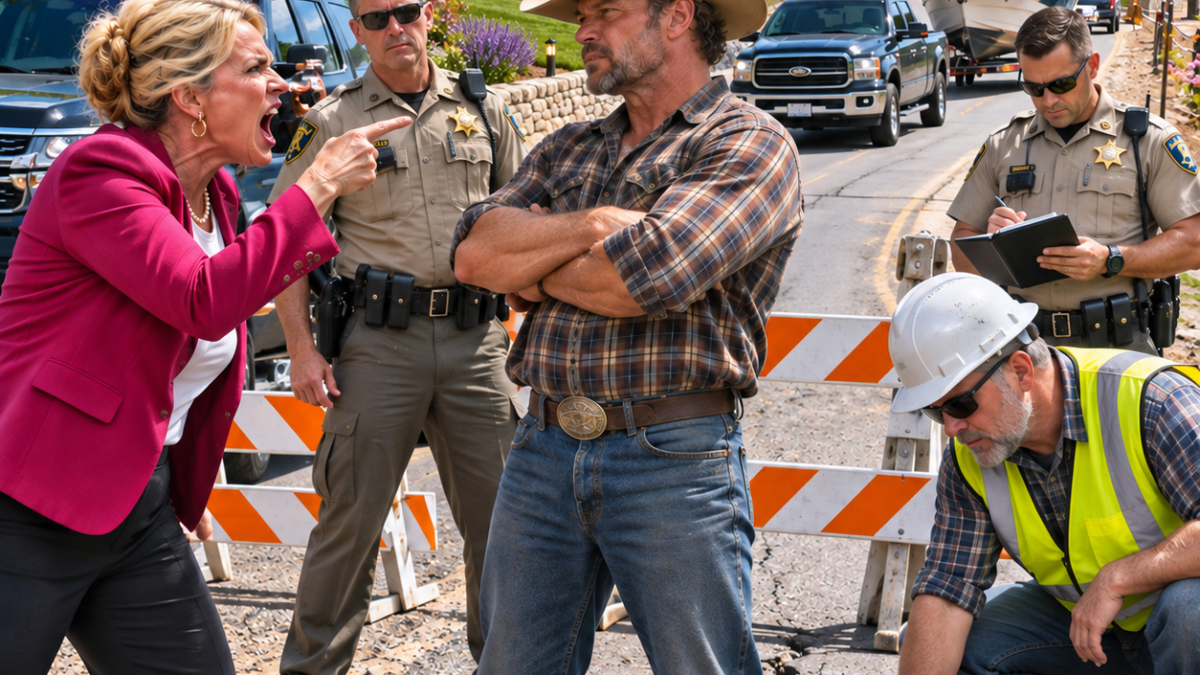
**“OFFICER, HE’S BLOCKING OUR ONLY MARINA ROAD—ARREST HIM BEFORE HE SHUTS DOWN AN EIGHT-MILLION-DOLLAR COMMUNITY FACILITY!” HOA president Deborah Whitman shouted while a forty-ton concrete truck idled behind my pickup.**
**The last six hundred feet of that beautiful new road crossed land I had bought three months earlier, and I had only stopped heavy construction traffic because an old ranch culvert under the pavement was starting to fail.**
**Then the county engineer pushed a steel probe into the road shoulder, looked at the deputies, and said, “Close both ends immediately.”**
My name is Patrick Morgan, and four months before all of this, I had never owned anything close to 7,800 acres.
I was fifty-seven years old.
I had spent most of my adult life running a small excavation and land-clearing company outside Knoxville, Tennessee.
Nothing glamorous.
Bulldozers.
Dump trucks.
Trailers.
Hydraulic hoses.
Grease.
Mud.
And enough tools that my wife, Laura, liked to say every flat surface we owned eventually became a place where I stored something oily.
Our son Tyler was thirty and worked with me.
Our daughter Grace taught fourth grade and believed every piece of rural land should eventually become an outdoor science classroom.
Then Blackwater Ridge came up for sale.
Seven thousand eight hundred acres.
Wooded hills.
Cattle pasture.
Creek valleys.
Old logging roads.
Nearly five miles of shoreline along Lake Mercer.
Two tenant houses.
Several barns.
Broken fencing.
Washed-out crossings.
An old ranch house with a roof that looked like it had spent twenty winters losing arguments with the weather.
Most buyers saw maintenance.
I saw room.
Room for cattle.
Timber management.
Habitat restoration.
A place where Tyler and I could slowly build something lasting.
I bought it through a combination of savings, selling two smaller properties, financing, and buying out my remaining business partnership.
When Laura saw the final number, she stared at the contract.
“You bought a small kingdom.”
“I bought a lot of broken fences.”
“You bought 7,800 acres.”
“With broken fences.”
“That does not make it sound cheaper.”
She had a point.
The first thing I told Tyler after closing was:
“Before we build anything, we figure out exactly what we own.”
That sentence ended up saving me more trouble than I knew.
My attorney, Rebecca Hayes, ordered a full title review.
Blackwater Ridge had been assembled from several parcels over decades.
Some old timber rights had expired.
A power easement crossed the west side.
The county maintained one road along the southern boundary.
Nothing too unusual.
Then there was Lake Haven Estates.
PART2:
Lake Haven sat northeast of Blackwater Ridge along Lake Mercer.
Wealthy gated neighborhood.
About 260 homes.
Clubhouse.
Pool.
Boat storage.
And a marina project that nearly everybody in the county had heard about.
The HOA had spent around eight million dollars on it.
Road.
Retaining walls.
Lighting.
Landscaping.
Parking.
Marina access.
Improvements around the waterfront.
People casually called it the Eight-Million-Dollar Marina Road.
I had seen it once from the highway.
Fresh asphalt.
Stone walls.
Decorative light poles.
Young trees planted perfectly along the shoulder.
I assumed all of it was inside Lake Haven.
Rebecca was the person who told me that might not be true.
She called one afternoon.
“Patrick, do you know Old Quarry Road?”
“Yes.”
It was one of the abandoned routes on Blackwater Ridge.
The timber company had used it decades earlier.
“It has an old easement attached.”
“What kind?”
“Quarry access.”
Thirty years earlier, a previous landowner allowed industrial access across roughly six hundred feet of what became Blackwater Ridge.
The road reached a stone quarry near the lake.
The quarry closed.
The easement language was narrow.
Quarry access.
Maintenance of that corridor.
Specific parcels.
Nothing clearly granting general residential use forever.
Rebecca said:
“I need to know whether Lake Haven is using it.”
Neither of us knew.
So Tyler and I drove there.
At first, I thought we had the wrong place.
Old Quarry Road was not old anymore.
It was brand-new.
Fresh asphalt.
Drainage.
Lighting.
Stone edges.
Landscaping.
Tyler looked at me.
“Dad?”
“Yeah?”
“This doesn’t look abandoned.”
“No.”
We kept driving.
The road crossed what I knew from the survey was Blackwater Ridge.
Then continued through an impressive stone entrance.
LAKE HAVEN MARINA.
Tyler looked at me again.
“Do we own this road?”
“I’m hoping Rebecca tells me no.”
Rebecca told me yes.
At least part of it.
Roughly six hundred feet of the new marina route crossed Blackwater Ridge.
The modern road had also been widened beyond the original quarry corridor in places.
Some grading outside the historical easement.
Retaining wall.
Landscaped shoulder.
All on my side.
I called Lake Haven’s property manager.
Scott Daniels.
He sounded surprised.
“You’re the new Blackwater Ridge owner?”
“Yes.”
“I’ve been meaning to contact you.”
“Good time.”
I explained the problem.
Scott went quiet.
“I thought the access was permanent.”
“So did I until yesterday.”
He checked Lake Haven’s files.
Engineering plans.
Construction contracts.
County permits.
HOA board approvals.
Title documents.
Plenty of paper.
What they did not have was a clean modern access agreement.
The original developer had treated the old quarry easement as though it also served the later subdivision and marina.
Then the HOA widened and upgraded the route during the eight-million-dollar project.
Scott said:
“I need our attorney to review this.”
That was a normal answer.
I told him I was not shutting anything down.
Not then.
If Lake Haven had valid rights, fine.
If the old easement needed to be modernized, we could discuss it.
Simple.
Then Deborah Whitman called.
She was the HOA president.
She skipped introductions.
“Mr. Morgan, our marina access has been established for decades.”
“The quarry road existed for decades.”
“It became the marina road.”
“That doesn’t automatically expand the easement.”
“Our attorneys approved construction.”
“Then send the paperwork to Rebecca.”
She sighed.
“I don’t think you understand how established access works.”
I did not like that sentence.
“I think lawyers should handle that part.”
“We cannot have a new landowner suddenly interfering with an eight-million-dollar community investment.”
“I’m not interfering with anything.”
“Then we agree there’s no issue.”
“That’s not what I said.”
For three weeks, I did nothing.
Cars crossed.
Boat trailers crossed.
Maintenance vehicles crossed.
Nobody was stopped.
Rebecca and Lake Haven’s attorney traded documents.
The issue looked complicated but manageable.
Some historical access existed.
The exact modern scope did not.
The road had grown wider.
Traffic had changed dramatically.
Quarry trucks serving a quarry decades earlier were not the same thing as hundreds of SUVs and boat trailers serving a residential marina.
The logical fix:
New easement.
Clear boundaries.
Maintenance responsibility.
Insurance.
Drainage.
Heavy vehicle limits.
Compensation for expanded use.
Done.
Then Tyler and I started inspecting the rest of Blackwater Ridge.
That was when the road stopped being just a legal problem.
We found a concrete drainage outlet from the marina road dumping concentrated stormwater into one of my creeks.
The bank was badly eroded.
Soil washed away.
Roots exposed.
I called Scott.
He sent an HOA engineer.
To his credit, the engineer admitted immediately that the drainage needed work.
Then he noticed something else.
An old culvert under the road.
Forty years old, maybe older.
The new marina road had been built directly over it.
The engineer asked for project drawings.
Then found out the culvert had never been replaced.
Contractor had apparently inspected it visually and decided it could remain.
That might have been reasonable under light traffic.
But the new road carried:
SUVs.
Boat trailers.
Fuel trucks.
Delivery vehicles.
Construction equipment.
Concrete mixers.
Some days hundreds of crossings.
Rebecca requested structural records.
Deborah called me almost immediately.
“You’re trying to stop our marina.”
“No.”
“You suddenly have questions about a road that’s been finished for almost a year.”
“Because I bought the land beneath part of it.”
“It was inspected.”
“Then send the inspection.”
“Our engineer is reviewing it.”
“Sounds like we agree.”
She hung up.
Two days later, Tyler found a sign beside the road.
PRIVATE HOA ROAD.
NO RANCH ACCESS.
On my property.
I laughed.
Tyler did not.
“They put a sign on our land saying we can’t use it?”
“Looks like it.”
Scott had it removed that afternoon.
He apologized.
Deborah had ordered it because ranch vehicles had used the shoulder while we inspected drainage.
That was when I understood her mindset.
She did not think of Blackwater Ridge as neighboring property.
She thought of it as empty land surrounding Lake Haven.
Useful when the HOA needed it.
Irrelevant when I did.
I still did not close the road.
Instead, I proposed a temporary ninety-day agreement.
Lake Haven keeps access.
Normal resident traffic allowed.
Emergency vehicles always allowed.
No heavy construction traffic over twenty tons until the culvert was structurally evaluated.
HOA repairs drainage erosion.
No additional construction outside current pavement.
Scott liked it.
Lake Haven’s lawyer liked it.
Three board members liked it.
Deborah refused.
Signing a temporary agreement, she said, would imply the HOA did not already have permanent rights.
So we remained in limbo.
Then the concrete trucks came.
Lake Haven was building a large event pavilion near the marina.
I knew nothing about it until a concrete mixer passed me while I checked fence posts.
Then another.
Then another.
Each truck weighed far above the temporary limit I had proposed.
I called Scott.
“I thought they were using the west entrance.”
“They’re not.”
“I’ll call the contractor.”
Traffic stopped.
Two hours later, it started again.
Then Deborah arrived.
“You cannot interfere with our contractor.”
“I can ask a forty-ton truck not to cross an untested culvert on my land.”
“Our engineer approved the road.”
“Your engineer is currently reviewing that culvert.”
“You’re creating problems because you want money.”
“What money have I asked for?”
She had no answer.
I had not even proposed a permanent easement price.
I placed my truck partly beside the entrance.
Not across the whole road.
Passenger vehicles could still pass.
Tyler put up a temporary sign.
HEAVY VEHICLES STOP.
STRUCTURAL REVIEW IN PROGRESS.
Residents could still reach the marina.
Then Deborah called 911.
She told dispatch a hostile ranch owner was blocking the neighborhood’s only marina access.
Threatening vehicles.
Holding the community hostage.
I threatened nobody.
But apparently:
“Landowner asks concrete truck to stop”
did not sound dramatic enough.
Deputy William Price arrived first.
Samuel Grant came behind him.
Deborah met them before I did.
“That man is obstructing our private road.”
William pointed toward my truck.
“Is that yours?”
“Yes.”
“Why is it there?”
“To stop heavy construction traffic until the culvert is inspected. Cars are still passing.”
Deborah said I had no authority over the road.
I handed William the survey.
Deed.
Rebecca’s temporary agreement proposal.
He studied them.
Then looked at Deborah.
“Part of this appears to cross his property.”
“Our easement is permanent.”
“Maybe. I’m not deciding an easement dispute beside the road.”
Fair.
Sheriff’s deputies are not title judges.
Then Samuel looked at the pavement.
“Is that crack new?”
I turned.
Thin diagonal crack.
Across one lane.
Right above the old culvert.
I had not noticed it before.
Neither had Tyler.
A loaded concrete truck waited fifty yards away.
Deborah shrugged.
“Roads crack.”
William crouched.
Asked who was inspecting it.
Scott arrived.
Called the county road department.
Thirty minutes later, county engineer Brian Foster pulled up.
He measured the crack.
Walked down the embankment.
Looked through the culvert.
Returned.
“When was this fill installed?”
Scott checked plans.
“During the marina project.”
“How much?”
“About eight feet here.”
Brian looked toward the pipe.
“You placed eight feet of fill above an old drainage crossing?”
“Project engineer approved it.”
“I need the calculation.”
Deborah crossed her arms.
“Hundreds of residents use this road.”
Brian nodded.
“That’s exactly why I care.”
He pushed a metal probe into the shoulder.
It sank too far.
Moved ten feet.
Again.
Soft ground.
Water had been migrating through the fill.
Probably connected to drainage problems we already found.
Brian walked to William.
“Nobody drives across this.”
Deborah stopped talking.
“What?”
“Close it.”
“You cannot close our marina road.”
“I’m recommending immediate closure.”
William did not hesitate.
Patrol SUV across one end.
Samuel blocked the other.
Barricades.
Concrete truck backed away.
Boat trailers stopped.
Residents got out of cars.
Deborah looked at me.
“This is your fault.”
I did not even answer.
Brian went back down the slope.
Tyler followed.
Then Tyler yelled:
“Dad!”
I went down.
Brush covered the lower end of the culvert.
Water seeped beside it.
Brian pushed branches away.
The pipe had separated at a joint.
Gap almost four inches.
Soil had been washing into the pipe.
Brian shined a light inside.
Then stepped back.
“There’s a void.”
“How big?”
“Can’t tell.”
He looked up toward the eight-million-dollar road.
“Pavement may be bridging empty space.”
A heavy crack sounded above us.
People shouted.
The shoulder dropped several inches.
Asphalt split wider.
Decorative curb tipped.
William ordered everyone farther back.
That was when Scott ran toward us holding the marina plans.
“Patrick!”
“What?”
His face had gone pale.
“The road isn’t the only thing on your property.”
He spread the site plan across William’s patrol SUV.
The boundary line cut across land I had assumed belonged entirely to Lake Haven.
Past the marina entrance.
Through the landscaped section.
Then directly across a large paved area.
“What’s that?”
Scott swallowed.
“Overflow trailer parking.”
“How much?”
“Most of it.”
Deborah stepped closer.
“That cannot be right.”
Scott moved his finger farther.
The property line continued toward the newest construction area.
The two-million-dollar event pavilion.
One corner of the pavilion foundation also sat on Blackwater Ridge.
Concrete work stopped that afternoon.
Nobody poured another yard.
Rebecca arrived with recorded deed and boundary description.
The line was not ambiguous.
The road stayed closed.
Contractors left equipment exactly where it sat.
Boat owners already inside could leave using a smaller service route on Lake Haven land.
Nobody was trapped.
Nobody was endangered.
The marina simply became inconvenient.
Deborah still blamed me.
“You knew about this boundary.”
“No.”
“You bought the property.”
“I started reviewing it after I bought it.”
Rebecca answered:
“The recorded boundary does not move based on who noticed it first.”
That sentence became important.
Nobody moved a fence.
Nobody stole anything.
Lake Haven built using an inaccurate planning boundary.
The mistake existed long before I arrived.
Lake Haven hired an independent surveyor.
Good.
I wanted verification.
They checked monuments.
Old plats.
Recorded deeds.
Control points.
Result:
Our survey was correct.
About 2.7 acres of the marina complex sat on Blackwater Ridge.
Overflow trailer lot.
Landscaped entrance.
Drainage structure.
Retaining wall section.
Corner of pavilion site.
Plus the six-hundred-foot road segment.
Scott stared at the map.
“How did nobody catch this?”
Rebecca explained that project planners apparently used an old developer concept map rather than the recorded property boundary.
Concept maps are not deeds.
Still, I did not want to tear down everything.
That would be wasteful.
Parking lot existed.
Retaining wall existed.
Road existed.
Pavilion was early enough to redesign.
I suggested separating the problems.
First:
Fix unsafe road.
Second:
Negotiate a permanent legal easement after repair.
Third:
Resolve 2.7-acre encroachment by lease, sale, boundary adjustment, or removal.
Fourth:
Move pavilion entirely onto Lake Haven property.
Scott liked the approach.
Three board members liked it.
Deborah called it extortion.
I had not asked for a dollar.
Rebecca reminded her.
Deborah said:
“You know the property is valuable now.”
“Yes.”
“That’s why your HOA built an eight-million-dollar marina next to it.”
The engineer’s full report arrived.
Old culvert could not be patched.
Separated joint had been washing fill for a long time.
Large underground void.
Road weight made it worse.
Repair required:
Removing major pavement section.
Excavating failed fill.
Replacing old culvert with larger reinforced structure.
Rebuilding road base.
Redesigning drainage.
Estimated cost:
$740,000.
Scott nearly choked.
Brian said:
“You’re not repairing asphalt. You’re rebuilding what’s under it.”
Then drainage redesign added more.
Insurers got involved.
Road contractor.
Project engineer.
HOA insurer.
Everyone started passing documents.
Normal large-project behavior.
Meanwhile residents were furious.
Marina access got difficult.
Alternate service route was narrow.
Heavy boat launching suspended.
One resident drove to Blackwater Ridge.
Accused me of closing the road to force a land sale.
I handed him Brian’s engineering report.
He read the section about the void.
“So deputies closed it because it might collapse?”
“Yes.”
“Not because of the property argument?”
“The property argument brought us there. The engineer closed it.”
His face changed.
“I was told you blocked the road.”
“I stopped heavy construction traffic. Cars were passing until Brian closed everything.”
Someone had been telling residents a cleaner story.
Deborah’s email said:
MARINA ROAD CLOSED DURING LAND OWNERSHIP CHALLENGE INITIATED BY NEW RANCH OWNER.
Technically clever.
Practically misleading.
Scott issued a correction.
ROAD CLOSED AFTER STRUCTURAL FAILURE DISCOVERED.
That made residents more angry at Deborah than at me.
Emergency HOA meeting.
Clubhouse full.
Scott presented boundary issue.
Brian presented road failure.
Project engineer admitted the original design relied on a report treating the old culvert as serviceable.
A resident asked:
“Why?”
Engineer:
“Because the project scope assumed it had been maintained.”
“By who?”
That question became a problem.
Former quarry company used to maintain it.
Quarry closed.
Lake Haven maintained road surface later.
Timber company handled nearby drainage but never claimed responsibility for the culvert.
Everyone used it.
Nobody clearly inspected it.
Classic old-infrastructure problem.
Then Susan Walker stood.
Fourteen-year resident.
“Why did we spend eight million dollars without knowing who owned the ground?”
Silence.
That question hurt more than the repair bill.
Scott said the board relied on professional reports.
Susan looked at Deborah.
“Did the board see the original deed?”
Deborah said legal handled title.
Lake Haven’s current attorney Jonathan Wells cleared his throat.
“My firm did not handle the original marina title review.”
That got attention.
The older closing file was found a week later.
And it made things worse.
The old title company had identified the quarry easement correctly.
Its report specifically warned that the right appeared narrow and recommended an updated easement before major road expansion.
Scott stared.
“Who saw this?”
Former management company.
Marina project committee.
Deborah.
Deborah said she remembered title concerns but believed they were later resolved.
“With what document?” Rebecca asked.
“I’d have to locate it.”
Nobody could.
Board minutes had one line:
ACCESS COUNSEL CONFIRMS PROJECT MAY PROCEED.
No attached legal opinion.
No new easement.
No agreement with previous Blackwater Ridge owner.
Maybe informal advice existed.
Maybe documents got lost.
We did not invent facts.
But one thing was clear.
The risk was known.
Someone pushed forward anyway.
The board finally authorized negotiations with me.
I surprised them.
No million-dollar demand.
No threat to destroy the marina.
Proposal:
Permanent easement across the rebuilt six-hundred-foot road section.
Long-term ground lease for 2.7-acre overflow lot.
Pavilion moved fully onto Lake Haven property.
HOA responsible for road maintenance and drainage.
Blackwater Ridge keeps ranch and wildfire emergency access.
Heavy construction loads require engineering review.
Lease based on independent appraisal.
Scott stared.
“You’re not making us remove the parking lot?”
“No.”
“You’re not forcing us to buy the land?”
“No.”
“Why?”
“I don’t need a parking lot.”
He laughed.
Then:
“That’s fair.”
Deborah disagreed.
Signing a new easement, she said, would prove Lake Haven never had the rights it claimed.
Rebecca answered:
“That may be because Lake Haven never had the rights it claimed.”
Board voted five to one to continue negotiations.
Deborah voted no.
Road repair began.
Because work crossed Blackwater Ridge, I signed a temporary construction license.
Repair work only.
No permanent new rights.
Restore disturbed land.
Protect creek.
That simple piece of paper prevented half the fights we had already had.
Crews removed the failed road section.
Void under it was nearly twenty feet long.
Old culvert partly crushed.
Tyler stared down.
“We drove over that?”
“Yes.”
“Concrete trucks drove over that?”
“Yes.”
“I hate that.”
“So does Brian.”
Repair cost climbed toward $900,000.
Then workers found another pipe under the fill.
Smaller.
Old.
Not on modern plans.
At first Brian thought it was abandoned.
Then water moved through it.
Clear water.
Not storm runoff.
“Where does that come from?”
Lake Haven maintenance did not know.
Old faded utility drawing labeled it:
MARINA SERVICE LINE — FUTURE.
Future what?
Nobody knew.
On Lake Haven’s side, it ran toward marina maintenance.
On my side, downhill through Blackwater Ridge.
The next morning, one ranch hand called Tyler.
Water pooling in lower meadow.
Coming from ground.
Brian traced it to the exposed pipe.
Excavation had shifted the soil and caused a leak.
Lake Haven maintenance closed a valve.
Flow stopped.
Then marina manager called Scott.
“We lost pressure at the fuel dock wash system.”
Then:
“Fish-cleaning building too.”
So the pipe served marina utility water.
Fine.
But why did it cross my land?
Brian traced another branch farther south.
Toward an old ranch pond.
William Price drove up.
“What did you people find now?”
“Apparently the marina has another utility line under my ranch.”
William rubbed his forehead.
“I miss when this was just a road.”
“So do I.”
County records showed the pipe had been permitted as a temporary construction water line.
It should have been removed after marina construction.
Instead, it remained active.
Then the as-built drawing showed a branch to:
MARINA IRRIGATION RESERVE POND.
I looked at Scott.
“There is no marina pond.”
He looked at the map.
Then at me.
“The reserve pond is on Blackwater Ridge.”
Old ranch pond.
I had assumed rain and spring fed it.
At the far edge, Tyler found a floating intake.
Not ours.
Black hose running underground toward Lake Haven.
HOA maintenance supervisor Robert Hale arrived.
“That feeds marina landscaping during dry months.”
I stared at him.
“You pump water into my pond, then pump it back out?”
“Sometimes.”
“Why?”
“Cheaper than another storage tank.”
Of course.
Temporary shortcut becomes permanent because nobody asks.
Rebecca asked for permission records.
None found.
Deborah called it shared water infrastructure.
Again.
“Show me the agreement.”
Nothing.
Then Brian noticed the pond embankment.
Wet line near the base.
Seepage.
Then another.
Then another.
The pond had been held far above its natural level because Lake Haven used it as storage.
Robert checked maintenance logs.
During summer:
Filled most nights.
Thousands of gallons.
Brian asked:
“How high above natural level?”
Robert hesitated.
“About three feet.”
The old ranch pond sat above a lower pasture.
Equipment road.
Creek.
County highway farther down.
Brian called geotechnical engineer Allison Grant.
“No more filling until she gets here.”
“Should we drain?”
“Not fast. Dropping water too quickly can destabilize an old embankment too.”
Allison arrived near sunset.
Walked the dam.
Measured seepage.
Reviewed old ranch maps.
“How long has Lake Haven maintained this elevated level?”
“About four years.”
“Was this pond ever engineered as a storage reservoir?”
“No.”
“Then we need to lower it carefully.”
She reached the center.
Stopped.
Narrow crack across the earthen dam.
Half-inch.
Fresh.
She crouched.
Called Brian.
Then stood.
“This embankment is moving.”
“How bad?”
“Enough that nobody should stay below it tonight.”
Tyler looked at Lake Haven’s map.
Drainage channel below the pond turned east.
Straight toward the closed marina road excavation.
If the dam failed, water could hit workers.
Brian grabbed his radio.
“Clear the excavation.”
Then we heard a low tearing sound.
Wet soil moving.
The crack widened.
Water began bubbling through the downhill face.
Allison shouted:
“Everybody back!”
We ran uphill.
Part of the embankment slumped almost two feet.
Water broke through.
Not the entire pond.
Enough.
Fast brown stream down the drainage channel.
Straight toward the eight-million-dollar road.
No full catastrophic wall.
Thank God.
Road workers had time to move equipment.
One excavator was pulled back by a dozer before the ground softened.
Nobody hurt.
That mattered more than everything else.
Brian shut down all contractor access again.
William and Samuel blocked the work zone.
Allison monitored from high ground.
Pumps and controlled spill paths lowered the pond gradually.
Messy.
Expensive.
Manageable.
Tyler looked at me.
“So the HOA built a road on our land, used our pond as a storage tank, filled it higher than it was designed for, and the pond almost washed out the road they built on our land.”
“That’s one summary.”
“There should be a shorter word.”
Laura arrived with coffee.
“I vote for ridiculous.”
Good enough.
Pond needed full rebuild.
Deborah immediately said:
“Blackwater Ridge owns the pond.”
Rebecca looked at her.
“Lake Haven used it as a marina reservoir for four years.”
“That doesn’t change ownership.”
“No. It changes responsibility.”
Deborah stopped talking.
Engineers reviewed old aerial photos.
Natural level had historically been lower.
Marina project had installed hidden water line and raised the outlet level so the pond held more.
Nobody upgraded the embankment accordingly.
Age contributed.
Roots contributed.
Old construction contributed.
But artificially raising water pressure for years mattered.
Scott started digging through marina files again.
By then, he looked exhausted instead of shocked.
“Patrick, I think this entire project was built on temporary solutions.”
“Temporary road access,” he said.
I nodded.
“Temporary water line.”
“Temporary pond storage.”
Tyler added:
“Permanent eight-million-dollar bill.”
We laughed because we needed to.
Then Scott and I started holding thirty-minute morning meetings.
No board speeches.
No blame.
No lawyers unless necessary.
What is broken?
What is safe?
What requires permission?
Who fixes it?
Those meetings accomplished more than weeks of arguing.
Road contractor built drainage bypass.
Allison created pond-lowering plan.
Lake Haven stopped using pond.
Marina landscaping switched temporarily to municipal water.
Flowers looked slightly worse.
Civilization survived.
Residents finally saw full engineering reports.
Pictures of the road void.
Crushed culvert.
Flooded excavation.
Cracked pond.
Public anger shifted.
From:
“Why is the ranch owner blocking us?”
To:
“How did we spend eight million without checking any of this?”
Much better question.
Special board meeting.
Scott presented a timeline.
Old quarry easement.
Title warning.
Road expansion.
Old culvert.
Wrong boundary.
Overflow lot.
Pavilion.
Hidden service line.
Ranch pond storage.
One resident, Henry Collins, stood.
“I have an expensive boat slip down there. I want this marina open.”
Several people nodded.
Then he continued:
“But I also don’t want to drive my truck across empty ground because somebody was too proud to ask a ranch owner for an easement.”
Applause.
Deborah looked furious.
Susan Walker stood.
“Has Patrick demanded we remove the marina?”
“No,” Scott said.
“The parking lot?”
“No.”
“The road?”
“No.”
“Then what are we fighting?”
Silence.
That question ended Deborah’s control of the discussion.
I wanted:
Safe road.
Clear easement.
Proper drainage.
Fair land lease.
Nothing more.
The board removed Deborah from the marina project committee.
Four to two.
She stayed president for the moment.
But could no longer direct construction, negotiate access, or approve marina spending.
Scott became lead representative.
Ten days later:
Draft permanent road easement.
Legal.
Clear.
Recorded.
Lake Haven gets access.
Blackwater Ridge keeps ownership.
HOA maintains the road.
Drainage changes require written approval.
Heavy loads require engineering review.
Blackwater Ridge keeps emergency and ranch access.
If road becomes unsafe, either party can request inspection.
Simple.
Overflow lot:
Independent appraisal.
Twenty-year ground lease.
Renewal options.
Lake Haven maintains it.
I own the land.
Fair rent.
Not cheap.
Not punishment.
Pavilion:
Redesigned entirely inside Lake Haven.
Some early foundation work removed.
Building slightly smaller.
Nobody died from that either.
Then Rebecca found something in the quarry easement that actually helped Lake Haven.
It contained limited emergency access rights for fire, medical, and lake rescue.
That proved something important.
I was never trapping the neighborhood.
Emergency cooperation had always existed.
We preserved and clarified it.
By late summer, the ranch pond was near natural level.
Allison designed a reinforced embankment and proper spillway.
Then I surprised Scott.
I told him Blackwater Ridge would rebuild the pond mainly for ranch use.
No more daily marina irrigation.
No hidden storage.
But if firefighters needed the pond during wildfire emergencies, they could use it.
Scott stared.
“After all this, you’re letting us use it for fires?”
“I don’t want your houses burning just because your old board annoyed me.”
He nodded.
“That’s fair.”
That became the lesson of my first year at Blackwater Ridge.
Kindness is easier when limits are clear.
Sharing water does not create ownership.
Using a road does not erase the deed.
Parking on someone’s land does not magically change the boundary.
The road reconstruction resumed.
Old culvert removed.
New reinforced concrete crossing installed.
Fill rebuilt properly.
Drainage redesigned.
Engineers tested every layer.
Brian inspected everything twice.
Tyler joked:
“He probably inspects his coffee.”
Brian heard him.
“I do.”
Six weeks later, marina road reopened.
Passenger vehicles.
Normal boat trailers.
The first vehicle belonged to an eighty-two-year-old Lake Haven resident named George Miller.
Same fishing boat for twenty-five years.
Scott invited him because apparently George complained more politely than everyone else.
George stopped beside me.
“You the ranch owner?”
“Yes.”
“They said you’re why we got a new culvert.”
“That’s one way to tell it.”
He smiled.
“I’ll take it.”
Then drove to the marina.
No ribbon-cutting.
No cheering.
Just a safe road.
That felt better.
The final cost was ugly.
Road reconstruction and drainage:
More than one million dollars.
Pond stabilization and rebuild:
Around $430,000 split based on future use and responsibility.
Pavilion redesign:
More money.
Legal fees:
More money.
Insurers fought over shares.
Contractor insurer contributed.
HOA insurer contributed.
Lake Haven paid a significant amount.
Blackwater Ridge paid for the portion of pond improvement that benefited our ranch long-term.
Nobody escaped every responsibility.
That seemed fair.
Then Deborah came to Blackwater Ridge alone.
No attorney.
No board.
She stopped outside the ranch office.
Waited.
That was new.
Before, she acted like the land around Lake Haven belonged to the HOA by default.
This time:
“Can we talk?”
“Yes.”
We sat on the porch.
She looked exhausted.
“I think you turned half the neighborhood against me.”
“I think the project records did most of that.”
She almost smiled.
“I thought the access rights were settled.”
“I believe you.”
That surprised her.
I did not think Deborah began the marina project intending to steal my land.
I thought she inherited assumptions.
Saw old use.
Decided it was enough.
Then approved larger and larger construction without stopping to verify.
Once questions appeared, she became defensive.
Defensive became pressure.
Pressure became denial.
No secret crime necessary.
She looked toward the hills.
“We needed the marina.”
“I’m not against the marina.”
“I know that now.”
“Would’ve been useful three months ago.”
She nodded.
Then she admitted something.
“I thought if we admitted the easement was weak, you’d demand millions.”
“I didn’t.”
“No.”
“If you had contacted Blackwater Ridge before paving the road, we probably would have signed something.”
She looked down.
“That’s what Scott keeps saying.”
Sometimes the most expensive conflict begins because someone assumes the other side will be unreasonable.
Then acts unreasonably first.
Deborah’s term ended in two months.
She was unsure whether to run again.
I told her that was none of my business.
She laughed.
“First thing we agree on.”
I thought that would be the end.
Then Tyler called from the north ridge.
“Dad, you need to get up here.”
“What happened?”
“I found another road.”
I closed my eyes.
“Please tell me it’s ours.”
“I don’t know.”
Blackwater Ridge had dozens of logging roads.
But Tyler was standing beside a wide gravel route with fresh tire tracks.
Heavy steel gate.
Sign:
LAKE HAVEN MARINA SERVICE ACCESS — AUTHORIZED VEHICLES ONLY.
Entire visible road was inside Blackwater Ridge.
Not six hundred feet.
Nearly two miles.
I called Scott.
He had never heard of it.
Then engines sounded.
Three fuel-service trucks came around the bend.
The first driver stopped.
“Road closed?”
“No.”
“Then why are you standing here?”
“Because I own it.”
He laughed.
Then realized I was serious.
“We use this every week.”
“For what?”
“Marina fuel deliveries.”
Scott arrived.
Looked stunned.
Driver showed his route sheet.
LAKE HAVEN MARINA SERVICE ROUTE B.
Approved four years earlier.
Signature:
Deborah Whitman.
Of course.
But the real problem was farther down.
The gravel route crossed my creek twice.
At the second crossing:
Old timber bridge.
Rotten.
Fuel driver backed away immediately.
He had assumed Lake Haven maintained it.
Scott had assumed the same.
Nobody in current management even knew the road existed.
Brian arrived.
Climbed under bridge.
Returned.
“Close it.”
Again.
William Price arrived.
Looked at me.
“You have got to be kidding.”
“I didn’t build this one either.”
He rubbed his forehead.
Deputies blocked route.
Fuel trucks turned around.
Then Brian noticed stained soil beneath the bridge.
Dark soil.
Faint chemical smell.
“Has a truck leaked here?”
Nobody knew.
Scott called marina fuel contractor.
Incident record:
Eighteen months earlier.
Fuel truck damaged a valve on Route B.
Approximately 180 gallons of diesel spilled.
Cleanup completed.
Location:
PRIVATE SERVICE ROAD BRIDGE.
Rebecca asked:
“Where was the report sent?”
“To the HOA.”
“County notified?”
Scott did not know.
Tyler walked downstream.
Then shouted:
“Dad!”
Rainbow film in one quiet pocket of creek water.
Not proof of catastrophe.
Enough to worry me.
That creek ran through Blackwater Ridge for miles.
Cattle used it.
Wildlife used it.
Eventually it reached Lake Mercer.
Then Tyler found a rusted metal pipe coming from the hillside.
Brian followed it visually.
Toward Lake Haven’s marina service area.
Scott looked sick.
“That better not be what I think.”
A dark drop formed at the pipe.
Then another.
Diesel smell.
County environmental office arrived.
Inspector Karen Mitchell.
Samples.
Absorbent pads.
Technicians.
First thing she did:
Correct the spill location.
She checked the survey.
“This entire area is Blackwater Ridge.”
Scott nodded.
The old report saying the spill happened entirely on Lake Haven property was wrong.
That did not automatically mean anyone lied.
Maybe the map was wrong.
Again.
Karen refused to guess.
Samples from pipe.
Soil.
Creek.
Groundwater.
Then the pipe was traced.
Good news:
Not a fuel line.
Bad news:
Stormwater drain from marina service area.
When Lake Haven expanded fuel handling, part of that paved surface drained toward the same outlet.
Normal rain could carry runoff toward my creek.
Small spills might be captured.
Large spill?
Different problem.
The old 180-gallon spill report said most fuel had been absorbed and contaminated gravel removed.
Then one phrase:
MINOR MIGRATION TOWARD ROADSIDE DRAINAGE.
That phrase mattered now.
Cleanup crews believed drainage remained inside Lake Haven because the map they were given showed the wrong boundary.
So nobody inspected farther downstream on Blackwater Ridge.
Not malicious.
Still damaging.
Lab results:
Diesel-range petroleum compounds in soil near bridge and outlet.
Contamination in creek close to outlet.
Levels dropped sharply downstream.
Best bad news possible.
Not six miles of poisoned creek.
Main impact several hundred feet.
Cattle moved.
Temporary fencing.
Alternative water troughs.
Cleanup plan:
Remove contaminated soil.
Absorbent barriers.
Sediment testing.
Water monitoring.
Disconnect marina fuel yard from that drain.
Build proper containment.
Estimated cleanup:
$380,000.
Fuel contractor insurer took part.
Lake Haven insurer took part.
Blackwater Ridge insurer monitored.
For once, I was not writing the biggest check.
Then Lake Haven’s board found old spill emails.
Deborah knew about the 180-gallon incident.
That was not surprising.
She was president.
The important message was from the cleanup contractor.
PLEASE CONFIRM PROPERTY BOUNDARY AND DOWNHILL DRAINAGE OWNERSHIP BEFORE FINAL CLOSURE.
Deborah forwarded it to the former property manager.
His answer:
PLANNING MAP SHOWS HOA CONTROL THROUGH SERVICE ROAD.
PROCEED.
No survey.
No deed.
No call to the timber company that owned Blackwater Ridge then.
Same pattern.
Question raised.
Convenient assumption used.
Project moves on.
Rebecca said:
“This is becoming almost boring.”
“Polluted creek feels less boring.”
“I mean the mistake.”
She was right.
No secret mastermind.
Just the same shortcut repeated until every shortcut became expensive.
Lake Haven held its biggest meeting yet.
Scott presented everything.
Road easement.
Wrong boundary.
Overflow lot.
Pavilion.
Failed culvert.
Hidden service road.
Pond storage.
Fuel spill.
Drainage.
It sounded ridiculous spoken in one list.
Then Scott explained the common thread.
Planning maps and historical use were repeatedly treated as substitutes for actual legal ownership and engineering verification.
Deborah had not designed the culvert.
Had not built the old ranch pond.
Had not personally spilled diesel.
But as president, she pushed projects forward whenever questions threatened schedule.
That mattered.
Eighty-two-year-old George Miller stood.
“I like our marina.”
People laughed softly.
“I use it three days a week.”
More laughter.
Then:
“But I’d rather have waited one extra year than spend the next ten fixing what we rushed.”
Silence.
Susan Walker followed.
“Every mistake happened because somebody believed something.”
“We believed we owned the road.”
“We believed we controlled the pond.”
“We believed the service route was ours.”
“At what point do we start checking?”
Applause.
Deborah finally spoke.
She defended the marina’s purpose.
Better lake access.
Higher property values.
Beautiful facility.
Fair.
Then she admitted:
“I pushed people to keep moving when they raised questions because I believed delays would kill the project.”
The room went silent.
Then:
“I thought once the marina existed, remaining details could be solved.”
There it was.
Remaining details:
Who owned the road.
Who owned the parking lot.
Whether the culvert was safe.
Whether the pond dam could handle added pressure.
Where fuel runoff went.
Those were not details.
They were foundations.
The board removed Deborah as HOA president.
Five in favor.
One against.
One abstention.
No cheering.
Scott became acting president.
His first rule:
No construction project proceeds until land rights and engineering approvals are documented.
Tyler heard that.
“They invented paperwork.”
I laughed.
“Sometimes civilization is just paperwork arriving before the bulldozer.”
Cleanup began.
Contaminated soil removed.
Old timber bridge dismantled.
Storm drain rerouted to controlled system on Lake Haven property.
Fuel pavement got raised containment edges.
Capture tank.
Automatic shutoff.
New legal delivery route.
Route B disappeared permanently.
The old two-mile gravel road became ranch access again.
Exactly what it should have been.
Creek improved.
Water samples got cleaner.
Cattle eventually returned.
One monitoring area stayed fenced.
The new marina road easement was recorded.
Clear language.
Lake Haven gets access.
Blackwater Ridge owns the ground.
HOA maintains road.
Drainage changes require written approval.
Weight limits.
Emergency access.
Parking-lot lease:
Twenty years.
Fair rent.
Defined boundaries.
Pavilion finished entirely inside Lake Haven.
Nobody could tell the original corner once crossed mine.
The ranch pond was rebuilt.
Natural operating level.
Reinforced embankment.
No marina irrigation.
Wildfire emergency access remained.
Written.
Specific.
Limited.
One sign near the fire access point said:
EMERGENCY FIRE ACCESS BY AGREEMENT WITH BLACKWATER RIDGE.
Scott smiled.
“You really like writing things down now.”
“I always did.”
“No. You like it emotionally now.”
Probably true.
Financial settlement took months.
HOA insurer.
Road contractor insurer.
Fuel contractor.
Lake Haven.
Everyone paid portions tied to actual responsibility.
Blackwater Ridge received compensation for land use.
Creek restoration.
Temporary loss.
Encroachment.
No fantasy jackpot.
No absurd punitive fortune.
Just an expensive correction to things that should have been handled before construction.
The full marina crisis cost Lake Haven far more than one proper easement would have cost at the beginning.
That was the lesson residents remembered.
Not:
Patrick defeated the HOA.
But:
Asking first would have been cheaper.
Deborah came to Blackwater Ridge once more before moving the following year.
She called first.
I appreciated that.
Laura joined us on the porch.
Deborah looked toward the eastern hills.
“I hated you when that road closed.”
“I noticed.”
“I thought you bought the ranch and immediately decided you could control our marina.”
“I thought your HOA built half a marina on my land.”
She laughed.
“That too.”
Then she became serious.
“I should have stopped when the first title warning came.”
“Yes.”
“I thought stopping meant failure.”
“Sometimes stopping prevents failure.”
She nodded.
That was probably the hardest lesson for her.
Deborah was good at getting things done.
People had liked that.
But when people move fast long enough, they can start treating caution as opposition.
Sometimes the person slowing you down is protecting you.
Before leaving, she apologized for calling 911.
“I really thought you were blocking us illegally.”
“I know.”
“The deputies closed the road anyway.”
“Yes.”
“That was humiliating.”
I smiled.
“You did invite them.”
She laughed.
“I know.”
A year after the closure, Lake Haven held a marina safety day.
Scott invited me.
I nearly declined.
Laura forced me.
“You’ve complained about that marina for a year. You can at least eat their barbecue.”
Fair.
The event was crowded.
Boats.
Families.
Finished pavilion.
Overflow lot on my land under a signed lease.
Road across Blackwater Ridge under a recorded easement.
Brand-new reinforced culvert.
Brian had probably inspected it more times than medically necessary.
A sign near the entrance read:
PRIVATE MARINA ACCESS — EASEMENT ACROSS BLACKWATER RIDGE — PLEASE RESPECT POSTED LIMITS.
I liked it.
It told the entire story.
Access.
Not ownership.
Agreement.
Not assumption.
George Miller found me near the docks.
“You finally joining the HOA?”
“No.”
“Good. Meetings are terrible.”
Then handed me barbecue.
I decided I liked George.
Blackwater Ridge changed too.
We repaired fences.
Improved pasture.
Restored logging roads.
Grace started bringing small school groups to one safe section for science days.
Tyler expanded cattle operations.
Laura renovated the ranch-house kitchen.
And established one rule:
Nobody discusses easements while eating.
That rule actually survived.
Most importantly:
The ranch stopped feeling like a giant legal file.
It became home.
Sometimes I drove the eastern ridge at sunset and looked down at Lake Haven.
Marina lights reflected on Lake Mercer.
From that distance, nobody could see the fight.
Nobody could see the cracked culvert.
Wrong map.
Hidden road.
Old pond.
Fuel spill.
You just saw a beautiful marina beside a huge ranch.
That was how it should have looked from the beginning.
Neighbors do not need identical interests.
They need clear boundaries.
And enough respect to cooperate across them.
I bought 7,800 acres expecting broken fences and bad logging roads.
Instead, I discovered an HOA had paved part of an eight-million-dollar marina road across it.
Built parking on it.
Started a pavilion across the line.
Used my ranch pond as hidden water storage.
Sent fuel trucks down a two-mile road nobody in the current HOA office even knew existed.
Then when I stopped a heavy concrete truck from crossing an old culvert that looked unsafe, Deborah called 911 and asked deputies to make me move.
The deputies came.
They looked at my survey.
Looked at the road.
Looked at the crack.
Then county engineer Brian Foster pushed a steel rod into soft ground above that old culvert.
And instead of arresting me—
they closed Lake Haven’s eight-million-dollar marina road.
That closure caused months of trouble.
It also probably prevented something worse.
A concrete mixer could have dropped through the void.
A boat trailer could have collapsed the road shoulder.
The pond dam could have failed with workers still inside the excavation.
The fuel contamination could have stayed hidden another decade.
Sometimes the interruption everybody hates arrives exactly when it is needed.
I never joined Lake Haven.
Never wanted to.
But I became their neighbor.
That meant saying no when no was necessary.
It also meant saying yes when yes became safe.
Lake Haven kept the marina.
I kept Blackwater Ridge.
The road stayed.
The parking lot stayed.
The pavilion stayed.
The creek recovered.
The pond became safe.
The fuel route disappeared.
And nobody had to keep pretending that an old quarry easement gave the HOA control over anything it wanted.
The last time Deputy William Price drove through Blackwater Ridge, he stopped beside my truck.
“You finding any more HOA roads?”
“Not today.”
“Please keep it that way.”
“I’ll try.”
He pointed toward Lake Haven.
“They still call you?”
“Sometimes.”
“For problems?”
“Mostly to ask permission.”
William smiled.
“Progress.”
He was right.
Permission sounds like a small thing until people stop asking for it.
Then one missing question can become a six-hundred-foot road.
A two-mile service route.
A damaged creek.
A failing pond.
And an eight-million-dollar project built on assumptions.
I learned that on 7,800 acres.
Lake Haven learned it one cracked culvert at a time.








