I Bought 1,800 Acres Outside the HOA—Then They Sued Me and Lost the Only Road Into Their Own Neighborhood
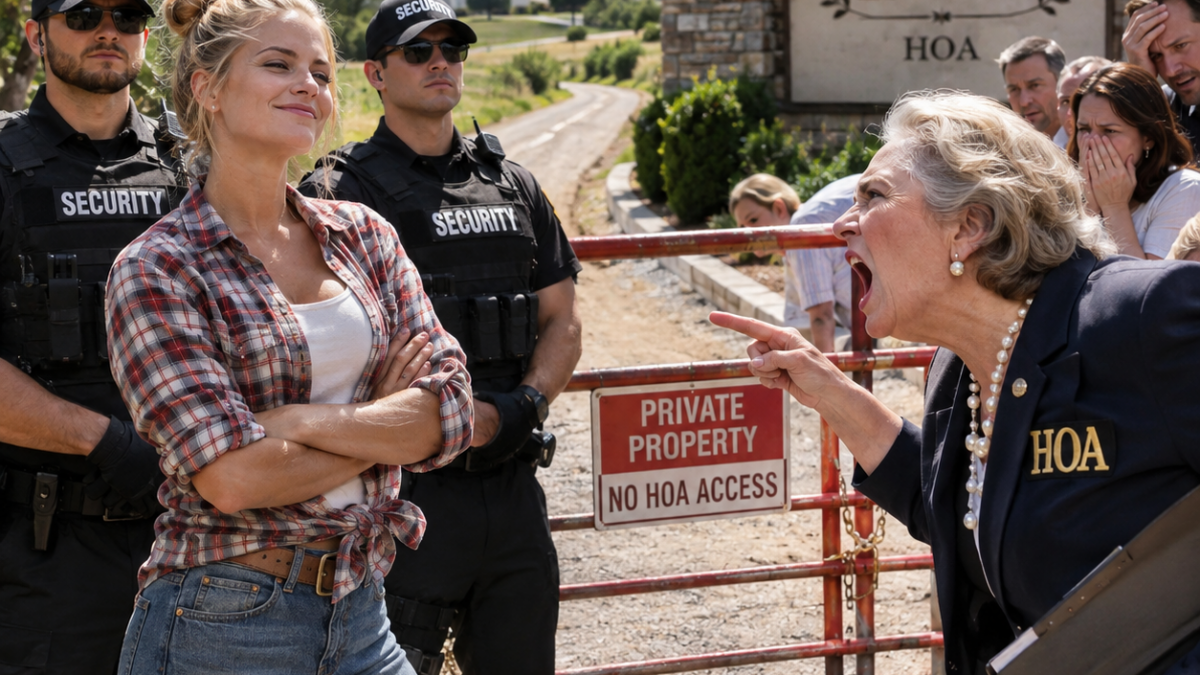
I Bought 1,800 Acres Outside the HOA—Then They Sued Me and Lost the Only Road Into Their Own Neighborhood
The morning the sheriff closed the only road into Silver Creek Estates, more than two hundred HOA residents stood behind orange barricades staring at me like I had somehow stolen the ground beneath their cars.
Less than twenty-four hours earlier, HOA president Patricia Whitmore had walked into court certain a judge would force me to surrender permanent access across the 1,800-acre ranch I had just bought—but the ruling did something she never expected: it confirmed that Silver Creek had never possessed the permanent road right she was suing to protect.
Then the county surveyor unfolded an old map across the hood of my truck, pointed beyond the neighborhood toward land deep inside my ranch, and showed us why Patricia had been so desperate to turn twenty-seven years of neighborly permission into something much bigger.
The morning everything finally broke, Patricia Whitmore was crying beside her black SUV.
I had never seen her cry before.
For three months, I had watched her argue with lawyers, surveyors, county officials, contractors, members of her own HOA board, and me.
She was not a woman who appeared uncertain easily.
But that morning, with orange barricades stretched across Canyon Road and county workers installing a temporary steel gate, she looked like someone who had finally realized that confidence did not change property records.
Behind her stood families.
A lot of families.
Silver Creek Estates had around 230 homes.
Not all of the residents were outside, but enough had gathered that the entrance looked like the scene of a disaster.
Parents needed to get to work.
Children had school.
Delivery drivers were already turning around.
An elderly man named Harold Grant had a dialysis appointment that afternoon.
A home-health nurse was waiting on the county-road side of the barricade.
None of those people had created the lawsuit.
That mattered to me.
I did not feel victorious.
I looked at Rebecca Hayes, my attorney.
“We can’t leave them like this.”
“I know.”
“They need a road.”
“I know.”
“They’re not Patricia.”
Rebecca nodded.
“We’ll deal with the residents fairly.”
Then she looked toward Patricia.
“But she just made this much more complicated than it ever needed to be.”
Patricia heard us.
She pushed forward.
“This is illegal.”
Sheriff Owen Parker turned toward her.
“No, ma’am.”
“You cannot close a community’s only entrance.”
“This is a private road crossing Mr. Brooks’s property.”
“We have twenty-seven years of access.”
“You had permission.”
“We had rights.”
“The judge ruled on that yesterday.”
Patricia’s face tightened.
“We’re appealing.”
PART2:
“That does not create an easement this morning.”
She turned toward me.
“Daniel, open the road.”
I almost laughed.
Not because anything was funny.
Because three months earlier, before any lawsuit, before fake documents, before midnight bulldozers and hidden construction, I had offered Silver Creek exactly what she was demanding now.
Permanent residential access.
Emergency access.
School buses.
Guests.
Deliveries.
Utility maintenance.
All I asked was that the HOA share reasonable road-maintenance costs, carry insurance, and agree that the road could not be widened or converted into a development corridor without my permission.
Patricia had rejected it.
Not negotiated.
Rejected.
She had told me Silver Creek would never sign a document admitting that the road crossed somebody else’s land.
Now the road was closed because the court had confirmed exactly that.
Then county surveyor Thomas Reed walked toward us carrying an old map.
“Daniel.”
I turned.
“Yeah?”
PART2:
“Before you reopen anything, you need to see this.”
Patricia stopped crying.
Thomas spread the map across the hood of my pickup.
Canyon Road appeared as a red line winding three miles through my ranch before entering Silver Creek.
Nothing surprising.
Then Thomas placed his finger farther east.
“Everybody has been assuming Silver Creek’s property starts at the entrance gate.”
Frank Wilson, the HOA treasurer, stepped closer.
“It does.”
Thomas shook his head.
“No.”
He pointed to an iron monument he had located beneath landscaping less than an hour earlier.
“The recorded subdivision boundary begins almost four hundred feet farther inside.”
Frank stared at him.
“What does that mean?”
“It means your guard booth, entrance sign, gate, and the first section of road are all on Daniel’s ranch.”
Patricia said:
“That’s impossible.”
Thomas did not argue.
He turned the map.
“There’s more.”
A second red line branched from Canyon Road before the neighborhood entrance.
An old service route.
It curved behind Silver Creek.
Then continued north across my ranch.
Toward land owned by a development company connected to Patricia’s husband.
Rebecca became very still.
“What is that?”
Thomas followed the line.
“Old county service road.”
“I’ve never seen it.”
“Most of it disappeared years ago.”
Then he pointed farther north.
A square symbol.
“What’s this?” I asked.
“Old emergency reservoir.”
“County?”
“Originally.”
“Now?”
Thomas looked at me.
“According to the county sale records, William Dawson bought it twenty years ago.”
William was the man who had sold me the ranch.
“So I own it?”
“Yes.”
Patricia took one step backward.
Rebecca noticed.
So did I.
Thomas continued.
“Somebody has recently graded the service road leading toward it.”
“How recently?”
“Very.”
Then my phone rang.
Thomas Walker.
My ranch hand.
I answered.
“Daniel, you need to get north.”
“What happened?”
“There are crews at the old reservoir.”
“What crews?”
“Concrete trucks.”
“How many?”
“Six. Maybe seven.”
My stomach dropped.
“What are they building?”
“I don’t know.”
Then Thomas said:
“But they’ve already poured a foundation the size of a football field.”
Rebecca grabbed her keys.
The road dispute suddenly looked very small.
And that was how a lawsuit over one neighborhood entrance led us to a commercial construction project sitting deep inside 1,800 acres that had belonged to me for less than three months.
My name is Daniel Brooks.
Buying the Dawson Ranch was the biggest decision I had ever made.
My family thought I was crazy.
They were not entirely wrong.
I grew up outside Grand Junction, Colorado.
My father repaired agricultural equipment for thirty-five years.
My mother worked at an elementary school.
We were not poor.
We were not wealthy.
We were a family where a broken transmission could change the month.
I learned early that money stayed longer when you respected how hard it was to earn.
After college, I started a small excavation company.
One used skid steer.
One pickup.
The truck leaked oil anywhere I parked long enough.
For the first two years, I did almost everything myself.
Driveways.
Drainage ditches.
Small retaining walls.
Snow removal.
Fence lines.
Anything that paid.
Then one machine became two.
Two became a crew.
We started building ranch roads and larger drainage projects.
By my forties, I owned a real company.
Nothing enormous.
But profitable.
I bought a couple of rental properties.
Some small acreage.
Kept saving.
Then William Dawson decided to sell.
The ranch was spectacular.
Eighteen hundred acres in western Colorado.
Open grassland.
Pine-covered ridges.
Two creeks.
Rocky canyon.
Old cattle infrastructure.
A barn that needed work.
Private roads.
Water rights.
Enough room that you could stand on the northern ridge and hear nothing except wind.
I knew the land because my company had repaired erosion there years earlier.
William was eighty-one.
His wife had died.
His daughter wanted him closer to her in Oregon.
He was ready.
When I first told my sister I was considering buying it, she said:
“All eighteen hundred?”
“Yes.”
“Why?”
“Because they won’t sell me the good parts separately.”
She called me an idiot.
Then asked when she could bring her horses.
Families are consistent.
The ranch had one complication.
Silver Creek Estates.
About 230 homes built on roughly 190 acres that had once been part of a much larger cattle property.
The subdivision sat almost inside the ranch.
My land surrounded it on three sides.
Silver Creek had large homes.
Mountain views.
A clubhouse.
Tennis courts.
Walking trails.
And a single normal entrance.
Canyon Road.
The road left the county highway, crossed roughly three miles of Dawson Ranch, then reached Silver Creek’s western gate.
During negotiations, William showed me the road.
“They use that.”
“Who?”
“Silver Creek.”
“Do they have an easement?”
He shrugged.
“They’ve used it since the neighborhood was built.”
“That isn’t what I asked.”
William smiled.
“That’s why you have a lawyer.”
Rebecca ordered the title work.
Utility easements.
Power lines.
Old cattle access.
Temporary construction permission.
No permanent Silver Creek road easement.
The title company searched again.
Nothing.
Rebecca warned me:
“Do not assume that means they have zero legal rights.”
“Why?”
“Twenty-seven years of use can raise questions. There may be old agreements. Implied rights. Prescriptive claims. Something improperly indexed.”
“Can we figure that out before closing?”
“We can try.”
William’s records told part of the story.
When Silver Creek was built, the developer had temporary construction access across Canyon Road.
That agreement expired December 31, 2001.
After construction, residents kept using the road.
The HOA contributed toward snow removal and maintenance.
But one old maintenance agreement explicitly said:
MAINTENANCE PARTICIPATION DOES NOT CREATE OWNERSHIP OR PERMANENT EASEMENT RIGHTS.
William had allowed access because he wanted to be a good neighbor.
That was how he described it.
Neighbor access.
Permission.
A practical arrangement.
I did not buy the ranch intending to block 230 families.
That would have been cruel.
It also would have been stupid.
My plan was straightforward.
Keep Canyon Road operating normally while Rebecca confirmed the legal history.
Then negotiate a recorded permanent easement so everyone knew exactly what rights existed.
That should have been easy.
Then Patricia Whitmore called.
“I understand you purchased our access road.”
Not hello.
Not welcome.
Not congratulations.
“Our access road.”
“I purchased Dawson Ranch.”
“Canyon Road crosses it.”
“Yes.”
“It has been Silver Creek’s entrance for twenty-seven years.”
“I know.”
“So nothing changes.”
“I didn’t say anything was changing.”
Pause.
“Good. I wanted to make sure we understood each other.”
That sentence bothered me.
I told her my attorney was reviewing the records.
“There is nothing to review.”
“There is always something to review when you buy eighteen hundred acres.”
“The HOA has permanent access.”
“Great. Send the easement.”
Another pause.
“We have documents.”
“Send them.”
Two days later they arrived.
Temporary 1998 construction access.
Expired.
Maintenance agreement.
Explicitly no permanent rights.
Some correspondence.
Nothing else.
Rebecca found letters from the early 2000s.
One from William to Silver Creek said:
WE WILL CONTINUE ALLOWING RESIDENT ACCESS ACROSS CANYON ROAD AS A NEIGHBOR ACCOMMODATION.
Another reminded the HOA:
SUCH USE REMAINS BY PERMISSION OF THE DAWSON FAMILY.
Silver Creek never objected.
So I sent Patricia a proposal.
Permanent residential easement.
Residents forever.
Emergency services forever.
School buses.
Mail.
Guests.
Deliveries.
Utility maintenance.
HOA shares road upkeep.
Insurance.
No widening.
No outside commercial or subdivision traffic.
No future development use without separate written permission.
Patricia rejected it.
Her email:
SILVER CREEK WILL NOT PAY RENT FOR A ROAD THAT ALREADY BELONGS TO THE COMMUNITY.
I read it twice.
Then called Rebecca.
“Did I accidentally buy a community road?”
“No.”
“Good.”
We tried a meeting.
Frank Wilson came.
Jennifer Collins, another board member.
Patricia.
HOA attorney Charles Benton.
Rebecca and me.
At first, reasonable.
Frank admitted no one had found a recorded permanent easement.
Jennifer said residents simply believed the road had always been theirs.
Charles said long-term use might create legal arguments.
Rebecca agreed that legal questions could exist.
No one needed to yell.
Then Patricia placed a folder on the table.
“This should end the discussion.”
PERMANENT COMMUNITY ACCESS AGREEMENT.
Dated May 2002.
Supposedly signed by William Dawson.
It granted Silver Creek unlimited rights across Canyon Road.
Not just driving.
Widening.
Utilities.
Drainage.
Gate construction.
And:
FUTURE COMMUNITY TRANSPORTATION NEEDS.
Rebecca read that phrase twice.
“Where was this recorded?”
“It wasn’t.”
“Why?”
“The developer kept it privately.”
Charles Benton shifted in his chair.
“When did you receive this?”
Patricia said:
“Recently.”
Rebecca looked at Charles.
“You saw this before today?”
“No.”
That mattered.
Patricia had apparently found the perfect document after everyone had spent weeks failing to find one.
We took a copy.
Then I drove to see William.
He was still in Colorado finishing his move.
I handed him the document.
He read the first page.
Second.
Then said:
“I never signed this.”
“You’re certain?”
“I spent twenty years refusing to give them exactly this.”
I pointed at the signature.
“That looks like yours.”
“It is.”
He disappeared into another room.
Returned with a file.
Old cattle lease.
His genuine signature at the bottom.
The two signatures were identical.
Not similar.
Identical.
Same angle.
Same little marks.
Someone had copied it.
I called Patricia the next morning.
“William says he never signed the agreement.”
She laughed.
“He’s eighty-one.”
That made me angry.
William was older.
He was not confused.
“We’re having it examined.”
“If you interfere with Silver Creek access, the HOA will sue you.”
“I haven’t interfered with anything.”
“Good.”
Then:
“Keep it that way.”
For another month, I did.
Canyon Road stayed open.
Residents drove normally.
Most waved.
Robert Hayes, a retired firefighter who lived inside Silver Creek, stopped one day.
“Daniel, I’m sorry about all this.”
“You didn’t do anything.”
“Most of us don’t care who owns the dirt.”
“I know.”
“We just need to get home.”
“I know that too.”
That conversation mattered.
The families were not bargaining chips.
Then survey crews appeared.
Not mine.
Silver Creek had hired them to map road improvements.
I asked the supervisor what improvements.
He showed me.
Canyon Road widened near Silver Creek from two lanes to four.
Turning lanes.
Streetlights.
Bike path.
Utility trenches.
Then I saw the plan continue north beyond Silver Creek.
Into my ranch.
“Why does the road continue here?”
He shrugged.
“I don’t know.”
Frank had never seen the plan.
Jennifer had never seen it.
Patricia called it “preliminary engineering.”
Rebecca asked the county for the public application.
Project name:
SILVER CREEK NORTH ACCESS STUDY.
North access to what?
We found out.
Mesa Ridge Development Partners had been studying around nine hundred acres north of Silver Creek.
Separate land.
Concept:
Hundreds of houses.
Maybe small commercial space.
Preferred entrance:
Canyon Road.
Through my ranch.
Silver Creek sat between the highway and that future development.
Then Rebecca checked Mesa Ridge’s management.
One name immediately mattered.
Steven Whitmore.
Patricia’s husband.
Suddenly Patricia’s insistence on “future community transportation rights” looked different.
I did not accuse her of anything yet.
Having a spouse involved in development was not itself criminal.
But it was a conflict that needed daylight.
Rebecca sent preservation notices.
Save emails.
No destruction.
No construction.
No road work.
Confirm no development access had been approved.
Frank supported the request.
Jennifer supported it.
Patricia did not.
Two days later—
Silver Creek sued me.
The complaint described me as a new landowner threatening to isolate a long-established neighborhood.
Interesting, considering I had never closed Canyon Road.
They asked the court to prohibit me from:
Gating the road.
Rerouting it.
Charging for it.
Interfering with it.
Limiting its use.
And they wanted recognition of permanent transportation rights for:
CURRENT AND FUTURE COMMUNITY PURPOSES.
Future again.
Rebecca tapped the language.
“This is not just about those houses.”
“No.”
“They want a judgment broad enough that Mesa Ridge can argue the corridor extends to future development.”
“So they sued before I even blocked anything.”
“Yes.”
“Why?”
“To obtain rights you were never threatening residents with.”
Then the document examiner called.
The 2002 agreement was recently created.
PDF metadata.
Wrong software.
Font inconsistent with the claimed date.
William’s signature copied.
And the witness signature?
Belonged to a man who died before the date shown on the agreement.
Rebecca went silent.
“That’s bad.”
“For us?”
“For whoever created it.”
We sent the findings to Charles Benton.
He wanted time.
Patricia refused to withdraw the lawsuit.
Instead, she emailed Silver Creek residents.
Daniel Brooks intends to erase Silver Creek’s historic access.
He may close the only road.
Protect our community.
My phone began ringing.
Parents.
Older residents.
One woman said:
“Are you really going to lock us in?”
“No.”
“Patricia says you are.”
“I offered your HOA permanent residential access.”
Silence.
“What?”
I mailed every homeowner the proposal.
No insults.
No accusations.
Just the terms.
Permanent resident access.
Guests.
Deliveries.
School buses.
Emergency vehicles.
Normal utilities.
Shared road costs.
No outside development traffic.
Frank called the next morning.
“You started a civil war.”
“Why?”
“Residents want to know why we rejected this.”
“Good question.”
Patricia called my proposal a trap.
But now people were asking what rights they supposedly already had.
The only perfect document supporting her story was disintegrating.
Then, three nights before the court hearing, Thomas Walker called at 1:20 a.m.
“Daniel, there are trucks on Canyon Road.”
“What trucks?”
“Construction.”
I drove out.
Four dump trucks.
Bulldozer.
Grader.
Pickups.
Heading north.
Not into Silver Creek.
Deep into my ranch.
I blocked the dirt track with my pickup.
Stayed inside.
Called the sheriff.
The supervisor came over.
“We’re starting the North Connector.”
“On whose property?”
“Silver Creek access corridor.”
“No.”
He showed me the work order.
Client:
MESA RIDGE DEVELOPMENT PARTNERS.
Authority:
Silver Creek Estates.
Attached:
The disputed 2002 agreement.
They were using the fake document while the lawsuit was still pending.
Rebecca answered her phone on the third ring.
“Do not let them start.”
“I’m not moving.”
Then Thomas shouted.
“Daniel!”
Another excavator was already on the northern hill.
It had entered from a different direction.
The bucket came down.
Once.
Twice.
The old fence separating my ranch from the Mesa Ridge parcel collapsed.
Headlights appeared behind it.
More construction vehicles.
Dozens.
The lawsuit had not even reached the main hearing.
Someone had already decided they owned the outcome.
The first bulldozer pushed through the fence before the sheriff arrived.
I recorded.
Vehicle numbers.
Company names.
Time.
I did not threaten anybody.
Did not stand in front of machinery.
The supervisor realized something was wrong and ordered the machines stopped.
Sheriff Owen Parker arrived.
Then Rebecca.
The work packet described the route as a “previously established transportation corridor.”
Not proposed.
Not disputed.
Previously established.
Rebecca looked at the contractor.
“Who told you title was settled?”
“Our client.”
“It isn’t.”
The sheriff stopped the work.
Temporary fence panels went up.
Nobody arrested.
The contractors had been handed documents and believed them.
I was angry.
But I refused to turn every employee in a reflective vest into a villain.
Rebecca got an emergency court order before noon.
No widening.
No new utilities.
No construction.
No new development use.
Existing Silver Creek residential traffic could continue until the hearing.
Patricia called it an attack.
Frank called it a pause.
The board began splitting.
Residents demanded records.
Then Frank told me something.
“They’re afraid of you.”
“Why?”
“They think if the HOA loses, you shut the road.”
I understood.
So I went to the Silver Creek clubhouse parking lot.
About eighty residents came.
I told them:
“I am not trying to trap anyone.”
A woman asked:
“Then why won’t you just give permanent access?”
“I already offered it.”
“Patricia says you can cancel it.”
“No. A recorded permanent easement would remain permanent.”
A man asked:
“My family can drive forever?”
“Yes.”
“Delivery trucks?”
“Yes.”
“Ambulance?”
“Yes.”
“Guests?”
“Yes.”
“School buses?”
“Yes.”
He frowned.
“Then what are we suing about?”
Exactly.
I told him:
“Read the filing.”
The lawsuit was about more than their homes.
Road widening.
Future subdivisions.
Utilities.
Commercial development.
Transportation control.
Residents began understanding the difference.
Then Rebecca’s investigator found Silver Creek’s Access Preservation Reserve.
Nearly $460,000 spent over five years.
Traffic studies.
Engineering.
Surveying.
Legal research.
Consultants.
A large portion tied to Steven Whitmore’s companies.
One invoice:
FUTURE CORRIDOR RIGHTS DEVELOPMENT.
$88,000.
Frank had never seen it.
Patricia had approved it under emergency contracting authority, supposedly because wildfire evacuation risks required road planning.
Wildfire risk was real.
But county emergency records showed officials had recommended studying a secondary emergency-only route to the south.
Not a four-lane Canyon Road.
Not Mesa Ridge.
Patricia had taken a legitimate safety concern and attached it to the development corridor her husband needed.
Then William remembered something.
“Patricia came to see me years ago.”
“When?”
“Six years.”
“With Steven?”
“Yes.”
“What did they want?”
“Permanent road rights.”
He said no.
Steven offered $200,000.
Then $350,000.
Still no.
Why?
Because the proposed language allowed future neighborhoods.
William was fine with Silver Creek families using the road.
He would not turn it into a regional development corridor.
Then Patricia asked him to sign a statement recognizing historic permanent access.
He refused that too.
William’s old attorney had records.
Charles Reynolds.
Retired.
Still alive.
Rebecca called him.
He found the file.
Letter sent to Patricia six years earlier:
MR. DAWSON PERMITS SILVER CREEK RESIDENTS TO USE CANYON ROAD AS A NEIGHBOR COURTESY.
NO PERMANENT EASEMENT EXISTS.
ANY FUTURE DEVELOPMENT USE REQUIRES A SEPARATE NEGOTIATED AGREEMENT.
Patricia had received it.
Signed delivery receipt.
She knew.
Then Charles found the draft Steven had sent William.
The rejected six-year-old agreement used language nearly identical to the supposedly 2002 permanent agreement.
Same paragraph order.
Same phrase:
FUTURE COMMUNITY TRANSPORTATION NEEDS.
Same typo.
TRANSPORTION.
Missing the A.
The fake document had been built from language William rejected years later.
Silver Creek’s own attorney withdrew the 2002 agreement as evidence.
Patricia objected.
Her own lawyer no longer trusted it.
The main hearing continued.
Silver Creek argued that twenty-seven years of use had created some right.
Rebecca did not argue that people should suddenly lose all access.
She argued:
Use had always been permissive.
Permission is not ownership.
Maintenance is not ownership.
Twenty-seven years of driving does not automatically create unlimited widening rights.
And no residential access theory should turn into a development highway for a completely different subdivision.
Patricia testified first.
Silver Creek used Canyon Road for decades?
True.
William knew?
True.
Residents openly used it?
True.
HOA paid some maintenance?
True.
Then Rebecca showed the maintenance agreement.
MAINTENANCE PARTICIPATION DOES NOT CREATE OWNERSHIP OR PERMANENT EASEMENT RIGHTS.
Patricia said:
“I never focused on that sentence.”
Then the six-year-old attorney letter.
NO PERMANENT EASEMENT EXISTS.
“You received this?”
“Yes.”
“So you knew William disputed permanent rights?”
“He disputed development rights.”
“The letter says no permanent easement.”
Silence.
Then Rebecca placed Steven’s rejected draft beside the fake 2002 agreement.
Same unusual wording.
Same typo.
The courtroom became very quiet.
Steven testified.
Mesa Ridge was “conceptual.”
Rebecca showed the midnight construction authorization.
He said:
“Preliminary site work.”
“Across property you do not own?”
“We believed access had been established.”
“Based on a document William denied signing?”
“Yes.”
The document examiner testified.
Copied signature.
Modern file.
Wrong font.
Witness already dead.
Language lifted from the newer rejected agreement.
The judge asked Silver Creek’s attorney:
“Do you still rely upon the 2002 agreement?”
Charles Benton stood.
“No, Your Honor.”
Patricia looked furious.
But Charles was doing what attorneys are supposed to do.
Stop defending evidence you cannot responsibly defend.
The judge then asked me something.
“Mr. Brooks, if I find Silver Creek has not proven a permanent easement, what do you intend to do the following morning?”
I looked at Rebecca.
She nodded.
“I will offer Silver Creek the same permanent residential easement I offered before the lawsuit.”
“You will permit access?”
“Yes.”
“Why?”
“Because two hundred families should not lose practical access to their homes because HOA leadership overreached.”
“Would the HOA pay you?”
“They would share actual road maintenance and insurance. I’m not trying to collect profit rent.”
The judge nodded.
“Reasonable.”
The written ruling came days later.
Silver Creek lost.
Not everything.
The judge acknowledged decades of use.
But the HOA had not proven:
Permanent easement.
Ownership.
Broad transportation rights.
Future development rights.
Road widening rights.
Utility corridor rights.
Or Mesa Ridge access.
The 2002 agreement carried no weight.
Then came the part Patricia had not anticipated.
Silver Creek’s old use depended on landowner permission.
William’s permission.
Then my temporary permission during the lawsuit.
The lawsuit did not turn permission into ownership.
It clarified the opposite.
Rebecca looked at me.
“You need to decide what happens next.”
“Send the easement.”
“Same one?”
“Same one.”
But court effect and temporary access timing created a short legal gap.
Rebecca prepared an extension so no resident would lose access while the permanent easement was signed.
Patricia refused it.
She emailed:
SILVER CREEK WILL APPEAL AND WILL NOT LEGITIMIZE DANIEL BROOKS’S FALSE OWNERSHIP CLAIMS BY SIGNING HIS EASEMENT.
False ownership.
Of eighteen hundred acres with a recorded deed.
After a judge had just ruled.
Frank was furious.
“We did not authorize that.”
Jennifer said the same.
Rebecca warned Patricia:
Temporary access ends at 8:00 a.m. unless the HOA accepts the extension.
At 7:45, Frank called.
“We’re holding an emergency vote.”
“Good.”
“We have five votes.”
“Send it.”
7:52.
Patricia removed Frank’s administrative access from the HOA system.
7:56.
She sent residents a message:
DANIEL BROOKS IS ABOUT TO ILLEGALLY CLOSE SILVER CREEK’S ONLY ROAD.
7:58.
Rebecca received Patricia’s answer.
NO AGREEMENT.
8:00.
Temporary permission expired.
I called the county.
Not because I wanted to trap people.
Because I wanted the road status documented while the HOA sorted out who had authority to sign.
County crews placed barricades.
Emergency vehicles still allowed.
Residents already inside could leave.
General new entry stopped.
That is the scene everyone remembers.
Patricia crying.
Residents furious.
Me standing near the gate.
Then Frank arrived carrying the emergency board vote.
Five of seven.
Approved.
Rebecca checked the bylaws.
“The board has authority.”
“So reopen it.”
“We can.”
Then Thomas Reed called:
“Daniel. Don’t open anything yet.”
That led to the boundary discovery.
Silver Creek’s entrance itself sat almost four hundred feet on my property.
The easement description needed to include that too.
Then Thomas showed us the old service road.
The reservoir.
The newly graded access.
And Thomas Walker called about the concrete trucks.
By the time Rebecca and I reached the reservoir site, concrete was already being pumped into a foundation massive enough for a commercial facility.
Six trucks.
Steel forms.
Utility trenches.
Security guards.
Construction crews.
The supervisor, Robert Jenkins, showed us his authorization.
Project:
NORTH VALLEY WATER CENTER.
His map said Mesa Ridge owned the land.
My deed said I owned it.
Thomas Reed surveyed.
County monument.
Coordinates.
Recorded sale history.
Mine.
Robert looked sick.
“We were told this closed last month.”
“With who?”
“Dawson Ranch Holdings.”
Rebecca searched the business database.
Dawson Ranch Holdings had been created eight months earlier.
Two weeks after William listed the ranch.
Registered manager:
Steven Whitmore.
The fake seller had William’s family name.
But it was Steven’s company.
The project file contained a deed.
William supposedly sold the reservoir parcel to Dawson Ranch Holdings eighteen months earlier.
William denied it immediately.
The signature was wrong.
Another false property transfer.
The construction stopped.
Then we discovered what Mesa Ridge was building.
Water tanks.
Pumps.
Treatment equipment.
Booster station.
Infrastructure for future development north of Silver Creek.
They were turning my old emergency reservoir into their private development water center.
Without permission.
Frank arrived.
He looked at the site.
“Patricia knew.”
I said:
“We don’t know that yet.”
It mattered.
Accuracy mattered.
Being angry did not give me permission to accuse everybody of everything.
Steven was clearly tied to the fake company.
Patricia’s role still needed evidence.
Meanwhile, Silver Creek’s board signed the corrected easement.
The real one.
Permanent residential access.
Including the entrance section sitting on my property.
Residents.
Guests.
Emergency services.
Deliveries.
School buses.
Utilities necessary for existing homes.
Maintenance sharing.
No Mesa Ridge.
No commercial development.
No four-lane widening.
No outside subdivision traffic.
No future utility corridor.
Frank signed for the board.
Patricia refused.
Five votes were enough.
For the first time in twenty-seven years, Silver Creek actually had a recorded permanent legal right to use Canyon Road.
I wanted that.
A woman brought cookies.
A mechanic offered to help with a gate.
A father told me his daughter had cried because she thought they would lose their home.
I told him:
“Your family was never the target.”
That sentence mattered to me more than winning the case.
Then Mesa Ridge’s financing began collapsing.
Rebecca found the company had borrowed nearly six million dollars based partly on:
Future development phases.
Road access.
Utility rights.
And the North Valley Water Center parcel.
My reservoir.
The bank believed Mesa Ridge owned it.
Now a fake deed was collateral supporting millions in loans.
The lender froze additional funding.
Steven finally wanted to negotiate.
Offer:
$2.4 million.
Reservoir parcel plus road corridor.
“No.”
$3 million.
“No.”
$3.8 million.
“No.”
Rebecca asked:
“No counter?”
“No.”
“Why?”
“Because I do not want a development highway through my ranch.”
She smiled.
“Good answer.”
At some point, price stops being the issue.
I did not buy eighteen hundred acres to immediately cut a major subdivision road through the middle because somebody else had already spent money pretending it existed.
Frank told me Silver Creek residents were relieved.
Many did not want hundreds of additional houses dumping traffic through their neighborhood either.
Patricia had sold road expansion as protection.
In reality, Silver Creek could have become the front entrance to her husband’s development.
The board removed her as president.
Six to one.
Frank became acting president.
He hated the job.
That made him perfect.
Silver Creek hired independent counsel.
The audit found more than $600,000 in HOA money had been spent over eight years on access planning, surveys, engineering, utility studies, and road concepts tied to the northern development.
Some legitimate.
Some not.
Several contracts connected to Steven’s companies.
Broad categories hid the details.
Emergency access.
Road resilience.
Utility safety.
All reasonable phrases.
Underneath them:
Development preparation.
Then they found Patricia’s cooperation agreement with Mesa Ridge.
Silver Creek would support road and utility coordination.
In exchange, the HOA could receive connection fees from future Mesa Ridge homes.
Potential value:
About $1.5 million over ten years.
That explained part of Patricia’s reasoning.
She probably believed Mesa Ridge could strengthen Silver Creek financially.
She could tell herself she was helping residents.
But good intentions do not create property rights.
Then investigators found an email.
Steven:
NORTH WATER SITE NEEDS DAWSON PARCEL BEFORE FINANCING.
Patricia:
WILLIAM WILL NEVER SELL DEVELOPMENT ACCESS.
Steven:
RESERVOIR IS SEPARATE ENOUGH.
Patricia:
ONLY IF TITLE CAN BE CLEANED.
Steven:
I CAN HANDLE TITLE.
Patricia:
KEEP HOA OUT OF THAT PIECE.
That changed everything.
Patricia knew Steven was trying to obtain the reservoir outside normal negotiations.
She may not have forged the deed herself.
But she knew the title was a problem.
She specifically wanted Silver Creek kept away from the details.
Search warrants followed.
Investigators found the file used to create the fake reservoir deed.
William’s signature copied from an old conservation document.
Notary stamp from a retired notary.
Metadata tied to Steven’s company.
Dawson Ranch Holdings belonged to Steven.
No $1.2 million payment ever went to William.
It existed only as an accounting entry.
Paper transaction.
Fake seller.
Fake transfer.
Real collateral.
Steven had turned a parcel he did not own into an asset on company books.
Then Thomas Reed found something beneath the new foundation.
Old steel pipe.
County emergency water main.
The title company had missed an old indexed easement.
Real easement.
County right.
Emergency firefighting water.
That was fine with me.
I had no problem with legitimate public-safety infrastructure.
Then Thomas discovered Mesa Ridge had connected its future water center to the old county main.
Without county approval.
They intended to use public emergency infrastructure as backup firewater for a private development.
Again:
Build first.
Secure permission later.
The county ordered the connection removed.
Silver Creek residents voted to eliminate all HOA support for Mesa Ridge access.
Eighty-four percent.
No North Connector.
No development traffic.
No future utility coordination without verified rights and resident approval.
For two weeks—
Peace.
I moved cattle.
Fixed fence.
Checked creeks.
Rebecca joked I was becoming boring.
Then William visited from Oregon.
We drove the ranch.
At the reservoir, he stared at the unfinished foundation.
“I should have warned you about Patricia.”
“You warned me.”
“Not enough.”
“You couldn’t have known.”
He pointed north.
“My father once owned land beyond that ridge.”
That surprised me.
He remembered an old mineral access route.
We searched boxes.
Found a 1959 Dawson mineral-access license.
Temporary exploration right.
Extended once.
Expired in 1979.
The path roughly followed Mesa Ridge’s grading.
No current legal right.
We sent it to the county.
Expired.
Done.
Except three nights later, Thomas Walker called.
“North gate is open.”
“You locked it.”
“I know.”
“What happened?”
“Chain cut.”
“Anyone inside?”
Pause.
“Too many.”
I drove north.
At least twenty trucks.
Survey crews.
Utility crews.
Workers marking the old mineral path.
A supervisor held a county emergency-access declaration.
Franklin County Emergency Management.
Signed by a county engineer.
I called the engineer.
He answered from home.
“I never signed that.”
Of course.
Sheriff arrived.
Crews stopped.
Except one utility truck.
It continued toward the reservoir.
We followed.
Two workers stood by the county emergency valve.
One holding a cutting tool.
Outer lock already removed.
They had been told to isolate the county line before “private system conversion.”
Their paperwork contained a deed.
Not the old fake reservoir deed.
Something new.
A transfer of the entire 1,800-acre ranch.
Seller:
Daniel Brooks.
Buyer:
North Valley Land Trust.
Date:
Two days earlier.
My signature at the bottom.
Real-looking.
Because it was mine.
Copied from my original ranch closing documents.
Someone had not tried to steal a road this time.
Not a reservoir.
The entire ranch.
North Valley Land Trust then immediately granted Mesa Ridge:
Old mineral road access.
Reservoir rights.
Utility corridors.
Water infrastructure rights.
The deputy called from his vehicle.
“The recorder’s office confirms it.”
Rebecca turned.
“Confirms what?”
“The deed was filed this afternoon.”
For one strange second, I could hear nothing.
Wind.
Engines.
People speaking.
All seemed far away.
According to the public record, somebody had filed a deed claiming I no longer owned any of the land I was standing on.
Rebecca did not panic.
“Recording a deed doesn’t make a forged deed valid.”
“It still exists.”
“For now.”
She filed an emergency title action before sunrise.
Freeze everything.
No sale.
No mortgage.
No lease.
No construction.
No easement.
No reliance on the North Valley deed.
Notice recorded against the property warning everyone of suspected fraud.
The county traced the electronic filing.
A legitimate recording-service company had received the document through a new client.
North Valley Land Trust.
Account opened nine days earlier.
Business records:
Manager.
Steven Whitmore.
Steven called me.
Rebecca put him on speaker.
“Daniel, we can fix this.”
“What are we fixing?”
“The title issue.”
“You mean the deed claiming I gave away eighteen hundred acres?”
“The structure can be corrected.”
“Why would I transfer my ranch to your company?”
“You were supposed to receive equity.”
“I never agreed.”
“You understood the development was moving forward.”
“That doesn’t mean I sold you anything.”
Then Steven said:
“You could have signed afterward.”
Rebecca’s eyes snapped toward me.
She wrote:
KEEP HIM TALKING.
“After what?”
Silence.
He knew.
Then:
“Withdraw the title challenge. We recognize your ownership interest. You grant the corridor. Everyone walks away.”
“My ownership interest?”
“Yes.”
“I own the ranch.”
Long silence.
Then he hung up.
At the emergency hearing that afternoon, Rebecca showed:
My original purchase deed.
Wire transfer.
Title policy.
Tax records.
William’s sale documents.
Insurance.
Possession.
Then the fake deed.
No payment.
No negotiation.
No closing.
No escrow.
No legitimate notary meeting.
Nothing.
Just a newly recorded transfer.
A handwriting expert compared signatures.
The one on the fake deed was pixel-for-pixel identical to my original purchase signature.
Real people do not sign their names identically twice.
Copied images do.
The judge froze the deed immediately.
North Valley could do nothing with it.
My ranch was not going anywhere.
Still, seeing another company’s name tied to the property bothered me deeply.
William called.
“You okay?”
“Yes.”
“You sound angry.”
“I am.”
“Good.”
I laughed.
“I thought you’d tell me to calm down.”
“No. Be angry. Just don’t be stupid.”
Sounded like my father.
Investigators recovered Steven’s laptop.
Folder:
LAND CONSOLIDATION.
Inside:
Fake reservoir deed.
Fake ranch deed.
Mineral route documents.
False county authorizations.
Utility grants.
Road easements.
Development schedule.
The strategy was almost brutally simple.
First:
Use Silver Creek’s twenty-seven-year road history to establish broad access in court.
If that worked—
Mesa Ridge gets transportation corridor.
If not—
Revive the old mineral route.
If that fails—
Create ownership paperwork.
If fake ownership survives long enough—
Contractors build.
Lenders fund.
Infrastructure grows.
Then force the real landowner to negotiate after removal becomes expensive.
Momentum.
Always momentum.
One old Patricia email said:
ONCE ROAD INVESTMENT PASSES CERTAIN POINT, DAWSON WILL NEGOTIATE RATHER THAN LITIGATE.
William had refused.
Then I bought the ranch.
Same strategy.
New target.
The numbers explained the risk.
Mesa Ridge projected value with direct Canyon Road access:
Approximately $74 million.
Without it:
Less than half.
The ranch was not just empty land between the development and highway.
It was the missing infrastructure corridor.
Road.
Water.
Utilities.
Emergency access.
Patricia had not created the final North Valley deed.
Evidence pointed toward Steven.
But she had spent years using Silver Creek’s HOA position to prepare the road.
She knew Steven would benefit.
She approved contracts.
Access spending.
Survey work.
Road plans.
Her emails showed she received a draft of the fake 2002 agreement before it mysteriously appeared in the HOA archive.
That destroyed her story that she simply “found” it.
Frank called after the board received the investigative summary.
“I don’t know what to say.”
“You don’t have to say anything.”
“She used us.”
“Yes.”
“Residents paid for some of it.”
“Yes.”
Then he asked:
“Do you regret giving us the permanent easement?”
“No.”
“Really?”
“Silver Creek needed a road before Patricia. You’ll need one after her.”
Silence.
“That’s different.”
“Exactly.”
That was the distinction I refused to lose.
Residents were not the scheme.
Families had purchased homes believing Canyon Road was their normal entrance.
I was not going to punish them because Patricia and Steven tried to convert their legitimate need into a development weapon.
The permanent residential easement stayed.
Exact.
Recorded.
Limited.
No Mesa Ridge.
No outside subdivision.
No four-lane widening.
No development utilities.
Silver Creek finally had stronger legal access than it had ever possessed before Patricia sued me.
That was the irony.
Patricia went to court trying to make the road rights bigger.
The court examined the history and discovered the HOA had never established permanent rights at all.
Her lawsuit erased the story she had been relying upon.
For a few tense hours, Silver Creek truly lost its only normal road.
Not because I wanted that.
Because Patricia refused the new agreement after the judge ruled the old right did not exist.
Then the board stepped around her and accepted the easement I had offered from the beginning.
The title case moved faster than Rebecca expected.
North Valley eventually stopped defending the fake ranch deed.
The evidence was overwhelming.
The judge declared it void from the beginning.
Every easement and access grant created under it disappeared.
County records were corrected.
Brooks Ranch Properties remained owner of the full eighteen hundred acres, subject only to legitimate historic easements and the new Silver Creek residential easement.
I framed the court order.
Rebecca told me that was weird.
I did it anyway.
It hangs in my ranch office.
Small frame.
No shame.
The reservoir fake transfer was voided separately.
The bank removed it from Mesa Ridge collateral.
The real county emergency-water easement remained.
I supported it.
Firefighters needing emergency water was not an attack on my property rights.
That was something Patricia and Steven never seemed to understand.
I was never against easements.
I was against fake ones.
A real easement has:
An owner.
Permission.
Purpose.
Limits.
Records.
Everyone knows what it means.
A fake one works only until someone checks.
Mesa Ridge still owned land north of me.
They still had the right to develop whatever their actual zoning, roads, and utilities legally allowed.
But their preferred plan stopped working.
No Canyon Road.
No mineral route.
No private reservoir.
No stolen ranch corridor.
They studied another route from the northern highway.
Longer.
More expensive.
But not across my land.
That was their problem.
Some investors left.
The development shrank.
Then paused.
Maybe houses will eventually be built.
I have no objection if they are built legally.
What I objected to was being treated like an obstacle that could be erased with enough paperwork.
The criminal cases came slowly.
No dramatic confession.
No courtroom screaming.
Lawyers.
Evidence.
Hearings.
Negotiations.
Restitution.
Steven faced serious consequences related to forged property records, false filings, government documents, lender representations, and other conduct tied to his companies.
Patricia’s case involved a different set of issues.
HOA records.
Financial conflicts.
Disputed documents.
Misuse of authority.
Civil claims.
The exact outcomes took time.
That was fine.
I never needed spectacle.
Their documents had already done most of the work.
Silver Creek pursued recovery too.
Some money returned.
Not all.
Legal fights rarely put every dollar back exactly where it started.
But enough came back that residents did not absorb all the damage.
Patricia never returned to HOA leadership.
Steven lost control of much of the development plan he had built around my ranch.
Frank eventually became permanent HOA president.
He complained constantly.
I told him:
“That’s why people trust you.”
His first major project?
A real secondary emergency road.
Not through my northern ranch.
Not for Mesa Ridge.
A narrow emergency-only route along Silver Creek’s southern ridge using land the HOA legally controlled and a small county easement.
Fire department supported it.
County engineers designed it.
Residents approved the cost.
Before anyone moved dirt—
Frank called every affected landowner.
Imagine that.
Ask first.
The emergency route opened the next year.
Normally gated.
Only fires.
Evacuations.
Major blockage of Canyon Road.
Silver Creek was safer.
I was happy for them.
“I wish Patricia had started here,” I told Frank.
“So do I.”
Life became boring.
Best kind.
Cattle.
Snow.
Fence repair.
Creek maintenance.
Coyotes.
No midnight bulldozers.
No mystery deeds.
No calls from Rebecca beginning:
“You need to see this.”
Almost missed her.
Almost.
The unfinished reservoir foundation still created a practical problem.
Mesa Ridge offered to remove it.
Thomas Reed had another idea.
The county wanted additional wildfire water storage.
The foundation could support updated emergency tanks.
So we made a legitimate deal.
Mesa Ridge contributed part of the conversion cost instead of paying complete demolition.
The county installed emergency-water infrastructure under its existing lawful easement.
I kept the land.
No private development water.
No Mesa Ridge control.
Public emergency storage only.
Useful.
A bad project turned into something that might someday save homes during a wildfire.
William returned when the new tanks were tested.
He watched county crews fill them.
“You improved my useless old reservoir.”
“Our reservoir.”
“You paid me.”
“Fair.”
We drove Canyon Road.
Silver Creek’s entrance still partly sat on my land.
Now the easement described it correctly.
HOA helped maintain the section it used.
I handled drainage farther out.
When snow came, we coordinated.
Simple things work well when nobody pretends they own more than they do.
At the entrance, Patricia’s reserved HOA-president parking space was gone.
Frank eliminated board parking altogether.
His reasoning:
“Anybody important enough to need special parking can walk fifty extra feet.”
I liked that.
Almost two years after I bought the ranch, I stopped at Silver Creek’s clubhouse with road-maintenance records.
Susan Grant was leaving with her grandson.
She recognized me.
“You’re the man who almost locked us out.”
I smiled.
“Almost.”
“That’s how Patricia told it.”
“What do you tell people now?”
She thought.
“I tell them our HOA sued the man who was already letting us use his road, then found out we didn’t legally own the access we were suing over.”
“That’s closer.”
She smiled.
“And then you gave it back.”
“I gave you a real one.”
“Exactly.”
That was basically the entire story.
I bought 1,800 acres outside Silver Creek.
Not inside.
No HOA membership.
No dues.
No architectural rules.
No Silver Creek authority over my ranch.
Their residents driving across my property for twenty-seven years did not magically place the ranch inside the association.
It did not grant Patricia power over the land.
It did not give Steven’s company development rights.
Silver Creek sued anyway.
Patricia believed the court would make her claims larger.
Instead, the court measured them.
Once measured, the truth was simple.
Silver Creek owned Silver Creek.
I owned my ranch.
The county held its legitimate easements.
Mesa Ridge owned land it had actually purchased.
Nobody needed to steal from anyone.
Nearly every disaster in the story came from refusing that simple arrangement.
The old North Connector is barely visible now.
Grass grows through disturbed gravel.
Thomas Walker repaired the fence where the bulldozer pushed through.
I installed a new steel gate.
Not enormous.
Not threatening.
Small sign:
BROOKS RANCH
PRIVATE PROPERTY
AUTHORIZED ACCESS ONLY
No insults.
No HOA jokes.
No lawsuit warning.
The boundary itself says enough.
Frank sometimes drives out for coffee.
He still comes down Canyon Road like every other Silver Creek resident.
The first time he stopped after everything ended, he noticed my framed court order.
“You actually framed that?”
“Yes.”
“That’s terrible.”
“I know.”
He pointed around the office.
“Eighteen hundred acres?”
“Still mine.”
“Silver Creek access?”
“Still yours.”
“Mesa Ridge?”
“Not through here.”
He lifted his coffee.
“Sounds fair.”
It was.
That became the lesson I kept.
You can own land without treating neighbors badly.
You can help people without giving away your boundaries.
You can say yes to families and no to developers.
You can cooperate with an HOA without joining it.
And you can be generous without allowing someone to turn generosity into ownership.
William Dawson spent decades letting Silver Creek use Canyon Road because he wanted to be a good neighbor.
Patricia mistook that kindness for weakness.
She tried to convert permission into control.
Then she sued me.
She expected the judge to make the HOA’s rights permanent and broad.
Instead, the lawsuit forced everyone to examine the paperwork.
And for a brief, chaotic morning, Silver Creek lost the only road it had relied on for twenty-seven years.
The board fixed it.
Not Patricia.
The residents.
They accepted the permanent residential easement I had offered all along.
Today those families have something better than the vague arrangement they had before.
Real recorded access.
Permanent.
Clear.
Protected.
What they do not have is a hidden development corridor attached to it.
That belongs to nobody.
And that difference is exactly why the ending felt fair.
Standing on my northern ridge today, I can see Silver Creek below.
Hundreds of roofs through the trees.
People going to work.
Children coming home from school.
Delivery trucks.
Visitors.
Normal life.
Canyon Road winds across my ranch toward the highway.
Cars use it every day.
Legally now.
Clearly now.
No fear.
No secret commercial rights.
No four-lane expansion quietly attached to somebody’s interpretation.
Beyond Silver Creek sits the Mesa Ridge property.
If development happens there someday, they will need their own road.
Their own water.
Their own legitimate agreements.
Their own permission.
Exactly as they should.
I bought 1,800 acres outside the HOA.
They sued me over the only way into their neighborhood.
They lost.
And for a few hours, they lost that road too.
Then the people who actually lived there chose cooperation over control.
I gave them the residential access they needed.
The developers lost the access they had been trying to manufacture.
And after millions of dollars, fake deeds, lawsuits, survey crews, bulldozers, banks, contractors, and years of planning, Patricia and Steven learned the simplest lesson in the most expensive way possible.
A road can cross your property for twenty-seven years.
People can drive it every morning.
They can plow the snow.
Maintain it.
Map it.
Insure it.
Build their routines around it.
They can even start believing it belongs to them.
But confidence is not ownership.
Habit is not ownership.
A plan is not ownership.
And if the deed, the agreement, and the permission say otherwise, eventually somebody checks the paperwork.








