I Asked for the Oldest Cat Nobody Wanted—Then My Ex-Husband Mocked Him Until Amos Did Something That Made the Entire Shelter Cry
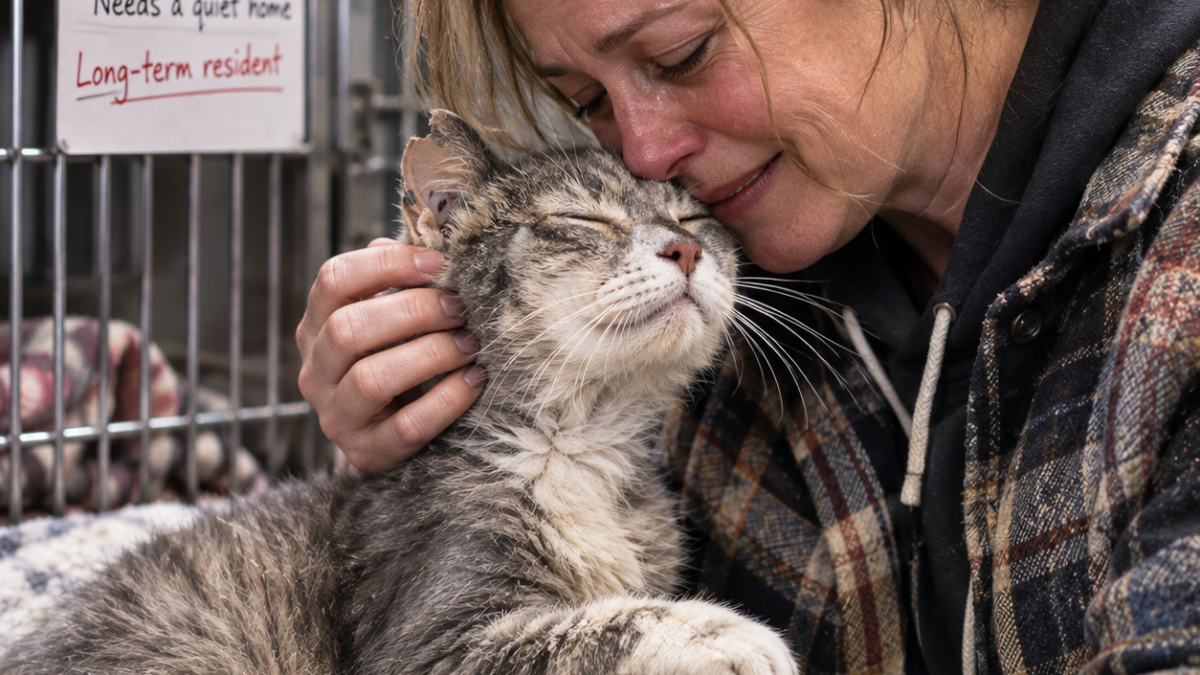
I Asked for the Oldest Cat Nobody Wanted—Then My Ex-Husband Mocked Him Until Amos Did Something That Made the Entire Shelter Cry.
I went to the shelter looking for the animal everyone else had decided was already too old to matter, six months after my husband of twenty-two years decided the same thing about our marriage.
Amos was eighteen, arthritic, half-deaf, eleven months into waiting, and carrying a handwritten note from his dead owner asking one final favor: please tell him I did not leave him on purpose.
I thought I was bringing home a forgotten cat so he would never die behind bars, but when my ex-husband laughed and called Amos “the saddest thing in the shelter,” neither of us knew that this frail old cat was about to expose a betrayal, save me from surrendering the only home I had left, and start something that would empty an entire row of senior cages.
I asked for the oldest cat in the shelter, and the woman behind the desk stopped breathing for a second.
Not dramatically.
Just long enough for me to notice.
Her name tag said Marnie.
She was probably around sixty, with tired blue eyes, silver hair pulled into a loose knot, and a faded sweatshirt covered in enough cat hair to suggest she had stopped fighting that particular battle years ago.
She looked at me the way people look at someone who has just announced a decision that sounds noble but may actually be stupid.
“You don’t want kittens?” she asked.
“No.”
“Young adult?”
“No.”
“Any particular temperament?”
I shook my head.
“I want the one everybody walks past.”
Something changed in her face.
She didn’t smile.
That would have been too easy.
Instead, she took her glasses off, wiped them on the bottom of her sweatshirt, put them back on, then reached beneath the counter for a large ring of keys.
“Then you need to meet Amos.”
I followed her.
The first adoption room was bright.
Sunlight came through tall windows.
Colorful towers stood against the walls.
A half-dozen kittens tumbled over one another beneath a suspended feather toy while a young couple crouched nearby filming them.
One kitten tried climbing the man’s jeans.
The woman laughed.
“Oh my God, he’s choosing you.”
Maybe he was.
Maybe people just like believing beginnings choose them.
I understood the attraction.
Kittens are possibility wrapped in fur.
They represent years you have not lost yet.
First Christmas.
First ruined couch.
First veterinarian visit.
First time they curl beside you like you invented warmth.
People can imagine a decade when they look at a kitten.
Nobody wants to imagine goodbye.
Marnie kept walking.
We passed younger cats reaching paws through bars.
A black-and-white female who chirped whenever anyone came near.
A huge orange male who rolled onto his back as if auditions were underway.
Two bonded sisters pressed against the glass.
Then we turned down another hallway.
The lights changed.
Fluorescent.
One buzzed overhead.
The air felt cooler.
The cages here were clean.
The blankets were fresh.
The animals were cared for.
PART2:
But the hallway had a different atmosphere.
These were not the cats people came in asking to see.
One was diabetic.
Another had only three legs.
One had a card that said FIV+.
Then, at the very end, was Amos.
He sat in the back of his cage.
Gray.
Or at least he had once been gray.
His face had gone almost white around the mouth.
The fur above his eyes had silvered.
His body looked narrow beneath his coat.
One ear folded slightly inward, as if life had bent it years ago and nobody had bothered straightening it.
He did not meow.
Did not approach.
Did not perform.
He simply looked at me.
PART3:
The card clipped to his cage read:
AMOS
18 YEARS OLD
MALE / NEUTERED
GENTLE
ARTHRITIS
EARLY KIDNEY DISEASE
NEEDS QUIET HOME
Below it, in black marker:
LONG-TERM RESIDENT.
I felt something pull tight beneath my ribs.
“How long?”
Marnie looked at the floor.
“Eleven months.”
I turned.
“Eleven?”
“Three hundred thirty-eight days as of this morning.”
“You know the exact number?”
“We know all the long ones.”
Amos blinked slowly.
I looked at the metal bars.
Eleven months.
At eighteen.
I did the math despite myself.
If an eighteen-year-old cat lived to nineteen, eleven months was not a waiting period.
It was a significant percentage of whatever remained.
“Why?”
Marnie leaned against the wall.
“His owner died last winter.”
“No family?”
“None willing to take him.”
I hated the wording.
Willing.
Not able.
Willing.
Marnie continued.
“He came in with a carrier, a blanket, medical records, and a note. At first people were interested because he’s sweet.”
“What happened?”
“They saw the age.”
I looked back at him.
Marnie shrugged.
“People stop. Read the card. Some say he’s beautiful. Some even ask to pet him. Then they ask where the younger cats are.”
“Every time?”
“Pretty much.”
Amos blinked again.
Maybe he had heard that conversation hundreds of times.
Maybe he had learned that human footsteps were not promises.
I had come to the shelter because my house had become too quiet.
Six months earlier, my husband ended our marriage at the kitchen table.
No shouting.
No broken dishes.
No affair confession.
At least not then.
Just Daniel sitting across from me with both hands around a coffee mug he never drank from.
Twenty-two years together.
Nineteen married.
A mortgage.
A thousand Sunday mornings.
Two miscarriages.
His mother’s funeral.
My father’s stroke.
Three job changes.
One kitchen renovation that nearly ended us before the marriage did.
All of it reduced to:
“I don’t think I want this life anymore.”
I remember asking:
“What life?”
He looked around our kitchen as if evidence might be hanging from the cabinets.
“This.”
“That isn’t an answer.”
“I need something different.”
“What?”
“A fresh start.”
Fresh start.
Those two words did more damage than yelling could have.
Fresh.
As if our marriage had gone stale.
As if years were mold.
As if love had an expiration date stamped somewhere underneath.
I was fifty-one.
Daniel was fifty-three.
He had recently started running.
Bought expensive shoes.
Lost twenty pounds.
Changed his hair.
Started wearing shirts that required ironing after spending fifteen years insisting wrinkles were a personality trait.
I noticed.
I did not accuse.
Trust makes fools of intelligent people because intelligent people assume trust must be rational if it has lasted long enough.
He moved into an apartment three weeks later.
Took half the furniture.
The newer television.
His tools.
The espresso machine I had bought him for Christmas.
He left the wedding china.
Nobody wants wedding china after a divorce.
For six months, I lived alone in the house we’d bought together when I was thirty-two.
The rooms did not become smaller.
They became louder.
Every absence had a sound.
One coffee mug.
One towel hanging in the bathroom.
One toothbrush.
One side of the bed staying perfectly flat.
People told me:
“You’ll rediscover yourself.”
I hated that too.
I had not misplaced myself.
I had been left.
There is a difference.
On the morning I went to the shelter, I woke at 5:20 with no reason to be awake.
I made coffee.
Sat at the kitchen table.
Looked across at Daniel’s empty chair.
And thought:
There has to be something in this city more unwanted than I feel.
It wasn’t a healthy thought.
But it got me dressed.
Now I stood in front of Amos.
Marnie unlocked the cage.
“He may take a minute.”
“That’s okay.”
“He has stiffness in the front legs. Don’t pick him up unless he asks.”
“I won’t.”
“He doesn’t hear well on the right side.”
“Okay.”
“And if he walks away—”
“I’ll let him.”
Marnie looked at me.
Then smiled for the first time.
“You really did come for an old cat.”
“I told you.”
“People tell me a lot of things at the front desk.”
She opened the door.
Amos did not move.
I knelt.
Cold tile through my jeans.
“Hi, Amos.”
His head turned slightly.
I offered my hand.
Not too close.
He stared.
Ten seconds.
Twenty.
Then stood.
Slowly.
His front legs trembled.
He paused after the first step.
There was dignity in it.
That is the word.
Not weakness.
Pride.
He looked like an elderly man refusing help getting out of a church pew because he had stood by himself for eighty years and intended to continue.
“I’m not in a hurry,” I whispered.
Amos took another step.
Then another.
He reached the cage door.
Sniffed my fingers.
His nose was dry and warm.
He stepped outside.
Marnie did not speak.
Amos looked at me.
Then placed one paw on my knee.
Only one.
I don’t know why that broke me.
Maybe because it was not trust.
Not yet.
It felt like permission to try.
My eyes filled.
I sat fully on the floor.
Amos considered my lap.
One front paw.
Then another.
He tried lifting his back end and stopped.
I almost helped.
Something told me not to.
He tried again.
This time he made it.
He settled across my legs, bony spine beneath my hand.
Then released the longest breath I had ever heard from an animal.
Not a purr.
Not contentment.
Exhaustion.
The sound of something stopping its brace against disappointment.
Marnie turned her face away.
I saw her wipe beneath one eye.
“You do this with every adopter?” I asked.
“No.”
“Good.”
“That would be exhausting.”
I laughed through tears.
Amos pushed his forehead against my stomach.
Marnie said:
“There’s something else.”
“The note?”
She looked surprised.
“You heard?”
“You mentioned it.”
“Oh.”
She left and returned with a small envelope.
Soft corners.
Fold lines worn.
My name was not on it.
Only:
FOR WHOEVER TAKES AMOS HOME.
I opened it.
The handwriting shook.
His name is Amos.
He has slept beside me for sixteen years.
He likes warm towels from the dryer and chicken only if you pretend it is yours first.
He is afraid of the vacuum but will follow it from room to room because he does not believe fear should go unsupervised.
He wakes around five in the morning.
Please don’t be angry.
He has done that his whole life.
If someone kind takes him home, please tell him I did not leave him on purpose.
Tell him I loved him until the last morning.
My name is Eleanor.
If he sits by the front door at night, that is where he used to wait for me when I came home from my nursing shift.
Please don’t make him stop.
I couldn’t read the next lines.
Not because the handwriting was difficult.
Because tears blurred everything.
I lowered the paper.
Amos had tucked his face into my sweater.
I placed my hand along his thin back.
“Eleanor didn’t leave you.”
Marnie made a sound behind me.
I finished the note silently.
There were instructions.
Medication.
Favorite food.
An old veterinary clinic.
And one final line:
He has been loved every day of his life.
Please make sure he knows that did not end with mine.
I signed adoption papers ninety minutes later.
Marnie asked three times if I understood the medical costs.
I did.
Kidney disease.
Arthritis.
Dental issues.
Possible hyperthyroidism they wanted rechecked.
Senior bloodwork.
He might live two years.
He might live two months.
Nobody knew.
“Do you want to think overnight?” Marnie asked.
“No.”
“We can hold him.”
“He’s been held eleven months.”
She looked down.
“Fair.”
The adoption fee was twenty-five dollars.
I gave them five hundred.
Marnie tried to refuse.
“Use it on another old one.”
That made her eyes fill again.
Amos left in the same carrier Eleanor had sent with him.
His name was written inside the plastic bottom in faded black marker.
AMOS ELLISON.
I stared at the surname.
“Her last name?”
Marnie nodded.
“You want his records?”
“Yes.”
She handed me a folder thick enough to belong to a human geriatric patient.
On the drive home, Amos made no sound.
I talked anyway.
“Left turn.”
Nothing.
“You’ll hate this road. Everyone hates this road.”
Silence.
“We have stairs.”
His ear moved.
“But I’ll carry you if you let me.”
Another turn.
“You have no idea what you’re getting into.”
I glanced at the carrier.
“Actually, maybe that makes two of us.”
At home, I opened the carrier in the living room.
I expected exploration.
Cats investigate.
At least every cat I had known did.
Amos stepped out.
Paused.
Smelled the air.
Then walked past the couch.
Past the kitchen.
Down the hallway.
Straight toward my bedroom.
I followed.
At the foot of the bed, I had placed a blue fleece blanket.
I had bought it on the way home.
Amos stepped onto it.
Turned once.
Twice.
A slow third circle.
Then lowered himself.
He looked at me.
So I sat on the floor.
For the first time in six months, my house did not feel empty.
That night, Amos slept with one paw touching my ankle.
Just one.
Around 2:00 a.m., I woke.
His paw was still there.
At 5:07, he stood.
Eleanor had warned me.
I opened one eye.
“You weren’t kidding.”
Amos walked toward the bedroom door.
I followed him to the kitchen.
Food.
Water.
Then he sat by the front door.
Exactly as Eleanor said.
He remained there seventeen minutes.
Then returned to bed.
That became our routine.
Amos was not adorable in the way internet cats are adorable.
His tongue occasionally failed to retract all the way.
One ear was wrong.
He snored.
He drooled when he purred.
He drank water with the sound of a small horse.
His litter-box aim became philosophical rather than precise.
He shed gray hair onto everything I owned.
The veterinarian confirmed Stage 2 chronic kidney disease, arthritis, mild hyperthyroidism, and high blood pressure.
Dr. Priya Mehta looked at his records.
“This cat has better documentation than most people.”
“Eleanor was a nurse.”
Priya smiled.
“That explains the spreadsheet.”
“What spreadsheet?”
She pulled out three pages.
Eleanor had recorded Amos’s weight every month for eight years.
Food.
Medications.
Bowel movements during illness.
Water intake.
Priya shook her head.
“She loved him.”
“I know.”
“Whoever she was, she knew what she was doing.”
That sentence mattered to me.
Eleanor had become strangely present in my life.
Not haunting.
Company.
Every time Amos did something odd, I checked the note.
Warm laundry?
Yes.
He climbed into a basket of towels before I finished folding them.
Chicken?
I put a piece in his bowl.
He refused.
I placed it on my plate.
Pretended to eat.
Offered it again.
Gone.
Vacuum?
He fled six feet away, then followed me room to room glaring at the machine.
At night, front door.
Every night.
The first week, he sat twenty minutes.
Second week, maybe fifteen.
Then less.
I never stopped him.
Eleanor had asked.
And I understood waiting.
Daniel came to the house three weeks after Amos arrived.
He still had boxes in the garage.
Golf clubs.
Tax records.
Winter coats.
A red toolbox.
I had delayed.
He had delayed.
Divorce is full of objects nobody wants badly enough to confront each other over.
When the doorbell rang, Amos startled.
He had been asleep on the couch.
His head snapped up.
I spoke softly.
“It’s okay.”
I opened the door.
Daniel looked different.
Not transformed.
Just polished.
New jacket.
Trimmed beard.
That expensive watch he had bought two weeks after moving out.
“Hey.”
“Hi.”
His eyes moved past me.
Amos stood in the hallway.
Daniel frowned.
“You got a cat?”
“Yes.”
“When?”
“Three weeks ago.”
He stepped inside.
Amos retreated one pace.
Daniel looked at him.
Then laughed.
Not cruelly at first.
Surprised.
“That cat is ancient.”
“Eighteen.”
“Jesus.”
Amos walked toward my bedroom.
Daniel watched.
“Why would you adopt an eighteen-year-old cat?”
“Because he needed a home.”
“There weren’t any normal cats?”
That annoyed me.
“He is normal.”
“You know what I mean.”
“No. Explain it.”
Daniel knew the tone.
He dropped the subject.
We went to the garage.
He packed.
I carried smaller boxes.
At some point Amos returned.
He climbed onto my bed and curled on the blue blanket.
Daniel stood in the doorway.
“That’s his spot?”
“Yes.”
He shook his head.
“You really picked the saddest thing in the shelter.”
I looked at Amos.
Gray body curled like a question mark.
Thin shoulders.
Folded ear.
One paw beneath his chin.
Then I looked at the man who once promised we would grow old in the same house.
Something inside me settled.
Not anger.
Scale.
Daniel suddenly seemed smaller than he had six months earlier.
“No,” I said.
“I picked the one who still had love left.”
Daniel stared at me.
He didn’t know what to do with that.
Men like Daniel were good at clean endings.
Neat boxes.
Fresh starts.
New apartment.
New sheets.
New routines.
A version of history where leaving meant courage.
Amos was not clean.
He was old.
He smelled slightly medicinal.
He had cloudy eyes.
He carried sixteen years of another woman’s life inside his habits.
And every time I walked into a room, he lifted his head as if my arrival mattered.
Not because I was new.
Because I was there.
Daniel taped his final box.
“You always did like fixing things.”
I almost laughed.
“Amos isn’t broken.”
“I didn’t say he was.”
“You didn’t have to.”
He picked up the toolbox.
At the door he stopped.
“There are some divorce papers coming from my attorney.”
“What papers?”
“Just financial stuff.”
“We already submitted financial disclosures.”
“Some updates.”
His eyes did not quite meet mine.
That was the first moment I knew there was more.
Not suspected.
Knew.
Twenty-two years teaches you the exact distance between someone’s normal face and the face they use when hiding something.
“What updates?”
“Nothing dramatic.”
Fresh start.
Nothing dramatic.
I learned to distrust phrases designed to lower my pulse.
“Daniel.”
He exhaled.
“I need to go.”
He left.
Amos came to the front door after it closed.
Sat.
I lowered myself beside him.
“Well.”
He looked at the door.
“You have terrible taste in men.”
Amos blinked.
“Fair.”
The papers arrived four days later.
My attorney, Rachel Kim, called before I had finished reading them.
“Don’t sign anything.”
“I wasn’t going to.”
“Good.”
“What is this?”
Daniel wanted us to sell the house immediately.
That was new.
Our original separation agreement allowed me to remain for eighteen months before either buying out his equity or selling.
Now he claimed “financial hardship” made the arrangement untenable.
Rachel was quiet.
“What kind of hardship?”
“He doesn’t say.”
“I thought his job was fine.”
“So did I.”
“Can he force a sale?”
“Not automatically.”
She paused.
“I want updated bank records.”
“Why?”
“Because something about this smells.”
Rachel was right.
Over the next month, documents arrived.
Statements.
Transfers.
Credit-card charges.
A joint investment account I rarely checked because Daniel managed it.
Three transfers.
Eight thousand.
Twelve thousand.
Nine thousand five hundred.
All within the last year of our marriage.
Destination:
An account I did not recognize.
Rachel traced what she could.
Then called me into her office.
Daniel had been moving marital funds months before he told me he wanted a fresh start.
Not huge enough to bankrupt us.
Enough to matter.
Enough to show planning.
Then there were hotel charges.
Restaurants.
A furniture store twenty miles from our home.
A jewelry purchase.
I stared at the statements.
“How long?”
Rachel didn’t answer directly.
“We need discovery.”
“How long?”
“I don’t know.”
I knew.
The shape of betrayal appears before the details.
“You think there was someone else.”
“I think we should ask.”
Daniel had insisted there was no affair.
I had asked during the first week.
Once.
He looked almost offended.
“No.”
I believed him because I was still measuring truth according to the old marriage.
Three weeks later, Rachel found the lease application.
Daniel’s apartment listed an emergency contact.
Samantha Vale.
Relationship:
Partner.
The application was dated seventeen days before the kitchen-table conversation.
Partner.
I read the word six times.
Rachel sat across from me.
“I’m sorry.”
I didn’t cry.
That worried me.
“Who is she?”
“We don’t need—”
“Rachel.”
She sighed.
“Works at his company.”
“How old?”
“That doesn’t matter legally.”
“How old?”
“Thirty-six.”
I laughed.
One sharp sound.
Rachel flinched.
Twenty-two years.
Fresh start.
Apparently fresh had a date of birth.
I drove home carefully.
Not because I was calm.
Because my hands had gone numb.
Amos was at the door.
He had been there more often since Daniel’s visit.
I entered.
Dropped my purse.
Sat on the floor.
Amos came toward me.
He did not climb into my lap.
He placed one paw on my knee.
The same paw.
The same gesture from the shelter.
That did it.
I cried.
Not elegant tears.
I folded over.
Amos stood there while I buried my face against his old gray side.
He was small enough that I should have been comforting him.
Instead, his purr vibrated against my cheek.
“They always know, don’t they?”
He drooled on my sleeve.
I laughed while crying.
“Thanks.”
Daniel called that evening.
I answered.
“Was there someone else?”
Silence.
That was enough.
“Was there?”
“Yes.”
I closed my eyes.
“How long?”
“It’s complicated.”
“How long?”
“About eight months before I moved.”
I gripped the phone.
“You sat at our kitchen table and told me you needed a fresh start.”
“I didn’t want to hurt you.”
That sentence almost impressed me.
“You didn’t want to hurt me?”
“I handled it badly.”
“You lied.”
“I was trying to make the transition easier.”
“For whom?”
“Both of us.”
“No.”
My voice surprised me.
Steady.
“You don’t get to rename cowardice as kindness because the word sounds better.”
He became quiet.
Amos sat at my feet.
Daniel said:
“Samantha isn’t why our marriage ended.”
I laughed again.
“Of course.”
“We had problems.”
“We did.”
“You were unhappy too.”
“I was.”
“Then—”
“I didn’t move money.”
Silence.
“I didn’t plan a new apartment while sleeping next to you.”
“It’s not what you think.”
“Daniel.”
“It was money for the apartment.”
“Before you left.”
“I knew I was going.”
“That is the point.”
He exhaled.
“We can fight about this for a year or settle.”
There it was.
The real call.
He wanted the house sold.
His new life cost more than expected.
My grief was an accounting problem.
“I won’t agree to sell early.”
“Be reasonable.”
“No.”
“You can’t afford the buyout.”
“I’ll figure it out.”
“With what?”
I looked at Amos.
He was drinking water with aggressive volume.
“I’ll figure it out.”
Daniel’s voice changed.
Softer.
The voice he used when trying to convince me I was the emotional one.
“Don’t cling to the house because you’re angry.”
For six months that sentence would have crushed me.
That evening it didn’t.
I thought of Eleanor.
Her note.
Tell him I did not leave him on purpose.
I thought about Amos sitting by my door every night because somebody had once returned through one like it.
Home mattered.
Memory mattered.
Being old did not make something disposable.
“I’m not clinging,” I said.
“I’m deciding.”
I hung up.
The legal fight lasted four months.
Not dramatic courtroom scenes.
Mostly emails.
Documents.
Depositions.
Numbers.
Divorce is often less cinematic than betrayal deserves.
Rachel uncovered enough that Daniel’s attorney became interested in settling.
The transferred funds were treated as marital assets.
My share was restored through the final distribution.
His attempt to force an immediate sale failed.
I refinanced.
It hurt.
The payment increased.
I cut expenses.
Took on freelance bookkeeping for two small businesses in the evenings.
But the house remained mine.
The day the refinance closed, I bought a bottle of champagne.
I don’t even like champagne.
Amos sniffed the cork.
I poured one glass.
“To bad financial decisions.”
He stared.
“To Eleanor.”
His ear moved.
“To old things people should not throw away.”
That was when I cried.
Not because of Daniel.
Because the deed had my name on it.
Only mine.
For the first time in my adult life, home was not something another person could redefine for me.
Amos had been with me five months.
His health was surprisingly stable.
He gained almost a pound.
Priya adjusted his thyroid medication.
His kidney values held.
Arthritis remained.
We added little foam steps.
One by the couch.
One by the bed.
Amos ignored the couch step and continued trying to climb directly until I physically blocked the route.
“You are eighteen.”
He stared.
“You have arthritis.”
Stare.
“Use the steps.”
He walked away.
Ten minutes later, I found him on the couch.
I never discovered how.
His personality expanded as his body felt better.
He hated closed doors.
Loved warm laundry.
Developed an obsession with rotisserie chicken.
Would not eat salmon.
Liked brushing exactly seven strokes.
On the eighth he bit the brush.
Not hard.
Boundary enforcement.
At night he still sat by the front door.
But the ritual shortened.
Seventeen minutes.
Ten.
Seven.
Then some nights he forgot.
The first time that happened, I noticed at 10:30.
“Amos.”
He was asleep on the bed.
“Are you supposed to be doing something?”
One eye opened.
I almost reminded him.
Then stopped.
Eleanor had asked me not to make him stop.
She had not asked me to make him continue.
I turned off the lamp.
He stayed.
Around that time, Marnie began calling every couple of weeks.
Officially for adoption follow-up.
Unofficially because Amos had been part of her life for eleven months.
“How’s our gentleman?”
“Demanding.”
“Good.”
“He tried to steal turkey.”
“Better.”
“He bit his brush.”
“Excellent.”
“Are these signs of wellness?”
“In an eighteen-year-old shelter cat? Absolutely.”
I sent photographs.
Amos in laundry.
Amos sleeping on my pillow.
Amos with one paw inside my coffee mug.
Marnie circulated them among staff.
I knew because she once accidentally sent me a screenshot from their group chat.
AMOOOOOS!!!
LOOK AT HIS FACE.
HE HAS CHEEKS NOW.
WHO GAVE GRANDPA A CHICKEN LEG?
That last one concerned me.
I did not give him a chicken leg.
He had stolen the photograph prop before I could stop him.
Then, one morning, Amos did something that made the entire shelter call me in tears.
It happened at 5:11.
Of course.
Amos woke me.
I followed him into the hallway.
Expected food.
Instead, he went to the front door.
He sat.
Normal.
I went to the kitchen.
Started coffee.
Five minutes later, Amos was still at the door.
Then he stood.
Walked toward a small basket on the entry table.
Inside were mail, spare keys, and Eleanor’s letter.
I had placed the envelope there weeks earlier after rereading it.
Amos sniffed the basket.
Reached one paw up.
Knocked the envelope onto the floor.
I froze.
Probably coincidence.
He pawed it.
Then picked the corner gently between his teeth.
My breath caught.
“Amos?”
He carried it.
Not far.
Three feet.
Dropped it beside the door.
Then sat next to it.
I stared.
I knew better than to turn animal behavior into human language.
Cats like paper.
Maybe Eleanor’s scent remained.
Maybe the envelope smelled like my hands.
Maybe he wanted breakfast and this was unrelated.
Then Amos touched the envelope with one paw.
Looked at the door.
And meowed.
One sound.
Low.
Rough.
I had never heard him meow before.
Not once.
Not at the shelter.
Not in five months.
Marnie had told me he stopped vocalizing after Eleanor died.
I crouched.
“Do you remember her?”
Amos meowed again.
I started crying.
I picked up my phone.
Not to make a viral video.
To send Marnie proof that Amos had found his voice.
I recorded maybe twenty seconds.
“Amos?”
He looked at me.
“Want breakfast?”
Nothing.
I touched Eleanor’s envelope.
Amos made the same rough sound.
Then something happened I still struggle to describe without assigning meaning I cannot prove.
He turned away from the door.
Walked toward me.
Placed one paw on my knee.
And purred.
I sent the video to Marnie.
No caption.
At 6:02 my phone rang.
Marnie.
I answered.
She was crying so hard I could barely understand her.
“What?”
“He talked.”
“I know.”
“He talked.”
Then voices behind her.
Apparently she had shown the video to the morning staff.
Someone else took the phone.
A younger woman named Jessie.
“He didn’t meow here.”
“I know.”
“Not once in eleven months.”
Another voice:
“Tell her about the intake.”
Marnie came back.
“When he first arrived, he screamed for three days.”
My stomach dropped.
“What?”
“He called every time the front door opened. Every carrier. Every footstep. After three days he stopped.”
I looked at Amos.
He was eating breakfast now as if he hadn’t just destroyed six shelter workers emotionally.
Marnie continued.
“We always thought he was calling for Eleanor.”
I sat on the floor.
“He carried her letter to my door.”
“I saw.”
“I don’t know what it means.”
“Neither do I.”
That mattered.
Neither of us tried to turn it into something supernatural.
Marnie said:
“But he talked to you.”
That was enough.
The shelter staff called throughout the morning.
Priya heard.
She cried too, though she denied it later.
At noon, Marnie asked if she could post the video on the shelter’s private volunteer page.
“Not public?”
“Not unless you want.”
I agreed.
The volunteers responded.
One comment said:
HE WASN’T WAITING TO DIE. HE WAS WAITING TO FEEL HOME AGAIN.
I read that sentence too many times.
Then another:
I WANT TO ADOPT AN OLD ONE.
That comment came from a volunteer named Paul.
He had worked weekends for two years.
He went to the shelter that afternoon and adopted Hazel.
Fifteen.
Black.
Hyperthyroidism.
Seven months waiting.
Two days later, a woman who had followed the private volunteer page adopted Winston.
Sixteen.
Diabetic.
Then Marbles.
Fourteen.
Then June.
Seventeen.
The shelter posted a public update about senior cats.
Not Amos’s video.
Just his story with my permission.
No claim that he remembered a letter.
No fake miracle.
The post said:
Amos waited 338 days.
His adopter asked for the oldest cat nobody wanted.
Five months later, he has gained weight, found his voice, and sleeps in a bed every night.
If you have room for a shorter chapter, shorter does not mean less meaningful.
That post spread.
Locally first.
Then farther.
People began calling.
Marnie hated that.
“Everyone wants the oldest now.”
I laughed.
“That’s bad?”
“We only have one oldest.”
“Give them second oldest.”
“We did.”
Within three weeks, every cat in that back hallway over thirteen had either been adopted or entered foster care.
Marnie sent me a photograph.
Empty cages.
Fresh blankets folded inside.
No cats.
Caption:
LOOK WHAT YOUR OLD MAN DID.
I showed Amos.
He licked himself.
“Very humble.”
That should have been enough.
But the story grew.
A local reporter called.
I refused at first.
I had no desire to become the Divorced Woman Saved by Elderly Cat.
Life is more complicated than headlines.
Marnie convinced me.
“Talk about Amos.”
“Only Amos.”
“And senior adoption.”
“Fine.”
The reporter came to my house.
Amos slept through half the interview.
She asked why I chose him.
I told the truth.
“My husband left.”
She waited.
“I felt discarded.”
“Did you think Amos felt the same?”
“I don’t know what Amos felt.”
Good.
That remained important.
“I knew what it looked like when people read his age and kept walking.”
“Did that feel familiar?”
“Yes.”
Amos woke.
Walked across the couch.
Put one paw on my thigh.
The reporter smiled.
“Does he do that often?”
“Yes.”
“What does it mean?”
I looked at him.
“Probably that he wants chicken.”
The article ran Sunday.
OLD CAT, NEW HOME: AMOS INSPIRES SENIOR ADOPTION WAVE AFTER 338-DAY WAIT.
Daniel saw it.
Of course he did.
He texted:
Saw the article. That’s really nice.
I stared at the message.
Really nice.
Twenty-two years reduced to legal documents.
Five months with a cat became really nice.
I typed:
Thank you.
Then deleted it.
Typed:
He is.
Deleted.
Finally I sent nothing.
Healing sometimes looks like not explaining yourself.
Two weeks later, Daniel showed up unexpectedly.
Samantha was with him.
That was new.
I had never met her.
She stayed beside the car.
Daniel came to the door.
I did not invite him inside.
“What’s wrong?”
“Nothing.”
“Then why are you here?”
He glanced past me.
“Wanted to bring this.”
A box.
Inside were photographs.
Old albums.
Wedding.
Vacations.
My parents.
His parents.
Twenty-two years.
“I found them.”
“Okay.”
“I thought you’d want them.”
“Yes.”
I took the box.
He remained.
I waited.
“I read the article.”
“You texted.”
“Right.”
Silence.
Then he smiled awkwardly.
“You really made something out of that cat.”
Something sharpened.
“Amos made something out of himself.”
“I didn’t mean—”
“I know.”
Daniel looked toward the living room.
Amos appeared.
Slow.
Stiff.
Gray face.
He came to the doorway.
Daniel smiled.
“Hey, old guy.”
Amos stopped.
Looked.
Then turned around.
Walked away.
I nearly laughed.
Daniel exhaled.
“I guess he remembers me.”
“Probably not.”
“Still don’t like me?”
I considered lying.
“No.”
He nodded.
“That fair?”
“Does it matter?”
“I don’t know.”
There was something tired in his face.
For the first time, I saw that fresh starts age too.
Samantha waited in the car.
Daniel’s apartment was now a condo, I had heard.
Their relationship had survived the divorce.
Maybe they were happy.
Maybe not.
It no longer felt like my responsibility.
He said:
“I handled things badly.”
“Yes.”
“I should have told you sooner.”
“Yes.”
“I shouldn’t have moved the money.”
“No.”
“I was scared.”
That surprised me.
Of what?
I almost asked.
Then realized I didn’t need the answer.
Daniel continued.
“I knew if I told you the truth, I’d have to see what it did to you.”
I stared.
“So you lied to avoid watching me hurt.”
He looked ashamed.
“Yes.”
There it was.
Not noble.
Not monstrous.
Cowardly.
Human.
I could finally fit him into a shape smaller than villain and less forgiving than victim.
“That was cruel.”
“I know.”
“I don’t forgive you yet.”
“I understand.”
“Maybe never.”
He nodded.
“That too.”
Amos meowed from the kitchen.
Daniel looked startled.
“He makes noise now?”
“Yes.”
“I thought he didn’t.”
“He changed.”
Daniel smiled sadly.
“So did you.”
I expected the line to irritate me.
It didn’t.
“Yes.”
He left.
I carried the photo box into the living room.
Opened it.
Amos climbed onto the couch.
I found our wedding picture.
Daniel young.
Me younger.
Both smiling.
I did not tear it.
Did not burn it.
Did not put it back.
I placed it into an archival box.
History.
Not instruction.
Amos leaned against me.
I stroked his back.
“Not everything has to stay current to have mattered.”
His eyes closed.
That became a lesson I needed.
Eleanor had mattered.
Daniel had mattered.
The marriage had mattered.
Its ending did not retroactively make every year false.
Amos did not need to forget Eleanor to love me.
I did not need to deny my marriage to build something after it.
Maybe that was why the cat understood me before I understood myself.
Not because he was wise.
Because he carried the contradiction naturally.
Old love.
New home.
Both true.
Amos turned nineteen in August.
Estimated birthday.
Marnie insisted on a party.
I objected.
“He doesn’t know.”
“We know.”
“That is human projection.”
“Bring the cat.”
I brought the cat.
The shelter closed the staff room.
No public crowd.
Marnie.
Jessie.
Paul.
A few volunteers.
Priya came.
There was a tiny cake for humans and a chicken plate for Amos.
Marnie placed a paper crown near him.
He knocked it off.
“Good,” I said.
“He has standards.”
The back senior hallway remained nearly empty.
They had started a program called Last Chapter.
I hated the name at first.
Then understood it.
Senior cats thirteen and older received reduced adoption fees, first-month medical support through donations, and foster priority.
Amos’s story helped fund it.
Not because I became some fundraising celebrity.
People simply cared.
One donor paid for renal bloodwork for ten senior cats.
Another covered arthritis medication for a year.
A veterinary clinic offered discounted exams.
An older man adopted two bonded fourteen-year-olds.
A widow fostered hospice cats.
Small things.
No hero.
Just doors opening.
Marnie gave me a framed copy of Eleanor’s note for Amos’s birthday.
Not the original.
That remained mine.
The copy ended with:
He has been loved every day of his life.
Please make sure he knows that did not end with mine.
Underneath, Marnie had added:
IT DIDN’T.
I cried in the shelter staff room.
Everyone pretended not to notice.
Amos ate chicken.
At nineteen and four months, his kidney disease progressed.
Not suddenly.
Numbers crept.
Weight slipped.
He slept more.
Priya increased fluids.
I learned subcutaneous administration.
The first time I held the needle, my hand shook.
“I’m going to hurt him.”
“Briefly.”
“He’ll hate me.”
“He might.”
“Comforting.”
Priya demonstrated.
Amos barely reacted.
At home, I hung the fluid bag from a coat hook beside the bed.
Warm towel.
Needle.
Slow flow.
Amos glared.
Then accepted chicken.
Our relationship survived.
He began needing help onto the bed.
I bought better stairs.
This time he used them.
Age had finally defeated pride.
Some mornings he no longer woke at five.
That frightened me more than the early mornings ever had.
I would wake at six.
Look down.
Touch his side.
Breathing.
Relief.
I started understanding why Eleanor kept eight years of spreadsheets.
When time feels limited, numbers give the illusion of control.
Weight.
Ounces eaten.
Water.
Creatinine.
Good days.
Bad.
I began my own chart.
Then stopped.
One evening I realized I had spent forty minutes staring at a food log while Amos sat in the window beside a sunset.
I closed the notebook.
Sat beside him.
“Sorry.”
He leaned against my arm.
We watched light change.
He could still see.
Barely, according to Priya.
But enough.
At nineteen and eight months, Amos developed a urinary infection.
Antibiotics.
Recovered.
At nineteen and ten, a dental abscess.
Too risky for major anesthesia.
Managed carefully.
At twenty, he stopped jumping entirely.
We celebrated his twentieth birthday quietly at home.
Marnie brought chicken.
Priya brought a heating pad.
Paul brought nothing because he claimed Amos hated gifts.
Correct.
Daniel mailed a card.
That surprised me.
No long message.
Just:
Happy birthday to the old guy. I was wrong about him.
I placed it beside Eleanor’s note.
Not because Daniel deserved symbolic redemption.
Because admitting you were wrong should be allowed to exist without becoming forgiveness.
Amos slept through most of his birthday.
At 8:30 that night, he went to the front door.
He had not done that in months.
Marnie noticed.
“What’s he doing?”
“Old habit.”
We watched.
Amos sat.
Five minutes.
Ten.
Then he looked toward Eleanor’s framed note.
Or maybe toward nothing.
I sat behind him.
Marnie whispered:
“Do you ever think he’s still waiting for her?”
“Sometimes.”
“Does that hurt?”
“No.”
It didn’t.
Not anymore.
I rested my hand on his back.
“He’s allowed.”
Amos turned.
Walked away from the door.
Went to the bedroom.
That was the last time he ever waited there.
Three months later, I woke to a different silence.
No paw.
No movement.
No water bowl.
I sat up.
Amos was awake.
Lying on the blue blanket.
But he had not stood.
“Hey.”
His eyes moved toward me.
I touched him.
Warm.
He tried lifting his head.
Stopped.
I knew.
Not magically.
You learn an old animal’s ordinary.
This was outside ordinary.
I called Priya.
She came to the house at 8:20.
Marnie came at nine.
I did not ask her.
Priya must have.
Amos lay against my thigh.
His kidneys had worsened dramatically.
He was dehydrated despite fluids.
Body temperature low.
Heart rhythm irregular.
We could hospitalize.
IV.
Tests.
Maybe stabilize.
Priya explained everything.
Then said:
“Or we can let him stay here.”
I looked at Amos.
Twenty years.
Eleven months in a cage.
A dead woman asking someone not to let him think she left intentionally.
My house.
Blue blanket.
Five o’clock mornings.
One paw.
Chicken theft.
Front door.
I asked:
“Would hospitalization give him good time?”
Priya’s eyes filled.
“I don’t know.”
“Would it give him time?”
“Possibly.”
Not the same question.
I nodded.
“Then no.”
Marnie cried silently.
I called no one else.
No social media.
No Last Chapter announcement.
Amos had already spent too much of his old age representing something to strangers.
That morning he was just mine.
I opened Eleanor’s letter.
Read it aloud.
Amos’s ear moved.
At the line:
Tell him I loved him until the last morning.
My voice broke.
I pressed my forehead against his.
“Eleanor loved you.”
Marnie covered her mouth.
“And I love you.”
Amos’s paw moved.
Barely.
Touched my wrist.
One paw.
Always one.
I laughed and sobbed at once.
“You really committed to that bit.”
Priya gave the first medication.
Amos relaxed.
No fear.
His head became heavy against my leg.
Marnie sat on the floor beside us.
She whispered:
“You know, I almost didn’t bring her back here that first day.”
I looked up.
“What?”
“You.”
“Why?”
“I thought you’d change your mind.”
I smiled through tears.
“Fair.”
“No.”
She shook her head.
“I’d seen too many people fall in love with the idea of rescuing a senior cat.”
“And?”
“They imagine gratitude. They don’t imagine medication and pee outside the box and expensive bloodwork and dying.”
I stroked Amos.
“Neither did I.”
“You stayed.”
“So did he.”
Priya waited.
When I nodded, she gave the final medication.
Amos’s breathing slowed.
I kept my hand on his back.
Marnie kept one hand on his paw.
The room became impossibly quiet.
Then he was gone.
There is no poetic way to describe the instant a body becomes memory.
It is too physical.
One breath.
Then none.
I expected devastation.
It came.
But beneath it was something else.
Completion.
Not relief that he was gone.
Relief that nothing had been left unfinished.
He did not die behind bars.
He did not die wondering why nobody chose him.
He died on the blanket he had claimed the first day.
With people who knew his habits.
With Eleanor’s letter beside him.
Loved until the last morning.
Exactly what she had asked.
The shelter closed senior adoptions for one hour that afternoon.
Marnie didn’t tell me until later.
Staff gathered in the back hallway.
The place Amos had waited eleven months.
They placed his original cage card on the door.
AMOS. 18 YEARS OLD. GENTLE. NEEDS A QUIET HOME.
Below LONG-TERM RESIDENT, someone wrote:
HOME: 17 MONTHS.
Not long.
Enough.
The shelter posted one photograph.
Not of Amos dying.
Not the video.
A photograph of the empty senior hallway after the first Last Chapter adoption wave.
The caption said:
Amos died at twenty years old in the home of the woman who asked us for the cat everybody else had passed by.
He spent 338 days waiting for adoption.
After his story was shared, every senior cat in this hallway found either a home or foster placement.
His life did not matter because he inspired anything.
His life mattered because it was his.
The rest was something he left behind.
I read it twice.
Then put my phone down.
For three weeks, I could not move his blue blanket.
His water bowl stayed.
The steps beside my bed stayed.
The front door looked wrong without him.
At 5:07 every morning, I woke.
Body memory.
Sometimes I heard water.
Nothing there.
Sometimes I thought I felt one paw against my ankle.
Grief teaches the nervous system terrible tricks.
Marnie called.
“You eating?”
“Yes.”
“Liar.”
“A little.”
“You sleeping?”
“No.”
“Want company?”
“No.”
“Good. I’m coming Saturday.”
Saturday she arrived carrying a box.
I stared.
“No.”
“It’s not a cat.”
“Good.”
“Yet.”
“Marnie.”
She laughed.
Inside the box were letters.
Dozens.
People who had adopted senior cats after Amos.
A woman in Buffalo whose sixteen-year-old cat lived only ninety-one days.
She wrote:
I thought ninety-one days would break me.
Instead, I think about the fact that she had ninety-one mornings where someone said her name.
A couple from Rochester adopted a seventeen-year-old bonded pair.
One died.
The other was still alive.
A college student fostered a twelve-year-old diabetic cat.
A veteran adopted a fourteen-year-old three-legged tom.
One letter contained a picture of Hazel—the fifteen-year-old Paul adopted after seeing Amos’s first meow video.
Hazel sat on his kitchen table looking furious.
Caption:
SHE OWNS THE HOUSE NOW.
I laughed.
First real laugh since Amos died.
Marnie said:
“There’s one more.”
She handed me an envelope.
No return address.
Inside was a copy of Eleanor’s obituary.
I stared.
“How?”
“Her niece came across the article about Amos.”
“Niece?”
“She didn’t know what happened to him.”
The letter was from a woman named Sarah Ellison.
Eleanor’s niece.
She lived in Vermont.
She explained.
Eleanor had been her father’s older sister.
They were not close during Eleanor’s final years because of a long family conflict over inheritance and caregiving.
After Eleanor died, Sarah assumed Amos had gone to another relative.
Nobody told her he entered the shelter.
She had found his story online months later.
Sarah wrote:
I have spent a lot of time feeling guilty that Aunt Eleanor died without enough family around her.
Knowing Amos was loved gives me a kind of peace I don’t know how to explain.
She included a photograph.
Eleanor.
Probably seventy-five.
White hair.
Navy scrubs.
Sitting in a recliner.
Amos younger and much heavier across her lap.
One paw on her wrist.
I stared.
The same paw.
Probably coincidence.
But I let myself have it.
Marnie whispered:
“That’s him.”
“I know.”
Sarah’s letter ended:
Thank you for being the person my aunt hoped would exist.
I cried.
Marnie cried.
We were getting very good at that.
Six months after Amos died, I went back to the shelter.
Not because I was ready for another cat.
I was not.
I told Marnie that before she could reach for keys.
“I’m volunteering.”
She grinned.
“That is what they all say.”
“I mean it.”
“Laundry?”
“Yes.”
“Good.”
“Not adoption floor.”
“Fine.”
“Not senior hall.”
“Of course.”
She assigned me laundry.
For three weeks.
On week four she asked me to carry towels to the senior hall.
Manipulative woman.
I walked past Amos’s old cage.
Different cat.
Seventeen-year-old tortoiseshell named Pearl.
She hissed at me.
“Healthy boundaries.”
Marnie appeared.
“She’s been here six months.”
“No.”
“I didn’t ask.”
“You were going to.”
“I was going to say she hates everybody.”
“Good.”
“She especially hates men.”
“Smart.”
Pearl hissed again.
I walked away.
Two weeks later, Pearl allowed me to place food beside her.
A month later, she sat near me.
Three months later, she bit my finger.
Progress.
I did not adopt Pearl.
A widowed schoolteacher did.
That mattered.
Amos did not leave me a mandate to collect every unwanted animal.
He gave me something quieter.
The ability to see endings differently.
A final chapter is not a lesser chapter because fewer pages remain.
Sometimes it is the first part where someone finally gets the story right.
A year after Amos died, Last Chapter had placed seventy-three senior cats.
Not all survived long.
One lived eight days.
Another eighteen months.
One adoption failed and the cat returned.
Nobody pretended love solved everything.
Medical bills remained real.
Grief remained brutal.
Some older cats hid for weeks.
Some never became cuddly.
Some had dementia.
Some screamed at night.
Some missed litter boxes.
Some ate expensive prescription food exactly once before refusing the remaining twenty-three cans.
Marnie made adopters sign a sheet:
SENIOR ANIMALS DO NOT OWE YOU GRATITUDE.
I loved it.
The shelter placed Eleanor’s sentence beneath it:
HE HAS BEEN LOVED EVERY DAY OF HIS LIFE.
PLEASE MAKE SURE HE KNOWS THAT DID NOT END WITH MINE.
With Sarah’s permission.
And mine.
Daniel and I eventually became something close to civil.
Not friends.
Not enemies.
Two people with a long shared history who no longer needed to damage each other to prove the ending mattered.
He married Samantha.
I learned through a mutual friend.
The news hurt less than I expected.
A year later, Daniel’s mother died.
He called me.
Not Samantha.
Not because he wanted me back.
Because I had known his mother twenty-five years.
I attended the funeral.
Afterward Daniel said:
“Thank you.”
“She mattered to me too.”
He nodded.
Then:
“Did that cat really change everything?”
I looked at him.
“No.”
He seemed surprised.
“People say—”
“Amos was a cat.”
Daniel waited.
“He didn’t fix my marriage.”
“No.”
“He didn’t fix the divorce.”
“No.”
“He didn’t make me strong.”
Daniel looked uncomfortable.
I smiled.
“He gave me somewhere to put love when I thought love had become embarrassing.”
Daniel looked down.
“That sounds like changing everything.”
“Maybe.”
He nodded.
“I was cruel about him.”
“Yes.”
“I’m sorry.”
“I know.”
This time, when I said it, I meant:
I accept that you understand.
Not:
Everything is erased.
Forgiveness became less like a door and more like weather.
Some days clear.
Some days not.
I stopped waiting for a grand moment.
Two years after Amos died, Marnie retired.
The shelter held a small party.
I gave her a framed picture.
Not Amos.
The empty senior hallway.
She cried before unwrapping it fully.
“I hate you.”
“I know.”
She touched the frame.
“We used to think empty cages meant we had done our job.”
“Don’t they?”
“Sometimes.”
She looked around the shelter.
“Other times it means we moved the problem somewhere else.”
That was Marnie.
Even retirement had caveats.
She hugged me.
“You ready?”
“For what?”
“Another one.”
“No.”
“Liar.”
“I’m not lying.”
“You ask about the intake list every week.”
“Research.”
“You bought two heated beds.”
“Sale.”
“You have kidney food in your pantry.”
I stared.
She smiled.
“Amos trained you.”
“He absolutely did not.”
The new adoption coordinator came over.
Her name was Tasha.
She was thirty.
Energetic.
Dangerous.
She had a file.
“No.”
Tasha stopped.
“I didn’t say anything.”
“You have a file.”
“It’s not a cat.”
“What is it?”
“A cat.”
Marnie laughed so hard she had to sit down.
The cat was named Ruthie.
Nineteen.
White.
Deaf.
Hypertension.
Owner entering long-term care.
I looked at her photograph.
“No.”
Tasha nodded.
“Okay.”
I went home.
For three nights, I thought about Ruthie.
On the fourth morning, I woke at 5:07.
Amos time.
I stared at the ceiling.
Then laughed.
“You’re dead and still annoying me.”
At nine, I drove to the shelter.
Tasha was behind the desk.
I said:
“I want to meet Ruthie.”
She tried not to smile.
Failed.
The senior hall felt familiar.
Ruthie sat at the back of her cage.
Did not meow.
Did not sell herself.
I knelt.
“I know this trick.”
She stared.
I offered my hand.
Nothing.
Ten minutes.
Twenty.
Then Ruthie came forward.
Slow.
Proud.
She sniffed my fingers.
And walked past me.
Completely.
I laughed.
“Excellent.”
Tasha whispered:
“She does that.”
“Good.”
I sat on the floor.
“I’m not in a hurry.”
Eventually Ruthie sat three feet away.
That was all.
I adopted her the following week.
Not because she was Amos.
Because she wasn’t.
My house changed again.
Ruthie did not sleep at my feet.
She preferred the bathroom rug.
She hated chicken.
Loved tuna.
Did not care about warm laundry.
Never sat at the front door.
Her life had its own shape.
That mattered too.
The blue blanket stayed in a cedar box.
Amos’s collar beside it.
Eleanor’s original letter.
Sarah’s photograph.
Daniel’s birthday card.
A tiny collection of evidence that one old gray cat existed.
Sometimes volunteers asked me to tell Amos’s story at adopter orientations.
I resisted at first.
Then agreed.
I never called him a rescue.
That word can make the human too important.
I said:
“He waited eleven months.”
I told them about Eleanor.
The note.
The paw.
The front door.
Kidney disease.
The meow.
The empty hallway.
Then I always ended with the same thing.
I had walked into the shelter believing I was choosing the animal with the least time left.
I thought that made the choice sad.
It didn’t.
Time is not what makes love valuable.
Attention is.
Presence is.
Someone knowing how you like your chicken.
Someone leaving the curtains open because you still need to watch.
Someone learning the sound you make when pain is worse.
Someone staying on the floor while you decide whether hope is safe.
Amos did not need me to give him sixteen years.
Eleanor already had.
He needed me for the years she could not.
Seventeen months, as it turned out.
That was our whole lifetime together.
Long enough for him to stop waiting at the door.
Long enough for me to stop waiting for Daniel to explain why I hadn’t been enough.
Long enough for both of us to learn that being left and being worthless are not the same thing.
The shelter still keeps Amos’s old cage card in the office.
Marnie stole it once when she retired.
Tasha made her return it.
On the back, volunteers have written names.
Hazel.
Winston.
June.
Marbles.
Pearl.
Dozens more.
Senior cats adopted because somebody heard about an eighteen-year-old nobody wanted.
My name is not there.
Neither is Eleanor’s.
It isn’t our list.
It belongs to the cats.
Ruthie is asleep near me as I write this.
She is twenty now.
Loud for a deaf cat.
Bad at boundaries.
Excellent at stealing tuna.
Somewhere in my bedroom closet is Amos’s blue blanket.
I take it out occasionally.
There are still gray hairs caught deep in the fleece.
I could wash them away.
I don’t.
Not because I cannot move on.
Because moving on does not require disinfecting your life of everyone who mattered before.
Amos taught me that without knowing he was teaching anything.
He had Eleanor.
Then he had a shelter.
Then he had me.
I had Daniel.
Then silence.
Then Amos.
Then Ruthie.
Lives overlap.
End.
Begin.
Continue.
Love does not become counterfeit because it cannot stay forever.
Years ago, Daniel stood in my bedroom doorway, looked at an old gray cat sleeping on a blue blanket, and called him the saddest thing in the shelter.
I understand now why the sentence bothered me so deeply.
It was not only about Amos.
Daniel still believed then that old, damaged, complicated things were sad because they could no longer offer the clean promise of something new.
He was wrong.
Amos was not sad because he was old.
He was not tragic because his time was short.
The tragedy was that people had mistaken less time for less value.
I nearly made the same mistake about myself.
Fifty-one.
Divorced.
House half empty.
Marriage over.
I thought my best chapter had already happened because someone else wanted a fresh start without me.
Then an eighteen-year-old cat with a crooked ear placed one paw on my knee.
He did not ask how old I was.
Did not care whether my marriage worked.
Did not need me to become new.
He only needed me to stay.
So I did.
And when his final morning came, I kept the promise Eleanor had written with a shaking hand before I ever knew either of them.
Amos had been loved every day of his life.
That did not end with hers.
And it did not end with mine.








