I Asked for a Job on Her Texas Farm—She Said, “I Don’t Need a Cowboy… I Need a Husband,” Then She Opened a Ledger and Explained Why
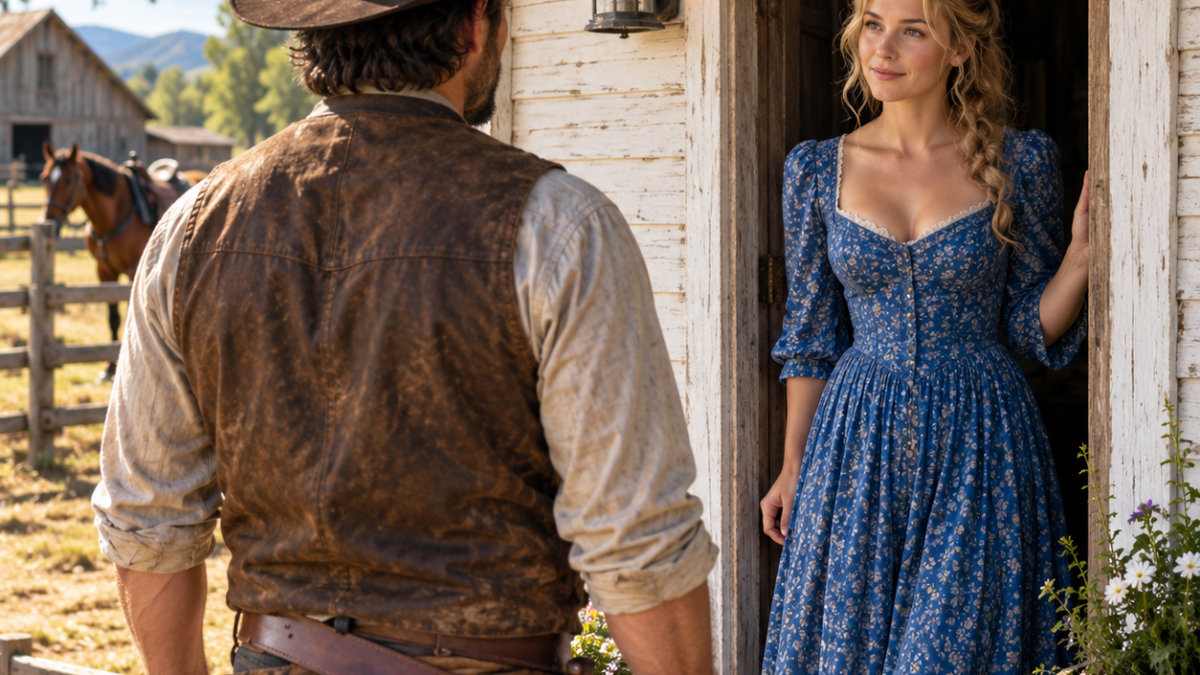
PART3:
A person shouting at injustice is still surprised by it. May Callaway sounded as if she had studied it, measured it, priced it, and placed it in the ledger where it belonged.
“The estate is in probate,” she continued. “The land is technically mine in every way that matters except the ways men at desks recognize. Harlon Briggs at Mil Haven Savings says he answers to depositors. He says calling the note is his legal right.”
“He says that like he wishes it weren’t?”
She looked at me for a long moment.
“You notice tone.”
“I’ve been on the wrong end of enough decisions to notice how men excuse them.”
A faint breath left her, almost a laugh, but not quite.
“Harlon Briggs is not the worst man in Mil Haven,” she said. “That does not make him useful.”
“No.”
“The note comes due in sixty days. I could sell cattle, but I would need to move near forty head at current prices to clear it. That leaves too little to carry the place through winter. I have no family to borrow from. The lawyer in town says fighting the bank would cost more than losing.”
She closed the ledger.
“I need a husband’s signature on the refinancing documents. That is what the bank requires. A husband who can sign and be recognized as having authority over the property.”
Something ugly shifted in my chest.
“You need a man’s name so other men will admit your numbers are real.”
“Yes.”
“And you’re asking me.”
“Yes.”
“You don’t know me.”
“No.”
“That seems unwise.”
“For a woman in my position, every option left has already lost the right to call another one unwise.”
I looked at the ledger. Her handwriting was neat, small, exact. Columns balanced. Expenses marked. Feed, tack, tax, veterinary, salt, repairs, bank interest, burial costs. Daniel Callaway’s death had not only broken her life; it had generated bills.
“What are you proposing?” I asked.
“A marriage that begins as a business arrangement.”
I leaned back.
“Begins as one?”
“If two people live under a roof, work the same land, and survive long enough, it would be arrogant to claim I can predict what it remains.”
That was the first time I truly saw her.
Not just a widow with a hard ledger and a hard problem. A woman honest enough not to decorate desperation, but not so cold she mistook the future for a line item.
“What would the arrangement be?” I asked.
“You would have a home, board, forty dollars a month once the debt is refinanced, and a share of the operation if you stay through winter and work honestly. In return, I need your name on the bank documents and your actual labor on this land. You sleep in the spare room. The marriage remains practical unless both of us choose otherwise later. If either of us chooses to end the arrangement after the note is secure and winter is past, we do it legally and fairly.”
“You wrote terms?”
“Four pages.”
“Of course you did.”
Her eyebrow lifted.
“I mean that respectfully,” I said.
“You should. They are good terms.”
Despite myself, I almost smiled.
She turned the papers toward me. “Read them before you answer.”
I did.
Slowly.
She did not rush me. She poured coffee, set a cup near my hand, and returned to checking another column while I read. The terms were plain and fair. More generous than most employment contracts I had worked under, and more honest than some marriages I had seen.
When I finished, I looked at her.
“You asked other men?”
“Two.”
“What happened?”
“One laughed.”
I waited.
Her mouth tightened.
“The other tried to renegotiate the terms in a direction I found unacceptable.”
My hand curled around the coffee cup.
“What direction?”
“One that would have made me less a partner and more an included piece of property.”
I looked toward the rifle above the door.
“Did he leave walking?”
“Yes.”
“Fast?”
“Eventually.”
That time, the smile nearly reached me.
She gathered the papers.
“You have until tomorrow morning to decide. The barn is dry. There is food in the kitchen. If you leave before dawn, latch the gate behind you.”
Then she stood and went back to her accounting as if she had not just placed the strangest proposition of my life between us.
I remained at the table for a long time after she left the room.
Through the window, beyond the east pasture, I saw a man on horseback sitting motionless on the ridge.
Watching the house.
I stood.
The rider turned his horse east before I could get a proper look, but something about the stillness stayed with me. Men who pause on ridges are rarely just enjoying the view.
I filed it away.
Then I went to the barn.
It was a good barn. Clean. Dry. The kind of barn that told the truth about its owner. Animals settled when a person cared properly. These animals were settled. The horses watched me with interest, not fear. The tack was worn but oiled. Hay was stacked with sense. A loose board near the east wall had been marked for repair with a strip of cloth tied through a nail hole.
I spread my bedroll in the loft and lay awake with my hands folded over my chest.
I thought about May Callaway’s dark eyes.
I thought about her ledger.
I thought about the rider on the ridge.
I thought about the word husband, and how strange it felt when applied to a man like me.
I had spent my entire life working other people’s land.
My father had been a hired hand, and his father before him had been a tenant farmer who died owing more than he owned. I had learned early that usefulness could keep a man fed, but it could not make him belong. I had repaired barns where I had no right to sit at the table. I had fixed fences I would never cross again. I had driven nails into beams beneath roofs where another man’s children slept.
Always useful.
Never rooted.
I had told myself that was freedom.
A man with no land could leave whenever he pleased. A man with no wife could disappoint no one but himself. A man with no fixed place could outrun every failure except the ones he carried under his skin.
But somewhere after twenty-five, the open road had stopped feeling like liberty and started feeling like proof that nothing had asked me to stay.
That night in May Callaway’s barn, I stared into the dark rafters and imagined driving a nail into wood that was mine to keep.
I wondered if the echo would sound different.
By dawn, I had not slept much.
At six, I walked into the kitchen.
May was already awake. Coffee made. Bacon in the pan. Ledger open. Hair pinned, sleeves rolled, face composed.
She looked up.
“Yes,” I said.
For a moment, the stillness in her broke.
Not dramatically. May did not seem built for dramatic collapse. But something in her eyes shifted, and she let out a breath like someone who had been carrying a full bucket too far and had just felt another hand take the handle.
“Sit down,” she said. “We go to town this afternoon.”
We were married at three o’clock on a Wednesday.
The ceremony took eleven minutes.
The reverend looked at us over his spectacles as if he suspected there was more arithmetic than romance in the room, but he said the words. The witnesses were Martha Greer from the general store, who stared hard enough to stitch a story with her eyes, and a blacksmith named Caleb Rowe who smelled like iron and politely minded his own business.
May wore her good dress. Dark green, plain, well-made. No flowers. No veil. Her wedding ring from Daniel hung on a chain beneath her collar. I noticed the shape of it once when sunlight caught it through the fabric and then made myself stop noticing.
I wore my clean shirt.
When the reverend asked if I took May Callaway as my lawful wife, the word lawful struck me differently than I expected.
Not beloved.
Not cherished.
Lawful.
That was what she needed first. Not poetry. Not passion. Protection the law would recognize. A signature men in town would not laugh out of the room.
“I do,” I said.
May’s voice did not shake when she said the same.
Outside, as we walked back to the wagon, she looked at me and said, “Thank you.”
“We should go over the cattle records tonight,” I replied. “I want to know what we’re working with before the week is out.”
She looked at me sideways.
“All right,” she said.
For the first time since I had knocked on her door, a smile came close to reaching her face.
It didn’t fully arrive.
But it was there.
What was also there, standing outside the feed store as we passed through Mil Haven, was the rider from the ridge.
Now I got a clean look.
Broad shoulders. Sandy beard. Good hat. Expensive saddle. Cigar between his fingers. A man too comfortable being watched.
“Garrett Holland,” May said without turning her head.
“The neighbor?”
“East side. Five hundred acres.”
“He always watch wedding wagons like that?”
“Only when the bride owns land he wants.”
I kept my eyes on the road.
“How long?”
“Since before Daniel died.”
The man did not move as we passed.
I had repaired enough broken things to recognize damage at the beginning. Some rot starts with water. Some with termites. Some with a man standing still in the distance, deciding which tool to use.
The first weeks were entirely practical.
That was good.
Practical work keeps awkwardness from getting too much oxygen.
I rose before sunrise and worked until my shirt clung to my back. The east side of the barn roof needed repair where weather had softened the boards. Two pasture gates hung wrong. The south fence had been patched three different ways by three different standards, none of them satisfactory. The herd needed a clearer count. The tack needed repair. The windmill needed attention before cold weather.
May worked like two people and ate like she forgot food existed unless reminded.
By our third day, I learned to put a plate near her ledger if I expected her to eat before nightfall. She would blink at it, as if surprised food had found her, then eat while reading.
She knew the land in a way Daniel’s old notes did not. She knew which pasture held water longest, which slope dried first after rain, which cow always tested weak fence, which horse would pretend lameness if the wrong person saddled him, which boards on the porch complained loudest in damp weather.
The bank meeting happened on Thursday.
Mil Haven Savings Bank was a brick-front building that looked too proud for the street it stood on. Harlon Briggs, the bank manager, was a small, precise man whose suit fit perfectly and whose face wore the careful expression of someone who believed fairness was a column to be balanced, not a mercy to be extended.
He greeted me first.
“Mr. Harding.”
“Callaway-Harding now, I suppose,” May said.
Briggs blinked as if she had spoken out of turn in a room where her own land was being discussed.
“Mrs. Harding,” he said, correcting himself with effort.
He reviewed the paperwork.
Then he asked me three questions about the property without looking at her.
“How many head currently?”
“Sixty. Fifty-six mature, four spring calves.”
“Water access?”
“Creek on the western edge, well near the barn, windmill north pasture needing maintenance before winter.”
“Estimated winter feed?”
“Short unless we move ten nonbreeding stock or supplement from Greer’s hay lot before prices rise.”
May turned her head slightly.
I answered without looking at her.
Briggs signed the refinancing papers.
Just like that, the crisis that had been squeezing her lungs for eight months loosened because a man had repeated numbers she already knew.
Outside, May stood on the boardwalk with the signed papers in her hand.
“He looked at you like you’d done something remarkable,” she said.
“What did I do?”
“You answered his questions about my land without looking to me to check.”
“I read the ledger.”
She stared at me.
“The entire ledger?”
“Before I decided, I needed to understand what I was working with.”
“Most men would have only read the payment terms.”
“I’m not most men.”
The words came out before I could dress them in humility.
A dangerous sentence. Often foolish. Occasionally true.
May looked at me with the expression of a woman recalibrating something.
Then she folded the papers carefully.
“The cattle records are in the second drawer,” she said. “I’ll show you the pasture rotation after supper.”
What I did not tell her then was that while reading the ledger, I had found something troubling.
A note in Daniel Callaway’s handwriting from the previous April.
Holland offered again. Land office showing boundary discrepancy from ’74 survey. Check with Pratt in Abilene before winter.
Daniel had never checked.
Maybe he meant to. Maybe fever took him before he could. Maybe he brushed it aside because men often underestimate paperwork until paperwork becomes a weapon in another man’s hand.
I had folded that information away.
Now, walking beside May through Mil Haven with Garrett Holland watching from across the street, I felt the note unfold inside my mind.
Mil Haven had opinions, naturally.
A town can survive drought, debt, and bad beef prices, but it cannot survive a strange marriage without discussing it to death.
By sunset, Martha Greer at the general store had reportedly told half the county that May Callaway had married a stranger she had known one day. By sunrise, the story had acquired details no one present had witnessed. I had been described as a drifter, a fortune hunter, a hired gun, a cousin from Arkansas, and, briefly, an escaped prisoner, until Caleb Rowe told the blacksmith customers I had stood beside him for eleven minutes and my wrists bore no shackle scars.
May ignored all of it.
Or pretended to.
The pretending cost her. I could see that.
She stood straighter in town than she did at home. Spoke less. Paid exact amounts. Answered questions no one had asked directly. People who had smiled at her when Daniel lived now watched her like she had done something indecent by surviving him intelligently.
Garrett Holland did not gossip.
That made him more dangerous.
He came by the east fence on a Monday while I was replacing posts.
“You’re the new husband,” he said.
I kept working. “Will Harding.”
“Holland.”
“I know.”
He sat his horse comfortably, cigar unlit between his teeth.
“Heard May finally found someone to sign the papers.”
“She found a husband. The papers were a side effect.”
His eyes narrowed a fraction.
He looked at the fence, at the posts I had set, at the wire I had pulled straight enough to sing.
“You intend to be here long?”
“Fence won’t care if I don’t.”
“That land’s been in contention longer than May knows.”
I drove a staple into the post.
“Which land?”
He pointed with the cigar toward the east pasture. “Old survey from ’74 has irregularities. Bank knows about it too. Might be worth checking before you put too much work into that side.”
There it was.
The stone dropped into water to measure the depth.
“You concerned for us?” I asked.
He smiled slightly. “I prefer clean boundaries.”
“Most men do when they hope to move them.”
The smile disappeared.
“Ask around before you get too comfortable, Harding.”
“I ask the ground first.”
“That so?”
“It’s less inclined to lie.”
He rode away without answering.
I drove the next post with three clean strikes, then stood looking along the east boundary until sweat dried cold under my shirt.
That evening, I wrote to John Pratt in Abilene, the surveyor named in Daniel’s note.
I did not tell May yet.
Not because I meant to keep secrets from my wife, business arrangement or not. But fear is a weight. A man should not hand it to someone already carrying too much unless he can also hand her a handle.
I wanted the shape of the problem first.
October arrived, and with it came complications not written into our four pages of terms.
The weather cooled. The cattle grew restless. The evenings shortened. Work that had been hot and hard became cold and hard, which is a different thing entirely.
One night, I was in the barn mending a trace harness when May came in carrying a supper plate.
That was not in the terms.
It had simply started happening.
She set the plate on the workbench. Beans, cornbread, salt pork, coffee in a tin cup.
“You’ll forget to eat,” she said.
“I’ve remembered eating most of my life.”
“Not recently.”
I took the plate.
“Thank you.”
She looked at the harness.
“Daniel kept saying he’d replace that.”
“It can be repaired.”
“The leather’s good?”
“Good enough. Stitching failed first.”
“He was a good man,” she said after a moment. “Just not careful with money.”
I kept my eyes on the harness.
“Or with ledgers.”
Her silence sharpened.
“Or land office filings,” I added.
She sat slowly on the edge of the workbench.
“You found the note.”
“Yes.”
“When?”
“Before the wedding.”
Hurt flashed across her face before she controlled it.
“You didn’t tell me.”
“No.”
“Why?”
“Because I didn’t know what it meant yet.”
“You should have told me.”
“Maybe.”
That answer angered her more than denial would have.
“Maybe?”
I set the harness down.
“I have spent most of my life watching men toss problems at women and call it honesty. I found a sentence in Daniel’s hand, a neighbor watching your ridge, and a bank too eager to make your authority someone else’s. That wasn’t yet information. It was smoke. I wrote to Pratt to find the fire.”
She stood.
“You are my husband on paper.”
“I know.”
“That means if men are coming for this land, they will come through you now. But it is still my land too. My fear belongs to me as much as yours belongs to you.”
I felt the truth of that like a deserved slap.
“You’re right.”
She looked surprised.
Then suspicious.
“You agree too easily.”
“I agree when I’m wrong.”
“That must be convenient.”
“Rarely.”
She looked away, but I saw the corner of her mouth soften.
“What did Pratt say?”
“Nothing yet. I asked him to come if he remembers the 1874 survey.”
“And Holland?”
“Knows enough to want us worried.”
She folded her arms.
“Then from now on, you tell me smoke before you find fire.”
“Yes, ma’am.”
“Don’t ‘ma’am’ me after hiding boundary trouble.”
“Yes, May.”
That did it.
The smile finally arrived. Small, unwilling, and gone quickly, but real.
We ate supper in the barn that night, sitting side by side on the workbench with the harness between us and lantern light warming the wood walls. We did not speak much. We did not need to. The air between us had changed, not into ease exactly, but into something more honest than politeness.
John Pratt arrived from Abilene in the second week of November.
He was a narrow, sunburned man with a gray beard, a surveyor’s chain, a theodolite packed like church silver, and the deep irritation of someone who had spent his life explaining to landowners that wishful thinking did not alter measurement.
He spent two days on the east pasture with May and me beside him.
May asked better questions than I did.
Pratt noticed.
By the second afternoon, he spoke mostly to her.
“The compass variation was mishandled in the 1874 survey,” he said, standing near a stake driven deep into the ground. “Boundary was placed roughly ninety feet west of where it ought to be.”
May’s face went very still.
“How much land?” she asked.
“Close to forty acres along the east side.”
“Holland’s been grazing it?”
“By the old filed line, yes.”
“But by correct measure?”
Pratt pointed east.
“Callaway land.”
For a moment, nobody spoke.
The wind moved dry grass across our boots.
May looked out over the disputed ground, and I watched anger rise in her—not hot and noisy, but clean and bright.
“How soon can the correction be filed?”
“Tomorrow morning if we ride early.”
“We ride early,” she said.
We filed the corrected survey on Thursday.
On Friday night, someone cut the east fence.
Not one section.
Three.
A quarter mile of wire dropped. Posts pulled. Sixty cattle pushed through the gaps into the open land between the Callaway property and Holland’s eastern boundary. Land muddy enough in law, dark enough in practice, and cold enough in weather to create exactly the confusion Holland needed.
I found it at five in the morning.
The world was still black, the kind of black that comes before winter dawn when the sky has not yet admitted there will be light. The wind had turned mean overnight. My breath fogged hard in front of me. Somewhere to the north, a norther was coming down.
I rode back to the house fast and went inside.
For half a minute, I stood at the foot of the stairs, debating.
May had slept poorly all week. I could saddle up, ride out, gather what I could before waking her. Spare her one more blow.
Then her words came back.
My fear belongs to me as much as yours belongs to you.
So I went upstairs and knocked once on her door.
She opened it already reaching for her wrapper.
“What?”
“East fence is down. Three sections. Cattle are out.”
She was dressed before I finished saddling my horse.
Boots. Coat. Hair braided fast. Rifle from above the kitchen door.
I looked at the rifle.
“You don’t have to—”
“They’re my cattle.”
She walked past me into the barn.
I stood there one second longer than necessary, watching her saddle with quick, furious competence.
This is what it looks like, I thought, when someone refuses to let a thing fall.
We rode into the dark together.
The cattle were spread across a mile of open ground, pushed east by men who knew what they were doing. Not scattered randomly. Moved deliberately. Tracks told the story even in poor moonlight. Three horses. Wide pressure. No panic. No theft in the usual sense.
Confusion.
That was the plan.
Cattle mixed with Holland’s herd in the dark. Boundary newly corrected, not yet known by half the county. A legal dispute filed before we could sort brands cleanly. Winter pressing down. Bank debt still tender. A widow’s authority newly protected by a husband no one trusted yet.
It was not a wild move.
It was a patient man’s move.
May rode west to cut off a group drifting toward a draw. I pushed east.
Near the far end, I found two of Holland’s men sitting horses beside the boundary.
Not working.
Waiting.
I rode directly at them.
No rifle raised. No shouting. Just me and my horse crossing open ground in the cold dark with the wind rising.
One of them said, “This ain’t your land, friend.”
“It is actually.”
“Old line says different.”
“Corrected survey filed Thursday. You’re welcome to check.”
They glanced at each other.
One had a scar under his left eye. The other kept his hand too near his revolver and his eyes too far from mine.
“I’m moving my cattle now,” I said. “You can help, or you can ride back to Holland and tell him the survey is filed and the cattle are going home.”
Scar laughed. “Or what?”
“The next time someone pulls my fence posts in the dark, I won’t come alone.”
The wind struck hard enough to flatten my coat against my ribs.
The two men considered me.
A hired man does arithmetic like anyone else. Pay on one side. Broken bones on another. Legal trouble somewhere in the middle.
The second man muttered, “Ain’t worth freezing over.”
They turned and rode east.
I watched until they disappeared.
By the time May and I pushed the herd back through the gaps and braced the fence well enough to hold until daylight, the temperature had fallen sharply. The first snow came sideways.
May looked north.
“Big die-up coming,” she said.
“I know.”
“Then we have work to do.”
She was already riding for the barn.
The winter of 1886 hit Texas like judgment.
Old-timers later called it the big die-up. Men who had survived Comanches, drought, ticks, rustlers, panics, and politics watched cattle freeze standing in open range. The storm did not arrive as weather usually does, giving warnings a man can bargain with. It came like an army.
The temperature dropped below anything I had ever felt in Texas. Water froze hard. Wind cut through wool, through seams, through skin, through courage if a man let it. The creek sealed over. The north pasture windmill seized. A calf could die in less than an hour if exposed wrong. Cattle drifted with the storm until fences, draws, or exhaustion stopped them.
Sleep became something we discussed but rarely met.
May and I worked as if our bodies belonged to the land and would be returned later if the land was feeling generous.
We lost seven head in the first week.
Unavoidable, Pratt said later.
Necessary loss, Briggs called it.
I hated both phrases.
There is no such thing as an acceptable dead animal when you were the one responsible for keeping it breathing.
We saved eleven more by doing things bigger operations would have called foolish. We brought weakened calves into the kitchen. Three of them spent two nights near the stove wrapped in blankets while May and I took turns warming milk, rubbing legs, and arguing with death in the language of chores.
The kitchen smelled of cattle, smoke, coffee, wet wool, and stubbornness.
May kept the ledger on the table through all of it.
Not because she had time to account. Because it steadied her. When she could not control the wind, she could write down what feed went where. When she could not stop the cold, she could mark which cattle were moved to the barn, which needed checking, which might last if morning came soon enough.
On the worst night, the temperature dropped to twenty-two below.
The barn door froze at the base and took both of us to force open. Wind shoved snow through every gap in my coat. The air burned inside my nose. The dark seemed solid.
I came in from the north pasture near midnight with frostbite starting in three fingers.
I did not mention it.
May saw anyway.
“Sit,” she ordered.
“I need to check—”
“Sit down before I knock you down and check everything myself.”
I sat.
She took my hands in hers over the kitchen table. Her fingers were cold too, rougher than they had been in August, skin cracked near the knuckles. She warmed cloths by the stove and worked over my fingers with steady concentration.
“You should have said something sooner,” she muttered.
“You were busy keeping a calf alive in a flour sack.”
“I can be angry at two things at once.”
“I’ve noticed.”
She looked up.
For some reason, we both nearly laughed.
The calf nearest the stove sneezed weakly.
May went back to my fingers.
Color returned slowly, painfully. I gritted my teeth through it.
“Hurts?” she asked.
“Yes.”
“Good.”
“That seems unkind.”
“If it hurts, they’re not dead.”
She bent over my hands, lamplight catching loose strands of dark hair near her cheek, and something in me settled so deeply I almost did not recognize it.
I had been looking my whole life for the thing that would make me stop moving.
I had imagined it, when I bothered imagining, as land with my name on paper. Or a herd I had built. Or a house where nobody could tell me to pack before sunrise. A place mine enough to keep.
I had not expected it to look like a woman with flour on her sleeve, a rifle above the door, a ledger on the table, and the nerve to tell a grown man pain was good because it meant his fingers were alive.
“May,” I said.
She did not look up. “What?”
“Thank you.”
Her hands paused over mine.
Then she said, simply, “They’re your hands too.”
The words struck me harder than they should have.
“This is your land too,” she added.
Then she continued working.
I looked around the kitchen. The calves by the stove. The coffee always on. The ledger open. The rifle above the door. Her late husband’s hat still hanging on the peg, though now my coat hung beneath it. The table where I had first read the terms of a marriage built like a contract and somehow stronger than most vows I had seen spoken with flowers.
I understood then that the echo I had been listening for all my life had finally answered.
I had driven the nail.
I had heard it.
I was not going anywhere.
The worst of the winter broke in February.
Not ended.
Winters like that do not end cleanly. They loosen their fist one finger at a time. But the sky changed. The wind lost some of its teeth. The cattle that remained began to move with a little more purpose. The calves in the kitchen returned to the barn, then the pasture, wobbling like miracles with legs.
Holland came by after the first thaw.
I was mending the east fence. The same fence his men had cut now stood stronger than before. Posts set deeper. Wire pulled tighter. Boundary stakes from Pratt’s corrected survey frozen into the earth like verdicts.
Holland sat his horse and looked at the fence a long time.
“Lost thirty head in the die-up,” he said finally.
“Twenty-two on our side.”
“Heard you lost less than most.”
“We worked harder than most.”
His jaw shifted.
“My men that night,” he said.
“Were doing what you told them.”
He looked at me.
“Or what you let them do,” I added. “Same thing.”
Wind moved across the open ground.
Holland looked at the corrected stakes.
“The survey stands,” he said.
“It does.”
“Then there’s nothing more to say about the east pasture.”
I set down the fence tool and faced him fully.
“There is one thing.”
He waited.
“May Callaway has been on this land her whole adult life. She buried her husband on it. She kept it through a bank that would have taken it, a winter that tried to kill it, and neighbors who thought a woman alone was an opportunity.”
Holland’s face remained blank.
“She’s not alone anymore,” I said. “I’d like us to understand each other on that point.”
For a long moment, he took my measure.
Then, finally, he nodded once.
Not friendly.
Not apologetic.
But a nod all the same.
The nod of a man choosing to become a neighbor rather than continue as a problem because he had been shown the cost.
He rode east.
I watched him go.
Then I picked up the fence tool and went back to work.
The fence needed three more hours.
I would be there to finish it.
I would be there tomorrow too.
For the first time in twenty-eight years, that was not a compromise.
It was exactly what I wanted.
By March, the house had changed.
Not in large ways.
May was not a woman who rearranged life for decoration. But there were signs if a man had eyes.
My spare shirt hung beside Daniel’s old coat instead of folded in my saddlebag. My razor sat on the washstand. There were two coffee cups near the stove every morning. The ledger now had two hands in it—hers neat and precise, mine larger and uglier, but improving under her critical supervision.
The spare room remained where I slept.
Most nights.
Some boundaries remain because no one has named them.
The four pages of terms sat folded in the ledger drawer. We had not spoken of them since the die-up began. There had been no time. Survival does not pause to define relationships.
But the terms had expired in November.
I knew it.
May knew it.
We continued anyway.
One evening in March, with the fire low and the first real warmth of spring pressing faintly through the window glass, I sat across from her at the kitchen table while she reviewed the accounts.
The operation would survive.
More than survive, perhaps.
Fifty-three head had become fifty-eight with spring calves. The bank note was current. We had not expanded the way Daniel once hoped, but the numbers were sound. Real. Sustainable.
May turned a page.
Then stopped.
Her eyes narrowed.
“What?” I asked.
She pushed the ledger toward me.
I looked down.
The salary line.
Forty dollars a month.
Five months.
Beside each entry, in her careful hand, she had written what the account showed.
Returned to operation.
She looked at me.
“You’ve been paying yourself back in.”
“The operation needed it.”
“The operation needed it,” she repeated.
“Yes.”
“So did I.”
That made me look up.
She was not looking at the ledger anymore.
“You could have left,” she said. “After the bank. After Holland. After the fence. After the die-up. You could have taken wages and moved on when the worst passed.”
“No.”
“You had reasons.”
“No,” I said again. “I didn’t.”
Her face softened, but only slightly. May did not give tenderness away cheaply, which made every piece of it worth more.
I took the folded contract from the ledger drawer and placed it on the table.
“The terms,” I said.
She looked at the pages.
“They expired in November.”
“I know.”
“We’ve been operating without a contract since before the die-up.”
“I know.”
“I’d like to discuss new terms.”
She leaned back slowly.
“All right.”
I had faced Holland’s men in the dark with less fear than I felt then.
“I’d like the arrangement to be permanent.”
May did not move.
“Not because of the land,” I continued. “Not because of the bank. Not because of the legal situation or the forty dollars a month I haven’t actually been taking.”
I looked around the kitchen, because looking straight at her made the truth almost too large to say.
“Because of you. Because of this. The coffee always on. The ledger. The calves by the stove. The way you ride into darkness because the cattle are yours. The way you ask for what you need when the whole town expects you to fold. The way you can look at a ruined fence and already be planning the repair.”
My voice roughened.
“I have worked other men’s land my whole life. Slept in barns. Fixed things I had no right to keep. I used to think belonging meant having my name on a deed. But I think maybe it means knowing exactly where you’re needed and choosing to stay after the needing changes.”
May’s eyes were bright now.
I had never seen her cry.
Not once.
“I’d like this to be a marriage,” I said. “A real one. If you’ll have me.”
For a long moment, the only sound was the fire.
Then May stood.
My heart stopped in the half second before she crossed the space between us.
“It became a real one somewhere around the calves in the kitchen,” she said.
Then she kissed me.
Not tentatively.
Not like a woman testing a business arrangement for warmth.
She kissed me with the complete conviction of someone who makes decisions carefully and keeps them entirely.
I kissed her back with the certainty of a man who had finally found the place where the nail sounded different.
Outside, Texas spring was arriving on land that had tried to freeze, starve, and break, and had failed.
The east fence stood.
The herd was rebuilding.
The survey was filed.
The debt was on schedule.
Garrett Holland was behaving like a tolerable neighbor.
Inside, the kitchen was warm, the coffee was on, and my wife’s hand was in mine.
By May, the pastures came in strong.
Good grass often follows a hard winter. The ground, broken and battered, finds some stubborn way to renew itself. I understood that better than I once had.
May and I walked the east fence line together one morning, checking wire after the thaw. She carried the ledger even then, tucked under one arm as if the cattle might present receipts. I teased her for it. She ignored me with dignity.
The boundary stakes stood firm.
The land beyond them rolled green under the Texas sun.
“I wrote to my father,” I said.
May looked at me.
“You haven’t written him in years.”
“Three.”
“What did you say?”
“I found a place. I’m staying.”
She looked away.
“You left the letter on the table.”
“I know.”
“You knew I’d read it?”
“You read everything.”
“That is not an answer.”
“It is when it’s true.”
She walked a few paces, boots brushing new grass.
“Did you send it?”
“Yes.”
“And?”
“He wrote back.”
That made her stop.
“What did he say?”
I took the letter from my coat pocket.
It had arrived the day before, and I had carried it folded there because some words need time near the heart before they can be shared.
May opened it carefully.
My father’s handwriting was rougher than I remembered.
Will,
Your mother cried when I read your line about staying. She said it was the first sensible thing any Harding man has written in twenty years. I told her that was unfair to me. She said it was accurate.
If the place is good, work it. If the woman is good, honor her. If the land answers when you put your hand to it, stop looking for a better road.
We would like to meet her when the weather allows.
Your father.
May read it twice.
Then handed it back.
“I like your mother already.”
“She’ll like you.”
“You sound certain.”
“She appreciates accuracy.”
May smiled fully then.
Not almost.
Not briefly.
Fully.
The sight of it made the whole pasture seem better lit.
In June, Harlon Briggs stopped me outside the bank.
For a man who had nearly helped the law bury my wife’s future, he looked unusually humble, which is to say mildly uncomfortable.
“Harding,” he said.
“Briggs.”
“The Callaway-Harding note is the most current in my portfolio.”
“I know.”
He coughed. “I did not expect it.”
“I know that too.”
He looked across the street, then back at me.
“The system is not designed for situations like Mrs. Harding’s.”
“No. It is designed to make situations like hers worse.”
His mouth pressed flat.
“I did what the law allowed.”
“That is not always the same as doing what is right.”
“No,” he admitted. “It is not.”
That surprised me.
He adjusted his cuffs.
“I will be recommending different refinancing policies for widows with established operation records.”
“Will the board listen?”
“Perhaps not.”
“Recommend them anyway.”
He nodded.
“I intend to.”
When I told May that evening, she listened without expression.
Then she said, “Good.”
That was all.
But later, I saw her write something in the back of the ledger where she kept notes not meant for daily accounting.
I did not read it.
Marriage had taught me that some pages are private until offered.
In late summer, nearly a year after I first knocked on her door, May moved Daniel’s hat from the peg by the back door.
I was coming in from the barn when I saw her holding it.
The house went quiet around us.
She stood very still, fingers around the brim.
“I’m not throwing it away,” she said before I could speak.
“I didn’t think you were.”
“I thought about leaving it there forever.”
“I know.”
“That seemed loyal.”
“Maybe it was, for a while.”
She looked at the peg.
“It started feeling like I was asking him to guard a door I no longer needed guarded.”
My chest tightened.
“What will you do with it?”
She carried it to the trunk in the sitting room where she kept Daniel’s things. Not hidden. Not displayed. Kept.
She placed it inside with care.
Then she closed the lid.
When she turned, tears stood in her eyes.
Not many.
Enough.
“He was a good man,” she said.
“I know.”
“I loved him.”
“I know.”
“I love you.”
Those words struck me silent.
She laughed through the tears, small and embarrassed.
“Don’t look like I shot you.”
“You moved fast.”
“I’ve been thinking it since March.”
“That’s fast to you?”
“Very.”
I crossed the room and took her hands.
“I love you too.”
“I know.”
That made me laugh.
Then she added, “But I still wanted to hear it.”
So I said it again.
“I love you, May.”
Outside, the land held heat. The cattle moved slow in the evening pasture. Somewhere near the barn, a hammer hung on a nail I had driven months ago, and I thought of the echo it had made.
Different.
I knew now why.
It had not sounded different because the wood belonged to me.
It sounded different because I was finally building something with someone who expected me to remain.
By the next spring, the operation had grown modestly. Not recklessly. May had no patience for vanity disguised as expansion. We rebuilt the herd carefully, improved the east fence, added drainage near the barn, and replaced the old trace harness I had repaired that first October. May insisted we keep the repaired one hanging in the barn.
“For reference,” she said.
“To what?”
“To the fact that not everything worn out needs replacing.”
It was the nearest she came to sentiment, and I did not mock it.
Garrett Holland became, as I once told May, a tolerable neighbor. He never apologized directly. Men like Holland often lack the muscle. But he sent two hands to help raise a fallen section of fence after a storm without being asked, and he stopped grazing close to the corrected line. Once, when passing through Mil Haven, he tipped his hat to May and called her “Mrs. Harding” with no sarcasm in it.
May accepted the respect without rewarding him with warmth.
That was one of the many things I admired about her.
Respect was owed.
Warmth was earned.
Martha Greer, who had declared our marriage either practical genius or coming disaster, eventually announced at the general store that it was practical genius after all. May said Martha had only waited until profit made romance respectable.
She was probably right.
The strangest thing about the whole arrangement was how ordinary it became.
At first, everything between us had felt like a document waiting for signatures. Then like a storm to survive. Then like a question neither of us dared answer too early.
Eventually, it became coffee before dawn.
Her cold feet under the blanket.
My hat on the wrong peg.
Her corrections in the ledger margins.
My habit of overbuilding gates.
Her insistence that I not overfeed cattle out of affection.
My insistence that she sleep when fever took her one winter and she tried to calculate feed costs with a temperature of one hundred and two.
It became arguments, too.
Real ones.
About buying a second bull.
About whether the kitchen roof needed patching or replacing.
About whether I had any right to mend my own shirt when her stitching was clearly better.
About children, once, in a quiet conversation that left us both tender and afraid. May said she did not know if her body would give her that. I said a family was not only made by birth. She cried then, unexpectedly, and I held her until the lamp burned low.
Two years later, a boy named Samuel came to us after his mother died and his father vanished somewhere west of Fort Worth.
He was nine, silent, suspicious, and too thin.
He had been sleeping in Greer’s storeroom when Martha sent for May.
“I can’t keep him in flour sacks forever,” Martha said. “And he bit Caleb when Caleb tried to move him.”
May crouched in front of the boy and looked him over the way she had once looked at me on her porch.
“Do you know cattle?” she asked.
Samuel stared.
“No.”
“Can you learn?”
He shrugged.
“Do you bite everyone or only blacksmiths?”
I turned away to hide my smile.
Samuel’s mouth twitched.
“Only if they grab me.”
“Fair,” May said. “We don’t grab people on our farm unless they’re falling off something. Come eat.”
He came home with us that day.
No papers at first.
Then papers.
Then a room.
Then chores.
Then laughter, rare and startling and precious.
The first time he called May “Ma,” she kept working like she had not heard, then went behind the barn and cried into my shirt for ten full minutes.
“Don’t say anything,” she warned.
“I wouldn’t dare.”
“You’re smiling.”
“I’m breathing.”
“You smile with your breathing.”
“I’ll stop breathing.”
She hit my chest lightly and cried harder.
Samuel grew into the land the way good grass grows after hard weather. Not all at once. Not without stubborn patches. But strongly. He learned cattle. Learned figures. Learned that May’s ledger was law and my overbuilt gates were a family curse. He learned Daniel’s name, not as a ghost but as part of the land’s history. He learned that a person can be loved by people who arrived late.
Once, years after he came to us, he found the old four-page agreement tucked into the back of a ledger.
He was sixteen then, long-legged and all elbows, pretending not to care about everything he cared deeply about.
“What’s this?” he asked.
May and I were at the kitchen table.
I looked up.
“My first marriage proposal,” I said.
May rolled her eyes.
Samuel read the pages with growing fascination.
“You paid Pa forty dollars a month?”
“No,” May said. “He kept putting it back into the operation like an infuriating saint.”
“I was never a saint.”
“No. That’s true.”
Samuel looked between us.
“So you married him to save the farm?”
“Yes,” May said.
He looked at me.
“And you said yes?”
“Yes.”
“After knowing her one day?”
“I had read the ledger.”
Samuel considered that.
Then nodded as if it made perfect sense.
“Well,” he said, “it is a good ledger.”
May laughed so hard she had to sit down.
I loved that sound.
Every year on the anniversary of the day I knocked on her door, May made bacon and coffee before dawn and placed the old ledger on the table.
“Performance review,” she would say.
The first year, I thought she was serious.
By the fifth, I still pretended to worry.
By the tenth, Samuel joined in and accused me of underperforming in the area of punctual fence repair. May marked the complaint as “noted.”
On our twentieth year, after the herd had grown, after the bank debt had long been paid, after Briggs had retired and Holland had died and Mil Haven had changed the way towns do when railroad rumors come and young people leave and babies become store owners, May brought out the ledger at dawn.
Her hair had silver in it then.
Mine had more.
Her eyes were still dark, still direct, still capable of taking a full measure of a situation before committing to a response.
She opened to the back page.
I expected the old joke.
Instead, she turned the book toward me.
On the page, written in her careful hand, was a note.
August 14, 1886. Will Harding came to the porch asking for work. I asked for more than I had any right to expect. He did not laugh.
I read it twice.
My throat tightened.
“You wrote that the day I came?”
“That night.”
“Before I said yes?”
“Yes.”
I looked at her.
“What if I had left?”
“Then I suppose I would have written that you latched the gate.”
I laughed, but my eyes burned.
She turned another page.
March 3, 1887. Terms expired months ago. Marriage became real around the calves in the kitchen. Must tell him soon. He is slow with certain matters.
“I was not slow,” I said.
“You were glacial.”
“I was respectful.”
“You were glacial respectfully.”
I reached across the table and took her hand.
Her fingers were older now. Knuckles enlarged from work. A scar near her thumb from the winter Samuel tried to build a chicken coop and involved nobody with sense. Hands that had held ledgers, rifles, calves, grief, my frostbitten fingers, our son’s face, and every season the land had brought us.
“I came asking for a job,” I said.
“You got one.”
“I asked to be a cowboy.”
“You became a husband.”
“I think you were the better negotiator.”
“I had the better ledger.”
That was true.
She closed it.
Outside, dawn spread over the Callaway-Harding land. The east fence stood where it should. The barn roof I had first repaired still held, though it had been replaced properly twice since. Cattle moved in the pasture. Samuel’s children would arrive later that day, loud and hungry, carrying chaos in both hands.
I thought of my younger self riding up to that gate, dusty, rootless, believing the world had no particular reason to keep him.
I thought of May opening the door with ink on her finger and a ledger in her hand.
I thought of every man who had underestimated her because she was a woman alone.
Every law that had tried to make her smaller.
Every neighbor who had mistaken her vulnerability for invitation.
Every winter that had tried to take what we were building before we knew we were building it.
They all failed.
Not because love made life easy.
It never did.
They failed because May Callaway asked for what she needed when pride would have killed her. Because I said yes before I understood that I was not saving her nearly as much as she was giving me the first true place I had ever belonged. Because we learned, day by day and chore by chore, that marriage is not proved by the words spoken in front of a reverend.
It is proved in the bank office when one person’s numbers are finally believed.
It is proved in the barn when supper appears beside a broken harness.
It is proved in the dark when the fence is cut and both riders saddle up.
It is proved at twenty-two below when frostbitten hands are warmed without complaint.
It is proved when the contract expires and nobody leaves.
May once told me she did not need a cowboy.
She needed a husband.
She was right.
But I needed something too, though I did not know how to name it then.
I needed a door to open.
I needed a woman brave enough to put the truth plainly on the table.
I needed land that would answer when I worked it.
I needed a reason to stop mistaking drifting for freedom.
I needed the echo of a nail driven into a roof I meant to keep.
And on a hot Texas afternoon in 1886, with a tired horse at the gate and dust on my boots, I found all of it on a porch where a widow stood holding a ledger like a weapon and asked me for the strangest, truest work of my life.








