I Arrested a Silent Biker for Blocking an Ambulance—Then a Paramedic Found What His Harley Had Saved
PART3:
Its screen was cracked, and an unfinished message remained visible.
LOOK BEHIND—
The phone began vibrating.
The incoming caller was identified as HAWK.
The biker looked at the phone, then at me, then back toward the blind corner.
Something in his face finally reached me.
“Is someone there?” I asked.
He nodded so hard his beard struck his chest.
I left Daniel holding him and ran around the ambulance.
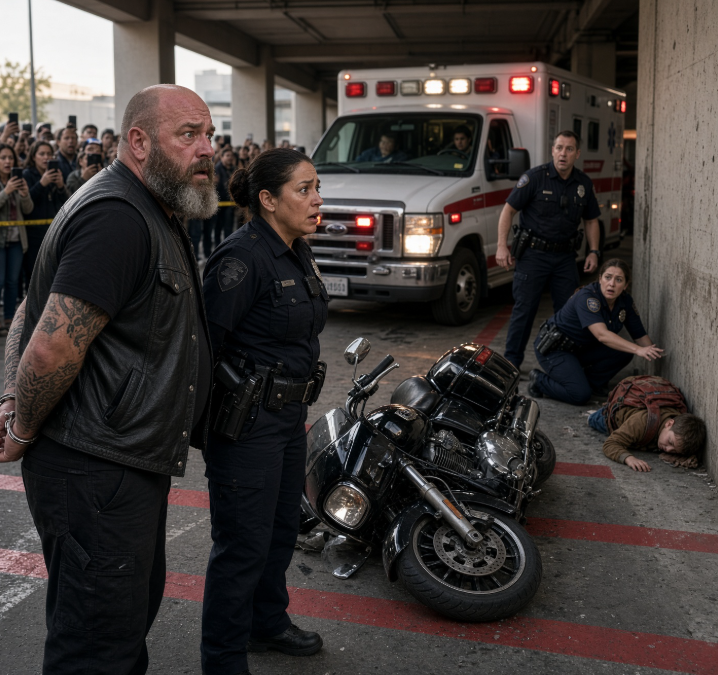
The building created a deep wedge where the rearview mirrors reflected concrete instead of pavement. Unit 14 had pulled forward to unload through a side entrance, but congestion forced Grace to reverse before she could align with the receiving doors.
A child’s hand lay in that blind wedge.
I ran harder.
The boy was unconscious. His head rested less than four feet from the ambulance’s rear path. He wore a brown sweatshirt that blended into the shadow. One sneaker had fallen off, and a faded red backpack was caught around the corner.
Only its strap could be seen from the open lane.
“Grace!”
She heard something in my voice and ran.
The next sixty seconds moved faster than thought.
Grace dropped to her knees and found a weak pulse. Her partner, Devin Cole, pulled a pediatric bag from the ambulance. Daniel released the biker long enough to move toward us, then stopped because the crowd was closing in.
I shouted for everyone to get back.
The biker remained beside the patrol vehicle with his wrists cuffed behind him.
He watched the boy.
His face showed no relief, only terror.
Grace checked the child’s airway while Devin prepared oxygen. His skin was dangerously hot. A shallow cut beneath his sock had soaked through the fabric. His breathing came in weak, rapid bursts.
“How long has he been down?” Grace asked.
“I don’t know.”
“Did anyone see him fall?”
No one answered.
The people holding phones lowered them one at a time.
I looked at the fallen Harley.
There had been no safe parking space near the boy. No time to type an explanation. The biker had accelerated across the ambulance bay, stepped away while the Road King still rolled, and forced nearly eight hundred pounds of steel onto its side.
The motorcycle created a barrier no driver could overlook.
Unit 14 stopped twelve feet short.
The boy was alive inside those twelve feet.
I ran back to the patrol car and removed the handcuffs.
Deep red marks circled the biker’s wrists.
He did not rub them.
He went to the grocery bag lying beside the child and knelt among the spilled contents. Two bread rolls had burst from their plastic wrapping. An apple had rolled beneath the ambulance. A small carton of milk leaked across the pavement.
The biker collected the bread and returned it to the bag as carefully as if it still mattered.
“I’m sorry,” I said.
He looked at me.
“Why didn’t you shout?”
His expression changed.
He reached beneath his bandanna and pulled down the collar of his T-shirt.
A curved surgical scar crossed his throat. Below it was a permanent breathing opening.
I knew enough about medicine from working at St. Anne’s to recognize a total laryngectomy.
Air entered his lungs through the stoma in his neck. It no longer passed through vocal cords because he no longer had any.
The man physically could not shout.
He took the cracked phone from Unit 14’s dashboard. Using two thick thumbs, he typed seven words and held the screen toward me.
I LOST MY VOICE.
I DIDN’T LOSE MY BIKE.
Behind us, Grace and Devin raised the boy onto a stretcher.
His eyelids opened for less than a second.
He looked past the paramedics and found the biker.
Then the child pressed two fingers against his chest in a small, deliberate motion.
Thank you.
The biker answered in the same language.
That was the first sign they had met before.
The second came from inside the boy’s backpack.
Beneath two school workbooks, a bus schedule, and an emergency-shelter card was a photograph protected with clear tape.
The picture showed the same black Road King.
It showed the same biker.
And standing in the background was another homeless young man who had died at St. Anne’s eighteen months earlier.
The biker’s name was Dale Rourke, though everyone who rode with him called him Mute.
The name had not begun as an insult.
Dale had carried it since his twenties, when he worked nights towing wrecked cars from Interstate 40. Back then, he possessed a deep voice that could be heard over an idling Harley, but he rarely used it during club meetings.
He preferred a wrench, a nod, or a hand placed on someone’s shoulder.
At fifty-seven, silence was no longer a choice.
Eleven months before I handcuffed him, surgeons removed Dale’s larynx, part of his thyroid, and the voice his late wife had once described as “gravel dragged through warm coffee.”
The surgery left the permanent stoma in his throat. He carried cleaning supplies in his saddlebag and covered the opening with a soft black cloth when he rode to keep out road dust.
He owned an electrolarynx, a small device that produced a mechanical voice when pressed against his throat.
Dale hated it.
Children stared at the sound.
Adults pretended they were not staring.
He communicated mostly through text messages and sign language instead.
Dale had gone to St. Anne’s that Friday for an oncology scan.
Three members of the High Desert Saints had ridden with him because his previous scan showed a shadow near the surgical margin.
No one used the word recurrence.
Hawk Bell, the club president, brought two thermoses of bitter road coffee and talked about a carburetor problem for most of the ride. Lewis “Doc” Haney carried Dale’s medical folder inside his vest. Benny Cruz followed the Road King closely enough to watch for the dizziness Dale sometimes experienced after radiation.
They were not escorting a fearless man.
They were escorting a frightened friend who could no longer hide his fear behind a steady voice.
At 2:38 p.m., the radiologist requested additional images. Hawk and Doc stayed upstairs to wait for the results.
Dale went outside because the smell of disinfectant reminded him of the night his wife died.
He had been returning to the same corner behind St. Anne’s for six Fridays.
A boy had been waiting there.
His name was Micah Reed.
Micah was eleven years old, though dehydration and malnutrition made him appear younger. His mother, Tessa, had spent the previous year moving between temporary shelters, weekly motels, borrowed couches, and the back seat of an abandoned Buick.
She was hiding from a former boyfriend who had broken her jaw.
Tessa washed dishes at a diner on Central Avenue whenever she could find someone to watch Micah. On other days, the boy waited near the kitchen exit with his school workbook.
Then Tessa collapsed during a shift.
A customer called an ambulance. Her purse remained locked in the diner office, so she arrived at St. Anne’s without identification. Micah followed on a city bus but reached the hospital after she had been taken for neurological imaging.
He was too frightened to enter the main building.
The last time Micah asked an institution for help, a caseworker separated him from his mother for nine weeks. The foster placement was safe, but Micah understood only one thing.
He had asked for help and lost his mother.
So he waited outside.
Dale first noticed him sitting behind the oxygen-storage wall with a bruised apple and an empty water bottle.
Dale offered him money.
Micah refused.
He offered food.
The boy asked whether he would have to give his name.
Dale shook his head.
They ate turkey sandwiches on opposite sides of a narrow concrete strip. Dale typed into his phone. Micah answered mostly through shrugs.
Before leaving, Dale showed him the sign for water.
Micah copied it.
The following Friday, Dale found him in the same place.
Tessa had been released from the hospital and was staying at a women’s shelter. Residents had to leave during daytime hours. Tessa attended treatment in the behavioral-health annex and feared losing her place if the staff learned she had nowhere safe for Micah to wait.
Dale brought a paper bag containing sandwiches, oranges, clean socks, and a reusable bottle.
Micah noticed the scar across his throat.
“Does it hurt?”
Dale typed:
NOT TODAY.
“What happened to your voice?”
DOCTORS TRADED IT FOR MORE TIME.
Micah considered the answer.
“Was it a good trade?”
Dale looked up at the hospital windows before typing again.
STILL COUNTING.
Their meetings became a quiet arrangement.
Dale never photographed Micah. He never posted about feeding a homeless child. He did not ask the boy to perform gratitude.
He kept food in the right saddlebag of the Road King and sat far enough away that Micah could leave whenever he wanted.
On the fourth Friday, Micah arrived with a library book on American Sign Language. He had taught himself four signs.
Food.
Mother.
Safe.
Thank you.
On the fifth Friday, Dale gave him an information card for Mesa House, a family shelter that did not separate older boys from their mothers.
Micah placed the card inside his backpack but made no promise.
Dale did not push.
That was his mistake.
He believed patience was kindness because force had destroyed too many parts of his own family. He did not understand that a child could trust him and still remain in danger.
On the sixth Friday, the temperature reached ninety-four degrees.
Dale emerged from the clinic dizzy from the contrast dye used during his scan.
He saw Micah stumble behind the concrete curve.
Dale crossed the ambulance lane, but Micah collapsed before he reached him.
Unit 14 entered from the opposite side.
Dale waved both arms.
The driver did not see him.
He pulled out his phone.
One glove came off easily. The other caught on the silver skull ring around his finger. By the time the screen unlocked, Unit 14’s reverse lights were already glowing.
Dale typed two words.
LOOK BEHIND.
Then he heard the engine change as the transmission shifted into reverse.
He looked at Micah.
He looked at the ambulance.
Then he looked at the motorcycle his wife had helped him buy twenty-nine years earlier.
The Road King was the final object large enough to stop the vehicle.
Dale mounted it, accelerated across the red receiving lane, turned the handlebars, and stepped away while the bike was still moving. He drove one boot into the crash bar and forced the Harley onto its side.
The motorcycle struck the concrete.
The ambulance stopped.
That was the moment the phones recorded.
They missed the six Fridays before it.
Grace and Devin moved Micah into the pediatric emergency department. His pulse was weak but present. His temperature had reached 104.1 degrees. His blood sugar was dangerously low, and tests eventually revealed dehydration, anemia, and an infection in a cut beneath his sock.
The cardiac patient inside Unit 14 had remained attached to a monitor throughout the delay. A second team reached him through the side entrance, and he arrived in the catheterization laboratory four minutes later.
He survived.
That fact mattered because the first online accounts claimed Dale’s obstruction had killed him.
The woman beneath the awning uploaded a thirty-two-second video showing the fallen Harley, Grace shouting, and Daniel pressing Dale against our patrol vehicle.
Her caption read:
BIKER ATTACKS EMERGENCY WORKERS AND BLOCKS DYING PATIENT.
Within an hour, the clip had been shared more than twenty thousand times.
People identified Dale from photographs on the High Desert Saints’ public page. Strangers called him a terrorist, a gang member, and a murderer. Someone posted the address of Kane’s Custom Cycles, mistakenly believing he worked there. Others threatened to burn the Saints’ clubhouse.
No one had yet uploaded the part where we found Micah.
Dale’s Road King was still leaking fuel when Hawk, Doc, and Benny came down from the oncology clinic.
Hawk saw the handcuff marks first.
“What happened?”
Dale pointed toward the pediatric entrance.
Benny saw the damaged Harley and moved toward me. He was sixty-three, broad across the chest, with a white braid hanging over one shoulder and faded prison tattoos covering his forearms.
“Who put him against the car?”
“I did.”
Leather creaked behind him as the other two men shifted.
Daniel moved closer to me.
Hawk stepped between us.
He looked at Dale and asked a question in sign language.
Child safe?
Dale held one hand flat and rocked it slightly.
Uncertain.
The anger left Hawk’s face.
The three bikers turned away from us and walked toward the pediatric doors.
Hospital security stopped them.
By then, administrator Grant Leland had watched the viral clip.
Leland was the kind of executive who could make concern sound like an accusation. His suit remained perfectly pressed even during emergencies, and he used the phrase “institutional exposure” when everyone else was talking about human beings.
He ordered all club members removed from hospital property until the obstruction could be investigated. He also requested that Dale’s Road King be impounded.
Hawk argued that Micah had asked for Dale.
Leland looked at the tattoos, the leather, and the gathering cameras.
“We cannot permit an organized group to interfere with hospital operations.”
“There are four of us,” Hawk said.
“Leave now or security will escort you.”
Benny stepped forward.
Dale placed a hand against his own chest and shook his head.
Go.
The four men crossed Central Avenue to a public parking lot while a tow operator lifted the Road King from the pavement.
The brotherhood faced its first test there.
Benny wanted to summon fifty riders and surround St. Anne’s until the hospital released its security footage. Doc knew an employee who might obtain the file before administrators restricted access. Hawk’s twenty-seven-year-old nephew, Caleb, had already found the name and workplace of the woman who filmed the arrest.
“Give me ten minutes,” Caleb said over the phone. “I’ll put her information beside the truth.”
Dale typed into his cracked phone.
THE BOY IS THE TRUTH.
“They’re calling you a killer,” Caleb replied.
THEN DON’T BECOME A MOB FOR ME.
Benny looked at the hospital.
“They don’t get to put cuffs on you and walk away clean.”
Dale removed the road-captain pin from his vest and placed it in Hawk’s palm.
If the club rode against his decision, it would ride without him leading.
That hurt them more than an order.
Hawk closed his fist around the pin.
“No retaliation,” he said. “No names. No posts. We wait.”
Inside the pediatric unit, nurses removed Micah’s brown sweatshirt and found three hospital visitor stickers attached inside the lining. The oldest was dated six weeks earlier.
Micah had been entering the lobby to refill his water bottle, then slipping outside before anyone could ask why he was alone.
A registration clerk recognized him.
She assumed he belonged to a patient.
A cafeteria employee remembered him asking whether unopened food from returned trays was thrown away.
A custodian had seen him washing his face in a restroom.
Everyone had noticed part of the boy.
No one had seen his life.
A nurse discovered a white hospital bracelet looped around Micah’s wrist.
It carried the name OWEN ROURKE.
Age twenty-three.
Admission date eighteen months earlier.
That was not Micah’s name.
It belonged to Dale’s only son.
When Micah briefly regained consciousness, he clutched the bracelet and refused to let the nurse remove it.
Then he asked for “the man with no voice.”
I found Dale sitting on a curb across Central Avenue. Hawk and Benny stood nearby while the tow operator secured the Road King.
I showed Dale a photograph of the bracelet.
His entire body became still.
Hawk reached for the phone, but Dale would not release it.
He touched Owen’s name on the screen with one finger.
That was when Hawk told me the history Dale could not speak aloud.
Owen Rourke injured his back at nineteen while unloading construction steel. A doctor prescribed pain medication. When the prescription ended, Owen bought pills from friends. Heroin followed.
Dale responded with force.
He took Owen’s money, searched his pockets, and locked the garage. Once, he pinned his son against a kitchen wall and ordered him to choose between drugs and his family.
Owen left that night.
For four years, father and son found each other in shelters, emergency departments, county jails, and short periods of recovery. Every reunion began with hope and ended with a missing wallet, an argument, or a phone call no one wanted to receive.
Dale’s wife, Maria, died from a brain aneurysm during the second year.
Owen missed her funeral because he was incarcerated under another name.
Dale told people his son had chosen drugs over his mother.
Then he spent years hating himself for saying it.
Eighteen months before the ambulance-bay incident, Owen was brought to St. Anne’s after being found behind a convenience store. He had pneumonia, heart-valve damage, and untreated sepsis.
He died before Dale reached the hospital.
The final item returned to his father was the white patient bracelet cut from Owen’s wrist.
Dale kept it in the right saddlebag of the Harley.
That was the same saddlebag where he carried food for Micah.
The bracelet must have fallen into one of the paper bags.
Micah found it and began wearing it.
Grace later asked him why.
The boy whispered, “It proved somebody once came looking for someone like me.”
Dale asked again to enter the pediatric unit.
Administrator Leland refused.
“You are not a relative,” he said. “Your behavior remains under investigation.”
Dale typed:
HE ASKED FOR ME.
“That does not give you legal authority.”
Dale remained outside the locked doors.
One hour became two.
He did not threaten anyone.
He did not leave.
At 8:17 that evening, Micah woke and asked for his mother.
Staff still had no reliable contact number, but a social worker found the Mesa House card in his backpack. The shelter recognized Tessa’s name.
She had checked in that afternoon.
Tessa had spent six hours searching bus stations, the diner, and the hospital’s main lobby while her son lay in a pediatric room three floors above her.
When she arrived, she ran past Dale without recognizing him.
Ten minutes later, she came back.
Micah had told her about the sandwiches, the sign language, and the motorcycle that stopped the ambulance.
Tessa studied Dale through the glass doors.
“You knew my son for six weeks?”
Dale nodded.
“You knew we didn’t have a home?”
Another nod.
“Why didn’t you report us?”
Dale typed carefully.
I WAS WAITING UNTIL HELP LOOKED SAFER THAN HIDING.
Tessa read the sentence.
Her face tightened.
“That almost got him killed.”
Dale did not defend himself.
She was right.
His kindness had kept Micah fed, but it had not moved him out of the blind corner. Dale’s fear of repeating the institutions that failed Owen had become its own kind of hesitation.
He typed again.
I SHOULD HAVE DONE MORE.
Tessa looked through the glass at her son’s bed.
Then she opened the door.
Dale entered without his leather vest.
He removed the skull ring from his finger because it frightened Micah when he woke confused. He sat beside the bed and placed both hands on top of the blanket where the boy could see them.
Micah opened his eyes.
He made the sign for motorcycle.
Dale tilted one hand and let it fall sideways.
Micah smiled weakly.
“Broken?”
Dale held two fingers slightly apart.
A little.
The truth was worse.
The front fork was bent. The left engine guard had collapsed. The tank was scraped to bare metal, and the right saddlebag containing Dale’s stoma supplies had been crushed.
Insurance would not cover damage Dale caused deliberately.
He did not care.
Tessa did.
“That motorcycle belonged to your wife?”
Dale shook his head and typed one word.
OURS.
Maria had selected the black paint. She rode behind him for twenty-three years, tapping his right shoulder when he missed an exit and occasionally falling asleep against his back during long stretches of desert highway.
After Maria’s death, Dale covered the Road King with a tarp and stopped riding for eleven months.
Owen found it during one of his sober periods.
The fuel pump had failed. Father and son spent three nights repairing it. They did not discuss addiction, grief, the funeral Owen missed, or the four hundred dollars that had disappeared from Maria’s dresser.
For those three nights, they were simply two men with dirty hands.
Owen vanished again the following week.
The Road King became the final thing they repaired together.
A social worker brought Micah’s backpack into the room.
Beneath the workbooks was the photograph I had seen earlier.
The image showed Dale beside the Road King at a winter outreach camp. He looked thinner, and his beard was still mostly black.
Owen stood in the background wearing a donated green coat and holding two cups of coffee.
Beside him was Tessa.
Dale stared at the picture.
Tessa lowered herself into the chair across from him.
“I knew your son,” she said.
The room became silent except for oxygen moving through the tubing beneath Micah’s nose.
Tessa met Owen beneath an interstate overpass during the final winter of his life. He shared food with her, warned her which shelters separated mothers from older sons, and once stayed awake outside a motel room after her former boyfriend discovered the address.
Owen never gave her his father’s name.
He spoke only about “an angry old man with a black Harley who kept showing up after I gave him every reason to quit.”
The photograph had been taken when Dale came searching for him.
Owen saw his father approaching and left the camp before Dale reached him. Someone else captured the photograph and gave Owen a copy later.
Owen passed the picture to Tessa.
“If something happens,” he told her, “find that bike. He’ll act mad. Stay anyway.”
Tessa kept the photograph.
Months later, Micah found it in her bag.
When the boy first saw Dale outside St. Anne’s, he recognized the Road King.
He had known who Dale was from the first Friday.
“Why didn’t you tell me?” Tessa asked him.
Micah looked toward the window.
“I didn’t want him to know we knew Owen.”
“Why?”
“Because Owen died.”
The answer was enough for a child.
Micah feared Dale would disappear if he knew the connection. Adults often left when memories became painful.
Dale stared at the image until his breathing through the stoma became rough.
For eighteen months, he believed his son’s final days contained only relapse, hiding, and failure.
Now he learned Owen had protected a woman and her child while being unable to save himself.
The truth hurt.
It also returned something.
Owen had not become only the ending Dale feared. Some part of him remained recognizable—stubborn, protective, and unwilling to walk away from someone cornered by danger.
Micah touched the bracelet.
“Was he bad?”
Dale’s thumbs hovered above his phone.
He wrote one answer, erased it, and tried again.
Finally, he showed Micah four words.
HE WAS STILL MINE.
Micah read them twice.
Tessa turned toward the window and wiped her face.
The next morning, our hospital investigator obtained footage from Unit 14’s rear safety camera.
It showed Micah staggering behind the curve.
It showed him collapsing.
It showed Dale running toward him as Unit 14 prepared to reverse.
It proved exactly why the Road King had been placed across the lane.
The footage also revealed something none of us expected.
Forty-seven seconds before Dale reached Micah, a man in hospital-maintenance coveralls walked through the blind passage.
He looked down at the boy.
Then he stepped over Micah’s outstretched hand and entered a secured door.
Administrator Leland initially claimed the worker might not have recognized a medical emergency.
Investigators enlarged the recording.
The man had turned back.
He had seen Micah move.
A supervisor identified him as Curtis Vann, a maintenance subcontractor.
Curtis first told investigators he believed the boy was sleeping. Then he admitted the truth.
He had previously been reprimanded for allowing homeless people into a restricted area. He feared that reporting Micah would lead administrators to blame him for the child’s presence.
So he chose his job over a question.
He stepped over an unconscious eleven-year-old and kept walking.
The footage changed public opinion before breakfast.
Dale transformed from villain to hero almost as quickly as he had become a criminal.
News trucks surrounded St. Anne’s. Online pages copied photographs of Dale without permission, added angel wings behind him, and played patriotic music over images of the fallen Road King.
The same strangers who had called him a murderer now called him a saint.
Caleb wanted to release the full rear-camera recording.
Dale refused.
Micah’s collapse belonged to Micah.
The child would not become evidence of Dale’s goodness.
Benny slammed his hand against a table at the Saints’ clubhouse.
“People deserve the truth.”
Dale typed:
THEY NEED ENOUGH TRUTH.
“Enough for what?”
ENOUGH TO FIX THE CORNER.
“They called you a killer.”
Dale turned the phone around.
NOW THEY WANT TO CALL ME AN ANGEL.
BOTH ARE LAZY.
The room fell quiet.
Hawk placed Dale’s road-captain pin on the table.
Dale pushed it back toward him.
The club had obeyed when he asked them not to retaliate. Now he asked for something harder.
He wanted them to help without being seen.
The High Desert Saints paid for eight weeks at Mesa House so Tessa and Micah could remain together. They routed the money through a church account, ensuring that no motorcycle-club name appeared on the receipt.
Doc arranged dental care for Micah.
Benny repaired Tessa’s abandoned Buick.
Caleb deleted the post he had prepared about the woman who filmed Dale’s arrest. He spent three nights reporting stolen copies of Micah’s hospital footage instead.
The men did not suddenly become gentle.
They became precise.
Dale’s scan results arrived two days later.
The shadow near the surgical margin was scar tissue.
The cancer had not returned.
For the first time since the ambulance bay, Dale’s hands began shaking.
Micah saw.
He reached across the bed and made the sign Dale had taught him.
Safe.
St. Anne’s issued a statement clearing Dale of “intentional interference with emergency medical operations.”
The wording bothered everyone.
Dale had interfered intentionally.
That was the reason Micah survived.
The hospital meant he had not acted maliciously, but institutional language flattened the moment into a misunderstanding. It did not capture the reverse lights, the hidden child, the glove caught on a skull ring, or an eight-hundred-pound motorcycle becoming the last sentence of a man without a voice.
I submitted my body-camera footage for the internal investigation.
It showed Dale complying.
It showed him pointing.
It showed me interpreting urgency as aggression because of his size, tattoos, clothing, and motorcycle.
My actions fit policy.
That did not make every judgment correct.
A week later, I went to the High Desert Saints’ garage.
The Road King rested on a hydraulic lift. Its damaged fork and crushed saddlebag had been removed. Six men worked around it.
No music played. The garage held only the scrape of tools, the click of cooling metal, and an occasional burst from the air compressor.
Dale sat at a workbench repairing his cracked phone mount.
I stopped several feet away.
He looked up.
“I came to apologize.”
Dale wiped his hands and waited.
“I saw a motorcycle blocking an ambulance. I saw your tattoos. I saw your size. After that, I made everything fit the story I had already chosen.”
He typed.
YOU HAD A JOB.
“I did it badly.”
He looked at the damaged Road King.
Then he wrote:
YOU STOPPED WHEN YOU SAW.
It was more generous than I deserved.
“I should have seen sooner.”
Dale considered that.
SO SHOULD EVERYBODY.
He did not mean only me.
He included himself.
During the hospital’s formal review, Dale admitted knowing that Micah had been waiting near the property for weeks. He acknowledged that he had not contacted outreach workers, social services, or hospital staff because Owen’s experiences taught him to distrust institutions.
Tessa sat beside him.
“His caution gave my son one adult he could trust,” she told the panel. “But it also left Micah outside in dangerous heat.”
Both things were true.
Dale did not ask anyone to choose between them.
The panel recommended changes instead of punishment.
St. Anne’s assigned two outreach nurses to walk the property every afternoon, including the hidden areas around the parking garage.
A large convex mirror was installed above the blind curve. Yellow crosshatching replaced the faded red lane. Reverse cameras were recalibrated. Motion sensors activated warning lights whenever someone entered the concealed passage.
A blue emergency button was mounted low enough for a child to reach.
Curtis Vann lost his subcontract.
Dale opposed making Curtis the hospital’s only explanation.
He did not defend what the man had done. He argued that firing one frightened worker allowed administrators to pretend the danger began and ended with him.
Ambulance drivers had reported the blind curve three times.
Each report had been marked low priority because no collision had occurred.
Micah nearly became the first number large enough to change that priority.
Dale wrote a statement for the safety committee.
A NEAR MISS IS NOT PROOF THE SYSTEM WORKED.
IT IS PROOF SOMEONE RAN OUT OF LUCK SLOWLY.
His electrolarynx malfunctioned during the hearing, so Administrator Leland read the statement aloud.
Dale’s words filled the room in the polished voice of the man who had ordered him removed from hospital property.
Leland looked uncomfortable.
He should have.
Afterward, he asked whether the redesigned entrance could be named Rourke Lane.
Dale refused.
He suggested Micah’s name.
Tessa refused that too.
Micah settled the argument.
“Call it the Quiet Lane,” he said. “Then people remember to look when they don’t hear anything.”
The name remained unofficial. It appeared only on a maintenance map inside the ambulance office.
The drivers began using it anyway.
“Check the Quiet Lane.”
“Clear the Quiet Lane.”
“Mirror clear at the Quiet Lane.”
The phrase spread through St. Anne’s until new employees assumed it had always existed.
The cardiac patient from Unit 14 eventually contacted Dale.
His name was Walter Ellison, a retired school custodian. He received a stent and suffered no lasting heart damage from the delay.
Walter arrived at the garage carrying an envelope.
Inside was a check for the Road King’s repairs.
Dale pushed it back.
Walter pushed harder.
“You saved a child while I was inside that ambulance.”
Dale typed:
THE MEDICS SAVED BOTH OF YOU.
“Then use it to buy the medics lunch.”
Dale accepted one hundred dollars and returned the rest.
The following Friday, forty-three emergency workers found breakfast burritos in the staff room.
No card identified the donor.
Grace recognized the hot sauce.
While treating the marks on Dale’s wrists, she had mentioned which brand Devin liked.
Small details returned that way.
We learned why Dale’s warning remained unfinished. His phone screen had cracked two weeks earlier when radiation-related dizziness made him fall at a gas station.
The soft black cloth around his neck was not a gang symbol. It filtered dust from the opening through which he breathed.
The three strikes against our patrol hood were not aggression. Dale and Owen had once used the same signal while repairing equipment in their garage.
Three blows meant shut the machine down.
The red strap from Micah’s backpack had been the only part of him visible beyond the wall.
The Road King remained legally registered to Maria because Dale never transferred the title after her death. That was why an early vehicle check listed the owner as deceased.
Rumors had built monsters from paperwork.
The truth was smaller.
A widower kept his wife’s name on their motorcycle.
A sick man carried his dead son’s bracelet.
A homeless boy recognized a Harley from an old photograph.
And when nobody could hear danger, a biker placed the loudest possession he owned in its path.
The High Desert Saints rebuilt the Road King over four months.
They could have replaced every damaged panel.
Dale refused.
The scrape across the fuel tank remained. The left crash bar was straightened but not rechromed. A shallow crease stayed in the repaired saddlebag near the place where Micah’s red strap had caught the sunlight.
Hawk called the marks ugly.
Dale typed:
SO ARE MOST TRUE THINGS.
Every Friday, Dale visited Mesa House with grocery bags packed inside the same saddlebag.
He no longer arrived alone.
Tessa had reminded him that quiet help could become invisible help too easily, so an outreach nurse joined the club on each visit.
Micah returned to school.
He entered sixth grade two months late and hated the required uniform, the cafeteria peas, and a counselor who asked how he felt before learning what music he liked.
He excelled in mathematics.
He struggled to sleep indoors.
On difficult nights, Tessa found him sitting on the shelter steps with Owen’s bracelet looped around two fingers.
Dale never asked for it back.
Instead, he gave Micah a small metal tag cut from the broken Road King mirror. One side carried Tessa’s new emergency contact number.
The other side held one stamped word.
LOOK.
Dale began using the electrolarynx more often.
The device produced a flat mechanical voice, but Micah refused to let him hide it.
During one visit, the boy asked, “Why do you sound like a robot?”
Dale pressed the device against his throat.
“UPGRADE.”
Micah laughed until a volunteer stepped outside to check on him.
That became their ritual.
Micah asked a question. Dale answered with as few mechanical words as possible.
“Were you scared when the ambulance came?”
“YES.”
“Of the police?”
Dale looked at me during that one.
“LESS.”
“Of breaking the Harley?”
He paused.
“MARIA.”
Micah understood.
Dale had not feared destroying metal. He feared ruining the last place where his wife’s hands and his son’s tools had rested.
“Would she be mad?”
Dale looked at the scarred tank.
“FURIOUS.”
Then he added:
“PROUD LATER.”
On the anniversary of Owen’s death, Tessa took Dale to the underpass where she had last seen his son.
There was no memorial. Only shopping carts, blankets, and names written in black marker beneath the concrete.
Dale brought no flowers.
He brought socks, bottled water, wound-care kits, and twelve prepaid bus cards.
Before leaving, he placed one palm against the pillar where Owen once slept.
His shoulders moved once.
No sound followed.
Micah waited beside the rebuilt Road King without looking away.
Some silence needed a witness.
One year after the ambulance-bay incident, St. Anne’s invited Dale to a safety demonstration for new drivers.
He declined the microphone.
A large screen displayed his prepared message while Grace stood beside the convex mirror and explained the blind approach.
Micah attended with Tessa.
He was taller, healthier, and carrying a clean red backpack. Owen’s bracelet remained inside the front pocket instead of around his wrist.
The difference mattered to Dale.
Micah no longer needed to display proof that someone might search for him.
Three High Desert Saints waited across the street. Their engines were off, but the cooling pipes clicked beneath the afternoon sun.
Hawk brought Dale’s road-captain pin.
This time, Dale accepted it.
A trainee asked whether he regretted sacrificing the motorcycle.
Dale raised the electrolarynx.
The artificial vibration filled the bay.
“IT WAS A MACHINE.”
Hawk coughed skeptically.
Dale glanced at him.
“A GOOD MACHINE.”
The paramedics laughed.
Then an alarm sounded inside the hospital.
Unit 22 turned toward the receiving entrance as a delivery van mistakenly stopped across the yellow crosshatching.
Before anyone could shout, Micah ran to the low blue emergency button and pressed it.
Red lights flashed above the Quiet Lane.
The ambulance stopped.
Security moved the van.
No collision.
No fallen motorcycle.
No handcuffs.
The system worked because a child’s hand could finally reach it.
Dale watched Micah step away from the button.
The boy made the sign for safe.
Dale returned it.
After the demonstration, Tessa handed Dale an envelope.
Inside was a photocopy of the old photograph showing Owen near the winter outreach camp.
Micah had written three words on the back.
HE FOUND US.
Dale read them beside the Road King.
Then he placed the photograph inside the repaired saddlebag with his stoma supplies, emergency cards, sandwiches, and a new phone protected by thick rubber.
That morning, Dale had finally transferred the Road King out of Maria’s name.
He was not letting her go.
The motorcycle had simply become part of a story she never lived to see.
He placed a small card inside the saddlebag.
It carried three names.
Maria.
Owen.
Micah.
No public patch.
No painted tribute.
Nothing created for strangers to photograph.
Just names carried close to the machine all three had touched in different ways.
At sunset, Dale started the Harley.
The rebuilt V-twin filled the ambulance bay, shook the glass doors, and rolled beneath the concrete overhang.
Everyone turned toward the sound.
A year earlier, we had mistaken that motorcycle for an obstruction.
Now every driver checked the mirror before reversing.
Dale waited until Unit 22 cleared the curve.
Micah stood beside Tessa and raised two fingers against his chest.
Thank you.
Dale answered.
Then he released the clutch and led three motorcycles west along Central Avenue.
His voice remained behind.
The Harley carried the rest.








