I Almost Walked Past the Box Behind an Abandoned Grocery Store—Then the Dying Cat Inside Answered Two Words He Hadn’t Heard in Two Years
PART3:
Like the universe had presented me with one more task and I was refusing delivery.
I took another step.
The box moved again.
Not much.
Just a soft push from inside.
I stared.
“Please don’t be a rat.”
That was genuinely my first thought.
I was tired enough that even rescuing a rat felt beyond me.
Then I heard the sound.
Not a meow.
Not really.
A dry clicking noise followed by something that almost resembled a breathy squeak.
I froze.
The skin across my arms went cold.
There are sounds you recognize intellectually.
And there are sounds your body recognizes before your brain does.
That was suffering.
I knew it.
I walked back.
The box had been folded closed but not taped.
One flap was bent inward.
There was a dark stain along the bottom.
I crouched.
“Hey?”
Nothing.
I touched the cardboard.
The thing inside moved.
Barely.
“Okay.”
I pulled my phone from my pocket and turned on the flashlight.
“Please don’t bite me.”
I lifted the flap.
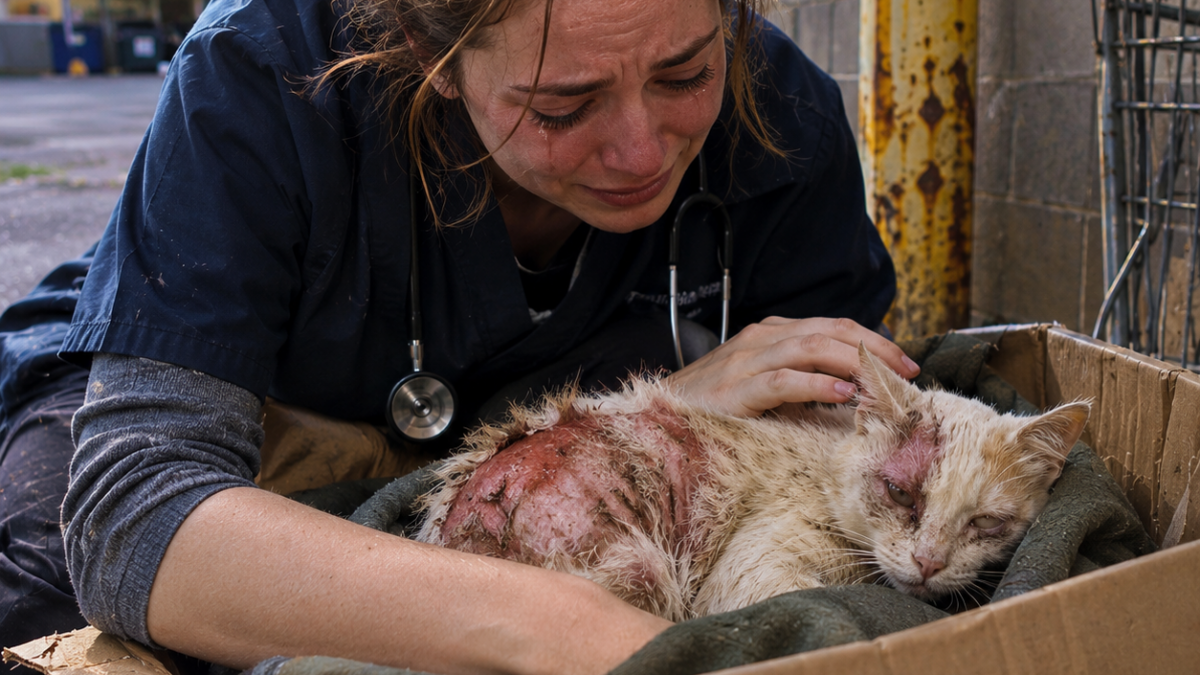
For maybe two seconds, I could not understand what I was seeing.
There was an animal.
Small.
Curled tightly.
Something pale.
Something raw.
Then I realized it was a cat.
Or what looked like a cat after the world had taken almost everything recognizable away.
Most of the fur from his shoulders to the middle of his back was missing.
Not shaved.
Gone.
The exposed skin was mottled red, gray, pink, and brown.
Some areas were scar tissue.
Others were open sores.
There were crusted patches where infection had dried.
His ribs pushed against what remained of his coat so sharply that I could count them.
His front legs looked like sticks.
His eyes were worse.
One was swollen nearly shut.
The other was cloudy, filmed over in pale blue-gray.
He wasn’t looking at me.
Not really.
His face pointed in my direction, but the eye didn’t track the light.
“Oh, sweetheart.”
The words came out before I thought about them.
His mouth opened.
Click.
That sound again.
He tried to lift his head.
It rose maybe half an inch.
Then dropped.
I had worked at Green Valley Veterinary Clinic for almost six years.
My official job title was veterinary support assistant, which sounded more impressive than what I actually did most days.
I cleaned rooms.
Restocked supplies.
Washed blankets.
Held nervous animals when technicians needed an extra pair of hands.
Mopped urine.
Took out trash.
Answered phones when the front desk got overwhelmed.
I was not a veterinarian.
Not a technician.
I had no degree.
No authority.
But I had seen enough emergencies to know three things immediately.
He was severely dehydrated.
He was dangerously thin.
And he was dying.
I pulled off my jacket.
The temperature that evening was maybe forty-six degrees.
The pavement was colder.
I slid my hands beneath him.
He felt weightless.
That frightened me more than the burns.
People who have never held a starving animal sometimes think the shock comes from the bones.
It doesn’t.
It’s the absence.
A grown cat should have substance.
Muscle.
Warmth.
Resistance.
Charlie felt like picking up a towel with a heartbeat inside it.
I wrapped him in my jacket.
His body was cold.
Too cold.
I reached for my phone.
The clinic’s front desk had closed at seven, but Dr. Lauren Bishop and technician Miguel Santos were still inside finishing with a dog recovering from emergency surgery.
I called the back line.
Miguel answered.
“Green Valley.”
“It’s Erin.”
“You forgot something?”
“I’m behind Miller’s.”
“Why?”
“I found a cat.”
There was a pause.
“Okay.”
“He’s bad.”
His voice changed instantly.
“How bad?”
“Burns. Starved. Eyes swollen. Barely moving.”
“Bring him.”
“I’m coming.”
“Don’t give food.”
“I know.”
“Water?”
“I haven’t.”
“Good. Keep him warm.”
“I’m using my jacket.”
“Come through the side door.”
I put the box on the passenger seat.
I should have transferred him to something cleaner.
I didn’t want to move him again.
I placed a towel beneath the box so it wouldn’t slide.
Then I got behind the wheel.
The clinic was technically three minutes away.
That drive felt longer than most highway trips I’ve taken.
At the first light, I looked over.
“Stay with me.”
No reaction.
The cat’s chest moved.
Barely.
“Come on.”
The light stayed red.
“Don’t make me sit here at a red light while you die.”
I don’t know why I said it.
Maybe because fear makes people angry.
His mouth opened.
Click.
I leaned closer.
“Yeah.”
The light turned green.
“That’s good. Keep doing that.”
Halfway back, he stopped moving.
Completely.
I reached across at the next stop sign.
Touched my jacket.
Nothing.
My heart slammed against my ribs.
“Hey.”
I slid two fingers under the fabric until I felt his side.
Then—
a tiny expansion.
Breath.
I nearly cried.
“Okay.”
Another breath.
“Okay, okay.”
When I pulled into the clinic, Miguel was already outside.
He opened the passenger door.
His face changed.
“Oh, damn.”
“He’s alive.”
“How long has he been like this?”
“I don’t know.”
We carried the box inside.
Dr. Bishop was waiting in treatment.
Lauren Bishop was forty-four, calm in the particular way veterinarians become calm when everyone else is allowed to panic.
She had short brown hair, wire-rim glasses, and an ability to make terrible news sound truthful without making it sound hopeless.
She lifted one corner of the jacket.
Her expression tightened.
“Temperature.”
Miguel inserted the thermometer.
“Can’t get a reading.”
Lauren looked up.
“Below range?”
“Yeah.”
“Warm fluids. Slowly.”
She examined his gums.
“Pale.”
Skin tent.
“Severe dehydration.”
She listened to his heart.
“Bradycardic.”
She checked his eyes.
“Possible corneal damage.”
She moved toward his back.
The cat tried to twitch away when she touched one open lesion.
“Okay. Pain response.”
I stood near the table.
“That’s good?”
“It means he can feel it.”
“Is that good?”
Lauren looked at me.
“It’s information.”
That was Dr. Bishop.
Never false hope.
Never unnecessary cruelty.
Information.
Miguel started preparing an IV catheter.
The cat’s veins were terrible.
Collapsed.
Tiny.
They tried one front leg.
Failed.
Second leg.
Failed.
Lauren said, “Jugular?”
Miguel nodded.
I felt useless.
“Can I do anything?”
“Talk to him.”
“What?”
“You’re the familiar voice right now.”
That sentence hit me oddly.
Familiar.
I had known him fifteen minutes.
Still, I leaned closer.
“Hey, sweetheart.”
His ear moved.
I noticed it.
So did Lauren.
I said, “You’re safe.”
His mouth opened.
Click.
I froze.
Miguel looked up.
“What was that?”
“The sound I heard.”
“Again?”
I leaned closer.
“Nobody’s going to hurt you.”
His ear twitched.
Then a tiny, dry sound came from his throat.
Not quite a meow.
More like air pushed over something too tired to vibrate.
Lauren glanced at me.
“Interesting.”
“What?”
“He responds to your voice.”
“Maybe he’s just reacting.”
“That’s what responding means.”
I almost smiled.
They got access.
Warm fluids started.
Not aggressively.
His body was too compromised.
Lauren explained that too much too quickly could destabilize him.
His blood glucose was low.
His body condition score was nearly at the bottom of the scale.
His bloodwork showed anemia, infection, liver stress, and kidney values that concerned her.
The burns were not fresh.
That surprised me.
I had assumed I found him shortly after whatever had happened.
Lauren shook her head.
“These are old.”
“How old?”
“Some areas weeks, possibly longer.”
“And nobody treated them?”
“Doesn’t look like it.”
“Could he have gotten burned outside?”
“Possible.”
“Car engine?”
“Not like this.”
“What does it look like?”
She hesitated.
“Thermal burns.”
“From what?”
“I can’t tell you.”
I stared at his back.
“Someone did this?”
“I didn’t say that.”
“But you’re thinking it.”
“I’m thinking we don’t know yet.”
Some wounds had become infected.
Other areas had healed badly, tightening the skin.
There were places where new tissue had formed only to crack again.
The cat must have spent weeks licking, scratching, hiding, surviving.
He smelled faintly of smoke beneath the infection and dirt.
Maybe that was my imagination.
I still don’t know.
At 10:42 that night, we had a patient.
No name.
No history.
No owner.
No explanation.
And no promise he would survive until morning.
Lauren entered him into the system as FOUND CAT — WHITE/ORANGE DSH.
I looked at her.
“Can we call him something?”
She gave me a tired smile.
“You found him.”
I stared at the cat.
There were faint orange patches around his ears and tail beneath the dirt.
His face must once have been beautiful.
“Charlie.”
I don’t know why.
The name simply arrived.
Lauren typed it.
CHARLIE.
Then Miguel said, “We should scan him.”
I looked up.
“For a chip?”
“Always.”
The microchip scanner was kept in a cabinet beside the scale.
Miguel ran it over Charlie’s shoulders.
Nothing.
Down his back.
Nothing.
He changed the angle.
Beep.
We all stopped.
Miguel looked at the screen.
“Got one.”
My heart jumped.
“Registered?”
“We’ll find out.”
The chip company database took a few minutes.
Charlie lay beneath the warming blanket.
I sat on a stool near him.
Every minute or so, I spoke.
Not because I thought it was medically useful.
Because silence felt wrong.
I told him stupid things.
That I had frozen lasagna at home.
That my cat Juniper would hate him on principle.
That Miguel had once accidentally stapled his own glove to a patient chart.
Miguel looked over.
“Why are we telling him that?”
“It builds trust.”
“It was one time.”
I kept talking.
Charlie’s ears moved whenever I did.
Sometimes his mouth opened.
That broken sound came.
Each time, I assumed he was trying to meow.
Maybe asking for water.
Maybe in pain.
Maybe simply reacting to noise.
Then Miguel stared at the computer.
“Erin.”
“What?”
“This chip is registered.”
Lauren stepped closer.
“Owner?”
“Margaret Ellis.”
I felt hope rise.
“Phone?”
“Yeah.”
“Call.”
Miguel dialed.
The number rang five times.
A man answered.
“Hello?”
Miguel identified the clinic.
“I’m calling about a cat.”
Silence.
“A cat?”
“Yes, sir. We found a severely injured cat with a microchip registered to Margaret Ellis.”
Nothing.
“Sir?”
Then the man asked:
“Did you say his name was Charlie?”
I looked at Miguel.
Miguel looked at me.
We had not said the name.
He switched to speaker.
“I’m sorry, sir. How did you know that?”
The man started breathing differently.
“Is he white with orange ears?”
I looked at Charlie.
“Yes.”
“Orange tail?”
“Mostly.”
A sound came through the phone.
The man was crying.
“Oh my God.”
Miguel pulled a chair closer.
“Can you tell us who you are?”
“I’m David Ellis. Margaret is my mother.”
“Is Charlie her cat?”
“He was.”
“Was?”
“He disappeared.”
“When?”
A pause.
“Almost two years ago.”
Every person in treatment stopped moving.
Lauren looked at me.
I stared at Charlie.
David continued.
“My mother lived in Bellevue. She had him since he was a kitten.”
“How did he disappear?”
“The kitchen window.”
“What?”
“My mother had one of those old window air conditioners. My brother took it out after summer. The screen wasn’t secured right.”
David’s voice trembled.
“Charlie got out.”
“When exactly?”
“October. Two years ago this October.”
I looked at the dying cat.
Two years.
“What did you do?”
“We searched.”
David’s answer came too quickly.
Defensive.
Desperate.
“We searched everywhere. Flyers. Shelters. Neighborhood pages. We went door to door.”
“Did you call our clinic?”
“I don’t remember. We called so many places.”
He took a breath.
“My mother walked those streets every day.”
“How long?”
“Months.”
There was guilt in his voice.
Something more.
“What happened to Margaret?”
“She got sick.”
“From what?”
“Several things. Heart failure. Then a small stroke.”
“I’m sorry.”
“She moved into a care facility about seven months after Charlie disappeared.”
He laughed once, but there was no humor.
“She didn’t want to go.”
“Because of him?”
“Partly.”
Lauren pulled another chair over for me.
I sat.
David continued.
“She kept saying he might come home and nobody would be there to let him in.”
My throat closed.
I looked at Charlie.
His one cloudy eye remained half open.
“Is she still alive?”
“Yes.”
“Does she remember him?”
A long pause.
“Sometimes.”
David’s voice broke.
“She doesn’t remember me every day.”
I covered my mouth.
“But she remembers him?”
“Not always his name.”
“Then how do you know?”
“Because she asks whether the cat came home.”
I looked away.
Miguel blinked hard.
David asked, “How bad is he?”
Nobody wanted to answer.
Lauren stepped closer.
“I’m Dr. Bishop.”
“Is he going to die?”
“We don’t know.”
“Can I come?”
“Yes.”
“Tonight?”
Lauren looked at the clock.
“It’s late, and he needs stabilization. Tomorrow morning may be better.”
“I’ll be there.”
Then he said something else.
“Talk to him.”
I frowned.
“What?”
“Charlie likes people talking.”
I almost laughed because I had already been doing exactly that.
David continued.
“My mother talked to him constantly.”
“About what?”
“Everything.”
He sniffed.
“She lived alone after Dad died.”
Then his voice softened.
“Every evening, she’d stand at the back door and call him.”
I looked at Charlie.
“What did she say?”
David answered.
“Come home.”
The words sent something cold through me.
“Just that?”
“Usually, ‘Come home, Charlie.'”
I leaned toward the treatment table.
“Did he respond?”
David went quiet.
“How did you know?”
I stopped breathing.
“He made a sound.”
“What kind?”
I looked at Miguel.
“Small.”
“Broken.”
“Almost like…”
Click.
Charlie opened his mouth.
David heard it through the phone.
There was silence.
Then he whispered:
“That’s him.”
My eyes filled.
“You’re sure?”
“That’s his answer.”
“His answer?”
“My mother would call, ‘Come home, Charlie,’ and he’d make this stupid little chirp.”
A sob escaped him.
“He never had a normal meow.”
I sat very still.
The box.
The clicking.
Every time I spoke.
Every attempt Charlie made to answer.
The cat had almost no saliva.
His throat was damaged by dehydration.
Maybe he had been trying to meow.
Maybe it was simply reflex.
But now that sound belonged to a history.
Somewhere behind it was a kitchen door.
An elderly woman.
Evening light.
Two words.
Come home.
I leaned close.
“Charlie.”
His ear twitched.
I whispered, “Come home.”
The tiny sound came again.
David cried through the phone.
So did I.
That first night, Charlie did not die.
That was our victory.
Nothing more.
His temperature rose gradually.
His blood pressure improved slightly.
He tolerated the fluids.
At two in the morning, he swallowed a tiny amount of nutritional slurry.
At four, he urinated.
Lauren actually smiled.
“Kidneys are functioning.”
“That means he’s okay?”
“No.”
“You’re impossible.”
“It means kidneys are functioning.”
I stayed until nearly five.
Nobody asked me to.
Miguel left at one.
Lauren slept for forty minutes in her office.
I sat beside Charlie.
Every time his breathing changed, I woke fully.
At 4:17, I told him about Juniper.
“She’s gray.”
Ear twitch.
“Mean.”
Nothing.
“Very judgmental.”
Click.
“Exactly.”
I rested my arms on the kennel door.
“You cannot die because I told David you made it through tonight.”
His chest rose.
“That’s legally binding.”
Another breath.
“You also haven’t met Margaret.”
I stopped.
The thought had been growing since the phone call.
Margaret.
The woman who searched.
The woman who waited.
The woman who still asked whether her cat had come home.
Charlie had disappeared for almost two years.
Nobody knew where he had been.
But he was here.
And she was alive.
At six thirty, I went home, showered, fed Juniper, slept three hours, then returned.
David was already there.
He was sixty-one, tall, thin, with a gray beard and tired eyes.
He held an old photograph.
Charlie.
Healthy.
White coat.
Orange ears.
Bright green eyes.
He was stretched across the lap of an elderly woman sitting in a floral armchair.
Margaret.
She had silver hair and a mischievous smile.
Her hand rested on Charlie’s back.
“He was twelve pounds.”
I looked through the kennel glass.
Charlie was barely six.
“How old?”
“About seven now.”
“So five when he disappeared.”
David nodded.
“He was spoiled.”
“Good.”
He smiled sadly.
“Mom made him scrambled eggs.”
“That’s not balanced nutrition.”
“You sound like her vet.”
“Occupational hazard.”
David moved closer to the kennel.
“Charlie?”
The cat’s ear moved.
David’s face crumpled.
“Jesus.”
He knelt.
“Hey, buddy.”
No response.
Then David said softly:
“Come home.”
Charlie’s head shifted.
Maybe half an inch.
Click.
David broke down.
I stood beside him.
He cried with one hand over his mouth.
“I looked for you.”
Charlie breathed.
“I swear I looked.”
That guilt again.
I recognized it.
Rescue stories often create villains where there are none.
Someone always wants to know:
Why didn’t they search harder?
Why didn’t they update the microchip?
Why wasn’t the window secure?
Why didn’t they find him sooner?
Sometimes those are fair questions.
Sometimes life simply breaks into too many pieces at once.
David had been caring for his mother.
Managing her stroke.
Selling her house.
Coordinating assisted living.
Working.
Driving back and forth from Cleveland.
He had called shelters.
Posted flyers.
Searched.
And Charlie had vanished into a city where thousands of unseen things happen every day.
“What happened to him?”
David asked.
“We don’t know.”
“Those burns.”
“I know.”
“Someone did that.”
“Maybe.”
“Don’t tell me maybe.”
I looked at him.
“I’m not going to invent an answer because the real one hurts.”
He nodded.
That was the beginning of the investigation.
Not a police investigation at first.
A human one.
David had old veterinary records.
We compared dates.
Charlie’s microchip number.
Vaccinations.
Physical features.
The small nick in his right ear.
He was unquestionably Margaret’s cat.
But the missing two years were blank.
We asked local shelters.
No intake record.
Animal control.
Nothing.
Nearby clinics.
Nothing.
Neighborhood groups.
People remembered the missing posters vaguely.
One woman said she thought she had seen a white cat near an abandoned row house eighteen months earlier.
Another remembered a white cat eating behind a diner.
Someone else swore Charlie had lived around a mechanic’s garage.
None could prove it.
Then we found a clue in his body.
An old fracture in his left rear leg.
Healed badly.
Lauren saw it on X-ray.
“That didn’t happen recently.”
“Car?”
“Could be.”
“Would he have survived untreated?”
“Yes.”
“Painfully?”
“Probably.”
His teeth showed signs of eating strange, hard things.
His claws were worn unevenly.
There was scar tissue around both front paws.
He had survived outside.
For months.
Maybe all two years.
Then came the burns.
That part made no sense.
Lauren estimated some were three to five weeks old.
Others could have been older.
The pattern covered his back and shoulders.
Not his belly.
Not his paws.
“It looks like something hot came from above,” she said.
“What does that mean?”
“Liquid.”
I stared at her.
“Someone poured something on him?”
“I can’t prove that.”
“But that’s what it looks like.”
“It could also be accidental exposure.”
“To what?”
She sighed.
“Erin.”
“I know.”
“We don’t know.”
That phrase haunted me.
We don’t know.
We didn’t know where Charlie slept during winters.
We didn’t know what he ate.
Who fed him.
Who chased him away.
Who hurt him.
Who might have been kind.
Whether he had spent months near Margaret’s old house.
Whether he ever returned to a door no longer belonging to her.
We didn’t know how he ended up in the box.
That question mattered most.
Because cats do not usually climb into cardboard boxes and fold the flaps above themselves.
Someone had put him there.
The box had once held restaurant supplies.
There was no writing.
No address.
No clue.
But somebody had placed a dying cat behind the abandoned grocery store.
Maybe because they wanted him found.
Maybe because they wanted him hidden.
That difference kept me awake.
David came every day.
Margaret didn’t.
Not yet.
I asked him on the second day.
“Can she travel?”
“Yes.”
“Would it be bad for her?”
“I don’t know.”
“What does her doctor say?”
“I haven’t asked.”
I looked at Charlie.
His condition remained critical but slightly improved.
“You told me she still asks.”
“Sometimes.”
“What exactly?”
David looked down.
“She’ll be eating breakfast and suddenly ask whether I’ve checked the porch.”
“Because of Charlie?”
“Yes.”
“Does she know it’s been two years?”
“No.”
His answer was almost a whisper.
“Some days she thinks it’s the same week.”
I swallowed.
“Bring her.”
David stared.
“What if she doesn’t recognize him?”
“Then she doesn’t.”
“What if it upsets her?”
“She already lost him.”
“Erin.”
“Ask her doctor.”
He hesitated.
“What if Charlie doesn’t recognize her?”
That was the fear underneath all of it.
Not Margaret forgetting.
Charlie.
I looked at him.
“Then we don’t force anything.”
David called that afternoon.
Margaret’s physician approved a short visit.
Three days later, she came.
I had imagined the scene too many times.
That was my first mistake.
Real moments rarely obey the version you build in your head.
Margaret arrived in a wheelchair wearing a pale blue cardigan.
She was eighty-one.
Smaller than she appeared in the old photograph.
Her silver hair had thinned.
Her face was soft with age.
David pushed her.
She looked around the clinic.
“Why are we here?”
He crouched beside her.
“Mom, someone wants to see you.”
“Who?”
David looked at me.
I walked over.
“Hi, Margaret.”
She smiled politely.
“Do I know you?”
“No.”
“Then why are you saying my name?”
David laughed through nerves.
“Because I told her.”
Margaret frowned at him.
“You tell strangers too much.”
That made all of us smile.
I led them into the quiet recovery room.
Charlie lay under a warmed blanket.
His wounds were bandaged.
His face had been cleaned.
He looked slightly less frightening than the night I found him.
But only slightly.
Margaret stared.
No reaction.
David’s face fell.
“Mom?”
She looked at him.
“What?”
“Do you know that cat?”
She looked again.
Nothing.
My heart sank.
Maybe this was too much.
Maybe we had turned a dying animal into an emotional test for a woman who didn’t deserve one.
I crouched beside her.
“It’s okay.”
Margaret looked at me.
“He’s sick.”
“Yes.”
“Poor baby.”
That was all.
David turned away.
I could see him trying not to cry.
Then Charlie moved.
His head lifted maybe an inch.
Margaret’s eyes narrowed.
She leaned forward.
“Why is his ear like that?”
David froze.
“What?”
“The little nick.”
She pointed.
“Charlie tore his ear on the porch screen.”
Every hair on my arms lifted.
David knelt.
“Mom.”
Margaret looked at the cat.
Her lips trembled.
Then confusion crossed her face again.
“Where has he been?”
Nobody answered.
She turned to David.
“I told you to check outside.”
He covered his face.
“I know.”
“Did you put food out?”
“Yes.”
“You have to leave food.”
“I did.”
“He gets scared when it rains.”
David was crying now.
Margaret looked back at Charlie.
Something in her face changed.
Not memory returning all at once.
More like a door opening a crack.
Her hand lifted.
I moved Charlie’s blanket-covered bed closer.
Margaret whispered:
“Come home, Charlie.”
His ears moved.
The room stopped breathing.
Charlie lifted his head.
It trembled.
His cloudy eye faced her.
Then came that sound.
Small.
Broken.
But unmistakable.
A meow.
Margaret covered her mouth.
“That’s my boy.”
David sobbed.
Miguel turned away.
Lauren stood in the doorway with her arms folded tightly across her chest.
I cried before I even realized I was crying.
Margaret repeated it.
“Come home.”
Charlie answered.
A little louder.
She reached for him.
Lauren started forward.
I stopped her with my eyes.
Margaret’s fingers touched the fur near Charlie’s cheek.
His head leaned into her hand.
Not much.
But enough.
She whispered, “You took your time.”
David laughed through tears.
“Mom.”
“What?”
“He was missing.”
“I know.”
“Two years.”
Margaret looked at him sharply.
“Don’t be ridiculous.”
Then she looked back at Charlie.
Her mind had moved somewhere else.
Maybe two years disappeared for her.
Maybe she was in the old kitchen.
Maybe it was 2020.
Maybe her husband was still alive.
Maybe Charlie had simply spent an afternoon outdoors.
She stroked his face.
“Bad boy.”
Charlie purred.
Very faintly.
Margaret smiled.
“He’s hungry.”
That broke me.
Because of course he was.
Of all the things she might have forgotten, she still knew that.
“He is,” I said.
“Feed him.”
“We are.”
“Not that hospital nonsense.”
I laughed.
“What should he eat?”
“Eggs.”
David burst out laughing.
“I told them.”
Margaret looked offended.
“He likes eggs.”
Lauren said, “Once he’s stable, we can discuss an egg.”
Margaret nodded approvingly.
“You seem sensible.”
After twenty minutes, she became tired.
David prepared to leave.
Margaret gripped the wheelchair arm.
“We’re taking him.”
David looked at me.
“Mom—”
“No.”
Her voice sharpened.
“He’s coming home.”
Charlie was nowhere near ready.
I crouched.
“Margaret, Charlie has to stay with us a little while.”
She looked suspicious.
“Why?”
“Because he’s sick.”
“I can take care of him.”
“I know.”
“You don’t know anything.”
That was fair.
“I know he needs medicine.”
She stared at me.
Then at Charlie.
“How long?”
“A few weeks.”
Her eyes filled.
“No.”
David put a hand on her shoulder.
“Mom.”
“He’ll think we left him.”
The words cut through the room.
I swallowed.
“I won’t let him think that.”
Margaret looked at me.
“You promise?”
“Yes.”
“Don’t lie to old people.”
I almost laughed.
“I won’t.”
She held my eyes for a long moment.
Then nodded.
“Tell him I’m coming back.”
I looked at Charlie.
“I will.”
Margaret left.
Charlie slept for almost four hours afterward.
I sat nearby.
When he woke, I whispered:
“She’s coming back.”
His ear moved.
For the first time since finding him, I believed he might live.
Not because of love.
I am not sentimental enough to believe love fixes kidney values or infected burns.
Medical care saved Charlie.
Antibiotics.
Fluids.
Nutrition.
Wound management.
Pain medication.
Eye treatment.
Temperature support.
Monitoring.
But something changed after Margaret visited.
He became more responsive.
He began eating more willingly.
He tried to sit.
The first attempt failed.
The second lasted three seconds.
By day six, he could lift his head without shaking.
By day eight, he stood.
He looked terrible doing it.
Legs spread.
Back bowed.
Bandages around his torso.
But he stood.
I had just entered treatment when Miguel whispered, “Don’t move.”
Charlie was upright.
I covered my mouth.
“Oh my God.”
Lauren looked up from a chart.
“He did it ten seconds ago too.”
“Why didn’t you call me?”
“You were in the bathroom.”
“You call me.”
She stared.
“For standing?”
“For anything.”
Charlie took one step.
Then collapsed onto the blanket.
I cheered.
He looked irritated.
That was another good sign.
I began visiting even when I wasn’t working.
That was probably unprofessional.
Nobody stopped me.
I read beside his kennel.
Talked.
Sang badly.
Told him gossip from the front desk.
Charlie learned my footsteps.
His vision remained poor.
The ophthalmologist eventually confirmed that his left eye had severe corneal scarring.
The right retained only partial vision.
He could see light.
Large movement.
Shapes.
Maybe more.
Nobody could know exactly.
His ears became his map.
Voices mattered.
Mine.
Miguel’s.
Lauren’s.
David’s.
And Margaret’s.
She visited every week.
Sometimes she remembered Charlie immediately.
Sometimes not.
On one visit, she asked whose cat he was.
David started to answer.
I stopped him.
“Just give her a minute.”
Margaret sat.
Charlie heard the wheelchair.
His ears moved.
Then she whispered:
“Come home.”
He meowed.
Her entire face lit up.
“Oh.”
Memory arrived through sound.
“My Charlie.”
It happened again and again.
Even on days she could not remember the name of the facility where she lived.
Even when she called David by her brother’s name.
Even when she asked me twice within ten minutes whether I worked at the clinic.
Two words reached somewhere dementia had not erased.
Come home.
Charlie answered every time.
The story should have been enough.
It wasn’t.
Because someone had burned him.
Someone had put him in that box.
And I wanted to know who.
The police took a report after we established that the injuries might have been intentional.
Animal control opened a case.
Officer Denise Harper interviewed me.
“Who has access behind the grocery store?”
“Anyone.”
“Camera?”
“Clinic cameras face our lot, not the store.”
“Nearby businesses?”
“A tire shop across the road.”
They checked.
Nothing useful.
One camera showed the alley entrance but not the dumpster area.
At 5:11 p.m. the day before I found Charlie, a dark SUV entered.
At 5:17, it left.
Plate unreadable.
Could have been unrelated.
A man was seen walking through the alley at seven.
He carried nothing.
The box itself gave no fingerprints useful enough to identify anyone.
No note.
No collar.
No evidence.
Weeks passed.
The investigation stalled.
Then a woman walked into the clinic carrying a photograph.
Her name was Keisha Monroe.
She lived three blocks from the abandoned grocery store.
“I saw your Facebook post.”
We had posted Charlie’s photograph after David gave permission.
Not the worst images.
Just enough to ask if anyone recognized him.
Keisha placed her phone on the counter.
“I’ve seen that cat.”
My heart accelerated.
“Where?”
“Behind my building.”
“When?”
“All summer.”
“Are you sure?”
“White cat. Orange ears.”
She zoomed in.
The image was blurry.
A white-and-orange cat beneath a fire escape.
Thinner than Margaret’s old photos.
But healthy compared with the animal I found.
“Charlie.”
Keisha nodded.
“People fed him.”
“Who?”
“Everybody, sort of.”
A woman in Apartment 3 left dry food.
A mechanic gave him scraps.
Children called him Ghost.
He slept under porches.
He had survived as a neighborhood stray.
“Was he friendly?”
“Not really.”
“Scared?”
“Careful.”
“Did anyone try to catch him?”
“One woman did.”
“Who?”
Keisha frowned.
“Her name’s Paula.”
That led us somewhere.
Paula Grant ran an informal cat-feeding network.
Not a rescue.
Just a woman with six traps and no ability to ignore hungry animals.
She recognized Charlie immediately.
“We called him Old Man.”
“He wasn’t old.”
“He acted old.”
She showed me videos.
Charlie eating from a dish.
Charlie walking beside an abandoned shed.
Charlie rubbing against a fence post.
His eyes were clear.
His coat intact.
Date: August 2.
Six weeks before I found him.
“What happened after this?”
Paula’s face darkened.
“He disappeared.”
“When?”
“Late August.”
“Before the burns?”
“I didn’t know about burns.”
I showed her a medical photo.
She turned pale.
“Who did that?”
“We don’t know.”
“I swear he wasn’t like that.”
“I believe you.”
“Wait.”
She searched her phone.
“I heard something.”
“What?”
“There was a guy.”
My stomach tightened.
Paula told me about a vacant rental on Sycamore Street.
Teenagers had been using the backyard.
Neighbors complained about fireworks.
Bottle rockets.
Small fires.
Animal control had received one report about kids chasing cats.
No names.
No charges.
The timing fit.
Maybe.
That became another branch.
Police interviewed residents.
Someone remembered a white cat being seen near a backyard fire.
Someone else heard boys laughing.
Nobody saw an animal harmed.
No direct evidence.
Again:
We don’t know.
Months later, I learned to live with that.
Not peacefully.
But honestly.
Sometimes there is no final villain standing in a courtroom.
Sometimes cruelty leaves scars and keeps its name.
Charlie healed anyway.
That became more important.
His first real meal happened seventeen days after rescue.
Not full-size.
A careful portion.
Renal-friendly food mixed with recovery diet.
He ate slowly.
Then licked the plate.
I laughed.
“You want more?”
Meow.
A real one.
Weak.
Raspy.
But real.
“You found your voice.”
Meow.
Miguel looked over.
“You’re rewarding demand behavior.”
“I don’t care.”
“That’s how monsters are created.”
Charlie meowed again.
I gave him another spoonful.
“Monster.”
By week three, he weighed nearly seven pounds.
By week four, almost eight.
His burns were closing.
Some areas would never regrow fur.
His back remained patchy.
Scars pulled slightly when he stretched.
The left eye never regained vision.
The right improved enough that he could navigate familiar rooms.
He learned quickly.
Sound.
Smell.
Memory.
He knew where water lived.
Where food arrived.
Where the sunny bed sat.
He started reaching for hands.
Not all hands.
Mine.
David’s.
Margaret’s.
Especially Margaret’s.
The first time she visited after Charlie could walk, we put him on the floor.
He stood uncertainly.
Margaret sat in her wheelchair.
She looked tired.
She did not recognize him.
David said, “Mom.”
She looked up.
“There’s someone here.”
“Who?”
He nodded toward Charlie.
She stared.
Nothing.
Charlie heard her breathing.
He took one step.
Then another.
Margaret whispered without prompting:
“Come home.”
Charlie walked toward her.
Slowly.
Unevenly.
He reached the wheelchair.
Put both front paws against the footrest.
Meowed.
Margaret began crying.
“My boy.”
David cried.
I did too.
Charlie tried to climb.
He didn’t have the strength.
I lifted him carefully.
Placed him across Margaret’s lap.
He curled there.
Exactly like the old photograph.
Margaret’s hand moved over the scarred back.
She stopped.
“What happened?”
No one answered.
Her face hardened.
“Who did this?”
David knelt.
“We don’t know.”
“Find them.”
I smiled through tears.
She looked at me.
“I’m serious.”
“So am I.”
She stroked Charlie.
“You tell me.”
Charlie purred.
Margaret leaned close.
“I’ll take care of it.”
There was something almost funny about an eighty-one-year-old woman with memory loss threatening an unknown animal abuser.
And something devastating.
Because to Charlie, maybe nothing had changed.
This was his person.
The woman who protected him.
The woman who called.
The woman who had been waiting.
Charlie remained at the clinic thirty-nine days.
The final question was where he would live.
Margaret could not have a cat full-time in her care facility.
Her building allowed scheduled pet visits but not permanent animals.
David wanted Charlie.
That surprised me.
Not because he was unkind.
Because he lived outside Cleveland, worked full-time, and had never considered himself a cat person.
“You sure?”
“No.”
I laughed.
“Honest.”
“I’m sixty-one.”
“Not ancient.”
“I travel.”
“How much?”
“Maybe four days a month.”
“You can arrange care.”
“I know.”
“You understand his medical needs?”
“Yes.”
“Eye medications?”
“Yes.”
“Follow-up?”
“Yes.”
“Scars?”
“Erin.”
“What?”
“He’s my mother’s cat.”
That was the whole answer.
Charlie went home with David.
I cried in the clinic parking lot.
Of course I did.
I had found him.
Fed him.
Cleaned wounds.
Spent nights talking.
He knew my voice.
Part of me had imagined adopting him.
But Juniper hated every cat she had ever encountered.
My apartment was small.
And more importantly, Charlie had a family.
Broken.
Changed.
Complicated.
But family.
David lived two hours from Margaret.
Every other Sunday, he drove Charlie back to Pittsburgh.
The first trip, he sent me a video.
Margaret sat in the care-facility garden.
Charlie wore a harness.
He was heavier.
Whiter.
Still scarred.
Margaret looked at him.
Confused.
Then smiled.
“Come home.”
Charlie meowed.
David’s voice behind the camera broke.
I watched it six times.
Charlie became part of Margaret’s care routine.
Not formally at first.
Then the staff noticed something.
On days he visited, Margaret was calmer.
She ate better.
She participated more.
One nurse named Jocelyn began writing “CHARLIE VISIT” on the activity board.
Margaret would see it.
Sometimes understand.
Sometimes not.
But when Charlie arrived, something inside her recognized him.
Smell.
Sound.
Touch.
Old memory.
Nobody could say which.
Dementia is strange that way.
It steals the calendar before it steals the heart.
One afternoon, Margaret did not know David.
That was the first time.
He called me afterward.
“She looked at me like I was maintenance.”
“I’m sorry.”
“I said ‘Mom.'”
His voice broke.
“Nothing.”
I sat on my kitchen floor with Juniper beside me.
“What happened with Charlie?”
“That’s why I’m calling.”
“What?”
“He walked in.”
I waited.
“She said his name.”
My eyes filled.
“She didn’t know me.”
David cried.
“But she knew him.”
Charlie had become a key to a room none of us could enter any other way.
The care facility started allowing longer visits.
Charlie slept on Margaret’s lap.
She brushed the fur that grew back.
He learned the sound of her wheelchair.
The moment he heard it coming down the hall, his ears lifted.
Once, David arrived with Charlie in a carrier.
Margaret was having a bad day.
Agitated.
Trying to leave.
Insisting she had to go feed “the boy.”
Staff thought she meant David.
Then Charlie meowed from the carrier.
Margaret stopped.
Everything in her face softened.
“There you are.”
Jocelyn cried afterward.
“She was looking for him.”
Maybe she was.
Maybe memory had folded time.
Maybe Margaret’s mind still lived partly in the two years when Charlie was missing.
But now, unlike before, he could answer.
That mattered.
A year passed.
Charlie reached eleven pounds.
His coat never returned completely.
The scars remained visible.
His left eye eventually required removal after chronic pain developed.
David struggled with the decision.
“He’s already lost so much.”
Lauren explained:
“Removing a painful blind eye isn’t taking something from him.”
“It’s giving comfort.”
The surgery went well.
Charlie adjusted in days.
He had already relied on sound more than sight.
When Margaret first saw him afterward, she gasped.
“His eye.”
David braced.
“Mom, it was hurting him.”
Margaret studied Charlie.
Then said, “He still has the good side.”
David laughed.
“Yes.”
She touched his face.
“Handsome boy.”
Charlie purred.
Some things never needed perfect vision.
I continued seeing him for follow-ups.
The first time he returned after three months away, I was mopping Exam 2.
I heard a carrier door.
Then a raspy meow.
I froze.
“Charlie?”
Another meow.
I dropped the mop.
He was in reception.
David laughed.
“You abandoned cleaning.”
“Someone else can mop.”
I opened the carrier.
Charlie stepped out.
He walked toward my voice.
Rubbed against my shin.
I cried.
“You’re fat.”
David looked offended.
“He’s eleven pounds.”
“Obese.”
“Dr. Bishop said ideal.”
“She’s easily fooled.”
Charlie meowed.
“I missed you too.”
That became our ritual.
Visits.
Updates.
Videos.
Margaret saying come home.
Charlie answering.
Two years after I found him, Margaret’s health declined.
David told me quietly during Charlie’s annual exam.
“She’s on hospice.”
My chest tightened.
“How long?”
“They don’t know.”
“Does Charlie still visit?”
“More.”
He looked down.
“I think he understands something.”
“What?”
“He doesn’t wander around the room anymore.”
“Maybe because he’s older.”
“No.”
David shook his head.
“He stays on her.”
The last time I saw Margaret alive, I went with David.
I hadn’t planned to.
He had stopped by the clinic to pick up medication.
I asked how she was.
He said, “Come.”
I hesitated.
“I don’t want to intrude.”
“She asks about you.”
“Me?”
“You’re ‘the girl who brought Charlie.'”
That was enough.
Margaret was in bed.
The room smelled like lotion, flowers, and oxygen tubing.
Charlie lay beside her hip.
He lifted his head when I entered.
Meowed.
Margaret opened her eyes.
“Who is that?”
David said, “Erin.”
She frowned.
Then looked at Charlie.
“The box girl?”
I laughed.
“Yeah.”
She smiled.
“You found him.”
“Yes.”
“Behind the store.”
I stared.
David did too.
Some days she remembered almost nothing.
Yet there it was.
“Yes.”
Margaret reached for my hand.
“Thank you.”
I swallowed.
“You don’t have to thank me.”
“Yes, I do.”
Charlie shifted closer to her chest.
Margaret whispered:
“He came home.”
Her voice was weak.
“That’s all I wanted.”
I sat beside her.
For an hour, we talked in fragments.
Her husband.
Charlie as a kitten.
A garden she once had.
David’s childhood.
Then confusion.
Then clarity.
Before I left, Margaret looked at Charlie.
“Come home.”
He answered.
One small meow.
She smiled.
“See?”
I nodded.
“I see.”
Margaret died eleven days later.
Charlie was there.
David had received the hospice call that morning.
He drove in with Charlie.
The staff let him stay.
Margaret slept most of the day.
Near sunset, she opened her eyes once.
David was holding her hand.
Charlie lay beside her.
She looked at him.
Whispered:
“Come home.”
Charlie meowed.
Those were the last clear words she spoke.
She died that night.
David called me at 11:14.
I knew before answering.
“I’m sorry.”
“She wasn’t alone.”
“No.”
“Charlie was on the bed.”
I closed my eyes.
“Good.”
There was silence.
Then David said, “Do you know what I keep thinking?”
“What?”
“We spent two years telling her to accept he was gone.”
I didn’t know what to say.
“We thought we were helping.”
“You were.”
“She was right.”
“About what?”
“He came home.”
I cried quietly.
“Yeah.”
“He came home.”
Charlie’s grief was harder to interpret.
Animals grieve.
Anyone who has lived with them knows that.
But we should be careful about turning every behavior into a human emotion.
Charlie did not stop eating.
Did not become severely depressed.
But after Margaret died, he started sitting near the front door at David’s house.
Every Sunday afternoon.
That had been the time they usually left for Pittsburgh.
David noticed after three weeks.
“He’s waiting.”
Maybe.
Or he had learned the routine.
Sometimes routine is another form of waiting.
David moved Margaret’s floral armchair into his house after the family cleared her room.
The same chair from the old photograph.
He put it by the living-room window.
Charlie climbed into it the first evening.
Curled in the worn center cushion.
Slept.
David sent me a picture.
No caption.
It didn’t need one.
The animal-cruelty investigation officially closed without charges.
No suspect.
No proof.
No final revelation.
That frustrated people who heard the story.
They wanted justice.
I did too.
For a long time, I thought justice meant finding the person who had hurt Charlie.
Standing in a courtroom.
Photographs.
Evidence.
Consequences.
Maybe that would have mattered.
But life did not give us that ending.
Instead it gave Charlie six more years.
He lived with David.
Slept in Margaret’s chair.
Visited me twice a year.
Became increasingly opinionated about veterinary care.
Hated nail trims.
Loved rotisserie chicken far more than medically advisable.
Lost most of his remaining vision by age ten.
Didn’t care much.
He navigated by memory.
Furniture stayed in predictable places.
David put textured mats near stairs.
Water bowls had small fountains so Charlie could hear them.
He became an old cat.
That fact alone felt extraordinary.
An old cat.
After everything.
The dying creature in the cardboard box got to become elderly.
Gray appeared around his orange ears.
He slowed.
Developed kidney disease.
Needed medication.
Slept more.
And no one ever treated those needs as inconveniences.
David adjusted.
Just like Margaret would have.
When Charlie was twelve, David moved to a smaller house outside Pittsburgh to be closer to his daughter.
He joked that Charlie had become “too expensive to commute with.”
Really, he wanted to be near us.
Near the clinic.
Near Margaret’s grave.
Near the neighborhood where Charlie’s story had begun.
He brought Charlie to Margaret’s grave once.
I didn’t go.
David told me later.
“He didn’t do anything dramatic.”
“Good.”
“He sniffed the grass.”
“Sounds like a cat.”
“Then he peed beside the headstone.”
I laughed so hard I had to sit down.
David smiled.
“Mom would’ve been furious.”
“No.”
“You’re right.”
“She would’ve said he was marking her as his.”
David laughed.
For years, Charlie’s story remained pinned to the bulletin board in the clinic break room.
Not online.
Not framed professionally.
Just an old photograph.
The one from the night I found him.
Beside it, another photograph.
Charlie on Margaret’s lap months later.
Underneath, Miguel had written:
COME HOME.
New employees would ask.
Then someone told them.
Every time, the story changed slightly.
Not the facts.
The emphasis.
Miguel talked about the medical recovery.
Lauren talked about microchips.
Jocelyn talked about dementia.
David talked about Margaret.
I always talked about the box.
Because that was the part I couldn’t release.
I almost walked past.
That haunted me.
Not because I believed Charlie’s survival depended on me being special.
It depended on me doing something ordinary.
Stopping.
Looking.
Opening cardboard.
That’s all.
I have wondered hundreds of times what would have happened if I had been wearing headphones.
If I had parked on the other side.
If the box had moved only once.
If I had been more tired.
If Juniper needed medication that night.
If it had been raining harder.
There are too many versions of that evening where Charlie dies alone.
I stopped counting them.
Instead, I started doing something different.
Whenever something seemed wrong, I checked.
A bag moving beside a dumpster.
A cat sitting strangely near a curb.
A dog alone in a parked car.
A bird tangled in fishing line.
Most of the time, it turned out to be nothing.
Once I called animal control about what I thought was an injured possum.
It was a trash bag.
Miguel never let me forget it.
“How’s your patient?”
“Shut up.”
“Did the trash bag survive?”
“It made a miraculous recovery.”
But I would rather be embarrassed.
Charlie taught me that.
Not intentionally.
He never knew he taught anyone anything.
That is another thing people do to animals.
We turn them into lessons.
Symbols.
Inspirational quotes.
Charlie wasn’t inspirational.
He was stubborn.
Sometimes cranky.
Terrible at taking pills.
He had opinions about blanket texture.
He hated closed carriers.
He once bit David because David tried to clean dried food from his chin.
He was not a saint.
He was a cat.
That made the story better.
At fourteen, his kidneys began failing.
Slowly.
We had expected it eventually.
Years of malnutrition, dehydration, untreated injury, then normal aging.
Lauren had retired by then.
Dr. Sarah Ng took over much of Charlie’s care.
She was excellent.
Younger than me.
Which I found personally offensive.
She adjusted his diet.
Fluids.
Medication.
For nine months, he stabilized.
Then he declined.
David called on a Tuesday morning.
“He’s not eating.”
I looked at the schedule.
“Bring him.”
“I have an appointment at two.”
“Come now.”
Charlie arrived wrapped in Margaret’s old blue blanket.
I recognized it from the care facility.
He was thin again.
Not like the box.
Never like that.
But enough to frighten me.
He heard my voice.
His ears moved.
“Hi, sweetheart.”
Meow.
Still there.
That sound.
Older.
Rougher.
But his.
Dr. Ng examined him.
Kidney values were very poor.
There was anemia.
Weakness.
Nausea.
We could hospitalize.
We could try aggressive fluids.
Maybe buy days.
Weeks if we were lucky.
David asked the question good owners eventually have to ask.
“Would we be doing it for him or for me?”
Sarah was quiet.
“For both, at first.”
“And after that?”
Her expression softened.
“Mostly for you.”
David cried.
I stood beside him.
Charlie rested in Margaret’s blanket.
“Can I take him home?”
“Yes.”
“What do I watch for?”
Sarah explained.
Pain.
Breathing.
Restlessness.
Distress.
Not eating alone wasn’t enough to tell us everything.
But Charlie was tired.
We all knew.
David took him home.
I visited that evening.
Charlie was in Margaret’s armchair.
Of course he was.
David had placed the blue blanket over the cushion.
I sat on the floor.
“Do you remember me?”
Charlie lifted his head.
Meowed.
“Show-off.”
David brought coffee.
We talked about the old days.
The first phone call.
Margaret’s eggs.
The box.
Then David asked:
“Do you ever wonder what he was answering that night?”
“What do you mean?”
“When you found him.”
I looked at Charlie.
“I assumed he was reacting to my voice.”
“Yeah.”
“But?”
David sat opposite me.
“What if he thought it was Mom?”
I had considered that.
Of course I had.
“No way to know.”
“I know.”
“He could barely hear.”
“Maybe.”
I watched Charlie breathe.
“Maybe he wasn’t answering anyone.”
David nodded.
“Could’ve just been trying to meow.”
“Yeah.”
Silence.
Then I smiled.
“But I like your version.”
“Me too.”
The next morning, David called.
“It’s time.”
I drove to his house with Dr. Ng.
Charlie had not moved from the chair.
His breathing was shallow.
He was conscious.
Calm.
David sat beside him.
There was no clinic table.
No fluorescent light.
No cardboard.
No cold pavement.
Just home.
Sarah explained each step.
David nodded.
Then he looked at me.
“Can you say it?”
I knew immediately.
My throat closed.
“What?”
“You know.”
I stared at Charlie.
The cat who had answered me from a box.
The cat who had answered Margaret after two years.
The cat who answered those words every time.
“I don’t know if I can.”
David put his hand over Charlie’s back.
“He should hear it.”
I knelt.
My hands shook.
Charlie turned one ear toward me.
I leaned close.
“Come home, Charlie.”
His mouth opened.
One tiny meow.
I broke.
David did too.
Sarah waited.
I said it again.
“Come home.”
Charlie relaxed.
Sarah administered the medication.
His breathing slowed.
Then stopped.
He was fifteen.
He had spent almost two years missing.
Thirty-nine days recovering.
Six years home.
Those numbers mattered to me.
People always focused on the two missing years.
The burns.
The box.
But I preferred the six.
Six years of food bowls.
Sunlight.
Margaret’s chair.
Visits.
Blankets.
Annoying pills.
David’s house.
My voice.
Come home.
When Charlie died, David had his ashes divided.
Some stayed with him.
Some were buried beside Margaret.
He asked whether I wanted any.
I said no.
Not because I didn’t love Charlie.
Because I already had what I needed.
The memory of the box moving.
Not as guilt anymore.
As instruction.
Stop.
Look.
Listen.
Years have passed since that night.
Miller’s grocery store was eventually demolished.
The land became a pharmacy and a coffee shop.
The alley disappeared.
The cracked pavement was repaved.
Nobody walking there now would know a cardboard box once sat behind the loading dock.
Nobody would know a dying cat was inside.
Sometimes I drive past.
I never stop.
I don’t need to.
The place isn’t sacred.
Charlie wasn’t saved by the pavement.
He was saved because the box moved.
And because, for once, somebody noticed.
I still work at the clinic.
Different doctors.
Different staff.
Same disinfectant smell.
My knees hurt more now.
I no longer take many double shifts.
Miguel became a licensed technician.
He still makes trash-bag jokes.
Juniper died at seventeen.
I eventually adopted another cat.
Not Charlie.
There could never be another Charlie.
His name is Walter.
He screams constantly.
Nobody could ever accuse him of having a small voice.
But every once in a while, late at night, Walter makes a tiny chirp instead of a meow.
And my whole body remembers.
A dark parking lot.
A ruined box.
A sound almost too weak to hear.
I think of Margaret too.
The woman who forgot dates.
Forgot faces.
Forgot where she lived.
But kept a door open somewhere in her mind for one white-and-orange cat.
People sometimes say Charlie remembered Margaret for two years.
I think that is only half the story.
She remembered him too.
Not perfectly.
Not every day.
But enough.
That is the part that stays with me.
Two lives separated.
Both damaged in different ways.
One wandering through streets.
One losing pieces of memory.
Neither knowing whether the other still existed.
Then a microchip connected them.
A phone call.
A wheelchair.
Two words.
Come home.
And an answer.
People wanted Charlie’s story to end with the reunion.
It didn’t.
Real stories don’t freeze at their most beautiful moment.
Margaret continued to decline.
Charlie remained scarred.
David grieved.
I worried.
The investigation failed.
Nobody was punished for hurting him.
Eventually Margaret died.
Eventually Charlie did too.
And yet I still consider it a happy story.
Because happiness is not the absence of endings.
It’s what happens before them.
Charlie got six years.
Margaret got to know he was safe.
David got the chance to keep the promise his family thought they had broken.
I got to learn that being tired is not always a good enough reason to keep walking.
And Charlie got something he had been searching for long before I ever found that box.
He got home.
Not the exact home he left.
That house had been sold.
Margaret no longer lived there.
His old yard was gone.
Nothing returned exactly as it had been.
Home rarely works that way.
Sometimes home changes addresses.
Sometimes it becomes an old woman’s lap inside a care facility.
Sometimes it becomes her son’s living room.
Sometimes it is a scarred cat sleeping in a floral chair that still smells faintly of the person he loved first.
Sometimes home is simply the place where a familiar voice keeps answering back.
I don’t know who put Charlie in that box.
I don’t know why.
I don’t know what he had survived before I found him.
I wish I could give you the satisfying version.
A name.
An arrest.
A confession.
Justice.
I can’t.
The truth is less clean.
Someone hurt him.
Someone abandoned him.
And we never found out who.
But anonymous cruelty did not get the last word.
Margaret did.
Come home.
Charlie answered.
And in the end, maybe that is why the sound behind the grocery store still matters to me.
It was almost nothing.
A tiny broken noise inside cardboard.
So weak I could have mistaken it for trash shifting in the wind.
But that little sound carried years inside it.
A lost house.
An old woman calling from a doorway.
A son searching shelters.
Rain.
Streets.
Hunger.
Burns.
Fear.
Memory.
A promise nobody knew was still alive.
The world had nearly silenced Charlie completely.
He answered anyway.
And because he did, I stopped.
Because I stopped, we found the chip.
Because we found the chip, David answered the phone.
Because David answered, Margaret got to say the words one more time.
Come home, Charlie.
And this time, after nearly two years, somebody was there to hear him answer.








