I Almost Walked Past a Burned Cat in a Cardboard Box—Then His Microchip Led Us to the Woman Who Had Waited Two Years for Him
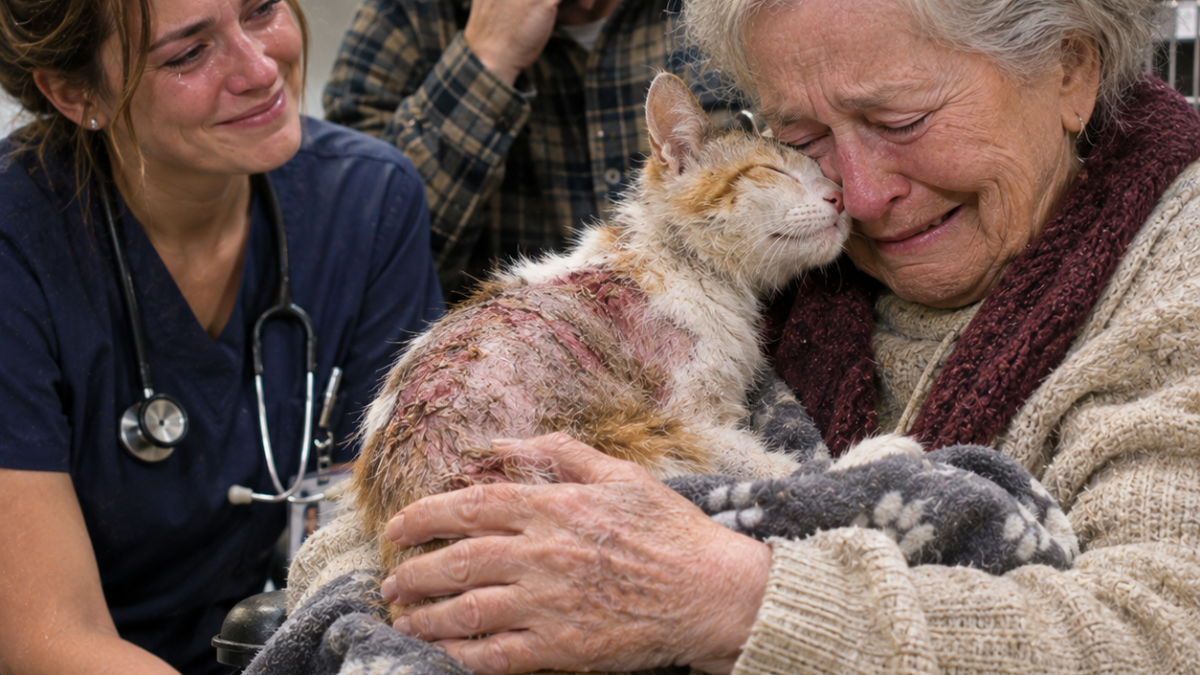
I Almost Walked Past a Burned Cat in a Cardboard Box—Then His Microchip Led Us to the Woman Who Had Waited Two Years for Him
I almost walked past the cardboard box behind an abandoned Pittsburgh grocery store after a sixteen-hour shift, but the broken little sound coming from inside stopped me long enough to find a burned, starving cat who seemed to have only one thing left in him—the strength to answer whenever I promised he was safe.
When our veterinary clinic scanned his microchip, we discovered he was Charlie, a beloved cat who had vanished nearly two years earlier from an elderly woman named Margaret, but the reunion we expected to be joyful turned darker when the pattern of his wounds suggested his disappearance had not been an accident.
Then the police found old security footage showing exactly who had carried Charlie into that alley, and I realized the little cat I had nearly walked past was not only trying to survive—he was carrying the last piece of a story someone had spent two years hoping would stay buried.
I almost did not hear him.
That is the part I still think about.
Not the burns.
Not the microchip.
Not Margaret crying when she heard his voice.
Not even the police officer standing in our clinic three weeks later holding a photograph that made every person in the room go silent.
I think about the fact that I almost walked past.
It was 10:47 on a Thursday night in late November, and I was exhausted in the ugly, ordinary way exhaustion happens when nobody is watching.
My name is Claire Bennett.
I was twenty-seven years old, living outside Pittsburgh, and working two jobs because my mother had taught me that bills did not care whether you were tired.
My main job was at North Ridge Veterinary Clinic.
Calling it my “veterinary job” made it sound more impressive than it was.
I was not a veterinarian.
I was not a technician.
I cleaned treatment rooms.
Washed bowls.
Disinfected kennels.
Restocked towels.
Mopped things no one should ever have to mop.
Held nervous animals when the staff was short.
Answered phones when the receptionist stepped away.
And, because I had been there three years, I had learned enough to recognize trouble when I saw it.
My second job was cleaning offices three nights a week.
That Thursday had started at 6:15 in the morning.
By the time I left the clinic after staying late to help sanitize an isolation room, I had already worked more than sixteen hours between both jobs.
All I wanted was a hot shower.
Leftover spaghetti.
Maybe fifteen minutes of television before I fell asleep with the remote in my hand.
The shortcut home took me behind an old grocery store on Hamilton Avenue.
It had closed almost a year earlier.
The big red letters had been removed, leaving pale rectangles on the brick where the sign used to be.
Most of the windows were boarded.
The loading dock attracted people dumping furniture, tires, broken televisions, and whatever else they did not want to pay to get rid of properly.
I usually crossed the back lot without looking around.
That night, I saw the box.
Brown cardboard.
Half collapsed from rain.
PART2:
Sitting beside the rusted loading ramp.
I noticed it because it moved.
Just slightly.
A corner lifted.
Then settled.
I stopped.
My first thought was raccoon.
My second was rat.
My third was that I was too tired to deal with either.
I took two steps.
Then heard the sound.
It was not really a meow.
More like somebody trying to make a meow but not having enough breath.
A thin, broken cry.
I stopped again.
“Great.”
I said it out loud.
Not because I was angry at whatever was inside.
Because I already knew myself well enough to understand that I was not going home.
I turned around.
The box moved again.
“Hey.”
Nothing.
I crouched.
The wet cardboard smelled like garbage and old rain.
One flap was partly folded over the top.
I reached toward it.
Then hesitated.
A frightened animal could bite.
PART3:
I had seen enough hands wrapped in gauze at the clinic to know good intentions did not make teeth less sharp.
“Okay.”
I spoke softly.
“I’m just looking.”
I lifted the flap.
And forgot how tired I was.
The cat inside was black and white.
At least I thought he was.
It was difficult to tell because so much fur was missing.
Large patches across his shoulders, spine, and left side were bare.
The exposed skin was red, gray, and crusted in places.
Some wounds looked old.
Some looked newer.
His ribs were visible.
Not slightly.
Every rib.
His hip bones pressed sharply under thin skin.
His eyes were swollen and clouded.
One would barely open.
His ears had little scabs along the edges.
The smell coming from the box was infection, urine, wet cardboard, and something metallic.
The cat lifted his head.
It shook.
His mouth opened.
That broken sound came again.
“Oh my God.”
I reached in slowly.
He tried to pull backward.
There was nowhere to go.
“Okay.”
I sat down on the dirty pavement beside the box.
“I’m not going to grab you.”
His breathing was too fast.
Every inhale seemed shallow.
I had seen cats in shock.
I had seen badly injured strays.
This was worse.
Not because one wound was dramatic.
Because everything about him said he had been suffering for a long time.
I took off my jacket.
Pittsburgh in late November does not reward that decision.
The cold went straight through my scrub top.
I laid the jacket partly inside the box.
“Can you come to me?”
The cat did not move.
Of course he did not.
I reached beneath his chest.
He flinched.
Not violently.
That scared me more.
Animals with strength fight.
This cat seemed beyond fighting.
When I lifted him, I nearly cried.
He weighed almost nothing.
A grown male cat should have had substance.
Muscle.
Weight.
This one felt like lifting bones wrapped in a blanket.
He made one tiny sound and then rested his head against my wrist.
“I know.”
I wrapped him carefully.
“I know.”
I did not know anything.
But that is what we say when someone hurts.
I carried him to my car.
The passenger seat was full of receipts, a reusable grocery bag, and two coffee cups I had been meaning to throw away.
I shoved everything onto the floor.
Placed the cat on my jacket.
Then called North Ridge.
Our overnight emergency service was limited, but one veterinarian and one technician remained on call.
Lena answered.
“North Ridge emergency.”
“It’s Claire.”
Pause.
“Why are you calling from the parking lot after I watched you leave?”
“I found a cat.”
Another pause.
“How bad?”
I looked at him.
“Bad.”
“What does bad mean?”
“Severe weight loss. Skin injuries. Possible burns. Dehydrated. Weak respiration.”
“Bring him.”
“I’m coming.”
“Claire.”
“What?”
“Drive normally.”
“I always drive normally.”
“You drove through a red light bringing in that beagle last year.”
“It was yellow.”
“It was red enough for God.”
I hung up.
The cat lay on his side.
I started the car.
Heat blasted.
He did not react.
“Hang on.”
I pulled onto Hamilton.
“You’re going to be okay.”
That was the first promise.
I had no right to make it.
I made it anyway.
At the second light, I looked over.
He had stopped moving.
My heart slammed.
“No.”
I reached across.
My fingers found the jacket.
Nothing.
“Come on.”
I pulled into a gas station too fast.
Put the car in park.
Reached over.
For one horrible second, I thought he was gone.
Then I felt it.
A tiny movement beneath the fabric.
Breath.
Weak.
But there.
“Okay.”
I closed my eyes.
“Don’t do that to me.”
The cat’s ear moved.
Very slightly.
I stared.
“Did you hear me?”
Nothing.
I touched his head.
“You’re safe.”
The ear moved again.
I froze.
“You’re safe now.”
His mouth opened.
A tiny, broken meow.
It sounded almost exactly like the one from the box.
I laughed.
Then cried.
“Good.”
I pulled back onto the road.
“Keep arguing.”
We reached North Ridge twelve minutes later.
Lena was waiting at the side entrance.
Behind her stood Dr. Julian Reeves.
He had been with the clinic nine years.
Early forties.
Always looked mildly annoyed with the world even while saving it.
He saw the bundle in my arms.
His expression changed.
“Treatment two.”
They took the cat from me.
I followed automatically.
Julian pointed.
“Gloves.”
I put them on.
Lena cut away pieces of matted fur.
Julian checked temperature.
“Thirty-four point seven.”
Too low.
Dangerously low.
“Heart rate?”
Lena answered.
“Fast. Weak.”
“Gums pale.”
They moved quickly.
Warming blanket.
Heated fluids.
Oxygen.
Blood draw.
Pain control.
The cat made no attempt to resist.
Julian frowned at the wounds.
“Where did you find him?”
“Box behind the old Bell Market.”
“Dumped?”
“I don’t know.”
Lena whispered:
“These are burns.”
Julian nodded.
“Some.”
“Chemical?”
“Could be thermal. Some look like contact injuries.”
He examined the shoulders.
“Older than the sores.”
I stared.
“What does that mean?”
“It means the skin damage didn’t happen today.”
“How long?”
“Hard to say.”
“Weeks?”
“Possibly longer.”
My stomach turned.
“And these?”
I pointed to round lesions along his side.
Julian looked.
“Pressure sores.”
“From lying down?”
“Likely.”
“He’s that weak?”
“Yes.”
Julian listened to the chest.
“Respiratory sounds rough.”
“Pneumonia?”
“Maybe secondary infection.”
The cat’s eye opened.
He looked toward me.
I stepped closer.
“Hey.”
His ear moved.
Lena noticed.
“He likes you.”
“No.”
I reached toward his head.
“He just recognizes the idiot who kidnapped him from a box.”
The cat meowed.
A little stronger.
Julian glanced up.
“Again.”
“What?”
“Talk.”
I felt stupid.
“Hi.”
Ear movement.
“Good job.”
Meow.
Lena smiled.
“Okay. That’s weird.”
“Cats respond to voices.”
Julian did not look convinced.
I leaned closer.
“You’re safe now.”
The cat’s eyes shifted toward me.
“Promise.”
Julian said:
“Do not promise my patients things I haven’t medically approved.”
I looked at him.
“Too late.”
His mouth twitched.
That was Julian laughing.
The lab results were ugly.
Severe dehydration.
Anemia.
Low blood protein.
Evidence of infection.
Electrolytes out of balance.
Body condition score almost as low as it could go while the cat was still alive.
The burns worried Julian.
The respiratory issue worried him more.
The next six hours would matter.
Maybe the next two.
At 12:36 in the morning, Julian said the sentence every animal worker hates.
“We might lose him.”
I nodded.
“Okay.”
“You should go home.”
“No.”
“Claire.”
“I found him.”
“That does not make you medically useful.”
“I can clean.”
“The clinic is clean.”
“I can sit.”
He stared.
“Apparently you’re doing that regardless.”
“Yes.”
He sighed.
“Fine.”
They moved the cat into an intensive-care kennel.
Oxygen.
Warming.
IV fluids.
I dragged a chair beside it.
Lena brought me coffee.
“Drink.”
“I hate black coffee.”
“Tonight you don’t.”
I drank it.
It was terrible.
The cat slept.
At one thirty, his temperature began rising.
At two ten, he vomited.
At two twenty, his breathing worsened.
Julian adjusted treatment.
At three, things stabilized slightly.
Not good.
Slightly.
I talked.
Not constantly.
Just enough.
“You’re safe.”
“You have very expensive taste.”
“You owe me a jacket.”
“I don’t actually own a good jacket, so you took the wrong person.”
His ear moved sometimes.
At four fifteen, I said:
“I have no idea what happened to you.”
His eyes opened.
“But nobody gets to do it again.”
Meow.
Lena looked over from the desk.
“He really does answer you.”
“He’s complaining.”
“About what?”
“Service.”
At five forty-two, while entering his temporary medical record, Lena said:
“Wait.”
I looked up.
“What?”
“Microchip.”
Julian came over.
“You got one?”
“Scanner picked it up.”
I stood.
The little scanner beeped again.
A fifteen-digit number.
Lena entered it into the database.
We waited.
A record appeared.
Registered name:
CHARLIE.
Owner:
Margaret Whitmore.
Address in McKees Rocks, Pennsylvania.
Phone number.
Alternative contact blank.
Last update:
Almost two years earlier.
My stomach tightened.
“Charlie.”
The cat’s ears lifted.
I stared.
“Charlie?”
He opened his eyes.
Lena covered her mouth.
“Okay.”
Julian said:
“Could be the sound.”
I leaned closer.
“Charlie.”
Meow.
Not loud.
But immediate.
I sat down hard.
“He has a person.”
Maybe.
Microchips were not magic.
Addresses changed.
Owners died.
Animals were surrendered and databases never updated.
Phone numbers expired.
But for the first time, the cat had a name.
Charlie.
Lena called the number at 6:03.
It rang six times.
A man answered.
His voice sounded older.
Sleepy.
“Yes?”
“Good morning. I’m sorry to call so early. My name is Lena. I’m calling from North Ridge Veterinary Clinic outside Pittsburgh.”
Silence.
“Is this regarding Margaret Whitmore?”
Another pause.
“My mother?”
“Yes.”
“My mother is in Brookhaven Care Center.”
Lena looked at us.
“We found a cat with a microchip registered to her.”
The silence changed.
“What cat?”
“Male domestic shorthair. Black and white. Registered name Charlie.”
Nothing.
Lena glanced at me.
Then the man whispered:
“Did you say Charlie?”
“Yes.”
A sound came through the phone.
At first I thought the connection cut.
Then I realized he was crying.
“Oh my God.”
Lena softened.
“Sir?”
“Charlie disappeared.”
“How long ago?”
“Almost two years.”
He inhaled shakily.
“October seventeenth. Two years ago this October.”
I looked at the cat.
Two years.
The man continued.
“My mom searched everywhere.”
“Was he indoor-only?”
“Yes.”
“He got out through a window.”
“Where?”
“My mother’s house in McKees Rocks.”
That was nearly nine miles from where I found him.
“What’s your name, sir?”
“Daniel Whitmore.”
“Mr. Whitmore, Charlie is alive.”
Another broken breath.
“But he is seriously ill.”
Daniel went quiet.
“How bad?”
Lena looked at Julian.
He took the phone.
“Mr. Whitmore, I’m Dr. Reeves.”
He explained.
Severe malnutrition.
Dehydration.
Skin injuries.
Burns.
Infection.
Critical but currently stable.
Daniel whispered:
“Burns?”
“Yes.”
“What happened to him?”
“We don’t know.”
“My mother…”
His voice broke again.
“She thought somebody took him.”
Julian looked at me.
“Why?”
“Because she said he would never just leave.”
Julian said carefully:
“Cats can travel. They can become displaced.”
“I know.”
Daniel sounded embarrassed.
“Everyone told her that.”
He paused.
“She never believed it.”
After the call, I sat beside Charlie.
“Your name is Charlie.”
His eyes opened.
“How did you get nine miles away?”
No answer.
“Where have you been?”
He moved his paw.
It landed against the kennel door.
I put my fingers there.
“Somebody’s been waiting for you.”
He closed his eyes.
Later that morning, Daniel called back.
He had spoken with his mother’s care facility.
Margaret was eighty-one.
Her memory had declined significantly over the previous year.
Vascular dementia, Daniel explained.
Some days she recognized him immediately.
Some days she called him by his father’s name.
Some days she forgot she had eaten.
But one thing remained.
Charlie.
“She asks about him.”
Daniel’s voice was quiet.
“Not every day anymore.”
“But sometimes.”
“What does she say?”
“She asks whether I checked the porch.”
I closed my eyes.
Daniel continued.
“When he disappeared, she put his blanket outside.”
“She slept downstairs for months because she thought she might hear him scratching.”
“Every shelter within twenty miles knew her number.”
“She called so much one of them finally asked her to stop checking every day.”
I looked at Charlie.
He slept beneath the warming blanket.
“How old was he when he disappeared?”
“About five.”
“So he’s seven now.”
“Yes.”
“Anything distinctive?”
“White patch shaped like a comma on his chest.”
I looked.
Beneath shaved fur and sores, there it was.
A curved white mark.
“Yeah.”
I smiled.
“That’s him.”
Daniel cried again.
Then he told me the thing I would remember most.
“My mother used to call him every night.”
“What do you mean?”
“She’d go upstairs around ten.”
“Charlie would usually be in the kitchen or under the table.”
“She would say, ‘Come home, Charlie.’”
I frowned.
“Come home?”
“She thought it was funny.”
“Even though he was already inside.”
“Yeah.”
“He’d answer her.”
“What did it sound like?”
Daniel made a tiny broken imitation.
High.
Short.
Almost exactly what I had been hearing since the box.
My skin prickled.
“That’s what he does.”
“What?”
“When I say he’s safe.”
Daniel went silent.
I looked through the kennel.
Charlie’s ears twitched when I said his name.
“Do you think Margaret could visit?”
“I don’t know.”
“She’s alive?”
“Yes.”
“But she’s fragile.”
“I understand.”
Daniel sighed.
“She might not know him.”
“Maybe.”
I did not say the rest.
Maybe Charlie would know her.
The first night, Charlie survived.
That was our victory.
Not healing.
Survival.
His temperature normalized.
His oxygen levels improved.
He ate nothing on his own.
But he remained alive.
By day two, Julian believed his respiratory infection was responding to treatment.
The burns had to be cleaned carefully.
Some dead tissue removed.
One area over the shoulder was infected deeply enough that surgery might be needed.
I helped hold Charlie during dressing changes.
He cried.
So did I, privately.
I learned where not to touch.
I learned he liked his chin rubbed.
I learned he hated the smell of one particular antibiotic.
I learned he responded to “Charlie” more strongly than any other word.
And I learned the phrase.
“Come home.”
The first time I tried it, I almost felt guilty.
Like I was borrowing something that belonged to Margaret.
Charlie was lying curled in the ICU kennel.
I whispered:
“Come home, Charlie.”
His head lifted.
Slowly.
He looked toward me.
Then gave that little meow.
Lena stared.
“Again.”
I did.
“Come home, Charlie.”
Meow.
Julian heard from across the room.
He came over.
“Could be conditioning.”
“Obviously.”
I looked at him.
“I’m not saying he understands English.”
“Good.”
“But he knows something.”
Julian looked at Charlie.
“Yes.”
That afternoon, Daniel sent photographs.
Charlie as a healthy adult.
Black and white.
Bright green eyes.
Thick coat.
Sleeping in Margaret’s lap.
Sitting on a windowsill.
Wearing a ridiculous Christmas bow.
One photograph showed Margaret in a blue cardigan holding him against her shoulder.
Her face looked younger.
Full.
Clear-eyed.
Charlie’s paws rested around her neck.
I stared at the screen.
The animal in those pictures looked almost nothing like the one in our ICU.
That hurt in a different way.
It made the damage visible.
Not just wounds.
Loss.
“What happened to you?”
I whispered.
For the first two days, nobody asked that question as an investigation.
We assumed Charlie had lived outdoors.
Maybe slept beneath cars.
Maybe burned by hot machinery.
Maybe developed skin disease.
Maybe got trapped somewhere.
Maybe survived among feral colonies.
A lot can happen to a cat in two years.
Then Julian examined the burns again.
He called Dr. Evelyn Price, a veterinary dermatologist from a specialty hospital nearby.
She arrived that evening.
Tall.
Silver hair.
No patience for speculation.
She looked at Charlie.
Photographed lesions.
Examined scars.
Then asked:
“When was he found?”
“Thursday.”
“Box?”
“Yes.”
“Any fire near the location?”
“No.”
“Chemical exposure?”
“Unknown.”
She looked at the scars on his back.
“These are old.”
“How old?”
“Months at least.”
“And the smaller round wounds?”
“Could be contact burns.”
“What does that mean?”
She looked at me.
“Something hot touching skin.”
My stomach tightened.
“Accidental?”
“Could be.”
“Multiple times?”
Evelyn did not answer immediately.
Then:
“Possible.”
That answer meant she did not like the pattern.
Julian asked:
“You thinking intentional trauma?”
“I’m thinking we do not know enough.”
She pointed at another scar.
“This one looks different.”
“Thermal splash maybe.”
“And here.”
She traced a line along the shoulder without touching.
“Repeated injury or untreated infection.”
I said:
“Could he have been living somewhere with heat sources?”
“Yes.”
“Factory?”
“Garage?”
“Yes.”
“Could explain it?”
“Could.”
Evelyn looked at me.
“You want certainty too soon.”
Everybody told me that.
I hated it every time.
The next morning, Daniel visited without Margaret.
He was fifty-three.
Tall.
Thin.
Red eyes.
He stood outside Charlie’s ICU kennel and did not speak for almost a minute.
Then:
“That’s not him.”
I froze.
Daniel covered his mouth.
“I mean…”
He started crying.
“That is him.”
He crouched.
“Oh, Charlie.”
The cat lifted his head.
Daniel extended one finger.
Charlie sniffed.
No dramatic recognition.
No sudden leap.
He was too weak.
Daniel whispered:
“Mom’s going to lose her mind.”
Then corrected himself bitterly.
“She already loses things.”
I sat beside him.
“You don’t have to bring her.”
“I want to.”
“Only if it’s good for her.”
“I know.”
He looked at Charlie.
“She asks about him even when she forgets me.”
There was no jealousy in his voice.
Only grief.
“She’ll remember him?”
“I don’t know.”
Daniel sighed.
“You know what dementia does?”
I waited.
“It turns grief into something new every time.”
He looked at me.
“She has forgotten Dad died.”
“Some mornings she asks where he is.”
“I tell her.”
“Then she cries like it happened that day.”
My throat tightened.
“She forgot Charlie disappeared once.”
“For three weeks.”
“She stopped asking.”
“I thought…”
He laughed bitterly.
“I thought maybe that was mercy.”
“Then she remembered again.”
“Asked if I had checked the shelters.”
He wiped his face.
“So no.”
“I don’t know what she’ll remember.”
“But if there’s a chance…”
He looked at Charlie.
“I have to try.”
Margaret came three days later.
By then Charlie had started eating small amounts.
His wounds remained severe.
But his blood values improved.
He could sit upright for short periods.
Daniel wheeled his mother into our quiet consultation room.
She wore a pale purple sweater.
White hair.
Tiny gold earrings.
She looked around the room with mild suspicion.
“Is this the doctor?”
Daniel smiled.
“No, Mom.”
Margaret looked at me.
“You’re very young.”
“I get that a lot.”
“Are you married?”
Daniel closed his eyes.
“Mom.”
“What?”
I laughed.
“No.”
“Good.”
Daniel whispered:
“I’m sorry.”
“I’ve had worse intake questions.”
We brought Charlie in on a padded blanket.
Margaret looked at him.
Nothing.
My heart sank.
She stared.
Charlie stared back.
No reaction.
Daniel crouched beside her.
“Mom.”
She looked at him.
“Do you remember Charlie?”
Margaret frowned.
“Charlie?”
“Your cat.”
She looked again.
The cat was thin.
Bandaged.
Missing fur.
One cloudy eye.
No resemblance to the healthy animal in her photographs unless you knew where to look.
Margaret shook her head.
“No.”
Daniel’s face collapsed for one second.
Then he hid it.
“That’s okay.”
I felt something inside me hurt for him.
For her.
For Charlie.
I knelt beside the blanket.
“Charlie.”
The cat’s ear moved.
Margaret watched.
I did not want to manipulate her.
But Daniel had told me the phrase.
I looked at him.
He nodded.
I said softly:
“Margaret, what did you used to say when you wanted Charlie upstairs?”
She frowned.
“What?”
“At night.”
No response.
Daniel whispered:
“Mom, you used to call him.”
Margaret stared at Charlie.
Her hand moved slightly.
Then stopped.
For maybe ten seconds, nothing happened.
Then her face changed.
Not dramatically.
Her eyes sharpened.
Like someone turned a light on behind them.
She leaned forward.
“Charlie?”
The cat lifted his head.
Margaret’s lips began trembling.
Then she whispered:
“Come home, Charlie.”
The reaction was immediate.
His ears rose.
He pushed himself upright.
Not fully.
His body shook with the effort.
Then that tiny meow.
Margaret covered her mouth.
“Oh.”
Daniel turned away.
I started crying.
Julian, standing in the doorway, looked down at the chart because apparently even veterinarians sometimes need something to pretend to read.
Margaret reached out.
Charlie tried to move toward her.
We helped.
I lifted him carefully.
Placed him on a padded blanket across her lap.
He sniffed her hand.
Her wrist.
Then pressed his face into the sleeve of her purple sweater.
Margaret began sobbing.
“That’s my boy.”
Charlie purred.
Weakly.
But unmistakably.
“That’s my Charlie.”
Daniel knelt beside them.
His shoulders shook.
Margaret looked at him.
For one terrible second, confusion returned.
“Why is he hurt?”
Daniel did not answer.
She looked at me.
“Who hurt my cat?”
I had no answer either.
Then she said something that changed everything.
“He came back from that house.”
Daniel froze.
“What?”
Margaret stared at Charlie.
“That house.”
“Mom.”
She became agitated.
“The man said he didn’t see him.”
Daniel stood.
“What man?”
Margaret looked frightened.
“I told him.”
“Mom, who?”
“The house with the green porch.”
Daniel’s face changed.
I looked at him.
“What?”
He whispered:
“Our old neighbor.”
Margaret’s eyes had already drifted.
She stroked Charlie.
“Come home.”
Purr.
Daniel waited until we moved Charlie back to ICU.
Then he turned to me.
“My mother said that before.”
“What?”
“About the green porch.”
“When Charlie disappeared.”
I felt cold.
“She thought our neighbor took him.”
“Why?”
“Because she saw Charlie go into his yard.”
“Who was he?”
“Raymond Cole.”
“What did he say?”
“That he never saw the cat.”
“Did police get involved?”
Daniel shook his head.
“No crime.”
“Missing cat.”
“Mom was seventy-nine.”
“People thought she was confused.”
“Was she?”
“Not then.”
The dementia diagnosis came later.
Daniel rubbed his face.
“I told her she was imagining it.”
He looked toward the treatment room.
“Oh God.”
“Where does Raymond live now?”
“He moved.”
“When?”
“About six months after Charlie disappeared.”
“Where?”
“I don’t know.”
Julian joined us.
“What are you thinking?”
Daniel told him.
Julian looked toward Charlie.
Then at the burn documentation.
“We call humane enforcement.”
That was the first time the word abuse entered the story officially.
Officer Melissa Grant from Allegheny County Humane Investigations arrived the next afternoon.
She interviewed Daniel.
Took copies of Charlie’s medical records.
Photographed injuries.
Asked Evelyn Price for her assessment.
No one said Raymond Cole had hurt Charlie.
Not yet.
They said:
Possible non-accidental trauma.
Possible prolonged neglect.
Known microchipped animal missing from one neighborhood.
Found injured nine miles away nearly two years later.
Prior allegation by owner that cat entered neighbor’s property shortly before disappearance.
Melissa did not react dramatically.
She took notes.
“What did Cole do for work?”
Daniel thought.
“Construction.”
“Own property?”
“Rented.”
“Any animals?”
“Dog.”
“What happened to it?”
“No idea.”
Melissa found Raymond Cole within two days.
He lived outside Monroeville.
Worked irregular jobs.
Had two prior citations involving dogs kept outdoors without adequate shelter.
No felony cruelty convictions.
He denied ever seeing Charlie.
When Melissa showed him a healthy photograph, he said:
“Never seen that cat.”
When she showed the injured photograph, he looked away.
Still denied it.
Without more, there was little.
Then someone called the clinic.
Anonymous.
A woman.
She asked for me specifically.
“Claire Bennett?”
“Yes.”
“You found the cat?”
I sat straighter.
“Who is this?”
“Did you find him behind Bell Market?”
My skin prickled.
“Yes.”
Pause.
“Black and white?”
“Yes.”
Another pause.
“I saw a man leave that box.”
I stood.
“When?”
“The night you found him.”
“Who are you?”
She hung up.
I called Melissa immediately.
The old grocery store had security cameras.
That was the next surprise.
The building was abandoned, but the property owner had installed two exterior cameras after repeated dumping and copper theft.
One camera faced the loading dock.
The footage was low quality.
Dark.
But at 9:18 p.m. Thursday, a white van entered.
No logo.
Rear plate partially visible.
A man got out.
Opened the side door.
Removed a cardboard box.
Placed it beside the loading ramp.
He looked around.
Then drove away.
The box moved at 9:26.
Again at 9:42.
At 10:47, I walked into frame.
I watched only once.
The van was traced through plate fragments and traffic cameras.
Registered to Cole Renovations.
Raymond Cole.
Daniel sat beside me when Melissa told us.
He did not react at first.
Then he whispered:
“My mother was right.”
That sentence carried two years of guilt.
“She was right.”
Melissa cautioned:
“We can prove he left the box.”
“We cannot yet prove what happened before.”
Daniel laughed.
“He said he never saw Charlie.”
“Yes.”
“That lie matters.”
“It does.”
Police obtained a warrant for Cole’s property.
The investigation uncovered three outdoor dog kennels.
One empty cat carrier.
Veterinary medications not prescribed to any animal currently registered to him.
Old photographs on a phone backup.
Charlie appeared in one.
Date:
Eleven days after his disappearance.
Healthy.
Sitting on a workbench inside a garage.
Another photo three months later.
Charlie thinner.
In the background, a cage.
Another.
Nearly a year later.
Missing fur.
Melissa showed Daniel only what he needed to identify the cat.
He cried.
I did too when he told me.
“Why would he take him?”
That answer came from Raymond’s former girlfriend.
Her name was Stacy Hall.
She had lived with him for part of that year.
According to her, Raymond had not intentionally stolen Charlie at first.
The cat wandered into his open garage.
Raymond fed him.
Liked him.
Decided to keep him.
When Margaret came asking, Raymond lied.
Why not return him?
Stacy’s answer was simple.
“Because Ray hated being told what to do.”
That was it.
Not money.
Not revenge.
Not some elaborate plot.
Pride.
Control.
He had a woman at his door asking for her cat.
Instead of admitting the animal was inside, he said no.
Then had to protect the lie.
Charlie became indoor-outdoor around Raymond’s workshop.
Later, Raymond moved.
Took Charlie with him.
Stacy said the burns began after an accident.
Raymond used a propane heater in the garage.
Charlie knocked something over.
His fur caught briefly.
Stacy wanted a veterinarian.
Raymond refused.
“Too expensive.”
Also too risky.
A vet might scan the microchip.
Discover Charlie belonged to someone else.
So the burns went untreated.
They became infected.
Charlie started losing weight.
His eyes worsened.
Stacy left Raymond months later.
She assumed the cat had died.
When she saw the local story online about a rescued cat named Charlie, she recognized him.
She had been the anonymous caller.
Melissa asked why she had not reported Raymond earlier.
Stacy cried.
“Because I was afraid of him.”
There were no grand explanations after that.
Only small failures accumulating.
A cat wandered into a garage.
A man decided he wanted him.
An elderly woman knocked.
He lied.
The cat was injured.
He refused veterinary care.
Someone else saw suffering and stayed quiet.
Then another month.
Another.
Another.
By the time Raymond dumped Charlie behind Bell Market, the cat was dying.
Later investigators believed he abandoned him because Stacy had contacted him after seeing a social media post from Margaret’s family renewing their missing-cat search.
Raymond feared she might tell them.
So he removed Charlie.
Not because he wanted to save him.
Because he wanted the problem gone.
The charges included animal cruelty, aggravated neglect, theft-related offenses connected to knowingly retaining a microchipped animal, and abandonment.
The legal process took months.
People online wanted a dramatic punishment immediately.
Real justice moved slower.
Evidence.
Hearings.
Medical testimony.
Plea negotiations.
Raymond initially claimed Charlie’s burns were accidental and that he had been caring for him.
Julian testified about the severity of untreated infection.
Evelyn testified that several injuries were consistent with prolonged lack of care.
Stacy testified about Margaret coming to the house.
The photographs proved Raymond possessed Charlie days after telling her he had never seen him.
The security footage proved he abandoned Charlie while the cat was critically ill.
Raymond eventually pleaded guilty to multiple cruelty and neglect counts and an offense related to unlawfully keeping property he knew belonged to someone else.
He was sentenced to jail time, probation, restitution, and a long-term prohibition on owning animals.
It did not feel like enough to Daniel.
He told me that.
Then added:
“I don’t know what enough would look like.”
Neither did I.
You cannot sentence someone to give back two years.
You cannot court-order healthy skin.
You cannot fine someone enough to restore an old woman’s memory.
Justice could stop Raymond from doing it again.
It could put the truth on paper.
It could tell Margaret, even if she could not hold the fact every day, that she had not been confused.
She had not imagined the cat going into that yard.
She had been right.
That mattered.
Charlie remained at North Ridge for almost five weeks.
His recovery was slow.
The burns closed.
The sores healed.
His blood values improved.
He gained nearly two pounds.
Soft black fur began appearing around the edges of the damaged skin.
Some areas would never regrow normally.
His left eye remained cloudy.
He had partial vision.
His right eye improved considerably.
His hearing was fine.
We learned that because he could identify a food can opening from three rooms away.
He became opinionated.
That was my favorite sign of recovery.
Week one, he accepted everything.
Week two, he began objecting.
Week three, he tried to bite Lena during a bandage change.
She celebrated.
“He hates me.”
Julian nodded.
“Excellent.”
Charlie also learned my schedule.
I arrived at 6:30.
At 6:31, if I had not visited him, he called.
Not loudly.
That same distinctive little meow.
Lena teased me.
“Your boyfriend’s upset.”
“Very funny.”
“Come home, Claire.”
“Stop.”
One morning I was twelve minutes late because of traffic.
Charlie meowed continuously.
Julian walked into the prep room.
“You created this.”
“I did not.”
“You emotionally conditioned a cat.”
“He came that way.”
“Now he’s worse.”
Charlie yelled again.
Julian sighed.
“Go see your son.”
Margaret visited whenever her health allowed.
Sometimes she knew Charlie immediately.
Sometimes not.
The second visit, she called him Thomas.
Daniel gently corrected her.
She became angry.
“I know my own cat.”
Charlie did not care.
He climbed as far into her lap as his healing body allowed.
She stroked him.
Five minutes later she whispered:
“Come home.”
Meow.
Recognition returned.
Other days, she stared at him with no sign of memory.
Then Charlie would purr.
Or touch her wrist.
Or answer the phrase when Daniel prompted her.
Sometimes something opened.
Sometimes it did not.
I learned not to demand a miracle from dementia.
Recognition was not proof of love.
Forgetting was not the absence of it.
Daniel struggled with that more than Charlie did.
One afternoon Margaret did not know Daniel.
She looked at him and asked:
“Are you from the bank?”
He laughed.
Then cried in the hallway.
I found him leaning against the vending machine.
“I hate this.”
“I know.”
“No, you don’t.”
He immediately looked ashamed.
“Sorry.”
“You’re right.”
He wiped his eyes.
“She remembers the cat.”
“Sometimes.”
“And not me.”
I waited.
He laughed bitterly.
“I’m jealous of a cat.”
“No.”
“I am.”
“You’re grieving your mother while she’s alive.”
He looked at me.
“That’s a terrible sentence.”
“Sorry.”
“It’s accurate.”
We sat on the floor.
Daniel told me about Margaret before dementia.
She had worked thirty-six years in an elementary school cafeteria.
Knew every child with a food allergy.
Kept extra mittens in winter.
Adopted Charlie after finding him beneath her porch at six months old.
“He chose her.”
Daniel smiled.
“Wouldn’t leave.”
“Sounds familiar.”
“She’d tell everybody she didn’t like cats.”
“While buying him salmon.”
“Exactly.”
Charlie was eventually discharged.
That raised the next question.
Where would he live?
Margaret’s care facility did not permit permanent pets.
Daniel had two dogs at home.
One had a high prey drive.
Not safe.
Stacy offered.
Absolutely not.
Second Chance Rescue offered foster placement.
I volunteered before anyone asked.
Julian looked at me.
“You rent.”
“Cats allowed.”
“You work sixty hours.”
“I’m dropping the office-cleaning job.”
That surprised even me.
“Because of Charlie?”
“Because I’m exhausted.”
“That is the first intelligent thing you’ve said in three years.”
“I’m touched.”
Daniel wanted Charlie near Margaret.
My apartment was fifteen minutes from Brookhaven.
That decided it.
Temporary foster.
That was the phrase.
Temporary.
Charlie came home with me on a Tuesday.
He spent the first hour beneath my bed.
Then the second.
Then the third.
I put food nearby.
Water.
Litter box.
No pressure.
At 11:14 p.m., I turned off the lights.
Five minutes later:
Meow.
I sat up.
“Charlie?”
Another.
I got out of bed.
He was standing in the doorway.
Thin.
Patchy.
Scarred.
One cloudy eye.
Looking at me.
I crouched.
“Come home.”
Charlie walked toward me.
Slowly.
Then climbed into my lap.
Temporary lasted ten days.
On day eleven, Daniel said:
“You know he’s yours.”
I shook my head.
“No.”
“Yes.”
“He belongs to Margaret.”
“He does.”
“That can still be true.”
I looked at Charlie sleeping on my couch.
Daniel continued.
“My mother cannot care for him.”
“I can.”
“You already are.”
“What about you?”
“I can visit.”
“You’re sure?”
He smiled sadly.
“I lost Charlie two years ago too.”
“That wasn’t your fault.”
“I know.”
“Mostly.”
He looked toward the cat.
“What I want now is for him to be safe.”
“So does Mom.”
“Even if she can’t always say it.”
I adopted Charlie officially that month.
On paper, he became mine.
Emotionally, he remained Margaret’s.
I never tried to change that.
Every Sunday, unless Margaret was ill, Charlie went to Brookhaven.
At first staff worried.
Then residents fell in love with him.
He became an unofficial visitor.
He sat on blankets.
Walked through common rooms.
Allowed people to touch his scarred back gently.
One resident named Arthur always called him Winston.
We never corrected him.
Margaret’s best days were extraordinary.
She would see Charlie.
Smile.
“There’s my boy.”
He would climb into her lap.
She would say:
“Come home.”
Meow.
Her worst days were harder.
One Sunday she recoiled.
“I don’t know that animal.”
Charlie stopped.
I pulled him back.
Daniel’s face fell.
Margaret became frightened.
“Why is everyone looking at me?”
“No reason, Mom.”
“We can go.”
She stared at Charlie.
Then at Daniel.
“Is he hurt?”
“Yes.”
“Somebody should help him.”
Daniel’s eyes filled.
“They did.”
“Good.”
Five minutes later she forgot the conversation.
Charlie slept beside her wheelchair anyway.
Over the next year, his coat returned in irregular patches.
The scars remained.
The cloudy eye remained.
The tiny meow remained.
People often asked whether Charlie was traumatized.
Probably.
But trauma in animals is not a neat story.
He feared cardboard boxes.
That was obvious.
The first delivery box I left in the living room sent him running beneath the sofa.
After that, I broke boxes down outside.
He hated propane heaters.
He froze when he smelled one at an outdoor event.
He hated men with heavy work boots for several months.
But he loved windows.
That surprised me.
I expected him to fear escape.
Instead he spent hours on the sill.
Watching birds.
Cars.
Rain.
The world that had nearly killed him was still interesting.
I found that beautiful.
The trial coverage brought unwanted attention.
Reporters asked for interviews.
I refused most.
Daniel spoke once.
He did not want Margaret photographed.
Neither did I.
One television producer said:
“This is an incredible reunion story.”
Daniel answered:
“It’s also a story about an old woman nobody believed.”
That became the part I cared about most.
Margaret had told people Charlie went into Raymond’s yard.
They dismissed her.
Not cruelly.
That is what made it worse.
They explained.
Cats roam.
Memory changes.
Maybe she saw another cat.
Maybe grief confused her.
Even Daniel had doubted her.
Years later, her dementia made everyone even more ready to treat the original memory as unreliable.
But she had been right.
Daniel struggled with that.
He apologized to her one afternoon.
She was sitting by the care-center window with Charlie asleep in her lap.
“Mom.”
She looked at him.
“I’m sorry.”
“For what?”
“I didn’t believe you about Charlie.”
Margaret frowned.
“Charlie?”
Daniel touched the cat.
“You said Mr. Cole had him.”
Her face sharpened.
“That man lied.”
“Yes.”
“I told you.”
“I know.”
Daniel started crying.
“I should’ve believed you.”
Margaret stared at him.
Then patted his hand.
“You were always stubborn.”
He laughed.
“Yeah.”
“Your father too.”
Then she looked out the window.
Moment gone.
Daniel leaned toward me.
“She remembered.”
“Yes.”
“For thirty seconds.”
“Still counts.”
He nodded.
“Yeah.”
It did.
Raymond Cole’s sentencing took place nearly eleven months after I found Charlie.
I attended with Daniel.
Not Margaret.
She had declined too far by then.
The courtroom was smaller than I expected.
No dramatic speeches.
Raymond wore a suit.
Looked ordinary.
That disturbed me.
I had built an image in my head.
Cruel people should look cruel.
They often do not.
His attorney described financial hardship.
Poor judgment.
Untreated anger.
Fear of legal consequences.
Raymond apologized.
I believed he was sorry about something.
Maybe consequences.
Maybe Charlie.
Maybe both.
The judge spoke about prolonged suffering.
About knowingly refusing veterinary care.
About abandoning an animal in critical condition.
About dishonesty preventing Charlie from being returned to his lawful owner.
Daniel gave a statement.
He brought no photographs.
He stood at the lectern.
“My mother was seventy-nine when Charlie disappeared.”
His voice shook.
“She walked our neighborhood every evening for almost six months.”
“She put flyers on telephone poles.”
“She called shelters.”
“She left food outside.”
“She blamed herself.”
Raymond looked down.
Daniel continued.
“You had one chance on the first day to say, ‘Yes, your cat came into my garage.’”
“You didn’t.”
“After that, every day became another choice.”
“You chose the lie again.”
“When Charlie was burned, you had another choice.”
“When he stopped eating, another.”
“When his wounds became infected, another.”
“When you put him in that box, another.”
Daniel paused.
“My mother lost two years with an animal she loved because you were too proud to admit a simple thing.”
He looked directly at Raymond.
“You didn’t make one mistake.”
“You made the same mistake every morning for almost two years.”
That was the sentence everyone remembered.
Not because it was clever.
Because it was true.
The judge imposed the sentence.
It did not restore anything.
Still, walking outside afterward, Daniel breathed differently.
“You okay?”
“No.”
“Better?”
He thought.
“A little.”
Charlie’s story changed my life too, though not the way strangers assumed.
I did not become a veterinarian.
I did not suddenly discover a heroic destiny.
I became a veterinary technician.
Slowly.
I enrolled in classes.
Worked at North Ridge.
Studied after shifts.
Failed one pharmacology exam.
Cried in my car.
Passed the course.
Eventually became licensed.
Julian pretended he had always predicted it.
He had not.
Lena had.
She collected twenty dollars from him when I graduated.
Charlie attended none of it.
He hated crowds.
He celebrated by sleeping on my diploma.
Margaret declined.
There is no gentle way to describe dementia.
People romanticize fragments of recognition because the alternative is painful.
But the disease took more.
Language.
Faces.
Walking.
Eventually swallowing.
Charlie still visited.
Some days she did not know him at all.
Still, he would settle beside her.
Sometimes her hand moved toward his fur without her opening her eyes.
Muscle memory.
Affection memory.
Something below names.
The final time she clearly recognized him happened in early spring.
Rainy afternoon.
Daniel and I brought Charlie into her room.
Margaret had been mostly nonverbal that week.
Her eyes opened when Charlie jumped onto the blanket.
She looked at him for a long time.
Then whispered:
“You came back.”
Daniel froze.
Charlie meowed.
Margaret smiled.
“Good boy.”
She lifted one weak hand.
Touched the white comma on his chest.
Then:
“Come home, Charlie.”
Meow.
Daniel covered his mouth.
I cried silently.
Margaret closed her eyes.
She never clearly recognized him again.
She died three months later.
Charlie was beside her bed.
Daniel asked the facility.
They allowed it.
We brought him in that morning.
Margaret was unconscious.
Charlie walked around her blanket.
Sniffed her hand.
Then curled beside her hip.
No dramatic meow.
No miracle awakening.
No final sentence.
He stayed.
Margaret died just after four in the afternoon.
Charlie remained until Daniel lifted him.
At the funeral, Daniel placed one photograph inside the casket.
Margaret holding Charlie years before his disappearance.
Healthy cat.
Healthy woman.
Both looking irritated at whoever had taken the picture.
“That’s how she’d want it.”
He smiled.
“No saintly photo.”
“Absolutely not.”
After Margaret died, I worried Charlie would change.
He did.
For about a month, Sunday afternoons made him restless.
That had been our visiting day.
At two, he would sit near the carrier.
Wait.
The first week broke my heart.
I took him for a drive.
No destination.
Just around.
The second week, Daniel came to my apartment.
Sat on the couch.
Charlie climbed into his lap.
Daniel laughed.
“I guess I’m second choice.”
“Third.”
“Who’s second?”
“Food.”
“Fair.”
He began visiting Sundays.
Routine continued.
Different shape.
Charlie aged well for a cat who had survived what he did.
His kidneys remained good.
His eyesight in the left eye never returned.
The right eye compensated.
His scars softened.
Fur grew over most, but not all.
A large silver-pink patch remained over his shoulder.
Children sometimes asked what happened.
I learned to answer without making him a symbol.
“He got hurt.”
“Then people helped him.”
That was enough.
I did not tell every child about cruelty.
Not every truth has to be given all at once.
Years after I found him, I drove past the old Bell Market.
The building had been demolished.
A pharmacy stood there.
Bright.
Clean.
No loading ramp.
No cardboard box.
I parked.
I do not know why.
Maybe because memory likes geography.
I walked behind the building.
The alley was gone.
Landscaped.
Dumpster enclosure.
Security lights.
Nothing looked familiar.
I stood there anyway.
Five years earlier, I had been exhausted.
Cold.
Late.
Thinking only about home.
A box moved.
A cat cried.
That tiny interruption connected lives that had been separated for nearly two years.
Mine.
Charlie’s.
Margaret’s.
Daniel’s.
Even Raymond’s, in a way.
One moment does not always change a life because it is extraordinary.
Sometimes it changes a life because somebody does not ignore it.
I thought about the other version.
The one where I kept walking.
That possibility haunted me for a long time.
What if I had been wearing headphones?
What if traffic covered the sound?
What if I thought the box contained a rat?
What if I said, “Someone else will handle it”?
Charlie probably would have died that night.
Not because I was uniquely capable of saving him.
I was not.
I could not administer fluids.
Could not treat burns.
Could not prescribe antibiotics.
Could not identify his microchip without the clinic.
I simply happened to be the first person, at that moment, who stopped.
That is different from being a hero.
Heroes are too easy.
They let everyone else imagine rescue belongs to special people.
It does not.
It belongs to whoever is standing there when the choice arrives.
Daniel once asked me whether I believed Charlie remembered Margaret during the missing years.
I answered honestly.
“I don’t know.”
He nodded.
“Me neither.”
We were sitting in my kitchen.
Charlie was asleep on the table despite knowing he was not allowed.
Daniel continued:
“You think he remembered ‘come home’?”
“Probably the sound.”
“Her voice?”
“Maybe.”
“Her smell?”
“Definitely when he saw her.”
Daniel smiled.
“I used to want it to be magical.”
“What changed?”
He looked at Charlie.
“The real version is better.”
I understood.
Charlie did not need to spend two years consciously longing for Margaret every second.
He was a cat.
He survived however cats survive.
Food.
Shelter.
Fear.
Pain.
Habits.
Scent.
He did not need human grief imposed on him to make his story important.
The extraordinary thing was simpler.
Something in Margaret remained familiar.
Her voice.
The phrase.
The rhythm.
When she said:
“Come home, Charlie.”
Something in him answered.
Whatever that something was, it outlasted a different house.
A different city block.
Untreated burns.
Hunger.
Illness.
Time.
That was enough.
Charlie reached thirteen.
Then fourteen.
Kidney values began rising.
Arthritis.
Typical aging.
Nothing connected to Raymond.
For once, his problem was ordinary.
I appreciated that more than I expected.
He became grumpy.
Hated cold floors.
Demanded his food warmed.
Stopped jumping onto the counter but still screamed when dinner was late.
Daniel said:
“Margaret spoiled him.”
I replied:
“You continued it.”
“Absolutely.”
At fifteen, Charlie developed kidney disease.
Manageable at first.
Fluids.
Diet.
Medication.
I knew every step.
That was both comfort and curse.
Working in veterinary medicine means you understand the map while still wishing the destination could change.
Charlie tolerated fluids if I talked.
Specifically if I used Margaret’s phrase.
“Come home.”
Meow.
Needle in.
Fluids.
Purr.
Years after her death, her words remained useful.
I thought about that often.
When his final decline came, it was not violent.
He stopped eating well.
Lost weight.
Slept more.
His kidney values worsened.
My coworkers treated him.
Not me.
I was too close.
Julian, now grayer and somehow still permanently annoyed, looked at the blood work.
“You know what I’m going to say.”
“Yes.”
“Do you want me to say it anyway?”
“No.”
Pause.
“Yes.”
He explained.
Options.
Hospitalization.
Aggressive support.
Possible short extension.
Low likelihood of meaningful recovery.
Comfort.
I cried before he finished.
“Sorry.”
“Stop apologizing.”
“I tell owners that.”
“I know.”
Charlie sat between us on the exam table.
He looked tired.
Not dying that minute.
Tired.
Julian touched his head.
“You gave him a ridiculous amount of time.”
I shook my head.
“No.”
“He gave it to himself.”
Julian nodded.
“Fair.”
Daniel came that evening.
We sat on my apartment floor.
Charlie between us.
Daniel brought Margaret’s old blue cardigan.
He had kept it.
Charlie sniffed it.
Then lay on it.
We both broke.
“He remembers.”
Daniel whispered.
I looked at him.
“Maybe.”
He smiled through tears.
“You still ruining magic?”
“Yes.”
“Good.”
We spent one last night.
No clinic.
No oxygen chamber.
No cardboard.
Charlie slept on Margaret’s cardigan beside me.
At three in the morning, he woke.
Meowed.
I opened my eyes.
“Hey.”
Another meow.
I touched his face.
“You ready?”
He purred.
I cried.
“Terrible timing.”
He closed his eyes.
In the morning, Julian came to my apartment.
So did Daniel.
We had arranged it.
Charlie hated the clinic near the end.
I wanted his last place to be home.
He lay on the cardigan.
Daniel on one side.
Me on the other.
Before the medication, Daniel leaned close.
“Charlie.”
The cat opened his eyes.
Daniel whispered:
“Mom waited for you.”
My throat closed.
“And you came back.”
Charlie’s ear moved.
I touched his shoulder.
The scar was warm beneath my fingers.
I thought of the box.
The cold.
The broken sound.
All the promises I had made without permission.
Warm bed.
Food.
Safety.
A life where he would not struggle outside.
Some promises I kept.
Some life refused to let me keep forever.
That is how promises work.
I whispered the words that had followed him through almost his entire life.
“Come home, Charlie.”
His eyes moved toward me.
Then that meow.
Older.
Rougher.
But unmistakably his.
Daniel laughed and cried at once.
“That’s it.”
I kissed Charlie’s head.
“Good boy.”
Julian gave the first medication.
Charlie relaxed.
Purring.
The second stopped the heart.
No struggle.
No fear.
One breath.
Then stillness.
For a long time, I held my hand on his chest.
Nothing.
Daniel sat beside me.
Nobody tried to make it meaningful too quickly.
That matters too.
Sometimes grief should be allowed to be grief before people turn it into lessons.
Later, Daniel asked what I wanted to do with the ashes.
I told him:
“Part with Margaret.”
He agreed.
We buried half beside her grave.
Daniel placed a small stone.
No dramatic inscription.
Just:
CHARLIE
HE CAME HOME.
I kept the rest.
They sit on a shelf in my living room beside a photograph of Charlie healthy, years after the rescue.
Not the box.
Not the wounds.
Not the viral image the local news used.
Healthy Charlie.
Fat.
Annoyed.
Sitting in a sunbeam.
That is how I choose to remember him.
People still occasionally find the old article online and contact me.
“Are you the woman who rescued Charlie?”
I tell them yes.
Then usually add:
“A lot of people rescued Charlie.”
Because that is the truth.
I opened a box.
That was all.
Julian and Lena kept him alive.
Evelyn documented what had happened to him.
Melissa investigated.
Stacy eventually found courage to speak.
Daniel brought Margaret back into Charlie’s life.
Margaret had loved him long before any of us knew his name.
The court stopped Raymond from owning another animal.
Dozens of people made choices.
Some late.
Some imperfect.
Some brave.
Some not brave enough at first.
Charlie’s life was shaped by all of them.
Including one man who made the worst choice repeatedly until the law finally stopped him.
That may be the part I understand differently now.
Cruelty is not always a single dramatic act.
Sometimes it is the accumulation of ordinary selfish decisions.
Not returning someone’s cat.
Not making the call.
Not going to the veterinarian.
Not admitting a lie.
Not asking for help.
Leaving a box.
Walking away.
Kindness can accumulate the same way.
Hear a sound.
Stop.
Lift a flap.
Make a call.
Stay through the night.
Scan a chip.
Dial an old number.
Bring an old woman to a clinic.
Believe her when everyone once did not.
One small act rarely fixes everything.
Enough small acts can change the direction of a life.
I know because I almost kept walking.
That is the sentence I never leave out when I tell Charlie’s story.
I was not scanning alleys for animals.
I was not on a rescue mission.
I was not feeling particularly generous.
I was cold.
Overworked.
Hungry.
I wanted spaghetti and sleep.
The box moved.
I heard something.
For a few seconds, the entire future depended on whether I was willing to be inconvenienced.
That sounds harsh.
It is also true.
Charlie had survived nearly two years of things I still do not like imagining.
He survived being taken from Margaret.
Being kept.
Burned.
Denied care.
Abandoned.
He survived a cold box behind an empty grocery store.
By the time I found him, he had almost nothing left.
Not strength.
Not fur.
Not weight.
Not sight in one eye.
But he still had that little voice.
Broken.
Barely there.
Enough to say:
I’m here.
And because I happened to hear it, a veterinarian got the chance to save him.
A microchip got the chance to speak for him.
A son got the chance to call his mother.
An old woman who had spent two years being told her cat was probably gone got to put her hand on his scarred back and say the words she had said every night when he was safe in her house.
“Come home, Charlie.”
And Charlie answered.
Years later, when he was old and his body was finally finished, those were the last words I gave him too.
Not because I believed he understood death.
Not because I thought Margaret was literally waiting somewhere on the other side.
I do not know any of that.
I said them because those words had once meant something simple.
You belong somewhere.
Someone knows your name.
Someone is expecting you.
You do not have to keep wandering.
You do not have to survive alone.
You can stop now.
You’re home.
Charlie’s smallest cry changed my life because I heard it on a night when it would have been easier not to.
That is why, even now, whenever I walk past a box, a bush, a parked car, or some dark corner where something seems slightly wrong, I slow down.
Usually it is nothing.
Wind.
Trash.
A squirrel.
Once a very angry raccoon.
But I still listen.
Because sometimes the faintest sound belongs to a life that has already spent too long being ignored.
And sometimes all that life needs, in that exact moment, is for one tired person to stop walking.








