I Aged Out of Foster Care and Had to Leave My Cat Behind—Eleven Days Later, He Walked Fourteen Frozen Miles to Find Me
PART3:
The first time he came to me, I was sitting on the back steps after group therapy, wearing a hoodie too thin for November because I did not want to be inside.
I had said exactly three words in group.
Fine.
No.
Whatever.
The counselor tried to make my silence into a discussion topic.
I hated that.
Silence was not a problem to be fixed.
Silence was the only thing I owned that no one else could rearrange.
I sat outside with my elbows on my knees, watching my breath turn white.
The door creaked behind me.
I thought it was Marcus, one of the younger kids, coming to ask if I had extra chips.
It was Boxer.
He stepped onto the concrete, glanced at me, then at the yard, then at me again.
“Don’t,” I said.
He blinked.
“I don’t have food.”
He sat down.
“I’m serious.”
He walked over anyway, turned in one circle, and climbed onto my lap like he had been doing it for years.
He was heavy.
Warm.
Rude about personal space.
His front paws dug into my thigh while he adjusted himself.
Then he tucked his head under my chin and started purring.
I froze.
Not because I disliked it.
Because I did not know what to do with something choosing to be close.
No one saw us.
That helped.
I sat there until my legs went numb and the cold got through my shoes.
Boxer did not move.
After that, he became mine.
Officially, he belonged to the facility.
Unofficially, everyone knew.
He slept on my bed.
Followed me to the kitchen.
Waited outside the bathroom.
Sat on my homework.
Appeared beside me during group sessions and climbed into my lap whenever conversation got too close to something real.
The first time he did that, Ms. Renee, our case manager, looked at him and smiled.
“Boxer thinks you have something to say.”
I looked down at him.
He looked up at me.
I said, in a higher voice, “Tell Renee we decline.”
For half a second, the room went silent.
Then Marcus laughed.
Then the new girl Kayla laughed.
Then even Ms. Renee laughed.
I had not meant to be funny.
That made it better.
After that, I talked to Boxer constantly.
People called them conversations.
They weren’t wrong.
“What do you think, Box?”
He would blink.
“Yeah, me too.”
If someone asked how my day was, I would look at Boxer and say, “He says not great, but the chicken nuggets were acceptable.”
If I was angry, I told him.
If I was scared, I told him in the dark where nobody else could hear.
If I missed my mother, I did not say that out loud, but Boxer seemed to know anyway. He would climb onto my chest, heavy enough to make breathing feel less optional and more organized.
That weight mattered.
It told my body I was still there.
By my seventeenth birthday, Boxer had been sleeping on my bed for almost two years.
That morning, he was curled behind my knees when I woke.
For a few seconds, I forgot.
Then I saw the cardboard box by the closet.
The packed backpack.
The folded papers on the desk.
The birthday card Ms. Renee had left outside my door the night before because she knew I hated receiving things in front of people.
Happy birthday, Eli. I know today is complicated. I am proud of you.
Complicated.
That was one word for it.
In our state, the specific funding tied to my group placement ended when I turned seventeen because of the category my case fell under. There were appeals sometimes. Extensions sometimes. But not for me. Not this time. Not with the backlog, the bed shortage, the paperwork, the way adults lowered their voices when they thought I wasn’t listening.
I was being moved to a transitional housing program forty kilometers away.
They made it sound like progress.
Independent living.
Vocational training.
Case management.
A furnished room.
Shared kitchen.
Bus access.
A chance to build my future.
Maybe all that was true.
But the truth beneath it was simpler.
I was leaving the only place where something waited outside the bathroom door for me.
At 9:00 a.m., I signed the discharge paperwork.
Mr. Pollard, the house director, sat across from me in his office. He was not a bad man. I need to say that. He had a tired face, a kind voice, and the permanent posture of someone crushed under rules he did not make.
He slid each paper toward me.
“This confirms you received the transition packet.”
I signed.
“This confirms you received the transportation voucher.”
I signed.
“This confirms your belongings have been released to you.”
I signed.
“This confirms you understand Hollis House is no longer your residential placement after today.”
I stared at that one longer.
Then signed.
Boxer sat beside my chair.
His tail flicked once.
Mr. Pollard cleared his throat.
“Eli.”
I did not look up.
“We talked about Boxer.”
“I know.”
“The program doesn’t allow animals.”
“I know.”
“And Boxer is registered to Hollis House as a therapy animal. Legally, he belongs to the facility.”
“I know.”
“He helps other residents too.”
I looked at him then.
“No, he doesn’t.”
Mr. Pollard sighed.
“He could.”
That almost made me laugh.
“He ignores them.”
“He might adjust.”
“He won’t.”
“Eli—”
“He chose me.”
The words came out before I could make them smaller.
Mr. Pollard’s face changed.
For one second, he looked like he wanted to be a different kind of adult in a different kind of world.
“I know,” he said softly.
I hated him for that.
Not because he didn’t care.
Because caring did not change anything.
That is what breaks you as a foster kid.
Not always cruelty.
Sometimes the people are kind and the answer is still no.
At 10:15, the van arrived.
My backpack was by the door.
My box of clothes sat beside it.
The other kids hovered in the hallway pretending not to.
Marcus gave me a pack of gum.
Kayla gave me a bracelet she had made from black string and two blue beads.
“I know you won’t wear it,” she said.
I put it in my pocket.
Ms. Renee hugged me even though I stayed stiff.
“Call me when you get there.”
“I don’t have minutes.”
“I put a card in your bag.”
I looked away.
“Thanks.”
Then Boxer walked into the common room.
He had been sleeping on the radiator.
He stopped when he saw the bag.
Animals know departures before humans admit them.
I crouched.
“Come here, Box.”
He came.
I picked him up.
He hated being lifted by most people.
He let me.
I knelt on the worn carpet with him against my chest.
One hand under his back legs.
One hand around his shoulders.
His body was warm and heavy and real.
His purr started immediately, confused but trusting.
I buried my face in his fur.
I did not cry.
I need you to understand that.
I wanted to.
Something in my chest had cracked wide open, but no tears came.
Tears had been trained out of me in earlier houses where crying made adults annoyed or triumphant or gone.
So I held him.
Eleven minutes.
The staff counted later.
I did not know that at the time.
I only knew I had to memorize him.
The smell of his fur.
The rumble of his purr.
The white patch under his chin.
The way his front paw rested against my hoodie.
The little scar near his nose from a fight he probably started before arriving at Hollis.
I whispered into his fur.
“I’m sorry.”
He purred harder.
“I tried.”
He pressed his head under my chin.
“You have to eat, okay?”
His paw flexed.
“I mean it.”
Ms. Renee turned away.
I heard her sniff.
Finally, the driver called from the door.
“Kid, we gotta go.”
Kid.
I was seventeen.
I was a case number.
I was a kid.
I set Boxer down.
He looked up at me.
I stood.
Picked up my backpack.
Opened the door.
Boxer followed.
“No,” Mr. Pollard said gently.
He stepped between Boxer and the door.
Boxer sat.
I walked out.
The last thing I saw before the door closed was Boxer sitting on the inside mat, staring at me through the glass.
He stayed there all day.
They told me that later.
He did not move when lunch was served.
Did not move when the school kids came back.
Did not move when someone dropped a tray in the kitchen.
He sat in front of the door until the lights went out.
The transitional housing building was called Maple Ridge Youth Independence Program, which sounded better on paper than it looked in person.
It was a three-story brick building near the edge of a small industrial town. Half the windows had old blinds. The lobby smelled like floor cleaner and microwave burritos. My room was on the second floor.
Bed.
Desk.
Dresser.
Lamp.
One window facing the back parking lot and a chain-link fence.
Shared bathroom down the hall.
Shared kitchen downstairs.
Rules taped to the back of the door.
No overnight guests.
No drugs.
No weapons.
No candles.
No pets.
No pets was underlined.
I stared at that line for a long time.
My new caseworker, Carla Dominguez, was in her thirties, with dark hair pulled into a bun and the energy of someone who had already handled five emergencies before noon.
“I know this is a lot,” she said.
“Okay.”
“We’ll get you settled. Your vocational orientation starts Monday. You’ll have weekly check-ins. There’s a grocery card for the first two weeks. Bus schedule is in the folder.”
“Okay.”
She studied me.
“Do you need anything right now?”
I almost said Boxer.
Instead I said, “No.”
That first night, I slept badly.
Not because the mattress was uncomfortable.
I had slept on worse.
Not because the building was noisy.
It was.
People argued downstairs. Someone played music through a phone speaker. Pipes clanked. A door slammed every twenty minutes.
I slept badly because nothing heavy climbed onto my chest.
At Hollis, Boxer slept on me most nights.
Not beside me.
On me.
Ribs to ribs.
His weight kept me from floating backward into memories I did not want.
In the new room, my chest felt empty.
Too light.
I woke three times with my hand reaching for fur that was not there.
On the second day, Ms. Renee texted me from the staff phone.
Made it okay?
I wrote back:
Yeah.
She replied:
Boxer is still by the door.
I stared at that message until the screen dimmed.
Then I put the phone face down.
On the third day, she called.
I answered because I knew if I didn’t, she might send someone.
“Eli,” she said.
“What?”
“Boxer isn’t eating.”
The room went very still.
“He’ll eat.”
“We’ve tried wet food, dry food, tuna, chicken. He drinks a little water, but that’s it.”
“He’s stubborn.”
“I know.”
“He’ll eat.”
“The vet came this morning.”
I sat on the edge of the bed.
“What did they say?”
“No medical cause.”
“Then he’ll eat.”
There was silence.
Then she said, “The vet used the word grief.”
I closed my eyes.
“Don’t.”
“I thought you should know.”
“No, you thought I should feel worse.”
“That is not true.”
“You won’t let me take him.”
“I don’t make that decision.”
“Then don’t call me telling me he’s sad.”
My voice rose.
Carla, walking past my open door, glanced in.
I lowered my voice.
“If he dies, that’s on them.”
“Eli—”
I hung up.
Then I sat on the floor because the bed felt too high.
On the fifth day, Boxer disappeared.
I found out from Mr. Pollard himself.
He called at 7:12 p.m.
I almost didn’t answer.
Then I did.
His voice was wrong.
“Eli.”
“What happened?”
“Boxer got out.”
The hallway around me tilted.
“How?”
“A laundry room window was left open. Only a few inches. We think he squeezed through.”
“You think?”
“We found fur and blood on the frame.”
I gripped the phone so hard my hand hurt.
“You lost him.”
“We’re looking.”
“You lost him.”
“We have staff searching the property. We’ve called animal control. We’re putting up posts. I’m so sorry.”
Sorry.
I had heard that word from adults in every placement.
Sorry about the move.
Sorry about your mom missing visits.
Sorry this family isn’t working out.
Sorry we can’t make an exception.
Sorry the cat is gone.
I hung up.
Then I destroyed the room.
Not fully.
I didn’t break anything expensive because I had learned the consequences of property damage. But I threw the pillow against the wall. Kicked the chair. Swept the papers off the desk. Punched the mattress until my wrist hurt.
Carla came in without knocking.
“Eli.”
“Get out.”
“What happened?”
“Get out.”
She saw my face and did not get out.
That made me angrier.
“He’s gone,” I said. “Boxer. He got out. They left a window open.”
Her expression changed.
“Oh, Eli.”
“No.”
“I’m so sorry.”
“Stop saying that!”
My voice cracked.
I hated that more than shouting.
“Everyone is sorry. Nobody does anything, but everybody’s sorry.”
Carla stood very still.
That was smart.
“I can call shelters,” she said.
“They won’t find him.”
“We can make posts.”
“He doesn’t know this town.”
“We can still—”
“He’s going to die.”
There it was.
The thought I could not say until it forced itself out.
February.
Snow.
Roads.
No food.
Boxer, who had never been outside more than the fenced yard at Hollis.
Boxer, who refused to eat because I left.
Boxer, who was probably looking for me without knowing where I was.
Carla said softly, “We don’t know that.”
I slid down the wall.
For the first time since I left Hollis, tears came.
Not loud.
Not dramatic.
Just a leak I could not stop.
Carla sat on the floor across from me, far enough away not to trap me.
We stayed there until the hall lights clicked on.
For eleven days, Boxer was gone.
People searched near Hollis first.
Then farther.
They put his picture online.
Orange tabby, six years old, white chin, therapy cat, missing from Hollis House.
I checked every post obsessively.
Every found cat.
Every blurry orange shape.
Every comment saying, I saw one near the highway, or Check barns, or Praying.
I hated the praying comments.
Then I hated myself for hating them.
The weather got worse.
Night temperatures dropped below zero Fahrenheit.
Wind cut across the open fields hard enough to burn skin.
Snow crusted, melted slightly in afternoon sun, then froze again into sharp layers.
I tried to picture Boxer finding shelter.
A barn.
A porch.
A culvert.
I tried not to picture him lying somewhere under brush, too tired to move.
By day nine, even Ms. Renee stopped sending hopeful updates.
By day ten, I stopped sleeping.
By day eleven, I woke before dawn with a headache behind my eyes and a vocational training shift at 7:00.
I remember everything about that morning.
The room was cold because the radiator clanked but did not heat properly.
My work boots were still damp from the day before.
The sky outside was dark blue, not black, the way winter mornings look just before sunrise.
I put on my hoodie.
Then my jacket.
Then my backpack.
At 6:02 a.m., I opened my door.
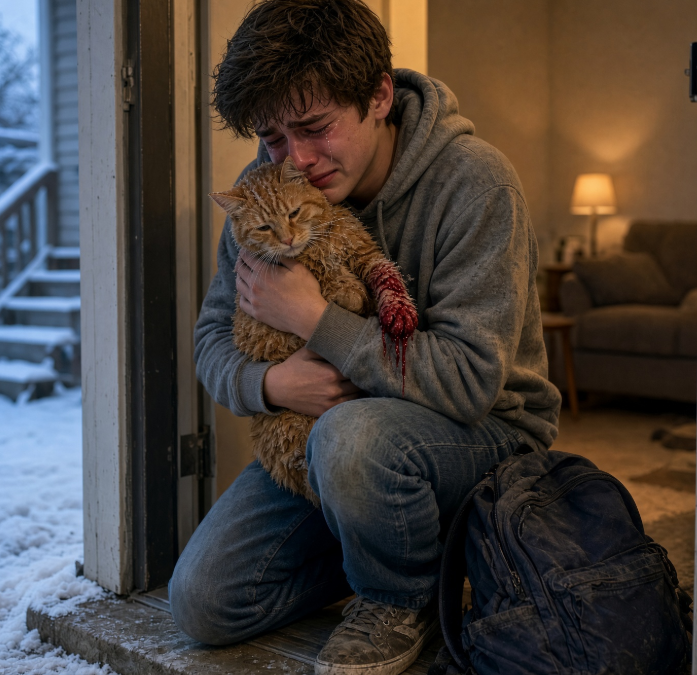
Boxer was sitting on the step outside the building.
At first, my brain refused him.
It showed me an orange shape and would not name it because naming it would risk being wrong.
He was not the Boxer from Hollis.
He was smaller.
So much smaller.
His fur was clumped with ice and mud. His right ear was black at the tip. One shoulder was torn open, the wound crusted and frozen. His eyes were nearly sealed with discharge. His nose was raw. His body trembled so violently that his jaw clicked.
He sat on the concrete step with one front paw lifted, not touching the ground.
His back leg shook.
He looked up at me.
Opened his mouth.
No sound came out.
His throat was too dry to meow.
But I saw the shape of it.
Eli.
Maybe he didn’t say that.
Of course he didn’t.
He was a cat.
But I heard it anyway.
My knees hit the concrete.
I do not remember deciding to move.
I was just there, on the freezing step, hands reaching.
“Boxer.”
His head lowered into my palms.
“Box.”
I scooped him up.
He was too light.
That terrified me.
He should have been heavy.
Boxer had always been heavy.
I pulled him against my chest exactly the way I had held him on the common-room floor eleven days earlier.
Two hands.
Against my heart.
Face in his fur.
He smelled like blood, snow, mud, and cold.
“I’m here,” I said.
My voice broke on every word.
“I’m here. I’m here. I’m here.”
He tried to purr.
It came out as a dry vibration.
I carried him inside.
Someone in the hallway said, “Is that a cat?”
I ignored them.
Carla’s office was on the first floor. I kicked the door until she opened it in slippers and a sweatshirt, hair loose, face half-asleep.
Then she saw us.
“Oh my God.”
“He found me,” I said.
She reached for her phone.
“We need a vet.”
“He found me.”
“I know.”
“Fourteen miles.”
“I know.”
“How did he know?”
Carla’s eyes filled.
“I don’t know.”
I sat on the floor of her office and held Boxer.
Carla called the emergency vet.
Called Mr. Pollard.
Called Ms. Renee.
Called her supervisor.
Called transportation.
People moved around me, but I did not put him down.
Not when they brought towels.
Not when Carla said she needed to check the wound.
Not when the driver arrived.
Not in the car, even though Carla said a carrier would be safer.
“He’s not going back in a box,” I said.
No one argued.
At the emergency clinic, they tried to take him from me.
I tightened my arms.
Carla touched my shoulder.
“Eli. They have to help him.”
“He just got here.”
“I know.”
“If I let go—”
“He won’t think you left.”
I looked down at Boxer.
His eyes were barely open.
Carla said, “Tell him.”
So I did.
I bent close.
“They’re going to fix you. I’m right here.”
His paw flexed against my hoodie.
The vet tech took him.
The door swung closed.
For the second time in my life, I felt something I loved being taken somewhere I could not follow.
The veterinarian’s name was Dr. Meera Shah.
She was direct, which I appreciated because gentle lies make me angry.
“He is severely malnourished,” she said after the first exam. “Hypothermic. Dehydrated. He has an infected shoulder wound approximately three inches long, frostbite on the right ear tip, torn paw pads, and a suspected fracture in the right rear foot. His kidneys are under stress from dehydration. He is in serious condition.”
Carla asked, “Will he live?”
Dr. Shah looked at me, not Carla.
“He found you after eleven days outside in February?”
I nodded.
“Then I am not betting against him.”
Boxer stayed at the clinic nine days.
Nine more days of leaving without him.
But this time, I knew where he was.
This time, people let me visit.
The first day, they cleaned the shoulder wound and stitched it with twenty-two sutures. They amputated the dead tip of his right ear where frostbite had killed the tissue. They warmed him slowly. Gave fluids. Antibiotics. Pain medication. Bandaged his torn paw pads. Immobilized the fractured metatarsal.
He had walked miles with a broken bone.
Miles after his paw pads split open.
Miles while starving.
Miles in cold that made grown men hurry from car to door.
The staff traced the likely path using where he disappeared and where he arrived.
Farmland.
Two major roads.
A frozen creek.
Railroad tracks.
A section of highway with almost no shoulder.
Twenty-two kilometers.
Fourteen miles.
People kept saying, “Incredible.”
I hated that word at first.
It made his suffering sound beautiful.
But maybe incredible simply means the mind cannot hold it all at once.
I could not hold it.
So I held him.
Every visit, Boxer tried to climb into my arms despite the bandages.
Every visit, I sat in the exam room chair with a towel over my lap and let him rest against my chest.
He was too weak to purr loudly.
But the vibration was there.
Small.
Determined.
Dr. Shah asked me on the third day, “How did he know where to go?”
“I don’t know.”
“Had he ever been to Maple Ridge before?”
“No.”
“Had anyone transported him there? Any bedding with your scent moved between places?”
“No.”
She frowned thoughtfully.
“Cats have remarkable spatial memory, scent tracking, magnetic orientation—there are theories.”
I looked at Boxer.
He opened one eye.
“What do you think?” she asked.
I did not answer right away.
Then I said the only thing that felt true.
“He’s the only thing that ever came back for me.”
Dr. Shah stopped writing.
Carla, sitting beside me, looked down.
I stroked Boxer’s head carefully, avoiding the bandaged ear.
“He didn’t know the route. He knew I was gone.”
No one in the room said anything after that.
The problem came before Boxer was discharged.
Maple Ridge did not allow animals.
No pets.
Underlined.
Carla submitted the first request for a policy exception while Boxer was still hospitalized.
Denied.
She submitted the second with a note from Dr. Shah explaining Boxer’s medical condition and emotional attachment.
Denied.
The program director wrote that allowing an animal could create liability, sanitation concerns, resident conflict, and precedent.
Precedent.
That word made me want to put my fist through a wall.
My life had been destroyed by policies written to prevent exceptions, and now the one creature who had crossed fourteen miles of frozen land to find me was being turned away because someone was afraid other kids might ask for hamsters.
Carla came to my room with the second denial printed in her hand.
I knew before she spoke.
“No.”
“Eli—”
“No.”
“I’m not done.”
“They said no.”
“I said I’m not done.”
She sat at my desk.
“We are going to submit again.”
“They won’t care.”
“They might.”
“They don’t.”
“Then we make it harder not to.”
She pulled out a blank sheet of paper.
“I need you to write something.”
I laughed once.
“No.”
“Eli.”
“I’m not writing a feelings letter so a committee can feel important before saying no.”
“It’s not for them to feel important.”
“Then what?”
“It’s for them to see you.”
I looked away.
Carla softened her voice.
“In three years of your file, every report says some version of the same thing. Eli is quiet. Eli avoids engagement. Eli refuses reflective exercises. Eli declines written processing.”
“Sounds accurate.”
“This is your chance to put something in your own words.”
“I hate my own words.”
“Use them anyway.”
I stared at the paper.
It stayed blank a long time.
Carla waited.
She was good at that.
Finally, I wrote.
Not much.
Just the truth.
He walked 22 kilometers in the snow with a broken paw to find me. Nobody has ever done that for me. Please don’t take him away. He is the only family I have. He chose me. Nobody had ever chosen me before.
My hand shook so badly the letters tilted.
I pushed the paper toward Carla.
“That’s all.”
She read it.
Her face changed.
“Okay,” she whispered.
She attached my statement.
Dr. Shah’s letter.
Mr. Pollard’s statement admitting Boxer had stopped eating after I left and escaped while searching.
Ms. Renee’s note describing our bond.
Photos of Boxer before and after.
Medical estimates.
A proposed care plan.
Litter box location.
Cleaning schedule.
Vaccination records.
Financial support from a local rescue group that offered to cover Boxer’s food and medical supplies for six months.
Then Carla sent the third request.
We waited two days.
Boxer was ready to discharge.
Dr. Shah said he needed a quiet indoor space, medication, bandage changes, and a stable caretaker.
Stable caretaker.
Me.
No one had ever used stable to describe me before.
On Friday morning, Carla knocked on my door.
I was sitting on the bed, shoes on, jacket zipped, staring at nothing.
She held a folder.
Her face gave nothing away.
I stood.
“Well?”
“The exception was granted.”
For a second, I did not understand the sentence.
Then I did.
I sat back down hard.
Carla smiled.
“Boxer can live here with you.”
My throat closed.
“Permanent?”
“As long as you remain in good standing with the housing program and follow the care plan.”
“That’s not permanent.”
“No,” she said honestly. “But it’s real.”
Real was enough.
Dr. Shah released Boxer that afternoon.
He came out wearing a small cone, a shoulder bandage, a wrapped front paw, a splinted back foot, and the expression of a cat deeply offended by modern medicine.
When he saw me, he tried to run.
His body failed to cooperate.
I met him halfway.
“Hey, Box.”
He pressed his face into my hand.
Dr. Shah handed me medications, instructions, warning signs, appointment dates, and a bill mostly covered by donations after Carla shared his story with a local rescue network.
People had helped.
That made me uncomfortable.
Then grateful.
Then uncomfortable again.
Dr. Shah touched Boxer’s head.
“No more cross-country travel,” she told him.
He blinked.
“I’m serious.”
He sneezed.
She looked at me.
“Keep him warm. Keep the bandages dry. He needs to gain weight slowly. Watch his water intake. We’ll recheck kidney values in two weeks.”
“I will.”
“And Eli?”
I looked up.
“He came a very long way. Don’t spend all your energy feeling guilty for the road behind him. Use it taking care of the road ahead.”
I nodded because speaking would have ruined me.
Boxer’s first night at Maple Ridge, he slept on my chest.
Not beside me.
On me.
Bandages and all.
He was lighter than before, but still warm.
His purr rattled because he was weak.
I lay flat on the bed with both hands resting gently around him, afraid to move.
At 2:00 a.m., I woke from the first deep sleep I had had since leaving Hollis.
Boxer was still there.
I whispered into the dark, “You’re heavy.”
His tail tapped once against my ribs.
I smiled.
It hurt.
The next weeks became routine.
Medication at 7:00 and 7:00.
Bandage checks.
Warm compress.
Food measured.
Water measured.
Litter scooped twice daily because program staff were watching for any reason to regret the exception.
Vocational training from 8:00 to 1:00.
Part-time work placement after that.
Home by 4:00.
Boxer in the window.
Always.
He learned the sound of my steps in the hallway. By the time I reached my door, I could hear him on the other side, a rough meow returning as his throat healed.
His ear healed shorter.
The right tip gone, leaving him permanently uneven.
His shoulder scar closed under the fur, though a long ridge remained if you knew where to feel. One paw pad healed thicker than the others, forming a small bump that changed the rhythm of his walk.
His back foot mended, but in cold weather he limped.
So did I, in ways people could not see.
We adjusted together.
Maple Ridge changed because of Boxer.
Not officially.
Officially, he was an approved emotional support animal under a specific documented exception.
Unofficially, he became building management.
Residents who had ignored me now stopped to ask how he was.
The girl in Room 12 brought him a toy mouse.
He ignored it for three days, then carried it into my boot.
The guy in Room 4, who acted tough but cried during phone calls with his little sister, asked if he could pet Boxer once. Boxer allowed exactly four seconds.
Carla checked in more often than required, always pretending it was paperwork.
Ms. Renee visited from Hollis after a month.
When Boxer saw her, he limped over and headbutted her ankle.
She cried.
“I’m sorry, Box,” she whispered.
He accepted her apology with the generosity of a cat who knew humans were often disappointing but occasionally useful.
Mr. Pollard came once too.
He stood in my room looking older than before.
“I failed both of you,” he said.
I did not know what to do with that.
Adults rarely admitted failure to me.
I shrugged.
He nodded like he deserved less than forgiveness and had expected it.
Then Boxer climbed onto his shoe.
Mr. Pollard stared down.
“That means he forgives me?”
“No,” I said. “That means your shoe is warm.”
He laughed.
So did I.
A little.
At eighteen, I graduated from the transitional program’s first-year track.
At nineteen, I was working full-time at an auto parts warehouse on the shipping side. I stayed in the same apartment because Carla helped me qualify for an extended housing option tied to employment.
My room became more like a home.
Secondhand couch from a church basement sale.
Small television I bought with my third paycheck.
Microwave.
Two mugs.
A framed photo of Boxer before the journey, fat and annoyed on my Hollis bed.
Another photo of him after recovery, sitting in my window with his uneven ear lit by morning sun.
I never got many pictures of myself.
Foster kids learn not to expect albums.
But Carla took one photo without asking that became my favorite.
She came by for a routine visit on a Saturday afternoon around 2:00. I had worked an early shift and fallen asleep on the couch.
Boxer was on my chest.
His body stretched from my ribs to my collarbone.
My hands rested around him even in sleep.
Both of us completely still.
Carla told me later she stood in the doorway for almost a full minute.
Then she took out her phone and took a picture.
She wasn’t supposed to.
She told me that too.
“I don’t care,” she said.
When she showed me, I looked away at first.
I didn’t like seeing myself asleep.
Too vulnerable.
Then I looked again.
The apartment was almost empty.
Bare wall.
Used couch.
Work boots on the floor.
Boxer on my chest.
My face peaceful in a way I did not recognize.
Carla said, “That is the most complete picture of family I have ever taken.”
I kept it.
I printed it at a pharmacy and put it on the dresser.
Boxer is eight now.
I am nineteen.
His missing ear tip makes strangers ask questions sometimes.
His limp gets worse when temperatures drop.
The scar on his shoulder hides beneath fur unless he stretches.
The thickened paw pad makes one step softer than the others.
At night, he still sleeps on my chest.
Every night.
Not beside me.
On me.
Some people think that sounds uncomfortable.
It is not.
I like the weight.
I like waking up and feeling proof that something wants to be exactly where I am.
There is no easy way to explain what that means to someone who has always had people come back.
If you grew up with a mother who picked you up from school every day, a father who knew what cereal you liked, grandparents who called on birthdays, siblings who remembered inside jokes, maybe love feels like background noise.
For me, love was paperwork.
Visits.
Promised calls.
Packed bags.
Adults whispering in hallways.
Court dates.
New rooms.
New rules.
New reasons I could not keep what I loved.
Then Boxer walked fourteen miles through winter on injured feet and sat on my step.
That kind of love does not become background noise.
It becomes the sound your life is built around.
I still think about the road he took.
Not constantly.
But sometimes.
When snow starts falling.
When a truck splashes slush across the curb.
When I cross the railroad tracks on the bus.
I picture him small against all that space.
Orange fur against white fields.
Paws freezing.
Shoulder bleeding.
Ear dying at the tip.
Still moving.
Not because he understood addresses.
Not because he read maps.
Because somewhere ahead, I existed.
And that was enough.
People say animals don’t think like that.
Maybe they’re right.
Maybe Boxer was following scent, instinct, memory, magnetic fields, hunger, confusion, all the mysterious things scientists study and the rest of us turn into stories.
But I know what happened before he left.
He stopped eating.
He sat by the door.
He squeezed through a window that hurt him.
He crossed roads he had never seen.
He arrived at my building.
He sat on my step at six in the morning.
And when he saw me, he tried to meow.
No theory has ever explained that better than love.
I am not fixed.
People like stories where love fixes the damaged kid.
This is not that.
I still hate forms.
I still go quiet when people ask too many questions.
I still flinch when someone says, “We need to talk,” even if they only mean the work schedule changed.
I still have days when I expect good things to be taken because history taught my body that wanting something is dangerous.
But I eat breakfast now.
Most days.
I go to work.
I pay rent.
I answer Carla’s texts.
I bought Boxer a heated bed he refuses to use because apparently my sternum is better.
I have a bank account.
A library card.
A winter coat I chose myself.
A future I do not fully trust but have begun to make plans for anyway.
Boxer helped with that.
Not because he made life easy.
Because he made leaving impossible in the best way.
When you are responsible for a creature who nearly died to find you, you cannot disappear casually.
You have to buy food.
Schedule vet visits.
Come home after work.
Keep the room warm.
Remember medication.
Save money.
Think about next month.
That is how he saved me after I thought his journey was over.
First, he came back.
Then he made me stay.
On my twentieth birthday, Carla and Ms. Renee came over with cupcakes. Mr. Pollard sent a card. Marcus messaged me from wherever he had landed after Hollis. Kayla mailed me another bracelet, this one with orange beads.
Boxer wore it around his neck for one photo and looked betrayed.
I laughed.
A real laugh.
Carla pointed at me.
“There it is.”
“What?”
“You.”
I rolled my eyes.
But that night, after everyone left, I sat on the couch with Boxer on my chest and thought about the boy who left Hollis at seventeen.
The boy who held a cat for eleven minutes because he thought goodbye was permanent.
I wish I could tell him he was wrong.
I wish I could tell him that love would arrive on the coldest morning, half-starved and bleeding, with no voice left but still trying to say his name.
I wish I could tell him that one day he would own a couch, a TV, two mugs, and a cat with a crooked ear who slept like a stone on his ribs.
I wish I could tell him that being chosen once can be enough to begin rebuilding a person.
Not all at once.
Not magically.
But enough.
Boxer shifts in his sleep sometimes, paws twitching like he is walking.
I always wake when he does.
I place my hand on his back.
“You’re here,” I whisper.
Maybe I am saying it to him.
Maybe I am asking him to say it back.
Either way, the answer is always the same.
His purr starts low against my chest.
A rough, uneven sound, changed by age and cold and everything he survived.
It is the sound of fourteen miles.
Of frozen roads.
Of a door found.
Of a step climbed.
Of a family made from two creatures everyone else thought could be separated by rules.
Every night, Boxer sleeps on me like he is making sure I do not forget.
He came back.
He chose me.
He stayed.
And for the first time in my life, so did I.








