I Adopted Two Old Cats No One Wanted—Then They Exposed What My Daughter Was Doing to My Late Husband’s Things
PART2:
The world cannot stop every time one person’s world does.
But mine had stopped.
The house remained exactly where it had always been on a quiet street in Ohio, two maples out front, cracked walkway, blue shutters Harold painted himself and complained about for three summers afterward.
Everything looked normal from the outside.
Inside, I became a ghost moving through rooms that still belonged to two people.
Harold’s coat hung by the door.
His slippers waited beside the bed.
His crossword books were stacked on the side table near his recliner.
His shaving mug sat on the bathroom shelf, still holding the old brush he refused to replace.
There was a coffee ring on his desk that I used to nag him about.
After he died, I put my hand over that ring one morning and cried so hard I had to sit on the floor.
That is what grief does.
It makes sacred the very things you once threatened to throw away.
Megan called every evening.
At first, she kept her voice cheerful.
“Did you eat today?”
“Yes.”
“What?”
“Soup.”
“What kind?”
“The kind from a can, Detective.”
“Mom.”
“I’m seventy-one, not four.”
“Then stop eating like a college student.”
Sometimes I laughed.
Sometimes I pretended to.
After the first month, her questions changed.
“Did you go outside?”
“Did you see anyone today?”
“Are you sleeping?”
Then one night, after a silence that felt carefully placed, she said, “Mom, I’m worried about you.”
“I’m fine.”
“No,” she said quietly. “You’re not. You sound like you’re fading.”
That word stayed with me.
Fading.
I hated how accurate it felt.
I was not falling apart in any dramatic way.
I showered.
I paid bills.
I answered the phone when I had to.
I watered the fern Harold had hated because he said it looked like “a depressed palm tree.”
But some part of me had gone dim.
I could feel it.
A few days later, Megan asked me to go with her to the animal shelter.
“Just to look,” she said.
“No.”
“They have visiting hours Saturday.”
“No.”
“I’m not saying adopt anything.”
“Megan.”
“I just think it might help to get out of the house.”
“I get out.”
“To the mailbox?”
“That counts.”
She went quiet.
I almost hung up.
Then she said, very softly, “Please, Mom. Just one hour.”
That was what got me.
Not the suggestion.
Not the shelter.
The please.
Megan was my only child.
Harold and I had lost two pregnancies before her, and by the time she was born, Harold treated her like proof that the world could still be merciful.
He carried her around the house in one arm like a football and whispered entire baseball lineups to her before she could hold up her own head.
When she was seven and scraped her knee, he looked paler than she did.
When she left for college, he pretended dust had gotten into his eyes for six straight hours.
And when he was dying, he said her name more than anyone’s.
“Take care of your mother,” he told her.
That sentence became a stone in her pocket.
I know that now.
I did not fully know it then.
So I went to the shelter.
Not because I wanted a pet.
Not because I thought joy could be adopted in a cardboard carrier.
I went because my daughter asked, and because the house had become so quiet that even I was beginning to frighten myself.
The shelter was a low brick building near the edge of town with a cracked parking lot and tired flower pots by the door.
Inside, it smelled like bleach, newspaper, old towels, and warm animal fur.
Dogs barked somewhere in the back.
Cats blinked from cages along two walls.
Most were young.
Kittens with enormous eyes.
Sleek little cats reaching paws through bars.
Pretty things.
Easy things.
The kind of animals people pointed to first.
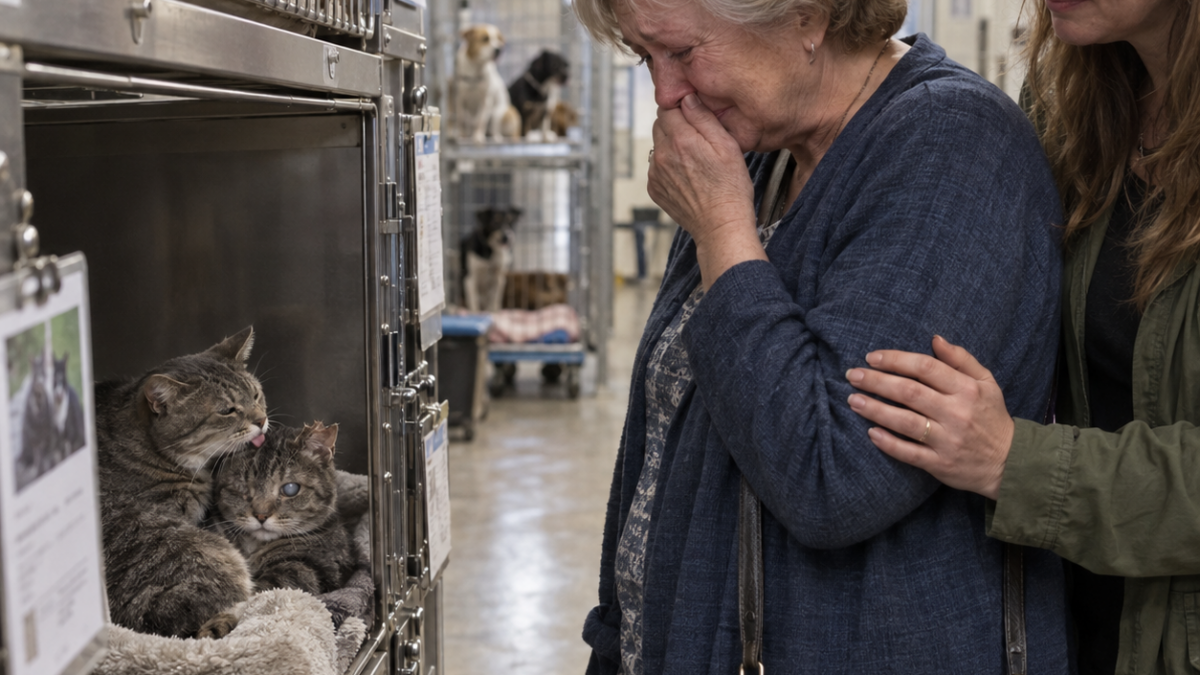
Then I saw the old pair in the bottom kennel near the corner.
Two gray tabbies curled so tightly together they almost looked like one creature.
One had a white patch beneath his chin.
The other had a cloudy left eye and one ragged ear that gave him the weary dignity of a retired boxer.
They were not sleeping exactly.
They were holding on.
A shelter worker named Janice came over and stood beside me.
“Those two are bonded,” she said.
I nodded without taking my eyes off them.
“How old?”
“Nine. Maybe ten. Hard to know for sure.”
The white-chinned one lifted his head.
The cloudy-eyed one leaned harder against him without opening his eyes.
“How long have they been here?”
Janice hesitated.
That told me before she answered.
“Too long.”
Megan appeared beside me.
“Oh, Mom.”
The shelter worker explained that the cats had belonged to an older man who had gotten sick and gone into care.
He never came home.
His family could not keep the cats.
Older bonded pairs are difficult to place.
People want kittens.
People want simple.
People want one.
“These two need to stay together,” Janice said. “Theo and Frankie. Theo’s the one with the white chin. Frankie’s the one-eyed gentleman.”
At the sound of his name, Theo began licking the top of Frankie’s head.
Slow, careful licks.
Not cute exactly.
Not playful.
Familiar.
Like it was a job he had been doing for years.
Like, I’m here.
Like, don’t worry.
Like, I know the world changed, but I’ve still got you.
I turned my face away because I was already crying.
Grief recognizes grief.
I believe that now.
It recognized those two old cats before my mind had caught up.
All I could see was Harold’s hand searching for mine in the hospital bed. The way we had moved around each other in those last weeks, slow and practiced, always aware of where the other one was.
I saw marriage.
Not the wedding-photo kind.
The real kind.
Two lives pressed together for so long that separation becomes more than loneliness.
It becomes disorientation.
I asked a terrible question.
“What if someone only takes one?”
Janice’s eyes softened.
“We try very hard not to let that happen.”
Theo kept licking Frankie’s head.
Frankie closed his good eye.
That was the moment.
I did not decide so much as understand that the decision had already happened.
I looked at Megan.
“Get the paperwork.”
Her eyes widened.
“For both?”
I looked back at the cats.
“I know what it feels like to lose the one you built your life around. I’m not doing that to them.”
Megan cried then.
So did Janice.
Even Theo looked mildly disappointed in all of us, which I later learned was simply his resting expression.
The drive home was the first drive in months that did not feel empty.
I could hear them shifting in the carriers in the back seat.
Small sounds.
Living sounds.
A claw against plastic.
A low questioning meow.
The rustle of an old body turning around.
I had not realized how starved I was for evidence of life.
When we got home, they came out cautiously.
Theo first.
Frankie waited until Theo had inspected the hallway, the living room rug, the legs of the kitchen chairs, and the bottom shelf of the bookcase.
Then Frankie followed exactly in Theo’s path, as if Theo had cleared the building for emotional hazards.
They moved like two elderly men checking into a motel they did not trust.
Theo paused beside Harold’s recliner.
He looked up at it for a long time.
Then he crouched and squeezed underneath.
That nearly finished me.
Harold had lived in that chair during the last year.
He watched baseball there.
Napped there.
Read there.
Argued with weather reports there.
After he died, I did not sit in it.
I did not move it.
I barely looked at it directly.
Theo walked into my house less than ten minutes and found the place I had been avoiding.
Frankie wandered into the bedroom.
Later that night, when I went in to change, I found him curled on Harold’s side of the bed.
Not the middle.
Not my side.
His side.
He had settled into the dip Harold’s body had left in the mattress.
I stood in the doorway holding my nightgown and whispered, “You too, huh?”
Frankie opened his cloudy eye.
Then closed it again.
That was the beginning.
I named them nothing new.
Their old names suited them.
Theo was brave, bossy, and opinionated.
Frankie was cautious, suspicious, and so emotionally dependent on Theo that if Theo left the room, Frankie would lift his head with an expression that said the world had clearly lost structural integrity.
They found the sun patch in the dining room.
They found the loose board by the laundry room.
They found the warm vent beneath the kitchen window.
They found the closet where Harold’s winter coats still hung.
They found the office door and sat in front of it like small furry mourners at a chapel.
Most of all, they found the shapes Harold had left behind.
The recliner.
The bed.
The hall tree.
The rug where he stood every evening to put on shoes before walking out to check the mailbox.
Every day at five-thirty, Theo and Frankie began sitting by the front window.
The first time I noticed, I nearly dropped a plate.
Harold had come home from work around five-thirty for most of our marriage.
Even after retirement, he still checked the driveway at that time because habit outlives employment.
I never taught the cats.
They never met him.
But there they sat, side by side, looking out as the late afternoon light shifted over the driveway.
Two old cats keeping an appointment with a man who would never pull in again.
It broke me.
And it helped me.
That is the strange truth.
Grief does not always want comfort that makes sense.
Sometimes it wants company in the senseless places.
Theo and Frankie gave me routine.
Breakfast to serve.
Medicine to crush into soft food once we discovered Frankie’s stomach issues.
Water bowls to rinse.
Litter boxes to scoop.
Fur to brush.
Windows to open exactly two inches because Theo believed one inch was insulting and three inches created unacceptable wind conditions.
They gave me demands.
I had not realized how much a grieving person needs to be needed in boring ways.
Not big ways.
Not emergency ways.
Just ordinary, daily ways.
A creature yelling at your ankle because dinner is six minutes late can be an anchor.
Megan noticed first.
“You sound better,” she said one Tuesday evening.
I stood at the sink rinsing two little bowls while Theo shouted at me as if I had personally invented hunger.
“I’m still sad.”
“I didn’t say happy. I said better.”
I looked down.
Frankie sat by the pantry door pretending not to care, which meant he cared very much.
“Maybe I am.”
Megan exhaled like she had been holding her breath for months.
That should have warned me.
Relief can turn into control so fast you barely notice the moment it changes.
At first, it was small.
“Mom, I could help tidy the garage this weekend.”
“No, thank you.”
“Maybe we can start with one closet sometime.”
“Not yet.”
“Dad had a lot of old papers in his office. We don’t want things piling up.”
“They have been piled up for years. They can wait.”
She always said, “Okay.”
But each okay became tighter.
I could hear it.
Megan had always been a planner.
When she was little, she lined up crayons by color and shoes by season.
When Harold got sick, planning became her armor.
Appointments.
Prescriptions.
Meal schedules.
Questions for doctors.
Insurance calls.
That armor had helped us survive those months.
The problem was, after Harold died, she kept wearing it.
And I became the emergency she was trying to manage.
One afternoon, she came over with a casserole and a look on her face that meant she had already made a decision.
Theo sniffed her shoe and backed away.
Frankie watched from beneath the coffee table.
Megan looked around the living room.
“It feels different in here,” she said.
“It smells like tuna half the time.”
She laughed.
“I mean it, Mom. It feels alive.”
I almost said, Then let it stay alive the way it is.
I didn’t.
I asked if she wanted coffee.
That was how many family disasters began in our house.
Coffee first.
Pain after.
We sat at the kitchen table.
Megan wrapped both hands around her mug.
Theo cleaned one paw with the theatrical focus of a creature pretending not to listen.
Then Megan said, “You know, maybe this is a good time.”
My stomach sank.
“A good time for what?”
“To start making some changes while you’re feeling stronger.”
There it was.
So soft you could almost mistake it for kindness.
I set my mug down.
“Megan.”
“Just hear me out.”
I did not want to.
But I did.
Because mothers keep listening long after they know what sentence is coming toward them.
She talked about the house.
Too big.
Too many stairs.
Too much maintenance.
The roof would need work eventually.
The yard was a lot.
I did not use the upstairs guest room anymore.
There were nice smaller places closer to her neighborhood.
Some had community activities.
Some allowed pets.
“I’m not saying now,” she said quickly. “Just eventually. We should be realistic.”
Realistic.
Another one of those words people use when they want their fear to sound more mature than yours.
“This is still my home,” I said.
“I know.”
“Do you?”
She looked hurt.
“That’s not fair.”
“No. What isn’t fair is talking about my life like it has already become too much for me because your father died.”
Her eyes filled.
“I’m scared for you.”
“I understand that.”
“Do you? Because I lie awake wondering if you’ll fall. Or get sick. Or stop eating again.”
“I am eating.”
“Because the cats force you into the kitchen.”
I almost smiled.
She was not wrong.
Megan leaned forward.
“You can’t freeze your life here, Mom.”
The word landed like a slap.
Freeze.
As if grief were bad weather.
As if staying in the house where Harold and I had built our adult lives was the same thing as refusing to scrape ice from a windshield.
I stood and carried both mugs to the sink even though mine was half full.
The conversation ended there.
Megan knew it.
She left quietly.
At the door, she bent to say goodbye to Theo.
He moved away.
I hated that I noticed.
The next month was full of tiny good things.
That made what happened later hurt worse.
I started sleeping better.
Not every night.
Some nights still split open at 3:00 a.m., and I would wake reaching toward Harold’s side of the bed before memory returned like a cruel nurse.
But other nights, Frankie slept near my knees and Theo took guard duty on the chair beside the dresser, and the room felt less like a tomb.
I opened curtains again.
Then windows.
Then the back door on mild afternoons.
I went to the grocery store without feeling like every aisle contained a ghost of Harold asking whether we needed mustard.
The first time I laughed without guilt, Theo had gotten his head stuck through the handle of a paper shopping bag and marched around the kitchen like an outraged sheriff.
I laughed until I had to grip the counter.
Then guilt came immediately behind the laughter.
Sharp.
Cold.
You are not supposed to laugh without him.
That is a part of grief people do not talk about enough.
They tell you grief comes in waves.
They tell you healing takes time.
They tell you your loved one would want you to smile.
But they do not prepare you for the first moment joy slips into the room and your heart treats it like betrayal.
Theo did not care.
He wanted dinner.
Frankie wanted my lap.
The cats wanted life.
Steady.
Boring.
Necessary.
So I kept participating in it.
Then came the Thursday that split everything open.
I had an eye appointment in the next town.
Routine.
Nothing serious.
The kind where they dilate your eyes, shine lights in them, tell you everything looks age-appropriate, which is a rude phrase if you ask me, and send you back into the world half blind and irritated.
Megan insisted on driving.
“You shouldn’t be behind the wheel after dilation.”
She was right.
That is how trouble often starts.
With someone being technically right.
The appointment took longer than expected.
Afterward, she suggested lunch.
“I should get back to the cats,” I said.
“They’ll be okay one extra hour.”
She gave me that patient smile adult children sometimes give aging parents when they think affection has become eccentricity.
I should have listened to the small flare of irritation in my chest.
Instead, I agreed.
We had soup and sandwiches at a quiet café near the clinic.
For a while, everything felt normal.
She told me about my grandson Tyler’s soccer game.
I told her about Frankie trying to intimidate a squirrel through the window.
We talked about rain gutters, gas prices, and whether her husband Brian would ever finish painting their deck.
Halfway through lunch, I even thought maybe I had been too hard on her.
Maybe she was only scared.
Maybe we both were.
Love keeps handing out the benefit of the doubt long after the warning signs have begun waving both arms.
When we pulled into my driveway, I knew something was wrong before I got out of the car.
The front curtains were open wider than I had left them.
The porch mat had been moved.
Inside, the air smelled like lemon cleaner.
Strong lemon cleaner.
Harold hated lemon cleaner.
He always said it made the house smell like “a hospital trying to sell lemonade.”
My eyes were still blurry from dilation, but I could see enough.
His wool coat was gone from the hall tree.
The little ceramic dish where he tossed loose change was missing from the side table.
The folded blanket he kept on the recliner was gone.
His crossword books were gone.
His reading glasses were gone.
Even the bent pair he had not worn in years.
I stood just inside the front door with my purse still on my shoulder.
“Megan.”
She came in behind me.
Her voice was too bright.
“Surprise.”
That word nearly made me sick.
“I had a little time while you were in the appointment, so I came back and got started.”
Got started.
People say those words as if they are harmless.
What they often mean is, I made decisions about your life while you were not there to stop me.
I turned slowly.
“What did you do?”
Her smile faltered.
“Mom, I only packed a few things. Nothing important.”
Nothing important.
The blanket Harold had pulled over his knees during chemo.
The crossword book he had been working in the week before he died.
The coat I still brushed my fingers across when I walked past because some part of me liked remembering the shape of his shoulders.
Nothing important.
Theo appeared in the hallway.
He froze.
His eyes moved to the recliner.
Then the side table.
Then the hall tree.
Frankie came out from beneath the sofa, sniffed once, and made a sound I had never heard from him before.
Not a meow.
A broken little cry.
He went straight to the hall closet and scratched at the door.
That sound went through me like a knife.
I opened the closet.
Inside were three black donation bags and two cardboard boxes.
One bag gaped open enough for me to see Harold’s slippers.
One box held his winter scarf, two flannel shirts, his shaving mug, the blanket from the chair, and the little wooden back scratcher he kept beside the couch because he insisted it worked better than any “newfangled plastic nonsense.”
Folded.
Neat.
Like none of it had ever belonged to a living man.
Theo shoved his whole face into the box.
Frankie climbed in after him.
And then those two old cats did the thing that broke me clean in half.
They started digging.
Not playing.
Not being naughty.
Searching.
Theo hooked both paws into Harold’s slipper and dragged it halfway out like he was trying to rescue it.
Frankie buried his nose in the blanket and froze there, breathing fast.
Theo pawed through flannel, pushing his head deeper, frantic.
Frankie made that broken sound again.
I sat down hard on the hallway floor.
My knees simply stopped holding me.
Then I sobbed.
Not the delicate crying people imagine widows doing into handkerchiefs.
This was ugly.
Loud.
Uncontrollable.
The kind of crying that makes your ribs hurt and your face wet and your body humiliatingly human.
Megan knelt beside me immediately.
“Mom, please. Please don’t do this.”
That sentence.
I still think about it.
Please don’t do this.
As if grief were a performance.
As if I had chosen that hallway as a stage.
As if I were making a scene instead of watching my husband’s life packed into donation bags while two old cats searched desperately for the scent that made the house feel safe.
I turned and looked at her.
“You did this while I was gone?”
“I was helping.”
“Helping who?”
“You.”
“No,” I said. “You were helping yourself.”
Her face changed as if I had slapped her.
“What is that supposed to mean?”
“It means you didn’t ask what I was ready for. You waited until I was gone and started erasing your father because this house makes you uncomfortable.”
“I did not erase him.”
“You bagged up his clothes.”
“He is not his clothes.”
“No,” I said, my voice shaking. “But this is the house he lived in. These are things his hands touched. I slept beside that man for thirty-one years. You do not get to decide when what remains of him becomes clutter.”
For a second, neither of us moved.
Theo was still inside the box.
Frankie had dragged the edge of the blanket onto the closet floor and laid on top of it like he could keep it from disappearing by weight alone.
Megan looked at them.
Then at me.
Instead of softening, she hardened.
Guilt does that sometimes.
It looks for armor.
“This isn’t healthy,” she said.
There it was.
That word.
Healthy.
People love using that word when they want grief to behave politely.
I stood too quickly and braced myself on the wall.
“What would look healthy to you, Megan? Tell me. Beige apartment? Two chairs? No memories over six months old? Should I keep one approved photograph and file the rest away alphabetically?”
“That’s not fair.”
“What isn’t fair is being treated like a project because I loved my husband enough for this house to still show it.”
She began crying then.
Real crying.
Not dramatic.
Not manipulative.
Overwhelmed.
“I watched Dad die too,” she said. “Do you think walking in here doesn’t hurt me? Do you think I don’t see him everywhere?”
That stopped me.
Because there it was.
Underneath the planning.
Under the practical talk.
Pain.
A daughter who had lost her father and thought if she could clean the room, maybe the ache would stop ambushing her.
“I know you hurt,” I said.
“Do you?”
“Yes.”
She shook her head.
“Every time I come here, I expect him in that chair. I expect him to call from the garage. I expect him to say something stupid about my parking. And then I remember.”
Her voice broke.
“I remember every single time, Mom.”
I swallowed.
My anger did not leave.
But it had to make room.
“I am sorry this house hurts you,” I said quietly. “I truly am. But this is still my house to hurt in.”
She covered her mouth.
The way she did as a little girl when she tried not to cry in public.
And for one strange second, I saw her at seven with a skinned knee.
Then I saw the grown woman in front of me, terrified that if she did not manage me, she would lose me too.
Maybe that is why I did not tell her to get out.
Maybe that is why I did not scream.
I just said, “Put it back.”
She looked at the bags.
The boxes.
The chair.
Me.
Then, slowly, she nodded.
We spent the next hour putting Harold’s things back where she had found them.
Not symbolically.
Practically.
The blanket back on the recliner.
The glasses back on the table.
The shaving mug back on the bathroom shelf.
The slippers beside the bed.
The coat on the hall tree.
While we worked, the house got quieter.
Not dead quiet.
Listening quiet.
Theo followed the blanket.
Frankie followed the coat.
At one point, Megan stood holding one of Harold’s flannel shirts and pressed it suddenly to her face.
I turned away.
Some crying belongs only to the person doing it.
After she left, neither cat ate much dinner.
Theo took three bites and walked away.
Frankie licked the gravy from his soft food and stared toward the closet.
At two in the morning, I found them curled together on Harold’s robe at the foot of the bed.
I did not remember taking the robe out.
Apparently, my hands had known what the rest of me needed.
The next morning, Frankie refused breakfast.
He threw up clear liquid on the kitchen mat and then crouched in the corner with his eyes half closed.
Theo kept going over to him, touching noses, then looking at me like he expected me to fix it.
By noon, I called the vet.
Megan texted as I was trying to ease Frankie into the carrier.
I’m sorry.
Then:
I really thought I was helping.
Then:
How is Frankie?
I stared at the messages.
For a long time, I did not answer.
Finally I typed:
Taking him in now.
That was all I had.
The veterinarian was a calm woman named Dr. Patel, with silver-threaded hair and the gentle firmness of someone used to explaining hard things to people who loved creatures with shorter lives.
She examined Frankie, ran bloodwork, gave him fluids, and asked whether anything had changed at home.
I hesitated.
Then told the truth.
“A lot of familiar things got moved yesterday,” I said. “Then moved back.”
Dr. Patel nodded.
“For older cats, especially bonded cats, sudden changes can be very stressful. Routine matters. Scent matters. Predictability matters.”
I felt vindicated and miserable at the same time.
Not because I wanted to be right.
Because I did not want Frankie to suffer just so someone would confirm what I already knew.
Stability is not a luxury when you are fragile.
It is mercy.
Frankie came home with medicine, bland food instructions, and a warning to call if he did not improve.
Theo met us at the door and pressed his face against the carrier grate.
Frankie made one tiny sound.
Theo answered.
I stood in the hallway holding the carrier and thought, This is what people keep missing.
Older lives are not less valuable because they come with more care.
They are not less worthy because they move slower.
They are not disposable because someone else finds their needs inconvenient.
Maybe I was not thinking only about cats.
Maybe I was not even mostly thinking about cats.
Megan came over that evening without calling.
For a moment, I considered not answering.
But pain had already made enough rooms smaller.
So I opened the door.
She stood on the porch with no makeup, her hair in a messy knot, and Harold’s blue flannel shirt folded in her hands.
“I found this in my car,” she said. “I must have carried it out by accident.”
I took it.
Neither of us moved.
Then she said, “Can I come in?”
I stepped aside.
We sat in the living room with Frankie sleeping in his carrier beside Harold’s recliner and Theo posted like a guard.
Megan looked older that night.
Not in her face.
In her posture.
Like she had been carrying something heavy too long and had finally admitted her arms hurt.
“I need you to understand something,” she said.
I waited.
“When Dad got sick, every time I came over here, I braced before I opened the door. I never knew if it would be a good day or a bad day. If you’d look exhausted. If he’d be worse. If I’d hear something in your voice that meant the end was getting closer.”
She swallowed.
“After he died, I kept walking in and still bracing. But there was nothing to brace for anymore. Just his things. Everywhere.”
I listened.
Not because she had earned it perfectly.
Because grief deserves witnesses even when it comes from the person who hurt you.
“I would leave here and sit in my car and cry,” she said. “And then I would think about you staying here alone with all of it, and I’d panic. The cats helped. You sounded alive again. So I thought if I could clear out some of the hardest things, maybe it would help both of us breathe.”
I nodded slowly.
“I believe that.”
She looked at me.
“But?”
“But help that arrives without asking can feel a lot like being erased.”
She closed her eyes.
I kept going before I lost courage.
“I need you to hear me, Megan. I am lonely. I am grieving. I am older than I was. None of that means I stop being the person in charge of my own life.”
She wiped her face.
“I know.”
“No,” I said softly. “I don’t think you do yet. I think you are terrified that I will disappear if you don’t get ahead of it. You look at me and see a widow in a big house. A mother who cries over slippers. A woman who talks to cats. Maybe that scares you. But scared is not the same as right.”
For a while, the only sound was Theo licking one shoulder with loud determination.
Then Megan whispered, “I don’t know how to lose another parent.”
That was the true sentence.
Not house.
Not closet.
Not stairs.
Not square footage.
Fear.
I reached over and took her hand.
It was cold.
“You are not losing me tonight.”
She gave a sad little laugh.
“You say that like you get to decide.”
“No. I say it like you don’t get to start burying me before I’m gone.”
That broke her.
Fully.
And because she is my daughter, I moved closer and held her while she cried, even though I still hurt.
That is motherhood too.
Holding the child who has broken your heart because you can see the broken place in theirs.
Eventually Theo climbed into Megan’s lap as if he had appointed himself minister of reconciliation.
She laughed through tears.
“Traitor.”
Frankie opened one cloudy eye from his carrier, saw nothing urgent, and went back to sleep.
Things changed after that.
Not magically.
Not neatly.
Honestly.
We made rules.
No more helping in my house without asking.
No bags.
No boxes.
No surprise sorting.
No practical ambushes disguised as errands.
If we touched Harold’s things, we touched them together.
Only when I said yes.
And when I said stop, we stopped.
A week later, I said yes to one bathroom drawer.
Not the closet.
Not the office.
One drawer.
Old razors.
Expired medicine.
A tube of cream with the cap glued shut.
A receipt from 2018.
We cleaned it together.
Halfway through, I got tired.
“Stop,” I said.
Megan stopped immediately.
That mattered more than the drawer.
Respect often looks small from the outside.
Sometimes it is just a hand not reaching where it used to.
Life settled again.
Theo resumed supervising dinner with the seriousness of a federal inspector.
Frankie got his appetite back and developed a voice so demanding that I accused him of pretending to be fragile for sympathy.
The five-thirty window ritual continued.
I began sitting with them.
Three bodies facing the driveway.
Not because I thought Harold would come walking up it.
Because love had lived here, and there was something holy in not pretending otherwise.
One Sunday afternoon, I opened the door to Harold’s office.
I had avoided that room almost completely.
I had opened the door after the funeral, looked inside, and shut it.
That does not count.
For months, Theo had pawed at that door.
Frankie sat beside him like moral support.
Finally I said, “Fine.”
The room smelled stale and paper-dry.
Harold’s desk was cluttered with pens, envelopes, a calculator, and a legal pad with three half-finished lines on it.
A sweater hung over the chair.
There was the coffee ring on the desk.
The one I used to nag him about.
I stood in the doorway and thought, I cannot do this.
Then Theo walked right past me.
Frankie followed.
Theo jumped into Harold’s desk chair.
Frankie went straight to the sweater and kneaded it once before settling down.
And just like that, my feet moved.
I entered.
I sat in the chair opposite the desk.
I put my hand over the coffee ring.
Then I cried in a way I had not allowed myself to cry yet.
Not funeral crying.
Not hallway crying.
Not startled-by-memory crying.
Deep crying.
The kind with sound in it.
The kind that leaves your face hot and your body hollow afterward.
Theo stepped onto the desk and bumped his head against my wrist.
Frankie stayed on the sweater.
Between them, they held that room open until I could sit in it without drowning.
That is what those cats did to my empty house.
They did not fix it.
They did not decorate my grief into something presentable.
They walked straight into the places I had nailed shut and made them livable again.
One room at a time.
One routine at a time.
One ordinary evening at a time.
A month after the hallway fight, Megan came over with Tyler, my grandson.
He was thirteen, tall, awkward, and trying very hard to be too old to care about cats.
Theo saw through him immediately.
Within fifteen minutes, he had climbed onto Tyler’s lap and forced him into emotional honesty.
“He’s heavy,” Tyler said.
“He’s wise,” I corrected.
“He smells like tuna.”
“Wisdom comes with a cost.”
Megan stood in the kitchen doorway watching us.
Her face softened.
Later, while Tyler played on his phone and Frankie snored dramatically from Harold’s recliner blanket, Megan said, “I talked to someone.”
I stiffened.
She raised both hands.
“A therapist. For me.”
I relaxed slowly.
“Oh.”
“I think I need help learning how not to make my fear your emergency.”
I looked at her.
That sentence would have been impossible a month earlier.
“I’m proud of you.”
She blinked hard.
“I’m sorry, Mom.”
“You already said that.”
“I know. I’m saying it again.”
I nodded.
“Then I accept it again.”
She laughed quietly.
Then she looked toward the living room.
“I miss him.”
“I know.”
“Sometimes I’m mad at him.”
That surprised me.
“For dying?”
“For leaving us with all this.”
She looked guilty the second she said it.
I reached for her hand.
“Oh, honey.”
“I know it’s not fair.”
“Grief is not a courtroom.”
Her mouth trembled.
“You can be mad.”
“At Dad?”
“Yes.”
“At cancer?”
“Yes.”
“At me?”
She looked down.
“Sometimes.”
I squeezed her fingers.
“Then be mad. Just don’t pack up my house without asking.”
She laughed through tears.
“I won’t.”
That became our way forward.
Truth.
Messy truth.
Not perfect peace.
Perfect peace is mostly something people write in sympathy cards.
Real healing is clumsy.
It apologizes badly.
It tries again.
It stops at one drawer.
It lets the old robe stay at the foot of the bed because two cats like it and because a widow is not ready.
Winter came.
The first snow without Harold nearly undid me.
He loved snow.
Not driving in it.
Not shoveling.
Just looking.
He would stand at the front window with coffee and say, “Would you look at that,” every single snowfall as if weather had personally invented itself overnight.
The first snow fell on a Tuesday.
I woke before dawn and knew by the light.
That pale, blue-white glow pushing around the curtains.
Theo and Frankie were already at the window.
Of course they were.
I made coffee.
One mug.
Then, without thinking, took down Harold’s.
I stood there holding it.
His old green mug with the chip near the handle.
For months I had avoided using it and avoided putting it away.
That morning, I poured coffee into both.
Mine stayed in my hand.
His went on the table across from me.
Not because I thought he was there.
Because he had been.
That was reason enough.
Theo jumped onto the chair beside Harold’s mug and sniffed the steam.
“No,” I said.
He looked offended.
Frankie sat under the table.
We watched snow together.
Later, Megan called.
“It’s snowing.”
“I see it.”
“Dad would be at the window.”
“I know.”
I looked at his mug.
“Megan?”
“Yeah?”
“I poured him coffee.”
Silence.
Then she said, “I’m glad.”
I closed my eyes.
Not “Mom, that isn’t healthy.”
Not “Should we talk about this?”
Just:
I’m glad.
That was how I knew we were healing.
In the spring, Megan and I opened Harold’s closet.
Not because she pushed.
Because I woke one morning and knew I was ready to open the door.
Ready does not announce itself dramatically.
Sometimes it simply stands there with its shoes on.
We took down one box.
Then another.
I kept his favorite sweaters.
I gave Megan the blue flannel shirt.
I donated coats he had not worn in years.
I cried over a tie I hated.
Megan cried over his old baseball cap.
Theo climbed into the donation box.
Frankie sat on the keep pile like a judge.
We laughed.
We cried.
We stopped twice.
At one point, Megan held up Harold’s robe.
“Keep,” I said immediately.
She folded it and placed it on my bed without comment.
That night Theo and Frankie slept on it.
I slept better than I expected.
A year after Harold died, I returned to the shelter.
Not to adopt.
Two old men were enough.
Janice remembered me.
“How are Theo and Frankie?”
“Demanding. Expensive. Perfect.”
She smiled.
“That sounds about right.”
I brought donations.
Food.
Blankets.
A check from Megan and me.
On the way out, I saw an older woman standing in front of the senior cat kennels.
She looked uncertain.
Beside her, a young man pointed toward a kitten.
The woman’s eyes stayed on an old black cat in the corner.
I knew that look.
The ache of recognition.
I did not interfere.
Then the young man said, too loudly, “Mom, you don’t want an old one. That’ll just be sad.”
The woman flinched.
I turned.
Maybe I should have kept walking.
I didn’t.
“Excuse me,” I said.
They both looked at me.
The young man saw my age and immediately smiled the polite smile people give older women when they assume interruption is harmless.
I pointed toward the old black cat.
“Sometimes old souls are exactly what a quiet house needs.”
The woman’s eyes filled.
The young man looked uncomfortable.
“I just meant—”
“I know what you meant.”
I softened my voice.
“Most people do.”
I told them about Theo and Frankie.
Not everything.
Not the hallway floor.
Not Megan’s boxes.
Not Harold’s robe.
Just enough.
The woman adopted the old black cat that afternoon.
Her son carried the carrier.
He looked humbled.
That pleased me more than it should have.
On the drive home, I thought about how quickly we make old lives smaller.
Old pets.
Old people.
Old homes.
Old grief.
Anything that moves slower than the culture wants becomes a burden waiting for efficiency.
Downsize.
Declutter.
Move on.
Let go.
Get closure.
As if life were a drawer that could be organized if we just bought enough clear plastic bins.
But love is not clutter.
Memory is not mess simply because it takes up space.
And grief is not unhealthy just because someone else is tired of seeing it.
Theo and Frankie are older now.
Frankie takes medication twice a day and has learned to spit pills behind the radiator.
Theo can no longer jump as high as he believes he can, which leads to regular insults to his pride.
They shed on every dark piece of clothing I own.
They wake me too early.
They argue about dinner as if I have never fed them.
They are inconvenient in all the ways old bodies become inconvenient.
I would choose them again in a heartbeat.
Because they gave me back to myself.
People like to say I rescued two old cats no one wanted.
That is not quite true.
I opened the cage.
I signed the papers.
I bought the food.
I paid the vet bills.
I gave them Harold’s sunny dining room and my old couch and half my pillow whether I intended to or not.
But what they gave back was bigger.
They stood in the wreckage of my quiet and refused to let it stay dead.
They made my daughter and me tell the truth.
They made us fight the fight we actually needed to have.
They made me defend the shape of my own life.
They taught Megan that helping is not the same as taking over.
They taught me that needing comfort does not mean surrendering authority.
They taught both of us that love does not leave cleanly.
It lingers.
In fabric.
In routines.
In the worn places where two lives rubbed against each other for a very long time.
One evening, nearly two years after Harold died, Megan came over for dinner.
She brought Tyler, who had become fully devoted to Theo despite claiming they were “just acquaintances.”
We ate spaghetti.
Frankie begged shamelessly.
Theo pretended not to beg while standing directly on Tyler’s foot.
After dinner, Megan helped me wash dishes.
The cats took their five-thirty place by the window.
Megan noticed.
“They still do that?”
“Every day.”
She dried a plate slowly.
“At first, I thought that was sad.”
“It is.”
She looked at me.
I smiled.
“But not only sad.”
We stood side by side watching Theo and Frankie stare toward the driveway.
The evening light turned everything gold.
For one second, I could almost imagine Harold’s old truck turning in, his hand lifting from the steering wheel, his face tired and dear and ordinary.
Then the image faded.
I did not fall apart.
I let it pass through me.
That is healing too.
Not forgetting.
Not stopping the ache.
Letting memory enter without knocking you flat every time.
Megan leaned her head lightly on my shoulder.
“I’m glad you got them.”
I looked at the cats.
Theo’s tail flicked.
Frankie leaned against him.
“So am I.”
“Dad would’ve complained.”
“Constantly.”
“He would’ve loved them.”
I laughed.
“He would have said he didn’t.”
“But he would.”
“Yes.”
Theo turned then, as if offended that we were discussing him without proper authorization.
He jumped down and walked toward us.
Frankie followed.
Of course.
Theo rubbed against my ankle.
Frankie rubbed against Megan’s.
She looked down, surprised.
“He forgives me?”
“Don’t be dramatic. He’s a cat.”
Megan smiled.
Then Frankie leaned harder against her leg.
She bent and touched his head gently.
“I’m sorry,” she whispered.
Not to me.
To him.
To Harold.
To the house.
To herself.
Maybe to all of us.
Frankie closed his cloudy eye.
He accepted.
Old souls know things.
They know how to stay.
They know how to search for what love touched.
They know that being passed over does not mean being empty.
They know worn is not finished.
They know slower is not worthless.
Most of all, they know that home is not created only by the living.
It is made of everything that has been loved there.
The people who remain.
The people who are gone.
The chair no one is ready to move.
The mug in the cabinet.
The robe at the foot of the bed.
The daughter learning to knock before she helps.
The mother learning to say, “I am not ready,” without apology.
The old cats who came into a silent house and found all the places where love was hiding.
That night, after Megan and Tyler left, I sat in Harold’s recliner for the first time.
I had avoided it for almost two years.
Theo watched from the rug.
Frankie sat in the doorway.
I lowered myself slowly into the chair.
It creaked exactly the way it always had.
For a second, the grief rose fast.
Then softened.
The chair was not Harold.
I knew that.
But it had held him.
Now it held me.
Theo jumped into my lap.
Frankie climbed onto the footrest.
I put one hand on each of them.
The house was quiet.
But not empty.
Never empty in the same way again.
I looked toward Harold’s coffee mug on the shelf and whispered, “You would not believe these cats.”
Then I laughed.
No guilt followed.
Only love.
And in the room where I had once thought silence might swallow me whole, two unwanted old cats closed their eyes, pressed their aging bodies against mine, and did the holiest thing any living creature can do for someone who is grieving.
They stayed.
They stayed in the quiet.
They stayed in the rooms that hurt.
They stayed beside the things others wanted packed away.
They stayed until the house remembered how to breathe.
And because they stayed, so did I.








