I Adopted a 15-Year-Old Shelter Cat Nobody Wanted—Then the Next Morning, the Shelter Called and Read Me a Letter From the Woman Who Had Been Coming Back for Him
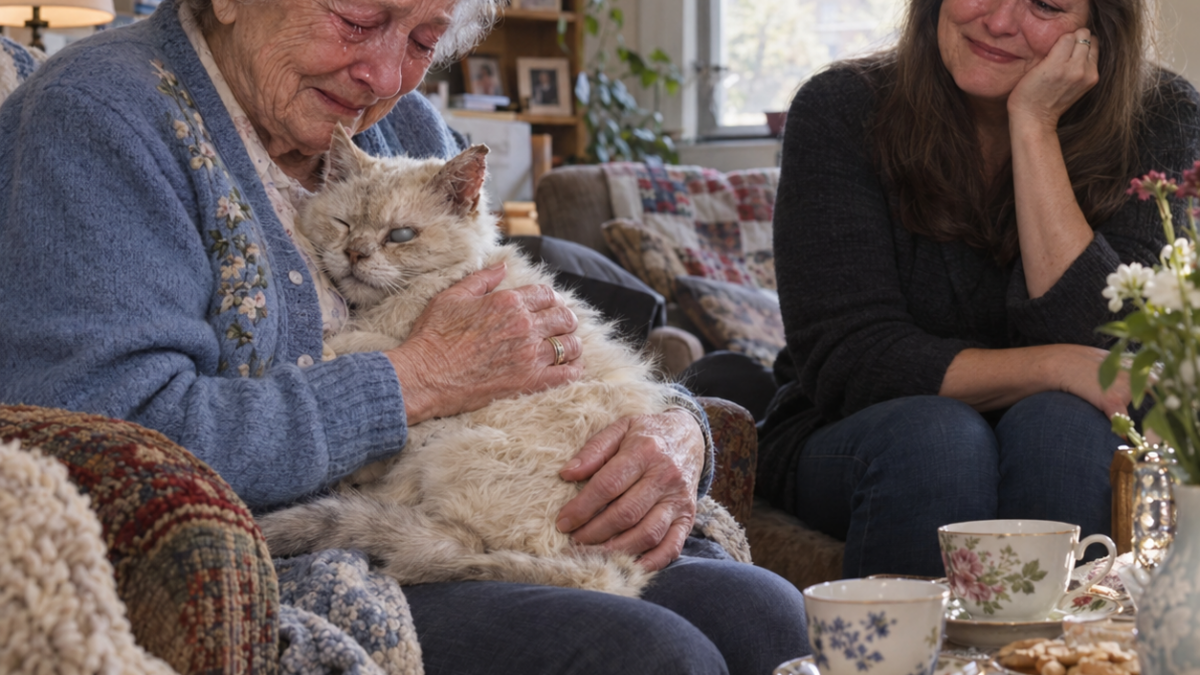
PART2″
At the very bottom row, in the last cage, I saw him.
At first, I thought he was a towel.
A gray towel curled in the back corner.
Then the towel lifted its head.
He was old.
That was obvious before I read the card.
Fifteen years old.
One ragged ear.
Cloudy left eye.
Fur the color of dirty snow.
His body was thin in the careful way old cats get, all angles and dignity.
The card clipped to his cage said:
JASPER.
LIKES QUIET PLACES, SOFT BEDS, AND WARM WINDOWS.
SENIOR CAT.
SPECIAL DIET.
HAS BEEN HERE A WHILE.
That last sentence did something to me.
Has been here a while.
Not abandoned.
Not unwanted.
Not difficult to place.
Just waiting, phrased politely.
I crouched down.
Jasper watched me with his good eye.
I expected him to hide or ignore me the way old cats do when they have survived enough human disappointment to stop auditioning.
Instead, he stood slowly.
Very slowly.
Like each joint had to be consulted before the meeting could proceed.
Then he walked to the cage door and pressed his bony side against the bars.
Not pawing.
Not begging.
Just leaning.
Like he was too tired to sell himself anymore.
Something in my chest folded.
“Hi, old man,” I whispered.
He closed his eye.
Just once.
The volunteer appeared beside me.
“That’s Jasper.”
“I read.”
“He’s sweet.”
“Why is he still here?”
She gave me the look shelter workers give when they are deciding how much truth a person can handle.
“Most people don’t come in looking for a fifteen-year-old cat with medical needs.”
I nodded.
Of course they didn’t.
People wanted beginnings.
Not late chapters.
The volunteer kept talking.
“He came in after his owner had to move somewhere that wouldn’t allow pets. It was hard.”
“How hard?”
Her face softened.
“Hard enough that everybody here remembers it.”
I looked at Jasper.
He leaned harder against the cage door.
“What happens if nobody takes him?”
The volunteer did not answer right away.
“We keep him comfortable.”
That was not an answer.
It was a waiting room disguised as one.
I stood up.
My knees cracked, which felt like Jasper and I were already spiritually aligned.
“I want to meet him.”
The volunteer smiled.
Within fifteen minutes, Jasper was sitting beside me in a small visiting room, not in my lap, not quite.
He had positioned himself against my thigh with the same quiet lean.
Like that was all he asked of the world.
Not excitement.
Not promises.
Just something warm enough to rest against.
“You know I’m not very interesting,” I told him.
His ear twitched.
“I don’t host parties. I don’t own fancy cat furniture. I sometimes eat cereal for dinner.”
He blinked slowly.
“I also snore, apparently.”
He leaned harder.
That was when I knew.
I brought him home in a cardboard carrier that smelled like dust and old blankets.
He did not cry once in the car.
Not a single sound.
I kept glancing over like maybe that was a bad sign, but he simply sat in the carrier and looked through the little holes at the world passing by.
At my apartment, I opened the carrier and expected him to disappear under the couch.
Instead, he stepped out, looked around the living room, and walked straight down the hallway like he already knew where the bedroom would be.
That nearly broke me right there.
There is something devastating about being found by a creature that has every reason to distrust new rooms.
He jumped onto my bed in a clumsy, old-man way, turned twice, and settled against my pillow.
Not at the foot of the bed.
Not near the edge.
Against my pillow.
As if he had decided, after one short tour, that this place needed supervision and I was clearly the weakest point in the structure.
That first night, I slept better than I had in months.
At some point before dawn, I woke and found him watching me.
Not in a spooky way.
In a soft way.
Like he was making sure I was still there.
I put my hand on his side.
He purred.
Low.
Rusty.
Like an engine trying to remember how to start.
For the first time in a long while, my apartment felt less like a waiting room.
The next morning, while coffee sputtered into the pot, my phone rang.
The caller ID showed the shelter.
For one horrible second, I thought they were going to tell me they had made a mistake.
That Jasper belonged to someone else.
That I needed to bring him back.
I answered too quickly.
“Hello?”
“Hi, this is Marcy from the shelter. Is this Jasper’s adopter?”
“Yes. Is something wrong?”
“No, no. I’m sorry. I should have started with that. Nothing is wrong.”
I looked over at Jasper.
He sat by the patio door in a patch of weak winter sun, looking like a retired judge considering a complicated sentence.
“Okay.”
“I just wanted to ask if everything went all right last night.”
I smiled despite myself.
“He slept on my pillow and looked at me like I was late with rent.”
Marcy laughed.
“That sounds like him.”
Then she went quiet.
The silence changed the shape of the call.
“What is it?” I asked.
“Someone came in this morning asking about him again.”
“Again?”
That word lodged under my ribs.
Again.
“She didn’t ask for your address. She didn’t ask for your number. She knows we can’t give that out. But she left a few things in case you were willing to take them.”
Jasper had turned away from the sun.
He was looking at me now.
“What things?”
“A letter. An old photo. His collar.”
I gripped the phone tighter.
Marcy continued carefully.
“She said Jasper belonged to her sister first. Then to her. She has been checking on him for months. She wanted you to know some things about him. You do not have to read the letter if you don’t want to.”
I stared at Jasper.
He stared back.
As if he already knew this part.
“Read it,” I said.
Marcy hesitated.
“Over the phone?”
“Yes.”
The letter was not long.
That made it worse.
Sometimes people say the most heartbreaking things simply because they no longer have the energy to decorate them.
Her name was Elaine.
Her sister, Rose, had adopted Jasper as a kitten.
Rose had raised him.
Rose had spoiled him.
Rose had called him handsome even after age turned him scruffy.
When Rose got sick, Elaine promised she would keep Jasper safe.
She did.
For three years.
Then Elaine’s own life got smaller in all the ways older lives sometimes do.
Less money.
Less space.
More medication.
More rules.
Less say.
She had fallen twice.
Her daughter had moved her into a senior residence where she would have a twin bed, one lamp, two drawers, and no pets.
Marcy’s voice trembled when she reached the next line.
“Giving Jasper up felt like putting my sister in the ground a second time.”
I closed my eyes.
Jasper walked away from the patio door and came toward me.
Marcy kept reading.
“I came back to ask about him because I cannot bear the thought of him thinking I left him on purpose.”
A sound left me.
Small.
Embarrassing.
Human.
At the end, Elaine had written:
“Please don’t change his name. He has lost enough.”
Jasper rubbed against my ankle once.
That was it.
Just once.
But it was enough.
“Did she leave a number?” I asked.
“She did.”
“Give it to me.”
“You don’t have to call.”
“I know.”
“I mean, this can get emotional for everyone.”
“It already is.”
Marcy gave me the number.
I called before I could talk myself out of it.
The woman who answered sounded older than me, but not weak.
Just worn thin in the places life rubs hardest.
“Hello?”
“Elaine?”
“Yes?”
“My name is—well, I adopted Jasper yesterday.”
Silence.
Not empty.
Full.
Then a breath.
“Oh.”
That single word carried so much longing I had to sit down.
“He’s safe,” I said quickly. “I just wanted you to know. He’s here with me. He slept on my bed. He ate half a can of food and then stared at me like I owed him the second half for emotional damages.”
Elaine laughed.
A bright, startled sound.
Then the laugh broke and became crying.
“I’m sorry,” she said.
“Don’t be.”
“I told myself I wouldn’t do this if they ever called.”
“You didn’t call me. I called you.”
That made her cry harder.
Jasper jumped onto the chair across from me with great effort.
He watched the phone.
I put it on speaker.
“Jasper,” Elaine said, her voice breaking. “Jasper, sweetheart?”
His ears moved.
He stood.
Then he stepped directly onto my unpaid electric bill and sat on it.
“Was that him?” Elaine asked.
“That was him committing financial obstruction.”
She laughed again.
That was how it began.
A week later, Elaine came to my apartment for tea.
Not to take him back.
She told me that twice on the phone.
“I’m not trying to interfere.”
“You’re not.”
“I don’t want to confuse him.”
“I think cats are naturally confused about human rules.”
“I just want to see him once.”
I understood once was a lie.
Not a malicious lie.
A hopeful one.
I cleaned my apartment like the queen was coming.
Then I realized that was ridiculous because Elaine was coming to visit a cat who had already licked butter off a paper towel in my trash.
Still, I cleaned.
When Elaine arrived, she wore a cream sweater, sensible shoes, and a nervous smile.
She was smaller than I expected.
Not fragile exactly.
Compressed.
As if life had been folding her inward.
Her white hair was pinned neatly at the back.
She held a paper bag in both hands.
“I brought lemon cookies,” she said. “Marcy said you sounded like a tea person.”
“I do?”
“You adopted an elderly cat and called a stranger about his feelings. You sound like a tea person.”
I liked her immediately.
Jasper was asleep by the heater when she stepped inside.
At least, I thought he was asleep.
Then he lifted his head.
For three seconds, he stared.
Elaine did not move.
Neither did I.
Then Jasper stood, walked across the room faster than I had seen him move yet, and climbed straight into her lap before she had fully sat down.
Elaine made a sound I will never forget.
It was not quite a sob.
Not quite a laugh.
It was recognition.
“Oh, there’s my handsome boy,” she whispered.
Jasper pressed his face into her sweater.
I should have felt pushed aside.
I didn’t.
I sat across from them and watched one old cat bridge the distance between two women who had both been living as if loss was normal.
Elaine told me about Rose.
Her sister.
“Rose was trouble,” she said.
“Good trouble?”
“The loud kind. She could make buying tomatoes feel like a felony.”
I laughed.
“She burned toast and blamed the toaster like it had betrayed her. She flirted with the mailman until he changed routes. She sang hymns off-key and loudly, which I always thought took more courage than singing well.”
Jasper had been Rose’s cat first.
A tiny gray kitten with huge ears and an attitude disproportionate to his body.
He slept on Rose’s neck.
Attacked men Rose dated if he found them morally inadequate.
Sat inside grocery bags.
Learned how to open the lower kitchen cabinet and stole dish sponges.
“When Rose got sick, he changed,” Elaine said, stroking Jasper’s back. “Animals know. Don’t let anyone tell you they don’t.”
I believed her.
“He stayed near her bed. If she coughed, he sat up. If she slept, he watched. The night she died, he sat outside the bedroom door until morning. Not crying. Not scratching. Just waiting for someone who wasn’t coming back.”
I swallowed.
Elaine looked down at him.
“I promised her he would stay with me.”
Her fingers paused in his fur.
“I meant it.”
There was nothing to say.
Some promises break because people are careless.
Some break because life becomes smaller than love.
Elaine started coming every Sunday afternoon.
I made tea.
She brought something small.
Lemon cookies.
A library book she thought I might like.
A packet of cat treats Jasper was technically not supposed to have.
A crocheted coaster with a visible mistake she dared me to mention.
Jasper knew the sound of her step by the third visit.
By the fourth, he waited at the door.
By the fifth, I started waiting too.
That was the part I did not expect.
I thought I was giving Elaine time with Jasper.
But Sunday became the place in my week where loneliness could set down its bags.
Elaine talked to Jasper like he was still handsome.
I pretended not to notice he acted younger on those days.
He sat taller.
Ate better.
Purred louder.
Even his cloudy eye seemed less tired when Elaine was there.
I told myself not to get too attached to the arrangement.
People say that sort of thing when they already are.
Three Sundays later, Elaine’s daughter appeared on my porch.
Her name was Carol.
She was in her late fifties, maybe early sixties, wearing a navy coat buttoned to the top and the exhausted expression of a woman who had spent years being the one people called when something went wrong.
She looked practical.
Not cold.
Not soft either.
Practical in the way people become when life has given them too many fires and only one bucket.
“I’m Carol,” she said. “Elaine’s daughter.”
I stepped aside automatically.
She did not come in.
Her eyes moved past me anyway.
Jasper was stretched in the sun by the heater.
For one second, Carol’s face changed.
Softened.
Then it closed again.
“He looks good,” she said quietly.
“He is good.”
She nodded once.
It seemed to hurt her and relieve her at the same time.
Then she said, “I need to ask something ugly, and I know how it’s going to sound.”
I already did not like where this was going.
But I let her speak.
“My mother loves coming here.”
“Most people would call that a good problem.”
Carol looked at me for a long moment.
“You get my mother for two hours on Sunday,” she said. “I get her the other hundred and sixty-six.”
That landed harder than I expected.
She kept her voice level, but strain ran beneath it like a live wire.
“After she leaves here, she cries. She asks why she can’t take Jasper back. She asks why she can’t have one thing that belongs to her. She asks why everyone keeps deciding what her life is allowed to contain.”
I said nothing.
“Then she refuses dinner. She won’t go to activities. She sleeps badly. Monday morning, the residence calls me because she’s upset.”
Residence.
Not home.
The word sat between us like a metal chair.
“So the answer is to take away the one thing that makes her feel alive?” I asked.
Carol’s jaw tightened.
“The answer is that I cannot keep pulling my mother back from fantasies that are not possible.”
I almost told her Jasper was not a fantasy.
That love was not a fantasy.
That old age did not turn attachment into foolishness.
But something in her face stopped me.
Not because she was right.
Because she was tired enough to make me wonder what being right had cost her.
“She had him for years,” Carol said. “I know that. I know what he means to her. I’m not heartless.”
I did not say anything.
She laughed once, without humor.
“That’s usually when people think you are.”
Jasper lifted his head.
Not alarmed.
Just listening.
Carol followed my eyes.
“She used to be the strong one,” she said.
Her voice changed slightly.
“My mother was the person everyone ran to. If somebody got sick, she showed up. If a kid needed watching, she took them. If somebody died, she had casseroles in the oven before the obituary went up.”
Her throat tightened.
“She hates being handled.”
I believed that.
I had only known Elaine a few weeks, but even in the careful way she sat on my couch, even in how she thanked me for tea like she was apologizing for needing space in a room, I could feel the outline of the woman she used to be.
A woman who had once moved through life like she belonged inside it.
Carol looked toward the stairwell.
“She fell twice last year. Once in the bathroom. Once outside by the front steps. The second time, she was there until a neighbor found her after dark.”
I inhaled.
“Her blood pressure was unstable. She was forgetting bills. Not big things. Small things. But small things become big things when someone lives alone.”
She rubbed her forehead.
“I moved her because I was scared.”
That softened something in me, whether I wanted it to or not.
Fear makes people clumsy.
Fear makes them controlling.
Fear makes them call something care when what they really mean is, Please don’t make me lose you on my watch.
Still, I said, “She didn’t want to give him up.”
Carol’s eyes shone.
“No.”
Then she looked directly at me.
“No, she didn’t.”
For one second, the two of us stood on either side of an impossible thing.
I saw what she had probably been carrying from everyone.
The judgment.
The whispers.
People who heard just enough to decide she had put her mother away and taken the cat to the shelter.
Maybe some of that judgment was deserved.
Maybe some wasn’t.
That is the trouble with family stories.
Nobody ever gets the whole thing.
“Do you know what she said to me the day I took him?” Carol asked.
I shook my head.
“She said, ‘You’re not taking my cat. You’re taking the last witness.’”
The room went very still.
Even Jasper seemed to stop breathing.
Carol swallowed.
“I hear that sentence when I’m trying to sleep.”
For one second, I hated her less.
Then I hated the whole arrangement more.
The residence.
The rules.
The shrinking of older lives down to safe surfaces, scheduled meals, and the constant expectation that gratitude should cover every loss.
Carol straightened.
“I am not asking because I enjoy this,” she said. “I’m asking because every Sunday sends her back there raw. And I don’t know how to help her with that anymore.”
I should have said no right then.
Maybe I should have told her that if one small joy wrecked the system so badly, the system deserved to be wrecked.
Instead, I said, “I need to think.”
She nodded like that was more mercy than she had expected.
At the door, she paused.
“I’m glad he has you,” she said without turning around. “I really am.”
Then she left.
Jasper got up slowly, padded to the door, and sniffed the bottom crack like he was checking whether grief had a smell.
I sat on the floor beside him.
He leaned into my leg.
Not hard.
Just enough.
That Sunday, Elaine came like always.
She wore her cream sweater and brought two lemons in a paper bag because I had once mentioned liking lemon in tea.
That was the kind of woman she was.
Some people hear you like lemon once and remember forever.
Jasper met her at the door before I did.
He rubbed against her ankles so hard he nearly tipped himself over.
Elaine bent slowly, making the little sound knees make when they are tired of carrying history, and touched his head like she was saying grace.
“Well, there’s my handsome boy.”
Then Jasper forgave the entire world for another week.
I made tea.
Elaine settled in the chair by the window.
Jasper climbed into her lap with the confidence of a man reclaiming a throne.
For a while, we were just three breathing things in a warm room.
Then I ruined it.
“Carol came by,” I said.
Elaine did not look surprised.
That hurt in its own way.
She stroked Jasper between the ears.
“What did she say?”
I told her.
Not every word.
Enough.
When I finished, Elaine sat quiet so long I wondered whether I had made a mistake.
Then she said, “My daughter loves me in a frightened way.”
I did not know what to do with that sentence.
So I waited.
“She was not always frightened,” Elaine said. “Life made her that way. Her father left. Money got thin. She had two boys before she had steady ground under her own feet. Then I got old all at once.”
She smiled, but it was not a happy smile.
“I can admit facts. I know why I am where I am. I know I need help with some things. But needing help is not the same as having no right to want what I want.”
There it was.
Plain and clean.
The thing under everything.
A lot of people in this country say older people deserve dignity.
Then the minute dignity becomes inconvenient, what they really mean is cleanliness, safety, and not too much trouble.
Those are not the same thing.
Elaine looked at me.
“She thinks coming here makes it harder for me to accept things.”
“Does it?”
“Yes,” she said.
I blinked.
She shrugged.
“Of course it does. It reminds me I had a life before everyone started speaking to me in brochure language.”
I laughed despite myself.
She did not.
“Do you know what they call the dining room?”
“What?”
“The Bistro.”
Something about the way she said it made me snort tea.
That earned one real smile from her.
Then it faded.
“I am not ungrateful,” she said. “I want you to understand that. I have a clean room. They check my blood pressure. If I fall, someone will hear me. There is kindness there. Real kindness.”
She looked down at Jasper.
“But a person can be safe and still be miserable.”
That sentence went all through me.
Because it was not just about Elaine.
It was about me before Jasper.
Bills paid.
Floor swept.
Refrigerator humming.
Nobody wondering whether I came home.
Safe.
Miserable.
Jasper opened his cloudy eye and looked at me as if to say, yes, that.
Elaine’s hand moved over his back in slow strokes.
“Carol wants peace,” she said. “I understand that. But there is a kind of peace people ask of old women that is really just silence with better furniture.”
I wrote that sentence down later.
Some truths deserve preserving.
When Elaine left that afternoon, she kissed Jasper between the ears.
At the door, she turned back.
“Please do not decide for me just to make everyone comfortable.”
Then she went into the hall before I could answer.
That week, I thought about little else.
I thought about Carol’s face on my porch.
I thought about Elaine saying brochure language.
I thought about Jasper waiting by the door every Sunday.
I thought about how easily people talk about independence like it is holy until an older person uses it to want something inconvenient.
Then suddenly they are unrealistic.
Unsafe.
Difficult.
A burden.
Funny how fast a grown woman becomes “sweetie” when she needs help with medication.
Funny how often “for her own good” really means for everyone else’s schedule.
By Thursday, I was angry enough to clean my whole apartment.
That is how my anger works.
No throwing things.
No screaming.
I scrub sinks and reorganize spices nobody sees.
Jasper watched me from the couch like I was performing community theater in my own kitchen.
On Friday, the residence called.
Not Carol.
The front desk.
Elaine had caught a chest cold.
Nothing severe, the woman assured me, but they were limiting visitors because a few residents were ill.
“She asked us to tell you not to worry,” the woman said. “And to tell you Jasper should not get vain just because he has two women missing him.”
I laughed.
Then, after hanging up, I sat on my bed and cried harder than the situation technically required.
Not because she had a cold.
Because I realized how much I had come to count on Sunday.
How quickly a person can build their whole week around being expected by somebody.
Jasper spent that Sunday near the door.
Not all day.
Cats have too much self-respect for full public grief.
But enough that I noticed.
He would sit there, then go to the window, then circle the coffee table, then return to the door again as if disappointment needed checking.
By three o’clock, he stopped pretending.
He climbed into Elaine’s empty chair and slept there with his chin tucked down, looking smaller than he was.
I made tea anyway.
That might sound foolish.
But grief likes ritual.
It needs somewhere to sit.
The following Tuesday, I took a bus across town to visit Elaine.
Maple Grove Senior Residence had a pleasant sign out front and flower beds that looked professionally encouraged.
Inside, it smelled like lemon cleaner and soup.
Everything was tidy.
Everything was beige.
Everything looked chosen by a committee that feared personality and lawsuits in equal measure.
There were framed prints of birds on the walls.
Not one real bird.
Not one crooked picture.
Not one sign that human mess had ever happened there.
A man in a cardigan slept in a lobby chair while the television talked to nobody.
Two women sat at a puzzle table, moving pieces around without conviction.
A staff member with kind eyes checked my name off a clipboard and smiled the smile of someone who had learned gentleness on purpose.
Elaine sat in her room by the window with a blanket over her knees.
Twin bed.
One lamp.
Two drawers.
Just like the letter.
Seeing it with my own eyes made me want to throw something.
Not because it was dirty.
It wasn’t.
Not because it was cruel in an obvious way.
It wasn’t that either.
It was the smallness.
The sanctioned narrowing.
The clean little box older people get thanked for fitting into.
Elaine brightened when she saw me.
Actually brightened.
That did more damage than the room.
“Well,” she said, “look what the cat dragged in.”
I held up a paper bag.
“Blueberry muffins. Store-bought, so don’t get emotional.”
“Too late,” she said.
We talked about nothing.
The weather.
The women at the puzzle table.
A gentleman down the hall who kept stealing sugar packets and denying it with the face of a saint.
Then I told her Jasper had spent Sunday in her chair.
Elaine put her hand over her mouth.
“I knew he would,” she whispered.
There are things that should not break your heart after fifty because by then you ought to have calluses.
Apparently an old cat missing an old woman is not one of them.
After a while, her voice thinned.
Fatigue came over her like weather.
I looked around the room and saw one framed photograph on the dresser.
Elaine and another woman stood in front of a little white house with peeling trim.
The other woman had Elaine’s mouth and brighter eyes.
Between them, a younger Jasper glared at the camera as if photography had insulted him personally.
“Rose?” I asked.
Elaine nodded.
“My sister.”
“She was beautiful.”
“She was trouble.”
That smile again.
The smile of someone stepping into an older version of herself.
“She could turn a grocery run into an event. She laughed too hard. Burned toast and blamed the toaster like it had betrayed her. Flirted with a pharmacist once just to see if he’d drop the change.”
“I would have liked her.”
“She would have liked you.”
That felt like an honor.
Elaine looked at the photograph for a long time.
“I promised her he would stay with me.”
“I know.”
“I broke it.”
“No,” I said. “Life broke it.”
Elaine looked at me.
“You’re kind. But a broken promise still feels broken even when there’s a reason.”
I had no clean sentence for that.
Sometimes a wound is exactly where the wound is.
Before I left, I asked at the front desk whether Jasper could visit.
The young man there looked sorry before he answered.
“We can’t allow outside animals unless they’re certified service animals. Allergies, safety, policy.”
Policy.
There it was again.
The word that explains everything and comforts no one.
I asked whether exceptions existed.
He shook his head.
“I wish they did.”
I believed him.
That was the worst part.
No one seemed evil.
Nobody twirled a mustache while taking joy in old women losing their cats.
It was just rules.
Liability.
Forms.
The thousand small ways compassion gets trimmed to fit into a folder.
Outside, I sat on a bench and called Carol.
She answered on the third ring, sounding breathless.
“Everything okay?”
“I saw Elaine.”
A pause.
“Did she charm you all over again?”
“Yes.”
“That tracks.”
We went quiet.
Then I said, “This is impossible.”
Carol laughed once.
“Now you understand why I look ten years older than my driver’s license.”
Something in me loosened.
Not all the way.
Enough to hear her.
“I judged you,” I said.
“You still can. I’ve earned some of it.”
“Why didn’t you tell me how much you were carrying?”
She was quiet long enough that I thought the call had dropped.
Then she said, “Because no one asks the daughter how tired she is. They ask whether the mother is comfortable. Whether staff is attentive. Whether the room is bright. Nobody says, ‘Hey, are you drowning quietly in a parking lot before going back to work?’”
That got me.
Because it was true.
Family caregivers disappear into the wallpaper of American life.
Everyone praises them in theory.
Then leaves them holding the bag in practice.
“Do you have brothers? Sisters?”
“One brother in Arizona who sends opinions and holiday cards.”
“Useful.”
“Wildly.”
I heard her exhale.
“I loved that cat too, you know,” she said. “He slept on my couch for years. He threw up on my laundry exactly when I was late. He bit one boyfriend, and frankly he was right. I am not the villain in a children’s movie.”
“I know.”
“I’m not sure I know that some days.”
That honesty made me trust her more than any polished defense would have.
She rustled something on her end.
“Mom has been asking to see him one more time without a clock on it. Not to keep him. Just to sit with him. And I keep telling her I can’t make rules disappear.”
I looked across the street.
There was a small public park with two benches, a bare maple tree, and a walking path no one was using.
The kind of place people forget exists until they need somewhere to cry without buying coffee.
“Maybe the rules don’t have to disappear,” I said slowly. “Maybe we go around them honestly.”
Carol went still.
“How?”
“What if I bring Jasper to the park? Sunday. If the weather holds. You bring Elaine out. Not on Maple Grove property. No sneaking. No tricks. Just a bench.”
Carol did not answer right away.
When she did, her voice sounded less defensive and more scared.
“She tires easily.”
“We keep it short.”
“She’ll want more.”
“She already wants more.”
That sat with both of us.
Finally Carol said, “Let me think.”
That Saturday night, Jasper didn’t eat much.
Not enough for me not to notice.
He drank water, then curled under the table instead of on the bed.
By morning, he looked mostly fine on the surface.
Still dignified.
Still Jasper.
But there was a heaviness to him.
The old kind.
The kind that reminds you fifteen is not a sweet detail.
It is a number with teeth.
I got him into the carrier and took him to the vet clinic near the laundromat.
The doctor was calm and kind and had hands that knew how to touch frightened creatures without insulting them.
She ran tests.
She used phrases like at his age and keep him comfortable and good days matter.
Nothing dramatic.
Nothing fixable in the movie-version way.
Just the plain truth.
He was old.
Some things were slowing down.
Love could not argue with biology, no matter how strongly it believed it had earned the right.
I brought him home and sat on the kitchen floor with him for a long time.
I thought about Rose.
Elaine.
Promises.
Timing.
The cruel way life makes reunion feel urgent only after everyone is already fragile.
At noon, Carol called.
“We can do one hour,” she said. “If she’s strong enough after lunch.”
I looked at Jasper sleeping in the open carrier, his whiskers twitching.
“One hour is a miracle,” I said.
The park bench was cold even through my coat.
The sky had that pale winter honesty that makes every tree look like it has decided to stop pretending.
I brought a blanket.
A thermos of tea.
Jasper in his carrier.
And the old collar Elaine had left at the shelter, which I had finally picked up that morning along with the photograph.
The collar was blue leather, worn soft, cracked at the edges.
A brass tag hung from it.
JASPER.
No last name.
No address.
Just a name.
As if once, that had been enough to bring him home.
Carol came slowly up the path with Elaine on her arm.
Elaine had a walker now.
I had not seen that before.
I hated it for her.
Then I hated myself for hating an object that helped her move through the world.
Old age forces you to grow up about symbols.
Sometimes dignity has wheels.
Sometimes pride needs rubber grips.
Elaine saw the carrier before she saw me.
Her whole body changed.
Not dramatically.
Not movie-big.
Just a visible returning.
Like someone lit a lamp behind her ribs.
“Oh,” she said.
That was all.
Just oh.
But it held enough love to start a church.
I knelt and opened the carrier.
Jasper took his time.
Of course he did.
He stepped out with the grave care of an elderly dignitary arriving somewhere important.
Then he looked up.
At Elaine.
She put both hands over her mouth.
For one second, nobody moved.
Not me.
Not Carol.
Not even the wind, it felt like.
Then Jasper walked forward and pressed himself against Elaine’s shoes.
Same as he had against the shelter cage.
Same as he had at my ankle in the kitchen.
Not begging.
Not performing.
Just leaning.
Like leaning was the truest language he had.
Elaine sank onto the bench with a sound that was half laugh, half sob.
I laid the blanket over her knees.
Jasper stepped onto it, turned once, and climbed into her lap as if the missing weeks had been an administrative error.
Carol looked away fast.
Too late.
I had seen the tears.
Elaine buried her face in his fur.
“You old rascal,” she whispered. “You old beautiful rascal.”
Jasper purred.
Low.
Rusty.
That little engine trying to remember itself.
I handed Elaine the collar.
Her fingers trembled when she took it.
“Oh my goodness,” she said. “I thought I’d never touch this again.”
She did not put it on him.
Just held it.
Ran the leather through her fingers like prayer beads.
Then I gave her the photo.
Rose and Elaine outside the little house.
Young Jasper glaring at the camera.
Elaine laughed through tears.
“Look at us.”
Carol sat on the far end of the bench.
Careful.
Uncertain.
Like she did not know whether this was healing or harm and was afraid to name either one too soon.
After a while, Elaine looked at her.
Not angry.
Not soft either.
Direct.
“You need to stop speaking about me like I am already gone,” Elaine said.
Carol went still.
So did I.
“I know you are trying,” Elaine continued. “I know you are tired. I know I have made your life harder. I know all that. But I am not a cabinet you are trying to fit into a smaller room.”
Carol’s face crumpled.
“Mom—”
“No.”
Not sharp.
Not cruel.
Just finished being edited.
“You keep talking about realistic. Manageable. Best. Maybe you are right about some of it. But every time I want one thing that feels like mine, everyone starts discussing me like a scheduling conflict.”
No one spoke.
A man with a stroller passed on the path and kept going.
Somewhere far off, a dog barked twice.
Life continued while three women sat on a bench trying to say the truth under years of fear.
Carol stared at the ground.
“When you ask for things I can’t give you,” she said finally, “I feel like I am failing you every hour of the day.”
Elaine’s face changed.
Softened.
Not because the truth fixed anything.
Because it was finally the truth.
“I know,” she said.
Carol rubbed both hands over her face.
“I was so scared when you fell. After the second time, I kept thinking if I didn’t make everything smaller and safer, you’d slip through some crack and I’d spend the rest of my life knowing I missed it.”
Elaine listened.
So did I.
“I couldn’t keep your apartment,” Carol said. “I couldn’t move you into my place. I couldn’t keep Jasper. I could barely keep my job and get Evan through his divorce and answer your calls and the residence calls and pretend I wasn’t angry all the time.”
Her voice broke.
“Then you looked at me like I stole your life.”
Elaine closed her eyes.
When she opened them, they were full.
“You didn’t steal it,” she said. “But you packed it too quickly.”
That one got all of us.
Some sentences hold blame and mercy in the same hand.
Carol laughed through tears.
“That sounds like you.”
“It should. I said it.”
We all laughed then.
Even me.
Even with wet faces.
Jasper opened one eye as if disturbed by our emotional volume, then tucked his chin deeper into Elaine’s coat.
A woman from Maple Grove came walking along the sidewalk carrying takeout coffee.
I recognized her from the front desk.
Kind eyes.
Clipboard smile.
Off duty, apparently.
She spotted us and paused.
“I wondered if that might be you,” she said to Elaine.
Elaine tried to regain dignity.
Too late.
We were all beyond dignity and into something better.
The woman smiled at Jasper.
“So this is the famous gentleman.”
“This,” Elaine said, “is Jasper.”
The staff woman crouched slightly.
“Well,” she said to me, “he seems worth the paperwork.”
I laughed.
She straightened.
“I can’t officially endorse anything.”
“Of course not,” Carol muttered.
The woman gave her a look that suggested she had heard every version of family frustration known to modern care systems.
Then she said, “But unofficially, several residents do enjoy the park on Sundays. Fresh air is very therapeutic.”
She tipped her coffee toward us and kept walking.
Carol watched her go.
“Did we just get bureaucratically blessed?”
“I think so.”
Elaine smiled down at Jasper.
“Miracles come in bland cardigans too.”
We stayed forty-three minutes.
Not because a timer went off.
Because I saw fatigue coming over Elaine like a tide.
Because loving someone includes noticing when enough has arrived.
When it was time, Jasper resisted leaving her lap.
Actually resisted.
Dug in with all the moral stubbornness an old cat can still summon.
Elaine laughed and cried at once.
“Oh, don’t make a scene,” she told him.
He made one anyway.
Frankly, it improved my opinion of him.
Carol helped her mother stand.
I put Jasper back into the carrier.
Elaine touched the top of it with two fingers.
“I don’t know how many Sundays I get,” she said quietly.
No one rushed to contradict her.
That is another thing age teaches if you are brave enough to learn it.
Not every hard sentence is asking to be corrected.
Some are asking to be heard.
Elaine looked at me.
“So let’s not waste them pretending comfort doesn’t matter.”
I nodded because I could not trust my voice.
Then she looked at Carol.
“And let’s not waste them making you the villain either.”
Carol made a broken sound.
Elaine took her daughter’s hand.
“You are not cruel,” she said. “You are scared and overworked and sometimes bossy as the devil. But not cruel.”
Carol laughed through tears.
“Bossy as the devil is fair.”
Then they walked back across the street together.
Slowly.
Arm in arm.
Not fixed.
Not magically healed.
Just closer than they had been an hour earlier.
That is how most real healing looks.
Less fireworks.
More walking pace.
After that, Sundays changed.
Not into something perfect.
Into something possible.
Sometimes Elaine was well enough for the park.
Sometimes she wasn’t.
On the Sundays she couldn’t come out, I visited her at Maple Grove and showed her pictures of Jasper pretending not to care about the knitted blanket I had bought him, then sleeping on it daily out of spite.
Carol started coming by my apartment on Saturdays.
At first, just to drop off soup for Elaine.
Then to stay five minutes.
Then fifteen.
Then for tea.
The first time Jasper climbed into Carol’s lap, she looked offended.
“Traitor,” she told him, scratching his chin.
He closed his eye and purred like a man refusing to participate in family politics.
I learned things about Carol.
She worked payroll at a plumbing supply warehouse.
She had not had a real vacation in seven years.
Her older son called only when he needed money.
Her younger son cried in her laundry room after his marriage cracked open and then told her he was fine.
She had high blood pressure, lower back pain, and a habit of apologizing for sitting down.
In other words, she was an American woman of a certain age.
Expected to carry three generations and somehow call it coping.
I learned more about Elaine too.
She had once driven to Nebraska with Rose in a car with no air-conditioning and twenty-six dollars between them.
She played piano badly at church but enthusiastically.
She hated casseroles with crunchy onion topping and lied about liking them for thirty years because people brought them after funerals and grief made honesty feel rude.
One Sunday in March, the front desk woman came to the park again.
Off duty.
This time she sat with us for ten minutes and mentioned, in a voice carefully aimed at no one in charge, that several residents had asked whether there might ever be some kind of informal community pet afternoon in the park.
Not on Maple Grove property, naturally.
Nothing official.
Just neighbors.
Animals.
Air.
“Neighbors” did a lot of work in that sentence.
So did “air.”
By April, there were five residents on the benches.
One grandson with a beagle.
A teenage girl with a sleepy rabbit in a carrier.
Me with Jasper.
Elaine in her cream sweater.
Carol carrying extra paper cups because apparently once a person becomes responsible, she never stops bringing supplies.
By May, there were twelve residents.
A man named Leon, who according to his daughter had not spoken much in weeks, spent twenty minutes telling me about the collie he had in 1968.
A former librarian named Mrs. Vega held a guinea pig like it was a relic.
A widow named June cried into the fur of a mutt belonging to somebody’s niece, then laughed so hard at herself she nearly lost her dentures.
Nobody called it therapy.
Nobody called it programming.
Nobody gave it a cheerful brochure title.
It was just old people with their hands on living creatures.
The looks on their faces made me angrier than ever at how optional this had apparently been.
Because here is the thing that should not be controversial and somehow still is:
A clean room is not the same as a meaningful life.
Three meals and blood pressure checks are not the whole measure of care.
Safety matters.
Of course it matters.
But if your version of caring for someone asks them to surrender every soft, unruly, inconvenient thing that made them feel like themselves, then maybe what you are offering is management, not love.
A lot of people will disagree.
They will say be realistic.
They will say families are doing their best.
They will say facilities have rules for a reason.
They will say one old cat is just one old cat.
Some of that is true.
Families are doing their best.
Rules exist for reasons.
People are tired.
Money is tight.
Care is hard.
All true.
And still.
An old cat is not just a cat if he is the last living witness to the life you had before the walls closed in.
A Sunday visit is not just a Sunday visit if it reminds you your heart still works.
A bench in a cold park is not just a bench if it becomes the place where people stop treating you like an arrangement and start treating you like a person again.
By summer, Jasper had good days and slow days.
He slept more.
Ate less than I wanted and more than I feared.
Some mornings he paused before jumping off the bed as if negotiating with gravity.
Some evenings he only picked at food unless I warmed it exactly seven seconds in the microwave, no more, no less, because apparently senior cats have culinary standards sharper than restaurant critics.
On Sundays, somehow, he always found a little extra.
Enough to sit taller.
Enough to endure the carrier ride with offended grace.
Enough to lean into Elaine’s hands as if that was medicine too.
Maybe it was.
One hot afternoon, after the others drifted away and Carol packed up cups, Elaine said, “Do you know the worst part of getting old?”
I expected something about pain.
Or indignity.
Or exhaustion.
Instead she said, “People start congratulating you for disappearing politely.”
Nobody answered.
There was nothing to improve in that sentence.
Jasper slept beside her on the bench.
Carol sat down slowly, like she had been struck by something she recognized too late.
Elaine reached over and patted her daughter’s hand.
“I know you didn’t mean to help with that,” she said gently. “But sometimes you did.”
Carol nodded with tears in her eyes.
“I know.”
I looked at both of them.
The years between them.
The love.
The fear.
The damage fear had done to love and the damage love had done to fear.
And I thought maybe the miracle was never that Jasper brought people together.
Maybe the miracle was smaller and harder.
Maybe he simply kept making room for the truth.
Fall came.
Then winter again.
Jasper lost weight.
His good days still came, but they stood farther apart.
The vet said what vets say when kindness has to walk beside honesty.
“We focus on comfort.”
I nodded like an adult.
Then cried in my car like a child.
I told Elaine the same afternoon because I had promised myself not to protect people by stealing the truth from them.
She listened quietly.
Then said, “Bring him Sunday if he wants to come.”
If he wants to.
Not if he can.
Not if it’s convenient.
If he wants to.
That Sunday, Jasper wanted to.
I knew because when I set the carrier near the door, he walked into it without complaint.
The park was cold.
The maple tree was bare.
Elaine wore a knitted hat Carol said made her look like an indignant mushroom.
Carol brought lemon cookies.
I brought tea.
Jasper lay in Elaine’s lap under a blanket.
His purr was faint now.
Still there.
Still trying.
Elaine’s hand moved over him slowly.
“I think Rose lent him to both of us,” she said.
I looked at her.
“What do you mean?”
“She had him first. Then me. Then you. Maybe love is not ownership. Maybe it is stewardship.”
Carol sat very still.
Elaine looked at Jasper.
“You kept him safe when I couldn’t.”
I shook my head.
“You kept him loved before I knew him.”
Elaine smiled.
“That sounds like something from a sympathy card.”
“It does.”
“But I’ll allow it.”
We laughed softly.
The following Sunday, Jasper did not want the carrier.
He stayed on my bed.
I called Carol.
She brought Elaine to my apartment instead.
We broke every rule by not asking any policy for permission because, by then, even Carol understood that some moments are too human to be submitted for approval.
Elaine sat on the edge of my bed.
Jasper lifted his head when he saw her.
That was all he had.
But it was enough.
She touched his face.
“There’s my handsome boy.”
He blinked slowly.
Carol stood in the doorway, crying without hiding it.
I sat in the chair by the window.
For a long time, no one spoke.
Jasper died that evening after Elaine left.
Not dramatically.
Not with some final cinematic gesture.
He curled against my pillow, the same place he had chosen on his first night, and slipped away sometime between one breath and the next while my hand rested on his side.
His purr was gone.
The apartment became silent.
But not the same silent it had been before him.
That mattered.
Grief returned, yes.
Of course it did.
But this time, it found furniture already rearranged inside me.
Elaine came the next day.
Carol drove her.
I had wrapped Jasper in the knitted blanket Elaine had started and I had finished badly.
We buried him in a small pet cemetery outside town, beneath a maple sapling Carol insisted on buying because she had apparently become a person who bought memorial trees now.
Elaine placed Jasper’s blue collar in the grave.
Then took it back.
Then laughed through tears.
“No,” she said. “I’m not burying that.”
Nobody argued.
Some grief needs an object.
She kept the collar.
I kept the photograph.
Rose, Elaine, young Jasper, all attitude and ears.
Carol kept the blanket for one week because she said her mother wanted it, then returned it because Elaine said Jasper would haunt her for theft.
After Jasper died, I thought Sundays would end.
They didn’t.
Not exactly.
The pet afternoons continued.
Then grew.
Maple Grove never officially endorsed them.
Of course not.
But the front desk woman began telling families, “Some residents enjoy the park on Sundays,” with a perfectly blank expression.
Neighbors came with dogs.
A teenager brought her rabbit.
One man brought a very patient chicken, which caused so much conversation that even Leon called it “the poultry scandal.”
Elaine came when she could.
Some weeks she talked about Jasper.
Some weeks Rose.
Some weeks she complained about The Bistro with such precise bitterness that I considered writing reviews on her behalf.
Carol came too.
At first because Elaine needed help.
Then because she needed the bench herself.
Eventually, the three of us became something I do not have a simple word for.
Not family.
Not friends in the usual way.
Witnesses, maybe.
People who had seen each other at too many raw angles to pretend politeness was enough.
Months after Jasper died, Carol called me from a grocery store parking lot.
“I am sitting in my car eating crackers,” she said.
“That sounds familiar.”
“I thought you should know I have become my mother and possibly you.”
“Congratulations.”
“I bought lemon cookies and cried in aisle six.”
“Also familiar.”
“I miss him,” she said.
“So do I.”
There was a long pause.
Then Carol said, “Thank you for not letting me turn my fear into the final word.”
I leaned against my kitchen counter.
“You were doing your best.”
“I know. That’s what scares me.”
That sentence stayed with me.
Because people can do damage while doing their best.
Both things can be true.
The best does not erase the damage.
The damage does not always mean there was no love.
That is what Jasper taught us.
Or maybe he simply sat still long enough for us to learn it near him.
My apartment is not empty now.
Not exactly.
There is a dish by the sink Carol keeps forgetting to take home and I keep forgetting to return.
There is an ugly knitted blanket on my couch.
There is a photo of two sisters and a young cat in a cheap frame on my bookshelf.
There is a small ceramic jar on the windowsill with Jasper’s ashes because Elaine said he always liked a view and I was not emotionally equipped to argue.
There is a living-room chair that still catches afternoon sun.
Sometimes, absurdly, I expect him there.
Sometimes I still warm food for seven seconds in the microwave before remembering.
Sometimes I wake before dawn and feel for the old weight near my pillow.
Grief does that.
It leaves your body reaching after your mind has accepted the facts.
But now, when the apartment goes quiet, it does not feel like a waiting room.
It feels like a place that has held love and is still holding the shape.
That is different.
Elaine is weaker now.
Carol calls more often.
Not because there is always news.
Sometimes because she is tired.
Sometimes because I am.
Sometimes because neither of us wants to eat crackers alone over the sink.
Last Sunday, I visited Maple Grove.
Elaine was by the window with Jasper’s blue collar wrapped around her hand.
Not tightly.
Just resting there.
I sat beside her.
For a while, we watched rain slide down the glass.
Then she said, “Do you think he remembered us?”
I did not ask who she meant.
“Yes.”
“All of us?”
“Yes.”
“Even Rose?”
I looked at the old collar.
Especially Rose, I thought.
“Yes.”
Elaine smiled.
“Good.”
Then, after a while, she said, “I used to think losing him meant I failed my sister.”
I waited.
“Now I think maybe the promise changed shape.”
“How?”
She looked at me.
“I couldn’t keep him with me. But I helped him find you. You helped him find me again. Carol helped me get to the bench. The woman in the cardigan pretended rules had edges. Everyone carried a corner.”
She closed her eyes.
“Maybe that counts.”
I took her hand.
“Yes,” I said. “That counts.”
And I believe it does.
Maybe not perfectly.
Maybe not in the clean way people want promises fulfilled.
But life is rarely clean.
Love is even messier.
Sometimes keeping a promise means holding on.
Sometimes it means letting go.
Sometimes it means building a new road between the thing that was lost and the people still living.
Sometimes it means a park bench.
A thermos of tea.
A tired daughter.
A lonely woman.
An old cat who leaned instead of begged.
If someone reads this and thinks the whole thing is too emotional, too complicated, too much fuss over one elderly cat and three older women, they are welcome to think that.
This country is full of people who only respect what can be measured neatly.
I am done learning from them.
Because here is what I know now.
Nobody gets saved by being managed.
Nobody becomes less lonely because a room is tidy.
Nobody stops grieving because the paperwork makes sense.
And nobody, at any age, should be asked to give up the last living thing that still knows their name just because it makes everyone else’s schedule easier.
I thought Jasper rescued two women.
Truth is, he kept going.
He rescued a daughter from becoming only her fear.
He rescued a handful of strangers from another beige Sunday.
He rescued a little public park from being just a path and two benches.
He rescued me from mistaking survival for a life.
And maybe, in the quiet stubborn way old souls do, he rescued all of us from the lie that the best way to care for people is to make their lives smaller.
It isn’t.
The best way to care for people is to help them stay human for as long as they are here.
Even if it is inconvenient.
Especially then.
Because old age should not be a polite disappearance.
Grief should not be filed away because it makes the room easier to manage.
Love should not need to prove efficiency before it is allowed to remain.
And an old cat, with a ragged ear and a cloudy eye and a rusty purr, can still walk into a life that has gone quiet and remind everyone inside it of the one thing no policy, no residence, no fearful daughter, and no lonely woman should ever forget.
Being safe is not the same as being alive.
And being alive, really alive, means having something or someone who still knows how to find you.
Jasper found me.
He found Elaine again.
He found Carol underneath all that fear.
And for a while, every Sunday afternoon, he found a way to make the world bigger for all of us.
That was enough.
No.
More than enough.
That was the miracle.








