HOA Spent $5 Million Building a Marina Road on My 8,400 Acres—Then Deputies Shut It Down in Front of 300 Homeowners
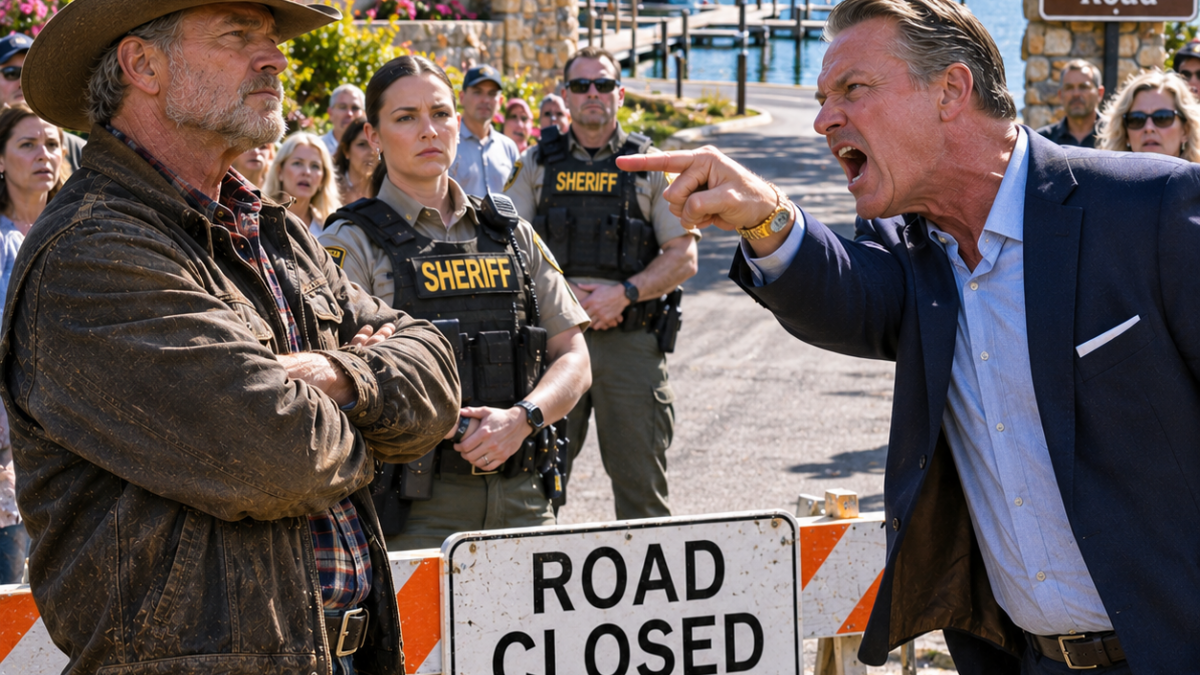
HOA Spent $5 Million Building a Marina Road on My 8,400 Acres—Then Deputies Shut It Down in Front of 300 Homeowners.
Three hundred homeowners watched sheriff’s deputies close the $5 million marina road they had all paid for while their HOA president pointed at me and screamed that I had no right to block “their” property.
The problem was that the road, the parking lot, and nearly a mile and a half of pavement were sitting entirely inside my 8,400-acre deed—and the man yelling at me had known about the boundary problem years before I ever bought the land.
What he didn’t know was that a trail camera, an old county receipt, and one forgotten piece of my father’s handwriting were about to explain why he had been so desperate to keep anyone from reading the original survey.
The sheriff’s deputies were standing between me and Douglas Kessler when he finally lost control.
“You can’t block us!”
His voice echoed across the entrance to Marina Road.
Behind him, a line of pickups, SUVs, boat trailers, and golf carts stretched back toward Emerald Lake Estates.
People were out of their vehicles.
Some filming.
Some shouting.
Some demanding answers from anyone wearing a uniform.
Douglas pointed at me like he wanted the entire crowd to know exactly who was responsible.
“That man doesn’t even live in our community!”
Deputy Elena Ruiz stood beside one of the concrete barriers.
“That isn’t the issue.”
Douglas spun toward her.
“This road belongs to Emerald Lake Estates.”
Ruiz held up the court order.
“Not according to the judge.”
His face went red.
“You don’t understand what you’re doing.”
“I understand exactly what I’m doing.”
She looked toward the line of deputies.
“Road closes at eight.”
My watch read 7:57.
Douglas looked at me again.
Pure hatred.
“You think you can buy a mountain and destroy three hundred families?”
I looked past him.
Toward the pavement.
Toward the marina parking lot.
Toward the stone landscaping walls homeowners had paid millions to build.
Then back at Douglas.
“I didn’t put your road on my deed.”
That was the part he still refused to understand.
Or maybe he understood it better than anybody.
Forty days earlier, I hadn’t known Douglas Kessler existed.
I had been sitting in the back of a county auction room with a numbered paddle in my hand and sweat gathering between my shoulder blades.
My name is Mitch Garrick.
I was forty-nine years old when I bought 8,400 acres of timberland, ridge, lake frontage, and abandoned logging roads known locally as the Garrick-Holloway Estate.
The Garrick part was coincidence.
At least I thought it was.
My family had no ownership connection to the estate that I knew of.
The property had belonged to a timber company for decades.
Then an investment group.
Then a regional bank after a default.
PART2:
By the time it reached auction, most people saw only the problems.
Too remote.
Too much land.
Old roads.
Steep terrain.
Deferred maintenance.
Some questionable timber value.
Limited development potential without major infrastructure.
I saw something else.
Space.
Forest.
Silence.
I had spent twenty-three years building and selling industrial equipment.
Not glamorous.
Pumps.
Hydraulic systems.
Material handling.
The kind of business where nobody knows your company name unless something breaks.
I had done well.
Better than I expected when I started.
My wife had died six years earlier.
Cancer.
No children.
No reason left to stay in the city except habit.
I wanted land.
Not a subdivision.
Not a resort.
Land.
The opening bid was lower than expected.
Nobody raised a paddle.
Then someone did.
A timber buyer.
Then another bidder.
I waited.
The number climbed.
My heart started beating harder.
I knew my limit.
I had spent two months reviewing the basic financials.
Timber appraisal.
Taxes.
Access.
Water.
Liens.
At least I thought I understood access.
When the bidding slowed, I raised my paddle.
The timber buyer answered.
I went higher.
He hesitated.
The auctioneer scanned the room.
“Going once.”
My hand was shaking.
“Going twice.”
The other bidder stared at his notes.
Then lowered his paddle.
“Sold.”
The gavel came down.
People clapped politely.
I sat there holding the paddle for another second.
Eight thousand four hundred acres.
Mine.
Or about to be once closing finished.
I should have felt victorious.
Mostly I wondered whether I had just made the most expensive mistake of my life.
My father would have laughed.
His name was Walter Garrick.
He had been a licensed land surveyor for thirty-seven years.
He never trusted auctions.
Never trusted developer maps.
Never trusted fences.
His favorite sentence when I was young was:
“Paper tells you what people intended. Iron tells you where they meant it.”
When I was twelve, he taught me to find boundary monuments.
At fifteen, I could run a compass line well enough to annoy him.
At seventeen, I told him I would never spend my life walking through briars looking for pieces of metal buried by dead men.
He said:
“Good. Then maybe you’ll make money.”
I did.
Dad died eleven years before the auction.
Heart attack.
Quick.
I had kept his old field compass.
Some notebooks.
A few instruments I didn’t know how to use as well as he had.
I thought of him when I signed the closing papers.
Then again the first morning I drove out to walk the property.
The estate was enormous.
You could drive half an hour on old logging tracks and still be inside it.
Pine ridges.
Hardwood bottoms.
Rock shelves.
Creeks.
A long western slope descending toward Emerald Lake.
On the opposite side of that lake sat Emerald Lake Estates.
Three hundred homes.
Clubhouse.
Pool.
Private docks.
A large marina.
From my ridge, the neighborhood looked polished.
Planned.
Expensive.
I had no interest in it.
My deed specifically excluded the HOA.
The estate was outside its covenants.
That suited me.
The first morning after closing, I did what Dad would have done.
I took his compass.
The deed description.
A topographic print.
Water.
And walked the western boundary.
Not because I believed I could professionally resurvey 8,400 acres myself.
I couldn’t.
But I understood enough to recognize major markers.
The first two corners were where the title packet suggested.
The third took almost forty minutes to find.
Near noon, I reached a slope above Emerald Lake.
The forest opened slightly.
I saw pavement through the trees.
Marina Road.
I knew about it from aerial photos.
It ran from the neighborhood down toward the lake and marina.
Fresh blacktop.
Stone drainage.
Decorative lighting.
Beautiful road.
The HOA had apparently finished it recently.
I walked lower.
That was when I saw something green in the dirt.
Metal.
Round.
I crouched.
Cleared leaves.
A brass survey cap.
Old.
Oxidized.
Stamped lettering.
I wiped it with my glove.
W.G.
I stared.
Walter Garrick.
My father’s initials.
Same stamp style he used on older control monuments.
My breathing changed.
There are plenty of Garricks.
Plenty of surveyors.
Maybe another W.G.
But I knew that mark.
Dad used a small star after his initials.
The cap had it.
W.G. ★
I sat back on my heels.
“How in the hell did you get here?”
A voice behind me answered.
“Old Walter set that.”
I turned fast.
An elderly man stood near the edge of the trees.
Cane.
Canvas coat.
White beard.
He lifted one hand.
“Didn’t mean to scare you.”
“You knew my father?”
He nodded.
“Hal Dorsey.”
I stood.
“Mitch Garrick.”
“I know.”
That made me cautious.
“How?”
“Everybody knows who bought Holloway.”
Fair.
Hal looked toward the brass cap.
“Walter surveyed this side of the lake years back.”
“When?”
“Late eighties. Maybe early nineties.”
I stared.
Dad had never mentioned Emerald Lake.
Hal came closer.
“He argued with them about that line.”
“Who’s them?”
“Developers.”
He pointed through the trees.
“Different outfit then.”
I looked toward Marina Road.
Hal lowered his voice.
“You better have somebody check that.”
“The monument?”
“The road.”
He leaned on the cane.
“Son, Marina Road was never supposed to be where it is.”
That sentence changed the next forty days of my life.
I asked what he meant.
Hal looked back toward the neighborhood.
“They moved that road years ago.”
“Moved it from where?”
“Closer to the lake.”
“Why?”
“Cheaper grade.”
I frowned.
“The road looks new.”
“The old gravel track wasn’t.”
He nodded.
“They rebuilt it fancy last year. Five million dollars, people say.”
“On HOA property?”
Hal looked at me.
Then at the brass cap.
“I wouldn’t bet my pension.”
I did not confront anybody.
Did not pull out stakes.
Did not close a road.
I called a surveyor.
Paul Osgood.
Licensed.
Experienced.
Recommended by two attorneys and the county forestry office.
I told him I wanted the western boundary around Emerald Lake verified first.
“Any particular reason?”
“Found an old monument.”
“Recorded?”
“Probably.”
“Anything else?”
“Road close to it.”
“How close?”
“That’s what I’m paying you to tell me.”
Paul laughed.
“Fair.”
He and his crew started the next morning.
GPS equipment.
Total station.
County control records.
Old plats.
Deed calls.
He was methodical.
Dad would have liked him.
The first day, Paul wouldn’t tell me anything.
“Still working.”
“Road on me?”
“Still working.”
“How far?”
“Mitch.”
“Fine.”
The second day went the same way.
At sunset, I drove back to the cabin.
The estate came with an old timber manager’s cabin near the center ridge.
Two bedrooms.
Wood stove.
Tin roof.
I had been sleeping there while deciding whether to renovate the larger house farther south.
At 9:06 that evening, my phone rang.
Paul.
“Please tell me I didn’t buy an HOA road.”
Silence.
That was bad.
“Mitch.”
“Yes?”
“Don’t tell anyone anything yet.”
My stomach tightened.
“What did you find?”
“And don’t come down here alone tonight.”
“Paul.”
He exhaled.
“The road isn’t a little over.”
“How far?”
“All of it.”
I stood.
“What do you mean all of it?”
“Marina Road, the parking area, retaining structures, drainage features—everything we’ve located in this section is west of the deed boundary claimed by Emerald Lake.”
“West meaning…”
“Your side.”
I sat down.
“How much land?”
“Preliminary about eleven acres of surface impact.”
I said nothing.
“Road length about a mile and a half.”
I still said nothing.
Paul continued.
“We are checking every monument again tomorrow.”
“Could the deed be wrong?”
“Anything can be wrong.”
“Could your survey be wrong?”
“Yes.”
I appreciated that answer.
“But?”
“But right now, multiple independent calls agree.”
“What about Dad’s cap?”
“It fits.”
I closed my eyes.
The HOA had spent five million dollars building a road.
On land I had bought forty days after completion.
Or maybe the road had been there before in some form and they had simply rebuilt it.
Either way, I needed records.
Paul said:
“Do not block anything.”
“I wasn’t planning to.”
“Good.”
“What should I do?”
“County records.”
Exactly what Dad would have said.
The following morning, I drove to the recorder’s office.
A clerk named Doris Wayland helped me.
Maybe sixty.
Silver hair.
Reading glasses hanging on a cord.
I gave her the parcel numbers.
The old plats.
Paul’s preliminary references.
She started pulling digitized files.
Then older scanned documents.
Then one paper volume from storage.
After nearly an hour, she stopped.
Her finger rested on a transaction log.
“What?”
She looked at me.
“Mr. Garrick…”
“Yes?”
“Someone requested this same historical boundary file in 2019.”
I leaned forward.
“Who?”
She hesitated.
“Public record.”
Then turned the log toward me.
DOUGLAS KESSLER.
Emerald Lake Estates Association.
Signature.
I stared at it.
“You know him?”
“Not personally.”
I photographed the page.
Doris looked uncomfortable.
“There’s more.”
She opened a scanned survey.
2019 Boundary Review.
Prepared for Emerald Lake Estates.
Western lake parcel interface.
And there it was.
A bold line.
Marina Road running outside the HOA boundary.
Across what was then the Holloway timber estate.
A note read:
EXISTING ROADWAY OCCUPIES ADJOINING PRIVATE PARCEL. NO RECORDED EASEMENT LOCATED IN CURRENT TITLE REVIEW.
I read it three times.
“Who ordered this?”
She checked the cover.
“HOA.”
“Who received it?”
Her finger moved.
“Douglas Kessler.”
My pulse started pounding.
The road had not cost five million yet in 2019.
The fancy rebuild came years later.
Douglas knew before the assessment.
Before construction.
Before homeowners paid.
At least he had received a survey saying the road sat on private land.
That did not automatically prove fraud.
Maybe there was another easement.
Maybe later title work changed the conclusion.
Maybe something had been recorded elsewhere.
I kept reminding myself of that.
Surveys can conflict.
Records can be incomplete.
Facts first.
I requested certified copies.
Then I went to the HOA clubhouse.
No lawyer.
No deputies.
No cameras.
I asked the receptionist if Douglas Kessler was available.
He came out ten minutes later.
Early sixties.
Heavy build.
Silver hair.
Expensive watch.
Confident.
He looked me over.
“You’re the timber buyer.”
“Mitch Garrick.”
He shook my hand.
“What can I do for you?”
“Talk about Marina Road.”
That changed something in his eyes.
Very small.
“Come in.”
His office overlooked the lake.
Framed photographs.
HOA awards.
Architectural renderings.
On one wall was a large picture from the Marina Road grand opening.
Ribbon.
Families.
Douglas holding oversized scissors.
I sat.
He sat behind the desk.
“What’s your concern?”
“My surveyor says Marina Road is inside my deed.”
Douglas leaned back.
Then smiled.
“Survey disputes happen.”
“I agree.”
“It’s an old property.”
“Yes.”
“Boundary descriptions are messy.”
“Sometimes.”
He folded his hands.
“What are you asking for?”
“I’m telling you before I do anything else.”
His eyes narrowed.
“There is established access.”
“Recorded?”
“Longstanding.”
“That’s not the same question.”
“Mitch, that road has served Emerald Lake for decades.”
“Your new road?”
“The corridor.”
“Do you have an easement?”
He reached into a drawer.
Not for a deed.
For a checkbook.
He wrote.
Tore it off.
Slid it across the desk.
$2,000.
I looked down.
“What’s this?”
“Goodwill.”
“For what?”
“Any inconvenience caused by overlap.”
I almost laughed.
“You think eleven acres and a $5 million road are worth two thousand dollars?”
His smile disappeared.
“This doesn’t need to become ugly.”
“I agree.”
“Then take the check and let our lawyers sort out the technical boundary.”
I pushed it back.
“No.”
Douglas leaned forward.
“You’re outside the HOA.”
“Yes.”
“You have no standing in our community.”
“I’m not asking for standing in your community.”
“You are nobody here.”
That sentence stayed with me.
He pointed toward the lake.
“Three hundred families use that road.”
“I know.”
“Children.”
“I know.”
“Boat owners. Elderly residents. Emergency services.”
“I understand.”
“You really want to become the man who takes their road?”
I looked at him.
“I want the truth in the record.”
His jaw tightened.
“If you interfere with access, we will respond.”
“I haven’t interfered with anything.”
“Good.”
I stood.
“Then don’t give me a reason.”
I drove straight to an attorney.
Hannah Rice.
Best property lawyer in the county according to Paul Osgood.
She was forty-something.
Dark hair.
Quiet.
The kind of person who could make silence sound like a cross-examination.
I gave her:
My deed.
Paul’s preliminary survey.
The 2019 county survey.
Douglas’s receipt.
Photograph of the $2,000 check.
She read everything.
Twice.
Then looked up.
“He knew.”
“Can you prove that?”
“He personally requested this survey.”
“That proves receipt.”
“Correct.”
“He could say he didn’t understand it.”
“He can.”
She tapped the note.
“But a man generally does not offer two thousand dollars for an eleven-acre boundary issue unless he already knows there is a problem.”
“What do we do?”
“Nothing dramatic.”
I laughed.
“Every property lawyer says that.”
“Because clients love doing stupid dramatic things.”
She opened a legal pad.
“We send notice.”
“How long?”
“Fourteen days to produce any recorded easement, license, deed, judgment, prescriptive-access basis, or other instrument they rely upon.”
“And if they don’t?”
“Then we decide next step.”
“Can I close the road?”
“Not today.”
“Hannah.”
“Three hundred households.”
“It’s my land.”
“And the court will care about both facts.”
She looked at me.
“You want to win cleanly?”
“Yes.”
“Then let them ignore a reasonable letter.”
So we sent one.
Certified.
Delivered to:
Emerald Lake Estates HOA.
Douglas Kessler.
Association counsel.
Hatch Marine LLC, the contractor that rebuilt the road.
Fourteen days.
Provide the legal basis for continued occupation.
Stop removing or disturbing boundary markers.
Preserve records.
No new construction without notice.
I waited.
Day three.
Nothing.
Day seven.
Nothing.
Day fourteen.
Nothing.
No easement.
No title opinion.
No request for mediation.
No call.
Instead, Douglas held a Marina Celebration.
Saturday night.
Two hundred residents.
Live music.
Food trucks.
Boats.
Fireworks over Emerald Lake.
A banner across the entrance:
OUR $5 MILLION INVESTMENT IN EMERALD LAKE’S FUTURE.
I stood on my ridge watching the fireworks.
I wasn’t angry at the people.
That surprised me.
They had paid a special assessment.
Some probably hated it.
Some were proud of the road.
Some believed it increased their property values.
None of them knew the president had received a survey years earlier saying the road corridor wasn’t theirs.
I felt sick for them.
Not angry.
At 2:07 the next morning, my phone buzzed.
Motion alert.
Trail camera.
I had installed several cameras near the survey line after Paul reported fresh disturbance around one of his stakes.
Not hidden on HOA property.
On mine.
I opened the video.
Headlights.
Pickup.
HATCH MARINE logo.
Two men.
One heavyset man got out carrying something.
He walked to Paul’s survey stake.
Pulled.
The first stake resisted.
He kicked it loose.
Then removed another.
I sat upright.
A flashlight appeared behind him.
Second figure.
Silver watch flashed.
Douglas.
I zoomed.
Same face.
Same build.
Same watch I had watched resting on his desk.
He pointed toward another marker.
The Hatch Marine man walked over.
Pulled that one too.
I replayed the video.
Again.
Again.
This was different.
Ignoring a survey was one thing.
Removing newly set markers after a formal preservation notice was another.
I called Hannah.
At 2:22 a.m.
She answered on the fourth ring.
“This better involve blood.”
“Survey stakes.”
Silence.
“What?”
“I have Kessler on video pulling my survey stakes with Hatch Marine.”
“You have him touching them?”
“He’s pointing. Contractor is pulling.”
“Original file?”
“Yes.”
“Do not edit it.”
“I know.”
“Save a copy.”
“Already.”
“Send it.”
I did.
Hannah called back ten minutes later.
“We file in the morning.”
“Emergency injunction?”
“Yes.”
“Now can I be dramatic?”
“No.”
She hung up.
By eight, she had drafted the application.
Survey.
Deed.
2019 county records.
Douglas’s signed receipt.
Our unanswered notice.
Trail-camera footage.
Paul’s sworn declaration.
She requested emergency relief preventing continued use and disturbance while title rights were adjudicated.
The hearing was set for Thursday.
9:00 a.m.
I barely slept before it.
Douglas arrived with two lawyers.
Hatch Marine had one.
Three rows behind them were HOA board members.
I sat beside Hannah.
The judge was Meredith Sloan.
Late fifties.
No patience for speeches.
Douglas’s lawyer argued first.
Longstanding use.
Reliance.
Public safety.
Resident access.
Equitable considerations.
Possible prescriptive rights.
Possible historical license.
He said closing Marina Road would cause enormous disruption.
All true except the parts that weren’t established.
Then Hannah stood.
“Your Honor, we are not asking the court today to finally adjudicate every conceivable access theory.”
Good opening.
“We are asking the court to stop continued occupation while the defendants explain why they spent approximately five million dollars improving a road after receiving a survey stating the corridor was on private property.”
Douglas’s attorney objected.
Hannah handed up the 2019 survey.
Then the records request.
Then the signed receipt.
Judge Sloan studied it.
Long silence.
She looked over her glasses.
“Mr. Kessler.”
His lawyer stood.
“Your Honor—”
“I am asking whether your client personally received this document.”
The lawyer whispered to Douglas.
Then:
“He is prepared to answer.”
Douglas stood.
Judge Sloan held up the survey.
“Did you read this in 2019?”
Douglas swallowed.
“I don’t recall.”
The courtroom became perfectly quiet.
Judge Sloan glanced at the receipt.
“You signed for it.”
“I receive many association records.”
“Did you understand the report concerned the western boundary near Marina Road?”
“I don’t remember the details.”
Hannah then introduced the formal notice.
No response.
Then trail-camera stills.
Douglas’s attorney said:
“Those survey stakes were temporary and created confusion.”
Judge Sloan looked at him.
“So your client resolved confusion by removing them at two in the morning?”
No answer.
That was the moment I knew the road would not remain open unchanged.
The judge did not declare me permanent owner of every disputed inch that day.
That would require full title proceedings if contested.
But she found a strong likelihood that the road occupied my property without a documented right sufficient to justify continued unrestricted use.
Then she issued the order.
Public and HOA access across the disputed Marina Road corridor suspended.
Effective Saturday.
8:00 a.m.
Emergency access could be coordinated through law enforcement as necessary.
No further removal of survey evidence.
Sheriff’s office authorized to enforce.
Douglas turned toward me.
His face looked almost gray.
Hannah closed her folder.
“Do not smile.”
“I’m not.”
“You’re smiling.”
“I’m breathing.”
“Do it less happily.”
Saturday came fast.
At 7:15, I drove down to Marina Road.
Deputies were already there.
Sheriff’s vehicles.
County barriers.
Flatbed.
No theatrics from me.
The court had ordered the closure.
I was there because Hannah told me to be.
By 7:40, residents were arriving with boat trailers.
Douglas had not warned them.
That was the first thing that made me furious.
He knew the order had been issued Thursday.
He had more than a day to notify three hundred households.
Instead, he apparently hoped something would stop enforcement.
Or maybe he wanted angry residents gathered at the road.
At 7:50, there were fifty vehicles.
By eight, more.
Deputy Elena Ruiz stepped onto the pavement.
She raised her hand.
“Attention.”
People quieted slowly.
She read the order.
Marina Road closed pursuant to court directive.
Regular access suspended.
Residents instructed to use alternative neighborhood routes and await HOA notice regarding marina access.
Douglas arrived during the reading.
He shoved through the crowd.
“What are you doing?”
Ruiz held up the order.
“Enforcing this.”
“This is our road.”
“The judge disagrees enough to suspend use.”
Douglas saw me.
Then came straight toward me.
“You can’t block us.”
I pointed toward Ruiz.
“I’m not.”
“You did this.”
“I filed a claim.”
“You bought land knowing this road was here.”
“I bought what the deed described.”
“Three hundred families paid for this.”
“I know.”
“Five million dollars.”
“I know.”
“You think you can just take it?”
“No.”
I looked at the pavement.
“I think you should explain why you built it on land your own 2019 survey flagged.”
His face changed.
Ruiz stepped closer.
“Mr. Kessler, back away.”
He turned on her.
“You’re destroying this community.”
“Sir, I’m not the one blocking the road.”
She held up the paper.
“The judge is.”
Douglas stepped back.
Then did something stupid.
He got into his SUV.
Started the engine.
Revved it.
People moved away.
Ruiz and another deputy stepped in front of the barrier.
Douglas rolled forward.
Fast enough to make people shout.
Then slammed the brakes.
Feet from the deputies.
Ruiz put one hand near her belt.
“Engine off.”
Douglas stared.
“Now.”
He shut it down.
Nobody cheered.
That would have been too much.
Instead, old Hal Dorsey came through the crowd.
Cane striking pavement.
One slow step at a time.
I hadn’t invited him.
He stopped near Ruiz.
“I’d like to say something.”
Ruiz looked toward the sheriff.
He nodded.
Hal turned toward the residents.
“I was here before most of your houses.”
People quieted.
“The old Marina Road was never where the developer’s maps said it ought to be.”
Douglas shouted:
“Hal, sit down.”
Hal ignored him.
“Walter Garrick surveyed that line thirty-some years ago.”
I felt my chest tighten.
“He told them the road was crossing Holloway timber land.”
Douglas said:
“That’s hearsay.”
Hal looked at him.
“You weren’t here then.”
A woman pushed through the crowd.
Late fifties.
Short hair.
Glasses.
Carrying a thick binder.
“I was treasurer.”
Douglas went still.
Her name was Marion Lowe.
I had seen her at the hearing.
She opened the binder.
“Our five-million-dollar special assessment had a line item I never understood.”
She flipped pages.
“Six hundred forty thousand dollars.”
Someone asked:
“For what?”
Marion read:
“Hatch Marine LLC. Land preparation and boundary accommodation.”
People started whispering.
Douglas shouted:
“That was construction.”
Marion looked at him.
“I asked what boundary accommodation meant.”
She turned toward the residents.
“I was told it involved stabilization and landscaping.”
Then she looked at me.
“I was afraid to push harder.”
Her voice shook.
“I should have.”
I looked at Douglas.
He had known.
Marion had suspected.
Hatch Marine had been paid hundreds of thousands under a vague line item.
Then survey stakes disappeared in the middle of the night.
The crowd stopped seeing me as the threat.
That happened slowly.
One face at a time.
That evening, Emerald Lake called an emergency HOA meeting.
They invited me.
Outside the HOA or not.
Hannah came.
The clubhouse was packed.
People stood along the walls.
Douglas sat at the front.
No smile.
Marion sat two seats away from him.
Hannah projected the timeline.
2019 survey.
Douglas’s signed receipt.
The note:
NO RECORDED EASEMENT LOCATED.
Special assessment.
Hatch Marine payments.
Five-million-dollar road project.
My purchase.
Paul’s survey.
Fourteen-day notice.
No response.
Trail-camera footage.
Emergency court order.
Nobody needed dramatic music.
The records were enough.
A resident stood.
“Did you know the road was outside the HOA boundary?”
Douglas said:
“Our counsel believed we had longstanding rights.”
“Show us the opinion.”
He didn’t.
Another homeowner:
“Why was Hatch paid six hundred forty thousand for boundary accommodation?”
“Construction complexities.”
“What complexities?”
No answer.
A man near the back shouted:
“Did you pull the survey stakes?”
Douglas’s lawyer leaned toward him.
Douglas refused to answer.
Then Marion stood.
“I move to remove Douglas Kessler as president.”
The room erupted.
Procedurally, they had to slow down.
Check bylaws.
Confirm voting authority.
Emergency removal process.
For once, I was impressed.
They did it correctly.
Ballots.
Count.
Nearly unanimous.
Douglas lost.
He sat at the podium while someone announced the result.
The man who told me I was nobody in Emerald Lake no longer had authority to speak for Emerald Lake.
I didn’t feel victorious.
I looked at the homeowners.
They were furious.
But not at me anymore.
Sheriff Ray Don Moore was standing near the side exit.
He asked Douglas to come with him for a conversation related to the survey-marker incident.
Not handcuffed.
Not dragged.
Just escorted out.
By the next morning, the district attorney’s office confirmed it was reviewing potential fraud, records, and evidence-tampering issues tied to the road project.
That investigation belonged to them.
Not me.
My problem was the land.
A week later, I finally started clearing out the old timber cabin higher on the ridge.
It had belonged to the Holloway estate manager.
Dust.
Broken chairs.
Old maps.
Rusty tools.
I found a small tin box under a shelf.
Inside:
Receipts.
Field notes.
A folded letter.
My name wasn’t on it.
Dad’s handwriting was.
I knew it instantly.
Walter Garrick.
The letter was yellowed.
Dated more than thirty years earlier.
Addressed to the original development engineer.
I sat on the floor.
Read it.
RE: WESTERN LAKE ROAD ALIGNMENT.
Dad wrote:
The road line is off approximately six hundred feet from the established property boundary in several locations.
Then:
I advised your field representative that continued work along the present alignment will place the road on Holloway ownership.
And near the bottom:
I was told construction would proceed according to the developer’s internal plan.
I read that sentence over and over.
Dad had tried to warn them.
Thirty years earlier.
He had been ignored.
That explained Hal.
The brass cap.
Everything.
I called Hannah.
“I found something.”
“Good something?”
“Dad.”
Silence.
“What?”
I read the letter.
She said:
“Original?”
“Yes.”
“Preserve it.”
“You property lawyers need new phrases.”
“Mitch.”
“I’ll photograph it.”
“Then bring it.”
The letter did not magically resolve every modern legal issue.
Dad’s warning didn’t prove every later entity had acted illegally.
But it established something important.
The boundary dispute was not new.
It was known.
Ignored.
Then buried under decades of use and a five-million-dollar reconstruction.
That made me think differently about the homeowners.
They hadn’t created any of this.
Their parents may not even have lived there when Dad wrote that letter.
They bought into a community that told them Marina Road belonged to them.
They paid the assessment because the HOA said they needed a safer road.
They trusted their board.
I did not want three hundred families permanently locked out of a marina they had spent money maintaining.
I wanted ownership acknowledged.
So I called the new board.
Marion had been elected interim president.
She invited me to the clubhouse.
I stood where Douglas had stood.
Three hundred chairs.
Maybe two hundred filled.
I held Dad’s letter.
“I never wanted to take your marina road.”
People listened.
“I wanted the road to stop being treated as if my property rights didn’t exist.”
I explained the options Hannah and I had discussed.
A legal recorded easement.
Surveyed.
Specific.
Defined width.
Maintenance obligations.
Insurance.
No expansion without consent.
No claim to additional adjoining land.
Payment based on an independent valuation.
HOA reimburses my documented legal and survey costs.
In return:
Marina Road could reopen lawfully.
People whispered.
One man raised his hand.
“You’re willing to let us use it?”
“Yes.”
“Permanently?”
“If the agreement is fair.”
Another:
“How much?”
“Independent appraisal determines it.”
Marion stood.
“The HOA also intends to pursue recovery from parties responsible for the original road expenditure.”
Hatch Marine became central.
The $640,000 payment drew scrutiny.
So did internal records.
Eventually, funds were returned through settlements and insurance arrangements tied to the project.
I wasn’t part of every negotiation.
I didn’t want to be.
Hannah handled my side.
Marion handled the HOA.
County authorities handled theirs.
The district attorney handled the investigation.
A month later, we signed the easement.
Real one.
Recorded.
My signature.
HOA signature.
Survey attached.
Not hidden.
Not assumed.
Not created by decades of silence.
Marina Road reopened.
Residents lined up that morning again.
Different mood.
No deputies blocking the entrance.
No screaming.
No cameras shoved into my face.
Marion stood beside me.
Deputy Ruiz was there only because she had become weirdly invested in seeing the thing end correctly.
She smiled.
“You staying out of trouble now?”
“I bought a mountain.”
“That is trouble.”
Fair.
At the entrance, the HOA had installed a small stone marker.
I hadn’t asked for it.
Brass plaque.
WALTER GARRICK ACCESS ROAD.
I stopped.
Looked at Marion.
“What is that?”
“Board vote.”
“You renamed Marina Road?”
“Officially it is still Marina Road.”
She smiled.
“Marker commemorates the easement boundary work.”
“That sounds bureaucratic enough to be legal.”
Hal Dorsey stood beside the plaque.
He touched the brass letters.
Then he started crying.
Not quietly.
Openly.
I put one hand on his shoulder.
“He was right,” Hal said.
“I know.”
“Your dad told them.”
“I found the letter.”
Hal nodded.
“I wish he could see this.”
I touched the plate.
“Yeah.”
Then whispered:
“You were right, Dad.”
The first truck drove through.
Then another.
Boat trailer.
Family waving.
People smiled.
Nobody was trespassing.
Nobody was surrendering.
They were using a road under an agreement everybody could actually find in the county records.
That mattered more to me than the plaque.
Douglas Kessler’s story took longer.
Investigations do.
Charges were eventually filed related to fraud and interference with survey evidence.
I won’t pretend every rumor around Emerald Lake was true.
Some residents claimed millions had disappeared.
I never saw proof of that.
Others said Douglas personally pocketed the entire Hatch Marine payment.
I never saw proof of that either.
What I knew was narrower.
He had requested the 2019 boundary survey.
He had signed for it.
The HOA later spent millions improving the road.
He offered me two thousand dollars after I raised the boundary.
He ignored our fourteen-day notice.
He appeared on trail-camera footage while survey stakes were being removed.
Those were facts.
The rest belonged to investigators and courts.
I learned to be careful about that.
Facts were what got me through the forty days.
Not anger.
Not speeches.
Not believing I knew more than I could prove.
My father taught me that, too.
Surveyors don’t get to move a boundary because they dislike where it falls.
They follow evidence.
Deeds.
Monuments.
Measurements.
Prior surveys.
Occupation.
Record history.
Sometimes all those things disagree.
Then you document the disagreement instead of pretending certainty.
That is what Douglas never did.
He treated certainty like authority.
If he said the road belonged to Emerald Lake often enough, people believed it.
If three hundred families drove it long enough, it felt permanent.
If five million dollars were spent improving it, challenging ownership seemed impossible.
That was the psychological trick.
The more money they spent, the harder it became for anyone to admit the original foundation might be wrong.
I understood why.
Imagine you are a homeowner.
You receive a special assessment.
Thousands of dollars.
You complain.
You pay.
Then the new road opens.
Beautiful.
Smooth.
Safer.
Your HOA says:
This belongs to us.
Why would you hire your own surveyor?
Why would you search county records?
Why would you ask whether the asphalt is actually on somebody else’s deed?
You wouldn’t.
That wasn’t the homeowners’ failure.
It was leadership’s responsibility.
Marion came to understand that better than anyone.
She stayed HOA president for three years.
During the first year, she did something I respected.
She ordered a complete title and boundary audit of every HOA-owned common area.
Expensive.
Boring.
No ribbon-cutting ceremony.
No fireworks.
Exactly what responsible boards should do.
They found three minor fence encroachments.
One drainage easement that had never been correctly updated.
A dock staircase partly outside its license area.
They fixed them.
Quietly.
No one became famous.
No deputies arrived.
That is what success looks like most of the time.
Paul Osgood stayed my surveyor.
We spent nearly a year walking and documenting the important boundaries of the 8,400 acres.
Dad’s old monuments appeared in places I never expected.
Not many.
But enough.
Every time we found one, I photographed it.
W.G. ★
The first brass cap near Marina Road remained my favorite.
I cleaned around it.
Didn’t polish it.
Paul said:
“Please don’t become emotionally attached to survey monuments.”
“Too late.”
“They’re pieces of metal.”
“You sound like someone whose father wasn’t a surveyor.”
“Mine sold insurance.”
“That explains your personality.”
He laughed.
We eventually found Dad’s old field-book references in county archive material.
He had surveyed portions of the estate under contract decades earlier.
That was why his initials were there.
Not fate.
Not some secret family ownership.
Just work.
Dad had walked this mountain before me.
Before I ever imagined buying it.
That meant something.
I renovated the timber cabin.
Not much.
New roof.
Windows.
Electrical system.
Kept the old stone fireplace.
Mounted Dad’s compass above the desk.
His letter stayed in a protective sleeve.
Not on display.
Too important.
The original went into secure storage.
Copy in the cabin.
The $2,000 check Douglas offered me?
I had photographed it.
Never cashed it.
He had taken the original back when I refused.
For a while, I wished I had kept it.
Hannah said the photograph and my written notes were enough to establish the conversation if needed.
Then she said:
“Also, stop collecting emotional souvenirs.”
“I’m becoming a landowner.”
“Exactly why I’m worried.”
She billed me for that conversation.
I complained.
She billed me for the complaint.
That became our relationship.
Old Hal visited often.
He knew the forest.
Showed me logging roads nobody had mapped correctly.
An abandoned spring box.
The remains of an old deer camp.
One afternoon, we sat above the lake looking down at Marina Road.
Cars moving.
Boats.
Normal.
Hal said:
“Walter would have closed it.”
I looked at him.
“Dad?”
“First day.”
“No lawyer?”
“He hated lawyers.”
“He hated everybody who charged by the hour.”
“That too.”
I smiled.
“He would’ve lost.”
Hal laughed.
“Probably.”
Then he looked at the road.
“You did better.”
I wasn’t sure.
Dad had spent his life trusting lines.
I spent forty days discovering how many people can ignore one.
The biggest surprise after everything ended was how many Emerald Lake residents became friendly.
Not all.
Some never forgave me.
A man named Stuart sent three letters arguing the HOA should condemn the road through eminent domain.
I replied once:
Please direct legal proposals to counsel.
After that, Hannah told me to stop replying.
Another homeowner accused me of profiting from “stealing” the road.
The easement had been independently appraised.
Price approved by the HOA board and membership.
Still, people prefer stories where somebody secretly wins.
Most residents, though, were reasonable.
One couple brought me dinner.
A fisherman sent a thank-you note.
A retired teacher mailed me a photograph of the Marina Road groundbreaking ceremony.
Douglas was standing in the center.
On the back she wrote:
WE SHOULD HAVE ASKED MORE QUESTIONS.
I kept that.
Not because it proved anything legally.
Because it was honest.
One summer afternoon, Deputy Ruiz drove up to the cabin.
No emergency.
She was off duty.
Her husband and two children were with her.
I came outside.
“You arresting me?”
“Depends.”
“On?”
“Is there a good fishing spot up here?”
I pointed toward the lake.
“You closed my road and now want fishing advice?”
She smiled.
“The judge closed it.”
“Good answer.”
I gave them access to a small pond on the estate.
Her son caught a bass.
Her daughter caught nothing and declared fishing a conspiracy.
Before leaving, Ruiz looked toward the ridge.
“That morning could’ve gone badly.”
“I know.”
“Kessler driving toward the barrier.”
“I know.”
“People were angry.”
“Yes.”
“You stayed calm.”
“Hannah threatened to kill me if I talked too much.”
Ruiz laughed.
“Good lawyer.”
“The bills say so.”
Then she became serious.
“You did one thing right.”
“Only one?”
“You let the order be the bad guy.”
I thought about that.
She was right.
If I had put up gates without court involvement, Douglas would have turned the story into:
Rich outsider blocks three hundred families.
Instead, the court reviewed evidence first.
Deputies enforced.
My anger did not control the timing.
That mattered.
It was similar to what my father taught me about surveying.
You don’t force the line where you think it should be.
You collect enough evidence that the line becomes difficult to argue with.
The survey stakes were not power.
The map was not power.
My deed was not even absolute power by itself.
What mattered was process.
Proof.
Independent confirmation.
That is why removing the stakes at two in the morning hurt Douglas more than he understood.
It revealed fear.
Not of me.
Of measurement.
People confident in their boundary usually want another survey.
People afraid of their boundary remove the markers.
Years later, Marina Road still crosses my land.
Legally.
Some people ask why I allowed that after everything.
Because my goal was never to destroy Emerald Lake.
If I wanted revenge, I could have pushed much harder for permanent closure.
Maybe succeeded.
Maybe not.
But three hundred families had built lives around that road.
A lawful easement solved the problem.
It acknowledged ownership.
Compensated the burden.
Protected the HOA.
Protected me.
Defined rights.
That is what Douglas should have pursued in 2019.
Instead, he apparently chose assumption.
Then concealment.
Then spending.
Five million dollars is a powerful argument emotionally.
Once homeowners paid it, Douglas could say:
Surely no one will take this from us now.
And for a while, he was right.
The scale of the mistake protected the mistake.
Until it didn’t.
The district attorney’s case took more than a year.
I attended only when subpoenaed.
Douglas faced charges connected to fraud and tampering with survey evidence.
Some charges changed during the process.
Some legal claims were resolved separately.
I won’t pretend I followed every hearing.
My job was done.
The land was recorded correctly.
The road had a lawful easement.
The HOA had new leadership.
Hatch Marine’s disputed payments had been addressed through legal and financial proceedings.
I had no desire to build my life around Douglas Kessler.
He had already taken forty days.
That was enough.
My father’s letter mattered more.
Sometimes I reread it.
Not often.
One sentence always caught me.
I told them they would not listen.
Dad must have been frustrated.
I knew his style.
He rarely wrote emotional reports.
If Walter Garrick wrote “they would not listen,” somebody had pushed him far.
I imagined him standing near the same brass cap.
Probably younger than I was when I found it.
Survey vest.
Field book.
Maybe smoking one of those awful cigars he claimed didn’t count because he never inhaled.
Telling a developer:
Your road is off.
Then watching machinery keep moving.
He could not have known his son would buy that mountain decades later.
Could not have known the road would become a five-million-dollar HOA project.
Could not have known his warning would be found in a tin box after deputies shut the pavement down.
Life rarely gives you those kinds of circles.
When it does, they feel almost fictional.
But the most important part was not that Dad was vindicated.
It was that his work endured because he documented it.
Brass cap.
Field notes.
Letter.
Record.
Evidence.
Truth does not survive because people remember it.
People die.
Memory changes.
Stories get cleaner.
More convenient.
Truth survives because somebody writes down what happened and somebody else bothers to look.
That became my rule for the estate.
Document everything.
Timber sales.
Access agreements.
Road maintenance.
Neighbor permissions.
Hunting leases.
Utility work.
Not because I distrusted everyone.
Because clear agreements preserve good relationships.
One fall, Emerald Lake asked for temporary access beyond the Marina Road easement so a contractor could repair a retaining wall.
Marion called.
“Mitch, we need about twenty feet beyond the current strip for equipment staging.”
“For how long?”
“Five days.”
“Insurance?”
“Yes.”
“Restoration?”
“Yes.”
“Survey sketch?”
“Attached.”
I read it.
Signed a temporary license.
Work happened.
Equipment left.
Ground restored.
End.
No deputies.
No trial cameras.
No five-million-dollar mistake.
The difference?
They asked.
That simple.
When Marion eventually stepped down as HOA president, the association gave her a plaque.
She brought it to my cabin.
“What am I supposed to do with this?”
“It has your name.”
“So does junk mail.”
“You earned it.”
She rolled her eyes.
Then looked at Dad’s compass above the desk.
“Do you ever think about selling?”
“The estate?”
“Yes.”
“No.”
“Eight thousand four hundred acres is a lot to manage.”
“I have help.”
“You could make a fortune developing parts.”
“Probably.”
“Golf resort?”
“No.”
“Ski mountain?”
“Get out.”
She laughed.
Then became serious.
“I’m glad you bought it.”
“Why?”
“If a timber investment company had discovered the road…”
“They would have negotiated too.”
“Maybe.”
She looked toward Emerald Lake.
“You gave us a way out.”
“You paid for it.”
“Still.”
I shook my head.
“You didn’t owe me gratitude.”
“Maybe not.”
She smiled.
“But we owed you the truth.”
That was enough.
Five years after the road fight, I walked the western boundary again.
Same compass.
Dad’s.
Older boots.
Paul’s updated map folded in my pack.
The forest had changed.
Storm damage.
Young growth.
A section selectively harvested under a management plan.
The brass cap near the lake was still there.
I cleared pine needles away.
W.G. ★
Downhill, Marina Road carried Saturday traffic.
Boat trailers.
Families.
Golf carts.
At the entrance, the small Walter Garrick plaque caught sunlight.
I could hear voices.
Nothing hostile.
Just summer noise.
Old Hal had died the year before.
Ninety-one.
At his funeral, his daughter told me he kept a photograph of that plaque on his dresser.
I didn’t know that.
Made it harder to speak for a while.
I sat beside Dad’s monument in the dirt.
Not a grave.
Just brass in stone.
I thought about the auction.
My shaking hand.
The gavel.
How I believed I was buying a remote timber estate.
I had no idea a line in an old deed would place me in the middle of three hundred people’s lives.
No idea Dad had walked the same ridge.
No idea an HOA president had ordered a survey six years earlier and apparently decided the result was inconvenient.
No idea five million dollars had been poured onto eleven acres that did not belong to the people paying for the pavement.
People sometimes ask whether I would still have bought the land if I had known.
Yes.
Immediately.
Not because of the settlement.
Not because of Marina Road.
Because it became home.
The road problem was temporary.
Eight thousand four hundred acres were not.
I built trails.
Restored the cabin.
Managed timber properly.
Protected creek buffers.
Leased a small pasture to a neighboring rancher.
Set aside one ridge under conservation restrictions.
Emerald Lake existed beside me.
Not against me.
That distinction took time.
But we got there.
One morning, a young man from the HOA knocked on my cabin door.
Maybe thirty.
New board member.
Nervous.
“Mr. Garrick?”
“Mitch.”
“I’m Evan.”
“Come in.”
He had a folder.
That made me laugh.
“What?”
“Nothing.”
He sat.
“We want to repair part of the marina parking lot next spring.”
“Okay.”
“The engineer says we may need to work near the edge of the easement.”
“Okay.”
“I brought the recorded agreement.”
I looked at him.
“Good start.”
“And the survey.”
“Even better.”
He smiled nervously.
“Marion told us never to come up here without one.”
“Smart woman.”
He spread the documents.
Everything clear.
I approved what was permitted.
Requested one change to drainage.
They accepted it.
Meeting lasted twenty minutes.
As Evan packed up, he noticed Dad’s compass.
“Was he a surveyor?”
“Yes.”
“Walter Garrick?”
I looked at him.
“You know the name?”
He smiled.
“The road marker.”
“Right.”
“We tell new board members the story.”
I groaned.
“What version?”
“The one where Douglas tries to run over three deputies and you shut off the whole neighborhood for a month.”
“None of that happened.”
He laughed.
“I figured.”
“What else?”
“They say you discovered the boundary because your dad left you a secret map.”
“No.”
“They say Hatch Marine buried survey pins.”
“No.”
“They say—”
“Stop.”
He smiled.
“What’s the real version?”
I thought about it.
Then pointed toward the window.
“I bought land.”
He waited.
“I checked the line.”
“That’s it?”
“That’s the beginning.”
He laughed.
“That’s not much of a story.”
“It was enough.”
After he left, I thought about that.
People want stories to begin with villains.
They rarely do.
Usually they begin with assumptions.
Douglas may not have started as a man planning to defraud three hundred neighbors.
Maybe in 2019 he saw the survey and thought:
We’ve used this road forever.
It’ll get worked out.
Then plans moved forward.
Costs grew.
Commitments accumulated.
At each stage, telling the truth became more expensive.
So maybe he delayed.
Then rationalized.
Then hid.
Then spent five million dollars.
Then offered me two thousand dollars.
Then ignored a legal notice.
Then stood in the dark while somebody removed survey stakes.
Bad decisions become easier once you have invested enough in the first one.
That does not excuse him.
It explains why records matter.
A map does not care how much money you spent.
A brass cap does not care how many families believe the road belongs to them.
A deed does not become embarrassed because the truth is inconvenient.
And a boundary does not move because somebody throws a better party on the wrong side of it.
That was the lesson.
Forty days after I bought the estate, deputies shut Marina Road.
A month later, we reopened it legally.
Years later, people barely remember the closure.
They remember the road.
The marina.
Summer weekends.
Boat launches.
Children riding bicycles.
That is the best possible outcome.
The truth did not destroy the community.
It forced the community to build its future on something real.
Late that afternoon, I stood and started uphill.
Before leaving, I touched Dad’s brass cap once.
Not sentimental.
At least that is what I tell myself.
“Still here.”
Then I walked back toward the cabin.
Behind me, cars continued along Marina Road.
Legally.
Recorded.
Surveyed.
Paid for.
Nobody screaming.
Nobody pulling stakes.
Nobody pretending the line wasn’t there.
Truth never needed Douglas to agree with it.
It never needed three hundred homeowners to vote for it.
It did not need me to shout louder than anyone else.
It needed one old monument.
One survey.
One county file.
One camera.
And people willing to finally read the map.








