HOA Spent $5 Million Building a Marina Road Across My 8,400 Acres—Then Deputies Closed It When the Survey Showed the Entire Road Was on My Deed
HOA Spent $5 Million Building a Marina Road Across My 8,400 Acres—Then Deputies Closed It When the Survey Showed the Entire Road Was on My Deed
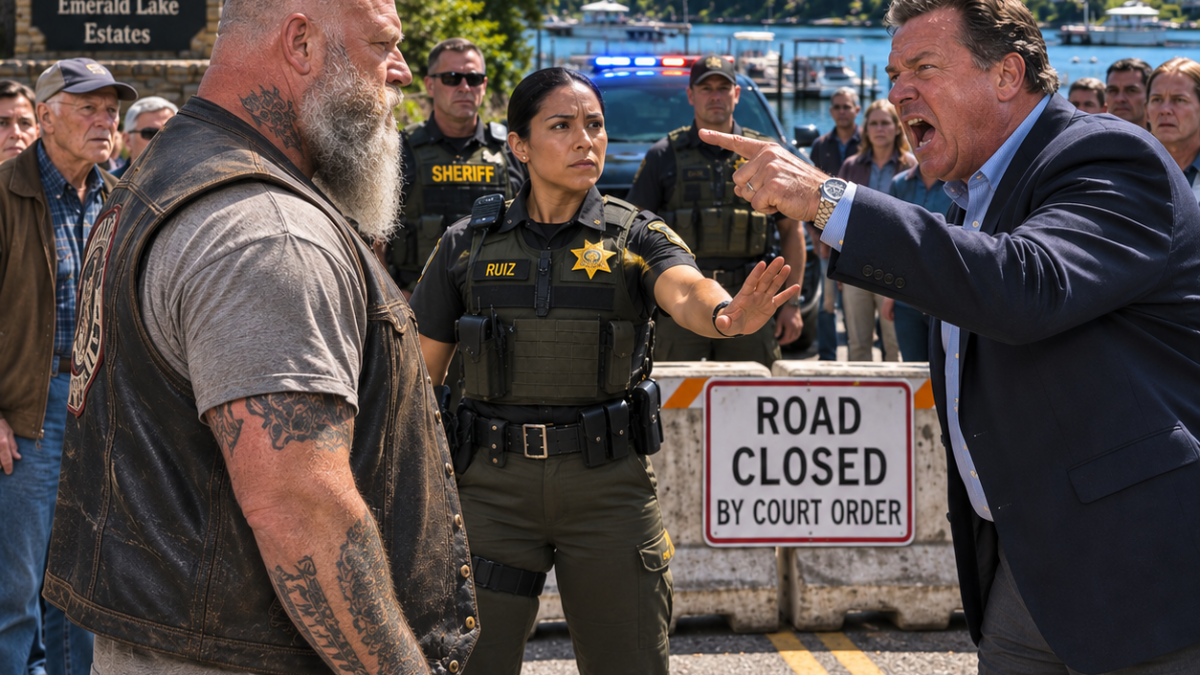
The sheriff’s deputies were standing between me and three hundred furious homeowners when the HOA president pointed at my face and screamed, “You can’t block us from our own marina.”
What none of those people knew was that their $5 million road, its parking lot, and eleven acres of expensive waterfront improvements had been built entirely on land recorded in my deed—and the man yelling loudest had known it years before I bought the property.
Forty days earlier, I had been nothing more than a quiet bidder with a shaking auction paddle, but by the time the deputies lowered the concrete barriers, I was holding a survey with my dead father’s initials on it and enough evidence to bring an entire HOA board apart.
The day I bought 8,400 acres, I nearly talked myself out of raising the paddle.
The auction was held in a ballroom at the Macon County Convention Center, the kind of room designed for weddings and insurance conferences, not land sales large enough to change a man’s life.
There were maybe sixty people there.
Timber companies.
Developers.
Investment groups.
Two men I recognized from Atlanta who specialized in turning rural land into gated subdivisions with names like Whispering Oaks and Hidden Preserve.
And me.
Mitch Garrick.
Forty-six years old.
Divorced.
No children.
Owner of a small civil engineering and land-management firm that had done reasonably well without making me rich enough to look comfortable bidding on a property that stretched across three counties.
The estate was called Black Ridge Timber.
Eight thousand four hundred acres of pine, hardwood, granite ridge, creek bottom, and lakefront.
Most of it had belonged to the same family for nearly seventy years.
Then debt, inheritance disputes, and a bank foreclosure tore it apart.
The auction catalog made it sound almost undesirable.
“Remote access.”
“Mixed terrain.”
“Limited utilities.”
“Portions subject to historic easements.”
To me, it sounded like peace.
My father would have loved it.
Walter Garrick had been a land surveyor for thirty-eight years.
He taught me to read bearings before I could properly read a newspaper.
Other fathers took their sons fishing.
Mine took me into wet woods carrying a prism pole and told me not to trust a fence merely because it looked old.
“A fence tells you what somebody believed,” he used to say.
“A monument tells you what somebody proved.”
He had been dead nine years when Black Ridge came to auction.
Cancer.
Fast at the end.
He left me his instruments, his field books, and an old compass worn smooth along one edge from decades in his hand.
I carried that compass in my jacket pocket the day of the sale.
Maybe that was sentimental.
I didn’t care.
The auctioneer opened at $9 million.
Nobody moved.
Eight.
Seven.
At $6.5 million, a timber company raised a bidder card.
Another investor joined.
I kept telling myself not yet.
At $7.2 million, the investor dropped.
At $7.4 million, the timber company hesitated.
I raised my paddle.
My hand shook.
The company answered.
Seven five.
I raised again.
Seven six.
PART2:
The auctioneer pointed toward the timber representative.
“Seven-seven?”
Nothing.
He waited.
The room became very quiet.
“Seven million six hundred thousand.”
He looked around.
“Once.”
My chest was hammering.
“Twice.”
I could hear my father’s voice in my head.
Walk it before you trust it.
“Sold.”
The gavel came down.
The sound was surprisingly small.
That was it.
A wooden tap.
And suddenly I owned a mountainside.
The auctioneer smiled at me.
“Congratulations, Mr. Garrick.”
I’m not sure congratulations was the word I would have used.
My stomach dropped so hard I thought I might be sick.
I had arranged financing.
I had investors in my forestry company.
I had done the numbers.
I knew exactly what I was doing.
And for the next six minutes I was completely convinced I had destroyed my life.
That feeling passed.
Mostly.
At closing, I received boxes.
Deeds.
Timber records.
PART3:
Environmental studies.
Old plats.
Water agreements.
Easements.
Tax maps.
Historical surveys.
The attorney pushed a thick folder toward me.
“There are several legacy access issues along the southeast corner.”
“What kind?”
“Mostly old utility easements. A few informal roads.”
“Anything active?”
“There’s a residential development bordering the lake.”
I knew about Emerald Lake Estates.
Everybody in that part of Georgia did.
Three hundred upscale houses around a man-made lake, private clubhouse, marina, pickleball courts, manicured entrances, and enough decorative stone to build a medieval fortress.
The subdivision had been developed in phases beginning in the late 1980s.
It was governed by an HOA.
The attorney flipped through pages.
“There’s been some road work recently.”
“What road?”
“Marina Road.”
I remembered seeing it in the auction aerials.
A clean black strip curving along the western edge of the lake.
“HOA road?”
“That seems to be their position.”
I looked at him.
“What does that mean?”
He smiled.
“Exactly what it sounds like.”
I should have asked more.
I didn’t.
Not that day.
I was too overwhelmed by the rest of the property.
The morning after closing, I drove to Black Ridge before sunrise.
There was an old cabin near the northern ridge that had been used by timber crews.
One bedroom.
Stone fireplace.
Tin roof.
No reliable cell signal unless you stood near the porch rail.
It became my temporary headquarters.
At 6:20 a.m., with coffee in a metal thermos and my father’s compass in my pocket, I started walking the western property line.
I was not conducting a legal survey.
I’m an engineer, not a licensed surveyor.
But my father had trained my eyes.
I knew what to look for.
Old fence scars in trees.
Stone piles.
Iron pins.
Blazed lines.
Survey caps.
The property dropped toward Emerald Lake through heavy pine.
Cold November air sat between the trees.
After about two miles, I heard traffic.
Not highway traffic.
Boat trailers.
Pickup trucks.
Engines climbing a grade.
Then I saw Marina Road below me.
It was impressive.
Fresh pavement.
Stone retaining walls.
Decorative lighting.
Wide shoulders.
New drainage.
A landscaped entrance leading toward the Emerald Lake marina.
I stood above it for several minutes.
Something felt wrong.
Not dramatically wrong.
Geometrically wrong.
The road seemed too far uphill.
My deed line, from memory, followed the old ridge contour farther east.
I walked down.
Near a drainage ditch, half buried beneath pine needles and red clay, I saw metal.
I knelt.
Scraped dirt away with my fingers.
Brass cap.
Old.
Green with oxidation.
Stamped around the edge:
W.G. SURVEY CO.
My heart stopped.
W.G.
Walter Garrick.
My father.
Below it was a monument number.
I sat back on my heels.
For a moment the woods disappeared.
I was twelve again, following him through briars while he told me to stop dragging the chain.
I touched the cap.
“Dad?”
I actually said it aloud.
A voice answered behind me.
“Figured you’d find that eventually.”
I stood so fast I nearly slipped.
An elderly man stood near the trees.
Thin.
Canvas coat.
Gray beard.
Wooden cane.
He looked about eighty.
“Didn’t mean to scare you.”
“You succeeded.”
He smiled.
“Howard Dorsey.”
“Mitch Garrick.”
“I know.”
Of course he did.
Rural communities could identify a new landowner before the deed finished recording.
Howard pointed at the brass cap.
“Walter Garrick was your father?”
“Yes.”
“Knew him.”
I stared.
“You knew my dad?”
“Thirty-something years back.”
He came closer carefully.
“Good surveyor.”
“The best.”
“That’s what he said too.”
I laughed.
That sounded exactly like my father.
Howard looked downhill toward Marina Road.
Then his expression changed.
“You bought yourself a problem.”
“What problem?”
He glanced toward the subdivision as though someone might be listening from half a mile away.
“That road.”
“What about it?”
“It ain’t supposed to be there.”
I studied him.
“Meaning?”
“Meaning your daddy told them it wasn’t supposed to be there before there was even pavement.”
I felt something tighten in my chest.
“Slow down.”
Howard pointed with his cane.
“Back in 1991, developers were laying out the second phase of Emerald Lake. They wanted marina access across that hillside.”
“My hillside.”
“Wasn’t yours then.”
“Black Ridge estate.”
“Yes.”
“Did they have an easement?”
Howard shook his head.
“Not where they wanted it.”
I looked at the road.
“That road is new.”
“New pavement. Old mistake.”
He explained that the original subdivision developer had cleared a rough construction path in the early 1990s.
My father had been hired by the Black Ridge family after they noticed grading near their boundary.
Walter surveyed it.
Determined the proposed access crossed private timberland.
There had been letters.
Arguments.
Threats.
Eventually the developer shifted most access farther south.
“At least that’s what everybody thought,” Howard said.
“What changed?”
“Time.”
He shrugged.
“Old owners stopped paying attention. Black Ridge family fought among themselves. HOA got bigger. People forgot.”
I looked downhill again.
“And this road?”
“Built last year.”
“How much?”
Howard whistled.
“Five million, give or take.”
I turned.
“You’re kidding.”
“Special assessment.”
“For that?”
“Road, parking, marina expansion. Folks paid plenty.”
I watched a Mercedes SUV towing a small boat pass below.
“Who authorized it?”
Howard laughed.
“You haven’t met Douglas Kesler yet.”
“No.”
“You will.”
That was not said as a compliment.
I hired Paul Osgood the same afternoon.
Paul was a licensed professional surveyor with thirty years of boundary work and no sense of humor when property lines were involved.
He was also one of the few surveyors I trusted enough to tell:
“I think my father surveyed part of this.”
He looked up.
“Walter Garrick?”
“You knew him?”
“Everybody knew Walter.”
I should have stopped being surprised.
“He trained half the surveyors in middle Georgia.”
“That sounds like him.”
Paul walked the road corridor for two days.
GPS equipment.
Total station.
Historic monuments.
County plats.
Deed calls.
Old right-of-way maps.
I stayed away as much as I could.
Surveyors hate owners breathing down their necks.
On the second night, at 9:03, my phone rang.
Paul.
“Where are you?”
“At the cabin.”
“Stay there.”
I sat straighter.
“Why?”
“Because I’m still at the south road.”
“What happened?”
“Nothing happened.”
“Then why stay there?”
He was quiet.
“Because I don’t want you walking into this alone until I confirm something.”
“Paul.”
“Mitch.”
I knew that tone.
It was the tone my father used when numbers had stopped being theoretical.
“Tell me.”
“The marina road is inside your deed.”
“How far?”
Silence.
“Paul.”
“Entire corridor.”
I stood.
“What?”
“Road centerline is anywhere from 180 to 640 feet inside your western boundary depending on station.”
“That’s impossible.”
“I thought so too.”
“The county GIS—”
“GIS is tax mapping. Not boundary.”
“I know.”
“I checked monuments.”
“How much land?”
“Approximately eleven point three acres affected by road, retaining walls, parking, drainage, and marina access improvements.”
I walked to the window.
Down through the trees, distant lights from Emerald Lake glowed near the water.
“They spent five million dollars on my land.”
“Looks that way.”
“Could the deed be wrong?”
“Possible.”
“Could the monuments be wrong?”
“Possible.”
“Could you be wrong?”
“Always.”
That was why I trusted him.
“Do you think you’re wrong?”
“No.”
I sat down.
Paul said, “There’s more.”
“Of course there is.”
“One monument at the north end matches a Walter Garrick field reference from 1991.”
My throat tightened.
“You found his survey?”
“Not yet.”
“Then how—”
“Old plat references W.G. survey book 17, page 43.”
I knew exactly where to go next.
County records.
The next morning, I was at the courthouse before eight.
The records clerk was a woman named Doris Wynn.
Seventy if she was a day.
Pink reading glasses.
Perfect memory.
I gave her parcel numbers.
She vanished into the back.
Twenty minutes later she returned with two folders and a roll of microfilm.
Then another folder.
She looked at the label.
Her face changed.
“What?”
“Nothing.”
“Doris.”
She looked over her glasses.
“You Garricks always ask too many questions.”
“You knew my father?”
“Everybody knew your father.”
I laughed.
“I’m beginning to think I’m the only person who didn’t know how famous he was.”
“He argued with me for twenty minutes once because I filed a plat upside down.”
“Sounds right.”
She opened a logbook.
“What are you looking for?”
“1991 boundary survey.”
She traced a finger down the page.
Then stopped.
“Oh.”
“What?”
“This file was pulled before.”
“When?”
“2019.”
My stomach tightened.
“By who?”
Doris turned the book toward me.
REQUESTOR:
DOUGLAS KESLER.
I stared.
“HOA president?”
“That’s him.”
“You’re sure?”
“He signed.”
Beside the name was a document number.
Walter Garrick Survey, 1991.
Doris brought the file.
Inside was my father’s plat.
His handwriting.
His bearing notes.
His seal.
The boundary line ran exactly where Paul said it ran.
Marina Road crossed deeply inside Black Ridge.
Attached was correspondence.
My father had written the developer:
PROPOSED MARINA ACCESS AS CURRENTLY STAKED ENCROACHES APPROXIMATELY 600 FEET ON BLACK RIDGE TIMBER PROPERTY. NO RECORDED EASEMENT HAS BEEN LOCATED.
My hands shook.
Thirty years earlier.
Same problem.
I looked at Doris.
“Kesler saw this in 2019.”
“He requested it.”
“Did he copy it?”
She checked.
“Twenty-seven pages.”
The entire file.
I drove back to Black Ridge slowly.
I wanted to believe there was an explanation.
Maybe the HOA later acquired rights.
Maybe an easement had been recorded elsewhere.
Maybe there had been a land swap.
Maybe Kesler had reviewed the file and received legal advice contradicting it.
I wanted peace.
That matters.
People later assumed I was waiting for an opportunity to trap the HOA.
I wasn’t.
I had just spent millions buying land I wanted to manage quietly.
Timber thinning.
Conservation leases.
Maybe build a house overlooking the lake.
The last thing I wanted was three hundred neighbors believing I had arrived to shut down their marina.
So I did the reasonable thing.
I asked for a meeting.
Emerald Lake’s clubhouse looked like a resort.
Stone columns.
Massive windows.
Lake view.
The lobby smelled like cedar and expensive furniture polish.
Douglas Kesler kept an office upstairs.
He was fifty-four.
Heavyset.
Silver hair.
Dark blue golf shirt embroidered with EMERALD LAKE ESTATES.
Expensive watch.
The kind of confidence that comes from years of being the loudest man in rooms where nobody challenges you.
He shook my hand.
“So you’re the mountain man.”
“Mitch Garrick.”
“I know who you are.”
He pointed toward a chair.
“Coffee?”
“No thanks.”
“I hear you bought the whole Black Ridge tract.”
“Yes.”
“Quite an undertaking.”
“I like undertakings.”
He smiled.
“So what can I do for you?”
I put Paul’s preliminary survey on his desk.
His eyes flicked down.
Then back up.
Too quickly.
“I believe Marina Road encroaches on Black Ridge.”
He leaned back.
“How much?”
That question told me something.
Not is it?
How much?
“About eleven acres total impact.”
He gave a short laugh.
“That’s ridiculous.”
“Paul Osgood surveyed it.”
“I know Paul.”
“Then you know he’s careful.”
“Surveyors disagree.”
“Sometimes.”
“County maps show our road.”
“County GIS isn’t a boundary survey.”
“I know that.”
Again.
Too quick.
I placed my father’s 1991 plat beside Paul’s.
Kesler stopped smiling.
“This survey was requested from county records in 2019.”
He did not touch it.
I continued.
“By you.”
Silence.
Then he smiled again.
A different smile.
Less friendly.
“You did homework.”
“I inherited the habit.”
He looked at the plat.
“That old survey was part of our due diligence.”
“For what?”
“Marina expansion.”
“And what conclusion did you reach?”
“That the HOA had historical access rights.”
“Recorded where?”
“Our attorney handled it.”
“Name?”
He ignored that.
“Mr. Garrick, three hundred families depend on that road.”
“I understand.”
“The HOA spent more than five million dollars improving it.”
“I understand that too.”
“So what exactly do you want?”
“The boundary acknowledged and the legal basis for your use documented.”
He stared at me.
Then opened a drawer.
Pulled out a checkbook.
He wrote.
Tore the check free.
Slid it across the desk.
Two thousand dollars.
I looked at it.
“What is this?”
“For your trouble.”
I laughed because I genuinely thought he was joking.
He wasn’t.
“Douglas.”
“Call it a boundary adjustment fee.”
“For eleven acres?”
“It’s unusable slope and road corridor.”
“Then why did you spend five million improving it?”
His face changed.
Small.
But real.
I pushed the check back.
He did not touch it.
“Mitch.”
“No.”
“Be practical.”
“I am.”
“You bought eight thousand four hundred acres.”
“Yes.”
“You won’t notice eleven.”
I leaned forward.
“That may be the worst property argument I’ve heard in my life.”
“You know what I mean.”
“No. I know exactly what you said.”
His smile disappeared.
“You’re outside the HOA.”
“I’m aware.”
“You’re not part of this community.”
“That road is on my deed.”
“You’re nobody here, Garrick.”
There it was.
Not an argument.
A hierarchy.
Three hundred homeowners.
Clubhouse.
Board.
Votes.
Money.
And me.
One man outside the gate.
Kesler continued.
“You really want to become the person who takes their marina away?”
I looked through his window.
Families were walking along the lake.
A woman pushed a stroller.
Two boys carried fishing rods.
I did not want to hurt them.
That was exactly why I said what I said next.
“I want the truth on the record.”
I stood.
Kesler’s voice hardened.
“If you interfere with access, our counsel will bury you in litigation.”
I looked back.
“Then tell him to bring the 2019 survey.”
I hired Hannah Rice that afternoon.
Hannah was forty-one, property attorney, former county prosecutor, and one of the smartest people I had ever met.
She read Paul’s survey.
Then my father’s.
Then the 2019 file request.
Twice.
Finally she said, “He knew.”
“You can’t prove he read it.”
“A man doesn’t offer you two thousand dollars for ‘trouble’ unless he already knows there’s trouble.”
“He claims historical access.”
“Maybe.”
“Prescriptive easement?”
“Possible.”
“Adverse use?”
“Possible.”
“Then we’re not done.”
“No.”
She smiled faintly.
“We’re barely starting.”
That was the problem with land law.
Everybody thinks a deed line ends the argument.
It often begins it.
The HOA could claim easement rights based on years of use.
They could claim implied access.
They could argue estoppel.
They could argue prior owners acquiesced.
They could challenge the monument.
They could challenge the deed.
Hannah was not interested in dramatic declarations.
She was interested in evidence.
“We do this clean,” she said.
“Meaning?”
“No gates.”
“I wasn’t planning one.”
“No trenches.”
“Obviously.”
“No angry Facebook posts.”
“I don’t have Facebook.”
“That makes you my favorite client.”
She sent a formal notice.
Fourteen days.
Provide all documents supporting the HOA’s right to construct and maintain Marina Road across the disputed corridor.
Cease additional construction.
Preserve records.
Respond through counsel.
Fourteen days passed.
Nothing.
On day fifteen, Emerald Lake hosted its grand marina reopening celebration.
Apparently the event had been planned for months.
Music.
Food trucks.
Boats decorated with lights.
Fireworks scheduled after dark.
I watched from the ridge.
Two hundred people, maybe more.
Kids running along pavement technically inside my deed.
Couples sitting on retaining walls.
Neighbors laughing.
For one terrible moment, I understood exactly how Kesler had gotten away with it.
Not because everybody was corrupt.
Because the road worked.
It was beautiful.
Useful.
Normal.
Once something becomes normal, people stop asking who had the right to put it there.
I felt sick.
Not angry.
Sick for them.
Each homeowner had paid a special assessment.
Some had paid more than $16,000 depending on property class.
They believed they were buying an asset.
Kesler had sold them certainty.
I went back to the cabin before fireworks started.
At 2:07 that morning, my phone buzzed.
Motion alert.
Boundary Camera 3.
I had installed trail cameras after Hannah told me to document the disputed corridor.
I opened the clip.
Headlights.
Pickup.
Three men.
One carried a shovel.
Another moved toward Paul’s survey stakes.
He yanked one free.
Then another.
My pulse shot up.
I replayed.
The truck had lettering on the door.
HATCH MARINE CONSTRUCTION.
I zoomed.
One man wore a cap.
Heavy build.
The other stayed near the headlights.
Flashlight in one hand.
Silver watch on his wrist.
My stomach dropped.
Douglas Kesler.
I watched again.
No mistake.
He pointed.
The worker removed another stake.
Kesler kicked dirt over the hole.
I called Hannah.
2:14 a.m.
She answered on the fourth ring.
“If you’re in jail, I’m charging double.”
“I have video.”
Silence.
“What kind?”
“Kesler removing survey stakes.”
She was instantly awake.
“Do not go down there.”
“I’m not.”
“Copy the file.”
“Already doing it.”
“Cloud and physical.”
“Yes.”
“Call Paul in the morning. Have him document missing monuments.”
“Those are stakes, not monuments.”
“I know, Mitch.”
“Sorry.”
“At least your father trained you.”
She hung up.
By 8:30, Hannah had filed for emergency injunctive relief.
Trail-camera footage.
Paul’s affidavit.
My father’s survey.
The county request log showing Kesler had accessed it.
Photographs.
Formal notice.
No response.
The hearing was Thursday.
Kesler came with two attorneys.
I came with Hannah.
The courtroom was small.
Maybe thirty seats.
Howard Dorsey sat in the back.
I had not asked him to come.
He nodded when he saw me.
Kesler’s attorney argued that Emerald Lake had used the access corridor for decades.
He talked about reliance.
Public safety.
Established use.
Substantial investment.
Economic harm.
Boat access.
Emergency services.
He said closing the road would punish hundreds of innocent homeowners over a technical boundary dispute.
Hannah did not interrupt.
That worried me.
When she became quiet, someone was usually about to have a bad morning.
The judge asked whether the HOA had recorded easement rights.
Kesler’s lawyer said historical documents were “being reviewed.”
The judge frowned.
Then Hannah stood.
“Your Honor, may I approach?”
She handed up the 1991 survey.
Then the 2019 request log.
Then a copy receipt.
“Mr. Kesler personally requested this exact boundary file approximately two years before HOA approval of the marina project.”
Kesler’s attorney stood.
“Objection to characterization.”
“Overruled. Continue.”
Hannah looked toward Kesler.
“Mr. Kesler, did you read the 1991 Walter Garrick survey?”
His attorney objected.
The judge allowed limited questioning.
Kesler moved to the witness stand.
For the first time since I met him, he looked uncertain.
Hannah asked again.
“Did you review this document in 2019?”
He looked at the page.
“I don’t recall.”
The courtroom became completely silent.
Hannah waited.
That silence did more work than any argument.
“You personally requested it?”
“I requested multiple records.”
“You paid copying fees?”
“I suppose.”
“Your signature?”
“Yes.”
“You then chaired the committee approving construction in the exact corridor identified as encroaching in that survey?”
“My understanding was different.”
“Based on what?”
“Our consultants.”
“Name one.”
His attorney objected.
The judge leaned forward.
“Mr. Kesler, the court would also like an answer.”
Kesler swallowed.
“I’d have to review records.”
Hannah introduced the trail-camera video.
The judge watched twice.
“Is that you?”
Kesler said, “I was present.”
“Why?”
“To inspect vandalism.”
Hannah looked almost impressed.
“Vandalism?”
“Unapproved stakes had been placed near HOA improvements.”
“By a licensed surveyor.”
“I didn’t know that.”
“His company name was printed on them.”
“I did not inspect them closely.”
“You watched your contractor pull them out.”
“I was concerned they were creating a hazard.”
The judge removed her glasses.
“Mr. Kesler.”
He stopped.
The judge looked exhausted rather than angry.
That was worse.
“Please do not insult this court.”
Kesler’s face went red.
The ruling came twenty minutes later.
Temporary injunction.
No further alteration.
No interference with survey work.
And most importantly:
Use of the disputed road corridor suspended pending title determination.
Effective Saturday.
8:00 a.m.
Sheriff’s office authorized to enforce.
Kesler turned toward me as people stood.
His face carried pure hatred.
“You did this.”
I looked at him.
“No.”
He stepped closer.
“You’re closing their road.”
Hannah moved between us.
I answered anyway.
“You built it before making sure you owned it.”
Saturday morning came cold and clear.
I arrived at 7:20.
Hannah told me I didn’t need to be there.
I knew.
I went anyway.
Boat trailers were already lining up.
Families had weekend plans.
Kesler had not notified residents.
Not one email.
Not one emergency notice.
Nothing.
At 7:40, two sheriff’s SUVs arrived.
Then another.
A county flatbed carried concrete barriers.
Deputy Elena Ruiz stepped out.
Early forties.
Calm.
Professional.
She walked toward the road entrance holding the order.
Residents began gathering.
“What’s happening?”
“Why are they closing it?”
“Is this construction?”
Then someone recognized me.
“That’s the Black Ridge guy.”
The phrase spread.
Black Ridge guy.
More cars arrived.
By 7:55, maybe eighty people were there.
Kesler arrived at 7:58 in a black SUV.
He jumped out before the vehicle fully stopped.
“What the hell is this?”
Deputy Ruiz walked toward him.
“Mr. Kesler?”
“You cannot close this road.”
“I have a court order.”
“This is HOA property.”
Ruiz looked at the document.
“The court disagrees enough to suspend access.”
“You don’t understand.”
“Sir, I’m here to enforce the order, not interpret your property case.”
At 8:00, she raised her voice.
“This road is closed by order of Macon County Superior Court pending resolution of a private-property dispute. Vehicles may not enter beyond the barrier.”
People erupted.
“What?”
“My boat’s down there.”
“We paid for this.”
“This is insane.”
Kesler pointed at me.
“He’s doing this.”
Heads turned.
I stood beside Hannah.
Kesler pushed through the crowd.
“You can’t block us.”
I looked at the road.
Then at him.
He still had no idea what else was coming.
“This is our road!” he shouted.
Deputy Ruiz stepped between us.
“Sir.”
Kesler ignored her.
“Three hundred families use this. Five million dollars. You think one man can steal it?”
I answered quietly.
“I didn’t put it on my deed.”
That made him angrier.
“You are nobody here.”
The same words.
But this time three hundred people were listening.
I said, “Then show them the 2019 survey.”
His face changed.
Residents noticed.
A man behind him asked, “What survey?”
Kesler turned.
“This is litigation. Do not engage.”
Someone else shouted, “Did you know?”
Kesler walked toward his SUV.
Deputy Ruiz warned him the barrier was going in.
He climbed behind the wheel.
Started the engine.
Then, in what might have been the worst decision of his life, he accelerated toward the road entrance.
Not fast enough to hit anyone.
Fast enough to intimidate.
Two deputies stepped forward.
Hands near their belts.
Kesler slammed the brakes.
His bumper stopped perhaps six feet from them.
Not inches, as people later told the story.
Six feet was enough.
Ruiz walked to his window.
“Put the vehicle in park.”
He stared forward.
“Now.”
He did.
“Step out.”
The crowd went silent.
Kesler climbed out.
Ruiz said, “You will not attempt to pass this barrier again.”
He looked at me.
His face had gone pale.
Then a voice rose from the back.
“He knew.”
Howard Dorsey.
He limped through the crowd using his cane.
Howard had put on a clean jacket for the occasion.
Kesler groaned.
“Howard, go home.”
Howard stopped.
“No.”
The old man turned toward the residents.
“I lived here before half these houses existed.”
People knew him.
That mattered.
He pointed toward the ridge.
“Walter Garrick surveyed that line in 1991.”
Murmurs.
“He told the old developers marina access crossed Black Ridge land.”
Kesler said, “That is not relevant to modern—”
Howard raised his voice.
“Then why’d you pull the same file in 2019?”
Silence.
A woman stepped forward.
Mary Ann Lowe.
I recognized her from HOA documents.
Treasurer.
Late fifties.
Glasses.
She was carrying a binder against her chest.
Her hands shook.
“Douglas.”
Kesler turned.
“Not now, Mary Ann.”
“Yes.”
Her voice was quiet.
Then louder.
“Yes, now.”
The crowd shifted.
Mary Ann opened the binder.
“Our marina assessment included six hundred forty thousand dollars paid to Hatch Marine LLC for ‘land preparation and corridor stabilization.’”
I looked at Hannah.
Hatch Marine.
The truck from the trail camera.
Mary Ann continued.
“I asked what land we were preparing because the HOA records did not show a purchase.”
Kesler moved toward her.
“Mary Ann, these are confidential financial records.”
She stepped back.
Deputy Ruiz shifted between them.
Mary Ann’s voice trembled.
“You told me it was settlement money.”
The crowd reacted.
Someone shouted, “Settlement with who?”
Mary Ann looked directly at me.
“Did you get $640,000?”
“No.”
She closed her eyes.
Then looked at the residents.
“I’ve been asking for documentation for eleven months.”
Kesler snapped, “You approved every payment.”
“Because you gave the board an attorney letter.”
“What letter?” Hannah asked.
Kesler turned toward her.
“This does not concern you.”
Hannah smiled without warmth.
“It absolutely concerns me.”
Mary Ann pulled a document from the binder.
It looked like a legal opinion.
Hannah read it.
Then looked at me.
“This isn’t from a law firm.”
Mary Ann blinked.
“What?”
“There’s no bar number. No firm address. The lawyer name is wrong.”
Kesler said, “Enough.”
Hannah looked at the signature.
“Who is Thomas A. Brennan?”
Mary Ann whispered, “Our outside counsel.”
“No, he isn’t.”
Everyone looked at her.
Hannah took out her phone.
“Our firm litigated against Emerald Lake’s outside counsel last year. His name is Thomas E. Brennan.”
The crowd went silent.
Mary Ann looked at the page.
“A?”
“Yes.”
Kesler walked away.
Not ran.
Walked.
That told me he was thinking.
The barriers went down behind him.
That night, Emerald Lake held an emergency HOA meeting.
The clubhouse was packed beyond fire-code capacity.
People stood outside looking through the windows.
Hannah and I were invited.
The irony was not lost on me.
Forty-eight hours earlier, I had been nobody because I lived outside the HOA.
Now they needed my evidence.
Mary Ann sat at the front with three other board members.
Kesler stood behind the podium.
He still looked composed.
I almost respected that.
Almost.
He opened with:
“We are facing an opportunistic property claim.”
The room exploded.
“Sit down!”
“You knew!”
“Where’s our money?”
He raised both hands.
“Please.”
Someone yelled, “Did you fake the lawyer letter?”
He ignored it.
Mary Ann took the microphone.
“Douglas, I am making a motion to suspend you as president pending investigation.”
Applause erupted.
One board member seconded.
Kesler stared at them.
“You do not have authority without notice.”
Hannah whispered to me, “He’s right.”
“What?”
“Depending on bylaws.”
I looked at her.
She shrugged.
“Bad people can still read procedure.”
Mary Ann produced the bylaws.
Emergency removal for alleged financial misconduct required four board votes.
There were seven board members.
Four raised their hands.
Kesler was suspended.
Then the membership demanded a recall vote.
That required different procedure.
Notice.
Ballots.
Quorum.
No cinematic instant removal.
Real life rarely works that neatly.
But something more important happened that night.
People spoke.
A retired teacher said she had taken out a home-equity loan to pay the marina assessment.
A widower said he had sold his fishing boat because the assessment was too high, then had to watch the marina expansion he could no longer afford to use.
A young couple said they had delayed fertility treatment because they were paying $1,400 a month toward HOA fees and assessment financing.
The $5 million was not abstract anymore.
It had come from kitchens.
Savings.
Marriages.
Retirement accounts.
Fear.
Mary Ann read line items.
Engineering.
Paving.
Drainage.
Lighting.
“Legal acquisition reserve.”
$640,000.
No recorded acquisition.
No payment to Black Ridge.
Hatch Marine invoices instead.
Hannah laid out the 2019 survey.
The county receipt.
Paul’s new survey.
Trail-camera stills.
Then I stood.
I had not planned a speech.
I said the only thing that mattered.
“I am not your enemy.”
The room quieted.
“I did not ask for this road.”
I looked around.
“And I did not ask the court to punish three hundred families.”
A man shouted, “Then open it.”
Hannah touched my arm.
I raised a hand.
“I cannot legally ignore an eleven-acre encroachment after discovering it. If I do, I create a worse title problem.”
Some understood.
Some did not.
I continued.
“I have no intention of trapping your marina.”
That changed the room.
Kesler looked at me sharply.
“I want the records corrected. I want the land rights handled legally. And I want to know where your money went.”
Someone shouted, “So do we.”
I looked at Mary Ann.
Then at the residents.
“I will negotiate.”
The mood shifted.
Not forgiveness.
Relief.
Then Sheriff Ray Dunmore entered through the side door.
He was not there to arrest Kesler.
That part of the story grew in retelling.
He was there because Deputy Ruiz had forwarded the trail-camera footage and financial allegations to investigators.
Dunmore approached Mary Ann.
“We need copies of those records.”
Kesler called his attorney.
By Monday morning, the district attorney had opened an investigation.
Not into a property dispute.
Into potential fraud.
The recall vote happened eleven days later.
Kesler lost by the largest margin ever recorded in Emerald Lake.
287 votes for removal.
9 against.
4 abstentions.
Mary Ann Lowe was elected interim president.
Then permanent president three months later.
The criminal investigation lasted nearly a year.
That is another thing viral stories get wrong.
Justice is slow.
Paperwork does not explode.
It accumulates.
Invoices.
Bank transfers.
Emails.
Contractor statements.
Subpoenas.
Depositions.
Hatch Marine had received $640,000 beyond legitimate construction invoices.
Of that, investigators alleged, more than $180,000 had been routed through a consulting company partly controlled by Kesler’s brother-in-law.
Kesler maintained the payments were legitimate project-management fees.
Prosecutors disagreed.
The tampering charge came from the survey stakes.
The fraud counts came later.
He eventually pleaded guilty to falsification of HOA records and attempted evidence tampering.
Other financial counts were resolved through restitution agreements rather than the dramatic prison sentence some residents wanted.
He served several months in county custody and received probation.
Hatch Marine returned substantial funds as part of a civil settlement.
The HOA recovered enough money to avoid another special assessment.
But none of that solved the road.
The property case remained.
Legally, I could have pushed harder.
Asked for removal.
Damages.
Rent.
Restoration.
Possibly millions.
Hannah explained every option.
“You have leverage.”
“I know.”
“You also have a title that deserves to be clean.”
“I know.”
“What do you want?”
That was harder.
I walked the road alone one morning.
The barriers remained.
We had arranged temporary marina access from another entrance, but it was narrow and inconvenient.
Residents waved now.
Some.
Others still looked at me like I had ruined their summer.
I understood.
Truth did not make inconvenience pleasant.
Near the northern ridge, I found Howard sitting on a fallen log.
“You gonna keep it closed forever?”
“No.”
“Good.”
“You taking their side?”
“I’m taking my knees’ side. That detour adds half a mile to my walk.”
I laughed.
Then he looked serious.
“Your daddy wouldn’t want you taking the road.”
“You knew him that well?”
“No.”
“Then how do you know?”
Howard tapped his cane.
“Because he had the chance.”
I stared.
“What?”
“In 1991.”
Howard explained.
After my father established the boundary, the Black Ridge owner could have sued immediately.
Instead Walter recommended negotiating a formal easement if the developer ever needed marina access.
“He wrote that?”
“Think so.”
I went back to the cabin.
I had still not fully cleaned it out.
Boxes remained in a loft.
Old Black Ridge records.
Broken tools.
Mouse nests.
A rusted tin container sat behind a stack of rotted ledgers.
Inside were letters.
One was from my father.
Walter Garrick.
Dated August 1991.
To Mr. Charles Blackwell, owner of Black Ridge Timber.
The marina access line as currently proposed is approximately 600 feet east of the true boundary in portions.
I have advised the developer.
They disagree.
I recommend no permanent construction occur until title is resolved.
Then lower on the page:
If future access is necessary, a recorded easement at fair value would serve both properties better than a boundary fight.
I sat on the floor.
There it was.
My father’s answer.
Not surrender.
Not revenge.
Paper.
Truth.
Agreement.
I found another handwritten note attached.
Charlie—
Road line is wrong.
Told them twice.
They don’t want to hear it.
Someday somebody will have to.
—Walter
I read it until the words blurred.
For thirty years, his warning had sat in a rusted box while people paved over the same mistake.
I took the letter outside.
Sat on the porch.
For the first time since the dispute began, I cried.
Not because of the road.
Because I could hear him.
Clear as if he were beside me.
Walk it before you trust it.
The next HOA meeting was quieter.
Mary Ann sat where Kesler used to sit.
No polished speeches.
No intimidation.
She had removed the oversized PRESIDENT plaque from the desk.
I liked that.
I stood before the residents.
“I found something.”
I showed them my father’s letter.
Then I told them my offer.
The HOA would receive a permanent recorded easement over the existing road and marina corridor.
I would retain underlying ownership.
The HOA would pay fair-market easement value determined by independent appraisal.
No penalty premium.
No punitive damages.
They would pay my legal and surveying costs.
They would maintain the road.
They would indemnify Black Ridge for marina operations.
No expansion without written permission.
And there would never again be a claim that the corridor was HOA-owned land.
A man in the back raised his hand.
“How much?”
“Appraisal is pending.”
Someone else asked, “Millions?”
“No.”
Hannah looked at me.
I already knew approximately.
The easement value was substantial but nowhere near the cost of removing and relocating the road.
I said, “I’m not trying to make you buy the pavement twice.”
That line changed things.
Mary Ann began crying.
She tried to hide it.
Howard did not.
“Your daddy would like that,” he said from the second row.
I looked at him.
“I hope so.”
The agreement took another month.
Lawyers argued about drainage.
Insurance.
Maintenance standards.
Emergency access.
Utilities.
Boat-trailer width.
Storm damage.
Every boring detail that prevents future wars.
Then we signed.
The road reopened on a Saturday morning.
No fireworks.
Mary Ann refused.
“We’ve had enough fireworks.”
Residents walked down together.
Children rode bicycles.
Boats rolled toward the marina.
A new stone marker stood near the entrance.
I had not requested it.
Mary Ann had.
Brass plate.
WALTER GARRICK ACCESS ROAD
BY RECORDED EASEMENT ACROSS BLACK RIDGE
ESTABLISHED 2024
I stared at it.
“You put my father’s name on this?”
Mary Ann smiled.
“He found the line first.”
Howard stood beside me.
Tears rolled down his face.
“You look like him.”
“Everyone says that now.”
“No.”
Howard shook his head.
“Not your face.”
I looked at him.
“The way you stand when you know you’re right and wish you didn’t have to prove it.”
That broke me.
I put one hand on the brass plate.
Cold metal.
Fresh screws.
My father’s name.
“You were right, Dad.”
That was all I said.
Emerald Lake changed after Kesler.
Not magically.
HOAs do not become perfect because one president leaves.
Arguments continued.
Pool rules.
Landscaping.
Dock permits.
Budgets.
People complained Mary Ann communicated too much.
Then not enough.
Some missed Kesler’s decisiveness.
That bothered me until Hannah said, “People often confuse certainty with competence.”
She was right.
Mary Ann implemented independent audits.
Large contracts required multiple bids.
Board members had to disclose family relationships with vendors.
Property acquisitions required recorded title review by outside counsel.
Survey records were stored with project files.
Boring safeguards.
Beautiful safeguards.
The first annual audit found no missing money.
Mary Ann called me.
“I almost cried.”
“Over an audit?”
“You have no idea how exciting clean accounting becomes after fraud.”
I believed her.
Howard died two years later.
Eighty-seven.
I attended the funeral.
Small Baptist church.
Packed.
His daughter told me he talked about the road constantly.
“I’m sorry.”
She laughed.
“Don’t be. It gave him something to complain about.”
At the graveside she handed me his cane.
“He wanted you to have this.”
I stared.
“I can’t.”
“You can.”
I took it.
The wood was polished where his hand had held it.
I keep it in the cabin.
Douglas Kesler wrote me once.
Three years after the dispute.
No apology.
Not exactly.
He said prison had given him “time to reconsider certain decisions.”
He claimed he never intended to steal land.
He had convinced himself historical use would eventually become legal entitlement.
He said the project had gotten too large to stop.
Money committed.
Contracts signed.
Residents expecting results.
He wrote:
Once I knew the road might be wrong, I believed correcting it would destroy me.
So I kept making decisions designed to avoid admitting the first one.
That sentence was the only part I cared about.
Because that was the real story.
Not $5 million.
Not 8,400 acres.
Not a sheriff’s barrier.
One man made a mistake.
Then protected it.
Then lied to protect the protection.
Then spent other people’s money protecting the lie.
By the time he was pulling survey stakes at two in the morning, the original boundary error was almost the smallest problem he had.
I never answered his letter.
I did not need to.
Black Ridge is still mine.
Most mornings, I walk.
Not all 8,400 acres.
I’m not insane.
But I walk sections.
The western line especially.
My father’s brass cap remains beneath the pines.
I clean it once a year.
No plaque.
No fence.
No spotlight.
Just metal in dirt.
That is enough.
Sometimes homeowners from Emerald Lake wave when I cross the easement.
Some stop to talk.
A few have become friends.
One man who cursed at me during the closure now brings me venison every winter.
Mary Ann still calls whenever the HOA plans work near the boundary.
“Mitch, we’re replacing a drainage pipe at station 18.”
“You don’t need my permission for maintenance.”
“I know.”
“Then why are you calling?”
“Trauma.”
Fair enough.
The marina road looks exactly as it did before the dispute.
That is the strange part.
If you drove through today, you would never know what happened.
Same asphalt.
Same lake.
Same stone walls.
Same boat trailers.
But legally, everything changed.
Truth does not always change what something looks like.
Sometimes it only changes who understands what it is.
People still tell the story wrong.
They say I bought 8,400 acres and immediately discovered the HOA had built a $5 million road on my property.
Not immediately.
It took walking.
They say I shut the road out of revenge.
I didn’t.
The judge suspended it.
They say Kesler tried to run over deputies.
He didn’t.
He accelerated toward the barrier and stopped.
Bad enough.
They say the sheriff arrested him in front of the neighborhood.
No.
He was investigated later.
Reality is usually less dramatic in individual moments.
But put the moments together and it becomes more powerful.
A brass cap.
My father’s initials.
An old man’s warning.
A survey.
A courthouse signature.
A ridiculous $2,000 check.
Fourteen days of silence.
A camera at two in the morning.
Survey stakes in a contractor’s hands.
A president with a flashlight.
A judge reading a thirty-year-old map.
Concrete barriers.
Three hundred confused homeowners.
A treasurer finding courage.
A forged-looking legal memo.
A father’s letter in a rusted box.
A legal easement.
A road reopened honestly.
Those were the pieces.
The road was never really the problem.
The problem was what happens when people believe power can replace ownership.
When a title on a door becomes more important than a title in the courthouse.
When a board starts believing residents’ dependence gives it permission to skip consent.
When someone tells the man holding the deed, “You’re nobody here,” because they assume numbers make truth democratic.
Property lines do not care how many people vote.
Neither does evidence.
That sounds harsh.
It is not.
Boundaries are what allow agreements to mean something.
If we do not know where my land ends and yours begins, we cannot honestly decide what we are willing to share.
My father understood that.
That was why his recommendation in 1991 was not:
Fight them.
It was:
Survey first.
Then negotiate.
Truth first.
Then agreement.
For years I thought my father loved surveying because he loved precision.
I was wrong.
He loved it because precision prevented people from having to rely on power.
A brass cap did not care who had more money.
A bearing did not care who was HOA president.
A deed did not care whether three hundred people wanted something to be true.
The line was the line.
And once everyone knew where it was, we could finally talk honestly about crossing it.
That is what Kesler never understood.
Had he come to the Black Ridge owners in 2019 with my father’s survey and said, “We need this road. What will it take?” the HOA probably could have secured an easement before spending a dollar on pavement.
Instead he treated the boundary like an inconvenience.
Then treated the truth like an enemy.
That choice cost him everything.
Not because I beat him.
Because eventually he ran out of people willing to believe him.
There is an old photograph hanging in the Black Ridge cabin now.
My father.
Probably 1990.
He is standing beside a survey tripod in a white shirt rolled to the elbows, cigarette tucked behind one ear, squinting at the camera like the photographer interrupted something important.
Behind him is the western ridge.
No Marina Road.
No houses visible.
Just trees.
I found the photograph after everything was over.
On the back, in his handwriting, were three words.
CHECK THE LINE.
I laughed when I saw it.
Then I framed it.
Of course that was what he left me.
Not wisdom about success.
Not money.
Not some grand speech about integrity.
Check the line.
That was my father.
Simple instruction.
Lifetime meaning.
I think about it whenever people ask what I learned.
Check the line before you build.
Check the record before you accuse.
Check the invoice before you trust the signature.
Check what someone knew before accepting what they claim they believed.
And maybe most importantly, check your own motives before turning a dispute into revenge.
I could have ruined Emerald Lake.
Legally, perhaps.
At least financially.
I had leverage.
Anger.
Evidence.
The residents had unknowingly built on my property.
But they were not the ones pulling stakes at two in the morning.
They trusted a board they elected.
Some had questioned things.
Most did what ordinary people do.
They paid the bill and assumed somebody had checked.
They deserved consequences only for their own choices.
Not his.
So I gave them a legal road.
They gave me clear title recognition.
The HOA paid my expenses.
Recovered part of its money.
Changed its leadership.
And the marina remained.
There are people who still tell me I was too generous.
Maybe.
My father once told me a surveyor’s job was not to win property for anybody.
It was to find the line.
What people did after that was character.
I found the line.
Kesler tried to erase it.
Mary Ann finally faced it.
The residents accepted it.
And in the end, we built an agreement across it.
Every morning when I walk past Walter Garrick Access Road, I see boats going down toward the lake.
Sometimes I stop near the stone marker.
Not often.
I’m not much for monuments.
The brass survey cap means more to me.
It is smaller.
Harder to find.
More honest.
Most people drive within a few hundred feet of it and never know it is there.
But it was there before the asphalt.
Before the HOA assessment.
Before Douglas Kesler’s presidency.
Before my auction paddle.
Before anyone started shouting.
Quietly marking the truth.
That is the thing about truth.
It does not need a clubhouse.
It does not need three hundred votes.
It does not need to scream.
Sometimes it can sit beneath red Georgia dirt for thirty years, green with age and almost forgotten, until somebody finally kneels down, brushes away the pine needles, and reads the name stamped into the metal.
Then the whole map changes.








