HOA Spent $2 Million Building a Lake on My Farm—Then My Lawyer Told Me, “Let Them Fill It”
HOA Spent $2 Million Building a Lake on My Farm—Then My Lawyer Told Me, “Let Them Fill It”
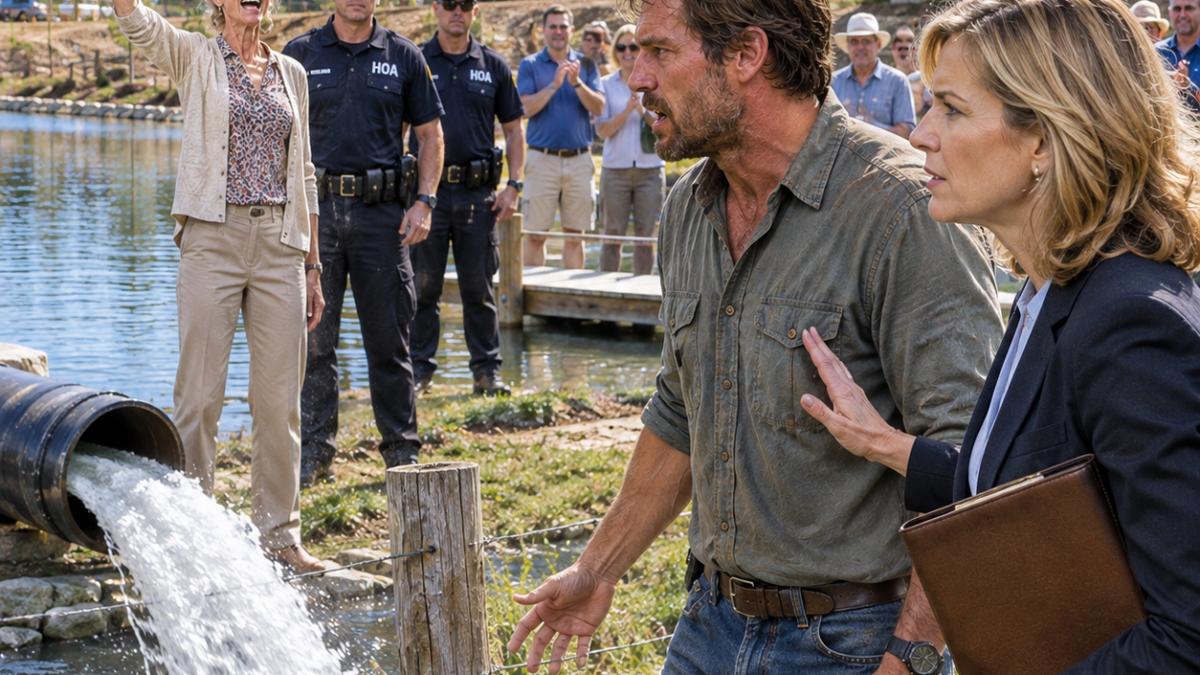
**“THE LAKE IS ALREADY BUILT, DANIEL—YOU CAN EITHER ACCEPT WHAT’S HAPPENING OR SPEND YEARS FIGHTING A COMMUNITY THAT HAS TWO MILLION DOLLARS INVESTED HERE!” HOA president Patricia Monroe snapped as water began pouring through a twelve-inch pipe into the valley my family had owned since 1978.**
I stood beside my attorney watching the new basin swallow pasture where my father had grazed cattle for thirty years, ready to walk down and close the valve myself, when Rebecca grabbed my arm and quietly said, “Don’t touch it—let them fill the lake.”
Then the rising water exposed an old Lawson boundary marker beneath the mud, the bank inspector discovered the HOA’s title packet contained a deed my father never signed, and a hidden pipe under the brand-new dam began pulling water into an underground system Patricia had never disclosed to the residents who borrowed nearly $2 million to build it.
By the time Green Valley Estates finished building the lake on my farm, it looked beautiful.
That was almost the worst part.
If the project had been ugly, unfinished, or obviously foolish, anger would have been easier.
Instead, the lower valley of Lawson Farm had been transformed into something that belonged on the front page of a real-estate brochure.
A broad basin stretched between two hills.
Fresh stone covered the new dam.
A walking trail curved along the waterline.
Young trees had been planted at regular intervals.
Benches faced the valley.
A small wooden dock extended from the eastern bank.
At the entrance stood a polished sign:
GREEN VALLEY COMMUNITY LAKE.
Almost $2 million.
That was what Green Valley Estates had spent.
There was one problem.
Almost all of it sat on property that belonged to me.
My name is Daniel Lawson.
My father, Robert Lawson, bought the original 142 acres outside Knoxville, Tennessee, in 1978.
Back then the area was mostly cattle pasture, woods, gravel roads, and families who knew which truck belonged to which farm before they knew the driver’s name.
Dad raised Angus cattle.
Grew hay.
Kept a small orchard near the house.
The lower part of the property was a wide natural valley crossed by a small seasonal creek.
Nothing dramatic.
Low pasture.
Good grazing when the weather cooperated.
Mud when it didn’t.
My mother loved the oak trees on the slope above it.
When she died, part of her ashes were scattered there.
Dad never talked about that much.
Neither did I.
Some things matter more when nobody needs to explain them.
As a teenager, I complained about farm work constantly.
Fence repair.
Feed.
Mud.
Heat.
Calves that somehow knew when I was wearing clean clothes.
Then I went away to college.
Within a year, I missed the place.
Funny how that works.
Eventually I came home.
Started a small construction business.
Helped Dad with the farm.
When he got older, I took over more.
After he died, the land came to me.
I kept around fifty cattle.
PART2:
Leased part of the upper field to a hay farmer.
Used the old barn as a workshop.
The farm was paid for.
I was not wealthy.
But owing nobody for the ground beneath your boots creates a kind of peace money cannot easily replace.
Then Green Valley Estates arrived.
A developer bought about two hundred acres east of us.
More than a hundred homes went up.
Clubhouse.
Pool.
Walking trails.
Landscaped entrance.
Nothing wrong with that.
Most of the residents were good neighbors.
Frank Miller, retired teacher, bought eggs from me every Saturday.
Jennifer Parker brought her kids to see newborn calves.
William Grant once spent half a Saturday helping me repair a fence after a storm dropped a tree across it.
Green Valley itself was never the problem.
Patricia Monroe was.
At least not at first.
Patricia became HOA president about five years after the subdivision was built.
Residents liked her.
She was organized.
Confident.
Good at projects.
She upgraded the entrance landscaping.
Added cameras.
Renegotiated trash service.
Got contractors to fix things the prior board had ignored.
Nothing about that bothered me.
Then she began talking about making Green Valley a “destination community.”
That was when the lake appeared.
Green Valley already had a little stormwater pond behind the clubhouse.
Calling it a pond was generous.
Muddy.
Shallow.
Reeds.
Mosquitoes.
Patricia wanted something better.
A real recreational lake.
Fishing.
Kayaks.
Walking trail.
Events.
Maybe paddle boats.
Concept drawings looked impressive.
The problem was geography.
Green Valley did not have enough low ground.
I did.
My southern valley was perfect.
One afternoon Patricia came to the farmhouse with a man named Steven Dawson.
Steven introduced himself as a development consultant.
Patricia got straight to the point.
Green Valley wanted twenty-four acres.
The valley.
“What for?”
“The lake.”
“No.”
She smiled like she thought I was negotiating.
“We’re prepared to offer three hundred fifty thousand.”
“No.”
“Daniel, this is low pasture.”
“It’s my low pasture.”
Steven stepped in.
“Five hundred thousand.”
“No.”
Patricia looked genuinely confused.
“You could earn more selling that field than grazing cattle there for twenty years.”
“Probably.”
“Then why say no?”
Because Dad loved the valley.
Because my mother’s ashes were near those trees.
Because I did not want community events, boats, docks, lights, and people covering every quiet part of the farm.
But I did not owe her all of that.
“I don’t want to sell.”
That should have ended it.
Instead, a few months later they returned with another proposal.
No purchase this time.
Ninety-nine-year water and recreation easement.
I would retain ownership.
The HOA would build the lake.
Pay annual rent.
Still no.
Steven asked:
“Why?”
“I don’t want a community lake in my pasture.”
Patricia gave me a tight smile.
“Progress is coming whether people like it or not.”
I remembered that sentence later.
At the time it sounded arrogant.
Eventually it sounded like a warning.
For almost a year, nothing happened.
Then survey flags appeared near my southern fence.
I assumed county drainage crews.
Next morning, I found an engineering team inside my pasture.
I drove down.
The supervisor apologized.
“Green Valley hired us.”
“You’re on Lawson Farm.”
He checked his tablet.
His map showed the HOA owning a long strip nearly thirty acres into my valley.
I laughed.
“That map is wrong.”
He looked uncomfortable.
“I’m just working from the file they gave us.”
Fair.
I asked him to leave until ownership was confirmed.
He did.
Then I called Rebecca Hayes.
Rebecca had handled Dad’s estate.
Property disputes.
Business contracts.
One of those attorneys who rarely raised her voice because she usually knew something the person yelling did not.
She pulled my deed.
Green Valley’s subdivision plat.
Tax records.
Survey history.
Boundary clear.
The valley belonged to Lawson Farm.
Rebecca wrote the HOA.
No entry.
No surveys.
No construction.
No work without permission.
A week later, Green Valley’s attorney responded.
According to them, my father had transferred twenty-nine acres to the original Green Valley developer years earlier through a “development adjustment agreement.”
Dad?
That stopped me.
They sent a scanned copy.
It looked real.
ROBERT LAWSON.
His signature.
Agreement dated March 14, 2008.
Supposedly transferred the valley in return for drainage improvements.
I stared at the signature.
“That looks like his.”
Rebecca asked:
“Do you remember him ever mentioning this?”
“No.”
“Payment?”
“No.”
“Tax change?”
“No.”
County records showed no transfer deed.
My family had continued paying property taxes.
Dad fenced it.
Insured it.
Ran cattle there.
No title change.
Rebecca suspected the document was not what the HOA claimed.
Then the machines arrived before we had finished proving it.
Monday morning.
Diesel engines.
Three excavators.
Two bulldozers.
Dump trucks.
Workers coming through the old southeast access road.
They were clearing my pasture.
I drove down so quickly I forgot my jacket.
The superintendent, Daniel Foster, knew me from a commercial construction job.
He looked embarrassed.
“Daniel?”
“What are you doing?”
“Lake excavation.”
“On my farm?”
His face changed.
“This is Green Valley property.”
“No.”
He showed me the packet.
Maps.
County grading permit.
Stormwater approval.
Engineering sheets.
Construction contract.
Everything looked legitimate.
Green Valley had already paid more than six hundred thousand dollars.
Daniel Foster was not the villain.
He had been handed documents and told the HOA owned the site.
I told him I objected.
Called Rebecca.
She arrived before noon.
Then Patricia.
The argument lasted almost two hours.
Patricia had the old agreement.
Rebecca had my deed.
Tax history.
Survey.
Patricia said Green Valley owned the valley.
Rebecca said:
“No deed transferred it.”
The contractor stopped work voluntarily while everyone argued.
Then Patricia’s lawyer said the HOA would seek a court order allowing construction to continue.
Rebecca smiled.
“Please do.”
Patricia looked surprised.
So did I.
Two days later, the judge refused to make a final ownership decision immediately.
Documents required discovery.
Expert review.
Survey work.
But the court did not completely stop construction.
Green Valley could continue limited work at its own risk while the title case proceeded.
At its own risk.
Rebecca loved those words.
I hated them.
“They can keep digging?”
“They can choose to.”
“That’s my pasture.”
“I know.”
“So I’m supposed to watch?”
“For now.”
“That sounds insane.”
“It’s expensive confidence.”
Green Valley chose expensive confidence.
Excavators returned.
Every week the basin grew.
Thousands of tons of soil moved.
Dam construction began.
Drainage pipe.
Stone.
Trail.
Trees.
Dock.
Nine hundred thousand.
Then $1.2 million.
Then $1.6.
Patricia sent glossy HOA updates.
LAKE PROJECT ON SCHEDULE.
PROPERTY VALUES EXPECTED TO RISE.
COMMUNITY AMENITY TAKING SHAPE.
Meanwhile I watched cattle lose pasture my family still legally owned.
Frank came one afternoon.
We stood along my fence watching a dozer shape the shoreline.
“I don’t understand how you stay this calm.”
“I’m not calm.”
“You look calm.”
“Different thing.”
He laughed.
Then became serious.
“Most Green Valley residents think the HOA already won.”
“I know.”
“Patricia says your lawsuit is only about compensation.”
“It’s not.”
“What is it about?”
“Ownership.”
Frank looked toward the construction site.
“Then why are they still building?”
That was exactly the question.
The answer was money.
Green Valley had financed the project.
Special assessment plus an improvement loan from a regional bank.
The original approved cost was around $1.15 million.
But the design had expanded.
Stopping now meant telling residents:
The expensive project might not be on HOA property.
The lender might freeze funds.
Contractors might file liens.
Special assessments might increase.
Each week Green Valley spent more.
Each dollar made admitting the problem harder.
Bad decisions do that.
One bad choice becomes justification for the next.
Then Rebecca broke Green Valley’s first ownership document apart.
The supposed 2008 agreement had been dated March 14.
On March 14, 2008, Dad was in Texas.
My uncle had died.
Dad attended the funeral.
We had photographs.
Hotel receipt.
Flight record.
The document claimed Dad signed in Tennessee before a notary named Linda Harper.
Linda was eighty-one and retired.
Rebecca located her.
She still had her old journal.
No Robert Lawson entry.
No land transfer.
No notarization on that date.
Then the signature.
It was Dad’s real signature.
Just not from that document.
Rebecca found the source.
Two years earlier, Dad had signed a fourteen-day temporary drainage-access permission after a storm blocked the creek.
Same signature.
Exactly.
Somebody had lifted it.
Moved it onto a document that supposedly transferred twenty-nine acres.
I felt sick.
Green Valley’s attorney said the current HOA had no knowledge of how the original developer produced the agreement.
Possible.
The present board had not existed in 2008.
But after we sent proof—
travel records.
notary journal.
tax history.
no deed.
copied signature—
Green Valley still kept building.
Patricia claimed there was “separate evidence.”
She would not explain.
The project hit $1.8 million.
Trees planted.
Benches installed.
Dock finished.
Dam controls connected.
Then came filling day.
That was when I told Rebecca:
“We stop it.”
“No.”
I stared at her.
“What?”
“Let them fill it.”
“They are about to fill a lake on my farm.”
“I know.”
“You filed the lawsuit.”
“I did.”
“And now you want me to stand there?”
“Yes.”
“Why?”
She placed a bank document on her desk.
Green Valley’s lender required final title certification before releasing the last $420,000.
The HOA had submitted ownership support.
Another deed.
Not the 2008 agreement.
A warranty deed.
ROBERT LAWSON to GREEN VALLEY DEVELOPMENT COMPANY.
Dad’s signature again.
“Recorded?”
“No.”
“Then what is it?”
“Evidence Patricia submitted to the bank.”
“This is fraud.”
“Potentially.”
“So stop them.”
“Not yet.”
The bank scheduled its final project inspection for filling day.
County engineer too.
Final payment depended on completed improvements and title support.
Rebecca wanted everyone standing on the same ground.
Same time.
Same lake.
Same boundary.
No emails saying one thing.
No contractor map saying another.
No vague discussion about twenty-nine acres.
The actual physical project.
We still had safety reviewed.
Thomas Reed, an independent engineer, inspected the dam.
No danger from ordinary filling.
No homes downstream at risk.
My livestock had been moved.
“If anything changes, we stop it,” Rebecca said.
“And I do nothing?”
“You do not touch that valve.”
Filling day arrived.
Residents lined the trail.
Kids brought fishing poles even though the lake had no fish yet.
Photographer.
Board members.
Contractors.
Bank inspector.
County engineer.
Patricia raised sparkling cider.
Called the project a $2 million investment in Green Valley’s future.
Then the valve opened.
Water rushed into my valley.
I wanted to shut it off.
Rebecca put one hand on my arm.
“Let them finish.”
“Why?”
“Because they still think this is only a property dispute.”
I looked at her.
“It isn’t.”
For almost an hour, nothing dramatic happened.
Water spread.
Reached depth marker one.
Then two.
Patricia smiled.
Contractors took photographs.
Then Thomas Reed walked toward an old oak tree on the southern bank.
He stared at something beneath the rising water.
“What?”
He pointed.
Old stones.
At first I assumed foundation ruins.
Dad once said a tenant farmhouse had stood there before I was born.
But Thomas followed the stones.
Straight line.
Long.
Not house foundation.
Boundary wall.
He pulled my 1978 deed.
Original description:
STONE WALL TO OLD MILLER SPRING.
The spring no longer existed.
Or had been buried.
The modern Green Valley survey used a different reference point.
“How far off?”
“Maybe forty feet.”
Patricia overheard.
“That’s impossible.”
Thomas nodded.
“It might be. We need evidence.”
Then water softened mud along the bank.
A county worker spotted metal.
He carefully removed soil.
Old iron survey pin.
Stamped with Lawson parcel identification.
Thomas measured coordinates.
Again.
Looked toward Rebecca.
“That confirms it.”
Patricia stopped talking.
The bank inspector asked:
“What exactly?”
Thomas pointed across the water.
“Your boundary map is wrong.”
Rebecca asked:
“How wrong?”
Thomas pointed toward the dam.
“The entire dam is on Daniel’s property.”
Silence.
“Most of the dock.”
He pointed.
“Walking trail too.”
Then entrance landscaping.
The project was even farther inside my farm than Rebecca had believed.
The bank inspector requested Green Valley’s deed.
Patricia handed over the packet.
He read Dad’s supposed warranty deed.
Rebecca stepped forward.
“That document is disputed.”
“How?”
“Robert Lawson never signed it.”
Residents started whispering.
Patricia insisted the title company cleared ownership.
“Which title company?”
“Heritage Land Services.”
The bank inspector frowned.
“Heritage did not issue our policy.”
Patricia froze.
“Our title work came from Franklin Title Group.”
The inspector opened the actual policy.
The lake parcel was an exception.
Not insured.
Not confirmed.
The bank had funded construction expecting Green Valley to cure title before the final draw.
Patricia had told the board something else.
Frank looked at her.
“You said the bank approved title.”
“It was supposed to be clear.”
That sentence damaged her more than any shouting could have.
Then the county engineer noticed a pipe near the fill control.
Large underground line.
“What is that?”
“Stormwater,” Patricia said.
He checked the plan.
“No. Stormwater enters north.”
Thomas followed the line.
Frank looked sick.
“I know.”
Everyone turned.
“Patricia told us it was future lake circulation.”
“Circulation from where?” the engineer asked.
Frank pointed toward Green Valley’s old retention pond.
The county engineer immediately ordered filling stopped.
Patricia protested.
Rebecca stepped in front of me.
“Not you.”
County workers closed the authorized fill valve.
Then Thomas noticed something stranger.
The water in the new lake was moving.
Not in.
Out.
A whirlpool formed near the southern bank.
Workers searched plans.
No disclosed outlet at that location.
Water level dropped.
Eventually the pipe mouth appeared.
Steel grate.
Behind it:
Concrete tunnel.
Large.
Old.
Thomas shined a light.
Thirty feet in.
Metal door.
Faded lettering.
PROPERTY OF LAWSON FARM.
I had never seen it.
Patricia looked terrified.
Not angry.
Terrified.
Rebecca noticed too.
“This,” she said quietly, “is why we let them fill it.”
Then the steel door moved.
Only inches.
Mud and water pushed around it.
Cold air escaped from beneath the valley.
Nobody knew what pressure sat behind it.
Patricia said it was probably old farm drainage.
Possible.
Rebecca stopped me from turning suspicion into certainty.
“We learn first.”
County inspectors ended the ceremony.
Residents left disappointed.
The half-filled lake kept draining slowly.
Next morning, inspectors entered the tunnel.
It turned out part of Patricia’s explanation was right.
The structure was old.
In the 1960s, before Dad owned the farm, Miller Creek Farm had built underground diversion infrastructure because the valley flooded.
Dad upgraded it in 1984.
The steel door was his.
An old inspection tag proved it.
That humbled me.
I thought I knew the farm.
I didn’t know every pipe Dad had maintained.
But inside that old structure was one very new line.
Black plastic.
Modern clamps.
New valve.
Less than eight years old.
Coming from Green Valley.
No county permit.
No Lawson agreement.
No easement.
No permission.
County crews traced it uphill.
Green Valley’s old stormwater pond.
Irrigation pond.
Pump station behind the clubhouse.
Green Valley had apparently been using Dad’s underground drainage system for years.
Frank asked:
“Were we paying you?”
“No.”
No agreement existed.
But Rebecca still looked unsatisfied.
“The lake is too expensive for drainage to be the whole story.”
Then the financial pressure hit.
Bank froze final $420,000.
Contractors still owed.
Landscapers unpaid.
Dam company waiting.
HOA reserves low.
Emergency board meeting.
Patricia told residents the bank had withheld funds because of my “boundary challenge.”
Rebecca whispered:
“There it is.”
Blame me.
Frank interrupted.
“The bank also questioned the ownership deed.”
Patricia tried to avoid details.
Residents started asking:
Is the lake actually ours?
Will assessments rise?
Why did construction continue?
Frank produced the original lake presentation.
Approved budget:
$1.15 million.
Original design:
Smaller.
Mostly inside Green Valley land.
Then Patricia and Steven Dawson expanded the basin west.
Onto my valley.
A slide said:
LAWSON PARCEL ACQUIRED THROUGH HISTORICAL DEVELOPMENT AGREEMENT.
False.
Another:
CONFIRMED BY COUNSEL.
Rebecca asked:
“What counsel?”
Patricia said the original developer’s legal team.
No opinion letter.
Then former treasurer Susan Parker remembered seeing one.
DAWSON PROPERTY COUNCIL LLC.
Rebecca searched it.
Owner:
Steven Dawson.
Not a law firm.
Not licensed attorneys.
A consulting company using “Council” in its name.
Yet the letter told the board Green Valley had enforceable ownership rights.
Residents had believed they were seeing legal advice.
They were not.
The half-filled lake drained.
Mud returned.
Then something unexpected happened.
Green Valley residents began visiting me.
Apologies.
Offers to help repair fencing.
Jennifer brought banana bread.
William Grant offered labor.
An older couple told me they had supported the lake because they wanted their grandchildren to fish safely.
“I still think that’s a good reason.”
They looked surprised.
“The lake isn’t the problem.”
“What is?”
“Building it on land you don’t own.”
They laughed.
Not because it was funny.
Because after everything, it sounded absurdly obvious.
That was when I began considering something Rebecca did not expect.
Maybe the lake could stay.
Not under Patricia’s theory.
Not because Green Valley had spent so much money.
Not because they had earned ownership by construction.
Under a real agreement.
My ownership.
Their recreational use.
Clear limits.
Real rent.
No hidden development rights.
Tearing out two million dollars of potentially useful work merely because I had legal power to do it would not automatically make me wise.
Boundaries and kindness can coexist.
Then Rebecca found Dad’s signature source on the fake warranty deed.
A 2011 farm-equipment loan filing.
Exact signature.
The PDF metadata showed the deed had been created only four years earlier.
Not 2008.
Not during the original development.
During Patricia’s presidency.
Creator computer:
SD-PROPERTY-01.
Steven Dawson.
Now motive mattered.
Steven owned Blue Creek Development Partners.
Blue Creek held an option on forty acres south of Lawson Farm.
That land would become much more valuable if it could connect to Green Valley’s amenities.
Frank stared at the map.
“It doesn’t touch the lake.”
“Not yet,” Rebecca said.
Green Valley had a consulting agreement with Blue Creek for “future community integration opportunities.”
Then another agreement.
If Steven’s future development connected to Green Valley amenities, the HOA would receive fees.
That sounded beneficial.
But only if the new lake existed.
Only if Green Valley controlled my valley.
Now continued construction made more sense.
Stopping threatened multiple projects.
Then the county discovered another line.
Modern.
Dry.
Hidden in the lake budget.
Running south toward Steven’s future property.
Invoice:
SOUTHERN CIRCULATION EXTENSION.
Cost:
$286,000.
Green Valley residents had paid for it.
Board members believed they were buying lake circulation.
Patricia signed the change order.
Then Steven stopped answering calls.
Office closed.
Website disappeared.
Bank froze every remaining dollar.
Green Valley suspended Patricia from financial and property authority.
Then Rebecca received an anonymous package.
Emails.
Patricia and Steven.
STEVEN: LAWSON WON’T SELL WILLINGLY.
PATRICIA: THEN OLD AGREEMENT IS ONLY PATH.
STEVEN: NEED STRONGER PAPER.
PATRICIA: DO WHAT TITLE COMPANY REQUIRES.
STEVEN: RECORDED DEED WOULD TRIGGER QUESTIONS.
PATRICIA: BANK ONLY NEEDS EVIDENCE OF CONTROL.
I read that twice.
Rebecca looked at me.
“That is not someone confused about ownership.”
Another exchange:
STEVEN: IF DANIEL CHALLENGES AFTER CONSTRUCTION STARTS, PROJECT MOMENTUM WORKS IN OUR FAVOR.
PATRICIA: ONCE BASIN IS BUILT, HE WILL SETTLE.
There it was.
They expected sunk cost to become leverage.
Build enough.
Spend enough.
Make removal painful enough.
Then assume I would give in.
That was why Rebecca let them fill.
Not a trap.
Green Valley had already been warned.
I had objected.
Filed suit.
Challenged title.
They chose to keep going.
Filling day would make every hidden assumption visible.
Then we reached the last email.
STEVEN: FILL DAY IMPORTANT. FINAL INSPECTION UNLOCKS BANK FUNDS AND SOUTH CONNECTION.
PATRICIA: DANIEL MAY TRY TO STOP VALVE.
STEVEN: DON’T LET HIM.
PATRICIA: HE WON’T KNOW WHAT HE’S STOPPING.
Thomas read it.
“What is south connection?”
We knew about the line toward Blue Creek.
But the pipe continued farther.
Downhill.
Toward an abandoned limestone quarry.
Owner:
Franklin Water Storage LLC.
Owner of that company:
Steven Dawson.
The quarry pit was mostly dry.
Large.
Perfect bulk-water storage.
State records showed Franklin Water Storage had applied for commercial permits to sell bulk water to construction and industrial customers.
The new “community lake” could potentially feed Steven’s private storage operation.
Water gathered on my land.
Moved through infrastructure Green Valley residents paid for.
Stored in Steven’s quarry.
Then sold.
Still needed permitting.
Still not proven operational.
Then Thomas found the control panel underground.
Three settings:
NORTH RETURN.
LAKE HOLD.
SOUTH TRANSFER.
South-transfer meter showed:
2.4 million gallons.
Already moved.
During testing.
Water from Green Valley’s old retention pond had already been pushed through my underground system toward Steven’s side.
Then tankers arrived.
Three.
Work orders from Blue Creek Development Partners.
Scheduled quantity:
500,000 gallons.
Destination:
Franklin Water Storage.
The drivers thought they were collecting from a Green Valley-owned reservoir.
County stopped them.
Then Frank got a call.
“Steven is at the dam.”
We ran.
Steven stood at the control structure with tools.
Two Green Valley maintenance workers nearby.
Thomas shouted:
“Step away.”
Steven looked up.
Then grabbed the south-transfer lever.
Pulled.
Something opened beneath us.
The surface of the half-filled basin started spinning.
Water rushed toward the southern tunnel.
Thomas checked the meter.
Flow climbing.
Fast.
“Shut it!”
Steven tried.
Lever stuck.
Thomas reached emergency controls.
Then his face changed.
“Downstream south line is closed.”
Rebecca stared.
“Then where is the water going?”
Pressure climbed in another branch.
West.
Directly beneath the new dam.
Ground vibrated.
A crack opened across the fresh stone walkway.
Then another.
Water bubbled through soil.
Thomas shouted:
“Everybody off the dam!”
The western edge dropped nearly three feet.
People stumbled backward.
Muddy water burst through the ground.
The beautiful two-million-dollar lake began losing water.
County workers evacuated the area.
Sheriff deputies moved Steven away from the controls.
Thomas mapped the pressure.
The western branch was not a modern approved pipe.
It was an old abandoned farm drainage culvert.
Dad’s 1984 records showed it had been sealed decades earlier.
Someone had reopened it.
And then built the new dam over part of it.
When Steven opened the transfer system, pressurized water entered the old culvert.
Soil washed away.
Foundation settled.
Crews worked six hours stabilizing the dam.
Lowered the lake through the approved spillway.
Pumped the western channel.
Filled voids.
Nobody hurt.
No homes flooded.
By sunset, the lake was almost empty again.
Mud.
Broken stone.
Tracks.
Rebecca stood beside me.
“Now you understand why I did not want you touching the valve.”
“Yes.”
“If you had interfered with controls you didn’t understand, someone might blame you.”
“You suspected something was wrong.”
“I suspected there was more infrastructure than the approved plans showed.”
“You knew about the culvert?”
“No.”
Important.
Rebecca had not engineered a disaster.
She had refused to let me become part of one.
Green Valley chose its project.
Its controls.
Its construction.
Its representations.
Their own system revealed their decisions.
Next morning, crews excavated beneath the damaged dam.
The old culvert had been lined with new pipe.
Blue Creek Utilities.
Steven’s company.
Installed eighteen months before the lake excavation.
The water-transfer design came first.
The “community lake” came after.
Sheriff warrant at Steven’s office uncovered drawings.
Lake.
Lawson tunnel.
South line.
Quarry.
Western culvert.
Underground holding chamber beneath future Blue Creek development land.
Water could move several directions.
Lake to quarry.
Quarry to lake.
Old pond to lake.
Lake west.
Why west?
The line continued beneath another farm.
William Parker.
Seventy-four.
Horses.
Hay.
No easement.
No permission.
Then into a seasonal creek.
Emergency overflow.
If quarry storage filled, excess water could be discharged across William’s land.
He studied the map quietly.
Then looked at me.
“You too?”
“Apparently.”
He said:
“People see open land and think nobody’s using it.”
Then:
“They forget leaving land alone is also a use.”
I never forgot that.
Forensic accounting followed.
Original approved lake:
$1.115 million.
Final commitments:
$2.03 million.
Nearly nine hundred thousand in increases.
Some normal.
Stone.
Labor.
Reinforcement.
But three large change orders stood out.
$286,000 — SOUTHERN CIRCULATION EXTENSION.
$194,000 — WESTERN HYDROLOGIC BALANCING.
$312,000 — SUBSURFACE CAPACITY IMPROVEMENTS.
Most of the hidden transfer system.
Patricia signed all three.
Board minutes never clearly explained what they were buying.
Then recovered emails ended any question about Patricia’s knowledge.
STEVEN: WESTERN BRANCH GIVES US EMERGENCY DISCHARGE IF QUARRY STORAGE MAXES.
PATRICIA: DOES LAWSON KNOW?
STEVEN: NO NEED. PIPE STAYS BELOW GRADE.
PATRICIA: WHAT ABOUT PARKER?
STEVEN: SAME.
Another:
PATRICIA: KEEP WESTERN BRANCH INSIDE LAKE BUDGET. BOARD WILL REJECT IF SHOWN AS OFFSITE TRANSFER.
STEVEN: UNDERSTOOD.
Green Valley removed Patricia as president unanimously.
Every Steven-related contract terminated.
Bank fraud investigator Laura Mitchell reviewed the fake deed.
Digital records showed Patricia forwarded it to the bank.
UPDATED OWNERSHIP SUPPORT ATTACHED. PLEASE PROCEED.
Did not prove she created it.
Proved she submitted it.
Bank froze all project funding.
Required new leadership.
Title review.
Recovery plan.
Residents worried their houses were at risk.
They were not.
The improvement loan was backed mainly by HOA revenues and common assets.
Still painful.
But no one was about to seize individual homes because of the lake.
Now everybody looked toward me.
The basin was on my land.
Dam on my land.
Dock.
Trail.
Most landscaping.
I could demand full restoration.
Potentially force Green Valley to remove millions in work.
That gave me leverage.
I hated having it.
Frank came one evening carrying two coffees.
“What do you want?”
“My land recognized.”
“Done.”
“Every hidden line removed or legally abandoned.”
“Agreed.”
“William Parker’s land restored.”
“Agreed.”
“Fake deed removed everywhere.”
“Absolutely.”
“And Dad’s name cleared.”
Frank nodded.
“He never sold this valley.”
“No.”
Then:
“What about the lake?”
I looked toward the empty basin.
I remembered the kids with fishing poles.
The hour when water covered it.
The dam was damaged.
Project corrupted.
But the idea itself?
“I might let Green Valley keep it.”
Frank stared.
“After all this?”
“Under a real agreement.”
“Why?”
“Because tearing out two million dollars of work just to prove I can would be stupid.”
Rebecca later agreed.
But no deal until full investigation ended.
Good decision.
Because hidden lines kept appearing.
Another chamber beneath William Parker’s land.
Lake line.
Creek discharge.
Third line north.
Toward an industrial area.
Bulk-water station.
Company tied partly to Steven.
State permit application described the lake as:
GREEN VALLEY RESERVOIR.
Source supposedly under long-term operating control of Franklin Water Storage.
Attached:
Thirty-year water-operating contract.
Patricia’s signature.
This one looked real.
Board never approved it.
Through counsel, Patricia admitted signing.
Claimed Steven told her it was for permit research and would not take effect until the board voted.
Document said:
EFFECTIVE IMMEDIATELY.
Rebecca summarized it perfectly.
“She signed away water rights to a lake the HOA did not own.”
State suspended the permit.
Steven’s financing collapsed.
Blue Creek’s future development stalled.
Franklin Water Storage began failing.
For a week, things were quiet.
We repaired fences.
Green Valley residents volunteered at the site.
Picked up debris.
Fixed damaged areas.
No arguments.
Then final survey arrived.
Almost the entire basin:
Lawson Farm.
Entire dam:
Lawson.
Most trail:
Lawson.
Dock:
Lawson.
Small eastern corner:
Green Valley.
A narrow strip from the valley south toward the quarry road also turned out to be mine.
Steven’s main water route crossed my property for nearly half a mile without permission.
County disconnected it.
Capped both ends.
Recorded abandonment.
Then Thomas found something good for once.
Old hand-operated valve near the orchard.
Dad’s era.
Label:
EMERGENCY DRAIN TO MILLER CREEK.
A legitimate emergency outlet.
Restorable.
Potentially perfect for safe lake design.
Thomas smiled.
“This might save the lake.”
Rebecca smiled too.
“Don’t tell Frank.”
“Why?”
“Now we negotiate.”
That was the first time the lake made me laugh.
Then Steven came back.
Night.
Black pickup.
Fast.
Sheriff cruiser behind him.
He stopped near the damaged dam carrying a red fuel can and black bag.
Ran toward the temporary equipment shelter.
The shelter contained pumps stabilizing the dam foundation.
I shouted.
He poured fuel.
Lit it.
Flames climbed immediately.
Temporary electric controls failed.
Pumps stopped.
Groundwater pressure beneath the western foundation began rising.
Sheriff deputies chased Steven toward the old Lawson tunnel.
He slipped.
Dropped the bag.
Second deputy arrived.
Handcuffed.
Inside his bag:
Valve diagrams.
Keys.
Portable drive.
Water-transfer records.
Handwritten note:
SOUTH TRANSFER.
WEST RELEASE.
INSURANCE LOSS.
Rebecca reminded me later that one note does not prove everything.
But alongside the fire.
The hidden transfer network.
The earlier control incident.
The permit scheme.
It mattered.
Thomas reached manual backup controls.
Opened Dad’s old emergency drain.
Pressure fell enough to slow the dam movement.
Firefighters protected electrical equipment.
County crews brought generators.
Two hours.
Mud.
Smoke.
Darkness.
Then the gauge finally dropped.
Ground stopped moving.
Nobody was hurt.
That remains the most important sentence in the story.
Nobody was hurt.
Next morning, engineers confirmed the dam could be saved.
Western section needed full reconstruction.
Most of the structure could remain.
Thomas looked at me.
“You still want a lake?”
“I want a week without discovering another pipe.”
“That wasn’t my question.”
I looked across the basin.
Then thought about Dad.
He used to say land should serve people.
But people should never forget the land existed before their plans.
“Yes.”
“Maybe.”
Thomas nodded.
“Then build the right one.”
So we did.
Not Patricia’s lake.
Not Steven’s private water business.
A real lake.
On my land.
Under a real agreement.
With real permits.
Green Valley admitted Lawson Farm owned the site.
Fake warranty deed withdrawn.
The 2008 adjustment agreement rejected as ownership proof.
Dad’s name cleared.
That mattered more than money.
Then the lease.
I refused to sell.
Instead:
Forty-year ground lease.
Lake basin.
Dam.
Trail.
Dock.
Narrow maintenance corridor.
Green Valley received recreational use.
Fishing.
Kayaks.
Walking.
Small community events.
No commercial water sales.
No Blue Creek connection.
No outside development access.
No hidden utility lines.
No transfer of rights without my written approval.
Fair annual payment based on independent appraisal.
Not revenge pricing.
Not free.
Past-use compensation for unauthorized construction and drainage.
Insurance paid part.
Civil recovery paid part.
Residents avoided one giant catastrophic assessment.
Legal fees were negotiated.
I did not recover every dollar.
Real settlements rarely work that way.
Then every hidden connection came out.
South line to quarry:
Removed.
North line toward industrial users:
Disconnected.
Western route under Parker farm:
Removed where possible, permanently sealed elsewhere.
Old Lawson tunnel restored to original stormwater purpose.
Dad’s emergency drain incorporated into the safe design.
The damaged western dam foundation was excavated.
Weak soil removed.
Old culvert taken out.
Base reinforced.
Sensors installed.
Every pipe placed on public engineering plans.
Every valve labeled.
No secret south-transfer switch.
Frank joked the control panel needed only two buttons:
FILL.
DON’T DO ANYTHING STUPID.
Thomas said the second might be difficult to get through county engineering review.
Green Valley changed too.
Frank became acting president permanently.
Weekly project reports.
Real numbers.
Real title information.
Real engineering reports.
No polished “everything is fine” newsletters when everything was not fine.
HOA rules changed.
Major land projects required independent title review.
Major contracts needed competing bids.
Related interests had to be disclosed.
No company could masquerade as legal counsel by putting “Council” in its name.
No offsite infrastructure without written permission from the actual landowner.
I asked Frank why that last rule had to be written.
He shrugged.
“Apparently we needed it.”
Patricia still owned her home.
Some residents wanted her forced out.
They could not.
And they should not have been able to.
Losing authority is not the same as losing property rights.
Rules matter most when they protect people you are angry with.
Patricia eventually came to my farm.
No lawyer.
No board.
Stopped at the upper gate.
“I thought you would sell.”
“I know.”
“I thought once the project became too expensive to reverse, you’d accept money.”
“I know.”
She looked toward the reconstruction.
“I kept telling myself Green Valley needed the lake.”
“You wanted the lake.”
She nodded.
“There’s a difference.”
Then:
“I still think the lake was a good idea.”
I laughed.
“So do I.”
She looked surprised.
“The idea was never the problem.”
She understood.
The problem was building first.
Asking later.
Using paperwork that was not honest.
Using HOA money to construct private infrastructure.
Assuming sunk cost created rights.
She apologized.
Not perfectly.
Did not ask me to forgive everything.
That helped.
I told her something Dad used to say.
“If you have to force somebody to say yes, you never really got a yes.”
She looked down.
Nodded.
We left it there.
Months later, filling day came again.
Very different.
No sparkling cider.
No photographer.
No giant banner.
No speech about property values.
Engineers.
County workers.
Green Valley residents.
Rebecca.
Frank.
William Parker.
Me.
Thomas stood beside the valve.
“You want to do it?”
“Is that legal?”
“Yes.”
“You sure?”
“Very.”
I opened it.
Water entered slowly.
Every line checked.
Emergency drain tested.
Every downstream path confirmed.
Water spread across the old valley.
Past the stone boundary.
Toward the rebuilt dam.
Around the dock.
Nothing shook.
No cracks.
No disappearing water.
No hidden transfer route.
For the first time, I enjoyed watching the pasture become a lake.
Frank stood beside me.
“You realize how strange this is?”
“What?”
“You sued us over the lake and now you’re filling it.”
“I sued you because you built it on my farm without permission.”
“Details.”
“Important details.”
It took weeks to reach normal level.
State-approved fish stocking followed.
Bass.
Bluegill.
Catfish.
Walking trail opened.
Dock opened.
Small kayaks appeared.
Kids fished along the bank.
One Saturday William Parker sat with me watching three children untangle a fishing line.
“This turned out better than I expected.”
“Same.”
“You miss the pasture?”
“Yes.”
That was true.
A good ending does not erase every loss.
Dad’s cattle grazed there.
Mom’s trees overlooked a field.
Water changed the landscape.
The lake added new memories.
It did not delete old ones.
I kept the western bank undeveloped.
No lights.
No event space.
No food trucks.
Simple grass.
Trees.
Fence.
Green Valley could walk there.
No weddings.
No commercial events.
Some places should stay quiet.
Lease payments partly went into a family trust.
Partly into a conservation and maintenance fund.
Water testing.
Dam inspection.
Shoreline work.
Habitat.
If I owned the land, I still had responsibility for what happened there.
Dad taught me that before lawyers ever entered the story.
The bank later restructured Green Valley’s loan after the ground lease was recorded.
The last unpaid construction amount was resolved through insurance recoveries and a smaller assessment.
Nobody enjoyed paying it.
But this time homeowners knew exactly what they bought.
A lake.
Not Steven’s water-transfer company.
Not a quarry-storage system.
Not offsite development infrastructure.
Just a recreational lake.
Civil claims recovered some of what Green Valley had spent on private infrastructure.
Not every dollar.
Companies fail.
Assets disappear.
Lawyers cost money.
Winning rarely means being restored perfectly.
Sometimes winning means stopping the damage.
Steven faced serious consequences tied to the forged documents, financial representations, hidden infrastructure, the control incident, and the fire.
Patricia faced different consequences because her conduct was different.
False representations.
Unauthorized agreements.
Misuse of HOA authority.
Financing decisions.
Restitution and restrictions.
Frank once asked if I wished Patricia had received the same result as Steven.
“No.”
“Why?”
“They didn’t do the same things.”
That seemed obvious.
Justice should match conduct.
Not anger.
A year after the second filling, Green Valley held its first fishing day.
Frank wanted to call it Lawson Lake Day.
“No.”
“Why?”
“Sounds like I died.”
He laughed so hard he nearly spilled coffee.
They called it Green Valley Lake Day.
Fine.
The deed knew whose land it was.
I stayed about an hour.
Children along the dock.
Parents on blankets.
William helping a boy remove a fish from the hook.
Jennifer brought food.
Nobody talked about lawsuits.
Nobody talked about Patricia.
Nobody talked about Steven.
For one afternoon, the lake was just a lake.
Rebecca arrived.
I handed her coffee.
“This is your fault.”
“What is?”
I pointed across the water.
“All this.”
She smiled.
“I told you to let them fill it.”
“That still sounds insane.”
“It worked.”
She was right.
The first filling day forced everything into the open.
Wrong survey.
Old boundary pin.
Fake deed.
Bank exception.
Underground tunnel.
Hidden pipes.
Commercial water plans.
The transfer system.
If I had physically blocked construction, Green Valley might have stopped with a half-built basin and spent years arguing over intentions.
Instead, they completed enough of their own plan for everyone to see exactly what it was.
Then Rebecca corrected me.
“You know why it worked?”
“Why?”
“Because you objected first.”
That mattered.
I had not silently allowed the project.
I sent letters.
Filed suit.
Challenged title.
Warned contractors.
Documented everything.
Green Valley chose to continue at its own risk.
People later told the story as if Rebecca and I tricked them.
We did not.
I begged them to stop.
Rebecca simply understood something I did not.
Once they refused, touching their machinery or shutting their valve myself could make me part of the problem.
So we let their decisions become visible.
Their confidence was the trap.
They believed spending almost $2 million would create leverage.
They believed a finished lake would force me to settle.
They believed the bank would accept questionable documents.
They believed residents would never inspect every invoice.
They believed nobody would map underground pipes.
They believed money already spent could make ownership less important.
It could not.
The truth stayed where it had always been.
In my deed.
In the old stone wall.
In the Lawson survey pin.
In the notary journal.
In Dad’s travel records.
In the bank’s title exception.
In Steven’s emails.
In the meters.
In the buried pipes.
In the old Lawson tunnel.
Today the lake is still there.
Legally.
Safely.
Green Valley residents use it.
The HOA pays rent under a recorded forty-year ground lease.
Lawson Farm still owns the basin.
Dad’s emergency drain protects the dam.
William Parker’s field is dry again.
Steven’s south-transfer route is dead.
The quarry never received commercial lake rights.
The industrial line is disconnected.
The private water business never got to turn my family’s land into its machine.
The entrance sign changed too.
The old one said:
GREEN VALLEY COMMUNITY LAKE.
Frank asked if I wanted it removed.
I thought about adding:
BUILT ON LAWSON PROPERTY WITHOUT PERMISSION.
Tempting.
Instead, we added one smaller line.
PRIVATE LAND — COMMUNITY ACCESS BY AGREEMENT.
Clear.
Respectful.
True.
Sometimes I sit on the western bank in the evening.
Cattle graze farther uphill now.
I still miss the pasture.
But I also hear kids laughing near the dock.
See older couples walking the trail.
Watch bluegill break the surface near the reeds.
And I remember standing beside Rebecca on that first filling day, furious because she would not let me close the valve.
I thought doing nothing meant surrender.
It didn’t.
Sometimes protecting what belongs to you does not mean yelling louder.
Sometimes it means knowing the boundary.
Saving the documents.
Objecting clearly.
Staying patient.
And allowing people who refuse to listen to reveal exactly how far they were willing to go.
Green Valley spent almost $2 million building a lake on my farm.
My lawyer told me to let them fill it.
And in the end, the water did something months of arguments never managed to do.
It exposed everything.








