HOA Sold My 4,800-Acre Farm for $26.8 Million Without Owning It—So the Court Sold Every House They Actually Owned
HOA Sold My 4,800-Acre Farm for $26.8 Million Without Owning It—So the Court Sold Every House They Actually Owned
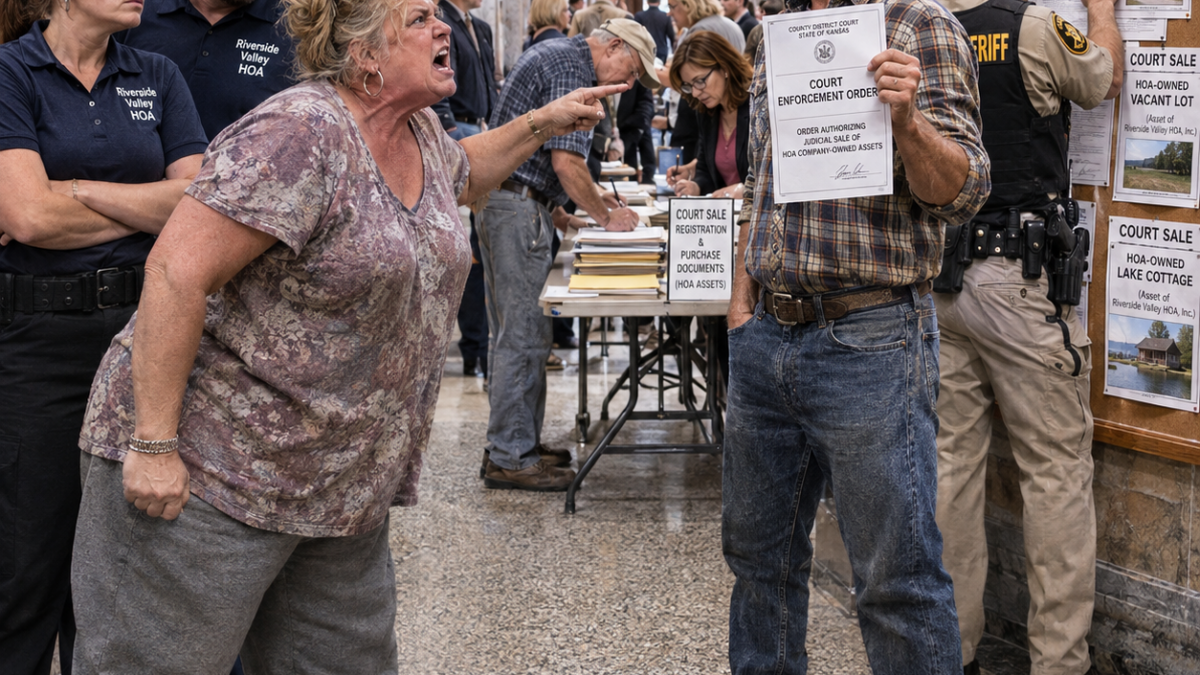
**“YOU CAN’T AUCTION OFF AN ENTIRE NEIGHBORHOOD JUST BECAUSE YOU’RE ANGRY ABOUT A LAND DEAL!” Brenda Wallace screamed across the county courthouse hallway as the sixth HOA-owned house sold before noon and a deputy posted fourteen more properties for court-supervised sale.**
I held up Judge Bennett’s enforcement order and told her, calmly, that not one privately owned homeowner’s house was being touched—the only properties being sold were the rentals, model homes, vacant lots, lake cottage, and other assets her own HOA holding company had pledged after using millions of dollars from the illegal sale of my farm to keep itself afloat.
A year earlier, Brenda had signed a deed claiming Redstone Valley HOA owned all 4,800 acres my family had spent generations building into a working Kansas farm, sold it to a developer for $26.8 million without my knowledge, and by the time I learned what she had done, survey crews with excavators were already cutting through my south gate with a recorded deed showing that I no longer owned my own land.
The first house sold at 9:04 on a Tuesday morning.
The second sold eleven minutes later.
By noon, six Redstone Valley properties had new owners.
Brenda Wallace stood in the courthouse hallway looking like she might explode.
“You planned this.”
“No.”
“You wanted revenge.”
“No.”
“You’re selling people’s homes.”
“I’m selling property the court says your company actually owns.”
Behind her, a deputy attached another sale notice to the public board.
Fourteen houses.
Two vacant lots.
A lake cottage Redstone Valley had been renting to tourists.
All properties owned directly by Redstone Community Holdings LLC, the company the HOA had created years earlier to manage its growing real-estate portfolio.
Brenda pointed toward the hallway where another buyer was signing paperwork.
“Families live in those houses.”
“Yes.”
“And you’re putting them out.”
“No.”
Her attorney touched her arm.
“Brenda.”
She pulled away.
I continued.
“Every valid lease stays in force. Nobody’s private home is part of this. Nobody is being removed because of me.”
“You could stop it.”
“So could Prairie Crest.”
She stared.
“So could the banks. So could the contractors your company owes. So could every other creditor.”
Nothing.
“This stopped being one lawsuit a long time ago.”
Her attorney looked at the floor.
That was the part Brenda never seemed willing to admit.
My judgment was large.
But it was not the only reason Redstone Community Holdings was being dismantled.
The company had borrowed against its own homes.
Pledged the same properties against multiple obligations.
Used rental income to support development projects.
Used HOA money to support the property company.
Then used money from the attempted sale of my farm to pay down debts that were already beginning to fail.
By the time the court receiver arrived, the entire thing had become a financial structure built on promises stacked on top of other promises.
And the largest promise of all had been land Redstone Valley never owned.
My land.
My name is Daniel Lawson.
The Lawson farm sits about forty miles outside Wichita in eastern Kansas.
My great-grandfather bought the first parcel in 1927.
Granddad expanded it.
PART2.
Dad bought neighboring farms when families retired or children moved away.
Over nearly a century, the pieces became one large agricultural operation.
Approximately 4,800 acres.
Not one clean rectangle.
More like a puzzle.
Wheat.
Hay.
Cattle pasture.
Four barns.
Three grain bins.
Two creeks.
Miles of fencing.
Lake frontage along Redstone Lake.
And more broken gates than any rational human being should willingly own.
My father, Robert Lawson, still worked even after claiming he had retired.
Our ranch manager, William Foster, had been with us for nineteen years.
He knew every fence line, low spot, water trough, stubborn cow, and tractor that required a kick before starting.
It was not glamorous land.
That mattered to me.
When people later saw maps showing $26.8 million offers, golf courses, marinas, residential streets, and lakefront development, they began imagining the farm as money waiting to happen.
I saw cattle standing beside a creek.
Wheat moving in July wind.
My grandfather’s handwriting on an old barn beam.
The south pasture where Dad taught me to drive a tractor before I was legally old enough to drive anything.
Land has value.
Money is part of that.
But value and price are not the same thing.
Redstone Valley Estates appeared east of us years after the farm was already there.
A developer bought roughly nine hundred acres.
Built a private neighborhood.
Large houses.
Golf course.
Clubhouse.
Artificial ponds.
Stone entrance.
Eventually about three hundred homes.
For the first few years, we had no problem.
Their roads stayed on their land.
Utilities stayed on their land.
Residents stopped at our roadside stand for beef, eggs, sweet corn.
Frank Miller became one of my best customers.
Susan Parker brought her grandchildren every spring to see newborn calves.
Robert Jenkins once spent half a rainy afternoon helping William drag a tractor out of mud.
Those people were not my enemies.
Redstone Valley was not my enemy.
Then Brenda Wallace became HOA president.
She had already served on the board.
Organized.
Energetic.
Confident.
Very good at convincing people every concern required immediate action.
At first, her concerns were ordinary HOA concerns.
Trash cans.
Fence colors.
Golf cart rules.
Street parking.
None of my business.
Then a letter arrived at my farm office.
VISUAL NUISANCE.
One of my cattle trailers could be seen from a Redstone Valley walking path.
I called management.
“My farm isn’t in your HOA.”
The manager sounded embarrassed.
“I believe that notice was generated automatically.”
It disappeared.
Then another.
My western barn roof did not meet Redstone Valley architectural standards.
Same conversation.
Canceled.
Then Brenda came herself.
White SUV.
Glossy folder.
Found me repairing a water trough.
“Daniel Lawson?”
“Yes.”
“I’m Brenda Wallace, Redstone Valley HOA president.”
“I guessed.”
She looked toward the pasture.
“We need to discuss the western corridor.”
“What western corridor?”
She unfolded a map.
A red line ran from Redstone Valley’s main road across my farm toward Redstone Lake.
“Second emergency exit.”
That part was reasonable.
Redstone Valley had grown.
One primary entrance served hundreds of homes.
Wildfire.
Tornado damage.
Major crash.
One blocked road could create a real problem.
“I’ll consider an emergency-only easement if the county fire department believes you need it.”
That surprised her.
“You would?”
“Yes.”
I was not against helping neighbors.
Then she explained what “emergency” really meant.
Eventually full two-lane road.
Utilities.
Walking trail.
Public lake access.
Possibly marina infrastructure.
Future recreation.
I handed the map back.
“No.”
Her smile vanished.
“We can compensate you.”
“No.”
“You haven’t heard an amount.”
“I heard what you want.”
“You said you would consider the road.”
“Emergency road.”
“This is a more comprehensive solution.”
“This is development.”
She looked toward the lake.
“Development is coming whether you want it or not.”
“Then it can come on land somebody else owns.”
That was our first real disagreement.
Not yet a war.
Two weeks later:
Offer.
160 acres.
$1.2 million.
Declined.
Then $1.8 million.
Declined.
Then $2.5 million.
Still no.
Rebecca Hayes, my attorney, asked:
“You understand how much money you’re refusing?”
“Yes.”
“Good. Just checking.”
I had nothing against selling land.
Farm families sell land every day.
Sometimes because they need money.
Sometimes because children do not want the operation.
Sometimes because the offer is simply too good.
I was not morally superior because I wanted to keep mine.
I simply wanted the choice.
That distinction became the center of everything.
Redstone Valley continued expanding south.
The HOA started buying homes directly.
Some model houses from the original developer.
Some foreclosed properties from banks.
Some rental units.
Vacant lots.
The theory was rental income could reduce dues and create a long-term reserve.
To manage everything, the HOA created Redstone Community Holdings LLC.
Frank hated it.
“An HOA should mow grass and fix streets.”
“You voted for the houses?”
“No.”
“Then why are you complaining to me?”
“I need someone to complain to.”
Fair.
By the time Brenda became president, the company owned more than twenty homes.
Then Brenda’s husband became relevant.
Richard Wallace.
Owner of Wallace Development Partners.
Richard had built subdivisions around Kansas and Oklahoma.
He bought 1,600 acres south of Redstone Lake.
Potentially valuable development property.
One major weakness.
Access.
A narrow county road reached it from the east.
Fine for existing rural use.
Terrible for hundreds of houses.
A road across my farm would solve Richard’s problem beautifully.
Suddenly Brenda’s “emergency corridor” looked different.
Survey crews appeared along my boundary.
Legal.
They stayed on the line.
I asked the supervisor who hired them.
“Wallace Development Partners.”
Project?
“Redstone South Access Study.”
Not emergency response.
Development.
Then Redstone Valley mailed a glossy newsletter.
One section showed:
LAWSON AGRICULTURAL INTEGRATION AREA.
My farm.
Trails.
Lake access.
Conservation zones.
Potential residential expansion.
I called Frank.
“What is agricultural integration?”
“No idea.”
“You sit on the board.”
“I voted against that map.”
At the next HOA meeting, I stood during public comment.
“My name is Daniel Lawson.”
People turned.
“I own the farm shown on your western expansion map.”
The room became quiet.
“I am not selling it. I have not agreed to annexation. I have not agreed to residential development. I have not granted Redstone Valley a road.”
Brenda leaned toward her microphone.
“Those plans are conceptual.”
“Then label them conceptual.”
“They are.”
“Your newsletter calls my lake pasture a future community shoreline.”
Pause.
“We believe cooperation will eventually benefit everyone.”
“That’s different from consent.”
Several homeowners nodded.
That was the first time I realized Brenda had allowed residents to believe negotiations were much farther along than they were.
Outside, Frank said:
“She’s furious.”
“I corrected a map.”
“To Brenda, same thing.”
I sent the board a written proposal.
I would discuss one thing.
True emergency access.
County fire department involved.
Locked except emergencies and drills.
No marina.
No full-time road.
No development traffic.
No utilities for Richard’s subdivision.
No annexation.
No residential use.
Brenda never responded.
Instead, paperwork started changing around me.
One tax parcel was suddenly described as planned residential transition.
County corrected it.
An agricultural lender received a title-monitoring alert involving possible future transfer interests.
Crop insurance asked whether I was reducing farm acreage for development.
I was not.
Somebody was constructing a paper trail.
Not ownership.
Appearance.
Enough documents saying the farm might change that anyone looking casually could begin believing change was already underway.
Rebecca sent cease-and-desist letters.
Redstone Valley.
Wallace Development.
Stop representing Lawson property as available.
Stop advertising rights that did not exist.
Their lawyers replied.
Conceptual only.
Study area only.
Future planning only.
For two months, everything quieted.
Then Dad found an old document in our records.
1994 agricultural conservation agreement.
The farm had participated in a county program protecting open land near Redstone Lake from uncontrolled development.
A nonprofit land trust held limited review rights over certain subdivisions.
The trust later dissolved.
Its remaining interests transferred to the county.
Nothing gave Redstone Valley ownership.
Rebecca noticed one thing.
The agreement used an old legal description covering nearly the entire farm.
Approximately 4,800 acres.
At the time, that number meant nothing unusual.
Then Brenda began using the phrase conservation stewardship.
Her newsletter claimed Redstone Valley had inherited responsibility for protecting western agricultural lands.
Frank searched the archives.
Folder:
WESTERN CONSERVATION RIGHTS.
Inside:
1994 agreement.
Old maps.
County letters.
And an assignment document.
It claimed the dissolved land trust had transferred its rights to Redstone Valley HOA.
Rebecca checked county history.
“No.”
“What?”
“The land trust rights went to the county.”
“So this is fake?”
“I said suspicious.”
Important distinction.
The document was not recorded.
Then Richard’s company filed a concept plan.
Huge lake community.
Golf course.
Marina.
Hundreds of houses.
School site.
Commercial center.
Boundary:
My entire farm.
Nearly 4,800 acres.
I stared at the map.
“This is insane.”
Rebecca remained calm.
“Concept maps don’t transfer ownership.”
“I know.”
“Then we respond.”
We filed formal objections.
County planning comments.
Title notices.
The hearing was postponed.
Then Jennifer Collins called.
County clerk.
I had known her since high school.
Her voice sounded wrong.
“Daniel, are you selling?”
“No.”
“All of it?”
I stood up.
“What?”
“Someone submitted a deed.”
My stomach tightened.
“From who?”
“Redstone Valley Homeowners Association.”
I thought I had misunderstood.
“Selling what?”
“Your farm.”
“All of it?”
“All listed parcels.”
“How many acres?”
She checked.
“Approximately 4,801.6.”
Every field.
Every pasture.
Every barn.
Farmhouse.
Lake frontage.
Everything.
Buyer:
Prairie Crest Development Group LLC.
Price:
$26.8 million.
I had never heard of them.
“Did you record it?”
“No. The chain looks wrong. I called you first.”
There are people who save you simply by asking one extra question.
Rebecca and I reached the courthouse fast.
The deed looked professional.
Special warranty deed.
Grantor:
Redstone Valley HOA.
Grantee:
Prairie Crest Development Group.
Legal description:
Lawson farm.
Brenda’s signature.
Notary.
Corporate seal.
Attached:
The suspicious conservation assignment.
But this version had changed.
The copy Frank found described limited conservation review.
The version attached to the deed added:
Development control.
Transferable land interests.
Disposition authority.
The right to sell.
Rebecca turned pages slowly.
“They altered it.”
“Can they record this?”
“Anyone can submit paperwork.”
“That’s comforting.”
“It doesn’t make it valid.”
Then the courthouse doors opened.
Brenda.
Richard.
Two attorneys.
Brenda looked surprised to see me.
Then smiled.
“Daniel.”
I held up the deed.
“What is this?”
Her attorney stepped forward.
“Questions through counsel.”
I looked at Brenda anyway.
“You sold my farm?”
“We transferred development rights lawfully.”
“That deed says land.”
“The conservation assignment gives Redstone Valley control.”
Rebecca stepped beside me.
“No, it doesn’t.”
Richard smiled slightly.
“That will be decided.”
Jennifer appeared from behind the counter.
“I’m not recording this until title is resolved.”
Richard’s attorney protested.
Brenda raised her voice.
Then Jennifer’s assistant ran from the records room.
“Jennifer.”
“What?”
“There’s another filing.”
Another deed.
Electronically submitted earlier through a title company.
Different parcel index.
Same property.
Same buyer.
Jennifer searched.
Then whispered:
“No.”
“What?”
She turned the screen.
Recorded forty-seven minutes earlier.
County records now showed Prairie Crest Development Group as owner of approximately 4,800 acres that my family still physically occupied and legally owned.
A fraudulent deed does not become true because a computer accepts it.
But a fraudulent deed inside a public land system creates real danger.
My phone rang.
William.
“Daniel, trucks at the south gate.”
“What trucks?”
“Survey crew. Excavator. Security.”
“Do not let them in.”
“They already cut the chain.”
My blood went cold.
“Call the sheriff.”
“Already did.”
Then:
“Guy here has a recorded deed. Says we have to leave.”
Across the hallway, Brenda met my eyes.
That was when I understood how far this had gone.
Not a newsletter.
Not a concept map.
Not an HOA fine.
Redstone Valley had sold my entire farm.
And the buyer was already taking possession.
Rebecca stopped me from driving home immediately.
“If they have a recorded deed, let deputies control the property until we get a court order.”
“They cut my gate.”
“I know.”
“They’re on my wheat field.”
“I know.”
“That’s my farm.”
“I know.”
I hated every word.
She was right.
A physical confrontation would create another problem.
Jennifer printed both deeds.
The unrecorded paper version.
The electronic one.
The electronic filing had a title-company certification.
SunCrest Closing Services.
Rebecca noticed Richard’s attorney react to the name.
Jennifer searched.
SunCrest had closed at least eleven transactions involving Redstone Community Holdings.
Interesting.
Not proof.
Jennifer put fraud alerts on every Lawson parcel.
Rebecca filed an emergency petition.
No entry.
No sale.
No borrowing.
No clearing.
No transfer.
No construction.
At the farm, sheriff deputies met Prairie Crest’s site manager.
Thomas Reed.
He showed them the recorded deed.
Survey contract.
Work orders.
Thomas seemed genuinely confused that I disputed the sale.
He claimed Prairie Crest believed Redstone Valley controlled the land.
Deputies ordered everyone to stop.
My workers continued ordinary farming.
Prairie Crest crews could not advance.
Their machinery stayed where it was until the court ruled.
That afternoon, Judge Harold Bennett held an emergency hearing.
He read:
The deed.
The conservation agreement.
The assignment.
My title history.
Then asked Redstone Valley’s lawyer one question.
“Show me where your client acquired fee title to these 4,800 acres.”
The lawyer began explaining conservation rights.
Judge Bennett stopped him.
“I asked where they acquired title.”
Silence.
Richard’s attorney tried another approach.
Development control.
Transferred stewardship rights.
Judge Bennett said:
“Development control is not fee ownership.”
That sentence changed the room.
Prairie Crest explained they had relied on:
Redstone Valley representations.
Board resolutions.
The assignment.
SunCrest’s title work.
The judge did not decide everything that afternoon.
But he froze everything.
Prairie Crest could not enter.
Develop.
Sell.
Borrow against.
Clear.
Or grant rights from the farm.
Redstone Valley could not file additional documents.
County had to mark the deed disputed.
Outside court, Thomas Reed approached.
“We paid a deposit.”
“How much?”
“Four million.”
“For land without meeting the owner?”
“We were told Redstone Valley controlled it.”
“You never thought to meet me?”
“Yes.”
That surprised me.
He looked angry.
At Brenda.
Prairie Crest had not paid the full $26.8 million.
Four million initial.
More after title confirmation.
Remaining balance after development approval.
Good.
Then Thomas revealed the first payment did not go directly to the HOA.
It went to Redstone Community Holdings.
The property company.
The company with the houses.
Rebecca asked for the wire records.
Prairie Crest voluntarily provided them.
Within days, the money had moved.
$900,000 to Wallace Development Partners.
$600,000 into a SunCrest escrow account.
$425,000 to Western Corridor Consulting.
$780,000 to pay loans connected to HOA-owned houses.
$500,000 into Redstone Valley reserves.
The rest distributed among smaller accounts.
The money was moving before title was even secure.
That suggested urgency.
Not just greed.
Cash need.
Frank called.
Residents were panicking.
The HOA portal was down.
Tenants in HOA-owned rentals had started seeing lender notices.
Redstone Community Holdings had borrowed more than most board members knew.
The $780,000 payoff from Prairie Crest’s deposit had apparently rescued loans already approaching default.
Now the attempted farm sale looked like a bailout.
Frank asked:
“You’re suing the HOA?”
“Yes.”
Long silence.
“Not homeowners personally.”
He exhaled.
That mattered.
I attended the emergency HOA meeting.
Clubhouse packed.
Brenda at the front.
Richard beside her.
Residents demanded answers.
Did Redstone Valley sell my farm?
Was the holding company insolvent?
Where did the four million go?
Why were rental properties carrying so much debt?
Brenda said the company was financially stable.
Frank asked:
“Then show us the books.”
She said an audit would take time.
Frank leaned toward his microphone.
“I’m treasurer. I’ve been asking for supporting records for six months.”
That was new.
Susan Parker stood.
Calm.
“Did you sell Daniel’s farm?”
Brenda answered carefully.
“We transferred rights we believed Redstone Valley controlled.”
Susan shook her head.
“That’s not what I asked.”
Silence.
“Did you sign a deed saying the HOA owned his farm?”
“Yes.”
“Did Daniel agree?”
“No.”
The room erupted.
Then Brenda blamed me.
I rejected reasonable offers.
Blocked community expansion.
Prevented emergency access.
Threatened Redstone Valley’s future.
Susan looked at her.
“So because he said no, you sold his land?”
That question ended the room.
Not my speech.
Not Rebecca.
Susan.
Brenda tried explaining conservation authority.
Nobody cared.
An hour later, Frank came outside.
Brenda suspended.
Five to two.
Richard-related contracts frozen.
Independent audit ordered.
Good start.
The following week, I repaired a fence with William.
No lawyers.
No courthouse.
Just hinges.
Mud.
Cattle watching.
Ordinary work kept me sane.
Then expedited discovery began.
The original conservation assignment existed.
Real paper.
Real land-trust letterhead.
Real signature page.
But it said the remaining conservation rights transferred to the county.
A second version had been created later.
County replaced with Redstone Valley HOA.
Added development control.
Added disposition authority.
Signature page copied from the real document.
Someone constructed false authority around a real signature.
SunCrest’s internal emails were worse.
One employee had written:
SELLER DOES NOT APPEAR IN FEE TITLE CHAIN. NEED OWNERSHIP CONFIRMATION.
Response:
WALLACE COUNSEL SAYS CONSERVATION ASSIGNMENT CONTROLS. PROCEED UNDER SPECIAL INDEMNITY.
Who indemnified SunCrest?
Redstone Community Holdings.
Wallace Development Partners.
They promised to cover losses if the title theory failed.
People do not usually sign special indemnity agreements because they are completely confident.
Then we found the schedule.
Prairie Crest’s $4 million deposit had been secured against Redstone Community Holdings assets.
Twenty-six houses.
Three vacant lots.
Maintenance building.
Lake cottage.
If the transaction failed and Redstone could not return the money, Prairie Crest could pursue those properties.
Frank stared.
“So they pledged our houses to support the farm deal?”
“HOA-owned houses.”
“Right.”
Important every time.
Not homeowners’ houses.
Investment properties.
Assets.
The same assets that later became the courthouse sale list.
At that moment, I did not want them.
I did not want anyone’s house.
I wanted:
Farm title restored.
My legal expenses.
Gate damage.
Crop disruption.
Title damages.
Compensation for what they had done.
Then Prairie Crest sued.
Not me.
Redstone Valley HOA.
Redstone Community Holdings.
Wallace Development.
SunCrest.
Return the four million.
Expenses.
Failed-project damages.
Now Brenda faced the buyer on one side.
Me on the other.
County prosecutors opened a fraud investigation because the altered assignment appeared fabricated.
Brenda hired criminal counsel.
Richard did too.
Their lawyers stopped sharing everything.
That was interesting.
Then the HOA audit arrived.
Redstone Community Holdings was much weaker than anyone believed.
The houses were valuable.
But heavily leveraged.
Rental income serviced debt.
HOA money supported the company.
The company supported HOA projects.
Money moved back and forth.
Repeated phrase:
WESTERN EXPANSION BRIDGE FINANCING.
The farm sale was supposed to solve everything.
Prairie Crest money would:
Pay property debt.
Rebuild HOA reserves.
Fund new roads.
Finance Richard’s access project.
Stabilize the holding company.
All they needed was my land.
Which they did not own.
Then Rebecca found Richard’s email.
Three months before the sale.
IF LAWSON KEEPS REFUSING, WE USE THE STEWARDSHIP PATH. ONCE PRAIRIE CREST FUNDS, EVERYTHING STABILIZES.
Brenda:
CAN WE SURVIVE CHALLENGE?
Richard:
BY THE TIME HE CHALLENGES, MONEY WILL BE DEPLOYED AND BUYER WILL DEFEND TITLE.
I read it three times.
They were counting on complexity.
Move money fast.
Create lenders.
Create buyer rights.
Create contracts.
Create development expectations.
Then make reversal so painful I might settle.
Maybe sell part of the farm.
Maybe accept cash.
Maybe stop fighting because fighting became too expensive.
They did not expect the land itself to stay quiet.
That was the strange part.
While lawyers argued over millions, wheat kept growing.
Then three nights before the full title hearing, William called at 1:17 a.m.
“Lights in the south grain field.”
“What kind?”
“Trucks. Drilling rig.”
“Call the sheriff.”
“Already did.”
I drove out.
The contractor had a real county permit.
Applicant:
Wallace Development Partners.
Project:
Western water test well.
Landowner authorization attached.
Signed:
Daniel Lawson.
Not my signature.
It looked perfect because it was copied from one of my real USDA conservation forms.
Same break in the L.
Same crooked final stroke.
Then we saw the map.
REDSTONE WESTERN WATER FIELD.
Twelve proposed wells.
Across my farm.
Not one.
Twelve.
“What are these for?”
The contractor supervisor answered.
“Subdivision supply.”
Richard’s development needed water.
My farm sat over one of the strongest groundwater areas in that part of the county.
Then William pointed toward the storage tank.
REDSTONE COMMUNITY WATER COMPANY.
State records showed:
Created eight months earlier.
Owned by Redstone Community Holdings.
Manager:
Richard Wallace.
The planned business would supply:
Prairie Crest future development.
Redstone Valley.
Possibly other projects.
Rebecca looked at me.
“They weren’t just selling your farm.”
“What?”
“They were building a utility company on it.”
The sheriff ordered the drill stopped.
Then one worker looked at the gauge.
“Something’s wrong.”
A vibration came from the borehole.
Seconds later:
Black water erupted nearly twenty feet into the air.
Oily.
Smelled like fuel and sulfur.
Everyone moved back.
Fire department.
State environmental crews.
Hazmat.
They tested the fluid.
Not fresh crude.
Petroleum residue.
Salty water.
Iron.
Old industrial compounds.
Historic records showed oil activity in that southern section during the 1950s.
Some parcels had not belonged to my family yet.
An old company named Prairie Fuel and Exploration had operated shallow wells and a disposal site.
Most equipment was supposedly plugged or abandoned by the early 1970s.
The unauthorized drilling had punched into an old contaminated structure nobody knew remained.
Environmental crews eventually found two buried steel tanks.
One collapsed.
One still holding brine, water, and petroleum residue.
The drill hit the edge of the collapsed tank and opened a pressure path.
Good news:
Localized.
Main cattle wells clean.
Farmhouse water clean.
Creek clean.
Most wheat safe.
The farm was not destroyed.
Cleanup required.
Someone needed to pay.
Richard argued the contractor had a valid permit.
Rebecca responded:
“The permit was supported by a forged landowner signature.”
Real permit.
Fake consent.
That became difficult for him.
County canceled all twelve well permits.
Frank called.
“You killed their water company.”
“No. The county canceled permits built on a forged signature.”
“Same result.”
“Different reason.”
That difference mattered to me.
Then came the five-day title hearing.
Courtroom full.
Our side.
HOA.
Holding company.
Wallace Development.
Prairie Crest.
SunCrest.
Insurers.
County.
Conservation-trust successor.
Rebecca started simple.
Who owned the Lawson farm?
Deeds.
Taxes.
Surveys.
Inheritance documents.
Purchases.
Parcel by parcel.
No transfer to Redstone Valley.
Then the 1994 conservation agreement.
Trust attorney:
It restricted certain subdivision activity.
Allowed review.
Did not transfer title.
Did not give sale authority.
Then the fake assignment.
Document examiner showed:
Copied signature page.
Wrong font.
Digital artifacts.
Modern toner.
Incorrect margins.
Copied county seal.
Judge Bennett asked Redstone Valley’s attorney:
“Does the HOA still claim fee ownership of the Lawson farm?”
The attorney stood.
Slowly.
“No, Your Honor.”
That was the collapse.
No screaming.
No confession.
One sentence.
Prairie Crest immediately asked to cancel the recorded deed.
We agreed.
Judge Bennett declared it void.
County clerk restored Lawson ownership.
Approximately 4,800 acres.
I stared at the corrected record longer than necessary.
Rebecca said:
“You can breathe now.”
“I’ve been breathing.”
“Not correctly.”
Probably.
That evening I drove to the highest pasture.
Watched sunset.
The farm looked the same.
That helped.
Paper matters.
But land has a way of reminding you how temporary human drama is.
Then came damages.
My legal bills.
Crop loss.
Gate damage.
Environmental response.
Title damage.
Forged permits.
Operational interference.
Prairie Crest wanted its deposit back.
SunCrest wanted indemnity protection.
Banks wanted loans paid.
Contractors wanted invoices paid.
And the audit of Redstone Community Holdings became worse.
Twenty-six houses.
Twenty-four with debt.
Some underwater.
Some with meaningful equity.
Several with substantial equity.
The same houses had appeared on multiple collateral schedules.
One mortgage.
Then Prairie Crest indemnity.
Then private Western Expansion credit.
Frank looked sick.
“We own millions in houses and have no money?”
The receiver later answered that perfectly.
“You own heavily leveraged real estate.”
Different thing.
Prairie Crest’s deposit had temporarily saved three loans approaching default.
When the deed collapsed, Prairie Crest demanded its money.
Redstone Community Holdings could not return it.
Prairie Crest asked the court for attachment of the pledged properties.
I still did not want them.
Prairie Crest did not want them either.
They wanted cash.
Then criminal investigators started tracing the forged documents.
My copied signature came from a real USDA filing.
An employee in Richard’s office admitted being told to place the signature on the water consent.
Who ordered it remained disputed.
The fake conservation assignment pointed toward a computer used by Redstone Valley’s former property manager.
The manager said Brenda supplied the altered language.
Brenda blamed Richard’s legal team.
Richard’s lawyer denied it.
People who once spoke with one voice suddenly had different memories.
Then came the attempted escape.
A new company appeared.
Redstone Residential Trust LLC.
Plan:
Transfer all twenty-six HOA-owned houses into the trust.
Price:
Ten dollars each.
Internal restructuring.
The court monitor caught it before recording.
Judge Bennett called an emergency hearing.
“Who authorized the transfers?”
The lawyer requested a recess.
“No.”
Silence.
“Who?”
Richard Wallace had signed the resolution.
The judge placed Redstone Community Holdings into receivership.
Laura Mitchell became receiver.
Brenda out.
Richard out.
No private transfers.
No hidden mortgages.
No ten-dollar houses.
Laura’s first report was brutal.
Twenty-six houses.
Twenty-four carrying debt.
Eight seriously underwater.
Twelve with meaningful equity.
Six with substantial equity.
Three vacant lots mostly debt free.
Lake cottage valuable.
Maintenance building.
Total claims exceeded cash.
Her report said:
ORDERLY LIQUIDATION OF NON-ESSENTIAL REAL ESTATE HOLDINGS MAY BE NECESSARY.
Liquidation.
Judge Bennett later ruled that the false deed slandered my title.
Unauthorized entry damaged the farm.
Forged well authorization caused measurable loss.
The environmental event produced costs.
Enough evidence existed for intentional-misconduct claims against several defendants.
Redstone Valley HOA and Redstone Community Holdings shared liability.
I did not celebrate.
Every legal victory seemed to uncover another financial hole.
Then Laura Mitchell contacted Rebecca.
Receiver wanted settlement.
Not enough cash.
So:
Sell assets.
Twenty-six houses.
Three lots.
Lake cottage.
Potentially other non-essential property.
Pay secured lenders first where required.
Return Prairie Crest’s money.
Pay creditors.
Resolve my judgment.
Anything left returned to legitimate HOA use.
I stared at the property list.
“How many houses?”
Rebecca hesitated.
“Possibly all of them.”
“Every house they own?”
“Yes.”
That was the moment the title of this story became possible.
The company had used those homes to support a deal involving my farm.
Now those assets might be sold because the deal collapsed.
Then someone leaked Laura’s report.
Local news headline:
REDSTONE VALLEY HOA MAY LOSE ENTIRE RENTAL HOME PORTFOLIO.
Brenda appeared outside the clubhouse.
“Daniel Lawson is trying to take people’s homes!”
False.
Fear did what fear always does.
Moved faster than correction.
My farm office received thirty-seven calls the next morning.
One elderly woman, Linda Harper, was crying.
She owned her home outright.
She thought her house was next.
“Mrs. Harper, is Redstone Community Holdings on your deed?”
“No.”
“Then your home is not part of this.”
“Are you sure?”
“Yes.”
“But Brenda said—”
“I know.”
I did not insult her.
People afraid for their homes do not become calmer because someone tells them they are stupid.
I explained.
She apologized later for calling me a thief online.
“Just correct it when you can.”
She did.
The clubhouse meeting was packed.
Tenants in the twenty-six properties came too.
They had the most legitimate fear.
Receiver Laura Mitchell spoke first.
She explained:
These twenty-six houses were investment assets owned by Redstone Community Holdings.
Not privately owned resident homes.
The company owed more than it could pay.
A sale might be required.
Then the critical part:
Valid leases would be honored.
A sold house could continue with a tenant.
New owner becomes landlord.
No instant eviction because ownership changed.
Amy Wilson raised her hand.
She had two children.
“What happens when my lease ends?”
Laura answered honestly.
“Normal landlord-tenant law applies. I can protect the current lease. I cannot promise what happens forever.”
Amy looked worried.
That answer was not comforting.
It was truthful.
I respected it.
Frank put a map on screen.
Twenty-six red properties.
Three lots.
Lake cottage.
Maintenance building.
Everything else white.
Three hundred privately owned homes untouched.
Susan asked:
“Can we post this map online?”
“Yes.”
That simple map did more good than weeks of rumors.
Then Brenda entered.
Walked to the front.
“Those houses belong to this community.”
Frank:
“They belong to Redstone Community Holdings.”
“Yes.”
“So Daniel is taking community property.”
I finally spoke.
“No.”
She turned.
“The receiver is selling assets because your company pledged them while trying to sell my farm.”
“You could drop your claim.”
“So could Prairie Crest.”
Silence.
“And the banks?”
Silence.
“Contractors?”
Nothing.
“Environmental response costs?”
Nothing.
“This isn’t one lawsuit anymore.”
Then Amy asked:
“Did you use the house I rent as collateral?”
Brenda did not know her address.
Laura checked.
“Yes.”
Amy’s expression changed.
“Did tenants know?”
“No.”
That shifted the room.
People stopped looking only at me.
They started looking backward.
At the decisions.
The remaining legal process was slow.
That was good.
Every house appraised independently.
No insider sales.
No hidden buyer.
No ten-dollar transfers.
Licensed brokers.
Court approval.
Auctions where appropriate.
Valid leases protected.
The first six houses were listed.
All had tenants.
Two tenants wanted to buy.
I asked Rebecca:
“Can tenants get first chance?”
“Maybe, if the receiver can still meet fair-value obligations.”
Laura liked the idea.
Judge Bennett approved a structured tenant-purchase period.
Not a giveaway.
Not a discount that cheated creditors.
Fair appraised value.
Time to arrange financing.
Amy Wilson qualified.
Four years renting.
Stable job.
Good payment history.
A month later, Amy bought the house she had been terrified of losing.
She called me.
“I guess you sold my house.”
“To you.”
“Still counts.”
Maybe.
Five tenants eventually purchased their homes.
Others did not.
Some preferred renting.
Some planned to move.
Some could not qualify.
No shame in that.
Remaining properties sold to families or investors subject to leases.
Then my final judgment hearing.
Judge Bennett allocated responsibility among:
Redstone Valley HOA.
Redstone Community Holdings.
Wallace Development.
Related parties.
Insurance covered some claims.
Assets covered some.
Other claims would take years.
Winning a judgment does not create money.
But Redstone Community Holdings had one clear source.
Its property portfolio.
Court authorized liquidation of every non-essential residential holding.
All twenty-six houses.
That was when the story returned to the courthouse hallway.
Tuesday morning.
9:04.
First closing.
9:15.
Second.
Then another.
Then another.
By noon:
Six.
Brenda arrived screaming.
“You’re stealing a neighborhood!”
“No.”
“You’re selling houses!”
“Yes. Houses your company owns.”
“You planned this.”
“No.”
“You wanted revenge.”
“If I wanted revenge, I’d be trying to hurt residents.”
“You are.”
“No tenant has been unlawfully removed. No homeowner has lost a private house.”
“You could forgive the judgment.”
That question stayed with me longer than I expected.
Because forgiveness matters.
Kindness matters.
I did not want to become someone who needed Brenda destroyed in order to feel whole.
But forgiveness does not mean absorbing every loss so the person who caused it avoids consequences.
My family spent months defending land we already owned.
Legal fees.
Crop disruption.
Title damage.
Environmental emergency.
Gate damage.
Forged permit.
Strangers entering our farm with machinery.
My name copied.
My property sold.
Millions moved.
None of that disappeared because Brenda disliked the result.
So I told her:
“I can forgive you personally without pretending nothing happened.”
For once, Brenda said nothing.
That was our last private conversation.
The sales continued.
Seven.
Eight.
Nine.
The lake cottage sold for more than expected.
A retired couple from Colorado bought it.
Vacant lots went to individual families.
The maintenance building stayed.
Laura proved the HOA needed it for basic operations.
That mattered.
The goal was not to destroy Redstone Valley.
Essential community property remained.
By house fifteen, several bank debts were paid.
Prairie Crest recovered most of its deposit.
Contractors received money.
My judgment received a major payment.
Some heavily mortgaged houses produced almost nothing after bank liens.
Still useful.
Debt disappeared.
Balance sheet cleaned.
Then house twenty-six.
Largest one.
Five bedrooms.
Lake view.
Former luxury model home.
Never permanently occupied.
Court-approved auction.
Bidding climbed.
Stopped high enough to cover the final major receivership shortfall.
Auction officer:
“Going once.”
Pause.
“Twice.”
Pause.
“Sold.”
That was it.
Every residential property Redstone Community Holdings owned had been sold.
Twenty-six.
Five directly to tenants.
Several to ordinary families.
Others to investors.
Valid leases remained where required.
Not one privately owned Redstone Valley resident home was touched.
No family woke up to deputies throwing furniture outside because of my case.
And after years of acting like a property developer, the HOA was finally out of the landlord business.
Laura’s final report surprised everyone.
After:
Secured loans.
Prairie Crest recovery.
Creditor payments.
Court expenses.
Tenant protections.
My judgment.
A small amount remained.
Enough for a real emergency reserve.
Frank smiled.
“So the HOA survives.”
“I never wanted it dead.”
“That’s going to disappoint the internet.”
“Probably.”
Criminal cases moved slower.
Richard eventually faced charges related to the forged permit process and financial transactions surrounding the attempted sale.
Some charges changed.
Some remained.
The former property manager cooperated and admitted helping prepare the altered conservation assignment using language supplied by people connected to Western Expansion.
Brenda’s role was complicated.
Not innocent.
Evidence showed she knowingly signed the deed despite repeated warnings that Redstone Valley did not hold fee title.
Emails showed she believed the conservation theory could survive long enough to force me into negotiation.
She eventually entered a plea related to document and financial charges.
Restitution.
Restrictions on future fiduciary roles.
Richard’s case lasted longer.
Eventually I stopped following every hearing.
At some point, justice should become the system’s job.
Not the victim’s hobby.
Prairie Crest abandoned the giant development.
Not because I demanded it.
Economics.
Without my 4,800 acres.
Without the twelve wells.
Without the shortcut.
The project no longer made sense.
They bought land elsewhere.
Thomas Reed later sent me a letter apologizing for entering the farm.
I wrote:
“You left when the sheriff told you. I appreciate that.”
Enough.
The south pasture recovered.
Environmental crews removed the old petroleum tanks.
Most land returned to agriculture.
One small section stayed in grass.
Dad suggested wildflowers.
“That ground’s been through enough.”
So we planted them.
A strange ending for the place where an illegal subdivision well had nearly created another disaster.
Redstone Valley changed too.
Frank became HOA president.
He tried to refuse.
Residents elected him anyway.
Susan joined finance only after making everyone promise she would never be an officer.
The new board required:
Member approval for major property acquisitions.
Conflict disclosures.
Independent legal review.
Public financial statements.
No hidden development financing.
No rental empire.
Redstone Community Holdings stayed alive only long enough to finish the remaining sales.
Then dissolved.
HOA dues increased slightly.
People complained.
Frank told them:
“Transparency is cheaper than another 4,800-acre lawsuit.”
Nobody had a strong response.
Then Redstone Valley came back to me about the road.
The original road.
The reasonable one.
This time:
Frank.
County fire chief.
Surveyor.
Rebecca.
No Richard.
No marina.
No utilities.
No residential traffic.
No development corridor.
Just a narrow emergency-only route along one pasture edge.
Locked except emergencies and approved drills.
Redstone Valley responsible for maintenance.
No expansion without written permission.
I read every page.
Then signed.
Frank looked stunned.
“After everything?”
“Your fire risk didn’t disappear because Brenda lied.”
He smiled.
Rebecca insisted on legal consideration.
One dollar.
Frank handed me a dollar bill at closing.
I framed it.
Beside the court order voiding the $26.8 million deed.
Dad laughed harder than I had heard him laugh in months.
One wall:
A deed where an HOA tried to sell 4,800 acres it did not own.
Other wall:
A one-dollar agreement giving the same neighborhood the safety access it should have asked for honestly at the beginning.
That contrast mattered more to me than the judgment.
About eighteen months after the final house sold, Amy Wilson invited me to a cookout.
Her house was no longer an HOA rental.
It belonged to her.
Blue front door.
Brenda would have hated it.
Frank approved immediately.
Amy handed me a plate.
“You know the weirdest part?”
“What?”
“When this started, I thought you were going to make us homeless.”
“I know.”
“Now I own this place because the sale gave me the chance to buy it.”
“Life does strange things.”
She looked toward her kids.
Sprinkler running.
Backyard.
Her yard.
Her mortgage.
Her choice.
That word again.
Choice.
I never felt guilty about enforcing the judgment.
Those houses had been used as financial tools by people who believed my farm could be used the same way.
The difference was consent.
Redstone Community Holdings actually owned those houses.
The court actually had jurisdiction.
Creditors actually had claims.
Every sale was appraised.
Advertised.
Reviewed.
Recorded.
Visible.
Everything the $26.8 million Lawson deed had not been.
My farm stayed in the family.
Years later, I did sell seventy acres.
To a young farmer who had leased from us.
Fair price.
My decision.
We also put another section into a legitimate conservation easement.
Real land trust.
Real signatures.
Real consent.
My decision too.
Maybe more land gets sold someday.
Maybe not.
That is not the point.
People hear this story and remember the numbers.
4,800 acres.
$26.8 million.
Twenty-six houses.
Four-million-dollar deposit.
Twelve fake-authorized wells.
Millions in debt.
Those numbers make everything sound enormous.
But the thing that broke everything was actually very small.
I said no.
Brenda heard:
Not yet.
That was the mistake.
I said no to selling part of the farm.
Instead of treating that as the end of a negotiation, she treated it as the beginning of a strategy.
Then each shortcut needed another shortcut.
Concept maps.
Fake stewardship authority.
Altered documents.
Recorded deed.
Copied signatures.
Unauthorized drilling.
Hidden collateral.
Money moved before anybody could challenge it.
They built an entire financial structure around property they did not have permission to use.
By the time truth arrived, hundreds of ordinary legal consequences landed at once.
That is why the ending looks like revenge.
It was not.
The last time I saw Brenda was at a gas station outside Wichita.
We noticed each other across two pumps.
She looked away.
Then back.
I nodded.
She nodded.
Nothing else.
No speech.
No argument.
I no longer needed her to understand my side.
That was worth something.
Dad still claims he is retired.
Still works.
William still runs most day-to-day operations.
Cattle still break fences.
Wheat still comes up.
The south field has wildflowers now.
At night, I can see Redstone Valley porch lights from the high pasture.
The neighborhood no longer feels like an enemy.
It never really was.
A few leaders made terrible choices.
Most residents wanted safe roads.
Working streetlights.
Reasonable dues.
That distinction kept me from becoming someone who wanted everyone punished.
And yes, the title people repeat is true.
Redstone Valley HOA illegally sold all 4,800 acres of my farmland.
They signed a deed.
Got it recorded.
Took millions from a buyer.
Sent crews through my gate.
Planned twelve wells beneath my pastures.
Copied my signature onto a permit.
Then the courts unwound it.
My title came back.
Their holding company collapsed under the debts it had created.
And through a lawful, public, court-supervised process tied to my judgment and every other legitimate claim against that company, every residential property they owned was sold.
Every single one.
But I never sold the homes Redstone Valley residents actually owned.
That part matters most.
Revenge would have been hurting innocent people because I was angry.
Justice was making the people and companies responsible answer for what they had actually done.
Brenda once believed paperwork could turn my farm into HOA property.
In the end, paperwork did something much simpler.
It proved exactly what belonged to me.
Exactly what belonged to them.
And exactly what the court had the legal right to sell.








