HOA Sent Its “Patrol” Onto My Ranch—So I Told Them, “I’m Not in Your HOA. Get Off My Land.”
HOA Sent Its “Patrol” Onto My Ranch—So I Told Them, “I’m Not in Your HOA. Get Off My Land.”
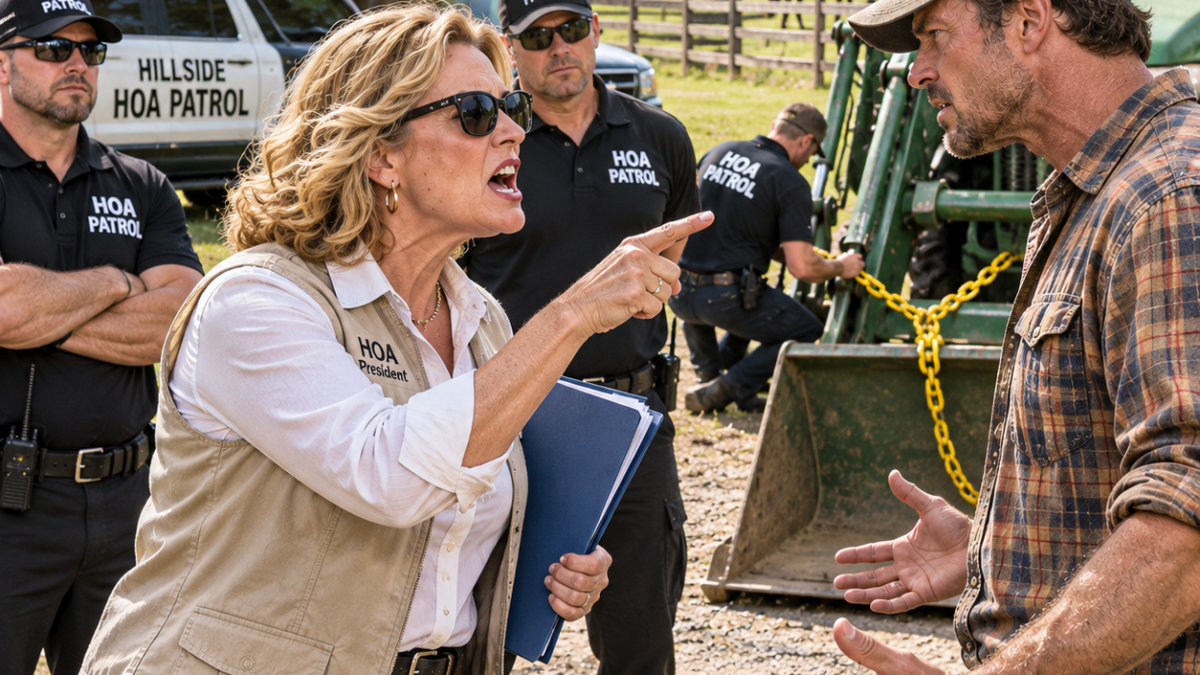
**“SECURE HIS TRACTOR, TAG THE BARN, AND DO NOT LET HIM INTERFERE—MORGAN RANCH IS UNDER HOA CONTROL NOW!” Brenda Whitmore shouted as three men in matching HOA Patrol shirts crossed my locked gate.**
**I had never joined Hillside Meadows, never signed over an acre, and had already warned them repeatedly to stay off my sixty-seven-acre ranch.**
**Then a county land officer arrived carrying the filing Brenda thought would prove I belonged to her HOA—and asked one question that made her stop smiling.**
The first white SUV came across my cattle pasture fast enough to throw dust twenty feet into the air.
Amber light flashing.
HILLSIDE HOA PATROL printed across both doors.
A second SUV followed.
Then a black vehicle carrying the logo of Safe Path Community Services.
By the time I drove my pickup down from the farmhouse, three men were already outside their vehicles.
One stood beside my tractor wrapping a yellow chain around the steering column.
Another walked toward the horse paddock carrying a red violation notice.
The third was photographing the barn.
Then Brenda Whitmore stepped from the second SUV.
Blue folder.
Sunglasses.
The same expression she wore every time she tried to explain my own property to me.
She pointed toward the farmhouse.
“Secure the property until he agrees to comply.”
I stopped twenty feet away.
“What exactly do you think you’re doing?”
Brenda turned.
“Compliance inspection.”
“You cut the chain on my gate.”
“Hillside now has authorized access.”
“No, it doesn’t.”
She held up a document.
“It does now.”
I stared at her.
“I’m not part of your association.”
Then I pointed toward the road behind her.
“So get off my land.”
For a second, nobody moved.
Then Brenda smiled.
Not nervously.
Confidently.
“You are now.”
My name is Caleb Morgan.
Morgan Ranch covers sixty-seven acres in western North Carolina.
My grandfather bought the first forty acres in 1976.
Dad added the rest years later when a neighboring farming family retired.
By the time the ranch came to me, it included pasture, woods, a creek, two barns, a workshop, a small farmhouse, and enough open land for twelve cattle and three horses.
I was thirty-seven when Dad died.
I worked four days a week repairing diesel engines at a shop in town and spent the rest of my time keeping the ranch alive.
I was not rich.
The ranch was not some thousand-acre western spread.
But it was mine.
Every fence post carried history.
Every old tree reminded me of something Dad had said while we worked beneath it.
His most important lesson had nothing to do with livestock.
“Be generous,” he used to tell me. “But don’t confuse generosity with permission forever.”
Dad helped people constantly.
If a neighbor needed a tractor, he lent one.
If a storm blocked a driveway, he helped clear it.
If somebody needed to cross one corner of the ranch during an emergency, he usually said yes.
But he believed help remained a choice.
PART2:
That distinction became important after Hillside Meadows was built beside us.
The development started east of Morgan Ranch about nine years earlier.
Forty homes at first.
Then another section.
Larger houses.
Pool.
Tennis courts.
Clubhouse.
Eventually more than one hundred families.
Most were good people.
Frank Wilson became one of my closest neighbors.
Retired electrician.
His backyard faced my eastern pasture.
He helped me repair fences.
I helped him remove storm-damaged trees.
His wife Nancy baked apple pie good enough to end minor wars.
Their grandson Tyler loved horses and usually appeared with carrots whenever he visited.
I never resented Hillside for existing.
People needed homes.
Their neighborhood sat on their land.
My ranch sat on mine.
Simple.
Then Brenda Whitmore became HOA president.
Our first serious conversation happened while I was repairing a gate hinge.
She pulled up in a white SUV carrying a blue folder.
“Mr. Morgan?”
“That’s me.”
She introduced herself and started talking about neighborhood safety.
Hillside had created something called the Hillside Patrol.
I had seen their SUVs.
White vehicles.
Amber roof lights.
Magnetic signs.
Dashboard cameras.
Mostly volunteers plus a couple of private security workers.
Their stated mission sounded reasonable.
Watch neighborhood streets.
Check common areas.
Report suspicious activity.
Call actual law enforcement when needed.
Then Brenda told me they wanted access across Morgan Ranch.
I laughed.
She didn’t.
She said allowing patrol vehicles to use my gravel lane would help them reach Hillside’s southern streets more quickly.
“No.”
She offered an electronic gate.
“No.”
Road maintenance.
“No.”
Then she asked if I would voluntarily join Hillside Meadows.
I looked behind me at sixty-seven acres.
“My ranch?”
“Yes. You’d receive clubhouse access, pool privileges, trash service, patrol coverage—”
“I already have enough to maintain.”
Her smile disappeared for half a second.
She handed me a membership packet.
I put it in the workshop.
Never signed.
A week later another arrived.
Then another.
The third offered free HOA dues for a year.
Still no.
That should have ended it.
Instead, Hillside Patrol started watching the ranch boundary.
One morning I found a patrol SUV parked near my east fence.
The driver was photographing cattle.
I walked over.
He introduced himself as Kevin Moore.
Kevin looked embarrassed before I even asked.
“Brenda asked us to document possible safety issues around the neighborhood boundary.”
“What safety issue do those cows create?”
He looked toward them.
Then back at me.
“I honestly don’t know.”
At least he was truthful.
I told him he could take photographs from Hillside property if he really wanted, but nobody had permission to cross my fence.
He nodded and left.
Two days later I received an HOA violation notice.
Livestock fence failed appearance standards.
Then another.
Barn roof wrong color.
Another.
Tractor visible from a community road.
Then one complaining about horse odors.
That became my favorite.
I called Hillside management.
Linda Harris checked my address.
“Mr. Morgan, I don’t see your parcel inside Hillside Meadows.”
“That’s because it isn’t.”
She apologized.
Said the notices were probably mistakes.
The next morning Brenda called personally.
Linda, apparently, “did not understand the new boundary enforcement policy.”
I asked what that meant.
Brenda said properties adjacent to Hillside could be required to follow certain safety and appearance standards if they affected community values.
“According to who?”
“Our legal adviser.”
“Send me the rule.”
She did.
It was not a rule.
It was a two-page planning opinion saying neighboring properties can affect traffic, appearance, and safety.
It did not say Hillside could fine me.
It did not say patrol vehicles could enter.
And it definitely did not make Morgan Ranch part of the HOA.
I hired Rebecca Hayes.
Land-use attorney.
Rebecca reviewed my deed.
County filings.
Hillside declaration.
Recorded covenants.
Everything.
Then she looked at me.
“You’re not in this HOA.”
“I know.”
“No declaration covers Morgan Ranch.”
“I know.”
“No membership agreement.”
“Correct.”
“No patrol easement.”
“Exactly.”
Rebecca sent Hillside formal notice.
Stop violations.
Stop claiming jurisdiction.
No patrol entry.
No inspection.
No photography from inside the property.
No access without permission.
Three weeks of peace followed.
Best three weeks of the entire story.
I repaired fence.
Cut hay.
Helped Frank rebuild part of his deck.
Tyler brushed Daisy, my oldest horse.
Nancy brought pie.
Everything felt normal.
I kept reminding myself that most people in Hillside knew nothing about Brenda’s obsession with my property.
Dad always said to judge people individually.
So I did.
Then patrol vehicles started entering again.
Kevin was first.
I found him just inside the front gate.
He looked embarrassed.
“You know you’re trespassing.”
“I know.”
“Then why are you here?”
“Brenda said the board approved patrol access.”
“The board doesn’t own the ranch.”
“I know.”
Kevin reversed out.
The next officer was Scott Bradley.
Scott drove nearly two hundred yards up the gravel lane before I stopped him.
“Turn around.”
“I’m conducting a boundary safety inspection.”
“On whose authority?”
“Hillside Patrol.”
“That’s not authority.”
He asked for my name.
I pointed toward the mailbox.
MORGAN.
“You already know my name.”
Scott took a photograph of me.
Then drove away.
The next day an HOA notice arrived.
HOSTILE INTERFERENCE WITH HOA SAFETY OFFICER.
Rebecca stared at it.
Then laughed.
“I’m keeping this one.”
“Why?”
“Because eventually somebody will have to explain it.”
Hillside’s attorney, Thomas Green, responded carefully.
He did not claim my ranch belonged to the HOA.
Instead, he said Hillside believed it possessed “historical access rights.”
New argument.
Rebecca asked for proof.
They produced an old farming map.
Decades earlier, a dirt track had crossed the area before Hillside existed.
The track was not an HOA road.
Not a county road.
Not a recorded easement.
Dad had fenced it off more than twenty years earlier.
Then Frank came over after an HOA meeting.
“Brenda says you’re blocking an emergency route.”
“What emergency route?”
“She says patrol needs your lane during storms.”
“Did EMS request it?”
“I asked.”
“And?”
“She said emergency departments had expressed concerns.”
“Which department?”
“She changed the subject.”
That same meeting, Brenda announced Hillside was reviewing “annexation options” for Morgan Ranch.
Annexation.
Rebecca nearly laughed when I called.
“An HOA cannot annex your farm because Brenda likes the word.”
Still, she told me to monitor county filings.
A few weeks later, an application appeared.
Hillside requested expansion of its controlled access system.
My gravel lane was marked:
HILLSIDE SOUTH EMERGENCY ACCESS.
I had never approved it.
Rebecca objected.
County paused the filing.
Brenda called me furious.
“You’re putting families at risk.”
“Which emergency department requested my lane?”
Silence.
“Brenda?”
“Safety planning is confidential.”
I hung up.
Two days later Scott followed my truck through my gate.
I stopped immediately.
“You need to leave.”
“We have authority to observe this lane.”
“No.”
He pointed toward his dash camera.
“This interaction is being recorded.”
“Good. Record yourself leaving.”
Eventually he did.
That afternoon:
$500 fine.
OBSTRUCTING PATROL OPERATIONS.
Rebecca sent another legal notice.
Then something strange happened.
Everything stopped.
No letters.
No patrol SUVs.
No calls.
Nearly two weeks.
Frank told me Brenda had begun privately meeting with a company called Safe Path Community Services.
Safe Path supplied neighborhood security.
Patrol staff.
License-plate readers.
Cameras.
Gate systems.
Rebecca searched the company.
Owner:
Daniel Whitmore.
Brenda’s husband.
That did not automatically make anything illegal.
But Hillside’s president was pushing for expanded patrol powers while her husband owned the company being paid to provide them.
Most residents apparently did not know.
Then came Saturday morning.
I woke to engines.
Checked the ranch cameras.
Two white Hillside Patrol SUVs outside the gate.
Safe Path vehicle behind them.
Six people.
Brenda.
And one man holding bolt cutters.
I called Rebecca.
Started recording.
Then watched him cut my chain.
The gate opened.
Three vehicles entered.
I called the sheriff.
By the time I reached the pasture, Scott was chaining my tractor.
Another patrol worker photographed the cattle.
Someone else headed toward the horses.
Brenda stepped toward me holding the folder.
“Caleb, we’re conducting a compliance inspection.”
“You’re trespassing.”
“No. We have authority.”
“Your authority ends at Hillside’s property line.”
She told Scott to keep working.
That was when I shouted:
“I’m not part of your association, so get off my land!”
Brenda smiled.
“You are now.”
She handed me the Morgan Ranch Community Access and Compliance Agreement.
My name at the bottom.
My signature.
It looked real.
According to the document, I had voluntarily placed the eastern twenty acres of Morgan Ranch under Hillside Meadows community standards.
It granted patrol access over my gravel lane.
Allowed inspections.
Allowed installation of access-control equipment.
Signed three months earlier.
Except I had never signed it.
My stomach dropped anyway.
Because whoever created it had my real signature.
Brenda started ordering patrol workers around.
“Tag the tractor.”
“Photograph the barn.”
“Document the livestock area.”
A patrol worker approached the horse paddock.
I told him:
“Do not touch that gate.”
He stopped.
Brenda snapped:
“Continue.”
Kevin stepped between them.
“No.”
Brenda stared.
“What?”
“We were told this was inspection work. Nobody said anything about handling animals.”
“Return to your vehicle.”
Kevin did.
But he had said no when it mattered.
Scott entered my barn.
A few seconds later he called:
“Brenda, you need to see this.”
Inside, Dad’s old filing cabinet stood open because I had been sorting records the night before.
On the workbench:
Original Morgan Ranch survey.
And a folder.
HILLSIDE ACCESS — 2009.
Scott pointed.
“I thought this ranch was already under Hillside.”
“It isn’t.”
Brenda reached for the folder.
I stepped between her and the table.
“Don’t touch anything.”
Then tires crunched outside.
County vehicle.
For half a second, I worried Brenda really had convinced someone official that the property had changed hands.
Senior land officer James Dalton stepped out.
He looked at the cut chain.
Patrol vehicles.
My tractor.
Then me.
“Mr. Morgan?”
“Yes.”
“I need to speak with you about an ownership filing submitted yesterday.”
My stomach tightened.
“What filing?”
Brenda answered.
“The one making the agreement official.”
James looked directly at her.
“I asked Mr. Morgan.”
She stopped talking.
Then the sheriff’s first cruiser appeared.
Deputies arrived.
James opened his folder.
Someone had filed documents claiming I voluntarily placed twenty acres under Hillside Meadows control.
My signature.
Notarized acknowledgment.
Copy of my driver’s license.
All of it looked legitimate.
I had signed none of it.
James explained the county flagged the filing because the legal description did not align with an older deed record.
That mismatch was why he came personally.
Rebecca arrived.
She read Brenda’s agreement.
“You didn’t sign this?”
“No.”
She turned to James.
“Recorded?”
“Not yet. Held for review.”
Brenda’s expression changed.
Slightly.
But I saw it.
Rebecca asked:
“Who submitted it?”
James checked.
“Safe Path Community Services.”
Brenda’s husband’s company.
The deputy photographed everything.
Cut gate.
Patrol vehicles.
Chain on tractor.
Violation tags.
Then he asked Brenda why Hillside patrol entered before the county accepted the filing.
She said the HOA believed it was already valid.
Maybe she did.
Maybe not.
Then another deputy looked inside the Safe Path SUV.
Fence markers.
Cameras.
Metal posts.
Portable license-plate reader.
Electronic gate parts.
Boxes labeled:
SOUTH ROUTE CONTROL.
Then he unfolded a map.
Morgan Ranch in the center.
Red line along my gravel road.
Across the eastern pasture.
Connecting to a proposed road south of Hillside.
James looked at it.
“Hillside South.”
“What’s Hillside South?”
He pointed.
“Future development.”
Ninety-six homes.
At the bottom:
INSTALL ACCESS CONTROL TODAY.
OWNER RESISTANCE EXPECTED.
That sentence changed the morning.
The patrol had not arrived to inspect.
They had brought enough equipment to take physical control of my lane.
Then came the crash.
Everyone turned.
An excavator pushed through the eastern fence.
Two dump trucks behind it.
Grader.
Already inside Morgan Ranch.
Deputy Foster—another sheriff’s officer who had just arrived—walked directly in front of the excavator and raised both hands.
The operator stopped.
Silence.
Then Foster turned toward Brenda.
“Did you send these people onto the ranch?”
Brenda hesitated.
“The crew is installing the approved emergency route.”
Rebecca raised the unsigned agreement.
“The filing isn’t even recorded.”
Brenda said Hillside had been advised the agreement was legally effective.
“By who?”
“Peter Wallace.”
Rebecca called him.
Peter represented Hillside on some legal matters.
He had reviewed a draft months earlier.
His advice had been clear.
Nothing happened unless I signed voluntarily.
He had never seen the version carrying my signature.
Brenda’s face tightened.
“Safe Path handled final paperwork.”
Her husband again.
The construction supervisor introduced himself as Robert Ellis from Blue Mountain Siteworks.
He looked confused.
His work order said Hillside legally controlled access over Morgan Ranch.
The job was not merely a gate.
Widen my lane.
Remove sixty feet of fence.
Lay crushed stone.
Install cameras.
Build a twenty-four-foot connection to Hillside South.
Rebecca looked at Brenda.
“This is not a compliance inspection.”
Brenda claimed patrol was there only to secure the work zone.
I laughed once.
They had cut my gate.
Chained my tractor.
Tagged my property.
Entered the barn.
Brought cameras.
Gate equipment.
Road-control signs.
They were not protecting the crew from me.
They were protecting the road project from the landowner.
Robert Ellis said Safe Path emailed his authorization packet the night before.
Agreement.
Map.
Construction notice.
Landowner Access Confirmation.
That last document carried another version of my signature.
It claimed I understood heavy equipment could enter before final road approval.
Someone had not forged one document.
They had built an entire paper trail.
Foster ordered Blue Mountain off the property.
Robert cooperated immediately.
Before leaving, his excavator crew temporarily repaired the opening in my fence so cattle would not escape.
I appreciated that.
Not everyone who entered that morning knew what was happening.
Some had simply trusted bad paperwork.
The patrol officers remained for statements.
Kevin spoke first.
Brenda told them Morgan Ranch officially joined Hillside the night before.
The county filing was complete.
They could enforce rules over the eastern acreage.
Kevin initially believed her.
Then he saw my reaction.
Scott’s statement was worse.
Daniel Whitmore had personally briefed them before sunrise.
He said the ranch owner was “hostile and unpredictable.”
Patrol personnel should maintain control over vehicles, equipment, and access points until road installation was complete.
Rebecca asked:
“Maintain control how?”
Scott looked embarrassed.
“Chain equipment that could block the route.”
So the chain around my tractor was not a violation tag.
They were preventing me from using my own machinery to stop construction.
Another patrol officer produced his written instructions.
MORGAN PROPERTY TRANSITION — DAY ONE.
Day one.
Section One:
Establish visible patrol presence.
Section Two:
Install access-control hardware.
Section Three:
Begin road preparation.
Section Four:
Document violations for full community compliance within thirty days.
Then:
OWNER MAY OBJECT VERBALLY. DO NOT TREAT OBJECTION AS WITHDRAWAL OF ACCESS BECAUSE AGREEMENT IS ALREADY EXECUTED.
Someone had anticipated my no.
Then written instructions telling patrol officers to ignore it.
Brenda claimed she had never seen the document.
Scott said:
“Daniel gave it to us.”
James Dalton continued reviewing the county filing.
The paperwork claimed twenty acres.
The attached survey showed twenty-six.
Those extra six acres included my barn.
Horse paddock.
Gravel lane.
And the strip needed to connect toward the county road.
Someone had altered the survey.
That was why the county flagged it.
Then deputies found another folder.
HILLSIDE SOUTH ACQUISITION.
Developer:
Whitmore Residential Partners.
Daniel Whitmore.
The same Daniel who owned Safe Path.
Brenda’s husband.
James pulled the county planning file.
Hillside South’s easiest access route crossed Morgan Ranch.
Alternative route required a new bridge and major county-road work.
Estimated extra cost:
More than $1.6 million.
Now every strange decision started lining up.
Brenda wanted me to join Hillside.
No.
Patrol access.
No.
Violations.
No.
Emergency route claim.
No.
Fake agreement.
Patrol raid.
Construction.
Every step aimed at the same thing.
My lane.
Rebecca warned me:
“Motive is not proof of forgery.”
She was right.
Then we found the source of my signature.
Inside Dad’s 2009 file was a temporary access agreement.
He had allowed the original developer to cross a short strip near our east fence for sixty days during early construction.
Nothing permanent.
No HOA rights.
Attached was a copy of my driver’s license.
I remembered why.
Dad had been hospitalized near the end of that period.
I signed the final inspection form as property contact.
The original developer copied my license.
My real signature sat there.
Rebecca placed it beside Brenda’s new document.
Nearly identical.
Who had access?
The old developer.
Original Hillside management.
Potentially HOA archives.
Brenda said Safe Path recently took over digital archiving.
Her husband’s company had both things needed to create the fake filing.
My signature.
My identification.
Foster told Brenda not to contact Daniel.
A deputy went to Safe Path’s office.
Daniel was supposedly not there.
But somebody was moving inside.
By afternoon, the ranch emptied.
Patrol vehicles gone.
Construction gone.
Brenda left last.
Near the gate she stopped.
“You’re making this bigger than it needs to be.”
I stared at her.
“I opened my gate to nobody.”
She left.
Frank and Tyler helped me replace the chain.
Tyler asked:
“Why do adults need so many locks if people are supposed to ask permission?”
Frank laughed.
“Some adults forget kindergarten rules.”
Nancy brought dinner.
For an hour, I sat on the porch with people I trusted.
No lawyers.
No patrol.
No arguments.
That mattered.
Not every hour of your life should belong to somebody trying to take something from you.
The next morning Rebecca called.
Safe Path’s office had been secured.
Daniel and an office manager were inside.
Boxes had been stacked near the rear exit.
One box:
MORGAN / ACCESS.
Investigators preserved the records.
A document examiner compared the old 2009 inspection form to the new agreement.
Same tiny ink break.
Same mark beneath the surname.
Same angle.
Copied.
Driver’s license?
Same scan.
Same scratch along the bottom edge.
Then investigators checked Safe Path’s computers.
File:
MORGAN FINAL ACCESS.PDF.
Created three days before the patrol raid.
Creator account:
Daniel Whitmore.
Then emails.
Brenda:
Caleb will never sign if he knows Hillside South depends on his lane.
Daniel:
He doesn’t need the full development picture yet.
Another:
Old access file has everything we need to establish continuity.
Brenda:
Can legal say it is valid?
Daniel:
Legal won’t sign off without him.
Then Brenda:
Then we move through operations first and sort legal after.
Operations first.
Legal after.
Exactly what they had done.
Patrol.
Gate.
Construction.
Physical control.
Then argue legality after the ground changed.
Hillside called an emergency meeting.
The clubhouse was packed.
Vice president Robert Mills stood at the front.
He looked exhausted.
His statement was simple.
The board had never voted to annex Morgan Ranch.
Never approved a compliance takeover.
Never authorized patrol to cut my gate.
Never approved construction across my land.
The room became silent.
Then the treasurer reported Safe Path had received more than $96,000 from Hillside over eight months.
Much of it:
SOUTHERN ACCESS SECURITY.
Residents started asking questions.
Then came the bigger number.
Whitmore Residential Partners had agreed to pay Hillside Meadows $450,000 if the HOA provided a direct road connection between the existing neighborhood and Hillside South.
Brenda had signed the letter of intent for Hillside.
Daniel signed for the developer.
Wife on one side.
Husband on the other.
My ranch in the middle.
Frank stood.
“So the patrol wasn’t protecting the neighborhood. It was protecting their road deal.”
Brenda argued Hillside South would benefit residents.
Property values.
Additional access.
Amenities.
The $450,000 could lower dues.
Some homeowners nodded.
I understood why.
That is real money.
Then Rebecca stood.
“A good deal does not create a property right.”
Nothing else needed saying.
The board voted to suspend Brenda.
Five to one.
She voted for herself.
Safe Path’s contract was suspended.
Every Morgan Ranch violation frozen.
Then Deputy Foster entered.
He asked me, Rebecca, Robert, and Brenda into a side room.
He placed photographs on the table.
Investigators had found more than forged access files.
They found surveillance maps.
Cameras around Morgan Ranch.
Some on Hillside land.
Some apparently inside my boundary.
Near the equipment shed.
Horse paddock.
Creek.
Farmhouse drive.
I had approved none of them.
Then Foster showed me a Safe Path control-screen screenshot.
My truck.
Daily departure times.
Return times.
Visitors.
Delivery schedule.
Days I moved cattle.
At the top:
MORGAN ROUTINE — BEST ENTRY WINDOWS.
For a second, I could not speak.
They were not only preparing a road.
They had studied when I was gone.
Then Foster pointed at an activity log.
One hidden camera had gone offline thirty minutes earlier.
Someone was on Morgan Ranch removing it right then.
Foster was already on the radio.
Rebecca looked at me.
“You’re not going back alone.”
I agreed.
When we reached the ranch, the front gate was still chained.
But somebody had used the livestock entrance.
Fresh tire tracks crossed wet grass.
Camera by the equipment shed?
Gone.
Paddock camera?
Gone.
Creek camera?
Memory card removed.
Deputies spotted movement near cedar trees.
A man stepped out carrying a black case.
Scott Bradley.
The same patrol officer who chained my tractor.
He surrendered immediately.
Three cameras.
Two memory cards.
Wireless transmitter.
Daniel had called him after the HOA meeting started.
He ordered Scott to retrieve Safe Path equipment.
Foster asked:
“Did he tell you to erase anything?”
Scott hesitated.
Then nodded.
Memory cards were supposed to go to a different Safe Path warehouse.
Not the office already under investigation.
A storage building fifteen miles away.
That gave investigators another location.
Deputies removed the remaining cameras.
One was aimed at the side of my barn.
Another watched the lane to the farmhouse.
The sixth took forty minutes to find.
Rebecca noticed a small black box under the porch roof.
I had walked beneath it for months.
Camera.
Pointed directly at my front door.
That one made me angrier than the others.
Cattle field was bad enough.
Front door meant visitors.
Family.
Neighbors.
Delivery drivers.
Who came inside.
When I left.
When I returned.
Dad’s voice came back to me.
Be generous.
Do not confuse generosity with permission forever.
I realized Brenda and Daniel had slowly erased the idea of permission.
First they wanted access.
Then patrol authority.
Then boundary enforcement.
Then cameras.
Then routine tracking.
Then planned entry.
Then road construction.
Each new step was built on the last.
The problem was never only one Saturday morning.
It was months of smaller lines being crossed.
The next day Hillside terminated Safe Path’s contract completely.
Robert called me.
“We’re doing a full audit.”
“I don’t want one hundred families paying for Brenda and Daniel if they didn’t know.”
He said the board felt the same way.
Insurance would handle some damage.
Safe Path and Whitmore Residential could face separate claims.
The HOA hired independent counsel.
Sarah Mitchell.
Her first letter to Rebecca confirmed what should have been obvious from the beginning.
Morgan Ranch was not part of Hillside Meadows.
No valid annexation.
No valid patrol easement.
No valid community access agreement.
Every violation was canceled.
Fence.
Barn.
Tractor.
Animals.
Patrol interference.
All gone.
I kept the apology.
Paper matters.
A week later, investigators searched the Safe Path warehouse.
Inside were separate computers.
Copies of Morgan Ranch camera footage.
Folders by date.
MORGAN DEPARTURE.
MORGAN DELIVERIES.
MORGAN VISITORS.
MORGAN EQUIPMENT.
Then:
PHASE TWO ENTRY.
The patrol raid had been day one.
Phase two would happen the following week.
Move my tractor and livestock trailer away from the route.
Install a permanent electronic gate.
License readers at both ends.
Begin twenty-four-hour patrol access.
Then:
OWNER CONDITIONING.
Repeated fines.
Repeated inspections.
Patrol pressure.
Towing threats.
Restricted access around the claimed zone.
Goal:
Make ranch operations unpleasant enough that I eventually signed a settlement granting the road.
Pressure through exhaustion.
Then the financial spreadsheet.
Whitmore Residential promised Safe Path a $120,000 “access implementation bonus” if Hillside South received Morgan Ranch access before quarter-end.
Daniel’s patrol company made money if Daniel’s development company got the road.
It was never merely community safety.
It was a business structure.
The Hillside board held another meeting.
This time no Brenda.
No patrol uniforms.
No amber lights.
Residents heard about the hidden cameras.
Frank asked whether anyone knew HOA dues were funding surveillance outside the neighborhood.
Nobody raised a hand.
Janet Lewis stood.
She had once called me selfish at a prior meeting.
She looked embarrassed.
“I owe you an apology.”
“You believed what you were told.”
“I still called you selfish.”
I shrugged.
“You didn’t cut my gate.”
That mattered.
Janet had trusted an elected HOA president.
That trust had been abused.
I was not going to treat every Hillside homeowner like an enemy.
The county formally rejected the fake filing.
My eastern twenty acres remained Morgan Ranch.
Hillside South’s road application was frozen.
Without my lane, Daniel’s development needed the expensive bridge.
Then its lender paused financing until legal access could be proven.
Hillside South started collapsing.
Daniel’s attorney contacted Rebecca.
Offer:
$300,000 for a road easement.
No.
$500,000.
No.
$750,000.
Rebecca looked at me carefully.
“That is serious money.”
“I know.”
“You don’t have to refuse because you’re angry.”
“I’m not refusing because I’m angry.”
The road would cut too close to livestock areas.
It would change the entire ranch.
And after months of pressure, I had no interest in turning coercion into a purchase.
His attorney asked what number would change my mind.
None.
Three days later, Hillside South missed a financing deadline.
The construction loan was suspended.
Then Brenda returned to Hillside.
Door to door.
Petition asking the county to recognize an emergency route through Morgan Ranch.
She told residents failure of Hillside South could lower everybody’s property values.
Some signed.
Others refused.
Then Frank called.
An old Safe Path SUV had been found behind an unused Hillside maintenance shed.
Inside:
Patrol signs.
Tools.
Records.
In the glove compartment was a handwritten list.
My name.
Frank.
Robert.
Sarah.
Kevin.
Board members.
Beside each:
COOPERATIVE.
HOSTILE.
UNRELIABLE.
BOARD RISK.
WITNESS.
Next to mine:
TARGET.
Then deputies found a rolled map.
Entire Morgan Ranch.
Red circle around the farmhouse.
Another around the barn.
Another around the propane tank behind the workshop.
Nobody knew exactly who created it.
Then my own camera alerted.
A man stood near the propane tank.
Dark clothes.
Baseball cap.
Wrench.
Red gasoline can.
He looked toward the farmhouse.
Daniel Whitmore.
I called 911.
Stayed inside.
Did not confront him.
Did not grab a weapon.
Foster had told me repeatedly:
Property can be repaired.
One bad confrontation can change everything.
Daniel moved behind the workshop.
Set the can down.
Bent near the propane tank.
I could not see exactly what he was doing.
Then headlights appeared.
Sheriff vehicles entered.
Another unit came from the service road.
Daniel picked up the can and started moving toward the trees.
He did not get far.
Deputies ordered him to stop.
He complied.
No chase.
No fight.
No explosion.
Just real law enforcement taking control after a private patrol had spent months pretending it had authority.
Foster came to the door.
“You okay?”
“I’m fine.”
“What was he doing?”
“We’re not ready to say.”
That answer was fair.
Investigators found tools.
Fuel.
Maps.
Suspicious did not automatically equal proof of intent.
The propane system was inspected.
No immediate danger.
That mattered most.
Ranch safe.
Animals safe.
I was safe.
Daniel later claimed he entered to recover Safe Path equipment.
Problem:
Safe Path had no equipment stored there.
And he had already been told not to enter Morgan Ranch.
Text messages made things worse.
Daniel:
Everything collapses if the route is dead.
Another:
I’m fixing this tonight.
Brenda replied:
Do not make things worse.
Investigators treated them separately.
I was glad.
By then I wanted facts, not exaggerated blame.
Brenda had done enough without inventing more.
Daniel’s truck contained the full Hillside South financial model.
Without Morgan Ranch:
Alternate bridge and road cost now estimated near $1.8 million.
That cost destroyed the original profit model.
Daniel had built a ninety-six-home development around access he did not own.
That was the root of the entire mess.
He assumed the lane would happen.
Spent money as if permission was something that could be solved afterward.
Then when I said no, he tried to change my answer rather than his project.
Every later decision came from that.
Safe Path.
Violations.
Patrol pressure.
Fake agreement.
Cameras.
Surveillance.
County filing.
Gate takeover.
Construction crew.
Settlement offers.
All because somebody treated another person’s land as a logistical obstacle rather than a boundary.
Hillside held one final emergency meeting.
I almost skipped it.
Rebecca persuaded me to go.
Robert Mills stood at the front.
Then read the statement I had wanted from the beginning.
“Hillside Meadows formally acknowledges that Morgan Ranch has never been part of this association.”
Never.
Not partially.
Not temporarily.
Not under historical access.
Not under patrol jurisdiction.
Never.
The board acknowledged the fake Community Access and Compliance Agreement was invalid.
Hillside had no right to enter.
Patrol.
Inspect.
Fine.
Photograph.
Monitor.
Control.
Or construct on Morgan Ranch.
Every compliance record would be removed.
Every patrol report marked invalid.
Every unauthorized camera removed.
Hillside withdrew the emergency road application.
Then Sarah explained the financial consequences.
Nearly $100,000 paid to Safe Path.
$450,000 road agreement with Whitmore Residential.
Insurance claims.
Legal fees.
Audits.
The board would pursue reimbursement from the companies and individuals responsible.
I stood.
“I don’t blame this entire neighborhood.”
People looked at me.
“Most of you were told this was about safety. You were told emergency services needed the route. You were told I had already agreed.”
Janet looked down.
“The people who knew the truth should answer for what they did. Not every family living here.”
The room changed.
Frank clapped once.
Others followed.
I did not need applause.
I needed the fight to stop.
The board passed new rules.
No private HOA patrol on non-HOA land without written permission or a genuine emergency.
No family-connected vendor contracts without full disclosure.
No expansion agreement without independent legal review.
No HOA president could sign development access agreements alone.
No property outside Hillside could be labeled part of a patrol zone simply because it was useful.
Rules that should have existed before.
At least they existed now.
The county kept Hillside South frozen.
Whitmore Residential lost its lender.
The ninety-six-home version collapsed.
Months later another developer purchased part of the land.
Their plan:
Fifty-eight homes.
Legal entrance from the southern county road.
New bridge.
No Morgan Ranch access.
It cost more.
That was their problem.
The new project manager, David Harper, contacted me before work started.
He brought drainage maps.
Everything stopped at my boundary.
He asked:
“If equipment ever crosses accidentally, can we call before retrieving it?”
“Yes.”
He nodded.
That was the whole conversation.
No patrol.
No threats.
No forged documents.
Respect turned out to be remarkably efficient.
The civil settlement came later.
Hillside’s insurance covered my gate, fencing, damaged grass, legal costs associated with HOA actions, and removal of the unauthorized surveillance.
Safe Path’s insurance handled other claims.
Whitmore Residential became responsible for road-preparation damages tied to development activity.
Rebecca cared most about the written terms.
Morgan Ranch remained outside Hillside Meadows permanently unless a future owner voluntarily agreed otherwise.
No patrol easement.
No road easement.
No surveillance rights.
No compliance authority.
Nothing.
The county recorded the boundary confirmation.
Safe Path did not survive.
It lost Hillside.
Other neighborhoods reviewed their contracts.
Some canceled.
The company eventually closed.
I did not celebrate.
Some employees had simply followed terrible leadership.
Kevin Moore was one of them.
He had refused to touch my horses.
He challenged Brenda during the raid.
After Safe Path closed, he found another security job.
Before starting, he came to Morgan Ranch.
He did not drive through the gate.
He stopped outside.
Called me.
That made me smile.
I walked down.
“I’m sorry.”
“You stopped when it mattered.”
“I should’ve questioned it earlier.”
“Probably.”
He laughed.
We shook hands.
Scott had a harder path.
He returned to remove cameras during an active investigation.
That brought consequences.
But he later cooperated.
People were judged according to what they actually did.
That felt right.
Brenda permanently lost her HOA position.
Her messages showed she knew I had not voluntarily signed the agreement before the operation began.
She faced civil and legal consequences related to the access plan and use of Safe Path.
Daniel faced more serious problems connected to the forged-document system, surveillance operation, repeated property entry, development pressure, and what happened behind my workshop.
I attended one hearing.
One was enough.
There was no dramatic courtroom applause.
Real consequences were boring.
Court orders.
Settlements.
Restrictions.
Lost contracts.
Business closures.
Insurance claims.
Property filings.
Slowly, the people who had acted as though they controlled everything lost control over the entire scheme.
Meanwhile, Morgan Ranch stayed.
That was enough.
A year later, the property looked almost exactly like it had before the patrol raid.
Stronger steel gate.
East fence repaired.
Surveillance cameras gone.
My gravel lane still narrow.
Still private.
Barn roof still the same color Brenda once cited as a violation.
Tractor still visible from certain Hillside houses.
Horses still smelled like horses.
Civilization survived.
Frank enjoyed pointing that out.
Tyler grew taller.
I taught him basic riding on Daisy.
Nancy still brought pie.
Janet joined Hillside’s new oversight committee.
The HOA got quieter.
More boring.
That may be the best compliment I can give an HOA.
Then one afternoon Robert called.
Storm damage had dropped a large tree across Hillside’s main entrance.
An ambulance needed to reach an older resident in the southern section.
“Caleb, could emergency vehicles cross the edge of your ranch using the old gravel lane?”
“Yes.”
Immediately.
I opened the gate.
The ambulance crossed.
Helped the resident.
Then the gate closed.
Nobody claimed permanent rights afterward.
Nobody sent me a violation.
Nobody installed cameras.
Nobody said one emergency created an easement.
That was the difference Dad had tried to teach me.
Kindness and entitlement can look similar for one moment.
Both may involve somebody using your property.
The difference comes afterward.
A good neighbor says:
“Thank you.”
An entitled person says:
“Now I have a right to this.”
Hillside had wanted my lane.
Daniel needed it for a development.
Brenda wanted the HOA payment.
Safe Path wanted its bonus.
Together they built an entire system meant to make my refusal feel unreasonable.
Patrol uniforms.
Amber lights.
Violation notices.
Security language.
Emergency-access claims.
They copied my signature because the real one would never appear voluntarily.
But none of that moved the property line.
Not the first warning.
Not the $500 fine.
Not the fake annexation.
Not the patrol vehicles.
Not the hidden cameras.
Not the grader.
Not Daniel’s $750,000 offer.
Not the word TARGET beside my name.
Morgan Ranch stayed outside Hillside Meadows.
Years later, I still keep one of the old violation notices in Dad’s filing cabinet.
HOSTILE INTERFERENCE WITH HOA SAFETY OFFICER.
Sometimes I pull it out and laugh.
My act of hostile interference?
Telling a man wearing a private patrol shirt to leave private land where he had no right to be.
That one page explains everything.
They believed my boundary was hostility.
I believed it was ownership.
Eventually everybody else agreed.
The title people around town later gave the whole mess was simpler:
HOA Sends “HOA Patrol” to My Ranch—I’m Not Part of Your Association, So Get Off My Land!
That is exactly what happened.
They arrived wearing matching shirts.
Driving marked SUVs.
Amber lights flashing.
Clipboards.
Chains.
Cameras.
Gate equipment.
Official-looking paperwork.
For a few minutes, all of it made them look powerful.
But a uniform does not create jurisdiction.
An amber light does not make somebody law enforcement.
A clipboard does not create an easement.
A board vote does not move a property line.
A copied signature does not create consent.
And writing PATROL on the side of an SUV does not give an HOA authority over a ranch that never belonged to it.
Today there is one small sign beside my front gate.
Nothing aggressive.
No legal threats.
No warning about Hillside.
It simply says:
PRIVATE RANCH
PLEASE ASK BEFORE ENTERING
Frank saw it after I installed it.
He laughed.
“That’s pretty polite after everything.”
I shrugged.
“Most people only need to be asked once.”
And that was the lesson Hillside learned through the most expensive route possible.
Good neighbors ask.
Good neighbors listen.
Good neighbors accept no.
Everyone else eventually meets the property line.








