HOA Sent Fake FAA Agents to Ground My Jet—Then They Learned I Was a Real FAA Inspector and Her $8.4M Hangar Was Shut Down
PART2:
He approached with the swagger of someone who believed the badge had already won the conversation.
“Blaine Hargrove?”
“Yes.”
“Troy Pemberton.”
He touched the credential.
“Aviation safety inspector. Flight Standards.”
The heavier man behind him said nothing.
Shaved head.
Clipboard.
Badge reading:
MILES CARVER.
Troy removed a sheet of paper from his folder.
Across the top, in red:
EMERGENCY ORDER OF SUSPENSION.
“This aircraft is grounded effective immediately.”
Blaine took the page.
Read it once.
Then again.
Troy continued:
PART3:
“You will surrender the aircraft keys, all maintenance documentation, and the electronic records device stored behind the right cockpit seat.”
Blaine looked up.
Not because of the grounding.
Because of the last part.
“The electronic records device?”
“The laptop.”
Miles had already begun drifting toward the cabin door.
Blaine shifted half a step.
Blocked his path.
Troy’s voice hardened.
“Do not interfere with a federal inspection.”
Blaine did not respond immediately.
He read the order again.
The document looked good from three feet away.
Official seal.
Regulatory references.
Case number.
Red stamp.
Correct government-style formatting.
Someone had spent time on it.
But paperwork often reveals what confidence tries to hide.
The office named in the header did not match the office listed beneath the signature line.
The order cited an alleged landing-gear discrepancy but contained no aircraft-specific maintenance finding beyond a generic tail number insertion.
The signature was printed.
Not digitally authenticated.
No direct verification contact.
And the document number did not follow the pattern Blaine expected from an emergency order of that type.
Then there were the men.
Inspectors grounding an airplane for a landing-gear concern would ask about the discrepancy.
Maintenance history.
Who performed the work.
Recent inspections.
Operational symptoms.
These two had mentioned the laptop twice in less than sixty seconds.
Blaine folded the paper.
“Which office issued this?”
Troy pointed toward the document.
“It’s right there.”
“I see two different offices.”
The first crack.
Tiny.
But Blaine saw Troy’s eyes move toward the bottom of the page.
Miles said:
“You don’t need to interrogate us.”
“I’m not.”
“I’m verifying an enforcement action involving my aircraft.”
Troy’s jaw tightened.
“Your aircraft is suspended.”
“Which issuing office should I call?”
“You can address appeals later.”
“I’m not appealing.”
“I’m verifying.”
Across the perimeter fence, someone laughed softly.
Blaine turned his head.
Corrine Satterfield stood on the other side.
Camel-colored wool coat.
Three Silvercrest Estates board members beside her.
And a camera crew.
That answered a different question.
Corrine had not happened to be there.
She had staged herself there.
She pressed one hand against her chest while a young man with a shoulder-mounted camera filmed her.
Her expression was a performance of grave concern.
“This is exactly what residents have feared.”
She spoke toward the camera.
“For months, one private operator has acted as though aviation safety rules did not apply to him.”
Blaine stared at her.
She kept going.
“Today the federal government is finally forcing accountability.”
Troy glanced toward her.
That glance lasted less than one second.
It was enough.
Blaine turned back.
“What is the direct verification number?”
Troy’s voice dropped.
“You have no standing to demand credentials from a federal inspector.”
Blaine almost smiled.
Almost.
Instead:
“Are you grounding my airplane?”
“Yes.”
“Or trying to take a computer?”
Miles stepped forward.
“You were ordered to surrender records.”
“The alleged defect is landing gear.”
Blaine pointed toward the laptop.
“What does my surveillance archive have to do with landing gear?”
Miles froze.
Troy answered too quickly.
“Electronic logs can contain relevant data.”
“They can.”
“That laptop doesn’t.”
Silence.
Blaine watched both men.
Then Corrine raised her voice.
“If Mr. Hargrove signs the east-taxiway release this morning, I am prepared to recommend that every HOA complaint against him be withdrawn.”
That was the moment the entire structure became visible.
Not all the details.
But enough.
The fake grounding.
The land dispute.
The laptop.
The camera crew.
The offer.
One weapon.
Blaine put the red notice on the nose of the Citation.
“Stay outside my cabin.”
Miles laughed.
“You are obstructing federal officials.”
Blaine took out his phone.
Photographed Troy’s badge.
Miles’s badge.
The red order.
SUV plate.
Miles lifted one hand.
“You can’t photograph federal credentials.”
Blaine looked directly at him.
“Anyone with legitimate authority should expect it to be verified.”
Across the fence, Corrine shouted:
“Stop filming.”
Blaine did not even look at her.
He dialed.
The number had been in his contacts for eleven years.
A woman answered on the second ring.
“Leona.”
“There are two men standing on my apron claiming to be Flight Standards inspectors.”
Pause.
Leona Harcourt’s voice changed.
Blaine had known her long enough to recognize the difference between surprise and concern.
“Names?”
“Troy Pemberton and Miles Carver.”
“Badge numbers?”
“I’m sending photos now.”
“Document?”
“Sending that too.”
Another pause.
Then:
“Do not surrender anything.”
“I wasn’t planning to.”
“Do not represent yourself as handling this.”
“I know.”
“Get airport management there.”
“Already calling.”
Blaine disconnected.
Troy said:
“Who was that?”
“My supervisor.”
The word landed strangely.
Troy’s face did not move at first.
Miles’s did.
“Supervisor?”
Blaine slipped the phone into his coat.
“You’ll understand in a minute.”
Three weeks earlier, Corrine Satterfield had believed she understood everything about Blaine Hargrove.
She knew his aircraft.
N-number.
Lease.
Departure patterns.
Approximate value.
His family’s business holdings.
Property records.
She knew his late father had bought the Citation for corporate travel and that Blaine had taken over the aircraft after the family manufacturing company was sold.
She knew he had enough money not to be frightened by ordinary HOA fines.
That irritated her.
Corrine understood leverage.
Money worked on some people.
Embarrassment worked on others.
Social pressure worked on nearly everyone.
Blaine seemed unusually resistant to all three.
What she had never bothered to learn was what he did professionally.
That omission would eventually cost her far more than the taxiway she wanted.
Corrine was fifty-four.
Smart.
Driven.
Successful enough that people often confused those qualities with being correct.
She had developed luxury subdivisions from Colorado Springs to Fort Collins and had built Silvercrest Estates around one idea:
Private aviation lifestyle.
Large homes.
Hangar access.
Concierge services.
Executives who could leave breakfast, cross a landscaped path, board an aircraft, and be in Scottsdale before lunch.
The center of her vision was the Silvercrest Executive Aviation Hangar.
Eight-point-four million dollars.
Glass.
Steel.
Marble.
VIP lounge.
Private offices.
Conference suites.
Maintenance area.
Fuel service.
A reception desk designed to look more like a five-star hotel than an airport facility.
The brochures called it:
THE FUTURE OF PRIVATE AVIATION LIVING.
There was only one problem.
Corrine did not own the airport.
The Silvercrest hangar stood on land leased from Cedar Vale Airport Authority.
The lease permitted aircraft storage and a defined range of maintenance activities.
It did not give Silvercrest Estates control of shared taxiways.
It did not make the HOA an airport operator.
And it absolutely did not grant Corrine exclusive control of the east taxiway connecting Blaine’s apron and several other leased properties to the runway.
Corrine hated that last part.
The taxiway passed directly beside the Silvercrest hangar.
In her architectural renderings, it had become a private VIP corridor.
Red carpet from lounge to aircraft.
Luxury carts.
Branded ground service.
Exclusive access.
The problem was that Blaine’s Citation used the same pavement.
So did three maintenance tenants.
And a flight-training operator on the eastern apron.
Corrine first approached Blaine politely.
Beautiful folder.
Embossed logo.
Proposal.
Relocate his aircraft to an apron on the far side of the field.
Silvercrest would provide one year of complimentary hangar services.
He read the two-page summary.
Then sent a two-line response.
The east taxiway is shared airport infrastructure under my existing lease.
I am not interested in relocation.
Corrine called him personally.
“You didn’t even ask what the free services are worth.”
“I don’t need them.”
“You’re blocking a major community investment.”
“I’m using the access I lease.”
“There are alternatives.”
“For you too.”
She did not like that.
The pressure began within days.
Silvercrest security guards started recording every movement of Blaine’s jet.
Engine start.
Taxi.
Return.
Fuel truck.
Visitors.
The HOA submitted noise complaints.
Some legitimate enough to investigate.
Others absurd.
One alleged Blaine departed at 4:30 in the morning on a Tuesday when his aircraft had been in maintenance with its batteries removed.
Another complained about a night engine run that airport records showed came from a medical transport turboprop on the opposite side of the field.
Corrine requested the airport restrict his gate credentials.
Abigail Norwood, Cedar Vale’s airport director, declined.
That led to the conference-room confrontation.
Abigail was forty-five.
Former airport operations manager.
The kind of person who could quote a lease paragraph and remember which snowplow had failed three winters ago.
Corrine unrolled a glossy new development map.
Silvercrest gold shaded the taxiway.
Blaine’s apron too.
His leasehold had been relabeled:
HOA SERVICE ZONE.
Blaine pointed.
“What document changed my lease?”
Corrine leaned back.
“The Silvercrest board approved the revised aviation plan.”
Abigail answered before Blaine could.
“The Silvercrest board does not have authority to revise airport leases.”
Corrine’s eyes hardened.
“Our residents have invested millions.”
“That does not change the airport map.”
“We have development rights.”
“Inside your leasehold.”
“This taxiway is necessary to the project.”
“It is also necessary to everyone else who already has the legal right to use it.”
Corrine rolled the map.
Slowly.
Then stood.
She looked at Blaine.
“You are going to leave this airport.”
Blaine remained seated.
“You can buy a building.”
Then:
“You cannot buy rights you were never granted.”
Corrine walked out.
Abigail waited until the door closed.
Then she sat.
“Now that she’s gone, I need to tell you something.”
Blaine looked at her.
“What?”
“Operations has noticed strange activity around Silvercrest.”
“Define strange.”
“Late departures.”
“Fuel deliveries that do not match reported activity.”
“Passengers entering after midnight.”
“Commercial-looking operations nobody can explain.”
Blaine leaned back.
He did not smile.
Did not say:
I knew it.
Instead:
“Put it through the normal channels.”
“I was going to.”
“Good.”
“And keep me out of the investigation.”
Abigail studied him.
“She’s actively trying to take your lease.”
“Exactly.”
“That is why I should not be evaluating anything involving her business.”
Abigail nodded.
That distinction mattered to Blaine.
He had spent nearly two decades in aviation safety.
He knew how quickly a valid investigation became contaminated when somebody with a personal conflict tried to steer it.
Blaine was an Aviation Safety Inspector with the Federal Aviation Administration.
He had begun as an aircraft mechanic.
Earned his ratings.
Worked corporate flight departments.
Moved into federal service in his late twenties.
Over the years he had investigated maintenance irregularities, operational violations, falsified records, and accidents no pilot ever wanted to think about.
At Cedar Vale, however, he was not “Inspector Hargrove.”
He was Blaine.
Private tenant.
Pilot.
The man with the gray Citation.
He kept his work life separate.
There was no reason the HOA should know his profession.
Until Corrine decided to impersonate it.
Several days after the airport meeting, Blaine reviewed his own apron security footage after a fuel truck clipped equipment near another hangar.
His cameras covered only his leasehold and the adjacent edge of the shared taxiway.
Routine security.
Nothing covert.
But patterns appeared.
Ground vehicles entering Silvercrest after midnight.
Aircraft arriving with position lights on, then being moved quickly into the hangar.
Passengers carrying luggage.
A limousine crossing a service lane at 2:07 a.m.
Once could be private activity.
Twice still nothing remarkable.
Repeatedly, while public records showed almost no commercial operation?
Worth reporting.
Blaine preserved clips relevant to movements visible from his property.
Forwarded them to Abigail with a short note.
For airport security review only.
No conclusions.
No accusations.
No interpretation.
That restraint became important later.
Meanwhile Roscoe Landry found something else.
Roscoe was forty-four.
A mechanic’s mechanic.
He distrusted polished paperwork unless the metal agreed.
A subcontractor who had worked inside Silvercrest stopped by Roscoe’s maintenance shop to borrow a calibrated torque wrench.
Left a folder on the bench.
Roscoe glanced at it while clearing space.
Part number.
Photograph.
He frowned.
Looked again.
The component listed on the maintenance form did not match the data plate visible in the photograph.
Could have been a clerical mistake.
Those happen.
Then another record.
Different serial.
Same problem.
Roscoe called Blaine.
“I’m not saying fraud.”
“Good.”
“I’m saying this needs to be checked by somebody who isn’t me.”
“Send it to Abigail.”
“I figured.”
“Do not copy me beyond what you need to explain.”
Roscoe laughed.
“You federal guys really know how to ruin gossip.”
“Occupational hazard.”
Then a retired couple from Silvercrest came to see Blaine.
Walter and Diane Reese.
Nice people.
Seventies.
They had bought one of the aviation-community homes because Walter had always dreamed of private travel after selling his dental practice.
They brought a glossy brochure.
SILVERCREST AIR CLUB.
Membership packages.
Priority aircraft access.
On-demand flights.
Aspen.
Jackson Hole.
Scottsdale.
Las Vegas.
Premium tier:
$85,000 initiation.
Annual service fees.
Blaine read the language twice.
“Is it a good deal?”
Walter asked.
“That isn’t the first question.”
“What is?”
“Who is operating the flights?”
“Silvercrest.”
“That’s branding.”
“Who is legally operating the aircraft?”
Walter looked at Diane.
“No idea.”
Blaine pointed to a sentence promising scheduled access to paid private transportation.
Operations of that kind could require specific federal authority depending on how flights were structured, marketed, controlled, and compensated.
He did not tell them it was illegal.
He did not know enough.
Instead, he said:
“Before you sign anything, ask for the operator certificate and the exact company conducting the flights.”
Walter frowned.
“They told us everything was approved.”
“Then documentation should be easy to provide.”
He scanned the brochure.
Forwarded it through the appropriate office.
And again wrote:
I have an active lease dispute involving Silvercrest leadership and am recusing myself from any substantive review.
Corrine learned somebody had forwarded the Air Club material.
She assumed Blaine.
That part was correct.
What she did not understand was that he had removed himself from the actual decision-making.
Inside Silvercrest’s executive office, Corrine gathered her operations people.
Miles Carver.
Troy Pemberton.
Her communications director.
A young technician named Evan Ruiz.
The Air Club launch was six days away.
Investors had committed money.
Members had paid deposits.
The hangar loan was enormous.
Delay could trigger defaults and withdrawal rights.
Corrine stood at the floor-to-ceiling window overlooking the airfield.
“He is trying to kill this project.”
Miles said:
“Then make him the problem.”
Corrine turned.
“How?”
“Inspection.”
“What inspection?”
“FAA.”
Troy smiled.
Former contractor.
Enough aviation background to know terminology.
Not enough judgment to fear it properly.
“You don’t need the FAA.”
“You need something that looks like the FAA.”
Evan looked up.
“What are you talking about?”
Miles leaned forward.
“Two inspectors show up.”
“Ground his jet.”
“Confiscate his records.”
“He panics.”
“Camera catches it.”
“Everyone sees the guy accusing us of safety violations has his own airplane grounded.”
Corrine did not answer.
That hesitation was the last easy exit she had.
Evan said:
“That is impersonating federal officials.”
Miles waved one hand.
“No one’s arresting anybody.”
“It’s pressure.”
Troy added:
“I know what an emergency suspension looks like.”
“I can reproduce one.”
Evan stared at Corrine.
“You cannot do this.”
Corrine looked back toward Blaine’s hangar.
“What do we need from him?”
Miles answered:
“The computer.”
That changed the conversation.
Blaine’s camera archive was dangerous.
Corrine’s team had learned its field of view.
Midnight flights.
Service vehicles.
Passenger movements.
If the federal review matched that footage to manifests and payments, Air Club launch could collapse.
Miles proposed:
Ground the Citation.
Demand the laptop as part of enforcement.
If Blaine complied, evidence disappears into their hands.
If he resisted, Corrine films him obstructing “FAA inspectors.”
Then she would pressure Abigail to terminate his lease.
One attack.
Three benefits.
Corrine asked:
“What if he verifies them?”
Miles laughed.
“No one checks an FAA inspector standing in front of them.”
Evan said quietly:
“Someone will.”
Nobody listened.
Two days later, counterfeit credentials were ready.
The paperwork looked convincing.
Corrine’s private company transferred money to Miles’s nearly dormant security business.
Troy practiced language.
They scheduled the confrontation for Blaine’s known departure morning.
6:00 a.m.
Before the 4:00 p.m. Silvercrest grand opening.
The night before, the hangar glowed like a luxury showroom.
Red carpet.
Champagne stations.
Spotlights.
Huge screens playing aerial footage of Colorado mountains.
A polished display jet positioned beneath the rafters.
One hundred sixty invited guests.
Bank representatives.
Investors.
Residents.
Vendors.
Business owners.
Corrine raised a champagne glass toward the dark field.
Across the airport, the Citation sat under its apron lights.
“Tomorrow morning,” she said, “that airplane is not going anywhere.”
At 5:54 the next morning, Blaine’s camera captured the black SUV.
By 6:20, the fake inspectors were losing control.
Troy repeated:
“Five minutes.”
“Then I document obstruction.”
Blaine said:
“Document it now.”
“What?”
Blaine pointed to the hangar camera.
“Face that lens and repeat your full name, office, and the fact that I’m obstructing you.”
Miles stopped moving.
Troy said nothing.
Blaine waited.
That hesitation was more convincing than any confession.
Then a tug appeared.
Airport line technician driving.
He looked half awake.
“Got a request to tow the Citation to Silvercrest inspection bay.”
Blaine turned sharply.
“From whom?”
Technician pointed toward Troy.
“Federal inspection.”
Troy raised his chin.
“Hook it up.”
Blaine stepped between tow bar and aircraft.
“No.”
Troy’s voice rose.
“You’re interfering with a lawful seizure.”
“No aircraft movement occurs from my leasehold until the directive is verified.”
Miles reached for the cabin.
Blaine blocked him again.
Then a white airport operations truck entered the apron.
Abigail Norwood stepped out.
No coat buttoned.
Hair pulled back.
Angry.
“Stop.”
The line technician froze.
Abigail walked directly toward Troy.
“Identify yourself.”
He touched badge.
“FAA.”
“Office?”
He gave one.
Blaine said:
“That’s not the one on the order.”
Troy glared.
Abigail held out her hand.
“Credential number.”
Troy hesitated.
Miles said:
“You have no authority to delay a federal action.”
Abigail replied:
“This is airport property.”
“I absolutely have authority to prevent an unverified tow into a private HOA hangar.”
Then Corrine made the mistake that would follow her through every investigation afterward.
Watching her carefully staged humiliation collapse, she came through the pedestrian gate herself.
Heels striking concrete.
Camera crew following.
“Enough.”
Everyone turned.
Corrine pointed at Blaine.
“I personally requested this action.”
Abigail said:
“You personally requested an FAA suspension?”
Corrine realized wording problem.
“I requested enforcement.”
Blaine said nothing.
Corrine’s anger took over.
“I spent a great deal of money making sure that airplane stayed on the ground today.”
Troy’s face drained.
Miles turned.
“Corrine—”
Too late.
Blaine tilted his head.
“Money for what?”
She heard her own sentence.
Corrected.
“Legal consulting.”
“Regulatory consulting.”
“Complaints.”
“Which consultant?”
No answer.
Behind her, camera remained recording.
Three HOA board members had heard everything.
Blaine’s phone buzzed.
Message from Leona.
Credential numbers do not match any FAA personnel assigned to those names or claimed functions.
Preserve evidence.
Independent authorities are being notified.
Blaine looked at Troy.
“Still want my keys?”
Troy tried:
“You’re facing serious penalties.”
Blaine reached inside jacket.
Corrine’s expression changed.
She thought he was complying.
Instead, Blaine removed a black leather credential case.
Opened it.
Federal seal.
Photograph.
Name.
BLAINE HARGROVE.
AVIATION SAFETY INSPECTOR.
FEDERAL AVIATION ADMINISTRATION.
Nobody spoke.
Troy stared.
Miles recovered first.
“That could be fake.”
Blaine nodded.
“Good instinct.”
He handed the credential information to Abigail.
“Verify it.”
Miles looked confused.
Blaine said:
“That is what legitimate people do.”
Abigail stepped aside and called through established airport contact procedures.
While she verified, Blaine looked at both men.
“You came here claiming to be FAA inspectors.”
“Yes?”
Troy said nothing.
“So why doesn’t either of you know I work for the agency?”
Corrine stood frozen.
She had researched his aircraft.
Property.
Business holdings.
Flight schedule.
Lease.
Never his career.
Blaine continued:
“I’ve spent eighteen years in aviation safety.”
“I know how an actual enforcement action begins.”
“I know what identification should be available.”
“I know what information belongs on an emergency order.”
“And I know an inspector grounding an aircraft over landing gear does not begin by demanding a surveillance computer.”
Troy looked toward Miles.
Miles looked toward SUV.
Blaine saw it.
“So nobody leaves with documents.”
“And nobody touches my aircraft.”
Corrine found her voice.
“This proves exactly what I said.”
Everyone looked at her.
“He’s using federal office to intimidate residents.”
Blaine answered:
“No.”
“In fact, I agree with one part.”
“You have a conflict of interest,” she said.
“Yes.”
That stopped her.
Blaine continued.
“I have a personal lease dispute with you.”
“Which is why I have recused myself from every substantive review involving Silvercrest.”
“The evidence goes to independent inspectors.”
“I do not decide your case.”
“I do not inspect your hangar.”
“I do not issue enforcement against you.”
Corrine had expected denial.
Instead, Blaine had removed the accusation before she could use it.
Abigail returned.
“Credential verified.”
Troy stepped backward.
Airport security vehicles were approaching now.
Blaine’s phone rang.
Leona.
Abigail put her on speaker at Blaine’s request.
Leona Harcourt’s voice came clear.
“Mrs. Satterfield?”
Corrine folded arms.
“Yes.”
“For clarity, this is Supervisory Aviation Safety Inspector Leona Harcourt.”
“Mr. Hargrove has been recused from the independent Silvercrest review because of his private dispute with you.”
“Good.”
Corrine said quickly.
Leona continued.
“But the two men presently claiming federal authority do not match the credentials or personnel records they have presented.”
“And we are now examining evidence of impersonation of federal officials.”
Corrine’s face lost color.
“This is absurd.”
Leona answered:
“This is no longer a noise complaint.”
Airport police directed Troy and Miles toward the security office.
Miles protested.
“We’re not under arrest.”
The officer said:
“You’re being detained for identification and investigation.”
“Do not turn this into something else.”
Troy looked at Corrine.
She looked away.
Her attorney answered on the second call.
Douglas Whitfield.
Sixty-two.
Commercial litigator.
He had represented Corrine through land deals and HOA disputes.
She spoke rapidly.
“Federal people are claiming those inspectors weren’t valid.”
Long pause.
Whitfield asked:
“Did you hire them?”
“They were consultants.”
“Did you hire them to represent themselves as FAA inspectors?”
Another pause.
“I needed Blaine’s aircraft grounded.”
Whitfield’s tone cooled.
“That is not what I asked.”
“I wanted pressure.”
“Corrine.”
“Did you pay people to impersonate federal officers?”
She looked through SUV windshield.
Across the apron Blaine was speaking with Abigail.
“I just needed him not to take off today.”
Whitfield exhaled.
“If you hired people to pretend to be federal inspectors, whether his jet takes off is no longer your largest problem.”
By late morning, the entire airport had changed.
Federal investigators arrived.
Not dramatic convoys.
No sirens.
People with credentials that survived verification.
Leona took operational and aviation-safety lead.
Vernon Ashby from the Department of Transportation Office of Inspector General handled the impersonation allegations.
Fire Marshal Helena Prior joined because Abigail had requested review of suspected hazardous fuel activity around Silvercrest’s leased facility.
Blaine gave a witness statement.
Handed over copies of:
Badge photographs.
Fake order.
Video.
Audio.
Security footage.
Then stepped back.
That was difficult.
He wanted to know everything.
Who paid.
Who designed the order.
Why the laptop.
Whether Corrine personally instructed them.
But being curious did not give him authority.
He sat in Abigail’s office.
Waited.
Meanwhile investigators were already building a larger picture.
The Silvercrest Air Club had been under review before the fake inspectors appeared.
Multiple sources.
Not just Blaine.
Employees.
Airport operations reports.
Passenger complaints.
Contract documents.
The late-night activities.
Paid flight records.
One internal employee had emailed signed Air Club agreements to Abigail the night before launch.
The documents described flights in ways that raised serious certification questions.
Passenger names.
Fees.
Destinations.
Scheduling.
Operational control.
Federal rules around commercial carriage are complicated.
That was exactly why Corrine’s brochures were dangerous.
She had sold simplicity where the law required structure.
One thing investigators immediately wanted:
Who was actually operating these flights?
Which certificate?
Which maintenance program?
Which pilots?
Which records?
Silvercrest’s answers did not align.
Fuel invoices showed far more movement than certain logs suggested.
Passenger manifests did not match reported operations.
Aircraft maintenance entries listed components whose serial histories were inconsistent.
Roscoe was asked to review technical records as a mechanic familiar with specific aircraft types.
He looked at one entry.
Then another.
His face tightened.
“If these records are wrong, I would not release these airplanes until the actual component status is established.”
Leona asked:
“Can you say they are unsafe?”
“No.”
“Good.”
“I can say the records are not reliable enough to prove what condition they are in.”
That distinction mattered.
People wanted dramatic words.
Experts used accurate ones.
Then Helena entered the rear technical bay.
Stopped.
“What is that?”
Behind a partition was a fuel storage installation.
Roughly 2,600 gallons.
Auxiliary system.
Piping.
Pump.
No matching system on the approved fire plan.
Containment inadequate.
Suppression coverage did not reach the entire area.
And one fitting was wet.
Jet fuel smell sharp in the air.
Helena crouched.
Touched nothing.
Looked at facility manager.
“Shut every transfer operation down.”
Corrine arrived five minutes later with Whitfield.
“This is temporary storage.”
Helena did not look at her.
“Where is the permit?”
“It was installed during final construction.”
“Where is the fire-plan revision?”
“I’ll have someone get it.”
“Where is the containment approval?”
“Again, paperwork can be produced.”
Helena finally turned.
“That fitting is leaking.”
“It is sweating.”
“It is jet fuel.”
“This area is out of service now.”
“My opening is at four.”
“Fire does not keep an event schedule.”
Corrine looked toward Whitfield.
He said nothing.
He had begun learning that every time his client spoke, his job became worse.
At 12:40, Vernon’s team obtained financial information connecting Miles Carver’s company to a payment from a Corrine-controlled business forty-eight hours before the impersonation.
Not proof of every element alone.
But important.
Messages followed.
Troy’s phone.
Miles’s devices.
Counterfeit paperwork found in SUV.
Draft images.
Badge layouts.
A message discussing:
GET THE LAPTOP BEFORE THE FLIGHT.
Another:
CAMERA ARCHIVE IS THE REAL PROBLEM.
Now the fake grounding had a second potential purpose.
Not merely public humiliation.
Evidence interference.
Troy broke first.
He had expected intimidation.
Not federal investigation.
He told Vernon:
Corrine wanted Blaine grounded.
Miles wanted laptop.
Troy created realistic-looking FAA documents because of prior aviation-contract experience.
He had been paid.
He claimed he never intended to steal aircraft.
Vernon did not argue.
Intent would be determined from evidence.
Miles denied almost everything.
He said badges were props.
He claimed the whole thing was “private compliance theater.”
Then investigators showed him the red order he had presented as genuine.
His own statements on video.
Demand for aircraft movement.
Demand for laptop.
The line between “theater” and impersonation looked less useful.
Blaine watched through Abigail’s window as Troy was moved between interview rooms.
He did not feel triumphant.
He felt angry.
Not because his flight had been interrupted.
Denver could wait.
The deeper offense was what Corrine had weaponized.
Aviation safety.
Blaine had spent years working accident scenes.
Standing beside wreckage.
Talking with families.
Reading maintenance logs after something irreversible happened.
Regulations could be frustrating.
Slow.
Technical.
Sometimes excessive.
But they existed because airplanes did not care how wealthy or persuasive the owner was.
Metal failed honestly.
Fuel burned honestly.
Gravity did not negotiate.
Corrine had turned that entire system into costume.
A fake badge.
A red stamp.
A camera.
She had taken something designed to keep people alive and used it as a prop in a land dispute.
That offended Blaine more than anything else she had done.
At 1:30, Corrine announced the 4:00 opening would continue.
Whitfield stared at her.
“No.”
She looked at him.
“No?”
“You have active inspections.”
“Restricted technical area.”
“Federal investigators.”
“An apparent impersonation case.”
She said:
“The public event is in the front hall.”
“Those investors flew here.”
“The bank is here.”
“If I cancel, I look guilty.”
Whitfield lowered his voice.
“You have stopped being in a public-relations problem.”
“You need to understand that.”
Corrine grabbed the event folder.
“Nobody shuts down an eight-point-four-million-dollar project on opening day.”
Helena, who happened to hear the last sentence while walking past, answered:
“If there is a serious fire risk, I do.”
At 3:45, Silvercrest hangar looked magnificent.
That was the tragedy of it.
Beautiful.
Polished.
Glass walls reflecting mountains.
Red carpet.
Champagne.
Massive screens.
A display jet beneath the lights.
About 160 guests filled the reception hall.
They knew almost nothing about what had happened that morning.
Some had heard a rumor that the “problem pilot across the field” had been investigated.
Corrine’s media team had not yet distributed the footage because lawyers intervened.
Still, whispers spread.
Corrine changed into a white suit.
Walked through crowd.
Smiled.
Told everyone minor administrative questions were being handled.
At 3:58, a staff member handed her an envelope.
Airport Authority.
Restriction notice.
She opened it.
Read the first line.
Folded it.
Put it in pocket.
At 4:00, she took stage.
Applause.
Warm.
Loud.
Corrine smiled.
“For years, people told us this vision was too ambitious.”
Behind her, a screen showed a sleek jet climbing over snow-covered mountains.
“They told us luxury aviation could not coexist with residential community.”
“They told us regulations would hold us back.”
“That one stubborn tenant could block the future.”
Blaine was not yet in the room.
Corrine could not resist.
She named him.
“Every criticism of this project has come from a man who refused to support the growth of everyone around him.”
More applause.
Not because guests hated Blaine.
Most had never met him.
Because Corrine had supplied a clean story.
Progress versus obstruction.
Community versus selfish pilot.
She lifted oversized gold scissors.
Ribbon stretched.
Then side doors opened.
Abigail entered first.
Leona beside her.
Helena.
Airport officials.
Vernon and investigators remained partly in secured areas.
Blaine entered last.
Gray jacket.
No federal badge displayed.
He stood near back.
Corrine saw him.
The scissors lowered.
“What is he doing here?”
Leona answered:
“Mr. Hargrove is present as a witness.”
Corrine pointed.
“This is exactly the abuse I’ve been warning about.”
“He is using his federal employment to sabotage my business.”
Leona stepped forward.
“No.”
“The determinations being communicated today were made independently.”
“Mr. Hargrove did not participate in the substantive review.”
That mattered to the room.
Corrine tried again.
“He initiated this.”
Abigail said:
“Airport concerns regarding Silvercrest predate today.”
Then she addressed guests.
Calm.
No theater.
“The Silvercrest hangar sits on leased airport land.”
“The lease does not grant the HOA exclusive control of the shared east taxiway.”
Murmurs.
Several investors looked at one another.
Corrine said:
“That is an interpretation.”
Abigail continued.
“The current review also identified questions concerning commercial flight operations and safety compliance.”
Corrine waved her hand.
“Paperwork.”
Helena stepped forward.
“An unapproved auxiliary fuel storage system has been identified in the technical area.”
“Current conditions include inadequate spill containment, insufficient suppression coverage in the affected area, and an active leak requiring corrective action.”
That changed the room.
Fire.
Fuel.
Those words were understandable.
A woman in navy suit near front raised her hand.
She represented the bank financing part of Silvercrest.
“Ms. Norwood.”
“Does the airport lease give Silvercrest exclusive aviation rights to the taxiway or surrounding facilities?”
Abigail answered:
“No.”
Corrine stepped toward the edge of stage.
“It provides access necessary for our development.”
“Access.”
Abigail said.
“Not ownership.”
The bank representative looked at Corrine.
“Our investor package states permanent exclusive ground privileges.”
Whitfield closed his eyes.
Corrine said:
“The commercial documents describe a service model.”
“Then show us the lease.”
An investor called from second row.
Another:
“Where is the operating certificate for the flights?”
Another:
“What exactly did we buy?”
The room shifted.
Not shouting.
Questions.
That was worse.
Corrine’s power relied on people accepting the summary.
Now they wanted documents.
She looked toward Blaine.
“You did this.”
He stayed where he was.
“No.”
“You’ve been trying to ruin this since day one.”
Blaine walked forward only far enough to be heard.
“You hired men with fake FAA badges to ground my airplane.”
Gasps.
Phones came out.
Corrine’s face went red.
“You’re lying.”
“The men are being questioned.”
“Their credentials were counterfeit.”
Leona said nothing.
She did not need to.
Blaine continued:
“You thought a fake federal order would silence me.”
“But the people making decisions today are people you cannot hire.”
Corrine’s voice cracked.
“What do you want from me?”
Blaine shook his head.
“Nothing.”
“Not a dollar.”
“I want the taxiway used lawfully.”
“I want passengers safe.”
“And I want federal authority to mean something more than a costume somebody can purchase.”
Silence.
Then Abigail signaled operations.
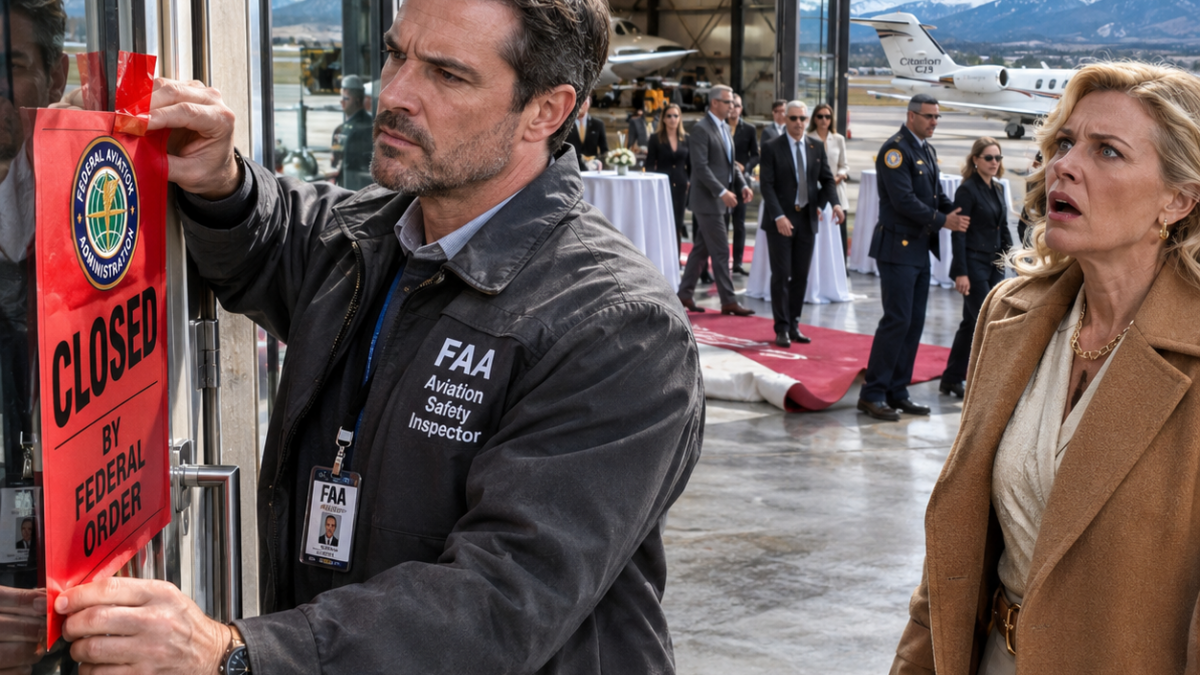
A staff member carried a large red closure placard toward the entrance.
Helena took microphone.
She read the emergency restriction covering unsafe areas and activities.
Certain portions of the hangar were to be cleared immediately.
Depending on interconnected systems, use of the facility would be suspended until hazards were corrected and reviewed.
Abigail followed with airport operational restrictions under lease and safety authority.
Leona added that any flight operations subject to federal certification concerns could not continue outside lawful compliance.
Three separate authorities.
Three separate scopes.
That mattered.
Blaine issued none of them.
Corrine had spent the entire morning accusing him of abusing government power.
The system was demonstrating the opposite.
Independent people.
Independent jurisdiction.
Independent findings.
Corrine shouted at private security.
“Do not let them close those doors.”
No guard moved.
One looked toward Abigail.
“This is leased airport property.”
He lowered hands.
Corrine stared.
“I put eight-point-four million dollars into this building.”
Abigail answered:
“Investment does not exempt a tenant from safety obligations.”
“I’ll sue.”
“You have every right to challenge the orders through proper process.”
Leona said.
“But an appeal is not the same as permission to ignore them.”
Guests began leaving.
Champagne abandoned.
Conversations turning urgent.
Bank representative already on phone.
Investors calling attorneys.
Screens going dark one at a time.
The mountain footage disappeared.
Red carpet remained.
Suddenly ridiculous.
When the authorized officials finished checking cleared access points, Helena supervised placement of the final warning seals.
Blaine remained a witness.
He signed nothing.
Approved nothing.
Then Helena held out one tag.
“Mr. Hargrove.”
He looked at her.
“This is already documented and approved.”
“You were the complaining witness in the impersonation matter.”
“Attach this final evidence tag to the exterior seal while we photograph chain of custody.”
Blaine hesitated.
“You sure?”
“Yes.”
He took it.
Walked to the main door.
Corrine stood twenty feet away.
White suit under camel coat now.
The grand opening banner still behind her.
Blaine pressed the tag onto the inspected seal.
Red closure notice beneath the illuminated SILVERCREST EXECUTIVE AVIATION logo.
The symmetry was almost too perfect.
That morning, Corrine had paid men to put a fake red suspension on his airplane.
By evening, real authorities had restricted her own facility.
Blaine looked at the notice.
Then at Corrine.
“This morning, you wanted an airplane that couldn’t leave the ground.”
He nodded toward the hangar.
“Now this place cannot operate until the real safety problems are resolved.”
Corrine stepped forward.
“I will have you fired.”
Blaine said:
“You’re welcome to file a complaint.”
Then:
“This time, send it to a real agency.”
That was the line people remembered.
Blaine wished they remembered the paperwork instead.
Inside the security office, Vernon’s team processed the counterfeit badges.
Fake orders.
Payment records.
Messages.
Troy and Miles were eventually taken into custody under appropriate legal procedures after investigators established grounds.
Corrine received notice that her role was under investigation.
No handcuffs for her that afternoon.
No theatrical arrest in front of investors.
Real cases take longer.
Evidence.
Interviews.
Charging decisions.
Counsel.
Blaine understood that.
Corrine did not.
She kept asking:
“Am I being arrested?”
Vernon answered:
“You are being advised to preserve records and remain available through counsel.”
Whitfield put one hand on her arm.
“Stop talking.”
For once, she did.
By sunset, the Citation was still parked on Blaine’s apron.
He had missed Denver.
No question.
He rescheduled.
The aircraft had never actually been legally grounded.
No real order existed.
He could have departed once airport security cleared the apron.
He chose not to.
There was nowhere he needed to be badly enough to leave while investigators were asking for statements.
At 7:10, he walked back to the Citation.
Fog gone.
Cold clear evening.
He picked the fake red order off the nose where he had placed it hours earlier.
Folded it.
Evidence copy already logged.
He looked across field.
Silvercrest hangar dark.
Red notice visible under exterior lights.
Abigail walked over.
“Long day.”
“That’s one description.”
“You okay?”
“I’m angry.”
“Good.”
He looked at her.
“That’s not very airport-director-like.”
“You stayed calm while it mattered.”
“You can be angry now.”
Blaine leaned against tug.
“You know what bothers me?”
“The fake badges?”
“No.”
“The laptop?”
“That too.”
He looked toward Silvercrest.
“She used safety as theater.”
Abigail understood.
“She thought rules were costumes.”
“Yes.”
“That building might have actual people flying out of it with records we cannot trust.”
“And fuel storage that could burn the place down.”
“She was worried about a ribbon.”
Abigail stood beside him.
“People are very good at caring about the wrong emergency.”
The investigations lasted months.
That part never made the viral retellings.
People wanted:
Fake FAA men appear.
Real FAA inspector reveals badge.
Karen’s hangar sealed by sunset.
End.
Reality continued.
Troy cooperated.
He admitted producing documents.
Described Corrine’s executive-office meeting.
Confirmed the objective included grounding Blaine publicly and obtaining the laptop.
He claimed Miles designed the evidence-seizure portion.
Miles denied.
Messages contradicted parts of both stories.
Financial records helped.
Video helped more.
Corrine’s own sentence on apron:
I spent a great deal of money making sure your airplane stayed on the ground today.
Her lawyers argued context.
Legal consulting.
Security services.
Regulatory complaints.
Investigators compared timing.
Payment to Miles’s company forty-eight hours before event.
Counterfeit badge drafts.
Message from Troy:
ORDER READY.
Another from Miles:
WE NEED THE COMPUTER BEFORE HE LEAVES.
Another from Corrine’s aide asking whether “the federal guys” would arrive before cameras.
Every piece alone could be explained.
Together, explanation narrowed.
Parallel review of Silvercrest Air Club became even more damaging financially.
Officials did not announce that every flight was illegal.
They examined them individually.
Who had operational control?
Who supplied pilot?
Who maintained aircraft?
Who collected payment?
What certificate authority existed?
Some flights may have fit lawful private operations.
Others did not match how Silvercrest marketed or sold them.
The company could not produce consistent documentation supporting the broad charter-like service promised to members.
That uncertainty itself froze operations.
Aircraft with questionable maintenance records remained grounded until identities and histories of installed components were established.
Roscoe spent days assisting owners in reconstructing records.
He hated every minute.
“Paper lies,” he told Blaine.
“Metal tells you what happened.”
Blaine corrected him.
“Good paper tells you what happened too.”
Roscoe grunted.
“Federal answer.”
The fuel installation took weeks to correct.
Then inspectors found additional fire-plan inconsistencies.
Not every one catastrophic.
Together expensive.
The grand opening never resumed.
Silvercrest’s loan documents contained representations about operational readiness.
The bank demanded review.
Investors demanded refunds.
Several sued.
The airport initiated lease enforcement based on violations within its jurisdiction.
Corrine fought.
Of course she did.
Appeals.
Lawyers.
Consultants.
Letters.
Press statements.
At first she framed everything as retaliation by Blaine.
That became harder once independent reports showed some concerns originated before his involvement and some came from Silvercrest employees themselves.
Then came the HOA audit.
This part angered residents more than aviation rules.
Aviation law was distant.
HOA money was theirs.
The new board—because Corrine had temporarily stepped aside under pressure before members formally voted—hired an independent accountant.
Roughly $1.6 million in association funds had flowed into project-related expenses without approvals matching bylaws.
Not every dollar stolen.
That word mattered.
Some funds had been spent on shared infrastructure and services.
But authorization records were incomplete, misclassified, or inconsistent.
Residents wanted to know:
Who approved transfers?
Why were private-development costs mixed with association budgets?
Why did project vendors overlap with Corrine-controlled entities?
Why had homeowners been told the hangar’s profitability would reduce future dues when the HOA did not own the airport property?
The special meeting filled the clubhouse.
Corrine attended.
No camel coat.
Gray suit.
No camera crew.
One homeowner stood.
“We trusted you.”
Corrine answered:
“I increased property values.”
“That’s not what I asked.”
Another:
“Did you move HOA money into Silvercrest aviation expenses without the vote required by our bylaws?”
“My legal team will address the accounting.”
Someone shouted:
“We’re your members.”
“Not opposing counsel.”
Corrine tried to regain control.
“This meeting is becoming disorderly.”
The new secretary said:
“You’re no longer chairing.”
That was the first moment many residents realized how much power they had surrendered simply because Corrine behaved as though leadership were permanent.
The recall vote followed the rules exactly.
Notice.
Quorum.
Ballots.
Certification.
Corrine lost.
The woman who had once signed every warning letter could no longer issue one in the HOA’s name.
Blaine did not attend.
He had no vote.
Was not a member.
He heard result from Walter Reese.
The retired dentist who had brought him the Air Club brochure.
Walter called that evening.
“She’s out.”
“Okay.”
“That’s all?”
“What do you want me to say?”
“I thought you’d celebrate.”
Blaine looked across his hangar at the Citation.
“No.”
“Why not?”
“Because none of this should’ve happened.”
Walter was quiet.
Then:
“Diane and I got our deposit back.”
“Good.”
“We almost put eighty-five thousand dollars into that club.”
“I know.”
“You saved us.”
Blaine shook his head although Walter could not see.
“No.”
“You asked for documents.”
“They couldn’t provide them.”
“You saved yourselves.”
That mattered to Blaine.
He did not want to become the hero Corrine once accused him of pretending to be.
People who followed procedure made the difference.
Abigail.
Leona.
Helena.
Vernon.
Roscoe.
Employees who reported concerns.
Investors who asked questions.
Residents who read bylaws.
No single inspector “brought down” Silvercrest.
Systems worked because enough people finally used them correctly.
Three months after the fake grounding, Blaine saw Corrine outside the airport administration building.
Winter morning.
Cold.
She wore the same camel coat.
No board.
No security.
No camera.
She looked smaller.
Not physically.
Context had changed.
“Blaine.”
He stopped.
“Corrine.”
She looked across toward the hangar.
Still restricted while lease and repair issues worked through appeals.
“You satisfied?”
“No.”
Her mouth tightened.
“I lost the project.”
Blaine waited.
“You got what you wanted.”
“No.”
“What did you want?”
“The taxiway left alone.”
“You could’ve had that without destroying everything.”
Blaine studied her.
“I didn’t destroy your project.”
“You sent the brochure.”
“Yes.”
“You sent footage.”
“To airport management.”
“You triggered reviews.”
“I reported what I could document.”
“You knew what would happen.”
“No.”
He stepped closer.
“What happened is that people asked you for authority you said you had.”
“You couldn’t produce it.”
“They asked for safety records.”
“They didn’t match.”
“They asked why men with fake FAA badges showed up on my apron.”
“Your own payment records answered part of that.”
Corrine looked away.
“I built something worth eight million dollars.”
“You built a very expensive building.”
“That’s not the same as owning every right you sold around it.”
She looked back.
“You think you’re better than me because you carry a federal badge.”
“No.”
Blaine’s voice remained calm.
“I think the badge means less than the rules behind it.”
“That’s the difference between us.”
Corrine said nothing.
Blaine continued:
“You thought authority was something you could create by printing the right paper.”
“You thought money could buy the appearance of legitimacy.”
“You thought if people were intimidated enough, they would obey before checking.”
“That worked for you.”
“For a while.”
She swallowed.
“My airplane was never your biggest problem.”
“Your decisions were.”
He walked away.
Did not ask for apology.
He did not need one.
The criminal case moved more slowly than gossip.
Troy and Miles faced federal charges related to impersonation and forged documents.
Troy’s cooperation affected how his case progressed.
Miles fought.
Evidence remained.
Corrine’s role went through separate process.
Blaine testified where required.
He did not embellish.
That frustrated some prosecutors less than it frustrated reporters.
A reporter once asked:
“Did she say she paid them to impersonate federal officials?”
Blaine answered:
“She said she spent a great deal of money making sure my aircraft stayed grounded.”
“That’s not exactly what I asked.”
“Correct.”
“You think that means she hired them?”
“I’m not here to tell you what to think.”
He had spent a career knowing words matter.
He would not become careless because the story was exciting.
Same with Air Club.
People said:
Corrine ran an illegal charter empire.
Blaine corrected:
“Authorities found operations requiring review and activities that could not continue without proper certification.”
Less exciting.
More accurate.
The $8.4 million hangar eventually lost its operating rights under Corrine’s company after reviews, corrections, and appeals failed to resolve the central lease and compliance problems.
The bank called portions of debt.
Investors sued.
Some settled.
Some fought.
The building did not vanish.
It remained on airport property.
Glass.
Steel.
A monument to the difference between owning a structure and owning the authority around it.
Eventually another aviation company negotiated a lawful lease for parts of the facility after everything was unwound.
Different management.
Different operating model.
Proper approvals.
Blaine supported it.
That surprised people.
“After everything?”
Abigail asked.
“I had a problem with Corrine’s conduct.”
“Not the building.”
“The airport can use a good facility.”
She smiled.
“You are annoyingly reasonable.”
“Occupational requirement.”
Silvercrest Estates continued too.
Homes did not disappear because president failed.
Property values did not collapse into nothing.
New board separated HOA governance from private aviation development.
Term limits.
Conflict disclosures.
Large transfers required multiple approvals.
Legal review for airport-related claims.
Members complained about paperwork.
Walter Reese stood at one meeting and said:
“We hired fake FAA agents because we had too little paperwork.”
Room went quiet.
Then laughter.
Policy passed.
Blaine kept flying.
The first flight after everything was not Denver.
That had already been rescheduled.
A winter morning months later.
Clear.
Citation on east taxiway.
Proper clearance.
No cameras except ordinary security.
Blaine advanced throttles.
As he taxied past the Silvercrest hangar, the VIP banners were gone.
Red carpet gone.
Glass dark.
One remaining regulatory placard near technical entrance.
Nothing dramatic.
He did not slow.
Tower cleared him.
He lined up.
Engines rose.
Acceleration pressed him into seat.
Then pavement fell away.
Cedar Vale became smaller beneath wing.
Mountains ahead.
For the first time in months, Blaine thought about his father.
Harlan Hargrove had been the one to buy the Citation.
Not as trophy.
Tool.
The family manufactured industrial pumps.
Factories scattered across three states.
His father hated airline schedules.
He loved flying.
Taught Blaine early.
But he also had one rule:
“Airplanes punish arrogance faster than people do.”
Blaine had heard it a thousand times.
As a teenager, rolled eyes.
As an inspector, understood.
Arrogance skips checks.
Assumes.
Rushes.
Treats warning as nuisance.
Believes money changes physics.
Corrine’s entire project had been built on a version of that mistake.
Not the building.
The belief underneath.
Enough money means rules become flexible.
Enough authority means ownership becomes negotiable.
Enough confidence means people stop verifying.
It worked until she targeted someone whose entire career was built around verification.
But even that explanation is too neat.
Blaine’s profession did not save him by magic.
The badge in his pocket was dramatic.
What saved the morning was procedure.
Photograph credentials.
Verify order.
Control access.
Do not surrender property to unconfirmed authority.
Call airport management.
Preserve evidence.
Recuse where conflicted.
Use independent investigators.
That was what Blaine taught younger inspectors after.
Not:
Always reveal your badge at perfect moment.
He hated that retelling.
A trainee once said:
“Sir, is it true you pulled your credential on two fake FAA guys?”
“Yes.”
“That must have been incredible.”
“No.”
“Come on.”
Blaine looked at him.
“The important part happened before I opened the credential.”
“What?”
“I asked them to verify who they were.”
The trainee waited.
“That’s it?”
“That’s it.”
He looked disappointed.
Blaine smiled.
“Most good safety work is disappointing.”
Years later, the video still circulated among Silvercrest residents.
Not publicly in full.
Clips.
Corrine saying:
I spent a great deal of money making sure your airplane stayed on the ground today.
Then Blaine opening credential.
People loved reversal.
Blaine cared more about a less-famous moment.
Miles accusing him of obstruction.
Blaine pointing toward camera.
Repeat it clearly.
Miles refusing.
That hesitation showed something powerful.
People pretending to have authority often rely on speed.
Confusion.
Fear.
They want compliance before reflection.
Slowing down is dangerous to them.
Repeat your claim.
Give me your name.
Give me your office.
Give me the number.
Wait while I verify.
Those simple acts remove momentum.
Blaine told Walter once:
“Fraud hates a pause.”
Walter laughed.
“That sounds like something you should put on a coffee mug.”
“Please don’t.”
Walter did.
The mug arrived at Blaine’s hangar Christmas morning.
FRAUD HATES A PAUSE.
Roscoe nearly dropped it laughing.
Blaine used it anyway.
Life returned to normal.
That was another part nobody tells in viral stories.
After federal investigations and cameras and $8.4 million hangars, Blaine still had to replace tires.
File taxes.
Renew insurance.
Fix a hangar heater that quit during the coldest week in January.
Roscoe complained about parts prices.
Abigail fought for snow-removal budget.
Walter lost his favorite golf club.
Normal problems.
Blaine appreciated them.
One afternoon, he found Abigail standing beside the east taxiway.
Airport had repainted edge markings.
“You like?”
She asked.
“It’s paint.”
“You fought an entire war over this pavement.”
“I did not.”
“Corrine did.”
“Fair.”
They stood.
A training Cessna rolled past.
Then maintenance truck.
Then Blaine’s Citation.
Shared infrastructure doing exactly what it was supposed to do.
No velvet rope.
No HOA branding.
No private red carpet.
Abigail said:
“Funny.”
“What?”
“This was the thing she wanted.”
“Taxiway?”
“Yes.”
“She lost a hangar trying to control pavement she already had legal access to.”
Blaine nodded.
“That happens.”
“People confuse access with exclusivity.”
“Not just airports.”
“No.”
Corrine had wanted something she did not actually need.
Silvercrest tenants could use taxiway lawfully like everyone else.
That was not enough.
She wanted control.
Control had value in her mind because exclusivity could be sold.
VIP members were not paying merely to taxi.
They were paying to believe other people could not.
That business model required rights she did not own.
So Blaine’s presence became intolerable.
Not because his jet blocked traffic.
Because it contradicted the story.
A shared taxiway does not look exclusive when a gray Citation belonging to an independent tenant keeps rolling down it.
Blaine’s existence was evidence.
Same reason his security footage frightened her.
Facts were inconvenient.
She tried to remove both.
One with lease pressure.
One with fake federal authority.
Neither worked.
Several years after incident, Blaine was asked to speak at an aviation compliance conference.
He usually refused personal-story talks.
This time accepted.
Topic:
AUTHORITY, VERIFICATION, AND CONFLICTS OF INTEREST.
No HOA Karen in title.
No drama.
He told the story carefully.
He never named Corrine.
Called her “a private development executive.”
Described fake inspectors.
Then asked audience:
“What made this scheme initially plausible?”
Someone said:
“Badges.”
“Yes.”
“Paperwork.”
“Yes.”
“Airport setting.”
“Yes.”
“Confidence.”
Blaine nodded.
Then:
“And what defeats plausible-looking authority?”
Someone answered:
“Knowledge.”
“Partly.”
Another:
“Verification.”
“Exactly.”
He put three words on screen.
STOP.
VERIFY.
PRESERVE.
Then:
“If a person claims emergency authority over your aircraft, facility, records, or operation, urgency does not eliminate verification.”
“Real agencies have channels.”
“Real inspectors expect accountability.”
“Real enforcement creates records that survive questions.”
Then he added:
“And if you have a personal conflict, do not become investigator in your own grievance.”
That was the less glamorous lesson.
Recusal.
Corrine accused him of bias.
If Blaine had inserted himself into the Silvercrest review, she might have had a legitimate procedural complaint.
He did not.
That protected both investigation and him.
After the talk, an airport manager asked:
“Did you know her hangar would be shut down when you reported the fake inspectors?”
“No.”
“Did you enjoy sealing it?”
Blaine sighed.
“That part gets exaggerated.”
“What really happened?”
“The fire marshal and airport authority issued restrictions.”
“I attached an evidence tag after they authorized it.”
“So you didn’t personally shut it down?”
“No.”
“Less cinematic.”
“Reality often is.”
Then he smiled.
“Still a memorable afternoon.”
The manager laughed.
Time changed Corrine’s story too.
People initially remembered villain.
Later, bankruptcy.
Lawsuits.
Removal.
But as years passed, more nuance appeared.
Corrine had actually been good at development.
Silvercrest homes were well designed.
She had negotiated road improvements.
Expanded utilities.
Helped raise property values.
Supported local charities.
Those facts did not excuse anything.
They made story more useful.
Competent people can become dangerous when success convinces them the rules are obstacles meant for lesser people.
Corrine did not begin her career hiring fake federal inspectors.
She arrived there incrementally.
First, aggressive negotiations.
Then pressure campaigns.
Then misrepresenting shared taxiway as something she could control.
Then filing complaints strategically.
Then believing Blaine’s evidence was the problem rather than her own operation.
Then hiring men to imitate authority.
Each step made next feel less impossible.
That progression frightened Blaine more than cartoon villainy.
He once told Leona over lunch:
“I keep thinking about when she could’ve stopped.”
Leona said:
“Pick a day.”
“Before fake badges.”
“Before Air Club.”
“Before misleading investors.”
“Before trying to force your lease.”
Blaine nodded.
“She had a hundred exits.”
“Most people do.”
Leona stirred coffee.
“The hard part is recognizing that changing direction feels like losing when you’ve built your identity around never backing down.”
Blaine thought of Corrine at grand opening.
Ribbon.
Investors.
White suit.
She could have canceled.
Admitted delay.
Fixed fuel issue.
Produced records.
Handled investigation.
Expensive.
Embarrassing.
Survivable.
Instead:
Nobody shuts down an $8.4 million project on opening day.
That sentence sealed more than the hangar.
Pride converts manageable problems into catastrophes.
Blaine knew aviation examples.
Pilots continuing into bad weather because turning back felt like failure.
Mechanics signing work they were unsure about because schedule pressure.
Managers hiding discrepancies because cancellation cost money.
Same psychology.
Different setting.
The safest decision often feels humiliating five minutes before it feels wise.
Corrine could not tolerate humiliation.
So she engineered someone else’s.
That failed.
One spring, Blaine saw Evan Ruiz—the young Silvercrest technician who had warned against fake badges.
Evan had left company before collapse.
He approached outside an aviation maintenance expo.
“Mr. Hargrove?”
Blaine recognized him vaguely.
“You were in Corrine’s office.”
Evan nodded.
“I should’ve reported it.”
“You did eventually send documents?”
“That was someone else.”
Blaine studied him.
Evan looked ashamed.
“I just left.”
“I thought if I wasn’t involved, that was enough.”
“Was it?”
“No.”
Blaine did not comfort him immediately.
Then:
“You warned them.”
“Not outside room.”
“No.”
“You’re right.”
Evan looked down.
“I work compliance now.”
That surprised Blaine.
“Why?”
“Because I got tired of being the guy who knew something was wrong and stayed quiet.”
Blaine nodded.
“That’s useful.”
Evan looked relieved.
Not absolved.
Useful.
Sometimes guilt can become responsibility if a person lets it.
Corrine’s downfall became a cautionary story in Silvercrest.
New residents barely knew details.
They heard versions.
Fake FAA agents.
Grounded jet.
Real inspector.
Sealed hangar.
But older residents remembered something else.
How easily they applauded.
At board meetings, Corrine had described Blaine as selfish.
A man blocking millions.
They believed her because her explanation was simpler than airport lease law.
Afterwards, Walter Reese became irritating about reading source documents.
Every proposal.
Every budget.
Every vendor agreement.
Someone would say:
“Walter, it’s straightforward.”
He answered:
“That’s what we thought last time.”
He served one term on the board.
Then quit.
“I’ve had enough democracy.”
Diane said:
“You volunteered.”
“Exactly.”
Silvercrest became less glamorous administratively.
That was healthy.
No executive speeches replacing legal review.
No private company intertwined with HOA without disclosure.
No aviation promises without airport signoff.
The community survived being less impressive.
Blaine’s Citation aged too.
Aircraft are not monuments.
Maintenance cost rose.
Avionics upgraded.
At fifty-two, Blaine considered selling it.
Roscoe reacted like Blaine proposed selling a family dog.
“You can’t.”
“It’s an airplane.”
“It’s Harlan’s airplane.”
“My father would sell it if operating cost stopped making sense.”
Roscoe thought.
“Unfortunately true.”
Blaine kept it another two years.
Then sold to regional company with excellent maintenance program.
On final flight, he taxied east.
Past the old Silvercrest hangar.
Now operated by another tenant under different name.
Active.
Legal.
Not sealed.
That mattered.
A building should not remain punished forever because one operator abused it.
He smiled seeing aircraft moving normally.
New operator had even kept some marble lobby.
Wasteful to rip out.
No red carpet.
Good.
Blaine rolled onto runway.
Paused.
Then advanced thrust.
Citation lifted.
He felt more emotion than expected.
His father.
Years.
Denver trips.
Fake inspectors.
One absurd morning.
Then mountains opened ahead.
He whispered:
“Good airplane.”
No one heard.
After selling it, Blaine bought a smaller turboprop share.
More practical.
Roscoe called it betrayal.
Then agreed fuel burn was better.
Life.
At fifty-five, Blaine moved into supervisory role.
Less field work.
More mentoring.
Young inspectors complained about documentation.
He told them:
“The paperwork is what remains after confidence disappears.”
They rolled eyes.
Same way he had rolled eyes at his father.
One day, a new inspector asked about the famous fake-FAA incident.
“Did those guys really not know who you were?”
“No.”
“How?”
“I wasn’t required to advertise my job.”
“Didn’t Corrine Google you?”
“Apparently not well.”
“That’s insane.”
“No.”
Blaine looked at him.
“It’s normal.”
“People research what they think matters.”
“She cared about my money.”
“My lease.”
“My airplane.”
“My schedule.”
“She assumed profession didn’t matter.”
“Assumptions create blind spots.”
Young inspector said:
“So the twist is she picked the worst possible person.”
Blaine shook his head.
“That makes a good story.”
“But it’s the wrong lesson.”
“What’s the right one?”
“Fake authority is a bad idea even if the person you target is a plumber.”
The inspector laughed.
Blaine did not.
He meant it.
The scheme should fail because impersonating federal authority is wrong and verifiable.
Not because victim happened to carry real credentials.
The dramatic reversal simply made exposure faster.
That distinction mattered.
Years later, Blaine learned Corrine had moved out of Silvercrest.
Her legal matters had mostly resolved.
Some through settlements.
Some through judgments.
Some through criminal and regulatory proceedings involving different people and entities.
He did not track every outcome.
That surprised friends.
“How can you not know?”
“Because it stopped being my case.”
“But she tried to steal your airplane.”
“She tried to seize access and records under fake authority.”
“Same difference.”
“No.”
Blaine always corrected details.
He had spent too long watching exaggeration damage investigations.
One exaggerated fact gives dishonest people something true to attack.
Better to keep facts exact.
The facts were enough.
Two men arrived claiming to be federal inspectors.
Credentials false.
Order false.
They demanded a laptop unrelated to alleged defect.
They attempted to arrange movement of aircraft into Corrine’s hangar.
Corrine publicly linked the event to her taxiway dispute.
She admitted spending substantial money to keep aircraft grounded.
Financial records linked her business to one participant.
Messages discussed computer.
Independent investigators already had Silvercrest under review.
Air Club records raised certification issues.
Maintenance records contained discrepancies.
Fuel installation presented documented fire safety concerns.
Hangar use was restricted by real authorities.
No embellishment needed.
Truth had better engineering.
One winter morning, several years after retirement planning had begun, Blaine drove through Cedar Vale before sunrise.
He no longer based an aircraft there.
Still liked airport.
Abigail had retired.
New director.
Roscoe’s shop expanded.
Silvercrest hangar—under new name—had lights on.
A legitimate charter company occupied half.
Maintenance business other half.
East taxiway busy.
Blaine parked near administration.
Walked to fence.
Fog looked almost exactly like that morning.
For a moment, memory returned with strange precision.
Black SUV.
Troy.
Red paper.
Corrine behind fence.
Camera.
Miles looking into cockpit.
Blaine wondered what would have happened if he had been someone else.
A private pilot intimidated by federal badge.
Would he have surrendered keys?
Laptop?
Allowed aircraft tow?
Probably many would.
That was why impersonation was serious.
Authority changes behavior.
People comply because society needs them to comply with legitimate authority.
If every pilot treated every real inspector like a criminal, safety system would fail.
Fake authority steals more than a badge.
It spends public trust.
That was what Blaine eventually understood as deepest offense.
Corrine had not merely lied to him.
She had borrowed credibility built by thousands of legitimate inspectors, investigators, public servants, and safety professionals.
Used it privately.
For land leverage.
Reputation.
Evidence.
That was why “fake badge, real consequences” was more than clever phrase.
Systems depend on symbols meaning something.
Badge.
Order.
Seal.
Signature.
Credential.
When people counterfeit those symbols, they do not only target one victim.
They damage confidence in entire structure.
Blaine stood by fence until sun began lifting.
Then walked toward Roscoe’s shop.
Roscoe was older.
Grayer.
Still complaining.
“You planning to buy another jet?”
“No.”
“You always say no before doing expensive things.”
“I learned from you.”
“That’s defamatory.”
They drank coffee.
Roscoe had framed one item on wall.
Copy of the fake red emergency order.
Across glass, Roscoe had written in marker:
CHECK THE BADGE.
Blaine sighed.
“You’re impossible.”
Roscoe grinned.
“History.”
“Take it down.”
“No.”
“You’re making this into folklore.”
“Too late.”
Blaine laughed.
Maybe folklore had use if lesson survived.
Later that morning, he walked past the east taxiway.
A business jet rolled toward runway.
Another waited.
Shared.
Ordinary.
Safe.
No red carpets.
No HOA guards logging who belonged.
Just pavement doing its job.
Blaine thought about Corrine’s original proposal.
Move.
Give up access.
Let her make taxiway exclusive.
Everything that followed had begun because he said no.
But saying no had not been heroic.
He had a lease.
He used it.
That was all.
Corrine turned refusal into personal humiliation because she believed disagreement from someone she could not control was rebellion.
That is another dangerous confusion.
Leadership is not obedience.
Community is not unanimity.
A neighbor exercising a lawful right is not an enemy simply because it complicates your project.
Had Corrine accepted that, Silvercrest aviation center might have opened legally.
Shared taxiway.
Proper certification.
Correct fuel permits.
Transparent finances.
Smaller profits perhaps.
Less exclusivity.
Still successful.
Instead, she chose control over cooperation.
The irony was obvious.
She wanted a private taxiway.
Lost control of the hangar.
Wanted to prove Blaine unsafe.
Exposed her own safety problems.
Wanted his security footage.
Created more evidence.
Wanted cameras to humiliate him.
Captured her own admission.
Wanted fake federal authority.
Attracted real federal scrutiny.
Every shortcut led in the opposite direction.
People call that karma.
Blaine did not.
“Karma is too vague.”
He once told Leona.
“I prefer causation.”
She laughed.
“Of course you do.”
He did.
Cause.
Effect.
Decision.
Consequence.
That was how airplanes worked.
Also people.
Corrine hired fake inspectors because she wanted a result without lawful process.
The real process arrived.
It did not care about her launch schedule.
Or marble.
Or investors.
Or home values.
It asked boring questions.
Who authorized?
Where is certificate?
What does lease say?
Who paid?
What maintenance record matches component?
Where is fire approval?
Those boring questions dismantled an empire of impressive answers.
That is why Blaine never considered himself the one who sealed Corrine’s hangar.
He attached one tag.
For a photograph.
After authorized officials made decision.
The seal was theirs.
The evidence belonged to record.
The consequence belonged to Corrine.
But if someone asked him what he remembered most, it was not the hangar door.
Not Troy’s face when Blaine opened credential.
Not Corrine yelling she would have him fired.
It was something smaller.
The moment he asked:
“Which FAA office issued this?”
And Troy could not answer cleanly.
That was the instant the costume began falling apart.
Authority that cannot survive one reasonable verification question was never authority.
Everything after was just paperwork catching up.
Years later, Blaine still kept his original credential case in a locked desk.
Retired eventually.
Badge surrendered as required.
Credential no longer valid.
The black leather case empty.
He kept it because of years of service, not Corrine.
On a shelf nearby sat the ridiculous mug Walter gave him.
FRAUD HATES A PAUSE.
One afternoon, Blaine’s nephew found it.
“What does that mean?”
Blaine smiled.
“How much time do you have?”
The boy shrugged.
“Ten minutes.”
“Not enough.”
He laughed.
Then gave simpler version.
“Sometimes people want you scared enough that you do what they say before you check whether they have the right to say it.”
“So you wait?”
“You verify.”
“What if they’re real?”
“Then verification works.”
“What if they’re fake?”
“They usually hate it.”
His nephew nodded.
Then pointed toward an old photograph of the Citation.
“Was that the plane?”
“Yes.”
“The one fake FAA guys tried to ground?”
“Yes.”
“Were you scared?”
Blaine considered.
“Not at first.”
“What scared you?”
“The computer.”
“Why?”
“Because they wanted something that had nothing to do with the reason they claimed to be there.”
“That told me their story had another purpose.”
His nephew looked impressed.
“You knew immediately?”
“No.”
“I noticed something didn’t fit.”
“Knowing came later.”
That distinction again.
Observation before conclusion.
Blaine hoped the boy remembered it.
Maybe not.
People usually need their own version of a black SUV in fog before lessons become permanent.
The final time Blaine saw Corrine was never dramatic.
No courthouse.
No confrontation.
Airport charity fundraiser years later.
She came as guest of someone else.
They saw each other across lobby.
She walked over.
Older.
Quieter.
“Blaine.”
“Corrine.”
She looked toward small exhibit about Cedar Vale history.
A photograph of original Silvercrest hangar before grand opening was included.
No mention of scandal.
Just building.
She said:
“They use it now.”
“Yes.”
“New company.”
“Yes.”
“They’re doing well.”
“I hear they are.”
Corrine looked at him.
“I thought seeing it succeed without me would make me angry.”
“Does it?”
“Less than I expected.”
Blaine nodded.
She continued:
“I spent years thinking you destroyed what I built.”
“And?”
“I know that isn’t true anymore.”
Blaine waited.
Corrine looked toward photograph.
“I thought if I lost control of the taxiway, I’d lose the project.”
“Then I lost the project trying to control it.”
That was perhaps the most honest thing she ever said to him.
Blaine answered:
“Yes.”
“I’m sorry.”
He believed she meant it.
Maybe completely.
Maybe partly.
He did not need to decide.
“Thank you.”
No forgiveness speech.
No friendship.
They shook hands once.
Then walked separate directions.
People change.
Sometimes after consequences.
Sometimes not.
Either way, consequences still matter.
That evening Blaine drove home.
No airplane.
No emergency.
No badge.
He thought about how stories compress lives.
Corrine becomes Karen.
Blaine becomes secret federal inspector.
Troy and Miles become cartoon villains.
Hangar gets “seized.”
Jet gets “grounded.”
Everything simplified.
But the truth was more interesting.
Corrine was smart enough to build something extraordinary and arrogant enough to believe that achievement entitled her to control what she did not own.
Troy knew enough about aviation paperwork to forge a believable order and not enough about aviation enforcement to survive basic verification.
Miles understood intimidation and misunderstood evidence.
Blaine had federal credentials but deliberately refused to use his office to settle personal dispute.
Abigail had airport authority but stayed inside its limits.
Helena had fire authority and used it only where conditions justified it.
Leona had federal responsibility and kept the conflicted inspector out of decision.
Vernon built a case instead of giving a speech.
That difference between people was not intelligence.
It was restraint.
Knowing where your authority ends.
Corrine never learned that until the end.
Maybe that is the real story.
Not that she picked the wrong man.
Not that a fake inspector accidentally challenged a real one.
The real story is that Corrine believed power meant never having to hear no.
Blaine believed power meant knowing exactly when no applied to you too.
That morning on the apron, he could have flashed his credential immediately.
Humiliated them.
Played the scene for camera.
Instead, he asked questions.
Documented.
Called supervisor.
Called airport director.
Waited.
Later, when Corrine’s hangar was reviewed, he stepped out.
When orders came, other people signed them.
When the facility was sealed, real authorities did the work.
His greatest advantage was not badge.
It was his refusal to misuse it.
Corrine had spent thousands trying to manufacture authority she did not possess.
Blaine had real authority in his professional life and knew when not to exercise it.
That difference decided everything.
On a clear Colorado morning years later, Blaine stood beside a small rented airplane with his nephew.
The boy was learning preflight.
Blaine watched him check fuel cap.
Control surfaces.
Tires.
Pitot cover.
Then the boy rushed toward cockpit.
Blaine said:
“What did you forget?”
The boy stopped.
Looked around.
Then:
“Nothing?”
Blaine waited.
The boy sighed.
Walked back.
Checked baggage door.
Not latched.
He secured it.
“Good.”
They climbed aboard.
Before engine start, the boy said:
“Uncle Blaine?”
“What?”
“Fraud hates a pause.”
Blaine groaned.
“Walter ruined you.”
The boy laughed.
Then completed checklist.
One line at a time.
Blaine watched.
That was enough.
The famous confrontation had begun because two men arrived at 6:12 wearing badges designed to make one pilot stop asking questions.
Instead, Blaine asked the only kind that really mattered.
Who are you?
What authority do you have?
Can I verify it?
Corrine Satterfield believed those questions were obstacles.
They were protections.
For his aircraft.
For the airport.
For her investors.
For every passenger who might have eventually boarded one of Silvercrest’s questionable flights.
She paid fake FAA agents to ground one jet because she thought government authority was something she could imitate long enough to get what she wanted.
By sunset, real inspectors, airport officials, fire authorities, and federal investigators were standing inside the project she had spent $8.4 million building, asking her for the documents she had always assumed nobody would dare demand.
Her fake order lasted a few minutes.
The real consequences lasted years.
And when Blaine finally watched the Citation climb cleanly over the Colorado mountains months later, the east taxiway still beneath him and the old Silvercrest hangar dark in the distance, he understood something Corrine had learned far too late.
You can forge a badge.
You can forge a notice.
You can hire a camera crew and rehearse a humiliation.
You can even convince an entire neighborhood that confidence is the same thing as authority.
But sooner or later, someone asks to see the real paperwork.
And when that happens, the truth either clears you for departure—
or keeps you grounded.








