HOA Sent an Excavator to Tear Down My Grain Silo on Christmas—Then the Contractor Checked One Line of Paperwork and Stopped Cold.
PART2:
The silo stood almost a hundred feet high near the center of our oldest parcel.
Galvanized steel darkened by sixty-eight winters.
A conical roof patched twice.
A ladder Dad forbade me to climb until I was fifteen and then spent the next twenty years complaining that I climbed too quickly.
To other people, it was ugly.
To me, it was a family photograph you could see from three miles away.
My grandfather Walter Boone had helped build it in 1958.
Back then, our farm was surrounded by nothing but pasture, grain fields, and a county road narrow enough that two pickups had to put wheels in the grass to pass.
Then the town grew.
Then came commuters.
Then developers.
Then a subdivision called Briar Crest.
The name amused my father.
“There wasn’t a briar crest within twenty miles until they printed those brochures,” he used to say.
Briar Crest wrapped around the east and south sides of our property.
Two hundred and sixteen houses.
Stone entry sign.
Decorative ponds.
Matching black mailboxes.
PART3:
Rules about shed colors, lawn height, basketball hoops, holiday lights, trash cans, fence materials, and apparently the emotional well-being of anyone forced to look at agricultural equipment.
The Briar Crest Homeowners Association had been irritating me for years.
But irritating was different from dangerous.
I learned that at 7:12 a.m.
I heard engines.
Not one.
Several.
Heavy diesel coming up the county road.
I set down my coffee.
The sound grew louder.
Then turned.
Onto my access lane.
I walked to the kitchen window.
Headlights moved through the snow.
First came a white Ford pickup with a magnetic company logo on the door.
MERCER DEMOLITION & SITE SERVICES.
Then a flatbed carrying steel fencing.
Then another truck.
Then the excavator.
The machine rolled behind them on a lowboy trailer, its bucket folded inward like a fist.
I remember staring for several seconds because the scene was so absurd my brain rejected it.
Christmas morning.
My farm.
Demolition crew.
Then a red SUV appeared behind the trucks.
I knew the SUV.
Everybody in Briar Crest knew it.
Marjorie Voss.
HOA president.
I put on my boots slowly.
That detail matters.
There are moments when anger tells you to move fast because speed feels like strength.
My father taught me the opposite.
When somebody comes onto your ground expecting you to panic, make them wait while you lace your boots.
I put on my coat.
Took my phone.
Walked outside.
Snow crunched beneath me.
The excavator was being unloaded.
Two workers were carrying temporary fencing toward the silo.
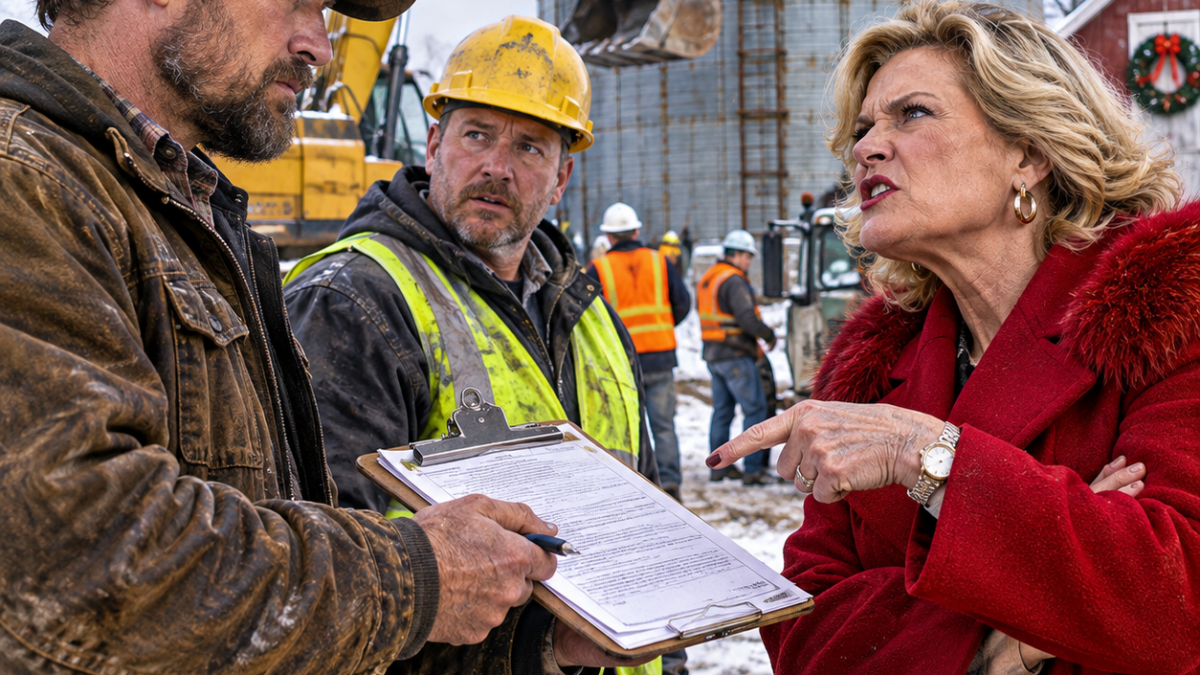
Another man in an orange vest stood beside a truck with a clipboard.
Marjorie stepped out of the SUV wearing a bright red wool coat.
Of course she wore red.
If you had asked Hollywood to design an HOA president invading a farm on Christmas morning, they might have rejected Marjorie as too obvious.
She was fifty-one.
Blond hair cut precisely at her jaw.
Pearl earrings even at seven in the morning.
Leather gloves.
Expensive boots that were learning quickly what frozen mud thought of expensive boots.
She carried a thick blue folder against her chest.
“Good morning, Calder.”
“No, it isn’t.”
Her smile remained.
“Merry Christmas.”
I looked at the excavator.
“Did you bring me that?”
She turned toward the silo.
“This should be completed by late afternoon.”
I looked at her again.
“What should?”
“The removal.”
“Of what?”
She gave me the expression people use when they think pretending not to understand is childish.
“The silo.”
I let the words sit between us.
A worker nearby stopped unrolling fence.
“You hired people to demolish my grain silo.”
“The association retained a licensed contractor to remove a noncompliant structure.”
“From my property.”
“The structure is subject to community architectural standards.”
“No, it isn’t.”
“We’ve been over this.”
“We have.”
She opened the folder.
“Then you’re aware of the board’s decision.”
“I’m aware you keep mailing me paper.”
“Those are formal notices.”
“They’re still paper.”
Her mouth tightened.
Behind her, the excavator engine started.
I felt that sound in my ribs.
“Shut the machine down.”
Marjorie smiled.
“No.”
I looked past her.
“Who’s running this job?”
The man with the clipboard lifted one hand.
“That’d be me.”
He walked toward us.
Late forties.
Broad shoulders.
Graying beard.
Carhartt jacket beneath a reflective vest.
The kind of face that looked more comfortable beside machinery than conference tables.
“Dorian Mercer.”
“Calder Boone.”
We shook hands.
Marjorie did not appreciate that.
“Mr. Mercer has already been briefed on the association’s authority.”
I kept looking at him.
“You have a demolition permit?”
Dorian glanced at Marjorie.
Then at his folder.
“We have a work authorization from the association, engineering notes, site designation—”
“Permit.”
He paused.
“City approval is supposed to be attached to the final packet.”
“Is it?”
He flipped pages.
Marjorie interrupted.
“The permit process is complete.”
Dorian kept looking.
“Where’s the permit number?”
“It’s in there.”
He searched.
I watched his expression.
People who work with their hands develop a particular suspicion of documents that do not match the physical world.
Dorian had it.
He found a sheet.
Read it.
Looked toward the silo.
Then toward the lane.
Then back at the sheet.
“Parcel number doesn’t look right.”
Marjorie said, “It’s the association’s master parcel designation.”
Dorian frowned.
“For a private demolition?”
“Yes.”
“That’s unusual.”
“Not in planned communities.”
I almost laughed.
“This isn’t inside your planned community.”
Marjorie turned.
“The property participates in association covenants.”
“For roads.”
“And community standards.”
“For the portion of my frontage adjoining Briar Crest.”
“That interpretation has been rejected.”
“By you.”
“By the board.”
“Same thing lately.”
One of the workers coughed.
Marjorie heard him.
Her cheeks flushed.
She pointed toward the silo.
“Dorian, your company has been paid. Please proceed.”
Dorian did not move.
“Not until I reconcile this.”
“We have a schedule.”
“I have insurance.”
That was the first moment I liked him.
Marjorie stepped closer.
“This is a routine removal.”
Dorian looked up at nearly one hundred feet of steel grain storage.
“Ma’am, nothing about dropping that on Christmas Day without a city permit is routine.”
Then he turned to me.
“Mr. Boone, you’re still the owner of record?”
“Yes.”
“Whole parcel?”
“Yes.”
“No transfer?”
“No.”
“No land contract?”
“No.”
“No trust controlling the structure?”
“My family trust owns part of the acreage. I’m trustee.”
He nodded.
Then flipped to the final page.
His face changed.
Not dramatically.
Just enough.
He read something twice.
Then held the paper toward me.
“Okay.”
“What?”
“I need you to sign here.”
Marjorie reacted instantly.
“He doesn’t need to sign.”
Dorian looked at her.
“Yes, he does.”
“No. The association is authorizing the work.”
“You’re not the property owner.”
“We are the governing authority.”
“That’s not what this says.”
He tapped the page.
“Owner authorization required before physical demolition.”
I took the paper.
The line was near the bottom.
PROPERTY OWNER CONSENT AND STRUCTURAL DEMOLITION AUTHORIZATION.
Blank signature.
Blank date.
My name printed beneath it.
I looked at Marjorie.
She had gone still.
That was the moment everything changed.
Not because I suddenly knew their entire plan.
I didn’t.
But I understood one thing.
She had expected the building to come down without my consent.
And the contractor had just told me somebody had created paperwork pretending my consent could be supplied later.
I handed the sheet back.
“No.”
Dorian nodded.
“That’s what I figured.”
Marjorie said, “Calder, don’t be theatrical.”
I laughed once.
“You brought an excavator to my house on Christmas.”
“This is not personal.”
“You’re standing thirty yards from my kitchen with a demolition crew.”
“It’s enforcement.”
“Then enforce something you control.”
Her voice sharpened.
“We do control this.”
“No.”
“You signed into the association.”
“I agreed to shared-road maintenance and specific frontage standards when Dad sold an easement to the subdivision developer in 2004.”
She blinked.
I continued.
“You keep pretending that makes the farm part of Briar Crest.”
“It does.”
“It doesn’t.”
“You are not an attorney.”
“No.”
I pointed toward the machine.
“But I know whose dirt that excavator is sitting on.”
Dorian was already walking toward his truck.
He opened his laptop.
Marjorie followed.
“What are you doing?”
“Checking county GIS.”
“We already provided the parcel map.”
“I’m checking it myself.”
“That’s unnecessary.”
“That sentence usually means it’s necessary.”
I liked him more.
The crew stopped working.
Within minutes, the entire operation had become a group of men standing in snow while one increasingly angry woman watched a contractor zoom through county property records.
Dorian called me over.
“Do you have a survey?”
“Yes.”
“Recent?”
“2019.”
“Bring it.”
I walked back to the house.
My hands were shaking now.
Not fear.
Adrenaline.
I grabbed the survey tube from Dad’s old office.
Before going outside, I looked through the living-room window.
The silo stood behind the trucks.
For one irrational second, I imagined coming home from church as a boy and finding it gone.
That image made me angrier than Marjorie’s voice ever could.
I returned.
Dorian spread the survey across his hood.
We used sockets from his toolbox to hold the corners down against the wind.
He traced the boundaries.
Then entered numbers again.
Marjorie stood opposite us.
“What?”
Dorian did not answer.
“What?”
He looked at me.
“Mr. Boone.”
“Yes.”
“Your silo is here.”
He tapped the map.
“I know.”
“Briar Crest jurisdictional boundary stops here.”
Another tap.
“I know.”
He looked at Marjorie.
“That’s over three hundred feet away.”
She leaned over the map.
“That survey predates recent covenant amendments.”
“Covenants don’t move property lines.”
“The association has enforcement authority.”
“Show me.”
She opened her folder.
For twelve minutes, Marjorie flipped through documents.
Bylaws.
Amendments.
Architectural standards.
Landscape rules.
Common-area language.
Road maintenance agreements.
Nothing granted her authority over the silo.
Dorian read every relevant clause.
Then closed the folder.
“Crew’s standing down.”
Marjorie stared at him.
“Excuse me?”
“I’m not touching that structure.”
“I hired you.”
“You hired me to perform lawful demolition.”
“It is lawful.”
“No permit.”
“It’s pending.”
“No owner authorization.”
“The association substitutes—”
“No.”
His voice became firmer.
“My insurance carrier will eat my company alive if I destroy private property based on this.”
She lowered her voice.
“You’ve already accepted a deposit.”
“I’ll refund whatever contract law says I refund.”
“You’ll also be sued.”
“Better than being charged.”
That word changed the temperature.
Charged.
Marjorie looked toward me.
I had not said anything.
She seemed to resent that most.
People like Marjorie preferred an angry opponent.
Anger gave them noise.
Noise gave them mistakes.
Silence gave them nowhere to hide.
Dorian called the city permit office.
Christmas staffing meant he reached an emergency municipal contact rather than the usual department.
He read the permit number.
Waited.
Read it again.
Then frowned.
“No record?”
Marjorie walked toward him.
“What are they saying?”
Dorian raised one finger.
Listened.
“Could you check by property address?”
Pause.
“Association name?”
Pause.
He looked directly at Marjorie.
“Nothing?”
She went pale.
Dorian ended the call.
“The city has no demolition permit.”
Marjorie’s response came too quickly.
“Administrative delay.”
“They have no application.”
“They’re wrong.”
“They searched three ways.”
“It was submitted through county compliance.”
“Then give me that filing number.”
She could not.
Dorian pulled the supposed permit from her folder.
He compared the signature block to a legitimate permit on his laptop.
Different.
Wrong formatting.
Wrong municipal seal.
Wrong numbering sequence.
Even the issuing department name was outdated.
He looked at me.
Then her.
“This document isn’t valid.”
Marjorie’s face transformed.
Not guilt.
Rage.
“You’re a demolition contractor, not a lawyer.”
“No.”
Dorian folded the page.
“But I know fake paperwork when the city tells me the number doesn’t exist.”
I took out my phone.
Started recording.
Marjorie saw.
“What are you doing?”
“Documenting.”
“Turn that off.”
“You’re on my property.”
“You do not have consent to record me.”
“You brought four trucks and an excavator onto my land.”
“That is separate.”
“Not anymore.”
She stepped toward me.
Dorian moved slightly between us.
Not dramatically.
Enough.
I said, “Everybody off the farm.”
Marjorie laughed.
“You can’t order an authorized association contractor—”
Dorian interrupted.
“He just did.”
She stared.
“I’m withdrawing the crew.”
“You will not.”
“I am.”
“You signed a contract.”
“I signed a contract based on representations you made.”
She pointed toward the silo.
“That structure has to come down.”
That sentence stayed with me.
Not should.
Not violates standards.
Has to.
Dorian heard it too.
His eyes moved toward me.
Then back to Marjorie.
“Why?”
She hesitated.
Barely.
Then recovered.
“Because it is dangerous.”
“You hired us under aesthetic remediation.”
“It’s both.”
“Engineering report says structurally stable.”
She looked furious.
Dorian continued.
“Your own attachment says that.”
She snatched the folder.
A county code officer arrived twenty minutes later.
Dorian had requested him.
He examined the documents.
Confirmed no permit.
Confirmed the silo sat outside HOA architectural jurisdiction.
Then told every machine to remain off.
Marjorie finally retreated.
Before getting into her SUV, she turned toward me.
“You think you’ve won.”
“I think it’s Christmas.”
“You’ll regret making this difficult.”
I looked around at the trucks.
“You came to demolish my silo before breakfast.”
She said nothing.
I continued.
“I didn’t make it difficult.”
Her mouth tightened.
“You’ll hear from our attorney.”
“I hope so.”
She drove away.
I stood in the lane watching the red SUV disappear.
The demolition workers began loading fencing.
Dorian joined me.
For a while neither of us spoke.
Then he looked up at the silo.
“I don’t think she came here because she hates looking at that thing.”
I turned.
“What do you mean?”
He held up the fake permit.
“People fake paperwork because something matters enough to risk getting caught.”
He looked toward the road.
“And they schedule demolition for Christmas because they don’t want anybody answering phones.”
That thought followed me all day.
I did not celebrate Christmas.
Not really.
My sister Leah called from Tennessee around noon.
“You sound weird.”
“HOA tried to demolish the silo.”
Silence.
Then:
“What?”
“Literally.”
“Today?”
“Yes.”
“On Christmas?”
“Yes.”
“Is Marjorie insane?”
“Possibly.”
“Did they damage anything?”
“No.”
“Did you call the sheriff?”
“County code handled it.”
“Calder.”
“I’m fine.”
“No, you’re doing the Boone thing.”
“What thing?”
“The one where somebody sets your barn on fire and you say the smoke is inconvenient.”
“Nobody burned a barn.”
“Yet.”
I smiled.
She continued.
“Call a lawyer.”
“I have a property attorney.”
“You have an attorney you used six years ago for a drainage easement.”
“Same category.”
“No.”
“Close enough.”
“Calder.”
“Fine.”
“Today.”
“It’s Christmas.”
“Tomorrow.”
“Fine.”
“Promise?”
“Yes.”
“You lied exactly like Dad.”
“Love you too.”
The next morning I called Sloan Whitaker.
Sloan had represented our family during a pipeline dispute years earlier.
Forty-five.
Sharp voice.
No patience for unnecessary adjectives.
She listened for six minutes.
Then said, “Send me everything.”
“Everything?”
“Every HOA letter for three years.”
“That’s a box.”
“Good.”
“The contract?”
“If you can get it.”
“Fake permit?”
“Especially.”
“Security video?”
“Yes.”
“Survey?”
“Yes.”
“Anything else?”
“Calder.”
“What?”
“You said the president told the contractor the structure had to disappear.”
“Yes.”
“Exact words?”
“I think so.”
“Find the video.”
By lunchtime, she had it.
By evening, Sloan was no longer talking like this was an HOA dispute.
She was talking like something smelled wrong.
“Who owns land east of your north field?”
“Several parcels.”
“Names?”
“Why?”
“Answer.”
I did.
“Southwest corner?”
I named another company.
“Have any neighbors sold recently?”
“Yes.”
“To whom?”
“I don’t know.”
“I do.”
Silence.
“Calder.”
“What?”
“A holding company called Evergreen Ridge Development has purchased nine parcels around Briar Crest in eighteen months.”
“That’s not unusual.”
“It is when three purchases were made through subsidiaries sharing the same registered agent.”
I sat at the kitchen table.
“What are you saying?”
“I’m saying somebody is assembling land.”
“For what?”
“Don’t know yet.”
She paused.
“And your farm sits in the middle.”
I looked through the window.
The silo was dark against the evening sky.
Two days later Sloan drove out.
She spread maps across my kitchen table.
Property acquisitions.
Shell corporations.
County zoning drafts.
Transportation planning documents.
A proposed commercial-residential expansion corridor.
One possible access road crossed almost exactly where my grain silo stood.
I stared.
“That road isn’t approved.”
“No.”
“Then why would anybody care now?”
“Because land is cheaper before approval.”
I understood.
“If they control enough surrounding parcels—”
“They influence the project.”
“And my farm blocks the connection.”
“Part of it.”
She tapped another page.
“The silo complicates rezoning.”
“How?”
“Historic agricultural use.”
“It’s not officially historic.”
“Doesn’t need landmark status to be inconvenient.”
She explained.
Agricultural continuity.
Existing-use protections.
Recorded structures.
Easements.
County planning precedent.
Nothing individually made my land impossible to redevelop.
Together, they made it slower.
Expensive.
Messy.
Developers hate messy.
“Who’s behind Evergreen Ridge?”
“That’s where it gets interesting.”
The company passed through two LLCs.
One registered in another state.
Another owned by a partnership.
A managing member appeared.
Thomas Voss.
I stared at the page.
“Marjorie’s husband?”
“Brother-in-law.”
“Does she know?”
Sloan gave me a look.
“I’m a lawyer, Calder, not a magician.”
“Guess.”
“Yes.”
I leaned back.
Marjorie had attended three closed county planning sessions as an HOA representative.
She had never told Briar Crest residents.
Evergreen Ridge had been purchasing land.
HOA violation notices against my farm had increased dramatically eleven months earlier.
The proposed road appeared in internal planning correspondence nine months earlier.
My silo removal campaign began eight months earlier.
Patterns.
My father loved patterns.
He could look at three broken bearings and tell you the operator causing them was ignoring lubrication intervals.
“You don’t fix failure by staring at the last thing that broke,” he used to say.
“You find what keeps producing it.”
I started collecting everything.
Every HOA letter.
Every certified envelope.
Every email.
Pictures.
Security footage.
Violation notices.
One claimed my grain dryer produced “nonconforming seasonal noise.”
Another claimed farm trucks created “visual congestion.”
Another demanded I repaint the silo “a community-compatible neutral tone.”
It was galvanized steel.
What neutral tone did they want?
Emotionally beige?
Dorian came by three days after Christmas.
He brought the demolition contract.
“I shouldn’t technically give you the original.”
“Then don’t.”
He handed Sloan a copy.
She read it.
Stopped.
Read something again.
“Mr. Mercer.”
“Yes?”
“Who requested December twenty-fifth?”
“HOA.”
“Specifically?”
“Voss.”
“Why?”
“She said reduced neighborhood traffic.”
Sloan looked at me.
“Anything else?”
Dorian frowned.
“She wanted completion before December twenty-seventh.”
“Why?”
“Didn’t say.”
“Deposit?”
“Forty percent.”
“That’s high.”
“Holiday mobilization.”
“How far in advance?”
“Seven weeks.”
Sloan looked up.
“So this wasn’t a sudden board decision.”
“No.”
“When did she first contact you?”
Dorian checked his phone.
“November fourth.”
I almost laughed.
The HOA’s supposed final vote authorizing enforcement had occurred December 12.
They hired demolition before the vote.
Sloan smiled.
It was not a pleasant smile.
“Good.”
Dorian looked concerned.
“What?”
“She paid you before the board supposedly authorized the expenditure.”
His face tightened.
“That matters?”
“It might matter a lot.”
The next problem arrived that night.
A phone call.
Marjorie.
I almost ignored it.
Sloan motioned for me to answer and put it on speaker.
“Calder.”
“Marjorie.”
“We should talk.”
“We are.”
“I mean reasonably.”
I looked at Sloan.
She raised an eyebrow.
“Okay.”
Marjorie softened her voice.
“I think Christmas got out of hand.”
“You brought heavy equipment.”
“That was an unfortunate escalation.”
“By you.”
“By the situation.”
“No.”
She exhaled.
“The association is prepared to resolve this privately.”
“What does that mean?”
“We withdraw outstanding violations.”
“All of them?”
“Yes.”
“Even the ones you claim are legitimate?”
Pause.
“Yes.”
“Why?”
“Because continued conflict serves nobody.”
Sloan began writing.
Marjorie continued.
“There is an interested buyer for part of your eastern acreage.”
There it was.
“How interested?”
“Very.”
“I’m not selling.”
“You haven’t heard the offer.”
“Don’t need to.”
“Calder, this is the kind of money people retire on.”
“I already live where I’d retire.”
Silence.
Then:
“Sell forty acres.”
“No.”
“Thirty.”
“No.”
“You haven’t heard the number.”
“No.”
Her warmth vanished.
“You’re being stubborn.”
“Genetic.”
“You’re protecting an obsolete structure at the expense of significant financial opportunity.”
“I thought this was about community landscaping.”
Sloan smiled.
Marjorie realized it too late.
“I’m talking broadly.”
“No.”
“You know what I mean.”
“I’m starting to.”
She went quiet.
Then said something that made Sloan stop writing.
“Sign over the parcel, Calder, and all of this disappears.”
Sloan underlined something three times.
I asked, “What disappears?”
“The violations. The legal issues. The hostility.”
“What about the silo?”
“It becomes irrelevant.”
I looked through the kitchen window.
“How?”
“Because it won’t be your problem anymore.”
There it was.
I said, “I think we should let attorneys handle this.”
“If you choose that route, it gets expensive.”
“For who?”
“Everyone.”
“Good night, Marjorie.”
“You will regret—”
I ended the call.
Sloan looked at me.
“Excellent.”
“My attorney just praised me for hanging up.”
“I bill by the hour. Efficient clients are attractive.”
At 10:43 that night, someone left an envelope at my front door.
No vehicle on camera.
The person stayed outside the angle of one camera and approached from the north side.
Inside was an old deed copy.
Yellow paper.
County seal.
My grandfather’s name.
Another name I recognized.
Samuel Reddick.
He had owned the neighboring dairy acreage before Briar Crest existed.
A handwritten note was folded inside.
Three words.
CHECK THE SILO.
I read it twice.
Sloan read it.
“Do you recognize the handwriting?”
“No.”
“Who knew documents were stored there?”
“My father.”
“Anyone else?”
“Maybe old farmhands.”
“Your sister?”
“She was twelve when most of it was organized.”
“Check it.”
“At night?”
“No.”
She looked out the window.
“Preferably when nobody can hit you with farm equipment.”
I waited until morning.
The silo had a narrow maintenance compartment near the lower mechanical housing.
I had opened it dozens of times but never emptied the entire thing.
Dad stored manuals everywhere.
I found:
maintenance logs,
old receipts,
grain elevator inspection sheets,
blueprints,
county correspondence,
and beneath a rusted metal box, a folded document inside plastic.
The paper dated to 1959.
Recorded easement.
Agricultural storage access.
Independent parcel designation.
County protection language tied to continuous agricultural operation.
I read it three times.
Then called Sloan.
She arrived ninety minutes later.
When she finished reading, she sat on an overturned bucket.
“Calder.”
“That good?”
“This is why.”
“What?”
“The silo.”
She stood.
“This structure is not just sitting on land they want.”
She tapped the document.
“It helps prove the continuity of an independently recorded agricultural use corridor.”
“So?”
“So if the silo disappears, they can argue abandonment more easily.”
“Could they win?”
“Not automatically.”
“But easier.”
“Much.”
I stared upward.
Steel walls disappeared into darkness.
My father had known.
Maybe not the current plan.
But he knew someone eventually might want the farm.
I remembered a dinner from fifteen years earlier.
Dad talking about some developer.
“They’ll never buy the center unless they make the edges useless.”
I had forgotten.
At the time, I cared more about whether our combine needed a new feeder chain.
Sloan said, “Whoever sent that deed knows exactly what this is about.”
“Marjorie?”
“No.”
“Why help me?”
“I don’t know.”
We learned later.
Her name was Elaine Porter.
Seventy-four.
Former Briar Crest board treasurer.
She had resigned six months earlier.
Marjorie told neighbors Elaine left for health reasons.
Elaine told us the truth in Sloan’s office.
“I found invoices.”
“What invoices?” Sloan asked.
“Consulting payments.”
“To who?”
“Planning consultants tied to Evergreen Ridge.”
“Paid by the HOA?”
“Yes.”
My hands tightened.
“How much?”
“Almost eighty thousand dollars over eighteen months.”
Sloan leaned forward.
“For legitimate association work?”
“Some.”
“And the rest?”
Elaine shook her head.
“I started asking questions.”
“What happened?”
“Marjorie told the board I was confused.”
She laughed bitterly.
“I’m seventy-four, not dead.”
“Why didn’t you go public?”
“I tried.”
She pulled copies from her bag.
Emails.
Board minutes.
Internal messages.
One line made me stop.
Boone obstruction must be resolved before Q1 planning submission.
Obstruction.
Not violation.
Not silo.
Boone obstruction.
Another:
Holiday timing reduces municipal response risk.
I read it again.
Christmas was not convenience.
It was strategy.
Elaine had found my grandfather’s deed copy among old association acquisition records inherited from the original subdivision developer.
She knew Dad had one somewhere.
That was why she wrote:
CHECK THE SILO.
“Why didn’t you sign the note?”
She looked embarrassed.
“I was scared.”
“Of Marjorie?”
“Of the people behind her.”
“What people?”
Elaine stared at Sloan.
“Evergreen Ridge isn’t the real developer.”
Sloan’s expression changed.
“What is?”
“Orchard Capital Partners.”
Sloan knew the name.
I did not.
“What?”
“Big regional land assembler.”
“How big?”
“Big enough that this is not their first fight.”
Orchard Capital specialized in acquiring awkward parcels before major zoning changes.
They did not usually put their own name on the first purchases.
They used local development companies.
Consultants.
Intermediaries.
Clean hands until the pieces were assembled.
The grain silo was one piece.
My eastern field another.
Several Briar Crest homes near the proposed road were others.
Marjorie had apparently expected to sell influence she did not actually own.
Then, on January 3, Dorian called.
“Calder.”
“What’s wrong?”
“My office got another work order.”
I stood.
“For what?”
“Your silo.”
“From Marjorie?”
“Different entity.”
“Who?”
“Evergreen Ridge.”
My stomach tightened.
“Why are they contacting you?”
“They claim they acquired demolition authority through the HOA.”
“They didn’t.”
“I know.”
“When?”
“Tonight.”
“What?”
“They want mobilization at midnight.”
I looked at the clock.
4:38 p.m.
“Why tell me?”
Dorian sounded offended.
“Because I like sleeping without felony charges.”
Sloan filed for emergency relief.
County code.
Sheriff’s office.
Land-use enforcement.
Every camera on my farm went live.
At 11:41 p.m., snow began falling harder.
At 11:53, headlights appeared.
Not four vehicles this time.
Seven.
Marjorie’s SUV.
Two contractor pickups.
A utility truck I didn’t recognize.
One security vehicle.
And Dorian.
He came because he wanted his refusal documented in person.
Sloan stood beside me in a dark green coat.
County officials were five minutes out.
I asked, “Nervous?”
“No.”
“You’re lying.”
“Yes.”
“Good.”
Marjorie stepped out.
She looked exhausted.
Not less dangerous.
Sometimes desperation is authority with fewer options.
“You should be asleep,” she called.
“So should you.”
“This can end tonight.”
“It will.”
She walked closer.
“Calder, you’re making enemies you do not understand.”
Sloan whispered, “Excellent. Keep talking, Marjorie.”
I almost smiled.
Marjorie pointed toward the silo.
“That structure is blocking a project that will increase every property value in this district.”
“So now we admit this isn’t landscaping?”
She realized the mistake.
“Don’t twist my words.”
“I don’t have to.”
I pointed toward the cameras.
“They’re recording them.”
Her eyes moved toward the barn.
Red indicator lights.
Three cameras.
Then she saw Dorian.
“What are you doing here?”
“Making it clear Mercer Demolition is not performing work.”
“You accepted a contract.”
“Void.”
“You don’t determine that.”
“My attorney does.”
“Your attorney?”
He smiled.
“Yes, ma’am. You inspired me to get one.”
The county vehicles arrived.
A sheriff’s deputy.
Land-use officer.
Code enforcement supervisor.
Marjorie’s composure changed immediately.
Professional again.
She produced paperwork.
Every document failed.
No valid demolition permit.
No owner authorization.
No association jurisdiction.
No emergency condemnation.
No engineering basis for immediate removal.
Then she produced the same page Dorian had shown me on Christmas.
Blank signature line.
She held out a pen.
“Calder.”
I looked at her.
“Sign it.”
Everybody went quiet.
Even the officials seemed surprised.
“Why would I do that?”
“Because we can settle the compensation afterward.”
I laughed.
“No.”
“This development is happening whether you cooperate or not.”
Sloan said, “Marjorie.”
She ignored her.
“Sign the authorization and I will personally guarantee your property receives full market compensation.”
Sloan stepped forward.
“You should stop speaking.”
Marjorie snapped, “This is between him and the association.”
“No.”
Sloan opened her leather case.
“This is between my client and a collection of people currently creating evidence in front of county officials.”
Marjorie’s face went white.
I looked at the authorization.
Then everything clicked.
Christmas.
The contractor’s question.
My signature.
Had I signed that morning—tired, confused, intimidated by machines already moving—they could later claim I authorized the demolition.
The fake permit might become a secondary issue.
My signature would become the centerpiece.
Voluntary consent.
Property owner authorization.
They needed the silo gone.
But they also needed me to help them erase it legally.
I set the pen on Dorian’s truck hood.
“I’m not signing that.”
Marjorie clenched her jaw.
I turned toward the county official.
“But I’ll sign something.”
Sloan handed me another document.
Formal complaint requesting investigation into:
fraudulent permitting,
unauthorized entry,
misuse of HOA funds,
potential conspiracy relating to land acquisition,
and attempted destruction of protected agricultural property.
I signed.
Right there in falling snow.
Under floodlights brought to demolish my grandfather’s silo.
Marjorie watched.
For the first time since I had known her, she had nothing to say.
The investigation lasted four months.
Not one dramatic courtroom afternoon.
Four months of records.
Subpoenas.
Interviews.
Bank statements.
Planning documents.
Contracts.
Deleted emails recovered from backups.
HOA financial accounts.
Shell companies.
County meeting logs.
People imagine corruption as men exchanging envelopes in dark parking lots.
Sometimes it is.
Usually it looks more boring.
Invoices.
Consulting fees.
Calendar invitations.
Expense classifications.
Meeting minutes with sentences written carefully enough that nobody understands what they actually authorize.
The HOA had spent $126,000 on legal, consulting, and “community enhancement planning” work connected to the proposed development without fully informing homeowners.
Marjorie had not stolen the money personally.
That surprised some people.
Her motive was more complicated.
Her brother-in-law held an indirect financial interest in Evergreen Ridge.
If the development moved forward, his stake could become extremely valuable.
Marjorie had also negotiated a future advisory position with one of the planning consultants.
Nothing signed.
Enough emails to show expectation.
She convinced herself she was helping Briar Crest.
That became her defense.
Property values.
New commercial access.
Road improvements.
Amenities.
She believed my farm was holding everyone back.
At one hearing, she looked directly at me and said:
“You could have made millions too.”
I answered, “I never asked you to make me rich.”
“You’re preserving rust.”
“I’m preserving ownership.”
“You’re preserving the past.”
“It’s mine to preserve.”
That was what she never understood.
This was not an argument about whether selling would be financially smart.
Maybe one day it would be.
Maybe I would sell.
Maybe Leah’s children would.
Maybe some future Boone would get tired of farming and turn the whole place into apartments.
Ownership includes the right to make choices other people hate.
Marjorie believed a better economic use gave her moral authority.
Then she quietly converted moral certainty into fraudulent paperwork.
That was where she fell.
Dorian testified.
Elaine testified.
Sloan presented the records.
Three former board members admitted Marjorie had described demolition authorization as already approved before any vote occurred.
Two said they never understood Christmas Day demolition was planned.
One resigned during the hearing.
Then another.
Then four more.
Briar Crest residents packed the clubhouse.
People who had once sent me complaints about tractor noise now demanded to know why association money had funded demolition of property the HOA did not own.
One man stood up and shouted:
“You told us this was about safety!”
Marjorie said the silo represented “community risk.”
A woman in the second row yelled:
“My husband is an engineer! Your own report said it was stable!”
The meeting deteriorated.
I sat in the back with Sloan.
“You enjoying this?” she whispered.
“No.”
“Liar.”
“A little.”
The board eventually dissolved.
A temporary board took control.
Financial auditing began.
The association reimbursed part of the legal costs through settlement.
Its insurer covered another portion.
Orchard Capital withdrew from the proposed corridor after the county froze related rezoning applications pending review.
Evergreen Ridge disappeared almost immediately.
One shell company dissolved.
Another attorney resigned from representation.
Marjorie stepped down before she could be removed.
County prosecutors reviewed the permit fabrication separately.
The person who physically created the false permit turned out to be a planning consultant working with Evergreen Ridge.
He claimed Marjorie told him it was “for internal project visualization.”
Emails contradicted him.
He cooperated.
Marjorie faced fraud-related charges and ultimately entered a plea agreement involving probation, restitution, fines, and restrictions connected to serving in fiduciary association roles.
Some neighbors thought that was too lenient.
Others thought ruining her reputation was enough.
I stopped caring.
Not because consequences did not matter.
Because eventually I realized Marjorie had occupied enough of my life.
The silo was still there.
That was the part I wanted.
My land remained mine.
That was enough.
Sloan brought the final county report to my house in March.
Snow still sat beneath the north tree line.
The rest of the field was beginning to thaw.
She handed me a thick folder.
“Read page forty-seven.”
I did.
The county affirmed the agricultural easement.
Confirmed independent parcel boundaries.
Recognized the silo as continuous evidence of historic agricultural use.
Established additional notice requirements before any future rezoning affecting our acreage.
“They can’t do this again,” Sloan said.
“They can try.”
“They can always try.”
She smiled.
“But next time somebody needs a larger folder.”
I laughed.
Dorian came that weekend.
He parked near the silo.
Got out.
Stared upward.
“I’ve demolished bigger.”
“Congratulations.”
“Never one that caused this much trouble without falling down.”
“Also congratulations.”
He walked around the base.
“You going to repaint it?”
“Frame.”
“Whole thing?”
“No.”
“Good.”
“Why?”
“You know what that costs?”
“I own a farm. Everything costs.”
He laughed.
Then his expression became more serious.
“I almost did it.”
I knew what he meant.
Christmas morning.
Machine ready.
Crew present.
Documents looking official enough.
“I know.”
“If I hadn’t read the last page…”
“You did.”
“That’s luck.”
“No.”
He looked at me.
“That’s why professionals read paperwork.”
He smiled.
“Tell my wife that.”
“Does she skip contracts?”
“She married me.”
“Fair.”
We stood under the silo.
Wind made the roof creak.
Dorian shoved his hands into his coat pockets.
“Why didn’t you ever sell?”
“Dad asked me that once.”
“What did you tell him?”
“I didn’t know.”
“And now?”
I looked toward the house.
Barn.
Frozen creek.
Fields.
Subdivision roofs beyond the tree line.
“I still don’t.”
That answer surprised him.
People expect landowners to give poetic speeches.
Legacy.
Blood.
Soil.
Heritage.
Those things were real.
But ownership is often more ordinary.
I knew which gate froze first.
Which field drained badly.
Where Dad buried an old dog named Sam.
Where Mom planted lilacs she never got to see bloom because cancer took her in February.
I knew the kitchen window that rattled in west wind.
I knew the sound of grain moving through the auger.
I knew where sunlight hit the silo at five in September.
Maybe home is just accumulated familiarity nobody else has the right to price for you.
Spring came.
I planted corn in the north field and soybeans east.
Briar Crest elected a new board.
The new president was a middle-school principal named Karen Douglas.
When she first visited, I almost laughed at the fact her name was Karen.
She noticed.
“What?”
“Nothing.”
“I get it.”
“Sorry.”
“No, you’re not.”
She brought revised agreements.
Simple.
Transparent.
Farm excluded from architectural jurisdiction.
Shared road obligations clarified.
No unilateral entry.
No enforcement against agricultural structures.
I read every page.
“So?”
Karen asked.
“Looks reasonable.”
“You’re going to sign?”
“I’m going to let Sloan read it.”
Karen smiled.
“Also reasonable.”
Before leaving, she looked at the silo.
“You know half the neighborhood likes it now.”
“Why?”
“Spite.”
“Healthy community value.”
“People started putting grain-silo ornaments on Christmas trees.”
I stared.
“You’re lying.”
“No.”
“Oh God.”
“Elaine sells them.”
That evening I called Elaine.
“You’re selling silo ornaments?”
She laughed.
“Twenty dollars.”
“You owe me royalties.”
“The money goes to the volunteer fire department.”
“Fine.”
“Want one?”
“No.”
She mailed me three.
Leah put one on her tree.
My niece posted a picture online.
For years afterward, neighbors called the incident “the Christmas Silo Mess.”
I hated the name.
Then stopped resisting it.
Stories belong partly to the people who repeat them.
The version I heard most often went like this:
Crazy HOA lady tried to destroy farmer’s silo.
Contractor stopped her.
Fake permit.
Developer scheme.
Farmer wins.
Good story.
Not quite accurate.
The part people missed was how close it came.
Dorian’s excavator was loaded.
Crew present.
Deposit paid.
If he had been careless—
if he had assumed the association’s papers were valid—
if I had been away visiting Leah—
if Christmas staffing had prevented the permit office from answering—
if I had signed one line because six people were telling me it was a formality—
the silo could have been on the ground before lunch.
By the time I hired Sloan, the evidence would be scrap.
The physical structure gone.
Documents inside destroyed.
Historic use harder to prove.
And everybody involved would have spent years arguing about whether I consented.
Sometimes ownership survives not because the law is strong.
Because somebody pauses.
Dorian paused.
He read.
He asked a question.
That mattered.
Elaine paused too.
She could have stayed quiet.
She had already resigned.
Nothing required her to help me.
She sent the deed.
Sloan paused over shell-company filings.
The county official answered a holiday call.
Board members eventually stopped trusting the version they had been given.
Nobody saved the farm alone.
That bothered my pride for a while.
I had always imagined independence as needing nobody.
Farms teach you otherwise.
You can own the land alone.
You still need mechanics.
Veterinarians.
Seed suppliers.
Neighbors when a combine catches fire.
Lawyers when somebody manufactures a demolition permit.
Apparently demolition contractors when the lawyer needs a witness.
The following Christmas, I woke at 6:30.
Later than usual.
Snow had fallen overnight.
I made coffee.
Pulled on Dad’s flannel.
Walked outside.
Checked the barn.
Water.
Dryer.
Equipment shed.
Then the silo.
The access door had a new coat of paint around the frame.
Dark green.
Dad used that color.
I had found the old can code in one of his maintenance journals.
I stood there with coffee steaming in my hand.
For a moment I remembered the previous Christmas.
Engines.
Red coat.
Excavator.
Dorian holding out the authorization form.
You’re the owner of record. You’ll sign here?
That question probably saved the silo.
But I realized something else.
It saved me from learning too late that being right about your property is not the same as being prepared to defend it.
I had spent years assuming old surveys were enough.
Assuming recorded deeds were enough.
Assuming obvious ownership was enough.
Marjorie taught me something I wish I had never needed to learn.
Authority is sometimes real.
Sometimes borrowed.
Sometimes invented.
And the invented kind can do plenty of damage before someone asks to see the paper behind it.
I heard a vehicle.
For one second my chest tightened.
Then I recognized Dorian’s truck.
He pulled into the lane.
Got out carrying a cardboard box.
“What are you doing here?”
“Christmas delivery.”
“I didn’t invite you.”
“Your hospitality hasn’t improved.”
“What’s in the box?”
He opened it.
A stainless-steel plaque.
I stared.
“No.”
“You haven’t read it.”
“I don’t need to.”
He held it up.
DEMOLITION POSTPONED INDEFINITELY
I laughed so hard coffee came out my nose.
“You’re an idiot.”
“Merry Christmas.”
“You paid money for that?”
“Business expense.”
“It isn’t.”
“My accountant fears me.”
I attached it inside the machine shed.
Not the silo.
Some jokes do not need public display.
Leah arrived around ten with her husband and children.
We had Christmas at the farm that year.
First time in a decade.
My niece asked why the silo mattered so much.
She was eleven.
I tried to answer.
“It belonged to Grandpa.”
“That’s it?”
“No.”
“Is there treasure in it?”
“No.”
“Secret tunnel?”
“No.”
“Dead body?”
Her mother shouted from the kitchen.
“Maddie!”
“What?”
I laughed.
“No bodies.”
She looked disappointed.
“So why?”
I thought about it.
Then pointed outside.
“Imagine somebody came to your room and said they didn’t like your bookshelf.”
“Okay.”
“So they brought people to tear it apart.”
“I’d tell Mom.”
“Your mom is scary.”
Leah yelled, “I heard that.”
I continued.
“But what if they said your whole room would be better if the bookshelf disappeared?”
“It’s still mine.”
“Exactly.”
Maddie frowned.
“That seems obvious.”
“It should be.”
Children understand property rights better than committees sometimes.
That afternoon, snow melted from the silo’s south side.
Water ran in narrow lines down the metal.
The winter sun turned the old steel almost gold.
Leah stood beside me.
“Dad would’ve gone insane.”
“No.”
“He would have.”
“He’d have been quieter.”
“He would’ve parked the tractor across the excavator.”
I thought about it.
“Maybe.”
“He’d be proud of you.”
I looked away.
“Don’t.”
“What?”
“Do the Christmas movie ending.”
“I’m serious.”
“I know.”
She nudged my shoulder.
“You almost lost it.”
“Yep.”
“You scared?”
“Now?”
“Then.”
I considered lying.
“Yeah.”
She nodded.
“Good.”
“Why good?”
“Because you act like not being scared is the same as being strong.”
I stared at her.
“You sound like Sloan.”
“That’s insulting.”
“Extremely.”
She laughed.
We stood there.
The subdivision beyond the trees had holiday lights in almost every window.
For years I had thought of those houses as the thing slowly swallowing the farm.
That was unfair.
Most people living there had nothing to do with Marjorie’s scheme.
They wanted schools.
Safe streets.
A yard.
A mortgage they hoped would someday feel smaller.
Same as anyone.
The problem had never been community.
The problem was someone using the word community to disguise ambition.
That distinction mattered.
A few Briar Crest families visited that Christmas afternoon.
Karen Douglas brought pie.
Elaine brought another ridiculous silo ornament.
Dorian stayed for ham.
Sloan arrived late because she claimed lawyers were legally prohibited from arriving before dessert.
At one point I looked around my kitchen.
Too many people.
Too much noise.
Kids running through hallways.
Boots piled at the door.
Dorian arguing with Sloan about whether contractors or attorneys lied more professionally.
Leah laughing.
Elaine telling Karen how terrible the old HOA bookkeeping had been.
My father would have complained.
Then sat at the center of it.
I stepped outside for air.
The silo stood over the yard.
Same place.
Same steel.
Nothing had changed.
Everything had.
Sloan came outside.
“You hiding?”
“Yes.”
“Healthy.”
She stood beside me.
“What happens when Orchard tries again?”
“Do you know something?”
“No.”
“You hesitated.”
“I’m a lawyer. We’re trained to make pauses expensive.”
I looked at her.
She smiled.
“Nothing active.”
“Good.”
“But eventually somebody will want this land again.”
“I know.”
“What will you do?”
“Read the paperwork.”
“Excellent.”
“And call you.”
“More excellent.”
She went back inside.
I remained.
The temperature was dropping.
Snow beneath my boots had started refreezing.
I walked toward the silo.
Placed my hand against the metal.
Cold.
Rough.
Real.
Marjorie had called it rusted steel.
She was right.
It was rusted in places.
Old.
Inefficient by modern standards.
Expensive to maintain.
Probably not what anybody designing a subdivision today would choose to place beside expensive houses.
None of that gave her ownership.
That was the whole story in one sentence.
You can dislike something without owning the right to destroy it.
You can believe a different future would be more profitable without owning the right to impose it.
You can have votes.
Titles.
Committees.
Letterhead.
Lawyers.
Folders full of signatures.
Machines idling behind you.
And still be standing on somebody else’s land.
The first Christmas morning, Marjorie thought power was the excavator.
I thought power was the deed.
Dorian thought power was the permit.
Sloan thought power was evidence.
We were all partly right.
But standing there one year later, I understood something simpler.
Power was the word no.
Not shouted.
Not dramatic.
Just accurate.
No, you may not enter.
No, you may not destroy.
No, you may not manufacture my consent.
No, your committee does not own what I own.
No, your profit does not become my obligation.
No.
People who depend on intimidation hate that word when it is spoken calmly.
Because calm means you may understand the thing they hoped you would never check.
I climbed the lower access ladder.
Only a few rungs.
Enough to see across the winter field.
Briar Crest roofs beyond the trees.
County road.
Barn.
My house.
The eastern acreage Evergreen Ridge had wanted for its access corridor.
Nothing spectacular.
Just land.
My land.
I thought about my grandfather helping raise the silo in 1958.
He never imagined HOAs.
Shell companies.
Digital permits.
County planning committees.
He understood something that survived all of them.
Know your boundary.
Maintain your records.
Do not sign what you have not read.
And when someone arrives telling you what you own no longer belongs entirely to you, make them prove it.
I climbed down.
Inside, my family shouted for me.
Dinner.
I turned toward the house.
Then looked back once.
One year earlier, an excavator bucket had hung in the air in front of the silo.
Marjorie told me it would be gone before dark.
She was wrong.
The silo survived Christmas.
So did the farm.
Not because steel is difficult to tear down.
Steel is easy.
Give the right machine enough time and it becomes a pile.
What they could not demolish was the history recorded beneath it.
The boundary around it.
The documents hidden inside it.
The witnesses they underestimated.
And finally, the decision of one man who refused to lend them his signature.
That was the part I remembered whenever somebody later asked how I “beat the HOA.”
I didn’t beat an HOA.
I stopped a group of people from confusing authority with ownership.
There is a difference.
And every Christmas morning since, I still make the same walk.
Barn.
Equipment shed.
Dryer.
Fence line.
Silo.
Sometimes snow.
Sometimes mud.
Always coffee.
I stand beneath the old steel and listen to winter move across the field.
No excavators.
No arguments.
No woman in a red coat.
Just the faint creak of metal expanding as daylight warms it.
Then I look toward the house.
And I go home.
Because the silo was never really the thing I was fighting to keep.
It was proof of something much harder to replace.
The right to decide what happens on the ground beneath my own feet.








