HOA Sent 16 Christmas Tour Buses Across My Ranch—So I Locked the Only Exit and Exposed Her $2.7M Land Deal
PART2:
Edith used to stand at that gate every autumn when cattle trucks came for market.
She once told me:
“A gate isn’t there because everyone outside is dangerous.”
I had been twelve.
“What’s it for then?”
“So you decide who comes through.”
I had forgotten that sentence for years.
I remembered it when sixteen buses rolled through without asking.
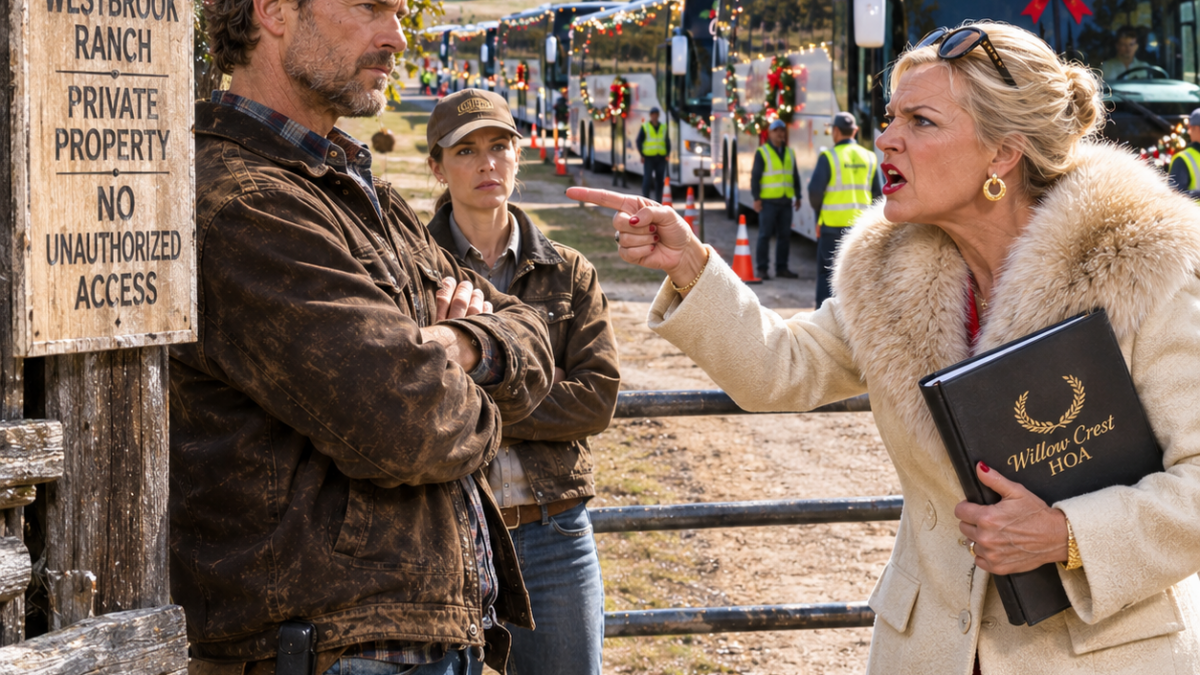
HOA staff were already on my land.
Orange cones.
Reflective vests.
Handheld radios.
Temporary signs.
One pointed toward my equipment shed.
BUS STAGING.
Another:
AUTHORIZED HOLIDAY EXIT.
Authorized by whom?
The first coach turned too sharply near a drainage ditch.
Its rear wheel dropped into the soft shoulder.
Mud sprayed.
The third coach rolled across an irrigation line buried shallow beneath the edge of the meadow.
Roxanne winced.
“That was the west lateral.”
A dull crack came through the ground.
PART3:
Then water began bubbling through the grass.
“Yeah.”
The sixth bus clipped a cedar fence post.
Snap.
Post fell.
I started walking.
Not running.
Roxanne took out her phone.
“You recording?”
“Already.”
That was why I paid her.
The event coordinator stood near the road holding a clipboard.
Young guy.
Maybe twenty-seven.
Bright green jacket.
Headset.
He waved another bus forward.
I stepped into the lane.
“Stop.”
The driver braked.
Coordinator jogged toward me.
“Sir, you can’t stand here.”
“That’s interesting.”
“We need this lane clear.”
“So do I.”
“We have sixteen buses to stage.”
“Not here.”
He looked irritated.
“Sir, this route is approved.”
“By whom?”
“Willow Crest.”
“This isn’t Willow Crest.”
He stared.
I pointed toward the pasture.
“Red Cedar Ranch.”
He opened his clipboard.
“I have the traffic authorization.”
He showed me a map.
Green line.
Willow Crest subdivision.
County road.
Then the green line crossed directly over Red Cedar Ranch.
Label:
AUTHORIZED HOLIDAY BUS EXIT.
At the bottom:
Approved by Willow Crest Estates HOA.
I read it twice.
No landowner signature.
No easement citation.
No county permit.
No lease.
Just an HOA stamp.
“How long have crews been here?”
The coordinator hesitated.
“I don’t know.”
“Who put down that crushed stone?”
“Site prep.”
“Who authorized it?”
“HOA.”
“Who installed those signs?”
“HOA contractor.”
“Who owns the road?”
He looked at the map.
“That’s not really my—”
“Exactly.”
I handed the clipboard back.
“No more buses move deeper onto my property until somebody explains this.”
The coordinator started reaching for his radio.
A white SUV rolled in before he could speak.
Roxanne muttered:
“Here comes the explanation.”
Daphne Lockidge stepped out.
Fifty-one.
HOA president of Willow Crest Estates.
Camel coat.
Leather gloves.
Hair perfect despite the wind.
Daphne had been president for six years.
Eighty-six houses answered to the Willow Crest HOA.
My ranch was not one of them.
Never had been.
Willow Crest sat along my southern boundary.
Its roads, clubhouse, decorative entrance, walking paths, and ridiculous seasonal banners all stopped at the fence.
At least legally.
Daphne had different ideas.
She walked toward me.
“Tobin.”
“Daphne.”
“Why are the buses stopped?”
“Because they’re on my ranch.”
“They’re supposed to be.”
“No.”
She smiled.
Not friendly.
Patient.
Like I had misunderstood a simple instruction.
“The route was approved weeks ago.”
“By me?”
“By the association.”
“The association doesn’t own Red Cedar.”
“You may own the land.”
I looked at Roxanne.
Roxanne raised one eyebrow.
Daphne continued:
“But the right to use this road has belonged to Willow Crest for years.”
“That’s new.”
“It’s documented.”
“Show me.”
She gestured toward the buses.
“Three hundred four guests have paid for tonight’s tour.”
“That doesn’t answer the question.”
“We cannot restructure a commercial transportation plan two hours before departure because you suddenly want attention.”
I almost laughed.
“Suddenly?”
I pointed at the broken irrigation line.
“Your buses arrived fifteen minutes ago.”
Then the snapped fence post.
“Your route damaged my property.”
Then the crushed-stone staging area.
“And somebody built a bus depot in my pasture before telling me.”
She looked toward the damaged pipe.
“It can be repaired.”
“Good.”
“You’ll send the invoice to the association.”
“No.”
Her face tightened.
“No?”
“I’ll send every invoice related to your trespass to whoever is legally responsible.”
“Trespass is a dramatic word.”
“So is sixteen buses.”
She turned toward the event staff.
“Keep loading.”
I stepped closer.
“Daphne.”
She stopped.
“Do not send another commercial vehicle deeper onto this ranch until you show me lawful access.”
Her eyes narrowed.
“If you interfere with tonight’s event, you will be responsible for the losses.”
“Show me the access right.”
She reached into her SUV.
Pulled out a thick envelope.
“Gladly.”
Inside was a document titled:
PERMANENT SHARED ACCESS AGREEMENT.
According to the paper, the owner of Red Cedar Ranch had granted Willow Crest permanent use of the twenty-six-foot private road connecting the subdivision to the county highway.
Broad rights.
Commercial vehicles.
Service access.
Event traffic.
Future infrastructure.
At the bottom:
EDITH WESTBROOK.
My aunt.
Daphne tapped the signature.
“Your family already agreed.”
I did not answer.
Not immediately.
Because my eyes had moved to the date.
May 17, 2024.
Something cold moved through me.
Edith died November 9, 2021.
I knew because I had been sitting beside her.
Daphne was still talking.
“This agreement survived the transfer of the property to you.”
I folded the page.
Put it back in the envelope.
Roxanne watched me.
She had worked with me nine years.
She knew my face.
“What?” she asked quietly.
I shook my head.
“Not yet.”
Daphne mistook my silence for surrender.
“Good. Now move your equipment away from the route.”
“No.”
Her smile vanished.
“You just read the agreement.”
“I did.”
“Then we understand each other.”
“No.”
“Tobin—”
“Red Cedar Ranch is not in Willow Crest.”
“We have access rights.”
“I said no.”
“Then you are obstructing an approved HOA activity.”
She handed me another sheet.
Violation notice.
$24,600.
I looked at the amount.
Then at her.
“You fined me?”
“It’s an enforcement assessment.”
“I’m not a member.”
“Your interference affects association property.”
“My road isn’t association property.”
“You’re becoming unreasonable.”
I held up the notice.
“Show me the covenant allowing Willow Crest to fine a nonmember landowner twenty-four thousand six hundred dollars.”
She did not answer.
Instead, she raised her voice.
Staff turned.
Drivers looked over.
Daphne announced:
“Mr. Westbrook intends to disrupt a Christmas event serving more than three hundred people because he refuses to honor an agreement made by his own family.”
That was calculated.
Not for me.
For the audience.
Selfish rancher versus Christmas.
People understand that story faster than they understand easements.
I refused to play.
“Roxanne.”
“Yes?”
“Photograph everything.”
“Already am.”
“Plates.”
“Done.”
“Pipe.”
“Done.”
“Signs.”
“Done.”
“Staging lot.”
“Done.”
Daphne glared.
“You enjoy this?”
Roxanne smiled.
“I enjoy records.”
Daphne returned to her SUV.
Before leaving she said:
“When those sixteen buses come back tonight, you will stay out of their way.”
I looked toward the iron gate.
Did not answer.
First, I needed facts.
Inside the ranch office, I pulled Edith’s estate file.
Deed.
Probate documents.
Prior title report.
Survey.
Recorded easements.
Nothing.
No shared-access agreement.
No commercial-road easement.
The only historic access involving Willow Crest was a narrow emergency provision at a different point along the southern boundary.
Fire.
Medical.
Emergency only.
Not this road.
Not buses.
I called Miriam Beckner.
Land surveyor.
She had surveyed Red Cedar after Edith died.
“Miriam, I need a records check.”
“On what?”
I gave her the road description.
“Any recorded access in favor of Willow Crest?”
“You have a title dispute?”
“Maybe.”
“What did they show you?”
“I’ll tell you after you check.”
She knew me well enough not to argue.
Forty-seven minutes later, she called.
“Tobin.”
“Yes.”
“There is no recorded shared-access right on that road.”
“You’re sure?”
“I checked the index and parcel history.”
“Nothing?”
“Nothing.”
I closed my eyes.
Across the pasture, engines idled.
This was no misunderstanding.
Someone had built a commercial transportation plan around access they did not possess.
Roxanne came in.
“What did Miriam say?”
“Nothing recorded.”
“And Edith?”
I handed her the agreement.
She read.
Then looked at the date.
Her face changed.
“No.”
“Yeah.”
“Tobin.”
“Not yet.”
“She was dead.”
“I know.”
“Almost three years.”
“I know.”
“You’re being very calm.”
“I’m trying to stay useful.”
We photographed every page.
Front.
Back.
Staples.
Notary block.
Document formatting.
Then I called Brett Ellsworth.
Owner of Mountain Crest Coach Lines.
His company provided the sixteen buses.
He came over irritated.
Understandably.
Christmas Eve.
Three hundred four passengers.
Drivers on overtime.
Detailed schedule.
Now a rancher claimed the route was illegal.
He unfolded the transportation contract on my truck hood.
“Here.”
Attached route map.
Green path.
Legal and approved.
Certification from the event planner.
I placed my survey beside it.
“This green line crosses Red Cedar.”
“Yes.”
“Where’s my authorization?”
Brett searched.
Nothing.
“Maybe separate attachment.”
“Find it.”
He called his office.
Waited.
Listened.
His expression changed.
“Okay.”
Hung up.
“No landowner document.”
“Did anyone tell you this road was private?”
“No.”
“Did your drivers know?”
“No.”
“Then I’m not blaming them.”
He looked toward the buses.
“We’ve already got people loading.”
“I’m not putting three hundred people on the side of the road.”
That surprised him.
“What are you saying?”
“They can leave.”
“You’re allowing the tour?”
“They’re already staged. Passengers didn’t cause this.”
He nodded slowly.
“What about return?”
“That depends.”
“On what?”
“Whether Willow Crest proves lawful access.”
He looked toward Daphne.
“That’s going to be a problem.”
“Then preserve your route instructions.”
“What?”
“Everything.”
“Why?”
“Because if this becomes litigation, your GPS logs may matter.”
Brett stared.
Then took out his phone.
Started forwarding communications to his business email.
Smart man.
Daphne called the sheriff.
Deputy arrived.
She demanded he order me to keep the road open.
He read my deed.
Read the association agreement.
Looked at the map.
Then said:
“This is a civil property dispute.”
Daphne snapped:
“There are more than three hundred guests.”
“Yes, ma’am.”
“This is an approved route.”
“I don’t have authority to adjudicate an easement on the roadside.”
“Then arrest him if he blocks it.”
“No.”
Her face flushed.
The deputy looked at me.
“You planning to physically trap any buses?”
“No.”
“Block occupied vehicles?”
“No.”
“Prevent emergency access?”
“No.”
He looked at Daphne.
“Then you need attorneys.”
She started talking about public safety.
Christmas.
Tourism.
Sponsors.
He listened.
Then left.
At 5:43, the first buses departed for the Christmas lights tour.
Passengers boarded at the staging area on my land.
I hated that.
But I had made a decision.
Not one person would be stranded because Daphne had lied to a transportation company.
Sixteen buses rolled out.
One after another.
Red tail lights disappearing toward the highway.
I watched the last one leave.
Then waited.
Roxanne walked the entire private-road section.
“No pedestrians.”
“No vehicles?”
“Only ours.”
“Any event equipment beyond the gate?”
“No.”
“Emergency lane?”
“Clear.”
I called Brett.
“You have all sixteen buses?”
“Yes.”
“Passengers accounted for?”
“Yes.”
“I’m formally denying future commercial access to Red Cedar Ranch.”
Silence.
“Tonight too?”
“Yes.”
“Where do you want me to take them?”
“Not here.”
He exhaled.
“I have access to the county fairgrounds. Big lot.”
“Permitted?”
“Yes.”
“Safe?”
“Yes.”
“Use it.”
“You’re serious.”
“Send me confirmation in writing that you received the notice.”
He did.
I emailed him the same notice.
Then my attorney.
Then Willow Crest.
Then the event company.
I walked to Edith’s old iron gate.
Closed one side.
Then the other.
Heavy steel met in the center.
Lock.
Click.
Roxanne put up a sign.
PRIVATE RANCH ROAD
NO COMMERCIAL BUS ACCESS
For authorized transport questions:
[number]
No traps.
No bus would be allowed to enter and then get stuck.
Nobody was inside.
Nobody was denied an emergency route.
We had simply closed our own gate before the convoy returned.
I photographed it.
5:58 p.m.
Gate shut.
Lock.
Sign.
Clear roadway.
Daphne called twelve minutes later.
“You opened that gate right now.”
“No.”
“You cannot do this.”
“I did.”
“The buses have to return through there.”
“They’ve been notified not to.”
“You are destroying the entire event.”
“You built the event on property you don’t control.”
“I will sue you for every transportation cost.”
“You’re welcome to send the claim to my attorney.”
“You think this is funny?”
“No.”
I looked toward the broken irrigation pipe.
“I wanted Christmas off.”
She changed tactics.
“This gate creates a public safety hazard.”
“Willow Crest has two lawful entrances.”
“Not for sixteen buses.”
“That’s not public safety.”
“You don’t understand emergency management.”
“I understand that a one-hundred-foot coach is not an ambulance.”
She hung up.
At 7:50, Daphne stood inside the Willow Crest clubhouse wearing a red evening dress.
I learned the details later from footage.
Tables.
Lights.
Stage.
Giant screen.
Donors.
Residents.
Sponsors.
The grand finale was supposed to be spectacular.
Sixteen buses would return through the neighborhood in procession.
The camera crew would capture them rolling beneath Willow Crest’s Christmas arches.
Then the coaches would continue across Red Cedar Ranch and exit to the highway.
A perfect loop.
A perfect demonstration.
At 8:10, no buses.
8:15.
Nothing.
8:20.
Still nothing.
Because all sixteen coaches were sitting at the county fairgrounds.
Three hundred four passengers safe.
Warm.
Confused.
Some angry.
But not stranded.
Brett called Daphne.
“I rerouted.”
“You what?”
“The ranch owner denied access in writing.”
“You have a contract.”
“Our contract does not establish property rights.”
“You were paid to follow the route.”
“I was paid to transport passengers legally.”
Daphne screamed.
“Bring them back.”
“No.”
“Do you understand what this costs?”
“Better than you think.”
Guests started receiving messages.
Fairgrounds.
Alternate pickup.
No procession.
No grand arrival.
Refund questions.
Some people posted videos.
The celebration began unraveling in real time.
Daphne took the microphone.
Blamed me.
Of course.
“A neighboring rancher has chosen Christmas Eve to interfere with access Willow Crest has lawfully held for years.”
People murmured.
“Three hundred guests are being inconvenienced because one man values personal grudges over community tradition.”
Then Brett walked into the clubhouse.
He had driven from the fairgrounds himself.
Asked for the microphone.
Daphne tried to stop him.
He spoke anyway.
“My company was never provided verified landowner permission for the Red Cedar Ranch portion of the route.”
Murmurs.
“Our drivers were redirected because we received written notice from the property owner denying access.”
Daphne snapped:
“We have an agreement.”
She reached into her folder.
The Edith document.
She held it above her head.
“Signed by the Westbrook family.”
That was the mistake.
She made the paper public.
Near the back of the room, Margaret Doyle stared.
Retired schoolteacher.
Longtime Willow Crest resident.
She knew Edith from church.
She remembered the funeral.
Then the clubhouse doors opened.
I walked in.
Roxanne behind me.
Survey.
Damage photographs.
Estate folder.
Daphne looked furious.
“You are not a member.”
“I know.”
“Then you have no right to disrupt this meeting.”
“I’m not here to vote.”
I looked at the page in her hand.
“Read the date.”
“What?”
“The agreement.”
She hesitated.
“Read the date.”
Several residents leaned forward.
Daphne looked down.
“May seventeenth, 2024.”
I nodded.
“And you’re certain Edith Westbrook signed it?”
“Yes.”
“Personally?”
“The document is notarized.”
I opened Edith’s estate folder.
Pulled out a certified death certificate.
Held it up.
“Edith Westbrook died November ninth, 2021.”
Silence.
Absolute.
The Christmas music kept playing quietly through the speakers.
Some instrumental version of Silent Night.
It suddenly sounded ridiculous.
Daphne stared.
One homeowner whispered:
“What?”
I placed the death certificate beside the agreement.
“Nearly three years before that signature date.”
Daphne’s face drained.
“No. That document could have been signed earlier.”
“Then why does the acknowledgment say 2024?”
She said nothing.
“Why does the dated signature block say 2024?”
“It could have been completed later.”
“Then the authorities can examine it.”
I did not accuse her of forgery.
Not there.
Not without forensic proof.
I did not need to.
The contradiction spoke loudly enough.
By Christmas morning, this was no longer a dispute about a locked gate.
Miriam completed a records review.
No commercial bus easement.
No permanent shared-access agreement.
No recorded right matching Daphne’s paper.
She also identified irregularities.
Edith signature inconsistent with exemplars on file.
Notary reference mismatch.
Recording history absent.
She wrote carefully:
Potential authenticity issues should be referred to appropriate authorities.
That was enough.
Then Roxanne found the second map.
One of the traffic signs the HOA had placed on my ranch carried a larger planning diagram on the back.
Not just a Christmas route.
PHASE 2 ACCESS CORRIDOR.
The yellow strip crossed Red Cedar Ranch.
I stared.
“What is Phase Two?”
Roxanne shook her head.
“We’re going to find out.”
The first call came from Sterling Ashby.
Real estate investor.
“Mr. Westbrook, are you permanently refusing access for the hill project?”
“What hill project?”
Pause.
“You haven’t been briefed?”
“No.”
Another pause.
“I think we should meet.”
He sent one page.
Development map.
Luxury lodging project.
Fifty-four units proposed beyond Willow Crest.
Hotel-style cabins.
Event lodge.
Service buildings.
The project needed commercial vehicle access.
Willow Crest’s internal roads were too narrow and winding for regular shuttles and heavy service vehicles.
The proposed solution?
My road.
Red Cedar Ranch.
Listed as:
DELIVERABLE ACCESS CORRIDOR.
Deliverable.
As if Daphne already owned it.
I met Sterling with my attorney.
He brought the draft agreement.
Conditional investment:
$2.7 million.
Access rights and related infrastructure.
No money had been released.
Funding depended on due diligence.
Valid road rights.
Clear authority.
Environmental review.
Approvals.
Sterling looked embarrassed.
“Daphne represented the road as secured.”
“It isn’t.”
“She showed us Edith’s agreement.”
“Edith was dead when it says she signed.”
His face tightened.
“She told us the current ranch owner accepted the historic arrangement.”
“I did not.”
“She said you were difficult but cooperative.”
Roxanne laughed.
I looked at her.
“Sorry.”
Sterling rubbed his forehead.
“Why sixteen buses?”
That question answered everything.
Christmas Eve was a demonstration.
Not merely a tour.
Sixteen large coaches crossing Red Cedar would show the investor that the road could handle heavy recurring traffic.
Photos.
Video.
GPS.
Traffic flow.
Turn radii.
Surface performance.
A live pilot test disguised as a holiday event.
No investor questions a convoy at Christmas.
It looks festive.
Community-approved.
Normal.
Daphne planned to use my road first.
Then point to that use as proof later.
Sterling looked sick.
“I trusted the documents.”
“So did the bus company.”
“I should have verified them independently.”
“Yes.”
He nodded.
No excuses.
That earned my respect.
He called his legal team.
Frozen.
$2.7 million stayed exactly where it was.
Then Phoebe Fenton found the money trail.
Phoebe was fifty-eight.
HOA treasurer.
Careful.
Quiet.
She had balanced Willow Crest’s books for years.
Festival budget included an entry:
EMERGENCY MOBILITY DEMONSTRATION.
$118,000 had been taken from reserve funds and distributed through traffic studies, route preparation, event coordination, and “pilot testing.”
Some invoices came from an event company with personal ties to Daphne.
No clear board resolution.
No normal approval process.
Phoebe searched the meeting minutes.
Nothing.
The Christmas tour had been partly disguised in the association’s books as an emergency mobility experiment.
Why?
Because the road demonstration served the development transaction.
Then came the most damaging document.
Personal guarantee.
In negotiations with Sterling’s group, Daphne had personally guaranteed that the access rights she represented were genuine.
Not merely HOA-backed.
Her guarantee.
If false, she could not simply tell eighty-six homeowners:
You pay.
She had tied herself to the representation.
Then we learned about the report.
Daphne had already sent Sterling a Christmas Eve route-completion report.
Successful demonstration.
Sixteen buses.
Full loop completed.
Road capacity confirmed.
Except it had not happened.
Brett preserved everything.
GPS data.
Dispatch messages.
Reroute notice.
Fairgrounds arrival.
All sixteen buses diverted.
Zero completed the route.
The report was false.
Worse:
Timestamp.
Marked complete before the buses were even scheduled to return.
Not inaccurate after the fact.
Prepared before the result existed.
That was impossible to explain as a misunderstanding.
You cannot truthfully report a successful demonstration before the demonstration is finished.
Brett’s records showed exactly where every coach had gone.
My gate camera showed the closure.
Email showed the notice.
Fairgrounds security showed arrivals.
The paper trail locked together.
If Daphne said buses completed the route:
GPS.
If she denied notice:
Email receipt.
If she claimed legal access:
County records.
If she relied on Edith:
Death certificate.
If she said the route report was based on results:
Timestamp.
Every escape led to another document.
That was the irony.
Daphne had built her authority on paperwork.
Now paperwork was burying her.
She called an emergency HOA meeting.
Tried to declare my road “essential to public safety.”
Phoebe objected.
“Why is a public-safety road part of a private $2.7 million development agreement?”
Daphne refused to discuss confidential negotiations.
Phoebe said:
“Put that refusal in the minutes.”
Daphne glared.
Phoebe repeated:
“Word for word.”
Later, Daphne contacted a contractor about removing my iron gate.
He asked for written property authority.
She could not provide it.
He declined.
My attorney sought a temporary order preventing further unauthorized commercial use of Red Cedar Ranch.
We also referred the questionable documents to the proper authorities.
December 26.
Special Willow Crest meeting.
Packed.
Many residents still blamed me.
They had watched Christmas collapse.
Some paid hundreds for tickets.
Some had family visiting.
Some had spent months planning.
Daphne understood resentment.
She opened with it.
“Tobin Westbrook deliberately locked a road on Christmas Eve.”
I stood when invited.
“Yes.”
That surprised people.
Daphne looked almost pleased.
I continued:
“I closed my gate after every bus had safely left my property.”
Brett nodded.
“I notified the transportation company before any coach returned.”
Another nod.
“All passengers were redirected to a permitted location.”
People shifted.
Then I looked at Daphne.
“I have three questions.”
She crossed her arms.
“First: who gave Willow Crest permission to use Red Cedar Ranch?”
She held up Edith’s document.
I held up the death certificate.
“Second: how did Edith Westbrook sign an agreement in May 2024 when she died in November 2021?”
No answer.
“Third: why is a Christmas lights tour connected to a $2.7 million private development agreement?”
The room changed.
Residents turned toward Daphne.
She said:
“It was a potential opportunity benefiting Willow Crest.”
Phoebe stood.
“Then why wasn’t the board told?”
Daphne snapped:
“Commercial negotiations were confidential.”
Phoebe opened her binder.
“Why did reserve money pay for route preparation?”
No answer.
“Why are there invoices to a company associated with you?”
No answer.
“Where is the authorizing resolution?”
Daphne turned toward the board.
Nobody rescued her.
Brett spoke next.
Transportation data on screen.
Sixteen buses.
Departure.
Rerouting.
Fairgrounds.
No completed loop.
Then he displayed Daphne’s route-completion report.
Timestamp.
Someone in the room said:
“That was written before they came back.”
“Yes,” Brett said.
Miriam explained the land records.
“No recorded commercial access matching the document supplied by the HOA.”
Sterling stood last.
That got everyone’s attention.
He explained the proposed development.
Fifty-four lodging units.
Access dependency.
Conditional $2.7 million.
No money released.
He also confirmed Daphne personally guaranteed that road rights were legitimate.
A resident in the third row stood.
Older man.
He had been one of Daphne’s loudest supporters Christmas Eve.
“Did the board know?”
Daphne looked at him.
“The project could have increased property values.”
“That isn’t what I asked.”
Silence.
“Did we know?”
She looked toward the other board members.
Eyes down.
Nobody spoke for her.
That was the moment Daphne lost the room.
Not when I locked the gate.
Not when I produced Edith’s death certificate.
When eighty-six homeowners realized their president might have exposed their association to risk while pursuing a deal they had never been fully told about.
Phoebe moved to suspend Daphne’s authority where permitted by the bylaws.
Financial review.
Independent counsel.
Document preservation.
Formal removal proceedings.
The measures passed.
Daphne walked out.
People shouted questions.
She did not answer.
Within days, the court issued temporary restrictions preventing unauthorized commercial bus use of Red Cedar Ranch while the dispute was resolved.
The development investors withdrew.
The $2.7 million did not move.
Daphne’s personal guarantee became her own legal problem.
The association audit expanded.
Approximately $118,000 in reserve expenditures connected to the traffic demonstration and related services came under review.
Invoices connected to Daphne’s event company were examined.
Payments were traced.
Some expenses legitimate.
Some questionable.
Some lacking board authorization.
The suspected signature irregularities went to authorities.
No HOA meeting could decide criminal guilt.
That was important.
I wanted facts.
Not a mob.
Audits.
Forensics.
Records.
Real courts.
Over the following months, Daphne was removed as president through Willow Crest’s procedures.
Her event company faced claims related to the failed project and disputed expenditures.
The investor walked away completely.
Financial corrections and repayment agreements followed where appropriate.
Red Cedar Ranch received compensation for property damage we could prove.
Irrigation line.
Fence post.
Surface repairs.
Trampled meadow.
Legal costs associated with protecting the road.
Nothing more.
I did not ask for millions.
I did not “take the HOA.”
I wanted my property fixed.
And my gate respected.
The new Willow Crest board came to see me in spring.
Phoebe was among them.
Different president.
Different tone.
“We want to discuss emergency access.”
“You already have lawful emergency access elsewhere.”
“Yes.”
“We’re not asking for commercial use.”
“Good.”
“We want to explore whether a clearly written contingency route could help fire response.”
I looked toward the road.
“Temporary?”
“Emergency only.”
“No buses?”
One board member smiled.
“No buses.”
“No development rights?”
“No.”
“No event traffic?”
“No.”
“Everything in writing?”
“Yes.”
“County reviewed?”
“Yes.”
“Insurance?”
“Yes.”
I nodded.
“I’ll consider it.”
They looked relieved.
Then I added:
“One condition.”
The new president waited.
“Nobody ever describes this road as association property.”
“Agreed.”
That was how adults should handle land.
Ask.
Write it down.
Define limits.
Pay if necessary.
Respect no.
Simple.
Spring thaw came.
Roxanne and I repaired the pasture.
New irrigation section.
Fence post reset.
Gravel graded.
We removed the last Christmas-tour sign from behind the equipment shed.
She carried it toward the trash.
AUTHORIZED HOLIDAY BUS EXIT.
She looked at me.
“Want to keep this?”
“No.”
“Evidence?”
“Copies exist.”
“Bonfire?”
“No.”
“You’re no fun.”
“Correct.”
Months later, she brought me the final audit summary.
I put it in the drawer beside Edith’s estate papers.
The irony was not lost on me.
Daphne had tried to use Edith’s name to take control of the road.
Now Edith’s death certificate sat beside the audit that helped prove why the claim failed.
I pulled out her funeral program once.
November 2021.
Her photograph.
Gray hair.
Old blue sweater.
The woman who taught me what a gate meant.
I thought about the signature.
Someone had taken the name of a dead woman and made her supposedly surrender something she had protected for decades.
That angered me more than the buses.
More than the broken pipe.
More than the $24,600 fake fine.
Land is not just dirt.
Sometimes it is memory with a legal description.
The final Christmas that Daphne lived in Willow Crest came quietly.
No grand tour.
No sixteen buses.
No transportation demonstration.
She sold her house within the next year.
Neighbors said she left early one gray morning.
One moving truck.
No farewell meeting.
No speech.
I did not watch.
Roxanne told me later.
“Any regrets?”
“About?”
“Locking the gate.”
“No.”
“Lawsuit?”
“No.”
“Ruining Christmas?”
I looked at her.
“I didn’t ruin Christmas.”
“I know.”
“I closed my gate.”
“I know.”
“The passengers were safe.”
“I know.”
“The bus company was warned.”
“I know.”
“Then stop saying I ruined Christmas.”
She smiled.
“I wanted to hear you say it.”
The old iron gate still stands.
Most days it is open while we work.
Cattle trucks come through.
Feed deliveries.
Veterinarian.
Utility crews.
Friends.
People with permission.
That is what Daphne never understood.
A private gate is not automatically hostile.
It is a question.
Do you have permission?
Sixteen tour buses arrived with an answer nobody had asked me to give.
They assumed yes.
Why?
Because someone with an HOA title said so.
Because a map looked official.
Because a signature looked real.
Because the event was already sold.
Because 304 guests were already coming.
Because Christmas created urgency.
Because everyone believed it would be easier for the rancher to surrender than for them to redesign the plan.
That logic works more often than people admit.
Build the pressure first.
Then ask permission after refusal becomes expensive.
Daphne thought sixteen buses were leverage.
They became evidence.
She thought a Christmas tour would establish history.
Instead, the GPS proved the route failed.
She thought Edith’s signature would end the argument.
The date started a much larger one.
She thought the locked gate was the problem.
The gate was never the problem.
The paper was.
Christmas Eve exposed a development scheme built around a road the association had no verified right to sell.
The proposed $2.7 million payment depended on access that never belonged to Willow Crest. The tour buses were meant to demonstrate that the private ranch road could carry heavy vehicles, while the supposed agreement supporting that access bore Edith Westbrook’s signature dated almost three years after her death.
By the end, all sixteen buses were safely rerouted.
Not one passenger was trapped behind my gate.
Nobody slept on a bus.
Nobody was abandoned in the cold.
Nobody lost access to an ambulance or fire truck.
What got trapped was something else.
A lie.
A lie that needed my road open long enough to become convincing.
When I closed the gate, people finally asked why the route depended on land nobody in Willow Crest owned.
That question led to another.
Then another.
Who signed the agreement?
When?
Why was a dead woman’s name on it?
Why did the Christmas-tour map resemble a development map?
Why did reserve money pay for a “mobility demonstration”?
Why was a successful route report completed before the buses returned?
Why did the president personally guarantee access rights to investors?
And why had none of the homeowners been told?
Daphne Lockidge had sixteen buses, 304 paying guests, an HOA presidency, a polished contract, and a multimillion-dollar deal waiting on the other side.
I had one iron gate.
But the gate was standing on land I actually owned.
And sometimes that is enough.
Not because a gate makes you powerful.
Because it forces everyone to stop pretending they don’t know where the property line is.
Daphne believed she could turn repeated trespass into proof of ownership.
Instead, sixteen Christmas buses created a record showing exactly what she had tried to do.
All I did was close the gate before they came back.
The rest was paperwork.








