HOA Security Harassed My Family for 18 Months—Then My Grandfather Raised His Private Bridge and Left Their Security Chief Stranded Overnight
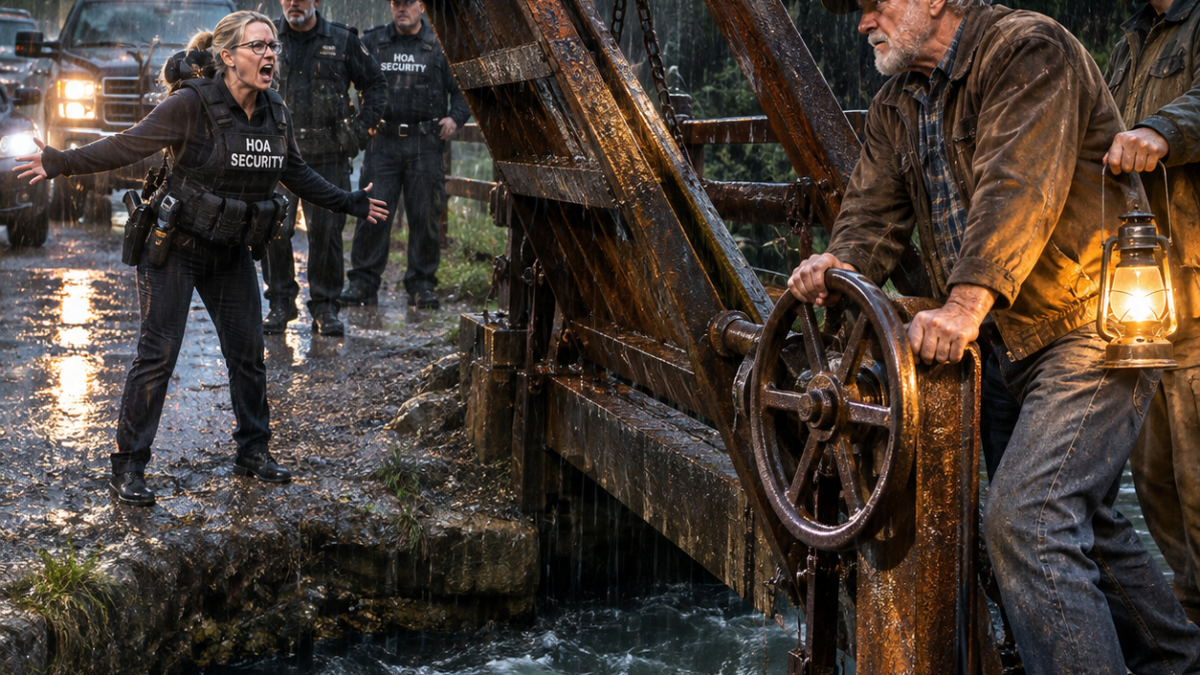
HOA Security Harassed My Family for 18 Months—Then My Grandfather Raised His Private Bridge and Left Their Security Chief Stranded Overnight.
For eighteen months, the HOA’s private security chief treated my grandfather’s Virginia farm like conquered territory, blocking our gate, photographing our workers, and zip-tying violation notices to a fence that had stood there before her entire neighborhood existed.
What she never bothered to learn was that the only convenient western route back to those 240 houses crossed a steel drawbridge my grandfather had built with his own hands—and an old county document gave him the legal right to raise it whenever legitimate maintenance required.
Then, on a freezing October night with rain hammering the creek and her black security truck sinking into the mud, the woman who had spent a year and a half telling us where we could stand finally discovered what it felt like to be trapped by a boundary she had ignored.
The first notice appeared on a Tuesday morning in March.
Grandpa found it zip-tied to the fence beside our mailbox.
Bright yellow.
Laminated.
HARWICK PINES COMMUNITY SECURITY.
PROPERTY VIOLATION NOTICE.
He stood beside the gravel road reading it while steam rose from the coffee mug in his left hand.
Corkran Hayes, who had worked our farm for twenty-seven years, was stacking oak boards near the truck shed.
“What’s it say?” Corkran called.
Grandpa didn’t answer immediately.
He read the notice twice.
Then he looked over his glasses toward the walnut grove.
The violation concerned Corkran’s lumber stack.
Specifically, the notice said it constituted “unsightly exterior material visible from a community corridor.”
The proposed corrective action was removal within seventy-two hours.
Failure to comply could result in “further enforcement.”
Grandpa looked at the lumber.
Then the fence.
Then the neighborhood half a mile north.
He took one sip of coffee.
“What community?”
Corkran laughed.
“That’s what I asked her.”
“Her?”
“Security woman.”
“Which one?”
PART2:
“The one who looks like she’d issue God a parking ticket.”
Grandpa smiled.
That meant Ranata Feain.
I met her three weeks later.
By then she had already decided our family had become her problem.
My name is Petra Drexel.
At the time, I was forty-two and working in Richmond as a senior paralegal for a commercial property firm.
Which meant I spent my days reading contracts people swore they had read before signing.
Mostly, they hadn’t.
I grew up on Drexel Farm in Harwick County, Virginia.
Thirty-four acres.
Walnut trees.
An old farmhouse.
Machine sheds.
A creek called Sallow Run.
And one bridge.
The bridge mattered more than any of us understood when the trouble began.
Grandpa Wendell Drexel bought the property in 1951.
He was twenty-two.
Fresh out of the Army.
Thin as a fence rail.
PART3:
Too stubborn to know when something was impossible.
The farm wasn’t really a farm yet.
It was timber, mud, scrub pasture, and a collapsed tobacco shed.
Sallow Run cut the property in half.
There was a county culvert then, narrow and unreliable.
Grandpa cleared land.
Built fences.
Raised a farmhouse board by board.
Planted the walnut grove.
Put up the truck shed.
Raised cattle.
Repaired machinery for neighbors when harvest money got thin.
By the time I was a child, every piece of that place had a story attached to it.
The kitchen table had knife marks from Christmas hams.
The back porch sagged because Grandpa refused to replace one beam he claimed had “another decade in it.”
The truck shed smelled like pine tar, diesel fuel, welding smoke, and cold steel.
To me, that smell meant home.
In 1987, a flood washed out the county culvert over Sallow Run.
For weeks, getting from one side of the property to the other required a seven-mile detour.
Grandpa had spent thirty years by then working structural jobs for the Army Corps of Engineers.
He looked at the creek.
Looked at the washed-out crossing.
Then built a bridge.
Not a little farm bridge.
A real structure.
Steel I-beams.
Hand-welded trusses.
Plank deck.
Reinforced concrete footings.
And because Sallow Run occasionally rose fast enough to throw debris against anything permanent, he designed the central span to lift.
The system used a manual hydraulic crank.
Primitive by modern standards.
Reliable by every standard that mattered.
I grew up listening to Grandpa tell people:
“If the lights go out, the bridge still works.”
The county later recorded a public road easement allowing passage across the approach road.
But the bridge itself remained on Drexel property.
Every beam.
Every bolt.
Every plank.
Grandpa maintained it.
Grandpa inspected it.
Grandpa carried the liability.
That distinction had existed in county records for decades.
For most of my life, nobody cared.
The road went nowhere important.
A few neighbors used it.
Mail carrier.
Farm trucks.
Hunters during deer season.
Then developers arrived.
Stone Brook Properties broke ground in 2018.
Two years later, Harwick Pines existed.
Two hundred forty homes.
Perfect lawns.
Stone entrance monuments.
A clubhouse.
Walking trails.
Decorative streetlights.
Rules about mailbox paint.
Rules about fence height.
Rules about trash cans.
Rules about flags.
Rules about sheds.
Rules about rules.
The subdivision had two official exits.
The eastern entrance connected directly to the state highway.
The western side connected to an older county road that ran along our fence and crossed Grandpa’s bridge.
That route shaved nearly eleven minutes off the morning commute for people headed west.
At first, we didn’t care.
Residents drove through.
School buses crossed.
Delivery trucks.
Contractors.
Soccer parents.
Nobody asked permission because the public road easement allowed ordinary passage.
Nobody needed permission.
Then Harwick Pines created a private security unit.
Harwick Pines Community Security.
HPCS.
Black Ford F-250s.
Magnetic door logos.
Roof lights.
Uniform shirts.
Tactical-style vests.
Radios.
No police authority.
That last detail eventually became important.
Ranata Feain became their director.
Fifty-one years old.
Wire-rimmed glasses.
Short brown hair.
Precise posture.
A voice that could sound almost friendly while telling you something absurd.
She had worked private security most of her adult life.
Her problem wasn’t laziness.
It was the opposite.
Ranata loved rules.
More accurately, she loved the moment another person discovered she knew a rule they didn’t.
She issued 140 warnings inside Harwick Pines during her first six months.
Wrong mulch color.
Basketball hoop left out overnight.
Trash can visible from side street.
Wind chimes not approved by architectural committee.
One homeowner received a notice because his Christmas wreath remained on the door until January 11.
If Ranata had stayed inside Harwick Pines, none of that would have involved us.
She didn’t.
The first time Corkran confronted her, she was standing beside our fence attaching the yellow notice.
He asked, “You lost?”
She looked at him.
“No.”
“This isn’t Harwick Pines.”
“This corridor serves Harwick Pines.”
“That’s a county road.”
“We maintain security interests along the entire western approach.”
Corkran stared.
“What does that mean?”
Ranata adjusted her glasses.
“This entire corridor is now within our community’s jurisdiction.”
Corkran laughed so hard he had to put down the board he was carrying.
She didn’t.
“Ma’am.”
He pointed at the fence.
“That post was here when half your homeowners were in diapers.”
“That doesn’t exempt it from standards.”
“Whose standards?”
“Community standards.”
“This ain’t your community.”
She wrote something on her clipboard.
“Your cooperation would make this easier.”
Corkran smiled.
“I did two tours in Vietnam.”
She paused.
“So?”
“Nothing.”
He picked up the board.
“Just saying I’ve had worse Tuesdays.”
She left.
That evening Grandpa came home, found the notice, and called me.
“Petra.”
“Hi, Pop.”
“I need you to come home Friday.”
“What happened?”
“I’ve been issued a violation.”
I laughed.
“You joined an HOA?”
“No.”
“Then how?”
“That’s the interesting part.”
I drove down Friday evening.
Blue Ridge foothills on one side.
Autumn smoke in the distance.
Dry leaves skittering across Route 11.
By the time I pulled onto our county road, dusk was settling over the walnut trees.
Ranata’s black F-250 was parked near our gate.
Not blocking it.
Not quite.
She sat inside.
Engine running.
I slowed.
She lifted a camera.
Photographed my license plate.
I stopped.
Rolled down my window.
“Can I help you?”
She approached.
“Are you associated with this property?”
“I’m the granddaughter.”
“Name?”
“Why?”
“For our records.”
“You don’t need records on me.”
Her eyes narrowed.
“This road is under enhanced community monitoring.”
“By who?”
“Harwick Pines Community Security.”
“I’m not in Harwick Pines.”
“This corridor impacts community safety.”
“That’s not an answer.”
She wrote something.
“Name?”
“Have a nice evening.”
I drove through the gate.
Grandpa stood on the porch holding coffee.
Of course.
He watched the black truck leave.
“You met her.”
“I did.”
“Charming.”
“She’s collecting license plates.”
“I know.”
“You know?”
“Trail camera.”
He pointed toward the fence.
There it was.
Browning Strike Force.
Camouflaged housing.
Bolted to an oak post.
“You already installed surveillance?”
“Documentation.”
“How long?”
“Eighteen days.”
I stared.
“Why didn’t you tell me?”
“You were busy.”
“Pop.”
He smiled.
“I knew you’d come eventually.”
Inside, three notices lay on the kitchen table.
First:
Lumber storage.
Second:
NON-CONFORMING AUXILIARY STRUCTURE.
That meant Grandpa’s tool shed.
Built in 1989.
Third:
UNRESTRAINED CANINES IN COMMUNITY VISUAL BUFFER.
Our dogs had been inside our own fenced pasture.
I read all three.
Then looked at Grandpa.
“These are nonsense.”
“I know.”
“You’re not in the HOA.”
“I know.”
“Why are you smiling?”
He opened a manila folder.
On the tab he’d written:
FEAIN MATERIAL.
Inside:
Certified copy of the 1953 road easement.
Trail camera timestamps.
License plate photographs.
Copies of every notice.
A written complaint to the sheriff’s office.
I looked at him.
“You started before calling me.”
“I didn’t raise a fool.”
“You raised my mother.”
“Same principle.”
I read the easement.
Four pages.
Typewritten.
Old county language.
The right granted:
Passage over the described roadway.
Nothing about property adjacent to it.
Nothing about enforcement.
Nothing about security.
Nothing about landscaping.
Nothing about control of the bridge.
“This kills her notices.”
“Probably.”
“Not probably.”
I tapped the document.
“She has no jurisdiction.”
“Good.”
“Then send her a cease-and-desist.”
Grandpa shook his head.
“Not yet.”
“Why?”
“I want to know how far she’ll go.”
That worried me.
“Pop, don’t play games with her.”
“I’m not.”
“What are you doing?”
“Reading.”
That was how Grandpa fought.
He read.
He waited.
Then he moved once.
Ranata didn’t wait.
The notices multiplied.
She started driving past the farm three times a day.
Sometimes four.
She photographed the shed.
The gate.
Tractors.
Dogs.
Walnut trees.
She filed an encroachment complaint with the county claiming our fence sat fourteen inches inside the public road easement.
Her theory was obvious.
If she could establish our fence line encroached onto the road easement, she could claim an expanded security interest.
It was legally ridiculous.
But bureaucracy doesn’t have to be right to cost money.
Grandpa received certified mail requiring a survey.
I called furious.
“She’s making you pay for a survey now?”
“Yes.”
“Let me contact counsel.”
“No.”
“Why?”
“I contacted Thad.”
Thad Grimshaw had served with Grandpa in the Corps.
Seventy-eight now.
Still licensed as a land surveyor because retirement, according to Thad, was “what men say when they’re bored of earning money.”
He arrived Saturday.
Tripod.
Total station.
Orange markers.
Spent four hours measuring.
Ranata drove by twice.
The second time she stopped.
“What are you doing?”
Thad didn’t look up.
“Surveying.”
“Under whose authority?”
“Virginia.”
She frowned.
“I represent Harwick Pines.”
“Congratulations.”
Corkran laughed from the shed.
When Thad finished, he spread his map across Grandpa’s kitchen table.
Ranata had been wrong.
Our fence didn’t extend fourteen inches into the easement.
It sat fourteen inches inside our own surveyed boundary.
We actually controlled more roadside land than everyone assumed.
Grandpa nodded.
Then asked:
“Thad.”
“Yeah?”
“Run the bridge.”
“What?”
“Coordinates.”
Thad looked at him.
Then smiled.
“You’re finally curious.”
“Been curious forty years.”
They went back outside.
The result came that afternoon.
Every structural element of the Sallow Run Bridge sat within the Drexel parcel.
Approach road easement crossed it.
But the bridge was ours.
I read the survey twice.
Then the easement.
Again.
“Pop.”
He looked over.
“This says the county has passage.”
“Yes.”
“It doesn’t say the county owns the bridge.”
“No.”
“It doesn’t even define maintenance responsibility.”
“Keep reading.”
I did.
Then found it.
The easement was conditional upon continued operability of the crossing “as maintained by the property owner.”
I looked up.
“Maintained by you.”
Grandpa sipped coffee.
“Seems so.”
“You can close it for legitimate maintenance.”
“Seems so.”
“Pop.”
“What?”
“Stop smiling.”
Ranata escalated in May.
The weather became hot and humid.
Creek water turned low and warm.
Harwick Pines residents began spending weekends at the pool.
Ranata began speaking about us publicly.
Not in official notices.
In conversations.
At mailboxes.
At the clubhouse.
In parking lots.
She described Drexel Farm as an “unresolved liability corridor.”
She called Grandpa “uncooperative.”
She suggested our property lowered values.
One resident, Dorsey Mills, later told me Ranata said:
“Eventually older rural parcels have to adapt to the communities growing around them.”
That sentence bothered Grandpa more than anything else.
Not because he hated development.
He didn’t.
He had built roads and bridges his entire life.
He understood growth.
What he hated was the assumption that age made ownership temporary.
Then Ranata started following Corkran.
The first time, he was driving into town for hydraulic fluid.
Her F-250 pulled alongside.
Matched his speed.
She stared through the passenger window.
Corkran stared back.
Twenty seconds.
Thirty.
One minute.
Then she accelerated away.
Corkran called Grandpa.
“Your little sheriff’s bored.”
“She’s not a sheriff.”
“I know.”
“Don’t antagonize her.”
“I smiled.”
“That’s antagonizing enough.”
The second time, Ranata followed him nearly four miles.
Corkran pulled into a gas station.
She continued.
That crossed a line for me.
I pulled HPCS corporate records.
Then the HOA charter.
The charter defined the security team’s authority precisely.
Inside the recorded Harwick Pines plat.
Full stop.
No adjacent corridors.
No county roads.
No neighboring parcels.
Ranata’s authority ended at the subdivision boundary.
Every notice she had issued us was legally meaningless.
I called Grandpa.
“Pop.”
“Yeah?”
“She has zero authority outside the plat.”
“I figured.”
“You knew?”
“Suspected.”
“Why didn’t you say that?”
“I wanted you to confirm.”
I rubbed my forehead.
“You’re impossible.”
“Keep reading.”
So I did.
I searched Ranata’s employment history.
Two prior civil complaints.
Fredericksburg.
Private security company.
Both settled.
The allegations were disturbingly familiar.
Targeting older property owners near development access roads.
Aggressive documentation.
Repeated visits.
Claims of authority outside contracted boundaries.
One case involved a developer attempting to pressure an elderly couple into selling a strip of land.
The second involved access to a service road.
I printed both.
New folder.
HISTORY.
Grandpa called it “interesting.”
I called it pattern evidence.
By July, Harwick Pines residents began noticing that Ranata’s obsession with us affected them.
Whenever she parked along the western county road to photograph our property, traffic backed up.
The route was narrow.
People waited.
School pickup.
Delivery drivers.
Soccer carpools.
Morning commuters.
Twenty minutes.
Sometimes forty.
Complaints began reaching the HOA board.
Board chair Wilfred Hollis was a retired pediatric nurse.
Sixty-seven.
Direct.
Unsympathetic to drama she had not personally authorized.
She called Ranata into a closed meeting.
I only know what happened because Wilfred later told us.
She asked Ranata:
“What exactly are you enforcing outside the plat?”
Ranata placed a folder on the table.
Inside were:
The dismissed noise complaint against Grandpa’s tractor.
The failed encroachment complaint.
Her own photographs.
And a handwritten page titled:
ONGOING LIABILITY ASSESSMENT.
Wilfred read it.
Then looked at her.
“This is a note you wrote.”
“It’s a working assessment.”
“It’s handwriting.”
“Documentation doesn’t have to be digital.”
“Ranata.”
Wilfred pushed it back.
“Stop operating outside the community unless counsel confirms authority.”
Ranata nodded.
Then ignored her.
The tractor complaint came next.
Grandpa’s 1978 John Deere 2440.
Ranata claimed it violated residential noise limits.
The county called him in.
He wore his good shirt.
Brought maintenance records.
Owner’s manual.
Manufacturer noise ratings.
Photographs.
The compliance officer studied everything.
Then asked:
“Mr. Drexel, how long have you operated this tractor?”
“Forty-five years.”
“Has it become louder?”
“No.”
“Do you operate at night?”
“No.”
“Before seven?”
“Not near residences.”
The officer closed the file.
“Complaint dismissed.”
Eleven minutes.
Grandpa drove home.
Ranata never attended.
That became her pattern.
File complaint.
Force inconvenience.
Disappear before consequences.
Then came the gate proposal.
Ranata convinced two board members Harwick Pines needed a retractable security gate at the western entrance.
Not across our bridge.
Inside Harwick Pines.
But positioned so anyone using the western route would pass through an HPCS-controlled checkpoint.
That was what she wanted.
Control.
She called it security.
The location sat inside a designated scenic corridor.
My mother, Priscilla Drexel, spent nineteen years on the county planning commission before retiring.
Grandpa called her.
She read the proposal.
Then the scenic corridor ordinance.
“Special use permit.”
I smiled.
“How long?”
“Minimum ninety days.”
“Public hearing?”
“Yes.”
“Environmental review?”
“Likely.”
Grandpa leaned back.
“Good.”
Mom looked at him.
“What are you planning?”
“Nothing.”
She looked at me.
“Petra?”
“Also nothing.”
“You both have terrible lying faces.”
By then, Grandpa had found the bridge maintenance clause.
I asked the question carefully.
“Is the lift mechanism actually due for service?”
Grandpa looked toward the shop.
“It was installed in 1987.”
“That’s not an answer.”
“Hydraulic seals should’ve been rebuilt five years ago.”
“Does it still work?”
“Perfectly.”
“Would real maintenance require the bridge to remain raised?”
“If I service the cylinder, pressure valve, pivot pins, and crank housing?”
“Yes.”
“Absolutely.”
“How long?”
“Overnight would be sensible.”
I stared at him.
He stared at me.
“No.”
“What?”
“You’re enjoying this.”
“I enjoy maintenance.”
“Sure.”
The most important discovery came in September.
I took a day off work and drove to the county records room.
Basement of the old courthouse.
Fluorescent lights.
Dust.
Bound ledgers.
Microfilm equipment nobody under fifty knew how to operate.
I requested the original Stone Brook Properties development file.
Three boxes.
Inside the second box, I found a 2017 application.
PERMANENT SECONDARY ACCESS EASEMENT — SALLOW RUN BRIDGE.
I stopped.
The developer had formally requested rights to use Grandpa’s bridge as an official secondary access route.
The county reviewed it.
Then denied it.
Reason:
Private structural ownership.
Insufficient authority to dedicate crossing.
Alternative eastern access available.
Stone Brook revised its site plan.
Used the eastern exit.
Moved on.
Harwick Pines residents were never told.
Neither was Ranata.
Or maybe she simply never bothered checking.
Either way, it meant Harwick Pines had no formal right to the bridge beyond the same ordinary public passage available to everyone else.
No special status.
No ownership.
No emergency access entitlement.
Nothing.
Then I found something else.
A 2021 financial filing.
Harwick Pines had transferred $47,000 from restricted capital reserves to cover legal expenses related to an unrelated contractor dispute.
The HOA’s own charter prohibited that.
Another weakness.
Another document.
Another folder.
I called Grandpa from the courthouse parking lot.
“I found their old bridge application.”
“What happened?”
“Denied.”
Silence.
Then:
“They knew?”
“Developer knew.”
“Why?”
“Private bridge. Alternative route available.”
“Good.”
“There’s more.”
I explained the reserve issue.
Then Ranata’s prior cases.
Then the security boundary.
Then the scenic corridor permit.
When I finished, Grandpa asked one question.
“So if I close the bridge for documented maintenance…”
“They have no special legal standing to challenge it.”
“County?”
“Easement allows reasonable closure if necessary for actual maintenance.”
“Emergency vehicles?”
“East route remains available.”
“How long?”
“Reasonable period.”
He was quiet.
“One night?”
“With legitimate work and proper notice?”
“Yes.”
“Probably.”
“Probably isn’t enough.”
“I’ll get counsel.”
Grandpa had an old friend named Arthur Holbrook.
Retired contracts attorney.
He reviewed everything.
Survey.
1953 easement.
2017 denial.
Maintenance plan.
County notice requirements.
He called two days later.
“Wendell.”
“Yes?”
“I hate how pleased you sound.”
“Is it legal?”
“Annoyingly.”
“Completely?”
“Document the maintenance.”
“I always do.”
“Post notice.”
“I will.”
“File with county.”
“I will.”
“Don’t close access longer than necessary.”
“I won’t.”
“Don’t taunt anybody.”
Grandpa sounded offended.
“I am seventy-four years old.”
“You’ve been taunting people since Eisenhower.”
Grandpa was actually ninety-five by then, but Arthur had apparently stopped updating his mental picture sometime around 2005.
The night we chose was the last Saturday of October.
Harwick Pines annual fall assessment meeting.
Ranata’s gate proposal was on the agenda.
She always attended.
She always used the western road home.
Grandpa filed bridge maintenance notice Monday.
Closure:
Saturday 9:00 p.m. through Sunday noon.
He posted it Wednesday.
Large laminated notice.
Visible from both directions.
BRIDGE CLOSED FOR SCHEDULED STRUCTURAL AND HYDRAULIC MAINTENANCE.
ALTERNATE ROUTE VIA HARWICK PINES EAST ENTRANCE.
County acknowledged receipt.
Sheriff’s office received notice.
Everything clean.
Everything documented.
Then Ranata found out.
Thursday evening, she drove to the farm.
Grandpa was on the porch.
She walked to the bridge.
Photographed the notice.
Walked back.
“This won’t hold up.”
Grandpa sipped coffee.
“Evening, Ranata.”
“You are deliberately obstructing a community access route.”
“I’m servicing my bridge.”
“You cannot close a public road.”
“The road isn’t closed.”
“The bridge is.”
“Exactly.”
“Same thing.”
“No.”
“The HOA attorney will seek emergency relief.”
“Tell him to call Arthur Holbrook.”
“You think this is funny?”
“No.”
He looked toward the bridge.
“Hydraulic seals are serious business.”
She stepped closer.
“You are doing this because of me.”
Grandpa looked at her.
“Ranata.”
His voice was gentle.
“This bridge has needed service longer than you’ve lived in Virginia.”
She left angry.
Her attorney, Charles Sprig, called me Friday.
Professional.
Very careful.
“We are evaluating legal options regarding the bridge closure.”
“I can email the 2017 denied access application.”
Silence.
“What application?”
I smiled.
“Stone Brook Properties sought permanent secondary access across Sallow Run Bridge before development approval.”
“Outcome?”
“Denied.”
Long pause.
“Send it.”
I did.
He never called back.
He called Ranata.
Told her there was no basis for emergency relief.
The bridge was privately owned.
Maintenance closure valid.
Alternative access existed.
Use the east exit.
And tell the board.
Ranata did not tell the board.
That decision destroyed her more completely than anything Grandpa planned.
Saturday arrived gray.
Rain forecast after nine.
Grandpa spent the afternoon in his shop.
He had ordered a genuine hydraulic rebuild kit.
Seals.
Bushings.
Pressure relief components.
Grease fittings.
Pins.
He documented everything.
Photographs before disassembly.
Serial numbers.
Condition notes.
Measurements.
Army Corps habits never left him.
At 5:00, I arrived with coffee.
At 6:30, Corkran came.
At 7:15, my mother.
At 8:00, reporter Sylvia Ortega parked near the eastern farm road.
That had been my idea.
Grandpa initially objected.
“I don’t want a circus.”
“I want a witness.”
“We have county paperwork.”
“Ranata controls the story inside Harwick Pines.”
He thought.
Then nodded.
Sylvia worked for the Harwick County Courier.
Small weekly paper.
Serious reporter.
She had covered development disputes before.
I told her:
“Property rights. Bridge. Raincoat recommended.”
She came.
The rain started at 8:47.
Sideways.
Cold.
Hard.
It struck the metal shop roof so loudly we had to raise our voices.
Grandpa wore an old waxed canvas slicker.
Brown.
Stiff.
Older than me.
At 8:55, he walked toward the bridge.
I followed halfway.
Sallow Run churned dark beneath the planks.
Fallen leaves spun along the banks.
Rain silvered the steel rails.
Grandpa inserted the crank handle.
Released hydraulic pressure.
Engaged the lift.
The bridge moved.
Slowly.
Steel groaned.
Deck boards rose.
Twenty-eight feet of bridge tilted toward the black sky.
At forty-five degrees, Grandpa locked the safety pin.
Removed the crank.
Checked the mechanism.
Then recorded the time in his maintenance notebook.
9:02 p.m.
Corkran stood nearby holding a lantern.
Grandpa looked at him.
“She’s up.”
Corkran nodded.
“Yep.”
We walked back to the shop.
No one celebrated.
That mattered.
Because this wasn’t supposed to be a prank.
The maintenance was real.
The closure was legal.
If Ranata simply used the eastern exit, nothing dramatic would happen.
At 9:34, headlights appeared across the creek.
Black F-250.
HPCS logo.
Ranata.
She stopped.
Headlights swept across the raised bridge.
For nearly a minute, she remained inside.
Then she got out.
Rain hit her instantly.
She wore her tactical vest over a dark jacket.
She walked toward the railing.
Read the maintenance sign.
Looked at the raised span.
Then toward our side.
Grandpa stood beneath the shop awning holding coffee.
Ranata pulled out her phone.
Called her attorney.
We learned later Sprig answered from home.
She demanded an emergency injunction.
He told her there was no basis.
Use east exit.
She called county roads.
After-hours recording.
She called sheriff dispatch.
Properly filed maintenance closure.
Civil infrastructure matter.
Use alternate route.
Another car arrived behind her.
Then another.
A retired civil engineer named Borland stepped out.
Umbrella immediately inverted in the wind.
He cursed.
Walked to the notice.
Read it.
Ranata said, “This closure is unlawful.”
Borland read the notice again.
“County filing number’s right here.”
“He’s obstructing community access.”
“Eastern exit works.”
“That’s not the point.”
Borland looked at the raised bridge.
“Looks like maintenance.”
Then returned to his car.
He turned around.
That should have ended it.
It didn’t.
Ranata tried to turn her F-250 around on the narrow rain-soaked shoulder.
Rear wheel slipped.
Then another.
The truck slid sideways.
Mud swallowed the rear tires.
She accelerated.
Mud sprayed.
Truck sank deeper.
Now she partially blocked the road.
Two cars behind her couldn’t turn.
Another arrived.
Hazard lights began blinking through the rain.
Orange.
Orange.
Orange.
Sylvia lifted her camera.
The image practically took itself.
Black security truck sunk in mud.
Raised bridge in background.
Maintenance notice illuminated by headlights.
Rain pouring.
Grandpa under a waxed coat.
The symbolism was so heavy I almost felt guilty.
Almost.
At 10:11, Ranata walked to the creek bank.
“LOWER THIS BRIDGE!”
Grandpa stepped closer.
“It’s under maintenance.”
“I am not asking.”
“I know.”
“You are unlawfully trapping residents.”
“East exit is open.”
“You did this deliberately.”
“I filed Monday.”
“Lower it.”
“Can’t.”
“Why?”
“Hydraulic cylinder seals need to cure.”
“You expect me to believe that?”
“I expect the maintenance log to matter more than your belief.”
She pointed toward us.
“I will have you arrested.”
Grandpa looked toward the notice.
“Deputy Mabry has a copy of the closure.”
Ranata froze.
Grandpa continued.
“The county has one too.”
“You have no right to close a public access route.”
“This isn’t your access route.”
Her face tightened.
“It serves Harwick Pines.”
“Your developer applied for formal rights in 2017.”
Silence.
“They were denied.”
The rain filled the gap between them.
“What?”
Grandpa’s voice stayed calm.
“County records basement.”
He pointed vaguely toward town.
“Stone Brook Properties development file.”
Ranata stared.
“You’re lying.”
“No.”
“I have never seen such a denial.”
“That’s not the same thing.”
Her shoulders shifted.
It was subtle.
But from our side of the creek, I saw it.
Confidence recalculating.
At 10:42, Deputy Hannah Mabry arrived.
She parked on our side.
Reviewed the notice.
Looked at Grandpa’s maintenance log.
Checked the county filing.
Spoke with Sylvia.
Then with Borland.
She eventually reached the opposite bank by a narrow downstream footpath above the creek.
She spoke with Ranata for several minutes.
We couldn’t hear.
But we watched.
Ranata’s posture changed.
She stopped pointing.
Stopped waving.
Stopped performing.
Mabry returned.
“Mr. Drexel.”
“Deputy.”
“Everything appears in order.”
“Thank you.”
“County confirmed filing.”
Grandpa nodded.
“Coffee?”
She laughed.
“No, sir.”
Then:
“For what it’s worth, your documentation is extremely thorough.”
Grandpa smiled.
“Army Corps.”
“That explains it.”
She called a courtesy tow.
Ranata refused to leave the truck.
The tow couldn’t arrive until morning because storm calls had backed up the county.
The other residents eventually managed to turn around after Ranata’s truck was pulled slightly clear by a local farmer with a chain.
They used the eastern exit.
Ranata stayed.
Why?
Pride.
There was a clubhouse less than two miles away.
Neighbors offered rides.
She refused.
Her truck had heat.
She was safe.
She simply would not abandon it.
At 11:30, rain intensified.
Sylvia left.
Corkran went home.
Mom fell asleep in Grandpa’s recliner.
I stood inside the shop watching hazard lights blink across the creek.
Grandpa poured coffee.
“She’s really staying.”
“Apparently.”
“You feel bad?”
I looked at him.
“Do you?”
He thought.
“A little.”
“Seriously?”
“Petra.”
“What?”
“I’m not enjoying someone being miserable.”
“You spent three weeks rebuilding a bridge mechanism on the exact night she’d use it.”
“Maintenance was due.”
“Pop.”
He smiled.
“Timing was flexible.”
At midnight, the road was empty except Ranata’s truck.
I sat beside Grandpa.
“Was this worth it?”
He looked at me.
“The bridge?”
“All of it.”
He understood.
Eighteen months.
Notices.
Complaints.
Photos.
Surveys.
Legal research.
Stress.
“Ask me tomorrow.”
Sunday morning came clear.
The storm scrubbed the sky blue.
Sallow Run ran high and copper-colored.
Leaves clung to everything.
At 8:15, a tow truck pulled Ranata’s F-250 free.
She left without looking across the creek.
Grandpa completed his hydraulic inspection.
Reinstalled the components.
Tested pressure.
At 10:02, two hours ahead of the posted deadline, he lowered the bridge.
Steel descended.
Deck aligned.
Safety lock engaged.
He drove his pickup across once.
Then back.
Recorded:
BRIDGE RETURNED TO SERVICE.
Mom made eggs.
Corkran brought biscuits.
I drove into town for pastries.
We ate on the porch.
Nobody talked much.
The bridge sat level over Sallow Run.
Exactly where it had for thirty-seven years.
Nothing physically had changed.
Everything else had.
Sylvia’s story appeared Thursday.
Front page.
Three photographs.
Headline:
SALLOW RUN BRIDGE CLOSURE EXPOSES LIMITS OF HOA SECURITY AUTHORITY.
She laid out the facts.
The 1953 easement.
Private bridge ownership.
2017 denied access application.
Documented maintenance.
HPCS jurisdiction boundaries.
Ranata’s previous complaints.
The proposed gate.
The reserve-fund issue.
No insults.
No speculation.
Facts were enough.
The story spread.
State property-rights groups picked it up.
Then regional media.
Inside Harwick Pines, homeowners became furious.
Not at us.
At Ranata.
Because she had not told the board about the closure.
Had not told them their attorney said it was valid.
Had not told them Stone Brook’s access request had been denied years earlier.
And had posted publicly accusing Grandpa of hostility despite knowing enough to question her own position.
Wilfred Hollis called an emergency board session.
I attended with Grandpa.
The clubhouse was packed.
Ranata stood near the front.
No tactical vest.
Plain blazer.
Wire-rimmed glasses.
She looked smaller without the truck.
Wilfred opened.
“Director Feain, did HOA counsel advise you the bridge closure appeared lawful?”
Ranata hesitated.
“Counsel offered preliminary guidance.”
“Did he tell you to use the eastern exit?”
“That was one option.”
“Did you tell the board?”
“No.”
“Why?”
“I believed the matter fell under operational security.”
A homeowner laughed.
Others joined.
Ranata glared.
Wilfred continued.
“Did you know Stone Brook Properties was denied a permanent easement over that bridge?”
“No.”
“Did you check?”
“No.”
“Did you know your enforcement authority ends at the Harwick Pines plat boundary?”
“Security concerns do not stop at imaginary lines.”
I watched Grandpa’s expression.
That sentence ended her.
Not immediately.
But spiritually.
Wilfred leaned forward.
“They are not imaginary.”
Silence.
“They are property boundaries.”
Ranata tried again.
“My job is protecting this community.”
“From what?”
A man in the audience shouted.
Another:
“From wind chimes?”
Laughter.
Ranata raised her voice.
“The Drexel property has repeatedly resisted reasonable standards.”
Grandpa finally stood.
Everybody quieted.
He did not approach the microphone.
Didn’t need to.
“Ms. Feain.”
She looked at him.
“You’ve sent me sixteen notices.”
“I have documented—”
“Sixteen.”
He held up the folder.
“Three county complaints.”
Silence.
“Fourteen drive-by photography incidents after sunset.”
People murmured.
“Two reports involving my employee.”
Corkran sat against the wall.
“You told him my farm was inside your jurisdiction.”
Ranata said nothing.
Grandpa continued.
“I never answered you in anger.”
“No.”
“I read.”
He placed the 1953 easement on the table.
“Then I found this.”
Survey.
“This.”
Charter.
“This.”
2017 denial.
“And this.”
He looked around the room.
“None of them say what you kept saying.”
Ranata’s face reddened.
Grandpa’s voice softened.
“Authority is not something you get because people are too tired to argue.”
Nobody laughed.
“Your neighborhood didn’t hurt my family.”
He looked toward the residents.
“You did.”
That distinction mattered.
The board suspended HPCS activity outside the plat immediately.
Ranata was placed on administrative review.
Her gate proposal disappeared.
Not postponed.
Withdrawn.
The financial problem came next.
I filed a formal complaint concerning the $47,000 reserve transfer.
That triggered a compliance review.
It uncovered sloppy accounting.
Not embezzlement.
Important distinction.
The board had moved restricted reserve funds into operating legal expenses without following its own governing documents.
Embarrassing.
Fixable.
The HOA entered a voluntary compliance agreement.
Funds restored over eighteen months.
Budget controls strengthened.
Security authority rewritten explicitly.
No HPCS enforcement outside the recorded plat.
No surveillance of adjacent private property except for documented safety emergencies.
No attaching notices to non-HOA property.
Ranata resigned before the review finished.
“Personal reasons.”
Nobody believed that.
Grandpa didn’t celebrate.
That surprised me.
I asked him.
“She’s gone.”
“Seems so.”
“After everything?”
He shrugged.
“She lost a job.”
“That job was her weapon.”
“Still a job.”
“You feel sorry for her?”
“No.”
He looked toward the creek.
“I just don’t need to enjoy it.”
That was Grandpa.
The bridge night made a great story.
But revenge was never really his language.
Boundaries were.
The following spring, Wilfred Hollis called.
Not an attorney.
Not a formal letter.
Just Wilfred.
Grandpa answered from the kitchen.
“Hello?”
“Mr. Drexel, it’s Wilfred Hollis.”
“Morning.”
“I’d like to talk about the bridge.”
He looked at me.
I was eating toast.
He put the call on speaker.
Wilfred continued.
“The western route matters to our residents.”
“I know.”
“We’d like to formalize access.”
Grandpa said nothing.
“Properly.”
Still nothing.
“Through a negotiated easement.”
Grandpa looked at me.
I nodded.
“Come for coffee.”
That was how peace started.
Not a lawsuit.
Coffee.
The negotiations took four months.
Our attorney drafted a limited access agreement.
Harwick Pines received defined non-exclusive passage.
No ownership.
No enforcement authority.
No gate rights.
No control over the bridge.
Grandpa retained maintenance authority.
The HOA contributed annually toward inspection, decking, hydraulic service, insurance, and structural reserve.
Emergency closure procedures were written clearly.
Maintenance notice standards.
Alternate routing.
Weight limits.
Everything Ranata had pretended was obvious became actual language.
One clause made Grandpa smile.
The easement automatically terminated if the HOA ever attempted to assert regulatory authority over Drexel property.
Wilfred read it.
Looked at Grandpa.
“Personal?”
“Historical.”
She laughed.
“Fair.”
The agreement passed the HOA board unanimously.
Then residents voted.
Two hundred eighteen in favor.
Nine against.
Thirteen absent.
Grandpa signed at the kitchen table.
Same table where the first yellow notice had sat eighteen months earlier.
He used my grandmother’s fountain pen.
Afterward, Wilfred handed him an envelope.
First annual maintenance contribution.
Grandpa opened it.
Looked at the check.
“Too much.”
“It’s what the engineer recommended.”
“I can replace planks cheaper.”
“Mr. Drexel.”
“Yes?”
“Please allow us to pay our share without arguing.”
He thought.
“All right.”
The relationship changed.
Not overnight.
Some residents still resented us.
A few believed the bridge should simply belong to the county.
Others were embarrassed by everything.
But children began waving again.
Delivery drivers slowed.
The soccer carpool stopped leaving coffee cups near our fence.
Little things.
That summer, two walnut trees came down in a storm.
Grandpa milled the trunks.
Donated enough wood to Harwick Pines for three picnic benches near Sallow Run.
Wilfred called.
“You don’t have to do this.”
“I know.”
“Why?”
“Good wood shouldn’t rot.”
The benches were installed at a small creek access area just inside the subdivision.
Families used them.
Children caught crawdads.
Teenagers sat there after school.
One afternoon, I found Grandpa on the nearest bench.
A little boy was asking him about the drawbridge.
“Does it really go up?”
“Yes.”
“Can you do it?”
“Not today.”
“Why?”
“Doesn’t need maintenance.”
The boy looked disappointed.
Grandpa leaned closer.
“That’s the trick.”
“What?”
“Don’t move things just because you can.”
I smiled.
That became one of the last lessons he taught me.
The property rights scholarship came later.
Grandpa suggested it.
Actually, he said:
“People ought to know how to read their own papers.”
I turned that into a scholarship.
Drexel Property Rights Education Fund.
Two thousand dollars annually.
For a Harwick County Community College student studying paralegal work, land surveying, planning, or rural property law.
Grandpa gave the first award.
He wore his good shirt.
Coffee beside the podium.
He spoke three minutes.
No prepared speech.
“Read the documents.”
That was his opening.
People laughed.
He didn’t.
“The old ones.”
Silence.
“The ones in courthouse basements.”
He pointed at the students.
“Not summaries.”
“Not what somebody tells you they say.”
“The real papers.”
He paused.
“People wrote things down because they knew someday somebody would argue.”
That got a laugh.
“Find out what they actually agreed to.”
He looked toward me.
“Petra did.”
I felt my throat tighten.
“That bridge stayed ours because somebody in 1953 wrote down exactly what the county could use.”
Then:
“Rights you don’t understand are rights you’re borrowing from luck.”
I wrote that down.
Grandpa died two years later.
Ninety-seven.
In his own bed.
Farmhouse window open.
Sallow Run audible after spring rain.
He had spent the afternoon before his death arguing with Corkran about a carburetor.
Which felt appropriate.
After the funeral, I walked alone to the bridge.
It was strange seeing it without him.
Steel.
Wood.
Hydraulic mechanism.
Nothing mystical.
Yet I could see his hands everywhere.
Welds.
Bolt plates.
Grease marks.
The crank handle worn smooth.
I found his maintenance journal inside the control box.
Last entry:
APRIL 14.
PIVOT PINS GREASED.
DECK BOARDS 11 & 17 MONITOR.
WEST CYLINDER SEEPAGE MINOR.
PETRA KNOWS.
I sat down on the rail and cried.
Not because the bridge made me sad.
Because that final line did.
Petra knows.
He had spent his life making sure someone knew.
Where the tools were.
Which fence post leaned.
Which neighbor needed help.
Which document mattered.
How the bridge worked.
How authority worked.
How patience worked.
What not to do just because you could.
The year after Grandpa died, Harwick Pines asked if they could name the creek park after him.
I almost said no.
He would have hated it.
Then Wilfred proposed:
DREXEL CROSSING PARK.
Not Wendell.
Not memorial.
Just family.
I agreed.
The picnic benches made from our walnut trees still sit there.
One bears a small bronze plate.
READ THE DOCUMENTS.
That was Corkran’s idea.
Corkran died the following winter.
Eighty-four.
His daughter placed his Army medals in the coffin.
Grandpa’s lantern from bridge night sat beside the casket during the visitation.
I never expected that.
Neither did anyone else.
Ranata disappeared from our lives for nearly four years.
Then I received a letter.
No return address.
Inside was one page.
Petra,
You may not believe this matters, but I am sorry for how far I took things with your family.
For a long time, I believed I was protecting Harwick Pines.
After I left, I kept telling myself the board had made me responsible for things and then abandoned me when residents complained.
That was partly true.
It was not the whole truth.
The whole truth is that I liked having authority.
I liked people listening.
And when your grandfather refused to treat me as important, I took it personally.
The bridge night humiliated me.
For years, I hated him for it.
Now I understand he never actually trapped me.
The east exit was always open.
I trapped myself by refusing to turn around.
Ranata Feain.
I read that last paragraph three times.
Then I drove to the farm.
Sat at the kitchen table.
Placed the letter where the first yellow notice had once been.
Mom came in.
Read it.
“What do you think?”
“I don’t know.”
“Do you believe her?”
“Some of it.”
“Forgive her?”
“I don’t know.”
Mom sat.
“Your grandfather would.”
“No.”
“You don’t think?”
“He’d say forgiveness isn’t a bridge she gets to demand access to.”
Mom laughed.
“That’s definitely him.”
Then she became serious.
“But he’d probably lower it eventually.”
Maybe.
I never answered Ranata.
Not because I wanted to punish her.
Because the letter didn’t ask for anything.
It simply admitted something.
Sometimes that’s enough.
The Sallow Run Bridge still operates.
We replaced two hydraulic cylinders three years ago.
New deck planks.
Steel inspection every two years.
Harwick Pines contributes exactly what the easement requires.
The western road remains open most days.
Sometimes the bridge closes.
Routine service.
Storm debris.
Inspection.
Nobody complains.
A notice goes up.
Residents use the eastern exit.
Because now everyone understands the difference between inconvenience and entitlement.
Every October, I think about that night.
Rain.
Hazard lights.
Ranata across the creek yelling:
Lower this bridge right now.
Grandpa standing under his old brown slicker.
Hands in his pockets.
“It’s under maintenance.”
People tell the story as revenge.
HOA security harassed an old farmer.
Old farmer raised his bridge.
Security chief got trapped in a rainstorm.
Perfect ending.
Except that’s not the ending.
The bridge came down the next morning.
The gate proposal disappeared.
The security authority got fixed.
The stolen reserve procedure got corrected.
A real easement was negotiated.
Harwick Pines helped maintain the bridge.
Children played beside the creek.
Grandpa donated walnut wood.
We created a scholarship.
That’s the ending.
The point was never to keep people out forever.
It was to teach them they couldn’t enter by pretending they owned the door.
That’s something development often forgets.
A new subdivision appears.
Hundreds of houses.
New roads.
New signs.
New people.
And suddenly everything around it starts being described as if it exists to serve the development.
The farm becomes “adjacent land.”
The creek becomes “stormwater infrastructure.”
The old road becomes “secondary access.”
The bridge becomes “community circulation.”
The people who were already there become “stakeholders.”
Grandpa hated that word.
“I own dirt,” he once said.
“I’m not a steak.”
He understood something planners sometimes don’t.
Names change power.
Call my grandfather’s bridge a community corridor long enough and eventually someone starts believing he has lost the right to control it.
Call private land a visual buffer long enough and security officers start issuing notices.
Call harassment enforcement long enough and people stop asking whether there was authority behind it.
Ranata’s greatest weapon wasn’t her black truck.
Or vest.
Or clipboard.
It was vocabulary.
Jurisdiction.
Security.
Liability.
Community standards.
Access corridor.
She said those words confidently enough that people assumed someone must have given her the power they described.
Nobody had.
Grandpa defeated her with older words.
Easement.
Boundary.
Owner.
Maintenance.
Denied.
Recorded.
Words on yellowed paper.
Words filed before Ranata ever saw Harwick County.
That’s why I still tell young paralegals what Grandpa told that first scholarship class.
Read the original.
Not the HOA’s summary.
Not the management company’s explanation.
Not the security guard’s interpretation.
Not your neighbor’s Facebook post.
Read the recorded document.
I have seen a single sentence decide cases involving hundreds of thousands of dollars.
One boundary description stop a developer.
One maintenance clause save a bridge.
One old denial buried in a courthouse basement expose years of assumptions.
Documents are boring until somebody needs what they say.
Then they become memory.
Years after Grandpa died, I took my niece Emma to the bridge.
She was thirteen.
Same age I was when Grandpa first taught me the crank system.
We stood at the control box.
She looked at the handle.
“This is the famous bridge?”
“Unfortunately.”
“It looks normal.”
“It is.”
“Can we raise it?”
I looked at her.
“Does it need maintenance?”
“No.”
“Then why would we?”
She rolled her eyes.
“Grandpa Wendell said that, didn’t he?”
“Constantly.”
She walked across.
Stopped halfway.
Looked at the creek.
“What happened to the lady?”
“Ranata?”
“Yeah.”
“She moved away.”
“Did she really sleep in her truck?”
“Yes.”
“Because you trapped her?”
“No.”
Emma frowned.
“Everybody says you trapped her.”
“The eastern exit was open.”
“So she could leave?”
“Anytime.”
“Then why didn’t she?”
I looked toward the road.
“Because turning around would have meant admitting Grandpa was right.”
Emma thought.
“That’s stupid.”
“Most pride looks stupid from outside.”
She kicked a leaf through the railing.
“So what did Grandpa actually do?”
“He set a boundary.”
“With a bridge.”
“Yes.”
“And she got mad.”
“Very.”
Emma nodded.
“I like him.”
“You met him.”
“I was five.”
“He liked you too.”
We walked back.
At the control box, Emma touched the crank handle.
“Petra?”
“Yeah?”
“What if Harwick Pines gets bad again?”
I smiled.
“Then we read the paperwork.”
She groaned.
“That’s boring.”
“Good.”
“What?”
“The best fights are the ones paperwork prevents.”
She didn’t understand then.
She will.
I have owned the farm since Mom transferred her share.
The walnut grove is thinner.
Two storms took trees.
The farmhouse has a new roof.
Corkran’s truck shed finally leaned too far and had to be rebuilt.
Ironically, we painted the new one almost exactly the shade Harwick Pines once recommended.
Not because they asked.
Because it looked good.
That amused me.
The bridge inspection last year found corrosion on one lower gusset plate.
We closed it two days.
Posted notice.
Filed with county.
Harwick Pines sent a check covering its share without complaint.
Wilfred Hollis, now eighty, called me.
“Need anything?”
“No.”
“Food?”
“Why?”
“Bridge maintenance seems to involve your family forgetting meals.”
“That was Grandpa.”
“It’s genetic.”
She brought chili.
We ate in the shop.
At dusk, we walked toward the raised span.
For a moment it looked exactly like that October night.
Dark creek.
Deck angled skyward.
Cold air.
Except no one was yelling.
No security truck.
No cameras.
No conflict.
Wilfred looked up.
“You know, I should’ve stopped Ranata sooner.”
I said nothing.
“I knew she was aggressive.”
“You didn’t know everything.”
“I knew enough.”
That mattered.
She continued.
“Board members kept telling ourselves she was effective.”
“She was.”
“That’s the problem.”
I looked at her.
Wilfred sighed.
“People confuse effectiveness with correctness.”
Grandpa would have liked that sentence.
The next morning, the welder finished.
We lowered the bridge.
Cars crossed.
Nobody cheered.
Nobody photographed it.
That’s what healthy systems look like most of the time.
Boring.
Predictable.
Ordinary.
The drama exists when boundaries fail.
When people who don’t own something decide they should control it.
When organizations stop asking where authority ends.
When fear keeps everyone quiet long enough for confidence to masquerade as law.
Ranata’s black F-250 looked powerful.
Until a bridge rose.
Then it was simply a truck on the wrong side of a creek.
That’s the image people remember.
But I remember Grandpa in the kitchen before any of it.
First yellow notice beside his coffee.
He could have ripped it up.
Could have stormed into the HOA office.
Could have shouted.
Threatened.
Made a spectacle.
He didn’t.
He read it.
Then he read the easement.
Then the survey.
Then the charter.
Then county records.
He documented every drive-by.
Every complaint.
Every plate.
Every notice.
He let Ranata believe his calm meant weakness.
It didn’t.
It meant he wasn’t willing to move until he knew exactly where the ground was.
By the night he raised that bridge, the fight had already been decided.
The hydraulic crank was just the part everyone could see.
That’s the lesson I kept.
Not revenge.
Preparation.
Not humiliation.
Patience.
Not the thrill of trapping someone.
The value of knowing your boundary so clearly that you don’t need to shout when someone crosses it.
Ranata spent eighteen months telling us what belonged to her community.
Our road.
Our view.
Our fence.
Our shed.
Our dogs.
Our bridge.
In the end, Grandpa never told her she couldn’t cross.
He only reminded her that crossing and owning were not the same thing.
And sometime after midnight, sitting inside a black truck with rain hammering the roof and the raised bridge silhouetted against the storm, Ranata finally understood the difference.
She had spent eighteen months trying to make an old man feel trapped on his own land.
All Grandpa did was raise one bridge.
The east exit remained open all night.
She could have turned around whenever she wanted.
She simply couldn’t bear to.
And that is why, whenever people say my grandfather trapped the HOA security chief overnight, I correct them.
“No.”
He didn’t trap her.
He maintained his bridge.
Pride did the rest.








