HOA Security Harassed My 82-Year-Old Grandparents for Months—So Grandpa Legally Locked Their Only Bridge With Them Trapped on Our Farm
PART2:
But that night, standing in our hallway while four private security guards laughed in our yard, his calm made me angrier.
“They followed Grandma yesterday.”
“I know.”
“They towed my truck.”
“I know.”
“They held the hay delivery three hours.”
“I know.”
“And now this?”
Grandpa put one hand against my chest.
Not hard.
Enough.
“Not tonight.”
I stared at him.
Outside, someone shouted:
“Hey, farmer! Nice curtains!”
Another man laughed.
My fists closed.
Grandpa felt it.
He leaned closer.
“That’s what they want.”
“What?”
“You angry.”
“I am angry.”
“They want you stupid.”
That stopped me.
PART3:
He pointed toward my phone on the dresser.
“Record.”
I took it.
Grandpa moved to the window but stayed behind the curtain.
I recorded the light.
The laughter.
The black Sentinel Ridge SUV parked thirty yards from the house.
Four men in dark uniforms.
One of them was Brock Hadley.
Security chief.
Broad shoulders.
Shaved head.
A badge-shaped patch sewn over his chest even though he was not law enforcement.
Brock stood with one boot on our flower-bed border.
Smoking.
Another guard aimed the portable floodlight toward the house.
I whispered:
“This has to be illegal.”
“Maybe.”
“You know it is.”
“Knowing isn’t proving.”
Grandpa stood beside me.
Then said something I didn’t understand until the following morning.
“I want them to keep coming.”
I looked at him.
“What?”
He watched the men outside.
“I want them comfortable.”
“Comfortable?”
“Men like Brock get careless when they think nobody can stop them.”
The floodlight crossed the curtains again.
Grandpa closed them tighter.
“Let him get careless.”
My name is Eli Thornton.
I was thirty-four that year, and I had spent most of my life on Thornton Farm at the end of Old Mill Road in western Virginia, where the Blue Ridge foothills flatten into cattle country and people still describe distance by whose property you pass.
Turn at the old Baptist church.
Past the abandoned mill.
Left at Pearson’s orchard.
Keep going until the pavement gives up.
That was us.
Thornton land.
Two hundred and seventeen acres if you counted the creek bottom.
Cattle.
Hay.
A little corn.
Some timber.
The farmhouse had been built in pieces.
Original section in 1919.
Kitchen added in the forties.
Upstairs after the war.
Grandma’s sunroom in 1987.
The floors leaned slightly toward the center.
Nothing matched.
Everything had a story.
But the most important thing on Thornton land was not the farmhouse.
It was the bridge.
Thornton Creek Bridge.
Steel and timber.
Ninety-six feet long.
Single lane.
Built in 1962 by my great-grandfather Harland Thornton with help from three neighbors, a welder from Roanoke, and enough county inspection visits to convince everyone involved that Harland had lost his mind.
Before the bridge, the family crossed the creek at a ford.
Fine in summer.
Dangerous in spring.
After a school bus nearly washed sideways during a storm, Harland decided he would build something permanent.
Grandpa used to tell the story while pointing at the old beams.
“He overbuilt everything.”
“Why?”
“Because he didn’t trust engineers.”
“You became an engineer.”
“Exactly. Somebody had to fix the family reputation.”
The bridge connected our farm to the county highway.
For decades it served mostly us.
Hay trucks.
Feed deliveries.
School buses.
Veterinarians.
Neighbors.
Then Hawthorn Crossing happened.
In the mid-1990s, a developer bought twelve hundred acres west of the creek.
Big plans.
Gated subdivision.
Lake.
Clubhouse.
One hundred forty homes.
The problem was access.
Their land had no direct road to the state highway without cutting through steep terrain and protected wetlands.
The easiest route crossed Thornton Creek.
Our bridge.
In 1998, the developer approached Grandpa.
Back then Grandpa was sixty.
Still county bridge inspector.
Suspicious of everything.
They negotiated an easement.
Hawthorn Crossing homeowners could use the bridge and a specified strip of Old Mill Road for access.
In return, the association contributed to maintenance.
The document was sixteen pages.
Most people remembered the general deal.
Nobody in Hawthorn Crossing seemed to have read all sixteen pages.
Grandpa had.
His father had insisted on one clause.
Section Seven.
Grandpa never forgot it.
Neither would I.
For twenty-four years, the arrangement mostly worked.
Hawthorn residents drove through.
We farmed.
Occasional complaints.
Mud.
Slow tractors.
Cattle smell.
Nothing serious.
Then Renata Colter became HOA president.
Renata had moved into Hawthorn Crossing five years earlier.
Her husband had made money in medical-equipment sales.
She had no obvious job beyond board service, committees, charity luncheons, and treating neighborhood governance like a federal agency.
The first time I met her, she came to our gate in a white Range Rover.
She wore sunglasses large enough to qualify as protective equipment.
“Mr. Thornton?”
“Which one?”
She did not laugh.
“I’m Renata Colter, Hawthorn Crossing HOA president.”
“Congratulations.”
Her mouth tightened.
“We’re reviewing compliance conditions along the access corridor.”
I looked past her at our cattle.
“With what?”
“Community standards.”
“This isn’t your community.”
“The easement serves our community.”
“Yes.”
“So conditions affecting it concern us.”
“What conditions?”
She glanced toward a manure spreader.
“Agricultural odor.”
I thought she was joking.
She wasn’t.
Three days later, someone nailed a notice to our farm gate.
Not taped.
Nailed.
HOA VIOLATION.
NUISANCE ODOR / AESTHETIC IMPACT.
$500.
Grandpa removed the nail carefully.
Read the notice twice.
Folded it.
Put it in the kitchen drawer.
I said:
“You’re not paying that.”
“No.”
“You going to call their lawyer?”
“No.”
“What are you doing?”
“Keeping it.”
Grandpa opened the drawer.
Inside were four other folders.
Tax records.
Bridge inspections.
Easement.
Property surveys.
He placed the pink violation notice on top.
“Keep every piece of paper they hand us.”
That became the rule.
Two weeks later, Sentinel Ridge Security appeared.
Three black SUVs.
Uniformed guards.
Magnetic door signs.
Renata introduced them in an HOA newsletter as a “professional safety and compliance partner.”
Their chief was Brock Hadley.
He looked like the sort of man who practiced standing wider than necessary.
First incident came during a hay delivery.
Semi from Waynesboro.
Sixteen tons of baled hay.
Driver called me from the east approach.
“Some security guy won’t let me cross.”
I drove down.
Brock had his SUV angled across the road.
Yellow magnetic light spinning.
Grandpa arrived behind me in his old Ford.
“What’s this?”
Brock pointed at the truck.
“Commercial vehicle safety checkpoint.”
Grandpa looked at the uniform.
Then the bridge.
Then Brock.
“Who authorized you to conduct inspections on my road?”
“HOA rules.”
“This isn’t HOA property.”
“The bridge serves Hawthorn Crossing.”
“Who authorized you?”
Brock tapped his badge-shaped patch.
“Security authority.”
Grandpa looked at it.
“That isn’t an answer.”
Brock smiled.
“Truck waits.”
“For what?”
“Verification.”
“What verification?”
“Weight.”
Grandpa pointed to the state-certified scale ticket taped inside the driver’s window.
“There.”
Brock didn’t even look.
“We’re conducting our own review.”
Three hours.
Our cattle needed hay.
Driver sat idling.
We paid detention time.
Brock stood near the SUV drinking coffee.
Every time I looked at him, he smiled.
Finally he waved the truck through.
“Looks good.”
Grandpa said nothing.
That frightened me more than yelling would have.
At home, he wrote:
October 7
Sentinel Ridge blocked lawful farm delivery 9:12 a.m.–12:18 p.m.
No written authority provided.
Witnesses: Eli Thornton, Walter Thornton, driver Samuel Beck.
Then he clipped the delivery invoice and detention fee behind it.
A week later, my pickup disappeared.
I parked it in our turnaround.
Our land.
Two hundred feet inside the property line.
I came out after lunch.
Gone.
At first I thought Grandpa had borrowed it.
Then I saw tire marks.
I called Sentinel Ridge because by then suspicion had become reflex.
Brock answered.
“Hadley.”
“Where’s my truck?”
“What truck?”
“My Silverado.”
“Oh.”
Pause.
“Parking violation.”
I nearly dropped the phone.
“On my land?”
“Vehicle was within the access corridor.”
“No, it wasn’t.”
“Our assessment differed.”
“Where is it?”
“Impound.”
“Where?”
“Payment required first.”
“How much?”
“Nine-fifty.”
I laughed.
“Send me the citation.”
“Cash only.”
That stopped me.
“What?”
“Bring nine hundred fifty dollars to the rear lot behind the clubhouse.”
“No.”
“Then storage accrues seventy-five daily.”
I called the sheriff.
Dispatcher told me a deputy would take a report.
Deputy Sam Whitaker arrived that evening.
Forty-something.
Local.
He listened.
Walked the property.
Photographed tire marks.
Looked at our survey pins.
Then sighed.
“Private tow?”
“Yes.”
“HOA contractor?”
“Yes.”
“Property boundary dispute?”
“No dispute.”
He rubbed his jaw.
“Legally, Eli, this gets messy.”
“It’s theft.”
“Maybe.”
“Maybe?”
“If they claim authority under the easement—”
“They don’t have it.”
“I know what you’re saying.”
I got angry.
“You know what I’m saying?”
Sam stepped closer.
Lowered his voice.
“Listen to me.”
I did.
“I am not telling you they’re right.”
He looked toward the bridge.
“I’m telling you if I arrest somebody tonight and their attorney produces an easement argument tomorrow, this becomes a circus.”
“So I pay?”
“No.”
“What then?”
“Document.”
Grandpa had come outside.
Sam looked at him.
“Walt, you’ve dealt with these people longer than I have.”
Grandpa nodded.
Sam said:
“Keep everything. Dates. Photos. Video. Whatever they do, don’t ever put a hand on them.”
Then:
“Something about that security crew feels paid for.”
I didn’t understand yet.
The next morning I paid $950.
Cash.
Behind the clubhouse.
Brock counted every bill.
Slowly.
One hundred.
Two.
Three.
He licked his thumb between bills.
When he finished:
“Pleasure doing business with you, Thornton.”
I imagined punching him.
Instead I asked for a receipt.
His smile faded.
“What?”
“Receipt.”
“Office sends it.”
“No. Cash changes hands, I get paper.”
He eventually scribbled one.
I kept it.
Grandpa photocopied it twice.
Then came Grandma June.
That’s when anger became something else.
Grandma was seventy-nine.
Five feet two.
Still baked pies for half the county.
Still insisted she could carry fifty-pound feed sacks until Grandpa threatened to hide them.
She drove into town every Tuesday.
Pharmacy.
Grocery store.
Sometimes lunch with friends.
One Tuesday, a Sentinel Ridge SUV followed her.
From Old Mill Road.
Across the bridge.
Into town.
To the pharmacy.
Guard named Kyle Danner parked two spaces away.
When Grandma came out, Kyle stood near his SUV filming.
She asked:
“Can I help you?”
Kyle said:
“Just making sure you’re in compliance, ma’am.”
“With what?”
He smiled.
“Have a nice day.”
She returned home pale.
Prescription bag shaking in her hands.
“I’m fine, sweetheart.”
She wasn’t.
I called Brock.
He laughed.
“Routine observation.”
“You followed my grandmother twelve miles.”
“Public roads.”
“You filmed her.”
“Public parking lot.”
“If one of your men follows her again—”
Grandpa took the phone from me.
“Mr. Hadley.”
Pause.
Whatever Brock said, Grandpa listened.
Then:
“Thank you.”
He hung up.
I stared.
“Thank you?”
“For talking.”
“I just threatened him.”
“I noticed.”
“Why did you thank him?”
“Because now we know he thinks he’s untouchable.”
That night Grandpa opened another notebook.
October 21
Sentinel Ridge vehicle followed June Thornton from residence to pharmacy.
Guard Kyle Danner recorded her without stated security purpose.
Statement preserved.
Grandpa treated harassment like bridge damage.
One crack.
Then another.
Measure each.
Wait until the structure explains itself.
The pressure increased.
Floodlights.
Drive-bys.
Drone over pasture.
Anonymous complaint to county agriculture office.
False report that our cattle were in the road.
Another claiming manure runoff contaminated the creek.
Inspectors came.
Found nothing.
Each time Grandpa made coffee.
Cooperated.
Asked for a copy.
Filed everything.
Renata sent increasingly aggressive notices.
Fence height.
Equipment visibility.
Commercial activity.
Noise.
One demanded we remove an antique tractor because it was “visually inconsistent with community character.”
Grandpa mailed back one sentence:
Thornton Farm is not subject to Hawthorn Crossing architectural standards.
Certified mail.
Renata replied with twelve pages.
Grandpa filed them.
Then came the floodlight night.
11:48.
Four guards in our yard.
Laughing.
Trying to provoke me.
Grandpa stopping me.
“I want them to keep coming.”
At dawn, he led me to the barn.
Old workbench.
Dust.
His father’s green steel toolbox.
Grandpa opened it.
Socket set.
Wrenches.
Rusty level.
Underneath, wrapped in wax paper, a yellowed folder.
1998 CROSSING EASEMENT.
He unfolded it.
County stamp.
Signatures.
Developer.
Harland Thornton trust.
Walt Thornton.
Page fourteen.
Section Seven.
Grandpa ran one finger beneath the words.
OWNER RETAINS AUTHORITY TO TEMPORARILY RESTRICT OR CLOSE CROSSING WHEN A LICENSED OR COUNTY ENGINEER DETERMINES THE STRUCTURE UNSAFE OR WHEN FLOOD, FIRE, STRUCTURAL DAMAGE, OR OTHER EMERGENCY CONDITION PRESENTS MATERIAL RISK TO PERSONS OR PROPERTY.
Below:
NO USER OF THE EASEMENT MAY COMPEL PASSAGE DURING A VALID SAFETY CLOSURE.
I read it again.
Then looked at Grandpa.
“You can close the bridge.”
“If it’s unsafe.”
“You’re a retired bridge inspector.”
“Retired.”
“You know that bridge better than anyone.”
“Doesn’t matter.”
“What?”
“I don’t certify my own bridge.”
He closed the folder.
“Need county.”
I smiled.
“So we call county.”
“Not yet.”
I almost shouted.
“Why not?”
Grandpa looked at me.
“Because right now they’re harassing farmers.”
“And?”
“If they think we’re preparing something, they change behavior.”
“What are we waiting for?”
“Proof of why.”
That arrived the next afternoon.
At Miller’s Feed & Seed.
I was loading oats when Gwen Abbott bumped my cart.
Hawthorn Crossing treasurer.
Early sixties.
Teal cardigan.
Normally immaculate.
That day her eyes were red.
She slipped a manila envelope beneath the feed bag.
I looked at her.
She whispered:
“Don’t open it here.”
“Gwen—”
“Ask yourself who owns Sentinel Ridge.”
Then:
“And why one family needs eighteen thousand dollars of protection every month.”
She walked away.
I drove home before opening it.
Grandpa.
Grandma.
Kitchen table.
Bank statements.
Invoices.
Sentinel Ridge billed Hawthorn Crossing $18,000 monthly.
Not impossible for private security.
But the checks went to:
BH PROTECTIVE SERVICES LLC.
Owner:
Brock Hadley.
Same Brock.
Then another set of statements.
Developer payments.
Ardell & Partners.
Two hundred forty thousand dollars across multiple transfers.
Recipient:
Label Consulting LLC.
Registered agent:
Renata Colter.
Grandma whispered:
“Oh, Lord.”
I stared.
“Label?”
Grandpa looked at Renata’s consulting company name.
“Probably meaningless.”
“What is Ardell paying her for?”
“That’s the question.”
Gwen had included a handwritten note.
Vincent Ardell needs Thornton acreage for Phase Two. Renata promised him control of access corridor and farm within six months. Brock’s contract doubled after enforcement began. I objected. She threatened to accuse me of embezzlement. I copied everything.
My stomach dropped.
It was not HOA zealotry.
Not really.
The fines.
Tow.
Following Grandma.
Floodlights.
All of it had direction.
Make Thornton Farm unbearable.
Force sale.
Three days later, Vincent Ardell came to our house.
As if summoned by the paperwork.
Silver Mercedes.
Expensive shoes not designed for gravel.
Fifties.
Smiling.
Grandpa met him on the porch.
I stayed nearby.
Ardell looked across pasture.
“Beautiful property.”
Grandpa said:
“You didn’t drive here for scenery.”
Ardell smiled.
“I appreciate efficiency.”
He handed over an envelope.
Offer.
$1.2 million.
For farm.
Bridge rights.
Development access.
I looked at the number.
It was a lot of money.
Grandpa didn’t.
“Not selling.”
“You haven’t read it.”
“No need.”
“Mr. Thornton, that’s substantially above agricultural value.”
“Then buy another farm.”
Ardell’s smile thinned.
“Phase Two is specifically designed around this corridor.”
“Sounds like a planning problem.”
“Everything has a price.”
“My father’s bridge doesn’t.”
Ardell looked toward it.
Then back.
“Ask yourself how long a farm survives without a road.”
There.
Not direct threat.
Almost.
Grandpa nodded.
“Thanks for stopping by.”
After Ardell left, I said:
“He admitted it.”
“No.”
“He threatened access.”
“He implied pressure.”
“Same thing.”
“Not in court.”
Grandpa called Marisol Vega.
Attorney in town.
Property law.
Known our family fifteen years.
We drove in with the easement, notices, bank copies, tow receipt, videos, Ardell offer.
Marisol read for almost two hours.
Finally she leaned back.
“Section Seven is strong.”
I smiled.
Grandpa did not.
“Strong isn’t enough.”
“No.”
She tapped the page.
“You can close for documented safety conditions.”
“County certification?”
“Best.”
“What happens to Hawthorn Crossing?”
“They’ll have to use the temporary construction access on the west side if available.”
“There isn’t one open.”
Marisol looked at me.
“Then they have a serious planning issue.”
I almost enjoyed it.
She saw.
“Do not enjoy this yet.”
“Why?”
“Because if you close that bridge one minute before lawful authority exists, Renata will paint you as retaliatory.”
“She already does.”
“Now imagine 140 homeowners saying the Thorntons trapped them because of an HOA fight.”
I stopped.
Marisol leaned forward.
“You do this lawfully to the letter.”
Grandpa nodded.
“Exactly.”
Two days later, county engineer Dennis Koval inspected.
Under bridge.
Hammer.
Flashlight.
Ultrasonic tester.
He spent an hour near the north bearing.
Then came out.
Quiet.
Grandpa noticed first.
“What?”
Dennis wiped mud from his gloves.
“Hairline fracture in the bearing plate.”
“How bad?”
“Not catastrophic yet.”
“Load?”
“I want six tons max immediately.”
Grandpa looked toward the deck.
“How long?”
“Could have started years ago.”
Hawthorn Crossing had grown.
Delivery trucks.
Moving vans.
Pool contractors.
Landscaping trucks.
All heavier than Harland designed for sustained modern traffic.
Dennis continued.
“Need repair.”
“Close?”
“Not under normal flow if restricted.”
Then he checked weather forecast.
A major storm was moving in Thursday.
Creek expected near flood stage.
Dennis frowned.
“If this hits nine and a half, I don’t want traffic on it.”
Grandpa said:
“Put that in writing.”
Dennis looked at him.
“You planning something?”
“Planning safety.”
Dennis knew him too long to be fooled.
Still, he wrote it.
Official county notice.
Maximum six tons immediately.
Full closure authorized at flood stage or upon visible movement at north bearing.
Thursday.
Storm.
Wednesday morning, certified letter arrived.
From Renata.
MANDATORY COMPLIANCE INSPECTION.
THURSDAY 9:00 P.M.
SENTINEL RIDGE SECURITY ESCORT.
REFUSAL MAY RESULT IN LIEN, ACCESS SANCTIONS, AND EVICTION PROCEEDINGS.
Grandma sat at the table.
“Eviction?”
Her voice was tiny.
“From our own farm?”
I grabbed the letter.
“They can’t.”
Grandma’s eyes filled.
“I know, but…”
Grandpa reached over.
Covered her hand.
Then smiled.
Very small.
Very strange.
“Thursday night?”
I looked at him.
“Grandpa.”
He read again.
“Good.”
Thursday afternoon, sky turned purple-gray.
Weather radio warned flash flooding.
I helped Grandpa install a steel barricade gate beside the bridge approach.
Not across it yet.
Everything staged.
County order laminated in plastic.
Reflective closure signs.
Chains.
Locks.
Cameras charged.
Grandpa gave me three rules.
“No touching.”
“Okay.”
“No shouting.”
“Harder.”
“Record everything.”
“Easy.”
I asked:
“What if they don’t come?”
He looked at the certified letter.
“Renata never misses a chance to humiliate somebody.”
At 8:55 p.m., rain started hard.
Creek rising.
Grandma stayed inside.
Grandpa and I waited on porch.
At 9:04, headlights appeared.
Two black Sentinel Ridge SUVs.
They crossed the bridge.
Renata’s white Range Rover behind.
Brock.
Kyle.
Troy Mercer.
Another guard.
All the way onto our property.
Past NO TRESPASSING signs.
Past county six-ton restriction sign.
I whispered:
“We could close it now.”
Grandpa shook his head.
“Flood stage?”
“Eight point nine.”
“Then no.”
Renata climbed porch steps holding clipboard.
Raincoat.
Hair protected.
Expression furious.
“Walter Thornton.”
“Evening.”
“We are conducting the compliance inspection.”
“Show me authority.”
She lifted clipboard.
“HOA covenants.”
“Recorded authority at the county.”
“You know perfectly well—”
“Show me.”
She stopped.
Brock stepped forward.
“We don’t need paperwork, old man.”
Grandpa looked at him.
“You always do.”
I held up phone.
Brock slapped it.
Hard.
Phone flew into mud.
Troy laughed.
My fists closed.
Every cell in my body wanted his jaw.
Then Grandpa’s voice.
“No touching.”
I bent.
Picked up phone.
Screen cracked.
Still recording.
Grandpa looked at Brock.
“Mr. Hadley.”
“What?”
“That was your last step on my land.”
Brock smirked.
“What are you going to do?”
Grandpa lifted handheld radio.
I stared.
“Eli’s done what he needed to.”
I hadn’t.
Then realized.
Danny.
My cousin.
He had been waiting near lower field with barricade equipment.
Voice crackled.
“Gate’s ready. Creek nine point six.”
Grandpa looked at me.
Flood stage.
He keyed radio.
“Close.”
Metal clanged in darkness.
Chain.
Lock.
Grandpa faced Renata.
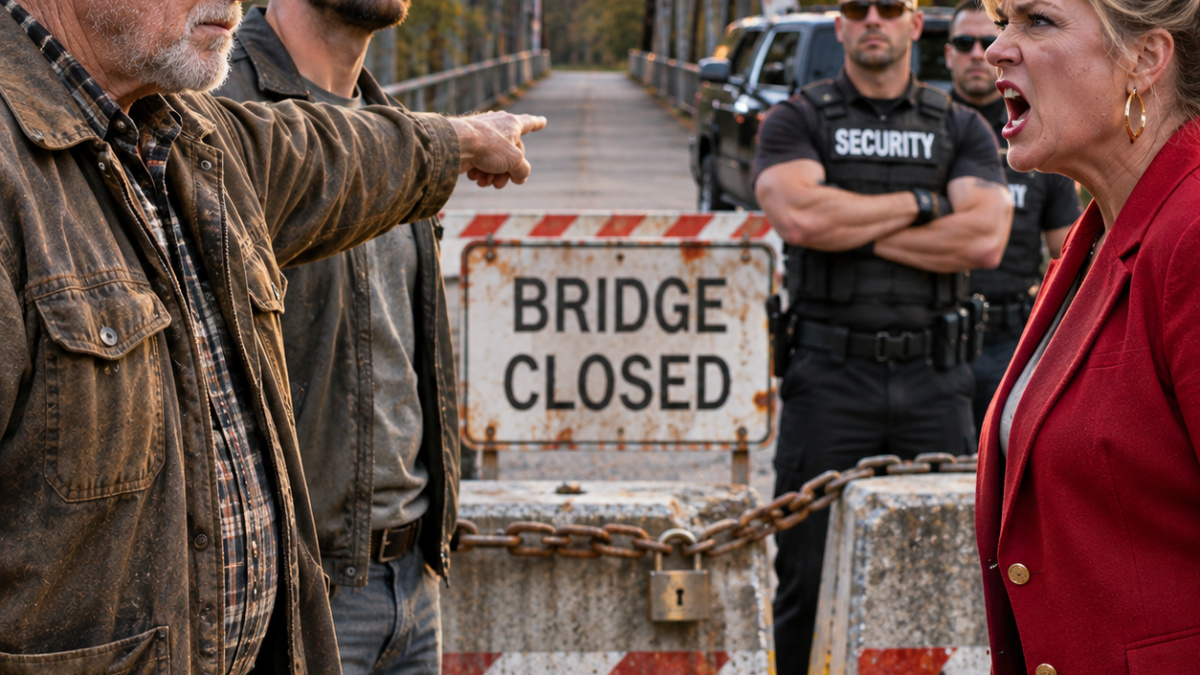
“By order of county engineer Dennis Koval, effective 9:41 p.m., Thornton Creek Bridge is closed to all vehicle traffic.”
Renata stared.
“No.”
Grandpa handed her copy of order.
She didn’t take it.
“You can’t do this.”
“I didn’t.”
His voice stayed flat.
“The creek did. County did.”
Then he looked at their SUVs.
“And you drove in after the warning.”
Brock ran.
Literally sprinted toward bridge.
We followed far enough to see.
Steel gate across east approach.
Red flashers.
County order.
Creek boiling beneath deck.
Brock returned to SUV.
Pulled bolt cutters.
Before he reached chain, headlights appeared far side.
Sheriff cruiser.
Deputy Sam Whitaker.
Loudspeaker crackled.
“Mr. Hadley, put those down.”
Brock froze.
“You cut that lock, you’ll be crossing a cracked bridge in a flood on your way to my cell.”
I almost laughed.
Grandpa didn’t.
Renata screamed across creek:
“Deputy! Make them open it!”
Sam answered:
“Ma’am, county engineer order is valid.”
“I have a hundred forty homes!”
“Then you should call your emergency access coordinator.”
“We don’t have one!”
Silence.
Grandpa looked at me.
There it was.
Developers had relied on our bridge so completely they never built redundancy.
Renata had driven her security team onto the one property she was trying to seize.
During the exact weather condition that legally shut their exit.
It was revenge only in the sense that consequences sometimes arrive with excellent timing.
We did not trap them.
They trapped themselves.
Rain intensified.
At 10:30, creek hit 10.2 feet.
Nobody crossed.
Not them.
Not us.
Renata spent an hour calling attorneys.
Brock paced.
Kyle stood under barn overhang.
Troy smoked.
Grandpa went inside.
Returned with thermos and blankets.
He offered Brock one.
Brock refused.
Grandpa shrugged.
Renata stayed in Range Rover with engine running.
Around midnight, Grandpa carried coffee out.
“You want some?”
Kyle took a cup.
Hands trembling.
Brock snapped:
“Don’t take anything from them.”
Kyle looked at him.
Then drank.
Grandpa offered blanket.
Kyle accepted.
I started feeling something strange.
Not pity exactly.
The younger guards were wet, cold, tired.
They had done ugly things.
But Brock and Renata had power over them too.
At 1:52 a.m., Kyle came to porch.
Pale.
Blanket around shoulders.
“Mr. Thornton.”
Grandpa looked up.
Kyle glanced toward SUVs.
“I can’t do this anymore.”
Brock shouted from yard:
“Danner!”
Kyle kept talking.
“He told us to make your lives miserable.”
Everything in me went still.
“Who?”
“Brock.”
Grandpa said:
“Why?”
Kyle looked at Renata’s vehicle.
“So you’d sell.”
Brock started toward porch.
I held phone up.
Recording.
Kyle spoke faster.
“The towing. Floodlights. Following Mrs. Thornton. Blocking deliveries. Renata wanted pressure every day.”
“Who paid?”
“Ardell.”
Brock roared:
“Shut your mouth, kid!”
Kyle flinched.
Grandpa didn’t move.
“Keep talking.”
Kyle’s voice shook.
“Brock said sixty days. Said old people get scared. Said eventually you’d take the buyout.”
I wanted to break something.
Grandpa asked:
“Who told you to follow June?”
Kyle closed eyes.
“Renata.”
Behind us, Grandma stood inside screen door.
She had heard.
Kyle saw her.
His face changed.
“Ma’am…”
Grandma said nothing.
He looked down.
“I’m sorry.”
Brock yelled:
“You’re fired!”
Kyle laughed once.
A miserable sound.
“Good.”
Then from Renata’s SUV, her voice rose.
She was on speakerphone.
Angry.
“You swore the old man would fold in sixty days, Vincent!”
I looked at Grandpa.
Porch camera.
Audio.
Recording.
Renata continued:
“I’m stuck on his land, and my name is on every one of those papers!”
Whoever Vincent Ardell said was inaudible.
Renata shouted:
“No, you fix it!”
Grandpa looked at me.
One slow nod.
That was the moment.
Not bridge closure.
Not bolt cutters.
That phone call.
They had become careless.
Exactly as Grandpa predicted.
Storm broke near sunrise.
Creek began dropping.
At 6:40, Dennis Koval arrived.
Could not drive across.
Walked from east side after deputy opened pedestrian access.
Inspection harness.
Two county workers.
He examined bearing.
Deck.
Abutments.
Returned muddy.
“Bridge held.”
Renata stepped out.
“Then open it.”
Dennis looked at her.
“No.”
“What?”
“Bearing shifted two millimeters.”
“That’s nothing.”
Grandpa’s eyebrows raised.
Dennis said:
“Two millimeters is the difference between a bridge I certify and one I don’t.”
“How long?”
“Until repair.”
Renata looked like she might faint.
Then Deputy Whitaker walked up our drive.
Behind him:
Marisol Vega.
And Detective Ray Lindgren from county financial crimes.
Ray carried Gwen’s ledger.
Tablet.
Renata saw it.
Her face changed.
Marisol had sent everything overnight.
Bank records.
Video.
Kyle statement.
Porch audio.
Ray stood on porch.
“Mrs. Colter?”
“This is trespassing.”
He almost smiled.
“No, ma’am.”
He opened tablet.
Played her call.
You swore the old man would fold in sixty days, Vincent.
Renata whispered:
“Taken out of context.”
Ray opened ledger.
“Two hundred forty thousand dollars from Ardell & Partners to Label Consulting.”
“Consulting work.”
“For what?”
She said nothing.
Ray turned pages.
“Eighteen thousand monthly to BH Protective.”
Brock started edging toward SUV.
Ray didn’t look up.
“Mr. Hadley, you’re in the ledger too.”
Brock stopped.
By 8:12 that morning, Renata was in the back of a sheriff’s vehicle.
Not convicted.
Arrested pending charges tied to bribery, conspiracy, harassment, and financial misconduct.
Brock was cited immediately for trespass and property interference.
Later investigation produced broader charges.
Sentinel Ridge’s contract was suspended that day.
Ardell’s offices received warrants within forty-eight hours.
Hawthorn Crossing woke to chaos.
Their president arrested.
Bridge closed.
Only access gone.
Residents furious.
At us first.
That part matters.
For the first day, many homeowners believed Grandpa had intentionally trapped the entire neighborhood.
Social media exploded.
THORNTON FARM HOLDING 140 HOMES HOSTAGE.
PRIVATE LANDOWNER ABUSES OLD EASEMENT.
FARMER CLOSES BRIDGE DURING HOA DISPUTE.
Then Marisol released the county closure order.
Engineer report.
Timeline.
Renata’s certified inspection letter.
The fact her own convoy crossed after six-ton restrictions.
Then Kyle’s statement became public through proceedings.
Then financial investigation.
Anger shifted.
Not completely.
People do not surrender a villain quickly once chosen.
But facts accumulate.
By week two, Hawthorn residents packed county commission meeting.
Not to demand our bridge.
To demand explanation from Ardell.
Phase Two depended on acquisition of Thornton land.
Planning documents showed proposed expansion road running directly through our lower pasture.
Ardell had represented to investors that access negotiations were “substantially complete.”
They were not.
He had apparently expected pressure to finish the job.
County commissioners froze Phase Two approvals.
Environmental review reopened.
Financing collapsed.
Project died.
Bridge repair estimate:
$186,000.
That number started another fight.
Who paid?
Easement stated users contributed proportional maintenance.
Hawthorn Crossing relied on bridge overwhelmingly.
Years of heavy traffic contributed to wear.
Our cattle trucks did too.
Marisol negotiated.
Grandpa refused to be greedy.
He could have tried.
Instead:
HOA pays full immediate $186,000 repair because closure directly threatened their sole access and deferred maintenance contributions had been improperly reduced under Renata’s administration.
Future maintenance funded through dedicated account.
Annual independent bridge inspection.
Weight controls.
No Sentinel Ridge.
No private security allowed on Thornton property without written consent.
No HOA enforcement beyond recorded easement corridor.
No fines against Thornton Farm.
No access inspections of our house, barn, livestock, vehicles, or fields.
Emergency alternate-access plan required for Hawthorn Crossing.
And one line Grandpa insisted on:
Nothing in amendment expands original easement rights.
The HOA attorney fought that sentence.
Grandpa did not move.
Eventually they signed.
Gwen Abbott became interim HOA president.
She hated it.
“I never wanted this.”
Grandma told her:
“That’s probably why you’re qualified.”
Bridge repair took thirty-one days.
Temporary pedestrian access for emergencies.
Residents used a rough west-side construction road after county expedited it.
They hated it.
Mud.
Long route.
Ten extra minutes.
Good.
Not because I wanted them miserable.
Because sometimes convenience hides dependency.
Hawthorn had spent twenty-four years assuming our bridge was theirs because nobody had forced them to notice otherwise.
A month later, repaired bridge reopened.
County crew.
New bearing.
Reinforced steel.
Deck work.
Weight monitoring.
Grandpa and I stood at sunrise.
Grandma brought warm apple pie because that is how she marks engineering events.
On the rail was a small brass plaque.
THORNTON CREEK BRIDGE
BUILT 1962
HARLAND THORNTON
Grandpa touched it.
“My father would’ve complained.”
“About what?”
“Font too small.”
I laughed.
Grandma handed him pie.
He looked over creek.
Then at me.
“A road is a promise, Eli.”
I remembered.
He had said versions all my life.
“A bridge is a promise.”
That morning he finished it.
“Keep your word, and it holds.”
I looked at repaired steel.
“What if the other side doesn’t?”
Grandpa took a bite.
“Then you close the bridge.”








