HOA Routed 50 Homes Through My Ranch—Then I Closed the Gate and Their “Permanent Easement” Was Exposed as a Dead Man’s Forgery
HOA Routed 50 Homes Through My Ranch—Then I Closed the Gate and Their “Permanent Easement” Was Exposed as a Dead Man’s Forger
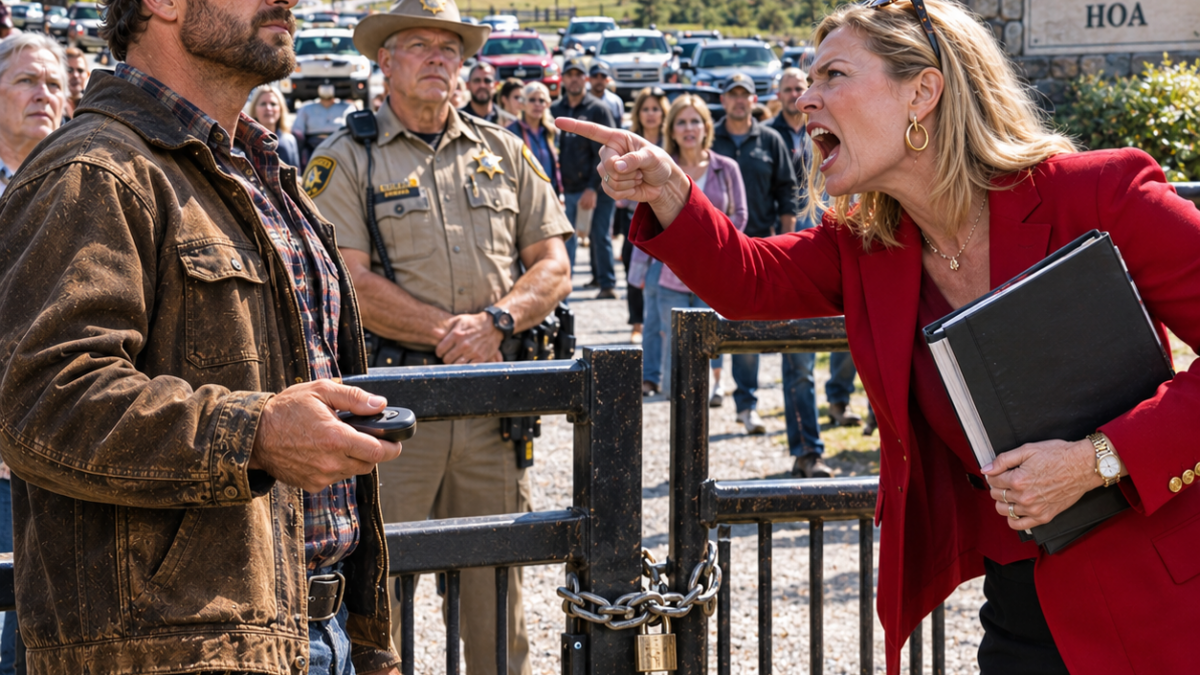
Fifty newly built homes depended on a road across my ranch, and the morning I finally closed the gate, the HOA president stood in front of hundreds of furious residents screaming that I was holding their neighborhood hostage.
She waved a “perpetual easement” in my face as deputies arrived, never realizing the signature giving her that road was dated nine weeks after my father had been buried.
What she still didn’t know was that I had already made one phone call—and before that morning was over, everyone trapped behind my gate would learn why their developer had never built the second road the county required.
There were fifty houses on the ridge.
More than a hundred cars.
Dozens of angry homeowners.
Two sheriff’s cruisers.
One ambulance.
And one black iron gate standing between all of them and the road they had been using every day for more than a year.
Linda Crawford stood on the other side of it wearing the same red blazer I had come to hate.
She had one hand wrapped around the bars.
The other pointed at me.
“OPEN THIS GATE!”
I stood beside my truck with the remote in my palm.
“No.”
“You cannot imprison an entire neighborhood!”
“I’m not imprisoning anybody.”
“This is our only road!”
“That is the problem.”
People shouted behind her.
Car horns blared.
Somebody yelled that they were going to be late for work.
Someone else demanded to know whether I had lost my mind.
A man in a pickup leaned out his window and called me a psychopath.
I didn’t answer any of them.
I looked at my watch.
8:03 a.m.
The phone call had already been made.
The only thing left was waiting for the people Linda never expected to show up.
She slapped the gate.
“You think this is some kind of game?”
“No.”
“You’re blocking access to fifty homes!”
“I gave you thirty days.”
“You had no authority to give us anything.”
“You signed for the notice yourself.”
She lifted a binder.
“We have a perpetual easement.”
I looked at it.
“No, Linda.”
Her face tightened.
“You have a piece of paper.”
That morning was the end of a fight that had started fourteen months earlier, before I even knew there was a fight.
My name is Wade Garrett.
I was forty-two when I came home to the ranch after working a long transmission-line project in Alaska.
I had left shortly after we buried my father.
That sentence still sounds too simple.
We buried my father.
As though the man could be reduced to a hole in the ground and a few words over a casket.
His name was Earl Garrett.
He had spent seventy-one years believing there were only two kinds of promises worth making.
The ones you kept.
And the ones you should never have made in the first place.
He raised cattle.
Cut hay.
Repaired his own fences.
Paid his taxes early.
Distrusted anybody who used the phrase “standard form” while asking for his signature.
The Garrett ranch had been in our family for three generations.
Not huge.
A little over four hundred acres of pasture, timber, and rough Wyoming ground that was beautiful mostly to people who understood how hard it was to keep anything alive there.
Dad knew every drainage.
Every fence corner.
Every spring.
Every place snow drifted high enough to bury a calf.
PART2:
When he died, I wasn’t ready to sit in his kitchen and look at his coffee cup every morning.
So when a utility contractor offered me fourteen months on a line project in Alaska, I took it.
The money was good.
Better than good.
I told myself I was leaving temporarily.
That I would come back when the grief had stopped making every room feel occupied.
Old Hank Mercer agreed to watch the place.
Hank had worked beside Dad since before I could drive.
He was sixty-eight, walked with one shoulder lower than the other, and could repair a stock-water pump using parts nobody else knew existed.
I trusted him completely.
What I didn’t understand was that Dad had made one final agreement before he died.
A temporary one.
And somebody else had decided temporary was an inconvenience.
When I returned fourteen months later, Hank was waiting on the porch.
I should have noticed his face first.
Instead, I noticed the fence.
The south line looked wrong.
A section that should have been old barbed wire had newer steel posts.
One corner brace had been rebuilt.
Then I saw the road.
Fresh gravel cut across my south pasture.
Not a ranch lane.
Not a utility path.
A real road.
Wide enough for two vehicles.
Compacted.
Ditches on both sides.
Reflective markers.
Someone had bolted a plastic sign to one of my fence posts.
HAIL RIDGE ACCESS.
PRIVATE RESIDENT TRAFFIC.
I stopped my truck.
Just sat there.
Then I got out.
A small pink pig trotted toward me from the barnyard.
I stared at him.
“Hank buy you?”
PART3:
The pig snorted.
Apparently not interested in answering ownership questions.
I followed the gravel road uphill.
It crossed my pasture.
Climbed the ridge.
Then turned east.
At the top, my stomach dropped.
Houses.
Not one.
Not five.
A whole subdivision.
New roofs.
Driveways.
Lawns that had not yet figured out whether they could survive Wyoming wind.
Children riding bicycles.
A man washing a pickup.
A woman pushing a stroller.
Stone entrance sign:
HAIL RIDGE ESTATES.
Fifty homes where my father’s hay fields ended.
People waved at me.
Friendly.
Like I was the stranger.
I drove back to the house.
Hank stood when I approached.
He twisted his hat.
That told me everything before he spoke.
“What happened?”
He looked toward the road.
“Your dad signed something.”
“What?”
“Temporary construction access.”
My anger rose fast.
Then Hank added:
“Just for the builder.”
I stopped.
“When?”
“Before he got sick bad.”
“How long?”
“Two years, I think.”
“Why?”
“Developer needed a way to get equipment in while they built another road.”
I stared toward the ridge.
“What other road?”
Hank swallowed.
“Wade…”
“What other road?”
“The permanent entrance was supposed to go east.”
I looked at him.
“Why are all those people using ours?”
“That’s the thing.”
He removed his cap.
“Your dad died.”
“I know that part.”
“The temporary license ended.”
“When?”
“About the same time.”
“And?”
Hank looked miserable.
“Nobody stopped using it.”
I walked inside.
Dad kept important papers in an old metal filing cabinet beside the pantry.
Deeds.
Tax bills.
Cattle records.
Water agreements.
I searched.
Found nothing labeled Hail Ridge.
Hank followed me.
“Developer dealt mostly with your dad directly.”
“Who?”
“Preston Hale.”
I knew the name.
Hale Development.
Regional builder.
Expensive trucks.
Full-page newspaper ads.
I looked through Dad’s desk.
No road agreement.
That bothered me.
Dad never threw away land paperwork.
Never.
The next morning, a white SUV came flying up my driveway.
It stopped hard enough to scatter gravel.
A blonde woman stepped out.
Red blazer.
Black slacks.
Binder.
No smile.
No introduction beyond her title.
“I’m Linda Crawford, president of the Hail Ridge Homeowners Association.”
I leaned against the porch rail.
“Wade Garrett.”
“You’re blocking our road.”
I looked behind her.
My truck was parked beside the barn.
“Looks open to me.”
“You moved equipment near the access lane yesterday.”
“I moved my tractor on my pasture.”
“That road cannot be obstructed.”
“Who says?”
She opened the binder.
“The perpetual easement.”
There it was.
Smooth.
Confident.
Like the phrase itself settled ownership.
“My father gave you a perpetual easement?”
“He granted Hale Development access that transferred to the association.”
“When?”
“During construction.”
“Recorded where?”
Her expression shifted.
“The HOA has the documentation.”
“That isn’t what I asked.”
She took out a photocopy.
“Your late father granted access.”
I reached for it.
She pulled it back.
“You can receive a copy through counsel.”
I almost laughed.
“You drove onto my ranch to tell me I can’t see the document you say controls my ranch?”
“You’re being combative.”
“No. I’m asking where it’s recorded.”
“This road is HOA common access now.”
“No.”
Her eyes narrowed.
“Excuse me?”
“My dad never gave away a road forever without telling me.”
“That’s not legally relevant.”
“Maybe.”
I stepped off the porch.
“But until I verify it, don’t bolt another sign to my fence.”
“You have no right to interfere with resident access.”
“I have every right to check my own title.”
“You’ll find exactly what I told you.”
She smiled.
The kind of smile people use when they believe paperwork has already defeated you.
“I suggest you do your homework before you embarrass yourself.”
Then she left.
I did my homework.
At the county recorder’s office, I asked for every document affecting the Garrett property.
Deeds.
Licenses.
Easements.
Access agreements.
Anything filed during Dad’s last five years.
A title examiner named Gil Ostrander helped me.
Gil was probably in his sixties.
Thin glasses.
Quiet voice.
He typed for almost ten minutes.
I stood at the counter trying not to ask every thirty seconds whether he had found something.
Finally, he looked up.
“Mr. Garrett?”
“Yes?”
“I don’t see a recorded perpetual easement benefiting Hail Ridge.”
I leaned forward.
“Nothing?”
“Not under Hale Development. Not under the HOA. Not under the parcel numbers I checked.”
My pulse picked up.
“Then why are fifty houses using my road?”
Gil raised one finger.
“I didn’t say there was nothing.”
He printed an old document.
Placed it on the counter.
Construction Access License.
Grantor:
Earl Garrett.
Grantee:
Hale Development LLC.
Purpose:
Temporary access for construction equipment, contractors, material delivery, and development-related traffic.
Term:
Twenty-four months.
Revocable under stated conditions.
Nonexclusive.
Nontransferable except for contractors directly performing project work.
No permanent easement created.
Expiration date.
I stared.
The date was fourteen months earlier.
The same week Dad died.
My throat tightened.
“He signed this?”
Gil nodded.
“It appears properly recorded.”
“So it expired.”
“According to the face of the document, yes.”
“Can homeowners inherit it?”
“Not this document.”
“Can the HOA turn it permanent?”
“Not without another valid instrument.”
I tapped the paper.
“Is there another valid instrument?”
“Not recorded here.”
I looked toward the office window.
The road.
Fifty houses.
Hundreds of people.
All depending on access that legally seemed to have disappeared more than a year earlier.
Gil lowered his voice.
“There is something else you should understand.”
“What?”
“The county’s subdivision approval file may contain separate access conditions.”
“Can I see those?”
“Planning department.”
I thanked him.
Before I could get there, Linda showed up at my house again.
This time she brought the perpetual easement.
She placed a copy on my kitchen table like she was playing the winning card.
“Here.”
I read it.
PERPETUAL ROADWAY EASEMENT.
Beneficiary:
Hale Development and successors.
Burdened property:
Garrett Ranch.
Purposes:
Residential ingress and egress.
Utilities.
Emergency access.
Maintenance.
Wide rights.
Far wider than Dad would ever have granted casually.
Then I saw the signature.
EARL T. GARRETT.
It looked close.
Very close.
Dad’s handwriting had changed in his last year.
Shakier.
But still distinctive.
This could fool someone.
Then I saw the date.
I read it again.
Nine weeks after his funeral.
The room went quiet.
Linda sat opposite me.
“Well?”
I looked up.
“When did you say Dad signed this?”
“During final subdivision negotiations.”
“Date says September eighteenth.”
“Yes.”
“My father died July fourteenth.”
She blinked.
Once.
Then:
“Obviously the execution date may reflect when it was recorded.”
“No.”
I turned the page.
“Signature acknowledgment is dated September eighteenth.”
“That could be an administrative correction.”
“A dead man cannot sign an administrative correction.”
Her cheeks flushed.
“I’m not a title lawyer.”
“Neither am I.”
I pushed the document back.
“But I know when we buried my father.”
She gathered the pages too quickly.
“This document was supplied by Hale Development.”
“Leave me a copy.”
“You have one.”
She pointed.
I had already photographed every page.
Good.
“You are creating an unnecessary conflict, Mr. Garrett.”
“No.”
I looked at the road through the kitchen window.
“Somebody created it before I got home.”
That afternoon, I called Dana Whitfield.
Best real estate attorney in the county was what three different people told me.
Dana was in her early fifties.
Gray-streaked dark hair.
No wasted words.
Her office looked like paper went there to die.
I handed her the temporary license.
The alleged perpetual easement.
Dad’s death certificate.
Dana read everything.
Then read the perpetual easement again.
She tapped the notary block.
“Interesting.”
“What?”
“This notary commission.”
She turned the page.
“Expired three months before the supposed signing date.”
My stomach went cold.
“Could that be a clerical error?”
“Possible.”
She looked at me.
“Combined with a grantor who was already dead?”
“Less possible.”
She read Dad’s signature again.
Then said:
“Wade, do not close that road yet.”
I had been thinking exactly that.
“Why not?”
“Because fifty families live there.”
“On a road they don’t own.”
“They may not know that.”
“So?”
“So we do this clean.”
She leaned back.
“No midnight gate. No bulldozer. No surprise barricade. No giving Linda a chance to make you look like a rancher who trapped innocent families.”
“What do we do?”
“We verify every document.”
“Then?”
“Formal notice.”
“How long?”
“Long enough that nobody can call it unreasonable.”
I hated that answer.
But she was right.
Dana obtained certified copies.
Compared Dad’s known signatures.
Requested the notary records.
Pulled the subdivision file.
Then she found something that changed the whole strategy.
The county had approved Hail Ridge Estates with two points of access.
The temporary Garrett Ranch construction route.
And a permanent East Connector Road.
The east road was supposed to be built before full occupancy.
It appeared clearly on the approved subdivision map.
I stared.
“Where is it?”
Dana looked at me.
“That’s the right question.”
We drove out.
On the east side of Hail Ridge, there was no road.
Only scrub.
A rough graded strip in one section.
Nothing connecting to the county highway.
Dana pointed to the map.
“The developer was required to complete this.”
“He didn’t.”
“No.”
“How did fifty houses get occupancy?”
“Also a good question.”
She looked at me.
“But we don’t answer that by blocking people tomorrow morning.”
So we sent notice.
Certified.
Thirty days.
The notice explained:
The temporary construction license had expired.
No valid recorded perpetual easement had been identified.
The easement document being asserted appeared facially defective and would be challenged.
Daily residential traffic across the Garrett ranch was not authorized.
Emergency access would continue.
The HOA and developer had thirty days to establish lawful access or arrange an agreement.
I even offered terms.
A temporary paid easement.
Insurance.
Maintenance responsibility.
Speed limits.
No widening.
No utilities without separate permission.
A defined expiration date tied to completion of the East Connector.
Fair.
Reasonable.
Not cheap.
But fair.
Linda signed for the notice herself.
Then nothing happened.
Twelve days.
No response.
Twenty.
No roadwork.
No negotiation.
Nothing from Hale Development.
Instead, Linda went online.
Her post appeared in the Hail Ridge community Facebook group.
LOCAL RANCHER THREATENS TO LANDLOCK FAMILIES.
She called me unstable.
Claimed I was trying to extort the HOA.
Wrote that the road had been legally used for years.
Said I was angry because development had increased property values around my “failing ranch.”
That part made Hank angrier than anything else.
He read it at my kitchen table.
“Your dad would’ve driven that woman into the stock pond.”
“No, he wouldn’t.”
“He’d have considered it.”
“Maybe.”
The comments were worse.
GREEDY.
SUE HIM.
TAKE THE ROAD BY EMINENT DOMAIN.
HE CAN’T BLOCK FAMILIES.
WHO DOES HE THINK HE IS?
People had never met me.
Most didn’t know the road crossed private land.
They believed the subdivision owned it.
Why wouldn’t they?
They had closing documents.
HOA packets.
Maps.
Monthly dues.
They were homeowners, not title examiners.
I started to understand something Dana had warned me about.
Those families were not the enemy.
The people who built the neighborhood around a temporary road were.
So I attended the HOA meeting.
Not as a ranch owner ready to fight.
As a man in the back row carrying one folder.
Linda ran the meeting.
Of course.
About sixty residents attended.
When public comments opened, I stood.
Murmuring started.
Linda’s face hardened.
“This is an association meeting.”
“I know.”
“Are you a member?”
“No.”
“Then—”
Ruth Dorsey, an older woman in the third row, raised her hand.
“He’s the man whose road we’re discussing.”
Linda ignored her.
I held up my letter.
“I’m here to offer a temporary agreement.”
People quieted.
I explained it.
Paid easement.
Emergency access guaranteed.
Regular traffic allowed temporarily.
Insurance.
Maintenance.
Enough time to build the county-approved east road.
No tricks.
No hostage situation.
A solution.
A man near the front asked:
“How much?”
I gave the proposed number.
Some people muttered.
Not cheap.
But not absurd.
Linda picked up the letter.
She read maybe three lines.
Then tore it in half.
Right there.
“Enough.”
The room went silent.
“We do not negotiate with squatters.”
I looked at her.
“I own the land.”
“You are attempting to interfere with an established community access.”
“Then show the recorded easement.”
“We’ve been through this.”
“No.”
I looked around the room.
“You’ve told everyone there is one.”
I pointed at Linda.
“She showed me a document supposedly signed by my father nine weeks after we buried him.”
That got attention.
Linda slapped her hand on the table.
“That allegation is defamatory.”
“Then show them the date.”
“Sit down.”
I didn’t move.
“Our attorney has given your association thirty days.”
“You have no authority to give deadlines.”
“Maybe.”
I looked around.
“But day thirty still comes.”
Then I left.
In the third row, Ruth Dorsey bent down and picked up the torn halves of my letter.
I noticed.
Linda didn’t.
Two nights later, Biscuit started barking.
Not normal barking.
A deep frantic sound from near the porch.
It was after midnight.
I grabbed a flashlight.
Then heard metal.
Snap.
I walked toward the south fence.
Headlights moved slowly with no beams pointed toward the house.
Two figures.
One holding bolt cutters.
I stayed back.
Called the sheriff.
Then remembered Dad’s trail camera.
He had installed it years earlier after someone stole diesel from a tank.
Motion activated.
Infrared.
Facing the south crossing.
I didn’t confront them.
Dana had said clean.
So I stayed clean.
By the time a deputy arrived, the people were gone.
A section of fence had been cut.
The next morning, I pulled the memory card.
The image was clear.
A man with bolt cutters.
Preston Hale.
The developer.
And standing behind him?
Linda Crawford.
Red blazer.
At midnight.
Pointing toward my fence.
I called Dana.
“Now can I close the road?”
Silence.
Then:
“Send me the footage.”
I did.
Ten minutes later:
“Now we prepare.”
We reported the fence damage.
Preserved the original memory card.
Dana sent supplemental notice to Hale Development and the HOA.
The thirty-day deadline remained unchanged.
No response.
Day thirty came.
Nothing.
No agreement.
No East Connector construction.
No legal easement filing.
No court order.
Day thirty-one arrived cold and clear.
I hired a licensed fencing contractor.
We installed a black steel gate entirely inside my property line.
Surveyed location.
Photographed.
Emergency access system.
Remote.
Lockbox available to fire and sheriff under written arrangement.
Dana reviewed everything.
At 6:30 a.m., I closed the gate.
Then I called her.
“It’s shut.”
“Good.”
“What now?”
“Make the call.”
I did.
The call went to county engineering.
Dana made the second.
Sheriff’s office.
By seven, the first Hail Ridge resident came down the road.
Pickup.
Stopped.
Driver got out.
Stared.
Called someone.
By 7:15, three vehicles.
By 7:30, fifteen.
By eight?
Traffic stretched back toward the subdivision.
Horns.
Doors.
People yelling.
Linda arrived in the white SUV.
Red blazer.
She marched to the gate.
“OPEN IT.”
“No.”
“You have lost your mind.”
“Deadline expired yesterday.”
“This road is ours.”
“Show me the recorded easement.”
She held up the binder.
I looked at the gate.
“Still no.”
People gathered.
Some recognized me from Facebook.
One man shouted:
“You’re the lunatic?”
I looked at him.
“Apparently.”
Another:
“My kids have school!”
“I know.”
“You can’t do this!”
“I gave your HOA thirty days.”
“We never saw anything!”
That caught me.
I looked at Linda.
She didn’t.
Interesting.
Sheriff’s cruisers arrived.
Deputy Tom Reyes stepped out.
He had spoken to Dana beforehand.
Still, he did not take my side automatically.
Good deputy.
He looked at the gate.
Survey markers.
Dana’s notice.
My deed.
Temporary license.
Linda’s easement copy.
He read slowly.
Linda hovered beside him.
“This is criminal.”
Reyes kept reading.
“He is intentionally detaining residents.”
Reyes looked up.
“Is anyone physically prevented from leaving their home?”
“This gate blocks the road.”
“Is this road on HOA property?”
“It is a legal easement.”
“Recorded?”
Linda’s voice rose.
“We have documentation.”
Reyes looked at the copy.
Then Dad’s death certificate Dana had included.
His eyebrows moved.
Just slightly.
He handed it back.
“Ma’am, based on what I have in front of me, this is a civil property dispute.”
“Arrest him.”
“No.”
“He’s holding fifty families hostage!”
“He’s standing on his property behind a gate.”
“This is the only exit.”
“That creates a serious safety issue.”
She turned toward me triumphantly.
“Exactly.”
Reyes continued:
“But it doesn’t automatically make him guilty of a crime.”
Linda’s face tightened.
Then someone ran down the road.
A man.
No coat.
Wild-eyed.
“My wife.”
Everyone turned.
“She’s having chest pain.”
That changed everything.
I hit the remote.
Gate opened.
No argument.
No delay.
I called:
“Ambulance is coming?”
“Neighbor called.”
I waved.
“Keep this clear.”
Within minutes, we heard sirens.
People moved.
The ambulance came through.
Gate wide open.
Fire unit behind it.
I never touched the remote until both passed.
Linda turned toward the crowd.
“You see?”
Her voice rose.
“He has to leave it open!”
I looked down the road.
Dana’s SUV was approaching.
She parked.
Walked up carrying a folder.
No rush.
No red blazer.
No shouting.
“Emergency access remains open.”
Linda turned.
Dana continued so everyone could hear.
“Fire, ambulance, sheriff. Immediate access. No questions asked.”
She looked toward the residents.
“But unrestricted daily residential traffic across private ranch property ended this morning after thirty days’ written notice.”
A murmur moved through the crowd.
Linda snapped:
“There is no other road.”
Dana looked toward the highway.
“Actually…”
A county pickup was arriving.
A woman stepped out wearing a hard hat and reflective county vest.
Miriam Sato.
County engineer.
She unrolled a large blueprint across the hood.
Residents moved closer.
Linda did not.
Miriam pointed to Hail Ridge.
Then the east boundary.
“This is the approved subdivision plan.”
A thick dotted line ran east.
“Secondary access.”
Somebody asked:
“What is that?”
“The East Connector.”
Linda said:
“That was conceptual.”
Miriam looked at her.
“No.”
One word.
Calm.
“It was a condition of approval.”
She tapped the line.
“Two means of vehicle access were required before full buildout.”
People stopped talking.
A homeowner near me said:
“We’ve never had another road.”
Miriam nodded.
“That is what the county is reviewing.”
Linda stared at the blueprint.
“The ranch road satisfied access.”
“During construction, temporarily.”
“That changed.”
Miriam looked at her.
“Show me the recorded change.”
Linda had nothing.
Miriam continued:
“The Garrett route was shown in the early construction file as temporary access.”
Then she pointed east again.
“The permanent residential connector was supposed to be completed here.”
A woman in the crowd asked:
“Why wasn’t it?”
Nobody answered.
Then someone shouted:
“Where’s Hale?”
Perfect timing.
A black SUV came down the ridge.
Preston Hale stepped out.
Fifty-something.
Expensive coat.
The confident posture of a man who had spent years walking into rooms where people needed him to solve expensive problems.
He approached me.
“Wade.”
“Preston.”
“Let’s fix this.”
“You had fourteen months.”
He smiled.
Public smile.
“Everybody’s emotional.”
“Not me.”
“We don’t need lawyers turning neighbors against each other.”
“You brought one?”
He glanced toward Dana.
“I can make you an offer.”
He reached inside his coat.
Thick envelope.
“Name your number.”
I stared at it.
Then looked at the homeowners.
“Is that for the road?”
“Permanent easement.”
“Today?”
“We can close this out today.”
I didn’t touch the envelope.
“My father’s name was used on a perpetual easement dated after he died.”
His smile faded.
“I wasn’t personally involved in every document.”
Dana stepped beside me.
“That’s why records are useful.”
She opened her folder.
Linda’s face changed.
Dana held up an email.
Subject line:
EXTENSION SIGNED — USE THIS IF RANCH GUY COMPLAINS.
She looked toward Linda.
“Sent from Linda Crawford’s association account to Hale Development eleven months ago.”
Silence.
Then a gasp.
Linda said:
“That was private correspondence.”
Dana looked at her.
“You’re concerned about privacy?”
“It was taken out of context.”
“What context makes this subject line better?”
Linda’s face went red.
Hale said:
“I’m not discussing privileged material in the road.”
Dana smiled slightly.
“It isn’t privileged.”
He looked at her.
She continued:
“And we haven’t even reached the attachments.”
A woman behind me whispered:
“Oh my God.”
Linda pointed at Dana.
“You illegally obtained HOA communications.”
“No.”
Dana closed the folder.
“Your association produced them in response to a records request after asserting the easement.”
Linda looked around.
For the first time, she seemed to realize the crowd had changed.
People were no longer looking at me.
They were looking at her.
Then Ruth Dorsey stepped forward.
Cane.
Gray coat.
The torn letter in one hand.
She had taped the two halves back together.
“I kept this.”
Linda stared.
Ruth held it up.
“Mr. Garrett came to our meeting.”
She turned toward the neighbors.
“He offered us temporary access.”
Linda said:
“Ruth, this isn’t—”
“I read it.”
Her voice shook, but she didn’t stop.
“It was fair.”
She looked at me.
“Insurance. Maintenance. Time to build the other road.”
Then back at Linda.
“You tore it in half.”
A man in the crowd asked:
“You told us he refused to negotiate.”
Another:
“You said he wanted a million dollars.”
I looked at Linda.
That was new.
Linda raised both hands.
“I was protecting the association.”
Ruth answered:
“From what?”
Nobody gave Linda room to escape that question.
Then she did something I still don’t understand.
Maybe panic.
Maybe rage.
Maybe she thought movement itself could restore control.
She walked fast toward her SUV.
Got in.
Started it.
Dana said quietly:
“Wade.”
“I see.”
Linda reversed.
Then accelerated toward the gate.
Not full speed.
But too fast.
Deputy Reyes stepped into the road with one hand raised.
“STOP.”
The SUV braked.
Hard.
Stopped less than two feet from him.
People screamed.
Reyes approached the driver’s window.
“Put it in park.”
Linda stared straight ahead.
“Ma’am.”
She shifted.
“Park.”
Then he asked her to step out.
The road went silent.
Nobody shouted for my gate to open anymore.
The ambulance eventually returned.
The woman with chest pain was taken to the hospital.
I later heard she was okay.
That mattered more to me than anything else that morning.
The gate reopened for emergency vehicles.
Then closed again.
By noon, Hail Ridge had a temporary controlled transportation arrangement while county officials worked with residents.
I didn’t force people to carry groceries for miles.
I didn’t trap children.
Dana would never have allowed it.
The county set up temporary emergency provisions.
The developer arranged a shuttle and temporary authorized access elsewhere while the East Connector issue was addressed.
For three days, residents were inconvenienced.
Seriously.
I didn’t enjoy that.
I also didn’t apologize for refusing to let the developer turn temporary access into permanent property rights by simply using my land long enough.
The county opened a formal review.
The sheriff’s office investigated the fence cutting.
The questioned easement went to investigators.
So did the notary information.
So did the email.
Nobody was declared guilty on the roadside.
That is not how the real world works.
But the evidence was no longer hidden inside HOA binders.
Hale Development’s remaining approvals tied to Hail Ridge were temporarily suspended while the county reviewed compliance with the subdivision conditions.
The county required a corrective access plan.
And suddenly, the East Connector Road that had apparently been impossible for fourteen months became urgent.
Survey crews showed up within a week.
Excavators followed.
Not on my ranch.
On the approved route.
Exactly where they should have been from the beginning.
The HOA held an emergency meeting.
I didn’t attend.
Hank did.
He came home smiling.
“What?”
“They tried to recall Linda.”
“Tried?”
“She resigned first.”
“That fast?”
“She said the community had become hostile.”
I laughed.
Hank sat at the kitchen table.
“They asked who should take over.”
“And?”
“Ruth.”
I stopped laughing.
“Ruth Dorsey?”
“President Dorsey.”
“She’s eighty.”
“Seventy-six.”
“Same thing.”
“Don’t tell her that.”
I wouldn’t.
Ruth came by the next day.
First official act, apparently.
She carried a folder.
No red blazer.
No threats.
She sat at Dad’s kitchen table.
“I owe you an apology.”
“You didn’t build the road.”
“I believed Linda.”
“So did a lot of people.”
“I voted for her.”
“That’s not a crime.”
“She told us your father granted access permanently.”
“I know.”
“We should’ve asked for the document.”
“Yes.”
She nodded.
Didn’t ask me to soften it.
I liked her immediately.
“What happens now?”
“The board voted to cooperate with the county.”
“Good.”
“We’re also withdrawing any claim that the HOA owns an easement over your ranch unless a court determines otherwise.”
“Better.”
“And…”
She took a breath.
“I’d like to negotiate temporary emergency access until the east road opens.”
“Emergency access was never going away.”
“I know that now.”
She slid a document toward me.
Dana had already reviewed it.
Fire.
Ambulance.
Sheriff.
Utility emergency.
No routine resident traffic.
No claim of permanent rights.
No adverse use.
No future easement.
I signed.
Ruth signed.
Simple.
That was what should have happened months earlier.
Preston Hale?
He lawyered up.
Three lawyers at one point, according to Dana.
The questioned easement became part of a broader investigation into the development records.
The notary whose stamp appeared on it denied notarizing that document on that date.
Her commission had already expired.
Investigators compared electronic records.
Emails.
Drafts.
Metadata.
Closing files.
I didn’t personally receive every detail.
I didn’t need to.
Dana advised me not to turn rumors into facts.
So I didn’t.
What I knew was this:
The document Linda relied on was not accepted as a valid easement.
My father’s temporary construction license remained exactly what it said it was.
Temporary.
Expired.
The developer had no permanent right to send ordinary residential traffic across my ranch.
The East Connector had been required.
And it had not been built.
Hale Development eventually entered negotiations with the county and residents over the cost of finishing infrastructure it should have completed before.
Insurance companies joined.
Attorneys joined.
Nobody looked happy.
I stayed mostly out of it.
My legal issue was simpler.
Stay off my land.
Repair the fence.
Pay for the damage.
Stop using Dad’s name.
Dana handled the claims.
The trail-camera footage mattered.
So did the cut wire.
So did my photographs.
So did the thirty-day notice.
So did Ruth’s taped-together copy of the offer Linda tore up.
The settlement on my side was not dramatic.
Fence repair.
Survey costs.
Attorney fees.
Damage from road use.
Restoration.
And written acknowledgment that no permanent residential easement burdened the Garrett ranch through the disputed documents.
The gravel road itself remained for a while.
I didn’t rip it out immediately.
Dana told me to wait until the access transition was complete.
Again, clean.
Always clean.
Hank hated that word by then.
“Your lawyer ever tell you to do something satisfying?”
“No.”
“What are we paying her for?”
“To keep us from doing satisfying things.”
He grunted.
The East Connector took ninety days.
Ninety.
Three months.
After fourteen months of pretending it couldn’t happen.
Crews graded the east side.
Installed drainage.
Connected to the county road.
Built the proper intersection.
Emergency services inspected it.
County engineers signed off.
The morning it officially opened, Ruth called me.
“Come up.”
“Why?”
“You should see this.”
I drove to the ridge.
People lined the new road.
Not everyone.
Enough.
Kids.
Parents.
Pickup trucks.
Cars.
Ruth stood near the new entrance.
Small temporary banner:
EAST CONNECTOR OPEN.
I parked at the side.
One man approached.
I recognized him.
The same guy who had called me a psychopath at my gate.
He stuck out his hand.
“Mr. Garrett.”
“Morning.”
“I owe you an apology.”
“Probably.”
He laughed nervously.
“I didn’t know.”
“I know.”
“We bought our house assuming the ranch road was permanent.”
“I know.”
“My closing map showed it.”
“That part is between you and whoever sold the house.”
He nodded.
“I was angry at the wrong person.”
“That happens.”
His daughter stood beside him.
Maybe ten.
She looked at me.
“Do you own the pigs?”
“Pig.”
“One?”
“One.”
“What’s his name?”
I realized I had never named the little pink pig.
Hank had apparently inherited him from a neighbor.
“He doesn’t have one.”
She looked horrified.
“Every pig needs a name.”
“Talk to Hank.”
She nodded seriously.
Important work.
The first vehicles began using the East Connector.
Some honked.
A few people waved.
Not at me specifically.
Just celebration.
Freedom from the road dispute.
A permanent entrance that actually belonged to them.
That mattered.
Around noon, I drove back to the ranch.
The south road still crossed my pasture.
One last group of authorized contractor vehicles came through to remove temporary signage.
Then Ruth’s SUV.
She stopped beside me.
“Last one.”
“You sure?”
“County confirmed.”
I looked back toward the ridge.
No traffic coming.
I pressed the remote.
The black iron gate swung shut.
Slowly.
Metal met metal.
Latch engaged.
For the first time in almost two years, the south pasture was quiet.
No SUVs.
No school traffic.
No delivery vans.
No moving trucks.
No strangers cutting across Dad’s land because somebody had told them it was the neighborhood road.
Just wind.
Cattle.
Fence.
And that little pink pig walking directly down the middle of the abandoned gravel lane like he owned the place.
Hank laughed.
“Now he thinks it’s his.”
“Better claim than the HOA had.”
We stood there for a while.
I expected to feel triumphant.
Mostly I felt tired.
Then I thought about Dad.
His temporary license.
I could picture him signing it.
Preston probably told him:
Two years.
Construction trucks only.
We’ll build our permanent entrance on the other side.
Dad would have agreed because it was neighborly.
Because construction access across an existing ranch lane made more sense than cutting another temporary road.
Because he assumed adults would honor the expiration date printed three inches above his signature.
Dad was not foolish.
He was trusting within limits.
Other people had treated those limits like obstacles.
That was the part that still bothered me.
Linda had kept saying:
The road has been used for more than a year.
As though repeated trespassing slowly transformed into ownership.
Preston had said:
Let’s be reasonable.
As though “reasonable” meant I should sell permanent rights because he had already built houses around the assumption that I eventually would.
The homeowners said:
But this is our only road.
And for them, emotionally, it was true.
That was the road they knew.
The road their moving trucks used.
The road their children took to school.
The road ambulances would take if somebody got sick.
That was why Dana had insisted we separate the people from the lie.
Fifty families did not forge anything.
They did not draft the subdivision map.
They did not fail to build the East Connector.
They bought homes.
Paid mortgages.
Followed directions.
The moment I understood that, the strategy changed.
I did not want to punish residents.
I wanted to stop the people responsible from using those residents as leverage against me.
Linda’s favorite sentence was:
You can’t do this because families depend on the road.
She was right about the dependency.
Wrong about what it proved.
If you secretly connect fifty houses to somebody else’s private road, the existence of fifty families does not magically make the road yours.
It makes your original decision more reckless.
A few weeks after the East Connector opened, Ruth came to my house carrying an apple pie.
Homemade.
Still warm.
I opened the door.
“What is this?”
“An HOA bribe.”
“Expensive?”
“Apples were on sale.”
“Suspicious.”
She handed it over.
“Thank you.”
“For what?”
“For not becoming what Linda said you were.”
I set the pie down.
“What was that?”
“Someone who wanted to hurt us.”
I looked toward the south pasture.
“I never wanted that.”
“I know.”
She sat in Dad’s old chair.
“The first morning at the gate…”
She shook her head.
“I was furious.”
“At me?”
“Yes.”
“Fair.”
“No.”
She looked at me.
“That’s the part I’m embarrassed about.”
“You thought you were trapped.”
“We were trapped.”
She paused.
“Just not by you.”
That was exactly right.
Ruth continued.
“When Miriam unfolded the county plan…”
She laughed softly.
“You could actually see people realizing it.”
“What?”
“That the road we were fighting over wasn’t supposed to be our road.”
I cut the pie.
“That was a strange morning.”
“You handled it better than I would have.”
“Dana threatened me.”
“I believe that.”
“She kept telling me not to do anything dramatic.”
“You installed a gate in front of fifty houses.”
“That was the nondramatic version.”
Ruth laughed.
Then grew serious.
“Linda told us you were refusing every solution.”
“I know.”
“She never showed us your offer.”
“I know.”
“I picked it up because I thought throwing someone’s letter on the floor was rude.”
“That might have been the most useful act of recycling in HOA history.”
She smiled.
Then said:
“She’s moving.”
“Linda?”
“Yes.”
I felt almost nothing.
“Okay.”
“You don’t care?”
“Should I?”
Ruth considered.
“No.”
Linda’s house sold a month later.
I saw her once before she left.
Gas station.
She was filling her SUV.
I was buying diesel.
We both noticed each other.
For several seconds, neither spoke.
Then she walked over.
“No red blazer?”
She almost smiled.
“No.”
We stood beside the pumps.
Finally she said:
“You destroyed Hail Ridge.”
“No.”
“Property values dropped when the access dispute became public.”
“Temporary.”
“Several buyers backed out.”
“Talk to Hale.”
“You made us look unstable.”
I looked at her.
“Linda, your subdivision’s only used road crossed land it didn’t own while the permanent road sat unbuilt on the approved plans.”
She tightened her jaw.
“Residents didn’t know that.”
“I agree.”
“You embarrassed me in front of everyone.”
“No.”
She stared.
“You did that yourself.”
Her cheeks colored.
“You could have negotiated privately.”
“I tried.”
“You demanded money.”
“I offered a temporary easement.”
“You knew we couldn’t accept those terms.”
“Then you should have built the East Connector.”
She looked away.
For once, she didn’t have a binder.
No audience.
No microphone.
No HOA title.
Just Linda.
After a moment:
“I believed the easement was valid.”
I studied her.
“Did you?”
She looked back sharply.
“What is that supposed to mean?”
“You sent an email eleven months ago saying ‘Extension signed. Use this if the ranch guy complains.’”
Her face changed.
“I was told the document was legitimate.”
“By Preston?”
She said nothing.
“Then why didn’t you show the homeowners the date?”
“I’m not discussing an active legal matter.”
“Good.”
I reached for the diesel nozzle.
“Neither am I.”
She turned to leave.
Then stopped.
“Do you know what the worst part is?”
I waited.
“We could have built that road.”
“The east road?”
“Yes.”
She looked angry again.
“Not easily.”
“Nothing involving roads is easy.”
“But we could have.”
I nodded.
“Ninety days.”
She stared at me.
“You enjoyed that.”
“No.”
I meant it.
“I enjoyed my gate closing.”
That was different.
Linda shook her head.
Then left.
I never saw her again.
The gravel road through my south pasture stayed through winter.
Snow filled the tire tracks.
Grass began returning along the shoulders.
The following spring, I hired a contractor to remove most of the residential road improvements.
Not all.
We kept part of the gravel as a ranch lane.
Useful road.
Wrong purpose.
We narrowed it.
Removed reflective posts.
Took down the HAIL RIDGE ACCESS sign.
That sign hung in my barn for months.
Hank wanted to burn it.
I told him plastic fumes were bad for him.
He said:
“So is HOA management.”
Hard to argue.
The fence where Linda and Preston had been caught on camera was repaired.
I kept one section of cut wire.
Not as evidence.
Dana already had copies of everything.
I hung it on a nail in Dad’s shop.
A reminder.
Boundaries do not defend themselves.
Neither do agreements.
A piece of paper works because people agree to honor what it says.
A temporary license means nothing if one side decides expired is inconvenient.
A deed means nothing if nobody checks it.
A subdivision condition means nothing if people approve houses without asking whether the required road exists.
And a forged or misused signature can create an astonishing amount of confidence in people who never stop to verify it.
That was the strangest thing about the whole fight.
Linda believed she had authority because she had a document.
Residents believed her because she had authority.
Contractors believed the developer because people were already living in the houses.
Everybody pointed to the next person as proof.
Nobody started at the beginning.
What does Wade’s deed say?
What did Earl actually sign?
When did it expire?
Where is the permanent access road?
Simple questions.
Expensive answers.
The sheriff’s investigation continued for months.
Dana occasionally called with updates.
Some I could repeat.
Some she told me not to.
The disputed perpetual easement was never accepted as valid against my property.
The expired notary issue became part of the investigation.
The posthumous date did too.
The fence-cutting footage remained evidence.
County investigators reviewed how subdivision conditions were certified.
Hale Development negotiated several matters rather than drag everything into years of litigation.
There was no dramatic courtroom scene where a judge slammed a gavel and sent half the county to jail.
Real property disputes rarely end that way.
They end with corrected plats.
Signed releases.
Insurance payments.
Recorded documents.
Settlement agreements.
Compliance work.
Attorney invoices thick enough to stun livestock.
And finally, quiet.
I liked the quiet best.
My ranch became a ranch again.
Hail Ridge became a neighborhood with its own road.
Ruth became an annoyingly competent HOA president.
She cut meeting times in half.
Required every property-related decision to include actual title documentation.
And banned the phrase “we’ve always done it this way” from being accepted as proof of anything.
She called me three months after taking office.
“Question.”
“No.”
“You don’t know the question.”
“Still no.”
“We want to put up a fence near the east drainage.”
“Whose land?”
“Ours.”
“Surveyed?”
“Yes.”
“Then why are you calling me?”
She laughed.
“Trauma.”
“Good.”
“Can I send you the map?”
“No.”
“I already did.”
I hung up.
Hank nearly fell out of his chair laughing.
The little pink pig eventually got a name.
The girl from Hail Ridge named him Pickles.
She came with her father one afternoon to ask permission.
That was the important part.
They asked.
Her father stood outside the ranch gate.
Didn’t drive through.
Didn’t assume.
Asked.
“Mr. Garrett, my daughter has been talking about that pig for three months.”
The girl held a bag of apple slices.
“He needs a name.”
I looked at the pig.
“Does he?”
“Yes.”
“Why?”
“Because.”
Hard to argue with nine-year-old law.
“What name?”
“Pickles.”
I looked at her father.
He shrugged.
“Don’t drag me into this.”
I opened the gate.
Pickles had a name by sunset.
Sometimes boundaries work exactly as intended.
They don’t keep everybody out.
They make people stop long enough to ask.
That summer, I finally fixed the porch.
The same porch I had promised myself I’d repair after Alaska.
Dad’s chair stayed in the corner.
I thought about replacing it.
Didn’t.
One evening, Ruth dropped off another pie.
Hank was working on a water pump.
Pickles slept under the porch.
Biscuit beside him.
The south pasture glowed gold near sunset.
No traffic.
I could hear cattle at the tank.
Wind in the grass.
Nothing else.
Ruth sat.
“Do you miss Alaska?”
“No.”
“Line work?”
“Sometimes.”
“Money?”
“Yes.”
She laughed.
Then looked toward the old road.
“You know, people still tell the gate story.”
“I know.”
“They say you trapped fifty families.”
“Of course.”
“Some say you had the developer arrested right there.”
“No.”
“Some say Linda tried to run over a deputy.”
“She stopped.”
“Barely.”
“Still stopped.”
“Some say your dad left you a secret deed.”
I rubbed my forehead.
“There was no secret deed.”
“I know.”
“Why does every story get dumber?”
“Because the real story has too much paperwork.”
That was probably true.
The real story wasn’t about one gate.
It wasn’t even about Linda.
It was about what happens when temporary convenience becomes permanent assumption.
Dad gave a builder access.
Not ownership.
Not residential rights.
Not forever.
A way to get trucks in while they built the road they were supposed to build.
Then Dad died.
I left.
Nobody challenged the traffic.
Construction trucks became contractor pickups.
Contractor pickups became moving vans.
Moving vans became resident cars.
Then school buses.
Delivery trucks.
Visitors.
After enough time, people stopped asking why the road existed.
It simply became:
Our road.
That is how dangerous assumptions grow.
Quietly.
One person says:
This should be fine.
The next says:
It has always been this way.
The next says:
We have rights.
Then someone prints a document.
Adds a signature.
Puts it in a binder.
And suddenly fifty families are furious at a rancher because his gate is standing where the truth should have been months earlier.
People later asked why I waited thirty days.
Why not close it immediately after finding out the easement was fake?
Because Dana was right.
Those residents needed time.
Not because their claim was valid.
Because they were human.
They had jobs.
Children.
Medical needs.
Lives built around information other people gave them.
Being legally right did not require me to be cruel.
That was the difference Linda never understood.
She believed the only choices were surrender or warfare.
Either I let the traffic continue forever, or I hated fifty families.
There was a third option.
Rules.
Notice.
Emergency access.
Records.
A deadline.
A fair temporary offer.
Then enforcement.
That made the difference when the deputies arrived.
When Linda screamed:
Arrest him.
I had the deed.
Survey.
Expired construction license.
Thirty-day notice.
Emergency plan.
County map.
Everything.
She had anger.
A disputed document.
And fifty scared families.
If I had closed the road the first night I came home, maybe she would have won the story even if she lost the law.
Instead, she had thirty days.
She chose not to use them.
Preston had a second road on the approved map.
He chose not to build it.
Then, when consequences finally arrived, they both tried to make the consequences my decision.
They weren’t.
The gate did not create their problem.
It revealed it.
That lesson stayed with me.
A year after the East Connector opened, I drove through Hail Ridge for the first time.
Not using my ranch road.
The real entrance.
Wide.
Paved.
Proper turning lanes.
Streetlights.
I had been invited to Ruth’s retirement party as HOA president.
She lasted one year.
Said it was enough.
Smart woman.
The neighborhood looked settled.
Trees had grown.
Lawns looked less new.
Children rode bikes.
People waved.
Some recognized me.
Nobody threw rocks.
Progress.
Ruth’s house was near the center.
The man who once called me a psychopath was grilling hamburgers.
He saw me.
“Gate guy.”
“Psychopath.”
He laughed.
“Fair.”
His daughter ran over.
“Pickles is fat.”
“That’s not polite.”
“He is.”
“Still not polite.”
“Can I visit him?”
“Ask your dad.”
She did.
Her father looked at me.
“Saturday?”
“After ten.”
“Thank you.”
Ask.
Permission.
Simple things.
Inside Ruth’s garage, somebody had framed my torn letter.
Both halves.
Tape line visible.
I stared.
“You’re kidding.”
Ruth smiled.
“History.”
“That belongs in a trash can.”
“No.”
Below it, she had mounted a small brass plate.
THE OFFER WE SHOULD HAVE ACCEPTED.
I laughed.
“You’re insane.”
“HOA president.”
“Same thing.”
People gathered.
One homeowner asked:
“Would you ever have given us a permanent easement?”
“No.”
He nodded.
“What if Hale had offered enough money?”
“No.”
“Everything has a price.”
“Not everything.”
He seemed unconvinced.
So I explained.
Dad’s grave sat on the hill west of the ranch house.
The road passed within sight of it.
Every morning traffic would have run past.
Every school bus.
Delivery truck.
Moving van.
Visitor.
Hundreds of trips.
Eventually someone would widen it.
Then utilities.
Then signs.
Then lighting.
Then the ranch would have been split by a subdivision road forever.
“No amount?”
“No amount.”
He considered.
“I get that now.”
“Good.”
That was enough.
When I left the party, I drove east.
Proper road.
No ranch.
No private gate.
No confusion.
I stopped once at the top of the ridge.
From there, I could see my south pasture.
The old road had almost disappeared.
Grass had reclaimed the edges.
Cattle grazed across sections where cars once lined up bumper to bumper.
My gate looked small from that distance.
Funny.
That gate had seemed enormous the morning it closed.
Symbol of conflict.
Emergency.
Panic.
From the ridge, it was just a gate.
That was all it ever should have been.
A physical way of saying:
This line matters.
Dad understood that.
He wasn’t anti-development.
He sold hay to builders.
Loaned equipment.
Helped neighbors.
Signed temporary access when it made sense.
But he knew kindness and ownership were different things.
You can let someone cross your land without giving it away.
You can help a developer without financing his shortcut forever.
You can open a gate for an ambulance without making it a public highway.
You can be reasonable without surrendering.
On the anniversary of Dad’s death, I walked to his grave.
Biscuit followed.
Pickles tried.
Hank stopped him halfway.
I sat near the marker.
“Your road caused some trouble.”
Wind moved through the grass.
“You probably knew it would.”
Nothing.
“I fixed it.”
I looked toward the south gate.
“Eventually.”
Dad would have hated how long it took.
Would have hated attorney fees more.
He might have liked Dana.
Maybe.
She billed too much for his taste.
I laughed to myself.
Then I thought about the fake easement.
Dad’s name.
That was the part I had never completely gotten over.
People can steal money.
Timber.
Fuel.
Land use.
But using a dead man’s signature to make a lie look respectable felt different.
It borrowed his reputation.
His word.
Dad spent a lifetime making his signature mean something.
Paying what he owed.
Doing what he promised.
Then someone used that same name to support something he could not possibly have agreed to because he was already gone.
That made the fight personal in a way the gravel road never had.
Closing the gate wasn’t revenge for that.
I want to be clear.
Revenge would have meant trapping people.
Refusing ambulances.
Humiliating homeowners.
I did none of that.
The gate was simply the first moment the lie stopped receiving free use of my land.
Everything after that belonged to the people who created the problem.
County officials.
Developer.
HOA.
Investigators.
Attorneys.
They finally had to solve what they had postponed.
And once the shortcut disappeared, the permanent road appeared remarkably fast.
Ninety days.
That number still makes me laugh.
Fourteen months of:
Impossible.
Complicated.
Too expensive.
Unnecessary.
Then one gate.
Ninety days.
Sometimes convenience survives only because nobody has forced the responsible person to pay the real cost.
The final time Ruth visited that fall, we sat on Dad’s porch.
She had apple pie again.
Biscuit slept at my boots.
Pickles lay under the steps.
Hank was somewhere in the barn cursing at machinery.
The south pasture was quiet.
Ruth looked toward the gate.
“You know what Linda never understood?”
“What?”
“You would have opened it.”
I looked at her.
“If we had negotiated honestly.”
“Yes.”
“Temporarily.”
“Yes.”
“With insurance.”
She smiled.
“Yes, Wade.”
“And maintenance.”
“Definitely.”
“And—”
She held up a hand.
“I remember the letter.”
I laughed.
Then she said:
“She turned someone willing to help into someone forced to defend himself.”
I looked toward the ridge.
“That happens when people mistake cooperation for weakness.”
Ruth nodded.
Then:
“Do you regret closing it?”
“No.”
“Not even the morning with the ambulance?”
“That’s why we had an emergency plan.”
“Linda tried to use that against you.”
“I know.”
“She almost convinced me for about ten seconds.”
“Only ten?”
“Maybe fifteen.”
We sat quietly.
After a while she said:
“I’m glad you made that call.”
“Which one?”
“The county engineer.”
I nodded.
That had been the call Linda never understood.
She thought the morning was about one gate.
One rancher.
One HOA.
But by the time the gate closed, the real question was already moving beyond us.
How had fifty houses been allowed to depend on temporary private access when the approved subdivision plan required a second public road?
Once the county had to answer that question, my gate was no longer the biggest problem on the ridge.
The missing road was.
And once the missing road became visible, everybody finally looked in the correct direction.
Not at the ranch.
At the developer.
At the plans.
At the signatures.
At the choices that had been made before those families ever unpacked their first moving box.
One call did not magically end everything.
It did something more useful.
It forced the right people to look at the right documents.
After that, the truth did most of the work.
I stood and walked toward the porch rail.
The sun was dropping.
Gold over the pasture.
Ruth joined me.
Far up the ridge, we could see cars using the East Connector.
Small from this distance.
Silent.
They turned onto the county highway without crossing one foot of Garrett land.
“That road looks good from here,” she said.
“Best road I never paid for.”
She laughed.
Then pointed.
“Your pig is eating something.”
I looked.
Pickles had found one of Hank’s gloves.
“Hank!”
From the barn:
“WHAT?”
“Your pig’s eating your glove!”
“He’s your pig!”
“Kid named him on your property!”
“That’s not how ownership works!”
Ruth started laughing.
I looked at her.
“What?”
“After everything you went through, you still don’t understand how people claim property.”
I laughed too.
Fair point.
That night, after Ruth left, I sat alone on Dad’s porch.
Biscuit asleep beside me.
The ranch quiet.
No headlights crossing the south field.
No HAIL RIDGE ACCESS sign.
No cars.
No horns.
No red blazer.
Just the old gravel line fading slowly back into pasture.
I thought about the sentence people kept repeating:
You closed the only road.
Technically, for one morning, yes.
But that wasn’t the truth of the story.
There had always been another road.
It existed in the county plans.
It existed as a requirement before the first family ever bought a home.
It simply hadn’t been built because my father’s temporary road was cheaper.
Then Dad died.
The license expired.
And instead of building what they had promised, people built a story around continuing to use what belonged to someone else.
A temporary road became permanent in conversation.
A permission became an easement.
An easement became HOA property.
Then a dead man’s signature appeared where it did not belong.
By the time I returned, fifty families believed the story because their daily lives depended on it being true.
That was why I waited.
That was why Dana insisted on thirty days.
That was why emergency access stayed open.
That was why I offered a temporary agreement.
I never wanted to punish the families who bought homes.
I wanted the people who created their dependency to stop hiding behind them.
The gate accomplished that.
Once it closed, nobody could keep pretending.
The subdivision needed its own road.
My ranch needed its boundary back.
And Dad’s temporary favor needed to become what it had always been intended to become.
Finished.
I looked toward the gate one last time.
Black iron.
Locked.
No traffic beyond it.
For good.
Then I looked toward the ridge.
Far away, headlights moved down the East Connector.
Fifty families going home on a road that actually belonged to them.
That was how it should have been from the beginning.








