HOA Put a Checkpoint on My Private Lane and Fined Me $350 a Day—So I Gave Them 30 Days, Then 214 Families Woke Up to a Dead End
PART2:
“The second time was weather-related.”
She never accepted that defense.
Ruth died in 2018.
Cancer.
Nine months from diagnosis to funeral.
The house changed after that.
So did the ranch.
Not physically.
Emotionally.
I kept working because cattle still needed feeding and fences still needed fixing.
But the lane became something different.
Ruth had planted those trees.
Every spring she trimmed the young branches herself.
Every October she complained that the leaves clogged the drainage ditch.
After she was gone, I took over.
Poorly.
But I did it.
That road was not just access.
It was my father underneath the gravel.
My wife standing beneath the trees.
Forty years of my life pressed into eleven hundred feet.
That mattered later.
PART3:
In 2004, the land behind mine belonged to a developer named Grayson Holt.
Not Hope, as some newspaper later printed it.
Holt.
He was building a residential development called Ridgemont Preserve.
Two hundred fourteen homes.
Big houses.
Stone entrances.
Decorative ponds.
The kind of neighborhood where people put lights underneath trees.
Grayson needed access during construction.
The county road on the eastern side was still years from completion.
My lane provided the easiest route.
He came to my house himself.
No lawyers.
No board members.
Just Grayson.
Late forties then.
Expensive boots that had never touched manure.
He sat at my kitchen table and said:
“Hollis, I need a favor.”
I said:
“That sentence usually means I’m losing money.”
He laughed.
We worked it out.
His company would improve the lane.
Add drainage.
Widen two turns.
Lay fresh asphalt over the center section.
In return, I would grant temporary access.
Then his lawyer suggested extending that access after the development was completed.
Not an easement.
A license.
That difference would eventually cost Ridgemont Preserve a great deal of money.
At the time, I barely cared.
The document was fourteen pages.
I read it.
My father had trained that habit into me.
Never sign something because somebody says it is standard.
Standard is what people call paperwork when they hope you will not read it.
The agreement allowed residents, guests, service vehicles, school buses, and delivery traffic to use Tate Lane.
But ownership remained mine.
No transfer.
No dedication to the county.
No recorded permanent easement.
And section six contained the condition Grayson himself had agreed to.
Access had to remain open.
No tolls.
No private gate.
No restriction interfering with my use.
If any future HOA or governing entity attempted to “gate, regulate, obstruct, restrict, license, credential, or otherwise control passage,” I could terminate the license after thirty days’ written notice.
Grayson had insisted on that language because he understood one thing.
I was not giving away my road.
I was letting his people use it.
For nineteen years, the arrangement worked.
Perfectly.
Ridgemont grew.
Children rode bicycles.
UPS trucks came through.
People walked dogs under Ruth’s oaks.
Some residents waved.
Some did not.
I did not care.
Ida Mae Crowley lived in the third house past the bend.
She was seventy-eight when this all happened.
Widowed.
Tiny woman.
Hair the color of snow.
She baked peach pies every summer and brought one to my ranch whether I wanted it or not.
“You’re too thin.”
“I weigh two hundred pounds.”
“Your face is thin.”
“You insult people strangely.”
She would put the pie on my counter.
“Eat.”
Yes, ma’am.
There were plenty of good people in Ridgemont.
That mattered too.
I did not hate the neighborhood.
I did not even hate the HOA.
Not at first.
Then they elected Gwen Aldrich.
Gwen was fifty-four.
Former regional sales manager.
Lived in one of the largest homes in Ridgemont.
White Mercedes.
Perfect landscaping.
The kind of person who looked at a room as if she was already deciding where everyone should sit.
She became HOA president in March.
Her campaign slogan, according to Ida Mae, was:
“Protecting Property Values Through Professional Standards.”
I did not live in Ridgemont.
Did not vote.
Did not care.
Three weeks after her election, Gwen came to my porch.
Clipboard.
Cream-colored coat.
Smile so polished it looked professionally installed.
“Mr. Tate.”
“Yes.”
“I’m Gwen Aldrich.”
“I know.”
“You do?”
“Ida Mae talks.”
That seemed to annoy her.
She recovered.
“The Ridgemont board is conducting a comprehensive review of infrastructure.”
“That sounds exciting.”
She ignored the sarcasm.
“We have concerns regarding Tate Lane.”
“What kind?”
“Security.”
“Security from what?”
“Unregistered traffic.”
“You mean cars?”
“Yes.”
“On a road?”
Her smile tightened.
“We’ve had packages stolen.”
“That’s unfortunate.”
“Contractors entering without authorization.”
“This is a public access route under your license.”
She corrected me.
“Our access route.”
“No.”
She looked down at her clipboard.
“Excuse me?”
“It’s my lane.”
“I understand historically—”
“No.”
That stopped her.
“It isn’t historical.”
“It’s current.”
“My deed.”
“My taxes.”
“My maintenance obligations outside what your agreement covers.”
“My land.”
Gwen smiled again.
“Of course.”
That “of course” should have worried me more than it did.
She said:
“We’re simply reviewing procedures.”
“Review anything you like.”
“Thank you.”
“Just don’t build anything.”
She looked at me.
“I’m sorry?”
“On Tate Lane.”
“No booth.”
“No gate.”
“No barrier.”
Her smile disappeared for half a second.
Then returned.
“Nothing has been approved.”
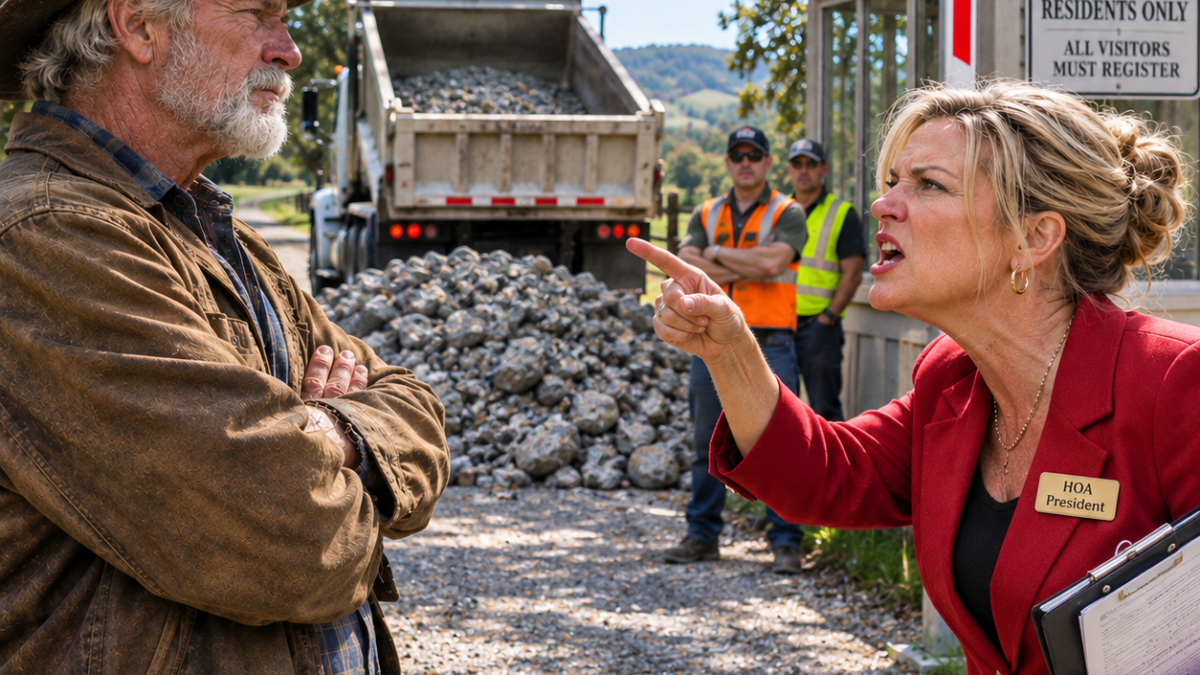
Three weeks later I came home from the feed store and found a guard booth sitting in the middle of my road.
Steel-sided.
Dark green.
Concrete pad.
Barrier arm.
Security camera on a twelve-foot pole.
A keypad.
Reflective sign.
RIDGEMONT PRESERVE.
RESIDENTS ONLY.
VISITORS MUST REGISTER.
I stopped my pickup thirty feet away.
For a moment, I thought I had turned onto the wrong road.
Then I looked at Ruth’s oaks.
Same road.
My road.
A uniformed security guard stepped out.
Young man.
Maybe twenty-three.
He held a tablet.
“Good afternoon, sir.”
I lowered my window.
“What is this?”
“Security checkpoint.”
“I can see that.”
“Name?”
“Hollis Tate.”
He scrolled.
“Address?”
“End of the road.”
More scrolling.
“You’re not on the resident list.”
“I know.”
“Purpose of visit?”
I stared at him.
He was not the enemy.
I reminded myself of that.
Just somebody working a shift.
“I live here.”
He frowned.
“In Ridgemont?”
“No.”
“Then I need visitor authorization.”
I took a breath.
“This road goes to my house.”
He looked uncertain.
“I’m going to need someone from the HOA to approve entry.”
I almost laughed.
Instead I pointed.
“You see the asphalt under your shoes?”
“Yes.”
“I own it.”
He looked at his tablet.
I said:
“The booth too, apparently, because they poured that concrete on my property.”
“Sir, I’m just doing my job.”
“I know.”
“Call your supervisor.”
He did.
Ten minutes later, I was allowed through as an “exception.”
An exception.
On my driveway.
I went home.
Pulled my deed.
Pulled the 2004 license from Dad’s old steel cabinet.
Then called the HOA.
Gwen answered.
“Hollis.”
Not Mr. Tate anymore.
She had expected me.
“What did you build?”
“A security improvement.”
“On my land.”
“The HOA has maintained access for nearly two decades.”
“Access.”
“Yes.”
“Not ownership.”
“Our counsel believes Tate Lane has functionally become common infrastructure.”
“That is not a legal phrase that means anything.”
She paused.
“You may want to review your records.”
“They’re in front of me.”
“So are ours.”
I looked through the kitchen window toward the road.
“Remove the booth.”
“No.”
I thought I had misheard.
“No?”
“The board approved it.”
“Your board cannot vote to build on my property.”
“We disagree.”
“Gwen.”
Her voice changed.
Colder.
“Mr. Tate, this conversation is becoming unproductive.”
“You built a gate on my lane.”
“We installed reasonable controls for the safety of 214 households.”
“And blocked the man who owns it.”
“You were allowed through.”
“I do not require permission.”
“You will need a resident-access credential going forward.”
I actually laughed.
Not because it was funny.
Because sometimes arrogance becomes so complete that it crosses into comedy.
“A credential.”
“Yes.”
“To reach my ranch.”
“Yes.”
“On my road.”
There was a pause.
Then:
“Legally, the situation is more complicated than that.”
It was not.
But people love telling landowners things are complicated when they want the land.
The next morning I found a notice stapled to my gate.
RIDGEMONT PRESERVE HOMEOWNERS ASSOCIATION.
VIOLATION NOTICE.
UNREGISTERED VEHICLE.
UNAUTHORIZED BYPASS OF SECURITY CONTROL.
PENALTY:
$350 PER DAY.
I read it twice.
Then flipped it over.
Nothing.
My first reaction was amusement.
The HOA had no authority over me.
I was not a member.
My ranch was outside the development boundary.
They could fine the moon if they wanted.
Collection would be another matter.
But something bothered me.
At the bottom was a signature.
Gwen Aldrich.
And beside it, a date.
Three weeks earlier.
Before the guard booth had even been installed.
The violation system had been prepared in advance.
They had planned for me to resist.
That changed my mood.
This was not confusion.
Not a board making a mistake.
They knew I owned the road.
They had simply decided ownership could be overcome by administrative pressure.
That night I opened the old steel cabinet again.
Dad had bought it from a government surplus sale in 1979.
Green.
Heavy.
Ugly.
Everything important lived in it.
Deeds.
Water rights.
Mineral agreements.
Ruth’s death certificate.
Dad’s handwritten maps.
The 2004 license.
I sat at the kitchen table.
Read every page.
Page one.
Two.
Three.
At section six, I stopped.
Then read it again.
In the event that the Licensee, any successor association, homeowners association, management company, or agent thereof installs, operates, or maintains any gate, barrier, checkpoint, credential system, toll, restriction, access-control device, or other measure limiting the Licensor’s unrestricted passage or asserting control over Tate Lane, Licensor may terminate this License upon thirty (30) calendar days’ written notice.
I stared.
Then smiled.
First time since the booth went up.
I slept very well.
Next morning I called attorney Tamara Quinn.
Tamara had handled agricultural property disputes for half the county.
Sixty-one.
Silver hair.
Glasses she wore on a chain even though she claimed not to.
Her office smelled like coffee and paper.
She read the license.
Then again.
Then the original deed.
Then the county plat.
Then looked at me.
“Where exactly is the booth?”
I slid over photographs.
She adjusted her glasses.
“Entirely within your parcel?”
“Yes.”
“Survey?”
“Old one.”
“We’ll get a new one.”
She read section six again.
“Hollis.”
“Yes.”
“This is extremely favorable.”
“I figured.”
“But favorable does not mean painless.”
“I’m aware.”
“If you invoke this, the HOA will fight.”
“Let them.”
“Two hundred fourteen homes use that road.”
“Yes.”
“Any second access?”
“Emergency gravel route on county reserve.”
“Full vehicle access?”
“Technically.”
“Practical?”
“No.”
She leaned back.
“So Tate Lane is their primary road.”
“Yes.”
“And they have no recorded easement.”
“No.”
“Only this license.”
“Yes.”
Tamara tapped the document.
“Then their new president has made a very expensive mistake.”
We served notice that afternoon.
Certified mail.
Personal service.
Email.
Recorded memorandum at the county courthouse.
Thirty calendar days.
Remove all access-control infrastructure.
Restore unrestricted access.
Cancel all purported fines.
Acknowledge Tate ownership.
Failure would terminate the license.
Gwen called me within two hours.
She did not say hello.
“You hired a lawyer.”
“You built a checkpoint.”
“That notice is invalid.”
“Tamara disagrees.”
“Our counsel says the HOA has prescriptive rights.”
“After nineteen years of permissive use?”
Silence.
That was a problem for them.
Prescriptive easements generally require use under a claim of right adverse to the owner.
Their use was expressly permitted by contract.
You cannot easily claim somebody’s land by openly using it under their written permission.
Gwen said:
“We’ve maintained that road for years.”
“Your agreement requires partial maintenance.”
“That strengthens our claim.”
“No.”
She hated that word.
“You cannot simply shut 214 families in.”
“You have thirty days.”
“This is extortion.”
“No.”
“You remove the booth.”
“I do nothing.”
She hung up.
The fines continued.
Day one:
$350.
Day two:
$700.
Day five:
$1,750.
Then another violation.
“Harassment of security personnel.”
$500.
My harassment consisted of telling the guard he was standing on private property.
Day eight:
“Unauthorized commercial traffic.”
That was my cattle feed delivery.
Day ten:
“Failure to register agricultural equipment.”
My tractor.
I collected every notice.
Put them in a folder labeled:
GWEN’S FAN MAIL.
Tamara did not find that funny.
“Do not antagonize her.”
“I haven’t.”
“You named the folder.”
“She can’t see the folder.”
“Knowing you, someday a jury will.”
The HOA sent a lawyer’s letter.
Five pages.
It referred to me as a “hostile adjoining landowner.”
Tamara circled adjoining.
“You are not adjoining.”
“I know.”
“The development lies behind your parcel.”
“Yes.”
“So technically they’re adjoining you.”
“Fine.”
She circled hostile.
“Accurate?”
“Improving.”
Tamara looked at me.
“Hollis.”
“I’m joking.”
“Try harder.”
Gwen began holding meetings.
Residents got emails warning that I was “threatening community access.”
That part enraged me.
I was not threatening anything.
I had told them exactly how to keep the road.
Remove the checkpoint.
That was it.
No money.
No new contract.
No demand.
Take down your gate and continue as before.
But Gwen framed me as the aggressor.
People began driving by slowly.
Some glared.
One man shouted from a truck:
“Stop holding us hostage!”
I was repairing fence.
I shouted back:
“Tell Gwen to move her booth!”
He kept driving.
Then Ida Mae came.
Midnight.
Almost literally.
11:38 p.m.
Knocking hard.
I opened the door.
She stood in slippers and a coat over her nightgown.
“Ida?”
“I did something.”
“That sounds promising.”
“Not funny.”
She carried a large envelope.
Hands shaking.
“Come inside.”
She sat at my kitchen table.
I made coffee.
She refused.
That worried me.
Ida never refused coffee.
She put the envelope down.
“I’m on the HOA correspondence committee.”
“I know.”
“They send overflow mail to my house sometimes.”
“Why?”
“Because Gwen fired the office assistant.”
“Of course.”
“This came by mistake.”
I looked.
Bank statement.
RIDGEMONT PRESERVE HOA.
SECONDARY ACCESS CAPITAL RESERVE.
I looked at Ida.
“What is this?”
“Read.”
The fund had been established in 2005.
Purpose:
Construction of permanent secondary roadway and county-compliant entrance.
Homeowners had been paying into it for years.
Special assessment components.
Transfer fees.
Reserve contributions.
At one point balance:
$412,683.
I looked up.
“I thought you said a hundred twelve thousand.”
“That was the last figure I remembered.”
“Ida.”
“Keep reading.”
Over five years, the money had been withdrawn.
Security infrastructure.
Consulting.
Traffic study.
Camera system.
Gatehouse.
Landscape redesign.
Private management contract.
A company called Aldrich-Sloan Site Services.
I tapped the name.
“Related?”
“Gwen’s brother-in-law.”
“How related?”
“Her sister’s husband.”
“That’ll do.”
Current balance:
$7,842.
I stared.
“They spent the backup road fund.”
Ida nodded.
“That’s why Gwen can’t lose Tate Lane.”
Now everything made sense.
The checkpoint was not simply about control.
It was cover.
For nineteen years, the HOA had been required by its original development plan to pursue secondary access.
Residents had paid for it.
But the project never happened.
Money was redirected.
As long as Tate Lane remained available, nobody looked too closely.
Then Gwen built the checkpoint partly using reserve money designated for the alternative road.
She was making my road look like official HOA infrastructure.
If ownership blurred enough, perhaps questions stopped.
Tamara read the statements the next morning.
Her expression changed slowly.
“Where did this come from?”
“Misdelivered mail.”
“Did Ida open something not addressed to her?”
“It arrived in the packet she was assigned.”
Tamara looked at me.
“We need to be careful.”
“Can we use it?”
“Maybe.”
“Can residents ask for their own financials?”
“Absolutely.”
Ida did.
So did twelve others.
Then thirty.
The board delayed.
That was the third major mistake.
If you want people to ignore financial records, do not tell them they cannot see them.
Residents began asking questions.
Where is the secondary road?
Why is the fund depleted?
Why was $96,000 paid to a company related to Gwen?
Why did the gatehouse cost almost twice the original estimate?
Why had no one disclosed Tate Lane was private?
Gwen responded with an email.
“The HOA is currently engaged in defensive legal action caused by an outside landowner seeking to destabilize community access.”
That outside landowner was me.
Ida printed it.
Brought it over.
I read.
“Creative.”
“She’s blaming you.”
“She can blame my cattle if she likes.”
“People are scared.”
That mattered.
I had spent two weeks angry enough to forget there were families behind this.
People with jobs.
School.
Medical appointments.
One family had a disabled child.
Several elderly residents.
If I terminated access completely, they would suffer before Gwen did.
I told Tamara.
“I’m not trapping emergency vehicles.”
“We can preserve emergency ingress.”
“How?”
“Separate revocable emergency license.”
“No.”
“That creates another agreement.”
“Temporary.”
“How temporary?”
“Until the dispute is resolved.”
We coordinated with the county fire marshal.
That detail later saved me from a great deal of criticism.
A ten-foot emergency route could remain.
No resident traffic.
Fire.
Ambulance.
Law enforcement.
County-approved.
I also informed the sheriff’s office three days before the deadline.
Deputy Carlos Medina came to the ranch.
Forty-two.
Calm.
He read the documents.
“You’re actually going to close it?”
“If they don’t remove their booth.”
“Think they will?”
“No.”
“What are you planning?”
“Remove improvements from my property.”
Carlos looked at me.
“What does that mean?”
“Road included.”
He stared.
“The whole road?”
“The usable surface.”
“You’re serious.”
“Yes.”
“Hollis.”
“I have a legal right.”
“I didn’t say you didn’t.”
“But?”
“But legal and wise sometimes live in different counties.”
I liked Carlos.
That was why I listened.
“I’m leaving emergency access.”
“Good.”
“I’m notifying you.”
“Also good.”
“No confrontation.”
“Very good.”
“I’m doing it at night.”
“Less good.”
“Less traffic.”
He sighed.
“Have Tamara send our office the paperwork.”
“She already did.”
Carlos smiled.
“Of course she did.”
Day twenty-five.
Checkpoint still there.
Day twenty-six.
Still there.
Gwen installed a second camera.
Tamara sent another letter.
Day twenty-seven.
HOA counsel replied that the license was “irrevocable by reliance.”
Tamara laughed.
Actually laughed.
“That is not how this document works.”
Day twenty-eight.
The board held an emergency meeting.
Ida attended.
Gwen told residents:
“Mr. Tate is bluffing.”
Ida asked:
“What if he isn’t?”
Gwen said:
“He cannot remove a road used by hundreds of people.”
“Why?”
“Public reliance.”
“But is it his?”
Gwen refused to answer directly.
Ida pushed.
“Is Tate Lane legally owned by the HOA?”
Gwen said:
“Our attorneys are addressing title issues.”
That answer started a whisper through the room.
Ida called me afterward.
“She still thinks you’ll fold.”
“I know.”
“What are you going to do?”
“Exactly what I said.”
“Hollis.”
“What?”
“You’re frightening people.”
I sat on my porch.
Looked down Tate Lane.
Ruth’s oaks.
Lights from Ridgemont beyond.
“I know.”
“Can you give them another week?”
“No.”
“Why?”
“Because then the notice means nothing.”
Silence.
I continued.
“I gave her thirty days to undo one stupid thing.”
“I know.”
“She chose not to.”
“I know.”
“I’m not punishing residents.”
“That won’t be how it feels.”
She was right.
That bothered me.
“Tell them emergency access stays.”
“I will.”
“And tell them to pressure the board tonight.”
“I already did.”
Day twenty-nine.
Surveyor Les Farrell arrived.
Seventy-one.
Had been surveying ranch property longer than some Ridgemont residents had been alive.
He walked the entire lane.
GPS equipment.
Old monument references.
Pins.
By late afternoon, orange stakes marked the boundary.
Six feet beyond the road edge on one side.
Five to eight on the other.
Every booth post.
Every camera pole.
Every inch of pavement.
Mine.
Les handed me the signed map.
“You’ve got it.”
“All of it?”
“Every inch.”
“What about the southern turnout?”
“Yours.”
“Drainage?”
“Yours.”
“Gatehouse slab?”
“Yours.”
I looked down the lane.
“Then tomorrow it’s mine again.”
Les sighed.
“You and your father were stubborn.”
“He was worse.”
“No.”
Les packed his equipment.
“You are.”
At 5:00 p.m. on day thirty, Tamara sent final notice.
Deadline:
8:00 p.m.
Remove checkpoint.
Acknowledge unrestricted passage.
License remains.
Do nothing.
License terminates.
7:00.
Nothing.
7:45.
Nothing.
At 7:58, Gwen’s Mercedes came through.
Barrier lifted automatically.
She stopped beside my fence.
Window down.
“Hollis.”
“Gwen.”
“I hope you enjoyed your little performance.”
“Deadline’s in two minutes.”
“You’ll do nothing.”
I looked at my watch.
“We’ll see.”
“You think a judge will let one angry rancher destroy access for 214 homes?”
“I think a judge will read the contract.”
She smiled.
“Enjoy your little land, Mr. Tate.”
I tipped my hat.
“Good night, ma’am.”
8:00 p.m.
Tamara texted.
License terminated.
At 11:45, Buddy Rollins arrived with a CAT D6 dozer on a flatbed.
Behind him came two dump trucks.
Then an excavator.
Buddy was sixty.
Heavy beard.
Knew my ranch.
Knew my father.
He climbed down.
Looked toward Ridgemont.
“You sure?”
I handed him:
Deed.
Survey.
License.
Notice.
Termination record.
County emergency-access plan.
Tamara’s written opinion.
Buddy whistled.
“You brought homework.”
“I don’t want you guessing.”
He read.
Then looked at the road.
“What stays?”
“Ten-foot emergency strip along the eastern edge.”
“Everything else?”
“Surface comes up.”
“Booth?”
“Mine now if abandoned on my land.”
“You want it destroyed?”
“No.”
That surprised him.
“Remove it intact if possible.”
“Why?”
“Evidence.”
Buddy smiled.
“There’s the Hollis I remember.”
At midnight, the blade touched Tate Lane.
The sound was terrible.
Asphalt tearing from compacted base.
Metal scraping stone.
I felt it in my chest.
This was my father’s road.
Ruth’s trees.
For one second I nearly stopped everything.
Then I looked at the guard booth.
Barrier.
Camera.
Residents-only sign.
I remembered being asked my purpose for driving home.
“Go.”
Buddy pushed.
The first section came apart.
The booth went next.
Excavator lifted it from the slab.
Set it on my pasture.
Camera pole removed.
Barrier arm disconnected rather than smashed.
I did not want theatrics.
I wanted possession.
Then road surface.
Truckload after truckload.
We hauled aggregate onto my south pasture where I intended to reuse it.
At 1:20 a.m., one resident came outside.
Then another.
Phones appeared.
Someone shouted:
“What are you doing?”
Buddy stopped.
I walked toward the property boundary.
“We’re removing private improvements from my land.”
“You can’t do that!”
“I can.”
A man in pajamas said:
“My wife has to work at six.”
“Emergency route stays.”
“That doesn’t help her.”
“No.”
“Then stop!”
I looked at him.
“Call your board.”
By 2:00, twenty residents were watching.
Gwen did not appear.
Maybe nobody called her.
Maybe they did and she thought we were bluffing.
Again.
At 3:35, we reached the Ridgemont line.
The usable road was gone.
Not a crater.
Not dangerous.
A broad raw strip of compacted red-brown earth.
Drainage intact.
Emergency lane packed along one side.
Temporary reflective markers installed.
At 4:12, Buddy shut down the dozer.
Silence returned.
I stood in the dark.
Looked at the lane.
I expected victory.
Did not feel it.
Mostly grief.
My father’s road had been there thirty-seven years.
Now it looked like a construction site.
Buddy stood beside me.
“You okay?”
“Ask tomorrow.”
“You want coffee?”
“Yes.”
“At four in the morning?”
“That’s when coffee is most honest.”
We sat on the tailgate until sunrise.
At 6:41, first commuter reached the missing road.
Brake lights.
Then second.
Third.
By 7:00, traffic backed into Ridgemont.
At 7:12, my phone showed eighty-three missed calls.
I turned it off.
Then turned it back on.
One voicemail from Ida.
“Hollis.”
Pause.
“You crazy old bastard.”
Another pause.
“You actually did it.”
At 7:18, Gwen arrived.
Not in the Mercedes.
Golf cart.
Faster through the neighborhood.
She stepped out wearing a business suit and heels unsuitable for raw earth.
She crossed the dirt almost running.
“HOLLIS!”
I was beside my pickup.
Carlos Medina had just arrived with two deputies.
Gwen waved documents.
“What have you done?”
I looked at the road.
“Seems obvious.”
“Where is our road?”
There it was.
Our road.
I crossed my arms.
“Ma’am.”
“It was never our road.”
“It was mine.”
“And I took it back.”
Her face turned red.
“You destroyed HOA property.”
“No.”
“You stole the booth.”
“No.”
“The cameras.”
“No.”
“We paid for them.”
“You installed them on my land after written warning.”
Carlos stepped between us.
“Everybody keep space.”
Gwen pointed at me.
“Arrest him.”
Carlos looked tired already.
“For what?”
“Destruction of property.”
He held out his hand.
“Show me ownership.”
She shoved HOA papers toward him.
Carlos read.
Then looked at Tamara’s package.
Deed.
Survey.
License.
Recorded notice.
Termination.
He took his time.
Gwen kept talking.
“He has blocked a residential community.”
“Emergency access is open.”
“That is irrelevant.”
“It’s not irrelevant to me.”
Carlos looked toward the emergency lane.
Fire marshal markers.
Ten-foot packed surface.
Clear.
Then he looked at Gwen.
“Did you install this checkpoint?”
“Yes.”
“Permission from Mr. Tate?”
“The HOA has road rights.”
“I asked permission.”
“Our attorney—”
“Ma’am.”
Carlos pointed to the survey stake.
“This booth was entirely on his parcel.”
Silence.
“Was it?”
Gwen looked at me.
Then at Carlos.
“Our rights are established through decades of use.”
Carlos handed her the license.
“Looks to me like your use was permissive.”
She went pale.
Then angry.
“You are not a judge.”
“No.”
“And I’m not making a final civil determination.”
He pointed toward the dismantled booth on my pasture.
“But based on what I’ve got in front of me, I’m not arresting Mr. Tate for removing structures from land his recorded deed and survey identify as his.”
Gwen said:
“He trespassed against the HOA.”
Carlos almost smiled.
“On his own property?”
She had no answer.
He continued:
“If anything, we’d need to discuss whether your association exceeded its permission by installing access controls after being warned not to.”
That was the moment her face changed.
Not defeat.
Fear.
She knew the contract mattered.
Residents had gathered.
Phones out.
Someone recorded every word.
Within an hour, the video was everywhere in Ridgemont’s private Facebook group.
By noon, local news knew.
By 2:00 p.m., Gwen filed suit.
Emergency injunction.
She wanted the court to order me to rebuild the road immediately.
Tamara called.
“You enjoying your morning?”
“Not particularly.”
“Good.”
“Why good?”
“People who enjoy litigation are usually the problem.”
Hearing three days later.
County courthouse.
Judge Ellen Radcliffe.
Sharp eyes.
No patience for theatrical lawyers.
Ridgemont’s counsel argued first.
He called Tate Lane a “community access corridor.”
Not private road.
Corridor.
Tamara wrote the word on a pad.
Slid it toward me.
Fancy word for somebody else’s road.
I nearly laughed.
The HOA argued reliance.
Emergency hardship.
Implied easement.
Prescriptive easement.
Equitable estoppel.
Public necessity.
Anything that might turn nineteen years of written permission into permanent ownership.
Tamara stood.
“Your Honor, none of those theories overcome the document they signed.”
She held up the license.
“The homeowners did not use Tate Lane adversely.”
“They used it with permission.”
“The instrument expressly reserves ownership.”
“It expressly prohibits access control.”
“It expressly identifies the remedy.”
“Thirty days’ notice.”
“Mr. Tate gave thirty days.”
“The HOA ignored it.”
“And the license terminated by its own language.”
Judge Radcliffe asked:
“Why remove the road surface?”
Tamara looked toward me.
Then:
“Because it is his improvement on his property, and because leaving it in place would have enabled continued unauthorized use after termination.”
The judge looked at me.
“Mr. Tate.”
I stood.
“Ma’am.”
“Was your purpose to punish residents?”
“No.”
“Then why not simply install your own gate?”
“Because I didn’t want a gate.”
“Why not close access temporarily?”
“Because they already decided a barrier meant ownership.”
I paused.
“I wanted the physical condition to match the legal condition.”
The judge raised an eyebrow.
“That is a very rancher answer.”
“I am a rancher.”
A few people laughed.
Judge Radcliffe did not.
But almost.
Then Tamara called Grayson Holt.
Original developer.
I had not seen him in twelve years.
Now seventy.
White hair.
Still expensive boots.
He testified about the 2004 license.
“Yes, we understood Tate Lane remained Hollis’s property.”
“Was a permanent easement created?”
“No.”
“Why?”
“Hollis wouldn’t grant one.”
I nodded.
Tamara asked:
“Was there supposed to be another road?”
Grayson hesitated.
“Yes.”
The courtroom shifted.
“Explain.”
“Ridgemont’s original traffic plan contemplated secondary access from County Road 18.”
“Why was it not built?”
“Cost.”
“Was funding established?”
“Yes.”
“Through homeowner reserves?”
“Yes.”
“Did you communicate that requirement to subsequent boards?”
“Yes.”
Tamara displayed an email.
Then another.
Gwen’s lawyer objected.
Overruled.
One email, dated fourteen months earlier, was from Gwen to Grayson.
It said:
Need you to confirm Tate access was intended as permanent. Current deed language is creating unnecessary complications.
Grayson replied:
It was never permanent. Hollis would not sign an easement. Secondary entrance was always expected eventually.
Then another email from Gwen:
Could you sign a clarification stating the plat intended permanent access from inception?
Grayson:
No. That would be inaccurate.
Then:
Gwen:
We can date it to original closing package if necessary.
The courtroom went silent.
Tamara let the silence work.
“Mr. Holt, did you understand that as a request to backdate a document?”
“Yes.”
“Did you do it?”
“No.”
Judge Radcliffe looked directly at Gwen.
She did not look back.
That was the first real crack.
Then came the money.
Tamara did not need to prove embezzlement for the road case.
She only needed to show the HOA’s own conduct undermined its claim.
But the reserve fund explained motive.
The judge asked HOA counsel:
“Is there in fact a secondary-access reserve?”
He hesitated.
“Yes.”
“Current balance?”
He whispered to someone.
Then:
“Approximately eight thousand.”
“Original collected amount?”
“We would need accounting.”
Tamara stood.
“We have statements indicating more than four hundred thousand passed through that fund.”
Gwen’s lawyer objected.
Judge Radcliffe looked at him.
“Then perhaps an accounting is exactly what we need.”
Emergency ruling came that afternoon.
The court found I lawfully terminated the license.
No permanent easement existed.
My removal of the road surface, based on the current record, was within my ownership rights.
However, because of community hardship, the emergency lane would remain protected until a permanent solution was negotiated.
The HOA’s request to force me to rebuild Tate Lane at my expense was denied.
Then Judge Radcliffe added:
“The court is deeply concerned about representations concerning ownership, reserve funds, and the apparent request for a backdated property document.”
She ordered financial records preserved.
County authorities notified.
Independent accounting.
Gwen stared straight ahead.
The residents did not.
They stared at her.
That was worse.
By Friday, she resigned.
Not gracefully.
Her letter blamed “harassment, misinformation, and hostile external actors.”
I framed nothing.
Tamara told me not to.
A state investigation followed because reserve money had been used through affiliated contractors without proper disclosure.
Not every withdrawal was illegal.
That matters.
Some were poorly authorized.
Some wasteful.
Some violated HOA rules.
The brother-in-law’s company had overbilled on several contracts.
Gwen had approved them without competitive bids.
The audit eventually found approximately $137,000 in questionable or unsupported expenditures.
Some money was recovered.
Insurance covered part.
Civil settlements covered more.
No dramatic prison sentence.
Gwen paid restitution through settlement.
Her brother-in-law’s company lost contracts.
The HOA had to disclose years of financial records.
The bigger punishment was public.
The residents who had trusted her saw exactly what she had done.
And they had to pay for the consequences.
That part bothered me.
Because when leaders waste communal money, leaders rarely feel the full cost.
Ordinary people do.
Two weeks after the hearing, a group came to my porch.
Not lawyers.
Residents.
Seven of them.
Ida Mae in front.
A man named Jason Lee.
A nurse named Carla Morris.
Two retirees.
A young couple.
And the newly appointed interim HOA president, Thomas Bell.
Thomas was sixty-two.
Accountant.
Soft-spoken.
Looked like he would rather be anywhere else.
He removed his hat.
“Mr. Tate.”
“Hollis.”
He nodded.
“Hollis.”
Ida walked past everyone.
Into my house.
“Coffee.”
I looked at Thomas.
“She does this.”
He said:
“I’ve noticed.”
We sat on the porch.
Thomas opened a folder.
Not threateningly.
Carefully.
“We came to ask whether you’d consider restoring access.”
I looked down the lane.
Raw dirt.
Emergency path.
“What are you offering?”
“Whatever is fair.”
That answer mattered.
Not:
We deserve it.
Not:
You have to.
Fair.
I asked:
“Recorded easement?”
Thomas nodded.
“Permanent.”
“Nonexclusive.”
“Yes.”
“No checkpoint.”
“Yes.”
“No gate.”
“Yes.”
“No credential system.”
“Yes.”
“No interference with my ranch traffic.”
“Yes.”
“Road maintenance shared.”
“Yes.”
“Surveyed width defined.”
“Yes.”
“Emergency responsibilities?”
“County standard.”
I looked at Tamara, who had joined us.
She said nothing.
I continued.
“Compensation.”
Thomas took a breath.
“We have an appraisal.”
He slid it over.
Fair market value for permanent easement rights.
Not absurd.
Not insulting.
$186,000.
I looked at him.
“Your reserve fund has eight thousand dollars.”
“Yes.”
“How?”
“Special assessment.”
The residents behind him looked uncomfortable.
I shook my head.
“No.”
Thomas frowned.
“You won’t sell?”
“I didn’t say that.”
“Then?”
“You people already paid for a second road once.”
Silence.
“I’m not making 214 families pay twice because Gwen burned the first fund.”
Thomas leaned forward.
“What do you suggest?”
I had thought about it.
Too much.
I said:
“Insurance recovery.”
“Recovered contractor money.”
“Sale of unnecessary HOA property.”
“Legal claim against the former board where appropriate.”
“Use that first.”
“And if it’s short?”
“Then we talk.”
Thomas stared at me.
“You’d wait?”
“I’ve waited forty years for people to respect a deed.”
“I can wait a little longer.”
The negotiation took six weeks.
The county temporarily improved the emergency route so residents had access.
Inconvenient.
Longer.
Dusty.
But functional.
That prevented anyone from being trapped.
Eventually the financial recovery package produced enough.
Insurance settlement.
Returned contractor payments.
Board reserve reallocation.
A smaller special assessment than initially feared.
I agreed to a permanent easement.
Recorded.
Clear.
No ambiguity.
Tate Lane remained my land.
Ridgemont received permanent passage rights.
No booth.
No private gate.
No resident-only sign.
No treating my ranch traffic as visitor traffic.
And one clause Tamara added because she knew me.
No future access-control structure may be installed without the written consent of the Tate parcel owner.
Thomas read it.
Looked at me.
“Planning ahead?”
“Yes.”
“I respect that.”
The road had to be rebuilt.
Buddy Rollins returned.
He looked at the plans.
“So we’re putting back the thing we removed.”
“Yes.”
“Government work.”
“Private.”
“Worse.”
This time residents helped choose details.
Improved drainage.
Wider shoulder.
Reflective emergency markers.
New base.
Fresh gravel and asphalt.
I refused decorative lights.
Somebody suggested stone pillars.
I almost revoked negotiations on principle.
Ida Mae brought pie to the construction crew.
Buddy ate half.
I told him he was supposed to work.
He said:
“Union break.”
“You’re not union.”
“Pie changed my politics.”
Ruth’s oaks had survived.
Most of them.
Two near the old booth had been damaged during construction.
I replaced them.
Then planted four additional young oaks.
Ida asked:
“Why four?”
“No reason.”
But there was.
Two for the trees lost.
One for Dad.
One for Ruth.
I did not tell her.
She would have cried.
Then I would have had to pretend there was dust in my eye.
The reopening happened on a Saturday.
No ceremony planned.
Residents gathered anyway.
Thomas asked if I wanted to cut a ribbon.
“No.”
“You own the road.”
“That’s why I don’t need a ribbon.”
Ida brought one anyway.
Red.
She tied it between two stakes.
Then handed me scissors.
I said:
“Absolutely not.”
She stared.
I cut it.
People clapped.
I hated that.
Then a little boy on a bicycle rode through.
No guard.
No checkpoint.
No tablet.
Just a kid on a road.
That felt right.
I did one more thing with the easement payment.
The first check I wrote was not actually for Ida Mae’s entire porch, despite the version that later circulated online.
But I did pay to replace her broken front steps and railing.
She had been putting it off.
I told her it was payment for the bank statement.
She said:
“I did not sell you information.”
“I know.”
“Then why?”
“Because your porch is trying to kill you.”
“I’m seventy-eight.”
“Exactly.”
“You’re sixty-six.”
“I have better stairs.”
She hit me with a dish towel.
The rest of the money went toward ranch debt.
Taxes.
Equipment.
A small scholarship in Ruth’s name at the local agricultural program.
I did not become rich.
I did not want to.
Gwen left Ridgemont nine months later.
House sold.
I saw the moving truck.
Did not wave.
She did not wave either.
Fine.
Not every story needs reconciliation.
The last time we spoke was by accident at the county courthouse.
I was renewing agricultural paperwork.
She was leaving some hearing related to the financial settlement.
We passed.
She stopped.
“Hollis.”
I stopped too.
She looked tired.
Not polished anymore.
“I suppose you’re pleased.”
“With what?”
“Everything.”
I thought.
“No.”
She looked surprised.
“You ruined me.”
There it was.
I could have said:
You ruined yourself.
That would have been satisfying.
Also mostly true.
Instead:
“You built a checkpoint on land you knew wasn’t yours.”
She looked away.
“I thought the board had rights.”
“No.”
“You thought people would be too afraid of losing access to challenge you.”
Silence.
I continued.
“You were almost right.”
She looked at me.
“What does that mean?”
“It means most people do not read old documents.”
I started walking.
Then stopped.
“One more thing.”
She turned.
“If you had taken the booth down during those thirty days, none of this would have happened.”
Her face changed.
Because that was the truth she could not escape.
No bulldozer was inevitable.
No road removal.
No courtroom humiliation.
No audit triggered by panic.
No public collapse.
I had given her thirty days.
All she had to do was remove a gate.
Pride cost more.
I left.
Today, Tate Lane looks better than it did before.
Fresh surface.
Better drainage.
Ruth’s old oaks on one side.
Young ones growing beside them.
No guard booth.
No barrier arm.
No camera pole.
There is one sign at the entrance.
Small.
County-approved.
It says:
TATE LANE.
PRIVATE PROPERTY.
RECORDED ACCESS EASEMENT.
That is all.
No threat.
No slogan.
No warning.
Just the truth.
Ridgemont residents use the road.
So do I.
School buses.
Delivery trucks.
Farm equipment.
Ambulances.
Children on bicycles.
Ida Mae still brings peach pie.
Thomas sometimes stops for coffee.
Carlos drives through occasionally and slows near my porch.
He says he’s checking for illegal bulldozers.
I tell him to keep moving.
The old guard booth sits behind my equipment shed.
Buddy wanted to scrap it.
I kept it.
Not as a trophy.
As storage.
Rakes.
Fence staples.
Chains.
The residents-only sign is turned backward against the wall.
Once, Ida saw it.
“You should hang that in your house.”
“Why?”
“Conversation piece.”
“My house already has walls.”
She said I lacked imagination.
Maybe.
But I do not need reminders.
Every time I drive Tate Lane, I remember.
My father’s loader.
Ruth’s trees.
Gwen’s booth.
Thirty days.
Midnight.
The first dozer blade tearing into asphalt.
Two hundred fourteen families standing at a dead end.
And the moment a woman who had spent months calling it “our road” finally learned that voting on somebody else’s property does not make it yours.
People later asked whether I would do it again.
That is the wrong question.
The better question is whether I should have had to.
I did not want a fight.
I wanted to drive home without asking permission.
I did not want to close a neighborhood.
I wanted a checkpoint removed.
I did not want an audit.
I wanted a contract honored.
At every stage, there was an easier option.
Respect the deed.
Read the license.
Remove the gate.
Show residents the financial records.
Build the second entrance the fund was created for.
Apologize before pride became litigation.
Nobody chose the easy option until everything became expensive.
That is the part people miss when they tell the story as revenge.
They say:
Old rancher destroys HOA road overnight.
It sounds satisfying.
Simple.
One man versus a bad HOA.
But roads are not simple.
Neither are neighborhoods.
Neither is ownership.
Two hundred fourteen families did not deserve to lose access because their president made terrible decisions.
That is why I preserved emergency passage.
That is why we negotiated a permanent solution.
That is why I agreed to rebuild instead of spending the next ten years proving I could legally keep them off.
Rights matter.
So does what you do with them.
I could have kept Tate Lane closed forever.
Maybe.
Tamara thought my position was strong.
But owning the right to hurt people is not the same as needing to use it.
Once Ridgemont came to my porch honestly, the fight changed.
They stopped telling me what they owned.
They started asking what was fair.
That was all I wanted from the beginning.
Respect.
It is cheap when given early.
Expensive when forced.
My father understood that.
He once told me something while we were grading the first version of the lane.
I was young.
Impatient.
Complaining that the gravel truck driver had spread material six inches beyond our line.
Dad made me shovel it back.
I said:
“Six inches doesn’t matter.”
He said:
“It matters if it isn’t yours.”
At twenty-nine, I thought he was being stubborn.
At sixty-six, I understood.
Six inches becomes a foot.
Permission becomes entitlement.
A shortcut becomes infrastructure.
A license becomes “our road.”
Then one morning a man wakes up and finds a guard demanding identification on land his father worked.
Lines matter.
Not because dirt is sacred.
Because consent is.
Tate Lane taught 214 families that lesson.
It taught me another one.
Winning is not getting everything you can.
Winning is getting back what should never have been taken, then having enough sense not to become the same kind of person who took it.
Today the road is open.
The oaks are growing.
The booth is gone.
And nobody asks me my purpose when I drive home.
Sometimes, near sunset, I stop halfway down the lane.
I park beneath Ruth’s trees.
The neighborhood lights come on behind me.
Cattle move in the pasture.
Cars pass.
Somebody waves.
I wave back.
The road belongs to me.
The right to use it belongs to them.
That arrangement works because everyone now understands the difference.
A road is gravel.
Asphalt.
Dirt.
Drainage.
Survey stakes.
Legal descriptions.
But underneath all of that, a road is trust.
And trust works a lot like property.
If somebody gives you access to it, do not mistake permission for ownership.
Because respect costs almost nothing.
Pride, lawyers, audits, and a bulldozer at midnight cost considerably more.








