HOA President Turned My Christmas Tree Farm Into Her Private Gala Entrance—Then One Deed Exposed What Her Board Had Bought
PART2:
Temporary lighting tied to fence posts.
Then he panned toward the locked gate.
Donnelly Tree Farm stretched behind it.
Ninety-six acres.
Rows of Fraser fir.
Blue spruce.
Douglas fir.
A maintenance barn.
Two equipment sheds.
The old farmhouse.
A seasonal retail lot on the western side.
And the narrow working roads his family had used for three generations.
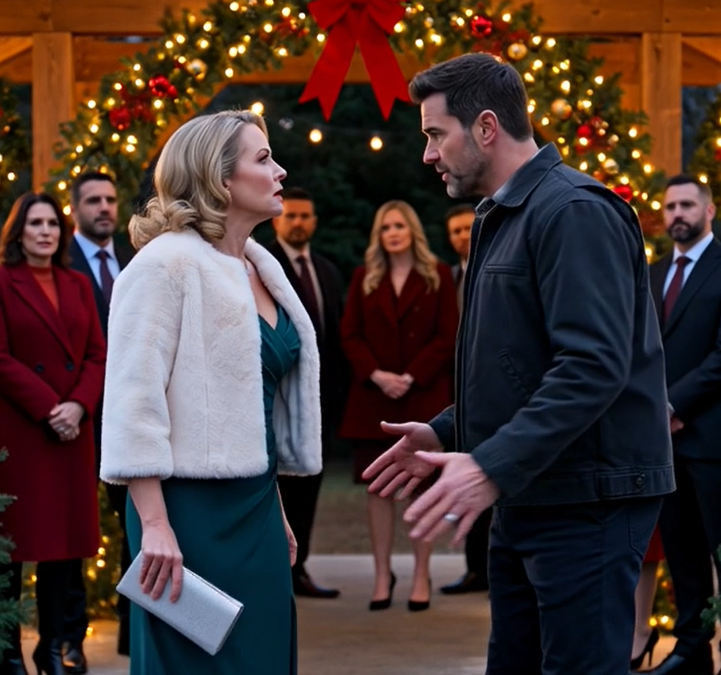
Elaine folded her arms.
Her emerald dress shimmered beneath the event lights.
A white fur wrap hung over one shoulder.
“Are you finished?”
“No.”
“You’re embarrassing yourself.”
“I’m documenting my property.”
“This isn’t about your property.”
Bryce lowered the phone.
“Elaine.”
“What?”
“You put a sign on my land.”
“It’s temporary.”
“You blocked my gate.”
PART3:
“The valets can move the cars.”
“Move them now.”
She laughed.
“They’ll be gone tonight.”
“That wasn’t my question.”
“This is an HOA event.”
“This is my property.”
“Tonight this road belongs to the community.”
Bryce stared at her.
“No.”
Her face tightened.
“It doesn’t.”
Elaine stepped closer.
“We’ve used West Farm Lane for years.”
“You’ve used it because I allowed you to.”
“And we’re using it tonight.”
“No.”
She glanced toward the security guards as though she expected them to make his answer disappear.
Bryce pointed at the black Range Rover parked across the gate.
“I need that gate open.”
“You have another entrance.”
“The north track.”
“Yes.”
“It’s almost two miles around.”
“You own a truck.”
“That road is for fence crews and seasonal access. My loader doesn’t use it unless I have to.”
“Then tonight you have to.”
Bryce almost smiled.
Not because anything was funny.
Because Elaine had just made the problem simple.
There are disputes where people disagree about what happened.
There are disputes where people disagree about what a document means.
And then there are disputes where one person says, directly and clearly:
Yes, I know your right exists.
I simply do not care.
Those are useful.
They reduce ambiguity.
Bryce looked at her.
“You’re refusing to open the gate?”
“Yes.”
“You’re refusing after I’ve told you I need access?”
“Yes.”
She smiled.
“Are we done?”
Bryce nodded once.
“Yes.”
That surprised her.
He walked back to his pickup.
Elaine followed.
“Where are you going?”
“Nowhere.”
He opened the driver’s door.
Climbed inside.
Set his phone on the console.
Opened the laptop he carried for farm orders and inventory.
Elaine stood outside his window.
“What are you doing?”
“Reading.”
“Reading what?”
“The agreement you signed.”
That changed her face.
Not dramatically.
A fraction.
Enough.
Six years earlier, Northgate Ridge had not existed.
The eastern edge of Bryce’s farm had bordered open woodland owned by Wescott Development.
Then came survey crews.
Road graders.
Sewer work.
Model homes.
Within eighteen months, seventy-two large houses climbed the ridge overlooking the valley.
The subdivision had a landscaped primary entrance on County Route 14.
Stone columns.
Decorative gatehouse.
Two narrow lanes.
Beautiful.
And badly designed for large service vehicles.
The first winter, the HOA had a problem.
Catering trucks.
Landscaping trailers.
Portable generators.
Furniture rentals.
Tree-service vehicles.
Snow-removal equipment.
Their main entrance could technically handle most of it.
But not easily.
West Farm Lane ran behind the subdivision.
It connected to a county service road and passed along Bryce’s eastern boundary before turning toward his equipment yard.
Wescott Development approached him.
Would he allow limited service access?
Bryce said no.
They offered money.
He still said no.
Then his father died.
December harvest.
Heart attack in the lower field.
Sixty-one years old.
One day he was running the farm.
Three days later Bryce was looking at payroll, debt, fertilizer contracts, property taxes, Christmas orders, and a stack of paperwork his father had always managed without telling anyone how.
Wescott came back.
This time Bryce negotiated.
He granted Northgate Ridge a limited license to use the first eight hundred seventy feet of West Farm Lane.
Not ownership.
Not an easement.
A revocable license.
Specific permitted purpose:
Approved service and delivery traffic associated with HOA common-area operations.
Not guest access.
Not event parking.
Not resident parking.
Not valet operations.
Not permanent signage.
Not road modification.
And absolutely no blocking Bryce’s agricultural access.
Section Seven was clear.
Any obstruction of Donnelly Tree Farm’s access constituted material breach and allowed immediate termination of the license by written or verbal notice.
Elaine Barlo had signed the renewal seventeen months earlier.
Bryce opened the PDF.
Scrolled.
Section Seven.
Still there.
He checked the time.
4:07 p.m.
Then he opened the email Northgate Ridge’s event coordinator had sent two weeks earlier.
Subject:
CHRISTMAS EVE GALA — VENDOR ACCESS CONFIRMATION.
Bryce had approved six service entries.
Catering.
Florist.
Furniture rental.
Heating contractor.
Lighting company.
Transportation support.
Each approval had been conditional on normal access rules.
Elaine had apparently decided conditional permission meant private event boulevard.
Bryce opened his contacts.
First call:
Megan Cross.
Northgate Ridge property manager.
She answered cheerfully.
“Merry Christmas Eve.”
“Megan. Bryce.”
Pause.
Her tone changed.
“What happened?”
“I’m terminating the West Farm Lane license under Section Seven.”
Silence.
“Right now?”
“Right now.”
“Bryce—”
“My gate is blocked by event vehicles.”
Another silence.
“She did what?”
“You’re on speaker in my truck. Elaine is standing outside.”
Elaine’s eyes widened.
Megan said:
“Elaine?”
Elaine leaned toward the open window.
“This is being blown out of proportion.”
Megan ignored her.
“Bryce, send written notice.”
“Already drafting it.”
“Email me and legal.”
“Doing it.”
He ended the call.
Elaine stared.
“You cannot terminate access during an event.”
“I just did.”
“You gave permission.”
“I revoked it.”
“You’re being childish.”
Bryce clicked send.
Second call:
Florist.
“Hi, Paige. Bryce Donnelly. The private access through West Farm Lane is revoked. Do not enter my property.”
“What happened?”
“Contract issue.”
“Are we still delivering?”
“Through Northgate’s public entrance if they can accommodate you.”
“Elaine told us the service road was guaranteed.”
“It isn’t.”
Third:
Rental company.
Fourth:
Catering coordinator.
Fifth:
Heating contractor.
Sixth:
Transportation manager handling valet flow.
Same message every time.
West Farm Lane closed.
No permission to enter Donnelly property.
Use public HOA access only.
Elaine stood beside the truck.
“You are deliberately sabotaging my gala.”
Bryce closed the laptop halfway.
“No.”
“What do you call this?”
“Enforcing the agreement.”
“You waited until tonight.”
“I arrived ten minutes ago.”
“You could make an exception.”
“I did.”
Her face flickered.
“What?”
“For six years.”
At 4:38, Elaine’s phone rang.
She looked at the screen.
Answered.
“What?”
Pause.
“What do you mean you can’t come through?”
She looked at Bryce.
“No. The road is approved.”
Another pause.
“It was approved this morning.”
Her jaw tightened.
“Then call the property manager.”
She hung up.
Immediately dialed another number.
Behind her, a large catering truck appeared at the far end of the service road.
It slowed.
Stopped.
Did not enter.
Elaine waved.
The truck remained where it was.
Her second call ended.
Then her third.
The florist van turned around.
A rental truck pulled onto the county shoulder.
The heating contractor called Bryce directly.
“Confirming we do not have access?”
“Correct.”
“Okay.”
“You can reach the clubhouse through the main subdivision entrance.”
“They told us the turning radius is too tight.”
“Then that’s between you and them.”
“Understood.”
Bryce ended the call.
Guests began arriving.
The valet team had expected westbound traffic to enter through the farm lane.
Now cars stacked near the county road.
The fourteen SUVs already inside had nowhere efficient to exit because the same gate Elaine blocked was also part of the valet circulation plan.
A white BMW attempted a three-point turn between cones.
Nearly backed into a portable heater.
Someone shouted.
Music continued from the clubhouse uphill.
Christmas strings.
Brass.
Artificial cheer drifting across an increasingly real traffic problem.
Elaine stormed toward Bryce.
“You need to undo this.”
“No.”
“Two hundred guests are coming.”
“That sounds like something your event coordinator should solve.”
“You approved the vendor route.”
“Until you breached the license.”
She pointed at him.
“You planned this.”
“I was delivering fifty-seven trees this morning.”
“You knew I needed the road.”
“You knew the conditions.”
A black SUV appeared at 4:52.
Not a guest vehicle.
County seal on the door.
It stopped beside Bryce’s pickup.
A man in a gray overcoat stepped out carrying a folder.
Bryce recognized him.
Alan Wexler.
County land-use enforcement.
Behind him came another SUV.
Two attorneys.
One was Bryce’s.
Megan Cross had called them after receiving his termination email.
The other represented Bryce’s title-insurance carrier.
That surprised him.
Elaine noticed.
“What is this?”
Wexler looked around.
Vehicles.
Signage.
Private security.
Cones.
Then at the gate.
“Who authorized event operations on this parcel?”
Elaine pointed toward Bryce.
“He did.”
Bryce shook his head.
“I authorized limited service delivery under a revocable license.”
Wexler opened the folder.
“I have the agreement.”
Elaine said:
“Then you know we have access.”
Wexler looked at her.
“Had.”
Silence.
He continued.
“Section Seven allows termination for obstruction of owner access.”
Elaine’s attorney had apparently not arrived yet.
That was unfortunate for Elaine.
She tried another approach.
“We’ve used this road continuously for six years.”
Bryce said:
“Under written license.”
“That creates established usage.”
“No.”
The title attorney beside Wexler looked up.
“A license does not become a property interest because you repeatedly use it with permission.”
Elaine looked at him.
“And you are?”
“Daniel Cho. Harrington Title.”
“Why is a title company here?”
Bryce wondered the same thing.
Before anyone answered, his phone rang.
Megan.
He picked up.
“Bryce.”
Her voice sounded wrong.
Not panicked.
Focused.
“Are you with Wexler?”
“Yes.”
“Put me on speaker.”
He did.
“I pulled the full Northgate property package after your termination notice.”
Wexler moved closer.
Megan continued.
“There’s something in the 2023 asset acquisition file.”
Elaine went still.
Bryce watched her.
“What?”
Megan said:
“Northgate Ridge purchased an eleven-point-four-acre parcel from Wescott Land Holdings eighteen months ago.”
“Where?”
“West boundary.”
Bryce frowned.
“There is no available eleven-acre parcel on their west boundary.”
“I know.”
His stomach tightened.
Megan continued.
“The deed description overlaps Donnelly Tree Farm.”
Nobody moved.
Bryce said:
“How much?”
“Preliminary overlay shows at least seven-point-eight acres.”
He looked toward the clubhouse.
“What seven acres?”
Pause.
“West Farm Lane.”
Another pause.
“The meadow beside your lower Christmas fields.”
Elaine’s face lost color.
“And the strip where tonight’s event entrance is set up.”
Bryce looked at the giant wreath-covered sign.
Then at Elaine.
She said:
“That’s impossible.”
Megan replied through the speaker:
“It’s in the HOA asset schedule.”
Elaine snapped:
“Who asked you to pull that?”
Bryce slowly lowered the phone.
There it was.
Not:
That isn’t true.
Not:
The deed is wrong.
Not:
We never bought that.
Who asked you to look?
Wexler heard it too.
His expression changed.
Bryce said:
“Who sold the parcel?”
Megan paused.
“Wescott Land Holdings.”
“That company should have dissolved after development closeout.”
“It didn’t.”
“Who signed?”
“Preston Wescott.”
Bryce knew the name.
Everyone in the county did.
Developer.
Smooth.
Retired to Arizona two years earlier.
Bryce had negotiated the original access license with Preston.
He had never sold Preston a square foot.
“Purchase price?”
“Eight hundred seventy thousand.”
Elaine said:
“This has nothing to do with tonight.”
Wexler turned toward her.
“It may have quite a lot to do with tonight.”
Bryce reopened his laptop.
“Send me the deed.”
Megan did.
Thirty seconds.
PDF.
Recorded eighteen months earlier.
Grantor:
Wescott Land Holdings LLC.
Grantee:
Northgate Ridge Homeowners Association.
Legal description attached.
Bryce opened the exhibit.
Metes and bounds.
Bearings.
Distances.
Survey references.
He knew enough to recognize one thing immediately.
The starting monument was wrong.
The deed began from an iron pin on the southwest corner of Northgate Ridge.
But the coordinate listed for that pin sat almost three hundred feet west of the actual subdivision boundary.
On Donnelly land.
He zoomed in.
Then opened his own survey.
1999 boundary survey.
2018 update.
2021 agricultural conservation filing.
Same monuments.
Same family parcel.
No conveyance.
Wexler looked over Bryce’s shoulder.
“That is a serious overlap.”
Daniel Cho from Harrington Title said:
“Who insured the HOA purchase?”
Elaine said nothing.
Megan answered.
“Harrington.”
Cho closed his eyes.
For half a second.
Then:
“Wonderful.”
Bryce looked at him.
“You insured someone else selling my land?”
“Potentially.”
“That sounds bad.”
“It is not ideal.”
Elaine said:
“This is a drafting error.”
Bryce looked at her.
“You paid eight hundred seventy thousand dollars for a drafting error?”
“The HOA acquired event land.”
“From whom?”
“Wescott.”
“He didn’t own it.”
“Our attorney reviewed the title.”
“Which attorney?”
No answer.
Bryce already knew they were no longer talking about Christmas.
The gala became background noise.
Cars.
Guests.
Music.
Elaine’s dress.
All of it suddenly small.
Wexler said:
“No additional activity on the disputed strip until ownership is confirmed.”
Elaine stared.
“You’re shutting down my gala?”
“I’m shutting down unpermitted event use on land with an active ownership dispute.”
“We have two hundred guests.”
“You also have an alternate entrance.”
She looked at Bryce.
He said nothing.
That seemed to make her angrier.
By 5:20, Northgate Ridge had three separate problems.
First:
West Farm Lane access terminated.
Second:
The event setup itself was sitting partly on land the HOA apparently purchased from someone who may never have owned it.
Third:
Their public entrance could not efficiently handle the vendor volume Elaine had routed through Bryce’s lane.
The catering company made a decision.
They left.
Not completely.
They delivered what could fit into smaller vehicles through the main gate later.
But the hot-food equipment remained outside.
The florist sent two vans instead of a box truck.
Half the arrangements never arrived.
The large rental truck carrying additional chairs could not make the turn.
Guests arrived to find valet service collapsing.
The heating contractor refused to move equipment across disputed property.
At 5:45, temperatures dropped below freezing.
The outdoor reception tent became decorative rather than usable.
Elaine spent the next hour on her phone.
Bryce spent it doing something less dramatic.
He opened files.
His father had taught him that paperwork was not impressive until the day it was the only thing between your land and somebody else’s story.
Bryce found the original deed.
1948.
His grandfather purchased sixty-three acres.
1976.
Added twenty-one.
1989.
Added twelve.
Total:
Ninety-six.
Boundary descriptions were awkward because older rural deeds often were.
Fence line.
Creek.
Stone marker.
Oak tree that no longer existed.
But later surveys modernized coordinates.
No seven-acre transfer.
No sale to Wescott.
No sale to Northgate.
Nothing.
At six, Bryce drove to the farmhouse using the north track because his main gate remained blocked.
It irritated him to do exactly what Elaine had ordered.
But he refused to move the SUVs himself.
That would become her argument.
Property damage.
Interference.
Aggression.
No.
Let the record stay clean.
He parked near the barn.
Opened his father’s fireproof cabinet.
Deeds.
Survey plats.
Tax maps.
Conservation records.
Then one folder:
WESCOTT DEVELOPMENT / ACCESS.
Inside:
Original negotiations.
Emails.
Draft agreements.
A letter from Preston Wescott six years earlier.
Bryce read it.
Then again.
Preston had asked to purchase a six-acre strip along West Farm Lane.
Bryce’s father had refused.
After his father died, Preston asked Bryce.
Bryce refused.
That mattered.
Wescott knew he did not own the land.
He had tried to buy it.
Bryce scanned the letter.
Sent it to Wexler.
Cho.
Megan.
His attorney, Sarah Vance.
Sarah called immediately.
“This is excellent.”
“Because?”
“Knowledge.”
“Meaning?”
“If Wescott knowingly conveyed land he had previously tried and failed to purchase, that moves us away from innocent survey error.”
“Toward?”
“Fraud, potentially.”
Bryce sat in the old farmhouse kitchen.
Christmas Eve.
His father’s chair still at the far end of the table.
Empty six years.
He looked through the window.
Rows of trees disappeared into dark.
“Sarah.”
“Yes?”
“How does somebody record a deed this wrong?”
“Several ways.”
“Give me the ugly ones.”
“Bad survey.”
“Okay.”
“Reused preliminary plat.”
“Okay.”
“Deliberate coordinate shift.”
“Better.”
“Compromised title work.”
“Worse.”
“Forged or misleading boundary certification.”
“There it is.”
Sarah was quiet.
“You think this is bigger.”
“I think Elaine knew enough to panic when Megan said the file was being reviewed.”
“Do not assume knowledge yet.”
“I’m not.”
“You sound like you are.”
“I’m thinking loudly.”
“Stop.”
Bryce smiled.
“Come tomorrow?”
“It’s Christmas.”
“Day after?”
“Yes.”
“Good.”
Then another file caught his attention.
An email from Elaine.
Seventeen months earlier.
Subject:
ACCESS LICENSE RENEWAL.
She wrote:
Northgate Ridge acknowledges that West Farm Lane remains private property of Donnelly Tree Farm and that HOA access is permissive only under the existing license.
Bryce stared.
Seventeen months.
The HOA had allegedly purchased the land eighteen months ago.
One month after “buying” West Farm Lane, Elaine signed an agreement acknowledging Bryce owned it.
That was not a small contradiction.
He forwarded it.
Sarah called again.
“Bryce.”
“I know.”
“If the acquisition closed first, why did she sign this?”
“That’s my question.”
“You need board minutes.”
“Megan can get them.”
“No.”
“Why?”
“We preserve first.”
The gala ended early.
Bryce learned that from the music stopping at 9:10.
He did not attend.
He ate reheated chili.
Opened a beer.
Ignored eighteen text messages from neighbors.
At 9:47, Elaine emailed him.
SUBJECT: NOTICE OF DAMAGES.
She claimed his “arbitrary revocation” caused:
Vendor penalties.
Event disruption.
Reputational harm.
Emergency transportation costs.
Estimated damages:
$146,000.
Bryce forwarded it to Sarah.
Her reply:
MERRY CHRISTMAS.
That was all.
Christmas morning began at 6:00 because tree farms do not understand holidays the way offices do.
Bryce fed animals.
Checked irrigation shutoffs.
Walked the lower field.
West Farm Lane was quiet.
Elaine’s giant sign remained.
Valet cones too.
He removed nothing.
Photographed everything.
At nine, Megan Cross arrived.
She looked exhausted.
“I brought board packets.”
“Coffee?”
“Yes.”
“Inside.”
They sat at the farmhouse table.
She opened the HOA records.
Acquisition first appeared in a special board session eighteen months earlier.
Present:
Elaine Barlo.
Treasurer Martin Kessler.
Secretary Diane Hume.
Board members Joel Park and Marissa Lowe.
Agenda item:
Strategic Land Acquisition.
Elaine presented opportunity to purchase eleven-point-four acres described as:
“Adjacent service corridor and event meadow historically associated with Northgate Ridge development.”
Purchase price:
$870,000.
Funding:
$170,000 reserves.
$700,000 bridge loan.
Bryce looked up.
“Event meadow?”
Megan nodded.
“There’s more.”
Appraisal:
$1.26 million.
Prepared by:
Barlo Ridge Advisory.
Bryce blinked.
“Barlo?”
“Elaine’s husband’s brother.”
Of course.
Megan continued.
The board approved purchase four to one.
Marissa Lowe voted no.
Why?
Her handwritten note in the minutes:
QUESTION OF SELLER TITLE / WEST BOUNDARY UNCLEAR.
Bryce leaned back.
“There was a warning.”
“Yes.”
“What happened?”
“Elaine said title insurance resolved it.”
The minutes showed that.
Elaine:
Seller has provided complete title package. Any legacy boundary concerns are covered by title policy. Acquisition presents no material risk.
Daniel Cho’s company had insured it.
But that did not necessarily mean Cho personally handled the file.
Bryce asked:
“Who was closing agent?”
Megan turned the page.
Harrington Title — agent:
Lydia Crane.
Cho did not recognize the name when Bryce texted him.
Five minutes later:
Former employee. Left thirteen months ago.
Reason?
No reply.
Then:
Call me.
Bryce called.
Cho said:
“Lydia was terminated.”
“For?”
“Internal compliance violations.”
“What kind?”
“Unauthorized override of title exceptions.”
Bryce stood.
“On my land?”
“I don’t know yet.”
“But possible.”
“Yes.”
“What does override mean?”
“A title search can identify unresolved issues. An authorized underwriter decides whether to insure around them, exclude them, or require correction.”
“And she bypassed that?”
“In several unrelated files, yes.”
“How many?”
“Enough that she no longer works here.”
“Did anyone review Northgate after she left?”
“Not specifically.”
Bryce looked at Megan.
“Now you are.”
“Yes.”
“Good Christmas?”
“No.”
By noon, Harrington’s internal team found the title file.
Problem one:
The preliminary title search had flagged a boundary mismatch.
Problem two:
A handwritten note instructed the examiner:
PER SURVEYOR UPDATE — DONNELLY CLAIM OBSOLETE. ACCEPT REVISED LEGAL.
Problem three:
No valid surveyor update existed in the file.
Problem four:
Lydia Crane removed the exception anyway.
Problem five:
The survey attached to closing was signed by a man named Raymond Tolbert.
Ray Tolbert had retired four years before the survey date.
Bryce knew Ray.
Everybody who owned acreage in the county knew Ray.
He had surveyed Donnelly land twice.
Bryce called him.
“Merry Christmas.”
“Bryce?”
“Did you survey Northgate Ridge eighteen months ago?”
“No.”
“Did you sign anything?”
“Not unless retirement got more interesting than I remember.”
Bryce emailed the survey.
Ray called back three minutes later.
“That is my seal.”
“Did you use it?”
“No.”
“Signature?”
“No.”
“Can you prove it?”
Ray laughed.
“My license was inactive by then.”
There it was.
By December twenty-sixth, the county fraud unit had the file.
Bryce had never dealt with a fraud investigator before.
Detective Sonya Keel did not look impressed by anything.
That reassured him.
She sat at the farm table.
Read documents.
Asked simple questions.
“Did you sell land to Wescott?”
“No.”
“Did your father?”
“No.”
“Any option agreement?”
“No.”
“Right of first refusal?”
“No.”
“Boundary settlement?”
“No.”
“Were you paid?”
“No.”
“Have you paid taxes on disputed acreage?”
“Yes.”
“For how long?”
“Always.”
She looked at Elaine’s access-renewal email.
“She signed this one month after the HOA purchase?”
“Yes.”
“It acknowledges your ownership.”
“Yes.”
“That’s interesting.”
“Sarah says not to use that word like it means guilt.”
Keel almost smiled.
“Sarah is right.”
The first search warrant went to Wescott Land Holdings records.
Preston Wescott’s Arizona attorney objected.
Then cooperated.
Wescott claimed he had relied on survey information.
Investigators asked why he had previously offered to purchase the same land from Donnelly Tree Farm.
His explanation became less confident.
Then came the bank records.
Northgate paid $870,000.
Where did it go?
$520,000 to Wescott Land Holdings.
$140,000 to Barlo Ridge Advisory as “acquisition structuring and appraisal.”
$65,000 to a company called Crane Settlement Consulting.
Lydia Crane.
$85,000 legal and closing expenses.
The remaining amount went toward loan payoff and miscellaneous settlement charges.
Bryce looked at the numbers.
“Elaine’s family got $140,000?”
Detective Keel nodded.
“Related-party disclosure?”
“None.”
“Lydia got sixty-five?”
“Yes.”
“For what?”
“Consulting.”
“After using a dead surveyor’s seal?”
“Retired.”
“Right.”
Keel corrected him gently.
“Very much alive.”
“Retired surveyor.”
“Yes.”
“Sorry.”
She turned a page.
“There’s another issue.”
Bryce had learned to dislike that sentence.
“What?”
“The HOA didn’t just buy the parcel.”
“What else?”
“They pledged it.”
“Against what?”
“A loan.”
The bridge loan used for purchase had later been refinanced into a larger facility.
$3.9 million.
Security included:
Clubhouse.
Common areas.
Reserves.
And the eleven-point-four-acre “West Events Parcel.”
Appraised later at:
$1.74 million.
Why had its value increased?
Because Elaine had launched plans for:
Northgate Winter Pavilion.
Outdoor event lawn.
Expanded guest parking.
Service entrance.
Future wedding venue operations.
On Bryce’s land.
The Christmas gala had not just been a party.
It had been a demonstration.
An investor preview.
A test run.
Photos from the event were scheduled to go into a lender presentation in January showing the parcel functioning as a premium event venue.
Bryce stared at Detective Keel.
“She blocked my farm gate to stage collateral.”
“That is one way to phrase it.”
“I like that way.”
“Your attorney will tell you to use fewer conclusions.”
“She always does.”
The photographs mattered.
Elaine had hired a professional photographer.
The event setup deliberately framed the meadow.
West Farm Lane.
Farm fencing.
Christmas trees in the background.
But the marketing materials removed any reference to Donnelly Tree Farm.
Instead:
NORTHGATE RIDGE WEST EVENTS CAMPUS.
Bryce found that phrase almost more offensive than the deed.
Campus.
His grandfather had grazed cattle there.
His father had taught him to drive a tractor there.
His mother scattered his father’s ashes near the upper fir row overlooking it.
Campus.
No.
Then the board learned.
The emergency meeting took place December twenty-eighth.
Bryce attended with Sarah.
Elaine arrived with counsel.
No emerald gown.
Gray suit.
Controlled expression.
HOA members filled the clubhouse.
Megan stood near the back.
Treasurer Martin Kessler looked physically ill.
Marissa Lowe sat in the front row with a binder.
Elaine opened.
“There has been significant misinformation circulating regarding the association’s western parcel.”
Someone shouted:
“You bought a tree farm?”
Elaine ignored it.
“The HOA purchased property in good faith based on professional title, appraisal, and survey documentation.”
Bryce watched.
Good sentence.
Carefully built.
Distributed responsibility.
Not:
I knew.
Not:
I didn’t know.
Just:
professionals told us.
Sarah whispered:
“Let her talk.”
Bryce nodded.
Elaine continued.
“Mr. Donnelly has unfortunately chosen to escalate a correctable boundary dispute after intentionally disrupting a community event.”
Bryce remained silent.
“Correctable?” someone called.
Elaine said:
“Yes.”
Marissa Lowe raised her hand.
Elaine tried to ignore her.
Marissa did not lower it.
Finally:
“Yes, Marissa?”
“You told the board title was clean.”
“It was represented as clean.”
“You told us the seller had historic ownership.”
“That was the information provided.”
“You told us Donnelly’s access agreement was temporary because ownership had changed.”
The room became quiet.
Bryce looked at Sarah.
Sarah looked back.
That was new.
Elaine said:
“I don’t recall using those words.”
Marissa opened her binder.
“I do.”
She held up an email.
Printed.
Subject:
POST-CLOSING WEST ACCESS STRATEGY.
From Elaine.
To board.
Seventeen months earlier.
One month after the purchase.
Bryce felt something shift inside him.
Marissa read:
“Although Donnelly continues to operate under the assumption that he owns West Farm Lane, title transfer gives Northgate superior long-term position. I recommend maintaining the existing license temporarily to avoid provoking litigation until the association establishes continuous operational use.”
Nobody spoke.
Elaine’s attorney leaned toward her.
Fast.
Whispered.
Bryce looked at Sarah.
She whispered:
“That one’s bad.”
Marissa continued.
“Elaine, you knew Bryce claimed ownership.”
Elaine said:
“A claim is not ownership.”
Bryce finally spoke.
“He paid property tax on it.”
Everyone turned.
He stood.
“My family’s deed includes it.”
He placed a survey on the table.
“County GIS includes it.”
Another document.
“Conservation filing includes it.”
Another.
“Your original developer asked me to sell it.”
He placed Preston Wescott’s old purchase letter down.
“And seventeen months ago, after supposedly buying it, you personally signed a license saying it belonged to me.”
The room went completely quiet.
Bryce placed Elaine’s signed renewal beside everything else.
“Which one were you lying in?”
Elaine’s attorney stood.
“Mr. Donnelly—”
“No.”
Bryce looked at the attorney.
“I’m not asking you.”
Then at Elaine.
“When you bought my land?”
Pause.
“Or when you signed an agreement saying it was mine?”
Elaine stared at him.
For the first time since he had known her, she had nothing immediate to say.
Martin Kessler, HOA treasurer, stood.
“How much did Barlo Ridge Advisory get?”
Elaine looked at him.
“That’s confidential.”
Martin laughed.
Not happily.
“It’s HOA money.”
“The company provided acquisition services.”
“It belongs to your brother-in-law.”
“Independent entity.”
“You didn’t disclose it.”
“I was not required—”
“You were.”
Martin held up the bylaws.
“Section twelve.”
Elaine’s attorney touched her arm.
She stopped speaking.
That meeting ended without a vote.
It ended with the entire board retaining independent counsel.
Three days later, Elaine was suspended as HOA president pending investigation.
Not removed.
Suspended.
That frustrated residents.
Bryce understood.
Process.
Documentation.
He had spent years learning that fast satisfaction and durable results were not the same thing.
January became paperwork.
Title litigation.
Insurance review.
Criminal investigation.
Bank negotiations.
Survey reconstruction.
The good news:
Bryce did not lose his land.
The better news:
He never had.
The recorded deed did not magically transfer title Wescott never possessed.
It created a cloud.
A serious one.
But chain of title was clear.
Harrington Title accepted the claim.
Their policy had insured Northgate’s acquisition.
That meant the title company now had a very expensive problem.
Daniel Cho came to the farm.
No county official.
No lawyers.
Just him.
He stood near the blocked gate.
Now open.
“You know how many title claims involve somebody arguing over six inches of fence?”
Bryce said:
“I’m guessing many.”
“Most.”
“And mine?”
“Seven-point-eight acres.”
“Efficient.”
Cho looked over the meadow.
“We’ll cover legal defense.”
“You insured the HOA.”
“We insure title position. When title fails, policy responds.”
“What about my expenses?”
“Your attorney will submit them.”
“Insurance language for maybe?”
“Insurance language for submit the invoices.”
Bryce liked him.
Then Cho said:
“We found something else in Lydia Crane’s archived files.”
Bryce sighed.
“Of course you did.”
A scan.
Email from Elaine.
To Lydia.
Before closing.
Subject:
DONNELLY EXCEPTION.
Elaine wrote:
Preston assures me the Donnelly strip should have transferred during original development assembly. Bryce is notoriously protective and will dispute anything touching the farm. We cannot allow a nuisance legacy claim to derail this acquisition. Please resolve at underwriting level rather than reopening with him.
Bryce read it.
“She knew.”
Cho said nothing.
“She knew enough that she didn’t want anybody asking me.”
“That is fair.”
Another email from Lydia:
Survey issue remains. Tolbert signature solves professional certification problem if file accepted as historical update.
Elaine:
Do whatever is necessary to close before Q4 board review.
There it was.
Not proof she forged the survey personally.
Proof she wanted the problem buried.
Lydia Crane eventually cooperated.
She admitted receiving $65,000 through her consulting company after leaving Harrington.
She admitted using an old digital image of Ray Tolbert’s seal.
She claimed Preston Wescott’s representative supplied the altered legal description.
Wescott denied that.
The evidence eventually showed a more complicated truth.
Preston had known he did not own the full parcel.
He believed the original development company might have acquired some portion informally through an unsigned boundary adjustment his father negotiated decades earlier.
No recorded conveyance existed.
No payment record.
No signed agreement.
Still, Preston wanted the money.
Elaine wanted the land.
Lydia wanted the fee.
Each person accepted the next person’s convenient version.
Then they created documents strong enough to make convenience look like title.
Fraud does not always begin with one mastermind.
Sometimes it begins with three people who each decide not to ask the question that would cost them the deal.
The lender froze the $3.9 million facility.
That terrified Northgate homeowners.
Rightly.
The HOA had already drawn $1.6 million.
Some for legitimate clubhouse work.
Some for event-site preparation.
Some for professional fees.
Some for questionable acquisition costs.
If the bank accelerated the loan, the association could face enormous assessments.
Bryce received angry messages.
Not from everyone.
Enough.
“You’re destroying property values.”
“Why can’t you sell them the strip now?”
“You don’t even use that meadow.”
“It’s only access.”
“Take the insurance money.”
That last one came from a man named Brent who lived in a $1.2 million house with three garage bays and apparently believed seven acres of inherited farm could be solved like a dented bumper.
Bryce did not respond.
Sarah did.
One sentence:
Mr. Donnelly is under no obligation to cure the HOA’s acquisition of property it did not own.
That became the phrase everyone hated because it was impossible to argue with.
The bank did not accelerate immediately.
Independent trustees took over HOA financial negotiations.
Legitimate projects separated from disputed collateral.
Harrington Title placed reserves against the claim.
The bank removed Bryce’s land from collateral after title counsel confirmed the defect.
Northgate had to restructure.
Painful.
Not catastrophic.
Residents eventually paid an assessment.
$1,480 per home over three years.
Nobody enjoyed it.
Some blamed Elaine.
Some blamed Wescott.
Some blamed the title company.
Several still blamed Bryce.
He accepted that.
People facing unexpected bills often prefer a nearby target.
Bryce was visible.
The deed fraud was abstract.
The criminal cases moved slower.
Lydia Crane pleaded first.
Professional misconduct.
Fraud-related counts.
Cooperation agreement.
Preston Wescott settled civil title claims and faced separate criminal review of representations made at closing.
Elaine fought.
Her attorney argued she relied on professionals.
Investigators responded with emails.
Especially:
We cannot allow a nuisance legacy claim to derail this acquisition.
Then:
Maintain the existing license temporarily to avoid provoking litigation until the association establishes continuous operational use.
That second email mattered more than Bryce initially understood.
Elaine had a plan.
Buy disputed land.
Continue acting as though Bryce still owned it when convenient.
Keep the license.
Build use.
Stage events.
Create photos.
Expand operations.
Then later argue the HOA’s rights had become established through years of use, investment, reliance, and community integration.
The Christmas gala had been part of that.
Not merely social.
Evidence of control.
That explained the sign.
The security guards.
The valet setup.
Why Elaine insisted:
Tonight this road belongs to the community.
She was not improvising.
She was rehearsing the legal story she hoped would become real.
But Section Seven killed it.
One obstruction.
Immediate termination.
Six calls.
No continuous permission.
No quiet accumulation.
No blurred boundary.
Instead:
Formal revocation.
Recorded video.
County official.
Title claim.
Everything exposed on Christmas Eve.
Bryce testified at Elaine’s hearing fourteen months later.
The prosecutor asked:
“When did you first suspect the event was connected to the disputed property acquisition?”
Bryce thought.
“When she told me the community owned the road.”
“Why?”
“Because I knew it didn’t.”
“Did you know at that point the HOA had purchased the parcel?”
“No.”
“So what did you believe?”
“That she was arrogant.”
A few people smiled.
The judge did not.
The prosecutor continued.
“When did that change?”
“When my property manager called.”
“What did she say?”
“That the HOA had purchased an eleven-point-four-acre parcel overlapping my land.”
“What did you do?”
“Opened my records.”
“Why?”
“My father taught me to keep them.”
“What records?”
“Deeds. Surveys. access agreements. Tax records. Correspondence.”
“Did you confront Ms. Barlo physically?”
“No.”
“Did you move event vehicles?”
“No.”
“Damage decorations?”
“No.”
“Block Northgate’s public entrance?”
“No.”
“Prevent guests from attending?”
“No.”
“What did you do?”
“I revoked permission to use my road.”
The prosecutor nodded.
“Why?”
“They blocked my gate.”
Simple.
That was always the strongest part.
Elaine’s defense tried to make Bryce vindictive.
A Christmas Grinch.
Farm owner offended by wealthy neighbors.
He let them.
His records did not care whether he was likable.
The access agreement said what it said.
The deed said what it said.
The survey said what it said.
The tax payments said what they said.
Elaine’s emails said what they said.
That was enough.
Northgate eventually abandoned the Winter Pavilion.
The “West Events Campus” disappeared from planning materials.
The meadow remained grass.
Bryce planted part of it with Christmas trees.
Not because he needed more trees.
Because it pleased him.
Five years after the gala, rows of young Fraser fir covered the area where Elaine had put valet cones.
Every December, people came to choose trees.
Families.
Children.
Dogs.
Cocoa.
Nobody needed a velvet rope.
West Farm Lane remained private.
The HOA eventually received a new service license.
That surprised people.
Bryce granted it two years after the case.
Shorter term.
Annual renewal.
Higher insurance requirements.
Clearer restrictions.
Automatic camera documentation.
And one new clause Sarah drafted.
No event, guest, valet, recreational, promotional, commercial showcase, investor presentation, photographic marketing operation, or ceremonial use.
Megan read it.
“Photographic marketing operation?”
Bryce said:
“History.”
She signed.
The new HOA president was Marissa Lowe.
She signed too.
Then said:
“For the record, we are never having another Christmas gala.”
Bryce smiled.
“Not my business.”
“It became your business last time.”
“Fair.”
Elaine moved away.
Her house sold.
Bryce never learned where she went.
He did not look.
Preston Wescott died several years later in Arizona.
Ray Tolbert, the retired surveyor whose seal had been misused, visited the farm once after the case ended.
He was eighty.
Moved slowly.
Still had the posture of a man who spent forty years staring through survey equipment.
Bryce showed him the disputed line.
Ray laughed.
“They moved my monument.”
“On paper.”
“Worst place.”
“You mad?”
Ray looked across the meadow.
“Surveyors spend their whole careers trying to tell people where something actually is.”
He tapped his cane against the ground.
“Then someone comes along and decides coordinates are suggestions.”
Bryce nodded.
Ray said:
“Your grandfather argued with me for two hours over a corner marker.”
“That sounds right.”
“He was wrong.”
“That also sounds right.”
“But he paid me.”
“Less likely.”
Ray laughed.
Before leaving, he said:
“Keep the old plats.”
Bryce answered:
“I do.”
That was the whole reason the farm still had quiet boundaries.
Not because nobody challenged them.
Because when somebody did, Bryce could prove where they were.
Every Christmas Eve after that, he remembered Elaine’s gala.
Not because it ruined Christmas.
It didn’t.
Bryce spent that Christmas morning drinking coffee with Megan and reading forged land records.
Strange.
Not ruined.
What stayed with him was the moment she asked:
“What are you doing?”
And he answered:
“Reading.”
Elaine expected conflict.
She understood conflict.
Raised voices.
Threats.
Public embarrassment.
Power.
What she did not understand was paperwork.
Not really.
She understood how paperwork looked.
Letterhead.
Signatures.
Seals.
Board resolutions.
Appraisals.
Enough paper could make a thing seem official.
But Bryce understood something different.
Paperwork only mattered if the thing beneath it was true.
An access license did not become ownership because Elaine treated it like ownership.
A forged survey did not move a boundary.
A title policy did not create land.
A board vote could not purchase property from someone who never owned it.
An appraisal could not make Bryce’s meadow Northgate’s event campus.
A luxury gala could not turn valet cones into a deed.
And two security guards standing beside a farm gate did not make the gate belong to them.
The Christmas trees eventually grew tall enough to hide most of Northgate Ridge from the lower field.
Bryce liked that.
Not because he hated the neighborhood.
He did not.
Most residents had been embarrassed by what happened.
Some became good customers.
Marissa bought a tree every year.
Megan bought two.
One for her house.
One for the clubhouse.
The clubhouse tree always came from the new rows Bryce planted in the old event meadow.
Megan found that funny.
“Does Elaine know?”
“No idea.”
“You should advertise it.”
“Absolutely not.”
“‘Grown on the land the HOA accidentally bought.’”
Bryce laughed.
“I’ll fire you.”
“You can’t.”
“Why?”
“I don’t work for you.”
“Good point.”
One year, a child choosing a tree asked Bryce why there were cameras near West Farm Lane.
Bryce said:
“Because adults sometimes forget where they’re allowed to park.”
The child nodded.
That explanation was enough.
Years later, Bryce opened the fireproof cabinet and found his father’s original folder.
The paper had aged.
Edges yellow.
The Wescott purchase offer still inside.
Six-acre strip.
Offer declined.
His father’s handwritten note at the top:
DON’T SELL ACCESS YOU MAY NEED LATER.
Bryce sat at the kitchen table.
Read it twice.
His father had meant something practical.
Farm access.
Equipment.
Harvest.
Probably nothing philosophical.
Still.
It felt larger now.
People sometimes sold convenience cheaply.
A road.
A permission.
A handshake.
A temporary favor.
Then years passed.
People forgot why the permission existed.
New leadership arrived.
Someone said:
We always use it.
Then:
We have rights.
Then:
It belongs to the community.
Then one Christmas Eve, someone in an emerald gown planted a sign in the ground and told the actual owner to use another entrance.
Bryce had not protected the farm because he was distrustful.
He protected it because memory fades.
Documents do not.
That was why his father kept everything.
Why Bryce kept everything.
Why, when Elaine Barlo turned his gate into a gala entrance, he did not have to convince her.
He did not need her agreement.
He needed Section Seven.
Then six phone calls.
Then the deed.
Then the survey.
Then the old letter.
One fact after another.
By the time the Christmas lights came down, the party was gone.
By the time the investigations ended, the fake parcel was gone too.
And West Farm Lane?
Still gravel.
Still narrow.
Still running beside rows of Fraser fir.
Still private.
Every December, Bryce drove through that gate with a trailer full of Christmas trees.
The latch clicked behind him.
No valet.
No velvet rope.
No giant wreath-covered HOA sign.
Just a weathered metal plate Sarah had given him as a joke after the case closed.
Bryce had actually mounted it.
It said:
**DONNELLY TREE FARM
PRIVATE ACCESS
PERMISSION IS NOT OWNERSHIP**
A little wordy for a gate sign.
But after Elaine Barlo, Bryce thought clarity was worth the extra line.








