HOA President Tried to Force Her Way Into My Lake Cabin for a “Routine Inspection”—Then She Grabbed the Case Holding My FBI Credentials
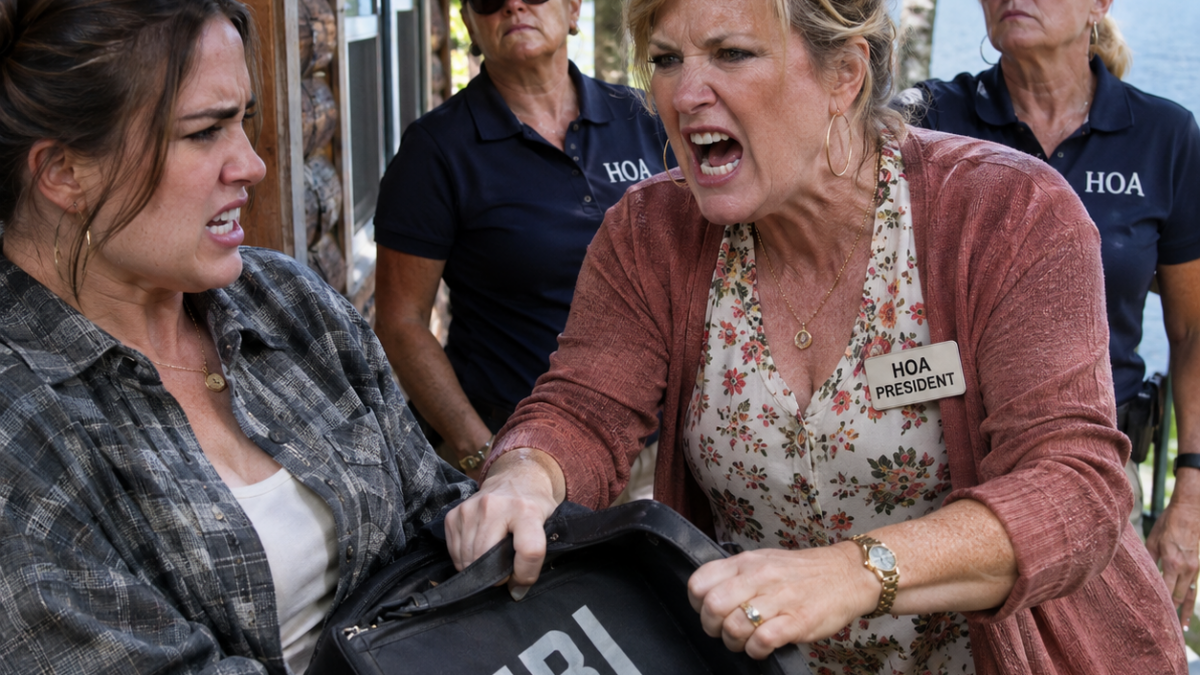
HOA President Tried to Force Her Way Into My Lake Cabin for a “Routine Inspection”—Then She Grabbed the Case Holding My FBI Credentials
The HOA president showed up at my lake cabin at 8:07 on a Saturday morning with a clipboard, a ring of keys, two board members, and a private “compliance officer,” then told me she had the authority to inspect everything from my electrical panel to the storage beneath my house whether I consented or not.
I refused to let her cross the threshold, so Patricia Wells reached inside, grabbed a locked black case from my living room, and yanked hard enough to pop one latch open—revealing the gold-lettered FBI credential wallet she had no idea belonged to me.
But Patricia did not turn pale because she had just discovered I was a federal agent; she turned pale when she saw the company name printed on a folder beneath my badge, and that was when I realized her obsession with getting inside my cabin had never really been about HOA rules.
The first thing Patricia Wells said to me that Saturday morning was not good morning.
It was:
“Routine property check.”
She slapped her clipboard against my front door as if the sound somehow made the statement official.
I opened the door but stayed inside.
Patricia stood on my porch wearing khaki pants, a pale blue blouse, expensive sunglasses pushed onto the top of her head, and the expression of someone who had already decided how the conversation would end.
Behind her were Jennifer Collins and Mark Ellison, both members of the Lakeside Pines HOA board.
A third man stood one step lower.
Black polo shirt.
Radio clipped to his belt.
COMMUNITY COMPLIANCE printed across his chest.
He was not law enforcement.
That was obvious before he ever spoke.
Patricia raised a ring of keys.
“We need access to the cabin.”
“For what?”
“Inspection.”
“You said that. Inspection of what?”
“Interior plumbing. Electrical panel. Storage areas. Deck connections. Utility equipment. Any unapproved alterations.”
She pointed past me.
“It should take fifteen minutes if you cooperate.”
I looked at the keys.
“Are those supposed to open my house?”
“If necessary.”
That got my attention.
Not because I was frightened.
Because it was an extraordinary thing to say to somebody standing inside his own home.
“You believe you have a key to my cabin?”
“Lakeside Pines maintains emergency access.”
“No, it doesn’t.”
Her lips tightened.
PART2:
“You signed the community declaration when you purchased.”
“I signed a limited road-and-services agreement.”
“Same community.”
“Not the same legal rights.”
She smiled the way people smile when they believe the other person is being intentionally difficult.
“You’re not an attorney, Daniel.”
“No.”
That was true.
I also was not an accountant, even though half the neighborhood thought I was.
My actual FBI credentials were locked in a hard case less than fifteen feet behind me.
I had been a federal agent for years.
Most of my work involved financial fraud, corruption, and cases where people used paperwork, institutions, and official-looking language to make dishonest conduct appear legitimate.
I understood authority.
More importantly, I understood limits.
My badge did not give me special control over Lakeside Pines.
It did not make my deed stronger.
It did not allow me to threaten an HOA president with federal power because she annoyed me.
And her title did not give her unlimited authority over my home.
So I asked the simplest question possible.
“Show me the rule that allows you to enter without my permission.”
Patricia lifted her clipboard.
PART3:
“I don’t have to educate every homeowner individually.”
“That wasn’t my question.”
Jennifer shifted behind her.
“Patricia, maybe we should just give Daniel the notice.”
Patricia ignored her.
She stepped closer.
I put one hand against the doorframe.
“Do not enter my cabin.”
The compliance contractor raised both palms slightly.
“Sir, calm down.”
I almost laughed.
“I am calm.”
Patricia was the one trying to enter another person’s house before breakfast.
She raised the keys again.
“Lakeside Pines retains inspection rights when there is a utility or safety concern.”
“What concern?”
“Possible unauthorized water connection.”
That changed something.
Not visibly.
But internally.
For weeks Patricia had been unusually interested in an old water line beneath my property.
I had assumed it was another HOA obsession.
Now she was calling it an emergency.
“Which connection?”
“That’s what we’re here to determine.”
“Who reported it?”
“Community records.”
“What records?”
“You can keep asking questions or you can cooperate.”
Then the compliance man looked over my shoulder.
A locked black equipment case sat beneath a side table.
He pointed.
“What’s in that?”
“None of your business.”
Patricia leaned sideways.
“Open it.”
“No.”
“This is exactly why inspections are necessary.”
I stared at her.
The water line.
The keys.
The insistence on interior access.
The case.
Something was wrong.
Patricia had not come because she cared about my deck stain.
She was looking for something.
What she did not know was that the object she was about to grab belonged to the federal government.
But the story did not begin that morning.
It began three months earlier, when I bought the quietest cabin I could find.
My name is Daniel Brooks.
I was forty-one when I purchased a small lake cabin on Lake Hartwell in South Carolina.
I had spent most of adulthood living wherever work required.
Apartments.
Rental houses.
A townhouse beside a man who apparently believed drums should be practiced between midnight and two in the morning.
I wanted something different.
Somewhere my phone could stop feeling surgically attached to my body.
The cabin was small.
Two bedrooms.
One bathroom.
Stone fireplace.
Old pine floors.
Deck facing the lake.
Private dock.
Nothing about it screamed luxury.
That was exactly why I loved it.
Lakeside Pines surrounded the northern part of the lake.
Around 120 houses and cabins.
Private road.
Community boat ramp.
Trash service.
A clubhouse.
Drainage infrastructure.
An HOA.
I read the HOA paperwork carefully before buying.
Occupational habit.
The restrictions seemed fairly ordinary.
No abandoned cars.
No giant detached structures without approval.
Basic dock regulations.
Short-term rental restrictions.
Some exterior design standards.
Nothing that would have stopped me from buying.
The cabin had one unusual feature.
It existed before Lakeside Pines.
The Palmer family built it in 1964.
Lakeside Pines did not exist until 1991.
When development eventually surrounded the Palmer property, the family refused to place the old cabin under every neighborhood covenant.
Instead they signed a limited agreement.
Road access.
Trash service.
Certain shared drainage obligations.
That was about it.
My closing attorney, Rebecca Hayes, explained it carefully.
“You have a strange parcel.”
“Is strange bad?”
“Strange is usually expensive.”
“Good start.”
She smiled.
“You pay Lakeside Pines for limited services. That does not mean every modern HOA rule applies to the Palmer cabin.”
“So I’m partly in?”
“That’s an oversimplification.”
“Sounds perfect for an HOA argument.”
She pointed at me.
“Do not joke. Keep these papers.”
“Expecting trouble?”
“You bought an older property surrounded by a newer association. At some point, somebody will forget where the boundary is.”
She was right.
For the first month, the neighborhood was peaceful.
My eastern neighbor was Frank Miller.
Retired high-school principal.
Sixties.
Gray beard.
Boat old enough to qualify for Social Security.
Frank showed up on my second weekend holding a plate of ribs.
“I’m not welcoming you.”
“No?”
“No. I cooked too much.”
“Understood.”
He stayed for two hours.
Across the road lived Susan Parker, a widow in her late sixties with a golden retriever named Charlie.
Charlie wandered onto my porch almost every morning.
Susan apologized the first time.
“He likes your porch.”
“He has good taste.”
She smiled.
The place felt normal.
Then Patricia arrived.
She drove a white golf cart into my driveway while I was replacing a loose board on the dock.
No hello.
No introduction.
She pointed at the board.
“That stain color isn’t approved.”
I looked at it.
Brown.
The rest of the dock:
Brown.
“What color should brown be?”
She did not appreciate that.
“I’m Patricia Wells. President of Lakeside Pines.”
“Daniel Brooks.”
“I know.”
That interested me slightly.
We had never met.
But closing records were public enough that knowing my name was not suspicious.
She handed me a printed copy of exterior standards.
One paragraph was circled.
Approved wood finishes.
I read it.
Then pointed at the paragraph immediately above.
“This applies to structures built under Lakeside Pines architectural control.”
“Yes.”
“My dock predates that.”
She paused.
“We’ll verify.”
“Sounds good.”
She left.
Two days later:
VIOLATION NOTICE.
Unauthorized dock refinishing.
Fine:
$250.
I emailed Rebecca.
One letter from her.
Fine disappeared.
No apology.
I did not care.
I had no interest in spending weekends fighting an HOA.
My professional life contained enough conflict.
Home was supposed to be coffee, fishing, and quiet.
Patricia had different plans.
Next violation:
Security camera facing a community road.
True.
So did dozens of other houses.
Rebecca checked.
No approval requirement applied to my parcel.
Canceled.
Then:
Truck parked overnight in my driveway.
Canceled.
Then:
Commercial equipment storage.
That one concerned a locked hard case I had temporarily left in the rear of my SUV.
The equipment inside was federal property.
Nothing classified.
Nothing dangerous sitting unsecured.
But definitely nothing Patricia Wells needed to inspect.
Most neighbors believed I worked for the Department of Justice doing financial investigations.
That was my standard casual explanation.
Not false.
Just incomplete.
Frank decided I was some sort of government accountant.
I never corrected him.
Peace is valuable.
Then Patricia’s questions changed.
She wanted names of overnight guests.
I refused.
She said community security required it.
Rebecca found no such rule.
Patricia requested the name of my alarm company.
I refused.
Then she wanted to inspect the utility closet because Lakeside Pines was “updating emergency infrastructure maps.”
That sounded plausible enough that I asked:
“What utility?”
No answer.
A week later, Frank and I were fishing.
He mentioned:
“Patricia’s been asking about your water line.”
I stopped tying a lure.
“What water line?”
“She asked whether the Palmer cabin still has an old lake pump.”
“Why?”
“No idea.”
The old cabin did have one.
Behind the house sat a concrete utility box containing a rusted pump and a capped pipe running toward the water.
The home inspector told me it had been abandoned decades earlier.
Frank remembered that before county water reached the area, several cabins pumped lake water for irrigation.
Nothing unusual.
Still, Patricia’s interest now felt less random.
I called Rebecca.
She researched old property records.
The Palmer family once had a legal lake-water withdrawal permit.
Expired decades ago.
Nothing important.
Then Rebecca found an easement.
Old utility easement.
Western edge of my lot.
Beneficiary:
Hartwell Shore Services Cooperative.
Never heard of it.
The cooperative dissolved in 1988.
Three years before Lakeside Pines existed.
Probably historical debris.
Then Patricia sent:
ROUTINE INFRASTRUCTURE INSPECTION.
According to the notice, “all properties” would receive utility compliance checks over the next sixty days.
I asked Frank.
“No notice.”
Susan?
None.
Three more neighbors?
None.
Only me.
Rebecca emailed Patricia.
Please identify the provision authorizing interior inspection of the Palmer parcel.
Patricia cited a general rule allowing inspection of common service connections.
Rebecca responded:
Please identify the common service connection.
Silence.
Then I came home one Thursday and found boot prints behind the cabin.
They led to the old pump box.
The lid was open.
I had left it closed.
Nothing looked damaged.
I installed another camera.
Two mornings later, it recorded a man in a Lakeside Pines maintenance shirt entering my lot at 6:20 a.m.
He opened the pump box.
Took pictures.
Left.
Frank recognized him.
Robert Hayes.
Maintenance contractor.
I called.
Robert sounded uncomfortable.
“Patricia told me the box belonged to the HOA.”
“It’s physically on my deeded property.”
“I didn’t know.”
“What were you photographing?”
“The pipe.”
“Why?”
Pause.
“She said the board needed to know whether it was active.”
“Which line?”
“I don’t know.”
I believed him.
That bothered me more.
Robert seemed like a man following instructions without understanding the purpose.
I told him not to return without permission.
He apologized.
Then said:
“Daniel, I thought your place had already been inspected.”
“What?”
“She said somebody checked the inside last month.”
Nobody had.
After that call, I walked through the cabin slowly.
Doors.
Windows.
Closets.
Office.
Nothing missing.
Maybe Patricia meant an inspection before purchase.
Maybe.
I changed every lock anyway.
Susan noticed the next morning.
“Trouble?”
“Improvement.”
She looked at the deadbolt.
“That one worked.”
“Retired principal next door and detective across the street. I’m surrounded.”
She smiled.
Then her expression changed.
“Patricia thinks there’s an illegal pipe under your cabin.”
I stopped.
“Under?”
“She said it during a board meeting.”
“What exactly?”
Susan remembered the phrase:
Historic utility control point.
I requested board minutes.
Official minutes:
Legacy utility matter discussed.
That was nearly useless.
Frank kept handwritten notes.
He brought them over.
Patricia had asked the board to authorize an interior inspection of the Palmer cabin because she believed a historic utility control point existed there.
Vote:
Four to three against.
Motion failed.
I read that twice.
“The board said no?”
“Yes.”
“Then why did she send an inspection notice?”
Frank looked embarrassed.
“I don’t know.”
That mattered.
Patricia had requested authority.
The board refused.
Then she acted as though she had authority anyway.
I had seen that pattern in professional investigations.
People ask permission when they think the answer will be yes.
Then when the answer is no, suddenly they discover some “emergency” exception.
Still, I refused to turn my personal life into an FBI case.
No federal searches.
No federal databases.
No running Patricia’s name.
No abusing access.
I documented like any homeowner should.
Saved emails.
Saved notices.
Saved footage.
Photographed everything.
Let Rebecca handle legal correspondence.
Then work sent me out of town for six days.
When I returned, everything looked normal.
Until I reviewed my backyard camera.
Patricia had visited three times.
First visit:
Five minutes beside pump box.
Second:
With Robert.
Third:
With an unknown man who photographed my foundation and pointed toward a crawl-space vent.
Rebecca immediately sent a formal no-trespass letter.
No entry except genuine emergency or written permission.
Patricia replied:
HOA RIGHTS ARE RESERVED.
That was when I knew we were heading toward a confrontation.
Almost two quiet weeks passed.
Friday night, certified letter:
ROUTINE PROPERTY COMPLIANCE INSPECTION.
Saturday.
8:00 a.m.
Interior access required.
Refusal might result in emergency entry.
Rebecca called the HOA’s attorney.
He had not approved the notice.
That was the first major warning.
Rebecca sent Patricia a direct email:
Daniel does not consent to entry. No emergency exists. Any attempted forced entry will be treated as unauthorized.
No response.
Saturday morning came.
Calm lake.
Clear sky.
Coffee in my hand.
At 7:58, white golf cart.
Patricia.
Jennifer Collins.
Mark Ellison.
Private compliance contractor.
They climbed the porch.
Which brought us back to the beginning.
I refused entry.
Patricia claimed emergency authority.
Then the compliance contractor noticed my locked black case.
“What’s in that?”
“Private property.”
Patricia pointed.
“Open it.”
“No.”
She looked toward the contractor.
“Document refusal.”
He pulled out his phone.
Then she reached across the doorway.
Not far.
Just enough to catch the edge of the case.
I grabbed the handle first.
“Take your hand off it.”
“This may contain unauthorized utility equipment.”
“It doesn’t.”
“Then open it.”
“No.”
The contractor stepped onto the threshold.
I raised one hand.
“Stop.”
He stopped.
Good decision.
Jennifer whispered:
“Patricia, we were told exterior inspection.”
“The situation changed.”
“How?”
“New information.”
I asked:
“From whom?”
Patricia looked toward the crawl space.
“The county.”
County offices were closed.
Rebecca had checked the day before.
I asked for the county order.
Patricia handed me a paper.
Not county letterhead.
Not county format.
Title:
LAKESIDE PINES UTILITY SAFETY AUTHORIZATION.
At the bottom:
Signature of James Walker.
County utility supervisor.
I knew that name because I had spoken with him two days earlier.
No county inspection was scheduled.
“Where did this come from?”
“Provided to the board.”
“By whom?”
“Move aside.”
“No.”
The private contractor reached toward his radio.
I looked at his sleeve.
Blue Ridge Community Security.
Private business.
I asked him:
“Were you told there was a court order?”
He looked at Patricia.
That was enough.
Jennifer stepped backward.
“Patricia, what is going on?”
Patricia ignored her.
Then she tried one of the keys in my deadbolt.
It did not fit.
Her face changed.
“You changed the lock?”
“Yes.”
“The HOA requires emergency access.”
“No, it doesn’t.”
“It always has.”
“Show me the document.”
She pulled out another key.
Newer.
Freshly cut.
I stared.
“How did you get that?”
No answer.
Then Frank’s truck came flying down my driveway.
He parked crooked.
Got out carrying a folder.
“Stop.”
Patricia turned.
“What are you doing here?”
“Stopping you from making this worse.”
He handed Jennifer a resolution.
The night before, after learning Patricia planned to proceed without legal approval, four board members held an emergency vote.
Patricia’s inspection authority was suspended effective midnight.
No board authority.
No attorney approval.
No emergency authorization.
Nothing.
Patricia read it.
Then tore it in half.
Jennifer stared.
Frank said calmly:
“That doesn’t cancel the vote.”
Patricia’s face reddened.
“You’re hiding something under this cabin.”
Maybe she genuinely believed that.
Someone certainly knew something was there.
I said:
“Get a lawful order.”
“I don’t need one.”
“Yes, you do.”
Then she crossed the doorway.
One foot inside.
I moved sideways.
Did not touch her.
Blocked her.
“Out.”
The compliance contractor finally said:
“Ma’am, we should leave.”
I looked at him.
“Finally.”
Patricia pointed at the black case.
“That stays.”
I nearly laughed.
“No.”
“It may contain evidence of unauthorized utility equipment.”
“Do not touch that case.”
She grabbed it.
Pulled hard.
The case slid across the floor.
One latch struck the baseboard.
Popped.
The lid opened maybe two inches.
Beneath a folded jacket sat a leather credential wallet.
Gold letters visible.
FEDERAL BUREAU OF INVESTIGATION.
Silence.
The contractor immediately stepped off my porch.
Jennifer covered her mouth.
Frank whispered:
“You’re not an accountant.”
“Not exactly.”
Patricia turned pale.
For several seconds, the woman who had arrived with keys, notices, and authority had nothing to say.
I expected her to stare at the credential wallet.
She did.
For about one second.
Then her eyes moved past it.
Inside the case was a folder I had brought home for delivery to my office Monday.
Public corporate records from an ongoing financial-fraud matter.
I had believed the folder was unrelated to my cabin.
One company name was visible.
HARTWELL SHORE SERVICES LLC.
Patricia stepped backward.
Not confused.
Afraid.
There is a difference.
Years of interviewing people teaches you to recognize it.
Frank saw it too.
“Patricia?”
Nothing.
She turned.
Ran toward the golf cart.
I called:
“Why do you know that company?”
No answer.
She drove away.
Frank looked at me.
Then at the folder.
“What is Hartwell Shore Services?”
Until that moment, I thought it had nothing to do with Lakeside Pines.
Now I was not sure.
After Patricia left, I did the most important thing an FBI agent can do when a personal matter might overlap an official investigation.
I removed myself.
I called my supervisor, Michael Grant.
Explained everything.
The cabin dispute.
HOA notices.
Water line.
Attempted inspection.
Patricia’s reaction to Hartwell Shore Services.
Michael asked:
“Have you run Patricia through any Bureau system?”
“No.”
“Lakeside Pines?”
“No.”
“Used federal resources on your HOA?”
“No.”
“Good.”
Then instructions.
Do not question Patricia as an agent.
Do not access case files relating to Hartwell Shore Services until conflict review is complete.
Do not use Bureau systems to investigate my own property dispute.
Local issue stays local unless independently connected.
I agreed.
A badge does not give you permission to turn people you dislike into federal targets.
If there was overlap, another agent would handle it.
Michael added:
“And Daniel?”
“Yes?”
“Store your federal equipment better.”
I looked at the case on my floor.
“Working on it.”
Frank waited until I hung up.
“So you’re arresting Patricia?”
“No.”
“What?”
“For what?”
“She tried to walk into an FBI agent’s house.”
“She tried to walk into a homeowner’s house.”
“She grabbed federal equipment.”
“She did not know what it was.”
“She recognized that company.”
“That is a question. Not probable cause.”
Frank looked deeply disappointed.
Television has done terrible things to public expectations of investigations.
Jennifer apologized.
“I thought we were inspecting an exterior pipe.”
“I believe you.”
“I should’ve asked to see the county request.”
“Yes.”
That surprised her.
But kindness does not require pretending mistakes are acceptable.
She had made one.
She also objected when Patricia tried to enter.
Both mattered.
The contractor, David Ross, gave me his card.
Patricia had hired his company for documentation and presence.
Not forced entry.
When she crossed the threshold, he considered it beyond their assignment.
He left.
Frank asked again:
“What does Hartwell Shore Services do?”
I told him only what was public.
Private shoreline contractor.
Erosion work.
Boat maintenance.
Utility projects.
Lake-access construction.
The federal case involved financial transactions involving multiple contractors.
Hartwell Shore Services appeared in records.
That did not mean the company was criminal.
Then Frank said:
“Lakeside Pines paid them.”
That sharpened my attention.
“How do you know?”
“I’m treasurer.”
“For what?”
“Shoreline work, I think.”
“How much?”
“I don’t know.”
Jennifer stared.
“Why didn’t you say something?”
“Because thirty seconds ago Hartwell Shore Services was a normal vendor.”
Fair.
I told them not to bring me HOA financial records.
Frank looked confused.
“You don’t want to see them?”
“No.”
“Why?”
“Because now there may be federal overlap. If those records become evidence, I don’t want anyone claiming I used my personal dispute to gather them.”
That separation protected me.
More importantly, it protected the case.
Frank contacted Lakeside Pines’s attorney, Laura Bennett.
Laura’s first instruction:
Preserve everything.
Emails.
Invoices.
Board minutes.
Vendor records.
Security footage.
Utility maps.
No editing.
No deleting.
No shredding.
And do not give anything to Daniel.
Exactly right.
By noon, my porch was empty.
I moved the federal case into proper secure storage.
Then I made lunch.
Turkey sandwich.
Chips.
Coffee.
Deliberately boring.
When your mind starts connecting every strange fact into one grand conspiracy, ordinary routine helps.
Twenty minutes later Susan called.
“Are you really FBI?”
Apparently Frank’s ability to maintain confidentiality lasted approximately three hours.
“Yes.”
“I knew you weren’t an accountant.”
“Frank thought I was.”
“Frank believes catfish can predict rain.”
“Fair.”
Then Susan got serious.
“Patricia is telling everybody you threatened her with your badge.”
I sat up.
“I never showed her my badge.”
“She says you used your federal position to intimidate the board.”
That was almost impressive.
I had spent the morning doing everything possible not to use federal authority.
Now Patricia was accusing me of doing exactly that.
I told Susan:
“Don’t fight with anyone about it.”
“But she’s lying.”
“Then documents matter more.”
My porch camera recorded most of the encounter.
Jennifer witnessed it.
David Ross witnessed it.
Frank’s board resolution existed.
Patricia’s version could be tested.
That afternoon, Lakeside Pines emailed residents.
No board-authorized interior inspection had occurred.
Patricia’s utility authority had been suspended.
Matter under review.
Residents asked not to speculate.
Then Patricia deleted her social-media post.
Did not correct it.
Deleted it.
By evening, she stopped answering board members.
Her car disappeared.
Her husband claimed not to know where she went.
Maybe she fled.
Maybe she went to family.
People leave town for innocent reasons.
I wrote down the time anyway.
Habit.
The next morning Michael called.
Conflict review complete.
I was formally removed from any FBI work involving Hartwell Shore Services.
Another agent would handle it.
Thomas Walker.
Patient.
Careful.
Painfully thorough.
Exactly who I wanted.
Michael said:
“Do not investigate your HOA.”
“Understood.”
“Anything at your property goes through local authorities.”
“Understood.”
“You sound disappointed.”
“I was hoping for a free helicopter.”
He hung up.
Around noon Rebecca arrived with something more useful.
Historical documents.
Remember Hartwell Shore Services Cooperative?
The organization from the old easement?
Not Hartwell Shore Services LLC.
The cooperative had operated shared irrigation and firewater infrastructure decades earlier.
Rebecca found maps.
The Palmer cabin had once been a control property.
A main utility chamber might actually be under my house.
“Under?”
“The cabin was expanded in 1983. The old chamber may have ended up beneath the addition.”
I crawled under.
Low clearance.
Dust.
Insulation.
Spiders.
Near the oldest section, beneath plastic sheeting, I found a rectangular concrete slab.
Separate from the foundation.
Roughly four by six feet.
Metal hatch in the center.
I backed out.
Rebecca asked:
“Well?”
“There’s something there.”
We did not open it.
Not because I was frightened.
Because ownership of old utility equipment can be complicated.
Property owner.
Abandoned cooperative.
Possible successor entity.
We wanted county utility staff present.
James Walker came Monday.
Same man whose signature appeared on Patricia’s fake county authorization.
I showed him the paper.
He stared.
“That isn’t mine.”
“Looks like yours.”
“It was copied.”
He pulled up an older letter.
Same signature image.
Exactly.
Somebody had taken his signature from a legitimate public document and pasted it onto Patricia’s authorization.
He contacted county legal.
Then we showed him the hatch.
James knew what it was.
“Old lake-water manifold.”
“Active?”
“Shouldn’t be.”
That word again.
Shouldn’t.
Public utilities replaced the system decades earlier.
The chamber was supposed to be dead.
We opened it.
Owner.
Attorney.
County supervisor.
Proper process.
Cold air.
Wet concrete smell.
Ladder about six feet down.
James descended.
I followed.
Old pipes.
Rust.
Valve wheels.
Pressure gauge.
Then his flashlight hit something white.
PVC pipe.
New.
Very new.
It vibrated beneath his hand.
“Active.”
A digital flow meter glowed.
Water was moving.
One line disappeared toward Lakeside Pines.
Another toward the lake.
Someone had rebuilt part of a supposedly abandoned system beneath my home.
That was why Patricia wanted inside.
At least we finally had a motive.
Then Frank arrived holding an old Lakeside Pines maintenance map.
Patricia had kept it inside a locked HOA cabinet.
The map was only five years old.
It showed my cabin.
The chamber.
And lines connecting it to:
Lakeside Pines clubhouse.
Maintenance building.
A small parcel owned by Hartwell Shore Services LLC.
Then invoices.
$68,400.
$42,600.
$31,900.
Legacy Water Infrastructure Rehabilitation.
Approved by Patricia.
More than $140,000.
Frank looked sick.
“I never saw these.”
“Where were they charged?”
“Emergency reserve.”
County crews traced the active line.
One branch fed a clubhouse irrigation reservoir.
Reasonable.
Another went south toward Hartwell Shore Services.
Another toward the lake.
Water flowed inland from the lake.
No current permit tied to my property.
Then crews found a modern pump controller inside Lakeside Pines maintenance.
Hartwell Shore Services label.
Official explanation:
Emergency irrigation and wildfire reserve.
Reasonable again.
Except the system did not feed the fire hydrants.
It fed irrigation.
Then continued toward Hartwell Shore Services’ boat-storage and repair yard.
County records showed the company had boat-repair permits.
Not permission to draw water through my property.
Not permission to use Lakeside Pines infrastructure.
Not permission to revive the old Palmer system.
Rebecca asked:
“Why would Patricia risk entering your cabin over this?”
I looked toward the floor.
“Because the control chamber is under my house.”
If I renovated:
I might discover it.
If county staff inspected:
They would discover it.
If I shut valves:
Hartwell Shore Services might lose whatever it was using the system for.
Then Jennifer called Frank.
Someone had entered the HOA records room.
Back door forced.
Cabinets open.
Hartwell Shore Services contract file gone.
Security camera system disabled at 1:12 p.m.
Recorder hard drive removed.
Now we had burglary.
The sheriff took over.
I stayed out of it.
Patricia’s master key was still missing.
But muddy prints near the back entrance looked like large work boots.
Probably a man.
Maybe Patricia.
Maybe not.
Assumptions remained dangerous.
Thomas Walker called me.
“Stay away from Hartwell Shore Services property.”
“I have been.”
“There may be overlap.”
“Understood.”
“Did you remove anything from the utility chamber?”
“No.”
“Lock it.”
“Why?”
“I can’t tell you.”
That evening I checked my crawl-space camera.
3:41 p.m.
A man crawled beneath my cabin.
Gloves.
Dark cap.
He moved directly to the hidden hatch.
Opened it.
Climbed down.
Seven minutes later he came back carrying a metal box.
Then he noticed my camera.
His face became visible.
Robert Hayes.
The maintenance contractor.
Rebecca called sheriff.
I called my supervisor.
Robert’s house:
Empty.
Hartwell Shore Services yard:
Locked.
Then sirens headed south.
Frank called.
“Smoke.”
Dark column climbed beyond the trees.
Hartwell Shore Services yard was on fire.
Then power flickered.
Something beneath my cabin started humming.
The old pump.
Loud.
Hard enough to feel through the floor.
Rebecca stared.
“What is that?”
“The hidden system.”
County workers had already shut down its controller.
It should not have been running.
Water began rushing through the pipe.
James called.
“Daniel, get away from the crawl space.”
“What happened?”
“Someone remotely opened the intake.”
“Where’s the water going?”
“South.”
“Toward the fire?”
“Yes.”
For a second, that sounded useful.
Then James shouted to somebody beside him.
His voice changed.
“That line does not connect to the fire system.”
“Then where does it go?”
Pause.
“A buried storage tank on Hartwell Shore Services property.”
“What’s in it?”
“We don’t know.”
A deep boom rolled across the lake.
Orange flash above the trees.
Cabin windows shook.
Then the pipe below us groaned.
Kitchen floor jolted.
Crack opened beside the baseboard.
Water sprayed upward.
Every instinct told me to crawl down and shut the valve.
I did not.
James had warned me.
Thomas had told me not to enter.
Training matters most when instinct tells you to ignore it.
I grabbed Rebecca.
Moved outside.
Called 911.
Fire department.
County utilities.
Sheriff.
Electricity disconnected before anyone entered the crawl space.
I stood twenty feet from my own house while other professionals saved it.
That was humbling.
I had spent years being the person walking into tense scenes with a role.
Now I was a homeowner standing uselessly beside his driveway.
The chamber hatch was open.
Robert had left it that way.
Water spraying from a smaller fitting.
Main line vibrating.
County crews eventually found an exterior isolation point at the lake.
Forty minutes.
Then silence.
Cabin survived.
Foundation damaged.
Kitchen floor lifted.
Water damage.
Nobody injured.
That mattered.
Thomas went directly to the Hartwell Shore Services fire scene.
Not my cabin.
That told me the federal overlap was real.
I spent the night at Frank’s.
He asked:
“You sure?”
“You have coffee?”
“Yes.”
“Then yes.”
Susan arrived before sunrise with muffins.
Of course she did.
At 8:10 Thomas asked me to come to the county office.
“As homeowner or agent?”
“Homeowner.”
Important distinction.
Rebecca came.
James laid out maps.
Old cooperative system.
Modern PVC.
South branch.
Buried tank.
The tank itself had not exploded.
The building above it had been damaged.
The line appeared designed to flush the tank.
With what?
Unknown.
The state fire investigator warned us not to speculate.
Correct.
Robert’s truck was eventually found near a boat ramp fifteen miles away.
No Robert.
Now I worried about him.
He might be fleeing.
Or frightened.
Or hurt.
Investigators needed him.
My crawl-space footage showed the box he took.
Enhanced image revealed:
FLOW CONTROL.
James thought it might be an old relay housing.
But removing it should have disabled the system.
Instead, the pump later activated remotely.
That meant another controller existed elsewhere.
County began tracing communications.
Slowly.
Meanwhile Lakeside Pines canceled nonessential maintenance.
Changed locks.
Disabled Patricia’s access credentials.
Hired temporary security.
Preserved records.
Neighborhood meeting that evening was packed.
Patricia absent.
Robert absent.
Residents wanted immediate answers.
Frank gave only confirmed facts.
Unauthorized interior inspection.
Questionable county authorization.
Hidden utility system.
Payments to Hartwell Shore Services.
Records-room burglary.
Fire under investigation.
Then somebody shouted:
“What about the FBI?”
Every head turned toward me.
Wonderful.
I stood.
“My job is not part of this HOA meeting.”
“Are we under federal investigation?”
“I cannot answer that.”
More noise.
Laura Bennett, the HOA’s attorney, stepped in.
“Cooperation with investigators does not mean guilt.”
Exactly.
Then Susan asked the best question of the evening.
“Who told Patricia the control chamber was under Daniel’s house?”
Silence.
Jennifer answered.
Five years earlier, Patricia first raised the Palmer utility chamber during discussions with Hartwell Shore Services.
The company wanted to “rehabilitate” the old lake system.
Jennifer asked whether the Palmer owner had given permission.
Patricia said the old cooperative easement still allowed access.
It did not.
At the time, Margaret Palmer owned the cabin.
Eighty-six now.
Living near Greenville.
Rebecca contacted Margaret through her niece.
Margaret agreed to speak.
First thing she asked me:
“You bought my cabin?”
“Yes, ma’am.”
“Roof still leak?”
“Not anymore.”
“Good.”
Then:
“Did you authorize utility construction beneath the house five years ago?”
“What construction?”
There was the answer.
Patricia had visited Margaret repeatedly.
Routine checks.
Safety inspections.
Emergency concerns.
Same words she used on me.
Margaret refused interior access.
Then she spent six weeks away recovering from surgery.
When she returned, crawl-space door looked different.
New screws.
New lock.
She assumed somebody had repaired it.
Nobody told her about new pipes.
“Why didn’t you complain?”
Margaret shrugged.
“I was seventy-nine and tired.”
That sentence stayed with me.
Not everyone fights.
Not because they agree.
Because conflict consumes energy.
People who abuse authority may count on exhaustion.
Margaret remembered receiving $2,000 from Lakeside Pines for “temporary property inconvenience.”
Her niece kept the paperwork.
Temporary access consent.
Real signature.
Permission to access the rear fifteen feet of the property for drainage inspection.
Not interior.
Not crawl space.
Not utility chamber.
Somebody had stretched limited cooperation into something much larger.
Margaret also remembered Patricia saying:
“If the old valve is ever shut, Lakeside Pines could lose something valuable.”
Not unsafe.
Not necessary.
Valuable.
Thomas later confirmed Hartwell Shore Services had received millions from companies tied to lake construction, boat storage, cleanup, and maintenance.
One category stood out:
WATER RECOVERY FEES.
James explained the old cooperative system once handled two-way flow.
Lake water could come inland.
Filtered wash water from boat-service areas could return through settling infrastructure.
If revived, the hidden pipe might move clean water one direction and wastewater another.
Then investigators tested the buried tank.
Water mixed with petroleum residue and cleaning chemicals.
Common industrial contaminants.
Regulated.
Not movie poison.
Still not something you quietly dump through an abandoned private utility line.
The question became whether Hartwell Shore Services had been routing waste back toward Lake Hartwell through the old cooperative system.
Fire.
Missing records.
Robert removing a control box.
Remote pump activation.
Convenient timing.
Still:
Evidence first.
Days later Robert came in voluntarily with an attorney.
Alive.
That was good.
He said Patricia ordered him to remove the metal box.
She told him county officials were about to seize equipment belonging to Hartwell Shore Services.
He panicked when he saw my camera.
Then someone from Hartwell Shore Services picked him up.
Robert had helped install modern portions of the hidden system five years earlier.
Why?
Officially:
Emergency irrigation.
Fire reserve.
Actually, according to Robert:
Hartwell Shore Services pumped lake water into its yard to wash boats and equipment.
Dirty water collected.
Some was routed back through the old system into a settling channel.
No proper permit for that route.
Then he said:
“Lakeside Pines got paid.”
“How?”
Access fees.
Some payments appeared in HOA records.
Others did not.
Separate account.
Patricia called it:
Lake Improvement Reserve.
Frank had never seen it.
Robert gave investigators additional names.
A former board member.
Former property manager.
A county contractor.
Not county employee.
A contractor.
The federal team served warrants on Hartwell Shore Services.
Not because I asked.
Because the existing case independently produced sufficient evidence.
I did not participate.
The sheriff served separate local warrants over the fake county authorization and records-room burglary.
Patricia returned with an attorney.
No high-speed chase.
No dramatic arrest in front of neighbors.
Investigators carried boxes from her house.
Computers.
Phones.
Paper.
Real cases often look boring from the outside.
The biggest discovery came from an old wall safe in the HOA storage room.
Inside:
Backup drives.
Cash receipts.
Bank statements.
Folder:
LAKE RESERVE.
Separate account existed.
Hartwell Shore Services had paid more than $620,000 over five years.
Some of the money funded legitimate neighborhood work.
Dock repairs.
Storm cleanup.
Erosion control.
Landscaping.
That helped explain why nobody questioned it.
Residents were receiving visible benefits without corresponding dues increases.
Bad systems can survive a long time when innocent people benefit from them.
But other withdrawals were harder to explain.
Consulting fees.
Cash reimbursements.
Travel.
Payments to private companies.
Then:
$86,000.
PALMER PROPERTY ACQUISITION FUND.
My cabin.
Five years earlier Patricia had tried buying Margaret Palmer’s cabin.
Offer:
$90,000.
Far below market value.
Margaret refused.
Then investigators found a draft easement.
If Lakeside Pines acquired the cabin, it would grant Hartwell Shore Services permanent access to the underground control chamber.
Payment:
$175,000 upfront.
Plus annual fees.
Margaret never sold.
Never signed.
Yet Hartwell Shore Services paid $175,000 anyway.
Not to Lakeside Pines’s ordinary account.
To the secret Lake Reserve.
Then federal investigators found a signed easement supposedly bearing Margaret’s signature.
She said she never signed it.
Document examiner compared it to her temporary drainage consent.
Exact copy.
Somebody took a signature authorizing fifteen feet of temporary drainage access and used it to create permanent utility rights under her home.
The entire hidden system had been built on false property authority.
Environmental teams traced the return line.
Buried settling basin near the shoreline.
Soil contained years of petroleum residue, cleaning solvents, and paint compounds.
Lake water itself remained within public-safety standards.
That was important.
Cleanup began.
For a little while, things seemed under control.
Then Susan called.
“Trucks at the old pump station.”
Nobody should have been working there.
Federal control.
County isolation.
I walked onto the deck.
Two unmarked utility trucks near an old service dock.
Workers in reflective vests.
Frank called.
“Clubhouse irrigation pump just turned on by itself.”
“Shut it off.”
“We did.”
“What happened?”
“It came back on.”
James called me.
“Check the exterior pressure monitor.”
County had installed one after the earlier failure.
The needle was climbing.
That should have been impossible.
Primary lake intake was physically isolated.
Alarm sounded.
James shouted at someone.
Then:
“They opened a secondary intake.”
“What secondary intake?”
“We missed another line.”
Older.
Not on the main cooperative map.
Pressure rising.
Thomas called.
“Get away from the cabin.”
I did.
No argument.
Frank’s house sat uphill.
As I walked toward it, deep mechanical vibration came through the ground near the lake.
Water beside my dock bubbled.
Brown sediment rose.
James called again.
“The second line isn’t feeding Hartwell Shore Services.”
“Then where?”
Long pause.
“North.”
“Toward what?”
“The Lakeside Pines dam.”
The neighborhood maintained a small earthen dam near the entrance.
Stormwater lake.
Not giant.
Still enough water to flood the lower road.
No rain that day.
Yet the lake behind the dam began rising.
Fast.
Then water appeared through a crack near the lower embankment.
Frank received an emergency alert.
DAM PRESSURE ANOMALY.
Then Thomas identified one of the utility trucks.
Registered owner:
Lakeside Pines Development Corporation.
Original developer.
Supposedly dissolved decades earlier.
Frank went pale.
“My father worked for them.”
“What did he do?”
“Bookkeeper.”
Then part of the lower embankment failed.
Mud.
Stone.
Water.
Lower entrance road flooded.
Fire crews and deputies evacuated residents uphill.
Two garages took water.
Several cars damaged.
Maintenance shed shifted off its foundation.
Nobody died.
Nobody trapped.
That mattered more than anything else.
County crews closed the secondary intake about forty minutes later.
Temporary rock barrier stabilized the remaining dam.
At the clubhouse, people wrapped blankets around neighbors.
Susan distributed water.
Jennifer made a list of every household.
Someone retrieved medication for an older couple.
Nobody discussed property values.
Nobody discussed architectural rules.
Nobody cared that my dock was brown.
That was what a community was supposed to look like.
The mysterious truck belonged to a corporation that had not truly disappeared.
Lakeside Pines Development Corporation had been administratively dissolved, then reinstated three years earlier.
Manager:
Richard Wells.
Patricia’s husband.
I barely knew Richard.
He traveled constantly.
Construction consultant.
Rarely attended HOA events.
Patricia had always appeared to be the central figure.
Now another old company had been revived.
Another historical name.
Another hidden system.
Michael called.
“Daniel, you stay out.”
“I know.”
“Completely.”
“I know.”
“The developer company is inside the federal case now.”
“Understood.”
“If local investigators need homeowner testimony, cooperate through counsel.”
“Understood.”
“Do not interview Frank’s father.”
That surprised me.
“You know about George?”
“We do now.”
Click.
Federal investigators were already looking.
So I waited.
Frank struggled with that.
His father was eighty-three.
He wanted answers.
I told him:
“Protect your father from becoming part of something before you know what he actually knows.”
George Miller called Frank first.
One question:
“Did they find the reserve account?”
Frank went silent.
“What reserve account?”
George said:
“Come see me.”
I refused to go.
Frank brought HOA attorney Laura Bennett.
Everything George said later went to investigators through proper channels.
Back in the 1980s, Lakeside Pines Development Corporation wanted broad control over shoreline and water infrastructure.
The Palmer property sat above an important control chamber.
The family refused to sell.
Developer used temporary agreements around them.
Then public utilities arrived.
Old system should have died.
But one executive believed the underground network might have future commercial value.
Private maps were kept.
Not county maps.
Developer dissolved.
Records should have been destroyed or transferred.
Years later Richard Wells acquired old developer records through a storage auction involving one of the original company offices.
Maps.
Ledgers.
Contracts.
Utility diagrams.
He discovered the old network.
He discovered the Palmer chamber.
That was apparently where the modern scheme began.
Long before I arrived.
Richard later had consulting connections to Hartwell Shore Services LLC.
The company’s name looked almost identical to the historical cooperative.
That confusion was useful.
Residents saw Hartwell Shore Services and assumed continuity.
Old local utility.
Familiar-sounding name.
Nothing alarming.
The secret reserve account was useful too.
Hartwell Shore Services money funded legitimate improvements.
Patricia looked effective.
Better docks.
Cleaner shorelines.
Storm repair.
Landscaping.
Residents enjoyed benefits.
Few asked why.
The Palmer cabin remained a problem.
If Lakeside Pines owned it, everything became easy.
No future owner discovering the chamber.
No access dispute.
No copied consent.
Patricia tried buying it from Margaret.
Margaret refused.
So work happened around her anyway.
Then I bought the cabin.
Patricia apparently hoped pressure would work better on me.
Violation notice.
Another.
Another.
Inspection demand.
Emergency language.
Keys.
Compliance contractor.
She had no idea I was FBI.
That detail was almost funny.
Almost.
Months passed before the investigations ended.
The dam was repaired.
Secondary intake permanently sealed.
Hidden industrial line beneath my cabin disconnected.
Underground chamber returned to being inactive.
Rebecca recorded a clear property notice.
No utility entry without written permission or lawful emergency authority.
No inherited “routine inspection” right.
No secret keys.
Remaining old equipment was formally abandoned.
The cabin was repaired.
New floor.
Foundation reinforcement.
New crawl-space door.
Steel lock.
Frank said my crawl space was now more secure than the clubhouse.
Probably true.
Lakeside Pines offered to remove my property entirely from the limited services agreement.
I declined.
That surprised them.
“I don’t hate the neighborhood.”
Frank smiled.
“After all this?”
“I hate bad paperwork.”
“That seems healthier.”
We rewrote the limited agreement clearly.
Road maintenance.
Trash.
Real emergency access when legally necessary.
Nothing else.
No interior inspection.
No master key.
No surprise utility access.
Simple language.
Susan celebrated by bringing pie.
I told her one pie was unnecessary.
She brought two.
Then came consequences.
Robert Hayes cooperated.
He admitted removing the control box.
Admitted helping install parts of the modern system.
He claimed he believed permissions existed.
Some documents looked legitimate.
Some he never saw.
Investigators treated those differences carefully.
David Ross, the private security contractor:
No involvement.
Jennifer:
No involvement.
Frank:
No involvement.
Several maintenance workers:
Simply performed jobs under documents they believed were valid.
Different evidence.
Different responsibility.
Patricia was charged in connection with false documents, hidden HOA financial activity, and actions that helped conceal unauthorized access to the Palmer property.
Richard faced broader federal financial and environmental allegations tied to the revived development company, Hartwell Shore Services relationships, hidden payments, and the industrial water network.
Hartwell Shore Services managers had their own cases.
Nobody was convicted because I was an FBI agent.
That mattered.
My badge did not determine guilt.
Evidence did.
Bank records.
Invoices.
Emails.
Copied signatures.
Corporate filings.
Utility maps.
Environmental samples.
Witnesses.
That is how it should be.
The environmental case produced huge financial consequences.
Investigators concluded the hidden system had been used for years to move wastewater containing petroleum residue and cleaning chemicals through an unpermitted settling area.
Repeated lake testing showed public safety levels remained acceptable.
Massive relief.
Shoreline soil still required cleanup.
Hartwell Shore Services and its insurers paid most costs.
Lakeside Pines contributed because HOA infrastructure had been involved.
But ordinary homeowners were not destroyed financially.
Courts separated residents from the people who controlled the hidden operation.
Fair.
Secret reserve account dissolved.
Improper funds went toward restitution, cleanup, and reserves.
Every statement became public to homeowners.
Frank’s rule:
“No more mystery money.”
The bylaws changed.
Large vendor payments required multiple approvals.
Related-party contracts required full disclosure.
Utility projects required permits and maps.
Master keys inventoried.
Emergency entry required an actual emergency.
Private homes could not be entered without consent, court authority, or immediate danger.
Nobody could turn “routine” into a magic word that erased boundaries.
Frank eventually became HOA president.
He hated the idea.
That made him a good choice.
Jennifer became vice president.
Susan refused every office.
Her explanation:
“I prefer pie.”
Wise woman.
Lakeside Pines apologized formally to Margaret Palmer.
Frank visited her.
The HOA provided additional compensation for how her limited consent had been misused.
Margaret wanted something simpler.
A letter confirming she never authorized reconstruction beneath the cabin.
She got it.
I visited her too.
First question:
“Roof still good?”
“Yes.”
“Crawl space?”
“Complicated.”
She laughed.
Then she told me:
“People get bold when they think you’re tired.”
I never forgot that.
She had been seventy-nine.
Recovering from surgery.
Tired.
Somebody counted on that exhaustion.
I felt anger rising.
Margaret saw it.
“Don’t waste too much time being mad for me.”
I looked at her.
She smiled.
“I’m still here.”
That was another lesson.
Defending somebody can become selfish too if you turn their pain into your anger long after they want to move forward.
Margaret wanted respect.
She finally had it.
Life at Lakeside Pines returned to something close to normal.
Frank still asked ridiculous fishing questions.
Susan’s dog still wandered onto my porch.
Jennifer once told me she needed to inspect my refrigerator for HOA-approved leftovers.
I told her I would contact Washington.
Nobody talked about Patricia much.
Good.
Her name had occupied enough space.
About a year later, a new homeowner stopped me near the boat ramp.
“I heard the old HOA president tried breaking into an FBI agent’s house.”
“That’s not exactly what happened.”
“But you are FBI.”
“Yes.”
“She didn’t know?”
“No.”
He grinned.
“Must’ve been incredible when you flashed the badge.”
“I didn’t.”
His face fell.
“What?”
“She found it because she grabbed a case she had no right to touch.”
“That’s less cinematic.”
“Reality usually is.”
The truth was better.
I never needed the badge.
The most important thing Patricia discovered was not that I had federal credentials.
It was that authority has limits.
Her title said president.
She had keys.
Clipboard.
Notices.
Compliance contractor.
For years, those things were apparently enough to make some people move aside.
But a title is not a property right.
Neither is a badge.
My FBI credentials did not make me more entitled to privacy than Frank or Susan.
My deed did.
My limited HOA agreement did.
The law did.
Boundaries did.
People sometimes ask if I used federal connections to destroy Lakeside Pines.
No.
I worked very hard not to.
The HOA survived.
It improved.
Bad contracts ended.
Dam repaired.
Hidden system removed.
Environmental contamination cleaned.
Financial controls strengthened.
Residents learned to ask questions.
And I continued paying my limited road and trash assessment.
Frank loved reminding me.
“Federal agent still pays HOA dues.”
“Limited assessment.”
“Money is money.”
He was right.
The last strange piece came when county workers removed the final modern pipe beneath my cabin.
They found an old brass valve plate.
Heavy.
Stamped:
HARTWELL SHORE SERVICES COOPERATIVE.
James asked whether I wanted it.
I did.
Cleaned it.
Hung it inside the cabin.
Not as a trophy.
As a reminder.
The original cooperative had not been evil.
Neighbors decades ago needed shared irrigation.
Fire protection.
Water.
They cooperated.
That was good.
Years later, somebody reused the name and old trust to hide something.
The problem was never cooperation.
The problem was secrecy.
One summer evening, Frank and I sat on the deck watching the sun drop over Lake Hartwell.
He handed me a beer.
“When Patricia first came up here, what were you thinking?”
“That I wanted coffee.”
“No. When she said she had authority.”
“That she probably didn’t.”
“And when she grabbed the case?”
“That she definitely shouldn’t.”
He laughed.
“Did you know everything was about to blow up?”
“No.”
That was true.
I thought I was dealing with an overbearing HOA president.
A woman who liked rules too much.
That would have been irritating enough.
Instead, her routine inspection led to:
An underground utility chamber.
Hidden industrial pipes.
Copied signatures.
Secret payments.
A private reserve account.
A clubhouse burglary.
A burning boatyard.
A damaged cabin.
A failed neighborhood dam.
A revived development corporation.
And a federal investigation that had begun long before I ever bought the place.
Frank shook his head.
“All because she wanted to inspect one house.”
“Not one house.”
He looked at me.
“What?”
“She wanted the chamber.”
Frank nodded slowly.
That was the answer.
The cabin simply sat on top of what she wanted.
That is why the title people later gave the story always made me laugh a little.
HOA President Marched Onto My Lake Cabin for a Routine Check—Unaware I Was an FBI Agent.
Every word technically true.
But the FBI badge was never what saved me.
Documentation did.
Boundaries did.
Rebecca asking for the actual rule did.
Frank keeping notes did.
Jennifer questioning Patricia did.
David Ross refusing to force entry did.
James checking his own signature did.
Margaret’s old papers did.
Robert eventually telling the truth did.
George remembering a reserve account did.
Neighbors who stopped defending a title and started asking for evidence did.
One fact connected to another.
Slowly.
That is what real investigations usually look like.
And here is the part I still find hardest to believe.
If Patricia had knocked on my door three months earlier and said:
“Daniel, there may be an old utility chamber beneath your cabin affecting neighborhood infrastructure. We would like to inspect it with you, your attorney, and the county present.”
I probably would have said yes.
That simple.
Ask.
Explain.
Document.
Respect the answer.
Instead, she chose authority first.
Pressure second.
Paperwork third.
Truth last.
It should have been the opposite.
The cabin is still mine.
The dock is still brown.
No approved stain color.
My security camera still faces the road.
Charlie still visits my porch.
The underground chamber beneath the floor is empty now.
The modern pipe is gone.
The old system is dead again.
And nobody in Lakeside Pines has a master key to my front door.
Only people I choose.
After everything that happened, that sounds like a very small victory.
To me, it feels enormous.








