HOA President Screamed “That Gas Is Ours!”—Then the State Inspector Dug Up a 2014 Stamp She Never Expected
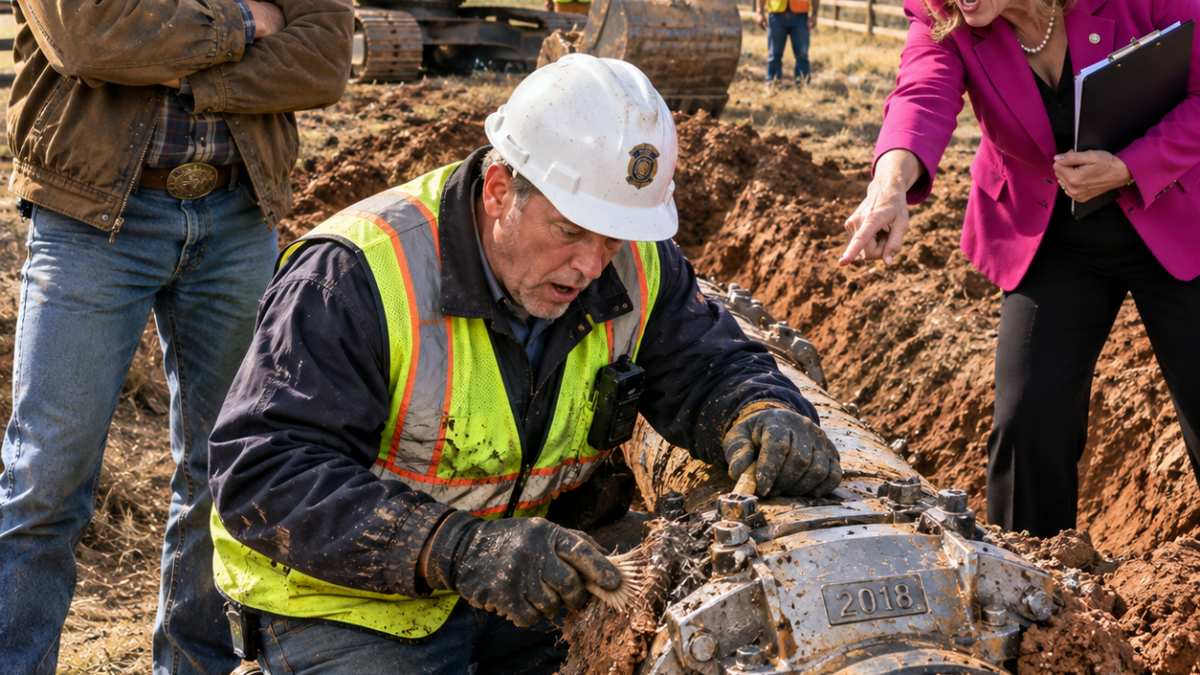
HOA President Screamed “That Gas Is Ours!”—Then the State Inspector Dug Up a 2014 Stamp She Never Expected.
The HOA president pointed at my chest in the middle of my own 8,400-acre ranch and screamed, “That gas is ours!” while a state inspector knelt beside a buried pipeline she claimed her neighborhood had legally used since 2018.
Ten minutes later, he scraped the dirt from an old steel tap plate stamped MARCH 2014, and the forged easement beside Ronda Pennington’s name suddenly became evidence of something far bigger than a property dispute.
By the time the meter audit, my grandfather’s notebooks, a terrified HOA treasurer, and a man caught beside the gas valve at one in the morning were finished telling the story, we had uncovered roughly $2.3 million in gas taken from my family’s land while 410 homeowners were being charged monthly for fuel the HOA never actually bought.
Three weeks before Ronda Pennington screamed at me in that field, I was sitting across from an estate lawyer wondering why my grandfather had left me a sealed envelope instead of simply telling me what he wanted while he was alive.
His name was Walter Merrill.
Everybody called him Walt.
He was eighty-nine when he died.
He had worked the same Montana ranch nearly his entire adult life.
Not because the ranch was easy.
It wasn’t.
The winters were brutal.
Spring mud could swallow a truck to its axles.
A dry August could burn grass yellow before noon.
Equipment broke at the worst possible time.
Cattle found holes in fences no human could see.
And every year seemed to invent a new way to make farming more expensive.
But my grandfather loved the land.
All of it.
The creek running through the eastern pasture.
The cottonwoods along the north boundary.
The red barn my great-grandfather had built.
The low hills where we used to ride horses when I was a kid.
And, more than anything, he respected what was under the ground.
Mineral rights.
Oil.
Natural gas.
People who have never owned rural acreage sometimes think the dirt is the property.
My grandfather understood that land exists in layers.
Surface rights.
Water rights.
Minerals.
Easements.
Pipelines.
Access.
A mistake involving any one of those could cost a family more than the ranch house itself.
That was why I paid attention when the attorney slid the folder across his desk.
“Your grandfather left everything to you.”
I looked down.
“Everything?”
“Approximately eighty-four hundred acres.”
He tapped the file.
“Surface and mineral rights.”
I sat back.
I had known the ranch would probably remain in the family.
I had not expected him to leave it all directly to me.
My mother had died years earlier.
I was Walt’s only grandson.
PART2:
Still, the weight of it felt enormous.
Then the lawyer reached into his desk.
“There’s one more thing.”
He handed me a plain white envelope.
My name was written across the front.
COLT
My grandfather’s handwriting.
Shaky.
Uneven.
The attorney said:
“He told me not to mail it.”
“Why?”
“He wanted you to receive it only after the estate transferred.”
That sounded like Walt.
He trusted paper.
But only when he controlled where it went.
I opened the envelope in my truck.
Not in the lawyer’s office.
I don’t know why.
PART3:
Maybe because the ranch had always been between my grandfather and me, and I wanted whatever he wrote to stay that way for a few minutes.
The note was short.
Colt,
The ranch is yours. Protect the minerals.
Check the east fence line.
Check the oil meter at Well Seven.
Something is wrong, and I ran out of time to prove it.
—Grandpa
I read it three times.
Then a fourth.
My grandfather did not use phrases like something is wrong casually.
If a fence post leaned, he said it leaned.
If a calf looked sick, he said which symptoms worried him.
If a neighbor lied, he said exactly what they lied about.
Vague language was not his style.
The line frightened me because it sounded like a man who knew enough to be worried but not enough to make an accusation.
I drove straight to the ranch.
Eddie Salazar met me at the gate.
Eddie had worked with Walt for thirty years.
He was sixty-four.
Lean.
Dark mustache going mostly gray.
Hands permanently stained by grease and fence paint.
He hugged me before I could reach for his hand.
That alone told me how much he missed my grandfather.
“Your granddad talked about you every day.”
I laughed.
“He complained about me every day.”
“That too.”
We stood beside the gate.
Same red barn in the distance.
Same gravel lane.
Same porch swing outside the house.
I felt fifteen again.
Then Eddie looked east.
Toward the tree line.
His smile disappeared.
“What?”
He shook his head.
“Nothing.”
“Eddie.”
He hesitated.
“Your granddad got strange about the east pasture near the end.”
“What kind of strange?”
“Kept checking meters.”
“Taking notes.”
“Arguing with somebody on the phone.”
“Who?”
“He wouldn’t say.”
I took the envelope from my pocket.
Eddie read it.
His eyes stopped at the line about the east fence.
“So he told you.”
“Told me almost nothing.”
“He told you enough.”
That evening, before we could ride out, someone came to welcome me.
A pink-and-white golf cart rolled up the gravel drive like it had taken a wrong turn leaving a resort.
Behind the wheel sat a woman in a magenta blazer.
Ronda Pennington.
President of Prairie Crest Estates.
Prairie Crest bordered the eastern side of the ranch.
Four hundred ten homes.
Stone entrance.
Private roads.
Community clubhouse.
Artificial pond.
Golf-cart paths.
The subdivision had been built in stages over the previous fifteen years.
My grandfather hated almost everything about it.
Not the families.
The planning.
He used to say:
“They built four hundred houses next to cattle, then complained they could smell cattle.”
Ronda stepped out holding a basket.
“Colt Merrill?”
“Yes.”
She smiled.
“Ronda Pennington.”
She extended one hand.
“President of Prairie Crest Estates.”
“Welcome home.”
She handed me the basket.
Muffins.
Blueberry.
Homemade-looking paper liner.
“You didn’t need to do that.”
“Neighbors take care of neighbors.”
The sentence would become funnier later.
At the time, I thanked her.
She talked for four minutes.
The community.
Property values.
Shared history.
How much everybody respected Walt.
How sad everyone was to hear of his passing.
Then the smile became more businesslike.
“One tiny administrative thing.”
She pulled a document from a clipboard.
“Access and utility agreement.”
I took it.
First page.
Bold language.
PERMANENT AND IRREVOCABLE UTILITY ACCESS
Prairie Crest Estates.
East corridor.
Pipeline rights.
Maintenance authority.
I read the first paragraph.
Then the second.
“This gives the HOA permanent access across my property.”
“It memorializes existing access.”
“Existing according to whom?”
“The association has used the corridor for years.”
“My grandfather signed this?”
“There are older arrangements.”
“I want to see them.”
Ronda smiled.
“Of course.”
“But this form simply cleans everything up now that ownership changed.”
I handed it back.
“My lawyer will look at it.”
Her expression altered.
Tiny.
Maybe half a second.
Then the smile returned.
“There’s really no need for lawyers.”
“Then you won’t mind one.”
“Colt, your grandfather and our community had a longstanding understanding.”
“Great.”
“Put it in writing.”
“It is in writing.”
“Not this.”
I pointed to the signature line.
“This is asking me to give you something now.”
She studied me.
Then folded the paper back into her clipboard.
“I hope we can keep things friendly.”
“So do I.”
The muffins stayed on my counter untouched.
That night I went into my grandfather’s study.
Nothing had changed.
Brown desk.
Old calculator.
Ranch maps rolled into cardboard tubes.
A coffee mug holding pens that had not worked in years.
On the wall:
A photograph of Walt at thirty.
Another of my mother riding a sorrel mare.
Another of me sitting on a tractor at eight years old.
I searched the obvious places first.
Desk drawers.
Filing cabinet.
Bookshelf.
Then I found a key taped beneath the bottom drawer.
Classic Walt.
The key opened the small center drawer.
Inside were field notebooks.
Dozens.
One for almost every year.
Weather.
Cattle.
Production figures.
Fence repairs.
Gas readings.
Meter numbers.
Then the last notebook.
The handwriting had become shakier.
Pages less full.
Near the back was a sketch.
East pasture.
Creek.
Fence.
A black line drawn toward Prairie Crest.
Pipeline.
At the connection point, Grandpa had written:
THIS TAP IS NOT MINE.
Three lines beneath it.
I stared.
The next morning, Eddie and I rode east.
I took my grandfather’s notebook.
GPS.
Camera.
No tools.
We followed the old service road.
About half a mile from the house, Eddie’s horse stopped near a patch of tall grass.
He climbed down.
“What?”
He kicked aside dry stems.
Metal.
Square valve box.
Not shown on any ranch map I had.
Fresh tire tracks surrounded it.
Eddie crouched.
“Somebody’s been here.”
“How fresh?”
“Day.”
“Maybe two.”
The box contained a valve and a gauge.
The needle moved.
Gas was flowing.
A black pipe disappeared into the ground.
We traced its likely path toward the creek.
Then fence.
Then Prairie Crest.
Eddie stood slowly.
“Colt.”
“I know.”
“They’re taking gas.”
“Looks like it.”
“How long?”
“No idea.”
He reached toward the valve.
I stopped him.
“Don’t.”
“I was just—”
“Nothing gets touched.”
That decision probably saved the case.
I photographed everything.
Valve.
Gauge.
Tire tracks.
GPS coordinates.
Fence.
Pipe marker.
Then called Naomi Castillo.
Naomi had handled mineral-rights litigation in the county for almost twenty years.
She was forty-six.
Short.
Calm.
The kind of lawyer who became quieter when everybody else became louder.
She listened to the story.
Then asked one question.
“Did you sign Ronda’s agreement?”
“No.”
“Good.”
“What do I do?”
“Nothing.”
“That can’t be the plan.”
“You document.”
“I already did.”
“Good.”
“Then we confirm ownership.”
“Pipeline records.”
“Mineral leases.”
“Meter history.”
“Any recorded easements.”
“Then we get the state involved.”
“What if they’re stealing gas right now?”
“They probably are.”
“And I leave the valve open?”
“Yes.”
I hated that answer.
Naomi leaned forward.
“If you shut it today, Ronda tells four hundred ten families that you cut off their utility without warning.”
“She turns you into the villain before we know what the line is.”
“So what?”
“We let an inspector establish it.”
“And if there’s no agreement?”
“Then we discuss conversion.”
“Fraud.”
“Accounting.”
“Potential theft.”
She paused.
“But facts first.”
The HOA discovered I was asking questions almost immediately.
The next morning, Ronda parked her golf cart across my gate.
Beside her stood an HOA attorney.
And a nervous-looking man carrying a laptop bag.
“Mr. Merrill.”
The muffins were gone from her personality.
“We understand you’ve been interfering with utility infrastructure.”
“I photographed a valve on my property.”
“That corridor serves Prairie Crest.”
“Show me the recorded easement.”
Her attorney stepped forward.
“We believe longstanding use establishes the association’s rights.”
“Believe?”
He adjusted his glasses.
“The line has been openly operated for years.”
“Then you should have documentation.”
Ronda’s eyes hardened.
“Stay away from the east corridor.”
I almost laughed.
“My east corridor?”
“Interfering with community utilities could expose you to liability.”
“Funny.”
“What?”
“I also don’t want legal action.”
I stepped around the golf cart.
“Move this off my gate.”
She did.
That night I could not sleep.
At two in the morning, headlights moved across the east pasture.
Not road headlights.
Low.
Slow.
I called Eddie.
He answered on the first ring.
“You see it?”
“Yes.”
“I’m coming.”
We drove out with a spotlight but stopped well away.
A heavy man in an orange safety vest knelt at the valve box.
Wrench in hand.
He had removed part of the cover.
Eddie whispered:
“That’s Gary.”
“Gary who?”
“Pennington.”
Ronda’s husband.
I turned on my phone camera.
Then the spotlight.
Gary froze.
“Evening.”
He nearly dropped the wrench.
“What are you doing?”
“Routine maintenance.”
“At two a.m.?”
“Emergency check.”
“Who authorized you to enter my land?”
He stood.
“You don’t understand how these utilities work.”
“Explain it.”
He looked toward Eddie.
Then toward me.
He put the wrench into his truck.
I kept recording.
“Gary.”
“What?”
“Don’t come back here without written permission or a lawful right of access.”
He slammed the truck door.
Drove away.
Dust covered us.
Eddie shook his head.
“Routine maintenance.”
“Apparently very routine.”
Two days later, somebody else arrived.
Loretta Haynes.
Seventy-one.
Silver bob.
Lilac cardigan.
Carrying a shoebox.
“I live in Prairie Crest.”
“Okay.”
“I think you need to see these.”
We sat at the kitchen table.
She opened the box.
Receipts.
Eleven years.
Monthly HOA statements.
One line appeared over and over.
COMMUNITY GAS CO-OP SURCHARGE — $38
“What is this?”
Loretta looked embarrassed.
“They told us Prairie Crest purchased gas through a community energy cooperative.”
“How many homes pay this?”
“All of us, I think.”
“Four hundred ten?”
“Yes.”
I pulled out a calculator.
Thirty-eight dollars.
Times 410 homes.
Times twelve months.
$186,960 per year.
If collected consistently.
Loretta stared at the number.
“We’ve been paying for gas.”
“You’ve been paying somebody.”
I called Naomi.
She arrived before lunch.
We spread the statements across the table.
“Utility Reserve.”
That was the account listed.
Naomi photographed everything.
“Loretta, can you provide copies?”
“All of them.”
“Would you sign a statement explaining what residents were told?”
“Yes.”
“Why are you doing this?”
Loretta looked toward the east pasture.
“Because Ronda keeps saying you’re stealing gas from us.”
She shook her head.
“But my husband was a pipeline engineer.”
“He died three years ago.”
“He always said the numbers on our HOA bills didn’t make sense.”
“I ignored him.”
Her eyes filled.
“I’d like to stop ignoring him.”
Naomi filed a formal complaint.
Forty-eight hours later, State Oil and Gas Inspector Raymond Teller scheduled a meter audit.
And excavation.
Ronda went public.
The HOA page posted:
NEW RANCH OWNER THREATENS GAS SERVICE TO 410 PRAIRIE CREST FAMILIES
My phone started ringing.
Residents.
Angry.
Scared.
One woman asked:
“How can you turn off heat to children?”
“I haven’t turned off anything.”
“Ronda said you’re shutting the line.”
“Ronda is wrong.”
Another man shouted for almost two minutes.
I let him.
Then said:
“Ask your HOA to show you the gas purchase invoices.”
Silence.
“What?”
“If you’re paying for purchased gas, ask who they purchase it from.”
He hung up.
The first court hearing was packed.
Prairie Crest filled half the gallery.
Ronda sat at counsel table.
Magenta blazer.
Clipboard.
Her attorney stood.
“Your Honor, the association has openly used this gas line continuously since at least 2018.”
Judge Susan Ortley looked over her glasses.
“And your theory?”
“Prescriptive easement.”
“Seven years of open, continuous utility use.”
Naomi stood.
“We dispute both the legal entitlement and the claimed start date.”
Judge Ortley looked at me.
Then Ronda.
Then Inspector Teller.
“Can the physical connection be dated?”
Teller nodded.
“Potentially.”
“Then let’s stop guessing.”
She signed the inspection order.
“Dig it up.”
Ronda went pale.
That was the first moment I knew the ground itself might tell a different story.
Dig day arrived cold and bright.
Yellow excavator.
Three workers.
Inspector Teller.
Naomi.
Eddie.
Ronda.
Gary.
Two HOA lawyers.
A deputy because Naomi had requested scene security.
The excavator removed red dirt slowly.
No one touched the pipe until Teller cleared it.
Ronda paced.
Then finally snapped.
“Stop this.”
Nobody did.
She marched across the field.
“That gas is ours!”
She pointed at my chest.
I folded my arms.
“Then you won’t mind what we’re about to find.”
The excavator bucket stopped.
Worker climbed down.
Hand tools from there.
Then metal appeared.
A saddle clamp.
Old steel tap plate.
Teller knelt.
Brushed away dirt.
Read the stamp.
His expression changed.
“What?”
He cleaned it again.
Then looked toward me.
“Mr. Merrill.”
“Yes?”
“This fitting is stamped March 2014.”
Silence.
Ronda stopped moving.
Naomi stepped closer.
“Not 2018?”
Teller shook his head.
“No.”
He cleaned another section.
“And there’s a company mark.”
“What?”
DRAPER LAND COMPANY
Ronda’s attorney moved forward.
“Could that part have been reused?”
Teller answered:
“Possibly.”
“That’s why we’re documenting before conclusions.”
Naomi smiled slightly.
Evidence first.
Always.
But the 2014 date mattered.
The HOA’s claim depended heavily on its story.
Open use beginning in 2018.
Yet the tap existed four years earlier.
That afternoon Naomi pulled every recorded easement connected to Draper Land Company.
One document surfaced.
June 2014.
Signed:
Walter Merrill
My grandfather.
I felt sick.
Maybe he had known.
Maybe he had authorized the line.
Then Naomi looked closer.
Notary:
Bev Tolliver
I called Eddie.
“Where was Grandpa in June 2014?”
“Hospital.”
“You sure?”
“Gallbladder first.”
“Then infection.”
“He was in Billings almost three weeks.”
Naomi obtained medical records through the estate.
Dates matched.
Walt had been hospitalized when he supposedly signed a ranch easement in the county.
Then she checked the notary.
Bev Tolliver’s Montana notary commission began in October 2014.
Four months after she had supposedly notarized Grandpa’s June signature.
Naomi put the two dates side by side.
“That document is a problem.”
“Fake?”
“We prove it properly.”
I was beginning to hate how much I liked hearing her say that.
Teller’s meter audit came back that Friday.
He called us into his office.
Eddie sat beside me.
Naomi across.
Teller opened a spreadsheet.
Historical well production.
Meter readings.
Estimated flow.
Pipeline capacity.
Pressure data.
Records from Well Seven.
He pointed to the final estimate.
Approximately twelve years of unmetered diversion.
Estimated value of natural gas removed:
Around $2.3 million.
Nobody spoke.
Eddie finally said:
“Two point three million.”
Teller nodded.
“Estimate.”
“Final accounting could move.”
Naomi asked:
“Direction?”
“Depends on pricing period and flow reconstruction.”
My phone buzzed.
Unknown number.
STOP NOW OR YOU’LL REGRET IT.
I showed Naomi.
She photographed the screen.
“Do not answer.”
“I wasn’t going to.”
“Preserve it.”
I assumed it was intimidation.
Something designed to scare me.
I was wrong.
At 1:07 the next morning, Eddie pounded on my front door.
“Colt!”
I woke instantly.
“What?”
“Gas.”
“What?”
“I smell gas east.”
We drove hard.
No headlights until we reached the service track.
Then Eddie hit the spotlight.
Gary Pennington was at the valve.
This time he had a cutting torch.
My body went cold.
“What the hell are you doing?”
Gary turned.
Torch flame still lit.
Gas hissed near the exposed connection.
He wasn’t repairing the tap.
He was preparing to cut something.
Destroy it.
Maybe remove evidence.
Maybe disconnect the line.
I didn’t care which.
Open flame beside a leaking gas line was all I needed to understand.
“Gary!”
He stepped back.
“Stay away.”
“Turn it off.”
“This doesn’t concern you.”
“You’re on my land with a torch beside natural gas.”
“Turn it off.”
Eddie moved toward the emergency shutoff.
Gary stepped in front.
“Don’t touch that.”
I shouted:
“Eddie, kill the torch.”
Gary raised one arm.
Eddie knocked the torch away from the pipe and forced the fuel control shut.
No heroic fight.
No punches.
Just three terrified men trying not to die.
The gas hiss grew louder.
I reached the emergency valve.
Put both hands on it.
Turned.
It resisted.
Then moved.
Half turn.
Another.
The hissing slowed.
Stopped.
We stood in darkness.
Nobody spoke.
Then sirens.
Deputy Travis Ames arrived first.
Followed by volunteer fire crews.
Gary sat on the ground.
Shaking.
Maybe because he realized what nearly happened.
Maybe because he realized what came next.
Deputy Ames asked:
“What were you doing?”
Gary looked toward me.
Then Eddie.
Then the exposed pipe.
His face collapsed.
“It was Ronda’s idea.”
Nobody moved.
Gary continued.
“She said Walt would never find out.”
I felt something inside me go cold.
Deputy Ames turned on his body camera.
“What was her idea?”
Gary covered his face.
“The line.”
“The company.”
“The charges.”
“All of it.”
The next person to come forward was Marcus Dell.
Prairie Crest treasurer.
He asked to meet at a diner.
Not the clubhouse.
Not my ranch.
Neutral.
He sat across from me with both hands around a coffee cup.
“I’ve kept two sets of books for six years.”
Naomi sat beside me.
Marcus looked sick.
“I knew it was wrong.”
“Then why?”
“Ronda.”
“That isn’t an answer.”
He closed his eyes.
“She had control over everything.”
“Board nominations.”
“Contracts.”
Legal counsel.
“People who challenged her ended up with violations.”
“Fines.”
“Neighbors turning against them.”
Naomi asked:
“You committed accounting fraud because you were afraid of HOA fines?”
“No.”
Marcus looked down.
“She knew something about me.”
“What?”
“I moved money years ago to cover a reserve shortage.”
“I put it back.”
“But she found out.”
“She told me if I didn’t cooperate she’d report me and make it look like theft.”
Naomi did not comfort him.
“Did you falsify records?”
“Yes.”
“Did you know gas was being diverted from Mr. Merrill’s mineral estate?”
“Eventually.”
“When?”
“Six years ago.”
He reached into his jacket.
Flash drive.
“Everything’s there.”
Naomi did not plug it into a laptop.
She bagged it.
Documented transfer.
Called investigators.
Chain of custody.
On that drive was the structure.
PRAIRIE CREST ENERGY PARTNERS, LLC
Owners:
Ronda Pennington.
Gary Pennington.
The shell company supposedly sold natural gas to the HOA.
But it bought gas from nobody.
No legitimate supplier invoices.
No upstream purchase records.
No production ownership.
Instead:
Gas came from my land.
The HOA paid Prairie Crest Energy Partners.
Homeowners paid monthly surcharges.
Ronda and Gary pocketed the margin.
Some money returned to association accounts when needed.
Enough to keep statements plausible.
The forged easement gave them a story.
The false 2018 start date gave them a potential prescriptive-use argument.
Then we found the email.
Ronda to Gary.
Years earlier.
Walt’s getting too old to check. We’re safe.
I read that sentence inside my truck.
Again.
Again.
I had been angry before.
That made it personal in a different way.
They had not merely seen an opportunity.
They had watched my grandfather age.
Waited for weakness.
Counted on confusion.
Counted on him dying before he could prove what he suspected.
I took out his notebook.
THIS TAP IS NOT MINE.
He knew.
Maybe not all of it.
Enough.
The emergency Prairie Crest meeting drew more than two hundred residents.
Loretta organized it.
By then Ronda was still technically president.
She entered carrying the clipboard.
Magenta blazer.
Same confidence.
At first.
The clubhouse lights dimmed.
Projector turned on.
First slide:
Night video.
Gary at my valve with a wrench.
Second:
The 2014 tap plate.
Third:
The alleged 2014 Walt Merrill easement.
Beside it:
Hospital admission dates.
Then:
Notary commission start date.
October 2014.
The room changed.
People who had blamed me stared at the screen.
Next slide:
Homeowner surcharge totals.
Then shell-company registration.
Ronda Pennington.
Gary Pennington.
A woman near the back shouted:
“You charged us for stolen gas?”
Ronda stood.
“This presentation is defamatory.”
Loretta faced her.
“Where are the supplier invoices?”
“Prairie Crest Energy Partners is an independent vendor.”
“Owned by you.”
“Indirectly.”
“Your name is on the registration.”
Ronda looked toward her attorney.
Then Marcus walked in.
That was the moment she lost control.
He carried nothing.
Investigators already had the records.
But residents recognized their treasurer.
Marcus stood near the front.
“I falsified books.”
A murmur moved through the clubhouse.
He continued.
“Ronda told me to.”
Her face went white.
“You liar.”
Marcus looked at her.
“I have the emails.”
No one clapped.
This wasn’t entertainment anymore.
These people had paid for eleven years.
Some had lived paycheck to paycheck.
Some were elderly.
Some had chosen Prairie Crest partly because utilities were supposedly managed through a reliable cooperative.
They were not only angry about money.
They felt humiliated.
Used.
Loretta stood beside me.
“You could shut the whole neighborhood off tomorrow.”
“I could probably ask.”
“Will you?”
“No.”
She looked surprised.
“Why?”
“Because four hundred ten families didn’t steal my gas.”
“Two people did.”
“And maybe some people who helped them.”
I looked at the room.
“I want the line metered.”
“Legal.”
“Paid.”
“That’s all.”
Loretta squeezed my arm.
The final hearing came months later.
Judge Ortley spent forty minutes reading.
Not performing.
Not lecturing.
Just moving through evidence.
Pipeline history.
Tap stamp.
Forged easement.
Notary dates.
Meter audit.
Shell company.
Utility payments.
Gary’s statements.
Marcus’s books.
Emails.
Threat.
Nighttime torch incident.
Then she removed her glasses.
“Mrs. Pennington.”
Ronda stood.
The judge’s voice remained flat.
“This court finds substantial evidence that you and your husband knowingly participated in the unauthorized diversion of natural gas from the Merrill mineral estate.”
Ronda’s mouth tightened.
“That you relied upon a purported easement whose authenticity is not supported by the evidentiary record.”
“That association residents were charged sums represented as payments for lawfully supplied gas.”
“And that funds were routed through an entity controlled by you and your husband.”
She looked toward Naomi.
“Injunction granted.”
“Accounting ordered.”
“Prescriptive-easement claim denied on this record.”
Then toward Ronda.
“And the relevant files will be referred to the district attorney and appropriate regulatory authorities.”
Outside the courthouse, two deputies approached Ronda and Gary.
By then investigators had obtained warrants connected to separate criminal proceedings.
Ronda’s clipboard slipped from her hand.
Hit the pavement.
Phones came up.
Reporters.
Residents.
Gary looked at the ground.
Ronda looked at me.
For the first time since I met her, she had nothing to say.
Loretta stood beside me.
“Your grandfather would be proud.”
I looked toward the sky.
Not because I expected anything.
Habit.
Memory.
“I kept my promise.”
The civil accounting took nearly a year.
Gas value.
Homeowner surcharges.
Shell-company transfers.
Interest.
Expenses.
Credits.
Taxes.
Nothing about $2.3 million turned into a neat check.
Real litigation is not television.
Some funds had been spent.
Some assets sold.
Some frozen.
Some recovered.
Some claims overlapped.
The homeowners had claims.
My mineral estate had claims.
The HOA itself had claims against former officers.
The court had to separate them.
Naomi warned me early:
“Justice is going to look like spreadsheets.”
“Wonderful.”
“You wanted proof.”
“I did.”
“You got it.”
The independent audit confirmed years of improper billing.
Prairie Crest families became eligible for refunds and account credits based on what they had actually paid.
Some received checks.
Others had balances offset.
The HOA pursued former management actors where evidence supported it.
My estate received compensation tied to the gas removed from the mineral interest.
Not instant.
Not perfect.
But documented.
Transparent.
That mattered.
Ronda and Gary faced criminal proceedings separately.
Fraud-related charges.
Forgery allegations.
The dangerous attempt to tamper with the line.
Financial offenses tied to the shell company.
Marcus cooperated.
His cooperation did not erase what he had done.
But prosecutors accounted for it.
He pleaded to reduced offenses.
Lost his treasurer position.
Paid restitution.
And spent the next several years rebuilding a reputation he had damaged himself.
I respected one thing about him.
Eventually, he told the truth even though it cost him.
Not early enough.
Still mattered.
Loretta became HOA president.
She hated the title.
That was probably why she was good at it.
First meeting:
She eliminated the private golf-cart parking space labeled PRESIDENT.
Second:
Independent audit schedule.
Third:
Residents could access vendor contracts.
Fourth:
No board member or immediate family member could hold a financial interest in an HOA vendor without disclosure and full homeowner approval.
Then she called me.
“About the gas.”
“I’m listening.”
“We still need it.”
“I know.”
“Can we talk?”
“Yes.”
We sat at my kitchen table.
Not clubhouse.
Not lawyers first.
Just Loretta, two new board members, Eddie, and me.
I put my terms down.
Real meter.
State-approved installation.
Recorded easement.
Defined corridor.
Fair market price tied to a transparent formula.
Annual audit rights.
Emergency shutoff protocol.
No hidden reserve surcharge.
No shell company.
No perpetual “irrevocable” control over land they didn’t own.
Loretta read everything.
Then smiled.
“This is incredibly boring.”
“Naomi says boring wins.”
She laughed.
Residents voted.
Agreement passed overwhelmingly.
The first legal gas meter went online the following winter.
I stood beside Inspector Teller.
He watched the numbers start moving.
“Feel strange?”
“Yes.”
“Why?”
“Same gas.”
“Different paperwork.”
I smiled.
“Paperwork matters.”
Teller laughed.
“Never thought I’d hear a rancher say that.”
The next monthly Prairie Crest statement looked different.
No mysterious $38 surcharge.
Instead:
NATURAL GAS USAGE — ACTUAL METERED COST
Volume.
Rate.
Administrative charge.
All visible.
Loretta mailed me the first statement.
Across the top she wrote:
LOOK. BORING.
I kept it.
The most emotional moment came months later.
Not court.
Not arrests.
Not refunds.
Eddie and I were cleaning out Grandpa’s study.
We had left most of it untouched during the lawsuits because every notebook seemed potentially relevant.
Once Naomi told us the record review was complete, I began sorting.
Maps.
Receipts.
Veterinary invoices.
Christmas cards.
Then the final notebook.
I opened to the east-pasture sketch.
THIS TAP IS NOT MINE.
I had read that line a hundred times.
But when I lifted the page, I realized two sheets were stuck together.
Old coffee.
Humidity.
I separated them gently.
On the last page, my grandfather had written another line.
The handwriting was faint.
Probably one of the final things he entered.
If Colt finds this, tell him not to get mad first. Measure first.
I laughed.
Then cried.
Eddie sat down.
“What?”
I showed him.
He read it.
“Sounds like Walt.”
“Annoyingly.”
Eddie smiled.
“He knew you.”
“He knew I’d want to rip the line out.”
“You did.”
“I didn’t.”
“No.”
“Naomi stopped me.”
“Walt would’ve liked her.”
“He would’ve hated her bills.”
We laughed.
Then I looked at the notebook again.
Measure first.
That was exactly what saved everything.
We didn’t cut the line.
Didn’t confront Prairie Crest residents.
Didn’t destroy evidence.
Didn’t accuse Ronda publicly before records existed.
We photographed.
Measured.
Recorded.
Compared.
Dug.
Audited.
The truth became undeniable because we allowed it to become measurable.
That was something Ronda never understood.
She believed confidence could beat documentation.
Clipboard.
Blazer.
HOA logo.
Attorney.
Official language.
She told residents the gas was theirs.
Then told the court they’d used it since 2018.
Then relied on an easement from 2014.
Then tried to explain away a notary who wasn’t licensed yet.
Then her own husband appeared at my valve at two in the morning.
Then a shell company appeared in the books.
Then an email mentioned my grandfather becoming too old to check.
Every new lie needed another explanation.
Eventually the explanations became heavier than the truth.
Prairie Crest changed after that.
Not perfect.
No neighborhood is.
People still argued about lawns.
Parking.
Fence colors.
Pool rules.
But something fundamental shifted.
Homeowners stopped treating the board like a government they could not question.
They asked for invoices.
Read minutes.
Voted.
Some residents apologized to me.
One man named Kevin showed up at the ranch with a case of beer.
“You probably don’t remember me.”
“I do.”
He looked embarrassed.
“I called you a thief at the first hearing.”
“Yes.”
“I was scared you’d shut off my heat.”
“I know.”
“I should’ve asked questions.”
“Yes.”
He looked surprised.
“You’re not making this easy.”
“No.”
Then I took the beer.
“Come inside.”
He helped Eddie repair a corral gate that afternoon.
Life is strange.
The families who once thought I was trying to steal their utility became customers of the gas beneath my ranch.
Legally.
Fairly.
I never blamed them.
They paid bills presented by people they trusted.
That was the real theft.
Not only gas.
Trust.
Ronda had used neighbor against neighbor to protect herself.
She told them:
Colt is coming for your heat.
She told me:
The neighborhood will sue you.
She needed us angry at each other because if we ever compared records, her story died.
Loretta compared records.
Then everything changed.
Years later, people still asked how I knew.
I didn’t.
My grandfather did.
Or at least he suspected.
He simply ran out of time.
That bothered me for a while.
He should have seen the ending.
Should have watched the pipeline dug up.
Should have heard Teller say March 2014.
Should have watched residents turn toward Ronda when the shell company appeared on the projector.
Should have watched the real meter start.
But grief doesn’t negotiate timelines.
Walt left me what he could.
The land.
The mineral rights.
His notebooks.
A warning.
That was enough.
I kept the east valve box.
Not the illegal tap itself.
Regulators removed and replaced everything necessary for the legal system.
But the old steel plate stamped MARCH 2014 eventually became releasable after the evidentiary process ended.
Teller asked:
“You want this?”
“Yes.”
“For what?”
“Reminder.”
I mounted it in Grandpa’s study.
Below it:
His handwritten sentence.
THIS TAP IS NOT MINE.
And beneath that, the last line:
MEASURE FIRST.
Eddie laughed when he saw it.
“Looks like a museum.”
“It’s two pieces of junk.”
“Expensive junk.”
He had a point.
The line represented twelve years of gas.
Millions in value.
Years of false charges.
A forged document.
A damaged community.
But to me, it meant something simpler.
A claim is not proof.
Authority is not ownership.
Confidence is not truth.
And just because someone has repeated something for years does not make it theirs.
Ronda screamed:
“That gas is ours.”
She believed volume could settle the question.
The inspector answered with steel.
March 2014.
Then the records answered.
Then the meters.
Then the bank accounts.
Then the residents.
I never needed to scream back.
That may have disappointed some people.
There was no moment where I stood over Ronda and delivered a perfect revenge speech.
Real justice is less cinematic than that.
She lost control of the HOA.
Lost the shell-company scheme.
Faced criminal and civil consequences.
Assets were pursued.
Residents were repaid under court supervision.
The legal line was replaced.
That was enough.
I did not need her humiliation.
I needed the theft to stop.
I needed Grandpa’s name cleared.
I needed the families next door to know where their money had gone.
And I needed the ranch to remain what Walt left me.
Mine to protect.
Not mine to exploit.
There is a difference.
One autumn evening, Loretta drove over.
No golf cart.
Pickup truck.
She handed me a jar of peach preserves.
“No muffins?”
She laughed.
“Too much history.”
We sat on the porch.
The pasture had turned gold.
Prairie Crest houses glowed beyond the tree line.
From the east corridor came the faint metal ticking of the legal meter.
Loretta listened.
“Funny.”
“What?”
“Same neighborhood.”
“Same ranch.”
“Same gas.”
“And everything feels different.”
“Because nobody is lying about it.”
She nodded.
Then looked toward Grandpa’s empty porch chair.
“You think Walt knew Ronda was involved?”
“I don’t know.”
“He knew the tap was wrong.”
“Yes.”
“Why didn’t he tell anyone?”
“He tried.”
“How?”
“Notes.”
“Meter checks.”
“Calls.”
“Maybe he didn’t have enough.”
I looked toward the horizon.
“He was eighty-nine.”
“People started treating his questions like confusion.”
That was the part I would never forgive easily.
Not one person.
A habit.
The way people sometimes hear an old man say something is wrong and assume age is speaking instead of experience.
Ronda had counted on it.
Walt’s getting too old to check. We’re safe.
She was wrong.
He checked enough.
Then left the rest to me.
A year after the new gas agreement, Prairie Crest held a community barbecue.
Loretta invited me.
I almost didn’t go.
Eddie forced me.
“You’re the gas man now.”
“I hate that.”
“Everybody needs a title.”
“Yours is annoying old ranch hand.”
“Accurate.”
Four hundred people.
Children.
Tables.
Grills.
No magenta blazer.
No clipboard.
A little boy approached me.
Maybe nine.
“My dad says the gas comes from your cows.”
I stared.
“Your dad said that?”
“Yes.”
“Your dad is lying to you.”
The father nearly dropped his drink laughing.
I explained natural gas badly.
The kid lost interest halfway through.
Then Loretta stood with a microphone.
I immediately became suspicious.
“No.”
She ignored me.
“Before we eat…”
Residents quieted.
She thanked volunteers.
Then said:
“And thank you to Colt Merrill, who could have treated every family here as an enemy and didn’t.”
I hated public attention.
“Loretta.”
She smiled.
“He had the legal right to fight hard.”
“He chose to fight accurately.”
“That matters.”
People applauded.
I looked toward Eddie.
He was enjoying this far too much.
Later, Kevin shook my hand.
Another family thanked me.
An elderly man said his refund had helped cover his wife’s medication.
That hit harder than any court order.
Because suddenly the numbers became lives.
Thirty-eight dollars a month.
Maybe small to some people.
Not to everyone.
Eleven years of charges could mean thousands.
Money for prescriptions.
Groceries.
School clothes.
Repairs.
Ronda and Gary had not only stolen gas from beneath my ranch.
They had taken small pieces from hundreds of households and hidden the theft inside a familiar monthly bill.
People pay familiar bills automatically.
That was part of the genius of the scheme.
And its cruelty.
Nobody questions thirty-eight dollars the way they question thirty-eight thousand.
Multiply silence by four hundred ten homes and enough years, and theft becomes a business model.
That was the lesson Naomi took from the case.
She began using parts of it in professional talks about rural mineral rights and fraudulent utility arrangements.
No names.
Just structure.
I attended one once.
Big mistake.
She displayed a map of the east corridor.
Then the fake easement.
Then the 2014 stamp.
At the end, somebody asked:
“What was the biggest mistake the defendants made?”
I expected Naomi to say the forged document.
Or shell company.
Or cutting torch.
Instead:
“They assumed nobody would compare independent records.”
She looked toward me.
“Fraud survives inside gaps.”
I understood.
Ronda controlled the HOA story.
Gary controlled maintenance.
Marcus controlled books.
The residents had bills.
My grandfather had ranch records.
The state had pipeline data.
The county had notary records.
The hospital had Walt’s admission dates.
Each piece alone looked incomplete.
Put them together:
Impossible to ignore.
That was why Grandpa wrote measure first.
Anger sees one thing.
Evidence sees connections.
I became obsessive about the ranch records after that.
Every well.
Every meter.
Every easement.
Digitized.
Backed up.
GPS mapped.
Annual third-party audits.
Eddie mocked me.
“You know Walt kept all this in notebooks.”
“Walt almost lost two million dollars.”
“Fair.”
Then he bought a tablet.
Spent six months complaining.
Eventually he loved it.
The ranch remained mine.
But I stopped thinking of ownership as simply possession.
Ownership is stewardship with paperwork.
Grandpa knew that.
He protected the place for decades.
I inherited not only the acreage.
I inherited unfinished questions.
People romanticize inheritance.
They picture land.
Money.
A house.
Sometimes inheritance is responsibility somebody else died before completing.
Mine was buried four feet beneath an east pasture.
The day we dug it up, Ronda thought the argument was about gas.
It wasn’t.
It was about whether history could be manufactured by repeating it confidently enough.
She said:
Since 2018.
The pipe said:
She said:
Walt agreed.
The hospital said:
Walt wasn’t there.
She said:
The easement was notarized.
The licensing record said:
The notary did not yet have a license.
She said:
The HOA bought gas.
The bank records said:
Her own company sold gas it never purchased.
She said:
I threatened four hundred ten families.
The legal agreement we later signed proved I had always been willing to serve them fairly.
Every claim met a record.
One by one.
That’s how her power disappeared.
Not in an explosion.
Not in a fistfight.
Not because I shouted louder.
Because eventually there was nowhere left for the story to hide.
I still walk the east fence sometimes.
The legal pipeline follows a surveyed route now.
Markers.
Meter.
Emergency contact number.
Everything boring.
Everything visible.
At the old tap location, grass grew back.
You would never know what had been buried there.
Except I know.
Eddie knows.
Teller knows.
And once a year, on Grandpa’s birthday, I carry his notebook out there.
Not because I think he can hear me.
I don’t know what I believe about that.
I just sit.
Open to the page.
THIS TAP IS NOT MINE.
Then the last page.
MEASURE FIRST.
For most of my life, I thought my grandfather’s greatest lesson involved ranching.
Work before sunrise.
Repair something before replacing it.
Never trust weather forecasts after lunch.
Don’t buy a horse you haven’t watched somebody else ride.
Turns out his best lesson came after he was gone.
When someone tells you something belongs to them, ask for the record.
When somebody claims a right over your land, measure it.
When authority arrives wearing a confident smile, verify where that authority begins and ends.
And when anger tells you to tear something out of the ground immediately, stop long enough to photograph it first.
Because sometimes the thing buried under your feet is not only a pipe.
Sometimes it is the evidence that an entire lie was built around.
Ronda Pennington stood in my field that morning believing seven years of repetition had turned stolen gas into HOA property.
Then Raymond Teller brushed away the dirt.
MARCH 2014.
Four years earlier than the story she had built her defense around.
That one stamp did not prove everything.
But it cracked the first wall.
Behind it came the forged easement.
The impossible notary date.
Twelve years of meter discrepancies.
Two sets of HOA books.
A shell company.
$2.3 million in diverted gas.
A midnight threat to destroy the line.
And one email written because Ronda believed an old rancher was too weak to stop her.
Walt’s getting too old to check. We’re safe.
She misunderstood my grandfather.
He never stopped checking.
He simply knew he might not have enough time to finish.
So he left the land to me.
Left the notebook.
Left the warning.
And trusted that eventually I would dig in the right place.
I did.
The gas was never theirs.
The lie was.
And once we pulled that lie into daylight, even Ronda Pennington could no longer claim ownership of the truth.








