HOA President Put 23 “NO TRESPASSING” Signs Around My Family’s Lake—So I Replaced Them and Exposed What She’d Been Charging 72 Families
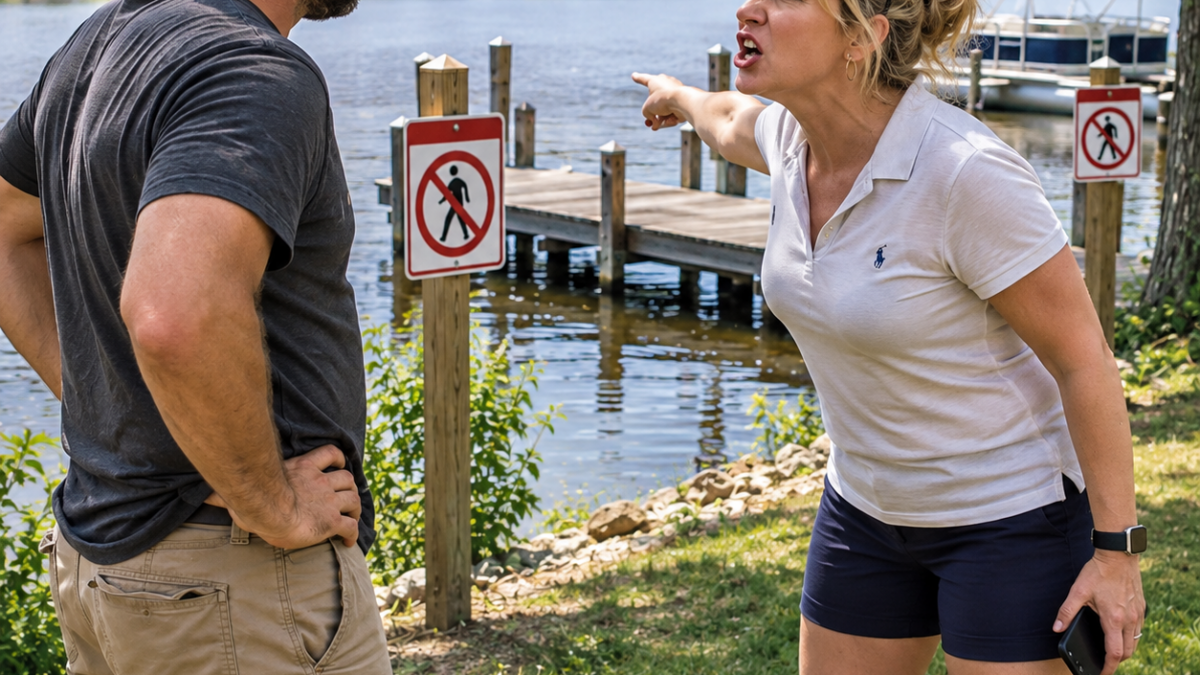
That sentence told me almost everything I needed to know.
People with actual ownership usually care quite a lot about deeds.
She pointed across the water.
“I’ve managed this lake for eight years.”
“You’ve managed access to property you don’t own.”
“You think you can show up after disappearing for years and take it away from seventy-two families?”
“I’m not taking anything away.”
“That’s exactly what you’re doing.”
“My grandfather let people use it.”
“Exactly.”
“For free.”
That stopped her.
Only for a second.
“What?”
“He never charged neighborhood residents to fish or swim.”
“You don’t know what arrangements existed.”
“I handled his books the last two years of his life.”
“Then maybe he didn’t tell you everything.”
“Maybe.”
I nodded toward the sign.
“But he definitely didn’t give you permission to hammer HOA signs into his land three weeks after he died.”
Her face went red.
“Put it back.”
“No.”
“I’m telling you—”
I grabbed the second sign.
Pulled.
It resisted.
PART3:
I rocked the post once.
Twice.
Then the packed soil released with a scrape.
Vivian shouted:
“Pull one more and I will have you arrested!”
I leaned the second sign against the first.
“Call whoever you want.”
She did.
The sheriff’s cruiser arrived eighteen minutes later.
Deputy Tom Brannigan.
Late forties.
Gray beginning around the temples.
Calm in the way people become calm after years of realizing that other people’s urgency does not have to become their own.
He parked near the gravel boat launch.
Vivian met him before he reached me.
“Officer, thank God. He’s tearing down private-property signs.”
Brannigan looked at the signs.
Then at me.
“Your name?”
“Daniel Callaway.”
Vivian interrupted.
“He’s claiming he owns the lake.”
Brannigan raised one hand.
“Ma’am, I’ll speak with you in a minute.”
I liked him immediately.
I handed over my driver’s license.
Then the deed.
Survey.
Probate order.
Tax parcel records.
Brannigan read longer than Vivian wanted him to.
She shifted.
Crossed her arms.
Uncrossed them.
Finally:
“Deputy, our HOA has had exclusive lake rights for years.”
He kept reading.
“Do you have a recorded easement?”
“A what?”
He looked up.
“Recorded access easement. Lease. Ownership interest. Covenant. Something showing the HOA controls the property.”
“We’ve invested hundreds of thousands of dollars.”
“That wasn’t my question.”
“I have association records.”
“Do they show a recorded interest in this parcel?”
Vivian’s jaw tightened.
“The neighborhood was developed around this lake.”
Brannigan turned to me.
“Mr. Callaway, these records indicate the land is yours.”
“Yes.”
“Any part of the lake transferred separately?”
“No.”
“Any HOA covenant?”
“No.”
He checked the survey again.
The blue line around the lake sat completely inside the larger Callaway parcel.
Then he looked toward Vivian.
“Ma’am, based on what I’m seeing, Mr. Callaway has the right to remove signs installed on his property.”
She exploded.
“That deed is outdated!”
“Recorded deeds don’t become invalid because they’re old.”
“The HOA has maintained this property.”
“Then you can present whatever claim you believe you have in civil court.”
“He’s stealing community property!”
Brannigan did not raise his voice.
“These documents support his right to be here.”
Vivian looked at me.
“You’re going to regret this.”
Brannigan’s head moved immediately.
“Ma’am.”
She turned.
“That sounded like a threat.”
“It wasn’t.”
“Then choose different words.”
Vivian pointed toward the neighborhood.
“Seventy-two families use this lake.”
I said:
“They still can.”
She looked at me as if I had changed languages.
“What?”
“I haven’t closed the lake.”
“Then why are you removing signs?”
“Because they say you own it.”
“They say residents only.”
“My grandfather allowed neighbors and local families to use it. He never created an HOA-exclusive lake.”
Vivian looked toward Brannigan.
“You see what he’s doing? He’s going to open it to strangers.”
Brannigan said:
“That would appear to be a decision for the property owner.”
Vivian walked away so hard her shoes threw gravel.
I thought that was the end of the morning.
It was the beginning.
My grandfather, Walter Callaway, had built the lake in 1961.
Calling it a lake made it sound natural.
It wasn’t.
It had started as a low pasture crossed by Piney Branch.
Walter bought the original land in 1958.
He worked equipment maintenance at a limestone quarry and spent almost every paycheck he could spare on the farm.
Three years later he rented a bulldozer.
Built an earthen dam.
Installed a spillway.
Spent another two summers shaping the banks.
By 1963 he had forty-six acres of water.
Bass.
Bluegill.
Catfish.
Walter loved fishing.
But he loved watching people enjoy the place even more.
Piney Bluff did not exist then.
Just farms.
Gravel roads.
A church.
A gas station.
People asked permission.
Walter almost always said yes.
His rule was simple:
Don’t leave trash.
Don’t cut fences.
Don’t drive into wet fields.
Don’t drown.
That last one was delivered like a joke but wasn’t.
When developers bought the old Turner farm next door in 1999, Walter allowed new homeowners to walk down an old farm lane to the lake.
No contract.
No dues.
No gate.
No HOA.
He later wrote a short permission letter for the developer.
Rachel, my attorney, found the original after I inherited the property.
It said:
**Residents of the Piney Bluff subdivision may access Callaway Lake for personal fishing, walking, and nonmotorized recreation at the discretion of the Callaway property owner. This permission creates no ownership interest, easement, or permanent right and may be modified or withdrawn at any time.**
Walter Callaway.
June 14, 2001.
Pretty clear.
Piney Bluff eventually grew to seventy-two homes.
Then an HOA formed.
Walter tolerated it because it had nothing to do with him.
Occasionally somebody from the association asked whether they could clean the trail.
Sure.
Put out a trash barrel?
Fine.
Host a kids’ fishing day?
Walter loved that.
He even bought the worms one year.
But he never charged them.
Not a dollar.
That was why the $850 fee bothered me so much.
I didn’t know about it yet when I pulled those signs.
That discovery came four days later.
First Vivian sent a letter to every homeowner.
I got a copy from a man named Pete Dawson.
Pete lived on Oak Bend Drive.
Retired electrician.
Fished the lake three mornings a week.
He drove his golf cart onto the farm and found me replacing the HOA signs with temporary ones of my own.
Mine said:
**CALLAWAY LAKE — PRIVATE PROPERTY**
**PINEY BLUFF RESIDENT RECREATIONAL ACCESS CONTINUES BY OWNER PERMISSION**
**NO HOA OWNERSHIP OR EXCLUSIVE CONTROL**
**PLEASE PACK OUT TRASH**
Pete read it twice.
Then laughed.
“Oh, Vivian is going to love that.”
“I hope she frames one.”
He held up an envelope.
“You seen this?”
The Piney Bluff logo sat in the corner.
Inside was a two-page letter.
**URGENT COMMUNITY PROPERTY NOTICE**
Vivian wrote that an “outside claimant” had presented “unverified legacy documents” attempting to take control of Piney Bluff Lake.
Outside claimant.
I had spent summers here since I was six.
My grandfather built the lake.
Vivian moved to Piney Bluff eight years earlier.
The letter warned residents not to communicate with me about “association legal strategy.”
That was interesting.
Then one sentence caught my eye.
**Residents are reminded that annual lake maintenance and access assessments fund the preservation of this community asset and should continue to be paid as scheduled.**
I read it again.
“What is the lake maintenance and access assessment?”
Pete stared at me.
“You serious?”
“Yes.”
“Eight-fifty.”
“A year?”
“Yeah.”
“For what?”
“Lake.”
I looked toward the water.
“Everybody pays that?”
“All seventy-two houses.”
My mind did the arithmetic automatically.
$850 times seventy-two.
$61,200 per year.
“How long?”
Pete scratched his chin.
“Since Vivian became president, I think.”
“Eight years?”
“Something like that.”
That was $489,600.
Nearly half a million dollars.
“For maintenance?”
“That’s what they say.”
“What maintenance?”
Pete looked at the lake.
“Good question.”
I knew what Walter had spent.
Dam inspection every few years.
Mowing.
Occasional gravel.
Fish stocking.
Spillway clearing.
Tree removal.
Most years he spent less than $5,000.
The biggest recent expense was a $12,400 emergency repair after a storm undermined part of the overflow channel.
Walter paid it himself.
I wrote the check from his account.
“Did the HOA pay my grandfather anything?”
Pete blinked.
“I assumed they did.”
“They didn’t.”
“Not even access?”
“No.”
“Maintenance contribution?”
“No.”
Pete looked uncomfortable.
“Vivian told us the fee covered the lake agreement.”
“What agreement?”
“I don’t know.”
That sentence started the real investigation.
I called Rachel Kim.
Same attorney who handled Walter’s probate.
“Do you have time?”
“How bad?”
“Potentially half a million dollars.”
She went quiet.
“That kind of time?”
“Yes.”
I explained.
Rachel said:
“Don’t accuse anyone of theft.”
“I wasn’t planning to.”
“Don’t post online.”
“I don’t own enough social media to know how.”
“Good.”
“Can an HOA charge its own members for lake access even if it doesn’t own the lake?”
“Possibly.”
That surprised me.
“For access they receive through your grandfather’s permission?”
“An HOA can levy assessments for legitimate association expenses if its covenants authorize them.”
“So she could call anything a lake fee?”
“Not exactly.”
Rachel continued.
“If the fee was represented as paying for maintenance, insurance, improvements, or contractual access, then those representations matter.”
“And if no contract existed?”
“Then we need records.”
“Can I get them?”
“You aren’t a member.”
“So no.”
“Not directly.”
I thought of Pete.
Rachel said:
“Association members may have inspection rights under governing documents and applicable law.”
Pete was very interested in that idea.
More interested after I told him Walter had never received lake-access money.
He requested eight years of budgets.
Vivian denied him.
Said the records were “under litigation hold.”
There was no litigation yet.
Rachel liked that.
“Ask again in writing.”
Pete did.
Three other residents joined him.
Melissa Grant.
Sanjay Patel.
And Ron Becker, who had served on the HOA board five years earlier.
Ron called me himself.
“I think you need to hear something.”
We met at my kitchen table.
He was sixty-eight.
Former accountant.
That helped.
“I was treasurer for eighteen months.”
“When?”
“Six years ago.”
“Did you see lake fees?”
“Yes.”
“What were they used for?”
Ron looked uncomfortable.
“That’s complicated.”
“Usually means bad.”
He nodded.
“When I joined the board, the lake assessment was already in place.”
“Eight-fifty?”
“Back then it was six hundred.”
“It increased?”
“Twice.”
“Why?”
“Vivian said dam liability.”
“Did the HOA insure the dam?”
“I never saw a policy.”
“Pay Walter?”
“No.”
“Contract?”
“No.”
“What did you think the money was for?”
“Reserve.”
“For what?”
“Future lake acquisition.”
I stopped.
“Acquisition?”
Ron nodded.
“That was the phrase.”
“So the board knew it didn’t own the lake.”
“Some of us did.”
“Did Vivian?”
“Absolutely.”
That changed everything.
I leaned back.
“Tell me.”
Ron exhaled.
“When the prior HOA president resigned, Vivian came in very aggressively.”
“I’m shocked.”
He almost smiled.
“She argued that the subdivision needed permanent control of the lake because homeowner values depended on it.”
“Okay.”
“She approached Walter.”
“When?”
“Seven years ago.”
I had never heard that.
“What happened?”
“He refused to sell.”
“Did he tell you that?”
“No. Vivian did.”
“What did she say?”
“That Walter was being unreasonable.”
I could hear my grandfather.
Probably told her no in six words.
Ron continued.
“She proposed building a reserve fund so the HOA could eventually buy the lake.”
“Were homeowners told that?”
He hesitated.
“Not exactly.”
“What were they told?”
“That the assessment funded lake preservation and permanent access.”
I felt my jaw tighten.
“Those are different.”
“I know.”
“Did the budget show acquisition reserve?”
“First year, yes.”
“And later?”
“No.”
“Where did it go?”
Ron looked at me.
“That is why I resigned.”
There it was.
He took out an old folder.
Photocopies.
Budgets.
Bank summaries.
Minutes.
Not complete.
Enough.
First year:
**Lake Preservation Reserve — $39,600.**
Second year:
**Community Amenities Reserve — $44,100.**
Third year:
Nothing separately identified.
Instead:
**Capital Improvement Fund.**
Ron pointed.
“I asked for the bank account.”
“What happened?”
“Vivian said all reserves had been consolidated.”
“Legal?”
“Could be.”
“But?”
“The balance didn’t make sense.”
“How far off?”
“At least seventy thousand when I left.”
I stared.
“Did you raise it?”
“Yes.”
“Board?”
“Yes.”
“Members?”
“No.”
“Why?”
Ron looked embarrassed.
“Vivian said I was misunderstanding accruals and reserve transfers.”
“You’re an accountant.”
“Retired.”
“Numbers don’t retire.”
He smiled despite himself.
“She had two other board members supporting her. I got tired of fighting.”
“So you resigned.”
“Yes.”
“You kept copies.”
“I keep everything.”
“You and Walter would’ve liked each other.”
Ron looked toward the window.
“We did.”
That surprised me.
“He knew?”
“Some.”
“How much?”
“He knew Vivian wanted the property.”
“Did he know homeowners were paying?”
“I don’t think so.”
That hurt.
Walter trusted people too easily when it came to the lake.
Not foolishly.
Generously.
Those are different.
Sometimes generosity only looks foolish after somebody exploits it.
Rachel reviewed Ron’s documents.
Then said:
“We need current records.”
The HOA’s attorney appeared the next week.
Martin Geller.
His letter asserted that Piney Bluff had acquired rights through “continuous maintenance, investment, reliance, and longstanding exclusive community use.”
Rachel laughed when she read “exclusive.”
I asked:
“Why?”
“Because exclusivity is exactly what Walter’s written permission disproves.”
She held up the 2001 letter.
“He expressly granted revocable use.”
“Can they claim adverse possession?”
“Not successfully on these facts.”
“Prescriptive easement?”
“Permission defeats hostility.”
“English?”
“You generally don’t acquire hostile-use rights when the owner invited you.”
Good.
Geller also demanded that I reinstall the HOA signs.
Rachel replied with Walter’s permission letter.
Survey.
Deed.
Tax history.
Photographs showing the HOA signs.
And a notice that any further installation of structures without permission would be treated as trespass.
Vivian responded by hiring contractors.
Not lawyers.
Fence contractors.
I was checking the spillway when I heard an auger.
Came over the ridge.
Two men were drilling post holes beside the trail.
Black vinyl-coated chain link stacked nearby.
“What are you doing?”
One man shut off the machine.
“Installing perimeter fence.”
“For who?”
“Piney Bluff HOA.”
“On whose property?”
He looked at the work order.
“HOA lake tract.”
“No.”
I showed him the survey pin.
Then my deed.
To his credit, he stopped.
Called his boss.
Vivian arrived fifteen minutes later.
“Keep working.”
The contractor said:
“Ma’am, he has a deed.”
“So do we.”
“Show him.”
“I don’t have to.”
The contractor folded his arms.
“I do.”
Vivian stared at him.
“You’re under contract.”
“Not to trespass.”
She turned on me.
“You’re interfering with association security.”
“You’re installing fencing on my farm.”
“You removed our signs.”
“Yes.”
“You’ve created an attractive nuisance.”
“That phrase doesn’t mean what you think it means.”
Her face tightened.
“You don’t know anything about HOA law.”
“Maybe.”
I nodded toward the stopped auger.
“But apparently I know enough about land ownership.”
The contractor packed up.
Vivian fired him by text before he reached the highway.
Then she installed cameras.
Small cellular trail cameras.
Five of them.
Trees around the lake.
Mounted inside lockboxes.
All on my property.
I found the first because it photographed me and flashed a tiny infrared indicator at dusk.
Rachel said:
“Don’t destroy them.”
“I know.”
“Photograph locations.”
“Already did.”
“Give written notice.”
“Done.”
“Then?”
“Can I remove them?”
“Yes. Secure them intact and offer return through counsel.”
I did.
Vivian called it theft.
The sheriff disagreed.
Again.
By now Deputy Brannigan recognized both our vehicles.
When Vivian demanded he charge me for stealing HOA security equipment, he asked:
“Where were the cameras located?”
“Piney Bluff Lake.”
“Whose parcel?”
She changed subjects.
That same week, homeowners finally forced access to some association financial records.
Not all.
Enough.
Pete brought three bankers’ boxes.
We spread them across my dining room.
Rachel was there.
Ron.
Melissa.
Sanjay.
Nobody drank the coffee.
The $850 assessment was real.
By then it had been collected at that amount for four years.
Before that:
$750.
Before that:
$600.
Total collections over eight years:
$421,800.
Not quite the half-million I’d first estimated.
Still staggering.
Actual lake-related expenditures we could identify:
$4,200 fish stocking.
Except Walter paid for stocking the same year.
$7,800 shoreline vegetation management.
No contractor name.
$11,600 “water-quality treatment.”
No lab records.
$18,400 “dam engineering reserve.”
No engineer.
$9,200 “liability allocation.”
No insurance policy attached.
Then larger entries:
$36,000 consulting.
$48,500 community planning.
$62,000 capital security.
$74,000 “strategic acquisition services.”
Rachel tapped that one.
“Who received it?”
Sanjay flipped pages.
“Mercer Community Solutions LLC.”
Nobody spoke.
I looked at him.
“Say that again.”
“Mercer Community Solutions.”
Vivian Mercer.
Rachel’s expression changed completely.
“Search the company.”
Sanjay did.
Registered agent:
Vivian Hale Mercer.
Business address:
A UPS mailbox in town.
Created six months after she became HOA president.
Ron whispered:
“Oh, no.”
Payments from Piney Bluff HOA to Mercer Community Solutions totaled at least $132,000 across six years.
Consulting.
Administrative services.
Lake acquisition strategy.
Community negotiations.
No detailed invoices in the records homeowners received.
Pete stared.
“She paid herself?”
Rachel corrected him immediately.
“We don’t know that yet.”
“The company is hers.”
“Yes.”
“That sounds like paying herself.”
“It sounds like a transaction requiring explanation.”
Lawyers ruin all the fun.
But she was right.
Then Sanjay found something better.
A reimbursement ledger.
Vivian had received direct reimbursements totaling another $31,700.
Travel.
Meetings.
Lake inspection.
Legal consultation.
One entry:
**Owner negotiation — $1,850.**
Date seven years earlier.
I pulled Walter’s old calendar from storage.
He wrote everything down.
Doctor.
Feed store.
Fishing.
Dentist.
Weather.
On that date:
**Woman from subdivision came again. Told her lake not for sale. 14 min.**
Fourteen minutes.
$1,850.
I laughed.
Then stopped because it wasn’t funny.
The $74,000 acquisition-services line was spread across payments to Vivian’s company during the same period she was apparently trying to convince Walter to sell.
But Walter had never agreed.
And after he said no, the fees continued.
For years.
What acquisition services were being performed?
Nobody knew.
Rachel said:
“Now we ask formally.”
The homeowners called a special meeting.
Vivian tried to cancel it.
Bylaws allowed twenty percent of membership to call one.
Twenty-nine households signed.
Almost forty percent.
The meeting took place in a church fellowship hall because Vivian controlled the HOA clubhouse reservation calendar and claimed it was “under maintenance.”
I did not attend.
Rachel advised against turning an HOA records meeting into a property dispute.
Pete called me afterward.
“You should’ve been there.”
“What happened?”
“Vivian says the LLC payments were approved management fees.”
“By who?”
“Board.”
“Ron?”
“No.”
“When?”
“Minutes supposedly exist.”
“Supposedly?”
“She didn’t bring them.”
“What about the lake?”
“She told everyone the HOA has equitable ownership.”
“Meaning?”
“No idea.”
“Neither does she.”
Pete laughed.
Then became serious.
“People are angry.”
“About me?”
“About money.”
That’s usually what does it.
Not principles.
Not signs.
Money.
For years, homeowners assumed their $850 bought something concrete.
Lake access.
Maintenance.
Insurance.
Long-term rights.
Now they were learning Walter had allowed access for free.
The HOA did not own the lake.
The association had no recorded lease.
No easement.
No purchase contract.
No insurance on the dam.
And more than $160,000 had gone directly or indirectly to Vivian or her company.
Melissa found another problem.
Homeowners had been told that part of the lake fee paid annual dam inspections.
I had Walter’s inspections.
Independent engineer every five years.
Most recently two years earlier.
Walter paid $2,650.
The HOA budget for that same year included:
**Dam Safety Compliance — $12,000.**
We contacted the engineer.
He had never worked for Piney Bluff HOA.
Never received $12,000.
Never invoiced them.
That was the moment Rachel stopped using phrases like “requires explanation.”
She said:
“Daniel, the members need independent counsel.”
“Criminal?”
“I said independent.”
“Rachel.”
She looked at me.
“If funds were intentionally misrepresented or diverted, that is bigger than a civil HOA fight.”
“Who reports it?”
“The board. Members. Possibly both.”
“I don’t want this to look like I’m retaliating because of the lake.”
“Then don’t be the complainant.”
The homeowners took it from there.
A group of twenty-one retained a forensic accountant.
His name was Marcus Bell.
Quiet man.
No sense of humor.
Possibly born wearing reading glasses.
He requested full bank statements.
The HOA refused.
A lawsuit followed.
Court ordered production.
That opened everything.
The numbers were worse.
Eight-year lake-assessment collections:
$421,800.
Documented, independently verifiable lake expenses:
$38,460.
Even giving Vivian the benefit of every questionable but possibly related expense, legitimate lake spending did not exceed $71,000.
More than $350,000 had gone somewhere else.
Some went to general HOA expenses.
That alone was a problem because residents had been told the assessment was restricted to lake maintenance and permanent access.
Some paid attorneys.
Some subsidized clubhouse renovation.
Some covered delinquent dues from other accounts.
Then Mercer Community Solutions:
$132,000.
Direct reimbursements to Vivian:
$31,700.
Another $46,000 had gone to a company called Blue Crest Land Advisory.
Owner?
Vivian’s brother-in-law.
Work product?
Three short “lake acquisition feasibility” reports.
The first was four pages.
Second six.
Third eleven.
$46,000.
Marcus Bell said:
“I’ve reviewed merger documents longer than all three combined.”
Pete said:
“So fraud?”
Rachel glared at him.
Marcus adjusted his glasses.
“I said the expenditure lacks reasonable documentation.”
He and Rachel would’ve made great drinking companions if either one seemed capable of relaxing.
Then they found a separate reserve account.
Balance should have been approximately $190,000 if board-approved reserve allocations had remained untouched.
Actual balance:
$23,414.
Withdrawals included transfers to the HOA operating account.
Checks to Mercer Community Solutions.
A $28,000 payment labeled:
**Emergency lake legal defense reserve.**
Date?
Six weeks before my grandfather died.
Payee:
Geller & Weiss.
Vivian’s attorney.
That meant she had been spending homeowner lake money preparing a legal claim before Walter was dead.
I sat with that one.
Six weeks.
Walter was dying of pancreatic cancer.
Vivian knew.
Everybody did.
She had already started positioning the HOA to claim the property after his death.
Rachel called Martin Geller.
Asked what the $28,000 covered.
Attorney-client privilege.
Fine.
But billing categories later produced under court order revealed:
Title research.
Adverse-use theory.
Prescriptive-rights analysis.
Post-death ownership strategy.
I read that phrase three times.
**Post-death ownership strategy.**
Walter was alive.
Vivian was planning what happened after he wasn’t.
I went outside.
Walked to the lake.
Sat on the old concrete spillway.
For years, people had fished there.
Kids swam.
Neighbors launched kayaks.
Walter loved it.
Vivian had turned that generosity into evidence of supposed HOA control.
Then collected money from families for rights Walter had never withheld.
Then spent some of that money figuring out how to convert permission into ownership.
It was elegant in a terrible way.
Use the lake for free.
Charge members for using it.
Call the fees an investment.
Then argue the investment creates ownership.
Rachel found me an hour later.
She had driven out.
“You okay?”
“No.”
She sat beside me.
“Good answer.”
“She waited for him to die.”
“Yes.”
“Planning before.”
“Yes.”
“He liked these people.”
“I know.”
“He would’ve kept letting them use it.”
“I know.”
“Why not just ask me?”
Rachel looked at the water.
“Because you had a deed.”
Vivian had a story.
Sometimes people choose the story because the deed is inconvenient.
Piney Bluff’s board finally suspended Vivian.
Four to one.
She challenged the vote.
Lost.
An interim president took over.
Elaine Brooks.
Former school principal.
First thing she did was stop collecting the lake assessment.
Second thing:
Send me a certified letter acknowledging the HOA had no ownership interest pending final legal review.
Third:
Ask whether residents could continue using the lake.
That one mattered.
I met Elaine at the farmhouse.
She looked exhausted.
“I understand if the answer is no.”
“It isn’t.”
She looked surprised.
“My grandfather wanted people here.”
“You’re still allowing access?”
“Yes.”
“After all this?”
“The residents didn’t install those signs.”
“Some supported Vivian.”
“Some did.”
“They paid fees.”
“They were told the fees were required.”
Elaine looked toward the water.
“What do you want from us?”
“Nothing right now.”
“That can’t be it.”
“It is.”
“You’re not charging access?”
“No.”
She actually laughed.
Not because it was funny.
Because eight years of assumptions were collapsing in one sentence.
“Daniel, these people paid thousands of dollars.”
“I know.”
“You could charge.”
“I could.”
“Why don’t you?”
“Because I don’t want to.”
She became quiet.
Then:
“We need something in writing.”
“That I agree with.”
Rachel drafted it.
Revocable recreational license.
Piney Bluff residents could walk, fish, kayak, and use designated swimming areas.
No motorized boats.
No nighttime access without permission.
No structures.
No exclusive rights.
No transfer of ownership.
No easement.
No fee to me.
HOA responsible only for trash pickup after organized events and maintaining the small footpath if I approved the work.
Either side could terminate with ninety days’ notice, except I retained immediate closure rights for safety.
Six pages.
Walter had managed the same thing in one paragraph.
Lawyers improve everything by making it longer.
Elaine signed.
I signed.
Residents got legal access for zero dollars.
That was when the anger at Vivian became uncontrollable.
Not because people suddenly cared about my property rights.
Because families calculated what they had paid.
Some households:
$5,800.
Some:
$6,400.
Original owners who paid every year:
More than $7,000.
For access now documented at no charge.
One man stood at the next HOA meeting holding eight years of statements and shouted:
“What exactly did I buy?”
Vivian attended with counsel.
She said:
“Preservation.”
He asked:
“What did you preserve?”
She said:
“Community value.”
Someone laughed.
Then everybody did.
That may have been the moment she lost them permanently.
The civil case multiplied.
Homeowners sued the association.
The association sued Vivian and Mercer Community Solutions.
Insurance carriers arrived.
Attorneys multiplied.
Invoices bred in captivity.
I stayed mostly out of it.
My lawsuit was simpler.
Quiet title.
Trespass.
Declaratory judgment.
Removal of any claimed HOA interest.
Compensation for physical damage from sign posts, fence drilling, and camera installation was minor.
Rachel included it anyway.
“Principle?”
“Record.”
Of course.
Vivian counterclaimed.
She argued Piney Bluff had acquired an irrevocable easement through decades of reliance.
Walter’s 2001 permission letter destroyed most of that.
Then we found another letter.
1999.
Developer had asked Walter to grant permanent lake rights to enhance subdivision sales.
Walter wrote:
**I will not burden the farm title with subdivision rights. Families are welcome to fish while I’m willing to have them. That’s neighborliness, not ownership.**
Walter Callaway.
I read it aloud.
Rachel smiled.
“Your grandfather would’ve been difficult in deposition.”
“He would’ve been magnificent.”
The judge agreed with us.
Piney Bluff had no ownership interest.
No permanent easement.
No exclusive rights.
No authority over the lake.
The HOA signs had been unauthorized.
The attempted fencing unauthorized.
The cameras unauthorized.
Residents’ use had historically been permissive.
Case closed on title.
Vivian still had the money problem.
The forensic audit went to the county district attorney.
Then the state financial-crimes unit.
Investigators asked for my records.
I gave them Walter’s.
They wanted confirmation that no access payments had been received.
Bank statements.
Tax returns.
Ledgers.
All clean.
Then they asked about Vivian’s contacts with Walter.
I had very little.
Walter’s calendar.
Two letters.
One voicemail saved on his old phone.
That voicemail became interesting.
Vivian, seven months before his death:
“Walter, I’m trying one last time to resolve this in a way that’s good for everyone. The HOA has invested too much to have the lake remain in private hands indefinitely. Eventually this will become a legal issue whether either of us wants it to or not.”
Walter’s return voicemail was shorter.
“Vivian, stop bothering me about buying my lake.”
That was Walter.
Seven words would’ve been enough.
Investigators found that Vivian had presented HOA members with annual budgets describing $20,000 to $40,000 per year as “contractual lake access obligations.”
There was no contract.
She told investigators the term referred to “anticipated future obligations.”
Nobody believed that after eight consecutive years.
Mercer Community Solutions became the center of the case.
Vivian claimed it legitimately managed HOA negotiations.
Investigators asked for work product.
She produced emails.
Meeting notes.
Reports.
Many were created after the forensic audit began.
Metadata showed it.
Bad move.
Her brother-in-law’s company had real reports.
Overpriced maybe.
But real.
The payments to Vivian’s company were much harder to explain.
Especially because some checks had been approved with only her signature plus that of a board member later shown to be out of state on the approval date.
That board member denied signing them.
Now there were potential forged authorizations too.
Elaine called me one morning.
“They searched her house.”
I looked out toward the lake.
“Vivian?”
“Yes.”
“Warrant?”
“State investigators.”
I felt no satisfaction.
That surprised me.
For months I’d imagined the moment she’d finally face consequences.
Instead I thought about Walter.
He would have hated all of this.
Not because Vivian was being investigated.
Because a place he built for fishing had become the center of lawyers, audits, police, bank records, arguments.
The lake had never needed any of that.
People did.
The charges came six months later.
Vivian Mercer.
Theft involving association funds.
Fraud-related counts.
Forgery-related counts tied to board approvals.
Falsification of business records.
Her attorney denied intentional wrongdoing.
The case took another year.
Meanwhile Piney Bluff rebuilt itself.
Elaine stayed president reluctantly.
Dues decreased because the $850 lake assessment disappeared.
Homeowners voted to create a small $75 annual voluntary recreation contribution.
Not for access.
For trash, trail gravel, and community fishing events.
Participation optional.
The money went into a separate account.
Monthly statement posted online.
Two signatures required for withdrawals.
I insisted on no money coming to me.
They used it for trash barrels.
Life jackets at the small swimming dock.
Trail maintenance.
A first-aid cabinet.
Walter would’ve approved.
The twenty-three HOA signs stayed stacked behind my barn.
I kept them because Rachel told me not to throw away evidence.
After the title case ended, I asked:
“Can I finally get rid of these?”
“Yes.”
I thought about scrap metal.
Then had a better idea.
I took one sign.
Covered the old wording.
Painted new lettering.
**CALLAWAY LAKE**
**PRIVATE LAND — NEIGHBORS WELCOME**
**PLEASE RESPECT THE WATER, THE LAND, AND EACH OTHER**
Underneath, smaller:
**EST. 1961 — WALTER CALLAWAY**
I installed it beside the trail.
Not twenty-three.
One.
Pete came by.
Read it.
“Vivian would hate this.”
“That’s not why I did it.”
“I know.”
He stood there.
“You really aren’t charging us?”
“No.”
“You should at least let us pay for stocking.”
“Voluntary.”
“What about dam maintenance?”
“That’s my responsibility.”
“That’s expensive.”
“Sometimes.”
Pete looked uncomfortable.
“We benefited from it.”
“You can help if you want.”
“Association?”
“No.”
“Personally?”
“Sure.”
Next spring, twenty-eight families showed up for a workday.
Cleared branches.
Picked up trash.
Repaired picnic tables.
Spread gravel.
A group of teenagers painted the old dock.
Nobody called it an HOA project.
Nobody sent me an invoice.
Walter’s version of community had returned.
Vivian’s criminal case eventually resolved through a plea agreement.
No dramatic trial.
No surprise confession.
The financial records were too detailed for drama.
Her attorney negotiated.
She pleaded guilty to several counts involving misuse of HOA funds and falsification of association records.
Other counts were dismissed as part of the agreement.
She was ordered to pay substantial restitution.
Some prison time.
Additional suspended sentence.
Probation.
Barred from serving as a fiduciary or officer of a homeowners association during the probationary period.
Mercer Community Solutions dissolved.
I attended sentencing.
Not because I needed to watch her lose.
Because the homeowners deserved to hear the accounting.
The prosecutor walked through the numbers.
More than $420,000 collected under the lake assessment.
Less than $71,000 even arguably related to lake purposes.
At least $132,000 transferred to Vivian’s company.
Additional reimbursements.
General HOA expenses improperly paid from restricted assessments.
Money spent attempting to establish ownership of property the HOA did not own.
The prosecutor said:
“The residents were told their payments secured and maintained lake rights. In reality, the underlying property owner had granted recreational use without charge.”
That sentence caused a sound in the courtroom.
Not a gasp exactly.
Something heavier.
Seventy-two families hearing the entire fraud reduced to one sentence.
Vivian spoke before sentencing.
She said:
“I believed I was protecting Piney Bluff.”
Maybe she did.
That’s the uncomfortable thing.
People can steal while believing they are guardians.
The judge asked:
“Did you disclose your ownership of Mercer Community Solutions before the HOA paid it?”
Vivian hesitated.
“It was known.”
“That wasn’t my question.”
“No.”
“Did homeowners know lake access was provided by Mr. Callaway’s grandfather without charge?”
“I don’t know what they knew.”
“Did you know?”
Long pause.
“Yes.”
There it was.
I didn’t smile.
Didn’t look at Pete.
Didn’t look at Elaine.
I simply sat.
For eight years she knew.
That mattered more than everything else.
After sentencing, Pete caught me outside.
“Well.”
“Yeah.”
“Half a million-dollar lake that never charged admission.”
“Almost.”
He looked toward the courthouse parking lot.
“I’m sorry.”
“For what?”
“We believed her.”
“You had budgets.”
“We should’ve asked.”
“People shouldn’t have to assume their HOA president is inventing ownership.”
“Still.”
I understood.
“Then ask next time.”
He nodded.
Good enough.
The restitution process took forever.
Insurance covered some association losses.
Vivian repaid some.
Her assets covered some.
Nobody got every dollar back.
Families received partial reimbursements.
Enough to matter.
Not enough to erase eight years.
Elaine sent me a check once.
$4,500.
I called her.
“What is this?”
“Association reimbursement.”
“For?”
“Your grandfather’s maintenance expenses during years we collected lake fees.”
“Send it back.”
“Daniel.”
“No.”
“That’s not reasonable.”
“My grandfather paid those expenses because it was his lake.”
“But we were using it.”
“He knew.”
“The association collected money for them.”
“Then return it to residents.”
Silence.
“You’re impossible.”
“That’s hereditary.”
She laughed.
They returned it proportionally.
Years passed.
Piney Bluff stopped calling it the Piney Bluff Lake.
Most people simply called it Callaway Lake.
I didn’t insist.
The county map had always called it Callaway.
Children swam there.
People fished.
A teenager caught a nine-pound bass near the south cove and almost cried.
Pete claimed it was ten.
Fishermen are constitutionally incapable of accurate numbers.
The dam received a full engineering review.
I paid for it.
Residents offered to contribute.
This time I accepted voluntary donations into a documented project account administered by Elaine.
Every invoice posted.
Every dollar visible.
The repair cost $18,700.
Neighbors contributed $11,200.
I covered the rest.
Nobody bought ownership by helping.
Nobody claimed they did.
Amazing what clarity can accomplish.
One autumn morning I found a woman near the new sign.
Young.
Maybe early thirties.
Two children carrying fishing poles.
She looked nervous.
“Mr. Callaway?”
“Daniel.”
“We’re new.”
“Welcome.”
“Piney Bluff.”
“I guessed.”
She pointed toward the lake.
“Are we actually allowed to fish?”
“Yes.”
“No permit from the HOA?”
“State fishing license if required. Nothing from me.”
“No lake pass?”
“No.”
“No fee?”
“No.”
She looked genuinely confused.
“The closing agent told us something about a lake agreement.”
“There is one.”
I pointed toward the trail.
“It says behave yourself.”
Her son asked:
“Can I catch a bass?”
“You can try.”
He ran toward the water.
She stayed.
“I heard there used to be some kind of dispute.”
“There was.”
“What happened?”
I looked at the sign.
“Too much paperwork.”
She laughed.
I liked that answer better than telling the whole story.
Later I walked the north shore.
The places where Vivian’s signs once stood were almost invisible.
A few round patches in the grass.
One rust stain on a stone.
That was all.
Twenty-three signs had looked permanent when I first found them.
They weren’t.
Neither was Vivian’s authority.
Neither was the story she told seventy-two families.
Paper signs.
Printed budgets.
Official logos.
Legal language.
All of it can create the appearance of ownership.
But appearance has limits.
My grandfather’s deed had existed before Piney Bluff.
His tax payments existed.
His dam permits.
His survey.
His permission letters.
The truth did not become true when I discovered Vivian’s scheme.
It had always been true.
She simply built something profitable on top of people’s failure to look underneath.
That’s why I kept one of the original HOA signs.
Not displayed.
In the barn.
Sometimes I see it when I’m looking for tools.
**NO TRESPASSING — PINEY BLUFF HOA — RESIDENTS ONLY.**
There is something almost funny about it now.
The HOA itself was trespassing when it installed the sign.
The residents it claimed to protect had never needed the sign.
The man who actually owned the land wasn’t allowed under its wording.
And the woman behind it collected hundreds of thousands of dollars by convincing people that permission freely given by my grandfather was something only she could sell them.
Twenty-three signs.
Seventy-two families.
Eight years.
$421,800.
All of it built around one assumption nobody bothered to verify.
That the HOA owned the lake.
It didn’t.
And in the end, I didn’t expose Vivian by outshouting her.
I didn’t need a secret loophole.
Didn’t need a billionaire lawyer.
Didn’t lock families out.
Didn’t drain the lake.
I pulled a sign from my own dirt.
Opened a folder.
And asked one question that should have been asked eight years earlier.
If my grandfather never charged anyone to use his lake—
what exactly had everyone been paying Vivian for?
The answer cost Piney Bluff a lot of money.
It cost Vivian much more.
But the lake stayed exactly where Walter put it in 1961.
Forty-six acres.
Bass under the docks.
Bluegill in the shallows.
Kids shouting from the swimming area.
Neighbors walking the trail.
And one sign by the path now says everything twenty-three HOA signs never could.
**PRIVATE LAND — NEIGHBORS WELCOME.**
Because there is a difference between owning something and sharing it.
My grandfather understood that.
Vivian never did.








