HOA President Offered Me $20,000 for My Inherited Lake—Then I Found the $240,000 Oil Proposal She Hid From Me
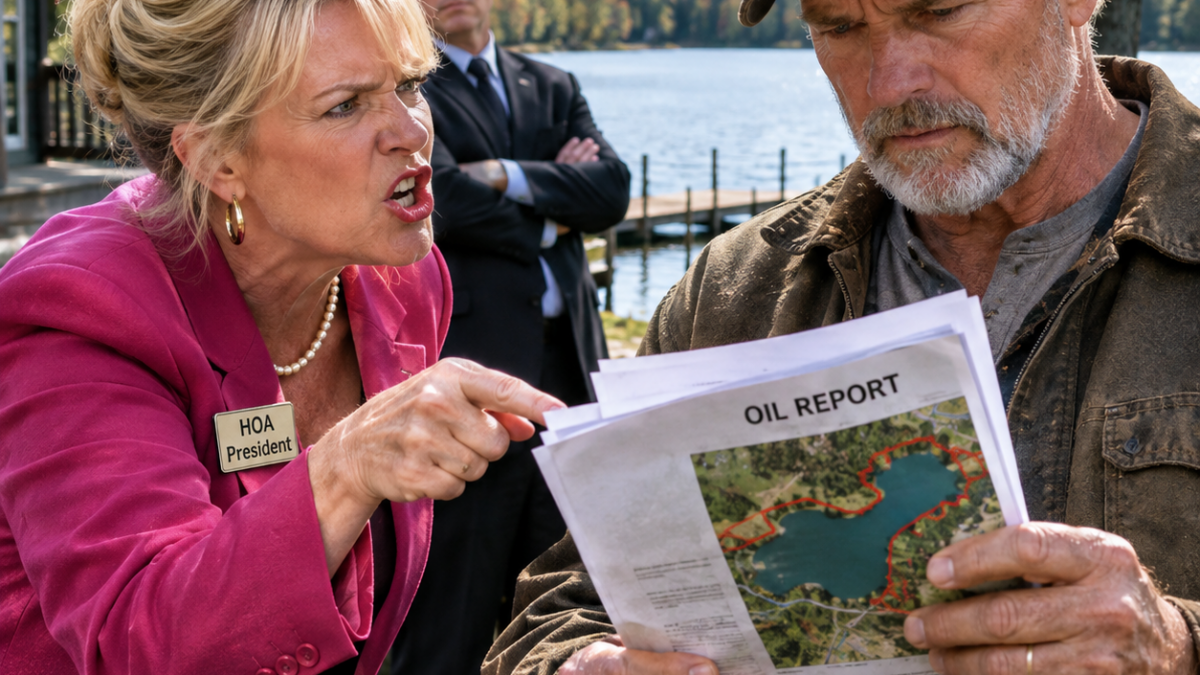
HOA President Offered Me $20,000 for My Inherited Lake—Then I Found the $240,000 Oil Proposal She Hid From Me.
The man who had been brought to inspect my lake cabin found me standing on my own porch, pulling an eviction notice off the door of the home my wife and I had spent thirty years repairing, while the HOA president stood behind him with a sales folder and acted as though my departure had already been arranged.
When the buyer asked why I was still there, I told him the truth—“Because I never offered this place for sale”—and the expression on his face changed when he opened his folder and realized Beverly Shaw had been marketing my cabin as part of an HOA waterfront package that did not even list my parcel number.
What neither of us knew yet was that Beverly had already been warned in writing that the cabin appeared to belong to me, had gone ahead anyway, had told neighbors I was voluntarily moving, told the buyer I had accepted relocation money, and had even scheduled a lock company to “secure” my house after I supposedly left.
My name is Dennis Walsh.
I was sixty-five years old when Beverly Shaw tried to sell my home.
Not threaten it.
Not argue about it.
Not fine me.
Sell it.
That distinction took me almost a week to understand because I spent the first several days believing I was dealing with a mistake.
That was my first mistake.
My wife Joan used to tell me I had a bad habit of assuming problems would stay small if I stayed polite long enough.
She was usually right.
Joan had been gone three years by then.
Cancer.
I still do not like writing the word.
There are some words that remain too sharp no matter how often you use them.
We had bought the cabin thirty years earlier.
Calling it a cabin made it sound romantic.
It was romantic to us.
To anybody else, it was a modest little house on a narrow lake lot with a green metal roof, an aging dock, a porch that leaned slightly toward the water, and enough ongoing repairs to prevent a retired appliance repairman from ever becoming bored.
Joan used to claim the porch lean was intentional.
“Drainage,” she would say.
I would point at the foundation.
She would point at the lake.
“Gravity, Dennis.”
That would end the argument.
There was a blue porch swing beneath the roof.
That was hers.
She had painted it herself.
Not some designer blue.
Not something with a poetic paint-store name.
Just blue.
Bright enough that you could see it from the water.
I replaced the chains every few years.
Never changed the color.
PART2:
After Joan died, people suggested changes.
Paint the bedroom.
Move the furniture.
Replace the curtains.
Fresh start.
I understood what they meant.
I did not want a fresh start.
I wanted my house.
Her clock still hung above the kitchen opening.
Her coffee mug stayed in the cabinet.
Her fishing rod remained in the shed with a piece of faded red ribbon tied above the handle because she used to accuse me of borrowing it and pretending I could not tell which one belonged to her.
The cabin was not a museum.
I lived there.
I repaired things.
I bought groceries.
I watched baseball.
I complained about the water heater.
I sat on the porch.
But every board had history.
That is what Beverly Shaw never understood.
Or maybe she understood and decided it did not matter.
The first sign came six days before the buyer appeared.
I had been in town getting plumbing parts.
The kitchen sink had started dripping underneath the basin, and I had bought washers, a length of supply line, and two fittings I probably did not need but would eventually.
I came home around three in the afternoon.
Beverly was standing on my porch.
She had a yellow tape measure hooked over the railing.
A younger woman stood near the steps with a notebook.
I pulled the truck beside the drive.
Stopped.
Watched them for a second.
Beverly saw me.
She let the tape retract.
Snap.
That sound still annoys me.
I got out holding the bag of plumbing parts.
“Can I help you?”
Beverly gave me the smile she used at HOA meetings when she wanted to make disagreement sound like confusion.
“Just updating the community property file.”
I looked at my porch.
“My property?”
“Of course.”
She said it as though I had asked whether the lake was wet.
“We’re including all the waterfront structures.”
The younger woman looked up.
“I thought this was part of the package.”
That word caught me.
Package.
“What package?”
Beverly answered before the woman could.
“Ashley, go ahead and photograph the old pump shed. I’ll catch up.”
Ashley hesitated.
Then walked toward the lane.
The old pump shed sat on the strip beside my property.
That strip belonged to the HOA.
Always had.
There was a community footpath there leading down to a small landing.
The distinction was simple.
My cabin sat on Lot 12.
The pump shed and path sat on Tract C.
Two parcels.
Two deeds.
Separate property.
I set the plumbing bag down.
“What package?”
Beverly smiled again.
“We’re exploring improvements along the shore.”
“Then explore them from the road.”
“Dennis.”
Nobody says your first name that way unless they are about to tell you something you are supposed to accept.
“Nobody is taking anything from you.”
I remembered that sentence later.
At the time, I was more concerned about the screen door.
It was open.
“Did you go inside?”
“No.”
“Did Ashley?”
“No.”
I walked past her and checked.
Living room.
Kitchen.
Bedroom.
Nothing looked disturbed.
I came back.
Beverly had moved toward the steps.
“You should really keep the porch clearer if we’re going to have people looking at the waterfront.”
“We?”
She stared for a second.
Then:
“The association.”
“You don’t need my porch to look at your pump shed.”
Her mouth tightened.
“We’re just gathering information.”
“Gather it off my land.”
That was about as angry as I got.
Beverly turned.
Walked toward her SUV.
No argument.
No threat.
Nothing dramatic.
That should have worried me more.
Instead, I carried the plumbing parts inside and convinced myself it was HOA nonsense.
Rude.
Unprofessional.
Probably harmless.
That was the version I wanted.
The next morning, there was a notice screwed to my front door.
Not taped.
Not placed beneath the mat.
Screwed.
A brass screw through the paper and into the trim beside the handle Joan had chosen.
The heading read:
NOTICE TO VACATE.
Large black letters.
Below that, the document described my cabin as a structure occupying association land.
I read the sentence twice.
Then again.
The notice ordered me to remove my belongings within seven days so the waterfront parcel could be delivered empty.
Delivered.
That word was worse than vacate.
Delivered to whom?
It was signed by Beverly Shaw.
President.
Pine Cove Homeowners Association.
No court name.
No case number.
No lawyer.
No judge.
No explanation.
Just a seven-day deadline printed as though authority existed because somebody had typed it in bold.
My hands went weak.
That surprised me.
I knew I owned the cabin.
I knew Joan and I had bought the land.
I knew where the boundary was.
But paper on your door changes something emotionally.
People say:
“It’s only a notice.”
Not when it tells you to leave your home.
Not when it is attached through the wood.
I stood there looking at the screw.
Joan had picked the handle because she said the old one looked like something from a dentist’s office.
I had installed it.
Now somebody had stood on our porch and treated the door like an HOA bulletin board.
I did not remove the notice immediately.
That was one good decision.
I took pictures.
Close.
Wide.
Whole porch.
The notice.
The screw.
The door.
The swing.
Everything.
Then I called Beverly.
She answered quickly.
“You’ve made a mistake.”
“No, Dennis.”
Her voice was calm.
“We completed a records review.”
“I own the cabin.”
“You own certain improvements.”
“And the land beneath them.”
“Your family has been allowed to use that area for a long time.”
I laughed.
Not because it was funny.
Because sometimes the alternative is swearing.
“Allowed?”
“Permission is not ownership.”
“My name is on the deed.”
“You need to read what the deed actually covers.”
I turned toward the kitchen.
The property folder was in a drawer beneath the phone charger.
“Send me what you’re relying on.”
“The notice tells you what you need to do.”
“It tells me what you want.”
Her voice hardened.
“The board has responsibilities to the entire community.”
“Did the board approve that notice?”
“The matter has been discussed.”
“That is not what I asked.”
Silence.
“Did the board vote to evict me?”
“Dennis, I’m not going to argue legal technicalities over the phone.”
That sentence told me more than she intended.
I ended the call.
I did not want to get angry enough to give her something she could write into a meeting note.
Dennis became threatening.
Dennis shouted.
Dennis refused cooperation.
I had spent forty years repairing appliances for people.
You learn quickly that angry customers remember tone better than facts.
So I wrote down the time.
Then I opened the drawer.
Deed.
Closing papers.
Survey.
Old title documents.
Joan had organized them better than I ever would have.
Tabs.
Sticky note.
Blue ink.
Lot 12.
There it was.
The cabin sat between the loop road and the lake.
Narrow lot.
Beside it, Tract C.
HOA strip.
Pump shed.
Footpath.
Landing.
Separate.
My father-in-law had helped us place a fence along part of the line when we first bought the place.
Years later, part of that fence was removed when the association repaired the path.
Nobody had cared because everybody knew where the property ended.
That was the problem with boundaries everybody understands.
Eventually somebody forgets why nobody is fighting about them.
I spread the documents across the kitchen table.
The deed referred to a recorded survey.
The survey showed the cabin clearly inside Lot 12.
I called the county recording office.
A woman answered.
I explained I needed certified or fresh copies of my deed and survey.
She told me what identification and parcel information to bring.
I drove there.
That trip was the first time I realized how frightened I actually was.
At a red light, I caught myself gripping the steering wheel hard.
I kept thinking:
What if there is something I missed?
What if the deed language is different?
What if Joan and I misunderstood something thirty years ago?
Fear does not care that logic says otherwise.
Fear asks:
What if?
At the county counter, a clerk named Teresa pulled up the records.
Lot 12.
Dennis Walsh.
Recorded deed.
Recorded survey.
Then she found the HOA parcel.
Tract C.
Separate deed.
Different property.
I felt my shoulders loosen.
“Can you print both?”
“Sure.”
She printed copies.
Then said:
“I can give you the records, but I can’t resolve a boundary dispute for you.”
“I understand.”
She pointed out the document references so I could match them.
Lot 12.
Tract C.
Two pieces.
Then she opened a newer county map on her screen.
I leaned closer.
The line between them was missing.
Instead of two separate shapes, the online display showed one shaded waterfront area.
My stomach dropped.
“Why does that look like that?”
Teresa studied it.
“This is an online parcel-location map.”
“Meaning?”
“It’s for general locating. It isn’t the deed.”
“But somebody could look at that and think the entire area belongs to the HOA.”
“Yes.”
There it was.
The seed.
Not proof.
Not ownership.
A map error.
But enough for somebody determined to believe it.
Teresa called another desk.
Asked when the display had last been updated.
She wrote down the process for requesting a correction review.
I paid for the copies.
Kept the receipt.
On the drive home, Beverly’s tape measure kept appearing in my mind.
Not checking.
Preparing.
Package.
I emailed the recorded documents to the HOA office.
Copied Susan, the office manager.
My message was simple.
The cabin sits on Lot 12.
Tract C is separate.
Withdraw the notice.
Do not enter my property without permission.
Susan replied that she received everything.
I called.
“Did you know about the notice?”
Pause.
“I saw a copy yesterday.”
“Did the board approve it?”
“I need to check the minutes.”
“Please.”
She sounded uncomfortable.
Not defensive.
That mattered.
Before we hung up, she asked:
“Can you send me a photo of how it was attached?”
I did.
Wide shot.
Whole porch.
She called back about an hour later.
“The minutes show authorization to seek offers for Tract C.”
“The pump shed strip.”
“Yes.”
“Anything about Lot 12?”
“No.”
“Anything about telling me to leave?”
“No.”
I wrote the time down.
I had never documented conversations with neighbors.
Now I did.
That afternoon, my daughter Claire came over.
She walked into the kitchen.
Saw papers everywhere.
“What happened?”
I told her.
Her expression moved from confusion to anger much faster than mine had.
“You didn’t call me?”
“I wanted to see if I had missed something.”
“You’ve lived here thirty years.”
“I know.”
She read the notice.
Then went outside.
Looked at the door.
Came back.
“She couldn’t even use tape?”
That nearly broke me.
Not the deed.
Not the sale.
The screw.
Small remark.
Joan’s door.
Claire saw my face.
“We can fix the door.”
I nodded.
“Let’s fix everything else first.”
She helped scan the survey.
Higher resolution.
In one corner, Joan had written the original survey company’s name and phone number in blue ink.
I remembered that day.
Closing table.
Joan writing:
Keep this.
“In case the fence ever needs moving.”
The company was still operating.
I called the next morning.
Explained the old survey.
Asked whether someone could come verify the markers.
Thursday opening.
$450.
I hesitated.
That money had a destination already.
Water heater.
Mine made a knocking sound after long use.
Plumber had warned me it was not getting younger.
But eviction had become more urgent than hot water.
I booked the surveyor.
Wednesday, Susan still had not sent a withdrawal.
Instead Beverly mailed me a letter.
Helpful tone.
The association would provide thirty days of storage.
Arrange a moving truck.
Assist with relocation.
If I left “without further delay.”
I stood at the kitchen sink reading it.
That was the first moment I understood she expected me to obey.
This was not bluff.
She was building logistics around my removal.
I called Susan.
“I do not authorize a truck.”
“Okay.”
“No storage.”
“Okay.”
“No entry.”
“Understood.”
“Who is buying Tract C?”
“I don’t have a signed contract.”
“Who is interested?”
Pause.
“Beverly has been handling inquiries.”
Everything led back to Beverly.
Later, Martin crossed the lane carrying a cardboard box.
My neighbor eighteen years.
Good man.
When Joan was sick, he rolled our trash cans up the drive without asking.
He held the box awkwardly.
“Thought these might help.”
Inside:
Packing tape.
Folded moving cartons.
I stared.
“Help with what?”
He turned red.
“The move.”
“I’m not moving.”
His expression collapsed.
“Beverly said you’d agreed to a place closer to Claire.”
There it was.
Story.
A believable one.
Widower.
Sixty-five.
Daughter nearby.
Moving closer to family.
No conflict.
No victim.
Just transition.
“She told you something that isn’t true.”
Martin looked horrified.
“I’m sorry.”
“You brought boxes because you thought I needed them.”
“Yes.”
“I’m not angry at you.”
He looked toward the blue swing.
“What do you need?”
That question was better.
I asked about the old fence.
“Do you remember it before the landing repairs?”
“Yes.”
“Any pictures?”
Martin thought.
Neighborhood cookout.
Years ago.
He went home.
Returned that evening with photographs.
Picnic tables.
Kids.
Paper plates.
The old fence visible in the background.
Pump shed beyond it.
Not legal proof.
But history.
Usage.
Context.
One photo showed Joan standing beside the blue swing.
Laughing.
I put that one aside.
For the first time in days, a photograph was not evidence.
It was my wife.
Thursday morning, the surveyor arrived.
Beth Coleman.
Orange equipment case.
Clipboard.
Practical voice.
We walked the line.
She checked measurements.
Near the pump shed, she scraped dirt away.
Found an old metal marker.
“There’s one.”
I had walked past it for years.
Ignored.
Permanent.
By the time she finished, she said:
“The cabin is inside Lot 12.”
I nodded.
“Porch?”
“Inside.”
“Not Tract C?”
“No.”
I breathed.
Actually breathed.
She said:
“I’ll put everything in writing.”
I stood beside the marker longer than necessary.
For three days Beverly’s voice had repeated in my head.
Read your deed.
Now somebody professionally trained to measure land had done exactly that.
Beth placed small orange flags.
I photographed them.
Sent Susan an update.
Cabin on Lot 12.
Report forthcoming.
Withdraw notice.
That should have ended activity.
At minimum paused it.
Instead, around four that afternoon, a car pulled in.
Ashley stepped out.
Camera bag.
The younger woman from Beverly’s first visit.
She stopped when she saw me.
“I’m sorry.”
“For what?”
“I thought you’d be gone until five.”
My skin went cold.
“Who told you that?”
She looked at her phone.
“Beverly.”
“Why would she know my schedule?”
“She said you had a regular Thursday appointment.”
I did.
Grief support group.
Twice a month.
I had missed it for Beth.
“What are you here to photograph?”
Ashley hesitated.
“The interior.”
“For?”
“The buyer’s file.”
There it was.
Buyer.
Not theoretical.
I stepped in front of the door.
“You’re not going inside.”
“Okay.”
No argument.
She put the camera away.
Then, perhaps because she realized something was wrong, she showed me the instructions.
Photograph of my cabin.
My address.
Notes.
Kitchen.
Porch.
Dock.
Parcel number listed as Tract C.
Bottom line:
CABIN INCLUDED.
VACANT POSSESSION AT CLOSING.
I read it twice.
“When is the buyer coming?”
“Saturday.”
I looked at Beth’s orange boundary flags.
Then at Ashley.
“They did not accidentally put my cabin on the wrong map.”
She said nothing.
“They are showing my house to someone.”
She looked miserable.
“Did Beverly tell you I owned it?”
“She said the association owned the waterfront parcel.”
“That isn’t what I asked.”
Ashley looked at the flags.
“No.”
“What did she call me?”
Pause.
“The occupant.”
Occupant.
Thirty years.
Mortgage.
Repairs.
Taxes.
Joan.
Occupant.
“Can you send me those instructions?”
“I need to ask my company.”
“Fair.”
Then:
“Please don’t delete them.”
“I won’t.”
She gave me a business card.
Left.
I called Susan immediately.
“There is a buyer coming Saturday.”
Silence.
“Beverly sent a photographer to take interior pictures.”
“I didn’t know about an interior visit.”
“Find out who the buyer is.”
“I’ll ask Beverly.”
“She’s the one telling him my cabin is included.”
Susan went quiet.
I heard anger in my own voice.
I stopped.
“I’m sorry.”
“You didn’t send Ashley.”
“No.”
“I need records.”
“I understand.”
That night I walked down to the dock.
From the water side, the cabin looked ordinary.
Green roof.
Blue swing.
Pump shed beside it.
Orange flags marking the line.
The truth was visible.
Beverly’s brochure photo had been cropped so the cabin dominated and the pump shed barely existed.
She had framed the image to create value.
My house.
Her sale.
Claire helped me find a property lawyer.
I called my home insurer too.
I did not expect them to solve it.
I wanted a record.
What happens if somebody enters?
If a contractor gets hurt?
If locks are changed?
Documentation.
Friday morning, lawyer called.
Paul Bennett.
I emailed everything.
He read the notice while I waited.
“This is an HOA demand.”
“Yes.”
“It is not a court order removing you.”
“I thought that.”
“Thinking and knowing matter.”
He asked:
Court papers?
No.
Title lawsuit?
No.
Deed to association?
Never.
He offered to send a letter.
Initial review and letter:
$350.
Survey:
$450.
Eight hundred dollars.
To prove I owned the home I already owned.
I wrote the numbers beside my water-heater estimate.
Beth’s report arrived.
Cabin.
Porch.
Lot 12.
Recorded survey matched.
I sent it to Paul and HOA.
Then county mapping called back.
Alice.
She had reviewed the missing line.
The online display had been changed during an update the previous year.
Wrong property number linked to part of the drawing.
Recorded deeds never merged.
Never.
She opened a correction.
Sent confirmation by email.
That was important.
There had been a real error.
Beverly had not invented the missing line.
But a bad screen map did not transfer title.
Especially after the recorded deed was shown to her.
Especially after a survey.
Especially after the county confirmed the error.
I sent Alice’s email to Susan.
Received.
Forwarded to full board.
Paul’s letter went out.
Ownership disputed.
No sale authorized.
No entry.
No belongings removed.
No locks changed.
Buyer should be notified.
Facts.
No anger.
I read it twice.
It felt good seeing reality expressed without emotion.
Later, Ashley’s supervisor called.
They had been hired to prepare simple photographs and brochure material.
Not acting as agents.
Had not verified title.
They had canceled remaining work.
He also sent the instructions.
There it was.
Beverly’s story in writing.
I was “someone who had been allowed to stay in an association cabin.”
Allowed.
Then:
Occupant has been notified of departure date.
Interior photographs would help buyer plan renovations.
She had not just misread a map.
She had written a biography for me.
Thirty years of ownership reduced to permission.
Around four, Martin came over.
More old cookout photos.
One showed Joan beside the swing.
Another showed the fence and pump shed.
He pointed.
“Your side.”
Then pump shed.
“Their side.”
“Everybody knew.”
“I have the survey.”
“I know.”
He gave me the photos.
Then looked at the damaged trim.
One screw had loosened the wood.
“You sleeping?”
“Not much.”
“You want me here tomorrow when the buyer comes?”
I hesitated.
“Yes.”
I did not need protection.
I needed a witness who was not afraid of losing the place.
Friday evening, Susan called.
The board had instructed Beverly to pause visits.
“Has the buyer been told?”
“She says she’s handling it.”
Those words meant nothing now.
Send me the instruction.
Susan did.
Then Beverly sent her own message.
The association did not accept my interpretation.
Review ongoing.
No withdrawal.
No apology.
No buyer cancellation.
Saturday morning, I made a folder.
Copies only.
Deed.
Survey.
County email.
Paul’s letter.
Originals stayed inside.
Martin brought lawn chairs.
He said:
“You look like you’re waiting for a storm.”
“I’d rather have the storm.”
Just before ten, Beverly’s SUV appeared.
Gray pickup behind.
I had left the notice on the door all week.
Partly because it was evidence.
Partly because I wanted whoever came to see what had been done.
Now I was tired of looking at it.
I pulled the paper off the brass screw.
Folded it.
Put it in my shirt pocket.
The man from the pickup approached.
About fifty.
Sunburned forearms.
Blue folder.
He looked at me.
“Dennis?”
“That’s me.”
“Robert Hayes.”
Beverly came behind him.
Robert glanced at the paper in my hand.
Then the door.
Then me.
“Why aren’t you selling?”
That sentence.
I remember exactly.
I almost laughed because it exposed how different our two realities were.
“I never offered it for sale.”
Robert’s expression changed.
Behind him, Beverly stepped onto the porch.
“Dennis is confused about how the community sale works.”
I looked at her.
Then at Robert.
“I’m confused about why you brought a buyer to my house.”
Robert lowered his folder.
Clear front cover.
Photograph.
My cabin.
Blue swing.
Joan’s swing.
He turned to Beverly.
“You told me the owner had accepted.”
“That’s being handled.”
Robert opened the folder.
Pulled out a map.
Then he asked the question that changed the entire direction of the dispute.
“Before I spend another dollar, show me which part of this property you actually have permission to sell.”
Beverly’s face tightened.
I pulled out my survey.
Placed it on the porch table.
“This is Lot 12.”
Pointed.
“My cabin.”
Then association deed.
“This is Tract C.”
Pump shed.
Path.
Landing.
Separate.
Robert bent over the documents.
Beverly stood at steps.
“The county map shows the entire waterfront as one area.”
I placed Alice’s email on top.
“The county says the online display is wrong.”
Robert read every word.
Not skimmed.
Read.
Then looked at Beverly.
“You said ownership had been settled.”
“It has been reviewed.”
“By whom?”
“The association.”
“That isn’t what I asked.”
I recognized that tone.
I had used it all week.
Beverly suggested going to clubhouse.
Robert refused.
“I’m standing beside the building I came to inspect.”
He asked me:
“Can I sit?”
That mattered.
He asked.
“Please.”
He took a chair.
Beverly stayed standing.
Robert opened his folder.
Brochure.
Private waterfront residence.
Community landing.
Cabin photograph front.
Pump shed tiny on last page.
Then proposed purchase agreement.
Seller:
Pine Cove Homeowners Association.
Property:
Tract C.
Plus words saying sale included waterfront cabin shown in photographs.
No Lot 12.
I pointed.
“My parcel isn’t listed.”
Robert pressed his lips together.
“I requested title review.”
“Completed?”
“No.”
“Paid anything?”
“Five-thousand-dollar refundable deposit to the closing company.”
Conditional.
Clear ownership.
Inspection.
I was relieved.
He had not simply handed Beverly money.
Then Robert showed me an email.
“Read the second paragraph.”
Beverly moved forward.
“No need to share private correspondence.”
Robert did not look at her.
“It’s about his home.”
I read.
Beverly told him I had accepted a separate relocation payment.
Would leave by Monday.
Amount private.
I looked at Robert.
“I have not accepted one penny.”
Robert looked through the screen door.
Reading glasses on table.
Book.
Clock.
No boxes.
No empty shelves.
“This is your home.”
“Yes.”
He closed the folder partly.
Then told me his story.
Sold repair business last winter.
He and wife wanted something smaller.
Lake place.
Beverly said cabin owner wanted to move closer to family.
Same lie.
Martin heard one version.
Robert another.
Both designed to make my disappearance seem voluntary.
Nobody needed to ask me because I had already agreed.
That was efficient.
Robert sent me emails.
One after another.
Then he stopped scrolling.
Face changed.
“What?”
“Message from this morning.”
He turned phone.
Possession check.
Monday.
9:00 a.m.
Lock company.
Work request.
My address.
Access instructions:
Resident may object.
Association representative will provide authorization.
Robert looked at Beverly.
“You knew he had not agreed.”
She glanced at my door.
I pulled out my phone.
Called Paul.
He answered.
I stepped inside.
“Monday lock appointment.”
Silence.
Then:
“Send it.”
Robert forwarded full message.
Sender.
Time.
Attachment.
Paul said:
“Keep everything.”
“I am.”
“I’m contacting association counsel.”
“Can they lock me out while they argue?”
“That is what we stop now.”
He told me to come to his office.
Temporary order if needed.
Court.
I had spent all week asking people to stop.
Now I was going to ask a judge.
When I returned, Robert was packing papers.
Beverly stood on first step.
“I suggest everybody stop making this worse.”
Robert stared.
“You scheduled a lock change at a house you told me would be empty.”
“It will be empty.”
“No,” I said.
“It won’t.”
Martin stood beside lawn chair.
Hands in pockets.
Beverly looked at him.
“This is not your concern.”
Martin answered:
“I heard what you said.”
Pause.
“That’s enough.”
Beverly left.
Gravel scattered under tires.
Robert waited.
“I’m calling the closing company.”
“I would.”
“I don’t want the deposit released.”
“Good.”
“Am I still buying Tract C?”
“I can’t answer that.”
He looked toward pump shed.
“I came to buy a home.”
“I know.”
He was embarrassed.
I told him:
“You asked before closing.”
He looked at me.
“That’s better than asking after.”
He gave me his number.
Sent messages.
Photographed orange flags with permission.
Before leaving, he asked:
“Do you want the brochure?”
I took it.
There is something sickening about holding marketing material for your own house.
Private waterfront residence.
Outdoor seating included.
Outdoor seating.
Joan’s swing.
Product feature.
Claire drove me to Paul’s office.
I could have driven.
I was grateful not to watch every car behind us.
Paul’s desk held everything.
Notice.
Deed.
Survey.
County email.
Lock request.
He said:
“This is enough to request temporary protection.”
“What would it do?”
“No entry.”
“No lock change.”
“No belongings removed.”
“No interference while ownership gets addressed.”
That was all I wanted.
He explained cost.
Two-thousand-dollar deposit.
Maybe all used.
Maybe not.
I sat staring at desk edge.
Cabin paid.
Truck paid.
Savings built slowly.
Now thousands leaving because somebody had packaged my home.
Claire started to speak.
I raised a hand.
“I can pay.”
“I know.”
She looked at me.
“I was going to ask if you wanted me to stay while you sign.”
I did.
Paul read everything.
He made me separate direct knowledge from reports.
Good lawyer.
I saw the notice.
I heard Beverly.
Robert showed messages.
I did not agree to leave.
Facts.
No extra story.
Then Paul called association lawyer.
Steven Reed.
Steven had been working on proposed sale of Tract C.
He had not written my eviction notice.
That mattered.
Paul emailed the lock instructions.
Twenty minutes later Steven called back.
He advised association not to enter.
Good.
But advice is not cancellation.
Paul said:
“Has Monday been canceled?”
Pause.
Then:
“Advice is not confirmation.”
We left without written cancellation.
Sunday morning, I called the lock company myself.
Owner returned call.
I gave work number.
“Yes, scheduled.”
“I live there.”
Silence.
“I own the cabin.”
More silence.
“I have not agreed to leave.”
He asked for documents.
I sent deed.
Notice.
Paul’s contact.
He wrote back.
Appointment suspended.
Written.
That should have relaxed me.
Instead I thought:
One locksmith.
What stops another?
I forwarded to Paul.
Do we still need court?
Yes unless firm written agreement.
Susan called later.
Board meeting that evening.
Steven had sent documents.
Would they withdraw notice?
She hoped.
Beverly was apparently blaming her for sending files outside office.
“The files concern my house.”
“I told her.”
I thanked Susan.
She had not caused this.
Records were helping because she preserved them.
That evening, I went to the dock.
Put fishing rods away.
Joan’s red ribbon.
Claire came down.
“You fishing?”
“Putting them away.”
She watched me.
“Don’t move everything because Beverly made you afraid.”
“I’m not.”
Lie.
Earlier I had packed photos into a plastic box.
Moved Joan’s jewelry to Claire’s.
Reasonable precautions.
Still felt like retreat.
Inside, I took Martin’s photo of Joan by the swing.
Found frame.
Put it on table.
First thing I moved back.
At 8:30, Steven emailed Paul.
Board agreed no lock change during review.
But would not withdraw claim.
Would not withdraw notice.
Reason:
Beverly argued cancellation might expose association to buyer claim.
I stared.
They were protecting themselves from a sale involving my house by leaving pressure on me.
Paul called.
“They paused one step.”
“But not possession.”
“No.”
“What now?”
“I file.”
Monday morning, Paul submitted.
Martin stayed near cabin.
Not to confront.
Just call.
Nobody came.
Shortly after noon, Paul walked out holding an order.
Judge directed association:
No entry.
No lock change.
No removal.
No interference with my use.
Until hearing.
Thursday.
I read it slowly.
Not final victory.
Not title judgment.
Time.
That was what it gave me.
Time in my own home without somebody else’s seven-day countdown.
I put the order in drawer beside deed.
Did not screw it to Beverly’s door.
That evening Martin helped repair trim.
Small piece of wood.
Sawdust.
The hole disappeared under patch.
Needed paint later.
Door looked like mine again.
Next days changed.
Beverly stopped coming.
Robert froze purchase.
Deposit held.
Beth delivered clear drawing.
Alice confirmed online map correction completed.
Boundary line reappeared.
Thin line.
Tiny.
So much fear over a line already legally there.
Wednesday, Paul called.
“Come in.”
He had received sale documents.
One email changed everything.
Dated Friday before Beverly first measured my porch.
From title examiner.
She had compared sale description with recorded deeds.
Cabin appeared to be on Lot 12.
Owned by Dennis Walsh.
Not Tract C.
She requested deed or proof before cabin could be included.
I read date twice.
“Before the notice?”
“Yes.”
“Before she told me to read my deed?”
“Yes.”
Below:
Beverly’s reply.
Map reviewed by association.
Occupancy matter would be handled before closing.
No deed.
No proof.
Occupancy matter.
Me.
I sat back.
Until that moment I had left room for incompetence.
Pride.
Map error.
Bad judgment.
But Beverly knew ownership had been questioned.
Before the notice.
Before the relocation story.
Before the photographer.
Before the buyer visit.
Before the lock appointment.
She had answered a title problem with a plan to remove the person who held title.
Thursday hearing room was smaller than expected.
No dramatic courtroom.
Claire behind me.
Robert nearby with blue folder.
Steven beside Beverly.
Paul began:
Deed.
Survey.
County correction.
Steven said association needed time to resolve conflicting information.
Judge asked:
“What conflicts with the recorded documents?”
Steven mentioned prior online map.
Association understanding.
Then Paul handed up title examiner email.
Judge read.
Looked at Beverly.
“You received this before issuing the notice?”
She leaned toward Steven.
Then:
“Yes.”
“What document did you obtain afterward showing Mr. Walsh no longer owned Lot 12?”
Beverly began moving papers.
Page.
Another.
Nothing.
For once she had no separate audience.
No neighbor hearing one story.
Buyer another.
Photographer another.
Me another.
Judge waited.
Finally:
“There is no later deed.”
“Then what was the basis for ordering Mr. Walsh to leave?”
“The county map showed the cabin on association land.”
“The email explains why the map could not be relied on.”
Silence.
“What did you do to resolve the warning?”
Beverly looked down.
“We believed the occupant would cooperate.”
Claire inhaled behind me.
The judge set the paper down.
“Mr. Walsh is not required to leave his home because a prospective seller expects his cooperation.”
That sentence.
I had spent a week being made to feel difficult for staying.
Uncooperative.
Confused.
Obstruction.
Then a judge said the obvious thing.
My home.
I did not have to leave because Beverly needed her sale to work.
My eyes burned.
I looked at table.
Kept hands folded.
Paul asked that order continue.
Steven said association would not enter or change locks.
He needed board time to withdraw claim formally.
Judge continued protection.
Ordered sale records preserved.
Another date.
Not full end.
But deadline gone.
Outside courtroom, Robert apologized again.
I told him:
“You already did.”
He shook head.
“Hearing her call you occupant…”
I understood.
I thanked him for coming.
His emails were already enough.
He looked disappointed he did not testify.
I said:
“You asking one question on my porch helped stop it.”
He stared.
“I almost didn’t.”
“I know.”
“I thought you might have changed your mind.”
“That was what she needed you to think.”
Claire drove me home.
On lake road, I noticed my hand gripping seat belt.
Released.
At cabin she put kettle on.
I stayed outside.
Sat on blue swing.
Chain squeaked.
Same squeak from before all of it.
For a few minutes, I let it.
Next afternoon Susan called.
Board met.
Notice withdrawn.
Claim that cabin sat on association land withdrawn.
Sale as presented to Robert stopped.
“Send decision.”
“Yes.”
“Correction to residents?”
“Yes.”
She paused.
“I’m sorry I couldn’t stop it sooner.”
“You kept records.”
“I should have asked more.”
“So should several people.”
I did not say none of it mattered.
It mattered.
But blame belongs where decisions belong.
Over next two weeks, Paul and Steven put resolution in writing.
Association acknowledged:
I own Lot 12.
Cabin on Lot 12.
No sale.
No advertising.
No entry.
No claim to speak for me without written permission.
Beth’s boundary attached.
I read every page.
Marked three things.
Paul explained.
Then money.
Survey:
$450.
Legal work.
Review.
Court.
Hearing.
Resolution.
Filing.
Delivery.
Total documented expense:
$3,664.
I asked reimbursement.
Nothing for fear.
Sleep.
Packing photos.
Checking driveway.
Those damages were real to me.
Hard to document.
I wanted bills paid.
Cabin left alone.
First offer:
$2,500.
I read it at kitchen table.
“They want me to pay the rest for proving them wrong.”
Paul said:
“Reject?”
“Yes.”
Next offer:
Full $3,664.
Thirty days.
Final agreed order permanently stopping association from removing me from Lot 12 or entering without permission or lawful authority.
Settlement.
Not damages award.
Important.
I signed only after Paul confirmed no new rights granted to HOA.
Beverly was no longer president by then.
Board removed her from position.
She later resigned board seat before member removal meeting.
Review showed what happened.
Board had authorized offers for Tract C because pump shed cost money.
Association did not need it.
Beverly decided adjoining cabin made sale attractive.
Title examiner warned her.
She pushed ahead.
Did not give warning to full board before notice.
Real map error.
She treated it as more powerful than deed, survey, title warning, and eventually current survey.
Residents received correction.
I had never agreed to sell.
Never accepted relocation payment.
Never announced move.
I read correction by mailbox.
Martin stood across lane.
“Got mine too.”
That mattered almost as much as reimbursement.
Because lies had traveled neighbor to neighbor.
Now correction traveled same route.
Robert got deposit back.
Called me.
“I’m ending the purchase.”
“Good.”
“I don’t want the pump shed.”
“I know.”
“I wanted the cabin they showed me.”
“I know.”
His wife wanted to take a month off house hunting.
“Sensible.”
He laughed.
First time.
Before hanging up, he asked:
“Can we come by sometime?”
“With your permission,” he added.
That phrase mattered.
“Yes.”
They came Sunday.
His wife waited at steps until invited onto porch.
Ordinary.
But after Ashley.
Beverly.
Photographer.
Notice.
Lock company.
I noticed.
She admired Joan’s swing.
Asked paint color.
I told her old can still in shed.
When they left, Robert shook my hand.
“I hope you get a long time here.”
“So do I.”
Beverly did not vanish.
Still lived around bend.
Same SUV.
We passed near clubhouse after settlement.
She stopped.
“The board would have made money on that sale.”
I looked at her.
“By including my house.”
“The records were confusing.”
“You got the warning before you put notice on my door.”
She looked toward lake.
No apology.
There was a time I would have filled silence.
Made it comfortable.
Said:
We all make mistakes.
Water under bridge.
Something.
I did not.
“I’m glad the records are clear now.”
Then I went home.
Settlement payment came.
Returned savings.
Called plumber.
Replaced water heater.
For weeks I had listened to it knock while wondering whether I would still be there when it failed.
Plumber noticed orange flags.
“Survey?”
“New fence.”
He nodded.
“Keeping track of where things belong.”
Beth showed me how to protect permanent markers.
Then I removed orange flags.
I did not want the yard to look like a lawsuit forever.
HOA changed procedures.
Future property sales required recorded ownership documents circulated to full board.
Any title warnings included.
Notices affecting someone’s right to remain in home had to go through association lawyer.
Rules that should not have been necessary.
Still useful.
I changed my own paperwork.
Deed.
Survey.
Final order.
Settlement.
Copies with Claire.
Originals safe.
New folder.
On front, I wrote:
LOT 12.
Large letters.
Not “waterfront package.”
Not “association cabin.”
Not shaded map.
Lot 12.
Mine.
One Saturday, Martin brought paint.
We sanded door repair.
Painted trim.
When finished, I had to lean close to find where screw had gone.
Then we fixed swing squeak.
Claire arrived with lunch and the framed copy of Joan’s photo.
We hung it inside screen door.
From porch you could see photograph of Joan standing beside blue swing, laughing at something outside frame.
Then real swing.
Same blue.
Same porch.
The cabin still needed work.
Always would.
One porch board before winter.
Gutter overflow at bend.
Dock bolt.
Kitchen faucet.
But none of those belonged to buyer’s renovation plan.
My list.
My problems.
That distinction felt enormous.
That evening, after everybody left, I sat outside with coffee.
Lake light faded.
Road quiet.
Screen door clicked shut.
For weeks, every sound behind me had made me turn.
Car.
Door.
Tire.
Footstep.
Lock.
That night I did not check whether latch caught.
Nobody was coming for keys.
I stayed until dark.
People have asked me since why Beverly did it.
Money?
Power?
Pride?
I cannot give one clean answer.
The board wanted to sell Tract C.
That part was real.
Pump shed cost money.
Strip had value.
Then somebody looked at wrong map and realized the sale would be much more attractive if a lake cabin came with it.
The first mistake might have been innocent.
What happened after was not.
That distinction matters.
A map error is a mistake.
Ignoring the deed after being shown it is a decision.
Ignoring a title examiner is a decision.
Calling an owner “occupant” is a decision.
Telling neighbors he agreed to move is a decision.
Telling buyer he accepted money is a decision.
Scheduling a photographer to enter his house is a decision.
Scheduling locks because the “resident may object” is a decision.
People sometimes use initial confusion to excuse everything that follows.
No.
The warning line matters.
Once you know there is a problem, what you do next reveals you.
Beverly knew before the notice.
That was the line.
Everything after crossed it deliberately.
I also learned something uncomfortable about myself.
Politeness can be good.
Documentation is better.
I spent decades solving problems by staying calm.
That helped.
I never screamed at Beverly.
Never threatened.
Never touched her property.
Never ripped down HOA signs.
Never blocked anyone.
Good.
But calm without records would not have saved me.
Pictures.
Times.
Emails.
Surveys.
Deeds.
Title warning.
Work order.
Those saved me.
Martin’s memory helped.
Susan’s records helped.
Ashley refusing entry when I told her no helped.
Robert asking a direct question helped.
Paul separating facts from anger helped.
Beth measuring helped.
Alice correcting map helped.
The judge helped.
This was not one heroic reversal.
It was a chain.
That is often how property disputes end.
Not with one clever line.
Evidence accumulating until the lie has nowhere left to stand.
Robert’s question mattered because he was the first person inside Beverly’s sale process to stop assuming somebody else had checked.
“Show me which part you have permission to sell.”
Simple.
That should have been asked first.
Before brochure.
Deposit.
Photographer.
Notice.
Lock company.
One question.
Show me authority.
I wish more people asked that whenever somebody speaks confidently.
Authority should be visible.
Documented.
Not performed.
Beverly performed authority very well.
Folder.
Title.
HOA president.
Letters.
Deadlines.
She always sounded as though the next step already existed.
That can frighten people.
Especially older homeowners.
Especially widowers.
Especially anyone who does not want conflict.
I think she counted on that.
Seven days is not enough time to think emotionally.
It creates motion.
Pack.
Move.
Panic.
Call daughter.
Maybe accept truck.
Storage.
Relocation.
Then once you are out?
Possession changes.
Facts become harder.
That possibility still makes me angry.
If Martin had believed her.
If Claire had convinced me moving was easier.
If I had not checked deed.
If Robert had not asked.
If lock company had arrived while I was at grief group.
There are many versions of this story where I leave because the paper looked official.
That bothers me more than Beverly personally.
How many people obey documents that have no court authority because they do not know difference?
Paul’s first sentence was simple:
“This is a demand.”
Not a court order.
Knowing that gave me space.
That is why legal advice mattered.
I am not a lawyer.
A deed can look obvious until somebody with a title says it is not.
Then doubt appears.
Getting qualified people involved prevented me from turning fear into either surrender or reckless confrontation.
Paul explicitly told me:
Do not physically fight over door.
Document.
Call.
Seek order.
That probably kept everything cleaner.
I was angry enough by Saturday that if a locksmith had touched my door, I do not know how calm I would have stayed.
Court order gave me structure.
Again:
Boundaries.
The cabin had one.
The dispute needed one too.
Susan asked me later whether I hated the HOA.
No.
HOAs are people operating paperwork.
Some good.
Some careless.
Some controlling.
The board ultimately corrected.
Removed Beverly.
Changed procedure.
Reimbursed cost.
Preserved records.
Could they have acted sooner?
Yes.
Absolutely.
But I distinguish institution’s failure from individual decisions.
Several directors had not seen title examiner warning.
Susan had not known interior photography was ordered.
Steven did not write eviction notice.
Responsibility matters.
If I make everybody villain, I become as careless with facts as Beverly was.
That lesson stayed.
Robert became an odd friend afterward.
Not close.
Christmas card.
Occasional call.
He and his wife eventually bought a smaller place on another lake.
He sent a photo.
I told him:
“Check the deed.”
He replied:
“Twice.”
Good.
He once asked:
“Did you ever consider selling after all that?”
“No.”
“Never?”
“Not then.”
“Now?”
I looked around.
Porch.
Swing.
Lake.
“I’ll sell when it’s my idea.”
That is the entire issue.
Property is not only market value.
Ownership includes the right to say no.
Beverly treated my no as administrative inconvenience.
The court treated it correctly.
Choice.
That is what I fought for.
Not only a cabin.
Choice.
If I decide tomorrow to sell Lot 12, that does not retroactively justify what happened.
If I leave to live near Claire someday, Beverly’s lie does not become truth because the future eventually resembles it.
Consent is specific.
Timing specific.
Agreement specific.
People blur that when money is involved.
“He might have moved anyway.”
Irrelevant.
He had not agreed.
“He might have sold for right price.”
Irrelevant.
No offer.
No consent.
That is the line.
Joan understood property emotionally.
She cared where things belonged.
Fence marker.
Survey number.
Paint can.
Fishing rod ribbon.
I used to tease her.
Now I am grateful.
Her blue ink on the survey led me back to survey company.
Thirty years later.
She had written a phone number because fence might need moving.
Instead, it helped keep our house where it already was.
That feels like her.
Practical even after death.
I do not believe signs from beyond.
At least I do not depend on them.
But there are moments when the dead leave useful habits.
That is enough.
Keep paperwork.
Label things.
Know boundaries.
Joan did.
I benefited.
Claire inherited that.
She now has copies.
If anything happens to me, nobody will tell her cabin belongs to “community” because somebody shaded map badly.
Lot 12.
Folder.
Survey.
Order.
Clear.
That gives me peace.
The screw hole disappeared under paint.
I can still find it if I know where to look.
That is true of many things.
Damage repaired.
Trace remains.
I am not afraid every day.
But when an unfamiliar vehicle turns down lane, I look.
When HOA sends letter, I open immediately.
When somebody mentions “community property file,” I ask:
Which parcel?
Hypervigilance fades slowly.
Home is supposed to be the place where you stop scanning.
For several weeks, mine became place I monitored.
That was Beverly’s most personal damage.
Not money.
Not title.
She made me feel temporary inside something permanent.
It took time to reverse.
The night I sat until dark without checking lock was first real sign.
Nobody coming.
That thought felt physical.
I think that is why Martin fixing the door mattered.
Court order protected legal possession.
Repair restored emotional possession.
Small acts.
Wood filler.
Paint.
Swing chain.
Normal maintenance.
Home again.
People love dramatic revenge in HOA stories.
Bulldozers.
Sheriffs.
Arrests.
Huge judgments.
Mine was not that.
Beverly lost presidency.
Resigned.
The association reimbursed $3,664.
I got permanent protection in final agreed order.
Robert got deposit back.
No one went to jail.
No million-dollar damages.
No public screaming.
I prefer truth.
The satisfying part was smaller.
She could not take my house.
The board had to correct lie to same neighbors who heard it.
My expenses returned.
Rules changed.
Door repaired.
That is enough.
Justice does not always need fireworks.
Sometimes it is a thin boundary line reappearing on a corrected map.
Sometimes it is a paragraph acknowledging ownership.
Sometimes it is somebody who called you “occupant” having to stop.
That can be enough.
Beverly never apologized.
I thought I needed one.
For a while.
Then I realized apology would not change file.
Records mattered more.
Board correction.
Settlement.
Order.
Those were durable.
An apology might have helped emotionally.
But I stopped needing her to understand.
That was freeing.
You do not need the person who wronged you to agree that you were wronged.
Evidence can stand without confession.
The judge’s question did more for me than any apology:
What document showed Mr. Walsh no longer owned Lot 12?
None.
That was it.
Truth did not need Beverly’s remorse.
I wish I had learned that younger.
Would have saved energy.
The lake looks same now.
Water does not care about boundary disputes.
Ducks still land near dock.
Leaves still clog gutter.
Sunset still hits opposite shore.
Porch still leans.
Joan would still call it drainage.
Sometimes Robert’s wife sends a picture of their new place.
Their porch is level.
I told Robert that was suspicious.
He laughed.
Martin still lives across lane.
We occasionally sit outside.
No moving boxes.
He once apologized again.
I stopped him.
“You believed what president told you.”
“I should have asked.”
“Yes.”
Then:
“You did later.”
That is what matters.
People make assumptions.
Correct them.
Martin became a witness because he changed behavior once corrected.
He stopped repeating story.
Told neighbors to ask me.
Brought old photos.
Sat nearby.
Helped door.
That is good neighbor.
Not perfect.
Good.
Ashley also mattered.
She could have pushed entry.
She did not.
She showed instructions.
Preserved message.
Her supervisor canceled.
Not everyone inside bad process became bad actor.
Some people stopped when facts appeared.
That distinction makes accountability fair.
Same with Robert.
He could have said:
I have deposit, not my problem.
Instead he asked.
Shared emails.
Canceled.
Attended hearing.
His question exposed contradiction.
I told him:
“You asked right question.”
He said:
“I nearly didn’t.”
That stayed with me.
Courage is often asking one uncomfortable question before money changes hands.
Why isn’t owner selling?
Who owns this?
Who gave permission?
Can I see deed?
Simple.
People avoid because they trust authority.
Sometimes authority is just a confident person with folder.
My advice now?
Read paper.
Ask source.
Do not confuse website map with deed.
Do not confuse HOA notice with court order.
Do not physically fight.
Document.
Get qualified surveyor.
Get lawyer early.
Ask for writing.
Keep originals safe.
And if somebody says:
“Everybody already agreed.”
Ask everybody.
That is practical lesson.
Emotional lesson is harder.
Do not let somebody else’s certainty replace your memory of your own life.
Beverly said we had merely been “allowed” to use that land.
For a moment, despite deed, part of me doubted thirty years.
That is power of repeated confident assertion.
Gaslighting is overused word.
I will not use it loosely.
But somebody can make you question what you know by speaking as though facts are settled elsewhere.
Records brought me back.
Joan and I bought it.
I repaired it.
Taxes.
Closing.
Survey.
Fence.
Lot 12.
Reality.
When fear distorts, return to verifiable.
That saved me.
I still keep Beverly’s notice.
Not on wall.
In folder.
Some people ask why.
Evidence.
History.
Reminder.
Paper can frighten you.
Paper can also protect you.
Notice tried to remove me.
Deed protected.
Survey protected.
County email.
Court order.
Settlement.
Same medium.
Different authority.
Read source.
That is lesson.
The brochure I kept too.
For a while it made me angry.
Photo.
Blue swing.
“Outdoor seating included.”
Eventually it became almost absurd.
I sometimes imagine Joan reading it.
She would have laughed.
Then asked royalties.
She always said if somebody used her work, she expected payment.
Maybe Beverly owed her paint licensing fee.
That thought helps.
Memory does not have to remain solemn.
Joan was funny.
I do not want grief turning her into saint.
She would have hated that.
The photo Martin found is still near screen door.
She is laughing at something outside frame.
I do not know what.
Maybe me.
Likely me.
I like that.
Whenever I come in from porch, I see her.
Not because house belongs to grief.
Because she belonged there.
Difference.
Claire worries about me living alone sometimes.
Fair.
I tell her:
“I have Martin.”
She says:
“Martin is older than you.”
“By three months.”
“That is not a safety plan.”
She may win eventually.
Maybe I move.
Maybe not.
When that day comes, decision will be ours.
Not Beverly’s.
If cabin sells, buyer will know exactly what they are buying.
Lot 12.
Cabin.
Porch.
Dock.
Blue swing if I leave it.
Probably not.
Swing may go to Claire.
Have not decided.
That is ownership too.
The right to decide what stays.
I used to think property disputes were mostly about money.
Now I think they are often about story.
Who gets to define place?
Beverly wrote:
Association cabin.
Occupant.
Relocation.
Robert’s brochure wrote:
Private waterfront residence.
My deed wrote:
Lot 12.
My life wrote:
Home.
Those are different stories.
Only one had legal ownership.
Only one had thirty years.
The fight was partly over whose language would become official.
That is why correction letter mattered.
Neighbors had received Beverly’s story.
They needed mine replaced in same channel.
Otherwise rumor survives legal victory.
Board did that.
Good.
Susan understood.
“People were told you agreed.”
“Then tell them I didn’t.”
They did.
That restored something money could not.
Reputation.
Choice.
I never wanted neighbors thinking I changed mind or caused sale collapse out of stubbornness.
I had never joined sale.
You cannot back out of a deal you never made.
That sentence became one I repeated.
Robert understood.
Martin understood.
Board eventually.
Beverly maybe not.
Does not matter.
Years from now, if somebody pulls records, they will find:
Lot 12.
Dennis Walsh.
Survey.
Order.
No ambiguity.
That is enough.
The lake cabin remains imperfect.
Water heater now quiet.
New porch board.
Gutter still clogs because trees do not respect litigation.
Pump shed remains on Tract C.
HOA eventually did whatever maintenance it needed.
No buyer got my house.
The orange flags are gone.
Permanent markers remain.
Sometimes I walk near boundary and notice metal cap.
I smile.
Tiny thing.
Whole dispute.
There you are.
Truth buried in dirt.
Beth found it.
Maybe that is metaphor too obvious even for me.
But it is true.
Some facts sit unnoticed until somebody measures.
Measure.
Do not assume.
I tell that story now whenever HOA meeting discusses property.
People are more careful.
Documents circulated.
Warnings included.
Good.
Beverly’s legacy may be procedure.
Not what she wanted.
Still useful.
I do not attend every meeting.
I am retired, not imprisoned.
But when property comes up, I listen.
If map shown, I ask:
“Recorded?”
People laugh.
Some do not.
Fine.
A little institutional memory prevents repetition.
That is worthwhile.
Robert visited once again two summers later.
He and his wife came by on way through.
We sat on porch.
He looked at swing.
“You ever think about how close I came to owning this?”
“No.”
“Why not?”
“Because you never did.”
He laughed.
“Fair.”
Then:
“I thought I was buying a home.”
“I know.”
He looked toward pump shed.
“You know what bothers me?”
“What?”
“I nearly asked nothing.”
I waited.
“I saw the notice and thought maybe you were refusing to move after accepting.”
“That was the story.”
“Yes.”
“If I had believed it?”
“I’d still have deed.”
He shook head.
“But maybe more trouble.”
True.
Then he said:
“I ask more questions now.”
Good.
So do I.
That may be another outcome.
Everybody leaves with changed habits.
Robert checks title.
Martin checks source.
Board checks records.
I check mail.
Claire keeps copies.
Locksmith checks authorization.
Small changes.
One bad week made many systems slightly better.
I would have preferred no bad week.
Still.
Take what good remains.
Sometimes people tell me I should have sued Beverly personally for more.
Maybe.
Paul discussed options.
Costs.
Proof.
Time.
Risk.
I chose resolution.
Expenses paid.
Possession protected.
Claim withdrawn.
Correction.
Her removal.
That was enough for me.
Justice should fit person harmed.
I did not want years of litigation.
I wanted to sit on porch.
That matters.
Victory that consumes your remaining peace can become another loss.
I am not criticizing people who pursue more.
Every case different.
For me:
Cabin.
Quiet.
That was goal.
I got it.
The first evening after final papers were done, I made coffee.
Went outside.
No folder.
No flags.
No lawn chairs set for witness.
No notice.
No lock company.
Just lake.
I sat in Joan’s swing.
Chain moved smoothly because Martin and I fixed squeak.
I almost missed squeak.
Funny.
Then screen door closed behind me.
I did not turn.
That is still the moment I consider the true end.
Not board vote.
Not judge.
Not payment.
Not Beverly resigning.
The end was when my home stopped feeling watched.
That is what I wanted back.
Nobody was coming to collect keys.
Nobody was bringing a buyer.
Nobody had permission to enter.
Nobody could turn my wife’s swing into brochure language.
For once, the lake was only the lake.
And Lot 12 was only home.








