HOA President Marched Into My Lake Cabin for a “Routine Check”—Then She Saw My FBI Badge and Went Pale
HOA President Marched Into My Lake Cabin for a “Routine Check”—Then She Saw My FBI Badge and Went Pale
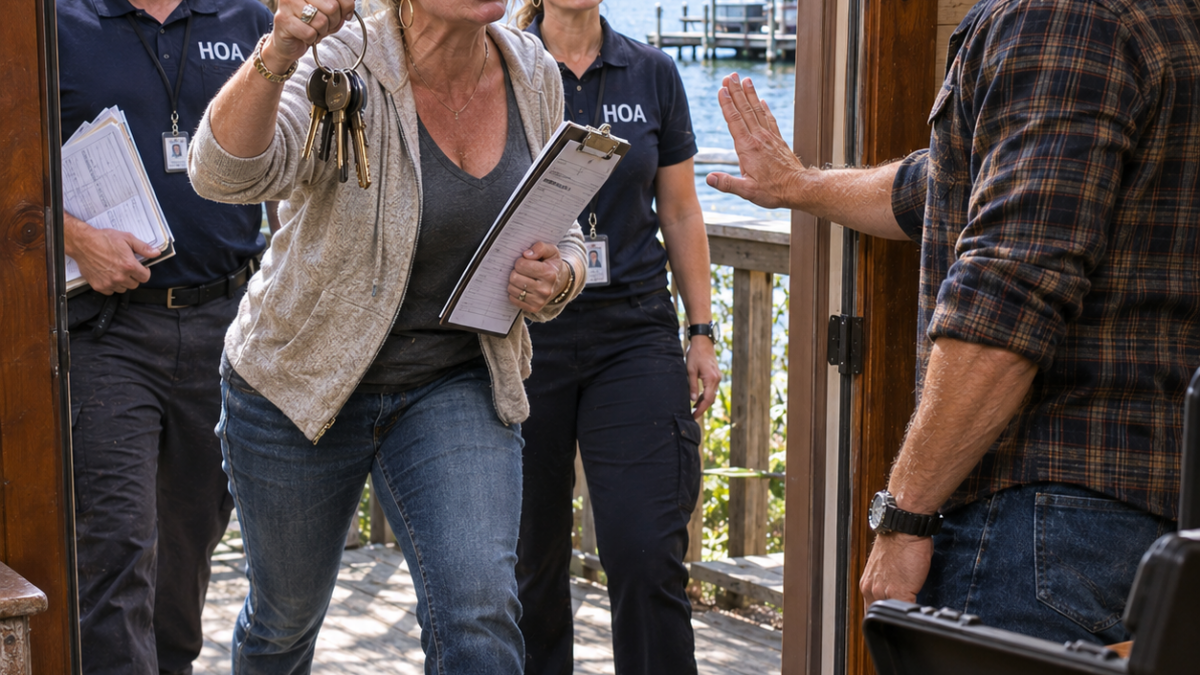
“MOVE ASIDE, MR. BROOKS—THE HOA HAS AUTHORITY TO ENTER THIS CABIN WHETHER YOU COOPERATE OR NOT!” Patricia Wells snapped at 8:07 on a Saturday morning as she stood on my porch with a ring of keys, two board members, and a private “community compliance” officer behind her.
I stayed inside my doorway and calmly told her to show me the exact rule allowing her to enter without permission, because my sixty-year-old lake cabin had never been subject to most of the interior inspection rules Patricia was waving around on her clipboard.
Then she reached across the threshold, yanked open a locked black case she had no right to touch, saw the gold letters FEDERAL BUREAU OF INVESTIGATION inside—and instead of staring at my badge, her eyes locked on the name of a company printed across a file beneath it.
For several seconds, nobody moved.
Patricia still had one hand on the case.
The private security contractor stepped backward.
Jennifer Collins, one of the HOA board members standing behind Patricia, covered her mouth.
Frank Miller, who had just arrived holding an emergency board resolution, stared at me.
Then at the credential wallet.
Then back at me.
“You’re FBI?”
“Not exactly the conversation we need to have right now.”
Patricia did not seem to hear either of us.
Her face had gone pale.
But she was not staring at the badge anymore.
She was staring at the top page inside the file.
HARTWELL SHORE SERVICES LLC.
I had brought that file home because I planned to return it to the office Monday morning.
The material inside was largely public corporate information from a financial fraud case I had been working.
At least, until that moment, I had believed the case had absolutely nothing to do with my lake cabin.
Patricia took one step backward.
Not confused.
Scared.
There is a difference.
I had spent enough years interviewing fraud suspects, witnesses, executives, public officials, accountants, contractors, and people who suddenly remembered very little when money disappeared to recognize it.
Fear is not proof.
But it is information.
Frank noticed too.
“Patricia?”
She turned.
Walked quickly down the porch steps.
Then almost ran toward the golf cart.
I called after her.
“Why do you know that company?”
She never answered.
The cart accelerated down my driveway.
Frank watched it disappear.
Then looked back at me.
“What the hell is Hartwell Shore Services?”
I looked at the file.
“Until thirty seconds ago, I thought it had nothing to do with Lakeside Pines.”
That turned out to be very wrong.
My name is Daniel Brooks.
PART2:
I was forty-one when I bought the Palmer cabin on Lake Hartwell in South Carolina.
I had spent most of my adult life living where work made sense.
Apartments.
Rental houses.
One townhouse beside a man who played drums at midnight.
After enough years of that, I wanted somewhere quiet.
Not impressive.
Quiet.
The cabin was perfect.
Two bedrooms.
One bathroom.
Stone fireplace.
Old pine floors.
Small kitchen.
Deck overlooking the lake.
Private dock.
Nothing luxurious.
That was exactly why I loved it.
The house had been built in 1964 by the Palmer family.
Lakeside Pines did not exist until 1991.
That detail mattered.
When the subdivision eventually grew around the old property, the Palmers did not place the entire parcel under the full HOA declaration.
Instead, they signed a limited road-and-services agreement.
The property paid for the private road.
Trash collection.
Certain emergency services.
PART3:
But many rules that applied to newer Lakeside Pines homes did not apply to the Palmer cabin.
My closing attorney, Rebecca Hayes, pointed this out before I bought.
“You have a strange parcel.”
“Good strange or bad strange?”
She smiled.
“Usually expensive strange.”
Then she explained.
“You participate in Lakeside Pines for limited services. Do not assume that means every HOA rule applies to you.”
I remembered that.
Partly because I am careful with documents by nature.
Partly because of my job.
I worked for the FBI.
Mostly financial fraud.
Public corruption.
Complex money trails.
Shell companies.
False invoices.
Fake authority.
People who discovered that enough official-looking paperwork could make an absurd claim appear legitimate long enough to move money.
Around Lakeside Pines, I did not advertise what I did.
When neighbors asked, I said I worked financial investigations for the Department of Justice.
That was true.
Most people assumed something administrative.
Frank Miller apparently told half the neighborhood I was some kind of government accountant.
I never corrected him.
Peace is valuable.
Frank lived east of me.
Retired high school principal.
Owned a fishing boat older than several people in my office.
On my second weekend at the cabin, he walked over carrying ribs.
“I’m not welcoming you.”
“No?”
“I cooked too much.”
“Understood.”
He stayed for two hours.
Across the road lived Susan Parker, a widow in her late sixties who walked a golden retriever named Charlie every morning.
Charlie discovered my porch during our first week.
Susan apologized.
“He likes your place.”
“Good taste.”
The neighborhood felt normal.
Then Patricia Wells arrived.
White golf cart.
Huge sunglasses.
Clipboard.
I was fixing a loose board on the dock.
Her first words were:
“That stain color isn’t approved.”
I looked down.
The board was brown.
The rest of the dock was brown.
“What color should brown be?”
She did not appreciate that.
“I’m Patricia Wells. HOA president.”
“Daniel.”
“I know.”
That answer caught my attention.
We had never met.
But property records are public.
Nothing strange about knowing the new owner’s name.
She gave me the exterior standards.
I read the paragraph she had circled.
Then showed her the sentence above it.
“Applies to structures built under Lakeside Pines architectural control.”
“Yes.”
“My dock predates Lakeside Pines.”
She paused.
“We’ll verify.”
“Sounds good.”
Two days later:
Unauthorized dock refinishing.
$250.
Rebecca sent one letter.
Fine disappeared.
No apology.
Fine by me.
I did not buy a lake cabin because I wanted to fight an HOA.
My job had enough conflict.
At home I wanted coffee.
Fishing.
Quiet.
Instead I started receiving notices.
Security camera facing a community road.
Cancelled.
Truck parked overnight in my driveway.
Cancelled.
Commercial equipment stored in a vehicle.
That last one made me more cautious.
The “commercial equipment” was a locked hard case sitting in the back of my SUV.
Federal equipment.
Nothing classified.
Nothing dangerous lying around.
Still nothing an HOA president needed to know about.
Then Patricia’s questions became stranger.
Who slept overnight at my cabin?
None of her business.
Alarm company information?
No.
Access to my utility closet?
Why?
“Emergency mapping.”
“What utility are you inspecting?”
No answer.
Then Frank said something while we were fishing one afternoon.
“Patricia’s been asking about your water line.”
I stopped tying my lure.
“What water line?”
“She thinks the Palmer cabin still has an old lake pump.”
Behind my house sat an old concrete utility box.
Rusted pump.
Capped pipe.
Home inspector said abandoned.
Frank said decades earlier, before public water reached that part of the lake, some cabins pumped lake water for irrigation.
That made sense.
But why did Patricia care?
Rebecca searched old records.
The Palmers once had a lawful lake-water withdrawal permit.
Expired long ago.
Then she found an old easement along the western edge of my lot.
Beneficiary:
Hartwell Shore Services Cooperative.
Not LLC.
Cooperative.
It dissolved in 1988.
Three years before Lakeside Pines existed.
Probably meaningless.
Still, the name would matter later.
Then came a notice announcing:
ROUTINE INFRASTRUCTURE INSPECTION.
Every property supposedly receiving a utility compliance check.
I asked Frank.
He had no notice.
Susan?
No.
Three other neighbors?
Nothing.
Only me.
Rebecca wrote Patricia.
Please identify the covenant authorizing interior inspection of the Palmer parcel.
Patricia replied with a general clause about common service connections.
Rebecca wrote back:
Please identify the common service connection at issue.
No response.
Then I found fresh work-boot prints behind the cabin.
They led to the old concrete pump box.
The metal lid was open.
I had left it closed.
Nothing damaged.
So I installed a second camera facing the rear of the property.
Two mornings later, it recorded Robert Hayes.
Lakeside Pines maintenance contractor.
He walked onto my property at 6:20.
Opened the box.
Photographed the pipes.
Left.
I called him.
Robert sounded embarrassed.
“Patricia told me it was HOA equipment.”
“It’s on my deeded lot.”
“I didn’t know.”
“What were you photographing?”
“Old connections.”
“Why?”
“She said the board needed to know whether they were active.”
I told him not to return without permission.
He apologized.
Then said:
“I thought your place had already been inspected.”
I stopped.
“What do you mean?”
“She said somebody checked the inside last month.”
Nobody had.
I checked doors.
Windows.
Locks.
Nothing obviously disturbed.
Maybe Patricia meant some inspection before I purchased.
Maybe Robert misunderstood.
Still, I replaced every exterior lock.
Susan noticed.
“Trouble?”
“Improving things.”
She looked at the old deadbolt.
“That lock was fine.”
I laughed.
“Retired principal next door. Detective across the street. I’m surrounded.”
Then she became serious.
“Patricia gets scared when she thinks something could hurt the neighborhood.”
“I understand.”
That was true.
Fear can make controlling people feel responsible.
Fire.
Storms.
Crime.
Property values.
Lawsuits.
Sometimes fear dresses itself up as authority.
Understanding that does not mean accepting whatever comes next.
Susan lowered her voice.
“She thinks there’s an illegal pipe under your cabin.”
I stared.
“What?”
“She mentioned it at a board meeting.”
Frank had handwritten notes.
He brought them that night.
Patricia had told the board there was reason to believe the Palmer cabin contained a “historic utility control point” affecting Lakeside Pines.
She requested authority for inspection.
The board voted.
Four to three.
Against her.
The inspection was denied.
I looked at Frank.
“Then why am I still getting inspection notices?”
He looked embarrassed.
“I don’t know.”
That mattered more than the original utility theory.
Patricia had asked.
The board said no.
Then she acted anyway.
I had seen that pattern in federal cases.
Documents later.
Authority now.
Still, I refused to turn every annoying neighborhood dispute into an FBI investigation.
My job did not give me special rights over Patricia.
So I handled it like a homeowner.
Saved notices.
Saved camera footage.
Documented contacts.
Let Rebecca send letters.
Then I left town for six days on a fraud case.
When I returned, my cameras showed Patricia had visited three times.
Once alone.
Once with Robert.
Once with another man.
That man photographed my foundation.
Then pointed toward the crawl-space vent.
Rebecca sent a formal no-trespass notice.
No entry without written permission or a true emergency.
Patricia’s reply:
HOA RIGHTS ARE RESERVED.
Two quiet weeks passed.
Fishing.
Work.
Steaks on Friday.
Then certified mail arrived.
Saturday.
8 a.m.
Interior access required.
Refusal could result in emergency entry.
Rebecca called Patricia’s attorney.
He sounded confused.
He had not authorized the letter.
That was the first warning that even the HOA’s legal counsel might not know what Patricia was doing.
Saturday morning came.
Lake flat as glass.
Coffee in my hand.
7:58.
White golf cart.
Patricia.
Jennifer Collins.
Another board member.
David Ross from Blue Ridge Community Security.
They walked up my porch.
Patricia slapped her clipboard against the door.
“Routine property check.”
I stayed inside.
“You have authority to do what?”
“Inspect the cabin, deck, plumbing, electrical panel, storage areas, dock equipment and any unapproved changes.”
“Show me the rule.”
“I don’t have to educate every homeowner individually.”
“That wasn’t my question.”
Then she stepped closer.
I put one hand against the doorframe.
“Do not enter.”
David Ross said:
“Sir, calm down.”
I almost laughed.
“I am calm.”
Patricia raised a ring of keys.
“You signed the community declaration. Lakeside Pines retains inspection rights.”
“No, it doesn’t.”
“You can cooperate or I can document refusal and authorize emergency access.”
“What emergency?”
“Possible unauthorized water connection.”
That caught my attention.
The old pipe.
The concrete box.
The board vote.
The crawl space.
Someone wanted inside badly.
Then David Ross saw the black federal case under my side table.
“What’s in that?”
“None of your business.”
Patricia leaned sideways.
“Open it.”
“No.”
“This is why we conduct inspections.”
“No, Patricia. This is exactly why you don’t enter someone’s house without authority.”
Jennifer said quietly:
“Patricia, maybe we should give him the notice and leave.”
Patricia ignored her.
She pulled out a folded paper.
LAKESIDE PINES UTILITY SAFETY AUTHORIZATION.
It contained what appeared to be the signature of county utility supervisor James Walker.
I knew James.
I had spoken with him two days earlier.
No county inspection scheduled.
No emergency order.
No request.
I looked at Patricia.
“Where did you get this?”
“It was provided to the board.”
“By whom?”
“Move aside.”
“No.”
David Ross reached for his radio.
I asked him:
“Were you told there was a court order?”
He looked toward Patricia.
That was enough.
Then Patricia tried one key in my new deadbolt.
Didn’t fit.
“You changed the lock.”
“Yes.”
“The HOA must maintain emergency access.”
“No.”
Then she pulled out another key.
Newer.
Freshly cut.
I stared.
“How did you get that?”
No answer.
Then Frank’s truck came flying down my driveway.
Stopped crooked.
He climbed out carrying a folder.
“Stop.”
Patricia turned.
“What are you doing here?”
“Stopping you from making this worse.”
He handed Jennifer a resolution.
Friday night, four directors learned Patricia intended to conduct the inspection without approval from HOA counsel.
They held an emergency vote.
Effective midnight:
Patricia’s authority to conduct the inspection was suspended.
No board approval.
No attorney approval.
No emergency authority.
Nothing.
Patricia read it.
Then tore it in half.
Jennifer stared at her.
Frank said:
“That doesn’t cancel the vote.”
Patricia looked at me.
“You are hiding something under this cabin.”
“Then get a lawful order.”
“I don’t need one.”
“Yes, you do.”
She stepped forward.
One foot crossed the threshold.
I shifted sideways.
Did not touch her.
“Out.”
David Ross said:
“Ma’am, we should leave.”
Finally.
Patricia pointed at the black case.
“That stays.”
“No.”
“It may contain unauthorized utility equipment.”
“It doesn’t.”
“Then open it.”
“No.”
She reached.
Grabbed the handle.
I grabbed it too.
“Take your hand off it.”
She pulled.
The case slid across the floor.
Hit the baseboard.
One latch popped.
The lid opened.
Two inches.
Enough.
Credential wallet.
Gold letters.
FEDERAL BUREAU OF INVESTIGATION.
Silence.
Frank:
“You’re not an accountant?”
“Not exactly.”
Jennifer covered her mouth.
David Ross immediately stepped off my porch.
Patricia froze.
Then saw Hartwell Shore Services LLC on the top page.
And ran.
That was when the story changed.
The first thing I did was call my supervisor.
Michael Grant.
I explained everything.
HOA.
Inspection.
Black case.
Company name.
Patricia’s reaction.
Michael did not sound excited.
Good supervisors rarely do.
He asked:
“Have you used Bureau systems to investigate your HOA?”
“No.”
“Run Patricia?”
“No.”
“Search Lakeside Pines?”
“No.”
“Good.”
Then instructions.
Do nothing in my official capacity.
Do not question Patricia as an agent.
Do not access the Hartwell Shore Services case until conflict review.
If anything happened at my property, call local authorities first.
A badge does not give you permission to convert a personal dispute into a federal case.
That separation protected everyone.
Including me.
Frank expected something different.
“So you’re going to arrest Patricia?”
“No.”
His face fell.
“No?”
“For what?”
“She tried to enter your house.”
“Local issue.”
“She grabbed an FBI case.”
“She didn’t know what it was.”
“She recognized the company.”
“Still not evidence.”
Frank looked disappointed.
Television had damaged expectations.
Real cases move slower because they have to survive courts.
Jennifer apologized.
“I thought we were inspecting an exterior pipe.”
“I believe you.”
“She said the county requested it.”
“I know.”
“I should’ve asked to see the request.”
“Yes.”
She looked surprised.
Kindness is not pretending every mistake is harmless.
Jennifer made one.
She also challenged Patricia.
That mattered.
David Ross gave me his card.
He had been hired for presence and documentation.
Not forced entry.
Once Patricia crossed my threshold, he wanted out.
Reasonable.
Then Frank asked:
“What is Hartwell Shore Services?”
I could only tell him public information.
Private contractor.
Shoreline stabilization.
Boat access.
Utility work.
Erosion repair.
One of several companies appearing in financial records already under federal review.
That did not make the company guilty.
Frank went quiet.
Then:
“Lakeside Pines has paid them.”
My attention sharpened.
“How much?”
“I don’t know.”
“You’re treasurer.”
“I became treasurer three years ago.”
“Recent payments?”
“I think so.”
I immediately told him not to give me HOA financial records.
Now there was potential overlap with my work.
I needed a clean line.
Frank contacted Lakeside Pines’ attorney, Laura Bennett.
Laura’s first instruction:
Preserve everything.
Emails.
Invoices.
Minutes.
Contracts.
Security footage.
Utility maps.
No deletion.
No shredding.
No editing.
Do not bring anything to me.
Perfect.
If federal investigators needed records, they would request them properly.
By noon, my porch was empty.
I moved federal equipment somewhere secure.
Then made lunch.
Turkey sandwich.
Chips.
Coffee.
Normal routine.
When your brain starts turning every new fact into a conspiracy, ordinary things help.
Then Susan called.
“Are you really FBI?”
“Apparently Frank is terrible at secrets.”
“I knew you weren’t an accountant.”
“Frank thought I was.”
“Frank thinks catfish predict rain.”
Fair.
Then she said:
“Patricia is telling people you threatened her with your badge.”
I sat up.
“I never showed it.”
“That’s not her version.”
According to Patricia, she conducted a lawful inspection and I used federal status to intimidate the HOA.
The porch camera recorded most of the encounter.
Frank’s board resolution existed.
Jennifer witnessed it.
David Ross knew what he had been hired to do.
Documents beat shouting.
Lakeside Pines sent a calm official message.
No authorized interior inspection had occurred.
Patricia’s inspection authority had been suspended.
Matter under review.
Residents asked not to speculate.
Then Patricia disappeared for the weekend.
Maybe she fled.
Maybe she stayed with family.
No assumptions.
My office formally removed me from any federal work involving Hartwell Shore Services.
Agent Thomas Walker took over.
Careful.
Patient.
Annoyingly thorough.
Perfect.
Then Rebecca came to my cabin with something from the old Palmer documents.
Hartwell Shore Services Cooperative.
The dissolved 1970s organization.
It once operated shared lake-water irrigation pumps and a small fire-water system before public utility service reached the neighborhood.
My cabin had been one of the control properties.
Rebecca pointed at a faded map.
“There was once a main manifold here.”
“Beside the cabin?”
“Under it.”
The original cabin had been expanded in 1983.
The utility chamber might now sit beneath the addition.
We checked the crawl space.
Dust.
Insulation.
Spiders.
Then beneath plastic sheeting:
A separate concrete slab.
Four by six feet.
Rusted metal hatch.
We did not open it.
Not yet.
If abandoned cooperative equipment remained, ownership could be complicated.
Rebecca contacted the county.
James Walker arrived Monday morning.
First, I showed him Patricia’s “county” authorization.
He looked at the signature.
“That isn’t mine.”
“Looks like yours.”
“It was copied.”
He found a legitimate inspection letter from two years earlier.
Same signature image.
Pixel-for-pixel.
Someone had lifted James Walker’s signature from an older public document.
Then we showed him the hatch.
“Old Lakewood manifold.”
“Active?”
“Shouldn’t be.”
There are few words more troubling than “shouldn’t” when dealing with infrastructure.
We opened it.
Cold damp air.
Six-foot ladder.
James climbed down.
I followed.
Two old steel pipes.
Three corroded valve wheels.
Dead gauge.
Then he shined the flashlight at the back wall.
New white PVC.
Digital flow meter.
Active.
Vibrating.
Water moving through a utility chamber hidden below my cabin.
The line disappeared toward Lakeside Pines.
Another branch toward the lake.
James climbed out and called the county.
Frank arrived holding an old maintenance map found in Patricia’s locked HOA cabinet.
Five years old.
My cabin marked.
Hidden chamber.
Lines connecting to:
Clubhouse.
Maintenance building.
A lakefront property owned by Hartwell Shore Services LLC.
Then invoices.
$68,400.
$42,600.
$31,900.
LEGACY WATER INFRASTRUCTURE REHABILITATION.
Approved by Patricia.
More than $140,000.
Charged to emergency reserves.
No full-board approval Frank could find.
County crews traced the line.
One branch supplied an irrigation reservoir near the clubhouse.
Fine.
One went toward the Hartwell Shore Services property.
Another toward the lake.
The flow direction showed water being pumped from Lake Hartwell inland.
No valid withdrawal permit linked to my property.
No current authorization.
County crews found a modern pump controller inside Lakeside Pines’ maintenance building.
Installed five years earlier.
Contractor:
Hartwell Shore Services LLC.
Patricia had been right about one thing.
There really was an old utility system beneath my cabin.
But she had apparently known because someone had secretly rebuilt it.
And that explained why she wanted control of my house.
If I renovated the floor, I might discover the chamber.
If county officials inspected, they would see new equipment.
If I closed the line, whatever Hartwell Shore Services depended on could stop.
Then someone broke into the HOA records room.
Cabinets opened.
Hartwell Shore Services contracts missing.
Security system manually disabled.
Recorder hard drive removed.
Jennifer noticed Patricia’s master key was still missing.
Possible connection.
Not proof.
A muddy boot print near the rear door suggested a man had entered.
Again:
Evidence first.
Thomas Walker called.
“Stay away from Hartwell Shore Services.”
“I have.”
“Good.”
“Why?”
“Can’t discuss it.”
That night I checked the crawl-space camera I had installed after Patricia’s repeated visits.
3:41 p.m.
Movement.
A man crawled beneath my house.
Black cap.
Gloves.
He went directly to the hidden hatch.
Seven minutes later he emerged carrying a small metal box.
Then turned toward the camera.
Face visible.
Robert Hayes.
Patricia’s maintenance contractor.
The same man who had photographed the old pump box.
Sheriff went to his house.
Empty.
Hartwell Shore Services yard.
Locked.
Truck missing.
Then smoke rose south of the neighborhood.
Hartwell Shore Services boat yard.
Fire.
Sirens.
Then the hidden pump beneath my cabin started.
Loud enough that I felt vibration through the floor.
Rebecca was with me.
“What is that?”
“The old system.”
County officials had shut the controller down earlier.
Yet now water was moving fast through the underground line.
James called.
“Get away from the crawl space.”
“What happened?”
“Somebody remotely opened the old lake intake.”
“Why?”
“Flow is heading south.”
Toward the burning Hartwell Shore Services yard.
At first that almost sounded useful.
Water to a fire.
Then James shouted to someone beside him.
His voice changed.
“That line doesn’t connect to the fire system.”
“Where does it go?”
“Buried storage tank at Hartwell Shore Services.”
“What’s in it?”
“We don’t know.”
Then a deep boom rolled across the lake.
Orange light above the trees.
Windows rattled.
The pipe under my floor began groaning.
Kitchen floor jolted.
Crack beside the baseboard.
Water sprayed through.
James told me the only accessible manual valve was in the underground chamber.
Thomas Walker had already told me not to enter it.
Every instinct said:
Go shut it.
Training said:
Do not create a second emergency because you want to feel useful.
I grabbed Rebecca.
Moved outside.
Called 911.
Fire department arrived.
County utility crews.
Sheriff.
Power disconnected.
Only then did James and firefighters enter the crawl space.
Pressure was not coming from my normal water service.
It came from the old lake intake.
It took forty minutes to isolate it near the shore.
Forty minutes while Hartwell Shore Services burned.
Several nearby homes evacuated.
Then the vibration beneath my cabin stopped.
Instantly.
Silence.
No one hurt.
Cabin still standing.
That mattered.
The kitchen floor had lifted.
Water damage.
Foundation needed inspection.
But compared with what might have happened, I had been lucky.
Frank offered his guest room.
I accepted.
“Coffee?”
“Yes.”
“Then yes.”
Sometimes kindness means accepting help instead of pretending you don’t need it.
Next morning, county officials explained what they knew.
The hidden line had been used to flush a buried tank at Hartwell Shore Services.
Water entered the tank.
Whatever liquid had been inside was pushed toward a drainage collection system.
Fire happened almost simultaneously.
Timing mattered.
It did not prove causation.
Robert Hayes’s truck was found abandoned fifteen miles away.
No Robert.
That worried me.
He might be running.
Might be hiding.
Might be hurt.
The small metal box he removed had a faded label.
FLOW CONTROL.
James thought it might once have housed old relay controls.
But if Robert removed the control box, why had the pump later activated remotely?
That suggested another controller.
Maybe Hartwell Shore Services.
Maybe Lakeside Pines.
Maybe both.
Then the neighborhood meeting exploded.
Residents wanted answers.
Unauthorized inspection.
Fake county authorization.
Hidden pipe.
Burglary.
Fire.
Federal presence.
One man shouted:
“What about the FBI?”
Everyone looked at me.
“My job is not part of this HOA meeting.”
“Are we under federal investigation?”
“I can’t answer that.”
Noise.
Laura Bennett stepped in.
“The HOA is cooperating with all lawful requests. Cooperation does not mean guilt.”
Good answer.
Then Susan asked the right question.
“Why was Patricia so desperate to get into Daniel’s cabin?”
Jennifer provided part of it.
Five years earlier, Hartwell Shore Services proposed rehabilitating the old lake system.
Jennifer remembered asking whether they needed permission from Margaret Palmer, the previous owner.
Patricia said no.
Claimed the old cooperative easement still gave the HOA access.
It did not.
The board never approved entry into Margaret’s house.
Hartwell Shore Services said they could work around it.
Margaret Palmer was still alive.
Eighty-six.
Assisted living near Greenville.
Rebecca contacted her niece first.
We did not show up unannounced.
Margaret agreed to talk.
First thing she asked:
“You bought my cabin?”
“Yes, ma’am.”
“Roof still leak?”
“No.”
“Good.”
Then Rebecca asked whether Lakeside Pines had permission to install modern utility equipment beneath the cabin five years earlier.
Margaret stared.
“What modern equipment?”
That answered a lot.
She remembered the old chamber.
Her father used it decades earlier.
By the 1990s it was abandoned.
Then Patricia began visiting.
Routine inspection.
Safety check.
Emergency access.
Same words she later used with me.
Margaret never allowed anyone inside.
One winter she spent six weeks recovering from surgery with her niece.
When she came home, the crawl-space door looked different.
New screws.
New padlock.
She assumed someone had repaired it.
Nobody told her about pipe work.
“Why didn’t you complain?”
Margaret looked at us.
“I was old and tired.”
That sentence stayed with me.
People often interpret silence as agreement.
Sometimes silence means someone is exhausted.
Margaret had received $2,000 from Lakeside Pines for “temporary property inconvenience.”
Her niece kept the paperwork.
Temporary access consent.
Fifteen feet along the rear lot.
Drainage inspection only.
No crawl space.
No interior.
No utility chamber.
Limited permission had apparently become something much larger.
Then Margaret remembered Patricia being unusually worried about the old valve.
“She said if it was ever shut, Lakeside Pines could lose something valuable.”
Valuable.
Not safe.
Not necessary.
Valuable.
Thomas later shared one narrow fact because it affected my property.
Federal investigators had obtained Hartwell Shore Services banking records.
The company received millions over several years from various construction, maintenance, boat-storage and cleanup entities.
Again:
Money itself is not criminal.
But one category stood out.
WATER RECOVERY FEES.
Old cooperative records showed the system once did two things.
Pulled lake water for irrigation.
And returned filtered wash water from boat areas through a settling system.
That second function should have died decades ago.
If someone revived it, the line under my cabin could move dirty water out as well as clean water in.
Now the hidden system looked different.
Then investigators identified residue in the buried Hartwell Shore Services tank.
Petroleum.
Cleaning chemicals.
Common industrial waste.
Still regulated.
They needed to determine whether waste had been routed through the old cooperative return system.
Potentially toward Lake Hartwell.
Public lake-water testing remained within safety limits.
That was critical.
But the shoreline soil near an old settling basin showed contamination requiring cleanup.
Then Robert Hayes came back.
Not to the neighborhood.
To the sheriff.
With an attorney.
Alive.
Unhurt.
Good.
He said Patricia had ordered him to remove the metal box because she claimed the county was going to seize it and it belonged to Hartwell Shore Services.
He panicked after realizing my camera caught him.
Someone from Hartwell Shore Services picked him up.
Then Robert admitted helping install the modern hidden line years earlier.
He said it had not been installed for fire protection.
Not really irrigation.
Those were cover explanations.
Hartwell Shore Services used the system to draw lake water into its facility, wash boats and equipment, collect contaminated wastewater, then move some of that water back through the old buried cooperative system into a settling area.
No proper permit for that route.
Why would Patricia help?
“Because Lakeside Pines got paid.”
Frank knew about some vendor payments.
Robert said there were more.
A separate account.
“Lake Improvement Reserve.”
Controlled by Patricia.
Not only Patricia.
One former board member.
One former property manager.
One county contractor.
Not employee.
Contractor.
Federal agents eventually served warrants on Hartwell Shore Services.
Not because I complained.
Because the existing case independently developed probable cause.
That distinction mattered deeply to me.
I did not participate.
Local investigators served separate warrants tied to the burglary and fake county authorization.
Patricia returned home.
No chase.
No dramatic arrest on the lawn.
Investigators carried boxes.
Phones.
Files.
Computers.
Reality is often paperwork.
Then an old wall safe in the HOA storage room changed everything.
Bank statements.
Cash receipts.
Backup drives.
Folder:
LAKE RESERVE.
More than $620,000 in Hartwell Shore Services payments over five years.
Some money had funded legitimate Lakeside Pines improvements.
Dock repairs.
Storm cleanup.
Landscaping.
Shoreline stabilization.
That explained why residents had never seen obvious missing money.
Some of it benefited them.
That is one reason bad systems survive.
People see results.
Nobody asks where the money came from.
Other withdrawals had no legitimate neighborhood purpose.
Consulting.
Travel.
Cash reimbursements.
Payments to private businesses.
Then Frank found:
$86,000.
PALMER PROPERTY ACQUISITION FUND.
My cabin.
Years before I bought it, Patricia had tried to purchase Margaret Palmer’s property.
Offer:
$90,000.
Far below market value.
Margaret refused.
Then the hidden pipe was built anyway.
My cabin had never been about the view.
The chamber under it controlled the system.
Owning the cabin solved every problem.
No old owner.
No risk of discovery.
No need for copied access rights.
Then Rebecca found a proposed easement.
If Margaret sold, Lakeside Pines would grant Hartwell Shore Services permanent chamber access.
In return:
$175,000 upfront plus annual fees.
Margaret never signed.
Yet Hartwell Shore Services paid $175,000 anyway.
Not to the HOA’s regular account.
To the Lake Reserve account.
Federal investigators found a “signed” easement.
Margaret denied signing it.
Document examiner compared the signature to her real temporary drainage consent.
Exact match.
Copied.
Again.
Limited cooperation transformed into permanent authority through forged paperwork.
Then another crisis hit before the first one had even fully settled.
Trucks appeared near an old service dock.
No logos.
Reflective vests.
Someone remotely activated the clubhouse irrigation pond.
County pressure monitors beneath my cabin began rising.
But the main lake intake had been physically isolated.
James called.
“We missed another line.”
A second old pipe.
Not on the standard cooperative map.
It ran north.
Toward the Lakeside Pines dam.
The neighborhood had a small earthen stormwater lake near the entrance.
Nothing enormous.
Large enough to flood the lower road if it failed.
Water level started rising.
Fast.
No rain.
No storm.
Then water began leaking through the base of the dam.
County sirens.
Residents ordered uphill.
Frank stared.
“Someone is pumping lake water into the dam.”
Then Thomas called.
They had identified one utility truck.
Registered owner:
Lakeside Pines Development Corporation.
Original developer.
Supposedly dissolved twenty years earlier.
Frank went pale.
“My father worked for them.”
“What did he do?”
“Bookkeeper.”
Then part of the dam collapsed.
Mud.
Stone.
Dark water.
Lower entrance road flooded.
Two garages took water.
Several vehicles damaged.
Maintenance shed moved off its foundation.
No deaths.
No trapped families.
That mattered more than anything.
Firefighters went door-to-door.
Residents helped older neighbors.
People grabbed pets.
Susan passed out water.
Jennifer accounted for households.
Nobody cared about dock-stain colors.
That is what real community looks like.
County crews closed the secondary intake.
The dam stabilized behind temporary rock barriers.
The two utility-truck drivers claimed they had been hired to test “legacy water infrastructure.”
They said they did not know the pipe fed the dam.
Possible.
Again:
The question was not who wore a reflective vest.
The question was who ordered the work.
Investigators discovered Lakeside Pines Development Corporation had not truly disappeared.
Administratively dissolved.
Then reinstated three years earlier.
New manager:
Richard Wells.
Patricia’s husband.
Richard had barely appeared during the HOA conflict.
He traveled frequently for construction consulting.
Rarely attended meetings.
Now the original developer’s revived company sat inside a federal financial investigation.
My supervisor called.
“Daniel, stay completely out.”
“I know.”
“Do not interview Frank’s father.”
That surprised me.
“You know about George?”
“We do now.”
Click.
So I stayed in my lane.
Frank did not enjoy waiting.
George Miller eventually called his son anyway.
Asked one question.
“Did they find the reserve account?”
Frank froze.
“What reserve account?”
George told him to come over.
I refused to go.
“Take Laura.”
Frank and the HOA attorney visited George.
Everything he said later went properly to investigators.
The broad story eventually became public through court records.
Back in the 1980s, Lakeside Pines Development Corporation wanted full control over water and shoreline access.
The Palmer family’s cabin sat over a critical control chamber.
They refused to sell.
Temporary operating agreements were signed around the property.
Then public utility service arrived.
Old system should have been abandoned.
One original development executive believed the hidden network could still be useful for future commercial projects.
Detailed maps were kept outside county records.
Years passed.
Company dissolved.
Records scattered.
Then Patricia married Richard Wells.
Richard once worked with a company that bought leftover assets from failed or dissolved developers.
Through a storage auction involving an original developer’s closed office, he acquired boxes of Lakeside Pines records.
Old contracts.
Ledgers.
Maps.
Utility diagrams.
He found the forgotten water network.
Then the Palmer chamber.
That was where the modern plan began.
Hartwell Shore Services LLC was formed later under different ownership.
Richard had consulting ties to it.
The modern company deliberately used a name almost identical to the defunct cooperative.
Hartwell Shore Services Cooperative.
Hartwell Shore Services LLC.
People assumed continuity.
There was none.
That confusion helped disguise the new operation as something old and legitimate.
The secret Lake Reserve account helped too.
Money from Hartwell Shore Services paid for real improvements.
Dock repairs.
Storm cleanup.
Landscaping.
Patricia looked effective.
Residents benefited.
Nobody asked many questions.
In a narrow sense, Patricia could tell herself she was helping Lakeside Pines.
But the money came from access residents had never knowingly approved.
Access built on false documents.
Copied signatures.
Unauthorized entry.
Hidden infrastructure.
That is not community improvement.
That is using a community as cover.
Then the reason Patricia wanted the Palmer cabin became obvious.
Owning the property eliminated the risk.
Margaret refused.
So the hidden system continued beneath her.
When I bought the cabin, Patricia probably assumed I could be pressured.
Violation notices.
Routine inspections.
Emergency language.
Keys.
Compliance contractor.
She had no idea I worked for the FBI.
That remains the funniest part.
Not because being FBI made me stronger.
Because it made me more cautious.
I knew how badly an investigation could be damaged if I crossed lines.
So I did not.
Weeks became months.
The dam was repaired.
The secondary intake permanently sealed.
The industrial line beneath my cabin disconnected.
The underground chamber remained physically there but inactive.
Rebecca recorded a notice against the property title.
No utility access without written owner permission or lawful emergency authority.
No inherited inspection claim.
No secret master key.
The old equipment was formally abandoned.
Simple language.
Clear boundaries.
My cabin was repaired.
Foundation strengthened.
New kitchen floor.
Crawl-space door replaced with steel.
Frank said:
“Your crawl space is now more secure than the clubhouse.”
“Probably.”
Lakeside Pines offered to remove my parcel entirely from the limited service agreement.
I declined.
“You don’t hate us?” Frank asked.
“I hate bad paperwork.”
“That sounds healthier.”
We rewrote the limited agreement instead.
Road.
Trash.
True emergency access where law required.
Nothing more.
No interior inspection rights.
No utility entry.
No master keys.
No surprise checks.
Susan celebrated by bringing pie.
Two pies.
Criminal cases moved much slower.
Robert Hayes cooperated.
He admitted removing the control box under Patricia’s direction.
He admitted helping install parts of the hidden system years earlier.
He claimed he believed permissions were valid.
Investigators treated that differently from people who knew the signatures were false.
David Ross, the private security contractor, had no role beyond the attempted inspection.
Jennifer had no criminal involvement.
Frank had none.
Several maintenance workers simply followed ordinary work orders.
That mattered.
Not everybody connected to a bad system carries the same guilt.
Patricia was eventually charged in connection with false documents, hidden HOA financial activity, and actions investigators said helped conceal unauthorized access to the Palmer property.
Richard faced broader federal financial and environmental allegations involving the revived developer company, Hartwell Shore Services contracts, secret payments, and the hidden industrial water system.
Hartwell Shore Services managers faced separate proceedings.
Nobody was guilty because I was FBI.
My badge decided nothing.
Evidence did.
Emails.
Bank records.
Copied signatures.
Invoices.
Utility maps.
Witnesses.
Environmental samples.
Property records.
That is how it should work.
The environmental case produced the largest financial consequences.
Investigators concluded the hidden network had been used for years to move wastewater containing petroleum residue and cleaning chemicals into an old settling area that was not properly permitted.
Lake-water testing remained within public safety standards.
Huge relief.
The shoreline soil required cleanup.
Hartwell Shore Services and its insurers paid most of the cost.
Lakeside Pines contributed because some HOA infrastructure had been used.
But ordinary homeowners were not crushed financially.
Courts and insurers distinguished residents from the people controlling the operation.
Again:
Important.
The Lake Reserve account was dissolved.
Improperly sourced funds were redirected toward restitution, cleanup, and restored HOA reserves.
Frank insisted every statement be published.
Every payment.
Every recovery.
“No more mystery money.”
Residents agreed.
HOA financial rules changed.
No single officer could approve large vendor payments.
Related-party contracts required full disclosure.
Utility work required real maps.
Real permits.
Emergency entry required an actual emergency.
Master keys inventoried.
Private homes could not be entered without consent, court authority, or immediate danger.
The rules were boring.
That was good.
Boring rules often protect people best.
Frank eventually became president.
He hated it.
Which made him a reasonable choice.
Jennifer became vice president.
Susan refused every position offered.
“I prefer pie.”
Smartest person in Lakeside Pines.
Margaret Palmer received a formal apology.
Frank visited her.
The HOA compensated her for the way her temporary-access permission had been abused.
Margaret did not ask for millions.
She asked for one thing.
A letter stating clearly that she never approved reconstruction of the hidden utility system.
She received it.
I visited too.
She asked:
“Roof still leak?”
“No.”
“Crawl space?”
“Complicated.”
She laughed.
Then said something I never forgot.
“People get bold when they think you’re tired.”
She had been tired.
Older.
Recovering from surgery.
Patricia and others had counted on her not pushing back.
I became angry for her.
Margaret saw it.
“Don’t waste too much time being mad for me.”
I looked at her.
She smiled.
“I’m still here.”
That was a lesson too.
Sometimes defending someone becomes another way of making their pain belong to you.
Margaret wanted respect.
Not endless outrage.
She had respect now.
A year later, life around Lakeside Pines felt almost normal.
Frank still asked terrible fishing questions.
Susan still let Charlie wander onto my porch.
Jennifer once told me she needed to inspect my refrigerator for HOA-approved leftovers.
I said:
“I’ll call Washington.”
She laughed.
Patricia’s name came up less.
That helped.
She had already controlled enough conversations.
One afternoon, a new homeowner stopped me near the boat ramp.
“I heard the old HOA president tried to break into an FBI agent’s house.”
“That’s not exactly what happened.”
“But you are FBI?”
“Yes.”
“She didn’t know?”
“No.”
He laughed.
“Must’ve been amazing when you flashed the badge.”
“I didn’t.”
His face fell.
“What?”
“She found it because she grabbed a case she had no right to touch.”
“That’s less cinematic.”
“Reality usually is.”
The truth was better anyway.
I never needed the badge.
That was the biggest misconception people had about the story.
Patricia had a title.
President.
Clipboard.
Keys.
Compliance contractor.
Notices.
Board language.
For years, that was enough to make people move aside.
But titles do not create rights.
Neither do badges.
My FBI credentials did not make me more entitled to privacy than Margaret Palmer had been.
Or Frank.
Or Susan.
Or any homeowner.
My deed gave me property rights.
My limited HOA agreement defined the association’s authority.
The law defined everyone else’s boundaries.
That was enough.
People later asked whether I used federal connections to destroy Lakeside Pines.
No.
I worked hard not to.
The HOA survived.
It actually improved.
Hidden contracts disappeared.
The dam was repaired.
The illegal system removed.
The shoreline cleaned.
Financial controls strengthened.
Residents started reading documents before approving things.
I still paid the same road and trash assessment.
Frank reminded me every year.
“Federal agents still owe HOA dues.”
“Limited assessment.”
“Money is money.”
He was right.
The last strange piece came when county workers removed the final modern pipe from beneath my cabin.
Behind it, they found the original brass valve plate from the 1970s.
Heavy.
Tarnished.
Stamped:
HARTWELL SHORE SERVICES COOPERATIVE.
James Walker asked if I wanted it.
I did.
Cleaned it.
Hung it inside the cabin.
Not as a trophy.
As a reminder.
The old cooperative had been created for a good reason.
Neighbors needed water.
Fire protection.
Irrigation.
People worked together.
Decades later, somebody reused that old trust for something secret.
Cooperation had never been the problem.
Secrecy was.
One summer evening, Frank and I sat on my deck watching the sun drop behind Lake Hartwell.
He handed me a beer.
“So when Patricia first came up here, what were you thinking?”
“That I wanted coffee.”
“No. When she said she had authority to inspect.”
“That she probably didn’t.”
“And when she grabbed the case?”
“That she definitely shouldn’t.”
He laughed.
“Did you know everything was about to blow up?”
“No.”
I meant it.
I thought I was dealing with an overbearing HOA president.
That would have been annoying enough.
Instead, her “routine inspection” uncovered an abandoned utility chamber, rebuilt hidden lines, false signatures, a secret reserve account, a clubhouse burglary, a boat-yard fire, contaminated shoreline soil, a damaged neighborhood dam, a revived development corporation, and a federal case that had started before I ever bought the cabin.
Frank shook his head.
“All because she wanted to inspect one house.”
“Not the house.”
“What?”
“She wanted the chamber.”
He nodded.
That was the real answer.
My cabin just happened to sit on top of what she needed.
And that is why the title people repeat still makes me laugh.
HOA President Marched Onto My Lake Cabin for a Routine Check—Unaware I Was an FBI Agent.
True.
Every word.
But the FBI badge was never what saved me.
Documentation did.
Boundaries did.
Neighbors willing to question authority did.
Jennifer speaking up did.
Frank bringing the board resolution did.
David Ross refusing to force entry helped.
James Walker checking the fake signature helped.
Margaret Palmer keeping old paperwork helped.
George Miller remembering the reserve account helped.
One small truth connected to another.
That is how the case actually unfolded.
Slowly.
And the part I still find almost unbelievable is this:
If Patricia had knocked on my door that first morning and said,
“Daniel, there may be an old utility chamber beneath your cabin that affects the neighborhood. Can we inspect it with your permission, your attorney present, and the county involved?”
I probably would have said yes.
That was all it required.
One honest question.
Instead, she tried authority first.
Pressure second.
Fake paperwork third.
Truth last.
It should have been the opposite.
The cabin is still mine.
The dock is still brown.
No approved stain color.
My camera still faces the road.
Charlie still wanders onto the porch.
The underground chamber is empty now.
And the only key to my front door is one I choose to give someone.
Before all of this, that would have sounded like a small thing.
After everything that happened, it feels enormous.








