HOA President Hired 6 Fake Federal Marshals to Evict 9 Veterans—Then Real U.S. Marshals Arrived at Dawn With Arrest Warrants
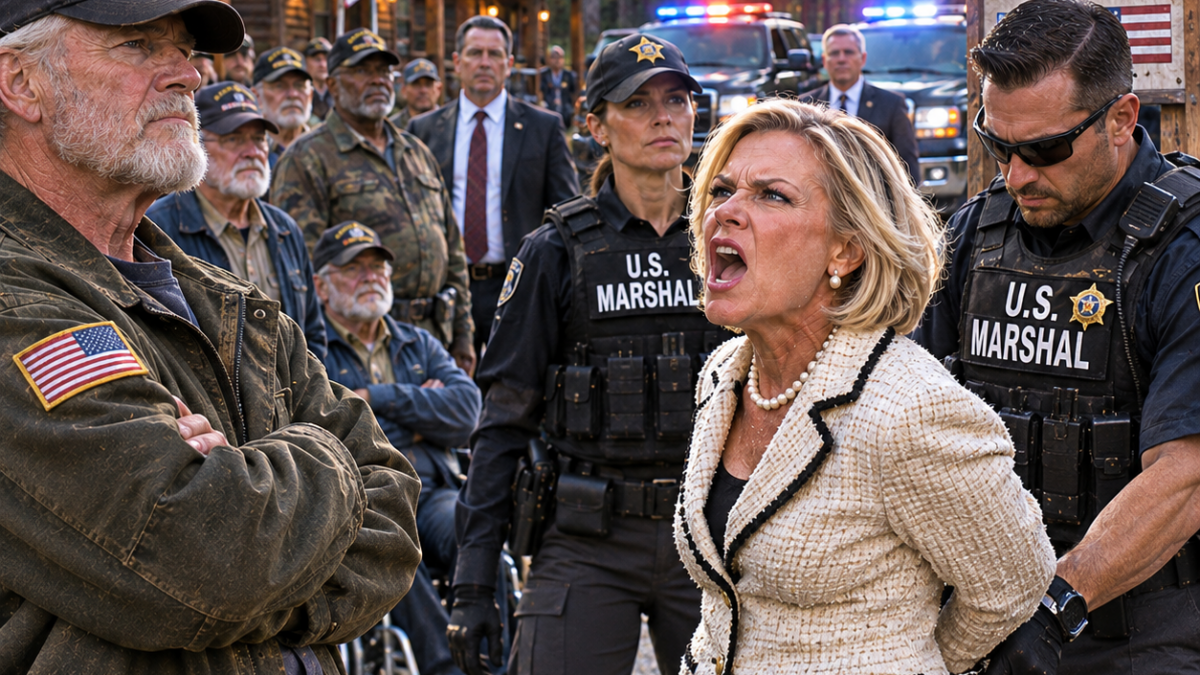
HOA President Hired 6 Fake Federal Marshals to Evict 9 Veterans—Then Real U.S. Marshals Arrived at Dawn With Arrest Warrants.
At 4:47 in the morning, six men in dark jackets marked FEDERAL MARSHAL began hammering on the doors of nine veterans’ cottages, waving a stamped eviction order and giving everyone ten minutes to abandon homes they had legally occupied for years.
Across the road, HOA president Veronica Treadwell sat inside her white SUV recording the scene because she believed the last obstacle to her $6.2 million resort deal was finally being dragged out before sunrise.
Then a second convoy appeared through the pines without sirens, the six “marshals” went pale, and Deputy U.S. Marshal Tessa Rourke stepped into the clearing holding the one document Veronica had never expected to see—a real federal arrest warrant.
Seven days earlier, Haven Ridge had been one of the quietest places in Raven Creek, Colorado.
Eighteen acres of pine.
Nine wooden cottages.
One narrow gravel road.
A generator shed.
A small maintenance barn.
A flagpole that leaned three degrees east because Floyd McAllister kept promising to straighten it and never did.
The land belonged to the Haven Ridge Veterans Housing Trust.
Each cottage belonged to the trust.
Each resident held a recorded long-term right of occupancy that allowed them to live there for as long as they followed a short list of basic rules.
Pay utilities.
Maintain the property.
No subleasing.
No commercial use.
No violence.
No illegal activity.
That was about it.
No architectural committee.
No mailbox color regulations.
No fines because somebody’s grass grew half an inch too high.
The arrangement had begun twenty-three years earlier when a local businessman named Samuel Harwick donated the acreage after his younger brother died homeless.
Samuel had served in Vietnam.
His brother had served too.
One came home with a business.
The other never really came home at all.
PART2:
Samuel created Haven Ridge because he was tired of people saying they supported veterans while finding reasons not to house the difficult ones.
At first, the cottages were temporary.
Then the residents themselves turned the place into something permanent.
They dug drainage.
Repaired roofs.
Installed backup power.
Built a common garden.
Paved sections of the access road with donated labor.
Nine cottages eventually became nine homes.
Leland Vickers occupied Cottage One.
At sixty-two, he had been retired from the Army for eleven years.
Logistics.
Thirty years.
He had spent most of his career moving people and supplies across places where roads, weather, politics, and occasionally enemy fire all conspired to make movement impossible.
That made him deeply suspicious of any person who said:
Don’t worry about the paperwork.
Every morning at five, Leland walked Haven Ridge.
Water lines.
Drainage ditches.
Propane gauges.
Fence posts.
Roof damage after storms.
Not because he ran the place officially.
Nobody did.
The nine residents made decisions together.
PART3:
But if something broke before sunrise, Leland was usually the first person standing beside it.
Judith Calder lived in Cottage Two.
Former Navy medical specialist.
Sixty-four.
Precise.
Organized.
She maintained the trust documents in two fireproof filing cabinets and a digital backup.
Abram Wexler lived in Cottage Three.
Air Force.
Electronics.
Generators.
He could make an engine run after most mechanics had declared it dead.
Floyd McAllister, seventy-four, lived in Cottage Four.
Army Corps of Engineers.
Survey maps made sense to him in a way conversation sometimes did not.
Maren Beckett lived in Five.
Coast Guard.
Logistics.
Patrick Renner occupied Six.
Marine.
Short temper.
Large heart.
Stella Birch lived in Seven.
Former Air Force communications specialist.
She had installed Haven Ridge’s security cameras after someone stole tools from the barn.
Walter Dunsmuir lived in Eight.
Seventy-seven.
The oldest.
Retired Army medic.
Slow gait.
Bad lungs.
Still capable of making every person at the table feel ridiculous when they argued too long.
Dale Edens lived in Nine.
Forty-six.
Youngest.
Former National Guard transportation officer.
He hated being called kid.
Everyone called him kid.
Haven Ridge’s neighbor was Raven Creek Estates.
Stone walls.
Private gates.
Security booth.
Large homes spread across a slope overlooking the valley.
For years, the two properties mostly ignored each other.
Then Veronica Treadwell became HOA president.
She had been on the Raven Creek board for six years.
President for four.
Fifty-four.
Former commercial real-estate broker.
White suits.
Expensive watches.
Careful smile.
She had a way of speaking as though every sentence had already been approved by counsel.
The first warning arrived Friday morning.
Three white SUVs stopped at the Haven Ridge entrance.
Leland was repairing a split water-line cover beside the gate.
He straightened when the doors opened.
Veronica stepped out first.
Behind her:
Hazel Folsom, HOA treasurer.
Bridget Lowry, secretary.
Bridget carried a red metal sign.
Without saying hello, she drove it into the ground.
PROPERTY UNDER HOA ENFORCEMENT
VACATE WITHIN 7 DAYS
Leland read it.
Then looked at Veronica.
“Morning.”
Veronica smiled.
“Mr. Vickers.”
“Mind explaining that?”
“Haven Ridge is entering redevelopment.”
“No.”
She blinked.
“No?”
“Haven Ridge isn’t part of your association.”
“That issue has been resolved.”
“By who?”
“Our attorneys.”
“Show me.”
Veronica opened a leather folder.
She handed him a packet.
FEDERAL COMPLIANCE RELOCATION NOTICE.
The title alone bothered him.
Federal compliance with what?
He read the first page.
Language about unsafe structures.
Land consolidation.
Future commercial redevelopment.
Enforcement authority.
No court name prominently displayed.
No judge.
No case number he recognized.
No agency contact.
Floyd walked over.
“Morning.”
Leland gave him the map.
Floyd opened it across the hood of his truck.
His expression changed.
“Where’d this come from?”
Veronica answered:
“Updated county planning records.”
Floyd traced the boundary.
“No.”
Veronica turned.
“No what?”
“This is wrong.”
The map showed the entire Haven Ridge parcel shaded the same pale green as Raven Creek common property.
The trust’s eastern edge had vanished.
A narrow service-road easement had become a broad access corridor.
The nine cottages sat inside a proposed development footprint.
Floyd tapped the map.
“This boundary doesn’t exist.”
“It does now.”
“That isn’t how boundaries work.”
Veronica smiled.
“Mr. McAllister, I appreciate your military background, but our planning team is not using seventy-year-old field maps.”
Floyd looked at Leland.
Then back at her.
“I read surveys for the Army Corps longer than you’ve been selling houses.”
Veronica ignored him.
Judith arrived next.
“What’s happening?”
Leland handed her the packet.
She read two pages.
Then looked up.
“The trust never transferred title.”
Veronica said:
“There are instruments you may not have seen.”
“I keep the instruments.”
“Then perhaps your records are incomplete.”
Judith’s voice sharpened.
“They are not.”
Veronica closed the folder.
“Listen carefully.”
The smile disappeared.
“You have seven days.”
“After that, federal marshals will enforce the relocation order.”
Patrick, walking over from Cottage Six, said:
“Federal marshals?”
“Yes.”
“For an HOA?”
“For an authorized redevelopment.”
Leland raised one hand before Patrick could answer.
Veronica stepped closer.
“Retirement is easier when people know which battles not to fight.”
Leland looked at her.
“We learned that lesson somewhere else.”
She smiled again.
Then the SUVs left.
Gravel sprayed.
The nine stood around the red sign.
Nobody spoke for a while.
Stella noticed a second sheet left on Leland’s hood.
Same project map.
But someone had written across the bottom in blue ink:
ALL NINE STRUCTURES MUST BE VACANT BEFORE CLOSING.
Leland read it.
Then again.
Walter said:
“Closing.”
Judith looked up.
“Sale.”
Floyd nodded.
“They have a buyer.”
Patrick stared down the road.
“For land they don’t own.”
That evening, Raven Creek called an emergency HOA meeting.
Eighty homeowners attended.
Leland, Judith, Walter, and Dale went.
They stood near the back.
Veronica presented a slideshow.
RAVEN CREEK RESERVE.
Luxury spa cabins.
Private lodge.
Wellness center.
Expanded walking trails.
New entrance.
$6.2 million development value.
Projected property-value increase.
Then slide four appeared.
Satellite image.
Haven Ridge outlined in red.
PARCEL PENDING CLEARANCE.
Leland raised his hand.
Veronica looked directly at him.
Then nodded toward security.
Two guards stepped into the aisle.
Blocked him.
“Residents only during formal discussion.”
Leland said:
“You’re discussing my home.”
Veronica turned toward the room.
“Haven Ridge currently contains nine aging temporary structures.”
Temporary.
Walter laughed softly.
He had lived there eighteen years.
Veronica continued.
“The site is underutilized and negatively affects the broader Raven Creek investment corridor.”
A few homeowners nodded.
Most had never seen Haven Ridge up close.
From the main road, they saw roofs through pines.
Veronica showed photographs chosen carefully.
Peeling paint.
Old utility shed.
Unpaved shoulder.
Not the repaired cottages.
Not the garden.
Not the new roofs.
Not the flagpole.
Then Walter raised his hand.
Veronica hesitated.
“Mr. Dunsmuir.”
Walter did not approach the microphone.
His voice was quiet.
“Do you have title?”
The room went silent.
Veronica gripped the podium.
“The association’s attorneys have reviewed all necessary instruments.”
Walter nodded.
“That wasn’t what I asked.”
A few heads turned.
“Do you have title to Haven Ridge?”
Veronica’s expression hardened.
“Your military service does not give you the right to stand in the way of progress.”
Nobody moved.
The sentence hung there.
Leland felt Dale shift beside him.
Phone recording.
Good.
Walter nodded once.
“No.”
“It doesn’t.”
Then he looked around the room.
“But neither does your HOA presidency.”
Someone in the third row whispered:
“Damn.”
Leland walked toward the front table.
Security moved.
He stopped before giving them a reason.
Held up a certified copy of the deed.
“This is title.”
Veronica barely glanced.
“Our counsel has already addressed this.”
She pushed it aside.
Then Cynthia Ray stood.
Board member.
Sixty.
Ten years with Raven Creek.
“Veronica.”
“Yes?”
“I’d like copies of the purchase agreement.”
Veronica’s face changed.
Slightly.
Cynthia continued.
“And minutes of the board vote authorizing acquisition of Haven Ridge.”
Hazel answered:
“Commercially confidential.”
Cynthia looked at her.
“I’m on the board.”
“Until closing, disclosure is limited.”
“To board members?”
“Legal advice.”
Cynthia sat slowly.
But she did not look convinced.
Sunday morning brought violation notices.
Nine stacks.
Identical.
Unauthorized structures.
Improper utility systems.
Failure to participate in community safety inspections.
Service-road violations.
Fines.
Threatened access suspension.
Patrick stood in Leland’s kitchen holding his.
“They’re trying to create a record.”
“Yes.”
“For what?”
“Pressure.”
Leland called the county sheriff.
A deputy listened.
Then said:
“An HOA notice is not an eviction order.”
“What if they send people?”
“Call us.”
“They’re claiming federal enforcement.”
“Verify with federal agency.”
“Property?”
“You need your deed and counsel.”
That afternoon, Judith worried about access.
“Our propane delivery uses the service road.”
“Yes.”
“Walter’s oxygen supplier too.”
Leland looked at her.
“You think they’d block it?”
“I think they already threatened to.”
At 8:14 that night, his phone rang.
Unknown number.
“Mr. Vickers?”
“Yes?”
“This is Officer Finn with the United States Marshals Service.”
Leland sat straighter.
“What district?”
Pause.
“We have been assigned to federal relocation enforcement at Haven Ridge.”
“Badge number?”
Pause.
“Sir?”
“Your badge number.”
Another pause.
Leland continued.
“Supervisor?”
Silence.
“Case number?”
Click.
The line died.
Leland stared at the phone.
Then called the publicly listed U.S. Marshals Service district office.
Not the number in Veronica’s paperwork.
Official number.
Duty officer answered.
Leland explained.
The officer asked him to email everything.
Monday morning, Leland, Judith, and Floyd went to county records.
They spent two hours pulling:
Original Haven Ridge deed.
Trust documents.
Occupancy instruments.
Easements.
Survey plats.
Recent filings.
Three facts became undeniable.
One:
The Veterans Housing Trust owned the full eighteen acres.
Two:
Each veteran’s occupancy right was properly recorded.
Three:
Raven Creek HOA held one narrow easement over part of a service road.
Nothing else.
No management rights.
No sale rights.
No reversion clause.
No eviction power.
Floyd spread the maps.
The new HOA map had altered boundaries.
The service path had been widened.
Haven Ridge absorbed.
Then Judith went pale.
“What?”
Leland looked.
She pointed at a recently filed consent form.
Signature:
Judith Calder.
Records Custodian, Haven Ridge Veterans Housing Trust.
Consent to transfer.
She whispered:
“I never signed this.”
Floyd stared.
“Sure?”
Judith looked at him.
“I know my own signature.”
Leland asked the clerk:
“Can you preserve the filing history?”
“Yes.”
The clerk hesitated.
“There’s already a verification flag.”
“Why?”
“Supporting documents didn’t reconcile.”
“When?”
“Last week.”
That explained the deadline.
Veronica needed Haven Ridge empty before county review finished.
An empty property could be described as surrendered.
Vacant.
Ready for closing.
The group called Denver attorney Dana Huston.
Property litigation.
She agreed to move fast.
The clerk also confirmed a notice of commercial interest had been submitted tied to a redevelopment buyer.
So somebody had already negotiated a sale.
Across town, Veronica was on the phone with Malcolm Keating.
Development executive.
Buyer representative.
Malcolm’s company had agreed to purchase the entire planned resort site for $6.2 million subject to:
Clear title.
Vacant possession.
Final inspection.
He had been told Raven Creek already controlled Haven Ridge.
He had been given:
Title packet.
Board resolution.
Consent to transfer.
Nine voluntary relocation releases.
The last piece was not complete yet.
Veronica promised it would be.
After hanging up, she called Hazel.
“The veterans need to be gone before inspection.”
“How?”
“Whatever it takes.”
That night, Stella’s camera caught a black panel van outside Haven Ridge.
Two men exited.
Dark jackets.
FEDERAL MARSHAL in yellow letters.
One taped a paper to the gate.
Revised deadline.
Tuesday.
8:00 a.m.
They returned in daylight.
Six cottages opened curtains.
Nobody stepped outside except Leland.
Curtis Finn approached.
Broad shoulders.
Mirrored sunglasses.
Fake badge.
“Federal enforcement.”
Leland looked at the badge.
Something was wrong.
The shield shape resembled online images but not exactly.
The text spacing looked cheap.
The seal on the order was worse.
Too dark.
Too perfect.
Curtis said:
“You need to surrender keys.”
“No.”
Curtis blinked.
“What?”
“Case number.”
“You have been served.”
“Court?”
“Federal.”
“Which one?”
Curtis’s jaw tightened.
“Mr. Vickers, failure to cooperate may result in arrest for obstruction.”
Patrick came off his porch.
Leland raised his hand.
Stop.
That saved them from exactly the confrontation Curtis wanted.
Judith stepped forward.
“Let me read the order.”
Curtis held it up.
Then snapped it closed.
“No.”
Judith almost smiled.
“Interesting.”
Curtis pointed.
“Next time, we come with full enforcement.”
He turned.
Stella’s cameras captured everything.
Dale’s phone captured audio.
License plate.
Faces.
Vehicles.
Jackets.
After the van disappeared, Leland called the real Marshals Service.
Official line.
The duty officer listened longer this time.
Then said:
“Send all footage immediately.”
Within the hour, investigators had it.
That afternoon, Veronica called.
“Next time they won’t ask.”
Leland answered:
“Then you’d better make sure they’re who you claim they are.”
She hung up.
Two hours later, FBI Special Agent Eloise Carver called.
Leland did not trust the caller ID.
He hung up.
Called the FBI field office publicly listed number.
Asked to be connected.
Smart.
Eloise appreciated that.
Thirty-nine.
Fraud investigator.
She told him:
“Do not confront those men.”
“Keep cameras running.”
“Preserve every message.”
“Do not alert Veronica that you have federal involvement.”
Leland smiled for the first time in days.
“Understood.”
Wednesday morning, orange barricades blocked the shared service road.
HOA construction project.
No construction equipment.
Only barricades.
Delivery van turned away.
Propane truck turned away.
Walter’s medical supply delivery delayed.
Abram checked generator fuel.
“Three days if weather stays mild.”
“What if it drops?”
“Two.”
Patrick wanted to remove the barricades.
Leland refused.
“They want us angry.”
“They’re starving us out.”
“They want us on camera tearing down HOA property.”
Patrick swore.
Maren found the recorded right-of-way language.
The HOA could not obstruct access to the cottages.
Dana filed emergency motion.
Then nine envelopes arrived.
Relocation offers.
Small checks.
Release forms.
Give up every claim to Haven Ridge.
Leave voluntarily.
Nine veterans met at Leland’s kitchen table.
Walter looked tired.
“I don’t want someone getting hurt.”
Patrick snapped:
“So we leave?”
“I didn’t say that.”
“You’re considering it.”
Walter looked at him.
“I’m seventy-seven and on oxygen.”
The room went quiet.
Walter continued.
“I’ve spent enough years fighting people.”
Patrick’s anger deflated.
Leland said:
“Nobody is required to stay.”
They looked at him.
“This isn’t the Army.”
“No orders.”
“If somebody wants out, we help them.”
“But nobody signs a thing until Dana reads it.”
All nine agreed.
That night, Stella received an email from a Raven Creek homeowner.
Expense report attached.
One line:
$185,000 — FINN PROTECTIVE SERVICES.
New company.
Formed six weeks earlier.
Managing member:
CURTIS FINN.
Stella called Leland.
“The marshal works for the HOA.”
That changed the federal investigation immediately.
Then Judith found the forged relocation consent.
Slipped through her mail slot.
Her real signature.
Her name.
But she had never signed that document.
The next morning, tension exploded inside Haven Ridge.
Patrick threw the page on Leland’s table.
“Who signed this?”
Judith stared.
“My signature.”
Walter looked hurt.
“You told us you never signed.”
“I didn’t.”
“It’s right there.”
Judith’s hands shook.
Then memory returned.
“Two months ago.”
Everyone stopped.
“A young man from Raven Creek office came here.”
“For?”
“Road-maintenance acknowledgment.”
“What did you sign?”
“One page.”
“Did you keep a copy?”
Judith stood.
Ran home.
Returned with it.
A simple drainage-maintenance form.
Same signature.
Same placement.
Different page.
Dana arrived before noon with an FBI document examiner.
Comparison.
Signature identical down to microscopic irregularities.
Because it had been lifted.
Transferred.
The examiner explained:
A real signature does not make the surrounding document real.
Someone had taken Judith’s genuine signature and inserted it into a fabricated consent.
Walter apologized first.
Patrick stared at the table.
Then:
“Sorry.”
Judith looked at him.
“You should be.”
Small smile.
Tension broke.
Leland said:
“This is what Veronica wants.”
Everyone looked.
“If we stop trusting each other, she doesn’t need to evict us.”
That afternoon, Cynthia Ray contacted Dana.
Private meeting.
She had started reviewing board emails.
What she found frightened her.
No valid board vote to acquire Haven Ridge.
No authorized sale.
Veronica, Hazel, and Bridget had circulated altered summaries.
They claimed approval already existed.
Cynthia produced one email.
From Veronica.
To Hazel and Bridget.
THE VETERANS MUST BE GONE BEFORE THE BUYER CHECKS ORIGINAL TITLE.
Another:
FINN’S TEAM SHOULD LOOK FEDERAL ENOUGH THAT THEY DON’T ASK QUESTIONS.
Another:
DO NOT LET THEM PHOTOGRAPH THE FULL ORDER.
Direct.
Ugly.
Cynthia agreed to cooperate.
Eloise Carver now had a line from:
Veronica
to Curtis
to fake uniforms
to staged eviction.
Bank subpoenas added money.
HOA funds labeled:
Security services.
Legal consulting.
Project preparation.
Some went to Finn Protective Services.
Others moved to companies linked to Hazel and Veronica.
The $6.2 million resort was not merely a land grab.
It was also a pipeline.
Construction planning fees.
Security fees.
Legal fees.
Consulting.
All routed before the deal closed.
Then Eloise interviewed Malcolm Keating.
He brought his entire acquisition file.
Title packet.
Board resolution.
Consent form.
Buyer correspondence.
He looked at the real Haven Ridge deed.
Then the county verification flag.
His face changed.
“We were buying land they didn’t own.”
“Yes.”
Malcolm stared at the documents.
“Our deposit?”
“Under review.”
He handed over everything voluntarily.
The intended fraud became clear.
Veronica needed:
Vacant land.
Fake appearance of federal removal.
Signed-looking consent.
Nine handover forms.
Then buyer inspection.
Once the buyer released funds, the paper trail would be buried under a commercial closing.
By Thursday afternoon, investigators had probable cause.
Federal magistrate signed warrants.
Search.
Arrest.
Records.
The county judge separately ordered the service-road barricades removed.
That evening, Deputy U.S. Marshal Tessa Rourke entered Leland’s cottage.
Forty-one.
Calm.
Direct.
She sat at the kitchen table with Eloise.
The nine veterans crowded around.
Tessa said:
“They are planning to return at dawn.”
Patrick smiled.
“Good.”
Tessa looked at him.
“No.”
He stopped smiling.
“You do not engage.”
“No doors open.”
“No weapons.”
“No confrontation.”
“Keep cameras running.”
“Stay inside until we announce the scene secure.”
Leland nodded.
“What happens to our homes?”
Dana answered:
“Court protection is already in place.”
Tessa added:
“Nobody is lawfully evicting you tomorrow.”
Walter exhaled.
Then Leland said:
“One request.”
Tessa waited.
“Whatever happens out there, keep my people safe.”
“That’s the plan.”
Across Raven Creek, Veronica held her own meeting.
Clubhouse conference room.
Hazel.
Bridget.
Curtis.
Five other men.
Dark jackets laid across chairs.
Fake badges polished.
Dashboard lights installed.
Nine handover forms.
Veronica poured champagne.
Curtis asked:
“What if they call federal?”
Veronica laughed.
“They already had a week.”
One younger guard looked uneasy.
“If actual law enforcement shows?”
“Our attorneys handle it.”
That man looked unconvinced.
But he stayed.
Thursday night, Haven Ridge did not sleep.
Walter sat with an old photograph.
Opening day.
Nine residents younger.
Ribbon.
Flag.
Samuel Harwick smiling behind them.
Leland walked in.
Walter said:
“I served twenty-two years.”
“I know.”
“I never thought I’d be afraid of a federal badge at my own door.”
Leland sat.
“They don’t have federal badges.”
“They look close enough at four in the morning.”
Leland nodded.
Then:
“We served the government.”
Walter looked at him.
“We don’t surrender our homes to somebody pretending to be it.”
Walter set the photograph down.
Across Haven Ridge:
Judith organized documents.
Floyd marked surveys.
Stella verified camera backups.
Dale tested porch lights.
Abram checked generators.
Maren prepared emergency medications and transportation plans.
Patrick cleaned his kitchen twice because sitting still made him angry.
At 4:30 a.m., Curtis Finn’s six-man team left a storage unit.
Dark SUVs.
Flashing dashboard lights.
Jackets.
Fake orders.
At 4:41, Veronica left Raven Creek clubhouse.
At 4:47, the first fist hit Leland’s door.
“FEDERAL MARSHALS!”
Another door.
Another.
“OPEN UP!”
Another.
“YOU HAVE TEN MINUTES TO VACATE!”
Leland stood six feet back.
Porch camera recording.
Curtis pressed a document against the glass.
Federal seal.
Eviction order.
Leland read the heading.
UNITED STATES DISTRICT COURT
RAVEN CREEK DIVISION.
There was no federal courthouse in Raven Creek.
No Raven Creek Division.
Curtis shouted:
“NINE MINUTES!”
At Cottage Four, another fake marshal pounded.
Floyd watched through camera.
At Cottage Eight, Walter sat in a chair instead of standing.
Oxygen line beside him.
At Cottage Seven, Stella watched all feeds on a monitor.
Six men moving across the property.
Veronica parked beyond the gate.
Interior light on.
Phone recording.
She was smiling.
Curtis shouted:
“EIGHT MINUTES!”
Leland answered:
“I will not open until this order is verified by legitimate federal authority.”
Curtis’s voice hardened.
“We are the authority.”
Leland said nothing.
Across the clearing, Dale saw headlights.
Far down Haven Ridge Road.
Not flashing.
Not sirens.
Slow.
Controlled.
Convoy.
He whispered:
“Here they come.”
Stella heard through intercom.
Looked at her screen.
Vehicles positioned at both ends of the road.
Then doors opened.
Men and women stepped out.
Real body armor.
Real credentials.
U.S. MARSHAL.
FBI.
Tessa Rourke walked into the clearing.
“STOP WHAT YOU’RE DOING!”
Curtis turned.
For half a second, nobody moved.
Tessa continued.
“KEEP YOUR HANDS VISIBLE.”
One fake marshal instinctively reached toward his jacket.
Three real deputies reacted.
“DON’T.”
His hands shot up.
Curtis stepped forward.
“We’re federal marshals executing—”
Tessa held up credentials.
“Deputy United States Marshal Tessa Rourke.”
Curtis went white.
“We’re contractors.”
“You just identified yourselves as federal officers.”
“No.”
Stella’s cameras had audio.
Tessa knew.
Curtis tried:
“We were told to use these jackets.”
“Hands behind your back.”
Within two minutes:
Six men detained.
Fake badges collected.
Documents seized.
Vehicles secured.
No shots.
No injuries.
Veronica stepped out of her SUV.
“What is going on?”
Tessa turned.
Veronica walked fast.
“This is an HOA enforcement action.”
“No.”
“We have legal authority.”
“An HOA cannot appoint federal marshals.”
Veronica pointed at Curtis.
“He told me he was authorized.”
Eloise Carver stepped forward.
“That isn’t what your emails say.”
Veronica stopped.
Eloise held an arrest warrant.
“Veronica Treadwell?”
Her face changed.
“No.”
“Special Agent Eloise Carver, FBI.”
“No.”
“You are under arrest.”
“This is ridiculous.”
“For offenses related to fraud, conspiracy, forged documents, and impersonation scheme under investigation.”
“I never impersonated anyone.”
“You paid people to.”
“Curtis did this.”
Curtis shouted from beside a vehicle:
“You told us what to wear!”
Veronica spun.
“Shut up!”
Every camera captured it.
Bad instinct.
Excellent evidence.
Eloise read her rights.
A deputy cuffed her.
Veronica looked toward Haven Ridge.
Leland had stepped onto his porch now.
Only after Tessa signaled.
She stared at him.
As though he had betrayed some private rule by surviving.
Leland asked:
“Where’s your federal authority now, Veronica?”
She looked away.
Across town, teams arrested Hazel and Bridget.
Search warrants executed at:
HOA management office.
Hazel’s house.
Finn Protective Services storage unit.
Veronica’s home office.
Computers seized.
Ledgers.
Phones.
Forged seals.
Blank federal-style forms.
Printed badge templates.
Nine prepared handover documents.
A contract with Finn Protective Services.
One line item:
FEDERAL-STYLE RELOCATION SUPPORT.
That phrase appeared in the affidavit later.
The sky lightened over Haven Ridge.
Gold through pines.
Fake marshals loaded into federal vehicles.
Veronica walked past the red sign she had planted.
PROPERTY UNDER HOA ENFORCEMENT.
She did not look at it.
Tessa approached the nine veterans.
“Scene is secure.”
Nobody cheered.
That surprised reporters later.
No celebration.
Walter sat on porch steps.
Judith stood beside him.
Patrick folded arms.
Leland looked at Tessa.
“Our homes?”
Tessa answered carefully:
“No lawful eviction is occurring.”
Dana added:
“Court order preserves the property while title fraud is litigated.”
Walter closed his eyes.
Just for a second.
Relief.
The investigation widened fast.
Forensic accountants followed HOA money.
The resort project created dozens of invoices.
Planning.
Security.
Consulting.
Legal research.
Land preparation.
A significant portion had flowed through entities connected to Veronica and Hazel.
Some legitimate expenses.
Some inflated.
Some invented.
Finn’s company had received $185,000.
For six weeks of “security.”
Homeowners had paid for men to pretend to be federal law enforcement against neighbors who were not even HOA members.
That fact spread through Raven Creek faster than any official statement.
Cynthia called a special HOA meeting.
Packed.
Standing room only.
She opened with one sentence:
“We need to know what our money paid for.”
Independent audit authorized.
Old leadership suspended.
Records preserved.
Homeowners who had applauded Veronica’s resort slides now stared at copies of the fake eviction operation.
Some were ashamed.
Some angry.
Some defensive.
A man said:
“We didn’t know.”
Cynthia answered:
“That’s why we audit.”
Simple.
The county invalidated the suspicious property filing after the legal process confirmed the underlying documentation was fraudulent.
The Haven Ridge deed remained unchanged.
The veterans’ occupancy rights remained intact.
The shared service road reopened permanently.
The buyer walked.
Malcolm Keating’s company terminated the acquisition.
The $6.2 million project died.
But Malcolm did something unexpected.
Months later, after the criminal case stabilized, he visited Haven Ridge.
No lawyers.
No presentation.
He sat with the nine residents.
“I nearly bought your homes.”
Leland said:
“You nearly bought paper saying you owned them.”
“Fair.”
Malcolm looked around.
“My company’s due diligence should have caught this earlier.”
“Yes.”
“We relied too heavily on seller representations.”
“Yes.”
Patrick whispered:
“He’s really making him work for this.”
Walter smiled.
Malcolm continued.
“We want to fund infrastructure improvements here.”
Leland shook his head.
“No.”
“Not purchase.”
“No.”
“Donation.”
“No.”
Walter touched Leland’s arm.
“Let him finish.”
Malcolm proposed:
New water lines.
Generator upgrades.
Proper paving on the shared access.
No ownership.
No branding.
No naming rights.
Trust approval required.
Independent contractor.
Why?
Part restitution.
Part corporate responsibility.
Part because his company had almost become the vehicle that completed the fraud.
Leland still disliked it.
Walter said:
“Pride can refuse good things for bad reasons too.”
Leland glared.
Walter smiled.
They accepted with conditions.
Everything transparent.
Nothing tied to Raven Creek ownership.
No future development rights.
That distinction mattered.
The criminal cases took time.
Much longer than dawn.
Indictments.
Discovery.
Motions.
Plea negotiations.
Some defendants cooperated.
Not all six fake marshals had understood the full land fraud.
They had understood enough.
They knew they were not federal officers.
They wore jackets saying they were.
Displayed fake badges.
Threatened arrests.
Demanded keys.
Those choices carried consequences.
Curtis received serious federal punishment.
Others received sentences according to roles and cooperation.
Hazel and Bridget faced charges tied to forged documents, financial conduct, and conspiracy.
Veronica faced the most.
Not because she was unpopular.
Because evidence showed planning.
Emails.
Payments.
Instructions.
Buyer communications.
The forged title package.
The fake federal enforcement.
The money.
At trial, Dale’s recordings played.
Veronica’s own voice:
Nobody defies my board.
Jurors heard it in context.
They also saw her email:
THE VETERANS MUST BE GONE BEFORE THE BUYER CHECKS ORIGINAL TITLE.
Intent is rarely kind enough to write itself down.
This time it had.
Judith testified about the stolen signature.
FBI document examiner explained transfer.
Cynthia testified about board records.
Malcolm testified about seller representations.
Leland testified about the phone call from the fake officer.
Tessa testified about dawn arrests.
Walter testified briefly.
The prosecutor asked:
“What did you think when men wearing federal insignia ordered you from your home?”
Walter looked toward jury.
“I thought somebody had taken something I respected and turned it into a costume.”
The courtroom went quiet.
The verdicts came later.
Sentences after that.
Restitution where assets existed.
Civil settlements.
Insurance.
Recovered association funds.
Not every dollar returned.
Never does.
But Haven Ridge survived.
Nine cottages.
Nine residents.
No one forced out.
Raven Creek elected an entirely new board.
Cynthia refused presidency.
“I’ve had enough.”
A younger accountant named Elise Porter took role reluctantly.
First reforms:
Independent audit every year.
No related-party vendor contracts without member disclosure.
No real-estate transaction without recorded membership vote.
No enforcement outside HOA property.
No use of association funds for private security action without counsel review.
No officer serving more than two consecutive terms.
Boring governance.
Exactly what Raven Creek needed.
The board formally apologized to Haven Ridge.
Not a social-media post.
Signed letter.
Recorded in minutes.
Each veteran received copy.
Patrick wanted to burn his.
Judith framed hers.
Different people.
The old guardhouse near the shared boundary became a joint community room.
Not immediately.
That idea took longer.
Haven Ridge did not want dependence.
Raven Creek homeowners did not want another symbolic gesture.
Eventually both sides created a written agreement.
Trust retained land.
HOA funded maintenance proportionally.
No ownership transfer.
Open for veterans’ events, community meetings, emergency shelter during wildfires.
Transparent.
Walter approved.
“If we spend forever punishing people who weren’t part of the fraud, Veronica still owns the future.”
That sentence changed Leland’s mind.
The infrastructure upgrades began.
New water line.
New propane access.
Generator controls.
Service road paved.
No barricades.
The red enforcement sign disappeared.
Patrick kept it.
Everyone asked why.
“Target practice.”
Leland said no.
Patrick complained.
The sign ended up in the maintenance barn.
Years later, rust crept around the edges.
The nine residents changed too.
Walter’s health worsened.
He used oxygen more often.
One winter he was hospitalized.
Came home.
The first thing he did was complain that Abram had adjusted his thermostat.
Judith retired from handling trust records.
Dale took over digital archive.
Floyd finally straightened the flagpole.
Three degrees east became zero.
Everyone hated it.
“It had character,” Maren said.
Floyd told her character was another word for poor measurement.
Leland kept walking at five.
Water.
Drainage.
Fences.
Habit.
One morning, Tessa Rourke returned.
No tactical vest.
Jeans.
Coffee.
Leland met her at gate.
“You lost?”
“No.”
“Government checking again?”
She smiled.
“I was nearby.”
“That sounds suspicious.”
They sat on Leland’s porch.
Tessa looked across cottages.
“Quiet.”
“That’s the idea.”
She said:
“You know the part people keep getting wrong?”
“What?”
“They say the veterans defeated fake marshals.”
Leland nodded.
“Sounds better.”
“You didn’t.”
“No.”
“You documented.”
“We stayed inside.”
“You called legitimate channels.”
“Yes.”
“And when real law enforcement showed up, nobody decided to prove how tough they were.”
Leland smiled.
“Patrick considered it.”
“I know.”
“You could tell?”
“From orbit.”
They laughed.
Then Tessa became serious.
“That saved lives.”
Leland looked toward Cottage Six.
“People hear ‘veteran’ and assume confrontation.”
“Sometimes discipline means not opening the door.”
“Yes.”
That was the lesson Leland carried.
Courage was not always advancing.
Sometimes courage was staying behind a locked door while somebody in a uniform screamed that obedience would be easier.
Sometimes it was asking:
What court?
What case number?
What badge?
What authority?
Questions are underrated defenses.
Veronica’s scheme depended on appearance.
Official jackets.
Official-looking seals.
Legal language.
Luxury SUVs.
HOA letterhead.
Board titles.
Commercial buyers.
People assumed authority because everything looked expensive and organized.
Leland had spent thirty years in military logistics.
He knew real authority comes with traceability.
Orders can be verified.
Units exist.
Case numbers exist.
Supervisors exist.
Documents originate somewhere.
Anybody demanding immediate compliance while refusing verification deserves more questions, not fewer.
That principle saved Haven Ridge long before the marshals arrived.
The nine veterans did not “beat” federal power.
They recognized fake power.
That distinction mattered.
One afternoon, a Raven Creek homeowner approached Leland at grocery store.
Middle-aged man.
Leland remembered him from resort meeting.
One of the people who had nodded when Veronica called the cottages run-down shacks.
“Mr. Vickers.”
“Leland.”
“I owe you an apology.”
Leland waited.
“I believed her.”
“Many did.”
“I thought your place was temporary.”
“It isn’t.”
“I know.”
The man looked uncomfortable.
“We never went over there.”
“That helped.”
“Helped what?”
“You believe anything about people you never meet.”
The man absorbed that.
Then:
“I’m sorry.”
Leland nodded.
“Thank you.”
No hug.
No grand reconciliation.
Enough.
Haven Ridge eventually hosted an open house.
Not because residents wanted tours.
Because Walter suggested Raven Creek families should actually see what they had nearly allowed to be sold.
They came.
Children.
Parents.
Board members.
Veterans cooked hamburgers.
Abram demonstrated generator system to anyone unlucky enough to ask.
Floyd explained property surveys for forty minutes.
Nobody escaped.
Judith displayed historical photographs.
Samuel Harwick.
Original trust.
First cottages.
The old deed.
At one table, she placed a copy of the fake transfer document beside the real maintenance form.
People stared.
Same signature.
Different document.
A teenager asked:
“How can they do that?”
Judith answered:
“Technology makes fraud easier.”
Then:
“Verification makes it harder.”
At another table, Dale displayed a replica of the fake marshal badge beside a photograph of Tessa’s verified credentials.
Not because badges alone proved everything.
Because visual difference was educational.
One child asked Leland:
“Were you scared?”
He considered lying.
“No.”
Then changed his mind.
“Yes.”
The child seemed surprised.
“You were Army.”
“Yes.”
“Doesn’t that mean you don’t get scared?”
Leland laughed.
“No.”
“What does it mean?”
“Nothing about fear.”
He crouched.
“It means I had a job once.”
The child frowned.
Leland continued.
“Being brave doesn’t mean you stop being scared.”
“It means fear doesn’t make every decision for you.”
Walter, nearby, nodded.
Good answer.
The old guardhouse community room opened the following spring.
Nine veterans attended.
Raven Creek families attended.
Tessa came.
Eloise Carver sent note.
Malcolm’s company finished infrastructure work.
No giant plaque.
No naming rights.
At Haven Ridge gate, the residents replaced their old sign.
The old one had read:
PRIVATE VETERANS PROPERTY.
The new one:
HAVEN RIDGE
NINE HOMES
ONE TRUST
NO ONE SPEAKS FOR US WITHOUT OUR CONSENT.
Patrick wanted something tougher.
Judith won.
Leland liked it.
Years later, the number nine changed.
People age.
Walter died first.
Peacefully.
Cottage Eight remained empty for several months.
The trust eventually welcomed another veteran.
Different generation.
Afghanistan.
Thirty-nine.
He saw the old photos.
Asked Leland:
“Were you really here when fake marshals came?”
“Yes.”
“Did you know real ones were outside?”
“Eventually.”
“Were you armed?”
“No.”
The younger man looked surprised.
“Why not?”
“Because six idiots pretending to be federal agents plus nine armed veterans is how somebody dies.”
The man nodded.
Fair.
Leland added:
“The goal was keeping homes.”
“Not winning a gunfight.”
That sentence spread around Haven Ridge.
The criminal case became part of local history.
Journalists occasionally called.
Documentary producers.
Podcasts.
Leland usually declined.
He did not like how stories flattened people.
Veronica became “HOA Karen.”
The veterans became heroes.
Real life was messier.
Cynthia had been part of the same board and still chose to expose corruption.
Some Raven Creek homeowners had believed lies because they were deliberately denied records.
Judith had signed a harmless form carelessly and nearly became weaponized against her own neighbors.
Walter briefly considered leaving.
Patrick briefly suspected Judith.
Curtis’s younger guards were not equal in culpability.
Malcolm’s company nearly bought stolen land because its due diligence failed.
Everyone had weaknesses.
That mattered.
If the story became:
Bad woman versus nine perfect veterans,
then nobody learned anything useful.
The useful lesson was about systems.
One president controlled information.
One treasurer helped move money.
One secretary prepared documents.
A board stopped asking questions.
Homeowners saw increased property values and applauded.
A buyer trusted seller paperwork.
A security contractor wanted money.
A signature was copied.
A boundary was redrawn.
Then fake federal authority was added because each earlier lie required a bigger lie to protect it.
Fraud grows like that.
Not linearly.
Structurally.
Every false beam requires another false beam.
Eventually the building becomes too complicated to support itself.
At dawn, the real marshals did not create the collapse.
They arrived when it was ready.
Veronica once wrote from prison.
Leland did not answer at first.
The letter sat unopened for weeks.
Finally Walter—still alive then—told him:
“Read it or throw it away.”
“Don’t worship it.”
Leland opened.
Veronica wrote that she had convinced herself Haven Ridge was inevitable redevelopment.
That the veterans would be better somewhere modern.
That Raven Creek property values justified consolidation.
That Samuel Harwick’s trust was outdated.
That she believed she could use sale proceeds to improve the whole community.
Then came:
I stopped seeing nine homes and started seeing eighteen acres.
Leland read that sentence twice.
That was the truth.
Not legal.
Human.
She converted people into an obstacle.
Once that happened, forged signatures became easier.
Fake officers became easier.
Blocking fuel became easier.
Because none of it felt like harming people anymore.
It felt like clearing a parcel.
He never wrote back.
But he kept the sentence.
Years later, during a Haven Ridge meeting about adding two cottages, Leland read it aloud.
I stopped seeing nine homes and started seeing eighteen acres.
Then he looked around.
“Don’t ever let this place do that to somebody else.”
The trust adopted a rule.
Every major property decision had to begin with names of affected residents before acreage, values, or development figures were discussed.
A small thing.
Maybe symbolic.
Still worthwhile.
The nine veterans’ civil settlement funded an emergency legal-defense reserve for the trust.
No resident would face a property challenge alone.
Judith insisted.
“Paper protects people only if people can afford to enforce it.”
True.
The trust also digitized every original record.
Off-site.
Encrypted.
Multiple backups.
Stella approved.
Floyd complained digital maps lacked romance.
Nobody knew what that meant.
Raven Creek eventually recovered financially.
Not perfectly.
Reserve losses hurt.
Some homeowners paid higher dues temporarily.
The resort never happened.
Property values did not collapse.
Another lesson.
Veronica had insisted the neighborhood’s future depended on taking Haven Ridge.
It didn’t.
Children kept riding bicycles.
People kept mowing lawns.
Homes sold.
The world continued without spa cabins.
That was perhaps the most humiliating outcome of all.
Her “essential” project was not essential.
It was wanted.
There is a dangerous difference between those words.
Wanted projects can be negotiated.
Essential projects become excuses.
Veronica called the resort essential.
Then Haven Ridge became an obstacle to community prosperity.
Then veteran occupancy became temporary.
Then forged consent became practical.
Then fake marshals became enforcement.
Language moved before conduct did.
Always watch language.
The last time Leland saw the old red sign, Patrick finally got permission to destroy it.
Not with bullets.
Judith forbade that.
They used it as patch metal for the maintenance shed roof.
PROPERTY UNDER HOA ENFORCEMENT became a bent piece of red steel keeping rain off lawn equipment.
Walter loved that.
“Best use it ever had.”
Leland agreed.
On a cold morning years later, he walked the property.
Five a.m.
Same routine.
At Cottage Eight, new resident’s porch light glowed.
At generator shed, Abram’s replacement system hummed.
At service road, no barricades.
He stopped at gate.
The polished pine sign caught first light.
HAVEN RIDGE.
Behind him, roofs emerged through trees.
Nine cottages.
Some renovated.
Some still crooked.
All home.
Leland thought back to 4:47.
Curtis pounding.
Veronica smiling.
Ten minutes.
That was all she gave them.
Ten minutes to abandon years.
Ten minutes to surrender legal rights.
Ten minutes to trust a uniform instead of evidence.
That was the entire scheme compressed into one command:
Move before you have time to verify.
Urgency had been Veronica’s strongest weapon.
Seven days.
Then forty-eight hours.
Then ten minutes.
Every shorter deadline reduced thinking.
That is why Leland kept asking questions.
Case number?
Court?
Supervisor?
Title?
Board vote?
Authority?
Questions slowed the fraud down long enough for truth to catch up.
At 4:47, six fake marshals had all the appearance of power.
Dark jackets.
Badges.
Stamped paper.
Flashing lights.
Loud voices.
Across the road, an HOA president held a phone and believed the scene was already hers.
Twenty minutes later, none of that mattered.
Because real authority had arrived with verifiable warrants.
Not because the real marshals wore better uniforms.
Because their power came from law, process, judicial review, and accountability—not from somebody printing words on a jacket.
Leland understood that better than ever.
A badge does not create legitimacy by itself.
A title does not create ownership.
A board vote cannot transfer land it does not own.
A copied signature cannot create consent.
And six costumes cannot turn private intimidation into federal authority.
That morning Veronica Treadwell tried to clear nine homes before sunrise.
Instead, the sunrise found every cottage still occupied.
Every veteran still inside.
Every fake marshal in custody.
And the HOA president herself standing in handcuffs beside the red enforcement sign she had planted seven days earlier.
For years afterward, people called it the morning the veterans won.
Leland never did.
Winning suggested somebody else had to lose their home for Haven Ridge to keep theirs.
That was never the point.
The point was simpler.
Nine people had legal homes.
Someone tried to take them with forged paper and borrowed authority.
The system, eventually, said no.
And sometimes that single word—verified, documented, enforced—is the difference between a frightened person surrendering what is theirs and waking up the next morning still home.








