HOA President Dumped an Old Cowboy’s Lunch—Then Learned He Owned the $12M Lakefront Beneath Her Clubhouse
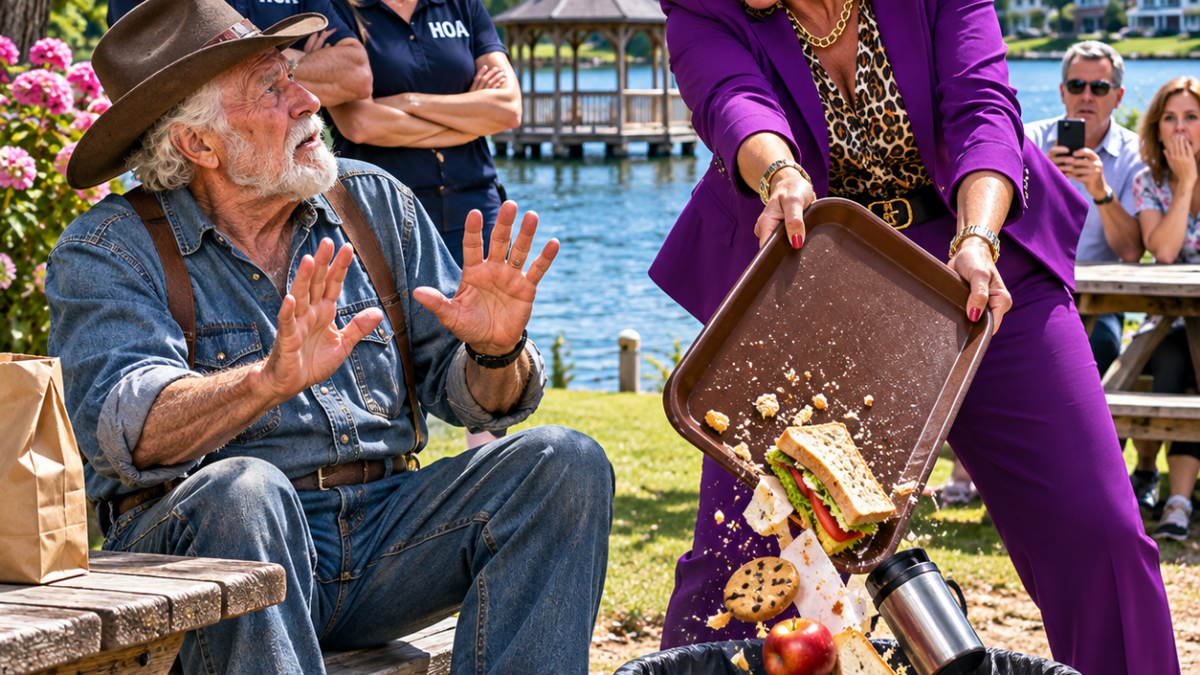
HOA President Dumped an Old Cowboy’s Lunch—Then Learned He Owned the $12M Lakefront Beneath Her Clubhouse
**“GET YOUR FOOD AND GET OFF OUR PRIVATE LAKEFRONT! PEOPLE LIKE YOU DON’T GET TO SIT HERE JUST BECAUSE YOU FOUND AN EMPTY BENCH!” HOA president Patricia Dawson snapped before grabbing my seventy-two-year-old father’s brown paper lunch sack and dumping his ham sandwich, apple, two homemade cookies, and metal thermos straight into a trash can beside Cedar Lake.**
**Dad did not yell or threaten her; he simply looked at the coffee grounds stuck to his thermos and quietly told Patricia she probably should not have done that—right before a black SUV pulled up carrying our attorney, the county surveyor, and an appraiser with a valuation showing Walker Lakefront Holdings was worth just over $12 million.**
**Then the surveyor unfolded his map across the hood, traced our family boundary through Pinecrest’s marina and luxury cottages, and stopped his finger directly beneath the HOA’s new $3.4 million clubhouse—while Patricia stared at my father and finally realized the dusty old cowboy she had just thrown off the waterfront might own the ground under nearly everything she had been bragging about.**
My name is Daniel Walker.
Robert Walker is my father.
And if you saw Dad walking across a parking lot without knowing him, you would probably make the same first assumption most strangers did.
Old rancher.
Maybe retired.
Maybe not much money.
Faded denim shirt.
Brown boots scratched from actual work.
Old silver belt buckle.
Cowboy hat that had been repaired so many times I honestly could not tell you which piece of it was original anymore.
He drove a nineteen-year-old pickup.
Fixed his own gates.
Carried lunch from home because, according to him, restaurants put too much salt in everything.
If coffee cost more than four dollars, Dad considered it evidence that civilization was failing.
What he did not do was talk about money.
That was probably why Patricia Dawson made the mistake she did.
The Walker family’s connection to Cedar Lake started with my grandfather, James Walker.
In 1964, Grandpa bought almost four hundred acres around the western side of what was then a quiet natural lake in eastern Oklahoma.
Back then, nobody would have called the property luxurious.
Rough pasture.
Timber.
Old dirt road.
A few cabins.
One fishing dock.
Cattle country.
Grandpa loved it.
He liked having water nearby.
He liked enough land to keep cattle.
And, according to Dad, he liked having enough distance between himself and the nearest neighbor that anybody who wanted to complain needed binoculars.
Over the next thirty years, everything around Cedar Lake changed.
The state improved the highway.
A nearby city expanded.
Vacation homes appeared.
Developers started buying land.
Grandpa sold small pieces carefully.
Never all at once.
He was suspicious of anybody carrying a glossy brochure.
But he kept the western lakefront.
That included nearly a mile of shoreline, the old picnic grove, the access road, the original dock area, and several flat acres above the water.
When Grandpa died, that land passed to Dad.
Dad never wanted to turn it into some massive resort.
He leased a little shoreline to a fishing business.
Allowed local families to use the picnic grove if they cleaned up.
And under a large cottonwood tree near the water, he kept an old wooden bench he had built himself in 1989.
That bench would become more important than anyone expected.
PART2:
Pinecrest Estates—or Pinerest, as some of the older paperwork called it—arrived about fourteen years before Patricia threw Dad’s lunch away.
A development company bought land east and south of ours and built a gated community around part of Cedar Lake.
First phase:
Eighty-six homes.
Then a pool.
Walking trails.
Marina.
More houses.
Eventually Pinecrest became one of the most expensive communities in the county.
The original developer, William Grant, got along with Dad.
William understood a concept that became strangely difficult for everyone later.
Property lines.
If Pinecrest needed something across Walker land, William asked.
They needed access across one narrow strip.
William negotiated an easement.
They wanted several boat slips beside our shoreline.
They leased them.
They wanted residents to use the picnic grove during the annual summer festival.
They asked permission.
Dad usually said yes.
Nobody needed attorneys screaming across conference tables.
The arrangement became friendly enough that Dad allowed Pinecrest to maintain part of the western shoreline near the marina.
In exchange, residents could walk a marked shoreline trail.
The agreement was written.
Twenty-year recreational license.
No transfer of ownership.
PART3:
No permanent structures without written permission.
No commercial use beyond what was specifically authorized.
Both sides could review the terms every five years.
Dad kept a copy.
The developer kept a copy.
Simple.
For years, it worked.
Then William’s company sold its remaining interest.
A management firm took over.
Eventually the HOA became fully homeowner-controlled.
Then Patricia Dawson became president.
I do not think Patricia began as some cartoon villain.
Residents liked her at first.
She was organized.
Energetic.
She pushed for better security.
Cleaner common areas.
Improved landscaping.
When Patricia wanted something done, it happened quickly.
The problem was that she gradually started confusing speed with authority.
If one contractor questioned her, she found another.
If somebody disagreed, she quoted an HOA rule.
If no rule applied, a new “policy” seemed to appear.
Dad noticed before I did.
One afternoon, he called.
“You know the picnic grove?”
“Of course.”
“They put up a sign.”
“What kind?”
“Pinecrest Residents Only.”
I laughed.
“On your land?”
“That’s what makes it interesting.”
“You want me to call them?”
“No.”
“Why?”
“Let them enjoy their sign.”
That was Dad.
He believed unnecessary fights were expensive and most bad assumptions eventually exposed themselves.
For a while, nothing happened.
Residents continued using the grove.
Dad continued eating lunch on his bench.
Then Pinecrest began improving the marina area.
Lighting.
Stone landscaping walls.
Large paved parking area.
Dad asked the manager whether construction stayed inside existing leases.
The manager said yes.
Dad trusted him.
That was probably our mistake.
Not because trust is wrong.
Because questions involving millions of dollars in land should be answered by surveys and deeds, not somebody saying, “Don’t worry, we checked.”
A year later, Pinecrest announced its new clubhouse.
Three stories.
Restaurant.
Event room.
Fitness center.
Huge terrace overlooking Cedar Lake.
Residents approved a major assessment.
Construction started near the marina.
Dad saw the heavy equipment but assumed the HOA had built on its own property.
Why wouldn’t he?
They had engineers.
Surveyors.
Attorneys.
A management company.
Surely somebody checked.
Those may be the three most dangerous words in real estate.
Surely somebody checked.
The clubhouse opened eighteen months later.
It was beautiful.
Stone exterior.
Huge lake-facing windows.
Wood balconies.
Restaurant terrace.
Patricia gave speeches about Pinecrest becoming the finest private waterfront community in the region.
Dad missed the opening.
He was fixing a cattle fence.
That tells you almost everything about my father.
Around the same time, the language around Walker land changed.
PRIVATE HOA MARINA.
PRIVATE HOA BEACH.
PRIVATE HOA PICNIC AREA.
The picnic grove was not technically a beach, but apparently marketing departments improve nouns for a living.
Dad asked Patricia about the signs.
She told him Pinecrest had maintained the shoreline long enough to possess “exclusive operational control.”
Dad said that sounded impressive.
Then he pointed to his bench.
“Operational control include that?”
Patricia did not know what he meant.
“I built that bench in 1989.”
She said it might have been replaced.
It had not.
Dad went home.
Still no fight.
Then Pinecrest installed parking controls on the lakefront access road.
The road crossed Walker land under the original easement.
Dad’s old pickup did not have a Pinecrest sticker.
One Saturday, a young security guard stopped him.
Dad explained who he was.
The kid checked something.
Realized the mistake.
Apologized immediately.
Lifted the gate.
Dad called me afterward.
“Nice kid.”
“They stopped you from driving across your own property.”
“He figured it out.”
“Dad.”
“What?”
“We need to check the documents.”
He sighed.
That was when I became involved.
I work in commercial property management.
Deeds.
Leases.
Operating agreements.
Easements.
Those things were not foreign to me.
I gathered Grandpa’s old files.
Dad’s recreational license.
The road easement.
Marina lease.
County parcel information.
Everything said essentially the same thing.
Walker Lakefront Holdings still owned approximately forty-six acres along Cedar Lake.
Picnic grove.
Western marina ground.
Access road.
Shoreline.
Several flat commercial sections.
Pinecrest owned residential parcels and separate common areas farther inland.
The marina was complicated but legal.
Dad owned ground under portions of it.
Pinecrest owned various improvements through long-term lease arrangements.
Then I looked at the clubhouse.
County parcel maps placed it very close to our boundary.
Too close.
Online maps are not surveys.
I knew that.
So I asked Dad.
“Did they ever request a clubhouse easement?”
“No.”
“Land sale?”
“No.”
“Boundary adjustment?”
“No.”
“Building rights?”
“No.”
That bothered me.
I hired Thomas Reed.
Licensed surveyor.
Twenty-five years around Cedar Lake.
I asked him to verify our property quietly.
No accusations.
No calls to Pinecrest.
Just measurements.
Thomas spent several days locating monuments, comparing old deeds, reviewing plats and tracing shoreline references.
Then he called.
“Daniel, your family owns more marina area than the current fence suggests.”
“How much?”
“I’m still working.”
“What about the clubhouse?”
Long pause.
“I’m still working.”
I hate when professionals say things like that.
While Thomas continued surveying, Patricia’s behavior toward Dad became worse.
Pinecrest had introduced premium annual lakefront memberships.
Reserved picnic areas.
Marina events.
“Private beach” benefits.
Clubhouse restaurant discounts.
Dad found it hilarious.
“They’re selling people permission to sit under my trees.”
The original license allowed residents to use sections of the grove.
It did not allow Pinecrest to turn Dad’s land into a commercial membership package.
We brought in Rebecca Collins.
Property attorney.
She read the recreational license.
Her conclusion:
Pinecrest could maintain the designated area for resident use.
It could not create separate paid commercial privileges without Walker permission.
Rebecca sent a polite letter.
No threats.
No demands to close anything.
Just:
Please review the agreement and meet with us.
Patricia refused.
Then Pinecrest installed fencing around part of the picnic grove.
Dad’s bench ended up inside.
Dad did not cut anything.
Did not remove locks.
He walked around the barrier using a shoreline opening and sat down.
Security questioned him again.
Patricia happened to be nearby.
Dad explained that he owned the land.
She told him he was confused.
“You might have owned property here years ago, Mr…?”
“Walker.”
“You may have had property here before Pinecrest was developed, but the HOA controls this shoreline now.”
“I still pay the tax bill.”
She asked for identification.
Robert Walker.
The name apparently meant nothing to her.
That was remarkable considering Pinecrest’s own original lake agreements were signed:
Robert J. Walker.
Patricia had never connected the quiet old man in dusty boots to the name written across the documents governing her most valuable amenities.
She ordered him to leave until he could produce written permission.
Dad left.
Not because Patricia had authority.
Because he did not want to argue.
When he told me, I was furious.
He was not.
“People show you who they are when they think you can’t do anything for them.”
I never forgot that.
Thomas was almost finished.
Rebecca ordered a valuation too.
If Pinecrest had been commercially using Walker property beyond the lease, we needed the land’s real market value.
The appraiser surprised even me.
Development around Cedar Lake had exploded.
Waterfront commercial access was scarce.
Marina ground.
Road frontage.
Shoreline development potential.
Existing lease income.
Altogether:
Just over twelve million dollars.
Dad stared at the report.
“Twelve million?”
“Yes.”
“For dirt?”
“Very expensive dirt.”
He shook his head.
“Your grandfather paid less than seventy thousand for almost everything out there.”
“Times change.”
Dad did not suddenly decide to sell.
Money was never his point.
He wanted Pinecrest to respect the agreements and stop pretending his land belonged to the HOA.
Rebecca tried scheduling another meeting.
Patricia ignored it.
Then came the lunch.
Dad spent that morning repairing fence at the northern pasture.
Around noon he drove to Cedar Lake because Thomas was supposed to meet him near the marina.
Dad carried his normal lunch.
Ham sandwich.
Apple.
Two cookies my aunt Susan had made.
Coffee in his old metal thermos.
He sat beneath the cottonwood tree on the bench he built thirty-seven years earlier.
Patricia was walking several prospective homebuyers around the lakefront.
Dad did not fit the picture.
Dusty shirt.
Old boots.
Paper sack.
Nineteen-year-old pickup.
No HOA badge.
No country-club clothes.
She walked over.
“You need to leave.”
Dad looked around.
“Why?”
“This area is reserved for residents and invited guests.”
“I’m waiting for someone.”
“You cannot loiter here.”
“I’m eating lunch.”
Patricia looked toward the buyers.
Then back at him.
“Not here.”
Dad stayed seated.
“My name is Robert Walker.”
“I don’t care what your name is.”
That was her final chance to stop.
Call management.
Check the original license.
Look up Walker Lakefront Holdings.
Ask one question.
She did none of those things.
Patricia reached down.
Grabbed Dad’s lunch sack.
Dad stood.
“Ma’am, give that back.”
She walked to the trash can.
Dumped everything.
Sandwich.
Apple.
Cookies.
Thermos.
Wet paper plates.
Coffee cups.
Garbage.
A few people gasped.
Someone began recording.
Dad looked into the trash.
Then at Patricia.
“You probably shouldn’t have done that.”
She laughed.
Pinecrest, she explained, could remove abandoned food and property from private common areas.
Dad answered quietly.
“This isn’t your common area.”
Then the black SUV arrived.
Thomas Reed.
Rebecca.
The appraiser.
And Pinecrest community manager Susan Grant, who had finally agreed to meet after Rebecca bypassed Patricia and contacted management directly.
Thomas saw Dad beside the trash can.
“What happened?”
Dad pointed.
“She threw away my lunch.”
Thomas stared at Patricia.
Then the bench.
Then his survey equipment.
Rebecca already knew exactly who Dad was.
Patricia still had no idea.
Susan walked over.
“Mr. Walker.”
Patricia’s expression shifted.
The appraiser handed Dad his valuation file.
“Mr. Walker, we have the updated appraisal. Walker Lakefront Holdings is now valued at slightly over twelve million dollars.”
Patricia stopped moving.
First reveal.
Not the biggest.
Thomas unfolded his survey across the hood.
Picnic grove:
Walker property.
Access road:
Walker property, subject to easement.
Western marina ground:
Walker property under lease.
Patricia’s face lost color.
Then Thomas moved uphill.
Parking lot.
Boundary ran through it.
Then:
Clubhouse.
The line passed directly beneath the western portion.
Susan Grant leaned closer.
“That can’t be correct.”
Thomas answered the way very confident surveyors do.
“County monuments, recorded deed calls and original plats all agree.”
Patricia finally spoke.
“How much of the clubhouse?”
“Still calculating.”
Then Thomas’s assistant shouted from the marina.
They had uncovered an old metal survey marker underneath decorative landscaping.
Original Walker parcel number.
Almost sixty feet inside what Pinecrest currently treated as HOA property.
Thomas opened an older plat.
The true Walker line continued along the shore.
Through the clubhouse.
Across the service yard.
Past the parking area.
Under three luxury cottages Pinecrest had been renting for almost three years.
And beneath most of a newly completed event pavilion scheduled to open the following weekend.
Susan whispered:
“How did nobody catch this?”
That became the question.
Rebecca found the first answer.
A later construction drawing said:
**BOUNDARY ADJUSTED PER WALKER AGREEMENT.**
“Robert, did you sign a boundary adjustment?”
“No.”
“Sell Pinecrest this land?”
“No.”
“Permanent building rights?”
“No.”
The drawing cited an agreement supposedly signed eight years earlier.
Seller:
Robert J. Walker.
Buyer:
Pinecrest Community Association.
Dad’s name.
Dad’s signature.
He stared.
“That isn’t mine.”
Rebecca enlarged it.
Dad leaned closer.
Then:
“I know where they got that.”
Years before, Dad had signed a temporary amendment allowing Pinecrest to widen the marina service lane.
They compared the signatures.
Exact.
Same shape.
Same strange break in the R.
Copied.
Patricia immediately said:
“I had nothing to do with that. I wasn’t president eight years ago.”
Maybe.
We did not know.
Then Susan checked the HOA digital archive.
The supposed eight-year-old boundary agreement had actually been uploaded four years earlier.
Administrator initials:
PD.
Patricia Dawson.
Patricia stepped backward.
Rebecca remained careful.
“That doesn’t prove who created it.”
Then Thomas pointed to another deed provision.
Grandpa’s original Walker deed had reserved important commercial shoreline and boat-access rights.
Pinecrest’s marina expansion depended on those rights.
So did parts of the rental operation.
So did the premium events Patricia had been promoting.
Dad looked toward the trash.
His sandwich was still lying on top.
“I came here to eat lunch.”
Then a maintenance truck appeared.
Small excavator behind it.
Concrete mix.
Steel marker.
Susan frowned.
“No work is scheduled.”
Thomas intercepted the supervisor.
“What are you doing?”
“Replacing the boundary monument.”
“Under whose authority?”
The supervisor showed him the work order.
**REMOVE OBSOLETE WALKER MONUMENT. INSTALL UPDATED PINECREST PROPERTY MARKER.**
Authorized that morning.
P. Dawson.
Dad slowly removed his cowboy hat.
Rebecca looked at Patricia.
“You ordered them to remove the original survey marker today?”
Patricia’s attorney told her not to answer.
Then Susan’s phone rang.
County recorder.
A new deed had just been filed.
Walker Lakefront Holdings.
All forty-six acres.
Transferred to:
PINECREST PROPERTY MANAGEMENT LLC.
Sale price:
Ten dollars.
Dad’s signature appeared at the bottom.
Dad stared at the screen.
Then looked at Patricia.
“I’ve bought sandwiches that cost more than that.”
Nobody knew what to say.
The deed supposedly transferred the picnic grove.
Marina ground.
Access road.
Shoreline.
Clubhouse land.
Cottage parcels.
Everything still tied to the Walker title.
For ten dollars.
Rebecca immediately challenged the filing.
The county could not erase a recorded deed because somebody complained, but it could flag the dispute and preserve the record.
Dad picked his thermos from the trash.
Rinsed it with bottled water.
Sat back down.
Susan asked:
“Mr. Walker, can I get you another lunch?”
“No, ma’am.”
He looked tired now.
“Not hungry anymore.”
The deed unraveled quickly.
Notary:
Helen Morris.
Real notary.
Digital title-processing verification code:
Real-looking.
Patricia’s attorney suggested perhaps Dad had completed a transfer he no longer remembered.
Dad stared at him.
“I’m seventy-two, not dead.”
Fair.
The deed claimed Dad signed six days earlier in an office almost fifty miles away.
I had been with him that morning repairing a gate.
Then he visited a veterinary clinic with Frank Wilson because one of our older cows had trouble walking.
Receipts.
Cameras.
Witnesses.
Clear Path Title Processing checked its records.
No Walker closing.
No Pinecrest Property Management purchase.
The verification number came from an unrelated mortgage release in another county.
Helen Morris had never notarized the deed.
Her stamp details came from an older Pinecrest banking document.
Then we discovered who managed Pinecrest Property Management LLC.
Patricia Dawson.
She insisted she had formed the company for future management operations and knew nothing about the deed.
Dad asked:
“Did your company pay me ten dollars?”
“No.”
“Then somebody owes me ten dollars.”
Even Thomas laughed.
The court froze the transfer the next morning.
Pinecrest Property Management could not sell, mortgage, lease or develop the property while title was disputed.
Dad remained in possession.
That night, Pinecrest held an emergency meeting.
Residents were terrified.
If Dad really owned parts of the clubhouse, marina, cottages and parking areas, could he close everything?
He stood.
“I’m not here to throw families off the lake.”
Quiet.
“I’m here because your president threw my lunch into the garbage while sitting on property my family owns.”
Nervous laughter.
A woman named Jennifer Cole asked:
“My children use the picnic grove every weekend. Are you going to block it?”
“No.”
“Even after what happened?”
Dad shook his head.
“You didn’t throw away my sandwich.”
That sentence changed the room.
Patricia was not Pinecrest.
The board was not every homeowner.
Families using the lake were not responsible for whatever somebody had done with property documents.
Then came the financial numbers.
Pinecrest collected nearly $410,000 a year in lakefront-related revenue.
Marina slips.
Premium memberships.
Rental cottages.
Clubhouse rentals.
Event fees.
A significant portion depended on Dad’s property.
Some use was authorized.
Some was not.
Different rights.
Different documents.
Over the years, those distinctions had been blurred until the HOA began acting like permission equaled ownership.
Thomas finished his survey.
Approximately forty-two percent of the clubhouse sat on Walker land.
Almost the entire primary lake terrace.
Twenty-eight parking spaces.
Marina maintenance yard.
Three cottages.
Most of the event pavilion.
The picnic grove remained completely Walker land.
That did not mean Dad suddenly owned the clubhouse building itself.
Pinecrest paid for the structure.
Dad owned the ground beneath a large portion of it.
Complicated.
Then the forensic property audit started.
The retired original developer, William Grant, confirmed:
Dad never sold the western lakefront.
Never signed a boundary transfer.
And, most importantly, the original clubhouse plan had placed the building almost two hundred feet farther east.
The final building had moved closer to the water.
Who chaired the development committee that approved the location?
Patricia Dawson.
Before she became HOA president.
Then an old engineer’s email surfaced.
**REVISED CLUBHOUSE FOOTPRINT EXTENDS BEYOND CURRENTLY CONFIRMED PINECREST PARCEL. WALKER LICENSE DOES NOT APPEAR TO INCLUDE PERMANENT BUILDING RIGHTS. RECOMMEND TITLE REVIEW BEFORE CONSTRUCTION.**
Patricia replied:
**Walker line shown differently on management map. Proceed with current design while documentation is corrected.**
Proceed first.
Correct paperwork later.
Another warning arrived months later.
No recorded Walker transfer found.
Patricia claimed “legal” said historical use supported Pinecrest’s boundary.
Rebecca searched for the opinion.
Nothing.
Instead, the old law firm found a letter sent directly to Patricia.
**DO NOT REPRESENT THE CLUBHOUSE SITE AS PINECREST-OWNED UNTIL WALKER MATTER IS RESOLVED.**
Clear.
Simple.
Ignored.
Why?
Financing.
The clubhouse lender required control of the site.
Moving the project would cost money.
Delay construction.
Reduce the view.
Lower expected commercial revenue.
A shifted map solved that problem on paper.
Then the same false boundary supported financing for the cottages.
Millions of dollars had been borrowed against improvements partly sitting on Dad’s property.
The new ten-dollar deed was worse.
A document examiner traced Dad’s fresh-looking signature.
One month earlier, Pinecrest had hosted a fundraiser for a children’s hospital.
Dad donated a registered quarter-horse experience.
He signed a donor form.
That signature matched the fake deed perfectly.
Dad looked genuinely hurt.
“That paper was for sick kids.”
Rebecca nodded.
“I know.”
“Whoever did that deserves whatever comes next.”
Digital evidence tightened around Patricia.
Fake deed created on a computer registered to Pinecrest Property Management.
Username:
P. Dawson.
File created while her account was active from her home internet.
Electronic filing account created using her email.
She claimed somebody used her systems without permission.
Possible.
But the board suspended her.
Frank Miller became acting president.
Dad’s first comment:
“That sandwich got expensive.”
He was right.
Then Pinecrest began negotiating instead of pretending.
Dad did not want to demolish the clubhouse.
He did not want families thrown out of rental cottages.
He did not want to lock residents away from the picnic grove.
He wanted accurate ownership.
Fair compensation.
Clear leases.
No more fake control.
For almost two weeks, everything calmed down.
Dad ate lunch on his bench again.
Susan brought him a sandwich the first day.
“You’re making me soft,” Dad told her.
“I’m protecting Pinecrest from another twelve-million-dollar lunch problem.”
That actually made him laugh.
Then an old concrete post surfaced on the northern shoreline.
Stamped:
**WALKER WATER RIGHTS 1964.**
Grandpa’s deed included more than surface ownership.
It reserved certain commercial water-access rights involving boat launches, docks and shoreline business.
Pinecrest’s existing marina lease covered some.
The premium events and cottage-related commercial uses did not necessarily.
That could mean years of unpaid compensation.
Dad’s first question:
“Residents going to lose their boats?”
“No.”
“Good.”
That was Dad.
Fairness before leverage.
Then Susan Grant opened an old locked cabinet behind Patricia’s office.
Inside:
Walker deeds.
Maps.
Appraisals.
Dad’s tax records.
Photos of the ranch.
Family information.
And a folder labeled:
**WALKER ACQUISITION STRATEGY.**
First page:
Lakefront valuation.
Around twelve million.
Prepared three years earlier.
Patricia had known the property’s value long before she threw Dad’s lunch away.
The folder included Dad’s age.
Home address.
Estimated income.
Family contacts.
My information.
Then a strategy chart.
Voluntary sale.
Long-term lease.
Boundary claim.
Adverse-use position.
Title consolidation.
Some of those were normal negotiation ideas.
Then:
**PROJECTED PINECREST VALUE AFTER FULL WALKER ACQUISITION: +$26 MILLION.**
Now we understood the stakes.
Then a handwritten note:
**ROBERT UNLIKELY TO SELL WHILE ALIVE. SUCCESSOR MAY BE EASIER.**
Dad closed the folder.
“That’s enough.”
Susan found another binder.
LAKEFRONT TRANSITION — FINAL PHASE.
Drafts of the ten-dollar deed.
Dad’s donor-form signature.
Fake notary information.
Closing checklist.
And one line:
**REMOVE WALKER MONUMENT AFTER RECORDING.**
Then:
**AFTER MONUMENT REMOVAL, ISSUE TRESPASS NOTICE TO ROBERT WALKER.**
The plan was not simply to put false ownership on paper.
File deed.
Remove physical boundary evidence.
Then ban Dad from the land.
Including the bench.
That same night, marina security alerted.
Flatbed truck.
Bulldozer.
Temporary fencing.
PROPERTY CLOSED signs.
A man arrived carrying an emergency condemnation order.
It claimed Walker Lakefront had unsafe structures and environmental hazards requiring immediate closure.
County director signature.
Official-looking number.
Rebecca checked.
County director had retired the previous year.
Permit number came from an unsafe warehouse forty miles away.
Another real number attached to a false document.
The bulldozer started.
Its headlights fell directly across Dad’s bench.
The work order listed it first.
REMOVE LEGACY BENCH.
Then:
REMOVE WALKER SURVEY MONUMENT.
Then old storage shed.
Dad stared at the contractor.
“They put my bench on a demolition list?”
The operator looked embarrassed.
“Yes, sir.”
“I built that bench before your truck existed.”
Sheriff shut the operation down.
The contractor had been deceived too.
Again:
The person driving the machine is not automatically the person creating the lie.
That distinction mattered throughout everything.
Digital traces led back to a private Patricia project folder:
WALKER CLEARANCE.
Created four days earlier.
Modified that morning.
Same company laptop.
Same home internet connection.
Pinecrest board froze every contract connected to Patricia’s private management company.
Then forensic accountant Laura Bennett found the money.
Pinecrest Property Management had received roughly $640,000 from the HOA over two years.
Lakefront planning.
Cottage management.
Marina consulting.
Shoreline operations.
But Pinecrest already employed a normal community management firm.
Why was the HOA paying another company controlled by its president?
One payment stood out.
**WALKER TRANSITION SERVICES — $118,000.**
Dad looked at me.
“They paid somebody to transition me?”
“That’s what it says.”
The money then moved from Patricia’s company to Lakefront Renewal Partners.
Owner:
Mark Dawson.
Patricia’s husband.
His company had a consulting agreement promising a success fee if Pinecrest obtained full control over Walker Lakefront.
Success fee:
$475,000.
Success was defined as any one of three outcomes:
Voluntary sale.
Court-confirmed title.
Administrative possession.
That final phrase mattered.
The fake condemnation order suddenly made sense.
Remove Dad through official-looking paperwork.
Establish physical control.
Then fight about ownership afterward.
Build reality around the documents and make everyone else catch up.
Then another payment:
$320,000.
STRUCTURE REMOVAL RESERVE.
They were budgeting demolition before they owned anything.
Pinecrest Property Management had also purchased a private insurance policy covering Walker Lakefront Holdings.
Insured value:
$14.8 million.
Owner listed:
Pinecrest Property Management.
Loss payee:
Patricia’s company.
The application included the fake ten-dollar deed.
Why insure property you did not own?
Why insure it for more than the independent appraisal?
Then construction records appeared.
PINECREST WESTERN RENEWAL.
Remove picnic grove structures.
Demolish storage.
Clear shoreline vegetation.
Rebuild marina entry.
Expand event area.
And:
**REMOVE OBSOLETE WALKER RESIDENCE ACCESS.**
Dad’s private road.
The sequence had been planned.
File deed.
Remove marker.
Condemn property.
Restrict Dad’s access.
Create visible control.
Fight later.
Then the insurance policy became even more disturbing.
The application emphasized wildfire exposure.
Dry vegetation.
Potential structure loss.
If the clubhouse, cottages or marina became unusable because of fire or major damage, Patricia’s private company could collect up to fourteen million dollars.
Nobody accused anyone of planning arson yet.
That would have been too great a leap.
Evidence first.
Then the county issued a high-fire-risk advisory.
Dry conditions.
Strong wind.
Dad and I installed more cameras.
He complained the entire time.
“Dad, someone tried to bulldoze your bench.”
“Doesn’t mean we need to become paranoid.”
“Hold this ladder.”
He held the ladder.
Two nights passed.
Nothing.
Third evening, Dad and I sat on the bench.
He had another ham sandwich.
I pointed toward the trash.
“Need help?”
He gave me a look.
Then laughed.
For twenty minutes, we were just father and son sitting beside Cedar Lake.
Then my phone buzzed.
Motion alert.
Northern service road.
Pickup truck.
Two people.
One climbed out carrying a red fuel can.
Dad saw the screen.
“Call the sheriff.”
I did.
Another camera triggered.
A second person near the tree line.
Then smoke appeared behind the cottages.
Thin.
Then dark.
Flames jumped through dry grass.
Wind pushed them toward the clubhouse.
The pickup sped for the exit.
Pinecrest security tried closing the gate.
Truck smashed through.
Deputy Michael Grant pursued.
Fire crews arrived fast.
Then Susan called screaming.
“The clubhouse sprinklers have no pressure.”
Thomas checked the water cabinet.
Main sprinkler line had been manually shut.
A secondary valve had been opened to drain pressure.
Someone had prepared the building to have no sprinkler water when the fire came.
Firefighters switched to truck-fed lines.
Then they found fuel containers along the landscaping.
This was not an accidental grass fire.
Deputy Michael stopped the truck five miles away.
Two men inside.
A contract worker.
And Mark Dawson.
Patricia’s husband.
Owner of Lakefront Renewal Partners.
The man promised nearly half a million dollars if Dad lost control of the land.
Inside the truck:
Insurance claim paperwork.
Already completed.
Policy matching the new $14.8 million coverage.
Date of loss:
Tomorrow.
Dad stared toward the smoke.
“They planned the ending before they started the fire.”
Firefighters stopped the flames less than thirty feet from the clubhouse wall.
Nobody hurt.
That was what mattered first.
Cottages evacuated.
Grass burned.
Several trees damaged.
Buildings survived.
The contractor in Mark’s truck began cooperating.
He said Mark claimed they were preparing for a controlled vegetation burn.
His phone messages told a different story.
**MAKE SURE WESTERN SPRINKLER FEED IS OFFLINE BEFORE START.**
And:
**NEED DAMAGE BEYOND LANDSCAPING OR INSURANCE WON’T TRIGGER.**
Security records showed Mark’s key card entering the clubhouse utility room forty-three minutes before the first flame.
Camera showed his truck there.
Fingerprints on the sprinkler cabinet.
Patricia was at home.
That mattered.
Her phone records placed her there.
But investigators found messages.
Patricia:
**Everything must be finished before Walker title hearing.**
Mark:
**Tomorrow changes leverage.**
Patricia:
**Do not involve me in operations.**
Mark:
**Understood.**
Those messages did not, by themselves, prove Patricia knew about a planned fire.
Rebecca refused to overstate them.
We already had enough evidence.
The next morning Pinecrest residents packed the pool house.
Frank opened with:
“The Walker family will not be blamed for what happened here.”
He made it clear.
Dad did not start the fire.
Did not turn off sprinklers.
Did not create false deeds.
Did not build private companies around HOA money.
Pinecrest would deal with its own problems honestly.
The board canceled every contract connected to Patricia’s company and Mark’s company.
Then Pinecrest formally acknowledged that Walker Lakefront Holdings remained privately owned unless a valid recorded document or court order proved otherwise.
Unanimous.
Dad leaned toward me.
“About time.”
Three days later, the court voided the ten-dollar deed.
Dad never signed it.
Notary never witnessed it.
Title service never handled it.
Verification code belonged to another file.
Signature copied from the children’s hospital donor form.
No ten-dollar payment.
No sale.
County records restored:
Robert Walker.
Owner.
Dad folded the order once and put it inside his shirt pocket.
“You want me to carry that?”
“No.”
“Why?”
“I’m carrying this one myself.”
Fair.
The fake boundary adjustment fell next.
Copied signature.
Wrong document reference.
No valid transfer.
Thomas’s survey became the accepted boundary.
Which meant Pinecrest really had built major improvements across Walker property.
Dad had enormous leverage.
He could have tried forcing demolition.
Clubhouse.
Cottages.
Pavilion.
Parking.
He did not.
Instead, we negotiated.
Dad sold Pinecrest the small parcels directly underneath the clubhouse and three cottages.
Fair market appraisal.
No revenge premium.
No symbolic ten-dollar joke.
The structures were already there.
Most residents had paid for them without knowing the boundary was wrong.
Tearing them down would punish people who had not created the problem.
Pinecrest paid compensation for years of unauthorized commercial use.
Marina agreement rewritten.
Commercial slips paid rent.
Cottage use received its own lease.
Event pavilion required explicit authorization.
The picnic grove stayed Walker property.
Residents received a new ten-year recreational license.
Clearer than before.
No permanent structures without written approval.
No commercial use unless listed.
Maintenance does not create ownership.
Permitted use does not create ownership.
No boundary change without a recorded deed.
Dad insisted on that line.
Rebecca looked at him.
“You’re starting to sound like a lawyer.”
Dad smiled.
“Maybe I’m learning.”
Walker Lakefront Holdings became somewhat smaller after selling the clubhouse and cottage footprints.
Still extremely valuable.
Dad barely cared.
His bench stayed.
That mattered more.
The financial investigations continued.
More than a million dollars in Pinecrest money had moved through Patricia, Mark and related companies.
Not every dollar was illegal.
Some work was real.
Some invoices legitimate.
That distinction mattered.
But other payments were tied directly to:
Walker acquisition strategy.
Transition planning.
Demolition reserves.
Success fees.
Fake condemnation.
Private insurance.
False property filings.
Mark faced serious charges tied to the fire, financial misconduct, false documents, insurance-related fraud and property schemes.
The contractor who carried fuel faced his own consequences.
Cooperation helped him.
It did not erase his choices.
Patricia faced separate allegations tied to the ten-dollar deed, false boundary documents, monument-removal plan, fake condemnation paperwork, related-party contracts and acquisition strategy.
Her attorneys argued Mark performed many technical steps.
Some evidence supported that.
Other evidence showed Patricia approved, discussed or signed enough that she could not simply claim she knew nothing.
The cases took months.
Then more months.
Dad attended one major hearing.
After that:
“I already got my land back.”
“You don’t want to know what happens?”
“I want to know when the judge finishes. I don’t need to watch lawyers talk all day.”
That was Dad.
Eventually Mark accepted responsibility for several major offenses and faced substantial legal consequences, restitution and business restrictions.
Patricia also faced criminal and civil consequences for the role investigators could document.
Neither simply walked away.
Dad never celebrated.
One day I asked:
“You feel bad for them?”
“No.”
“You hope they get off easy?”
“No.”
“What then?”
Dad looked at me.
“I hope they learn something.”
“That sounds like kindness.”
“Consequences and kindness aren’t opposites.”
I never forgot that.
Pinecrest changed.
Frank helped stabilize the HOA but refused to remain president forever.
Residents later elected Jennifer Cole.
First meeting:
Forty minutes.
Dad said that alone qualified her for public office.
New rules were strict.
Board members could not route contracts to family-owned companies without full disclosure and independent approval.
Outside attorneys reviewed property filings.
No officer-controlled private company could receive HOA funds without oversight.
Any land purchase required independent title work.
No survey marker could be removed without a licensed surveyor.
Emergency property actions needed more than one board member’s order.
Major contracts became available for homeowner review.
The picnic grove became busy again.
Dad could have closed it permanently.
He did not.
He renewed resident access for ten years.
Frank asked why.
Dad answered:
“Kids didn’t fake my deed.”
That was enough.
A new sign went up:
**WALKER LAKEFRONT — PRIVATE PROPERTY
PINECREST RESIDENT ACCESS BY PERMISSION
PLEASE RESPECT THE LAND**
No angry warning.
No threats.
Just truth.
The old PINECREST RESIDENTS ONLY sign disappeared.
Dad’s bench stayed under the cottonwood.
Susan offered to buy him a new one.
“It leans.”
“So do I.”
Discussion over.
The first lunch after the settlement became something I still think about.
About twenty residents showed up.
Not formally.
Word simply spread.
Jennifer brought sandwiches.
Frank brought drinks.
Susan brought cookies.
Someone installed a brand-new trash can fifty feet away.
Dad looked at me.
“You planned this?”
“No.”
He did not believe me.
Jennifer handed him a brown paper sack.
Ham sandwich.
Apple.
Two cookies.
Dad laughed.
Then looked at the trash can.
“Keep Patricia away from this.”
Everybody laughed.
It was the first time the lunch story felt funny instead of cruel.
Dad sat down.
Ate.
Nobody asked him to leave.
Nobody wanted his identification.
Nobody told him he did not look like he belonged.
One little boy asked:
“Are you a real cowboy?”
Dad looked down at his boots.
“Depends who you ask.”
The boy pointed to his hat.
“You have the hat.”
Dad nodded.
“Good evidence.”
That afternoon became one of my favorite memories.
Not because we won.
Because Cedar Lake felt normal again.
Walker family and Pinecrest residents sitting together.
Children running near the water.
Nobody carrying a legal folder.
No bulldozers.
No fake deeds.
No survey argument.
Just neighbors.
County maps were corrected.
Walker boundary restored.
Clubhouse sale parcels recorded.
Cottage leases recorded.
Marina rights recorded.
Water rights clarified.
Permanent survey markers installed.
No historical assumption pretending to be ownership.
No private map replacing a deed.
Commercial water rights produced another settlement.
Pinecrest compensated Dad for past unlicensed uses involving cottage rentals, premium events and certain marina activity.
Rebecca thought Dad could demand more.
He refused.
“What am I going to do with more money?”
“Buy a newer truck.”
“My truck runs.”
“Bigger house?”
“I have one.”
“Travel?”
“I hate airports.”
Rebecca gave up.
Dad used part of the settlement to restore the picnic grove.
Replaced trees damaged by the fire.
Repaired the shoreline path.
Added two safety lights.
Then he donated money to the same children’s hospital whose fundraiser form had been used to steal his signature.
I asked why.
“That paper didn’t do anything wrong.”
Fair.
He also started the James Walker Land Stewardship Scholarship for students studying agriculture, surveying or land management.
Dad said maybe a future surveyor would learn to check a deed before somebody built a multimillion-dollar clubhouse on the wrong ground.
Thomas said that sounded like a personal attack.
Dad said:
“It probably is.”
By spring, the burned grass had returned.
Cottages reopened.
Clubhouse sprinkler system was rebuilt with tamper alarms.
Independent monitoring made it impossible for one person to quietly drain pressure again.
Pinecrest also changed its marketing.
No more:
PRIVATE PINECREST WESTERN SHORELINE.
Instead:
Resident access to selected privately owned shoreline areas through recorded agreements.
Not exciting.
Accurate.
Dad loved it.
Almost two years after Patricia threw his lunch away, I found him on the same bench.
Same boots.
Same hat.
Same thermos.
Boats moving across Cedar Lake.
I sat beside him.
“You ever think about selling?”
“Yes.”
“Really?”
“No.”
“Even for twelve million?”
Dad looked at me.
“Son, if I wanted twelve million dollars more than I wanted this place, I would’ve sold it already.”
True.
“Then why sell Pinecrest the clubhouse section?”
“Because the building was already there.”
“You could’ve forced them to move it.”
“Maybe.”
“Why didn’t you?”
He looked out over the lake.
“Being right doesn’t mean you have to be cruel.”
I said nothing.
“Those homeowners paid for that building. Most didn’t know where the line was. Tearing it down would make me feel powerful for five minutes and stupid for the rest of my life.”
Then he smiled.
“Besides, their restaurant makes decent pie.”
That was Dad’s justice.
Protect what matters.
Fix what can be fixed.
Do not create extra pain just because somebody finally gives you leverage.
The story became famous around Cedar Lake.
And like every local story, people improved it until half the versions were nonsense.
Some claimed Patricia tried stealing Dad’s entire ranch.
Not exactly.
Some said Dad secretly owned all of Pinecrest.
Absolutely not.
Some claimed Dad bought the HOA after the lunch incident.
Also false.
The truth did not need help.
An HOA president saw an old cowboy eating from a paper sack and decided he looked too poor to belong near her luxury lakefront.
She grabbed his lunch.
Threw it away.
Told him nothing there belonged to him.
She did not know his name was Robert Walker.
Did not know he built the bench.
Did not know the picnic grove was his.
Did not understand that Pinecrest’s marina occupied Walker ground under lease.
Did not know large parts of the clubhouse, cottages, parking area and pavilion sat on land his family never sold.
And she certainly did not expect the property to be worth roughly twelve million dollars.
But the twelve million was never the most important part.
Dad did not prevail because he turned out to be wealthy.
He prevailed because the deed was real.
The survey was real.
The boundary monuments were real.
The leases were real.
His permission mattered.
His no mattered.
His ownership did not become weaker because he wore old boots.
Patricia looked at those boots and saw somebody unimportant.
Her project files looked at Dad’s age and saw weakness.
Her management company looked at Walker land and saw revenue.
Mark’s company saw a success fee.
The insurers saw paper they assumed somebody else had verified.
Everybody saw something except the person standing in front of them.
Dad said it better than I ever could.
“People get dangerous when they stop seeing the person.”
Today, the picnic grove still belongs to Walker Lakefront Holdings.
Pinecrest residents still use it.
The marina operates.
The luxury cottages still rent.
The clubhouse still stands.
Now the land beneath its Walker-side footprint actually belongs to Pinecrest because Dad sold that section legally.
The pavilion has a recorded lease.
The access road has a recorded easement.
The commercial shoreline rights are documented.
Everything that should have been clear from day one is finally clear.
And Dad still eats lunch beneath the cottonwood.
Brown paper bag.
Ham sandwich.
Apple.
Cookies.
Metal thermos.
There is one difference.
Beside the old bench now sits a small brass plaque.
**PROPERTY OF ROBERT WALKER
PLEASE DO NOT REMOVE**
Dad hates it.
I love it.
Every time I see that plaque, I remember the afternoon Patricia Dawson grabbed an old cowboy’s lunch and threw it in the trash because she was absolutely certain that nothing on that waterfront belonged to him.
She was wrong.
By about twelve million dollars.








