HOA President Drained Our Town’s Reservoir on Instagram—Then 43 Seconds of Her Own Video Exposed What Was Hidden Under the Water
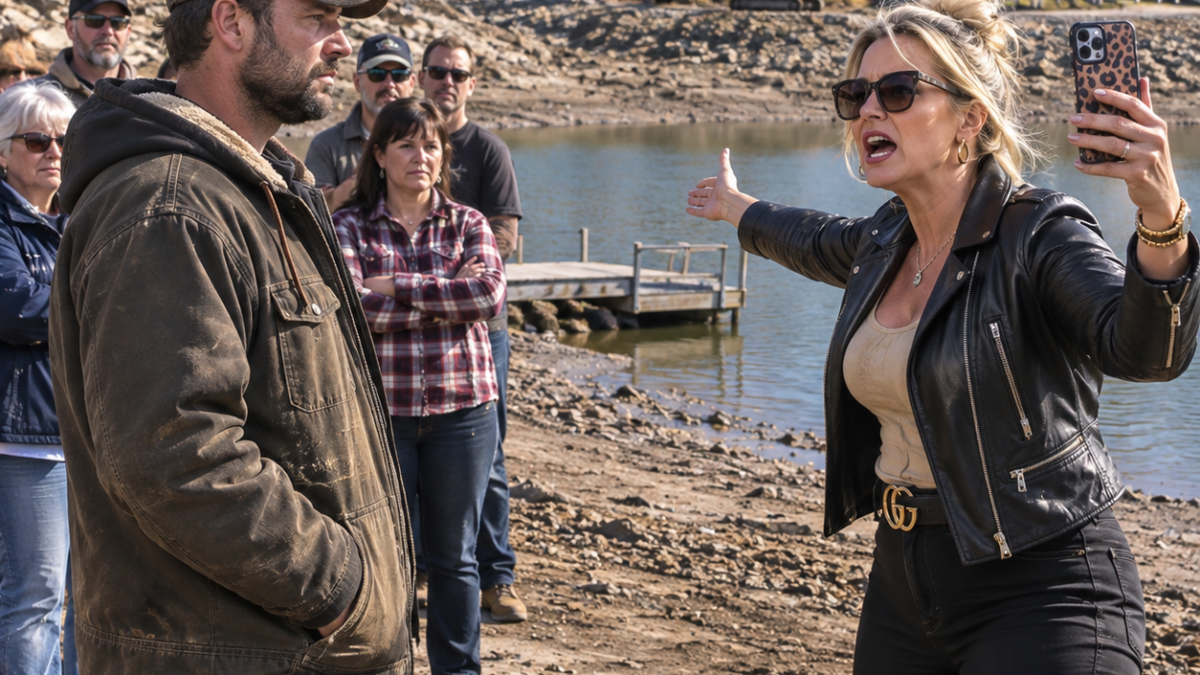
PART2:
“If you open it completely and the gate binds, we may not be able to close it under pressure.”
She rolled her eyes toward the camera.
“Government employee explaining why nothing can ever be fun.”
“It supplies four hundred households.”
“Ridge View has its own storage.”
“The town does not.”
“Sounds like poor planning.”
“The elementary school is on that system.”
She shrugged.
“So?”
“Medical clinic.”
Another shrug.
“Fire hydrants.”
For half a second, her expression changed.
Not enough to stop her.
“Sloan, listen to me.”
She turned back toward the valve.
“People need that water.”
“It’s water, Caleb.”
She laughed.
“It’ll rain again.”
PART3:
Both hands closed around the wheel.
“Sloan.”
She pulled.
I shouted:
“DON’T!”
Metal moved.
Then came the sound.
A deep mechanical groan below us.
Followed by a violent roar.
The twelve-inch discharge line opened.
Water exploded through the lower spillway channel and tore down the mountainside in a white wall.
The ground vibrated under my boots.
I ran toward the actuator housing.
Sloan screamed with laughter.
Not fear.
Laughter.
Her friends cheered.
Someone behind her shouted:
“Do it again!”
“There is no again!” I yelled.
Sloan lifted the phone.
“BYE-BYE, PEASANT WATER!”
She curtsied toward her audience.
“This is so therapeutic!”
I ignored her.
The indicator showed the gate had traveled almost fully open.
I engaged the manual return.
Nothing.
Again.
The wheel shuddered.
Stopped.
I knew immediately.
The lower stem had bound.
Exactly what I had warned her about.
That valve was meant for controlled reservoir drawdown during maintenance or emergency contamination events.
It had not been opened fully in eleven years.
We exercised it partially.
Inspected it.
Greased what could be reached.
But forcing an older valve from near-closed to full-open under a twenty-two-million-gallon head of water was something no competent operator would do casually.
Pressure was now helping hold it open.
I called dispatch.
“Caleb Mercer. Reservoir emergency.”
The dispatcher’s voice changed when I identified myself.
“What happened?”
“Western discharge is locked open.”
“Failure?”
I looked at Sloan.
“Human-assisted.”
She was still filming.
“How much flow?”
I checked the gauge.
“Approximately twelve thousand gallons a minute and rising.”
Pause.
“Repeat?”
“Twelve thousand per minute.”
The dispatcher swore quietly.
I agreed with the assessment.
“Call Public Works. Fire chief. County emergency management. Get me both night operators.”
“On it.”
I called my deputy director, Luis Ortega.
He answered on the second ring.
“What broke?”
“West discharge.”
Silence.
“How far?”
“Full.”
“Jesus.”
“Bring the portable actuator and the flange kit.”
“Who opened it?”
I looked at Sloan again.
“Instagram.”
Luis paused.
“I don’t know what that means.”
“You will.”
Within twenty minutes, the overlook stopped being a party.
Fire trucks came first.
Then Public Works.
Then county emergency management.
People carrying champagne glasses suddenly discovered they had somewhere else to be.
Sloan did not.
She stood beside her white Porsche Cayenne while I worked.
At one point she walked over.
“Caleb.”
I kept tightening a fitting.
“What?”
“You’re making this unnecessarily dramatic.”
I looked up.
Behind me, water was leaving the reservoir at a rate most people could not conceptualize.
“What part?”
“The whole emergency-services circus.”
“You opened an emergency discharge.”
“And you’ll close it.”
“It’s jammed.”
“That sounds like a maintenance problem.”
I stared at her.
“You forced it open.”
“You said yourself it was old.”
“You were warned.”
“Maybe the town should maintain its infrastructure better.”
Luis stopped what he was doing.
I gave him a look.
Do not.
He returned to the actuator.
Sloan smiled.
“See?”
She pointed toward me.
“This is why people hate bureaucrats. Nothing is ever their responsibility.”
Then she walked to her Porsche.
Before leaving, she lowered the window.
“You really should learn to relax, Mr. Mercer.”
I said nothing.
She drove away.
We worked all night.
The main discharge would not close.
At 12:40 a.m., we partially reduced the flow using the downstream isolation structure.
At 2:15, a hydraulic contractor arrived from Fort Collins.
At 3:30, we had flow reduced by roughly forty percent.
Not stopped.
The reservoir level kept falling.
The distribution system had gravity pressure, but only while the upper storage tank remained supplied.
By four, that tank began dropping.
I called the school superintendent.
Then the clinic.
Then Fire Chief Randall Boone.
Boone came to the control building personally.
“How bad?”
I showed him the pressure map.
Several zones were already yellow.
Ridge View Heights?
Green.
Boone noticed.
“How are they still green?”
“Private booster storage.”
“How much?”
I hesitated.
That question would come back later.
“According to their filed engineering plan? Four hundred thousand gallons.”
“That enough for them?”
“For a while.”
He looked down at town.
“Everyone else?”
“Not if we can’t stop this.”
At 6:12 a.m., the first residential zone lost pressure.
By 6:45, calls started.
No water upstairs.
Then no water at all.
At 7:10, Elhorn Springs Elementary delayed opening.
At 7:25, the medical clinic moved to emergency conservation protocol.
At 7:40, hydrant pressure on Spruce Street fell below what Chief Boone considered safe.
We positioned tankers at strategic points.
Mutual aid brought bottled water.
Main Street became a line of pickup trucks, plastic jugs, coolers, five-gallon buckets, parents holding toddlers, elderly residents sitting in vehicles with heaters running.
I had been awake twenty-six hours.
Then my phone buzzed.
Luis handed it to me.
“You need to see this.”
Sloan’s Instagram.
Photograph.
She was beside her infinity pool at Ridge View.
White robe.
Sunglasses.
Coffee.
Behind her:
Blue water spilling toward the mountain view.
Caption:
SOME OF US PLAN AHEAD.
I stared at it.
Luis said:
“You want me to say what I’m thinking?”
“No.”
“Good, because I’d like to keep my job.”
I handed the phone back.
At 8:03, something else arrived.
A message from a seventeen-year-old named Emma Bell.
I knew her father.
Science teacher.
The message said:
Mr. Mercer, I screen-recorded Sloan’s live before she deleted it. I thought you might need it.
Attached video.
Forty-three seconds.
I watched once.
Sloan laughing.
Me warning her.
Valve.
Water.
Nothing I had not seen.
Then I watched again.
Not because I needed proof she opened it.
Half of Ridge View had witnessed that.
I watched the background.
Years of military work had taught me something that water operations reinforced later.
When everybody else is watching the obvious problem, look at what the people who are not reacting are doing.
Sloan pulls the valve at second twelve.
Friends cheer.
At second fourteen, most people turn toward the discharge.
Two men do not.
They are down near the north shoreline.
About sixty yards behind her.
Orange work jackets.
One kneeling.
One standing.
Beside a section of black pipe.
My finger stopped the video.
I zoomed.
Resolution degraded.
Still enough.
Twelve-inch HDPE, maybe ten.
Not part of my system.
I replayed.
At second nineteen, one man points toward the falling waterline.
At twenty-two, the second man looks up toward Sloan.
At twenty-six, the audio catches a voice under the music.
Faint.
I turned the volume up.
Again.
Then again.
“…get it below marker six…”
I froze.
Luis leaned closer.
“What?”
I replayed.
A man’s voice.
“Need it below marker six before we can cut it.”
Then Sloan’s voice, closer because she holds the phone.
“That’s why I opened it.”
My stomach changed.
Not dropped.
Tightened.
I watched the final seconds.
At thirty-five seconds, the camera swings while Sloan curtsies.
For less than two seconds, the rear of a contractor pickup fills the background.
Logo.
SUMMIT TERRAIN & UTILITIES.
I knew the company.
They had worked on Ridge View Heights Phase Two.
At forty seconds, another voice.
“State guy’s Monday.”
Sloan laughs.
“Then he’ll see exactly what we want him to see.”
Video ends.
Luis stood beside me.
Neither of us spoke for several seconds.
Then he said:
“She didn’t open it because she was drunk.”
“She may have been drunk.”
“But that wasn’t why.”
“No.”
The reservoir level had to fall.
Someone needed access to something normally underwater.
Something involving a large black pipe.
Before Monday.
I opened the reservoir engineering drawings.
Original 1971 plans.
1998 rehabilitation.
2009 shoreline stabilization.
2018 intake upgrade.
No twelve-inch HDPE on the north shoreline.
I pulled Ridge View’s subdivision utility plans.
Phase One.
Phase Two.
Their approved connection came from our six-inch municipal main at Canyon Road.
Metered.
Boosted uphill.
Private storage.
Nothing touched the reservoir directly.
Nothing should.
I called the state Division of Water Resources.
Then the county sheriff.
Then our town attorney.
By 10:30, nobody at Ridge View Heights was laughing.
Sheriff Lena Torres arrived first.
I showed her the video.
She watched it once.
Then:
“Again.”
Second time.
“Who are the men?”
“Don’t know yet.”
“The company?”
“Summit Terrain.”
“What do you think the pipe is?”
“I’m not going to guess on the record.”
She looked at me.
“Off the record?”
“Illegal intake.”
“For the HOA?”
“Maybe.”
“How long?”
“No idea.”
“How much?”
“No idea.”
Torres looked toward the reservoir.
“What happens when the level reaches marker six?”
“We find out.”
By noon, state engineer Marcus Hale was driving from Denver.
We had closed the discharge to about twenty-eight percent flow.
The town was still in emergency restriction.
Ridge View remained full pressure.
That bothered me more every hour.
I opened our consumption records.
Their official meter usage.
Ridge View Heights had 146 occupied homes.
Large homes.
Landscaping.
Private clubhouse.
Two community pools.
Yet their reported municipal draw averaged only 11,800 gallons per day.
Impossible.
I ran comparable developments.
Forty to sixty thousand daily in normal months.
Higher in summer.
Ridge View was reporting roughly one-quarter of expected use.
I had questioned it a year earlier.
Their engineer responded that extensive gray-water reuse and private storage reduced demand.
We asked for supporting documentation.
They supplied it.
Stamped.
Signed.
I remembered approving the file as unusual but plausible.
Now I pulled it again.
Engineering consultant:
Carden Water Solutions.
Wesley Carden.
I called.
Voicemail.
Again.
Voicemail.
Then I searched the Ridge View HOA financial disclosures publicly posted to residents.
Water resilience assessment.
$310 per household monthly.
I stopped.
They were collecting almost half a million dollars per year from residents for something called:
PRIVATE MOUNTAIN WATER SECURITY PROGRAM.
I had never heard of it.
Official municipal bill to the HOA?
Less than $90,000 annually.
Where was the difference going?
At 1:20, reservoir level passed marker six.
The black pipe appeared.
Not the contractors’ loose section from the video.
The actual intake.
Buried beneath riprap.
Camouflaged.
Twelve-inch HDPE penetrating the reservoir bank approximately eighteen inches below normal waterline.
Luis stared.
“That wasn’t there in 2019.”
“I know.”
Sheriff Torres photographed everything.
State engineer Hale arrived thirty minutes later.
He did not speak for a while.
Walked the shoreline.
Measured.
Checked coordinates.
Then turned toward me.
“You have records for this?”
“No.”
“Permit?”
“No.”
“State diversion authorization?”
“No.”
“Easement?”
“No.”
“Who owns the adjacent parcel?”
I checked GIS.
Ridge View Heights HOA.
Hale looked uphill.
“Where does the pipe go?”
We traced it.
It entered the slope.
No surface route.
We brought ground-locating equipment.
The line climbed beneath private HOA property.
Then split.
One branch toward the Ridge View booster station.
Another toward Phase Two.
Phase Two was the luxury expansion Sloan had spent two years promoting.
Seventy-eight additional homes.
Boutique lodge.
Spa.
Small artificial lake.
Town council had refused to guarantee additional water capacity for the development the previous year.
I had personally signed the denial.
The existing municipal system could support current residents.
Not another seventy-eight luxury homes at Ridge View’s projected usage.
Development paused.
Or so I thought.
Sheriff Torres looked at me.
“Caleb.”
I already knew.
“They solved their capacity problem themselves.”
The bypass intake climbed straight from our reservoir.
Around our meter.
Into their private system.
The town had been providing unmetered water to Ridge View.
Possibly for years.
Hale said:
“Don’t touch anything.”
“I wasn’t planning to.”
“This is evidence now.”
By late afternoon, we found the hidden valve vault.
Buried beneath decorative stone near Ridge View’s southern entrance.
Locked.
The HOA denied access.
Torres obtained an emergency warrant.
Inside was a professional manifold.
Municipal-looking labeling.
Flow meter.
Backflow equipment.
Pump controls.
Nothing improvised.
Someone had spent serious money building it.
The private flow meter held its own memory.
That was Sloan’s second major mistake.
The first was the video.
The meter recorded eighteen months.
Peak days.
Average days.
Totalized volume.
I stood beside Marcus Hale while he read the screen.
He looked at it twice.
“Forty-eight point six million gallons.”
Sheriff Torres said:
“What?”
“Approximately forty-eight million gallons through this line since the meter was commissioned.”
Luis muttered something in Spanish.
I agreed with that too.
Forty-eight million gallons.
More than twice the full capacity of the reservoir.
Not stolen all at once.
Slowly.
Quietly.
Over eighteen months.
The town had spent almost two years investigating “unaccounted system loss.”
We had pressure-tested mains.
Replaced two sections early.
Spent $180,000 chasing leaks.
There had been leaks.
Every old system has leaks.
But the unexplained loss had never fully disappeared.
Now I knew why.
Ridge View was taking water before it entered our metered distribution network.
Then charging its own residents a premium for “private water security.”
And Phase Two?
The branch line ended at an unfinished pump house.
Ready.
Not active yet.
Sheriff Torres asked:
“What happens Monday?”
Marcus Hale answered.
“State capacity inspection.”
“For the development?”
“Yes.”
Ridge View had requested final review to prove it possessed adequate independent water infrastructure for Phase Two.
Someone knew inspectors would examine reservoir levels and source documentation.
The illegal intake termination was normally submerged.
If investigators arrived while the reservoir was full and happened to inspect the shoreline carefully, the pipe might be detectable.
But the video gave us the missing piece.
They intended to lower the reservoir.
Cut the visible section.
Cap it beneath fresh riprap.
Then present Ridge View’s private storage as if it had been filled through legal municipal purchases.
Sloan’s public tantrum had been camouflage.
If anyone questioned why the reservoir suddenly fell?
She had been drunk.
Reckless.
Entitled.
A ridiculous HOA president doing something stupid for social media.
Better to look stupid than organized.
Except she had filmed the organization standing behind her.
By 6:00 p.m., investigators were at Summit Terrain & Utilities.
The two men from the video were identified.
Neither was immediately arrested.
Both called lawyers.
One decided he liked freedom more than Sloan.
His name was Jeremy Vance.
Foreman.
Forty-seven.
He met investigators the following morning.
He had invoices.
Work orders.
Texts.
And one instruction that changed the case again.
LOWER ELKHORN RESERVOIR TO 61% MAXIMUM OPERATING ELEVATION PRIOR TO NORTH INTAKE REMOVAL.
Authorized by:
S. PRESCOTT.
CC:
W. CARDEN.
D. LASKER.
Denton Lasker.
I knew that name too.
Vice president of the Ridge View HOA board.
Commercial real-estate developer.
Primary investor in Phase Two.
Now we had motive.
Not just free pool water.
Phase Two was worth an estimated $38 million at buildout.
Its financing depended on water.
The town had denied guaranteed capacity.
Without a legal water source, the project was dead.
So they created one.
Then they needed paperwork.
Sheriff Torres asked:
“Who certifies municipal capacity?”
“Me.”
“Did you?”
“No.”
She showed me a document recovered from Summit Terrain.
ELHORN SPRINGS WATER CAPACITY CERTIFICATION.
My letterhead.
My title.
My signature.
It said Ridge View Heights maintained sufficient independent reserve storage and authorized withdrawal capacity to support Phase Two.
I stared at the signature.
It looked good.
Really good.
It was not mine.
“I never signed this.”
Torres said:
“I figured.”
“Where did they get the signature?”
“Probably another town document.”
I looked at the date.
Fourteen months earlier.
Same month the hidden line went active.
This was no longer water theft alone.
Forged capacity certification had been submitted to a lender.
The construction loan for Phase Two:
$18.4 million.
The bank believed municipal water capacity existed.
It did not.
Sloan had used stolen water to make a fraudulent infrastructure claim believable.
The forty-eight million gallons were not the prize.
They were supporting evidence for an eighteen-million-dollar financing package tied to a thirty-eight-million-dollar real-estate development.
That was the bigger scheme.
And we had found it because Sloan wanted applause on Instagram.
Meanwhile, Elhorn Springs still needed water.
That part mattered more to me than the criminal case.
By the second night, we had mechanically isolated the damaged discharge gate.
Reservoir remaining volume:
approximately 11.6 million gallons.
We had lost nearly half.
Enough to cripple pressure.
Not enough to destroy the town if we moved carefully.
Mutual-aid tankers supplied the clinic.
School closed for two days.
Fire department positioned tanker engines around town.
Boil-water advisory remained because pressure loss risked contamination.
Crews worked around the clock.
The people of Elhorn Springs became very practical very quickly.
Church opened its hall.
Hardware store donated containers.
Restaurant owners stopped using dishwashers.
Teenagers delivered bottled water to elderly residents.
A rancher named Pete Caldwell brought two clean agricultural tanks into town and refused payment.
Meanwhile, Ridge View residents discovered something uncomfortable.
Their “private water security” system had never been private.
It was ours.
When state officials isolated the illegal reservoir intake, Ridge View’s booster pressure began falling.
Sloan’s infinity pool stayed blue.
For about six hours.
Then her taps stopped too.
I wish I could say I enjoyed that.
I did not.
The residents of Ridge View were not all Sloan.
Children lived there.
Elderly people.
Families who had paid HOA assessments because someone told them those assessments purchased legitimate reserve water.
They had been lied to too.
We connected Ridge View to emergency municipal supply through the legal six-inch line.
Metered.
Just like everyone else.
No special treatment.
No punishment either.
Sloan disappeared.
Her Porsche was not at her home.
Her Instagram vanished.
Her attorney issued a statement saying the reservoir incident had been:
“an unfortunate spontaneous act during a private celebration.”
Sheriff Torres read that sentence aloud in my office.
Then looked at me.
“Spontaneous.”
I turned my computer toward her.
On the screen:
Jeremy Vance’s work order.
LOWER RESERVOIR PRIOR TO INTAKE REMOVAL.
“Very spontaneous.”
She smiled without humor.
Four days later, Sloan appeared at an emergency HOA meeting with two attorneys.
The Ridge View clubhouse was packed.
I attended because residents had asked me to explain the water system.
Sloan walked onto the small stage like someone still trying to occupy the old version of her life.
White suit.
Hair perfect.
No champagne this time.
She took the microphone.
“This community is being attacked.”
Groans.
She continued.
“Ridge View has invested millions in independent infrastructure precisely because municipal officials have repeatedly failed to provide dependable service.”
A man in the third row shouted:
“You drained the reservoir!”
Sloan raised a hand.
“That incident has been distorted.”
Someone else:
“We watched the video!”
“I was under enormous stress.”
Another voice:
“You said bye-bye peasant water!”
That almost ended the meeting.
The room erupted.
Sloan waited.
Then pointed toward me.
“This man has spent years trying to prevent Ridge View from growing because his family believes they own Elhorn Springs.”
I did not move.
She continued.
“Caleb Mercer personally denied Phase Two water certification despite independent engineers proving adequate capacity.”
I stood.
Not because I wanted a confrontation.
Because she had just made a factual claim I could answer.
The room quieted.
I walked to the front.
Sloan said:
“You don’t have the floor.”
The HOA treasurer, a seventy-one-year-old retired accountant named Walter Keene, said:
“He does now.”
That mattered.
Walter had spent the previous three days reading HOA accounts.
He looked exhausted.
And furious.
I took the microphone.
“I denied Phase Two because the municipal system could not safely guarantee the projected demand.”
Sloan laughed.
“Your opinion.”
“My statutory responsibility.”
“We built private capacity.”
“No.”
I looked at the residents.
“You built an unpermitted twelve-inch intake into the public reservoir.”
Silence.
“Forty-eight point six million gallons passed through it in eighteen months.”
Someone whispered:
“What?”
I continued.
“The town billed Ridge View only for water passing through the legal Canyon Road meter.”
Walter stood.
“How much did we pay for this private program?”
Nobody answered.
Walter did.
“$1.17 million in special water assessments over thirty months.”
The room changed.
Not outrage first.
Confusion.
Residents looking at one another.
Sloan said:
“That funded infrastructure.”
Walter raised a folder.
“Some.”
He looked at her.
“Where’s the rest?”
Sloan’s attorney stood.
“This meeting needs to adjourn.”
“No,” Walter said.
“The board meeting can adjourn.”
He looked around.
“The homeowners are staying.”
People applauded.
Walter had found transfers.
$620,000 from the so-called water-security fund into Ridge View Development Partners.
Company tied to Denton Lasker.
Another $190,000 into consulting contracts.
Carden Water Solutions.
Wesley Carden.
Then smaller payments.
Legal.
Public relations.
“Community development strategy.”
The water assessment had partly funded the infrastructure used to steal municipal water and partly funded the private development that needed the stolen water to secure financing.
Residents had paid to help build the scheme used to deceive them.
Sloan tried to leave.
Sheriff Torres was waiting outside.
She did not arrest Sloan that night.
People later complained about that.
They wanted handcuffs immediately.
Real investigations are slower than viral stories.
Torres served a warrant for Sloan’s phone, laptop, and HOA records.
That did more damage.
Cloud backups recovered deleted messages.
Sloan to Denton Lasker:
CALEB WILL NEVER SIGN CAPACITY. WE SOLVE IT WITHOUT HIM.
Lasker:
STATE WILL NOTICE INTAKE IF LEVEL DROPS DURING DROUGHT.
Sloan:
THEN WE CONTROL WHEN THEY SEE THE SHORELINE.
Another message to Wesley Carden:
NEED CLEAN LETTER BEFORE BANK COMMITTEE. USE MERCER SIGNATURE FROM 2023 ANNEX APPROVAL.
There it was.
Not ambiguous.
Not interpretation.
Instruction.
Copy my signature from a legitimate document.
Forge a capacity letter.
Then the message that investigators later read aloud in court:
IF ANYTHING GOES SIDEWAYS I’LL TAKE THE HIT FOR OPENING THE VALVE. EVERYONE WILL THINK I’M JUST BEING ME.
Sheriff Torres showed me that one.
I stared at it.
“She planned to look stupid.”
Torres nodded.
“She believed reckless entitled behavior gave her cover.”
“She wasn’t wrong.”
“No.”
That was the disturbing part.
If Emma Bell had not screen-recorded the livestream, Sloan might have succeeded in separating the reservoir incident from the intake removal.
Everyone would have focused on the obvious outrage.
HOA president drains town reservoir.
Reckless.
Vandalism.
Civil damages.
Maybe criminal mischief.
The illegal pipe could have disappeared beneath new riprap before Monday.
Inspectors might have seen a low reservoir and accepted the story that the strange water level resulted from Sloan’s stunt.
The forged capacity letter remained buried inside lender files.
Ridge View’s inexplicably low municipal usage remained a curiosity.
Phase Two financing closed.
Thirty-eight-million-dollar development moved forward.
Instead, forty-three seconds put the contractor, the lowering target, the state inspection, and Sloan’s own words into one frame.
Then things moved quickly.
The bank froze the $18.4 million loan.
Phase Two stopped.
State environmental officials issued cease-and-desist orders.
Ridge View Development Partners accounts were preserved.
Wesley Carden surrendered his engineering stamp pending professional review.
Denton Lasker resigned from the HOA board before anyone could vote him out.
Walter found evidence that Sloan’s private company owned twenty-two percent of the Phase Two development entity through a trust.
She had never disclosed that to homeowners.
Every special assessment she promoted increased the value of a project in which she secretly held a financial interest.
Then investigators found the private water invoices.
This was my favorite part only because of how unbelievably arrogant it was.
Sloan’s company had been billing Ridge View’s HOA for “premium source water” at a rate of $6.40 per thousand gallons.
Water stolen from our reservoir.
She stole public water.
Then sold it back to her own HOA.
Over eighteen months:
Roughly $311,000 in direct water charges.
On top of assessments.
Walter stared at the invoices.
“She charged us for stolen water?”
“Yes.”
“At a markup?”
I looked at the rate.
“A large one.”
Walter took off his glasses.
Put them on the table.
“I’m seventy-one years old.”
I waited.
“I have spent forty-six years believing accounting was the least exciting profession available to a man.”
He pointed at the invoice.
“This woman has offended me professionally.”
That was the first time I laughed in almost a week.
The reservoir emergency lasted nine days.
Full restoration took longer.
We replaced the damaged discharge assembly rather than trust a repair.
State emergency funds covered part.
Insurance fights covered another part.
Civil claims began before the concrete cured.
Rain eventually helped.
Snowmelt helped more.
By spring, the reservoir returned to normal operating level.
The hidden intake did not.
We removed the entire illegal connection under state supervision.
The pipe section from the shoreline went into evidence.
I kept expecting some dramatic feeling when they lifted it out.
Nothing.
Black plastic.
Scratched.
Dirty.
Ordinary.
That is often what expensive corruption looks like when you finally dig it up.
Not gold.
Not secret briefcases.
Pipe.
Invoices.
Signatures.
Spreadsheets.
People deciding no one will check.
Sloan was eventually charged with multiple offenses connected to utility tampering, fraud, forged documents, and the financial transactions surrounding Ridge View’s development project.
Denton Lasker faced his own charges.
Wesley Carden cooperated.
Jeremy Vance cooperated early.
Not because they became noble.
Because evidence changes loyalty.
Especially when the person who promised to protect you has a livestream saying she will take the blame while her phone contains messages showing she planned to blame everyone else.
The Ridge View HOA held a recall vote.
Sloan lost by 132 to 4.
One of the four votes was hers.
Walter told me that detail.
“I respect consistency,” he said.
He became temporary HOA president.
Against his better judgment.
His first meeting lasted nineteen minutes.
No champagne.
No livestream.
No special assessments.
He published every invoice online.
Ridge View residents eventually voted to abandon Phase Two entirely.
The unfinished pump house became a storage building.
The artificial lake was never built.
The boutique lodge remained a rendering in a sales brochure.
Several homeowners sued the former board and development entities.
Some money was recovered.
Not all.
That is another part stories skip.
Fraud destroys more than the amount someone steals.
Legal fees.
Engineering corrections.
Insurance increases.
Delayed maintenance.
Lost trust.
Town emergency costs.
Business interruption.
School closure.
Clinic disruption.
Families purchasing water they had already paid taxes to receive.
Sloan’s forty-three-second performance cost people years.
A court could assign dollars.
It could not refund time.
I testified twice.
First at a preliminary hearing.
Then later in the larger fraud case.
Sloan sat at the defense table.
For the first time since I had known her, she did not look at me like a maintenance worker who had wandered into the wrong room.
The prosecutor played the video.
Forty-three seconds.
Her own voice filled the courtroom.
“BYE-BYE, PEASANT WATER!”
Nobody laughed.
Then:
“…that’s why I opened it.”
Then the man:
“State guy’s Monday.”
Then Sloan:
“Then he’ll see exactly what we want him to see.”
Video ended.
The prosecutor froze the final frame.
Summit Terrain truck.
Men at the shoreline.
Pipe.
Sloan in the foreground smiling.
One photograph containing the entire structure.
Public spectacle in front.
Private operation behind.
Her attorney argued the phrases lacked context.
Then prosecutors supplied the texts.
Work orders.
Forged capacity certification.
Financial transfers.
Meter records.
The video did not prove everything by itself.
That was important.
It did something more useful.
It told investigators where to look.
People misunderstand evidence.
They imagine one perfect document that explains a crime.
Usually evidence is a door.
Open it.
Another room.
Then another.
Sloan opened the first door herself.
On Instagram.
Years later, I still work for Elhorn Springs.
People occasionally ask why.
The reservoir story made the town famous for a while.
Not in a way anyone wanted.
Documentary crews called.
Podcasts.
Local television anniversaries.
I declined most.
I had pumps to maintain.
Reservoir inspections.
Lead-service inventory.
Budget meetings.
Normal problems.
I like normal problems.
Normal is underrated.
The new discharge valve has a locked actuator.
Dual authorization.
Camera coverage.
Tamper alarm.
And one modification I insisted on personally.
Nobody can operate it remotely from the overlook.
Luis called that:
“The Sloan Prescott Memorial Safety Feature.”
I told him never to put that phrase in an official document.
He put it in the maintenance notes anyway.
I removed it.
He restored it.
We compromised.
The official file says:
Unauthorized Actuation Prevention Upgrade.
The crew calls it Sloan-proofing.
The town recovered.
Slowly.
The elementary school installed additional emergency storage.
The clinic increased backup capacity.
Fire department added a dedicated reserve tank.
Ridge View’s legal connection was upgraded and properly metered.
Their actual consumption surprised exactly nobody except former HOA leadership.
Turns out 146 large mountain homes use substantially more than eleven thousand gallons a day.
Walter sent the first honest bill to residents.
Some complained.
He printed a photograph of the illegal pipe and taped it beside his office computer.
Whenever anyone said the new bill seemed high, he pointed at it.
“Previous discount was felony based.”
Complaints decreased.
Emma Bell graduated high school.
The teenager who had saved the forty-three-second video ended up studying civil engineering.
Before she left for college, she came by the reservoir office.
“I always wondered something.”
“What?”
“What if I hadn’t recorded it?”
I thought.
“We probably still would’ve investigated Sloan for the valve.”
“But the pipe?”
“Maybe found it.”
“Before Monday?”
I looked out the window toward the reservoir.
“Maybe not.”
She nodded slowly.
“That’s scary.”
“Yes.”
“Why did I even record it?”
“Why did you?”
“She was being awful.”
Fair.
Emma smiled.
“I thought people wouldn’t believe how awful.”
“They believe you now.”
I gave her one of the retired brass valve tags from the old discharge assembly.
Not important.
Not evidence.
Just metal.
She held it.
“What’s this for?”
“Engineers like useless objects with stories.”
“I’m not an engineer yet.”
“You’re already asking what fails if nobody pays attention.”
She smiled.
“Is that engineering?”
“Half of it.”
“The other half?”
“Explaining to people why they shouldn’t touch valves.”
She laughed.
Then left.
My grandfather never saw Ridge View Heights.
He died before the first house went up.
But I thought about him throughout the case.
Edwin Mercer had been thirty-six when he worked on the reservoir.
I found his construction photographs after the incident.
Black-and-white.
Men standing in mud.
Concrete intake tower.
Old trucks.
No luxury subdivision.
No infinity pool.
Elhorn Springs had fewer than two hundred homes then.
He once told me:
“You don’t build water systems for the people you know.”
I had been twelve.
Did not understand.
He explained.
“You build them for people who haven’t arrived yet.”
That was why the reservoir existed.
Why we maintained it.
Why public infrastructure matters.
It belongs, in a practical sense, to people whose names you will never know.
A child who has not been born.
A firefighter twenty years from now.
A nurse washing her hands.
A family filling a glass at midnight.
You cannot see them when you turn a valve.
That does not mean they are not there.
Sloan’s worldview was the opposite.
If she could see it, own it, photograph it, control it, it mattered.
If she could not, it was somebody else’s problem.
Water does not tolerate that philosophy for long.
Neither do gravity systems.
There was one detail from the case that bothered me for years.
The infinity pool photograph.
SOME OF US PLAN AHEAD.
At first, it felt like the most insulting thing she had done.
Later, I understood it differently.
She was accidentally telling the truth.
Sloan had planned ahead.
For months.
The hidden intake.
Capacity forgery.
Bank financing.
Contractors.
Monday inspection.
Reservoir drawdown.
Even the public performance.
She had planned nearly everything.
What she had not planned for was the simplest thing.
Someone watching the background.
That is where complicated schemes often fail.
Not because criminals forget the big things.
They obsess over the big things.
Bank paperwork.
Corporate entities.
Legal explanations.
Consultants.
They forget the coffee cup.
The timestamp.
The truck behind them.
The reflected screen.
The person standing sixty yards away.
The sentence caught under music.
Forty-three seconds.
That was all.
Years after Sloan left Ridge View, Walter invited me to an HOA summer meeting.
I told him absolutely not.
He called again.
“Caleb.”
“No.”
“We’re dedicating something.”
“That makes it worse.”
“You need to see it.”
I went.
Against my judgment.
About seventy residents gathered near the clubhouse.
Kids running around.
Barbecue.
No champagne station.
Walter walked me toward the infinity pool.
I stopped.
“Oh, no.”
“Relax.”
“I hate when people say that near water now.”
He pointed at the wall beside the equipment room.
Small bronze plaque.
Nothing dramatic.
It read:
RIDGE VIEW HEIGHTS
WATER SYSTEM — METERED, MONITORED, PUBLICLY REPORTED.
That was it.
I looked at Walter.
“You put a plaque up celebrating meter compliance?”
“Yes.”
“That may be the most boring plaque in Colorado.”
His smile widened.
“Exactly.”
I laughed.
Then a boy cannonballed into the pool and soaked both of us.
Walter wiped water off his glasses.
“Publicly reported too?”
“No.”
We walked away.
The reservoir sits three miles uphill from town.
Most residents never visit.
Good.
They should not need to.
They should turn a faucet.
Water comes out.
That is the relationship most people deserve to have with infrastructure.
Boring.
Reliable.
Invisible.
I drive up there every morning anyway.
Partly because it is my job.
Partly because once you have stood beside a reservoir while someone intentionally empties it, you develop habits.
The new valve sits behind a locked steel enclosure.
Telemetry green.
Reservoir level normal.
North shoreline restored.
No black pipe.
Sometimes tourists stop at the public overlook.
Take photographs.
They have no idea where the hidden intake used to be.
Also good.
Scars do not all need monuments.
One October morning, years after the case, I stood near marker six.
Same elevation the contractors had been waiting for.
Water covered it now.
Exactly where it belonged.
Luis walked up behind me.
“Thinking?”
“Unfortunately.”
“Dangerous.”
I looked across the reservoir.
Twenty-two million gallons near full capacity.
Sunlight moving across the surface.
Elhorn Springs below.
Four hundred homes had become more by then.
New families.
New businesses.
More demand.
System still worked.
Luis said:
“You know what I remember?”
“What?”
“The curtsy.”
I groaned.
“She actually curtsied.”
“I was there.”
“‘Bye-bye peasant water.’”
“Please stop.”
He laughed.
Then became quiet.
“She really thought she’d get away with it.”
“Yes.”
“Even with the video?”
“She thought the video helped.”
“How?”
“It made her look reckless.”
“She was reckless.”
“She was also calculating.”
Luis nodded.
“The stupid thing hid the smart thing.”
“Exactly.”
Until it didn’t.
That was Sloan Prescott’s real mistake.
Not opening the valve.
That was catastrophic.
But repairable.
Not stealing the water.
We found the pipe.
Not forging my signature.
The lender had records.
Her biggest mistake was believing that if she performed arrogance loudly enough, nobody would search for intention underneath it.
She wanted us to see a spoiled HOA president having a tantrum.
So that is what she filmed.
Champagne.
Insults.
Laughter.
Curtsy.
A spectacle.
And while everybody watched her, the truth stood sixty yards behind her wearing orange jackets beside a black pipe.
Sloan pointed the camera at herself.
But she recorded the entire crime anyway.
Forty-three seconds.
That was all it took.
The reservoir eventually filled again.
The stolen money was partly recovered.
The illegal line disappeared.
Ridge View survived.
Elhorn Springs survived.
And every morning when I unlock the control house, I pass a framed copy of my grandfather’s original reservoir photograph.
Edwin Mercer in muddy boots.
Concrete behind him.
Nothing glamorous.
Just infrastructure built for people he would never meet.
I once considered putting Emma Bell’s forty-three-second video beside it.
I decided against it.
Sloan had enough screen time.
Instead, underneath my grandfather’s photograph, I placed one sentence.
Not inspirational.
Operational.
Water belongs to everyone downstream.
That is the entire job.
And after Sloan Prescott taught our town what happens when someone forgets that, none of us ever needed the lesson twice.








