HOA President Cut My Farm Gate for a “Routine Inspection”—Then 3 Black SUVs Rolled Up and She Learned I Was an FBI Agent
PART2:
Coffee from machines that should have been classified as chemical weapons.
I had spent years looking at people who owned five houses and still needed to steal from somebody with one.
Then my father died.
He left me enough money that, combined with my savings, I could finally make a change I had been considering for years.
I did not retire exactly.
That distinction matters.
I stepped away from daily field assignments and into a quieter federal role that allowed me to live outside Nashville, handle limited investigative work, and stay available when my experience was needed.
My neighbors knew none of that.
To Oak Hollow, I was just Cole.
The guy who bought the old Mercer farm.
Forty acres.
White farmhouse.
Red barn.
Two ponds.
A narrow creek running along the western boundary.
A porch facing east.
The property sat beyond the edge of Oak Hollow Estates, a neighborhood of roughly two hundred homes that had grown around farmland over the previous fifteen years.
My parcel looked connected to the development on a map.
It wasn’t.
That fact became important later.
The Mercer family had owned the farm before Oak Hollow existed.
When developers acquired the surrounding acreage, the Mercers refused to join the new association.
They negotiated a separate access arrangement with the county.
Their parcel was specifically excluded from the HOA declaration.
PART3:
The documents were clear.
Recorded.
Old.
Boring.
Exactly the kind of records people ignore until somebody decides boredom means weakness.
For the first six months after I moved in, life was everything I wanted.
I repaired fence.
Painted the porch.
Bought two rescue dogs.
Planted tomatoes badly.
Learned that owning land creates an endless list of objects that either leak, rust, lean, jam, split, clog, or refuse to start.
I loved it.
My badge stayed in a safe in the basement.
My service weapon stayed secured.
My old investigative phone stayed charged but rarely used.
At sunrise I drank coffee on the porch.
At night I heard coyotes.
Nobody asked about subpoenas.
Nobody lied to me across an interview table.
Then one Monday morning, I found a laminated notice zip-tied to my front gate.
MANDATORY ROUTINE COMPLIANCE INSPECTION
Oak Hollow Estates Homeowners Association.
Property owner: Cole Maddox.
Inspection date: Wednesday, 10:00 a.m.
Failure to pre-schedule:
$750 administrative fine.
Failure to permit inspection:
Additional penalties may apply.
Signed:
Judith Alcott
President, Oak Hollow Estates HOA.
I read it twice.
Then a third time.
The fine bothered me less than the wording.
Failure to pre-schedule.
They had scheduled the inspection.
Then fined me for not pre-scheduling it.
That kind of circular logic usually means the system was designed to produce violations, not compliance.
I cut the notice from the gate.
Took it inside.
Put it on the kitchen table.
Then made coffee.
At 2:00 that afternoon, somebody knocked.
An elderly woman stood on the porch holding an apple pie.
Small.
White hair.
Blue cardigan.
Hands shaking slightly.
“Mr. Maddox?”
“Cole.”
“I’m Loretta Odell.”
I knew the name.
House two properties over.
Seventy-four.
Widow.
She held out the pie.
“I thought I should welcome you.”
“I’ve been here six months.”
“I know.”
She looked toward the road.
“That’s not really why I came.”
I stepped aside.
“Come in.”
Loretta sat at my kitchen table.
She noticed the HOA notice immediately.
Her face changed.
“She came after you.”
“Judith?”
Loretta nodded.
“You know her?”
“Everybody knows Judith.”
“That usually isn’t a compliment.”
Loretta didn’t smile.
“Don’t let her inside.”
“Why?”
“She looks for things.”
“What kind of things?”
“Anything.”
She leaned closer.
“Unapproved storage.”
“Paint color.”
“Gardens.”
“Work equipment.”
“Animals.”
“She went into the Hendersons’ backyard and photographed a fence.”
“So?”
“They ended up owing thousands.”
“How?”
“Fines.”
“Legal fees.”
“Special assessments.”
Loretta twisted her hands.
“They lost the house.”
I watched her.
“An HOA foreclosure?”
She nodded.
“Over a fence?”
“It started with a fence.”
That phrase mattered.
Fraud often starts small because people tolerate small.
I asked:
“What else?”
Loretta hesitated.
“The road fees.”
“What about them?”
“We pay every month.”
“How much?”
“Two hundred forty.”
“For private roads?”
“Yes.”
I had driven through Oak Hollow.
The roads were terrible.
Cracks.
Potholes.
Patchwork.
One drainage ditch had washed halfway into a lane.
“They don’t look maintained.”
“That’s what I mean.”
“Has anyone asked for financial statements?”
Loretta looked toward the window.
“Howard says everything is fine.”
“Howard?”
“Howard Pembroke. Treasurer.”
“How long?”
“Years.”
“And Judith?”
“President for eleven.”
I leaned back.
That was a long time for one person to control an association.
Loretta lowered her voice.
“There are special assessments too.”
“For what?”
“Road resurfacing.”
“Clubhouse roof.”
“Storm drains.”
“Landscaping.”
“Security cameras.”
“Do those projects happen?”
“Some.”
“Some?”
Loretta looked embarrassed.
“I don’t know.”
She stood abruptly.
“I shouldn’t have come.”
“You’re fine.”
“No.”
Her eyes were wet.
“If Judith knows I talked—”
“Loretta.”
She stopped.
“Did she threaten you?”
“No.”
Too fast.
I waited.
Loretta looked down.
“She told me people who make trouble eventually find out how expensive rules can be.”
I had heard variations of that sentence from criminals for twenty years.
Never ignore a threat just because the speaker dresses it as advice.
I walked Loretta to the door.
Before leaving, she turned.
“Mr. Maddox.”
“Cole.”
“You really should not let her into your barn.”
I smiled.
“I don’t plan to.”
Wednesday at 9:57, a white Lexus SUV stopped outside my gate.
Judith Alcott stepped out.
Sixty, maybe.
Perfect silver-blond hair.
Cream blazer.
Large sunglasses.
Leather folder.
She moved like somebody who had spent years watching doors open before she reached them.
Two men followed.
One was gray-haired, thin, wearing a charcoal suit.
Howard Pembroke.
The treasurer.
The second was younger.
Early thirties.
Broad shoulders.
Blue polo embroidered:
HA COMPLIANCE SERVICES.
Clipboard.
Judith smiled.
“Mr. Maddox.”
“Morning.”
“This is Howard Pembroke, treasurer.”
Howard nodded.
Wouldn’t meet my eyes.
“And Trent Willis, compliance contractor.”
Trent smiled.
“Sir.”
Judith looked at the gate.
Locked.
“You’ll need to open that.”
“No.”
Her smile remained.
“I’m sorry?”
“You’re not entering.”
“This is a mandatory inspection.”
“Under which recorded covenant?”
She blinked.
“Excuse me?”
“Which covenant grants you inspection authority over my farm?”
Judith laughed.
Not because something was funny.
Because she thought the question itself was beneath her.
“Mr. Maddox, Oak Hollow has conducted compliance inspections for years.”
“That wasn’t my question.”
She opened her folder.
“Article Seven gives the board broad enforcement powers.”
“Over HOA property.”
“Correct.”
“My farm isn’t HOA property.”
Howard looked up.
Briefly.
Judith did not.
“That issue was resolved long before you purchased.”
“No.”
“I assure you—”
“Show me.”
Her smile thinned.
“I don’t need to litigate our governing documents at your gate.”
“Then you don’t need to enter.”
Trent shifted.
The clipboard turned.
A paper clipped to the back became visible.
GREEN LINE PROPERTY SERVICES LLC.
My entire body went cold.
Not visibly.
Twenty years teaches you how to keep your face quiet when your brain starts running.
Green Line.
Three years earlier, I had sat in a Nashville field office staring at that name for months.
Green Line Property Services LLC.
Registered through layers of mail drops and nominee managers.
Invoices to housing associations.
Property-management companies.
Small municipalities.
Work that often did not exist.
Payments routed through two states.
Then split.
Then transferred again.
We had tied Green Line to approximately $600,000 in suspicious transactions.
Not enough to understand the full structure.
The paper trail had gone dark.
No human source.
No cooperating witness.
No clean proof identifying who actually controlled it.
Case went inactive.
Not closed.
Inactive.
And now the name was three feet from me.
On an HOA compliance clipboard.
I looked at Trent.
“What does your company do?”
He glanced down.
“Inspections.”
“HA Compliance?”
“Yes.”
“And Green Line?”
His face changed.
Very slightly.
Judith spoke immediately.
“That is an HOA vendor.”
“What kind?”
“Property services.”
“What services?”
“Mr. Maddox.”
Her voice sharpened.
“This is not your concern.”
Actually, it had just become very much my concern.
I put both hands in my jacket pockets.
Farmer posture.
Tired.
Nonthreatening.
“I’ll review your notice.”
Judith smiled again.
“You have seven days.”
“For?”
“Full access.”
“To?”
“Barn.”
“Outbuildings.”
“Exterior structures.”
“And if I refuse?”
She removed a prepared document.
“Initial noncompliance lien.”
Amount:
$18,500.
I stared.
“Eighteen thousand five hundred?”
“Accumulated enforcement costs.”
“For an inspection you haven’t conducted?”
“Administrative procedures.”
I almost smiled.
Howard stared at gravel.
Trent looked toward the road.
Judith leaned closer.
“You’re new here.”
She lowered her voice.
“Most people eventually learn cooperation is cheaper.”
There it was.
I nodded as if defeated.
“I’ll think about it.”
“Seven days.”
She turned.
The heels clicked back toward the Lexus.
Certain she had won.
I went inside.
Locked the door.
Waited until the Lexus disappeared.
Then walked to the basement.
Opened the safe.
Badge.
Credentials.
Service phone.
I powered it on.
One contact still near the top.
Tasha Reeves.
Supervisory Special Agent.
Former supervisor.
I called.
She answered:
“Maddox?”
“Hi, Tasha.”
“You only use this phone when something is wrong.”
“I need you to run a name.”
Silence.
“What name?”
“Green Line Property Services.”
Another silence.
Longer.
“Where did you hear that?”
“On my farm.”
“What?”
“HOA vendor.”
Tasha stopped sounding surprised.
She became precise.
“Say nothing else on an unsecured line.”
“Fine.”
“I’ll call you.”
Forty-eight minutes later, my phone rang through an encrypted channel.
Tasha’s face appeared.
“Cole.”
“What?”
“You may have stepped into something.”
“That was my impression.”
“Oak Hollow Estates is already inside an active financial investigation.”
My pulse jumped.
“Since when?”
“Seven months.”
“What amount?”
“Approximately $2.3 million unaccounted for across reserves, special assessments, and vendor payments.”
“Green Line?”
“One of four recurring vendors.”
“Beneficial owner?”
“Unknown.”
“Judith?”
“Suspected control, not proven.”
“Howard?”
“Authorized signatory on several transfers.”
“Trent?”
“Name?”
“Trent Willis.”
Keyboard.
Tasha looked away.
Then back.
“He appears as subcontractor contact on two Green Line work orders.”
“Any criminal history?”
“Minor fraud complaint. No charges.”
“What are you missing?”
“Intent.”
She leaned closer.
“Payments can look terrible and still have explanations.”
“Need insider knowledge?”
“Or proof services were fictitious.”
“Loretta claims road work was billed but not done.”
Tasha became still.
“Do not interview anyone formally.”
“I know.”
“Do not reveal yourself.”
“I know.”
“Do not touch records you don’t lawfully possess.”
“I know.”
“Cole.”
“What?”
“You’re retired from being reckless.”
“I’m not retired.”
“Exactly.”
I smiled.
She did not.
“Act normal.”
“Define normal.”
“You’re a confused farmer being bullied by an HOA.”
“That part seems easy.”
“Document everything.”
“Understood.”
“And if they trespass?”
“Call local law enforcement.”
“Not you?”
“Depends what they do.”
I spent the next day at the county records office.
I pulled my deed.
Plat.
Oak Hollow declaration.
Amendments.
Annexations.
Exhibits.
Everything.
There it was.
Mercer Farm Exclusion Parcel.
Forty acres.
Specifically exempt.
No HOA covenants.
No assessment obligation.
No inspection rights.
No enforcement authority.
Judith had absolutely no jurisdiction.
Not questionable.
None.
That mattered because every letter she sent me claiming otherwise now had a different character.
Mistake once?
Possible.
Repeated notice after being informed?
More interesting.
Threatened lien on property legally excluded?
Much more interesting.
I did not tell her yet.
Instead, I visited Loretta.
She brought out a shoebox.
Inside:
Invoices.
Assessment notices.
Threat letters.
Lien warnings.
Road-maintenance charges.
A $400 monthly “infrastructure recovery assessment.”
I photographed each page with her permission.
One invoice showed:
Green Line Property Services.
Road resurfacing.
$412,000.
Project area:
Oak Hollow Drive, Pine Court, Laurel Way.
I drove those roads.
Photographed every crack.
Every pothole.
Every patch.
No fresh resurfacing.
Not remotely $412,000 worth.
At Pine Court, grass grew through a fissure running almost the entire lane.
I took wide shots.
Close shots.
GPS metadata.
Dates.
Then I noticed the white SUV.
Not Judith’s Lexus.
Older Chevrolet Tahoe.
Two car lengths behind.
I turned.
It turned.
Feed store.
It parked.
I went inside.
Bought salt blocks I did not need.
Five minutes later, Judith appeared at the end of the aisle.
No folder.
No smile.
Just Judith.
“Mr. Maddox.”
“Judith.”
“You’ve been asking questions.”
“I own property.”
“Property owners usually mind their own.”
“I thought I was under mandatory inspection.”
Her expression tightened.
“Be careful.”
“About?”
She stepped closer.
Nobody nearby.
My phone was recording inside my jacket.
“People who disrespect this board lose much more than arguments.”
“Meaning?”
“I’ve removed people before.”
“From the board?”
“From Oak Hollow.”
I let silence work.
She continued.
“Houses can be foreclosed.”
“Liens compound.”
“Legal fees grow.”
“People think they’re brave until the sheriff posts a notice.”
I looked at her.
“Is that a threat?”
Judith smiled.
“It’s a promise.”
She walked away.
I remained beside livestock minerals for thirty seconds.
Then sent the recording to Tasha.
Her reply:
DO NOT ENGAGE FURTHER.
Then:
GOOD AUDIO.
At 1:14 the next morning, my trail-camera system sent an alert.
Motion.
Barn.
I opened the feed.
A man moved along the rear wall carrying a flashlight.
Trent.
Blue polo replaced by dark hoodie.
Duffel bag.
I watched him remove two rusty steel barrels.
Set them beside my workbench.
Then another.
Stenciled markings:
HAZARDOUS MATERIAL.
He took photographs.
Angles carefully framed to show the barrels against my barn interior.
My first instinct was immediate.
Go out.
Detain him.
Call sheriff.
Then Tasha’s voice:
Act normal.
Collect.
I called her anyway.
“He’s in my barn.”
“Who?”
“Trent.”
“What’s he doing?”
“Planting barrels.”
Pause.
“Camera recording?”
“Yes.”
“Continuous?”
“Yes.”
“Any danger to people or animals?”
“I don’t know contents.”
“Stay away.”
“You’re telling me to let him finish?”
“If local danger is not immediate and your system is capturing it, yes.”
“That’s insane.”
“Cole.”
I stopped.
“This is the overt fabrication we needed.”
I watched Trent photograph a barrel.
Tasha said:
“Perfect.”
I almost laughed.
“Let him finish.”
Trent left at 1:31.
I waited.
At dawn, I photographed everything without touching the barrels.
Local sheriff’s deputy came first.
Then an environmental-response team after Tasha quietly coordinated through proper channels.
Contents?
Water mixed with harmless industrial residue.
Enough labeling to look frightening.
Not enough to create a real hazard.
Fabricated evidence.
Trespass.
Potential conspiracy.
Tasha was almost cheerful.
I was not.
I hired private counsel.
Priya Raman.
Property lawyer with a sharp mind and zero patience for HOA theater.
She reviewed the deed exclusion.
Covenants.
Threat letters.
Video of Trent.
Judith’s audio.
Then looked at me.
“Why haven’t you sued them already?”
“I’ve been busy.”
“With?”
I looked at her.
She stared back.
“You are the strangest farmer I’ve represented.”
“Thank you.”
“That wasn’t praise.”
Priya sent one letter.
Three pages.
My property was excluded.
No HOA authority.
No inspection right.
No lien right.
Cease contact.
Preserve all records.
Any further entry constitutes knowing trespass.
Judith ignored it.
Worse.
She escalated.
Certified mail.
Final notices.
$18,500 lien demand.
Then $26,300.
Then $31,700 after “environmental remediation.”
She posted in Oak Hollow’s private Facebook group:
POTENTIAL HAZARDOUS POLLUTION SOURCE IDENTIFIED ON ADJACENT AGRICULTURAL PROPERTY.
No name.
Everybody knew.
Neighbors stopped waving.
Someone called county animal control claiming my dogs were exposed to chemicals.
Anonymous complaints appeared.
Tasha watched each one accumulate.
Every mailing.
Every electronic notice.
Every invoice.
Every false representation.
She told me:
“Judith thinks pressure is leverage.”
“It usually is.”
“Not this time.”
The active investigation expanded.
Subpoenas went out quietly.
Bank accounts.
Vendor records.
Green Line.
A landscaping company.
Security consulting.
Paving.
Payments moved through all four.
Then into accounts connected indirectly to Judith’s adult son and a trust controlled by her sister.
Still circumstantial.
Then Howard Pembroke came to my house.
9:38 p.m.
Three nights before Judith’s inspection deadline.
I saw him on the porch camera.
Gray suit.
No coat.
Pale.
I opened the door.
“Howard.”
“I need to talk.”
“Inside.”
He stood in the kitchen.
Would not sit.
“I can’t sleep.”
I said nothing.
He pulled a small black USB drive from his pocket.
Placed it on the table.
“What is that?”
“Everything.”
I waited.
“Ledgers.”
“Vendor invoices.”
“Board minutes.”
“Bank reconciliations.”
“Emails.”
“Why give it to me?”
Howard looked close to collapsing.
“Because I know you’re not who she thinks you are.”
That caught me.
“What do you think I am?”
“I don’t know.”
His eyes lifted.
“But normal farmers don’t ask for covenant subsections before opening a gate.”
I almost smiled.
He didn’t.
“She made me sign.”
“Who?”
“Judith.”
“What?”
“Checks.”
“Transfers.”
“Reserve withdrawals.”
“How much?”
Howard whispered:
“Millions.”
“Why?”
“She said everything was legitimate.”
“At first?”
“Yes.”
“And later?”
He sat finally.
“I knew.”
There it was.
“How long?”
“Three years.”
“Why didn’t you stop?”
His face crumpled.
“My wife was sick.”
“Judith found out I had used an HOA credit card once for a personal hotel charge.”
“How much?”
“Four hundred dollars.”
“I repaid it.”
“She kept the receipt.”
“Blackmail?”
Howard nodded.
“She said if I resigned, she’d tell everyone I embezzled.”
“So you helped her embezzle.”
He closed his eyes.
“Yes.”
I did not comfort him.
Fear explains.
It does not erase.
“What’s Green Line?”
“Judith.”
“Directly?”
“Controlled through her nephew.”
“Services?”
“Mostly fake.”
“Road resurfacing?”
“Never happened.”
“Landscaping?”
“Some work. Invoices tripled.”
“Special assessments?”
“Used to refill accounts after transfers.”
“Henderson foreclosure?”
Howard looked down.
“Judith targeted them.”
“Why?”
“They challenged an audit.”
My jaw tightened.
“How many?”
“Homes?”
“Yes.”
“Three foreclosures completed.”
“More threatened.”
“Fraudulent liens?”
Howard whispered:
“Yes.”
That was the moment the investigation stopped being numbers.
Three families.
Homes.
I looked at the USB.
“Did you copy original records?”
“Yes.”
“Are they altered?”
“No.”
“Does Judith know?”
Howard shook his head.
Then paused.
“I don’t think so.”
That answer worried me.
I called Tasha from the basement.
She sent an evidence team through a discreet route.
The drive was imaged.
Chain of custody established.
Howard was interviewed separately with counsel.
His information matched subpoenaed bank records.
More importantly, his emails established intent.
Judith knew the road work did not occur.
She approved false invoices anyway.
She directed assessments to cover reserve shortages.
She instructed Trent to create compliance violations against dissenting homeowners.
She ordered aggressive liens against anyone asking for financial records.
The investigation finally had its spine.
Tasha said:
“We can move.”
“When?”
“Soon.”
“What does soon mean?”
“You know better.”
I did.
Federal investigations are not television.
You do not arrest someone because the story feels complete.
You verify.
Corroborate.
Prepare affidavits.
Coordinate prosecutors.
Secure warrants.
Protect evidence.
Then Judith made the timetable easier.
At dawn, a neighborhood-group notification appeared.
MANDATORY SPECIAL BOARD INSPECTION
MADDOX PROPERTY
10:00 A.M.
Residents encouraged to attend.
Reason:
Environmental and structural violations.
I stared.
She wanted an audience.
She wanted to humiliate me publicly.
Tasha called thirty seconds later.
“You saw it?”
“Yes.”
“We have warrants ready.”
“Today?”
“Yes.”
“Why wait until inspection?”
“Because she’s about to demonstrate knowing unauthorized enforcement after written notice.”
“Overt act.”
“Yes.”
“What time?”
“Team holds until 10:15 unless safety requires earlier entry.”
I looked toward the gate.
“She’ll cut the lock.”
“You know that?”
“No.”
“I know Judith.”
Tasha sighed.
“You do not provoke her.”
“I won’t.”
“You do not reveal federal status early.”
“I won’t.”
“You do not physically block twenty people.”
“I know.”
“Cole.”
“What?”
“You have spent twenty years ignoring instructions in creative ways.”
“That seems unfair.”
“It is documented.”
I laughed.
Then became serious.
“What about Howard?”
“He will attend.”
“That’s dangerous.”
“He agreed.”
“He’s cooperating?”
“Yes.”
“And Trent?”
“Target.”
“Judith?”
“Target.”
“Green Line warrants?”
“Simultaneous.”
I buttoned an olive work jacket.
Placed credentials in the inside pocket.
Not visible.
Then sat on my porch with coffee.
At 9:42, Loretta called.
“Cole.”
“Morning.”
“Something’s happening.”
“I know.”
“She told everyone to come.”
“I know.”
“Should I?”
“No.”
Silence.
Then:
“I’m coming anyway.”
“Loretta.”
“That woman took twenty-three thousand dollars from me.”
I closed my eyes.
“Stay behind the road.”
“Fine.”
“You do not approach Judith.”
“I’m seventy-four, not stupid.”
“Debatable.”
She laughed.
First time I’d heard it.
At 9:58, Judith arrived.
White Lexus.
Howard in another car.
Trent in a compliance pickup.
Approximately twenty residents behind them.
Phones out.
Judith walked to my gate.
Folder.
Smirk.
Same as before.
She had no idea.
Howard looked terrible.
He glanced at me.
I gave nothing.
Trent held bolt cutters.
That answered my question.
Judith addressed the crowd.
“For transparency, this inspection is being conducted in the presence of residents.”
Transparency.
Criminals love words like that.
She raised a document.
“Mr. Maddox has refused lawful access and failed to remediate hazardous conditions.”
I stood inside the gate.
“You received my attorney’s letter.”
Judith smiled.
“Your attorney is wrong.”
“My deed exclusion?”
“Invalid.”
“Recorded county document?”
“Superseded.”
“By?”
“Board authority.”
I almost admired the nonsense.
She continued.
“You are currently in violation of eleven provisions.”
“I’m not in your HOA.”
“Mr. Maddox, we’re done debating.”
She looked at Trent.
Then back at me.
“You have sixty seconds to open the gate.”
The crowd went quiet.
I looked at Howard.
He stared at Judith.
Not the ground anymore.
Good.
I looked at Trent.
Sweat on his forehead.
Then Judith.
“Last chance.”
She laughed.
“Excuse me?”
“Walk away.”
I kept my voice low.
“You can turn around right now.”
She looked toward the neighbors.
“You hear this?”
Some laughed nervously.
“He thinks he can threaten the board.”
I said:
“I’m giving you an opportunity to leave without committing another crime.”
Judith laughed louder.
“Another crime?”
She shook her head.
“You really are delusional.”
Then:
“Trent.”
He lifted the bolt cutters.
I looked at him.
He hesitated.
Judith snapped:
“Cut it.”
The jaws closed around my chain.
Metal creaked.
Snap.
The chain dropped.
Nobody spoke.
Trent opened the gate.
Judith stepped through.
One heel.
Then the other.
Onto my gravel.
Howard remained outside.
That mattered.
Judith turned toward the residents.
“See?”
She smiled.
“Easy.”
I checked my watch.
10:12.
“Judith.”
She turned.
“You have just knowingly entered excluded private agricultural property after receiving written notice that you have no HOA jurisdiction.”
She waved the folder.
“I have authority.”
“No.”
“Yes.”
“No.”
Her smile disappeared.
“Who exactly do you think you are?”
That was when engines sounded.
Not sirens at first.
Just engines.
Three black Chevrolet Suburbans appeared around the bend.
Moving together.
Residents turned.
The vehicles stopped across the road and driveway.
Small red-and-blue lights activated behind the grilles.
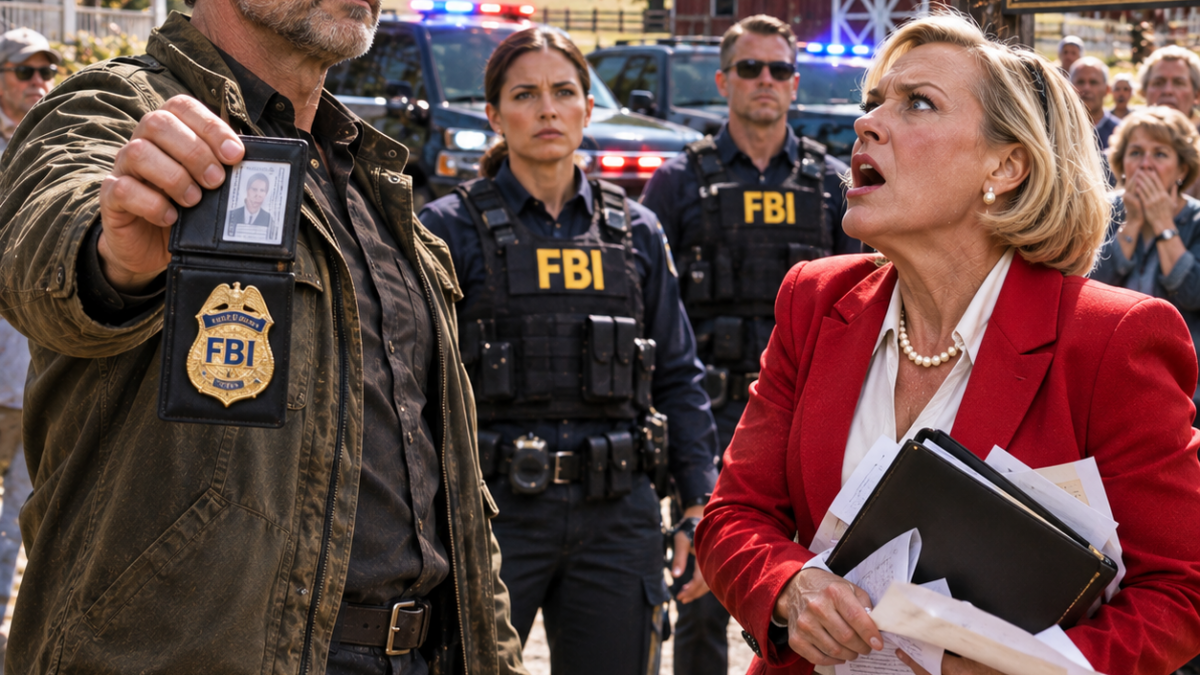
Doors opened.
Agents stepped out.
Navy jackets.
Credentials.
Body armor on two.
Tasha first.
Judith’s face changed slowly.
Confusion.
Annoyance.
Then fear.
Trent dropped the bolt cutters.
Howard closed his eyes.
I unzipped my jacket.
Reached inside.
Removed my credentials.
Held them open.
“Special Agent Cole Maddox.”
Silence.
Real silence.
Even Judith stopped breathing for a second.
Her eyes moved from my face to the badge.
Back.
“You’re—”
“Yes.”
She looked at Howard.
Then Trent.
Then Tasha.
Her folder slipped.
Papers scattered across the gravel.
“No.”
Tasha walked forward.
“Judith Alcott?”
Judith stepped backward.
“No.”
“Federal Bureau of Investigation.”
“No.”
“We have a warrant for your arrest and warrants relating to Oak Hollow Estates records and associated business entities.”
Judith’s voice rose.
“This is because of him!”
Tasha’s expression did not change.
“No.”
“Yes!”
“You have been under investigation for months.”
Judith looked at me.
Realization arrived.
Green Line.
The invoices.
The questions.
Howard.
Everything.
“You set me up.”
I shook my head.
“You came to my farm.”
She turned toward Howard.
“You.”
Howard finally looked her in the eye.
“Yes.”
“You signed everything.”
“I did.”
“You stole too.”
“I helped you.”
He was shaking.
“And I’m telling them everything.”
Judith lunged toward him.
Two agents moved immediately.
Hands behind her back.
Cuffs.
She screamed.
“You traitor!”
Howard cried.
Not dramatically.
Just tears.
“I should have stopped you years ago.”
Trent ran.
Not far.
Three steps toward the truck.
Agent Hadley caught him before he reached the door.
“Don’t.”
Trent froze.
Raised both hands.
Neighbors stared.
Nobody recorded anymore.
Or maybe some did.
I wasn’t watching.
Loretta stood near the road.
Hands over her mouth.
Tasha read Judith her rights.
Not a dramatic list of every possible charge.
That comes later.
But the core allegations were clear.
Wire fraud.
Mail fraud.
Conspiracy.
Embezzlement-related offenses under applicable statutes.
Fraud involving association funds.
The search teams moved simultaneously.
HOA office.
Judith’s house.
Green Line mail location.
Accounting office.
Trent’s residence.
Computers.
Phones.
Ledgers.
Bank records.
Years of quiet theft opened at once.
Judith kept shouting.
“This neighborhood needs me!”
Nobody answered.
Then she saw Loretta.
“You.”
Loretta walked closer.
Not too close.
Judith shouted:
“You never paid your assessments!”
Loretta’s face changed.
Fear first.
Old reflex.
Then something stronger.
“I paid you everything.”
Judith laughed bitterly.
“You’d be homeless if not for me.”
I watched Loretta.
She had spent years shrinking around this woman.
Now she stood straight.
“No.”
Her voice trembled.
“You tried to make me homeless.”
Then she stepped back.
That was enough.
Agents took Judith away.
The black SUV door closed.
The white Lexus stayed beside the road.
For the first time since I met her, Judith did not control where she went next.
The investigation became public within hours.
Local television arrived by afternoon.
I refused interviews.
Tasha handled agency statements.
The U.S. Attorney’s Office confirmed charges after unsealing.
The numbers grew.
$2.3 million became approximately $2.6 million after additional accounts were analyzed.
Some funds paid real expenses.
Some were diverted.
Some invoices were inflated rather than completely fake.
Green Line had been used as a laundering vehicle.
Judith’s relatives received payments.
Trent received “compliance bonuses” for identifying properties that could be pressured.
Howard had signed transfers.
He was not innocent.
His cooperation mattered, but so did his conduct.
He eventually pleaded to a lesser offense tied to false financial records and received a reduced sentence based on substantial assistance.
He accepted it.
No excuses.
That impressed me more than tears ever could.
Trent cooperated too.
The barrels in my barn were not his first planted violation.
That was the part that made people sick.
He admitted entering two other properties at Judith’s direction.
Once to photograph stored materials after moving them into a prohibited location.
Once to create evidence that a homeowner operated an unlicensed business from a garage.
Those fabricated violations supported fines.
The fines supported liens.
The liens created leverage.
The leverage forced payment.
Sometimes sale.
The Henderson foreclosure was reopened.
Their fence had never been the real issue.
They had challenged HOA financial records.
Judith escalated penalties until legal fees overwhelmed them.
By the time they understood what was happening, they were exhausted and broke.
People ask why they did not simply hire a lawyer.
That question usually comes from people who have never paid a lawyer.
Retainers cost money.
Court takes time.
Fraud thrives inside the gap between being wronged and being able to afford proving it.
Priya filed immediately to challenge the purported lien against my farm.
It disappeared.
Then she helped coordinate a homeowners’ civil action.
Every fraudulent lien was reviewed.
Some were voided quickly.
Others took longer.
Money was frozen.
Recovery proceedings began.
Loretta’s home had a pending lien for approximately $31,000.
When the judge signed the order releasing it, Priya brought the document to my porch.
Loretta came too.
Priya read:
“Lien released.”
Loretta blinked.
“That’s it?”
“That’s it.”
“No appeal?”
“Not from the HOA. The receiver agreed the underlying assessments were unsupported.”
Loretta sat down.
Then started crying.
I made coffee.
She laughed through tears.
“You always make coffee when people cry?”
“Yes.”
“Why?”
“I don’t know what else to do.”
“Typical man.”
“Probably.”
Within six months, Oak Hollow elected a new board.
No campaign signs.
No dramatic speeches.
The new president was a pediatric nurse named Maria Santos who had spent years avoiding HOA meetings because she said they made hospital committee meetings look exciting.
She accepted reluctantly.
That was probably why she was good.
First policy:
Independent annual audit.
Second:
No enforcement action without documented covenant authority.
Third:
No vendor payment above a threshold without competitive bids.
Fourth:
All liens required independent legal review.
Fifth:
Owners had an appeal process.
Sixth:
Board members could serve limited consecutive terms.
People joked that the first meeting under Maria lasted forty-one minutes instead of Judith’s three-hour performances.
The roads finally got resurfaced.
For real.
The company existed.
The asphalt arrived.
Residents took photographs because nobody trusted invoices anymore.
Loretta stood in the middle of her street after the paving crew left.
“Look.”
“What?”
“No potholes.”
I smiled.
“Miracle.”
“They charged us for this three times before.”
“I know.”
She looked at me.
“Does that make you angry?”
“Yes.”
“You don’t look angry.”
“I spent twenty years learning not to show criminals what helps them.”
She smiled.
“You know, I still can’t believe you were FBI.”
“Am.”
She stared.
“I thought you retired.”
“Everyone thinks that.”
“Did Judith?”
“Definitely.”
Loretta laughed.
“Good.”
The criminal case lasted more than a year.
Judith’s lawyers attacked everything.
The recordings.
The financial interpretations.
Howard’s credibility.
Trent’s credibility.
Green Line connections.
Normal defense work.
Necessary.
A system that makes conviction easy also makes false conviction easy.
Evidence matters.
Eventually Judith accepted a plea agreement.
Several federal counts.
Restitution.
Forfeiture.
Years in prison.
Some charges dismissed in exchange.
Some homeowners wanted more.
Some wanted decades.
I did not.
Sentencing is not revenge arithmetic.
No amount of prison time gives the Hendersons back the years they lost.
No sentence erases Loretta’s fear.
No judge can refund sleep.
What mattered was the scheme stopped.
Assets were recovered.
Records corrected.
Homes protected.
And the next person who tried to weaponize the HOA would face a community that had learned to ask for receipts.
The strangest fallout involved me.
Everybody in Oak Hollow suddenly knew who I was.
That destroyed part of what I had moved there to find.
Privacy.
For weeks, people drove slowly past my farm.
Someone left an FBI coffee mug on my gate.
Another neighbor dropped off a T-shirt that said:
ASK ME ABOUT MY COVENANTS.
I threw it away.
Then retrieved it from the trash because it was objectively funny.
Kids started asking whether I carried a gun while mowing.
I told them no.
Mostly.
At the feed store, the owner stopped me.
“Cole.”
“Yeah?”
“You really FBI?”
“Yes.”
He looked disappointed.
“That’s it?”
“What did you expect?”
“Something more mysterious.”
“I buy chicken feed.”
“I know.”
He shook his head.
“Ruined it.”
Eventually people stopped caring.
That was perfect.
I returned to the porch.
Sunrise.
Coffee.
Wind.
But something in me had changed.
I had come to the farm because I wanted silence after twenty years of corruption.
Then corruption followed me to the gate.
For a while that felt like proof I would never escape the work.
Eventually I saw it differently.
I had spent my career going toward places where people needed somebody to notice patterns.
At Oak Hollow, I did not need to chase anything.
The pattern arrived carrying a clipboard.
Green Line had bothered me for three years.
A ghost company.
Unresolved.
Then its name appeared on Trent’s invoice because Judith assumed nobody outside her little system would understand what they were seeing.
That is usually how fraud ends.
Not through genius.
Through arrogance.
Somebody stops imagining consequences.
Judith stopped imagining anyone could challenge her.
She had removed homeowners before.
Fined people.
Frightened widows.
Threatened families.
She had a lawyer.
A board.
Forms.
Letterhead.
A Facebook group.
A title.
President.
After enough years, she mistook compliance for legitimacy.
People obeyed her because fighting was expensive.
She interpreted that as proof she was right.
Then I arrived.
Quiet.
Alone.
Old farmhouse.
Work jacket.
Mud on my boots.
I never corrected her assumptions.
That bothered some people later.
They asked:
“Why didn’t you just show your badge the first day?”
Because my badge did not make my property rights stronger.
That answer matters.
Judith was wrong before she knew I was federal law enforcement.
My deed was still my deed.
The farm was still excluded.
Her threat was still improper.
The lien was still unsupported.
Trespass was still trespass.
If I had needed an FBI badge to make her respect those things, then the system would already have failed.
The point was never that she picked on someone powerful.
The point was how comfortable she had become picking on people she believed were not.
Loretta did not have a badge.
The Hendersons did not.
The retirees paying fake road assessments did not.
They deserved the same protection.
My credentials helped expose the larger crime.
They should not have been necessary for Judith to hear the word no.
One afternoon, Howard came to see me after serving his sentence.
Short.
Federal minimum-security facility followed by supervision.
He looked older.
Gray.
Thinner.
He stood outside the gate.
He did not enter.
That mattered.
“Can I come in?”
“Yes.”
We sat on the porch.
He held his hands together.
“I thought about this place a lot.”
“Why?”
“Because this is where everything ended.”
“No.”
He looked at me.
“It’s where everything became visible.”
Howard nodded.
After a while he said:
“I told myself I was protecting my wife.”
“She was sick.”
“Yes.”
“I told myself Judith would ruin me if I refused.”
“She might have tried.”
“I told myself I wasn’t stealing because I didn’t keep the money.”
I waited.
“That was the worst lie.”
He looked toward the road.
“I signed.”
“You did.”
“People lost homes.”
“Yes.”
His eyes filled.
“I don’t know how to live with that.”
I considered the answer.
“Don’t turn guilt into another excuse.”
He looked at me.
“What does that mean?”
“If you spend the rest of your life saying you’re terrible, that’s still making it about you.”
Silence.
“Do something useful.”
Howard nodded slowly.
“What?”
“Ask the people you harmed.”
He did.
Not everyone wanted to hear from him.
Some refused.
Good.
Victims do not owe redemption to offenders.
Loretta met him.
Once.
At the community center.
He apologized.
She listened.
Then said:
“I forgive you enough that I don’t want to hate you anymore.”
Howard cried.
Loretta did not.
She later told me:
“That is all he gets.”
Fair.
Trent’s story was different.
He was younger.
Less central.
Still responsible.
After probation, he worked construction again.
One day he pulled into my driveway.
He stopped outside the gate.
Called first.
Growth.
“I’m here.”
“For?”
“Your barn.”
I almost laughed.
“What about it?”
“The back door sags.”
“I know.”
“I can fix it.”
“Why?”
“I put barrels in there.”
“Yes.”
“I thought maybe I could repair something I actually broke.”
I considered.
“You’re charging?”
“No.”
“Then definitely not.”
He laughed nervously.
“I’m serious.”
“So am I. I don’t accept free work from former evidence planters.”
“What if I charge you?”
“Reasonable rate.”
We negotiated.
He fixed the door.
I paid him.
That felt cleaner.
Redemption should not require pretending the past never happened.
Sometimes it just means doing the next thing correctly.
Priya remained my attorney.
Mostly because after the case she claimed I attracted “premium-grade nonsense.”
She was right.
A year later, another nearby association sent me a letter about fence aesthetics.
I forwarded it to her.
She replied:
PLEASE STOP COLLECTING HOAS.
I framed that email.
Tasha retired before I did.
At her party, she gave me the old Green Line case-board photograph.
Not classified material.
Just a printout we had used internally after the case closed.
GREEN LINE PROPERTY SERVICES.
Red circle around the name.
She wrote:
GHOST FOUND ON FARM.
I hung it in the basement office.
Not because the case was glamorous.
Because cold cases teach humility.
Sometimes you do everything right and still do not have enough.
Then three years later, a clipboard turns sideways.
One invoice appears.
One widow talks.
One frightened treasurer chooses to stop lying.
One arrogant president cuts a chain.
Cases move because people do.
Oak Hollow changed.
Not magically.
Some neighbors still argued about garbage cans.
People complained about grass.
Maria received angry emails over basketball hoops.
Human beings remain human.
But meetings became boring.
That was success.
Boring governance is underrated.
Road budget.
Drainage.
Insurance.
Pool maintenance.
No secret companies.
No planted evidence.
No families terrified of losing houses over fences.
Loretta eventually sold her home voluntarily.
Not because anyone forced her.
Her daughter wanted her closer.
The day she left, she brought another pie.
Apple again.
“First one was better,” I told her.
“Liar.”
“I’m FBI.”
“You’re still a liar.”
She hugged me.
Then pulled back.
“You saved my house.”
“No.”
“Yes.”
“The case did.”
“Cole.”
“Loretta.”
She narrowed her eyes.
“Learn to accept a thank-you.”
I sighed.
“Thank you.”
“That isn’t how it works.”
“I know.”
She laughed.
Then drove away.
Her house sold to a young couple with two children.
No fraudulent lien.
No debt hanging over it.
Clean title.
That meant more to me than Judith’s sentence.
The Henderson family eventually recovered damages through civil proceedings.
They did not get their old house back.
Some losses do not reverse.
But their story became part of the reforms.
At one board meeting, Maria read their letter aloud.
One sentence stayed with me:
We were not defeated by a fence rule. We were defeated by a system designed to make resistance cost more than surrender.
That was Judith’s true business model.
Not property management.
Exhaustion.
Send letters.
Add fees.
Threaten lawyers.
Escalate.
Most people pay.
Some sell.
Some give up.
The brilliance of the fraud was also its ugliness.
Every individual charge looked too small to justify a war.
$200.
$400.
$750.
Then legal fees.
Administrative fees.
Special assessments.
Each step rational enough that victims wondered whether fighting made sense.
By the time the total became terrifying, they were already buried.
That is how systems become abusive without ever needing violence.
They turn process into a weapon.
Judith had believed paper was power.
In some ways she was right.
Paper can take a house.
But paper can also save one.
Deeds.
Bank records.
Audit trails.
Recorded exclusions.
Search warrants.
Court orders.
Checks.
Ledgers.
Truth often looks boring.
That is why fraudsters underestimate it.
Three years after Judith walked onto my farm, the barn still had one mark from that morning.
When Trent cut the gate chain, one half swung down and chipped the white paint from the post.
I never repaired it.
Not sentimental.
Reminder.
People ask why I didn’t replace the whole gate.
Because it works.
The new chain is heavier.
Not because I expect another HOA invasion.
Because farms teach practical lessons.
I still keep the old chain in the barn.
Beside it, Judith’s original inspection notice.
MANDATORY ROUTINE COMPLIANCE INSPECTION.
Sometimes I look at the $750 “failure to pre-schedule” fine and laugh.
It may be the stupidest document in the entire case.
And there were many contenders.
The most important evidence was Howard’s USB.
The most dramatic was Trent’s video.
The biggest money trail belonged to Green Line.
But the notice captured Judith perfectly.
She created the requirement.
Made compliance impossible.
Then punished the failure.
That was her whole system in one page.
Once, after a training session, a younger agent asked me what first tipped me off.
“The shell company?”
“No.”
“The lien?”
“No.”
“The planted barrels?”
“No.”
“What?”
“The $750 fine.”
He stared.
“That seems small.”
“Exactly.”
Fraudsters often reveal themselves in small injustices first.
The paperwork nobody challenges.
The fee nobody understands.
The signature that looks slightly wrong.
The vendor you have heard somewhere before.
The person who will not meet your eyes.
You notice enough small things and eventually the big thing stops being hidden.
Howard staring at gravel.
Trent’s invoice.
Loretta’s shaking hands.
Judith’s threat in a feed store.
Potholes beneath a $412,000 resurfacing invoice.
Then barrels in my barn.
None alone told the whole story.
Together, they did.
People later called what happened at my gate a sting.
I never liked that word.
It suggests we invented the crime.
We didn’t.
We documented a pattern that already existed.
Judith had choices at every stage.
She could have checked the deed.
Stopped sending letters.
Withdrawn the lien.
Responded to Priya.
Left the gate intact.
She chose escalation every time because escalation had always worked.
The only difference was that this time somebody was recording.
Sometimes people mistake quiet for weakness.
Judith did.
But the truth is quieter than intimidation too.
Bank records do not shout.
Deeds do not threaten.
Video files do not argue.
They wait.
And when enough of them line up, confidence becomes irrelevant.
I still wake before sunrise.
Coffee at 5:45.
Dogs outside.
Porch by six.
Oak Hollow’s roads are smooth now.
From the top pasture I can sometimes see headlights moving through the neighborhood.
People going to work.
School buses.
Delivery vans.
Ordinary life.
That is what all the investigations were supposed to protect.
Not headlines.
Not arrests.
Ordinary life without somebody secretly taxing fear.
My badge eventually went back into the basement safe.
Not because I was hiding again.
Because I did not need it on the porch.
I was still Special Agent Cole Maddox when the job required it.
On the farm, I preferred Cole.
The man fixing fence.
Mowing badly.
Arguing with tomatoes.
Drinking coffee while the sun climbed over the eastern field.
Some mornings I think about Judith’s face when the Suburbans arrived.
People expect that to be my favorite moment.
It isn’t.
My favorite came weeks later.
Loretta walked down her street after the judge voided her fraudulent lien.
She stopped in the middle of the patched, broken pavement.
A paving crew had just arrived.
A real one.
Real equipment.
Real contract.
Real asphalt.
She stood there watching.
Then looked at me.
“They’re actually fixing it.”
“Yes.”
She started laughing.
That was better than handcuffs.
Because punishment is only half of justice.
The other half is putting back what abuse distorted.
A safe home.
An honest road.
A clean title.
A board that understands it serves instead of rules.
A widow who no longer jumps when certified mail arrives.
That is what Judith never understood.
Authority is not the power to make people afraid of consequences.
Real authority is responsibility constrained by rules.
The moment you start believing your title makes the rules optional for you, the title has already become dangerous.
Judith thought HOA president meant she owned Oak Hollow.
She did not.
She managed paperwork for neighbors.
That was all.
She turned that ordinary role into a machine for fear because nobody stopped her soon enough.
Then she marched onto my farm expecting one more frightened homeowner.
Folder.
Smirk.
Bolt cutters.
Twenty witnesses.
Five minutes.
That was her plan.
She had absolutely no idea who she was talking to.
But even now, years later, I think that is the least important part of the story.
Because she should not have needed to know.
I should not have needed a badge.
Loretta should not have needed an FBI agent next door.
The Hendersons should not have needed federal warrants.
No person should have to prove they are powerful before another person respects the limits of their authority.
That morning, Judith crossed my gate because she believed I was harmless.
She was wrong about me.
But what destroyed her was something simpler.
She was wrong about the line.
Not the property line.
The other one.
The line between enforcing rules and inventing them.
Between collecting dues and stealing them.
Between inspection and trespass.
Between leadership and intimidation.
Between authority and control.
She had crossed it so many times that eventually she stopped seeing it.
Then, at 10:12 on a quiet Tennessee morning, she cut one final chain.
Three minutes later, the black SUVs arrived.
And for the first time in eleven years, Judith Alcott learned what it felt like when somebody else said:
No.
And meant it.








