HOA President Cut Down 31 Trees for Her Luxury Wedding View—Then I Checked the Survey Markers by the Lake
PART2:
I had been twelve.
I thought he was exaggerating.
He wasn’t.
Roots stitched that slope together.
Held soil.
Slowed runoff.
Protected the lakebank.
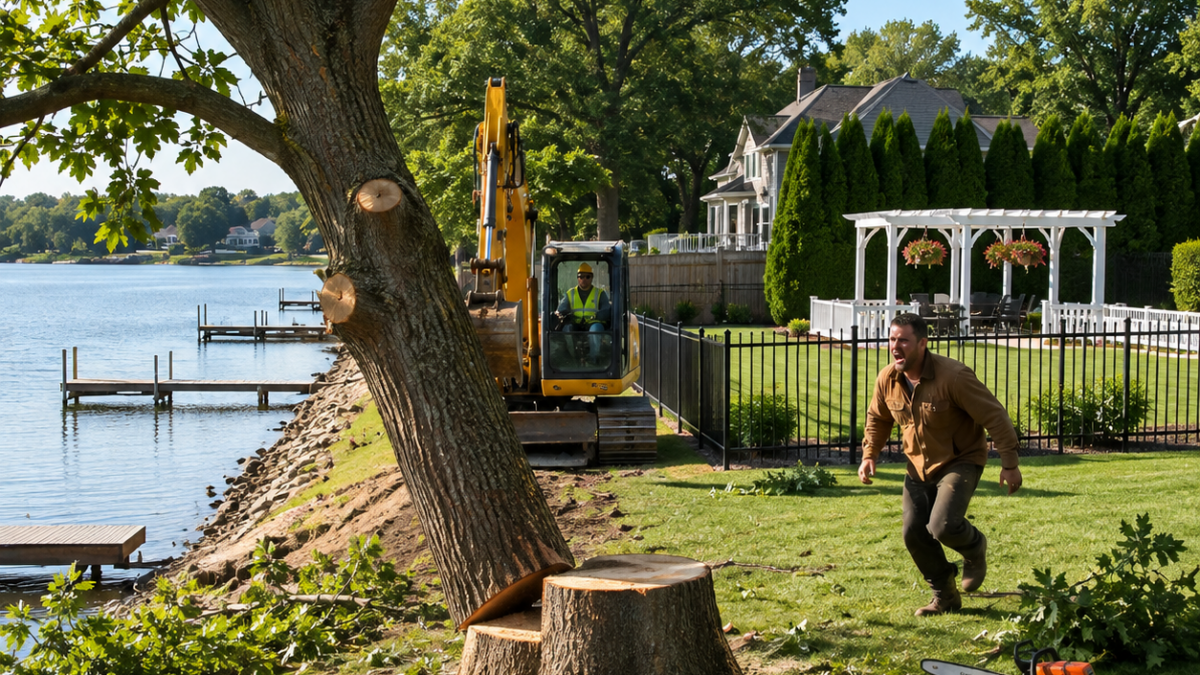
That morning those roots ended in thirty-one jagged stumps painted with orange marking paint.
An excavator was dragging the last cottonwood toward the fence.
I ran directly in front of it.
“SHUT THAT DAMN THING OFF!”
The operator slammed on the brakes.
Hydraulic arms stopped.
The engine dropped to idle.
A young guy climbed down.
Twenty-five, maybe.
Orange vest.
Mud on his boots.
He looked terrified.
“Sir, you can’t stand there.”
“Who told you to cut my trees?”
He blinked.
“The HOA.”
“What HOA?”
“Maple Reach.”
“This isn’t Maple Reach.”
He looked toward the neighboring property.
Then back at me.
“They said this strip was approved landscaping.”
“Approved by who?”
PART3:
He reached into the cab.
Pulled out a work order.
Crumpled.
Mud on one corner.
At the bottom was a signature I knew.
Gloria Talmadge.
President.
Maple Reach Homeowners Association.
I looked toward the new wedding lawn on the other side of the fence.
There she was.
Cream-colored dress.
Expensive sunglasses.
Standing beside a freshly painted white pergola overlooking Stonewater Lake.
A photographer moved around her, taking promotional pictures.
Gloria noticed me.
Smiled.
Not embarrassed.
Not worried.
Victorious.
I walked to the fence.
“GLORIA!”
She lowered her sunglasses.
“Oh, Bennett.”
Like she was surprised I happened to be awake on my own farm while heavy equipment removed half my shoreline.
“You’re up early.”
“Did you order those trees cut?”
“Of course.”
For a second I genuinely had no response.
“Those trees were on my property.”
She laughed.
Dismissive.
“They were blocking our sunset.”
I stared at her.
Behind Gloria stood the centerpiece of Maple Reach’s newest business venture.
The Stonewater Pavilion.
Wedding pergola.
Event lawn.
Catering structure.
Permanent string lighting.
Landscape walls.
Parking expansion.
The HOA had spent nearly a million dollars turning its western common area into a luxury wedding venue.
At least that was the number Gloria had repeated at every county meeting.
The venue could host eighty to one hundred twenty guests.
Lake backdrop.
Sunset ceremonies.
“Exclusive Wisconsin waterfront experience.”
That phrase was on their website.
The problem was that my trees occupied most of the western edge of their photographs.
Apparently Gloria had solved that.
“You cut thirty-one trees because they were in your pictures?”
“Don’t be dramatic.”
“My grandfather planted some of those.”
“Then your grandfather had terrible business sense.”
Something inside me went completely still.
I looked at her.
She smiled.
“Thirty-one trees were ruining a million-dollar view, Bennett. You should be thanking me.”
I wanted to yell.
I wanted to climb the fence.
I wanted to tell the excavator operator to put every tree back where he found it even though that was obviously impossible.
Instead I took out my phone.
One stump.
Then another.
Then another.
I photographed every cut.
Every trunk.
Every patch of orange paint.
Every tire track.
Contractor truck.
License plate.
Equipment numbers.
Gloria.
Pergola.
Fence.
Everything.
She watched me.
Amused.
“Take all the pictures you want.”
I kept photographing.
“Our attorneys already approved everything.”
“Did they?”
Her smile sharpened.
“The lake view belongs to everyone.”
I looked at her.
Then at the dead trees.
Then I walked away.
That confused her more than screaming would have.
I could feel it.
Gloria understood arguments.
She lived for them.
She liked an audience.
Liked forcing people to react until she could call the reaction unreasonable.
I wasn’t giving her one.
I went home.
Called the sheriff’s non-emergency line.
Called my land-use attorney.
Called my insurance agent.
Then I sat at my kitchen table looking out the window at a view I had never had before.
Maple Reach.
Clear as day.
Wedding lights.
White pergola.
Their parking lot.
The entire event lawn.
For forty-nine years those trees had been part of the horizon.
Now Gloria’s venue stared straight into my kitchen.
Above the stove hung a photograph of my grandfather, Earl Ralston.
Young.
Work pants.
Shovel.
One hand on an oak sapling.
He was smiling.
He once told me:
“Land isn’t just dirt, Benny. It’s a promise you keep for people who come after you.”
I had thought about that sentence often after he died.
More after my father died.
Land has a way of making time visible.
A fence post rots.
A barn settles.
A tree grows from something you could hold in one hand into something two people cannot wrap their arms around.
Then someone with a chainsaw removes eighty years in thirty seconds.
I stood.
Walked to the steel filing cabinet in the corner.
My grandfather bought it used from a feed store in 1978.
Ugly gray thing.
Dent in one side.
Heavy enough that moving it required either four men or poor judgment.
Inside:
Deeds.
Surveys.
Agricultural permits.
Shoreline documents.
Drainage agreements.
Tax maps.
Conservation correspondence.
But I wasn’t looking for old paperwork.
Bottom drawer.
Thick folder.
AGRICULTURAL CONSTRUCTION PLANS.
I had prepared it six months earlier.
My equipment storage was becoming a problem.
Two tractors.
Hay equipment.
Seeder.
Attachments.
Small excavator.
Snow equipment.
Tools.
The old pole barn was full.
I had talked with an agricultural engineer about building a new seventy-by-one-hundred-twenty-foot storage structure.
Tall enough for machinery.
Metal siding.
Concrete pad.
Three large doors.
I had considered three locations.
The eastern site near Maple Reach was technically the best.
Flat.
Road access.
Power nearby.
Drainage manageable.
But I rejected it.
Too many trees.
I was not cutting my grandfather’s shoreline grove for a building.
Now the grove was gone.
I opened the site map.
There it was.
Site C.
Eastern agricultural storage structure.
Entirely inside my boundary.
Right beside Gloria’s wedding lawn.
I looked through the kitchen window.
Could see the white pergola between the stumps.
For the first time that day, I smiled.
Not because I had decided to build out of revenge.
That would have been stupid.
Expensive too.
Agricultural buildings do not become free just because your neighbor annoys you.
But the reason I had rejected Site C had been removed.
Without my permission.
By Gloria.
The following morning, certified arborist Audra Finch arrived at 7:45.
She was fifty-two, blunt, and had the personality of someone who had spent twenty-five years explaining to developers that trees were biological structures rather than green decorations.
She inspected every stump.
Measured diameters.
Identified species.
Estimated age.
Photographed root zones.
Two hours later she stood near the largest oak stump.
“This one’s eighty, maybe eighty-five.”
“My grandfather planted it.”
“I believe you.”
She looked toward the bare shoreline.
Then frowned.
“Bennett.”
“What?”
“Trees aren’t your only issue.”
I followed her gaze.
“Erosion.”
“Yes.”
She walked downslope.
“These roots were acting as a retaining system.”
“I know.”
“Not just topsoil.”
She pushed her soil probe into the bank.
“The slope is already wet. Big storm, freeze-thaw, spring runoff…”
“How bad?”
“Potentially bad.”
I looked toward the lake.
“What do I do?”
“First, nobody touches this area.”
“No cleanup?”
“Not until soil and shoreline people see it.”
She pointed at the trunks.
“Leave everything where it is.”
“Gloria will love that.”
“I don’t care what Gloria loves.”
That was why I hired Audra.
I sent Maple Reach a formal demand that afternoon.
All permits.
All contractor agreements.
All surveys.
All legal documents they believed gave them authority to remove vegetation from my farm.
Gloria answered the following morning.
Not apology.
Threat.
Maple Reach claimed “scenic management authority” over vegetation interfering with community recreational facilities.
She ordered me to stop “obstructing improvements benefiting the broader Stonewater Lake environment.”
I read the letter twice.
Then drove to her office.
Gloria sat behind a glass desk looking at wedding photographs.
“Bennett.”
She did not look up.
“Have you finally come to apologize?”
I placed her letter on the desk.
“Show me.”
That got her attention.
“Show you what?”
“Where I gave Maple Reach scenic authority over my farm.”
She leaned back.
“You don’t have to give it.”
“Yes, I do.”
“Our community has standards.”
“Your community ends at my fence.”
“Your farm affects our property values.”
“My farm existed before your subdivision.”
She closed the photo album.
“Listen carefully.”
I waited.
“We already have eighteen weddings booked.”
“Congratulations.”
“If you interfere with those events, we will sue you for every penny we lose.”
“Did you check who owned the trees before ordering them cut?”
She laughed.
“I don’t need to own a tree to remove an eyesore.”
I looked at her.
That sentence told me everything I needed to know about the conversation.
“Thank you.”
She frowned.
“For what?”
“For making your position clear.”
I left.
That night I called Travis Kemp, the excavator operator.
He was reluctant.
I understood.
He worked for a landscaping contractor.
He did not want to get between a property owner and a client who had paid his company.
I asked only factual questions.
“Were you told the trees were diseased?”
“No.”
“Hazardous?”
“No.”
“Storm damaged?”
“No.”
“Did anybody tell you to confirm the property line?”
“Gloria said it had already been surveyed.”
“What exactly were you asked to do?”
“Clear the shoreline before the promotional shoot.”
“Entire strip?”
“Yes.”
“Why?”
He hesitated.
“View corridor.”
There it was.
No emergency.
No mistaken dead tree.
No safety issue.
View.
Wedding photographs.
I thanked him.
Then Audra called.
Her tone was different.
“Bennett.”
“What?”
“I’ve been reviewing my photos.”
“Okay.”
“The excavation tracks.”
“What about them?”
“They cross closer to the line than I realized.”
“How close?”
“That’s what I want you to check.”
I stood.
“Check what?”
“Survey markers.”
A cold feeling moved into my stomach.
She continued.
“They didn’t just cut your trees.”
I looked through the window.
Dark shoreline.
Lights from Maple Reach spilling across the pasture.
“There’s fresh soil disturbance right beside the boundary. Before anybody touches anything, verify your monuments.”
I grabbed a flashlight.
My grandfather had shown me the old boundary pins when I was a teenager.
Later surveys had replaced some.
The eastern lake boundary had three modern monuments.
One near the county road.
One halfway down.
One near the shoreline.
The top marker was where it belonged.
So was the middle.
The shoreline pin was gone.
Not hidden under leaves.
Gone.
I found disturbed soil.
Fresh.
An oval about two feet wide.
Excavator track beside it.
I stood there in the dark.
Then aimed my flashlight at Maple Reach’s new retaining wall.
Something felt wrong.
The wall sat close to the line.
Closer than I remembered.
I did not measure.
Did not touch.
I called Audra.
“Marker’s gone.”
Silence.
“Bennett, stop.”
“I am stopped.”
“Do not dig.”
“I’m not.”
“Call your surveyor tomorrow.”
“I will.”
“And photograph everything.”
Already doing it.
At 8:00 the next morning, licensed surveyor Mark Ellison arrived.
Mark had surveyed Ralston Farm six years earlier when a drainage dispute came up near the north pasture.
He carried GPS equipment.
Tripod.
Old plat.
Current county coordinates.
He worked most of the morning.
Gloria appeared around ten.
She stood on the other side of the fence.
“What is he doing?”
I ignored her.
“Bennett.”
Nothing.
“You can’t survey our property without permission.”
Mark looked at me.
Then at her.
Then continued.
She raised her voice.
“I’m talking to you.”
I finally turned.
“He’s on my farm.”
“That equipment is pointed at our venue.”
“It’s a survey instrument, Gloria, not artillery.”
Her face hardened.
“You’re creating a hostile environment for our guests.”
“No guests are here.”
“They will be this weekend.”
“Then I recommend keeping them on your property.”
She left.
Mark finished around noon.
He stood beside his truck looking at his tablet.
Not happy.
“What?”
“The line has not moved.”
“That sounds good.”
“The monuments have.”
I stared.
“Explain.”
“Your legal boundary is exactly where the recorded survey says.”
“Okay.”
“But somebody has been marking a different line physically.”
He showed me.
Small orange stakes.
Some removed.
Some hidden in brush.
They traced a line six to nineteen feet inside my property depending on location.
Near the lake, the false line moved almost twenty-three feet west.
I looked toward Maple Reach.
Their new retaining wall.
Part of it sat on my land.
So did approximately eight feet of the wedding lawn.
And one corner of the pergola foundation.
I said nothing for a while.
Mark zoomed the map.
“There’s more.”
Of course there was.
“What?”
“The excavation around your missing pin wasn’t just tree work.”
He walked me downslope.
We stopped near the bare bank.
Fresh soil.
Compacted.
A narrow trench ran along the slope.
Filled back in.
“What is that?”
“Could be drainage.”
I looked toward Maple Reach.
Their venue sat uphill.
Mark said:
“Need utility locate.”
We called.
By afternoon, paint lines crossed my pasture.
Blue.
Red.
Orange.
Then the contractor marked a buried four-inch drainpipe.
Coming from Maple Reach.
Crossing the property line.
Ending beneath my former tree grove.
No recorded easement.
No agreement.
No permission.
The pipe discharged stormwater directly into the slope above Stonewater Lake.
Audra stood beside me.
“That’s why the soil is saturated.”
I looked at her.
“The trees were holding a slope they were dumping stormwater into?”
“Yes.”
“And now they’re gone.”
“Yes.”
“How long has the pipe been there?”
Surveyor Mark said:
“Pipe looks new.”
I called the county.
That call changed the week.
Land-use enforcement.
Shoreline zoning.
Stormwater management.
Environmental services.
Within forty-eight hours, inspectors were standing on my pasture.
Maple Reach’s wedding venue had problems.
A lot of them.
The wedding lawn expansion permit showed the property line in the wrong place.
The retaining wall was approved based on that line.
So was the pergola.
So was the drainage design.
The submitted site plan showed a ten-foot landscaped buffer between venue improvements and Ralston Farm.
In reality, part of the venue crossed onto my land.
County engineer Dana Horowitz looked at the approved plan.
Then Mark’s survey.
“Who prepared this?”
“Northstar Civil.”
She checked the stamp.
Engineer:
Lewis Bannerman.
I knew the firm.
Large regional engineering company.
Dana made a call.
Then another.
By evening, Northstar Civil sent someone.
Not Lewis Bannerman.
A compliance manager.
He arrived holding their original survey base.
Compared it to the county submission.
Then became very quiet.
“Our plan doesn’t show this line.”
Dana looked at him.
“What?”
He turned his tablet.
Northstar’s original plan respected the real Ralston boundary.
The version filed with the county had been altered.
Twenty-three feet.
Enough to fit the expanded lawn.
Enough to keep the pergola setback legal on paper.
Enough to bury the drainage outlet where my trees had hidden it from casual view.
I looked at Gloria.
She had come outside with her attorney.
“You altered the survey.”
Her attorney said:
“Do not make accusations.”
The compliance manager continued.
“The title block is ours.”
Dana said:
“Revision notation?”
“Not ours.”
“Digital file?”
“We’ll preserve everything.”
Gloria crossed her arms.
“This is obviously a drafting mistake.”
Mark said:
“A drafting mistake does not relocate three separate boundary points consistently.”
Her attorney gave him a look.
Mark shrugged.
“I survey land. I’m allowed to notice geometry.”
The county issued an immediate stop-work order on the western venue area.
Gloria nearly exploded.
“We have a wedding Saturday!”
Dana answered:
“You have an unresolved boundary encroachment and unpermitted stormwater discharge.”
“You cannot shut down a private event.”
“I can shut down the use of improvements constructed outside approved plans.”
“The pergola is safe.”
“Part of its foundation appears to be on property you do not own.”
Gloria looked at me.
“You’re doing this.”
I almost laughed.
“You removed thirty-one trees.”
“You called the county.”
“You buried a pipe.”
“We did no such—”
Dana raised a hand.
“Save it for counsel.”
Saturday’s wedding was relocated.
The couple sued Maple Reach later for costs.
I felt bad for them.
Not Gloria.
The investigation moved faster after that.
Digital metadata showed the altered site plan had been created four months earlier on a computer registered to Maple Reach’s management office.
User account:
GTalmadge.
Gloria claimed assistants had access.
Maybe they did.
Then investigators found email.
Gloria to Lewis Bannerman:
WE NEED MORE WESTERN WIDTH OR THE PAVILION LOSES THE LAKE ANGLE. RALSTON WILL NEVER COOPERATE.
Bannerman responded:
Boundary is fixed. We cannot design across it without owner agreement.
Gloria:
THEN DESIGN TO CURRENT HOA LANDSCAPE LINE.
Bannerman:
There is no recorded landscape line. Only surveyed parcel boundary.
Two days later, Gloria emailed Maple Reach’s property manager.
USE ATTACHED REVISED BASE FOR COUNTY SET.
The attachment was the altered map.
That was bad.
Then came something worse.
The drainage pipe.
Invoices showed Maple Reach paid $28,400 to install “western landscape drainage.”
Contractor drawings showed the pipe ending ten feet inside HOA property.
As built?
Twenty-one feet inside mine.
Why?
Because dumping water on HOA land would have saturated the wedding lawn.
So someone extended the pipe downhill.
Onto my farm.
Under the trees.
The trees Gloria later destroyed because they blocked the view were also concealing the pipe that proved her venue was draining stormwater illegally across my property.
Audra said:
“She may not have cut them to hide the pipe.”
“No.”
“But cutting them exposed it.”
“Yes.”
Gloria had accidentally removed her own cover.
That was the first irony.
The second came from my agricultural plans.
My attorney, Susan Vale, reviewed everything.
Seventy-by-one-twenty storage building.
Agricultural zoning allowed it.
Setbacks worked.
Shoreline regulations worked if we shifted it twelve feet north.
Height:
Thirty-two feet at ridge.
Gloria’s wedding website advertised:
UNINTERRUPTED GOLDEN-HOUR LAKE PANORAMA.
Susan looked at the building rendering.
Then at me.
“You are not building this solely to annoy her.”
“No.”
“Say that again.”
“I need agricultural storage.”
“How long have plans existed?”
“Six months before the trees were cut.”
“Why didn’t you choose this location?”
“Trees.”
“Now?”
“Trees are dead.”
“Good.”
She pointed at me.
“Not good trees are dead. Good documentation.”
“I understood.”
“You have equipment need?”
I showed her machinery storage records.
Insurance concerns.
Current pole-barn capacity.
Quotes from before the dispute.
She smiled.
“Excellent.”
“Accountants and lawyers are strange people.”
“I’m a land-use attorney.”
“Worse.”
We submitted the agricultural building permit.
Public notice was not strictly required for the basic use.
But shoreline review meant Maple Reach learned anyway.
Gloria appeared at the county hearing with eleven residents.
She called the building:
“A retaliatory visual obstruction.”
I sat quietly.
County commissioner asked:
“Mr. Ralston, when were these plans prepared?”
“April.”
“Trees cut?”
“October.”
“Purpose?”
“Farm machinery and agricultural storage.”
“Alternative sites?”
“Two.”
“Why select eastern site now?”
“The primary conflict was removing mature trees. That issue no longer exists.”
Gloria shot up.
“You hear that? He admits it!”
Commissioner looked at her.
“Admits what?”
“He’s exploiting what happened.”
I answered:
“I am using my land.”
“Against us!”
“I store tractors, Gloria. They lack political ideology.”
Someone in the room laughed.
She did not.
The permit passed subject to ordinary conditions.
No special exception.
No revenge variance.
No HOA permission.
Thirty-two-foot agricultural building.
Metal.
Functional.
Legal.
The first support columns went up in spring.
From Maple Reach’s wedding lawn, they looked enormous.
Gloria sent cease-and-desist letters.
Susan answered each one.
No.
Gloria reported noise violations.
Agricultural exemptions applied.
She complained that equipment deliveries disrupted ceremonies.
We scheduled construction within allowed hours anyway.
Not because I wanted to ruin weddings.
Because contractors had schedules.
Farm work had schedules.
And Maple Reach had built a commercial wedding operation directly beside a working farm.
That was their planning decision.
Not mine.
Then the shoreline started failing.
April rains.
Heavy.
Three days.
The bare slope below the cut trees became saturated.
At 4:30 one morning, part of the bank slumped.
Not into the lake completely.
About eighteen feet of soil shifted.
Fence posts leaned.
Mud flowed down.
The county closed the immediate shoreline.
Audra came out in rain gear.
Looked at the slope.
Then at me.
“I warned you.”
“You did.”
“We need stabilization now.”
The cost estimate hurt.
Temporary erosion controls.
Slope engineering.
Root-zone replacement planting.
Stone toe protection in limited areas.
Native vegetation.
Nearly $190,000.
My insurance carrier looked at the tree-removal report.
Then at the illegal stormwater pipe.
Then at Maple Reach.
Their attorneys became interested.
Very interested.
Maple Reach’s insurer became equally interested in Gloria.
The original tree contractor’s insurance joined.
Then the civil case began.
Tree value.
Shoreline damage.
Trespass.
Restoration.
Stormwater damage.
Survey encroachment.
Loss of use.
Legal costs.
Nobody talked about sunsets anymore.
Independent arborist valuation placed the replacement and landscape value of the thirty-one mature trees at more than $300,000.
Not because someone could simply buy eighty-year-old oaks and drop them into the ground.
Because courts and insurers use structured valuation methods.
Species.
Diameter.
Condition.
Location.
Contribution.
Restoration.
The shoreline work added more.
Then Maple Reach had to remove part of the retaining wall.
Relocate drainage.
Pull back the wedding lawn.
And move the pergola foundation corner entirely onto HOA property.
Estimated correction:
$420,000.
Their million-dollar venue became a much more expensive venue.
Then auditors looked at the financing.
That was where Gloria’s real trouble began.
Maple Reach had financed the venue with a $1.1 million loan.
Application included projected wedding revenue.
Asset description.
Site plan.
Event capacity.
And one specific claim:
FULL OWNERSHIP AND CONTROL OF WESTERN EVENT LAWN AND SCENIC BUFFER.
The altered plan was attached.
So were photographs of my tree line labeled:
HOA-MANAGED SCENIC VEGETATION.
I stared at that label.
My grandfather’s trees had somehow become HOA-managed assets in a bank file.
The lender’s attorney asked the obvious question.
“Who represented that?”
Application certification:
Gloria Talmadge.
HOA president.
Now we were no longer arguing about wedding noise.
The bank froze future draws.
HOA board members panicked.
Several claimed they had never seen the complete loan package.
Treasurer Samuel Price said Gloria handled lender coordination personally.
He had approved the debt resolution.
Not the property representations.
The board called an emergency meeting.
I did not attend initially.
Then three Maple Reach homeowners came to my farm.
Not Gloria allies.
Ordinary residents.
One was a retired teacher named Ruth Ellis.
She stood on my porch.
“We owe you an apology.”
“You didn’t cut my trees.”
“We elected her.”
“That’s different.”
“Still.”
The man beside her, Tom Weller, asked:
“Are you trying to shut down the venue?”
“No.”
They looked surprised.
“I want my boundary restored, my shoreline fixed, and damages addressed.”
“What about the barn?”
“It’s a farm building.”
Ruth smiled faintly.
“It blocks almost the entire sunset.”
“I noticed.”
They laughed.
Then stopped because the situation was not actually funny for them.
HOA insurance premiums were rising.
Loan payments remained.
Weddings were being canceled.
Legal expenses accumulating.
Ruth said:
“Gloria says you want Maple Reach bankrupt.”
“Gloria says many things.”
“So you don’t?”
“No.”
I looked toward the half-built storage structure.
“I want Maple Reach on its side of the fence.”
That sentence traveled.
At the emergency meeting, 104 homeowners attended.
Gloria opened with a forty-minute presentation about “external aggression against community assets.”
Then Samuel Price stood.
Asked one question.
“Did you alter the site plan?”
Gloria said:
“No.”
He placed the metadata report on the projector.
User account.
GTalmadge.
Her attorney whispered to her.
She changed answer.
“My office made routine administrative adjustments.”
Samuel asked:
“Did an engineer approve those adjustments?”
“No response.”
“Did the landowner?”
She looked at me.
I was sitting in the back.
“No.”
Samuel continued:
“Did the bank know part of the listed event lawn belonged to Bennett Ralston?”
“It does not.”
The room erupted.
I stayed seated.
Then Mark Ellison walked to the front.
He had been invited by the board’s independent counsel.
Survey map on screen.
Recorded parcel.
Actual monuments.
False landscaping stakes.
Encroachments.
No ambiguity.
The crowd became quiet.
Gloria looked smaller.
Not physically.
Institutionally.
For two years she had controlled meetings through certainty.
That night certainty met coordinates.
Coordinates won.
The board suspended her 5–1.
She voted no.
The next month, members recalled her.
147 to 18.
I never learned who the eighteen were.
Ruth said some people would vote against gravity if the board told them gravity was being unfair.
The civil settlement took nearly a year.
Maple Reach’s insurance paid a large portion of the tree and shoreline damages.
The contractor’s insurer paid another part.
The HOA itself covered deductibles and costs tied to uninsurable conduct.
Gloria was personally named in several claims.
The final agreement required:
Removal of all encroachments.
Permanent drainage correction.
Reestablishment of the legal boundary.
Restoration planting.
Shoreline stabilization.
Compensation for destroyed trees.
Reimbursement of professional fees.
And one condition I insisted on.
Maple Reach would record a formal acknowledgment that it held no scenic, view, landscaping, agricultural, access, noise-control, or management rights over Ralston Farm.
Susan called it excessive.
I called it complete.
She put it in.
The wedding venue survived.
That surprised people.
It survived because the new board stopped pretending it owned the world around it.
They reduced capacity.
Installed proper sound buffering on their side.
Moved lighting.
Rebuilt drainage.
Corrected lender documents.
Disclosed litigation.
Raised rates.
Some weddings canceled.
Others came.
Couples still liked Stonewater Lake.
They simply had a large agricultural building in some photographs now.
My building was finished the following summer.
Gray metal siding.
Dark roof.
Three huge doors.
Tractor inside.
Baler.
Seeder.
Snowplow.
Tools.
Everything fit.
The first time I drove my tractor into it, I laughed.
Not because Gloria lost her sunset.
Because after twenty years of stacking equipment like a puzzle inside the old pole barn, I could finally walk around everything.
Practical joy.
Underrated.
The building did change Maple Reach’s view.
A lot.
From the pergola, the western sunset now disappeared behind thirty-two feet of legal agricultural storage for part of the year.
Their photographer adapted.
Professionals do.
They shifted camera angles toward the lake.
Used tighter lenses.
Took more photos facing south.
Turns out a luxury venue does not collapse because a farmer owns a barn nearby.
Gloria had destroyed thirty-one trees to solve a problem that never needed solving.
That was the real waste.
Years later, the replacement trees grew.
Oak.
Maple.
Willow.
Native shrubs.
Not where every original stood.
Shoreline restoration required different spacing.
Audra supervised.
She made me plant more than I wanted.
“You’ll be dead before these look mature.”
“Comforting.”
“I’m being honest.”
“You’re excellent at that.”
Some were eight feet tall when planted.
Others smaller.
I put one young oak near the stump of my grandfather’s tree.
Could not remove the stump completely because the remaining roots still helped stabilize soil.
So we left part of it.
Old beside new.
My grandfather would have liked that.
The old stump became silver over time.
The new oak thickened.
Every year it cast a little more shade.
Gloria eventually sold her Maple Reach house.
Moved to Madison, I heard.
Then maybe Florida.
I never checked.
Her wedding-venue photographs disappeared from the HOA website.
New board removed her name from promotional materials.
Not because I requested it.
They were tired of explaining.
The county case involving altered plans ended with penalties, licensing reviews, and a plea arrangement tied to document falsification and false representations.
Less dramatic than people expected.
No courtroom explosion.
No handcuffs beside the pergola.
Accountability is often paperwork arriving slowly.
Fines.
Restitution.
Probation.
Professional restrictions.
Civil judgments.
Documents more durable than humiliation.
I preferred it that way.
The tree contractor, Travis Kemp, visited after the settlement.
He had left the company.
Started working for another outfit.
He stood near the restored shoreline.
“I’m sorry.”
“I know.”
“I should’ve checked the line.”
“Yes.”
He nodded.
No excuses.
“I trusted the work order.”
“I know.”
“I don’t anymore.”
“Good.”
He looked at the young trees.
“Looks better.”
“Not yet.”
“Will.”
“Eventually.”
He offered to help plant one.
I let him.
Some neighbors thought that strange.
I didn’t.
Travis made a mistake because someone with apparent authority handed him paperwork.
Gloria made a choice after being told the property was disputed.
Those were not the same thing.
One deserves accountability.
The other can also deserve another chance.
The new Maple Reach president was Ruth Ellis.
Retired fourth-grade teacher.
Seventy years old.
Absolutely terrifying in meetings.
She called me six months after taking office.
“Bennett.”
“What broke?”
“Nothing.”
“That’s suspicious.”
“We want to discuss wedding noise.”
“My attorney?”
“No.”
“Then talk.”
She proposed quiet hours.
No outdoor amplified music after nine.
Agricultural operations expressly exempt if conducted normally.
I read that twice.
“You included farming.”
“We live beside a farm.”
“Gloria found that concept difficult.”
“I taught nine-year-olds for thirty-eight years. I have experience with difficult concepts.”
I liked Ruth.
Maple Reach and I eventually created a simple drainage inspection agreement.
Not an easement.
Not property rights.
Just an annual joint inspection of infrastructure near the boundary so nobody buried another pipe where it did not belong.
Susan drafted four pages.
I reduced it to two.
She complained.
We signed.
The steel filing cabinet got another folder.
MAPLE REACH — FINAL.
I put everything inside.
Settlement.
Survey.
Restoration plan.
Photographs.
Gloria’s scenic-authority letter.
The fake boundary plan.
The corrected map.
One copy of her email saying my farm threatened their booked weddings.
And the original agricultural construction plan.
The plan that existed before a single tree fell.
That folder mattered to me.
Not because I enjoyed winning.
People say that when you survive a property dispute.
“You won.”
It rarely feels like winning.
My trees were still dead.
My grandfather’s oak did not return because an insurer wrote a check.
The shoreline never looked exactly the same.
Money measures loss because courts need numbers.
Land remembers differently.
But the rest of the farm remained mine.
That mattered.
Gloria had wanted more than a view.
That was the part I understood only later.
Once she decided her million-dollar venue was more important than my trees, every other line became negotiable in her mind.
Boundary.
Drainage.
Noise.
Farming.
Ownership.
She started with:
Those trees affect us.
Then:
We have authority over them.
Then:
Your farm affects our property values.
Then:
Your activities must accommodate our weddings.
That progression is how control expands.
Not usually in one giant demand.
In small sentences that sound reasonable if nobody asks where the authority comes from.
My grandfather had understood that better than I did.
The old steel cabinet proved it.
He kept records not because he expected enemies.
Because he expected time.
People die.
Memories shift.
Neighbors change.
Boards change.
Promises become stories.
Stories become assumptions.
Assumptions become people like Gloria saying:
I don’t need to own a tree to remove an eyesore.
Documents stop assumptions from becoming history.
Ten years after the chainsaws, I stood beside the lake with my niece’s son, Eli.
Seven years old.
He pointed at the young oak growing beside the old stump.
“Why is that one little?”
“Because it’s younger.”
“What happened to the big one?”
I looked toward Maple Reach.
Wedding music floated faintly across the water.
Different president.
Different board.
Couple taking photographs by the pergola.
I said:
“Somebody made a bad decision.”
“What kind?”
“The expensive kind.”
He accepted that.
Kids understand consequences better when you do not over-explain them.
He touched the old stump.
“Did Grandpa Earl plant this?”
“Your great-great-grandpa.”
“That’s old.”
“Yes.”
“Will the new one get that big?”
“If people leave it alone.”
He nodded seriously.
Then ran toward the barn.
The agricultural building Gloria would have hated was no longer new.
Paint slightly faded.
A dent near one door where I misjudged the tractor blade.
Functional.
Boring.
Perfect.
From Maple Reach’s side, trees had also grown around it.
The venue gradually got part of its green backdrop back.
Not because anyone planned it.
Because landscapes move.
Views change.
That is what Gloria never understood.
You cannot own a sunset.
You cannot freeze a shoreline.
You cannot demand that somebody else’s trees, barns, cattle, tractors, or life arrange themselves permanently around your wedding photographs.
A view is what exists beyond your property.
Not what you control beyond it.
I still have the photograph from that first morning.
Thirty-one stumps.
Orange paint.
Excavator tracks.
Gloria in the background near the white pergola.
I almost deleted it after the case ended.
Audra told me not to.
“Historical record.”
She was right.
Years later I looked closely at that picture.
Something I had never noticed.
The missing shoreline survey marker would have been just outside the lower left corner.
Two feet away.
The whole case was already sitting there.
Trees gone.
Fresh dirt.
False line.
Wedding venue.
One image.
I had thought the crime was the trees.
Then I thought it was the encroachment.
Then the drainage.
Then the altered plan.
The truth was simpler.
They were all the same problem.
Gloria believed wanting something badly enough gave her authority over whatever stood in the way.
The trees stood in the way.
So she cut them.
The boundary stood in the way.
So someone moved it on paper.
The slope stood in the way.
So they drained across it.
My farm stood in the way.
So she tried to regulate it.
And when I resisted, she called me unreasonable.
People like Gloria depend on resistance feeling impolite.
That is why documentation matters.
A survey is not rude.
A deed does not raise its voice.
A photograph does not get emotional.
A timestamp does not care who is HOA president.
The truth does not need to win the argument.
It only needs to remain intact long enough for someone with authority to read it.
That is what happened.
The morning Gloria cut my grandfather’s trees, she thought she had stolen my sunset.
What she actually did was clear away the one thing preventing me from seeing exactly how far she had crossed onto my land.
And once the trees were gone, there was nowhere left for the boundary line—or the truth—to hide.








