HOA Karen Broke Into My Farm for a “Routine Inspection”—Then I Traced $187,432 to Her Family LLC and the FBI Walked Into Her HOA Meeting
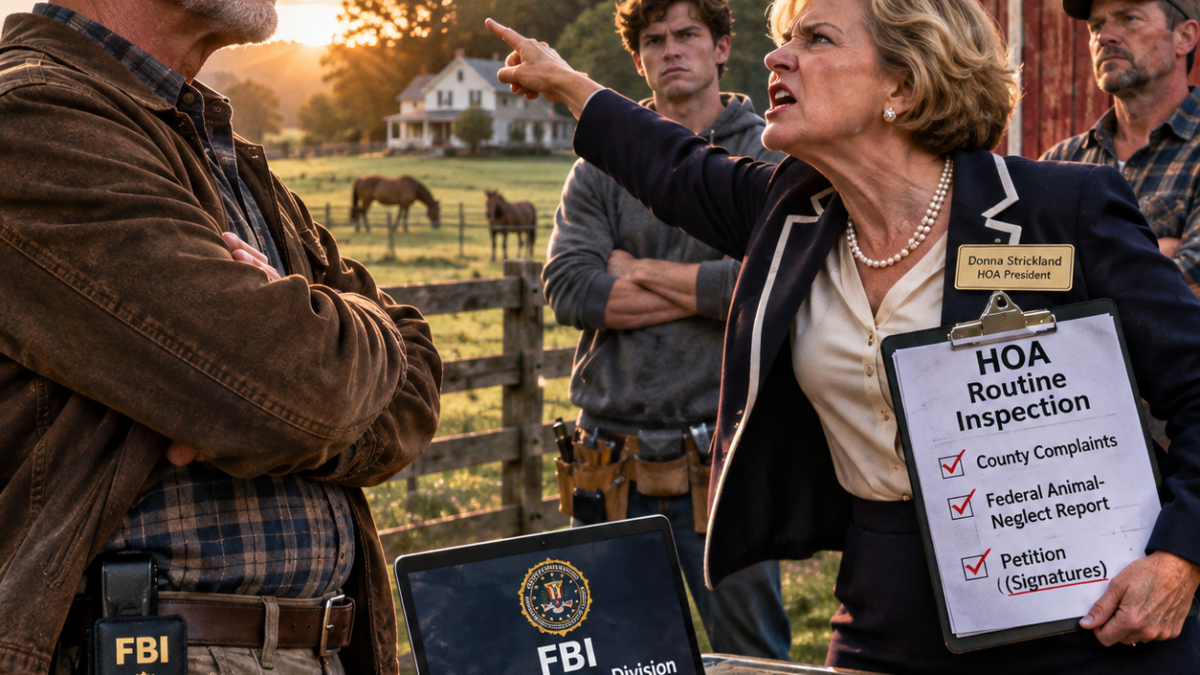
HOA Karen Broke Into My Farm for a “Routine Inspection”—Then I Traced $187,432 to Her Family LLC and the FBI Walked Into Her HOA Meeting.
The HOA president climbed over my fence at six in the morning with her son and a hired handyman, pointed at the security cameras on my barn, and ordered them removed because she claimed she was conducting a “routine inspection.”
She had already filed county complaints, federal animal-neglect reports, and a petition filled with signatures that didn’t belong to the people whose names appeared on it—but she still believed I was just a quiet widower she could frighten off his own farm.
What Donna Strickland didn’t know was that I had spent twenty-seven years with the FBI Financial Crimes Division, and by the time she stepped onto my property that morning, I had already followed her money farther than she had ever bothered to follow her own lies.
My name is Grant Holloway.
I was fifty-eight years old when the president of an HOA I did not belong to walked into my barn and informed me that she was shutting down my cattle operation.
That sentence sounds ridiculous.
It was.
But Donna Strickland delivered it with such confidence that, for a few seconds, even I had to admire the performance.
She stood between the feed stalls in a navy windbreaker, white sneakers, and sunglasses pushed onto the top of her blond hair.
One hand held a clipboard.
The other pointed toward my twelve Herefords.
“You think you can raise cattle next to my neighborhood?”
I looked around the barn.
“Yes.”
“It’s disgusting.”
One cow chewed hay behind her.
Donna continued.
“The whole road smells because of you.”
“I’m sorry you feel that way.”
“Sorry doesn’t fix the smell, honey.”
Honey.
That almost got me.
“This barn is falling apart.”
I looked at the fieldstone walls.
Built in 1942.
Still straight.
Still dry.
Still stronger than most houses built after 2000.
Donna gestured dramatically.
“Your animals are living in filth.”
One of the cleanest cows I owned tried to lick her clipboard.
She recoiled.
I said:
“They disagree.”
Her face tightened.
PART2:
“I’m shutting this place down today.”
I folded my arms.
“This land isn’t part of Ridgecrest Estates.”
Donna smiled.
“Everything I can see from my subdivision is my business.”
That sentence told me exactly who she was.
Not what she believed.
Who she was.
“I’m conducting a routine inspection.”
“No.”
“This property fails community standards.”
“No.”
“You’re done here.”
I looked at her.
She looked back.
Neither of us moved.
What Donna did not know was that I had spent twenty-seven years with the Federal Bureau of Investigation.
Most of it in financial crimes.
Washington Field Office.
Fraud.
Wire transfers.
PART3:
Shell corporations.
Public corruption.
Ponzi schemes.
Mortgage fraud.
International money laundering.
Corporate embezzlement.
I spent fourteen months once following a single forged invoice through six companies, three banks, two offshore trusts, and one congressional office.
People imagine FBI agents as men kicking down doors.
Sometimes.
My world was spreadsheets.
Bank records.
Footnotes.
Dates.
Signatures.
The quiet things liars forget.
I was good at it.
Patient.
Methodical.
Annoyingly patient, according to my late wife.
Lynn used to say:
“You don’t argue with people, Grant. You let them talk until they hand you the knife.”
She was right.
Then she got sick.
Pancreatic cancer.
Eight months.
That was all.
Eight months from a pain in her side to a hospital bed in Arlington.
Morphine.
Chemo.
Appointments.
Bad news followed by worse news.
Toward the end, she barely had enough strength to lift a glass.
One night she looked at me and whispered:
“Find somewhere quiet, Grant.”
I held her hand.
“What?”
“You’ve spent enough years chasing liars.”
That was Lynn.
Dying.
Still making decisions for me.
She died nine days later.
I retired six months after that.
Sold our house outside Arlington.
Loaded my Labrador, Buckley, into my truck.
Drove west.
I kept going until the buildings became fields.
Then fields became mountains.
Then cell service started dropping.
That was where I stopped.
Shenandoah Valley.
Forty-seven acres at the base of a ridge.
Pasture.
Apple orchard.
Two hundred Honeycrisp trees.
Old stone barn.
Wraparound porch.
Blue Ridge visible beyond the fields.
The first morning there, I sat with black coffee while mist lifted from the valley.
Buckley slept at my boots.
Nobody called.
Nobody needed an interview.
Nobody lied to me.
Perfect.
For six weeks.
Then Donna found me.
Ridgecrest Estates sat about a quarter mile north of my front gate.
One hundred eighty homes.
Built between 2014 and 2016.
Same beige siding.
Same black shutters.
Same approved mailbox.
Nothing wrong with that.
People like clean neighborhoods.
I like clean barns.
The problem was Donna.
She had been HOA president nine years.
Nine.
In most associations, that means everybody else has stopped attending meetings.
Donna treated the presidency like hereditary office.
Her email signature actually said:
Guardian of Community Standards.
Italic font.
I wish I were inventing that.
The first letter arrived on Tuesday.
No stamp.
No envelope.
Heavy card stock slipped into my mailbox.
NOTICE OF NONCOMPLIANCE.
Ridgecrest Estates Homeowners Association.
Three violations.
Repaint exterior fencing in Ridgecrest-approved sage.
Relocate unlicensed livestock structures.
Cease unauthorized commercial activity.
The “livestock structure” was my 1942 barn.
The commercial activity was a small apple stand at my gate.
Bag of apples.
Five dollars in a coffee can.
There was one problem.
My property was not in Ridgecrest.
Not same subdivision.
Not same zoning district.
Not same zip code.
Donna’s authority stopped at the last Ridgecrest lot.
My land started roughly four hundred yards beyond it.
I showed the notice to Earl Tipton.
My neighbor to the south.
Seventy-two.
Retired carpenter.
Beer drinker.
Professional pessimist.
He sat on my porch and read it twice.
Then:
“She’s done this before.”
“How many?”
“Four families I know.”
“What happened?”
“They got tired.”
“Of what?”
“Letters. Complaints. Inspectors. Lawyers.”
“And?”
“Sold.”
I looked at Ridgecrest in the distance.
Earl took another drink.
“She collects neighbors like trophies.”
I folded Donna’s notice.
Put it in a manila folder.
Wrote the date on the tab.
Old habits.
I did not respond.
That was deliberate.
People like Donna do not only want compliance.
They want acknowledgment.
They need confirmation that their authority has entered your head.
Ignoring them often produces more information than arguing.
Two weeks later, county health inspectors arrived.
White county SUV.
Two employees.
Complaint:
Hazardous biological waste.
Groundwater contamination.
Airborne pathogens.
Dangerous livestock conditions.
In normal language:
Cows smell.
I invited them in.
Made coffee.
Walked them through everything.
Drainage system.
Permitted retention pond.
Quarterly water testing.
Feed storage.
Veterinary records.
Manure handling.
Pastures.
Well.
The older inspector looked through my feed room.
Everything labeled.
Dated.
Rotated.
She asked:
“Military?”
“Federal service.”
She raised one eyebrow.
Didn’t ask more.
Two hours later, younger inspector closed his clipboard.
“Everything looks good.”
“Thank you.”
Then he hesitated.
“Between us?”
I waited.
“We get a lot of calls from Ridgecrest.”
“How many?”
He looked at his partner.
She shrugged.
“Fourteen in two years.”
“Same caller?”
He gave me the look.
“Yes.”
That night, I bought cameras.
Four.
Barn.
Equipment shed.
Front gate.
South fence.
Motion alerts.
Local hard-drive backup.
Cloud backup.
Encrypted.
People sometimes ask why I went that far after one complaint.
Because patterns matter.
One complaint is noise.
Fourteen is behavior.
Donna noticed the cameras in three days.
New notice.
PRIVACY VIOLATION.
She claimed surveillance equipment on my property invaded Ridgecrest resident privacy.
She cited:
Community Visual Harmony Code 14.7.3.
I searched.
No such law.
No such county provision.
No authority.
So I finally responded.
Certified mail.
One page.
Professional.
Dear Mrs. Strickland,
My property at 4781 Old Mill Road is not located within Ridgecrest Estates and is not subject to its covenants.
The security cameras are installed entirely on my property and monitor only my land.
Attached is the county zoning map showing the legal boundary of Ridgecrest Estates.
Please direct future enforcement correspondence toward property actually subject to your association.
Sincerely,
Grant Holloway.
I highlighted my parcel yellow.
Ridgecrest red.
Gap between them obvious.
Donna did not reply.
But the next week, her white Escalade slowed outside my gate.
She stared at the cameras.
I watched from the porch.
Sipped coffee.
Buckley watched too.
I said:
“She doesn’t like us.”
Buckley sneezed.
Three weeks later, I woke at 3:00 a.m.
Cattle bellowing.
Not normal.
I pulled on boots.
Grabbed flashlight.
Six cows missing.
South fence cut.
Not broken.
Cut.
Three separate strands of barbed wire.
Clean slices.
Bolt cutters.
My cows were standing in County Road 12.
One had wandered into Earl’s driveway and was staring at a garden gnome like they had both made terrible life choices.
Earl helped me herd them back.
At dawn, while I repaired the fence, he said:
“Check your cameras.”
“I will.”
“Case of Bud says I know who.”
He won.
Timestamp:
2:47 a.m.
Figure in dark clothes.
Ridgecrest Landscaping cap.
Red-handled bolt cutters.
Climbs fence.
Cuts wire.
Then does something I still struggle to understand.
He takes a selfie.
Bolt cutters raised.
Smile.
Like a fisherman posing with a bass.
Cody Strickland.
Donna’s twenty-four-year-old son.
I had spent decades investigating people who used encrypted phones, fake companies, overseas accounts, code words, and burner devices.
Cody photographed himself committing property damage.
With location metadata.
There are moments when experience almost feels unfair.
I backed up the footage.
Twice.
Said nothing.
Two days later, Donna sent a mass email to Ridgecrest.
DANGEROUS LIVESTOCK LOOSE IN COMMUNITY.
She described my cows like escaped rodeo bulls.
Warned parents.
Encouraged calls to animal control.
CC’d sheriff.
The woman whose son cut my fence was now using the result as evidence against me.
Interesting.
Folder got thicker.
Then came petition.
Eighty-seven signatures.
Requesting county action to force my property into Ridgecrest through annexation.
I requested a copy.
Sat at my kitchen table with a magnifying glass.
Lynn’s old reading lamp.
Fourteen signatures had same slant.
Same pressure.
Same capital letters.
Same crossed T.
I had seen forged signature blocks before.
These were not sophisticated.
Added to folder.
Then Donna moved federal.
Thursday morning.
Dark blue Suburban.
Government plates.
USDA Animal and Plant Health Inspection Service.
Animal welfare investigation.
Complaint alleged:
Underweight cattle.
No veterinary care.
Unsanitary barn.
Inadequate water.
I invited them in.
Coffee.
Again.
They inspected everything.
One of my Herefords tried to lick an agent’s clipboard.
Senior inspector wrote:
EXEMPLARY CONDITION.
Then told me something useful.
“Mr. Holloway, agencies note patterns.”
I waited.
“We’ve received multiple complaints.”
“How many?”
“Five in four months.”
“Same source?”
He did not answer directly.
Did not need to.
I filed a federal records request.
Three weeks later, documents arrived.
Five complaints.
Caller name partly redacted.
Phone number visible.
Same number on all five.
I opened Ridgecrest website.
Office of the President.
Donna Strickland.
Phone number.
Exact match.
She had filed five federal complaints from her official HOA line.
On the number printed beneath her own headshot.
I sat back.
Buckley looked up.
“She’s making this too easy.”
He went back to sleep.
Now I had:
Unauthorized notices.
Fourteen county complaints.
Five federal complaints.
Forged petition signatures.
Fence-cutting footage.
Cody’s selfie.
And still I had no idea how far this went.
Then Teresa Callaway appeared.
Saturday afternoon.
Front gate.
Forty-four.
CPA.
USB drive in one hand.
Looked like she had not slept.
“Mr. Holloway?”
“Yes.”
“I need to talk to you about HOA money.”
That sentence changed everything.
I brought her onto the porch.
Iced tea.
She had served on Ridgecrest finance committee for three years.
Donna dissolved that committee in 2021.
Reason given:
“Redundant oversight.”
That phrase alone would make every fraud investigator in America sit up.
Teresa had copied six years of financial records before losing access.
Why?
“Something felt wrong.”
Accountants and investigators sometimes share the same curse.
We cannot ignore numbers that do not fit.
I plugged in the USB.
Opened spreadsheets.
Ninety seconds.
That was all it took.
Quarter after quarter:
$4,000.
$6,800.
$8,250.
$5,400.
Paid to:
Strickland Property Solutions LLC.
Descriptions:
Grounds maintenance.
Infrastructure assessment.
Exterior consulting.
Community review.
Vague language.
Variable amounts.
Just below levels likely to draw attention.
I searched the company.
Virginia corporate database.
Registered agent:
Wade Strickland.
Donna’s husband.
Address:
Donna’s house.
Company had no active business operations I could find.
No employees.
No public clients.
Administratively dissolved.
Yet Ridgecrest kept paying it.
Six years.
Forty-three invoices.
Total:
$187,432.
I followed transfers.
HOA account.
Strickland Property Solutions.
Personal checking.
Mortgage payments.
Escalade lease.
Cody’s tuition.
Timeshare.
The pattern was not subtle.
Teresa whispered:
“Oh my God.”
I looked at her.
“How many people know?”
“Just me.”
“And now me.”
“Yes.”
I closed the laptop.
This was no longer about cows.
Donna had spent years using HOA authority in two ways.
As cover.
And as a weapon.
People who questioned money got fined.
People who resisted got harassed.
Neighbors outside Ridgecrest got complaints until they moved.
Keep everybody fighting over fences and paint colors.
Nobody looks at the bank account.
I called Nina Covington Monday morning.
Nina and I had worked eleven years together in financial crimes.
She was still FBI.
Senior special agent now.
Richmond.
She answered:
“Grant.”
“Morning.”
“Tell me retirement finally bored you.”
“Not anymore.”
I explained.
Silence.
Then:
“Let me get this straight.”
“Go ahead.”
“HOA president.”
“Yes.”
“Shell company named after her own family.”
“Yes.”
“Same bank?”
“Yes.”
“Same branch?”
“Yes.”
“Transfers to personal account?”
“Yes.”
Nina laughed.
Not because fraud is funny.
Because we had spent careers chasing people who hid money through Caribbean entities and layered transfers.
Donna used her own last name.
“I’ll open a preliminary inquiry.”
“Good.”
“Send everything.”
I built the referral like an old case file.
Chronology.
Exhibits.
Bank summary.
Corporate records.
Complaint records.
Camera timestamps.
Signature comparison.
Forty-seven pages.
Nina called later.
“This may be the most overprepared civilian referral I’ve ever received.”
“Thank you.”
“That wasn’t entirely a compliment.”
“I’ll take it.”
While FBI worked quietly, I worked locally.
Teresa introduced me to other homeowners.
Stories appeared.
Walt.
Retired electrician.
$500 fine for an “excessively bright” garage light.
Forty-watt bulb.
Sarah.
Young mother.
Threatened with lien because stroller stayed on porch.
Another family.
Guest parking revoked after challenging fines.
Pattern.
We gathered forty-one homeowner signatures.
Demanded independent financial audit and access to HOA books under applicable Virginia association law.
Real signatures.
Certified mail.
Donna responded at board meeting.
Eleven minutes.
Called signers:
Disgruntled agitators.
Personal vendetta.
Then adjourned.
Did not produce records.
Instead hired lawyer.
Randall Price.
His letter threatened me with legal action over livestock, cameras, property values, and “community disruption.”
Thirty pages.
Almost no relevant law.
I hired Clayton Burgess.
Agricultural attorney.
Seventy.
Virginia drawl.
Thirty years defending farms.
His response was four pages.
Page one:
County map.
My farm outside Ridgecrest.
Page two:
Agricultural protections.
Page three:
Camera stills of unauthorized entry.
Page four:
Recommendation that Donna seek criminal-defense counsel.
Randall Price withdrew from representing Donna that afternoon.
One sentence.
I almost framed it.
Donna went online.
Long Facebook post.
Called me dangerous outsider.
Claimed intimidation.
Asked residents to boycott my apple stand.
Urged more complaints.
The comments turned against her.
Where is the audit?
Where is the money?
Why did you dissolve finance committee?
People posted old fines.
One woman showed two nearly identical shades of beige and asked which one had cost her $300.
Then someone wrote:
WHERE’S THE MONEY, DONNA?
Forty-seven likes.
Post disappeared before midnight.
Screenshots did not.
Neither did the FBI inquiry.
Donna became desperate.
Desperate people make mistakes.
Donna made theatrical mistakes.
Early October.
Saturday.
Six in the morning.
Frost on pasture.
I was mucking stalls.
Phone buzzed.
Motion alert.
East gate.
I opened feed.
White Escalade.
Parked partly behind trees.
Donna exited.
Cody.
Third man.
Stocky.
Tool belt.
They climbed my fence.
Passed NO TRESPASSING sign.
Walked across pasture.
Donna pointed at cameras.
Made twisting motion.
Take them down.
I set down pitchfork.
Poured coffee.
Went to porch.
Sat in rocking chair.
Opened iPad.
Split-screen.
They knew about four visible cameras.
They did not know about two trail cameras disguised inside wooden birdhouses.
Those cameras watched them approach the cameras they planned to steal.
There is a kind of poetry in that.
Third man climbed ladder.
Started unscrewing barn camera.
Donna supervised.
Cody played with his phone.
I called Sheriff Hank Pemberton.
“Hank.”
“Grant?”
“I have three people on my property removing security cameras.”
“Who?”
“Donna Strickland, Cody, and a handyman.”
Pause.
“Are they there now?”
“I’m watching live.”
“I’ll send someone.”
“No rush.”
“Grant.”
“They’re not going anywhere.”
Deputy Curtis Walsh arrived twelve minutes later.
By then first camera was down.
Second being removed.
Donna saw cruiser.
Froze.
Curtis walked toward barn.
Quiet.
No shouting.
Real authority rarely needs theatrics.
“Mrs. Strickland.”
She straightened.
“Yes?”
“I need you to explain why you’re on this property.”
Donna gave the greatest answer she possibly could have given while standing beside a man holding my security camera.
“This is a routine inspection.”
Curtis looked at the NO TRESPASSING sign.
Then camera.
Then me.
Then Donna.
“Routine inspection of what?”
“As HOA president, I have authority to inspect properties affecting Ridgecrest community standards.”
“Is this property in Ridgecrest?”
“It affects Ridgecrest.”
“That wasn’t my question.”
Silence.
“Is it in your HOA?”
“No, but—”
“Then you do not have HOA inspection authority here.”
Donna pointed at me.
“He is operating livestock in a manner that affects our residents.”
Curtis looked at my cattle.
Then back.
“Did he invite you onto this property?”
“No.”
“Did he give permission to remove cameras?”
“No.”
Third man lowered camera.
Looked like he wanted to disappear.
His name was Dennis.
Donna had apparently told him she owned the property and wanted old cameras removed.
That mattered.
I did not blame him equally.
I filed formal complaint.
Trespassing.
Property damage.
Conspiracy issues referred for review.
Curtis photographed everything.
Ladder.
Camera.
Tool belt.
Escalade.
Sign.
Statements.
When they left, I called Nina.
“She came back.”
“What did she do?”
“Climbed fence and tried removing cameras.”
Pause.
“On video?”
“Six angles.”
Nina laughed softly.
“Grant.”
“Yes?”
“This woman is a gift.”
“Ready?”
“We’re ready.”
Annual Ridgecrest meeting came first Saturday in November.
Previous year attendance:
That year:
214 residents.
Community center packed.
Donna sat at head table.
White blazer.
Wade beside her.
Secretary Phyllis on other side.
Donna looked like she expected applause.
She read annual report.
Beautification.
Enforcement.
Harmony.
Community protection.
Nine pages.
Then public comment.
I stood.
No notes.
People assume presentations need drama.
Evidence is enough.
“My name is Grant Holloway.”
Room quiet.
“I own the farm south of Ridgecrest.”
Donna interrupted:
“This is a member meeting.”
I continued.
“I am not a member of your HOA.”
A few laughs.
“And I never have been.”
Laptop connected to projector.
Slide one.
County map.
My farm green.
Ridgecrest red.
Quarter-mile gap.
“My farm is outside Ridgecrest jurisdiction.”
Slide two.
USDA complaint records.
Five.
Same phone number.
I read it.
People recognized it.
Donna’s office.
Slide three.
2:47 a.m.
Cody cutting my fence.
Selfie.
Gasps.
Cody was somewhere near back.
Stopped smiling.
Slide four.
Donna, Cody, Dennis climbing my fence.
Removing cameras.
Timestamp.
No-trespassing sign visible.
Donna gripped table.
Slide five.
Strickland Property Solutions LLC.
Registered agent:
Wade Strickland.
Same home address.
No meaningful operations.
Slide six.
Forty-three HOA payments.
Six years.
$187,432.
Room changed.
Noise.
Anger.
Teresa was crying.
Walt stood.
“Nine years.”
He pointed at Donna.
“You stole from us for nine years.”
Donna jumped up.
“This is slander!”
“No.”
I changed slide.
Money flow.
HOA account.
Shell company.
Personal checking.
Mortgage.
Escalade.
Tuition.
Timeshare.
“It’s documentation.”
“This is a personal attack.”
“No.”
I closed laptop halfway.
“It’s a federal investigation.”
Double doors opened.
Nina Covington walked in.
Badge at belt.
Second agent behind her.
Navy jacket.
Yellow FBI.
Sheriff Pemberton at entrance.
Silence.
Not ordinary silence.
Fluorescent-light silence.
Nina walked forward.
“Donna Strickland?”
Donna looked around.
“Yes.”
“Special Agent Covington, Federal Bureau of Investigation.”
Wade put his face in his hands.
Cody moved toward exit.
Deputy shifted into doorway.
Nina continued.
“We need to speak with you regarding suspected wire fraud, mail fraud, and misappropriation of association funds.”
Donna looked at me.
Finally.
No confidence.
No clipboard.
No “community standards.”
Nothing.
I leaned slightly forward.
“Donna.”
She stared.
“I spent twenty-seven years catching people exactly like you.”
Pause.
“You were the easiest file I ever built.”
Maybe I should not have said that.
Nina later told me it was unprofessional.
I reminded her I was retired.
Three weeks later, indictments came.
Federal and state charges.
Wire fraud.
Mail fraud.
Conspiracy.
Property offenses.
The exact charging structure did not include every transaction as a separate count, which is normal.
Prosecutors choose cases strategically.
Donna’s photo appeared in the Valley Gazette.
Headline:
GUARDIAN OF COMMUNITY STANDARDS INDICTED.
Chip Hargrove wrote it.
Reporter I had given public records to months earlier.
He enjoyed that headline too much.
Wade lost his position on county planning commission after separate conflict-of-interest issues surfaced.
Cody took a plea on property-related charges.
Community service.
Restitution.
Written apology.
The letter said:
I was just doing what my mom told me.
That was not as helpful as he thought.
Donna eventually reached plea agreement.
Prison.
Restitution.
Permanent restrictions on future fiduciary roles.
Exact legal consequences mattered less to me than Ridgecrest getting its money back.
Teresa was elected HOA president.
First action:
Independent forensic audit.
Second:
Financial controls.
Third:
Remove “Guardian of Community Standards” from every official document she could find.
She mailed me handwritten note.
Thank you for caring about a community you’re not even part of.
I kept that.
What surprised me was what happened next.
People from Ridgecrest started walking to my apple stand.
At first one or two.
Then families.
People who had believed Donna.
People who had signed her petition.
People who had never known my side.
Some apologized.
Some didn’t.
I did not require it.
Fall came.
Honeycrisp harvest.
I decided to open orchard for one free pick-your-own Saturday.
Expected forty people.
One hundred fifty showed up.
Children ran between rows.
Parents carried bags.
Country music played from pickup bed.
Earl sold homemade apple butter.
Five dollars a jar.
Sold out before noon.
Buckley slept near porch.
Late afternoon, Earl sat beside me.
Looked over orchard.
Then valley.
“Lynn would’ve liked this.”
That got me.
“Yeah.”
I took a drink of coffee.
“She would.”
For months, Donna had tried to make the farm a battlefield.
Letters.
Complaints.
Inspections.
Petitions.
Trespassing.
She failed.
Not because I had been FBI.
That helped.
I knew how to document.
I knew how to read records.
I knew not to interrupt people while they were creating evidence.
But my old badge did not make Donna’s behavior wrong.
It would have been wrong if I were a teacher.
Mechanic.
Farmer.
Nurse.
Retired carpenter.
Anybody.
That distinction matters.
People love the reveal.
“She had no idea he was FBI.”
Fine.
Fun.
But I did not win because I had once carried credentials.
I won because Donna repeatedly put lies into systems that preserve records.
County complaints.
Federal complaints.
Government petition.
Bank transfers.
Corporate registrations.
HOA invoices.
Emails.
Every time she tried to create authority, she created documentation.
That is what finally destroyed her.
People like Donna mistake paperwork for power.
Real investigators see paperwork as memory.
Paper remembers what people later deny.
The FBI taught me that.
Lynn taught me something more important.
She told me to stop chasing liars.
For a while, I thought I had failed her.
I retired.
Moved away.
Then somehow ended up with another liar on my fence.
But one evening, months after everything ended, I sat beneath the porch light looking over the orchard.
No cameras alerting.
No sheriff.
No HOA letters.
Just wind.
Apples.
Buckley.
And I realized I had not gone back to my old life.
I had protected the new one.
Different thing.
Ridgecrest became quieter too.
Teresa stopped most petty enforcement.
Not all rules.
HOAs need rules.
Common areas.
Dues.
Shared maintenance.
Parking.
Things that actually belong to associations.
What disappeared was rule theater.
Donna had enforced authority for its own sake.
Teresa asked:
What problem are we solving?
Good question.
A stroller on porch?
No problem.
Forty-watt light?
No problem.
Different shade of beige?
Apparently civilization survived.
The HOA still existed.
Property values did not collapse.
Neighborhood did not become wasteland.
Amazing.
Years later, I still have the manila folder.
Actually, three now.
I labeled the first:
STRICKLAND — INITIAL.
Second:
STRICKLAND — FINANCIAL.
Third:
LITIGATION / RESOLUTION.
Old habits.
I almost threw them away once.
Couldn’t.
Not because I enjoy remembering Donna.
Because they remind me how these things start.
Not with $187,000.
With a letter.
Paint your fence.
Move your barn.
Stop selling apples.
Small demand.
Outside authority.
Most people comply because fighting feels exhausting.
Then another demand.
Then another.
Eventually, the person issuing them forgets the difference between influence and ownership.
Donna’s greatest mistake was not stealing money.
That was her greatest crime.
Different thing.
Her greatest mistake was believing everyone around her was too tired to look closely.
For years, she was right.
People complained privately.
Paid fines.
Sold homes.
Avoided meetings.
Finance committee disappeared.
Nobody demanded records.
Silence protected her.
Then one farmer started a folder.
That is all.
A folder.
Dates.
Photos.
Letters.
Videos.
Receipts.
Public records.
One item at a time.
There is nothing glamorous about evidence collection.
No dramatic music when you save a PDF.
No applause when you label a screenshot.
No one cheers because you backed up a camera file.
But eventually enough small facts become something nobody can explain away.
That was my entire career.
And Donna, despite everything, never understood it.
The funniest part?
About a year after her case ended, county health inspector came back to my farm.
Routine agricultural review.
Same older woman as first time.
She walked through barn.
Checked paperwork.
Then smiled.
“Still clean.”
“Trying.”
She looked toward Ridgecrest.
“Quiet lately.”
“Very.”
Then she asked:
“Do you ever miss the excitement?”
I thought about wire fraud.
Search warrants.
Courtrooms.
Donna climbing my fence.
Cody holding bolt cutters in a selfie.
“No.”
She laughed.
“I believe you.”
Buckley died two winters later.
Twelve years old.
Arthritis.
Then cancer.
I buried him near the orchard.
Earl helped.
Neither of us talked much.
Afterward, I sat on porch alone.
Farm felt too quiet.
Then a family from Ridgecrest came down the road.
Mother.
Father.
Little girl maybe seven.
She carried apples in a paper bag.
Stopped by gate.
“Mr. Holloway?”
“Yes?”
“We made you something.”
She handed me a drawing.
Crayon.
Barn.
Mountains.
Dog.
Tree.
Above it:
THANK YOU FOR LETTING US COME TO THE FARM.
I kept that too.
People ask why I never sold after everything.
Why stay near Ridgecrest?
Because Donna was not Ridgecrest.
That became important.
One bully can occupy so much emotional space that you begin treating everybody around them like part of the problem.
Most residents were not.
Some were afraid.
Some indifferent.
Some misled.
Some failed to ask questions.
But when truth arrived, many did the right thing.
Teresa risked retaliation by bringing records.
Forty-one owners signed audit demand.
Residents showed up.
They voted.
They rebuilt governance.
That matters.
The goal was never to destroy Ridgecrest.
It was to stop Donna.
There is a difference.
Earl eventually bought Donna’s old white Escalade at auction.
That actually happened.
He had driven a Ford Ranger almost thirty years.
Then one afternoon, here comes Earl in enormous white Cadillac.
I nearly spilled coffee.
He parked beside my barn.
Got out.
I stared.
“No.”
He grinned.
“Yes.”
“Why?”
“Good price.”
“You hate luxury cars.”
“Still do.”
“Then why buy it?”
He leaned against door.
“I like the view.”
“What view?”
He pointed toward Ridgecrest.
Donna’s former house sat up the road.
The Escalade was visible from it.
I laughed harder than I had in months.
“You are a petty old man.”
“Correct.”
That evening, sunlight hit the Blue Ridge.
Copper.
Rose.
Purple.
No HOA paint chart could approve it.
No committee could standardize it.
No letter could regulate it.
I sat on porch.
Thought about Lynn.
Her last instruction.
Find somewhere quiet.
For a long time, I thought quiet meant absence of conflict.
It doesn’t.
Quiet is knowing the conflict no longer owns you.
Donna tried to turn my farm into another territory she controlled.
In the end, she taught me why I had chosen it.
Boundaries.
Not just property boundaries.
Personal ones.
Legal ones.
Moral ones.
Your authority ends here.
My responsibility begins there.
Respecting that line is how people live beside one another.
Donna never learned.
She looked at my barn from her subdivision and decided visibility created jurisdiction.
“Everything I can see is my business.”
That may be the most revealing sentence she ever said.
Because there are people who believe proximity creates control.
Your fence affects my view.
Your cow affects my air.
Your choices affect my comfort.
Therefore I get authority over you.
No.
Neighbors get concerns.
They get conversation.
They get lawful remedies when real harm exists.
They do not get ownership of each other.
That is the difference Donna never understood.
Today, the old fieldstone barn still stands.
Still from 1942.
Cattle still graze.
Apple stand still uses coffee can.
Five dollars a bag.
Honor system.
Sometimes people leave ten.
Sometimes kids forget entirely.
Fine.
The security cameras remain.
Mostly because rural property should have cameras.
But I rarely check them.
No need.
Every spring, apple blossoms cover orchard.
For about two weeks, air smells sweet enough to taste.
I sit on porch.
Black coffee.
No badge.
No case file.
No Donna.
Sometimes a Ridgecrest family walks down for apples.
Sometimes nobody comes.
Both are good.
And whenever someone asks whether the HOA president really climbed over my fence and tried to remove my security cameras because she was performing a “routine inspection,” I tell them yes.
Then they usually ask:
“Did you tell her you were FBI?”
No.
Why would I?
People reveal much more when they believe you are nobody.
Donna thought I was a lonely retired farmer.
Quiet.
Old enough to intimidate.
Grieving enough to exhaust.
She was wrong about one thing.
I had spent twenty-seven years learning exactly what happens when arrogant people confuse a lack of resistance with a lack of attention.
I was always paying attention.
I just let her keep talking.
Keep filing.
Keep signing.
Keep transferring.
Keep climbing fences.
Until eventually she had built the case herself.
All I had to do was put the pages in order.








