HOA Patrol Smashed My Mailbox Three Times—Then a Deputy Looked at Me and Said, “Sheriff Dawson?”
HOA Patrol Smashed My Mailbox Three Times—Then a Deputy Looked at Me and Said, “Sheriff Dawson?”
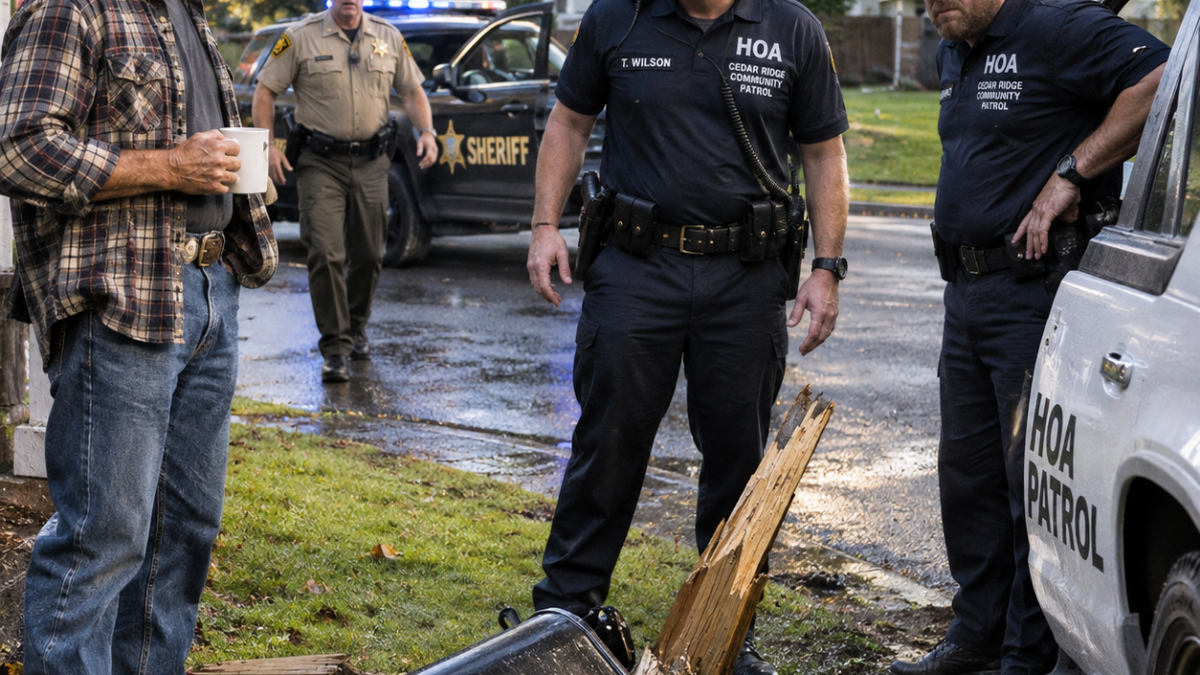
“MAYBE NOW YOU’LL FINALLY INSTALL A MAILBOX WE APPROVE!” Thomas Wilson shouted from the HOA patrol SUV after backing into my brand-new mailbox for the second time and snapping the wooden post while his partner laughed from the passenger seat.
I stood on my porch with a cup of coffee in one hand and watched the third mailbox I had installed in four months lying in the wet grass, while the security camera above my head recorded the tire tracks, the SUV, Wilson’s face, and the violation notice he was already walking toward me to hand over.
Then a county sheriff’s cruiser turned onto my street, the deputy stepped out, ignored Wilson’s attempt to explain the “HOA enforcement action,” stared straight at me and said, “Sheriff Dawson?”—and the patrol officer who had spent months treating me like a confused old retiree suddenly realized he had made a very serious mistake.
The mailbox hit the ground at 6:42 on a Monday morning.
I know the exact time because the porch camera recorded it.
I also know Thomas Wilson backed into it twice.
That matters.
The first impact cracked the post.
The second finished it.
The Cedar Ridge Community Patrol SUV rolled backward until its rear bumper pushed into the pressure-treated wood.
The post snapped near the concrete footing.
The black metal mailbox twisted sideways.
Then the vehicle rolled forward and pushed the whole thing another three feet into my grass.
Wilson leaned out the driver’s window.
“Maybe now you’ll install an approved one.”
His partner, Kevin Blake, laughed.
I did not.
My coffee was still warm.
Mailbox number three had been standing for less than forty-eight hours.
Nothing fancy.
Black metal.
Wood post.
Reflective address numbers.
Correct distance from the roadway.
Correct postal height.
Correct setback.
Correct HOA style.
I knew because I had checked everything.
Twice.
Wilson climbed out.
Dark polo.
Company badge.
Cedar Ridge Community Patrol across his chest.
He reached into a pocket and pulled out a folded notice.
“Unauthorized roadside structure.”
I looked at the mailbox.
“That was a mailbox.”
“Not anymore.”
Kevin laughed again.
Wilson extended the paper.
I did not take it immediately.
PART2:
Instead, I looked toward the camera mounted under the porch roof.
Wilson followed my eyes.
His expression changed for half a second.
“You recording us?”
“Yes.”
“You need HOA approval for exterior surveillance.”
“No, I don’t.”
He frowned.
“How would you know?”
I took another sip of coffee.
“Because I read the rules.”
That irritated him more than shouting would have.
“You people move in here and think you know everything.”
I almost asked what he meant by you people.
Before I could, a sheriff’s cruiser turned onto the street.
Wilson smiled.
“Good.”
He walked toward it.
Probably thought reinforcements had arrived.
The cruiser slowed.
Then stopped hard.
The deputy got out quickly.
Wilson approached first.
“Officer, good. This homeowner has been refusing community orders and—”
The deputy walked past him.
Looked directly at me.
His face changed.
“Sheriff Dawson?”
Wilson stopped talking.
Kevin stopped laughing.
I set the coffee down.
“James.”
Deputy James Walker grinned.
I had hired him sixteen years earlier.
Back then he was twenty-three and nervous enough to check his patrol bag three times before every shift.
Now he was a senior deputy with gray beginning around his temples.
Wilson stared at me.
“You were the sheriff?”
“A long time ago.”
“Why didn’t you say anything?”
That question told me everything I needed to know about him.
“Why should it matter?”
He opened his mouth.
Nothing came out.
My name is William Dawson.
I was sixty-three when I moved into Cedar Ridge.
For thirty-seven years, I worked law enforcement in western North Carolina.
Started as a patrol deputy.
Traffic crashes.
Domestic calls.
Missing children.
Burglaries.
Storm damage.
Drunks.
Noise complaints.
Death notifications.
All the ordinary human problems people call about when they do not know who else to call.
Later I became chief deputy.
Then sheriff.
I served twelve years.
I did not leave angry.
I was not voted out.
I simply reached the point where mornings without a radio sounded better than mornings with one.
My wife, Linda, died three years before I retired.
Cancer.
Fast.
After she was gone, our house felt larger every month.
Too many rooms designed for two people.
Too much quiet.
My daughter Jennifer kept asking me to move closer.
Eventually she found Cedar Ridge.
Twenty minutes from her house.
Brick ranch.
Three bedrooms.
Workshop.
Half-acre lot.
Large oak tree.
Back porch facing woods.
Nothing impressive.
Perfect.
Cedar Ridge had around 180 homes.
Clubhouse.
Pool.
Walking paths.
Two gated entrances.
The HOA fee covered landscaping, private road lights, gate maintenance and some common services.
I had dealt with plenty of HOAs as sheriff.
Most were boring.
Boring is excellent.
The covenants looked ordinary.
No junk vehicles.
Reasonable lawn maintenance.
Architectural approval for major exterior changes.
Nothing unusual.
My next-door neighbor was Frank Miller.
Seventy.
Retired mechanic.
Hands still looked capable of pulling an engine without tools.
On my first afternoon, he walked over carrying a folding chair.
Not food.
Not a welcome basket.
A chair.
“Your porch only has one.”
“That was intentional.”
“Now it has two.”
He unfolded it.
Sat down.
That was Frank.
Across the street lived Susan Parker.
Retired elementary teacher.
She walked every morning with a little brown dog named Benny who barked at garbage cans as if civilization depended on it.
Susan brought banana bread.
More traditional.
Both warned me about Brenda Collins.
HOA president.
Frank said:
“She likes rules.”
Susan corrected him.
“She likes being the person who explains the rules.”
There was a difference.
I met Brenda one week later.
Golf cart.
Another board member beside her.
I was cleaning leaves from a gutter.
She stopped in the driveway.
“You’re William Dawson?”
“Yes, ma’am.”
“Brenda Collins. HOA president.”
“Nice to meet you.”
She looked at my ladder.
“Exterior work?”
“Leaves.”
“Residents should notify architectural review before exterior modifications.”
“I’m removing leaves.”
Pause.
The woman beside her looked down, probably hiding a smile.
Brenda finally said:
“Maintenance is different.”
“I figured.”
She handed me the welcome packet.
That should have been it.
The real problem was Cedar Ridge Community Patrol.
I originally assumed it was normal private security.
That can be useful.
Check gates.
Watch empty houses.
Call deputies if something criminal happens.
Nothing wrong with that.
But the patrol officers were employees of a private company called Ridgeway Community Services.
Not police.
Not sheriff’s deputies.
Not government.
Still, they wore dark uniforms with company badges.
Their white SUVs had black push bars, amber lights, and large COMMUNITY PATROL markings.
From fifty feet away, most people would assume authority.
Presentation matters.
I learned quickly that Brenda liked that assumption.
Thomas Wilson was the first patrol employee I met.
He stopped me while I carried lumber from my truck.
“Sir, what are you building?”
“A shelf.”
“For where?”
“My garage.”
“I need to verify it isn’t an exterior structure.”
I looked at the boards.
Then at him.
“It’s a shelf.”
He typed something into his tablet anyway.
Two days later:
VIOLATION WARNING.
GARAGE DOOR OPEN FOR EXTENDED PERIOD.
Forty-three minutes.
While I installed the shelf.
I called the HOA office.
“Forty-three minutes is extended?”
“The patrol officer documented it.”
“I was working in the garage.”
“The rule is meant to preserve appearance and security.”
“Am I fined?”
“No. Warning.”
“Good.”
I hung up.
Annoying.
Not worth a war.
Retirement taught me something I should have learned earlier.
Not every stupid thing deserves your energy.
Then Wilson stopped Frank for moving his trash can out too early.
Susan received a leash warning.
Benny’s leash was supposedly longer than six feet.
It was five.
Susan measured it.
Showed me.
I laughed.
She did not.
“I bought a tape measure because of HOA patrol.”
“That might be the saddest sentence I’ve heard all week.”
Then came the mailbox.
The original had been there when I bought the house.
Wood post.
Black box.
Nothing special.
Six weeks after closing, a storm came through.
Heavy rain.
Wind.
A tree branch cracked the post.
I removed it before it became a road hazard.
Bought a replacement.
Same size.
Same color.
Same location.
Installed Sunday afternoon.
Monday morning, Wilson parked beside it.
Stared at it.
Then came to my door.
“That mailbox isn’t approved.”
“It replaced the broken one.”
“New structure.”
“It’s a mailbox.”
“Still a structure.”
I contacted Brenda.
She emailed the architectural standard.
Replacement required approval only if style, size, color, or location changed.
Mine had not.
I sent photographs.
Old.
New.
Brenda replied:
WE’LL REVIEW.
Next morning, the mailbox was lying in the yard.
Post broken.
At first I assumed another branch.
Then I checked my camera.
5:51 a.m.
Patrol SUV.
Wilson got out.
Pushed the mailbox with both hands.
It held.
He returned to the SUV.
Backed into it.
Once.
Again.
Post snapped.
Then he picked up the box.
Dropped it in my grass.
Drove away.
I watched twice.
Not because I doubted the video.
Because anger can distort memory.
Video does not get angry.
I called Brenda.
“Why would patrol damage your mailbox?”
“I have video.”
Silence.
“Send it.”
I did.
Three hours later, she emailed that Wilson had removed an “unapproved roadside hazard.”
I called.
“Did you authorize him?”
“The patrol team has authority to address dangerous community violations.”
“The mailbox wasn’t dangerous.”
“It was unapproved.”
“That isn’t the same thing.”
“We can reimburse you after architectural review.”
My old sheriff voice wanted out.
I kept it down.
“Brenda, your contractor intentionally destroyed my property.”
“He isn’t my employee.”
“Your contractor.”
“Correct.”
“Tell him not to touch my property again.”
She said she would speak to Ridgeway.
I replaced the mailbox.
This time I submitted product information first.
Brenda approved it.
Written email.
I saved it.
Mailbox number two lasted almost three weeks.
Friday night.
Crash.
I went outside.
Post bent.
Box twisted.
A Cedar Ridge patrol SUV was turning the corner.
Camera showed another officer driving.
Wilson in passenger seat.
The push bar struck my mailbox.
Maybe accident.
Then the SUV stopped.
Reverse lights.
Backed up.
Hit it again.
Accident disappeared as an explanation.
I called Ridgeway directly.
Manager Robert Hayes.
“Send me the footage.”
I did.
He called back.
“That shouldn’t have happened.”
“Agreed.”
“I’ll speak with them.”
“Speak with your insurance too.”
Then Brenda called.
Not Ridgeway.
“You escalated outside the HOA process.”
“I called the company whose employees damaged my property.”
“You should have gone through the board.”
“I did the first time.”
Silence.
Then:
“You’re creating unnecessary hostility.”
I looked through the window at mailbox number two lying sideways.
“My mailbox is in the grass.”
“You keep replacing it without coordinating with patrol.”
“It was approved.”
“Approval can be reconsidered.”
There it was.
No longer about rules.
Something personal.
Maybe Wilson hated being questioned.
Maybe Brenda hated being corrected.
Maybe both were accustomed to residents backing down.
I stopped treating it like a misunderstanding.
I documented.
Dates.
Emails.
Video.
Receipts.
Names.
Exactly what I had spent decades telling people to do.
Evidence is better than memory.
I installed mailbox number three.
Proper concrete footing.
Nothing dangerous.
No reinforced steel trap.
No hidden concrete wall waiting to destroy a car.
Just a strong legal wooden post.
Postal requirements checked.
County road clearance checked.
HOA standards checked.
Everything correct.
Frank watched.
“Building Fort Knox?”
“Apparently receiving mail is dangerous here.”
Then he became serious.
“Brenda’s talking about you.”
“What does she say?”
“You’re anti-community.”
“Because of a mailbox?”
“Because you challenge patrol.”
That made no sense.
Then Frank explained other residents had complained for years.
Threats to tow.
Requests for identification.
Patrol employees photographing vehicles.
One told a teenager he could be “detained” for damaging flowers near the clubhouse.
That word bothered me.
Private security can have limited authority under certain circumstances.
But neighborhood patrol employees should not casually let residents believe they have general police powers.
Susan told me about her fifteen-year-old grandson.
He had walked from her house to the pool.
Patrol stopped him.
Asked name.
Address.
Who he was visiting.
Then told him guests had to carry identification.
“Why didn’t you report it to the sheriff?”
Susan shrugged.
“It felt too small.”
That sentence bothered me more than the story.
Bad behavior often survives by staying just small enough that each victim feels foolish making a report.
One rude stop.
One fake warning.
One damaged mailbox.
One teenager questioned.
One questionable tow.
Alone, each looks small.
Together, they become a system.
I attended the next HOA meeting.
Not as Sheriff Dawson.
As William.
Homeowner.
I had never told Cedar Ridge about my career.
Frank knew I had worked for the county.
Susan assumed administrative work.
I liked that.
Retirement meant I did not need a title every time I entered a room.
At the meeting, Wilson stood along the back wall in uniform.
Public comment opened.
I raised my hand.
Brenda sighed.
“Yes, William?”
“I’d like to discuss patrol conduct.”
Wilson crossed his arms.
I described the two mailbox incidents.
No drama.
Just facts.
Then:
“What authority does patrol have to destroy private property?”
Brenda said:
“They may remove immediate safety hazards.”
“My approved mailbox wasn’t a safety hazard.”
“The incident is under review.”
“Good. Are patrol employees authorized to tell residents they can be detained?”
The room changed.
Heads turned toward Wilson.
“Our officers are trained professionals.”
“That wasn’t my question.”
Wilson stepped forward.
“You accusing me of something?”
“I asked the board a policy question.”
“You always have something to say.”
Brenda told him to sit.
He did not.
Frank spoke from the table.
“William’s question is fair.”
Jennifer Collins, another director, agreed.
Still no answer.
Afterward, residents approached me.
Three.
Then five.
Stories.
Parking on a public road.
Threats to tow contractor vehicles.
Photographs through garage windows.
Requests for identification while jogging.
Again, some actions might have explanations.
But the pattern was authority without clarity.
I told everyone:
“Document it.”
Frank laughed.
“You sound like a cop.”
“Old habit.”
Next morning:
HOSTILE CONDUCT TOWARD COMMUNITY STAFF.
Fine:
$750.
I laughed.
Not because it was funny.
Because some things become too ridiculous for anger.
I appealed.
Before the hearing, mailbox number three fell.
6:42 Monday morning.
Wilson.
Kevin.
SUV.
Twice.
Then James Walker arrived.
“Sheriff Dawson?”
That recognition changed Wilson instantly.
But I did not want special treatment.
James looked at the broken mailbox.
Tire marks.
Wilson.
“You want a report?”
“Yes.”
Wilson looked surprised.
Maybe he expected me to make a phone call and have somebody dragged away.
No.
I wanted what Susan deserved.
What Frank deserved.
What any resident deserved.
Report.
Photos.
Statements.
Evidence.
Normal process.
James called another deputy.
“I know William personally. I want somebody neutral handling the primary investigation.”
That made me proud.
Deputy Laura Mitchell arrived fifteen minutes later.
She had never worked under me.
Perfect.
She measured tire tracks.
Copied the approval email.
Downloaded video.
Photographed the mailbox.
Asked Wilson his explanation.
“Violation enforcement.”
“Does violation enforcement authorize you to strike private property with a vehicle?”
He stopped talking.
Then Brenda arrived.
Golf cart.
Binder.
Angry.
“What is going on?”
Laura introduced herself.
Brenda looked at me.
Then James.
Then Wilson.
“You’re the retired sheriff?”
“Yes.”
“That explains a lot.”
Before I could ask what that meant, Laura asked:
“Did you authorize patrol to remove Mr. Dawson’s mailbox?”
“I authorized enforcement of community standards.”
“Did you authorize them to hit it with the SUV?”
“No.”
Wilson turned.
“Brenda—”
She cut him off.
“No.”
First crack.
Then Robert Hayes arrived from Ridgeway.
Walked directly to Wilson.
“Give me the keys.”
“What?”
“Vehicle keys.”
“You can’t suspend me in front of residents.”
“I just did.”
Wilson slapped them into Robert’s palm.
Pointed at me.
“This is because of him.”
Robert answered:
“No. This is because you hit his mailbox with my vehicle after being told not to touch his property.”
Then Laura received another call.
Mailbox vandalism.
Different street.
Susan Parker.
A neighbor saw Cedar Ridge patrol near her house around 4:30 that morning.
Same unit.
Kevin said:
“That wasn’t us.”
Robert stared.
“You’ve had unit three since midnight.”
Kevin immediately pointed at Wilson.
“He was driving.”
“Shut up.”
Now it was not only my mailbox.
Susan had complained.
Spoken at meetings.
Now hers was destroyed too.
Robert opened the SUV’s internal camera system.
The dash camera had been manually disabled from 4:11 to 5:03.
Susan’s mailbox was damaged at 4:30.
Camera disabled again at 6:36.
Six minutes before mine.
GPS:
Stopped at Susan’s house at 4:27.
Stopped at mine at 6:40.
Laura asked Wilson if he wanted to change his statement.
No.
Robert searched the company vehicle.
Traffic cones.
Tow notices.
Bolt cutters.
Three removed mailbox address plates.
Susan’s.
Harold Price’s.
Mine.
From mailbox number two.
I stared at those numbers.
Wilson had kept them.
Then a spiral notebook.
Names.
Addresses.
Notes.
FRANK MILLER — BOARD PROBLEM.
SUSAN PARKER — CHRONIC COMPLAINT.
WILLIAM DAWSON — NON-COMPLIANT / CONFRONTATIONAL.
Beside mine:
MAILBOX X3.
Brenda whispered:
“I’ve never seen that.”
Then Robert received another call.
Ridgeway’s storage garage behind the clubhouse had been opened.
Equipment missing.
Radios.
Uniform shirts.
Blank violation forms.
Magnetic patrol signs.
Amber lights.
Spare badges.
Security video showed someone entering at 2:13 a.m.
Kevin Blake.
Kevin stepped backward.
Laura noticed.
“Mr. Blake?”
He looked toward the woods.
Then ran.
Across my yard.
Over the drainage ditch.
Between houses.
James called it in.
Within seconds, county radios lit up.
Brenda stood beside her golf cart.
Robert stared at Wilson.
Then an alert.
One stolen Ridgeway radio had powered on.
Clubhouse area.
Another tracker showed a magnetic patrol sign moving toward the south gate.
Someone had created a fake patrol vehicle.
James looked at me.
“This is bigger than the first call.”
It was.
Deputies stopped a white pickup at the south gate.
Magnetic Cedar Ridge patrol signs on both doors.
Amber light bar.
The driver was nineteen-year-old Tyler Grant.
Kevin’s cousin.
Wearing an oversized Ridgeway shirt with K. BLAKE on the tag.
He was terrified.
Kevin had paid him two hundred dollars to drive the truck out and leave it behind a grocery store.
Inside the bed:
Blank violation forms.
Patrol vests.
Temporary tow notices.
Magnetic signs.
Amber lights.
Boxes of photographs.
Residents’ cars.
Garages.
Yards.
Front doors.
Some images were normal violation documentation.
Others were taken through windows.
Over fences.
Late at night.
Names on the back.
Notes:
REPEAT PROBLEM.
PUSH HARDER.
EASY FINE.
Susan appeared in six.
Frank four.
Me more than ten.
Tyler admitted Kevin had used the fake truck for months.
Why?
Because Ridgeway’s real SUVs had GPS and cameras.
The fake truck did not.
Sometimes Kevin and Wilson wanted to perform enforcement without company systems recording them.
Mostly towing-related.
Company:
Mountain Ridge Recovery.
Frank knew it immediately.
Cedar Ridge had paid them thousands.
Residents had paid hundreds to recover vehicles.
Tyler said Kevin placed warning stickers.
Photographed cars.
Then called Mountain Ridge.
Sometimes Wilson called too.
For the next few days, Cedar Ridge became strangely peaceful.
Ridgeway suspended its entire patrol contract.
No SUVs creeping past houses.
No warning stickers.
No questioning teenagers.
No tow threats.
Frank said:
“Somehow our property values survived.”
Susan said Benny stopped barking every morning.
I installed mailbox number four.
Half the street came out.
Robert’s insurer paid.
Frank sat in his folding chair near the curb.
“You reinforcing it with steel?”
“No.”
“Concrete bunker?”
“No.”
“Landmines?”
“Definitely not.”
He looked disappointed.
It was a normal mailbox.
That was the point.
Then Ridgeway hired an outside investigator.
Robert understood his own company could not credibly investigate itself.
Logs.
GPS.
Camera gaps.
Violation records.
Tow records.
Complaints.
Four years.
Wilson and Kevin issued almost three times the violations of other patrol employees.
They generated most towing referrals.
Brenda repeatedly praised them in emails.
OTHER OFFICERS ARE TOO SOFT. TOM AND KEVIN UNDERSTAND STANDARDS.
Not an instruction to damage property.
But aggressive behavior was clearly rewarded.
Then came money.
Mountain Ridge Recovery paid referral bonuses.
Directly to individuals.
Not Ridgeway.
Twenty-five dollars per tow.
Fifty if stored overnight.
More for larger vehicles.
Wilson received money.
Kevin received more.
Private patrol officers deciding which vehicles should be removed while personally profiting from each removal.
Obvious conflict.
Robert looked sick.
“We prohibit this.”
Did Brenda know?
No evidence yet.
Residents began coming forward.
A visiting nurse’s car towed from a patient’s driveway.
A son’s truck removed after less than an hour.
A contractor’s van towed while legally parked.
Susan called me.
“I feel stupid.”
“Why?”
“I thought what happened to my grandson was too small.”
“It mattered to you.”
“I should’ve reported it.”
“Maybe.”
She looked surprised.
“Maybe?”
“Reporting things takes time. Stress. Sometimes money. The bigger question is why everybody was made to think they were alone.”
Frank created an anonymous complaint process.
More than sixty reports in three days.
Some were ordinary disagreements.
Some people really had violated parking rules.
Not every complaint meant misconduct.
That distinction matters.
But fifteen stood out.
Threats of detention.
Claims patrol could enter private property.
Questionable towing.
Photographs through windows.
Fake threats involving county warrants.
The sheriff’s office reviewed Ridgeway’s training manual.
The written rules were clear.
Employees were private security.
They could observe.
Report.
Monitor common property.
Call law enforcement.
They could not pretend to be deputies.
Could not threaten arrest authority they did not have.
Could not invent warrants.
Could not destroy property.
The paper rules were not the problem.
The culture in Cedar Ridge was.
Kevin was arrested two nights after running.
Motel outside Asheville.
No dramatic chase.
He surrendered.
His phone later became evidence.
Messages with Wilson.
Pressure lists.
Addresses.
STICKER TONIGHT.
TOW NEXT TIME.
NEED PHOTO.
My name.
Susan.
Frank.
Then messages from Brenda.
Again, not direct instructions to destroy anything.
She sent lists of “problem residents.”
Asked for increased visibility.
Daily documentation.
One message:
MAKE IT UNCOMFORTABLE TO IGNORE THE RULES.
Brenda later said she meant warnings and documentation.
Maybe she did.
But vague instructions can become dangerous when leaders reward people for being aggressive.
Wilson apparently interpreted “uncomfortable” literally.
My mailbox incidents followed my addition to one pressure list.
Susan’s address appeared after she complained.
Frank after challenging patrol spending.
Then another exchange:
WILSON: DAWSON REPLACED BOX AGAIN.
BRENDA: THEN DOCUMENT AGAIN.
WILSON: COULD REMOVE IT.
BRENDA: HANDLE WITHIN POLICY. I DON’T WANT ANOTHER COMPLAINT.
Important.
She did not tell him to destroy it.
Actually told him to stay within policy.
Wilson chose otherwise.
Truth had become more complicated.
Brenda helped create the pressure culture.
Wilson and Kevin made independent decisions.
Justice gets lazy when everybody is turned into the same villain.
At the board meeting, Robert apologized publicly.
Wilson and Kevin terminated.
Then Brenda defended patrol as a concept.
Fair.
Crime reports had declined.
Some residents liked overnight checks.
Programs can be useful even when employees abuse them.
Then she said residents were exaggerating because they disliked enforcement.
That cost her the room.
Susan stood.
“My mailbox was destroyed.”
Brenda looked at her.
“I know.”
“My grandson was told he needed guest identification.”
“I know.”
“Were those exaggerated?”
No answer.
Frank asked:
“Why did you keep Wilson after the first mailbox video?”
“Ridgeway managed its employees.”
Robert spoke immediately.
“Your office requested he remain assigned here.”
Silence.
After mailbox number one, Robert wanted Wilson temporarily moved.
Brenda objected.
Email:
REMOVING HIM WOULD REWARD RESIDENT RESISTANCE.
That was worse than any speech about community standards.
She knew there was a complaint.
Still prioritized appearing strong.
Jennifer made the motion.
Remove Brenda as president.
Five to one.
She remained a homeowner.
For the moment, board member.
But not president.
Frank became acting president.
He closed his eyes when they announced it.
Susan whispered:
“Congratulations.”
He whispered something back I won’t repeat.
Then the larger financial investigation opened.
Mountain Ridge Recovery sent me a legal letter demanding I retract statements.
I had made no statements.
Their attorney checked.
Wrong information.
Several residents were considering claims.
I refused to become the neighborhood commander.
They could make their own choices.
Then came a quiet month.
My mailbox stayed up.
My grandsons visited.
Frank helped them build a birdhouse.
Susan brought banana bread and ate two slices herself.
Nobody cared how long my garage stayed open.
Then Laura called.
“William, are you home?”
“Yes.”
“Stay there.”
That tone never leaves your memory.
Twenty minutes later:
Laura.
James.
State insurance investigator David Reynolds.
At my kitchen table.
Mountain Ridge had submitted insurance claims involving damaged vehicles.
Scratched doors.
Broken bumpers.
Damaged wheels.
Some vehicles appeared undamaged before towing.
Damaged afterward.
Then David showed an insurance claim involving a Ridgeway SUV.
Fourteen months earlier.
Report:
STRUCK ROADSIDE OBJECT DURING NIGHT SECURITY PATROL.
Attached photograph:
Destroyed brick mailbox.
Not mine.
They had found twelve similar incidents.
Mailboxes.
Fences.
Cars.
Decorative wall.
Mostly Wilson and Kevin.
Repair payments went to:
Blue Ridge Collision.
Owner:
Samuel Wilson.
Thomas Wilson’s brother.
Now damage had a possible financial motive.
Create incidents.
Generate repairs.
Referral money.
Tow fees.
Insurance claims.
Still allegations.
Needed proof.
Then another photograph.
Storage building rented partly by Mountain Ridge.
Search warrant.
Inside:
License plates.
Mailbox numbers.
Security cameras.
Vehicle badges.
HOA signs.
Removed property marked with addresses.
Black cases labeled:
CEDAR RIDGE.
BRYANT HILLS.
OAK MEADOW.
Wilson and Kevin had worked all three communities.
The Cedar Ridge case held old violation forms.
Private copies.
Handwritten dollar amounts.
PAID CASH.
Frank said the HOA never collected cash through patrol.
So who did?
Investigators believed some residents had been given a choice.
Pay directly.
Or face towing.
Higher fines.
Threatened county action.
The money never reached Cedar Ridge.
Now the “collection target” list made sense.
My address.
Susan.
Frank.
Jennifer.
Beside mine:
DOESN’T SCARE EASY. NEEDS STRONGER PUSH.
Date:
Two days before mailbox number three.
Then Frank called.
Someone had broken into the clubhouse records room.
The finance server was gone.
Not erased.
Physically stolen.
Same financial records investigators needed to compare patrol payments, towing, vendor contracts, cash reports.
Laura stood before I even hung up.
At the clubhouse:
Forced rear door.
Server cables hanging loose.
Three camera feeds manually disabled.
Rear service road.
Records hallway.
Equipment room.
Main entrance camera remained on.
Pool camera remained on.
Someone knew exactly what to disable.
Administrator access belonged to Brenda and the property manager.
Ridgeway supposedly only had view access.
Supposedly.
A witness saw a black pickup leaving.
One magnetic Cedar Ridge patrol sign attached crookedly to the driver’s door.
South gate log:
Access code 4172.
Brenda Collins.
People immediately reacted.
I reminded them:
“A code can be shared.”
Laura nodded.
“Or stolen.”
Brenda admitted Wilson knew her code.
Sometimes patrol used it when residents had gate problems.
Terrible practice.
Then she admitted something worse.
Wilson knew the clubhouse camera administrator password too.
She had given it to him two years earlier so patrol could review incidents without calling her.
She never changed it.
Brenda started crying during the interview.
“I thought more control meant more safety.”
That sentence explained a lot.
Good intentions do not automatically produce good systems.
She had handed private patrol:
Gate access.
Camera passwords.
Violation power.
Influence over towing.
Resident lists.
Then rewarded aggressive enforcement.
Eventually two employees stopped acting like they worked for residents.
They acted like residents worked for them.
Investigators traced the black pickup.
Kevin owned it through a little company named Ridge Security Transport.
They found the truck behind a warehouse.
Magnetic sign still attached.
Pry bar.
Gloves.
Network cable matching the clubhouse server cabinet.
Server missing.
Fortunately Cedar Ridge had backups.
Banks had statements.
Property management had monthly exports.
Vendors had invoices.
Insurance companies had claims.
Modern records leave trails.
Stealing one computer rarely erases history.
Eventually Wilson began cooperating.
He said Kevin planned the server theft.
Kevin believed the server contained spreadsheets connecting cash complaints and towing disputes.
Wilson denied helping.
Kevin used former Mountain Ridge tow driver Jason Brooks instead.
Jason surrendered.
Admitted driving.
Kevin carried the server.
Where?
Abandoned hunting cabin near the state line.
Deputies found it inside a metal trash barrel.
Not burned.
Not smashed.
Hard drives intact.
The recovered server opened an even larger problem.
Cedar Ridge paid Ridgeway approximately $96,000 annually.
Normal enough.
But another budget category appeared.
SPECIAL ENFORCEMENT SUPPORT.
Nearly $210,000 over six years.
Invoices from:
Community Standards Consulting LLC.
Owner:
Paul Stevens.
The same Paul Stevens who owned Mountain Ridge Recovery.
One company advised Cedar Ridge on stronger enforcement.
The other made money from towing generated by enforcement.
Frank stared at the records.
“Why would we allow that?”
Brenda said:
“He already knew the community.”
“That is exactly the problem.”
Then emails proved Brenda knew Paul owned both companies.
Still not proof she knew about Wilson and Kevin’s cash system.
But she knew the vendor conflict.
The board had not.
Both contracts were terminated.
My own civil lawyer asked whether I wanted more than mailbox reimbursement.
Repeated targeting.
Security upgrades.
Time.
Harassment.
False $750 “hostile conduct” fine.
I waited.
Then filed a limited claim.
Not a fortune.
Three mailboxes are not worth a fortune.
But an HOA and contractor should not be able to tell history later as if nothing happened.
We settled.
Attorney fees.
Camera upgrades.
Other documented losses.
I donated the remainder to a local youth program teaching teenagers about law enforcement, civil rights, and community service.
Frank asked why.
“Bad authority taught Cedar Ridge enough lessons. I want something better to come from it.”
Then postal carrier Linda Harper stopped at my house.
She had delivered Cedar Ridge mail nearly fifteen years.
“Mr. Dawson, there’s something you need to know.”
She sat on the porch.
Looked toward the road.
“Cedar Ridge has had more mailbox damage than anybody realizes.”
“How much?”
“More than thirty.”
That number changed everything again.
Some hit by vehicles.
Some knocked down.
Some vanished.
Linda kept informal notes because delivery became difficult.
“Who did you report it to?”
“HOA patrol.”
Of course.
Wilson often responded.
And he repeatedly asked whether damaged mailboxes had contained outgoing mail.
“Checks?”
“Yes.”
HOA payments.
Utilities.
Insurance.
Taxes.
Investigators compared old mail-theft reports.
Missing checks.
Altered checks.
One resident lost $2,800.
Another payment vanished.
Then the seized storage-unit property revealed opened envelopes.
Some addressed to Cedar Ridge residents.
One containing a blank check.
Federal postal inspectors joined.
Harold Price checked his old records.
His mailbox had been damaged two years earlier.
Three days later, a $1,450 check he had mailed to his insurance company was deposited elsewhere.
Bank image still existed.
Payee altered.
Receiving account:
Blue Ridge Collision.
Samuel Wilson’s shop.
Now the circle tightened.
Mailbox damage.
Outgoing mail.
Checks.
Repair shop.
Insurance claims.
Towing.
Cash fines.
One family business kept appearing.
Search warrants followed.
Blue Ridge Collision.
Mountain Ridge Recovery.
That afternoon, a dark SUV stopped outside my driveway.
Sat for three minutes.
Two men inside.
Nobody exited.
I wrote down the plate.
Registered to Blue Ridge Collision.
Deputies increased patrol near my house.
Not because I had once been sheriff.
Because I was a victim and witness in an active case.
That distinction always mattered to me.
After sunset, my porch camera alerted.
Motion near mailbox number four.
A man in a hooded sweatshirt approached.
Looked at my house.
Placed something inside.
I did not go outside.
Called 911.
Deputies recovered an envelope.
Not explosive.
Not threatening.
Inside:
Bank records.
Towing lists.
HOA payment sheets.
Photographs.
And a handwritten note:
ASK WHO BRENDA WAS PAYING.
Laura turned over one record.
Monthly transfers.
Community Standards Consulting LLC.
To:
B. COLLINS PROPERTY SERVICES.
$2,500.
$2,500.
$3,000.
Again.
Again.
Nearly four years.
More than $120,000.
Then James received a radio call.
Search team at Blue Ridge Collision had opened a safe.
Cash envelopes.
Resident names.
HOA addresses.
Ledger.
Heading:
CEDAR RIDGE SPLITS.
Initials beside percentages.
Wilson.
Kevin.
Paul.
Others.
And what looked like Brenda’s initials.
Nobody arrested her that night.
Good.
Initials are not proof.
Payments are not automatically criminal.
Brenda had operated a property-management business before becoming HOA president.
She came to the sheriff’s office with a lawyer.
Produced invoices.
B. Collins Property Services had received money for:
Community compliance coordination.
Vendor oversight.
Resident dispute management.
Vague phrases.
Work that overlapped heavily with duties she already performed as HOA president.
Frank had never approved it.
Jennifer had never seen it.
Board never disclosed it.
Brenda admitted receiving the money.
That was one truth.
She denied receiving stolen-check money.
Denied knowing mailboxes were being damaged to steal mail.
Denied knowing about private cash collections.
Investigators later found evidence supporting that distinction.
Two money streams existed.
First:
Official vendor money.
Cedar Ridge paid Community Standards Consulting and Mountain Ridge.
Some vendor funds flowed privately to Brenda’s company.
Undisclosed conflict.
Serious.
Second:
Private criminal money.
Cash collections.
Tow referral bonuses.
Stolen or altered checks.
Insurance-related fraud.
No evidence Brenda received money from that second stream.
Again:
Different conduct.
Different consequences.
The anonymous envelope had been left by Rachel Foster.
Part-time bookkeeper for Blue Ridge Collision.
She had suspected something was wrong for years.
When postal inspectors arrived, she panicked.
Copied records.
Drove to my house because my address appeared repeatedly.
Not the best way to report evidence.
But her copies helped confirm records investigators were already obtaining legally.
Eventually charges came.
Wilson:
Vandalism.
Theft.
Mail-related offenses.
Intimidation.
Fraud-related conduct.
Kevin:
Similar charges.
Stolen patrol equipment.
Impersonation-related offenses.
Clubhouse burglary.
Jason Brooks:
Burglary participation.
Cooperated.
Samuel Wilson:
Altered checks.
Insurance claims.
Financial restitution.
Paul Stevens:
Fraud-related charges involving vendor arrangements, referral money, and misleading financial records.
Brenda’s case was narrower.
Undisclosed vendor payments.
False financial disclosures.
Conflicts involving HOA contracts.
She was not charged with destroying my mailbox.
Some residents were disappointed.
I was not.
Wilson destroyed it.
Evidence showed that.
Kevin participated in intimidation.
Evidence showed that.
Brenda created a bad enforcement culture and secretly profited from a vendor relationship she should have disclosed.
Evidence showed that.
Justice is supposed to separate those things.
Cedar Ridge then had a choice.
Sue everyone.
Or fix itself.
Frank showed me a list of possible defendants.
Ridgeway.
Mountain Ridge.
Community Standards.
Brenda.
Wilson.
Kevin.
Blue Ridge Collision.
Insurers.
Former management company.
“We could spend ten years paying lawyers.”
“Probably.”
“What would you do?”
“Winning every possible fight isn’t the same as fixing the problem.”
Board hired independent counsel.
Forensic accountant.
Losses divided into categories.
Improper towing.
Unauthorized vendor payments.
Property damage.
Insurance claims.
Resident restitution.
Legal costs.
They pursued strong claims.
Dropped weak ones.
Ridgeway settled quickly.
Robert apologized again.
Covered documented property damage linked to Wilson and Kevin.
Refunded part of patrol fees for periods where supervision failed.
Changed company policy.
No police-style badges for HOA work.
PRIVATE SECURITY in large letters.
No cash fine collection.
No towing referral payments.
No HOA camera administrator access.
Vehicle cameras automatically notify supervisors when disabled.
Practical changes.
Cedar Ridge still ended the old contract.
New security role:
Gate monitoring.
Common-area checks after midnight.
Vacation checks by request.
Call deputies for crimes.
That was it.
No fake detention.
No resident interrogation.
No tow authority.
No violation enforcement.
HOA rules returned to boring paper notices.
Perfect.
Thirty-two households eventually reported major mailbox damage.
Some were actual accidents.
Storms.
Teenager learning to drive.
But investigators linked at least eleven directly or indirectly to patrol activity.
Restitution followed.
Susan got reimbursed.
Harold recovered money tied to the altered check.
I got reimbursement for all three destroyed mailboxes.
Mailbox four stayed.
Frank called it “the Survivor.”
I asked him to stop.
He did not.
Then Cedar Ridge invited me to speak at a meeting.
I refused.
“I’m retired.”
Frank said:
“You’ve mentioned that.”
“What am I supposed to say?”
“Why you didn’t pull rank.”
That made me think.
So I went.
Same clubhouse.
Same microphone where Brenda once dismissed my questions.
This time, the room was quiet.
I said:
“The fact that I used to be sheriff should never have mattered.”
People looked at me.
“My mailbox was private property before James recognized me.”
Silence.
“It was private property when Wilson thought I was just an annoying old retiree.”
More silence.
“If Wilson destroyed Susan’s mailbox, it was wrong. If he destroyed mine, it was wrong. If he destroyed the mailbox belonging to a nineteen-year-old renter nobody knows, it was still wrong.”
That was the lesson.
Rights cannot depend on being recognized.
I told them James did exactly what I hoped one of my deputies would do.
He knew me.
So he brought Laura in to handle the primary report.
He did not use his badge to settle my argument.
He protected the investigation from favoritism.
That made me prouder than hearing “Sheriff Dawson.”
Then I said something unpopular about Brenda.
“She wasn’t responsible for every crime Wilson and Kevin committed.”
A woman asked:
“Why does that matter?”
“Because if we turn every bad leader into one monster who caused everything, we learn nothing.”
Brenda wanted control.
Rewarded aggressive enforcement.
Dismissed complaints.
Accepted undisclosed money.
Gave patrol too much access.
Serious failures.
But Wilson and Kevin still made choices she did not order.
If we blamed everything on one person, the next board could remove one president and assume the system was fixed.
Systems need limits.
Not saints.
Afterward Susan hugged me.
Frank did not.
“We’re men.”
“You once brought me a chair because you thought my porch looked lonely.”
“Never say that again.”
Cedar Ridge rewrote bylaws.
Major vendor contracts required competitive bids.
Any board member receiving vendor money had to disclose it and leave the vote.
No cash fines.
Towing required written management authorization.
Security complaints went to an independent contact.
No single person could control:
Gate codes.
Camera administration.
Vendor approval.
Enforcement.
At once.
The system would no longer depend on one leader always being good.
Brenda resigned from the board before recall.
Almost a year later, she sold her house.
Before leaving, she came to my porch.
Mailbox number four beside the road.
“Can we talk?”
I nodded.
No binder.
No golf cart.
Just Brenda.
“I thought keeping control kept people safe.”
“I know.”
“I knew Paul owned both companies.”
“I know.”
“I told myself the payments were for consulting work I was already doing.”
“Were they?”
She looked away.
“Some of it.”
That honesty mattered.
“I should have told the board.”
“Yes.”
“I should have listened after the first mailbox.”
“Yes.”
She gave a small sad smile.
“You’re not making this easy.”
“I don’t think apologies are supposed to be easy.”
She looked toward the road.
“I really didn’t know Wilson was stealing mail.”
I believed her.
Believing that did not erase what she had done.
We talked for twenty minutes.
No dramatic forgiveness.
No friendship.
No perfect ending.
Just two people accepting that the truth was complicated.
The criminal cases took more than a year.
Wilson eventually pleaded guilty to several charges including property damage and fraud-related conduct.
Kevin entered his own plea involving theft, burglary and patrol-related offenses.
Samuel Wilson’s business paid restitution and penalties involving altered checks and false claims.
Paul Stevens faced serious consequences involving towing and consulting arrangements.
Mountain Ridge Recovery lost contracts and eventually closed under a separate settlement process.
Brenda entered an agreement involving restitution, financial-disclosure violations and restrictions on future HOA fiduciary service.
Nobody received the same outcome.
Because nobody did the same thing.
That was fair.
Cedar Ridge recovered money through insurance, vendor settlements and restitution.
Residents with improper tow charges received refunds.
Some cash-payment victims were reimbursed.
Recovered money improved lighting.
Gate security.
Emergency reserves.
Frank published every recovered dollar.
Monthly.
No vague accounts.
No “special enforcement support.”
Transparency made meetings shorter.
People argue less when they can see the numbers.
Usually.
My life finally became quiet.
Jennifer kept bringing my grandsons.
Frank kept leaving furniture on my porch.
Susan kept walking Benny every morning.
The new security company waved and drove past.
Nobody asked why my garage door was open.
Nobody measured how long a trash can sat at the curb.
Nobody called themselves “officer” while holding an HOA tablet.
Mailbox number four survived one year.
Then two.
On the anniversary of number three’s destruction, Frank attached a birthday balloon to it at six in the morning.
I caught him on camera.
He denied everything.
I still have the video.
People remember the wrong moment when they hear this story.
They remember the sheriff’s cruiser.
James getting out.
“Sheriff Dawson?”
Wilson’s face.
They think that was the victory.
It wasn’t.
Finding out I was a retired sheriff did not suddenly make destroying my mailbox illegal.
It was already wrong.
The important thing happened afterward.
The same process every resident deserved finally began working.
Report.
Evidence.
Independent investigation.
Financial records.
Witnesses.
Consequences.
I spent decades wearing a badge.
Retirement taught me something wearing one never could.
People should not need to know somebody important to be treated correctly.
Susan should not need a retired sheriff across the street.
Frank should not need law-enforcement connections.
A teenager should not need powerful parents.
A renter should not need money.
Rules matter most when they protect the person nobody recognizes.
That is why I am glad I never introduced myself as Sheriff Dawson when I moved in.
If Wilson had known on the first day, maybe he would have treated me differently.
Maybe my mailbox would have survived.
But Susan’s might not have.
Harold’s might not have.
Somebody else would have become the person they believed would stay quiet.
Instead, Wilson showed me exactly how he treated someone he thought had no influence.
Ugly information.
Useful information.
Cedar Ridge’s final board report ended with a sentence Frank wrote himself:
No private security contractor becomes law enforcement merely because residents are encouraged to treat them that way.
Susan added another:
Nobody should need three destroyed mailboxes before we listen.
Unanimous.
I still live in Cedar Ridge.
The oak tree is bigger.
Workshop is messier.
My porch now has three chairs because Frank apparently believes he is responsible for outdoor furniture.
My daughter says I seem happier.
She is probably right.
Retirement was never supposed to mean nothing difficult would happen.
It meant I could choose which things mattered enough to face.
Three mailboxes mattered eventually.
Not because of wood.
Not because of metal.
Because they showed how small abuses grow when everybody assumes somebody else will handle them.
The first mailbox was destroyed and explained away.
The second was called an accident.
The third was destroyed directly in front of me because Thomas Wilson no longer believed anyone would stop him.
Then a deputy looked at me and said:
“Sheriff Dawson?”
And Wilson finally understood something.
Not that I had more rights than everybody else.
That he had chosen the wrong person to assume would stay quiet.
That is why mailbox number four is still plain.
No reinforced steel.
No concrete fortress.
No warning sign.
Just a black mailbox on a normal wooden post.
Because the point was never to build a mailbox nobody could destroy.
The point was to build a community where nobody believed they had the right to destroy it.








