HOA Patrol Detained Me on My Own Private Road—Then the Real Sheriff Put Their “Officer” in Handcuffs
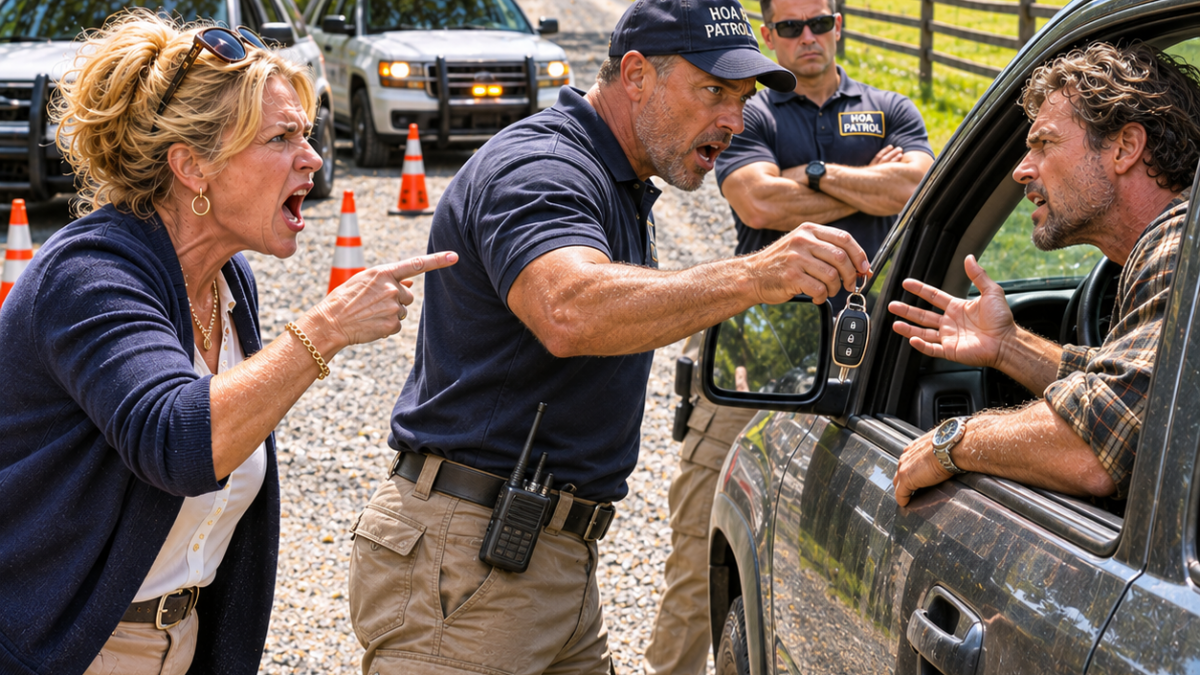
HOA Patrol Detained Me on My Own Private Road—Then the Real Sheriff Put Their “Officer” in Handcuffs
**“TAKE HIS KEYS—HE’S BEING DETAINED UNTIL HE LEARNS TO FOLLOW GREENFIELD TRAFFIC ORDERS!” HOA president Brenda Collins shouted as her volunteer patrol blocked my truck on my own private road.**
**For weeks, her fake patrol had installed speed-limit signs, photographed license plates, stopped delivery drivers, fined my mother, and treated Hayes Mill Road like an HOA street even though Greenfield had never owned a foot of it.**
**Then three real sheriff’s cruisers came around the bend, and the senior deputy asked one question that made every amber light, uniform, checkpoint, and fake ticket suddenly look very different.**
Kevin Parker still had my truck keys in his hand when the first sheriff’s cruiser came around the bend.
That image has stayed with me.
White Greenfield HOA Patrol SUV parked sideways across Hayes Mill Road.
Amber lights flashing.
Orange cones.
Temporary checkpoint sign.
Kevin in a reflective vest standing beside my truck.
Steven Bradley behind me so I could not back up.
And Brenda Collins, HOA president, recording everything on her phone like she expected to capture the moment I finally surrendered.
Then the real sheriff arrived.
Deputy Mark Reynolds stepped from the first cruiser.
Another cruiser stopped behind him.
Then a third.
He looked at the Greenfield SUVs.
The cones.
The patrol uniforms.
The PRIVATE ROAD sign beside the gravel shoulder.
Then at Kevin holding my keys.
“Who’s in charge here?”
Brenda raised her hand.
“I am.”
Reynolds pointed at Kevin.
“Why does that man have his keys?”
Brenda answered before Kevin could.
“He’s being detained.”
The deputy’s expression changed.
“By who?”
“Greenfield Community Patrol.”
For several seconds, Reynolds simply stared at her.
Then he looked at Kevin.
“Put the keys on the hood.”
Kevin hesitated.
Only for a second.
But that hesitation was enough to tell me how far this had gone.
A man wearing an HOA patrol shirt was considering whether to obey an actual sheriff’s deputy while standing on a road the HOA did not own.
“Now,” Reynolds said.
Kevin slowly placed my keys on the hood.
Another deputy retrieved them.
He handed them to me but asked that I keep my truck off until they sorted out what was happening.
Fine by me.
I had no interest in making a bad situation more confusing.
Then Reynolds turned back toward Brenda.
“Who owns this road?”
She answered carefully.
“Greenfield has established community access authority.”
“That wasn’t my question.”
Brenda crossed her arms.
PART2:
“Residents have used this road for years.”
“Who owns it?”
I spoke from the driver’s seat.
“I do.”
Reynolds looked at me.
“You have documentation?”
“In the house. Deed, road records, survey.”
Brenda interrupted.
“The road has become part of Greenfield’s transportation system through established use.”
Reynolds looked toward the PRIVATE ROAD sign.
Then back at her.
“Do you have a deed?”
“No.”
“Recorded easement?”
“Our attorney is reviewing historical access.”
“So no?”
Brenda’s mouth tightened.
“No recorded easement currently.”
“Written agreement with Mr. Hayes?”
“No.”
“Permission allowing your patrol to stop vehicles here?”
She said nothing.
That silence was the first crack.
Then another deputy walked toward the Greenfield patrol SUV.
The passenger window was open.
He looked inside.
Reached down.
When his hand came back out, he was holding a black plastic box.
GREENFIELD PATROL LICENSE PLATE DATABASE.
He looked at Brenda.
Then at Kevin.
Then at Reynolds.
“What exactly have you people been doing out here?”
That question eventually exposed far more than the checkpoint.
My name is Daniel Hayes.
Hayes Mill Road had belonged to my family for more than sixty years.
It ran almost a mile and a half through eastern Tennessee.
Narrow.
Two lanes in places.
One lane where trees tightened around it.
Gravel from the county highway all the way to my forty-seven-acre property.
My grandfather, Walter Hayes, built the first version in the 1960s.
Back then, he had a small cattle farm and no reliable way to get trucks from the highway to the barn during wet weather.
So he cut a route through the woods.
Cleared it.
Graded it.
Laid stone.
Dad widened it years later.
Added drainage pipes.
Built shoulders.
Reinforced the small bridge across Cedar Creek.
Every ton of gravel came out of family money.
Every fallen tree was our responsibility.
Every washed-out shoulder.
Every pothole.
Every bridge repair.
The county never maintained Hayes Mill Road.
Neither did the state.
Neither did Greenfield.
Even the road sign at County Route 12 had been purchased by Dad because delivery drivers kept missing the entrance.
Under it:
PRIVATE ROAD
LOCAL ACCESS ONLY.
Nobody cared about that sign until Greenfield Estates appeared.
Greenfield was built on old farmland east of us.
Started with maybe sixty houses.
Eventually grew past one hundred fifty.
Clubhouse.
Pool.
Playgrounds.
Walking trails.
HOA.
Lots of rules.
Paint colors.
Fences.
Vehicles.
Trash cans.
Landscaping.
The usual.
My land was never part of it.
Neither was Hayes Mill Road.
Greenfield’s legal entrance sat nearly two miles north on County Route 12.
But Greenfield had one connection to my road.
During construction, the original developer asked Dad for temporary truck access.
Six months.
They were building the back section of the subdivision and using my road would save them time.
Dad agreed because the developer promised to replace gravel damaged by construction traffic.
Temporary.
When the work ended, Dad restored the fence.
Done.
Or it should have been.
Years later, Greenfield residents discovered the maintenance gate at the rear of their neighborhood.
If somebody opened it, drove onto Hayes Mill Road, then headed south, they could reach town roughly twelve minutes faster.
At first, only a few residents used it.
Dad usually let it go.
That was who he was.
If somebody needed a shortcut once in a while, fine.
Storm blocked a road?
Use ours.
Lost?
Come through.
Delivery driver confused?
Wave them along.
But Dad always said:
“Being nice doesn’t make your fence invisible.”
He understood something Brenda never did.
Permission does not become possession simply because the owner chooses not to complain every time.
After Dad died, I inherited the property.
I was thirty-eight.
Diesel mechanic.
Moved back into the farmhouse.
Repaired the barn.
Started keeping cattle again.
My sister lived in Kentucky, so the property became mostly my responsibility.
Most Greenfield residents were good neighbors.
Thomas Miller lived closest.
Worked at a hardware store.
Helped me clear storm debris.
His wife Jennifer once brought soup when I had the flu.
Their thirteen-year-old son Cody loved tractors enough to ask questions faster than I could answer them.
I liked them.
That mattered later.
Because I never wanted a fight with Brenda to become a war against an entire neighborhood.
Then Brenda Collins became HOA president.
First time she visited, I was fixing boards beside a cattle gate.
White SUV.
GREENFIELD HOA magnetic sign.
She introduced herself and said she wanted to discuss road safety.
I assumed Greenfield roads.
She meant Hayes Mill Road.
Residents were using it more.
Complaints about potholes.
Gravel.
Speeding.
I stared at her.
“They’re complaining about my private road?”
She smiled.
“The road has become important to the broader community.”
“The broader community has County Route 12.”
“That’s inconvenient.”
“Yes.”
“That’s why we want to discuss a partnership.”
Greenfield would help maintain Hayes Mill Road if I allowed permanent neighborhood access.
In return:
HOA could install signs.
Set speed limits.
Install security cameras.
Patrol the road.
Possibly improve the surface.
“No.”
She blinked.
“Mr. Hayes, residents already use it.”
“That doesn’t give your HOA control.”
“We can make it safer.”
“The easiest way to make it safer is to stop using it as a shortcut.”
Conversation over.
At least I thought so.
Next Monday:
Speed-limit sign beside my mailbox.
GREENFIELD COMMUNITY ACCESS ROAD
SPEED LIMIT 20.
I removed it.
Two days later:
HOA PATROL ENFORCED.
Removed that too.
Brenda emailed me.
You removed community safety equipment.
My response:
Who gave Greenfield permission to install equipment on my property?
No answer.
Instead, Greenfield created something called Community Safety Patrol.
At first, harmless.
Volunteers driving around.
Reporting broken lights.
Suspicious activity.
Lost animals.
Maintenance.
I had no issue with that.
Then patrol crossed the maintenance gate.
One afternoon, I found a white SUV parked near Cedar Creek.
Amber roof light.
GREENFIELD COMMUNITY PATROL.
Kevin Parker and another man stood beside the road holding clipboards.
Kevin raised his hand for me to stop.
I did.
Mostly curiosity.
He told me they were doing speed awareness.
“Do you know you’re standing on private property?”
“Greenfield authorized patrols on shared access roads.”
“This isn’t shared.”
“Brenda showed us a map.”
“Let me see it.”
He didn’t have it.
Then:
“You were doing twenty-nine.”
“In what?”
“Twenty zone.”
“There is no twenty-mile-per-hour limit here.”
He pointed to another new sign.
HOA PATROL ENFORCED.
Then handed me a yellow slip.
GREENFIELD HOA ROAD SAFETY VIOLATION.
$75.
I looked at him.
“You just said this wasn’t a ticket.”
“It’s an HOA assessment.”
“I’m not in your HOA.”
That stopped him.
Only for a second.
“Brenda said anyone using the access road is subject to community safety rules.”
I folded the notice.
Kept it.
Not because I planned to pay.
Evidence.
From that day forward, I documented everything.
Photos.
Emails.
Signs.
Patrol vehicles.
Maintenance gate.
Then deed and road records.
Hayes Mill Road:
Private.
No public dedication.
No HOA easement.
No Greenfield maintenance rights.
Nothing.
That should have ended it.
Instead, the patrol escalated.
Package driver stopped.
Feed supplier stopped.
Septic truck stopped.
Friend coming to help repair my tractor stopped.
Commercial vehicle.
Speeding.
Unapproved access.
Noise.
Warnings for everyone.
Thomas called me embarrassed.
Most Greenfield residents did not know patrol was operating outside the subdivision.
They were being told Hayes Mill Road had become an official secondary access route.
Then Thomas mentioned something important.
Greenfield planned major drainage work on an internal street.
If that road closed, residents in the southern section would face a long detour unless Hayes Mill Road stayed available.
Useful.
Very useful.
Still mine.
I sent Brenda a formal letter.
No HOA patrol on Hayes Mill Road.
Remove all signs.
Greenfield residents had seven days before I locked the maintenance connection.
Emergency exception:
Police.
Fire.
Ambulance.
Real emergency?
Call me.
I would cooperate.
Brenda called next morning.
Closing the shortcut would create traffic problems.
“Traffic problems inside Greenfield are not a reason to control my road.”
She called me selfish.
That bothered me.
Dad had spent his life helping neighbors.
I did not want to become a person who refused everything because somebody abused one favor.
But help and surrender were not the same.
So Saturday morning:
I locked the maintenance gate.
Heavy chain.
Sign.
PRIVATE PROPERTY
GREENFIELD THROUGH TRAFFIC PROHIBITED
EMERGENCY ACCESS BY PERMISSION.
Three quiet days.
Best three days I had experienced in weeks.
Then Tuesday afternoon I came home.
Chain cut.
My chain gone.
In its place:
Electronic Greenfield gate.
Keypad.
HOA controlled.
Brenda emailed residents the access code.
By Wednesday morning, shortcut traffic was back.
So was patrol.
That was when I hired Laura Bennett.
Property attorney.
She reviewed everything.
“Greenfield has no recorded right to patrol this road.”
“I know.”
“No right to put a gate on it.”
“I know.”
“No traffic authority.”
“Yes.”
She sent a cease-and-desist letter.
Greenfield’s management company replied:
Long-term neighborhood use created community access expectations.
Laura laughed.
“Expectations are not deeds.”
Still, she told me not to rip out the electronic gate immediately.
Document first.
Fight smart.
So I did.
Bridge camera caught Kevin ordering cars to stop.
Another camera captured license-plate photographs.
Then they stopped my mother.
Seventy-one.
Driving slowly.
Kevin claimed she was eight miles over the HOA limit.
Mom refused to hand over her driver’s license.
Good for her.
He told her she could not continue until she identified herself.
She called me.
I arrived five minutes later.
Angry.
Stayed calm.
“You have no authority to demand her ID.”
“We’re responsible for safety.”
“She is not a Greenfield resident.”
“It doesn’t matter.”
“It does.”
Eventually he stepped aside.
Then handed me another violation.
INTERFERENCE WITH PATROL OPERATIONS.
$250.
I kept that one too.
Laura sent another warning.
Then we notified the sheriff’s office so there was a record before somebody got hurt.
A deputy contacted Greenfield.
For several days the patrol disappeared.
I thought sanity finally won.
Then Brenda hired private security.
Sentinel Neighborhood Security.
Professional uniforms.
Amber lights.
Licensed guards.
That gave them more authority on property where their client actually possessed authority.
The important part:
Where their client actually possessed authority.
Hayes Mill Road was still mine.
Laura contacted Sentinel.
Sent them my deed.
Their regional manager investigated.
The private security vehicles disappeared.
Brenda’s solution?
Bring back volunteers.
New shirts:
TRAFFIC ENFORCEMENT.
Orange cones.
Handheld radar.
CHECKPOINT signs.
That wording worried me more than the original patrol ever had.
Thomas called.
“Most of us think she’s lost her mind.”
“Don’t confront her for me.”
I meant it.
Let records handle it.
Then Friday came.
I spent the morning buying tractor parts.
Around 4:30, I turned onto Hayes Mill Road.
Checkpoint.
Two Greenfield patrol SUVs.
Kevin.
Steven Bradley.
Brenda.
Kevin stepped to my window.
“Road temporarily restricted.”
“Move the cones.”
“I need your license.”
“No.”
“Failure to cooperate may result in detention until security arrives.”
I looked at him.
“Detention?”
“Yes.”
“You think you can detain me?”
“If you refuse lawful community patrol orders.”
Nothing about that was lawful.
I started recording.
Brenda walked over.
“We’re done letting you interfere with neighborhood safety.”
“You’re standing on private property.”
“Greenfield has jurisdiction because residents use the road.”
Jurisdiction.
Not permission.
Not agreement.
Jurisdiction.
I told them to let me through.
Kevin reached through my window.
Pulled the keys from the ignition.
I stared at him.
“Give those back.”
He stepped away.
Steven moved behind my truck.
Brenda started filming me.
Kevin said:
“You are being detained for refusing patrol instructions.”
That was when I called 911.
Me.
Not Brenda.
Not Greenfield.
I told the dispatcher:
“I’m being blocked on my private road by people claiming they can detain me. One just reached into my vehicle and took my keys.”
Kevin heard me.
His confidence changed.
Brenda’s did not.
“He’s bluffing.”
Five minutes later, sirens.
Then Deputy Reynolds asked the question that broke the entire performance.
Who gave you authority?
No answer survived that question.
Inside the patrol SUV, deputies found the license-plate database.
My plate.
Mom’s.
Feed supplier.
Delivery drivers.
Contractors.
Notes:
OWNER ASSOCIATED.
NON-COMPLIANT.
COMMERCIAL.
REPEAT OFFENDER.
ACCESS DENIED.
Then they found the camera.
Mounted in a tree on my property.
Facing Hayes Mill Road.
Solar panel.
Wireless antenna pointed toward Greenfield.
I never authorized it.
Reynolds photographed everything.
Thomas appeared at the maintenance gate and explained residents had been told the patrol could stop cars, check identification, and issue assessments.
Had residents voted for detention powers?
No.
Neighborhood watch.
Not traffic enforcement.
Steven finally told deputies about a training manual.
Blue binder inside the second patrol SUV.
The beginning was normal.
Observe.
Report.
Call police.
Help residents.
Then:
Traffic Enforcement.
Signal vehicles to stop.
Record license information.
Issue violations.
Photograph drivers.
Block road if driver leaves before identification.
Then:
NON-COMPLIANT DETENTION.
Retain vehicle keys when safe to do so until security or law enforcement arrives.
Deputy Reynolds slowly closed the binder.
“Who wrote this?”
Bottom of final page:
PREPARED BY COLLINS COMMUNITY CONSULTING.
APPROVED BY HOA PRESIDENT BRENDA COLLINS.
Thomas laughed once.
“That’s your brother’s company.”
Michael Collins.
Brenda’s brother.
Another deputy wrote it down.
Now the fake patrol looked less like volunteers getting carried away and more like a designed system.
Still, deputies did not immediately arrest everybody.
They separated people.
Asked questions.
Called a supervisor.
Checked evidence.
That mattered to me.
I was angry enough to want Kevin in cuffs.
But anger should not decide arrest.
Evidence should.
Thomas walked with me after deputies let me move my truck.
He looked ashamed.
“We let this go too far.”
“Most residents didn’t know.”
Then he told me something new.
Greenfield had started charging a $90 annual secondary-road safety fee.
Every household.
For patrol vehicles.
Cameras.
Signs.
Road security.
On my road.
Residents were paying Greenfield to patrol property Greenfield did not own.
Laura arrived twenty minutes later.
She read the patrol manual.
Then my violation notices.
At the bottom:
Failure to pay may result in access suspension, vehicle restriction, or property lien review.
Lien review.
Against my property.
I wasn’t even in Greenfield.
Laura asked:
“You kept every notice?”
“Yes.”
“Good.”
By sunset, Lieutenant Andrew Pierce arrived.
He watched my video.
Kevin reaching through the window.
Taking keys.
Me asking for them back.
Steven behind the truck.
Kevin saying I was detained.
No ambiguity.
Pierce asked Kevin:
“What crime did Mr. Hayes commit?”
Kevin looked toward Brenda.
Pierce stopped him.
“I’m asking you.”
“He violated the HOA speed limit and refused identification.”
“Are you police?”
“No.”
“Sheriff?”
“No.”
“State trooper?”
“No.”
“Licensed private security?”
Kevin hesitated.
“No. Volunteer.”
“What gives you authority to take vehicle keys and stop somebody leaving?”
“Brenda said we could.”
Every head turned toward her.
Brenda claimed Kevin used the wrong word.
Nobody was detained.
I told Pierce:
“He said it twice. Then took my keys.”
Steven admitted he had been told to stand behind my truck.
“By who?”
He pointed at Brenda.
Then another deputy opened the patrol SUV.
Plastic restraints.
TRAFFIC OFFICER vest.
Radar devices.
ROAD CONTROL magnetic signs.
Red-and-blue emergency light package.
Unused.
But the receipt showed three had been purchased.
One remained.
Where were the other two?
Steven finally answered.
Greenfield maintenance garage.
Two patrol SUVs had been fitted with grill lights for night enforcement.
Each new discovery showed the same pattern.
Signs.
Uniforms.
Radar.
Plate scanner.
Detention manual.
Plastic restraints.
Emergency-style lights.
Every time somebody challenged their authority, Brenda added something that made the patrol look more official.
Then Kevin said:
“This wasn’t the first detention.”
Everybody looked at him.
He admitted they had held a teenager nearly twenty minutes because he refused identification.
Blocked a landscaper’s van.
Stopped a delivery driver until his license was photographed.
“Why didn’t anyone call police?” I asked.
“Most people cooperated.”
That answer made me furious.
People complying with somebody wearing a uniform does not create authority.
It can mean they were intimidated.
Eventually Pierce asked whether I would make a formal statement.
“Yes.”
Then Deputy Reynolds walked to Kevin.
“Turn around.”
Kevin’s shoulders dropped.
Hands behind his back.
Real handcuffs.
Brenda started yelling.
“He was following HOA instructions!”
Pierce answered:
“That will be documented.”
Steven was not arrested then.
Investigators needed more information.
Brenda was not arrested then either.
But Kevin became the first Greenfield patrol volunteer to learn exactly where pretend jurisdiction ended.
Then deputies searched the patrol SUV through proper procedure.
Under the passenger seat:
Folder.
DANIEL HAYES — ROAD CONTROL.
Photos.
Farmhouse.
Truck.
Mom’s car.
Cattle gate.
Bridge.
Private road sign.
Thomas and Jennifer visiting me.
Feed supplier schedule.
Gate routines.
Days I worked late.
Regular deliveries.
Then maps.
Hayes Mill Road in red.
Greenfield in blue.
Large yellow tract south of my property.
GREENFIELD SOUTH EXPANSION — PROPOSED 86 HOMES.
I stared.
Never heard about it.
Planning memo:
PERMANENT OPERATIONAL CONTROL OF HAYES MILL ROAD IS ESSENTIAL TO PHASE 2 ACCESS APPROVAL.
There it was.
The patrol was not only about residents using a shortcut.
Someone needed my private road to look like Greenfield already controlled it before a new development moved forward.
Then:
ROAD CONTROL ESCALATION PLAN.
Stage One:
Signs and speed enforcement.
Stage Two:
Vehicle monitoring and resident compliance.
Stage Three:
Controlled gate access.
Stage Four:
Formal association management.
Handwritten:
OWNER RESISTANCE EXPECTED. BUILD RECORD FIRST.
Laura looked at me.
Every fake ticket suddenly had a purpose.
Every stop.
Every camera.
Every access notice.
Build a record.
Make me look like the problem.
Monday morning was supposed to begin Stage Four.
At 7:12, Greenfield maintenance truck appeared.
Saw sheriff’s cruiser near my bridge.
Stopped.
Then another truck arrived.
Valley Access Systems.
Trailer:
Metal gate arms.
Electronic keypad.
Concrete posts.
Control cabinet.
Laura looked at me.
“Stage Four.”
Supervisor William Carter walked toward the deputy before unloading anything.
Greenfield hired him to install a controlled vehicle entrance across Hayes Mill Road.
HOA would issue electronic passes.
Work order called my road:
GREENFIELD SECONDARY ACCESS CORRIDOR.
Property control certification signed:
Brenda Collins.
Greenfield had exclusive operational authority.
Laura asked William:
“Deed?”
“No.”
“Recorded easement?”
“No.”
“Court order?”
“No.”
“Agreement from Daniel Hayes?”
“No. Only client certification.”
He immediately stopped the job.
That was the difference.
A mistake became something else only when somebody knowingly continued.
Greenfield’s acting vice president, Susan Reynolds, arrived.
The board had suspended Brenda after Kevin’s arrest.
Then she showed us finances.
Valley Access Systems:
$28,000.
Paid in full three weeks earlier.
No board vote.
Then:
Collins Community Consulting.
$16,500.
ROAD AUTHORITY IMPLEMENTATION AND ENFORCEMENT SUPPORT.
Brenda’s brother again.
Thomas brought old newsletters.
One vague announcement:
Future opportunities to improve neighborhood connectivity and long-term value.
Then a map.
South expansion land belonged to:
COLLINS RIDGE DEVELOPMENT LLC.
Owner:
Michael Collins.
Brenda’s brother.
Same man whose consulting company designed the patrol system.
Same man whose development needed the road.
Now the conflict was obvious.
Greenfield residents paid his consulting company to create patrol control over a road that would save his development enormous money.
How enormous?
Laura found preliminary estimates.
Separate public route for the eighty-six-home project:
Land purchase.
Grading.
Drainage.
New creek bridge.
Approximately $1.8 million.
Using Hayes Mill Road avoided most of that.
Now every $75 fake speeding fine looked ridiculous compared with the real money behind the scheme.
Detective Robert Lane joined the investigation.
He asked for every notice I kept.
RC1.
RC2.
RC3.
He looked at the escalation plan.
Stage One.
Stage Two.
Stage Three.
The codes matched.
Then Laura noticed one unopened certified envelope.
I had forgotten it during the arrest chaos.
RC4.
FINAL ROAD MANAGEMENT NOTICE.
Forty-eight hours to sign.
If I refused:
All available remedies.
Attached permanent agreement.
Greenfield would get rights to:
Install gates.
Patrol.
Set speed limits.
Issue access permits.
Approve commercial vehicles.
Maintain road.
Expand use for future residential phases.
Permanent.
Binding future owners.
Detective Lane asked:
“If Greenfield already had operational authority, why are they asking you to sign this?”
Laura answered first.
“Because they know they don’t.”
Exactly.
The signs were pressure.
Checkpoint pressure.
Detention pressure.
Camera pressure.
Gate pressure.
They needed my real signature.
The entire campaign existed because they did not have it.
At the emergency HOA meeting, Susan finally told residents the truth.
“HAYES MILL ROAD IS PRIVATELY OWNED BY DANIEL HAYES.”
People shouted.
One man said he had used it six years.
Laura answered:
“Use with permission or tolerance does not automatically create ownership.”
Thomas explained Dad had allowed occasional shortcuts.
No HOA dues maintained the road.
Then finances.
Nearly $14,000 collected from residents in secondary-road safety fees that year.
$44,500 paid to Michael-connected companies for patrol consulting and road-control planning.
Then Greenfield South.
Eighty-six homes.
Michael-owned development.
Potential savings:
Nearly $1.8 million.
The room exploded.
HOA attorney Allison Price stood.
Her firm never advised Brenda that Greenfield had jurisdiction over Hayes Mill Road.
They had advised negotiation.
Not patrol.
Not detention.
Not cameras.
Not fines.
Not gate installation.
Not road control.
Then Brenda walked in.
Michael behind her.
Susan told her she was suspended.
Brenda claimed the suspension was invalid.
Then turned toward residents.
“Hayes Mill Road has become essential to Greenfield.”
I stood quietly.
Then she said:
“People have used that road for years. At some point, private becomes public in practice.”
Allison immediately shook her head.
“That is not a legal conclusion you should make.”
Then Michael spoke.
Greenfield South meant jobs.
Home values.
Emergency access.
He admitted owning the land.
A resident asked why HOA money paid his consulting company.
He claimed board approval.
Susan asked:
“Show us the vote.”
He could not.
Thomas asked the question that broke the room:
“If Greenfield already owns the road rights, why were you trying to make Daniel sign them over permanently?”
Silence.
Michael looked at Brenda.
Brenda looked at the attorney.
Nobody answered.
The board voted.
Brenda removed.
Six to one.
She voted for herself.
Michael’s contracts canceled pending audit.
Patrol program dissolved.
All signs, cameras, cones, gate equipment removed from Hayes Mill Road.
Maintenance connection locked.
For the first time in months, Greenfield officially admitted:
No jurisdiction.
Ten minutes later, Detective Lane pulled Laura and me aside.
County planning had something worse.
Michael Collins submitted the eighty-six-home project six weeks earlier.
Primary construction and emergency access:
Hayes Mill Road.
Attached:
PRIVATE ROAD ACCESS CONSENT.
My name.
My signature.
Notarized.
I had never signed it.
The date made it easier.
On the stated signing date, I was in Kentucky visiting my sister.
Work records.
Receipts.
Family photographs.
Four hours away.
How did they get my signature?
Patrol records.
One stop involved a feed invoice carrying my signature.
Another time I handed them a signed road notice.
They had photographs.
Maybe that was the source.
We did not know yet.
That night Hayes Mill Road was finally quiet.
No patrol.
No cones.
No amber lights.
Then at 2:38 A.M., bridge camera alerted.
Three dump trucks.
Road grader.
Workers.
Entering from Greenfield.
I stayed home.
Called 911.
One worker carried a metal sign.
COUNTY EMERGENCY ACCESS IMPROVEMENT PROJECT.
Another started removing Dad’s PRIVATE ROAD sign.
The grader lowered its blade.
Dump truck poured gravel near the bridge.
They were physically changing Hayes Mill Road.
Before sunrise.
If they finished, anybody arriving the next morning might assume the county had taken control.
Appearances again.
Make something look official.
People stop asking questions.
Real sheriff’s cruisers arrived before the second sign came down.
Reynolds ordered every engine off.
Supervisor Frank Dawson produced the work packet.
Emergency county access order.
Department:
PUBLIC ACCESS AND EMERGENCY MOBILITY DIVISION.
Reynolds called dispatch.
No such county department.
Fake.
Frank went pale.
Job came from Collins Ridge Development.
Michael Collins.
Attached:
Fake county order.
Forged access consent with my signature.
Frank immediately stopped the crew.
He had been lied to.
Again:
Paperwork was the weapon.
Detective Lane arrived.
Then Laura.
My cameras showed everything.
Removing sign.
Dumping gravel.
Grading.
And another camera showed something else.
At 2:11 A.M., seventeen minutes before the trucks arrived:
Dark SUV at the maintenance gate.
Michael got out.
Another person looked like Brenda.
Could not identify her with certainty from distance.
But vehicle, height, coat matched.
They opened the gate.
Waited for road crew.
Then left.
Investigators handled the identification.
Not me.
By sunrise, the workers removed equipment.
Frank helped restore the private-road sign.
He apologized.
I told him:
“You stopped when you learned the truth.”
That mattered.
Next day:
Search warrant results.
Patrol tablet contained far more than plates.
Driver licenses.
Vehicle registrations.
Delivery paperwork.
Signed forms.
One clear photograph:
My signed road notice.
Michael’s office computer:
Same image.
Another file:
My signature cropped out.
Then:
That cropped signature placed onto the private-road access consent submitted to county planning.
There it was.
They had taken my real signature during a patrol stop and used it on a document granting the developer permanent access.
The patrol had become an information collection operation.
Then investigators found:
RESISTANCE TRACKING.
My name at top.
Dates I removed signs.
Dates I closed gate.
Times lawyers sent letters.
Times contractors were denied.
The night Kevin took my keys:
ESCALATION SUCCESSFUL — OWNER FORCED FORMAL RESPONSE.
Successful.
Kevin got arrested.
But from Michael’s perspective, confrontation helped build the story.
Another column:
COMMUNITY SAFETY INCIDENTS.
Speeding.
Interference.
Commercial access.
Unauthorized closure.
Failure to identify.
Their own fake record.
Designed to make me look like the reason Greenfield needed control.
Then financial records.
Collins Ridge Development had conditional investor financing.
Next major payment depended on proving reliable road access.
Deadline:
Less than two weeks.
Without Hayes Mill Road:
$1.8 million alternate infrastructure.
With it:
Savings close to $2 million.
There was the motive.
Spend tens of thousands on patrols.
Save millions.
That was when the investigation separated into pieces.
Kevin detaining me.
Other driver stops.
Fake county order.
Forged access consent.
Plate database.
Overnight road work.
Family business contracts.
Road-control plan.
Brenda’s role.
Michael’s role.
I asked Detective Lane:
“Are they getting arrested?”
His answer was exactly what it should have been.
“When evidence supports action, we take action.”
Not before.
Greenfield’s next meeting was almost peaceful.
Susan apologized.
To residents too.
They had paid a secondary road safety fee for a program they never fully approved.
They were told Hayes Mill Road was becoming community property.
Told patrol volunteers had powers they didn’t possess.
Told nothing meaningful about Michael’s development.
Greenfield would refund or credit the safety fee.
Then Susan looked at me.
“Hayes Mill Road is private.”
No HOA patrol.
No permanent shortcut.
No traffic enforcement.
No camera rights.
No signs.
No gates.
No development access.
The maintenance connection remained locked.
Emergency use only when actually necessary.
That was all I ever wanted.
Clarity.
Thomas came over after.
Jennifer.
Cody.
Cody asked:
“Can I still help with the tractor?”
“Yes.”
That mattered more to me than the meeting.
I refused to turn one family’s abuse of power into hatred for one hundred fifty neighbors.
Most residents did not steal my keys.
Did not forge my name.
Did not send road crews at 3 A.M.
Punishing them would only spread damage.
Weeks passed.
Hayes Mill Road became boring again.
Wonderful.
Feed truck arrived.
Nobody stopped it.
Mom visited.
Nobody asked for ID.
Package drivers stopped calling me for HOA permission.
I repaired the bridge railing.
Filled potholes.
Thomas helped spread gravel.
Then one afternoon, two sheriff vehicles entered Greenfield.
Thomas called.
“Daniel. I think it’s happening.”
I knew what he meant.
I stayed home.
About an hour later, Detective Lane called.
Michael Collins had been arrested in connection with the forged access document, false work order, unauthorized road project, and related records.
Brenda was also arrested after investigators found messages indicating she knowingly participated in the fake patrol authority and road-control plan.
Kevin’s earlier case remained separate.
Other volunteers were questioned.
Most were not charged.
Investigators concluded many had followed Brenda’s instructions without understanding the wider development scheme.
That distinction mattered.
Not every person wearing a patrol shirt was part of the plan.
Some were careless.
Some naive.
Some trusted the wrong person.
Kevin crossed a serious line when he physically took my keys and told me I could not leave.
Brenda and Michael crossed many more.
The civil side ended more quietly.
Greenfield signed a permanent acknowledgment.
Hayes Mill Road remained private.
No ordinary Greenfield traffic easement.
No patrol authority.
No development access.
No utility corridor.
No automatic future rights.
Greenfield covered damage to my signs, gate, road shoulder, and camera mounting.
Insurance covered part of my legal expenses.
The forged access consent was removed from Collins Ridge Development’s application.
Without lawful access:
Investor withdrew.
Greenfield South collapsed.
Michael’s company eventually sold the land.
New owner later proposed a smaller development.
With its own public entrance.
Fine by me.
Build legal homes.
On land you own.
Using roads you control.
Months later, Susan called.
“Can Greenfield use Hayes Mill Road for a charity bike ride?”
I paused.
She sounded nervous.
Then smiled even though she couldn’t see me.
“You asked first.”
She laughed.
“I figured I should.”
“One Saturday. Three hours.”
“Deal.”
No permanent rights.
No patrol.
No signs left behind.
Volunteers even helped fix a washed-out shoulder afterward.
Cody rode in the event.
As he passed my farmhouse, he shouted:
“Twenty miles an hour!”
I nearly dropped my coffee laughing.
For the first time, a Greenfield speed-limit joke on my private road was funny.
A year after Kevin took my keys, Deputy Reynolds stopped by while I repaired the cattle gate.
Off duty.
We talked.
He said the case had become a training example inside the department.
Private security.
Volunteer patrols.
Uniforms.
Flashing lights.
Why people should never assume appearance equals authority.
I asked:
“You remember Kevin’s face when he realized you weren’t going to support his detention?”
Reynolds laughed.
“I remember Brenda’s more.”
So did I.
For weeks she said Greenfield had jurisdiction.
Then real deputies arrived and asked:
“Who gave you authority?”
That simple question destroyed the illusion.
That was the strange lesson.
Bad plans often survive because nobody asks simple questions.
Who owns the road?
Where is the easement?
Who approved the patrol?
Why are residents paying fees?
Why is the president’s brother getting contracts?
Why does his development need this road?
Why does the HOA need my signature if it already claims authority?
Who signed this access consent?
Once those questions started being asked, everything collapsed.
I still keep the yellow violations.
$75 speeding.
$250 interference.
RC1.
RC2.
RC3.
RC4.
They looked official when they arrived.
Paper can look powerful.
Uniforms can look powerful.
Amber lights.
Radar guns.
Security vehicles.
Electronic gates.
Patrol manuals.
All of it can look powerful.
But appearance is not authority.
Authority has limits.
HOAs have limits.
Private security has limits.
Police have limits.
Even I have limits as a property owner.
Everybody does.
Problems begin when somebody decides those boundaries no longer apply to them.
Greenfield’s patrol crossed the line slowly.
First:
Signs.
Then warnings.
Then fines.
Then cameras.
Then checkpoints.
Then fake detention powers.
Then Kevin reached into my truck and took my keys.
That was the moment their pretend jurisdiction became something real law enforcement had to address.
And once the sheriff came onto Hayes Mill Road, Greenfield could no longer hide behind uniforms and made-up rules.
The cameras came down.
Signs disappeared.
Patrol SUVs were sold.
Fake fines canceled.
Safety fees refunded.
Greenfield South lost access.
Michael lost his development.
Brenda lost the presidency.
And the people who crossed the most serious lines faced real consequences.
But the best ending was quieter than all of that.
Hayes Mill Road became a road again.
Not a checkpoint.
Not an HOA patrol zone.
Not a development shortcut.
Not a place where volunteers pretended to be police.
Just the gravel road my grandfather built.
Thomas still waves when I’m fixing fence.
Cody still comes to the tractor shed.
Mom still drives slowly.
Feed truck still kicks up dust.
And when storms block County Route 12, I still sometimes open the maintenance gate and let Greenfield residents cross.
Because Dad was right.
Helping people is good.
Sharing can be good.
Being generous can be good.
But permission is not possession.
A road can be open today and closed tomorrow.
A favor can remain a favor.
A landowner can say yes once without surrendering the right to say no later.
Brenda never understood that.
She saw years of tolerance and called it jurisdiction.
She saw a shortcut and called it an HOA access road.
Then she built signs, patrol cars, cameras, tickets, checkpoints, a license-plate database, fake detention rules, and eventually fake legal documents around something that never belonged to her.
And finally one of her volunteers reached through my truck window, took my keys, and told me I was being detained on my own private road.
That was when the performance ended.
Because the next uniforms that arrived were real.
And this time, the HOA Patrol wasn’t giving the warning.
They were the ones leaving in handcuffs.








