HOA Officers Raided My Ranch Because I Refused to Join—Then the Sheriff Found Their Real Plan
HOA Officers Raided My Ranch Because I Refused to Join—Then the Sheriff Found Their Real Plan
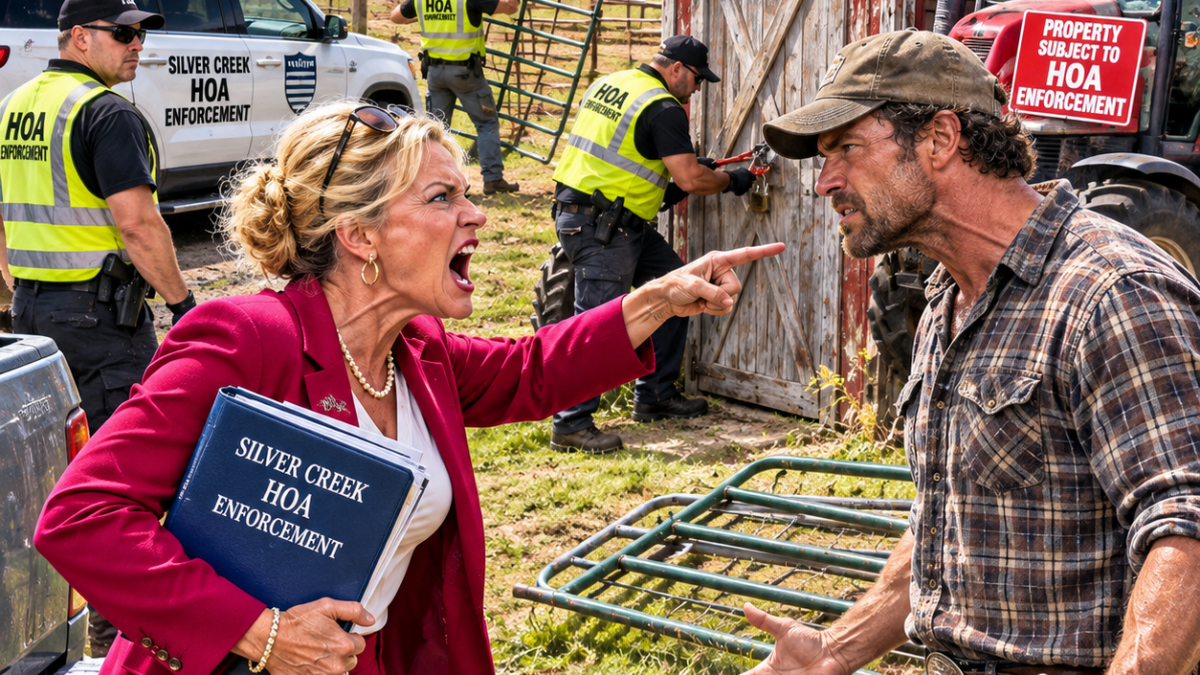
**“CUT THE LOCK, REMOVE THE FENCE, AND TAKE ANYTHING THAT DOESN’T MEET SILVER CREEK STANDARDS—HE HAD HIS CHANCE TO JOIN!” HOA president Linda Crawford shouted as her so-called officers spread across my ranch.**
**I had never joined her HOA, yet they smashed my gate, forced open my equipment shed, tagged my tractor, removed fence panels, and hauled away my two horses while I was still driving home from work.**
**Then a deputy opened one of their SUVs and found a folder labeled REED RANCH INTEGRATION—with a step-by-step plan showing that the raid had never really been about my red barn, my cattle, or “community safety.”**
The first thing I saw when I turned onto Reed Ranch was my front gate lying flat in the dirt.
The second was a white SUV parked beside the barn with SILVER CREEK HOA ENFORCEMENT printed across both doors.
Three men in black shirts and yellow reflective vests were already inside my property.
One was cutting the lock off my equipment shed.
Another had removed two metal fence panels from the cattle pen and dragged them onto the grass.
The third was sticking a bright red notice onto the hood of my tractor.
PROPERTY SUBJECT TO HOA ENFORCEMENT.
Then Linda Crawford stepped out from behind the second SUV.
She pointed toward my farmhouse.
“Check the porch storage too. Anything violating community standards gets removed.”
I slammed the truck into park.
“What the hell are you doing?”
One of the men turned toward me and held up his hand as though I were approaching a police line.
“Sir, stop where you are.”
I stared at him.
“This is my ranch.”
He said Silver Creek had issued an emergency compliance action because I had repeatedly refused to cooperate with community safety requirements.
Community safety requirements.
On eighty acres Silver Creek had never owned.
Linda walked toward me holding a thick blue folder.
“You had plenty of opportunities to handle this voluntarily, Jonathan.”
“Voluntarily?”
“You refused every membership offer.”
“Because I’m not joining your HOA.”
“That decision has consequences.”
Behind her, a pry bar hit my barn door.
Wood cracked.
Every instinct in me said run over there and physically stop them.
Then I noticed the east paddock.
The gate was open.
Empty.
My stomach dropped.
“Where are my horses?”
Linda glanced toward the field.
“They were relocated.”
For a second, I thought I had heard her wrong.
“Relocated where?”
“For safety.”
I ran toward the paddock.
Ranger and Molly were gone.
So was my livestock trailer.
Fresh tire tracks crossed the grass and disappeared toward the back road.
I pulled out my phone and called 911.
Linda laughed.
PART2:
“The sheriff will understand once they see the order.”
I looked at her.
“You better hope so.”
My name is Jonathan Reed.
Reed Ranch had belonged to my family for forty-seven years.
My grandfather, George Reed, bought the original sixty acres outside a small Colorado town when most of the area was still open country.
Dad later bought another twenty acres from a retiring neighbor.
By the time the ranch became mine, it covered eighty acres.
Pasture.
Ponderosa pine.
Creek.
Two barns.
Old farmhouse.
Equipment shed.
Enough open sky to make almost any bad day feel smaller.
I was thirty-nine when Dad died.
I worked as a heavy-equipment mechanic in town but spent most of my free time at the ranch.
Twelve cattle.
Two horses.
Ranger and Molly.
And a brown goat named Peanut who believed every bucket, fence latch, and open truck door had been created personally for him.
The place was not glamorous.
That was part of why I loved it.
The red barn needed paint every few years.
The gravel driveway became mud during spring snowmelt.
The old house creaked in winter.
But I knew every corner of it.
Every post.
Every gate.
Every tree Dad had planted.
Silver Creek Estates appeared beside us about eight years earlier.
Started with fifty homes.
Then another developer added almost seventy more.
Soon there was a pool, clubhouse, tennis courts, walking trails, landscaped entrances, and an HOA board that seemed capable of creating a rule for nearly anything visible from a street.
Dad never had a problem with the subdivision.
“People need homes,” he used to say.
“As long as they stay on theirs, we stay on ours.”
Most residents understood.
William Parker lived in the closest Silver Creek house.
Retired firefighter.
Good man.
His wife Susan bought eggs from me every Saturday.
Their twelve-year-old grandson Noah loved Ranger and showed up with carrots whenever he visited.
During a winter storm, Silver Creek residents helped clear branches from the county road.
Those people mattered later.
Because when the HOA conflict became ugly, I kept reminding myself:
Silver Creek was not Linda Crawford.
Linda was one person.
The neighborhood had a hundred families.
The trouble started the first spring after Linda became president.
I was fixing a leaking water trough when her black SUV stopped outside the gate.
She wore sunglasses and carried a blue folder.
She introduced herself politely.
Then said Silver Creek was entering “a new phase of community integration.”
I asked what that had to do with me.
She looked across the ranch.
Silver Creek now bordered me on the north and east.
The HOA wanted better visual consistency.
She pointed.
Wood fence.
Red barn.
Equipment shed.
Livestock trailer.
Even my mailbox.
Then she asked whether I had considered joining Silver Creek voluntarily.
I thought she was joking.
“Joining?”
“Neighboring parcels are being offered the opportunity.”
“What would I get?”
“Pool access. Clubhouse privileges. Neighborhood security. Trash service. Architectural support.”
I looked behind me at eighty acres.
“I think I’m good.”
Her smile tightened.
“Association membership can help protect property values.”
“My father protected the value just fine for forty years.”
She handed me a membership packet anyway.
VOLUNTARY ASSOCIATION AGREEMENT.
I tossed it in the truck.
Never signed it.
Two weeks later, another came by certified mail.
Then another.
Six months free dues.
No.
One year free.
Still no.
Then Linda called.
She said some board members were concerned Reed Ranch had become an “unmanaged island” inside Silver Creek’s growing development area.
I reminded her that the ranch had existed decades before the HOA.
“Things change,” she said.
“Property lines don’t change because you want them to.”
That ended the call.
Then came the first violation.
My barn was an unapproved color.
Red.
Same color since 1989.
Thirty days to repaint.
Otherwise:
$100 per day.
I laughed hard enough to show it to William.
He did not laugh.
“They can’t fine you.”
“I know.”
“She’s been talking about integrating adjacent land.”
Integrating.
A soft word for taking control.
I returned the violation with a deed copy.
Across the top:
REED RANCH IS NOT PART OF SILVER CREEK HOA.
Three days later:
Unapproved livestock.
Then:
Visible tractor.
Then:
Fence height.
Then:
Gravel driveway not meeting paving standards.
I saved everything.
Dad taught me that.
“Arguments disappear,” he said. “Paper stays.”
So I made a folder.
Every letter.
Every envelope.
Every email.
Every membership offer.
Then Silver Creek mailed me an invoice.
$4,800.
Unpaid dues.
Late fees.
Barn violation.
Livestock violation.
Administrative costs.
And my favorite:
Community compatibility assessment.
I called the management office.
Carol Simmons answered.
I gave her the address.
Long pause.
“That property isn’t showing as an association parcel.”
“Correct.”
She apologized and said she would cancel the account.
The next day Linda called.
Carol apparently had no authority to cancel board-issued assessments.
“How can your board fine somebody who isn’t a member?”
She claimed Silver Creek’s attorney believed Reed Ranch might be subject to certain community rules because of shared infrastructure.
“What shared infrastructure?”
Drainage ditch near my north boundary.
Utility line crossing one corner.
A small gravel lane some residents used during bad weather.
None of that created HOA membership.
I told her so.
Then she said:
“You can either join cooperatively or this becomes more expensive.”
I wrote those words down immediately.
That was when I hired Rebecca Lawson.
Rebecca had handled ranch and real-estate disputes for almost twenty years.
She reviewed my deed.
County maps.
Silver Creek declaration.
Notices.
Then:
“You’re not in their HOA.”
“I know.”
“No recorded covenant.”
“I know.”
“No membership agreement.”
“No.”
“No declaration covering Reed Ranch.”
“Exactly.”
She smiled.
“Then we tell them to stop.”
Formal letter.
Withdraw fines.
Stop enforcement.
Stop representing Reed Ranch as HOA property.
For almost a month, everything went quiet.
I repaired fences.
Noah brushed Ranger.
William brought me an old toolbox.
Susan baked peach pie.
Those weeks reminded me why I did not want a neighborhood war.
Then an HOA compliance officer appeared.
Gary Thompson.
Yellow vest.
Tablet.
He asked to inspect Reed Ranch.
“No.”
“Linda authorized it.”
“Linda can authorize inspection inside Silver Creek.”
Gary was polite.
He left.
The next week, two others came.
I refused again.
Then Silver Creek started photographing the ranch from public roads.
Annoying.
But if they stayed on public ground, fine.
Then I woke one morning and found a red sticker on my cattle trailer.
SILVER CREEK HOA FINAL WARNING.
Someone had crossed the gate overnight.
My security camera had been unplugged.
I filed a sheriff report.
No clear image of who entered.
But the sticker proved somebody had.
Rebecca sent another warning.
Linda denied knowledge.
Then my gate lock disappeared.
Not broken.
Gone.
I replaced it.
Three days later, scratches surrounded the keyhole.
Someone had tried opening the new one.
I installed another camera high in a tree.
That camera caught an HOA SUV stopping outside at 2:13 A.M.
It stayed twelve minutes.
Nobody visible getting out.
Rebecca told me:
“Keep recording.”
Then Silver Creek held a meeting about “ranch compatibility.”
William attended.
Afterward, he came straight over.
Linda told residents Reed Ranch created safety hazards.
Loose animals.
Old fencing.
Heavy equipment.
Drainage.
Multiple complaints.
William asked who complained.
Linda refused to say.
Then she announced Silver Creek was reviewing legal options to bring Reed Ranch into compliance.
That phrase bothered me.
Then William told me something else.
A new development was being planned west of my ranch.
Rebecca searched county records.
Westbrook Residential.
Forty-eight proposed homes.
And the cheapest connection between existing Silver Creek and the new development?
Across the northern edge of Reed Ranch.
Along an old tractor lane Dad had used for thirty years.
Rebecca pointed at the plan.
“Now I understand why they want you inside the HOA.”
If I joined, Silver Creek gained leverage.
Rules.
Internal planning pressure.
Possible road negotiations inside the association.
If I stayed outside?
They needed permission.
And I had no reason to give it.
We did not accuse Linda yet.
Facts first.
Then the pressure increased.
Public safety emergency notice.
Fence inspection demand.
Historic access claim.
Historic.
Silver Creek was younger than my horse trailer.
Then came the Thursday raid.
I left for work before sunrise.
At 10:43 my phone buzzed.
Front gate camera.
Two Silver Creek SUVs.
White pickup.
Five people.
Linda.
Gary.
A man holding bolt cutters.
I called Rebecca.
She said:
“Call the sheriff. Save every video. Don’t drive like a maniac.”
I watched the chain fall.
Gate open.
Vehicles enter.
Linda pointed toward the barn.
Two officers moved there.
Another headed toward the equipment shed.
Gary hesitated.
Linda said something.
He followed.
Then another alert.
Horse paddock.
One man opened the gate.
Another backed my livestock trailer toward the fence.
I called 911 again.
“My horses are in there.”
By the time I reached the ranch, my gate was destroyed.
Barn damaged.
Shed lock cut.
Tractor tagged.
Fence removed.
And Ranger and Molly gone.
Linda said they were conducting emergency HOA compliance.
I demanded a court order.
She raised the folder.
“We have one.”
One of her men had already broken my shed lock.
Another removed fence panels because they supposedly violated Silver Creek standards.
Then Linda said:
“This is what happens when people refuse to cooperate with their community.”
I stepped toward her.
Then stopped.
That was exactly what I could not do.
If I shouted.
Threatened.
Touched anyone.
She would have a new story.
So I backed away.
Recorded.
Waited.
Sheriff vehicles arrived within minutes.
Deputy Michael Grant took control.
Separated everyone.
Asked Linda for authority.
She gave him:
EMERGENCY PROPERTY COMPLIANCE AND ANIMAL SAFETY ORDER.
My name.
Reed Ranch.
Court case number.
Judge signature.
It looked real.
That scared me.
Maybe she had filed something without my knowledge.
Maybe I had underestimated how far this had gone.
Grant read it.
Then again.
Called his supervisor.
Then asked about the horses.
Linda finally admitted:
Silver Creek maintenance yard.
A deputy headed there.
Then another deputy shouted from behind an HOA SUV.
Inside the rear hatch:
Bolt cutters.
My broken gate chain.
Red enforcement stickers.
Pry bar.
And a large black folder.
REED RANCH INTEGRATION.
Grant opened it carefully.
Photographs of everything.
Farmhouse.
Barn.
Tractor.
Animals.
Gate.
Then maps.
Westbrook development west of me.
Silver Creek east.
Reed Ranch in the middle.
Thick red line across the northern pasture.
PROPOSED COMMUNITY CONNECTOR.
Rebecca arrived as Grant reached the next page.
PHASE ONE — OWNER PRESSURE.
Numbered steps.
Voluntary membership offers.
Compliance notices.
Financial penalties.
Safety complaints.
Property inspections.
Emergency entry if owner remains non-compliant.
I looked at Linda.
She was no longer smiling.
Then the final line:
ONCE RANCH CONTROL IS ESTABLISHED, BEGIN CORRIDOR PREPARATION IMMEDIATELY.
This had never been about barn color.
Then I heard a bulldozer.
Northern pasture.
Rebecca looked at me.
“Do you have contractors today?”
“No.”
We ran toward the north fence.
Yellow bulldozer already inside.
Two excavators.
One section of fence down.
Trees marked with orange paint.
Wood stakes stretching across Dad’s old farm lane.
They had launched two operations.
The HOA enforcement team at the house.
Construction crew at the northern pasture.
While everybody dealt with Linda, they were starting the road.
Deputy Grant ran toward the bulldozer.
“Shut it down!”
The operator raised the blade.
Excavators went quiet.
Supervisor introduced himself.
Dennis Cole.
Mountain West Excavation.
He looked confused.
Not nervous.
His company had been hired to prepare a temporary emergency corridor connecting Silver Creek to the future Westbrook site.
His paperwork said the HOA already controlled the northern farm lane.
Rebecca asked to see it.
Same emergency order.
But Dennis’s packet had an extra page.
Safety stabilization.
Access preparation.
Emergency corridor improvement.
Not just inspection.
Construction.
Grant asked whether Mountain West verified the court order independently.
Dennis admitted they relied on Silver Creek’s legal and management office.
The second Grant said ownership was disputed, Dennis stopped everything.
That mattered.
He made an error.
But he did not choose to keep digging after learning the truth.
Rebecca compared the two supposed orders.
Linda’s copy covered animal safety.
Dennis’s added road authority.
She asked Grant to verify the case number.
Linda objected immediately.
Said every minute of delay cost Silver Creek money.
Grant ignored her.
Ten minutes later, he returned.
The case number was real.
Silver Creek had filed a petition two days earlier.
But there was no court order.
Only a request for a hearing about alleged animal and property safety concerns.
No forced entry.
No animal removal.
No construction.
No road.
No authority to break my gate.
Linda claimed the online docket might be delayed.
Rebecca asked for a certified copy.
None.
Then:
“Which attorney got this for you?”
Linda hesitated.
Charles Benton.
Rebecca knew the firm.
Called him.
Speakerphone.
“Did your office obtain an emergency order authorizing entry onto Reed Ranch?”
“No.”
Instant.
Charles explained Silver Creek had asked about a county inspection hearing.
Nothing more.
His office never sought possession.
Forced entry.
Animal seizure.
Road work.
He had never seen Linda’s document.
Rebecca looked at her.
“Where did this come from?”
Linda suddenly did not know.
That answer looked terrible while her officers were standing beside a broken gate holding pry bars and fake enforcement stickers.
Grant documented everything.
He did not immediately arrest everybody.
That mattered.
Names.
Photos.
Statements.
Damage.
Vehicles.
Then word came from the maintenance yard.
Ranger and Molly were safe.
Water.
Temporary pens.
No injuries.
A maintenance supervisor said he had been told the horses came from unsafe private property under emergency authority.
A deputy brought them back.
Molly came off the trailer quickly and pressed into me.
I held her neck longer than I care to admit.
For a few minutes, nothing else mattered.
The horses were alive.
No injuries.
No road.
No Linda.
Just Molly breathing against my shoulder.
William and Noah arrived later.
Noah stood quietly beside Molly until she calmed.
That boy from Silver Creek cared more about my horses than the HOA president who claimed she was protecting them.
Dennis moved his equipment off Reed Ranch.
He gave Rebecca every email Mountain West received.
One from Linda:
SATURDAY ACCESS CONFIRMED. OWNER RESISTANCE EXPECTED. BEGIN NORTH CORRIDOR IMMEDIATELY AFTER COMPLIANCE TEAM SECURES PROPERTY.
Secures property.
Exactly what happened.
The raid was coordinated.
Still, Rebecca reminded me:
“We know what happened. We don’t yet know who created every fake document.”
Fair.
Gary Thompson stayed behind voluntarily.
The compliance officer who had once politely left after I refused inspection.
He looked miserable.
“I didn’t know about the bulldozers.”
He said Linda told them a court had approved an emergency welfare inspection.
Rebecca asked about the removed fence.
“Anything marked red was supposedly approved for correction.”
Then Gary added:
“There was supposed to be a membership packet.”
I froze.
“What?”
Once Reed Ranch had been “secured,” someone was supposed to place another Silver Creek membership agreement on my kitchen table.
“Inside the house?”
Gary shook his head.
“I wasn’t going inside. Linda said she had people for that.”
Then he explained the plan.
After the raid, I would get two options.
Sign the HOA membership agreement.
Silver Creek handles repairs.
Or refuse.
Continued fines.
Inspections.
Legal costs.
Pressure.
Break my property.
Take my animals.
Start the road.
Then offer me a way to make it stop:
Join.
Rebecca asked who trained the team.
Frontier Community Services.
Registered owner:
Patrick Crawford.
Linda’s brother-in-law.
Another family connection.
Six weeks old as a vendor.
Specialty:
“Difficult integration properties.”
Properties.
Plural.
Monday, Rebecca and I pulled the actual court file.
Silver Creek’s petition was minor compared with what Linda did.
Alleged loose cattle.
Unsafe fencing.
Hazardous farm equipment.
They requested a county inspection.
That was all.
Then we read the complaints.
William Parker’s name on one.
Susan Parker’s on another.
I called William.
He was stunned.
“I never complained about your cattle.”
Susan denied hers too.
Resident names had apparently been attached to complaints they never made.
Silver Creek’s emergency meeting came next.
Clubhouse packed.
Robert Hayes, a board member, opened with:
“Silver Creek HOA does not own Reed Ranch.”
Silence.
Then:
“The board never voted to authorize forced entry.”
Never approved animal removal.
Never approved road construction.
Never approved breaking gates.
Linda claimed she had emergency authority.
Robert asked for the resolution.
Nothing.
Treasurer revealed Silver Creek had paid Frontier $42,000 over four months.
Integration planning.
Compliance escalation.
Corridor preparation.
Board approved general legal spending.
Not those specific projects.
Then:
Westbrook Residential had paid Silver Creek a $75,000 infrastructure coordination deposit.
Residents started shouting.
Thomas Bradley from the planning committee stood.
Westbrook promised another payment if the connector opened.
“How much?”
“Six hundred thousand.”
Room went silent.
$600,000 if Silver Creek secured a direct route between the existing neighborhood and Westbrook’s future homes.
Across Reed Ranch.
Now Linda’s pressure had a price.
If I joined the HOA, controlling the northern road became much easier.
If I stayed outside, they needed my permission.
I kept saying no.
The board suspended Linda.
Five to one.
She voted for herself.
Frontier suspended too.
All Reed Ranch enforcement stopped.
I should have felt safe.
Rebecca did not.
“People under financial deadlines do stupid things.”
That night I checked every camera.
Every gate.
Animals.
Then at 2:06 A.M., six camera alerts hit at once.
Front gate.
Barn.
North pasture.
Equipment shed.
Creek road.
Farmhouse porch.
I opened the feeds.
Black.
Every camera disabled.
Then diesel engines.
Headlights across the northern field.
Flatbed truck.
Tow truck.
Portable work lights.
Three men jumped out.
One chained my tractor.
Another headed toward the livestock trailer.
I called 911.
Deputy Grant called me directly.
“Stay inside.”
Then glass shattered downstairs.
I froze.
A flashlight moved across the porch.
Side door window broken.
Handle turned.
A man entered.
Then shouted:
“Get the property files first.”
And from outside, Linda’s voice:
“They’re in the office.”
My blood ran cold.
They knew exactly where Dad’s records were kept.
Deeds.
Surveys.
Tax documents.
Old contracts.
Northern-access files.
Grant told me not to move.
Boots on kitchen floor.
Drawer.
Hall.
Office door.
Metal scraping.
Someone forcing the cabinet.
Outside, the tow operator chained my tractor.
Another man stood near the northern pasture.
Everything timed.
Then sirens.
Instant silence.
Then running.
Sheriff cruisers flooded the yard.
One tow truck tried reversing.
A deputy blocked it.
The man inside my house ran toward the equipment shed.
Another deputy came around the barn.
Hands up.
Raid collapsed in under a minute.
Grant cleared the house.
Then walked upstairs.
“You okay?”
“Yeah.”
I was shaking.
But okay.
Downstairs looked destroyed.
Office drawers forced.
Papers everywhere.
Bent file-cabinet handle.
Mud across Dad’s rug.
Blue folder near the kitchen.
Grant picked it up with gloves.
Northern survey.
Old farm lane map.
Rebecca’s letters.
They knew exactly what they wanted.
Tow crew supervisor Kyle Bennett said his company had been hired for overnight emergency asset recovery.
By Frontier.
Work order said Silver Creek had temporary management authority over Reed Ranch.
Remove unsafe equipment.
Store securely.
List:
Tractor.
Livestock trailer.
Utility trailer.
Generator.
Farm equipment.
Everything useful.
Everything expensive.
Rebecca arrived before dawn.
Grant showed her another paper.
EMERGENCY PROPERTY MANAGEMENT CONSENT.
My name.
My signature.
I supposedly gave Silver Creek authority over equipment, records, and buildings.
“I never signed that.”
Then deputies found the schedule.
2:00 A.M. — Disable exterior cameras.
2:10 — Enter residence and recover north corridor documentation.
2:20 — Remove movable farm equipment.
2:45 — Secure equipment shed.
3:00 — Begin corridor clearing.
Not spontaneous.
Step-by-step operation.
Kyle said construction crews were supposed to arrive at three.
They had been told the ranch would be “clear.”
Clear of my equipment.
Clear of my documents.
Clear of me.
The man deputies caught inside my house was Aaron Price.
Frontier field operations supervisor.
He had broken the window.
Entered without permission.
And was carrying my records when deputies arrived.
That part did not require much interpretation.
The tow crew was not arrested then.
Evidence suggested they had been deceived by paperwork.
Again, the distinction mattered.
Not everyone standing beside a tow truck had designed the plan.
But Aaron broke into my house.
After sunrise, the ranch looked exhausted.
Broken window.
Cut camera wires.
Tire tracks.
Half-attached chains.
William and Noah showed up with coffee and breakfast sandwiches.
Noah stared at the window.
“Did somebody really come inside?”
“Yeah.”
“That’s not fair.”
No.
It was not.
He helped sweep glass while William covered the window with plywood.
That morning, Rebecca sent the fake consent to a forensic examiner.
Dr. Karen Lewis.
Result:
My signature was not handwritten on that document.
It had been copied as an image.
Scaled.
Placed.
Where did they get it?
Carol Simmons had the answer.
The management employee who had once told me Reed Ranch was not an HOA parcel.
She met us privately.
Months earlier, Linda ordered the office to create a digital owner profile for Reed Ranch.
Carol objected.
Linda said it was for annexation planning.
The profile contained complaints.
Photos.
Property information.
Scanned correspondence.
Then Linda specifically requested the certified-mail receipt from one of the original HOA packets.
My signature.
Twice.
Once six months before.
Again three weeks before the raid.
Carol saved system logs before resigning.
Dr. Lewis compared the receipt signature to the fake consent.
Exact match.
Same pen stroke.
Same tiny break.
Same upward angle.
Someone had taken my real signature from Silver Creek records and created fake authority over my ranch.
At the next HOA meeting, residents were furious before it began.
They knew someone broke into my house.
They knew equipment had nearly been taken.
They knew my signature was copied.
Robert apologized publicly.
Then the audit.
Frontier had not received $42,000.
Total over nine months:
Nearly $118,000.
INTEGRATION CONSULTING.
COMPLIANCE OPERATIONS.
EMERGENCY ACCESS PREPARATION.
OWNER RESISTANCE MANAGEMENT.
That phrase made people gasp.
Then the $600,000 Westbrook payment.
And another contract.
Frontier would receive $90,000 completion bonus if the road opened before quarter end.
Patrick benefited directly.
Then one more.
Linda herself had signed a private consulting agreement with Westbrook.
$45,000 advisory payment if the expansion reached final approval.
There it was.
Not just ideology.
Money.
Charles Benton, Silver Creek’s own attorney, stood.
He reviewed every document.
Emergency order:
Fake.
Emergency consent:
Copied signature.
Animal complaints:
Questionable.
Some names attached without consent.
His firm never approved:
Forced entry.
Animal seizure.
Road construction.
Night recovery.
Then:
“Silver Creek HOA had no legal authority to conduct either operation on Reed Ranch.”
That sentence was what I had been waiting months to hear.
No authority.
No jurisdiction.
No membership.
No right to enter.
No right to take.
No right to damage.
The board removed Linda permanently.
Six to zero.
Frontier terminated.
Every fine erased.
Fake account deleted.
Reed Ranch formally acknowledged as outside Silver Creek.
Then Robert told us the Westbrook contract deadline.
Ten days.
If the road was not secured, the deal could fail.
The panic made sense.
First raid failed.
Second raid failed.
Ten days remained.
I moved original documents into a bank safe-deposit box.
Installed hidden battery cameras.
For several days:
Nothing.
Then investigators uncovered Frontier’s full strategy.
REED RANCH CONTROL STRATEGY.
Phase One:
Voluntary membership pressure.
Phase Two:
Compliance penalties and safety complaints.
Phase Three:
Emergency property intervention.
Phase Four:
Corridor establishment.
First three complete.
Phase Four:
CREATE PHYSICAL ROADWAY USE BEFORE FINAL LEGAL CHALLENGE.
That line explained the bulldozers.
They did not need permanent legal victory before building.
They needed the road physically open.
Trucks crossing.
Residents using it.
Construction traffic relying on it.
Then reversing the situation became harder.
Patrick emailed Linda:
EVEN ONE WEEK OF OPEN CORRIDOR GIVES WESTBROOK RELIANCE ARGUMENT.
Linda:
THEN GET IT OPEN.
The sheriff searched Frontier’s office and Patrick’s home.
Patrick eventually admitted the fake emergency order had been assembled from a real court filing.
He admitted raid teams were told Reed Ranch was under temporary control.
Admitted the overnight recovery operation.
Then blamed Linda for the overall strategy.
Her attorney blamed him.
Predictable.
Investigators had enough to begin serious legal action.
I thought we had reached the worst.
Five days before Westbrook’s deadline, I woke before sunrise smelling smoke.
Ranger was kicking his stall door.
I ran outside.
Northern pasture glowing orange.
Fire.
Flames moving through dry grass near the exact corridor line.
I called 911.
Moved Ranger and Molly south.
Cattle already in the west pasture.
Peanut screamed like the world was ending.
For once, he had a point.
Volunteer firefighters arrived.
Then county crews.
Wind stayed light.
That saved us.
No animals hurt.
Barn safe.
House safe.
But by sunrise almost six acres were black.
Rebecca stood beside me.
“Natural?”
“I don’t know.”
That answer mattered.
I had learned not to turn suspicion into fact.
Fire marshal began working.
Then a firefighter found a partially melted fuel container.
Another near the lane.
Then another.
Three separate points.
Near one:
Metal key tag.
FRONTIER COMMUNITY SERVICES
UNIT 7.
Sheriff Grant warned us.
Could be lost.
Stolen.
Planted.
Old.
Evidence needed context.
Then tire tracks.
Utility vehicle.
Could be Frontier.
Could be farmer.
Could be contractor.
Still not enough.
Then one of my hidden cameras saved everything.
Birdhouse camera.
Whoever disabled the visible system did not know about it.
3:46 A.M.
Dark utility vehicle entered.
3:51.
Hooded person walked toward first fire point.
3:58.
Returned.
Then second person appeared.
Partial white logo on vehicle.
FRONT…
Vehicle left at 4:07.
First flame visible 4:11.
Frontier records identified Unit 7.
Small black utility vehicle.
Assigned to Aaron Price.
Same man caught inside my farmhouse.
Aaron initially denied being there.
Then saw the footage.
Changed his story.
Somebody else had taken the vehicle.
Was it stolen?
No.
Reported missing?
No.
Who had spare key?
He stopped answering.
Two days later, he asked for another interview.
This time he cooperated.
Patrick called him the night before.
Deadline five days away.
Connector needed “cleared and visible.”
Aaron claimed he first believed Patrick meant brush work.
Then Patrick handed him gasoline cans.
He knew what that meant.
He should have refused.
He did not.
Another Frontier employee drove.
Aaron walked the route.
Fuel in three sections.
Fires started.
He dropped the Unit 7 key tag.
Then the question:
Did Linda know?
Aaron did not know for certain.
That mattered.
No guess.
No exaggeration.
Then investigators recovered messages.
Patrick:
LAST OPTION TOMORROW. NEED CORRIDOR PHYSICALLY USABLE BEFORE DEADLINE.
Linda:
DO WHAT YOU HAVE TO DO. I CANNOT LOSE THIS DEAL NOW.
Bad.
But not specific.
Then three hours later:
Patrick:
NORTH FIELD WILL BE CLEAR BY SUNRISE.
Linda:
MAKE SURE NOTHING REACHES THE BARNS. I ONLY NEED THE ROAD AREA.
I felt cold reading that.
There was no innocent explanation for discussing keeping something away from the barns while the northern field was being “cleared” before sunrise.
Patrick was arrested.
Aaron’s cooperation did not erase what he did.
But prosecutors considered it.
Linda was arrested after investigators tied her communications, financial interests, raid instructions, fake documents, and the wider pressure campaign together.
The fire was only the final escalation.
Before it came:
Fake violations.
Fake fines.
False safety complaints.
Copied signature.
Fake court order.
Illegal daytime raid.
Horse removal.
Road construction.
Night break-in.
Attempted equipment seizure.
Record theft.
Then fire.
All because somebody refused to accept one word.
No.
The Westbrook deadline arrived two days after Patrick’s arrest.
No connector road.
No signed HOA membership.
No lawful access.
Westbrook withdrew from the deal.
Silver Creek lost the promised $600,000.
Patrick lost the $90,000 bonus.
Linda lost her $45,000 advisory payment.
The scheme failed for a simple reason.
They never owned what they were trying to control.
Westbrook eventually redesigned.
Different entrance.
More expensive.
Fewer homes.
No Reed Ranch access.
Fine.
Build on land you own.
Use roads you control.
Pay your own infrastructure costs.
That was all I had asked.
The civil settlement came months later.
Rebecca insisted on clarity.
Silver Creek formally acknowledged:
Reed Ranch had never been part of the HOA.
Not partially.
Not historically.
Not through shared infrastructure.
Never.
Every fine canceled.
Every fake account deleted.
Every enforcement notice withdrawn.
Unauthorized photos removed from active compliance systems.
No officer, volunteer, contractor, board member, employee, or vendor could enter Reed Ranch without my permission except for a real emergency recognized by law.
Northern farm lane remained mine.
Connector removed from planning maps.
Silver Creek paid for:
Gate.
Fence.
Barn door.
Equipment shed.
Farmhouse window.
Camera system.
Pasture restoration.
Other property damage.
Insurance handled most of it.
Then the horses.
Silver Creek formally admitted there had been no valid authority to take Ranger or Molly.
That apology mattered more than the money.
The board changed its rules.
No enforcement files on outside property without independent legal review.
No family-connected vendor contracts without disclosure and vote.
No emergency spending for acquisition or enforcement without multiple approvals.
Every future expansion project had to disclose financial beneficiaries.
Robert told residents:
“We never want another Reed Ranch.”
Good.
That is what mistakes should do.
Teach.
Change policy.
Not just produce apologies.
The criminal cases took longer.
Patrick faced allegations involving false documents, unlawful entry, attempted equipment removal, and the fire.
Aaron faced consequences for the break-in and fire.
His cooperation affected his case.
Linda faced her own charges tied to the documents, raids, property damage, conflicts of interest, and broader strategy.
I attended one hearing.
Enough.
Linda looked smaller in a courtroom.
No blue folder.
No HOA officers.
No enforcement stickers.
No contractors.
Just another person inside the same legal system she had once pretended was already on her side.
She looked at me once.
I did not smile.
Did not glare.
Just looked back.
By then, the reason she wanted my ranch no longer mattered.
The presidency was gone.
Frontier was gone.
Road deal gone.
Westbrook had another route.
Reed Ranch remained independent.
The northern pasture needed a full season.
Grass returned slowly.
Some trees never recovered.
Fence posts replaced.
One afternoon Noah arrived with a bag of seed he bought himself.
“I want to help fix the black part.”
My first instinct was to tell him to keep his money.
Then I understood.
He wanted to contribute.
So we spread seed together.
He asked:
“Why did Linda hate the ranch?”
I thought.
“I don’t think she hated it.”
“Then why break things?”
“Because she wanted something the ranch was stopping her from getting.”
He frowned.
“That’s worse.”
Maybe.
Hatred admits what it is.
Entitlement can convince people they are being reasonable.
Linda probably told herself the connector helped everybody.
More homes.
More access.
More money.
Higher values.
Maybe she even believed joining the HOA would eventually be good for me.
None of those benefits gave her the right to decide for me.
No was not an attack.
It was an answer.
Silver Creek invited me to a fall picnic months later.
I almost declined.
Susan called.
Noah planned to enter a pie-eating contest.
That sounded worth seeing.
People were awkward.
Some apologized.
Others shook my hand.
I appreciated both.
Most residents had been lied to too.
They did not know Linda had a personal $45,000 payment tied to Westbrook.
Did not know Frontier had a $90,000 bonus.
Did not know horses would be taken.
Did not know contractors would enter my ranch.
Once the truth came out, most residents stood against it.
That mattered.
Gary Thompson found me at the picnic.
He had quit HOA compliance and started working at a building supply store.
“I learned something.”
“What?”
“I thought having an HOA title meant I had more authority than I actually did.”
I nodded.
“Titles don’t move property lines.”
He laughed.
“Apparently not.”
We shook hands.
That was enough.
One year after the first raid, I replaced the temporary front gate with steel.
I kept part of the broken original behind the barn.
Not as an anger trophy.
A reminder.
New sign:
REED RANCH
PRIVATE PROPERTY
PLEASE ASK BEFORE ENTERING.
No threat.
No legal paragraph.
No mention of Silver Creek.
Just a boundary.
Noah helped tighten the last bolt.
William stood nearby drinking coffee.
He looked at the sign.
“That should’ve been enough the first time.”
“It was.”
“They just didn’t like the answer.”
Exactly.
Linda first came to Reed Ranch carrying a voluntary HOA membership packet.
I said no.
That should have ended it.
Instead, my refusal became a challenge she believed she needed to defeat.
Membership offers became violations.
Violations became fines.
Fines became safety complaints.
Safety complaints became inspection attempts.
Inspection attempts became copied signatures.
Then HOA officers entered and damaged my ranch because I would not join.
They cut my gate.
Broke the shed.
Removed fencing.
Took my horses.
Started a road.
When that failed, contractors returned at night.
They broke into my home.
Tried to remove equipment.
Tried to take the documents proving the northern lane belonged to me.
When that failed, somebody used fire to clear the corridor before a development deadline.
Every step became larger than the last.
All because certain people could not accept one word.
No.
But what stayed with me most was not Linda.
It was everybody else.
Rebecca telling me to stay calm when anger would have given Linda exactly the story she wanted.
Deputy Grant checking the fake court order instead of assuming a confident HOA president must be telling the truth.
Dennis stopping his bulldozers the second he learned ownership was disputed.
William rebuilding fences.
Susan bringing food.
Noah sitting beside Molly when she was frightened.
Gary admitting he had been wrong.
Carol saving system logs because something felt wrong.
Residents demanding answers when the truth came out.
Those people reminded me that one bad leader does not make an entire community bad.
It would have been easy for me to hate Silver Creek.
Easy to close every gate forever.
Easy to treat every neighbor with suspicion.
But if I did that, Linda still would have changed Reed Ranch.
Just in a different way.
So the next winter, when a storm blocked Silver Creek’s main entrance, Robert called.
“Jonathan, emergency crews may need to cross one edge of your property.”
I said yes.
Not because Silver Creek had rights.
Because somebody needed help.
That was my choice.
Permission given freely is kindness.
Permission taken by force is control.
Those are not the same thing.
Today, the northern pasture is green again.
Ranger and Molly still run toward the fence when they hear my truck.
Peanut still thinks every bucket belongs to him.
The barn is still red.
The driveway is still gravel.
The tractor is still visible from the road.
Every ridiculous thing Linda once cited remains exactly where it was.
And Reed Ranch is still not part of Silver Creek HOA.
Sometimes I stand at the new gate and remember that Saturday morning.
HOA vehicles inside.
Fake officers.
Broken locks.
Horses gone.
Bulldozers in the northern field.
Official-looking papers everywhere.
For a few minutes, it looked like they had all the power.
But real ownership does not disappear because somebody carries a folder.
A fake court order does not become real because contractors believe it.
An HOA cannot create jurisdiction over private property simply because the owner refuses membership.
And no amount of paperwork changes the meaning of a locked gate.
Ask first.
Respect the answer.
And if the answer is no, leave the gate exactly where you found it.








